MACHINE SHOP MANAGEMENT (continued 2)
Reading edition
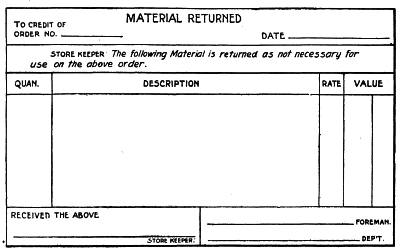
Fig. 25. Returned Material Card.
When the Storekeeper issues the articles, he first enters upon the requisition blank the date issued, and then passes it to his assistant, who notes the issue on the Stock Ledger Card, and then places it on file. The Storekeeper will enter on the invoice the rate and value of the articles issued, and the date of issue, and will sign it under the foreman's signature. He will send it, with the articles issued, to the foreman, who will in turn make it a part of his report of material used.
When the work on an order is completed, such serviceable stock and material as may remain will be returned to the Storekeeper, together with a Returned Material Card of the form shown in Fig. 25. The Storekeeper will enter upon it the value of the material returned, credit it to the department from which it came, and sign the receipt in the lower left-hand corner. The card will then be returned to the foreman as his authority for deducting the amount from the material account in the order in question.
Follow-Up Methods for Tracing Orders in the Shop. The Sub-Production orders having been put into the departments, the first one will order the material for starting the work. For instance, the first step may be upon iron castings. Theoretically all stock and material come from the Store-Room. Therefore we might say that upon a strict construction of this general rule the castings should be furnished by the Foundry and sent to the Store-Room, from which they might be drawn upon requisitions the same as any other material. Practically this would be not only a troublesome but an expensive method, requiring a great deal of unnecessary handling and transportation. The problem is much more practically solved by considering the Foundry as one of the manufacturing departments receiving its raw material (namely, pig iron) through storeroom accounts, and thus "constructively" from the storeroom, while physically it is in the foundry yard. This answers the demands of a theoretical as well as a practical view of the case.
Therefore the first sub-production order will go to the iron foundry, which will make the castings and deliver them to such departments as are required to do the first work upon them, as directed upon the order. The sub-production order which this department has received, directs to what department they shall be sent when completed; and so on, until they have gone through the last department and are sent to the Finished Parts Store-Room.
This arrangement is all right as far as it goes. If every man attended strictly to his business and pushed work along as rapidly as possible, and every foreman sent his work along to the next department as soon as his department had completed its work, this plan might work fairly well. Unfortunately, however, these conditions seldom or never exist; and there must be ways and means devised to keep the work moving and to be able to trace and locate the work upon any order at any time when information is desired upon it or its state of progress.
To accomplish this, there is a Transfer Office, located as conveniently as may be for all departments, and serving as a sort of "clearing house" for all departments in transacting inter-departmental business so far as it relates to the transfer of the work in progress. By this method, departments send all their work by way of the Transfer Office, where proper records are kept of all such transfers, so that at any moment the Transfer Clerk can locate any piece of work in progress in the plant.
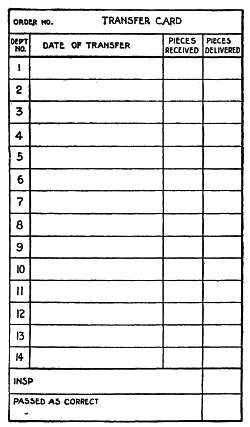
Fig. 26. Transfer Card.
The operation of this method is as follows: The sub-production orders are sent to the Transfer Clerk, who fills out two Transfer Cards, as shown in Fig. 26, one of which he sends with the order to the first department that is to do work on the order, and the other he retains. This card provides spaces for the various departments, which are designated by numbers. Following these are spaces for entering the dates of transfers, the entries being made with a rubber stamp. After these spaces are columns for the number of pieces of work received and the number of pieces delivered.
When the first department has finished its work, the number of pieces is entered in the column headed Pieces Delivered, and the work and the card sent to the Transfer Office. The duplicate transfer card that was retained by the Transfer Clerk was filed in a compartment in a Transfer Case corresponding to the department where the work began. He stamps the date of transfer on both cards, entering the number of pieces on his own, and sends the work on its way to the next department, together with the transfer card. His own card he removes from the compartment representing the first department, and places it in a compartment representing the department to which he has now sent the work.
Subsequent transfers are made in the same manner, small lots of work actually being sent to the Transfer Office, but large lots or heavy and bulky work being sent directly from one department to the next, but under the personal direction of the Transfer Clerk or his assistant.
When the parts are completed and ready for inspection, the Inspector is notified; and upon inspecting the parts previous to their being sent to the Finished Parts Store-Room, he enters the results of his work in the space at the bottom of the card that has accompanied the work in its progress through the departments.
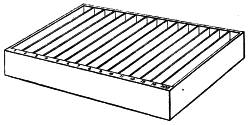
Fig. 27. Transfer Clerk's Card Tray.
The Transfer Clerk's card tray is shown in Fig. 27, and is made with compartments of sufficient dimensions to hold the number of cards expected to be on file in any one department at the same time. The cards are filed in numerical order. In a large concern the usual card-index method of guide cards is used, so as to render the work of finding the right card when wanted, easy and expeditious.
Tool-Room Methods. A large number of small tools such as drills, taps, reamers, and the like, and also numerous jigs and fixtures of various kinds, are drawn daily from the Tool Room and returned there after being used. The problem of keeping track of these valuable tools, of knowing where to locate every tool that has been issued, and getting them back promptly after they have been used, is an important one.
The simplest method of doing this is by the use of small brass checks bearing the individual numbers of the men. For this purpose a Tool Check Board, as shown in Fig. 28, is provided. This is lined off in small square or oblong spaces, the number of spaces equaling or somewhat exceeding the number of men employed in the departments served by the Tool Room. At the top of each of these spaces is the name of one of the men; and beneath the name two pins project about an inch from the face of the board. Under each pin is the man's individual number. Two forms of brass checks are used, a circular disc of ⅞ inch diameter, and a rectangular one ½ inch by 1¼ inches. Each check has a hole by which it may be hung on the pins, and each bears the individual number of the man, the checks being used in pairs of one circular and one rectangular check.
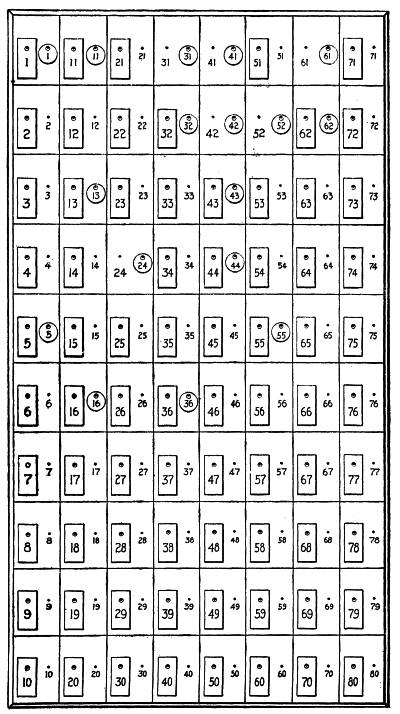
Fig. 28. Tool Check Board.
All tools are kept upon shelves, divided for individual tools or, in some similar manner; and in front of each tool is a pin similar to those on the board, upon which checks may be hung.
The operation of this method is as follows: the circular checks (there are usually twelve of them) are issued to the men of corresponding numbers. The rectangular checks are held upon the left-hand pins under the men's names. When a man goes to the Tool Room for a tool, or sends a boy for one, he presents one of his circular checks. This the Tool Keeper hangs on the right-hand pin under the man's name. He also removes one of the twelve rectangular checks, and hangs it on the pin in front of the space from which the tool was taken. If the workman sends for another tool, another circular check is added to the first one, and another rectangular check removed from the board.
It will be seen that there must always be twelve checks on the board under each name, counting both rectangular and circular ones. The absence of a tool from a shelf is accounted for by the rectangular check hung on the pin in place of it, and the number of this check shows what man has the tool. The number of circular checks on the board shows how many tools each man has in his possession.
The result of this method is that tools can be issued and taken back very rapidly; and accurate and positive records are very quickly made, without the use of a book, card, slip, or writing of any kind.
At the end of the week, all tools are turned in to the Tool Room, thus enabling the Tool Keeper to check them up and rectify any possible errors that may have been made during the preceding week. On Monday morning, such tools as are needed are re-issued.
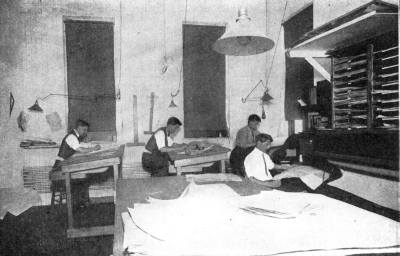
ENGINEERING DEPARTMENT, DOBIE FOUNDRY & MACHINE CO., NIAGARA FALLS, N. Y.