THE MISER’S DAUGHTER
Reading edition
A Tale
By William Harrison Ainsworth
Author Of ‘The Tower Of London’
l842
‘The delineation of such characters as these I consider as very moral instruction to mankind, and a lesson more demonstrative of the perfect vanity of unused wealth, than has lately been presented to the public.’—Topham’s Life of Elwes.
Other and lighter portions of the Tale refer to the adventures of a young man on his first introduction to town life about the middle of the eighteenth century, when Ranelagh was in its zenith, and Vauxhall and Marylebone Gardens in vogue; when the Thames boasted its Folly; and when coffee-houses filled the place of clubs. The descriptions I believe to be tolerably accurate; and they are at all events carefully done, with the view of giving a correct idea of the manners, habits, and pursuits of our great-grandfathers and great-grandmothers. Temptations to pleasurable excess were no doubt sufficiently abundant then.
RANDULPH CREW—THE MISER’S DWELLING IN THE LITTLE SANCTUARY
In a large, crazy, old-fashioned house at the corner of the Little Sanctuary in Westminster, and facing the abbey, dwelt, in the year 1744, a person named Scarve. From his extraordinary penurious habits, he received the appellation of Starve, and was generally denominated by his neighbours ‘Miser Starve.’ Few, if any, of those who thus designated him, knew much about him, none of them being allowed to cross his threshold; but there was an air, even externally, about his dwelling, strongly indicative of his parsimonious character. Most of the windows in the upper stories, which, as is usual with habitations of that date, far overhung the lower, were boarded up; and those not thus closed were so covered with dust and dirt that it was impossible to discern any object through them. Many parts of the building were in a ruinous condition, and, where the dilapidations were not dangerous, were left in that state; but wherever some repairs were absolutely necessary to keep the structure together, they were made in the readiest and cheapest manner. The porch alone preserved its original character. It projected far beyond the door-way, and was ornamented with the arms of a former occupant of the habitation, carved in bold relief in oak, and supported by two mermaids sculptured in the same wood. All the lower windows were strongly grated, and darkened like the upper with long-accumulated dust. The door was kept constantly bolted and barred, even in the daytime; and the whole building had a dingy, dismal, and dungeon-like aspect.
RANDULPH CREW DELIVERING THE PACKET TO MR. SCARVE—THE MISER AND HIS DAUGHTER—-RANDULPH DELIVERS THE PACKET TO THE FORMER
Following his conductor along the passage, the boards of which, being totally destitute of carpet or cloth, sounded hollowly beneath their feet, Randulph Crew glanced at the bare walls, the dusty and cobweb-festooned ceiling, and the staircase, as devoid of covering as the passage, and could not but admit that the account given him by the barber of Mr. Scarve’s miserly habits was not exaggerated. Little time, however, was allowed him for reflection. Jacob marched quickly on, and pushing open a door on the right, ushered him into his master’s presence.
Mr. Scarve was an old man, and looked much older than he really was—being only sixty-five, whereas he appeared like eighty. His frame was pinched as if by self-denial, and preternaturally withered and shrivelled; and there was a thin, haggard, and almost hungry look about his face, extremely painful to contemplate. His features were strongly marked, and sharp, and his eye, grey, keen, and piercing. He was dressed in a thread-bare cloth robe, trimmed with sable, and wore a velvet nightcap, lined with cotton, on his head. The rest of his habiliments were darned and patched in an unseemly manner. Beside him was a small table, on which was laid a ragged and dirty cloth, covered with the remains of his scanty meal, which Randulph’s arrival had interrupted. Part of a stale loaf, a slice of cheese, and a little salt constituted the repast.
Everything in the room bespoke the avaricious character of its owner. The panelled walls were without hangings or decoration of any kind. The room itself, it was evident, had known better days and richer garniture. It was plain, but handsome in its character, and boasted a large and well-carved chimney-piece, and a window filled with stained glass displaying the armorial bearings of the former possessor of the house, though now patched in many places with paper, and stopped up in others with rags. This window was strongly grated, and the bars were secured in their turn by a large padlock, placed inside the room. Over the chimney-piece were placed a couple of large blue and white china bottles, with dried everlasting flowers stuck in the necks. There were only two chairs in the room and a stool. The best chair was appropriated by the miser himself. It was an old-fashioned affair, with great wooden arms, and a hard leathern back, polished like a well-blacked shoe by frequent use. A few coals, carefully piled into a little pyramid, burnt within the bars, as if to show the emptiness of the grate, and diffused a slight gleam, like a mocking laugh, but no sort of heat. Beside it sat Mrs. Clinton, an elderly maiden lady, almost as wintry-looking and pinched as her brother-in-law. This antiquated lady had a long thin neck and a skin as yellow as parchment; but the expression of her countenance, though rather sharp and frosty, was kindly. She wore a close-fitting gown of dark camlet, with short tight sleeves, that by no means concealed the angularities of her figure. Her hair, which was still dark as in her youth, was gathered up closely behind, and surmounted by the small muslin cap then in vogue.
The object, however, that chiefly riveted Randulph’s attention on his entrance was neither the miser himself nor his sister-in-law—it was his daughter. Her beauty was so extraordinary that it acted like a surprise upon him, occasioning a thrill of delight, mingled with a feeling of embarrassment. Rising as he entered the room, she gracefully, and with much natural dignity, returned his salutation, which, through inadvertence, he addressed almost exclusively to her. Hilda Scarve’s age might be guessed at nineteen. She was tall, exquisitely proportioned, with a pale clear complexion, set off by her rich raven tresses, which, totally unrestrained, showered down in a thick cloud over her shoulders. Her eyes were large and dark, luminous, but steady, and indicated firmness of character. Her look was grave and sedate, and there was great determination in her beautifully formed but closely compressed lips. Her aspect and deportment exhibited the most perfect self-command, and whatever effect might be produced upon her by the sudden entrance of the handsome visitor, not a glance was suffered to reveal it, while he, on the contrary, could not repress the admiration excited by her beauty. He was, however, speedily recalled to himself by the miser, who, rapping the table impatiently, exclaimed, in a querulous tone—
‘Your business, sir?—your business?’
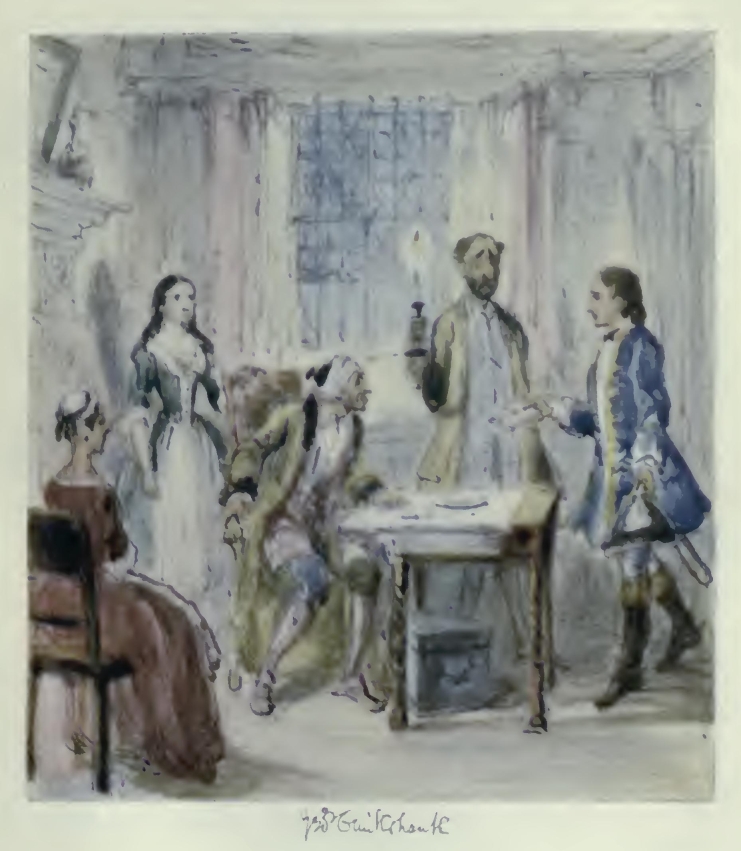

‘I have come to deliver this to you, sir,’ replied Randulph, producing a small packet, and handing it to the miser. ‘I should tell you, sir,’ he added, in a voice of emotion, ‘that it was my father’s wish that this packet should be given to you a year after his death—but not before.’
‘And your father’s name,’ cried the miser, bending eagerly forward, and shading his eyes so as to enable him to see the young man more distinctly, ‘was—was——’
‘The same as my own, Randulph Crew,’ was the reply. ‘Gracious heaven!’ exclaimed the miser, falling back in his chair, ‘and is he dead?—my friend—my old friend!’ and he pressed his hand to his face, as if to hide his emotion.
Hilda bent anxiously over him, and tried to soothe him, but he pushed her gently away.
‘Having discharged my mission, I will now take my leave,’ said Randulph, after a slight pause, during which he looked on in silent astonishment. ‘I will call at some other time, Miss Scarve, to speak to your father respecting the packet.’
‘No, stay!’ cried Hilda hastily. ‘Some old and secret spring of affection has been touched. I entreat you to wait till he recovers. He will be better presently.’
‘He is better now,’ replied the miser, uncovering his face; ‘the fit is past; but it was sharp while it lasted. Randulph Crew,’ he added faintly, and stretching out his thin hand to him, ‘I am glad to see you. Years ago, I knew your father well. But unhappy circumstances separated us, and since then I have seen nothing of him. I fancied him alive, and well, and happy, and your sudden announcement of his death gave me a great shock. Your father was a good man, Randulph—a good man, and a kind one.’
‘He was, indeed, sir,’ rejoined the young man, in a broken voice, the tears starting to his eyes.
‘But somewhat careless in money matters, Randulph—thoughtless and extravagant,’ pursued the miser. ‘Nay, I mean nothing disrespectful to his memory,’ he added, seeing the young man’s colour heighten. ‘His faults were those of an over-generous nature. He was no man’s enemy but his own. He once had a fine property, but I fear he dissipated it.’
‘At all events, he greatly embarrassed it, sir,’ replied Randulph; ‘and I lament to say that the situation of his affairs preyed upon his spirits, and no doubt hastened his end.’
‘I feared it would be so,’ said the miser, shaking his head. ‘But the estates were entailed. They are yours now, and unembarrassed.’
‘They might have been so, sir,’ replied the young man; ‘but I have foregone the advantage I could have taken of my father’s creditors, and have placed the estates in their hands, and for their benefit.’
‘You don’t mean to say you have been guilty of such incredible folly, for I can call it nothing else?’ cried the miser in a sharp and angry tone, and starting to his feet. What! give the estates to the very men who ruined your father! Have you been rash and unadvised enough to break down the barriers the law had built around you for your protection, and let in the enemy into the very heart of the citadel? It is the height of folly—of madness!’
‘Folly or not, sir,’ returned the young man haughtily, ‘I do not repent the step I have taken. Mv first consideration was to preserve the memory of my father unblemished.’
‘Unblemished!—pshaw!’ cried the miser. ‘You would have cleared the spots from your father’s name much more effectually if you had kept fast hold of the estates, instead of reducing yourself to the condition of a beggar.’
‘Father!’ exclaimed Hilda uneasily—‘father, you speak too strongly—much too strongly.’
‘I am no beggar, sir,’ replied Randulph, with difficulty repressing his anger, ‘nor will I allow such a term to be applied to me by you or any man. Farewell, sir.’ And he would have left the room, if he had not been detained by the imploring looks of Hilda.
RANDULPH CREW INTRODUCED TO BEAU VILLIERS ON THE MALL—ST. JAMES’S PARK
Randulph and his two uncles sallied forth, and, crossing Westminster Bridge, shaped their course towards Saint James’s Park. As they passed the Little Sanctuary, Randulph could not help gazing towards the dungeon-like dwelling which enshrined her who had made so deep an impression upon him. Uncle Abel noticed his look, and partly divining the cause of it, said,
‘Remember what I told you. Disobey me, and you will rue it.’
Randulph would have made some reply, but he was checked by a significant glance from uncle Trussell.
Passing through the Gate House, they entered the park by a small doorway at the end of Prince’s Court. It was now noon, and a warm and genial day. The avenues of trees then extending between this point and Rosamond’s Pond were crowded with persons of both sexes, and of all ranks, summoned forth by the fineness of the weather.
Amused by the scene, Randulph gazed with much curiosity at all presented to his view. Passing by the Decoy, the party skirted the great canal, and leaving Rosamond’s Pond on the left, proceeded towards Buckingham House.
Just at this juncture, uncle Trussell caught sight of a gay party approaching, and exclaimed, in a joyful tone, to his nephew, ‘As I live, we are most fortunate! There is the leader of fashion, Beau Villiers, coming towards us. You shall know him, nephew—you shall know him. The ladies he is walking with are Lady Brabazon and the Honourable Clementina Brabazon—a fine girl, Clementina—a remarkably fine girl; perfect in style and manners—quite a toast among the sparks. The old fellow at her side, Sir Singleton Spinke, was a great beau in his time, though never equal to Villiers, who far surpasses even his prototype, Beau Fielding, in style and taste. You shall know them all.’
‘And nice acquaintances you will make!’ remarked uncle Abel sneeringly.
‘Never mind him, Randulph,’ whispered uncle Trussell. ‘If you know this set, and they like you, you may know whom you please. Beau Villiers commands all society, from the highest down to—to———’
RANDULPH CREW INTRODUCED TO BEAU VILLIERS ON THE MALL—ST. JAMES’S PARK
‘Mr. Trussell Beechcroft,’ replied uncle Abel.
‘Well, down to me, if you please,’ rejoined uncle Trussell, ‘and that shows it does not extend too low. But, Randulph, I beg you to look at the beau. Did you ever see a finer man?’
‘He is very handsome, certainly,’ replied Randulph, ‘and remarkably well dressed.’
‘He is a great coxcomb, a great rake, and a great gamester, Randulph,’ said uncle Abel; ‘beware of him.’
‘Tush, never mind what he says,’ rejoined uncle Trussell, who really wished to have the éclat of introducing his handsome nephew to the beau. ‘Come along!’
So saying, he took his nephew’s arm and hurried him forward. Pushing their way through the throng, they soon approached the sentry-box opposite Buckingham House, near which they encountered the party in question.
Beau Villiers, who was, indeed, a remarkably handsome man, and dressed in the extremity of the mode, wore an embossed velvet coat, embroidered with silver, with broad cuffs similarly ornamented; a white waistcoat of the richest silk, likewise heed with silver; and tawny velvet breeches, partly covered with pearl-coloured silk hose, drawn above the knee, and secured with silver garters. His dress was completed by shoes of black Spanish leather, fastened by large diamond buckles, and a superb Ramillies periwig of the lightest flaxen hair, which set off his brilliant complexion and fine eyes to admiration. He carried a three-cornered hat, fringed with feathers, and a clouded cane, mounted with a valuable pebble.
Near the beau walked Lady Brabazon, a gorgeous dame of about five-and-forty, and still possessed of great personal attractions, which she omitted no means of displaying. She wore a hoop, and a blue and silver satin sack. Struck by Randulph’s figure at a distance, she had pointed him out to the beau, who thereupon vouchsafed to look towards him.
Behind Lady Brabazon came her daughter, Clementina, a very pretty and very affected blonde of two-and-twenty, with an excessively delicate complexion, fair hair, summer blue eyes, and a very mincing gait. She was exquisitely dressed in the last new mode, with a small escalloped lace cap, her hair crisply curled at the sides, a triple row of pearls round her neck, and a diamond cross attached to the chain; and though she pretended to be interested in the discourse of the old knight, it was evident her regards were attracted by the handsome young stranger.
As to the old beau, he was, indeed, supremely ridiculous. He was attired in a richly embroidered cinnamon-coloured velvet coat, with fur cuffs of a preposterous size, each as large as a modern muff. His pantaloon legs were covered with pink silk hose; his wrinkled features were rouged and bepatched; and his wig was tied with a large bow, and had such an immense queue to it, that it looked as if a Patagonian dragon-fly had perched on the back of his neck. Lady Brabazon was attended by a little black page, in a turban and eastern dress, who had charge of her favourite lap-nile. Uncle Abel drew on one side to allow the introduction to take place, and to witness it, uncle Trussell stepped forward, and bowing obsequiously to Beau Villiers, pointed to Randulph, ‘Permit me,’ he said, ‘to introduce my nephew, Mr. Randulph Crew, to you, Mr. Villiers. He is fresh from the country. But even there, your reputation has reached him.’
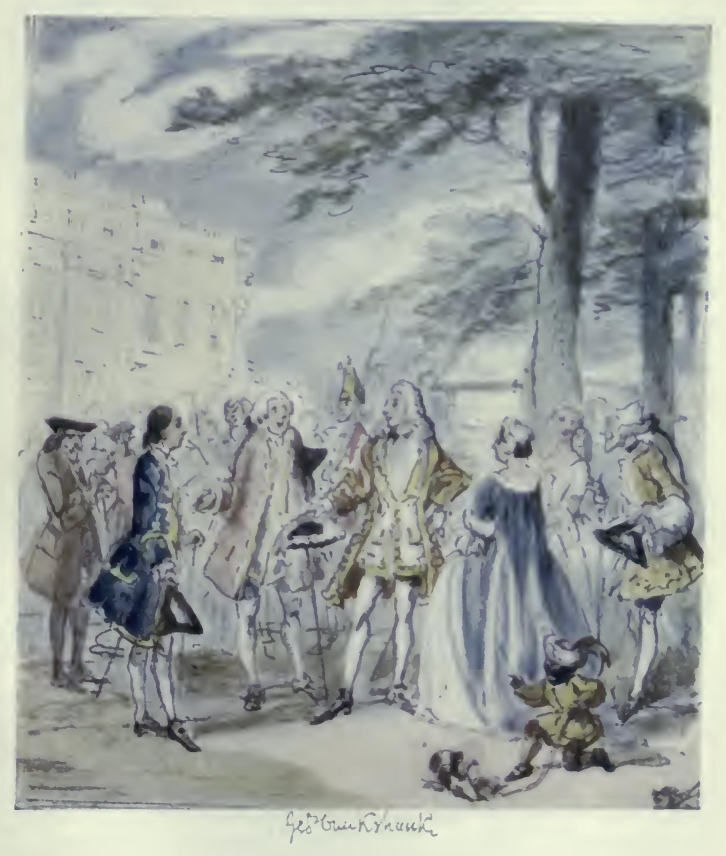
‘I am happy to make his acquaintance,’ replied the beau, courteously returning Randulph’s bow, and eyeing him curiously at the same time. ‘On my faith, your ladyship,’ he added aloud to Lady Brabazon, ‘the young man is not amiss, but destroyed by his wretched equipments and rustic air.’
‘I really think something may be made of him,’ returned Lady Brabazon, in the same loud and confidential tone. ‘Mr. Trussell Beechcroft, introduce your nephew.’
‘With the greatest pleasure, your ladyship,’ replied Trussell, obeying her behest.
‘Come with us,’ said Lady Brabazon to Randulph, after the ceremony had been gone through. ‘My daughter—Mr. Crew,’ she added, as they passed along. ‘By the bye, who was that strange old man I saw walking with you just now?’
‘Who?’ rejoined Randulph evasively, for he felt ashamed, he knew not why, of acknowledging his uncle.
‘There he is,’ said Lady Brabazon, pointing her fan backwards; ‘he is staring hard at us, and looks exactly like a—
‘It is my uncle Abel,’ replied Randulph, in some confusion. ‘Your uncle Abel!’ cried Lady Brabazon, with a scream of who stood on his right. ‘Then the sooner you get rid of uncle Abel the better.’
Abel could not hear the words, but he heard the laugh, saw the gesture, as well as his nephew’s confusion, and knew that he was the object of it. He turned away in the opposite direction, muttering to himself as he went, ‘So, he has taken the first step.’
SIR BULKELEY PRICE BRINGING THE MORTGAGE MONEY TO MR. SCARVE—THE PAYMENT OF THE MORTGAGE MONEY
Nearly an hour having elapsed, Mr. Scarve arose, and called to Jacob, who had retired to the cellar. The summons not being answered as expeditiously as he desired, he called again, and Jacob made his appearance brushing the moisture from his lips, and trying to swallow down a huge morsel that stuck in his throat.
‘You have been eating, rascal!’ cried the miser, ‘and drinking too! Faugh! how the knave smells of beer!’
‘If I have been eatin’ and drinkin’,’ said Jacob, clearing his throat by a violent effort, ‘it hasn’t been at your expense.’
‘Well, go and see what’s o’clock,’ said the miser, who did not appear particularly angry.
‘What’s o’clock!’ exclaimed Jacob, with surprise. ‘Why, I’ve lived with you these twenty years, and never was sent on such a message before. What do you want to know what’s o’clock for?’
‘What’s that to you, sirrah?’ rejoined the miser, with more anger in his words than in his tones or looks. ‘But I’ll tell you thus much, I never in my life wished a day to be passed so much as I do this.’
‘You excite my curiosity, father,’ said Hilda. ‘Why do you wish it passed?’
‘Because, if a certain sum of money is not paid to me before six o’clock, I shall be the possessor of one of the finest estates in Wales,’ replied the miser. ‘It must now be five; in another hour I shall be safe—safe, Hilda!—the mortgage will be foreclosed—the estate, mine! Mr. Diggs will be here at six. If I obtain this prize, Jacob, you shall drink my health in the glass of wine I put back in the bottle.’
‘Then it’ll be the first time I ever so drunk it,’ replied Jacob.
‘Take care it isn’t the last, you thankless varlet,’ rejoined the miser. ‘Don’t stand chattering there! Go and see what’s o’clock.’ As Jacob departed to obey his injunction, Mr. Scarve paced to and fro within the room, rubbing his hands and chuckling to himself. Five minutes nearly elapsed before Jacob returned; and when he did so, it was with a countenance of very peculiar significance. ‘Well, is it five?’ cried the miser.
‘No, it’s fourteen,’ replied Jacob.
‘Fourteen!’ exclaimed the miser. ‘What do you mean? You’re drunk, sirrah—drunk on the promise of a glass of wine.’
‘No, I’m not,’ replied Jacob. ‘I mean that there is a troop of fourteen horsemen at the door. There!—don’t you hear’em? They make noise enough, I should think.’
And as he spoke, a loud knocking, mixed with shouts and laughter, came sounding down the passage.
‘It is the mortgage money, father,’ said Hilda.
‘It is—damnation!’ cried the miser, stamping on the ground.
‘At first I took the troop for a gang of highwaymen,’ said Jacob, ‘when their leader, a fat, bloated old fellow, calls out to me, in an imperious tone, “Tell your master, the miser,” says he, “that Sir Bulkeley Price has brought him his money. He is not yet owner of an estate in Flintshire.” And then all his followers burst out a laughin’; and I don’t think they’ve done yet.’
‘Curses on them!’ cried the miser furiously, ‘and on him too! They shan’t enter my dwelling. I won’t receive the money. Send them away! Tell them I’m not at home, Jacob.’ ‘It won’t do, sir,’ replied Jacob; ‘they know you’re at home, for I told’em so. And as to refusing the money, why should you do that? They have brought it in great bags—bags of gold, of five hundred pounds each.’
‘Five hundred devils!’ cried the miser, foaming with rage. ‘What! bring such a sum as that in broad day! I shall be exposed to all my prying neighbours.’
‘That you will,’ rejoined Jacob; ‘they’re all at the windows looking on. There’s Mr. Deacle, the mercer, over the way, and his wife and daughter; and the inquisitive little barber next door; and the ironmonger’s wife and family at the Blackamoor’s Head; and the vintner’s at the Man-in-the-Moon, and——’
‘Hold your peace,’ cried the miser furiously, ‘or I’ll strangle you! I’ll not be insulted thus by any man! Fetch me my sword!’
‘Father!’ exclaimed Hilda, ‘why do you excite yourself thus? Sir Bulkeley Price has but done what was right; he has brought you back your money.’
SIR BULKELEY PRICE BRINGING THE MORTGAGE MONEY TO MR. SCARVE
‘What is it o’clock, Jacob?—did you ascertain that?’ cried the miser.
‘Not five, sir,—not five,’ replied Jacob.
‘Oh! perdition seize him! he is in time,’ cried the miser. ‘But I’ll be revenged. I’ll have his blood if I can’t have the estate. My sword, Jacob! What! you won’t move? Nay, then, I’ll fetch it myself.’ And opening a side door, he rushed up a small flight of steps leading to his bedroom.
‘Some mischief will happen, Jacob,’ cried Hilda, with a terrified look. ‘I never saw my father so agitated before. I’ll go forth myself, and entreat Sir Bulkeley to depart.’
‘Don’t expose yourself to the insults of his servants, miss,’ rejoined Jacob. ‘I did not tell master a quarter what they said of him.’ But despite his entreaties, and those of her aunt, who also endeavoured to detain her, she rushed forth, followed by Jacob.
On gaining the street, Hilda found Jacob’s statement perfectly correct. A troop of fourteen horsemen, with Sir Bulkeley Price at their head, were drawn up in front of the house. Most of them were well mounted, though a few of the number rode stout Welsh ponies. All had swords at their sides, and pistols in their holsters, as was needful from the amount of money they carried; every man having been provided with two bags, each containing five hundred pounds in gold, slung over his saddle-bow. A pile of these precious sacks lay at the door, and some of the men were now adding to the heap, while others were unslinging bags from their comrades’ saddles. The whole company were in high glee, and laughing loudly. The leader of the troop, Sir Bulkeley Price, was a stout portly gentleman, whose swollen, inflamed cheeks and mulberry nose showed he was by no means indifferent to the pleasures of the table. A claret-coloured velvet riding-coat, buttoned to the throat, displayed his full chest and rather commanding figure to advantage; while a well-powdered, full-bottomed periwig contrasted strongly with his rubicund and fiery visage. Hilda’s appearance created a great sensation among the lookers-on, and especially attracted the attention of the barber, who was chattering with Mr. Deacle about the occurrence, and of the fair Thomasine, who was leaning out of an upper window, just above her father’s sign of the Three Pigeons.
‘There’s Miss Scarve!’ cried Peter, calling to Thomasine.
‘I see her,’ replied the mercer’s daughter. ‘Poor thing, how I pity her—to be exposed to such insults! I long to fly to her assistance.’
‘Do, do!’ cried Peter. ‘I’ll fly with you.’
‘No, don’t,’ said Mr. Deacle; ‘you had better not interfere. Lord bless me! I wonder what it all means?’
Heedless of what was passing around her, for she heard her father’s furious voice in the passage, Hilda rushed toward Sir Bulkeley Price, and, in a tone of the most earnest entreaty, cried, ‘Oh, sir, I implore you to go away! My father is fearfully incensed—some mischief will happen!’
‘You are Mr. Scarve’s daughter, I presume?’ returned Sir Bulkeley, politely taking off his hat. ‘I should never have suspected him of owning aught so beautiful. But why should I go away, Miss Scarve? I am merely come to pay your father a sum of money which I borrowed from him.’
‘But it is the manner of paying it, sir,—the public manner—the exposure that incenses him,’ cried Hilda. ‘I would not for twice the amount, that this had happened.’
‘I daresay not,’ replied Sir Bulkeley; ‘but your father has forced me into the measure. My estate would have been forfeited if I had not repaid the money by six o’clock. It is as unpleasant to me as it can be to him; but I had no alternative.’
At this moment a loud angry cry was heard at the door, and the miser appeared, brandishing his drawn sword at it. His mad career was opposed by Jacob, whose wig was knocked off in his endeavours to push him backwards.
‘Villain!’ cried the miser, shaking his hand at Sir Bulkeley, ‘villain, you shall repent your insolence! Release me, Jacob! Let me get at him!’
‘No, you shan’t!’ replied Jacob, who had to exert all his strength, such was the miser’s fury, to keep him back.
Mr. Scarve’s vociferations of rage were now drowned by the hootings and jeers of the Welsh baronet’s attendants, who did all in their power to incense him further. Terrified by the cries, Hilda clasped her hands in agony, and again addressed herself to Sir Bulkeley.
‘As you are a gentleman, sir, I beseech you to withdraw,’ she said.
‘Such an appeal, and from such lips, is irresistible,’ replied Sir Bulkeley, again raising his hat.
‘He is no gentleman, Hilda!’ shrieked her father, who overheard what was said. ‘Come away, girl, I command you—leave him to me!’
‘Well crowed, old cock!’ cried one of the attendants, in mockery. And all laughed jeeringly, as before.
‘Hold your tongues, you saucy knaves!’ cried Jacob, fiercely regarding them; ‘or as soon as I’m at liberty, I’ll break some of your addle pates.’
‘For pity’s sake—go, go!’ cried Hilda to the baronet, ‘and take the money with you. Another time will do for payment.’
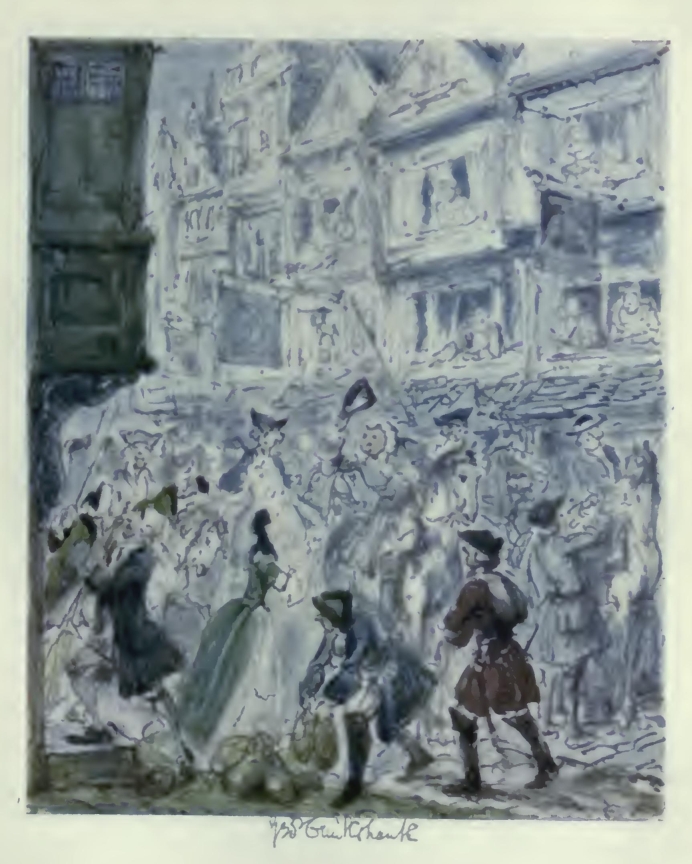
‘Pardon me, Miss Scarve,’ replied Sir Bulkeley; ‘another time will not do. I mustn’t jeopardise my estate. Mr. Scarve,’ he shouted to the miser, ‘here is your money—fourteen thousand pounds, in gold. Friends,’ he added, looking round at the crowd of spectators in the street, and at the windows, ‘I call you all to witness that this money is paid before six o’clock. I will take your word, Miss Scarve, for a receipt, and for the delivering up of the mortgage deeds.’
‘Take hence your money, villain!’ vociferated the miser, ‘I want none of it.’
This exclamation was followed by a roar of derisive laughter from the baronet’s attendants.
‘Silence them—oh! silence them, sir!’ cried Hilda imploringly.
Sir Bulkeley looked majestically round, and his attendants became instantly mute. At the same time, Jacob forced Mr. Scarve into the house; and Hilda, hastily expressing her thanks to the baronet, withdrew. In a few seconds, the whole of the bags of money were collected, and placed on the threshold. Sir Bulkeley would not, however, depart till Jacob returned, when he committed the heap to his custody.
‘What have you done with your master?’ he asked.
‘He has fainted, and his daughter is tending him,’ replied Jacob.
‘Well, take him that restorative,’ rejoined Sir Bulkeley, pointing to the money-bags; ‘it will speedily revive him.’
So saying, he rode off with his followers, amid the acclamation of the spectators. The same persons next began to hoot Jacob, and even seemed disposed to assail him; but being now provided with his crab-stick, he presented such a menacing and formidable appearance, that those nearest him slunk off.
HILDA’S VISIT TO ABEL BEECHCROFT
Hilda yielded at length to her aunt’s entreaties, and having put on her walking attire, quitted the house with Jacob. Instead of going over Westminster Bridge, they proceeded to Parliament Stairs, where Jacob said he had a friend a waterman, who would lend him a boat, in which they could cross the river. Nor did he assert more than the truth. On reaching the stairs, the first person he encountered was the friendly waterman in question, who, on learning his wishes, immediately ran down and got his skiff ready. Having placed Hilda within it, Jacob took off his coat, and plying the oars with as much skill as the best rower on the Thames could have done, speedily landed her at Lambeth, and secured the boat, where he inquired the way to Mr. Beechcroft’s house. A walk of a few seconds brought them to it. Hilda’s heart trembled as she knocked at the door; but she was reassured by the kindly aspect of Mr. Jukes, who answered the summons. She stated her errand to the butler, who appeared not a little surprised, and, indeed, confounded, at the announcement of her name. After a short debate with himself, Mr. Jukes said his master was at home, and she should see him; and, without more ado, he led the way to the library, and entered it, followed by the others.
Abel was seated beside an old-fashioned bookcase, the door of which was open, disclosing a collection of goodly tomes, and had placed the book-stand, supporting the volume he was reading, in such a position as to receive the full light of the window. So much was he engaged in his studies that he did not hear their approach. In the hasty glance cast by Hilda at the pictures on the wall, the most noticeable of which was a copy of Rembrandt’s ‘Good Samaritan,’ and a fine painting on the subject of ‘Timon of Athens,’ she thought she could read somewhat of the character of the owner of the house. Little time, however, was allowed her for reflection, for Mr. Jukes, advancing towards his master’s chair, leaned over it, and whispered a few words in his ear.
‘What!—who!—who did you say?’ exclaimed Abel, half-closing the book he was reading, and looking sharply and anxiously round. ‘Who did you say, Jukes?’
‘Miss Scarve, sir,’ replied the butler; ‘she has brought you a letter.’
‘Tell her I won’t receive it—won’t open it!’ cried Abel. ‘Why did you not send her away? What brings her here?’
‘You had better put that question to her yourself, sir,’ replied Mr. Jukes, ‘for she is in this room.’
‘Here!’ exclaimed Abel, starting to his feet. ‘Ah! I see—I see. O God! she is very like her mother.’
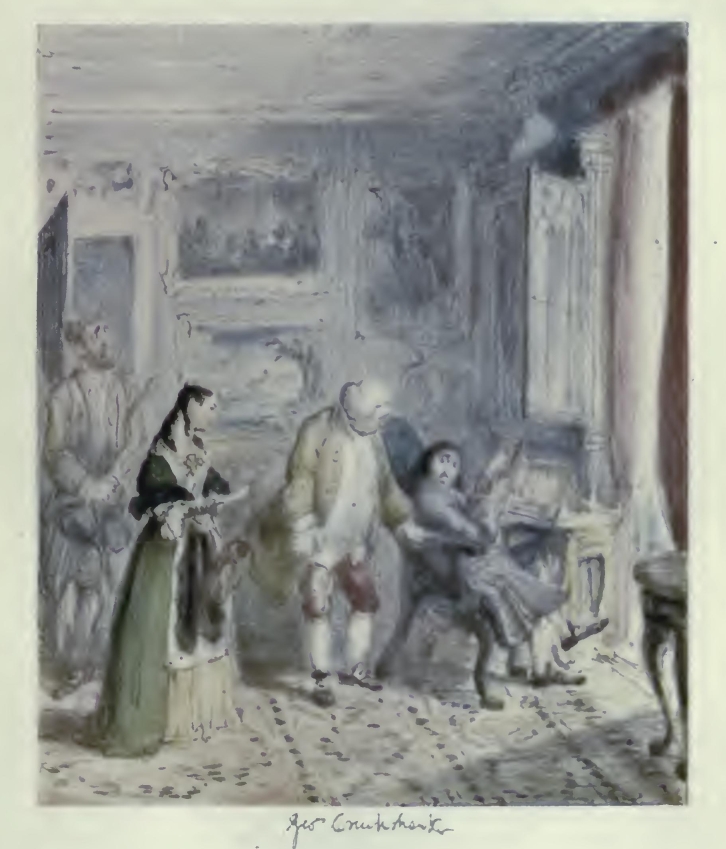
‘Calm yourself, I entreat, sir,’ said Mr. Jukes; ‘I would not have admitted her,’ he added, in a low tone, ‘but that she told me the letter was written by her mother, and left to be delivered to you under peculiar circumstances, which have now arisen. I couldn’t resist a plea like that—nor could you, sir, I’m sure.’
‘A letter written to me by her mother! cried Abel, shivering, as if smitten by an ague. ‘Leave us, Jukes, and take that man with you.’
‘Come, friend,’ said Mr. Jukes to Jacob, who, with his crab-stick under his arm, stood gazing curiously on, ‘you had better adjourn with me to the butler’s pantry.’
‘Thank’ee kindly, sir,’ replied Jacob, in tones a little less gruff than usual, for he was somewhat awestricken; ‘I would rather stay with my young missis.’
‘But don’t you see you’re in the way, my good man?’ rejoined Mr. Jukes impatiently; ‘they can’t talk before us. Come along.’ And despite his resistance, he pushed Jacob out of the room, and closed the door after him.
‘You have a letter for me, young lady, I believe,’ faltered Abel in a voice hollow and broken by emotion.
‘I have, sir,’ she replied, giving it to him.
Abel looked at the address, and another sharp convulsion passed over his frame. He, however, controlled himself by a powerful effort, and broke the seal. The perusal of the letter seemed to affect him deeply, for, staggering to his chair, he sank into it, and covering his face with his hands, wept aloud. It was some minutes before he arose. Hilda, who had watched him with much concern, was surprised to see how calm he looked. He had, indeed, regained the mastery he usually held over his feelings. ‘Pray be seated, young lady,’ he said, handing her a chair. ‘I would have shunned this interview if it had been in my power, but as it has been brought about, I will not shrink from it. How can I serve you?’
Hilda then proceeded to explain the object of her visit. Abel listened to her recital with a quivering lip and flashing eye, and at its close got up, and took a quick turn round the room.
‘This is only what might be expected from him—scoundrel!’ he ejaculated. ‘Sell his daughter!—but that is nothing—he would sell his soul for gold! I beg your pardon, young lady,’ he added, checking himself, as he saw the pain his exclamations occasioned her, ‘but if you knew the deep and irremediable injury inflicted on me by your father, you would pardon this outbreak of passion. He has sacrificed others without scruple, but he shall not sacrifice you. You may count on my assistance, my protection, if you choose to confide in me.’
‘I have my mother’s injunction to confide in you, sir,’ she replied.
‘Your mother!’ exclaimed Abel, in a voice of agony. ‘Oh, Hilda! what a fearful spell is there in that word!—what a host of feelings does it not summon up! I see your mother again as I remember her in her youth—beautiful as you are, more beautiful, if possible—certainly more blooming. I hear the music of her voice as I listen to yours; I feel again the charm inspired by her presence. You shall learn my history one of these days, and you will then know why your mother addressed this letter to me—why it affects me thus.’
‘I can partly guess the cause,’ returned Hilda mournfully; ‘but be it what it may, it is plain she felt she had a strong hold on your affections, and that she thought she could rely on you, when she could rely on no one else.’
‘If she thought so, she judged rightly,’ replied Abel. ‘I consider her request as a sacred injunction, and will strive to comply with it. And now,’ he added, changing his tone, ‘I must tell you that your name has been brought before me of late. My nephew, Randulph Crew, who visited your father the other night, has spoken of you.’ Hilda slightly coloured. ‘He will much regret not being at home this morning,’ pursued Abel, ‘as he might have had an opportunity of further cultivating his acquaintance with you. But he is gone out with my brother.’
‘I hope it will not offend you to say I am glad of it,’ replied Hilda; ‘I would not willingly have met him.’
‘Why so?’ asked Abel, who, however, looked somewhat relieved.
‘Because, sir, I will be frank with you,’ she replied, ‘and own that my father attributes my increased dislike of my cousin to a predilection for your nephew.’
‘And may I expect equal frankness in the reply, if I ask whether there is any truth in your father’s suppositions?’ rejoined Abel.
‘You may,’ she answered. ‘Your nephew appears a very amiable and pleasing young man, but having seen him only for a few minutes, I cannot possibly feel an interest in him beyond such as might be inspired by any stranger of equally prepossessing appearance and manners. My aversion to my cousin arises from various causes. I half suspect him of acting a very base part towards my father, who resolutely shuts his eyes to the deception.’
‘I will not affect to deny that I am pleased with what you say of your indifference to my nephew, Hilda,’ returned Abel, ‘because I have other views in reference to him. As to your cousin, Philip Frewin, I will make strict inquiries about him, and if your suspicions prove correct, I will myself unmask him to your father, which may perhaps put an end to the matter. He lives in Fen-church Street, you say. It so happens that an old friend of mine, a widow lady, Mrs. Verrai—a friend of your mother’s, by the bye—resides in that street. She is an excellent woman, but a little of a busy-body and a gossip, and makes it her business to know her neighbours’ concerns better than her own. I’ll venture to say she is acquainted with your cousin’s affairs. I haven’t seen the old lady of late, because, as you may perhaps have heard, I have little intercourse with your sex—my habits, and indeed feelings, unfitting me for their society—but I happen to know from my brother Trussell that she is well. You had better go to her yourself. I will give you a note of introduction—though, indeed, it is not needed, for, as I have told you, she is an old friend of your mother’s. In addition to gaining all the information you may require respecting your cousin, you will make a friend with whom you may take refuge, if matters—which we will not anticipate—should unhappily render such a step necessary.’
‘I will do as you suggest, sir,’ replied Hilda; ‘but suppose I should encounter my cousin?’
‘Tell him where you are going,’ replied Abel; ‘and depend upon it, if he is not what he represents himself, he will be the first to take the alarm. I will myself institute inquiries about him in another quarter.’ With this, he proceeded to a table on which writing materials were placed, and hastily penned a note, and gave it to Hilda. ‘And now, God bless you, my dear child!’ he said affectionately. ‘If called upon by circumstances, you shall never want a father or protector in me!’ He then rang the bell, and Mr. Jukes presently appeared, who informed him that Jacob had just sat down to dinner with the other servants.
‘I think, sir,’ he added, in a low tone, ‘it is the first good meal he has had for many a day, and it would be a pity to disturb him, if Miss Scarve is not in a very great hurry.’
Abel appealed to Hilda, and as she raised no objection, he proposed to her to take a turn in the garden till Jacob had finished his meal; and accordingly opened the window and led her forth. By this time Hilda had become more composed, and being quite easy with the old man, for whom indeed she felt a growing regard, she entered readily into conversation with him; and thus more than half an hour flew by, almost without their being aware of its flight. At the end of that time, Mr. Jukes made his appearance, and informed them that Jacob was ready. Abel attended his fair visitor to the door.
‘If you do not find Mrs. Verrai at home,’ he said, ‘or if anything should occur to make you wish to see me again, do not hesitate to come back. But, in any event, you shall hear from me—perhaps see me, to-morrow. God bless you, my child!’ And taking her hand, he pressed it to his lips; and when Hilda withdrew it, she found it wet with tears.
While this was passing, Jacob shook the hospitable butler warmly by the hand, and then strode on before his young mistress, towards the stairs where he had left the boat. Having placed her within it, and divested himself of his coat and hat, as before, he inquired where she meant to go, and being told to London Bridge, pulled off vigorously in that direction.
‘THE FOLLY’—A FLOATING TAVERN ON THE THAMES—KITTY CONWAY—RANDULPH PLACED IN AN AWKWARD SITUATION BY PHILIP FREWIN
The Folly on the Thames, whither Beau Villiers and his party were steering their course, was a large floating house of entertainment, moored in the centre of the stream, immediately opposite old Somerset House. It was constructed in the latter part of the reign of Charles the Second; and thither the merry monarch, who was excessively fond of aquatic amusements of all kinds, would frequently repair with his courtiers and frolic dames. Thither also Queen Mary, the consort of William the Third, went on the occasion of a grand musical entertainment; and the place continued in vogue for many years, until at length, degenerating in its character, it became the haunt of a very disreputable part of the community. The Folly resembled a large one-storied house, very long in proportion to its width, built upon an immense barge. There was a platform at the top, defended by a strong wooden balustrade, and flanked at each corner by a little turret with a pointed top, surmounted by a small streamer. These turrets constituted small drinking and smoking rooms, and were fitted up with seats and tables. In the centre of the structure was a sort of open belvidere, covering the main staircase leading to the roof. On this a large flag was planted. The Folly was approached from the water by steps on three sides. It was lighted by a range of large and handsome windows, and entered by two doors, one at the end, and the other at the side. Within, it contained a long music-hall with a frescoed ceiling, gilded and painted walls, an orchestra, and the necessary complement of benches, chairs, and small tables. There was, moreover, a bar, where all sorts of liquors, materials for smoking, and other tavern luxuries were dispensed. The rest of the structure was divided into a number of small apartments for private parties, and, in short, boasted every sort of accommodation afforded by a similar place of entertainment on shore. In summer it was delightful—the view of the Thames from its summit being enchanting. The coolness and freshness, combined with the enlivening influences of beauty, wine, and music, made it, on its first establishment, a charming place of recreation; and it cannot be wondered that the merry monarch, and his merrier court, found it so much to their taste.
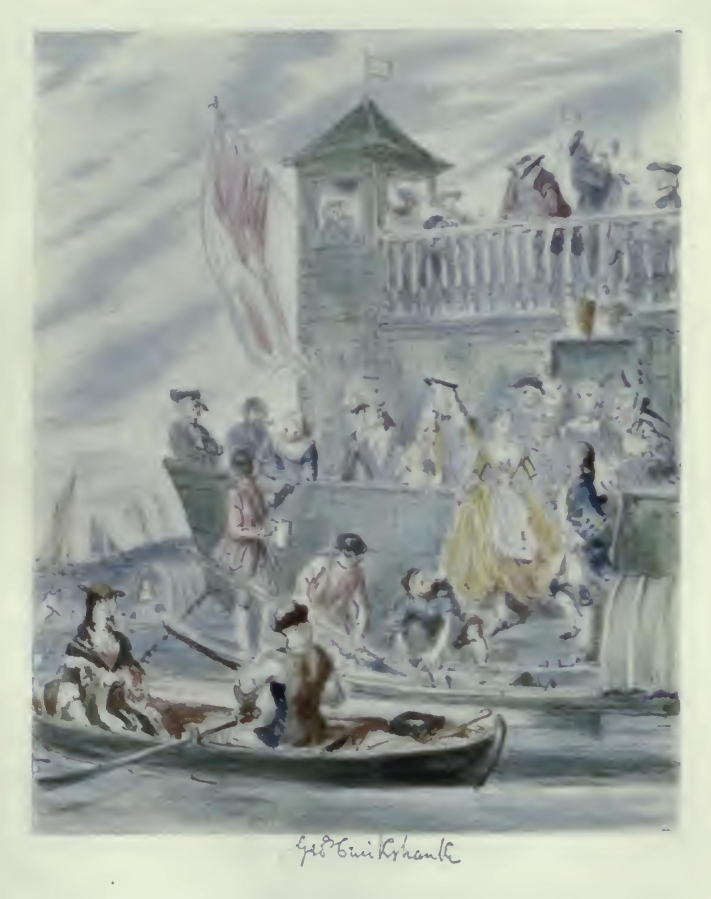
As the party approached the aquatic hotel, they perceived a number of persons, of both sexes, seated on the roof, and in the little turret parlours, smoking, drinking, or otherwise amusing themselves; while lively strains of music proceeded from within. Several small craft were landing their passengers, and from one, a tilt boat, there issued a very pretty young woman, though of rather bold appearance, who, as she took the hand of a young man in her ascent of the steps, displayed a remarkably neat foot and ankle. On reaching the deck, she turned for a moment to survey the scene, and her eye alighting on Randulph, his good looks appeared to rivet her regards.
This fascinating creature seemed to be about twenty; had very regular features, auburn hair, a brilliant complexion—whether wholly unindebted to art might be questioned—but there could be no question as to the natural brilliancy of her hazel eyes; and wore a pink silk hooped gown, made very low in front, so as to display her beautifully formed and radiantly white neck and shoulders. Her sleeves were very short, probably so contrived with the view of exhibiting her rounded arms, and edged with lace. A white silk apron embroidered with silver, a pretty fly-cap, and a necklace of precious stones, from which depended a diamond cross, completed her attire. The young man, by whom she was attended, had a slight thin figure, and sharp, disagreeable features, with rather an apish expression. He was dressed with much smartness, but had by no means the air of a gentleman, and seemed to be regarded with indifference, almost amounting to contempt, by his female companion.
‘Who is that young lady?’ asked Randulph of Sir Singleton, who happened to sit next him.
‘Let me see!’ exclaimed the old beau, placing his glass to his eye. ‘Ah! gadzooks! ’tis the delicious creature I mentioned to you—the little Haymarket actress, Kitty Conway!’
‘Kitty Conway! where is she?’ cried Trussell, who heard the remark, but whose back was towards the object of their admiration.
Sir Singleton pointed her out, and upon the instant every eye was directed towards her. Whether unable to stand so fierce a fire, or whether, as is more probable, dragged away by her companion, who did not appear to relish the notice she attracted, it is needless to inquire, but pretty Kitty suddenly vanished from their sight.
‘Well, isn’t she delicious?’ cried Trussell to Randulph. ‘Egad! you have made a conquest of pretty Kitty, my boy. I saw the parting glance she gave you over her shoulder as she whisked through the door. Don’t lose sight of her. You can soon put the City beau, by whom she is attended, hors de combat.’
Further remarks were interrupted by the arrival of the boat at the steps. A strange black-muzzled fellow, in a Guernsey shirt, with bare arms and bare legs, and who was a regular attendant at the Folly, helped them to disembark; and his request to ‘be remembered’ by the beau being met with a very munificent rejoinder, he well-nigh lost his balance in his glee, and got a tumble into the water.
The party then entered the music-hall, and just as they passed through the door, Randulph, chancing to look behind him, perceived that the stranger had likewise landed, and was mounting the steps. The novel scene, however, before him, so completely engrossed his attention, that he could think of little else. Upwards of a hundred persons of both sexes thronged the room; many of the ladies were masked, and a good deal of freedom marked their conduct. They talked and laughed loudly and recklessly. At one end of the hall, the benches were taken aside to allow Kitty Conway and her companion, with some other couples, to perform the cushion dance. At the upper end of the room stood the musicians. The party made their way towards the dancers, and the beau and Sir Singleton praised Kitty’s beauty in tones so loud, and in terms of admiration so strong, as would have occasioned confusion to any young lady troubled with a more oppressive sense of bashfulness than she was. Her partner did not know whether to look pleased or annoyed. He was evidently overpowered by the presence of Beau Villiers, whom he regarded with a species of awe; and as these applauses of Kitty gave a fancied consequence to himself, he was weak enough to be gratified by them. Towards the close of the figure, a particular step, executed by the pretty actress, elicited more than usual rapture from Sir Singleton, and he called to Randulph—‘Look at her, Mr. Randulph Crew. Is it not delicious?’
At the sound of this name, Kitty’s partner started, and stared so hard at Randulph, that he could scarcely finish the dance.
‘Upon my word, Philip Frewin, you are a very stupid partner,’ said the actress to him. ‘If you do not exert yourself more, I shall ask that handsome young fellow, who is ogling me there, to take my hand in the next set.’
‘I am quite fatigued, Kitty,’ replied Philip confusedly; ‘let us have some refreshment—a little rack punch, or a glass of champagne.’
Kitty Conway assented, and they moved off to one of the side tables, where a waiter speedily placed glasses before them, and opened a bottle of champagne. It must be confessed—unwilling as we are to admit it—that Randulph was not altogether proof against the undisguised admiration of the pretty actress, and that he could not help returning the tender glances she shot towards him.
Meanwhile the performances went forward; an Irish jig followed, in which Randulph and Sir Singleton joined; this was succeeded by some comic songs; and Mr. Villiers, who did not altogether relish the entertainment, walked forth, and was soon after followed by the others. As they all stood leaning over the sides of the bark, laughing at what had occurred, and admiring the gaiety of the scene, a skiff, impelled by a vigorous rower, as was evident by the progress it made, and containing a young female, wrapped in a black silk scarf, and with raven tresses, scarcely covered by a small bonnet, floating in the breeze, rapidly neared them. Various speculations were put forth as to whether this young female would prove as pretty on a nearer inspection as she looked at a distance; but in these Randulph took little part. To speak truth, his thoughts were running upon the fair syren within, and happening to cast his eyes towards the platform above, he perceived, leaning over the balustrade, and gazing at him, the stranger!
At this juncture, Philip Frewin came forth, to see whether his boat was in readiness, and admonished the watermen, one of whom was philandering with a buxom damsel, who was leaning over the side of the deck, that he should start immediately. He had scarcely, however, issued the order, than his eye fell upon the skiff containing the young female before mentioned, and which was now close at hand. He started as if an apparition had met his gaze, ducked down, and would have made his escape into the music-hall, if Kitty Conway had not placed herself in his way. Retreat was now impossible, and Philip’s distress was heightened by the fair actress, who exclaimed, somewhat pettishly, ‘Why do you leave me here, sir? Why don’t you hand me to the boat?’
Philip was almost at his wits’ end. The skiff containing Hilda and Jacob—both of whom he had too clearly recognised, though he could not account for their appearance, unless it were a trick of the fiend to convict him—was so near, that if he complied with Kitty’s request, discovery would be inevitable. A plan suddenly occurred to him, by which he hoped to free himself from risk, and place Randulph, whom he had reason to regard as a rival, in an awkward dilemma. Without apprising Kitty of his intention, he drew her forward, and bending down as low as he could to elude observation, said to Randulph—‘Will you have the kindness, sir, to hand this lady into her boat? You will do me an infinite favour; I have dropped a pocket-book in the music-hall, and must go back to search for it.’
Randulph was a good deal surprised by the proposal, but he unhesitatingly consented; and, taking Kitty’s hand, which she very graciously accorded, rewarding his attention by a slight squeeze, led her down the steps. All this occurred to the infinite amusement of Trussell, who stood a little back near the door, ogling a rather pretty damsel, and to the no slight chagrin of Sir Singleton, who, guessing the intention of Philip Frewin, had pushed forward to offer his services, but found himself supplanted. But these were not the only witnesses of the scene. By this time, the skiff-, containing Hilda, had come up, and with a pang of jealous feeling, neither to be accounted for nor controlled, she beheld Randulph handing the pretty actress, whose character she could scarcely mistake, down the steps. Jacob saw what was passing as well as herself, but, having no jealousy to divert his attention from other matters, he detected Philip Frewin even in his disguise, and, resting on his oars, exclaimed, ‘Look! miss, look!—there is your cousin Philip. Is that the dress he wore yesterday? I told master he wasn’t what he seemed. Look at him, I say!’
But Hilda was too much agitated to heed these exclamations. She could see nothing but Randulph and the pretty actress. Nor was she without embarrassment on her own account; for Mr. Cripps, having recognised her, pointed her out to his master, and the beau, being much struck with her beauty, favoured her with a very insolent stare. But if Randulph had been guilty of disloyalty towards the object of his affections, his punishment was not long delayed; for, as he handed Kitty into the boat, which was steadied by the black-muzzled Jack before mentioned, his gaze encountered that of Hilda, and he was instantly filled with confusion. He tried to disengage himself from the actress, who, however, sportively detained him, and, unable to retreat, he cut a most ridiculous figure. Indeed, he was a little relieved, though he felt how much he should sink in her esteem, when he saw Hilda bend forward, and order Jacob, who continued resting on his oars, to pass on. He continued gazing after the skiff till it was out of sight; but Hilda did not look back.
Meanwhile, as Philip Frewin did not make his appearance, Kitty Conway became very impatient, and turning a deaf ear to all the high-flown compliments showered upon her by Sir Singleton Spinke, entreated Randulph to go and see what her friend was doing. The young man could not very well refuse compliance with the request, and he accordingly entered the music-hall, and returned in a few minutes with Philip, who, finding the coast clear, recovered his composure, and tendering his thanks, in a very abject manner, to Randulph, got into the boat with Kitty, and ordered the men to row to Savoy Stairs. Randulph was too angry with himself, and now too indifferent to the fascinations of the pretty actress, to return the tender glance with which she favoured him on her departure.
The incident, however, afforded abundant merriment to his companions, who were greatly diverted by his looks, which they attributed to jealousy, and they endeavoured to remove the feeling by assuring him that Kitty had exhibited a decided preference for him. His uneasiness was not relieved by the admiration expressed of the miser’s daughter by Beau Villiers, nor was Trussell altogether pleased to find the beau so much captivated. That Hilda should have passed at the precise juncture seemed to surprise everybody.
RANDULPH’S INTERVIEW WITH CARDWELL FIREBRAS IN THE CLOISTERS OF WESTMINSTER ABBEY
Shortly after this, the party entered their boat and returned to Whitehall Stairs. Randulph had been so much engrossed by his own feelings, that he forgot the stranger, and only called him to mind a few minutes after he had landed, and when it was too late to look for him. He did not, however, forget his appointment with the writer of the mysterious letter, and, regardless of the construction that might be put upon it, told his uncle he had a particular engagement, which he must keep, at six o’clock. Trussell smiled significantly at the announcement, but made no remark, and proposed that they should all dine at one of the French ordinaries in Suffolk Street. Beau Villiers pleaded an engagement, but Sir Singleton acquiesced, and the trio repaired to the ordinary, where an excellent dinner was set before them.
Mindful of his appointment, Randulph, in spite of the jokes of his companions, who strove to detain him, got up from table at five o’clock, and took his way past Charing Cross and Whitehall towards the Abbey. He could not resist the impulse that prompted him to pass through the Little Sanctuary, and felt half-disposed to call at the miser’s and offer some explanation of his conduct to Hilda. Though the absurdity of the notion caused him to abandon it almost as soon as formed, he lingered before the house for a few minutes, in the hope of discerning some of its inmates, but was disappointed. He then entered Peter Pokerich’s shop, to inquire the way to the Abbey cloisters.
It chanced that the little barber was about to take an evening stroll with the fair Thomasine, who was waiting for him, and he offered to show Randulph the way; but this the young man, who had his own reasons for not desiring the attendance of the inquisitive barber, declined, though in such a way as to excite Peter’s curiosity, who secretly determined to follow him. As soon as Randulph was gone, he mentioned his design to the fair Thomasine, who was nothing loth to accompany him, and they set out together, taking special care to keep out of Randulph’s view. The young man shaped his course towards the Abbey, and, skirting its western extremity, passed under the archway leading to the playground of Westminster School. Here he paused, and, addressing a porter, was directed towards another archway, through which he passed, and entered the cloisters. On seeing this, Peter, still accompanied by his fair companion, ran forward, and finding that Randulph was walking in the south ambulatory, they struck into the west, being still able to watch him through the open columns.
Randulph, meanwhile, unconscious that he was the object of such scrutiny, slowly traversed the ambulatory, and, charmed with the exquisite groined arches of its roof, hoary with age, and the view afforded through the shafted windows looking into the quadrangle, of the reverend buttresses and of the Abbey, almost forgot the object that brought him thither. He was arrested at the eastern extremity by the ancient inscriptions and brasses, pointing out the resting-places of the old abbots, Laurentius Gislesbertus, and Vitalis, when a heavy footstep sounded on his ear, and looking up he beheld the stranger. Before he could recover his surprise at this unexpected apparition, the new-comer advanced towards him, and with a slight inclination of the head, and a singularly significant smile, said, ‘So you have kept your appointment with me, Mr. Randulph Crew.’
‘Are you, then, Mr. Cardwell Firebras?’ exclaimed Randulph in surprise.
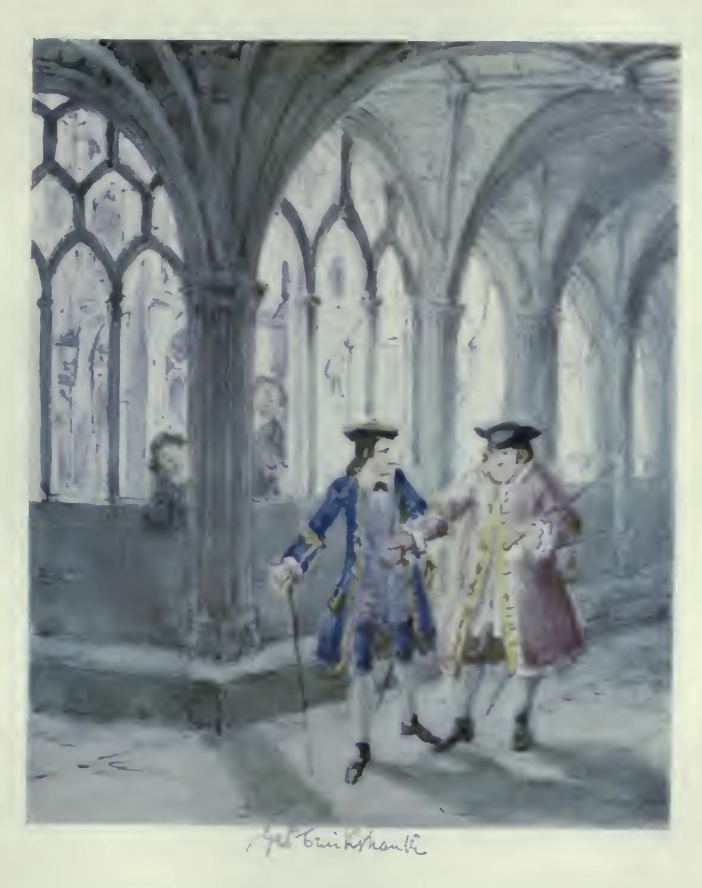
‘I am so called,’ replied the other.
‘I was little aware, sir, when I saw you this morning at the barber’s, how soon and how strangely we should be brought together again,’ rejoined Randulph; ‘but this in some measure accounts for the manner in which you have haunted me throughout the day. Perhaps you will now explain your motive for doing so, as well as for summoning me hither.’
‘All in good time, young gentleman,’ replied Cardwell Fire-bras gravely. ‘Before I advert to my own concerns, let me say a word on yours. Answer me truly—have you not conceived an affection for Hilda Scarve? Nay, you need not answer. Your hesitation convinces me you have. Circumstances led you into acting very injudiciously this morning at the Folly, and I fear your conduct may have produced an unfavourable impression on Hilda’s mind,—for I watched her closely. But heed not this. I will set all to rights. I have much influence with her father. He designs her for another—the apish gallant of the pretty actress who fascinated you this morning. But you shall have her nevertheless,—on one condition.’
‘Despite the singularity of your address, there is an earnestness in your manner that inspires me with confidence in you, sir,’ rejoined Randulph; ‘the rather, that you told me this morning you were an old friend of my father’s. I will freely confess to you that I am captivated by the miser’s daughter, and that I would hazard much to obtain her. Now, on what condition do you propose to make her mine?’
‘You shall learn presently,’ replied Firebras evasively. ‘Let us take a turn along the cloisters,’ he added, moving slowly forward. They marched on together in silence until they reached the eastern angle of the ambulatory, when Firebras, suddenly halting, laid his heavy hand upon Randulph’s arm, and fixed a searching look upon him. ‘Young man,’ he said, ‘I will tell you what you must do to gain the miser’s daughter.’
‘What, what?’ demanded Randulph.
‘You must join the Jacobite party,’ replied Firebras; ‘to which her father belongs—to which your father belonged—and to which your mother also belongs.’
Surprise kept Randulph silent. But neither he nor his companion were aware that this treasonable proposition had been overheard by Peter Pokerich and the fair Thomasine, who, having stolen upon them unperceived, were ensconced behind the shafts of the adjoining arches.
THE MISER DISCOVERING THE LOSS OF THE MORTGAGE MONEY
The miser, meanwhile, having obtained access to his chamber, threw his hat upon the bed, passed on, and unlocked the door of the closet. Marching up to the large chest in which he had deposited the bags of gold on the previous night, he sat down upon it, and was for some time lost in deep and painful reflection. He then rose, and taking a bunch of keys from his pocket, applied one of them to the lock of the chest. It would not turn; and imagining that he must have made some mistake, he drew it out and tried another. This, however, did not fit at all; and returning the first, he perceived, on examination, that it was the right one. Again applying it, and proceeding more carefully, he found, to his surprise and dismay, that the chest was not locked. Well knowing he had not left it in this state, he felt convinced that something must be wrong, and it was long before he could prevail upon himself to raise the lid.
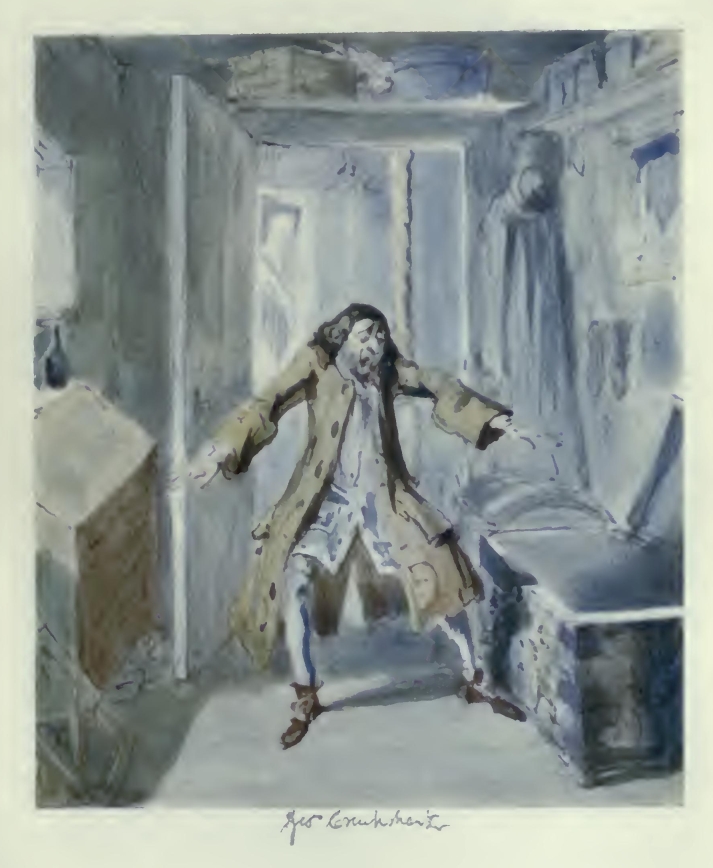
When he did so, he started back with a cry of anguish and despair. The chest was empty! For some minutes he remained as if transfixed, with his hands stretched out, his mouth wide open, his eyes almost starting from their sockets, and fixed upon the void where his treasure should have been. At length he shrieked in accents of despair, ‘I have been robbed—robbed of my gold!—robbed—robbed! It is a wicked thing—a cruel thing to rob me! Others do not love gold as I love it. I love it better than wife, child, mistress,—better than life itself! Would that they had killed me, rather than take my gold! Oh! those fair shining pieces—so broad, so bright, so beautiful!—what has become of them?’
After a pause, during which he experienced the acutest mental anguish, he looked around to see how the robbery could have been effected. A moment’s examination showed him that the iron bars in front of the little window opposite the chest had been removed.
‘The villains must have found entrance here!’ he cried, rushing towards the window. And clambering up an old oaken bureau that stood near it, he pushed it wide open, and stretching his long, scraggy neck through it, gazed into the little garden beneath.
Unable to discover anything, he drew back, and casting his eyes over the bureau, perceived that the dust with which it was covered had been slightly brushed away; but whether by himself or the depredators, it was now, of course, impossible to determine.
A bottle standing on one corner of the bureau had not been removed. It was clear that the plunderers had gone direct to the chest, of which they must have possessed a key, for the lock, though strained, had not been forced. Maddened by these reflections, and unable to account for the occurrence, he again vented his fury in words. ‘I have it!’ he shrieked, ‘it is that accursed Welsh baronet who has robbed me. He paid me the money in this public way only to delude me. I’ll charge him with the robbery—I’ll prove it against him—I’ll hang him! Oh! it would delight me to hang him! I would give a thousand pounds to see it done! A thousand pounds! What is that to the fourteen thousand I have lost? I shall go mad, and it were happy for me to do so. Philip Frewin will refuse to marry my daughter. Her portion is gone—gone! Why was I tempted forth with Firebras? I ought to have taken my seat on that chest—to have eaten my meals upon it—to have slept upon it! Night nor day should I have quitted it! Fool that I have been!
I have been rightly served—rightly served! And yet it is hard upon me, an old man, to lose all I held dear—very hard!’ And falling upon his knees, with his hands clasped together, beside the vacant chest, he wept aloud.
This paroxysm of rage and grief having subsided, he again rose and descended to the parlour, where he found Mrs. Clinton anxiously waiting his reappearance. She instantly divined what had happened, and retreated before him as he advanced, almost fearing from his looks that he would do her a violence. Shaking his clenched hand, and foaming at the mouth, he attempted to discharge a volley of imprecations against her; but rage took away the power of speech, and he stood gesticulating and shaking before her—a frightful and pitiable spectacle.
‘For Heaven’s sake, sir, compose yourself,’ she cried, ‘or you will have a fit of some dangerous illness. You terrify me to death.’
‘I am glad of it,’ he shrieked. ‘I have been robbed—the mortgage money is gone—the fourteen thousand pounds. D’ye hear, woman? I’ve been robbed, I say—robbed!’
‘I feared as much,’ replied Mrs. Clinton; ‘but the robbery cannot have been long effected, for just before you knocked at the door, I heard a window creak, as I thought, in your room.’
‘You did!’ screamed the miser. ‘And why did you not tell me this before? I might have caught them—might have got back the spoil.’
‘If you hadn’t frightened me so much about Hilda, I should have told you,’ replied Mrs. Clinton, in a deprecatory tone; ‘but your violence put it out of my head.’
‘Hell and fiends!’ ejaculated the miser; ‘what is Hilda—what are fifty daughters, compared with my gold? If you had enabled me to recover it I would have forgiven you all the rest. Don’t stand trembling there, fool! but come with me, and let us see whether we can discover any traces of the robbers!’ So saying, he hurried towards a small back door in the passage, the bolts of which were so rusty that he had considerable difficulty in removing them; and this effected, he passed into the garden.
RANDULPH REFUSING TO DRINK ‘THE KING’S HEALTH OVER THE WATER’—A MEETING OF THE JACOBITE CLUB
In about a quarter of an hour the landlord entered the room, and, bowing to the company, said, ‘I believe, gentlemen, you are all assembled; the room upstairs is ready, if you are disposed to adjourn to it.’ The proposition being assented to, the landlord threw open the door, and a slight contest occurred between the two baronets as to which should offer the other precedence.
‘I præ, Sir Bulkeley,’ said Sir Norfolk; ‘I will scale the staircase after you.’
Thus exhorted, Sir Bulkeley, who thought it good breeding not to dispute a point of needless ceremony, went on. Sir Norfolk marched after him with majestic steps, and the rest of the party followed. The landlord ushered them into a large room, lighted by a chandelier suspended from the ceiling, in the centre of which was a circular table covered with bottles and glasses. Having hung up their hats against the wall, the company sat down, and a few bumpers went briskly round. While they were thus carousing, a tap was heard at the door, and the landlord, opening a reconnoitring hole within it, spoke to some one without. He next proceeded to convey the information he had received in a low tone, to Cardwell Firebras, who immediately said aloud, ‘Oh, yes, admit him by all means. Gentlemen, a new brother!’ The door was then opened, and Randulph recognised in the gaily attired, self-possessed coxcomb who was admitted, Mr. Crackenthorpe Cripps.
‘Take a glass of wine, Mr. Cripps,’ said Firebras, filling a bumper, and handing it to the new-comer. ‘It is Beau Villiers’s chief valet,’ he added, in an undertone, to Sir Norfolk, who had made a polite though formal bow to the stranger.
‘What!’ exclaimed Sir Norfolk, almost shuddering at the inadvertence he had committed; ‘a waiting-man in such costly and nitid attire. Why, his master, the Pretonius Arbiter of the day, can scarcely be more studiously refined in the taste and style of the vestments wherewith he adorneth his person.’
‘Not a whit so,’ laughed Firebras; ‘the only difference between them is, that Beau Cripps wears in May the coat which Beau Villiers has worn in April.’
‘Mehercle!’ exclaimed Sir Norfolk. ‘Such prodigality almost exceedeth belief.’
‘Landlord, it is time!’ cried Father Verselyn, who performed the part of chairman, and occupied the principal seat.
‘I am ready, your reverence,’ replied the landlord. And he forthwith proceeded to a cupboard, from which he produced a large china bowl, apparently filled with punch, and placed it with great care and solemnity in the centre of the table.
‘Why, it is water,’ exclaimed Randulph, gazing at the clear lymph, with which, on nearer inspection, he perceived the bowl was filled.
‘To be sure!’ cried Firebras; ‘and we are about to drink the king’s health—over the water. And now, gentlemen,’ he continued, filling Randulph’s glass and his own, ‘fill, I pray you, to the brim.’
‘I have filled, even to the summit of the vase,’ said Sir Norfolk, rising and holding up his glass.
‘And I,’ cried Sir Bulkeley, likewise rising.
‘And I,’ added the landlord, who stood next to the last-named baronet, and was allowed to join in the ceremony.
‘And I—and I,’ chimed Mr. Travers and the valet.
‘Then give the word, my son,’ said Verselyn, addressing Firebras.
‘With the greatest pleasure, father,’ replied Cardwell. And he held his glass over the bowl, while his example was imitated by all the others except Randulph. ‘Here is the king’s health “over the water.” Why don’t you do as we do?’ he added, turning to Randulph.
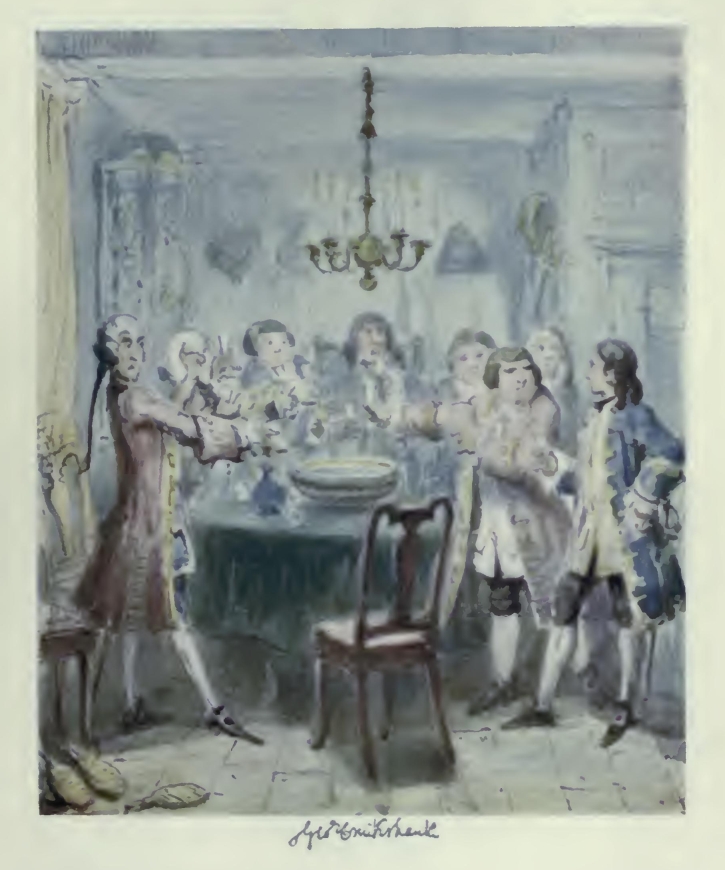
‘Ay, stretch forth your arm over the scyphus, young gentleman,’ cried Sir Norfolk, pointing to the bowl.
‘You must drink the toast—it’s the rule of the club,’ added Sir Bulkeley.
‘It is a rule I cannot subscribe to,’ replied Randulph.
‘How!—am I mistaken in you, young man?’ said Firebras, regarding him menacingly.
‘Do as they bid you, or you’ll have your throat cut, ‘pon rep!’ whispered Mr. Cripps, popping his head over Firebras’s shoulder.
‘Will you drink the toast, or not?’ demanded Firebras fiercely.
‘I will not!’ replied Randulph firmly. ‘It is treasonable, and I refuse it.’
Randulph’s bold declaration had well-nigh cost him dear. Cries of ‘spy!’ ‘traitor!’ ‘Hanoverian!’ ‘down with him!’ resounded on all sides; the landlord rushed to the door, and placed his back against it, to prevent any attempt at egress in that way; while Sir Norfolk Salusbury, plucking his long blade from its sheath, and making it whistle over his head, kicked a chair that stood between him and the young man out of the way, and bade him, in a stern tone, defend himself. The confusion was increased by the vociferations of Mr. Cripps, and by an accident caused by Sir Bulkeley Price, who, in hurrying round the table, contrived to entangle himself in the cover, and dragging it off, precipitated the bottles and glasses to the ground, drenching the lower limbs of his brother baronet in the contents of the fractured bowl. The only two persons apparently unmoved in the midst of this uproar were its author and Cardwell Firebras. The latter made no hostile display, and did not even alter his position, but kept his eye steadily fixed upon Randulph, as if anxious to observe the effect of the incident upon him. The young man maintained his firmness throughout. He retreated a few steps towards the wall, and put himself in a posture of defence. The nearest of his antagonists was Sir Norfolk Salusbury; but seeing the others press forward, the chivalrous Welsh baronet declined commencing the attack.
‘Singulatim!—one at a time, Mr. Travers,’ he cried. ‘Ne Hercules contra duos. It shall never be said that any man, however unworthy of fair treatment, fought against odds in the presence of a descendant of Adam de Salzburg. Stand aside, therefore, sir—and you, Father Verselyn—and leave him to me, or I must relinquish the right of combat, which I have in some measure acquired, as being the first to claim it, to you.’
‘Let the young man swear to keep silence touching all he has seen and heard, or he shall not quit this room alive,’ rejoined Travers.
‘Trust him not—trust him not!’ cried Father Verselyn: ‘his oath will not bind him. Fall upon him altogether and slay him! That is the only way to ensure his silence and our safety. I will absolve you of his blood. The imminence of the danger justifies the deed.’
‘Proh pudor!’ cried Sir Norfolk sternly. ‘That would be trucidation dedecorous and ignave; neither can I stand by and see it done.’
‘Nor I,’ cried Sir Bulkeley, who had by this time recovered from the embarrassment occasioned by the accident. ‘I disapprove of Father Verselyn’s counsel entirely. Let us hear what the young man has to say. I will question him.’
‘Haudquàquam, Sir Bulkeley,’ replied the other gravely, ‘I gave you precedence on a recent occasion, but I cannot do so on the present. I claim this young man as my own—to interrogate, to fight, and, perchance, to slay him.’
‘Fight him as much as you please, Sir Norfolk, and slay him if you think proper—or can,’ rejoined Sir Bulkeley angrily; ‘but you shall not prevent my speaking to him.’
‘Sir Bulkeley Price,’ returned Sir Norfolk, raising his crane neck to its utmost height, ‘I pray you not to interfere between me and Mr. Crew, otherwise——’
‘Well, Sir Norfolk, and what then?’ cried the other, his hot Welsh blood mounting to his cheeks, and empurpling them more deeply than usual. ‘What then, Sir Norfolk?’
‘I shall be compelled to make you render me reason for it,’ replied the other sternly.
Cardwell Firebras now thought it time to interfere. ‘Gentlemen,’ he said, advancing towards them, ‘we have plenty of other quarrels to settle without disputing among ourselves. I brought Mr. Randulph Crew here, and will be responsible for his silence.’
‘What saith the young man?’ demanded Sir Norfolk. ‘If he will oppignerate his word for taciturnity, I will take it.’
‘So will I,’ added Sir Bulkeley.
‘I thank you for your good opinion of me, gentlemen,’ returned Randulph. ‘I have been, almost unwittingly, a party to your counsels, and ought perhaps to have declared my sentiments sooner; but I hoped the meeting would pass off without rendering any such avowal necessary, in which case, though I certainly should never have joined your club again, the secret of its existence would have rested in my own bosom—as it will now, if I am suffered to depart. I could not avoid expressing my disapproval of a toast which, in common with every loyal subject of King George the Second, I hold to be treasonable.’
‘You cannot be the subject of a usurper, young man,’ said Firebras. ‘Your allegiance to King James the Third is unalienable.’
‘Compel him to avow allegiance to his rightful sovereign, Mr. Firebras,’ interposed Father Verselyn.
‘I will sooner lay down my life than comply,’ cried Randulph resolutely.
Firebras looked slightly disconcerted; and Sir Norfolk, who had lowered the point of his sword, again raised it.
‘It is vain to reason with him, my son,’ whispered Verselyn. ‘Our safety demands his destruction. If he goes hence we are denounced; and an irreparable injury will be done to the good cause.’
‘I have promised him safe conduct, father,’ rejoined Firebras; ‘and, at all risks, I will keep my word. Mr. Randulph Crew, you are at liberty to depart. You give up all hopes of the miser’s daughter?’ he added, in a deep whisper.
‘I must, if she is only to be purchased in this way,’ replied Randulph, in the same tone.
‘Take time to consider of it,’ rejoined Firebras. ‘I will find means of communicating with you to-morrow. Landlord, attend Mr. Crew to the door.’
‘You are wrong in letting him go,’ cried Verselyn. ‘You will repent this blind confidence. Sir Norfolk, I entreat you to interfere—Sir Bulkeley, I appeal to you.’ But they both turned from him, and sheathed their swords; while the landlord, having received a sign from Firebras, obeyed his instructions.
As soon as Randulph was gone, Firebras addressed himself to the two baronets: ‘I hope no unkindly feeling—none, at least, that cannot easily be set to rights—subsists between you, gentlemen?’ he said.
‘I shall never quarrel with my good friend, Sir Norfolk, except about a matter of punctilio,’ replied Sir Bulkeley, who was as easily appeased as roused to anger.
‘And I ought never to quarrel with one who knows how to make so handsome a concession as Sir Bulkeley Price,’ replied Sir Norfolk, with a gracious bow.
‘Then the storm has blown over,’ laughed Firebras. ‘I feared this more than the other.’
A long discussion then took place among the members of the club as to Randulph’s introduction to it, and Firebras was severely censured by Father Verselyn for admitting the young man without testing his political principles.
‘I do not repent what I have done, father,’ returned Firebras, ‘because I am satisfied no harm will come of it; and it was an attempt to gain a very useful ally to our cause. He is a brave lad, as his firmness during this affair proved, and it would be a great point to win him over. Nor do I yet despair of doing so.’
‘I hope we have seen the last of him,’ muttered Father Verselyn; ‘and I beg it may be borne in mind that it was against my advice that he was suffered to depart.’
Cardwell Firebras darted an angry look at the priest, but he made no reply; and the cloth having been replaced by the landlord and Mr. Cripps, the former proceeded to fetch a fresh supply of flasks and glasses; after which the company once more gathered round the table, and began to discuss anew their projects.
THE JACOBITE CLUB PURSUED BY THE GUARDS—THE JACOBITE CLUB SURPRISED BY THE GUARD—THE FLIGHT—AND PURSUIT—MR. CRIPPS’s TREACHERY
Midnight arrived, and found the party still in deep debate. Suddenly, a quick and continuous knocking was heard at the door. All instantly started to their feet, gazing at each other in alarm.
‘We are betrayed,’ said Firebras, in a deep whisper.
‘We are,’ replied Father Verselyn; ‘and by the spy you introduced among us.’
‘It is false!’ cried Firebras angrily. ‘But this is no time for dispute. We must provide for our safety. Who is it, landlord?’ he cried to the host, who, on the first alarm, had rushed to the door, and opened the reconnoitring hole within it.
‘O lud! we’re all lost!’ rejoined the landlord, closing the trap-door, and returning to them with scared looks and on tiptoe, as if afraid’ of the sound of his own footsteps.
‘Who is it?—what is it?’ demanded Firebras.
‘A dozen grenadier guards, headed by their captain and lieutenant, come to search the house,’ replied the landlord. ‘They’re mounting the stairs now.’
‘Zounds!’ exclaimed Sir Bulkeley, ‘this is awkward!’
‘There is nothing to fear,’ said Firebras calmly. ‘We have plenty of time for flight.’
‘Yes, you can fly, gentlemen, but I am ruined,’ exclaimed the landlord. ‘I can never return to my own dwelling!’
‘Pshaw! you shall never be the worse for it,’ replied Firebras.
‘But what will become of me, if I am taken?’ cried Mr. Cripps, feigning a look of despair. ‘I am sure to be the worse for it.’
‘Silence!’ cried Firebras authoritatively. ‘Don’t you hear them?—they are at the door. Be quick, gentlemen. Not a moment is to be lost.’
While this was passing, Father Verselyn hurried to the lower end of the room, and, mounting a ladder placed against the wall, passed through a trap-door in the ceiling above it. The landlord, Mr. Cripps, and Mr. Travers next ascended; then Sir Bulkeley followed; then Sir Norfolk, whose equanimity not even the present danger could disturb; while Firebras brought up the rear.
‘’Sdeath, Sir Norfolk!’ cried the latter, as the baronet slowly scaled the steps before him—‘move on a little more quickly, or we shall certainly be captured. They’re breaking open the door. Don’t you hear them?’
‘Perfecté,’ replied Sir Norfolk coolly. But he did not on that account accelerate his movements.
Knowing it was in vain to remonstrate, Cardwell Firebras waited till Sir Norfolk had worked his long frame through the trap-door, which he did with the utmost deliberation, and then ran up the steps himself, with much more activity than might have been expected from a person so weighty. Just as he was quitting the ladder, the door was burst open with a tremendous crash, and two officers of the guard rushed into the room, sword in hand, followed by a dozen grenadiers armed with muskets, on which bayonets were fixed. Firebras’s first object, on securing a footing on the floor of the garret above, was to try to draw up the ladder, and he was assisted in the endeavour by Sir Norfolk; but their design was frustrated by the foremost officer and a tall grenadier bearing a halberd, both of whom sprang upon the ladder, and kept it down by their joint weight, and all that those above could do was to shut down the trap-door, before it could be reached by their foes. A dormer window opened from the garret upon the roof of the house; but an unexpected difficulty had been experienced by the first detachment of fugitives in unfastening it. All ought to have been in readiness for an emergency like the present, and Sir Bulkeley and Mr. Travers bitterly reproached the landlord for his negligence. The poor fellow declared that the mischance was not his fault—that he had taken every possible precaution—and, in fact, had examined the window that very morning, and found it all right.
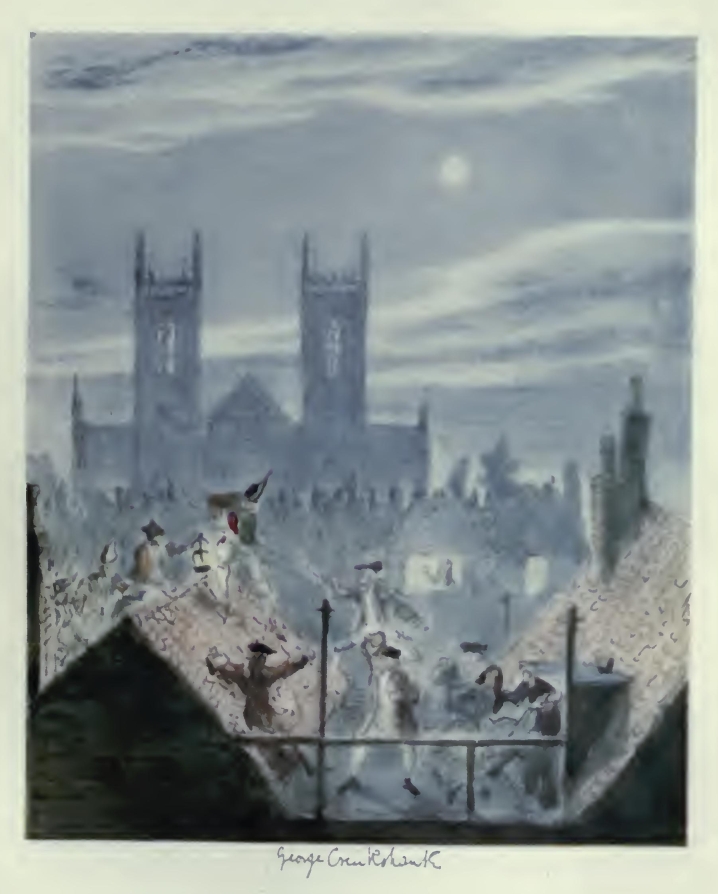
At length it was forced back, and all but Sir Norfolk and Firebras got through it. They were detained by the necessity that existed of guarding the trap-door. Unfortunately, there was no bolt on the upper side of it, so that they had to stand upon it to keep it down, and this plan being discovered by the officer below, he ordered two of his men to thrust their bayonets through the boards, while the tall grenadier tried to prize open the door with his halberd. The manoeuvre compelled Firebras and Salus-bury slightly to alter their position, to avoid being wounded by the bayonets, and in doing so, they necessarily gave admittance to the point of the halberd. The efforts of the assailing party were redoubled, and the trap slightly yielded.
‘Lose not a moment! fly, Sir Norfolk!’ cried Firebras, apprehensive lest the baronet’s deliberation, which he well knew nothing could shake, should prevent his escape.
But true to his principles, Sir Norfolk would not move an inch.
‘I cannot leave you in angusto,’ he said.
‘But I am the stronger of the two, as well as the more active,’ rejoined Firebras. ‘My weight will suffice to keep down the trap-door till you have got through the window, and then I can make good my retreat. Fly! fly!’
But Sir Norfolk continued immovable. ‘I shall be the last to quit this place,’ he said, in a tone of unalterable determination. ‘But do not, I pray you, tarry with me. The trifurciferous myrmidons of the Hanoverian usurper shall never take me with life.’
‘I must leave the punctilious old fool to his fate,’ muttered Firebras, observing that the greater part of the head of the halberd was forced through the side of the trap. ‘God protect you, Sir Norfolk,’ he cried, rushing to the window.
The brave old Welsh baronet essayed to hew off the head of the halberd from the staff—but in vain; and finding that the enemy must gain admittance in another moment, and that Firebras had cleared the window, he turned away and strode majestically towards it. His retreat was so suddenly made, that the grenadier who held the pike, and was prizing with all his force, lost his balance, and tumbled off the ladder, causing such confusion among his comrades, that Sir Norfolk had time to get through the window unmolested.
It was a beautfully bright night—the moon being at the full, and the sky filled with fleecy clouds. On the left lay ridges of pointed-roofed houses, covered with the warm-looking and mellow-tinted tile, so preferable to the cold blue slate—broken with stacks of chimneys of every size and form—dormer windows, gables, overhanging storeys and other picturesque and fantastic projections; and the view being terminated, at some quarter of a mile’s distance, by the tall towers and part of the roof of Westminster Abbey.
Viewed thus, the whole picture looked exquisitely tranquil and beautiful. The fires in the houses were almost all extinguished, and little or no smoke issued from the chimneys to pollute the clear atmosphere. Above the venerable and majestic fane hung the queen of night, flooding its towers—seen at such an hour to the greatest advantage—with silvery light, and throwing some of the nearer buildings and projections into deep shadow, and so adding to the beauty of the scene. On the right, the view extended over other house-tops to the gardens and fields of Pimlico. Behind was Saint James’s Park, with its stately avenues of trees, its long canal, and Rosamond’s Pond glimmering in the moonlight; while in front lay the New Artillery Ground, and the open and marshy grounds constituting Totnill Fields. But it will be readily imagined that neither Firebras nor his companions looked to the right or to the left. They were only conscious of the danger by which they were menaced, and were further discouraged by Father Verselyn, who at that moment scrambled over the roof they were about to cross, to inform them that the door by which they hoped to escape could not be got open.
‘Everything seems to have gone wrong! cried Verselyn in an ecstasy of terror. ‘What will become of us?’
‘Jacta est alea,’ replied Sir Norfolk composedly. ‘We must fight for it, father.’
‘Heaven and all its saints protect us,’ cried the priest, crossing himself.
‘Be composed, father,’ rejoined Firebras sternly. ‘You ought to be equal to any circumstances in which you may be placed.
The latter exclamation was occasioned by a joyous shout, announcing that their friends had succeeded in opening the door; and the next moment the good news was confirmed by Sir Bulkeley Price, who clambered over the roof to acquaint them with it. On hearing this the party instantly beat a retreat; and their flight was accelerated by the officer and the tall grenadier, who at that moment sprung out of the window. Even Sir Norfolk was urged to a little more expedition than usual; and two or three of his mighty strides brought him to the top of the roof. Cardwell Firebras would not have been much behind him, if Father Verselyn had not caught hold of his coat-tails to help himself up the ascent, which he felt wholly unable to accomplish without assistance. By this time the officer was well-nigh upon them; and, finding his summons to surrender wholly disregarded, he made a pass at the priest, which took effect in the fleshy part of his leg, restoring him at once to more than his former agility. Uttering a loud yell, and clapping his hand to the wounded limb to stanch the blood, Father Verselyn bounded over the roof, and made to the door through which the landlord and Mr. Travers had already disappeared, and through which Mr. Cripps was now darting. Between the two roofs lay a small flat space, used by its former proprietor as a place for drying clothes, as was evident from the four tall posts at the corners.
Here Firebras and Sir Norfolk came to a stand, resolved to dispute the passage with their pursuers. Sword in hand, and calling to them to surrender, the foremost officer dashed down the roof; but his precipitation placed him at the mercy of Fire-bras; for his foot slipping, the latter struck his sword from his grasp. Sir Norfolk, in the interim, had encountered another foeman with equal success. This was the tall grenadier, who, as he descended, made a thrust at the baronet with his halberd, which the latter very adroitly parried, and, lunging in return, disabled his adversary by a wound in the arm. At the same moment, too, the tiles gave way under the weight of the grenadier, and he sank above the knees in the roof. Other foes were now at hand. The second officer, carrying a lantern in one hand, and a drawn sword in the other, appeared on the roof; while the tall caps and bayonets of the rest of the grenadiers were seen above it. Though Sir Norfolk, whose blood was up, would have willingly awaited the advance of these new opponents, he yielded to the entreaties of Firebras, and followed him through the door, which was instantly secured behind them by a couple of strong bolts.
The house in which the Jacobites had taken refuge was expressly hired by them for an occasion like the present, and kept wholly uninhabited. The mode of communication between it and the Rose and Crown will, it is hoped, be sufficiently understood from the foregoing description. That so many unforeseen accidents should have occurred at a time when, if ever, things ought to have been in readiness, almost drove the poor landlord distracted; but if he could have watched Mr. Cripps’s manoeuvres, he would have speedily found out the cause of the delays. In the first instance, a penknife, dexterously slipped by the valet into the groove of the window, prevented it from moving, and had well-nigh, as has been seen, occasioned the capture of the fugitives. This difficulty having been overcome by the strenuous efforts of Sir Bulkeley and Mr. Travers, Mr. Cripps was the first to scramble through the window.
‘Which way?’ he cried to the landlord, who was following.
‘Over the roof, and to the door opposite,’ was the reply.
Nimbly as a cat the agile valet bounded over the roof, and instantly perceiving the door, made towards it. A key was in the lock; he turned it, took it out, and dropped it into the street below. He then began to shake the door violently, and shouted to the landlord, who at that moment came in sight.
‘Unlock it—unlock it!’ cried the host.
‘I can’t,’ cried Mr. Cripps; ‘there is no key. ‘Pon rep! we shall be all taken.’
‘No key!’ exclaimed the landlord. ‘Impossible! I saw it there this morning myself. It must have dropped down. Look about for it.’
Mr. Cripps feigned compliance, and the landlord coming up, poured forth a torrent of imprecations on finding his statement correct. Father Verselyn, as has been related, crept back to Firebras, while the others used their efforts to open the door. Nor were they long in effecting their purpose. Finding all other attempts fail, the landlord stepped back on the leads, and running to give additional impetus to the blow, dashed his foot against the door, and the lock yielded with a loud crash.
MR. CRIPPS ENCOUNTERING HIS MASTER IN MARYLEBONE GARDENS
Marylebone Gardens, it is well known, lay on the eastern side of the upper end of the lane bearing the same name—the whole of the country beyond Harley Street, which was not more than a third of its present extent, being open fields. They were of considerable size, and were originally laid out and planted at the beginning of the last century, at which time the public were gratuitously admitted to them. In one part of the grounds there was an excellent bowling-green, which drew many lovers of that most agreeable recreation to it. By degrees the gardens, being very conveniently situated, rose in repute; and in 1737, their proprietor, Mr. Gough, began to demand a shilling for admittance—this sum entitling the visitor to its value in refreshments. But still further improvements were effected. Orchestras, boxes, and a theatre for musical entertainments were erected within them. Besides the main walks, semicircular rows of trees were planted, and hedges contrived so as to form pleasing labyrinths for those who preferred privacy. Bowers and alcoves were built in different places; lamps were fastened to the trees, and at night, on the occasion of a fête, every part of the garden was illuminated with myriads of lamps of various colours. The company began to improve, and the price of admission was raised to five shillings. Fêtes of every kind were held here; and the place continued in vogue until nearly the end of the century with which its rise commenced. Malcolm mentions that a few trees, once forming part of Marylebone Gardens, were standing at the north end of Harley Street in 1808. But we fear not even a stump of one of them is now left. Carriages, coaches, and chairs were setting down their occupants at the entrance to the gardens as Mr. Cripps and his companion drew near. Never had Mrs. Nettle-ship seen a gayer throng—the dresses she thought magnificent. There was Lady Ancaster, whom Mr. Cripps pointed out to her, in a brocaded lutestring sack, with ruby-coloured ground and white tobine stripes trimmed with floss—the Countess of Pomfret, in a black satin sack flowered with red and white—Lady Almeria Vane, in a scarlet unwatered tabby sack—Lady Ilchester, in a white tissue flowered sack. All these ladies wore hoops; but none of them, Mr. Cripps assured his companion, managed this equipment with half so much grace as herself.
Throughout this stage of the business, Mr. Cripps had some difficulty in playing his part, and it required all his effrontery to enable him to go through with it. Having affirmed to his companion that he was an intimate acquaintance of all the ladies of rank he encountered, and in the habit of attending their routs and parties, he was under the necessity of sustaining the character, and kept constantly bowing and kissing his hand to them. In most cases he succeeded; for the ladies he addressed, deceived by his showy attire, which seemed to mark him as somebody, returned his salutations. Mrs. Nettleship was enchanted. To be attended by so fashionable a person, who knew all the beau monde, was supreme felicity. She would have given the world to be introduced to some of the fashionable ladies, and intimated as much to her companion; but he was too shrewd to attend to the suggestion, contenting himself with saying, with a very impassioned look, ‘I hope, my angel, that one of these days I shall have the honour of introducing you to my fair friends under another name.‘Twould make me the happiest of men—‘pon rep!’