HISTORY OF THE IRISH REBELLION IN 1798 AND EMMETT’S INSURRECTION IN 1803 (continued 3)
Reading edition
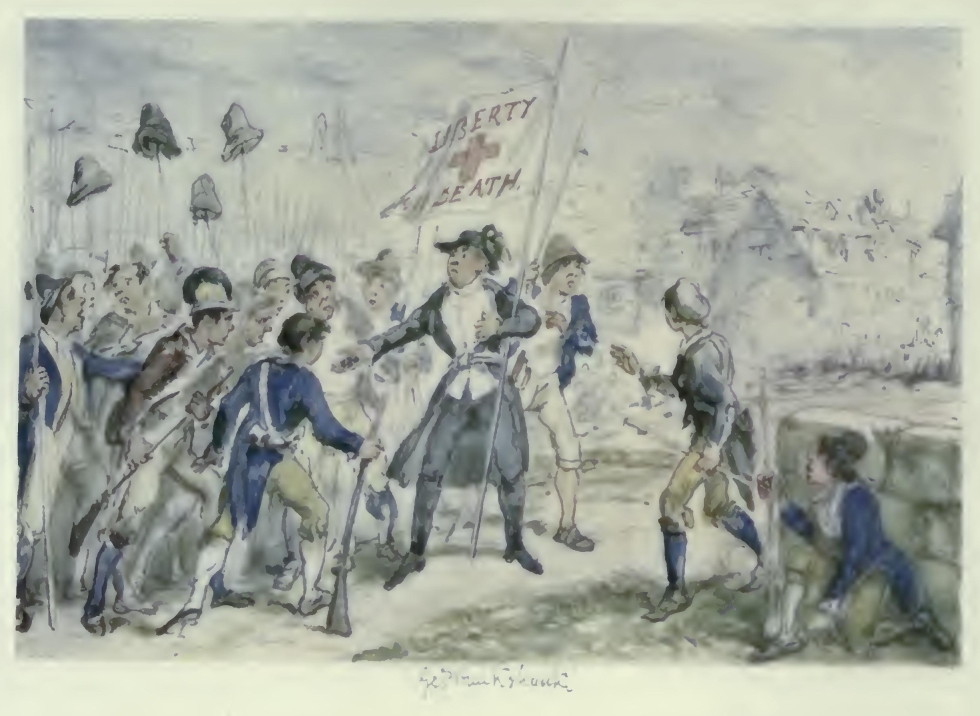

In the heat of action, on every repulse, and when his deluded followers retreated, Murphy of Ballycanoo had induced fresh victims to come forward, and, blinded against danger by whisky and fanaticism, they rushed on more than one occasion to the very muzzles of the guns. Were the fact not accredited beyond a doubt, it would not be believed that the drunken scoundrel persuaded the unhappy savages who obeyed his orders that his person was impervious to heretical balls, producing a handful of musket-bullets, which he averred had struck him during the action, or had been caught as they innocently whistled by. However potent the spell might be that saved the worthy churchman from lead, it proved inefficient against ‘cold iron.’ A round-shot from one of the Durham guns struck him down while leading these ignorant wretches to the charge; the ruffian went to his account, and his followers broke finally and disbanded. When the warlike Murphy fell he was but a few paces from the barricade, and was waving a banner over his head emblazoned with a huge cross and the motto of ‘Death or Liberty.’
THE BATTLE OF ARKLOW
The consternation which the intelligence of Walpole’s destruction occasioned in the metropolis may be easily imagined. Many families quitted the kingdom in despair. This, probably, was the gloomiest moment of that fearful period, but the unbounded loyalty and devotion of the Dublin Protestants shone out with increasing brilliancy, and assisted to dispel the gathering cloud.
In the metropolis the yeomanry amounted to nearly 4000 men, now armed, well disciplined, and purged from those traitors who, but a few weeks before, had thronged their ranks. With perfect confidence the city was intrusted to their protection, and from the few regular troops in garrison, the Cavan regiment, with a detachment of Reay Fencibles, were despatched to reinforce the troops in Wicklow, and enable the royalists to rally and recover the ground they had lost.
FATHER M. MURPHY OF BALLYCANOO AND THE HERETIC BULLETS
The troops were forwarded by carriages specially impressed, the command given to General Needham, and on the 6th of June the column quitted Wicklow, and after passing a deserted country and being joined by some yeomanry and armed loyalists, it entered Arklow early the same evening; some straggling rebels retiring from the town, where they had loitered, plundering and drinking, on the cavalry advanced guard appearing by the Dublin road.
The reception of the troops by the inhabitants was enthusiastic, for many, under fear of death, had already abandoned their houses to embark in fishing boats, and escape from a place which they expected to become an immediate scene of savage violence.
During the two succeeding days (7th and 8th of June) the commanding officer was engaged in making dispositions for the defence of the town and in selecting a position. Ground was marked out capable of being occupied by a body of troops so limited in number as the garrison; and while such fences were preserved as would afford cover to the royal light troops from which to annoy an advancing enemy, others that could neither mask their movements or interrupt the play of the guns were levelled and removed. Meanwhile the country was carefully patrolled, and alarm posts assigned to the different corps to take up on the rebels being reported to be in motion.
The morning of the 9th came. At noon a wing of the Durham Fencibles marched in under the command of an excellent officer, Colonel Skerrett, affording a well-timed and most effective reinforcement to the garrison, and, in consequence of this arrival, General Needham made a slight change in his dispositions, and never was a little army more curiously composed than the morning state of that of Arklow exhibited on the day of the attack upon the town.
As the evening came on, an advanced picket announced the appearance of the insurgents, and consequently an infantry outpost at the Charter-house was called in and replaced by a cavalry patrol, while by the two great approaches to the town—the seaside road and that leading to Coolgreney—dense masses were seen moving to the attack. By the former road one great column directed its march against the lower part of the town called the Fishery; by the latter an immense mass, under the command of Father Murphy of Ballycanoo, threatened the upper part of Arklow, and thus endangered the right and rear of the royalist position. To deploy their unwieldy masses appeared to be a task beyond the power of their leaders, for more than half an hour was consumed in the attempt, and when they did effect the change the line was irregular and disordered, at some parts merely in rank entire, and at others six files deep.
The royalists were already in position, the line being slightly curved, the flanks refused, and each protected by battalion guns, with two six-pounders nearly in the centre. The hedges were lined by the Suffolk and Tyrone Militia and part of the supplementary yeomen, with a small party posted in the churchyard and another at the bottom of the street which looked upon the bridge. These posts were occupied to defend the lower town. The barrack walls had been provided with a ‘banquette’ (a wooden stage attached to high walls, at an elevation which will allow the defenders to fire over the parapet), and supplied with musqueteers, while the upper end of the street was barricaded with carts and lumber, and defended by part of the Antrim regiment and a field-piece. Generally the cavalry were formed on the bridge and sands. Taking the local character of the place and the small number of its defenders into consideration, the disposition of the troops was very judicious and creditable to General Needham.
The actual strength of the rebel army was, on the lowest calculation, computed at 25,000 men, and on good authority it has been even raised to 31,000. About 5000 of the insurgents, were armed with firearms, and they brought two well-appointed guns into action. But it was not from their enormous numbers only that they were formidable. They came forward under the wildest enthusiasm, burning to exact vengeance for past defeats, and confident they must annihilate the small but daring body who, undaunted by a twenty-fold superiority, were steadily awaiting their attack. During the morning’s march from Gorey they plundered the houses of the Protestants of everything valuable, putting in requisition all the spirits and provisions that could be supplied; and, under the double influence of intoxication and fanaticism, were led on by their priests, who inspired them with ideas of their own invincibleness; because, as they assured the misguided wretches, they were engaged in the cause of heaven, and opposed to the enemies of God. To maintain that religious frenzy which was their great source of courage, at the end of every mile during the march their leaders said mass, and used every mode of exhortation and every superstitious device that priestcraft could invent. They advanced in an irregular line, which was frequently broken by their running out to file along the hedge-rows lying parallel to the position of the king’s troops, of the cover of which they endeavoured to avail themselves. Their front rank was composed of those who had firearms, and were mostly from the barony of Shelmalier, on the Wexford coast, where they subsist during the winter by shooting sea-fowl, which makes them expert marksmen. They were covered in the rear by the pikemen, many deep, while at certain intervals the line was strengthened by numerous masses of men, who were ready to supply the places of those who fell, or act as occasion might require. Each company had a green flag about two feet square, with a yellow harp in the centre, while some were parti-coloured, and equal in size to the king’s colours. Their leaders were distinguishable riding through the ranks, marshalling them and giving orders. During the engagement the rebels frequently repeated their dreadful yells, which heightened the terrific appearance of a numerous host of barbarians, who seemed confident, from superior numbers, that they could easily overwhelm the small army that opposed them.
The rebels advanced two guns by the Coolgreney road, under a sharp and destructive fire from those on the right of the Durham regiment, and the third in position at the barricade. Both of the former were dragged up by lanes on the high road and placed on high grounds, one looking on the centre of the royalist line, the other commanding its left flank.
Although tedious in their formation, the insurgent column directed against the lower town advanced so rapidly that they had nearly succeeded in cutting off a cavalry patrol, which saved itself, however, by swimming the horses across the Ovoca. Having fired the houses in the suburb, the rebels pushed on under cover of the smoke, but they never could gain the bridge, as the fire of the detached party, which covered that approach, and the second, which held the churchyard, cut down the head of the column, and finally disordered it so much as to allow the cavalry, formed on the sands, to charge with excellent effect. During a long and desperate struggle the troops behaved with a steadiness and determination which enabled them not only to secure the lower town, but to inflict a destructive loss upon the assailants.
But the grand effort of the insurgents was directed against the left and centre of the position and the barricade that covered its right flank. From behind the hedges the rebels kept up a steady and well-directed fusilade, and also commanded the royal line with such effect as to dismount a battalion gun and oblige Colonel Skerrett to advance his left wing and protect it behind a fence from the fire of a field-piece, which otherwise must have enfiladed it. The gallantry of the Durham Fencibles was unbounded. Thrice the rebels came forward in immense force against the wing of this noble regiment, and as often a destructive volley from their musketry, with grape from the battalion guns, obliged the assailants to recede from a fire they found intolerable. But, maddened by intoxication and encouraged by their ghostly leader, the deluded wretches again and again returned to the attack, and the General, despairing of repulsing the continued efforts of desperate savages, determined to yield the ground and abandon the position. Colonel Skerrett, well aware that to retire with a handful of beaten troops in the presence of five-and-twenty thousand men would lead to their total destruction, as sternly resolved to hold the post he had taken to the last; and an unforeseen event decided the fortune of this doubtful day, and crowned the gallant few with well-merited victory.
As long as the redoubtable Murphy of Ballycanoo—who hitherto seemed to bear a charmed life—remained to lead his demented and infatuated followers, all that the assailed could effect was to frantically hold their ground, their assailants continuing to rally after each repulse. It may be judged how critical was the situation of the defending royalists. Murphy, as described, had led his legions within a few paces of the barricade, and was encouraging his adherents by waving his famous banner of ‘Death or Liberty’ at the head of the advancing hordes he was leading to the charge, when a round-shot from one of the Durham guns struck him down; the invincibility charm was broken, and the rebels fled dismayed. About eight o’clock, when it was growing dusk, they began to retreat towards Coolgreney in an irregular and disorderly manner, carrying off nine cart-loads of dead and wounded. Had the cavalry but had sufficient daylight to have pursued them, they must have cut off great numbers in the retreat.
The loss of the rebels was said to have amounted fully to one thousand, while that of the royalists in killed and wounded did not exceed sixty or seventy.
Although night saved the rebels from any pursuit, and probably thus abated their losses extensively, as the wounded were enabled to crawl away, the moral effect of their defeat was incalculable, obliterating entirely the false confidence which the affairs at Oulart and Three Rocks and the calamity at Tubberneering had produced. The mischief occasioned by their first neglect of seizing Arklow when deserted by its garrison was consummated by the defeat attendant on the attempt on the part of the rebels to redeem their original error and carry the town when it had been rendered defensible. Had the insurgents not lost time at Gorey—had they advanced and seized Arklow—Wicklow and Bray must of necessity have fallen into their hands without the snapping of a flint. The metropolis, as Father Murphy’s intercepted letter revealed, assaulted by 100,000 reckless men, like the warlike priest’s followers, with the fourteen pieces of cannon at that time in their possession, joined in Dublin by the rising of a proportionate force similarly armed, might have effected their wicked object.
The effect of the defeat, and the deductive inferences from it, as drawn by Gordon as our authority observes, are interesting and correct:—
‘As the repulse at Arklow,’ writes Gordon in his History, ‘decided the fate of the rebellion, so it fortunately left undecided a question how far the Romanists would have carried religious animosity had the insurrection been successful. The violent acts of the insurgents at Gorey and its neighbourhood were not near so great as in the southern parts of the county. The former might, by an advocate of their cause, be coloured with a pretext of retaliation, since acts of the same kind had been committed by the loyalists, as the burning of houses, the quartering of men on families for subsistence, imprisonments, trials of prisoners by court-martial, the shooting of prisoners without trial, and the insulting of others by cropping the hair and covering the head with a pitched cap. But an opinion is entertained, I fear indeed with too much foundation, that if the town of Arklow had been taken, and thus a wide prospect opened for the success of the rebellion, the Protestants remaining in the power of the Catholic rebels in the county of Wexford were to have been massacred.
Many believe also that the persons excepted from the first massacre were destined for ultimate slaughter on the final success of the insurgents, and that even such leaders of the rebels as were Protestants were to be included in this proscription. The war from the beginning—in direct violation of the oath of the United Irishmen—had taken a religious turn, as every civil war in the south or west of Ireland must be expected to take by any man acquainted with the prejudices of the inhabitants. The terms Protestant and Orangeman were synonymous with the mass of the insurgents; and the Protestants they meant to favour had been baptized into the Romish Church by the priests of that communion. But whatever degree of religious bigotry or party hatred had been hitherto discovered by the insurgents, there were still many individuals who evinced the greatest humanity in their endeavours to mitigate the fury of their associates.’
CAPTURE OF VINEGAR HILL
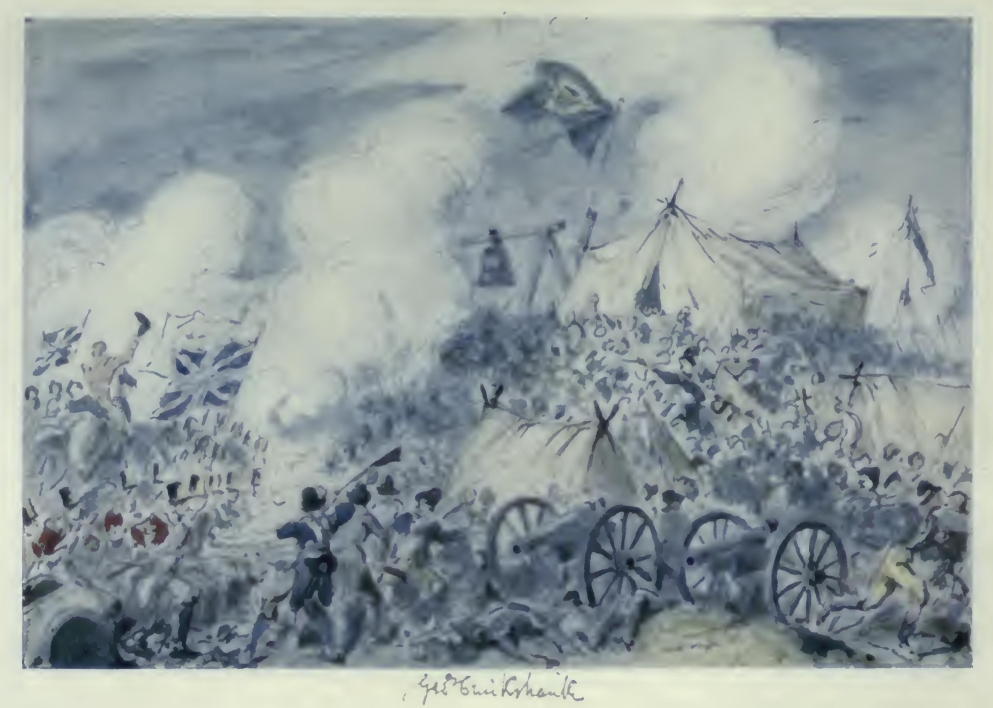
The fatal effects of the defeat at Arklow in the subsequent fortunes of the insurrection became every day more apparent, and during these transactions the rebels who remained at Gorey and its neighbourhood were gradually dispersing. ‘A part of them retired to Wexford, bringing with them the prisoners who had been confined in the market-house of Gorey. These had been severely treated; they had been supplied with food only once in the twenty-four hours, cropped, pitch-capped, and exposed from the windows to the insults of the shouting multitudes on their march to attack Arklow, while many had been shot or piked to death. As the mass of remaining rebels had taken their station on the hill of Ask, only a mile from Gorey, after the battle of Arklow, the royal army remained some days close within its quarters, sending out patrols with caution, at first to a very small distance, and afterwards gradually advancing further. At last a troop of yeomen cavalry ventured so far on the road towards Gorey as to approach the rebel station on Ask hill, and found the post had been so thinned by perpetual desertions that not more than about a hundred men fit for action were then remaining in it, and these without a leader.’
For every reason, military and political, it was now unanimously determined by the royalist commanders that the relief of Wexford and Enniscorthy, so long and so unhappily in possession of the rebels, must be preceded by the capture of the camp and a total dispersion of the insurgent bodies collected on Vinegar Hill. To effect this difficult but desirable object a vigorous and well-combined attack would be required, and on the 16th of June the preparatory movements of the different corps were arranged by General Lake; to Generals Dundas, Needham, Johnson, Sir Charles Asgill, Wilkinson, Sir James Duff, Loftus, and Moore were assigned plans of operations covering three or four days; some of these movements were delayed from various eventualities, and two brigades were unfortunately absent at the final assault on Vinegar Hill. As the attack was to be made immediately after daybreak on the 21st, and as it was utterly impossible that by any exertions his wearied troops could reach their ground in time, Needham despatched an aide-de-camp to the Commander-in-Chief requesting the advance to be delayed for an hour, to allow him time to get up; but General Lake could not postpone his movements against the rebel position, as an immediate assault upon the camp was absolutely necessary to prevent the enemy from detaching reinforcements to their friends at Enniscorthy, who were then warmly engaged with Johnson’s brigade. Under these circumstances General Needham, finding it impossible to get the column up, very properly pushed his cavalry forward; and when the rebels broke upon the hill, they were sufficiently advanced to cut down a number of the fugitives. General Sir James Duff, who advanced by the Ferns road, with his right resting on the Slaney and his left flanked by the light infantry under General Loftus, reached the base of the hill with occasional interruptions from rebel pickets, who occupied the high grounds on the line of march, but who were easily dispersed by a few shells from the howitzers. Previous to commencing his ascent he detached General Loftus with the light infantry and guns to seize an eminence which overlooked the lower line of the rebel position, and consequently laid it open to a cannonade at easy range. The movement was rapidly effected, and although the enclosures were numerous and the ground steep, General Loftus, by breaking down the stone fences, was enabled to get his artillery forward, and, crowning the height with his guns, he opened them with excellent effect upon crowded ranks, which were completely enfiladed. The remainder of Duff’s brigade pressed steadily up the hill, and at the same time the columns of Generals Lake, Wilford, and Dundas, with Campbell’s light companies, ascended the south-eastern face, while Johnson’s brigade mounted from Enniscorthy.
As the troops advanced they sustained a sharp fire from the rebel marksmen, who, acting en tirailleur, lined the numerous enclosures and disputed them with some spirit. The rebel cannonade was ineffective, although they had thirteen pieces of various calibres on the hill, but their musketry was well sustained, and yet, with all the advantages of a strong position, the loss inflicted on the assailants was infinitely less than could have been anticipated. The steady advance of the troops was never for a moment checked, and the movements of the columns so admirably timed that they crowned the hill simultaneously, while the rebels, availing themselves of the means of retreat which General Needham’s failure had unluckily left open, went off en masse, abandoning their cannon, ammunition, and all the plunder that had been accumulated during the period they had occupied their savage and sanguinary encampment.
If the wholesale destruction of a deluded multitude were a desirable object, certainly the failure of this movement is to be lamented, for the rebels were enabled to get off bodily, whereas had Needham reached his ground they must have been so totally derouted that no exertions could have rallied them again, and the flame of rebellion would have been extinguished. But the results of his failure, and not the cause, were severely tested at the time, and the General was censured with injustice for a miscarriage, occasioned by circumstances entirely beyond control, and of everyday recurrence in war.
The brunt of the action, and the greatest proportion of the loss, fell upon the brigade commanded by General Johnson (afterwards Sir Henry Johnson, G.C.B., who may be said, in the rebellion of 1798, to have been the military saviour of Ireland). On the evening preceding the attack on Vinegar Hill, that General advanced within a mile and a half of Enniscorthy, intending to bivouac in the vicinity of the rebel position, and bring his column fresh into action the next day. The troops had scarcely, however, piled arms when the rebels in great force issued from Enniscorthy and moved forward with the apparent intention of attacking the royalists and hazarding a general action. They advanced in close columns, covered by a number of sharpshooters, and connected by several bodies, formed in irregular lines. The rebel skirmishers, after maintaining a sharp fusilade, were speedily dislodged by the fire of the cannon, and, falling back on the supporting column, which had halted on an eminence half a mile from the ground occupied by the royalists, the guns were directly turned upon the height.
On this occasion these unfortunate and deluded men evinced an ignorance of warlike missiles which can hardly be conceived. As the round shot from the guns bedded themselves in the face of the hill against which they had been directed, the rebels rushed in numbers to pick them up. A shell from a howitzer falling, it was exultingly surrounded by a crowd of men, each struggling to become owner of this god-send. The effect of the explosion may be fancied, as when the fuse reached the powder, more than fifty of the ignorant wretches were furiously contending for the possession of the lighted shell.
According to Taylor’s History, ‘Here they were cannonaded, and on seeing the shells they were driven into the utmost confusion, as they could not conceive what they were, some shouting in a kind of delirium (as shell followed shell), “They spit fire at us”; others, “We can stand anything but these guns which fire twice!” Indeed the carnage occasioned by them was very great, and fully answered the end.’
The night passed, and at daybreak Johnson drove the rebels from the height and forced them back upon Enniscorthy. After halting an hour, to allow the general attack upon the hill to operate as a diversion and employ the main body of the enemy, Johnson pushed his column into the town. On this occasion the rebels made a stubborn resistance, their pikemen disputing the streets and their musketry firing upon the advancing troops from the windows. Every yard was stoutly contested, and a six-pounder, advanced into the open space before the court-house, was carried by a sudden rush, the gunners killed, and the piece captured by the pikemen. But it was immediately retaken; the bridge was cleared of the enemy, the Dublin regiment cheered and pressed up the hill, and although that ascent was the steepest, the brave old man reached the summit as the other columns cleared it.
The royalist casualties were comparatively trifling, and the rebel loss fell infinitely short of what might have been expected from a déroute so complete as that which followed the loss of their favourite position. As the greater number of the insurgents were cut down dispersing in the pursuit, the amount could not be correctly estimated. Probably three or four hundred might have been slain. One of their favourite generals, a church-militant leader, was included in the casualties of the day, for Father Clinch of Enniscorthy was killed while retreating after the action.
There is a military criticism which is placed here while summarising the results of this action. It is given in the M.S. Journal of a Field Officer:—‘There is one point which has never been explained to my satisfaction. After the defeat at Vinegar Hill the main body of the rebels retreated to Wexford, where they divided—one column crossed Wexford bridge, and made their way to the north of the county about Gorey; now this body must have been due north while General Lake was moving due south from Vinegar Hill upon Wexford, so that they must have actually passed each other at a distance of not six miles between the parallel roads, as a glance at the map will show. Perhaps General Lake did not consider himself strong enough to divide and occupy both roads to Wexford, or perhaps he might have thought “the stag at bay’s a dangerous foe,” and permitted them to weaken themselves by allowing them to quietly disbandon. It cost, however, much loyal blood at Gorey.’
REBELS EXECUTING THEIR PRISONERS ON THE BRIDGE AT WEXFORD
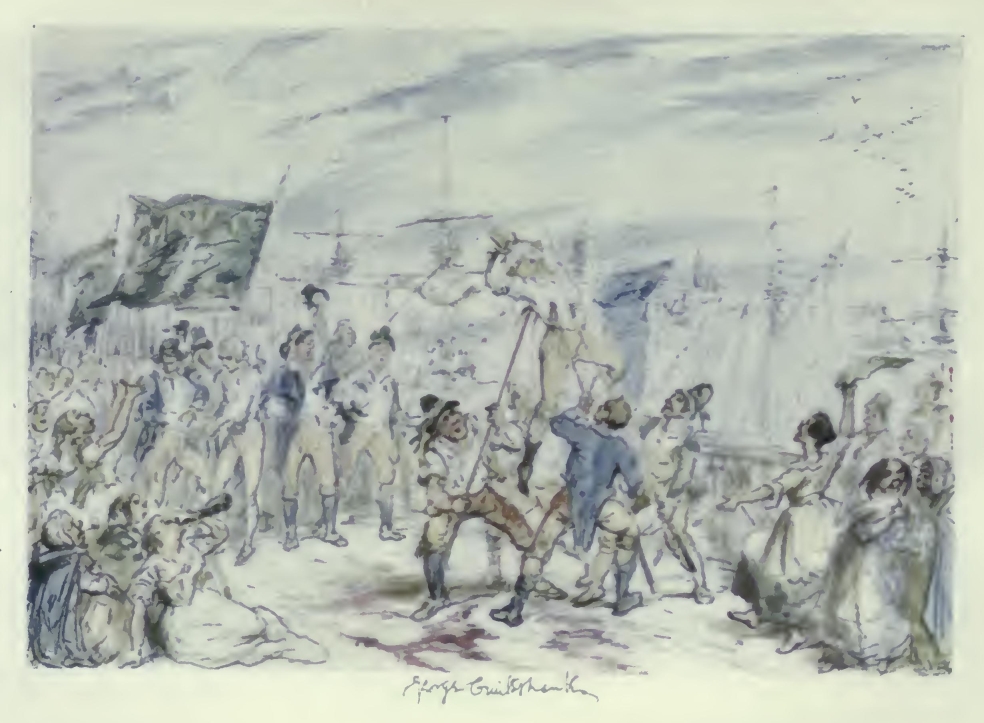
Wexford was a scene of unexampled horror, where were enacted the most sanguinary barbarities in emulation of the bloodthirsty atrocities of the reign of terror; nor can it be an excuse that the monsters avowedly imitated those terrorising scenes which were made luridly familiar by the annals of the French Revolution.
The plunder of houses and the incarceration of their innocent victims after the unfortunate defeat of the Meath detachment at the Three Rocks, which determined Colonel Maxwell’s fatal retreat from Wexford, immediately occupied the insurgents.
While the rabble were engaged in collecting numbers of ill-fated Protestants for future slaughter, the leaders went through the mockery of establishing a provisional government, and, in imitation of the French Jacobins, a grand national committee, a council of elders, and a council of five hundred were to be organised forthwith, while the dwelling-house of a wealthy merchant was put into requisition as a senate-house, wherein the different estates were to legislate for the young republic.
If it were necessary to prove the fallacy that any possibility exists of retaining influence over a sanguinary and superstitious mob by any means but acting on their ignorance or pandering to the worst passions of brutal dispositions, the rebel occupation of Wexford would afford an ample evidence, and the president of the council and the governor of the town, in their own sad stories, tell that the baser the materiel of the mob, the briefer is the authority of those who undertake the direction of its movements. Every day during the rebel occupation of the town and adjacent encampments, fresh victims continued to be brought in by the savage pikemen. In Wexford a small sloop, the town jail, and subsequently the market-house, were filled with unhappy sufferers. A reign of terror had commenced, the rabble power had become predominant, and all persons of superior rank or a different faith were denounced by wretches who associated crime with religion and slaughtered in the name of God. The chiefs themselves, particularly those few among them who had been educated in the Protestant religion, were in perpetual danger of death or violence from an ungovernable multitude, whom they had unwisely hoped to command.
With such feelings and dispositions it will be a subject of regret, but not surprise, that now the ferocity of the rabble resisted all control and blood alone could appease it. The death decree of the wretched prisoners went forth, and the fearful story of the massacre is recorded by one who miraculously escaped the fate of his less fortunate companions. It is a fearful record of butchery, and, alas! the statement is not over-coloured. The leading monster of these executions was Thomas Dixon, a relative of the priest, and he may well be described as a fiend in human form.
On the 19th of June the Protestants in Wexford received the heart-rending intelligence that all the prisoners were to be murdered the next day. That night also, one of them, while sitting alone in silent sorrow, heard the death-bell toll as loud as ever she heard it, and much more awfully. On the following morning, the never-to-be-forgotten 20th of June, Thomas Dixon rode to the gaol-door and swore that not a prisoner should be alive against sun-set. He then rode into the street repeating the same, with horrid imprecations, adding ‘that not a soul should be left to tell the tale.’ Good God! how shall I proceed? neither tongue nor pen can describe the dismal aspect of that melancholy day,—a day in which the sun did not so much as glimmer through the frowning heavens. The town-bell rang, and the drums beat to arms to assemble the rebels for the purpose of joining those at Three Rocks to march against General Moore’s brigade. In the evening Dixon assembled the murdering band, and immediately hoisted that harbinger of destruction, the Black Flag, which had on one side a bloody cross, and on the other the initials M.W.S., that is, ‘murder without sin,’ signifying that it was no sin to murder a Protestant. Having paraded for some time to give more solemnity to the scene, the Protestants who were confined in the gaol and prison ship were led forth to the slaughter, and conducted to the bridge under a strong guard of merciless ruffians, piked to death, with every circumstance of barbarous cruelty, and then flung into the river to leave room for more! While this work of blood was going on, a rebel captain ran to the Popish bishop and entreated of him ‘for the mercy of Jesus’ to come and save the prisoners. The bishop coolly replied that ‘it was no affair of his.’ All this time the sanguinary pikemen continued butchering the poor victims on the bridge; some they perforated in places not mortal, to prolong and increase their torture, others they would raise aloft on their pikes, and while the miserable victim writhed in extreme agony, his blood streaming down the handles of their pikes, they exulted round him with savage joy. In the midst of this terrific scene General Edward Roche galloped up in great haste and commanded the drums to beat to arms, declaring that Vinegar Hill was nearly surrounded by the king’s troops, and that all should repair to camp, as reinforcements were wanting. This express had a wonderful effect; the assassins instantly closed the bloody scene and fled in all directions. Some of the rebel guard returned soon after and conveyed the prisoners back to gaol. But that sanguinary monster, Thomas Dixon, returning, he soon evinced that his thirst for blood was not yet satiated by ordering out the remainder of the prisoners from the gaol and prison ship, the greater part of whom were tortured to death in like manner as the former. He then proceeded to the market-house, and having fixed his vulture eye on others, dragged them to the fatal bridge for execution. After butchering these, a lot of ten more was brought forth and barbarously murdered. The third time they took out eighteen, and were massacring them when Dick Monk rode into town from Vinegar Hill, with his shoes and stockings off, and shouted, ‘D—n your souls, you vagabonds, why don’t you go out and meet the enemy that are coming in, and not be murdering in cold blood?’ Some Protestant women followed him and asked him, ‘What news?’ He replied, ‘Bad news, indeed; the king’s forces are encamped round Vinegar Hill.’ He then rode towards the convent. Shortly after, Priest Collin was seen running towards the bridge. There were six of the poor Protestants killed out of the last party that were taken down before he arrived, and it was with great difficulty he prevailed on them to spare the rest. After using all the arguments he could, without effect, he at length took off his hat and desired them to kneel down and pray for the souls of the poor prisoners before they put them to death. They did so, and having got them in the attitude of devotion, he said, ‘Now pray to God to have mercy on your souls, and teach you to show that kindness towards them which you expect from Him in the hour of death and in the day of judgment!’ This had the desired effect; he led them off the bridge without opposition, and they were sent back to confinement. The massacre of that day ceased about eight o’clock in the evening. Out of forty-eight prisoners who had been confined in the market-house, nineteen only escaped.
Nor were these dreadful cruelties confined to the town alone. In their camps, and on their marches and retreats, the same execrable barbarities were constantly committed. No exaggeration can be imputed to those who escaped death, and afterwards described the sufferings they had undergone; for the dying confessions of many who were actors in those scenes of blood, and afterwards paid the penalty of crime, corroborated the statements of those who had been their prisoners, and confirmed their truth.
Jackson’s Narrative affords further dreadful details of the Protestant martyrdoms enacted on Wexford bridge:—
‘They thus continued till about seven o’clock to convey parties of prisoners, from ten to twenty, from the gaol, the market-house, and the prison ship, where many of them were confined, to the bridge, where they butchered them. Every procession was preceded by the black flag, and the prisoners were surrounded by ruthless pikemen, as guards and executioners, who often insultingly desired them to bless themselves.
‘The mob, consisting of more women than men, expressed their savage joy on the immolation of each of the victims by loud huzzas.
‘The manner in general of putting them to death was thus: Two rebels pushed their pikes into the breast of the victim, and two into his back; and in that state (writhing with torture) they held him suspended till dead, and then threw him over the bridge into the water.
‘After they had massacred ninety-seven prisoners in that manner, the insurgents were taken off their blood-thirsty work by the cry “to camp! to camp!”’
Musgrave, in the Appendix to his Memoirs, relates:—‘After taking possession of Enniscorthy they planted the Tree of Liberty, with shouts of “Vive la République” and “Erin go Bragh!” Here the work of blood immediately began, and continued every day, more or less, for twenty-five days—a dreadful specimen of what might be expected from such a government. One day they were so diabolical as to murder all the Protestants they had; and not satisfied with this, they sent to Wexford for more, and every day parties ranged the country, dragging forth all they could find, to satiate their thirst for blood.’
It is said that not less than four hundred Protestants were massacred in Enniscorthy and on Vinegar Hill, the bodies of whom lay unburied during several days.
Meanwhile, the final scene of the tragic occurrences promised to equal, and perhaps exceed, the terrible events which had preceded it. There is little doubt that a general and unsparing massacre of the Protestants had been resolved upon; and although, assisted by an alarm that their camp was being attacked, the Catholic bishop and clergy had induced the greater number of the insurgents to quit the town, still the most ferocious wretches remained, and seemed determined to conclude a period of anarchy and terrorism by a scene of indiscriminating slaughter.
During the confusion which the precipitate flight of the rebels occasioned (when they proposed to fire the town, only had no time!), the bloody Thomas Dixon, mounted on a very fine horse, rode through the streets with a broad sword drawn and upbraided the rebels for their timidity and their dilatoriness. ‘If you had followed my advice,’ he said, ‘in putting all the heretics to death three or four days ago, it would not have come to this pass.’ Mrs. Dixon—a worthy mate of her sanguinary husband—who accompanied him on horseback with a sword and case of pistols, clapped the rebels on the back and encouraged them by saying, ‘We must conquer; I know we must conquer!’ and she exclaimed repeatedly, ‘My Saviour tells me we must conquer!’ They repaired to the bridge to stop the retreat of the rebels, but in vain, though Mrs. Dixon drew a pistol and swore vehemently ‘that she would shoot any one who would refuse to return with her to put the remainder of the heretics to death!’ They endeavoured to raise the portcullis of the bridge to prevent retreat, but were unable to do so.
It has been said that the butcheries on Wexford bridge were perpetrated by a small section of the insurgents, kept by that sanguinary monster, Thomas Dixon, in a state of constant drunkenness, and ever ready to execute his ruthless orders. Every means were used by the ruffian to play upon the credulity and excite the worst passions of his followers, and his fiendish inventions to irritate a brutal mob appear almost incredible.
The approach of Moore’s brigade, however, freed Wexford from the banditti who infested it to the last moment, and averted the intended massacre. ‘Captain Boyd, the member for the town, and commandant of a corps of mounted yeomen, having ascertained that the great body of the rebels had returned, asked and obtained permission from General Moore to enter Wexford, and announce that the army was on its march to occupy the place. Attended by only a dozen mounted yeomen, Captain Boyd galloped down the streets, proclaiming to the inhabitants their deliverance. At five in the evening Moore’s brigade arrived at the heights commanding Wexford, and bivouacked on the Windmill Hill, while a wing of the Queen’s regiment marched into the place and took military possession. Description fails in attempting to set forth the emotions which arose in the breasts of the poor Protestants who had been doomed to destruction. Many wept with joy to see their deliverers.’
The Wexford prisons had been scarcely emptied of the Protestant prisoners who had occupied them until they were tenanted by those who had lately been the directors of the insurrection. General Lake arrived on the 22nd, and took up his quarters in the house of Captain Keugh, the ex-governor, the latter exchanging his former domicile for a jail.
SUMMARY FATE OF THE INSURRECTIONARY CHIEFS
While some of the rebel chiefs endeavoured to evade the first outbreak of the royalist excitement by seeking a temporary security in concealment, others, under the persuasion that the negotiations between the Wexford leaders and the commanding officers of the troops would lead to a general amnesty, or, perhaps, in the desperation of their circumstances, remained in their respective homes, and quietly awaited the fate they knew to be impending. Grogan had retired to his mansion at Johnstown, while Harvey repaired to Bargy Castle, from whence, as a peace-offering, he sent some fat cattle to the commanding officer in Wexford. On the return of the messenger he found that to the chiefs of the insurgents mercy would not be extended, and quitting his house, never to revisit it, he set out to join a fellow-unfortunate, who had vainly endeavoured to remove himself beyond the reach of the vengeance of the outraged laws.
Colclough, with his wife and child, had sought a temporary asylum in one of the Saltee Islands, about six leagues from Wexford; with some valuables hastily collected, and a few necessaries to maintain life, they had hidden themselves in a cave, of which the entrance was artfully concealed. There Harvey joined the unhappy fugitives; and chiefly through the indiscretion with which he had neglected to keep his fatal visit secret, the whole party were arrested, brought back, and committed to close custody.
THE CAPTURE OF COLCLOUGH AND HARVEY
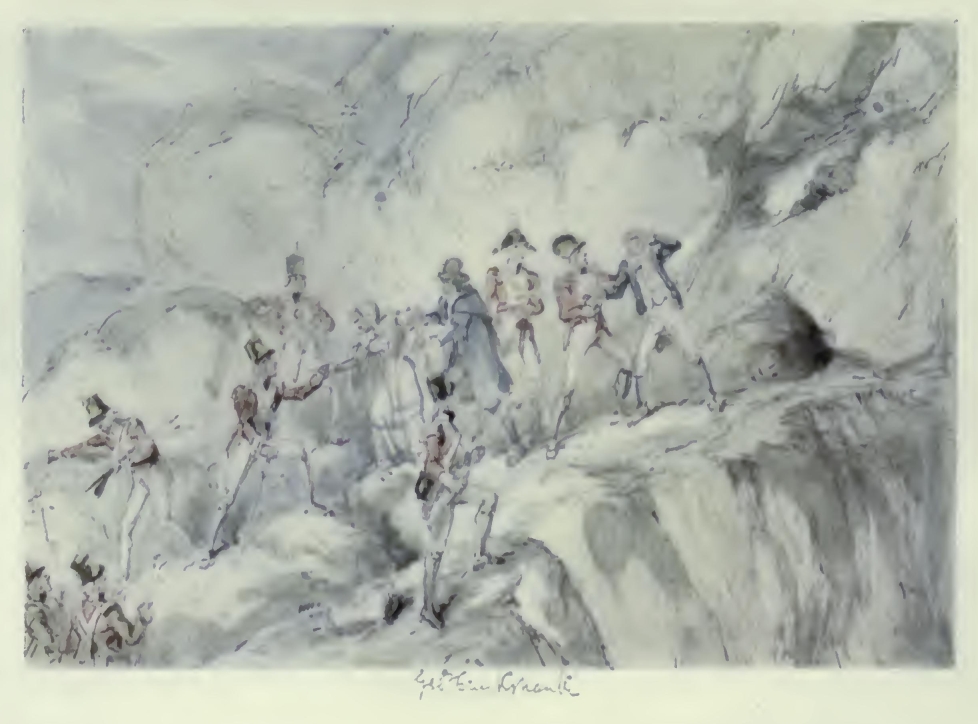
To these unfortunate gentlemen, John Colclough of Ballyteigue and B. Baganel Harvey of Bargy Castle, late commander-in-chief of the Wexford insurgents, a melancholy interest is attached; and the retreat selected by the hapless fugitives has an air of romance that makes it interesting. The subject of George Cruikshank’s realistic illustration of this picturesque incident is founded upon the account given in Musgrave’s Memoirs:—‘The arrest of B. B. Harvey and John Colclough was attended with some curious circumstances which I shall relate. On the flight of the rebels from Wexford, the 21st of June, they retreated to the largest of the Saltee Islands, which Mr. Colclough rented from Mr. Grogan. Dr. Waddy, a physician who served in the yeomanry, having got intelligence of their retreat, applied to General Lake for a proper party and armed vessel to go in quest of them, which he readily obtained.
‘About three o’clock on Sunday evening, the 23rd of June, he set sail in the Rutland cutter of ten guns, commanded by Captain Willoughby, with Lieutenant Turner of the Queen’s, a detachment of his regiment, and a man-of-war’s boat with a party of sailors well armed. The island is about six leagues from Wexford, and four or five miles from the southern coast of the country. The weather was so tempestuous that they were obliged to reef their sails; and the wind being adverse, they did not descry the island till about four o’clock in the morning, and could not cast anchor alongside till eight. When they were approaching it they saw a small boat pass from the island to the mainland. As it is surrounded with high precipices, and is accessible but in one place, and as they expected to be opposed by a party of armed rebels, who, it was believed, had accompanied Harvey and Colclough, Captain Willoughby prepared to cover their landing with the cutter’s guns, and they were attended for the same purpose by the man-of-war’s boat. On landing they repaired to the only house on the island, occupied by one Furlong, who rented it from Mr. Colclough. They found there an excellent feather-bed, with fine sheets which were warm, a handsome tea equipage, some genteel wearing apparel belonging to both sexes, particularly a pair of pantaloons, which Dr. Waddy had seen on Mr. Colclough before the rebellion; and, near the house, some silk shoes and other articles hid in high ferns. They searched every suspected spot in the island, particularly a place called the Otter’s Cave, but in vain, though they had not a doubt of their having been there, as they had found, among other things, a chest of plate in a concealed place belonging to Mr. Colclough. The doctor resolved to make another effort by going round the island in a boat, for the purpose of reconnoitring the sides of it. In doing so he perceived on the edge of a high precipice one rock lighter coloured than the adjoining one; and, as the earth near it seemed to have been recently stirred, he suspected that they had been making preparations there for their concealment. He therefore again ascended the island, and found that the approach to the place which he wished to explore was steep, serpentine, and through some crags. The light-coloured stone covered the mouth of the cave, and above it was an aperture to let in the light. The doctor called out to Colclough and told him that if he did not surrender immediately, and without resistance, he should receive no quarter. Colclough asked, “Is that Dr. Waddy?” and on his saying “Yes,” he said he would surrender; and soon after he, at the doctor’s desire, gave up his arms through the hole of the cave. The doctor threw down the precipice the stone which covered the mouth of it, which fell with a monstrous crash; on which Mr. and Mrs. Colclough came forth, dressed in the meanest habits of peasants for the purpose of disguising themselves. Then Mr. Harvey came out saying, “My God! my God!” and so pale and weak from fatigue and anxiety of mind that the doctor was obliged to support him. He also had a chest of plate concealed, which he gave in charge of the doctor and his party.’
There was little of romance about the sequel; these unfortunates were simply led off by their captors direct to the scaffold. The prisoners were arraigned on charges of high treason, and tried by a court-martial. Among the first to suffer were Father Philip Roach, Captain Keugh, who deserved a better fate,—he had served his king in America,—and Esmond Kyan, rebel captain of artillery. The executions took place upon the bridge, and they were hurried over with little consideration to the last moments of the dying, or to the feelings of relations who survived them. Roach was a tall and weighty man, and, on being suspended, the rope broke, and he fell to the ground, stunned and stupefied. Another halter was immediately procured; he thus suffered the last penalties of the law, it might be said, twice over. After death the sufferers were decapitated, the mutilated bodies cast into the river, the heads placed upon spikes on the Sessions-House, exposed to public view, thus calling into operation again one of the most disgusting remnants of feudal severity upon offenders against the State.
Harvey’s trial commenced on the same evening; he appeared to be much agitated, and spoke little. It came out in evidence that he acted as commander-in-chief of the rebel forces at the battle of Ross on the 5th of June, and his letter to the commander-in-chief of the king’s troops, signed ‘B. B. Harvey,’ summoning him to surrender the town to the rebels, was produced in evidence on the trial, and acknowledged by Mr. Harvey to be in his handwriting. The unhappy man produced many witnesses in his defence, but none to disprove the main facts. He did not deny having acted as commander of the rebel forces, but endeavoured to extenuate his conduct by saying he had accepted the distinction to prevent much greater evils, which must have occurred had it fallen into other hands, and in the hope of surrendering that command one day or other, with greater advantage to the country. He had no counsel, and, after a trial which lasted eight hours, was found guilty of death; which sentence, with that of Grogan, was put into execution on the morning of the 28th. His head was cut off and placed on the Sessions-House and his body thrown into the river. On the same evening was executed John Colclough of Ballyteigue. He was a gentleman of great respectability, and bore a very good private character. On this occasion the entreaties of his widowed partner were attended to, mutilation was dispensed with, Mrs. Colclough received the body of her husband, and in the poet’s words
She laid him in his father’s grave,
and had the melancholy satisfaction of giving sepulture to the body of a beloved husband.
THE ATTACK ON CAPTAIN CHAMNEY’S HOUSE, BALLYRAHEENE
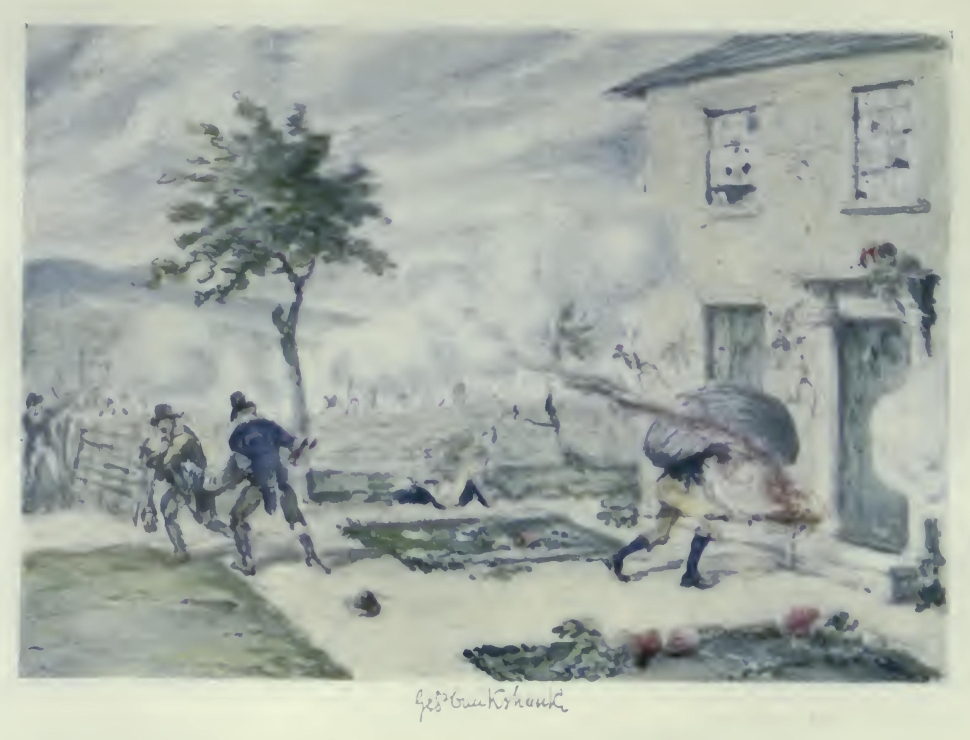
The tide of rebellion was ebbing fast, dissension prevailed in their councils, the leaders disagreed, and the Wexford men separated from those of Wicklow, the latter, under Garret Byrne of Ballymanus, moving off to the hill of Ballyraheene, nearly midway between Tinehaly and Carnew. Here another error in judgment occasioned an unnecessary loss of life. The yeomanry had pursued the rebels closely, but the latter gained the high grounds and formed in a very strong position. The numbers were enormously disproportionate, and every prudential consideration should have discouraged an attack. Some of the yeoman officers were of opinion that their troops ought to halt, and that they should content themselves with watching at a safe distance the movements of the enemy. Contrary opinions prevailing, an attack was made up the hill, when the rebels, who had wished to avoid a battle, rushing down, put the royalists to flight, killing ten of the infantry, but the cavalry escaped. Two officers fell in the beginning of this action, Captain Chamney of the Coolattin company, and Captain Nickson of the Coolkenna company, both greatly lamented. George Cruikshank’s picture vividly represents the situation of Captain Chamney’s house at the critical point of the siege, which saved a portion of this unfortunate loyalist force. ‘The slaughter,’ records Gordon, ‘would have been far greater if sixty of the infantry, under Captain Morton and Lieutenant Chamney, had not taken refuge in Captain Chamney’s house at the foot of the hill, where they sustained during fourteen hours the attacks of the rebels, who attempted repeatedly to fire the house. Some—particularly a very large man from Gorey named John Redmond, nicknamed “Shaun Plunder”—advanced under a covering of feather-beds to the hall door, with the design of burning it, and thus opening a passage into the house; but they were killed in the attempt, the bullets penetrating even this thick tegument. As a discharge of musketry was maintained from the windows on the assailants, whose associates injudiciously set fire to the neighbouring house of Henry Morton (the owner being among the defenders of Captain Chamney’s house), the illumination enabled the garrison to aim at their enemies in the night, and the loss of the rebels was very considerable, amounting according to some accounts to a hundred and thirty men, by others, to two hundred.’ This ill-judged affair occurred on the 2nd of July.
It has been described how Wexford was by the success of the king’s forces ultimately liberated from the masses of its insurgent population. We have stated that the scene of their predatory warfare was changed from their native county to Kildare, and that they were reinforced by the insurgents commanded by Michael Reynolds. The junction produced little advantage, except in increasing the numbers of a tumultuary rabble, in whom there was neither unity of purpose nor any fixed plan of future operations. Every leader had some object of his own, none a particle of military talent, and their strategic conceptions were as erroneous as the execution was feeble and contemptible.
Anthony Perry, another rebel general, despairing of doing any mischief in Wexford, now so well defended, where the insurgent forces were too dispirited to longer struggle in a body against the royalists and yeomanry, when joined by a strong body under the command of Michael Aylmer, intended to penetrate into the north of Ireland, where he expected to meet with a cordial co-operation. But Aylmer prevailed on Perry to abandon his intention, and declared that it was more advisable to attack Clonard, a town on the confines of Kildare and Meath, and situated on the river Boyne, as there was but a small force to defend it; and afterwards march by Kilbeggan to the Shannon, and surprise Athlone, where, from its central position, great advantages might be expected to arise. This plan was accordingly adopted; and their united forces, amounting to four thousand men, on the 11th of July marched to the attack of Clonard.
THE REBELS STORMING ‘THE TURRET’ AT LIEUTENANT TYRRELL’S, CLONARD
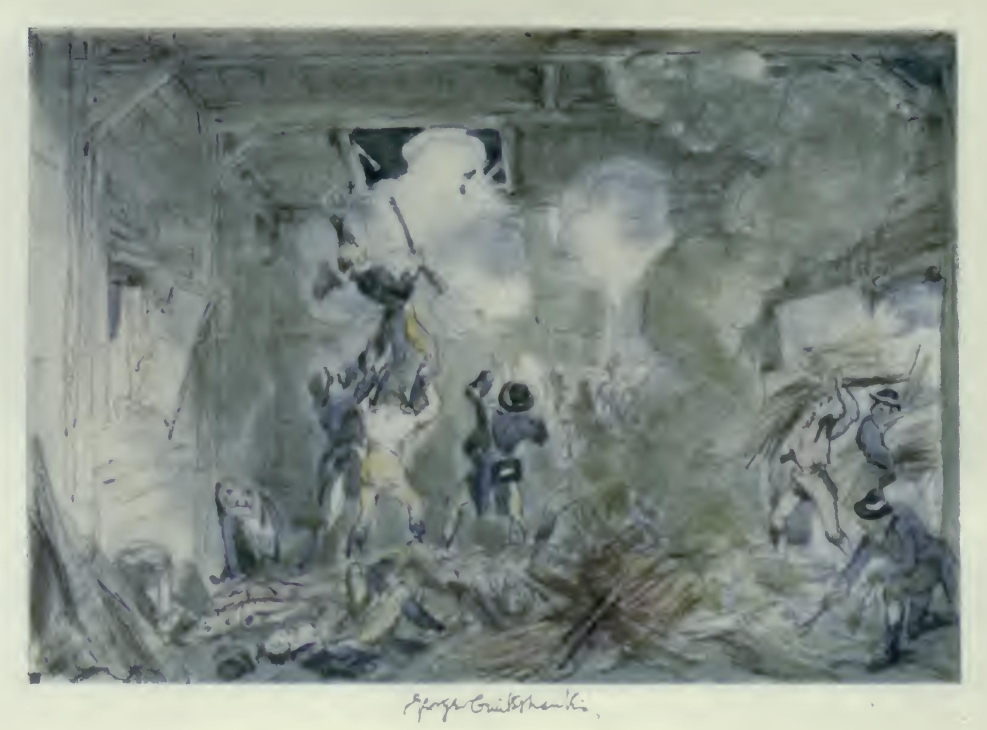
Many very gallant exploits were performed during this short and sanguinary period by loyalist irregulars; but probably the defence of Clonard may be placed foremost among numerous occurrences, in which the boundless gallantry of a determined handful of daring spirits repulsed the overwhelming masses to which they were opposed, and proved that no physical superiority can quench the courage of men devoted to home and altar, and determined ‘to do or die.’ The little garrison of Clonard consisted of a weak corps of yeoman infantry, and its commander was a self-taught soldier. But military talent is intuitive, and Lieutenant Tyrrell proved that the ruder the storm, the more extensively the resources of a brave man will be developed.
On being apprised that the rebel column was in march, Tyrrell made the best dispositions for defence which his small force permitted. He occupied a turret, which domineered the road, with half a dozen musketeers, and with the remaining twenty retired into the old mansion-house. Having selected his best marksmen, they were placed at such of the windows as offered the best positions for firing with effect upon the assailants, while the remainder of the corps were secured behind the walls, and employed in loading spare muskets to replace the firearms when discharged.
The rebel cavalry, amounting in rough numbers to three hundred, formed an advance guard, and were commanded by a man named Farrel. Unconscious that the garden turret was occupied, they came forward in a trot, and the first intimation that they were already under fire was conveyed by a shot from the youngest Tyrrell, a boy only fifteen years old, which mortally wounded the rebel captain. A volley from the other loyalists emptied several rebel saddles; a panic ensued, and the horsemen galloped out of musket range, leaving Several of their companions dead upon the road. With more caution and better success the rebel footmen came forward under shelter of a hedge, and, lining an opposite fence, they opened a sharp fire on the turret, while the column itself pushed forward to surround the’ house, and unite itself with another division which had advanced to join them by a cross-road. To cut off all communication and prevent the garrison from receiving reinforcements, the bridge was occupied by a rebel guard, but as it lay directly under the fire of the house, half a score of the occupants were rapidly shot down, the bridge cleared of its defenders, the western road laid open, and the garrison communication maintained.
In both their first attempts the insurgents were heavily repulsed, but defeat seemed only to exasperate them, and they again came forward to the attack. Penetrating by the rear, an immense number filled the garden and seized the lower portion of the turret. As the ladder had been drawn up by the defenders of the upper story, the rebels, by climbing on each other’s shoulders, attempted to force through the ceiling; still the fatal fire of the loyalists was kept up; at every shot a rebel fell, and on the ground floor lay seven-and-twenty bodies. At last, despairing of success, they procured a quantity of straw and fired the building. To force a passage through the rebels was almost a desperate attempt, but to perish in the flames, which had now seized the building, was the sad alternative. Two yeomen were killed in their attempt at escape, but fortunately the other four, by jumping from a window into a hay-yard under cover of the garden wall, succeeded in reaching the main body, who were posted in the dwelling-house. For six long hours this unequal contest had been maintained, and still no impression had been made upon the gallant royalists. To confuse the garrison, the assailants set fire to the toll-house and adjacent cabins, but the conflagration served no better purpose than to consume their own slain, whose bodies they flung into the burning houses. Happily succour was at hand, and at five in the evening a reinforcement was descried by the wearied royalists, advancing rapidly to meet them.
THE REBELS STORMING ‘THE TURRET’ AT LIEUTENANT TYRRELL’S, CLONARD
One of the yeomen, who had been excluded by the sudden shutting of the gates in the morning, finding he could be of no use in defending the house, repaired to Kinnegad and represented the alarming situation of his friends at Clonard; upon which, Lieutenant Houghton, with fourteen of the Kinnegad infantry, and a sergeant, with eleven Northumberland Fencibles (this being all the force that could be spared), immediately marched to their succour. The pass by the bridge having been kept open in the manner before related, Lieutenant Tyrrell now sallied from the house, and soon effected a junction with this reinforcement. A few volleys completely cleared the roads, and having placed the Northumberland Fencibles and Kinnegad infantry in such situations as most effectually to gall the enemy in their retreat from the garden, the lieutenant himself undertook the hazardous enterprise of dislodging them from thence.
‘At this time it is supposed there were four hundred rebels in the garden, a large body being posted on a mount planted with old fir-trees, which afforded considerable protection, while many lay concealed behind a privet hedge, from where they could see distinctly every person who entered the garden, though unperceived themselves. The brave Tyrrell, at the head of a few chosen men, now rushed into the garden, and was received by a general discharge from both bodies of the enemy; but he instantly attacked the party behind the hedge, which, being defeated, retired to the mount. Here a warm action ensued, the enemy appearing determined to maintain their advantageous situation; but the yeomen, though fatigued with the heat and burden of the day, and six of them badly wounded, persevered with the most undaunted courage, and directed such a steady and well-directed fire against the mount, that the enemy were at length dispersed, and in their flight the Northumberland Fencibles and Kinnegad infantry made great havoc among them.’—Taylor’s History.
The rebel loss, when it is remembered that it was inflicted by a garrison not numbering thirty men, may appear to be overstated. In killed and wounded it was said to reach two hundred. Nor is there any reason to question the accuracy of the return. A close and well-directed fire was maintained for half the day, and some of the yeomanry were supposed to have discharged one hundred rounds a man.
After this severe repulse the remaining body of insurgents retreated to Carbery and plundered the mansion of Lord Harburton, and next day entered Meath by Johnstown. On the 12th of July they were again overtaken, brought to action, and defeated by a detachment under Colonel Gough, hunted afterwards by General Myers, and driven upon Slane, and encountered ar In all these affairs disorganised that, as a body, they ceased to have existence.
FATE OF FATHER JOHN MURPHY OF BOULAVOGUE AFTER VINEGAR HILL
The horde of insurgents with Father John Murphy of Boulavogue escaped from the Vinegar Hill déroute, retreated through the Scullagh gap, and selected Kilkenny as their field of future operations. Their progress was marked by the customary atrocities of plundering and murder, and the line of march towards Castlecomer might have been readily traced by property destroyed and houses laid in ashes.
After the continuation of their old tactics and acts of coldblooded treachery—such as the affair at Gore’s bridge, when promises of protection were given to the discomfited loyalist soldiers surrounded in an untenable position, to induce them to lay down their arms, and scandalously violated, and in a few hours after their surrender, six privates of the Wexford, two of the 4th Dragoons, and nine Protestant prisoners were savagely butchered at Kellymount by orders of Devereux, a sanguinary ruffian, principally concerned in the massacre at Scullabogue—the insurgents were discovered at daybreak halted on Kilcomney Hill. The Downshire battalion guns—under Major Mathews—opened fire, and the rebels, to avoid the cannonade and gain time to make dispositions to receive the royalists, fell back a mile. While forming, Sir Charles Asgill’s artillery were heard firing at a rebel party in their rear, and a few rounds from the Downshire guns completed their discomfiture. They broke, fled, and were cut down, scarcely resisting, the pursuit being continued for two hours with fatal effect.
This was the crushing blow given to the southern insurrection. All was lost, for baggage, arms, provisions, and ammunition were totally abandoned. A few soldiers and Protestants who had fallen into their hands and escaped assassination were mercifully they suffered a continued loss, and at last had become so totally delivered and the insurgents disbanded, and while the Wexford party crossed into their native country through the Scullagh gap, the wanderers from Wicklow and Kildare went off dispersedly, some of the least guilty returning to their own homes, while others, despairing of forgiveness, commenced an outlaw’s life, and sank the rebel in the robber.
‘Father John Murphy, a priest who acted as aide-de-camp to the great sacerdotal hero, John Murphy of Boulavogue, and who had accompanied him from Vinegar Hill, fell in this action. He had a dove and a crucifix on his buttons, and letters directed to him were found in his pocket, recommending proper places for encamping. Father John Murphy, the commander-in-chief, who fled from the field of battle, was taken at an ale-house by three yeomen, one of the name of M’Cabe, and led a prisoner to Tullow, the headquarters of Sir James Duff. He was introduced into a room where the general, his aides-de-camp, Colonels Foster and Eden, the Earl of Roden, Captain M’Clintock, and about twenty officers were sitting. Major Hall, having asked him some questions which gave offence, in a violent rage the priest made a blow of his fist at the Major, which would have knocked him down, but that he warded it off with his arm, on which, however, he received a severe contusion. On searching Murphy, in his pockets his vestments were found, with some letters from Mrs. Richards and other ladies, prisoners at Wexford, imploring him to save the lives of their husbands and relations. He was hanged on the same day; his body was burned and his head fixed on the market-house.’
Musgrave’s Memoirs, which furnish the foregoing account, further enlighten us upon Murphy’s personal traits:—‘He was about forty-five years old, light complexioned, bald-pated, and about five feet nine inches high, well made, uniting strength with agility. He was exceedingly irascible, and when in a passion had somewhat the aspect of a tiger. His pix, his oil stock, and a small crucifix were found in his pocket.’
LANDING OF THE FRENCH INVADERS IN KILLALLA BAY
In the west of Ireland the system of terrorism was also incessantly persevered in; general murders were announced, and the people continued not to sleep in their own houses to avoid surprise. The strangest means by which these imaginary massacres were to be effected were invented, promulgated, and believed, and the peasantry in many places actually remained night after night in the open fields as the only means of escaping the devilish devices of destroyers.
Musgrave has set down in his Memoirs: ‘A few days before the French landed, a report was industriously circulated that the Protestants had entered into a conspiracy to massacre the Roman Catholics, and that they would not spare man, woman, or child. It was said that for this purpose a large quantity of combustible stuff had been introduced by the Orangemen, who made a kind of black candles of it; that they were of such a quality that they could not be extinguished when once lighted, and that in whatever house they should be burnt they would produce the destruction of every person in it.’
Such was the state of Mayo and Connaught generally when, on the 22nd of August 1798, three French frigates, with English colours flying, entered Killalla Bay. No suspicion was occasioned by their appearance, and under the belief that they were British cruisers, several gentlemen from the town visited the strangers, and when declared prisoners first discovered their mistake.
Killalla was at that time a bishop’s see (subsequently suppressed on the passing of the Reform Bill). On the day when the French appeared in the bay the lord-bishop was holding his annual visitation, and the clergy of the diocese were collected in the castle, as the see-house was popularly called. The strange vessels, however, excited no alarm; dinner passed quietly, the guests were preparing to depart, when that intention was accelerated by the arrival of a breathless messenger to inform the company and their host that the French had actually landed, and an advanced guard of three hundred men were marching on the town.
Killalla was feebly garrisoned by a party of the Prince of Wales’s Fencibles and a few yeomanry, the whole not exceeding fifty or sixty men, but still they offered a bold resistance, until, with the loss of a few killed and wounded, they were finally driven into the castle and obliged to surrender. The commander of this extraordinary expedition, Humbert, after summoning the bishop to his presence, and having announced that he came from the great nation to give the Irish liberty and sever the yoke of England, which had so long oppressed them, proceeded to put into requisition his lordship’s horses, sheep, and cows, intimating at the same time that the Irish Directory, to be established immediately in Connaught, would pay the full value of the same.
The French officers gave the following account of the expedition:—‘About eighteen days before, 1500 men, some of whom had served under Bonaparte in Italy, the rest had been of the army of the Rhine, embarked on board three frigates at Rochelle, and on a very dark night eluded (beyond their expectation) the vigilance of the English fleet, which was close behind them. Two of them had forty-four guns, eighteen-pounders, the other thirty-eight guns, twelve-pounders. They said also they brought nine pieces of cannon and arms for 100,000 men, but this was French gasconnade, as they had arms only for 5500 men and but two four-pounders. The meagre persons and the wan and sallow countenances of these troops, whose numbers did not exceed 1060 rank and file and 70 officers, strongly indicated the severe hardships which they must have undergone.
‘They hoisted a green flag in front of the castle, with the Irish words, “Erin go braugh” inscribed on it, which signifies “Ireland for ever,” and they invited the people to join them, having assured them that they would enjoy freedom and happiness by doing so.
‘The first day they passed in landing arms and ammunition; the second in clothing and arming the natives, of whom great multitudes flocked to their standard, and granting commissions to Irish officers.’
Compared with the other armaments destined for the invasion of Ireland, Humbert’s was by far the smallest. The grand army, termed ‘the reserve,’ which was commanded by General Kilmaine, amounted in round numbers to 10,000; and a second, lying in the harbour of Brest, under General Hardy, had 3000 men on board. Neither, however, attempted to put to sea, and although Kilmaine never appeared in person, his proclamations were abundantly distributed.
Humbert’s manifesto was cleverly conceived and ingeniously put together:—
LIBERTY! EQUALITY! FRATERNITY! UNION!
Irishmen—You have not forgot Bantry Bay; you know what efforts France has made to assist you. Her affections for you, her desire for avenging your wrongs and insuring your independence can never be impaired.
After several unsuccessful attempts, behold Frenchmen arrived amongst you.
They come to support your courage, to share your dangers, to join their arms, and to mix their blood with yours in the sacred cause of liberty.
Brave Irishmen, our cause is common; like you, we abhor the avaricious and bloodthirsty policy of an oppressive government; like you, we hold as indefeasible the right of all nations to liberty; like you, we are persuaded that the peace of the world shall ever be troubled, as long as the British ministry is suffered to make, with impunity, a traffic of the industry, labour, and blood of the people.
But exclusive of the same interests which unite us, we have powerful motives to love and defend you.
Have we not been the pretext of the cruelty exercised against you by the cabinet of St. James’s? The heartfelt interest you have shown in the great events of our revolution has it not been imputed to you as a crime? Are not tortures and death continually hanging over such of you as are barely suspected of being our friends? Let us unite then and march to glory.
We swear the most inviolable respect for your properties, your laws, and all your religious opinions. Be free; be masters in your own country. We look for no other conquest than that of your liberty—no other success than yours.
The moment of breaking your chains is arrived; our triumphant troops are now flying to the extremities of the earth to tear up the roots of the wealth and tyranny of our enemies. That frightful Colossus is mouldering away in every part. Can there be any Irishman base enough to separate himself at such a happy juncture from the grand interests of his country? If such there be, brave friends, let him be chased from the country he betrays, and let his property become the reward of those generous men who know how to fight and die.
Irishmen, recollect the late defeats which your enemies have experienced from the French; recollect the plains of Honscoote, Toulon, Quiberon, and Ostend; recollect America, free from the moment she wished to be so.
The contest between you and your oppressors cannot be long.
Union! liberty! the Irish republic!—such is our shout; let us march, our hearts are devoted to you; our glory is in your happiness. Health and Fraternity, Humbert, Gen.
Humbert’s was a bold but wild experiment, but still it evinced the daring character of the adventurer. He had encountered difficulties that would have disheartened a soldier less enthusiastic.
To land with 1200 men in a country in full military occupation, as Ireland then was, without money, necessaries, or any resources but what chance and talent gave, proved indeed that the French general was no common soldier.
The sketch given by Bishop Stock (his involuntary and captive host) of the invading army and their daring leader is not only graphic, but faithfully descriptive of the bold adventurer and his hardy followers:—‘Intelligence, activity, temperance, patience, to a surprising degree, appeared to be combined in the soldiery that came over with Humbert, together with the exactest obedience to discipline. Yet, if you except the grenadiers, they had nothing to catch the eye. Their stature for the most part was low, their complexions pale and sallow, their clothes much the worse for wear; to a superficial observer they would have appeared incapable of enduring almost any hardship. These were the men, however, of whom it was presently observed that they could be well content to live on bread or potatoes, to drink water, to make the stones of the street their bed, and to sleep in their clothes, with no covering but the canopy of heaven. One half of their number had served in Italy under Bonaparte; the rest were of the army of the Rhine, where they had suffered distresses that well accounted for thin persons and wan looks. Several of them declared, with all the marks of sincerity, that at the siege of Metz, during the preceding winter, they had for a long time slept on the ground in holes made four feet deep under the snow; and an officer, pointing to his leather small-clothes, assured the bishop that he had not taken them off for a twelve-month. Humbert, the leader of this singular body of men, was himself as extraordinary a personage as any in his army; of a good height and shape, in the full vigour of life, prompt to decide, quick in execution, apparently master of his art, you could not refuse him the praise of a good officer, while his physiognomy forbade you to like him as a man. His eye, which was small and sleepy (the effect, probably, of much watching), cast a side-long glance of insidiousness, and even of cruelty—it was the eye of a cat preparing to spring upon her prey. His education and manners were indicative of a person sprung from the lowest orders of society, though he knew how (as most of his countrymen can do) to assume, where it was convenient, the deportment of a gentleman. For learning, he had scarcely enough to enable him to write his own name. His passions were furious, and all his behaviour seemed marked with the characters of roughness and violence. A narrower observation of him, however, served to discover that much of this roughness was the result of art, being assumed with the view of extorting, by terror, a ready compliance with his demands. This latter trait in Humbert’s character was personally experienced by the bishop. An offer of the presidency of the Connaught Directory was declined by his lordship, on the plea of his sworn allegiance to the king—a pledge, he said, never to be violated; and a command that he should issue orders to place every horse and vehicle in the country at Humbert’s disposal for mounting his cavalry, and the transport of his guns, stores, and baggage, was evaded by an assurance that his lordship had been but lately a resident, and, from want of local knowledge or authority, had not the means of compliance with the French general’s request.
‘Next morning Humbert, finding that no cars or horses had been procured, became furious, uttered a torrent of vulgar abuse, presented a pistol at the bishop’s eldest son, and declared he would punish his father’s disobedience by sending him to France, and accordingly he marched off the bishop towards the shore under a sergeant’s guard, but when they had advanced a short distance a mounted orderly recalled the party, and Humbert apologised to the bishop, and excused, under the plea of military necessity, a very gross departure from the laws of la politesse.
‘The 24th was occupied by a French reconnaissance on Ballina, which was repelled by a party of carbineers and some yeomanry. In the evening the royalists advanced to Killalla in return, had a smart skirmish with the enemy, and, after losing a few men, were hastily driven back.’
On Sunday, the 26th, Humbert took the offensive, leaving six officers and two hundred men in Killalla to garrison the town, secure his spare ammunition, and drill such recruits as should join the standard of the republic. The French numbered about 900 bayonets, with treble that number of peasant partisans. They entered Ballina unopposed, and Humbert expressed considerable disappointment when no respectable persons welcomed his entree, and the body of an active agent suspended to a tree, executed by the troops before they retreated for having a French commission in his pocket, while it afforded an exhibition for Gallic civism, gave still but a sorry omen of success.
Before he had commenced his operations the French general felt difficulties which, in some degree, he was unprepared for. He came totally unprovided with money, and in the co-operation he was led from the reports of Irish agents to build upon as certain he was miserably disappointed. The first of these difficulties he endeavoured to overcome by the issue of assignats on the Irish Directory that was to be.
The first serious action Humbert had on encountering the royalist forces was signalised by a series of military mistakes, of which the French commander took the fullest advantage, and the memory of the loyalist discomfiture at Castlebar remains a discreditable page in the annals of our generalship.
It is almost impossible to conceive anything more disgraceful and unaccountable than the defeat of the royalist army at Castlebar. That the strength of the king’s army fully warranted its commander in covering the town and taking an open position cannot be denied, but still, as there was some uncertainty touching the number of the assailants, in the event of disaster measures should have been arranged for rallying the troops within the town, which a very little trouble would have made thoroughly defensible against a force so inferior as Humbert’s. That the general spirit of the troops was excellent many individual cases proved, and, with a superior cavalry and artillery, the latter particularly well served, the contest should not have lasted ten minutes.
HEROIC CONDUCT OF THE HIGHLAND SENTINEL
The party who defended the bridge of Castlebar, consisting of some gallant officers, some of the Longford, a few of the Kilkenny and Fraser Fencibles, suffered most severely, as they were exposed to a cross-fire both from the roads leading to it and from the houses on either side. The men often fell back, but were again rallied by their officers. At length most of the Royal Irish Artillery, who worked the gun, having been killed or wounded, it became useless, and the enemy were able to push forward a body of cavalry, whose charge was repulsed by this small party, and two of the foremost hussars killed within the ranks. By this charge, however, the numbers of the royalists were much reduced, and, having been deprived of the assistance of one captain and one subaltern, who were desperately wounded, they were at last obliged to retreat after having lost half their number.
‘The French appeared men qualified not only to obtain but also to improve a victory, and with singular daring a party of hussars, not exceeding ten in number, hung on the rear of the retreating royalists and overtook and captured a gun, which they were about to turn on the runaways, when a superior number of Lord Roden’s Foxhunters charged back, killed five, and drove off the rest. The slain were buried where they fell, and, in memory of the event, the place is still called French Hill.
‘The artillery taken in this disgraceful defeat consisted of fourteen pieces, of which four were curricle guns. The courageous behaviour of the Fraser Fencibles has been mentioned with admiration as a conspicuous example of gallantry against desperate odds.’
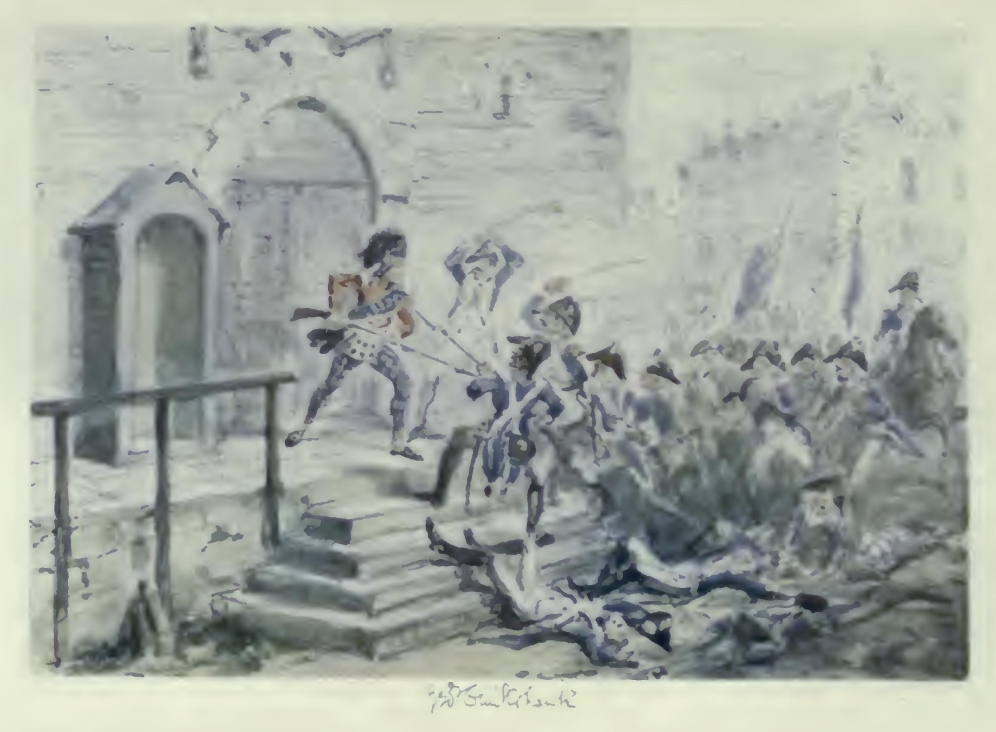
The spirited and characteristic water-colour drawing executed by George Cruikshank to illustrate the landing of the Gallic legions in Mayo deals with a noteworthy instance of individual and solitary devotion as related by Musgrave:—
‘The French approached the new gaol to break it open. It was guarded by a Highland Fraser sentinel, whom his friends had desired to retreat with them; he heroically refused to quit his post, which was elevated, with some steps leading to it. He charged and fired five times successively, and killed a Frenchman at every shot, but before he could charge the sixth time they rushed on him, beat out his brains, and threw him down the steps, with the sentry-box on his body.5
During the period that Humbert occupied Castlebar—that is, from the 27th of August until the morning of the 4th of September—the French behaved with the greatest moderation, protecting the Protestants from insult, and repressing every attempt at cruelty on the part of their ignorant and useless allies. Invariably, the invaders regarded the Irish mob who accompanied them as a pack of senseless savages, and no pains were taken to disguise these feelings of contempt. ‘The French,’ records Musgrave, ‘ate the best of meat and bread, drank wine, beer, and coffee, and slept on good beds. They compelled the rebels to eat potatoes, drink whisky, and sleep on straw. They beat and abused them like dogs, in the name of liberty, equality, and fraternity. A volume would not contain an account of the brutal actions of the rebels; and the women, who were worse than the men, carried off hides, tallow, beef, cloth, and various other articles.
‘The wonder was how the zealous papist should come to any terms of agreement with a set of men who boasted openly in their hearing “that they had just driven Mr. Pope out of Italy, and did not expect to find him so suddenly in Ireland.” It astonished the French officers to hear the recruits when they offered their services declare “that they were come to take arms for France and the Blessed Virgin.”’
To the Irish priesthood the French officers exhibited a marked antipathy. Frequently a latent hatred of Protestants became too apparent, but any attempt, and many were made, to give a religious turn to the war was on the French part furiously repelled.
ENDING OF THE FRENCH INVASION
No reinforcements had arrived from France; no insurrectionary movement in the other provinces followed the descent at Killalla and the unexpected success at Castlebar. The game was played; Lord Cornwallis was within thirty miles; another day, and surrender would be inevitable; but still a chance might be ‘upon the die,’ and, like a brave adventurer, Humbert determined to put it to the hazard. After mature consideration he decided to march in a northerly direction, as that part of the country he understood to be disaffected, and also the route leading through Sligo and Donegal was tolerably free from troops, and consequently more open to him. Accordingly, on the night of the 3rd of September he sent off his baggage and cannon, with part of his troops, towards Sligo, and about seven next morning set out with the remainder, about 400 in number. With the abandonment of the capital of Mayo, Humbert’s Irish career may be said to have closed, and probably the most summary but faithful account of his extraordinary campaign is contained in his own report to the French Directory:—
‘After having obtained the greatest successes, and made the arms of the French republic to triumph during my stay in Ireland, I have at length been obliged to submit to a superior force of 30,000 troops, commanded by Lord Cornwallis. I am a prisoner of war on my parole.’ Never a despatch more brief, nor yet more true.
Four days had passed since the French and their auxiliaries had abandoned Castlebar (on being apprised of Humbert’s retreat Colonel Crawford advanced, and at nine o’clock the same evening Castlebar was occupied by the royalists), and during that time they had been harassed continually. So closely were they pressed that the fusilade between their rear-guard and the advance of the royalists was almost incessant. His great superiority in cavalry enabled Lord Lake to hang closely on their rear, from which it was impossible to shake him off, and by mounting light infantry behind dragoons, so vigorously was Humbert pushed that he was obliged to halt the head of his column and receive an attack from the advancing enemy.
While forming the leading division the rear-guard, under Sarazin, were overtaken within a mile of Ballynamuck, and that general, who commanded en second, at once surrendered. Indeed, in doing this Sarazin exercised a sound discretion in preventing the useless expenditure of human blood, and, from the daring intrepidity of his character, the sacrifice, most painful to a soldier’s feelings, would never have been made by him until every hope was over.
The following circumstances, as Musgrave has related, attended the surrender of the French:—‘The Earl of Roden and Colonel Crawford, who led on the advanced guard, consisting of his lordship’s Fencibles, perceiving an officer who seemed desirous to communicate with them, Lord Roden ordered his trumpet to sound, which was answered by the French, when his lordship and the colonel advanced into the French lines. The officer politely asked them what their wishes were. They answered to stop the effusion of blood, and desired them to surrender. The officer said that he did not command, but that he would go to General Humbert, which he accordingly did. Humbert came up, asked the same question, and received a similar answer. He then demanded half an hour to give a final answer, which was granted on condition that he halted his troops; to which he made no reply, but retreated with precipitation. Lord Roden then ordered his trumpet to sound the advance, and came up to the first and second brigade of the French army, who surrendered to about 300 cavalry under his lordship and Colonel Crawford. After this they advanced with about twenty dragoons and took possession of the French guns. Shortly after Humbert rallied his grenadiers, the only part of the army, except the chasseurs, that had not surrendered, consisting of about 400 men, who surrounded Lord Roden and his twenty dragoons. They were given in charge to the hussars. While they were their prisoners—which lasted about fifteen minutes—the French officers loaded the United Irishmen, their allies, with execrations for having deceived and disappointed them by inviting them to undertake a fruitless expedition. They also declared that the people of Ireland were the most treacherous and cowardly they ever knew. Lord Roden and Colonel Crawford continued prisoners till his regiment of Fencibles advanced in quest of their colonel, which the French hussars perceiving, requested that his lordship would desire them to halt, as they meant to surrender, and by doing so he prevented them from being cut to pieces.’
According to Gordon’s authority, ‘the troops of General Humbert were found, when prisoners, to consist of 748 privates and 96 officers, a loss of 228 being sustained since their first landing at Killalla.’ The story is incomplete without recounting the fate of their misguided auxiliaries. It would appear that the soldiers of the grande nation and their Irish allies were heartily tired of each other, and both sides complained bitterly, and apparently with reason.
From the commencement of Humbert’s movement towards the north until his surrender, not an hour passed without the vengeance of the royalists felling on the deluded wretches, who still continued rather to embarrass than assist the French army while retreating. Every straggler that was overtaken was cut down by the Hompeschers and Foxhunters who hung upon Humbert’s rear; and when the invaders laid down their arms at Ballinamuck, if blood could have atoned for treason, it was fearfully exacted, for the sword and halter were used with an unsparing hand. It is impossible to form any correct estimate of the number sacrificed to the fury of the soldiery. During the pursuit of Humbert, as the rebels preserved not even the semblance of order, but straggled where they pleased, it was not unusual to find them sleeping in dozens in the fields, some from fatigue, and more from drunkenness. No questions were asked; the coup de sabre when on march, the arm of the next tree, if halting, ended all inquiry. At Ballinamuck va victis was pronounced, no quarter was given, and, to use Musgrave’s words, ‘dreadful havoc’ was made among the unfortunate wretches, who were excluded from mercy and cut down by the hundred.
REBELS DESTROYING A HOUSE AND FURNITURE
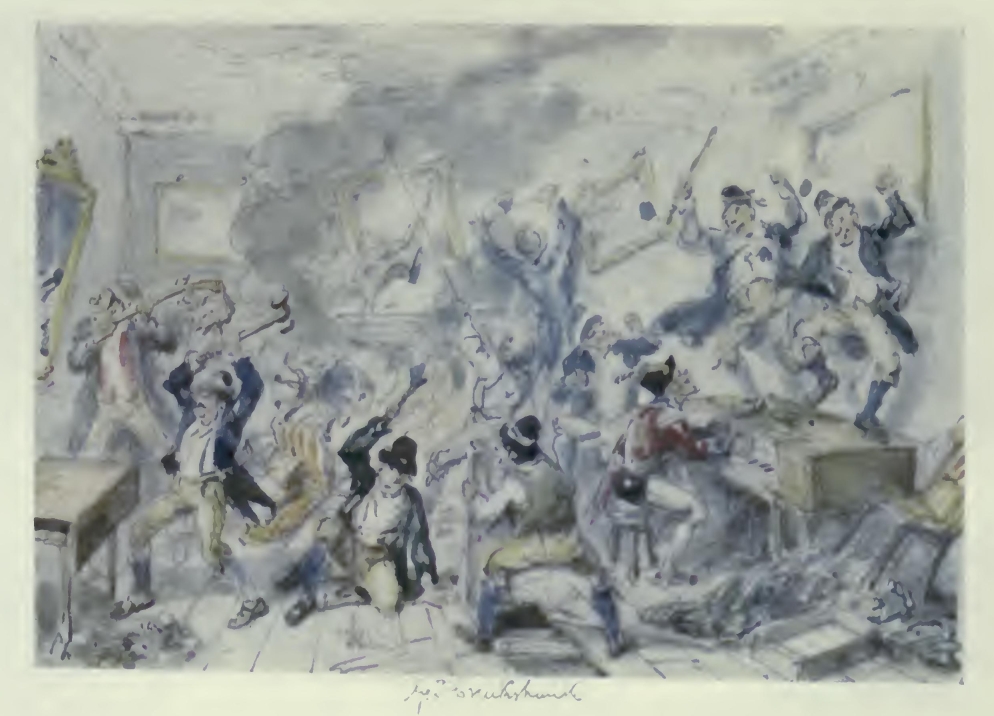
Probably the artist has executed this characteristic scene pertaining to the destructive proceedings which were so significant of the rebellion—con amore; it is sufficiently marked by George Cruikshank’s peculiar genius for conveying a full sense of boisterous exuberance, wherein the tragic marches hand-in-hand with the grotesque, and humour of the broadest contrasts with terrible episodes, which weirdly impress the imagination. In short, this picture may be regarded as the typical contribution of the gifted illustrator to Maxwell’s History, and, as such, speaks sufficiently for itself, telling its moving tale with that native force and graphic directness Cruikshank had always at command.
It may be realised that, to gratify their native love of fun, an Irish mob finds in the humours of any given situation the satisfaction of comic relief in contrast to absolutely grim terrorism; appreciative touches of these congenial qualities are conspicuous throughout Cruikshank’s vividly pictorial realisations of the episodes of the rebellion of 1798. Herein souvenirs of the humorous touches of the amenities of Donnybrook Fair lend their spice of rough fun to relieve the gloomier horrors inseparable from the subject, while the spirit of general destruction is in full swing, and the intoxicating influence of wantonly wrecking everything at hand, or within reach, is producing chaos and spreading annihilation around; the whole spectacle of reckless ruin to characteristically conclude with a grand conflagration of everything destructible, to put the final touches to the tableau.
EMMETT PREPARING FOR THE INSURRECTION
Two names most intimately connected with the Irish Rebellion are surrounded by an atmosphere of sentiment and the glamour of romance, which endears their memories to their admirers at this distant date. The untoward fate of one, the unfortunate enthusiast Lord Edward Fitzgerald, commences the history of the insurrection; the last, Robert Emmett, comes to complete the story, his episode almost as an anticlimax. Both were lives of promise, miserably thrown away, and it is recognised that both these victims rebels destroying a house furniture of misapplied talents were worthy of a better fate, and capable of higher things.
Robert Emmett was the son of a respectable physician in Dublin, and was the younger brother of Thomas Adis Emmett, a gifted barrister who had been a conspicuous member of the rebel Directory in the fateful 1798. Robert Emmett was by natural gifts qualified to figure as a hero of romance, and his name is so regarded by sympathisers, even after the lapse of a century, wherein his fame has fitfully survived. He was a young man of fine talents rather than solidity of judgment, possessing uncommon eloquence, and no inconsiderable portion of courage and activity. He was not unqualified for the part he had undertaken, and for a service so pregnant with difficulty and danger his sanguine temperament was a necessary adjunct. He had quitted Ireland after the unfortunate termination of the former conspiracy, and resided in different parts of the Continent, but principally in France, till Christmas 1802, when he returned to his native country, filled with ambitious projects of an unreasonable and uncompromisingly revolutionary nature.
‘A quotation from one of his speeches, when a lad at Dublin University, proves the early political bias of his mind. After a brilliant eulogy on the French republic, he concluded with a remark sufficiently expressive:—“When a people, advancing rapidly in knowledge and power, perceive at last how far their government is lagging behind them, what then, I ask, is to be done in such a case? Why, pull the government up to the people!” The consequences of indulging in such language at such a time may be imagined—Emmett was struck off the College roll.’—Memoir of Robert Emmett.
On his arrival in Ireland he first went into a state of the most perfect obscurity at the house of a Mrs. Palmer, at Harold’s Cross, where he assumed the name of Hewitt. The nature of his mission did not admit of his remaining in this retreat longer than was necessary to mature his plans and form his connections. About the end of April, a house and premises of some extent, formerly a malt-house, and which had been long unoccupied, were taken in Marshall’s Alley, Thomas Street, sufficiently obscure to escape detection, and yet near enough to the heart of the city to effect the most desperate purposes. In this place Emmett lodged for nearly two months, with no better accommodation than a paillasse, and surrounded by from fourteen to twenty associates. A depot of arms was here formed on a large scale; muskets and other weapons were procured from time to time to a considerable amount, and a large manufacture of pikes was secretly carried on. There was a group of tailor hands employed in making rebel uniforms of green.
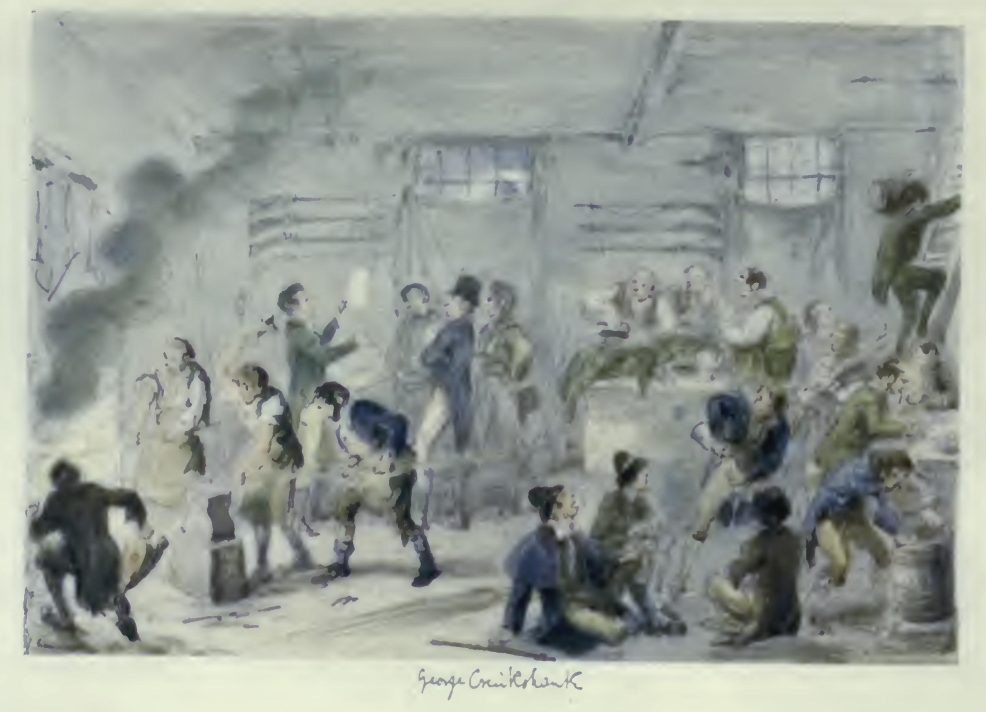
‘One of these dépôts was set apart for the manufacture of gunpowder and the construction of weapons. Some idea of the industry with which Emmett accumulated these implements of deadly vengeance, and his sanguine reliance upon thousands responding to the tocsin of insurrection, may be formed from the catalogue of the contents of his magazine:—It comprised forty-five pounds of cannon-powder, in bundles; eleven boxes of fine powder; one hundred bottles filled with powder, enveloped with musket-balls and covered with canvas; two hundred and forty-six hand grenades, formed of ink-bottles filled with powder and encircled with buck-shot; sixty-two thousand rounds of musket-ball cartridge; three bushels of musket-balls; a quantity of tow mixed with tar and gunpowder and other combustible matter, for throwing against woodwork, which when ignited would cause an instantaneous conflagration; sky-rockets and other signals, etc.; false beams filled with combustibles, with not less than twenty thousand pikes.
‘The conspirators occasionally pressed not only horses but men into their service, and forced the latter to work at different employments necessary for the object in view while confined in the depot. At the same time stores of arms and gunpowder were deposited at the residences of others of their accomplices in convenient stations of the city. The whole of the conspiracy had, however, been nearly overthrown and exposed by an explosion which took place in Patrick Street. By the ability of the conspirators, or the security of their adversaries, the accident was overlooked, or at least represented as unconnected with any treasonable design. Emmett once more changed the place of his concealment, apprehending the explosion would lead to untimely disclosures, removing to one of his dépôts situated in Mass Lane. “Here he strove to make, as far as possible, by increased exertions, amends for the recent loss. So restless was he, that he sought no further repose than that he derived from occasionally reclining upon a mattress, placed in the midst of the workmen, from which he could by night and day observe the progress of, and direct and animate their labours.”
EMMETT PREPARING FOR THE INSURRECTION
‘At length the preparations were complete, or the funds of the conspirators exhausted, and the 23rd of July 1803 was appointed for a general insurrection. Though the persons immediately connected with the principals in the plot—Emmett, Dowdall, and Quigley—did not exceed from eighty to one hundred persons, they were so far misled as to the state of the public mind, that they expected the spirit of rebellion would pervade the kingdom. The stopping of the mail-coaches was to be the signal of revolt in the country. The immediate object of the insurgents in the metropolis was the castle (“as it was felt that to have command over the seat they might speedily secure the power of government”), and the vicinity of the depot in Thomas Street was calculated to favour the intended enterprise against this seat of the government. Various rumours had been afloat for a. few days previous, that “a rising,” as it was termed, was intended; but the reports were so contradictory that the government was unable to take any measures of precaution further than the doubling of patrols in certain stations. Towards dusk on the 23rd of July, Emmett prepared for the anticipated action by superintending the distribution of arms and ammunition (of which he had a large supply) amongst the multitude that had congregated before the headquarters of the projected rebellion. But we must not omit to mention that previous to the evening the ill-success of the enterprise had been omened forth by the retreat of the Kildare men, who, after marching into the capital, were fortunately persuaded by their leaders to disband and return home.’ What ensued has been graphically described by one of Emmett’s coadjutors:—
‘About six o’clock Emmett, Malachy, one or two others, and myself put on our green uniform, trimmed with gold lace, and selected our arms. The insurgents, who had all day been well plied with whisky’ (this paragraph is most significant), ‘began to prepare for commencing an attack upon the castle; and when all was ready, Emmett made an animated address to the conspirators. At eight precisely we sallied out of the depot, and when we arrived in Thomas Street the insurgents gave three deafening cheers.
‘The consternation excited by our presence defies description. Every avenue emptied its curious hundreds, and almost every window exhibited half a dozen inquisitive heads, while peaceable shopkeepers ran to their doors, and beheld with amazement a lawless band of armed insurgents, in the midst of a peaceable city, an hour at least before dark. The scene at first might have appeared amusing to a careless spectator, from the singular and dubious character which the riot wore; but when the rocket ascended and burst over the heads of the people, the aspect of things underwent an immediate and wonderful change. The impulse of the moment was self-preservation, and those who, a few minutes before, seemed to look on with vacant wonder, now assumed a face of horror, and fled with precipitation. The wish to escape was simultaneous; and the eagerness with which the people fled before us impeded their flight, as they crowded upon each other in the entrance of alleys, courtways, and lanes; while the screams of women and children were frightful and heart-rending.