HISTORY OF THE IRISH REBELLION IN 1798 AND EMMETT’S INSURRECTION IN 1803
Reading edition
By W. H. Maxwell
Author Of ‘The Life Of The Duke Of Wellington,’ Etc. Etc.
Take heed
How you awake the deeping sword of war;
We charge you, in the name of God, take heed!
For never two such kingdoms did contend,
Without much fall of blood.
—Shakspeare.
THE CRADLE OF THE REBELLION
The rebellious movement which, in 1798, openly burst into the horrors of civil war, had for years been maturing. The success of the American colonists in defeating the mother country, and the upheaval in France, the great Revolution, proved fatal precedents, and the easily excited minds of the Irish people led the disloyal and disaffected of the sister kingdom to contemplate the forcible carrying out of a similar policy. As will be seen, this fratricidal struggle largely resolved itself into a religious campaign between the Catholic and Protestant sections of the community.
At an early stage of the coming struggle the ulterior objects of the discontented Catholics became perfectly apparent, and some of their warmest advocates took alarm. Sir Hercules Langrish, in his place in the Irish Parliament, thus addressed the House: ‘Notwithstanding my prepossessions in favour of the Roman Catholics, I was checked for some time in my ardour to serve them, by reading of late a multitude of publications and paragraphs in the newspapers, and other public prints, circulated gratis with the utmost industry, purporting to convey the sentiments of the Catholics. What was their import? They were exhortations to the people never to be satisfied at any concession till the State itself was conceded: they were precautions against public tranquillity; they were invitations to disorder, and covenants of discontent; they were ostentations of strength, rather than solicitations for favour; rather appeals to the power of the people, than applications to the authority of the State; they involved the relief of the Catholic, with the revolution of the Government; and were dissertations for democracy, rather than arguments for toleration.’
APPEAL TO FORCE OF ARMS
Acting, however, on the resolutions they had published, the Committees determined to summon a Convention in imitation of the proceedings which were at the time violently revolutionising France, where the horrors of the great French Rebellion had already unsettled everything in 1789. Circulars were issued by their leaders—representatives elected in the counties—and on the 3rd of December 1792 the ‘Back Lane Parliament’ commenced its first session in Tailor’s Hall.
The daring measure of calling together an assembly, where the delegates debated with closed doors, was followed by a still bolder demonstration. The discontented Romanists resolved upon making an overbearing display of physical force, and declared their intention to arm, to maintain their rights and effect their objects. For this purpose large sums of money were levied, and a body was enrolled in the metropolis under the title of ‘The National Guard.’ They were arrayed in green uniforms, with a harp without the crown displayed upon the buttons and appointments. Orders were issued for a general muster on the 9th of December; but a proclamation, issued by the Lord Lieutenant, declared the body to be dangerous to the public peace, and directed the authorities to disperse the meeting should it be attempted, and employ force were it required. Many conjectures were hazarded at the time respecting the objects of the movement; some asserted that it was merely intended, by an exhibition of numerical strength, to confirm unsteady friends, and intimidate those who were opposed to them; others, however, ascribed to the National Guards more serious and sanguinary designs—‘to seize even then upon the city, and commence at once a civil war.’ Certain it is that the Government were led to apprehend that this muster would lead to a revolutionary movement, and, accordingly, the most decisive measures were taken to render it abortive.
‘THE UNITED IRISHMEN’
To follow up the progress and proceedings of the ‘United Irishmen’ throughout that unquiet period which intervened between the lieutenancies of Earls Westmoreland and Camden would be unnecessary. Their civil and military organisation, however, shall be described, and a brief analysis given of their general history from the epoch where we have broken off, when the seeds of disaffection had taken a firm root, and a conspiracy was hatched, which, a few years afterwards, became fatally matured, and exploded in 1798 with portentous violence.
Under the colour of volunteering, the arming and drilling of the malcontents continued. A proclamation, issued by the 11th of March 1793, declared these proceedings illegal, and attached penal consequences to any who should continue them. The preamble ran thus: ‘Whereas certain seditious and ill-affected persons, in several parts of the north, particularly in the town of Belfast, have endeavoured to foment and encourage discontent, and to defame the Government and the Parliament, by seditious publications circulated among the people; and that several bodies of men have been collected in armed associations, and have been levied and arrayed in the said town of Belfast; and that arms and gunpowder to a very large amount have been sent thither; and that bodies of men have been drilled and exercised by day and night, under the pretext of obtaining a redress of grievances, though the obvious intention appears to be to overawe the Parliament and the Government, and to dictate to both.’
This and the Gunpowder Act struck heavily at the military organisations of the revolutionists; while the Convention Act, subsequently passed, embarrassed the leaders of the movement so much, that an influential member of the Union, Samuel Neilson, afterwards declared, ‘That the bill was calculated to meet every part of the system, and the framer must have had their constitution in his hand when he was devising its provisions.’
‘THE DEFENDERS’ AND ‘ORANGE LODGES’
In 1794 and 1795 outrages by ‘the Defenders’—a lawless confederacy, exclusively Catholic—became general, and the Protestants associated for self-defence. A conflict between the rival religionists took place at a spot called ‘The Diamond,’ in the county of Armagh, in which the Defenders were signally defeated. In commemoration of this success the first Orange Lodge was formed on the 21st of September 1795. The system of Orange Lodges ‘was not established in the metropolis, though many years threatened with open rebellion, till the month of January 1798; and many gentlemen of high character and considerable talents placed themselves at its head, to give the institution a proper direction, and to silence the calumnious clamours of traitors against it.’ The ‘Orange’ organisation, slowly but steadily, gained strength, until the body was considered in the north of Ireland so numerous and effective, that General Knox, commanding at the outbreak in 1798, assured the Government that to these ardent supporters of the constitution the safety of Ulster might be confidently entrusted.
STATE PROSECUTIONS
Early in the annals of the movement several of the revolutionary leaders were subjected to State prosecutions for sedition. Hamilton Rowan was convicted, fined, and imprisoned, but escaped in women’s clothes from Newgate; Nappy Tandy placed under bail, but fled the kingdom to avoid a trial; Doctor Drennan was tried and acquitted; Tone expatriated himself, and went with his family to America; but Jackson, an English clergyman, and an envoy from the French Republican Government to the Irish revolutionists, was, on the 23rd of April 1795, capitally convicted of high treason. The unhappy man committed suicide, and poisoned himself in the prisoner’s bar, immediately after the foreman had announced him guilty.
The recall of Lord Westmoreland and the appointment of Lord Fitzwilliam as viceroy raised the sinking confidence of the Catholic party as much as it depressed the hopes of the Orangists. The well-known bias of the Earl’s political opinions was warmly in favour of fresh and full concessions, and it was supposed that Catholic emancipation was at hand. While the Roman Catholics were buoyant with high expectation, arising from the noble lord’s appointment to the Irish lieutenancy, a sudden recall crushed their hopes and augmented their disaffection. From this period their hostility to any monarchical form of government appears to have become inveterate, and the first test required of a United Irishman—one in which a reformed Parliament was distinctly recognised—was instantly exchanged for another purely democratical.
OATH OF THE ‘UNITED IRISHMEN’
The initiatory oath taken henceforth by the United Irishmen was thus worded:—‘In the awful presence of God, I,... do voluntarily declare that I will persevere in endeavouring to form a brotherhood of affection among Irishmen of every religious persuasion, and that I will also persevere in my endeavours to obtain an equal, full, and adequate representation of all the people of Ireland. I do further declare, that neither hopes, fears, rewards, or punishments, shall ever induce me, directly or indirectly, to inform or give evidence against any member or members of this or similar societies, for any act or expression of theirs, done or made collectively or individually in and out of this society, in pursuance of the spirit of this obligation.’
FRENCH INVASION INVITED
1796 was not fated to enjoy more tranquillity than the stormy era that preceded it. A compulsory increase of military power, under the provisions of the Militia Bill, increased the general discontent, and the public uneasiness was not abated by a discovery that the French Directory had undertaken to land an invading army to assist the Irish revolutionists, who, on their part, undertook to pay these auxiliaries, and eventually defray the whole expenses of the expedition. Additional powers were now demanded by the Irish Executive, and the Insurrection Act, which had passed in spring, was followed up by a suspension of habeas corpus in October.
There is no doubt that these stringent powers were afterwards sadly and frequently abused. Arrests on secret information—districts unnecessarily proclaimed—suspected persons sent, without the shadow of a trial, on board the fleet—military license—arbitrary impressment of beasts of burden for baggage transport—abuse in billeting—a general insolence in the soldiery,—all these formed constant subject for complaint, and, unfortunately, it was seldom made without ample provocation.
These severities were impolitic—they reacted against the Government—and the feelings of the lower orders became exasperated, but not subdued. The most deeply marked of innate feelings in the human breast is resistance to oppression, whether it be real or imaginary. The peasantry assembled by night to drill, or deprive the loyalists of their arms, whilst by day they collected in enormous numbers to harvest the crops of persons imprisoned for political offences, or under the pretext of attending a funeral, or a hurling match, they paraded in military array, with banners and martial music.
While the disaffected thus evinced warm sympathy for their imprisoned friends, reaping their corn and securing their potato crops, they were equally assiduous in shielding them from the penal consequences of their crimes. Bribery and intimidation were the means commonly employed, and should these fail, assassination was not infrequent. This system of terror too frequently sheltered the guilty from the punishment they deserved; for, dreading the consequences of conviction and consequent reprisals, witnesses prevaricated, intimidated jurors were afraid to do their duty, and the criminal escaped.
PROSECUTIONS AND SEARCHES FOR CONCEALED ARMS
In the spring of 1797 General Lake issued a proclamation, directing that all persons unauthorised to keep arms should surrender them forthwith to the proper authorities. It was declared that secret information where weapons were concealed should be liberally rewarded, and the full value of such arms as might be thus recovered should be given to the informant. That the quantity hidden throughout the kingdom was immense may be conceived from the fact that, within the year, and in two provinces alone, Ulster and Leinster, 129,583 weapons of various descriptions were seized or surrendered. In this number there were 48,000 firelocks, 70,000 pikes, and 22 pieces of cannon.
READY FOR THE REBELLION
At this period it is probable that the United Irishmen, in point of numbers and organisation, were almost as formidable as at the moment of the insurrection. In the northern provincial meetings particular inquiries were made of the delegates assembled, ‘whether they considered themselves as being sufficiently strong to disarm the military quartered in their respective districts?’ and, with a few exceptions, the question received an affirmative reply. Although too successful in corrupting the soldiers, they appear to have made very erroneous calculations as to the number whose allegiance had been shaken. Many, both of the line and the militia, became pretended converts to republicanism merely to obtain the money and entertainment offered liberally by the disaffected. Some regiments, however, became seriously tainted with disloyalty; but, generally, the active measures to counteract seduction adopted by the commanding officers defeated the attempt.
ORGANISATION OF THE REBELS
With the confidence which strength and union give to those who meditate a revolutionary essay, the leaders of the disaffected waited with impatience the assistance promised them through their agents by the French Directory.
The military organisation of the United Irishmen was grafted on their elaborately framed civil representative constitution, and was constituted in the following manner:—‘The secretary of each subordinate society, composed of twelve members, was appointed their petty or non-commissioned officer. The delegate of five societies to a lower baronial committee was commonly appointed captain of a company, consisting of the five societies who had delegated him, and who made the number of sixty privates; and then the delegate of ten lower baronials to the upper or district committee was commonly appointed colonel of a battalion, which was thus composed of six hundred. The colonels of battalions in each county sent in the names of three persons to the Executive Directory of the Union, one of whom was appointed by them adjutant-general of the county, whose duty it was to receive and communicate military orders from the Executive to the colonels of battalions, and in general to act as officer of the revolutionary staff. They were required to inform themselves of, and report the state of the rebel regiments within their respective districts, of the number of mills, the roads, rivers, bridges, and fords, the military positions, the capacity of the towns and villages to receive troops, to communicate to the Executive every movement of the enemy (meaning the King’s troops), to announce the first appearance of their allies (the French invaders), and immediately to collect their forces.
MILITARY PLANS
Besides these a military committee was specially appointed. Its labours were twofold: one was to prepare a plan for a general insurrection unsupported by foreign aid; the other, to devise the best means of co-operation with a French army, in the event of the promised descent being effected on the coast of Ireland. On this event the Directory calculated with such certainty in 1797, that a general order ‘to be ready’ was issued through the provincial committees. Those who had the means to obtain them were exhorted to procure firearms and ammunition—pikes were to be provided by the lower orders—and throughout three provinces the order was promptly obeyed. The organisation of Connaught was, fortunately, still imperfect, and at the outbreak of the insurrection the western counties were, happily for themselves, quite unprepared for action.
FRENCH INVASION
Passing over the abortive attempt at an invasion arranged between Lord Edward Fitzgerald and General Lazare Hoche in 1796, when, after months of preparations, which—like the Spanish Armada—failed ignominiously, the ships being the victims of the adverse winds, and the commander, Morard de Galles, being watched by the English Admiral Gardiner with a stronger force (18 sail of the line). The equipment, but for unfavourable circumstances, was sufficiently formidable,—the expedition numbering 15 sail of the line, 10 frigates, and 7 transports, which were afterwards augmented,—the whole comprising 15,000 troops, with 40,000 extra stand of arms, a field park of 29 pieces, 60,000 barrels of powder, and 7,000,000 cartridges. The time chosen was just before Christmas.
DISCOMFITED FRENCH FLEET IN BANTRY BAY
On the 26th December—the morning after the French admiral had issued orders to cut the cables and put to sea—Wolf Tone, who was the active spirit of the expedition, thus describes the situation to which the remnant of the invading forces was reduced:—‘The morning is now come, the gale continues, and the fog is so thick that we cannot see a ship’s length ahead; so here we lie in the utmost uncertainty and anxiety. In all probability we are now left without admiral or general; if so, Cherin will command the troops, and Bedout the fleet; but, at all events, there is an end of the expedition. Certainly we have been persecuted by a strange fatality, from the very night of our departure to this hour. We have lost two commanders-in-chief; of four admirals not one remains; we have lost one ship of the line (the Séduisant was shipwrecked) that we know of, and probably many others of which we know nothing; we have been now six days in Bantry Bay, within 500 yards of the shore, without being able to effect a landing; we have been dispersed four times in four days; and at this moment, of 43 sail, of which the expedition consisted, we can muster of all sizes but 14. There only wants our falling in with the English to complete our destruction.’
On the 27th the weather continued stormy. Several ships were obliged to cut and run, the fleet was reduced to 7 sail of the line and a frigate, the troops to 4200 men, and the artillery to two four-pounders. As a last effort this miserable remnant of the expedition determined to seek the Shannon, which had been named as the place of rendezvous. During the whole gale, which blew on the night of the 28th, a sixth separation occurred, and three seventy-fours and a frigate parted company. On the 29th the commodore signalised the other captains to steer for France, and the last ship of an expedition intended to overthrow the British monarchy quitted the shores of Ireland without having landed a single soldier, communicated with the disaffected, or thrown a musket on the shore.
The failure of the first attempt at an invasion was a fatal disappointment to the Irish Unionists; and although hopes were held out that a second armament would be fitted out by the French Directory without delay, the financial and political embarrassments of the Republic gave little promise that it would or could be effected. Hoche, who did not reach France for fifteen days after Grouchy, was nominated soon after to the command of the army of the Sambre and the Meuse. This appointment was heavily regretted by the agents of the United Irishmen, for there is no doubt that Ireland was to Hoche the favourite field of ambition that Egypt was afterwards to Bonaparte; and undoubtedly he was sincere in his expressed intention of making the second effort at invasion, had not his sudden dissolution intervened.
‘The affair,’ replied he, ‘is but suspended. You know our difficulties for money; the repair of our fleet and the necessary preparations require some considerable time, and, in the meantime, there are 15,000 men lying idle below, and, in fact, we cannot even feed them there. The Directory has resolved, in the meantime, to employ them usefully elsewhere, and has accepted my services; but be assured, the moment the enterprise is resumed, that I will return with the first patrouille which embarks.’—General Hoche to Tone. Hoche sank from rapid consumption, it is said, 19th of September 1797, in command of the united armies of the Rhine and Sambre and Meuse. Adverse fate seemed determined to overwhelm unhappy Ireland, but fortune again miraculously warded off the desperately threatening conjunction of affairs.
THE DUTCH INVASION AVERTED
From another quarter, however, the Irish revolutionists obtained both sympathy and support. Lewines, the chief agent of the United Irishmen, had been accredited to Spain and Holland, with both powers England being at war, to request assistance. From the Spanish Government he received, generally, an encouraging answer to his memorial; and from the Batavian Executive a positive assurance of prompt and powerful co-operation on the part of the Dutch republicans—a promise they endeavoured to faithfully perform.
It was an awful epoch in British history; and it would have been difficult to say whether at home or abroad the political position of England was more embarrassed and portentous. Conquest had attended the onward march of the Republicans, and victory had succeeded victory; and while Ireland was ready to explode, public confidence was shaken to its centre, for that stay of Britain—her fleet—had failed her in her trying hour, and broken into open mutiny. Such was the ominous aspect, foreign and domestic, when the Batavian Government determined to strike a blow, that, if fortunately delivered, might have gone far to dismember that island empire which had wrung from the Dutch the dominion of the seas.
Holland was a power to be dreaded. France threatened and intended a descent, but she possessed the wish, rather than the power to effect it. Her naval executive was wretchedly defective, her marine and monetary resources limited and precarious; and while the dockyard authorities declared that eight weeks would be sufficient to fit out a second expedition, it was probable—and so it proved—that as many months must elapse before a fleet could be sent afloat. With the Dutch Republic matters were in a different state. In the Texel five-and-twenty line-of-battle ships and frigates were lying manned, equipped, and ready for sea; 15,000 troops were ordered for instant embarkation; and with a quantity of spare arms, a large artillery force, and plenty of money to subsist the troops when landed, the Batavian armament undauntedly determined to push out of harbour with the first fair wind, elude Admiral Warren and his blockading squadron—if they could—or, if intercepted, stand an action with the British admiral’s forces, and thus endeavour to redeem the honour of a flag that once had been feared and respected.
The Dutch Government proved their sincerity of intention by the selection they made for the command of the expedition. The naval department was entrusted to De Winter, an officer of distinguished reputation, while the troops were placed under the direction of Daendels, a man justly considered to be the best general in the service of the Republic. The feelings of the Batavian Executive towards the Irish revolutionists were ardent and disinterested, and nothing could surpass the enthusiastic spirit which pervaded both the military and marine.
Tone relates in his Memoirs:—‘General Daendels showed me to-day his instructions from the Dutch Government. They are fair and honest, and I have no doubt he will act up to them. The spirit of them is, always to maintain the character of a faithful ally, and not to interfere in the domestic concerns of the people; to aid them, by every means in his power, to establish their liberty and independence, and to expect no condition in return, but that we should throw off the English yoke, and that, when all was settled on that score, we should arrange our future commerce with the Dutch Republic on the basis of reciprocal advantage and accommodation.’
But it would appear that against invasive efforts fortune had declared herself an enemy, and the same wind that prevented the landing of a French armament as obstinately resisted the sailing of the Dutch one. Day after day fifteen sail-of-the-line, eight frigates, and thirty transports lay at single anchor, locked up in the Texel, while a breeze, any point to northward, would have carried them to sea with eighteen battalions of infantry, four of chasseurs, eight squadrons of cavalry, and eleven companies of artillery—the whole forming an efficient and well-appointed army of 14,000 men, a force more than sufficient, under happy auspices, to have changed an empire’s fate.
Foul winds continued. The spirit of troops cooped up a month on shipboard gradually abated, and golden opportunities slipped away. Even the most sanguine began to doubt, a coolness arose between the commanders, and De Winter at last memorialised his Government, and intimated that the expedition, as far as its original destination was concerned, must be abandoned for the present. The document stated that July had been named for the attempt, that on the 9th all was ready, that the English fleet (the forces of which he rightly foresaw, would have to be faced) at that time consisted, at the very most, of thirteen sail-of-the-line, which could not make any effectual opposition, that contrary winds having prevailed ever since, without an hour’s intermission, the enemy had had time to reinforce himself to the number of seventeen sail-of-the-line, so that he had now a superiority in force over the Dutch fleet, which, of course, rendered the issue of an engagement, to a certain degree, doubtful; that, by this unforeseen delay, which might, and probably would, continue still longer, a great additional consumption of provisions had taken place, so that in a very few days there would be barely sufficient for the voyage north-about; that the season was now rapidly passing away, and, if the foul wind continued a fortnight longer, the voyage would become highly dangerous, if not utterly impracticable, with a fleet encumbered with so many transports, and amounting to nearly seventy sail of all kinds, and that, in consequence, even a successful action with the English would not ensure the success of the enterprise, which the very season would negative; that for all these reasons, his opinion was that the present plan was no longer advisable, and in consequence he proposed that it should be industriously published that the expedition was given up; that the troops should be disembarked, except from 2500 to 3000 men of the élite of the army, who with twenty or thirty pieces of artillery, and all the arms and ammunition, should remain on board the frigates and one or two of the fastest-sailing transports; that as the vigilance of the enemy would probably be relaxed in consequence, this flotilla should profit by the first favourable moment to put to sea, and push for their original destination, where they should land the men, arms, and artillery, and he would charge himself with the execution of this plan; that by this means, even if they failed, the Republic would be at no very great loss, and if they succeeded must gain exceedingly; that she would preserve her grand fleet, which was now her last stake, and, during the winter, would be able to augment it, so as to open the next campaign—in case peace was not made ad interim—with twenty sail-of-the-line in the North Sea. These were most certainly very strong reasons, and, unfortunately for the would-be invaders, the wind gave them every hour fresh weight.
FATE OF THE DUTCH FLEET
In accordance with De Winter’s advice the troops were landed, and the Dutch attempt upon Ireland virtually abandoned; for although it was ordered that the invading army should be so cantoned that it could be instantly concentrated for embarkation, its future destination was changed, and the north of Scotland was declared a fitter place for the attempt than the Irish coast. But these designs were never carried out, for the excellent reason that the British North Sea fleet under Duncan’s leadership was prepared to intervene. On the 11th October 1797 De Winter put to sea, and the memorable action of Camperdown resulted. Both fleets in numbers, men, and metal were much the same, and though the Dutch vessels were skilfully handled and most gallantly fought, their defeat was so decisive, that with this crushing blow the marine power of the States of Holland was finally extinguished.
DESPAIR OF FOREIGN ASSISTANCE
The failure of the Batavian Government in giving their promised assistance to the Irish malcontents proved in many respects most injurious to the success of the conspiracy. The ardent expectations of succour from abroad, so long and eagerly expected, vanished with the crowning victory of Camperdown. This heavy and irremediable disaster abated the confidence of the most sanguine, distracted the deliberations of the leaders, and hurried the lower classes into overt acts of violence which irritated the royalists and provoked a fearful retaliation. Indeed, on both sides exasperated feelings had produced cruelty, and, as a consequence, barbarous reaction. The troops, with the impunity attendant upon martial law, made a plea of disaffection the excuse for licence and exaction; and upon the innocent and guilty, too frequently, the vengeance of the Executive was indiscriminately directed. The summary infliction of corporal and capital punishment—the destruction of property—the severity attached to charges of sedition, when secret enmity and vile espionage would bring ruin on the unoffending, and suspicion was held synonymous with guilt,—all these severities, equally illegal and injudicious, kindled a ferocity of feeling between parties which milder measures might have allayed, accustomed men to acts of violence from which otherwise they would have revolted, and reconciled them to the terrible barbarities attendant upon civil war.
INFLAMMATORY PUBLICATIONS
Nor is it to be denied that cruelty in the authorities found much extenuation in the crimes committed by the disaffected. That accursed crime, so alien to British feeling, became every day more prevalent, and secret assassination was perpetrated by the ignorant, and encouraged by the most infamous prints which ever damned a cause. The Union Star headed its columns with a broad encouragement to murder, and individuals were regularly branded for the knife; The Press was equally violent, but its sedition was modified—the treasonable doctrines of the one being levelled generally against public securities, while a malignant hatred to the person inculcated in the leading article of the other the assassination of those who were obnoxious. Both these inflammatory prints were eventually prosecuted and put down; and while no publications ever called for the intervention of the law-officers more imperiously, in justice we must add that none were more unconstitutionally disposed of—a military mob demolished the one, the civil authorities arbitrarily suppressed the other.
To the cause which they ardently but unwisely advocated these prints were fatally mischievous. There were two great parties in the kingdom: one—the Roman Catholics—had serious reasons for discontent, for statutory enactments excluded them from civil rights; with the Protestants it was different—they had much to reform, but nothing to obtain. In the north of Ireland and part of Leinster, as it does at present, the wealth, the moral character, and hence the moral influence of the kingdom, might be considered as being concentrated; and, as it will ever be, the intelligence of the minor section of the Irish people overbalanced the physical superiority of the other. To one object—wild and imaginative—the efforts of the Protestant party were directed; to another—vague, bigoted, and impracticable—the Romanists addressed themselves. Hence the combination of interests and feelings was easily disorganised, and within six months after an eternity of union had been announced as existing between religionists virulently opposed, the discrepancy of intentions had severed the Roman Catholics and Dissenters so completely, that the conviction exists, had the issue come to trial, nineteen out of twenty of the northern republicans would have eventually joined the royal banner.
Musgrave, in his Memoirs, has pointed out this logical conclusion:—‘When Dickey, a rebel leader and a Dissenter, was on the point of being hanged at Belfast, he declared that the eyes of Presbyterians had been opened too late; and that they were convinced by the massacres perpetrated by the Romanists in the province of Leinster, that they must have had to contend with them if they had succeeded in overturning the constitution.’
The secret informer played a most important part in this fearsome history from its commencement; of these—the most important—because occupying the most influential position, was Mr. Thomas Reynolds, of the county of Kildare, who had acquired a landed property at Kilkea Castle.
Lord Edward Fitzgerald and Oliver Bond, two leaders in the conspiracy, having, for the reason that he possessed considerable influence amongst the Romanists, considered Reynolds a proper person to assist in forwarding their treasonable designs, practised every art of seduction to attach him to their cause; and having at last succeeded, he was sworn a United Irishman at the house of Oliver Bond in Dublin in the beginning of the year 1797, was induced to accept the commission of colonel, the offices of treasurer and representative of the county of Kildare, and at last that of delegate for the province of Leinster.
THE LEADERS OF THE CONSPIRACY BETRAYED TO THE GOVERNMENT
Soon after he was raised to this elevated situation in the Union, having discovered that the conspirators, instead of intending to reform the abuses of the State, and to abolish all religious distinctions, which was their professed object at first, meditated the subversion of the constitution, the massacre of the leading members of Government, and of such persons as should oppose their designs, he determined to defeat them by embracing the first opportunity of communicating them to some person in whom he could confide.
REVELATIONS OF THE SECRET TRAITOR-INFORMER
He had a very great friendship and respect for Mr. Cope, an eminent merchant of the city of Dublin, who, having lamented to him in the course of conversation the crimes and atrocities which were constantly committed, and which were undoubted symptoms of an approaching rebellion, Mr. Reynolds, upon whom his conversation had made a very deep impression, said, ‘That he knew a person connected with the United Irishmen, who, he believed, would defeat their nefarious projects by communicating them to Government, in order to make an atonement for the crime he had committed in joining them.’ Mr. Cope assured him that such a person would obtain the highest honours and pecuniary rewards that the administration could confer, and that he would be admired and applauded by the most virtuous and valuable portion of society. But Mr. Reynolds said that nothing could tempt him to come forward and avow himself. However, after the most earnest and pressing solicitations repeatedly made on the part of Mr. Cope, for whom he had filial reverence, he said that his friend would appear in person and disclose the particulars of the plot on the following conditions:—“That he should not be called upon in person to prosecute any United Irishmen; that the channel through which the information came should be kept a secret, at least for a time; that, as his life would be in danger upon its being known, and he must leave the country and go to England till matters were settled—which would derange his affairs, and put him to considerable expense—he expected to receive some compensation. Mr. Cope then told him that he might draw on him for any sum not exceeding five hundred guineas. On that he told Mr. Cope that the Leinster delegates were to meet at Oliver Bond’s on the 12th of March to concert measures for an insurrection.”
It will be seen that, to pierce the conspiracy, no common informer was likely to penetrate the secrets of the confederacy. Save to a chosen few the higher executive was veiled in mystery—the revelations of obscure and ordinary traitors would therefore prove unavailing—and he who could denounce the Secret Directory must be a member himself.
The traitor who had betrayed the elements of this huge conspiracy found his confidences well kept. Documents, whose authenticity cannot be called in question, are in existence, and furnish irrefragable proof of Mr. Thomas Reynolds having received for his disclosures not £500 only, but the sum of £5000 in four payments, at the following dates, and in the following amounts:—
1798. Sept. 29, Mr. T. Reynolds received....£1000 Nov. 16.....................................£2000 1799-Jan. 19................................£1000 March,,.....................................£1000 £5000
In all these curious disclosures is revealed the fact that, owing to the sensitive conscience of the informer, he in all received a very comfortable sum—including an annuity of £1000 per annum.
Moreover, on the 14th of June 1799 Mr. Reynolds received his annuity of £1000, ‘in full to the 25th March 1799; from which period till his death, the 18th of August 1836, his pension continued to be paid to him.
The amount of that pension was £1000 Irish, or £920 British, per annum, he received for a term of thirty-seven years.
The gross amount for the above period, at £920 per annum, is £34,040
Gratuity before the trials of Bond, M’Cann, and Byrne £500
Gratuities between Sept. 1798, and 4th March 1799 £5,000
Consulship at Lisbon, four years at £1,400 per annum £5,600
Consulship at Iceland, two year at £300........£600
.............................................£45,740
THE HEADS OF THE CONSPIRACY SWEPT OFF
The result of Reynolds’s information was the arrest of the whole provincial committee, consisting of fifteen members, delegates from different societies. They had assembled at the house of Oliver Bond, in Bridge Street, on the 12th of March, and were completely surprised by Captain Swan, attended by a dozen soldiers in coloured clothes. Several important papers were found upon the persons of the conspirators, some written by Byrne, and others by John M’Cann—and both these unfortunate men subsequently underwent the extreme penalty of the law.
The arrest at Bond’s was followed up by many others, and most of the Leinster delegates were promptly seized and imprisoned, while others were denounced. Among the former were Emmett, Sweetman, Jackson, and Macnevin; among the latter Lord Edward Fitzgerald, Sampson, and McCormick.
The consequences of the fatal occurrence can be readily imagined. The loss of their leaders created confusion and distrust—that they had been betrayed was evident, and yet none could point to the betrayer. No wonder that men implicated in the conspiracy trembled for themselves—treason was abroad—and what added terror to that knowledge was that none could name the individual, and hence all was vague apprehension, more heart depressing than actual but open danger.
The effect of this fetal discovery was equally injurious to the interests of the Union abroad.
WOLF TONE’S DIARY
In his ‘Diary’ Tone records:—‘I have read news of the most disastrous and afflicting kind, as well for me individually as for the country at large. The English Government has arrested the whole committee of United Irishmen for the province of Leinster, including almost every man I know and esteem in the city of Dublin. It is by far the most terrible blow which the cause of liberty in Ireland has yet sustained. I know not whether in the whole party it would be possible to replace the energy, talents, and integrity of which we are deprived by this most unfortunate of events. I have not received such a shock from all that has passed since I left Ireland. What a triumph at this moment for Fitzgibbon (Lord Clare)! These arrestations following so close on that of O’Connor, give rise to very strong suspicions of treachery on my mind. I cannot bear to write or think longer on this dreadful event.’
BELATED PRECAUTIONS
The first care of such of the leaders as remained at liberty was to fill up the vacancies in their executive; and while the shaken confidence of the Unionists should be re-established they endeavoured, by a cautionary address, to repress any premature explosion. This diplomatic document thus concludes:—‘This recital, Irishmen, is meant to guard those of you who are remote from the scene of the late events against the consequences of misrepresentation and mistake. The most unfounded rumours have been set afloat, fabricated for the double purpose of delusion and intimidation. Your enemies talk of treachery in the vain and fallacious hope of creating it; but you, who scorn equally to be their dupe or slaves, will meet their forgeries with dignified contempt, incapable of being either goaded into untimely violence, or sunk into pusillanimous despondency. Be firm, Irishmen, but be cool and cautious; be patient yet awhile; trust to no unauthorised communications; and above all, we warn you—again and again we warn you—against doing the work of your tyrants, by premature, by partial, or divided exertion. If Ireland shall be forced to throw away the scabbard, let it be at her own time, not theirs.’
DESPAIR OVER WRECKED OPPORTUNITIES
A month wore on. Every day the chances of a successful rising became more gloomy; disclosures were hourly made; and it became quite evident to the revolutionary leaders that the Government had penetrated their most secret plans, and were prepared to crush the conspiracy. As the arms and ammunition of the malcontents were detected and seized, the hands of the Executive were proportionately strengthened as the offensive power of the disaffected became less formidable. Supplementary corps of loyalists were armed and embodied; and those to whom the destinies of Ireland were entrusted assumed now an air of stern determination equally inflexible and appalling to the guilty. Daily a French invasion appeared a more improbable event. At last the truth became apparent that it was hopeless to expect foreign assistance; and the blow must be struck by the conspirators, unaided and alone.
THE DATE OF RISING FIXED
Accordingly, the night of the 23rd May was appointed for a general insurrection; and the signal for a rising en mane was to be the destruction or detention of the mail coaches after they had left the metropolis, while the counties and districts were left generally to the direction of local leaders; the insurrectionary movement in the capital embraced a simultaneous attack on the castle, the prisons, and military posts, the artillery barracks at Chapelizod, and the camp at Laughlinstown, seven miles south of Dublin.
Some of the foreknowledge of the movements of the United Irishmen was evidently furnished by the informer Reynolds, who, strange to relate, had successfully eluded detection. In making his terms with the Government the traitor had prudently insisted upon his condition, that the channels through which the information came should remain for some time a secret; a stipulation in which his employers were no less interested than himself, as, by wearing still the mask of a friend, he could retain still the confidence of those he was betraying, and whatever victims his first aim had missed might, from the same ambush, be made sure of afterwards. In pursuance of this policy we find him, as he himself admits, paying a friendly visit to Mrs. Bond, two or three days after he had marked her husband for death; and even to Lord Fitzgerald—whose place of concealment at this moment was kept secret, as we shall see, from his own family—Reynolds, under the trust reposed in him, found ready admittance. Lord Edward was at once the head and arm of the seditious movement.
THE UNFORTUNATE LORD EDWARD FITZGERALD
The name of Lord Edward stands out as that of the most conspicuous actor in this lurid history of the Irish Rebellion, as a personage whose birth, talents, energies, and enthusiasm obtained for him an unhappy pre-eminence. The fifth son of the Duke of Leinster, Lord Edward was nobly born by the maternal side, his mother being the daughter of Charles, Duke of Richmond. When Lord Edward was ten years old the Duke of Leinster died, and after a brief widowhood his relict remarried, and removing to France, there Lord Edward commenced his education, which appears to have been hurried and imperfect. Subsequently, after remaining for a short time with the Sussex militia, he obtained a commission in the line, joined the 96th regiment in Ireland; exchanged into the 19th, embarked for America, with which England was then at war, and, landing at Charlestown, was placed under the command of Lord Rawdon (Lord Moira), and afterwards attached to the staff of that spirited commander.
Here the young soldier had an opportunity of witnessing field service for the first time, and in one important branch of the profession—outpost duty—it afforded frequent opportunities of exhibiting tact and address, as well as personal courage. With these qualities Lord Edward was abundantly gifted, and apparently a contempt for danger, carried to rashness. Owing to ill-health Lord Rawdon left Carolina for England, and Lord Edward rejoined his regiment (the 19th), when Greene attacked Stuart at Eutaw Springs, the result of which was a gallant and very doubtful action. Lord Edward, with his accustomed daring, was closely engaged, wounded in the leg, and left upon the field.
In this helpless situation he was found by a poor negro, who carried him off on his back to his hut, and there nursed him most tenderly till he was well enough of his wound to bear removing to Charlestown. The negro was the ‘faithful’ Tony, whom in gratitude for the honest creature’s kindness he now took into his service, and who continued devotedly attached to his noble master to the premature ending of his lordship’s career.
After the surrender of Cornwallis’s army at York Town, Lord Edward joined the staff of General O’Hara at St. Lucia; but, after a few months, he left the West Indies, returned home, and was nominated by his brother, the Duke of Leinster, member for the borough of Athy. Several years passed; his career appears to have been unsettled and undetermined—one while studying professionally at Woolwich, the next visiting Gibraltar and Lisbon, and subsequently the principal cities of Spain. In June 1788 he returned again to America, landed at Halifax, and proceeded to join the 54th regiment, quartered at St. John’s; and held a field officer’s rank in the same corps, in which the celebrated political writer, Cobbett, was then acting as sergeant-major.
Lord Edward appears—according to Moore’s Life and Death—to have been a man of nervous excitability. We find him occasionally enacting ‘Love’s Slave’—and, with all the ardour and inconstancy of Romeo, forgetting Rosalind for Juliet. Had circumstances permitted the chances are that he would have changed his military profession for the calm enjoyments of domestic happiness. But they did not—and hence, probably, ‘an uneasy mind’ sent him a second time across the Atlantic to seek, in savage or primaeval life, employment for an ardent and impassioned spirit, which, under more fortunate circumstances, would have sought domestic and cultivated enjoyments.
The active and careless character of his pursuits may be collected from an extract from one of numerous letters to his mother:—‘I have been out hunting, and like it very much—it makes me un peu sauvage, to be sure. You may guess how eager I am to try if I like the woods in winter as well as in summer. I believe I shall never again be prevailed on to live in a house. I long to teach you all how to make a good spruce bed. Three of the coldest nights we have had yet I slept in the woods with only one blanket, and was just as comfortable as in a room. It was in a party with General Carleton, we went about twenty miles from this to look at a fine tract of land that had been passed over in winter. You may guess how I enjoyed this expedition, being where, in all probability, there had never been but one person before.’
This excursion, no doubt, suggested to Lord Edward his subsequent overland journey direct from Fredericstown to Quebec.
To modern adventurers the exploit would appear a commonplace essay, but at the time the expedition was devised and accomplished, few excepting an Indian or backwoodsman would have voluntarily undergone the real and imaginary hardships of the journey. After a thirty days’ pilgrimage the young adventurer reached Quebec. One incident written to his mother is characteristic: ‘I must tell you a little more of the journey. After making the river we fell in with some savages, and travelled with them to Quebec; they were very kind to us, and said we were “all one brother”—all “one Indian.” They fed us the whole time we were with them. You would have laughed to have seen me carrying an old squaw’s pack, which was so heavy I could hardly waddle under it. However, I was well paid whenever we stopped, for she always gave me the best bits, and most soup, and took as much care of me as if I had been her own son; in short I was quite l’enfant chéri’
A final expedition he made via Detroit and Michilimackinack to New Orleans, seems to have confirmed his Indian predilections, and led to his adoption into the Bear Tribe,—an honour upon which Lord Edward prided himself no little. From New Orleans he embarked for England, and for the three years succeeding his career was passed in England and Ireland without important occurrences to mark them, beyond the outbreak of the great French Revolution, that prodigious social and political upheaval which turned the heads of Europe. This terrible cataclysm intoxicated the Irish sympathisers, who, valorous for liberty, were blind to its excesses. This bouleversement fascinated the imaginations of the men who aspired to copy its progressive developments, and to leave their record heroically impressed upon Irish history; the Emmett brothers, Wolf Tone, the brothers Sheares, Lord Edward himself, and many other enthusiasts—the guiding spirits of the Irish insurrection—drew their inspirations from the Gallic font. They were friends and developed into fellow-conspirators. For instance, take the names last mentioned. Henry and John Sheares were brothers, and sons of a banker in Cork. They had received a liberal education, and both had been called to the Irish bar. Travelling, during the wildest period of the French Revolution, they became residents in Paris while the reign of terror was at its height, and, as it has been stated, witnessed the horrible scenes enacted daily under the tyranny of Robespierre, with an apathy from which accomplished and civilised gentlemen should have recoiled. The fearless manner in which their political opinions were promulgated exposed them to the suspicions of the Executive, and shortly before the Irish conspiracy broke out,—thanks to the revelations on the part of the traitor-informer, which at one swoop cut off the entire corps of directing spirits—they were arrested and confined.
Lord Edward, more practical than his philosophic friends, had notoriously learned to act while they were ‘philosophising;’ he too had been educated in the school of the French Revolution, with the arch leading spirit of which violent movement he had connected himself by family ties. When France declared herself a republic in 1792, and the Duke of Orleans—‘the enigma of the revolution,’ as Lamartine pronounces him—had voted for the death of the king, his kinsman, possibly realising a similar fate overhung his own head, Lord Edward was too enthusiastic to lose such a spectacle of moral and political excitement, and hastened over to Paris without communicating his intentions even to the Duchess, and to that fatal visit, as his biographer Moore avers, his subsequent misfortunes must be traced. His wild and hasty attachment to French principles—for he became almost a personage of the French Revolution, and is mentioned in Lamartine’s History—his introduction to Madame de Sillery (de Genlis), gouvernante to the Orleans children, his falling desperately in love with the notoriously bewitching and spirituelle ‘Pamela,’ natural daughter of the Egalité Duke of Orleans by the lady gouvernante already mentioned, are matters of history. Pamela, on all accounts, was sufficiently fascinating to account for so romantic an attachment, and Lord Edward was in himself a perfect hero of romance, and was made all the more interesting, even in France, by this tender episode. After this union his dismissal from the British army, his return to Ireland with his bride, the surpassingly charming Frenchwoman, are merely personal details. Had not Lord Edward been steeped in the practical development of the Irish rebellion, his political career would have subsided in favour of that domestic felicity of which he sent his mother the following artless and sympathetic picture:—
‘My little place is much improved by a few things I have done, and by all my planting; by the bye, I doubt if I told you of my flower garden,—I got a great deal from Frescati. I have been at Kildare since Pam’s lying-in, and it looked delightful, though all the leaves were off the trees, but so comfortable and snug. I think I shall pass a delightful winter there. I have got two fine large clumps of turf, which look both comfortable and pretty. I have paled in my little flower-garden before my hall door with a lath paling like the cottage, and stuck it full of roses, sweetbriar, honeysuckles, and Spanish broom. I have got all my beds ready for my flowers; so you may guess how I long to be down to plant them. The little fellow will be a great addition to the party. I think when I am down there with Pam and child of a blustering evening, with a good turf fire and a pleasant book, coming in after seeing my poultry put up, my garden settled, flower beds and plants covered for fear of frost,—the place looking comfortable and taken care of, I shall be as happy as possible; and sure I am I shall regret nothing but not being nearer my dearest mother, and her not being of our party. It is indeed a drawback, and a great one, our not being more together. Dear Malvern! how pleasant we were there; you can’t think how this time of year puts me in mind of it. Love always. Your affectionate son, E. F.’
Moore significantly comments: ‘In reading these simple and, to an almost feminine degree, fond letters, it is impossible not to feel how strange and touching is the contrast between those pictures of a happy home which they so unaffectedly exhibit, and that dark and troubled sea of conspiracy and revolt into which the amiable writer of them so soon afterwards plunged; nor can we easily bring ourselves to believe that the joyous tenant of this little Lodge, the happy husband and father, dividing the day between his child and his flowers, could be the same man who, but a year or two after, placed himself at the head of the rebel myriads, negotiated on the frontiers of France for an alliance against England, and but seldom laid down his head on his pillow at night without a prospect of being summoned thence to the scaffold or the field.’
At the crisis of the conspiracy the hopes of the disaffected almost centred in this individual, who has left a memory behind which commands the admiration of many—the pity, I believe, of all. His earlier history we have already sketched, and the more painful duty of describing its hurried and unhappy close now devolves upon us. Meanwhile Lord Edward, as a military leader, devoted himself to arming and disciplining the people whose grievances he was preparing to redress by force.
Whether the high estimation in which his military character was held by the United Irishmen was justly merited or not, is a question that can never be determined. He had many essential qualities to command popular respect, and fit him to become a revolutionary leader—high birth, family influence, singleness of purpose, devotion not to be mistaken, and courage beyond a doubt. But he seems to have been a self-willed and most imprudent man, and, if his biography may be credited, the last person upon earth to whose absolute direction a nation’s fate, and the fortunes of a mighty and complicated movement, should have been entrusted.
It was perfectly notorious to the Government that Lord Edward was deeply implicated in the conspiracy; that he was the life and spirit of the plot, the hope of the revolutionists, and the selected leader of the intended insurrection. When the arrest at Bond’s, due to Reynolds’s treacherous disclosures, had fallen like the stroke of a thunderbolt upon the Union, and paralysed the boldest, it was whispered in that gloomy hour that Lord Edward had escaped abroad, and therefore the cause was not altogether desperate. That he had not been found at the secret meeting of the Leinster committee was a heavy disappointment to the Executive. It was true that, in the seizure of the delegates, the conspiracy had received a stunning blow, but it was ‘scotched, not killed.’ Lord Edward was at liberty, and consequently the masterspirit was abroad. On the score of humanity, of policy, or both, it had been hinted by the Irish Government that his escape would be connived at, and the ports left open, if he would secretly quit the kingdom. Mr. Ogilvie, Lord Edward’s foster-father, hastened to Dublin, and interviewed Lord Clare; the Lord Chancellor expressed himself with the most friendly warmth on the subject, counselling Lord Edward’s stepfather: ‘For God’s sake get this young man out of the country; the ports shall be thrown open to you, and no hindrance whatever offered.’
The offer was conveyed to Lord Edward, and rejected by him; no course remained but to apprehend him if possible, and thus deprive the hydra of its head. Among others, he was afterwards denounced by proclamation dated the nth of May, and £1000 offered for such secret information as might lead to his arrest.
On quitting Leinster House, the first place where Lord Edward sought concealment was the domicile of a widow lady situated on the banks of the canal. Thither, three nights after the surprise of the Leinster committee, he was conveyed in disguise, and there he remained a month undiscovered, although, with an imprudence not pardonable in a leader on whose safety a mighty movement hinged, he too frequently exposed himself to detection. For the feelings of the lover-husband, that would induce him to risk everything to visit an idolised wife and the children, even a callous heart would find or frame an apology. As Moore relates: ‘Her ladyship had immediately, on the disappearance of Lord Edward, removed from the Duke of Leinster’s to a house in Denzel Street, taking with her an attached female servant and the negro Tony, her husband’s favourite. The two latter believed, as did most people, that their master had fled to France, and it was therefore with no small surprise that the maidservant saw, in going into her lady’s room late in the evening, his lordship and Lady Edward sitting together by the light of the fire. The youngest child had, at his desire, been brought down out of its bed for him to see it, and both he and Lady Edward were, as the maid thought, in tears.’ Circumstanced as he was, unnecessary exposure was unpardonable. His person might be considered a sort of public property, and yet we find him walking most nights along the banks of the canal, jumping in and out of boats to amuse a child he had made his companion, and afterwards by sheer recklessness falsifying the incognito of an assumed name.
How Lord Edward could have evaded detection so long appears astonishing. An enormous reward was offered for his detection, and, as the plot became further unfolded, the alarm of the Government for its own existence superseded every other thought, and all considerations of mercy were lost in their fears. At the period, therefore, where we are now arrived, the search after his lordship was, by the emissaries of authority, pursued with as much eagerness as political zeal, urged by fear and revenge, could inspire.
Lord Edward at last seemed awakened to his danger, and it was considered by himself and friends that a longer residence where he was might be hazardous and lead to a discovery. Another asylum was accordingly provided for him at a feather merchant’s house in Thomas Street, and at Murphy’s, as the owner was called, he remained for several days in safety.
On the 30th March the kingdom had been declared by proclamation ‘in actual rebellion,’ the troops were directed to act without magisterial authority whenever their own officers deemed it proper. This fearful order loosed a licentious soldiery upon the country, and every hope of averting bloodshed ended. As the great object of the revolutionary leaders was to prevent a premature explosion, agents were despatched to hold out encouragement to the disaffected that a French invasion would speedily be reattempted. But a double failure had damped the expectations of the Directory. Hoche, the apostle of this adventurous policy, was in his grave; Bonaparte, bent on other objects, and unfriendly to an Irish demonstration; and without foreign assistance it became evident to the conspirators that ‘themselves must strike the blow.’ The plot was on the verge of coming to a head.
For the following fortnight Lord Edward—whose leadership counted for so much at the opportune and decisive moment of actual outburst—made Murphy’s house his place of concealment. Even there he received company (some of his friends were regarded as traitors to the cause), walked out at night, and, disguised in women’s clothes, visited Lady Edward in Denzel Street. He then changed his residence, and sought shelter in the houses of tradesmen, named Moore and Corwick, situated in the same street.
Some circumstances gave alarm to his friends, and Lord Edward a second time was conducted to his suburban retreat, and placed again in charge of his former hostess. Things were approaching a climax. On the 11th of May the proclamation that offered L.1000 for his apprehension appeared; the day for the insurrection was appointed; John Sheares despatched to Cork to raise the southern rebels; and, for the purpose of holding a closer communion with the Dublin leaders, Lord Edward quitted the house of his faithful protectress on the 13th May, and on the 18th he re-entered Murphy’s, and only left it on the 19th for a cell, wherein to linger out a few miserable days, and expire in the common jail, without a friend or relative to watch ‘the spirit’s parting’!
THE ARREST OF LORD EDWARD FITZGERALD
It was evident that the Government were cognisant of these plans. The date of the rising had been determined, Lord Edward was to head the movement; his commanding officer’s uniform was ready, but it was preordained that the commander-in-chief of the rebel forces would never appear in it. From this distant point of view the operations of the Government resembled the movements of the watchful cat prepared to spring upon the doomed mouse.
On the night preceding the 18th of May it was arranged that Lord Edward, the hero and hope of the movement, now on the eve of being declared openly, should resume his residence with Murphy in Thomas Street, and he set out, accordingly, under a strong escort of his followers. One of those affrays, of common occurrence in those days of terror—which this popular escort seemed destined to attract—resulted.
It is quite evident from this occurrence that his betrayal was already complete. Of Lord Edward’s intended movements Sirr, the Dublin town-major, had received certain information; and this officer was on the spot, ready prepared to stultify the plans of the conspirators. Sirr had with him a party for the purpose, and as either of two streets would have conducted Lord Edward to his destination, the town-major divided his myrmidons,—one section occupied Wading Street, the other was posted in Dirty Lane.
A similar precaution happened to be adopted by Lord Edward’s escort; there consequently ensued in both these streets a conflict between the parties. In the street affair John McCabe, a very active member of the United Irishmen, was seized and made a prisoner; he was afterwards tried, convicted, and executed. Lord Edward, by a miracle, was left free for the moment. Sirr, bearing the brunt of the struggle, found his opponents overstrong, and was nearly losing his life. In defending himself with a sword, which he had snatched from one of his assailants, he lost his footing and fell; and had not those with whom he was engaged in a hand-to-hand scuffle been much more occupied with their noble charge than with him, Sirr could hardly have escaped. A pistol or two was snapped at the fallen officer, and the group passed on with Lord Edward to Murphy’s.
The house was under surveillance. On the morning following, evidently the eve of the insurrection, the generalissimo of the United Irishmen’s uniform—dark green, faced with scarlet—was delivered by an old woman to Murphy. This ‘his already nervous host’ concealed under goat-skins in his warehouse. At noon a party of soldiers suddenly entered the street, and suspiciously halted before Moore’s house, the man who had formerly sheltered Lord Edward. Alarmed for the safety of his guest, the feather merchant conveyed him by a trap door to the roof of his warehouse, and in one of the valleys which ran between the houses.
Lord Edward remained for two or three hours, until the alarm had subsided, and the soldiers had left the street.
At the usual hour dinner was served, and Neilson, a constant and most imprudent visitor, was invited to join Murphy and his noble guest. The cloth ‘had not been many minutes removed, when Neilson, as if suddenly recollecting something, hurried out of the room and left the house; shortly after which, Mr. Murphy, seeing that his guest was not inclined to drink any wine, went downstairs. In a few minutes, however, returning, he found that his lordship had, in the interim, gone to his bedroom, and, on following him thither, saw him lying without his coat upon the bed. There had now elapsed, from the time of Neilson’s departure, not more than ten minutes, and it is asserted that he had, in going out, left the hall door open.’
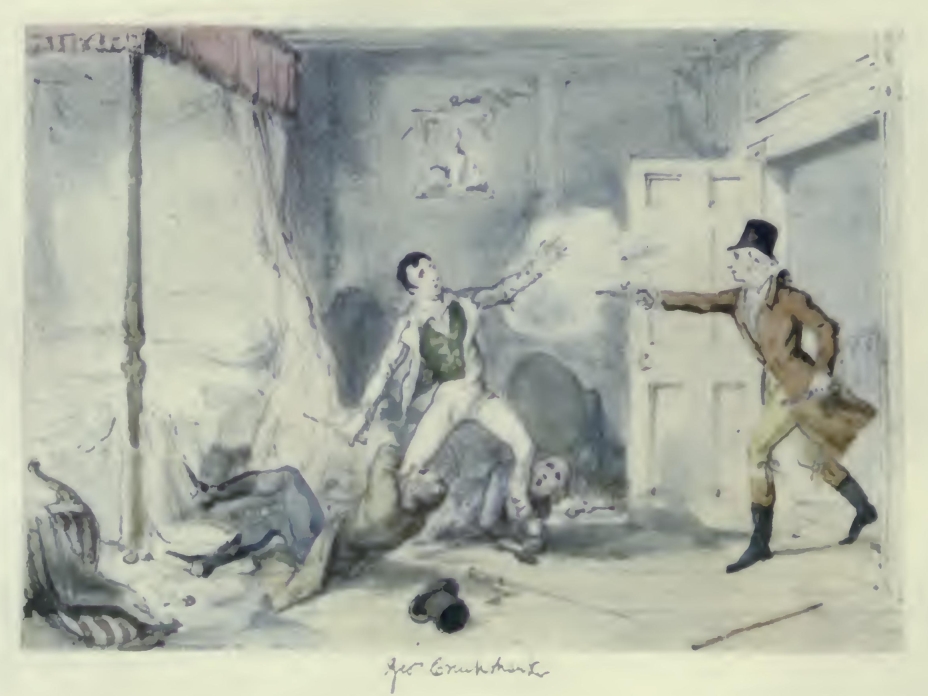

At this moment Major Sirr, who had but just received an intimation from the Castle of the place where Lord Edward was concealed, proceeded in hackney-coaches to arrest him, attended by eight soldiers in coloured clothes, and accompanied by Captains Swan and Ryan. While Sirr was disposing the soldiers below to prevent any chance of escape, Swan hurried upstairs, entered the apartment, and, approaching the bed, told Lord Edward that he was a prisoner. Lord Edward jumped out of bed, and Swan, perceiving that he was determined on resistance, snapped, or, as others say, discharged a pistol ineffectually, and then closing with his antagonist, both rolled upon the bed. In the struggle which ensued Lord Edward stabbed his opponent on the hand and body repeatedly, when Ryan entered the chamber and rushed to the assistance of his companion, lunging at Lord Edward with a cane-sword, which, however, turned on the ribs, and only inflicted a flesh wound. All three fell on the floor together; in the mêlée which followed Ryan received a mortal stab, and when Sirr entered he found Lord Edward on his feet endeavouring to reach the door, while Swan and Ryan held on desperately by the legs to prevent it. Threatened as he was with a fate similar to his companions, Sirr had no alternative but to fire, and aiming his pistol deliberately, he lodged the contents in Lord Edward’s right arm near the shoulder. The wound for a moment staggered him; but as he again rallied, and was pushing towards the door, Major Sirr called up the soldiers, and so desperate were the captive’s struggles that they found it necessary to lay their firelocks across him before he could be disarmed or bound so as to prevent further mischief. Clearly the powers would have preferred to take this unfortunate and embarrassing prisoner dead—the history of the affair makes this evident—three attempts all more or less deliberate had been made on the captive’s life in the short encounter.
An eminent surgeon was immediately brought to the assistance of the wounded men; Ryan’s injury was pronounced the most dangerous—he had commenced his share in the affray by attempting to run their captive through the body. Swan’s wounds, though numerous, were not severe, and on examination Dr. Adreen expressed an opinion that Lord Edward’s were not mortal. The surgeon’s communication elicited a brief but significant remark, ‘I am sorry, doctor, to hear it’!
On the arrival of a cavalry picket and the Rainsford Street guard the wounded men were removed, and Lord Edward was taken to the Castle in a sedan, and carried into the office of the Secretary of the War Department. On his arrest being communicated to Lord Camden, orders were given that the State surgeon should instantly examine and dress his wounds; while with a feeling honourable to his well-known humanity, the Viceroy transmitted by his own secretary a private message to the noble prisoner, giving him an assurance of receiving every indulgence consistent with personal safety. The message was conveyed by Mr. Watson, whose account of the melancholy interview is graphic and interesting. ‘I found Lord Edward leaning back on a couple of chairs, his arm extended, and supported by the surgeon, who was dressing the wound. His countenance was pallid, but serene; and when I told him, in a low voice, not to be overheard, my commission from the Lord Lieutenant, and that I was going to break the intelligence of what had occurred to Lady Edward, asking him, with every assurance of my fidelity and secrecy, whether there was any confidential communication he wished to be made to her ladyship, or whether I could undertake any other act of personal kindness in his service, he answered merely, but collectedly, “No, no, thank you—nothing, nothing—only break it to her tenderly.”’
After a delay of several hours, during which time his wounds had been carefully attended to, Lord Edward was removed to Newgate under a strong military guard, and placed in Lord Aid-borough’s room. As the carriage and escort passed from the Castle to the prison, the countenances and demeanour of the disaffected indicated how deeply they felt the loss of the leader on whom they had placed so much dependence. To attempt a rescue was determined, and, in full assurance that the effort would be made, the garrison remained under arms throughout the night.
On the 31st of May Captain Ryan died of his wounds, but it was considered, though the heat of the weather was against him, that Lord Edward would recover. Attended by a kind-hearted militia officer named Stone, and constantly visited by the State surgeon, there is no doubt that the severity attendant on his confinement as imputed to the authorities was exaggerated.
Lord Edward lingered to the 1st June, when his wounds assumed an unhealthy appearance and fever set in; the death of Captain Ryan had transpired, and the knowledge that his victim was no more added poignant sorrow to a mind already excited too seriously. It is said that the confusion and noise attending on the execution of a young man named Clinch increased this mental irritation. On the 2nd of June Lord Edward became delirious, and the attendance of a keeper from a mad-house was deemed necessary. On the 3rd reason returned, but his strength had sunk completely. The authorities gave a tardy consent for his brother and sister to visit him, a concession Lord Clare had seen fit to withhold until the last. Lady Louisa Conolly relates they saw he was cast for death—‘The two dear brothers frequently embraced each other, to the melting of a heart of stone; and yet God enabled both Henry and myself to remain quite composed. As every one left the room we told him we only were with him. He said, “That is very pleasant.” However, he remained silent, and I then brought in the subject of Lady Edward, and told him I had not left her until I saw her on board; and Henry told him of having met her on the road well. He said, “And the children, too? She is a charming woman,” and then became silent again. That expression about Lady Edward proved to me that his senses were much lulled, and that he did not feel his situation to be what it was; but, thank God! they were enough alive to receive pleasure from seeing his brother and me. Dear Henry, in particular, he looked at continually with an expression of pleasure.’
Immediately after Lord Henry and his sister had taken leave convulsions came on violently, and at two o’clock in the morning of the 4th, a gallant, generous, and enthusiastic spirit—would that it had been better directed I—parted.
After an inquest the body was interred in the cemetery of St. Werburgh, the funeral being conducted as privately as possible to prevent any exhibition of popular feeling, which, had it been more public, would have been certain to occur.
ARREST OF THE BROTHERS SHEARES
The capture of Lord Edward on the eve of the rebellion was followed by the arrest of the brothers Sheares; and had the Government required documentary evidence to establish the ruthless spirit with which the ends of the conspiracy would have been carried out, a military memoir found in the writing-desk of the ill-directed young nobleman, and a sanguinary manifesto in the handwriting of John Sheares, and discovered in the house of his brother Henry, would have been amply sufficient. Lord Edward’s document was purely military, and, although highly mischievous, it was defensible; but the proclamation to be issued on the 24th of May betrayed a ferocity of intention which no circumstances could palliate. Every paragraph seemed traced in blood; and while the sanguinary course of action which it inculcated deprived the unhappy author of that sympathy which his fate might have otherwise obtained, those who would rescue his memory from the odium of savage purpose have wisely grounded its defence upon the only pardonable excuse—insanity.
JOHN SHEARES’ BLOODTHIRSTY MANIFESTO
This explosive manifesto had been prepared in anticipation that the sanguinary programme laid down for the 23rd of May, the outbreak of the rebellion in the capital, had been successfully carried out to its reckless sequel:—
‘Irishmen, your country is free, and you are about to be avenged. That vile Government, which has so long and so cruelly oppressed you, is no more. Some of its most atrocious masters have already paid the forfeit of their lives, and the rest are in our hands. The national flag, the sacred green, is at this moment flying over the ruins of despotism!
‘As for those degenerate wretches who turn their swords against their native country, the national vengeance awaits them. Let them find no quarter, unless they shall prove their repentance by speedily exchanging the standard of slavery for that of freedom.
‘Under the conduct of your chosen leaders march with a steady step to victory. Heed not the glare of hired soldiery, or aristocratic yeomanry: they cannot stand the vigorous shock of freedom. Their trappings and their arms will soon be yours; and the detested Government of England, to which we vow eternal hatred, shall learn that the treasures it exhausts on its accoutred slaves for the purpose of butchering Irishmen shall but further enable us to turn their swords on its devoted head. Attack them in every direction by day and by night; avail the natural advantages of your country, which are and with which you are better acquainted than they. Where you cannot oppose them in full force constantly harass their rear and their flanks; cut off their provisions and magazines, and prevent them as much as possible from uniting their forces; let whatever moments you cannot devote to fighting for your country be passed in learning how to fight for it, or preparing the means of war—for war, war alone must occupy every mind and every hand in Ireland, until its long-oppressed soil be purged of all its enemies. Vengeance, Irishmen, vengeance on your oppressors. Remember that thousands of your dearest friends have perished by their merciless orders. Remember their burnings, their rackings, their torturings, their military massacres, and their legal murders. Remember Orr!’
OUTBREAK OF THE REBELLION
The crisis hurried on rapidly. On the morning of the 21st, the Viceroy officially to the Lord Mayor, and the day following, through Lord Castlereagh, apprised the House of Commons, ‘that his Excellency had received information that the disaffected had been daring enough to form a plan for the purpose of possessing themselves, in the course of the present week, of the metropolis, of seizing the seat of Government, and those in authority within the city; that, in consequence of that information, he had directed every military precaution to be taken which seemed expedient; that he had made full communication to the magistrates for the direction of their efforts; and that he had not a doubt, by the measures which would be pursued, the designs of the rebellious would be effectually and entirely crushed.’
A spirited and dutiful answer was voted by the Commons. ‘The Speaker and all the members immediately waited on his Excellency with the address; and to show their zeal, and to increase the solemnity of the proceedings, they walked through the streets on foot, two and two, preceded by the Speaker, the sergeant-at-arms, and all the officers of the house.’
The 23rd of May, a day that must ever carry with it deplorable recollections, dawned upon a city destined before another sun should rise to undergo every horror that attends a civil war. A gloom overspread the countenances of the royalists. Enough had been communicated by the Executive to convince the most sceptical that the long portending thundercloud was on the eve of bursting—and still the moment of actual insurrection continued veiled in impenetrable mystery.
Evening came, and no positive information of revolutionary outbreak as yet had reached the Castle. A Government spy, late in the day, communicated authentic intelligence, that the picket of yeomanry cavalry at Rathfarnham would that night be surprised and cut off, and, consequently, instead of a sergeant’s party the whole troop mounted for patrol. After narrowly escaping an ambush, Lieutenant La Touche ascertained that the rebels had actually risen, and an express, carried by a trooper called Bennett, was immediately despatched to apprise the Lord Lieutenant of the insurrection. The duty—one of the many instances of the zeal and personal gallantry with which the Irish yeomanry evidenced their fealty and devotion to the Government—was truly perilous, for the rebels in great numbers were collecting in the road and adjacent fields in the vicinity of Dublin. In the city, particularly the suburbs, the yeoman saw a great number of rebels with pikes, in the gateways, alleys, and stable-lanes, waiting the beat of their drums and the approach of rebel columns from the country which they were expecting; and as he passed they frequently cried out, animating each other, ‘Come on, boys! who’s afraid?’
Immediately the garrison and yeomanry drums beat to arms, and the latter hurried to their alarm-posts. The North Cork Militia were formed in Stephen’s Green, and the bridges of the canals, which stretch along the city north and south, were occupied by strong pickets. Those crossing the Liffey were also secured, and the communications completely interrupted.
For some nights previous to the 23rd of May beacon fires were seen on the Wicklow mountains, whose luminous appearance by night and whose smoke by day served as signals to the disaffected in the metropolis and in all the adjacent country. The same practice took place on all the mountains which extend from the Scalp in the county of Wicklow to Mount Leinster in the county of Wexford.
Where existed any necessity for this idle and unnecessary display, when all was organised and ready, and any striking exhibition must naturally add to the alarm which every prudential motive should have allayed? Why increase the fears and consequently the vigilance of the Executive? In secrecy of purpose lay success, and all was in favour of it could the authorities be lulled into a false and fatal security. The yeomanry corps, which in a few days afterwards were purified of traitors, at the moment of the outbreak abounded in United Irishmen, upon whom no shadow of suspicion had yet fallen. ‘It was discovered,’ says Sir Richard Musgrave in his narrative, ‘that near nine-tenths of the Roman Catholics in the yeomanry corps were United Irishmen, and had taken an oath to be true to the rebels in direct contradiction to their sworn allegiance, and yet many of them, after taking the United oath, had, by deliberate and pre-determined perjury, joined the yeomanry corps for the purpose of getting arms in their hands, learning the use of them, and turning them against the loyalists perhaps in the very moment of danger. In the subsequent development of the conspiracy there occurred direct evidence of the loyalist corps deliberately joining the rebels they were sworn to subdue at the critical juncture of the encounters.
The domestic servants of Dublin were deeply engaged in the conspiracy, and hence every action of their employers was revealed, and the safety of every house was compromised. Even the lamplighters lent their assistance, and darkness was prearranged to assist—as it would do most effectively—a sudden outburst, by neutralising the advantages which daylight secures to disciplined troops in a conflict with fierce and tumultuary assailants.
It has been already mentioned that the stoppage of the mail-coaches was to be the signal for a general rising. On the evening of the 23rd, at Santry, the Belfast mail was burned; the Limerick stopped on the Curragh of Kildare, and both guard and coachman murdered; the Athlone coach was destroyed at Lucan, and the Cork mail at Naas.
A number of petty affairs followed the instant outbreak of the rebellion, all characterised by the atrocities attending civil war. In these affairs the rebels were generally repulsed; but in a few they unhappily succeeded, and always by surprise, treachery, or the imprudence of the royalists. Of these we shall meet instances in the course of our illustrations. As regards the outbreak in the capital, naturally the capture of Dublin was the grand and primary object at which the conspirators unanimously aimed; and a simultaneous movement on the metropolis by the Kildare rebels was to have seconded the efforts of the disaffected within the city. Everything was in favour of success; and, as the garrison was almost drained of regular troops, and its safety entrusted to the yeomanry, that circumstance was not overlooked by the rebel leaders. In barracks soldiers cannot be easily surprised; a few taps from the drum, and a very few minutes are quite sufficient to place a regiment in battle order; but to collect irregulars, dispersed and distant from the alarm-posts they have been directed to assemble at, is a work of time, and equally difficult and precarious, as, in an attempt to reach the posts assigned, individuals and isolated parties are readily intercepted and overpowered.
This was the great design of the insurgents, and nothing could have been more easily effected when aided by the darkness of night and the intricacies of a city crowded with houses, and intersected by narrow lanes.
By an unaccountable oversight the canals, which covered two sides of Dublin, had been left open, when by stockading the bridges they could have easily been rendered defensible, and have thus placed an impassable obstruction to any bodies who might approach the city from Kildare. Before the royalists occupied the bridges numbers of insurgents from the country had crossed over, and it was computed that by one northern turnpike more than two thousand strangers had entered the city during the evening and succeeding night.
Of the chief plans propounded by the rebel leaders, the capture of the Castle with the high authorities it contained, the cutting off of the royalists in detached parties as they hurried to their respective alarm-posts at the beat to arms of rebel drums, with an attack on the jail of Newgate, the liberation of their friends the State prisoners there incarcerated, formed the grand objects of their midnight movement. The guiding spirit was evidently lacking, for the head had been cut off. On the plans of action there was a division of opinion among the existing leaders. John Sheares confined the intended operations of his followers to dealing with the Castle and disposing of the inmates. Neilson, it was arranged, should attack the jail. Accident interfered; neither plan had any success, and the leader found himself at midnight the inmate of the prison from which he had falsely calculated that he was going to liberate his imprisoned confederates.
Southwell C. McClure, a rebel colonel, who had been pardoned, gave evidence that Neilson had made preparations for his task, and taken elaborate preparations for the carrying out of his plan on Newgate and cutting off the loyalist auxiliaries in detail. He had assembled at a house in Church Lane, a noted rendezvous for rebels, fifteen colonels representing as many battalions; to each of these leaders he had produced a map of Dublin, and assigned to each the post which each colonel and his regiment was to occupy that night. In his attack upon Newgate he was to have been seconded by a large body of rebels, headed by Seagrave, who was to have secured possession of Mr. Halpin’s distillery, the windows of which flanked it, and they were to have kept up a constant fire on the front of the prison, while another party scaled the walls in a different quarter. Neilson’s preparations promised to prove formidable, and at ten o’clock this leader, having a body of rebels collected in some fields contiguous to-Eccles Street, proceeded to reconnoitre Newgate and point out the best points of attack to his supporters. Escalade, supported by a commanding fire of musketry, was the plan adopted, and from the manner in which the prison was domineered the attempt might have easily succeeded. In the most suspicious manner Neilson was always found doing compromising acts. His behaviour had helped to compromise Lord Edward’s security, and on this occasion he seems to have deliberately sacrificed his plans and his safety at the critical juncture, and thus compromised the entire scheme.
Some waste ground, then covered with heaps of market offal, and close to the prison, enabled a person to examine the building unperceived, and of this advantage Neilson, already well acquainted with the locality, had availed himself. In the darkness he trod upon a child, and the outcry brought its mother to the spot. The woman was drunk, an angry altercation followed, and no apology which Neilson could offer would conciliate the irritated poissarde. The noise naturally attracted attention; persons hastened to the spot, and among others Mr. Gregg, the jailor. Neilson, having already been in his custody, was perfectly familiar to Gregg. The latter immediately arrested him, a desperate resistance was offered, a pistol snapped, and a doubtful struggle ensued. Under a belief that Gregg’s assault on Neilson was occasioned by his resentment of the injury offered to her child, the fishwoman so far contributed by her clamour to mystify the affray that the line of posts which Neilson had established between Newgate and Eccles Street thought the noise only a squabble of drunken fishwomen, and waited in idle expectation for Neilson’s return and orders to advance, until the capture transpired in an hour or two, and the party took alarm and disbanded.
In a popular movement failure or success at first generally decides its fortunes. The attempt on the capital signally miscarried. The master-spirit was wanting at the hour of action, and he who might have given a fatal direction to efforts ill-directed and uncombined, was, with his abler associates, immured within the walls of a prison. Upon individuals alike wanting in courage and ability the hurried choice of revolutionary leadership had fallen. If Neilson’s imprudent visits to Lord Edward before the arrest subjected him to a charge of treachery afterwards, his conduct on the night he reconnoitred Newgate proves him to have been quite unfitted for command. That a man known to every turnkey should have personally examined a building in which he had been so long confined appeared, from its extreme rashness, almost to indicate indifference to the consequences of discovery.
THE REBELLION OFFICIALLY PROCLAIMED
On the morning of the 24th two proclamations were issued—the one from General Lake, the other from Alderman Fleming. Both were stringent, but the circumstances of the times admitted of no temporising measures:—
‘Lieutenant-General Lake, commanding his Majesty’s forces in this kingdom, having received from his Excellency the Lord Lieutenant full powers to put down the rebellion, and to punish rebels in the most summary manner, according to martial law, does hereby give notice to all his Majesty’s subjects, that he is determined to exert the powers entrusted to him in the most vigorous manner for the immediate suppression of the same; and that all persons acting in the present rebellion, or in any way aiding or assisting therein, will be treated by him as rebels, and punished accordingly.
‘And Lieutenant-General Lake hereby requires all the inhabitants of the city of Dublin (the great officers of State, members of the houses of Parliament, privy councillors, magistrates, and military persons in uniform excepted) to remain within their respective dwellings from nine o’clock at night till five in the morning, under pain of punishment.’
The Lord Mayor’s proclamation was equally to the point and equally judicious:—
‘Whereas the circumstances of the present crisis demand every possible precaution; these are therefore to desire all persons who have registered arms forthwith to give in, in writing, an exact list or inventory of such arms at the town-clerk’s office, who will file and enter the same in books to be kept for that purpose. And all persons who have not registered these arms are hereby required forthwith to deliver up to me, or some other magistrate of this city, all arms and ammunition of every kind in their possession. And if, after this proclamation, any person having registered arms shall be found not to have given in a true list or inventory of such arms, or if any person who has not registered shall be found to have in their power or possession any arms or ammunition whatever, such person or persons will, on such arms being discovered, be forthwith sent on board his Majesty’s navy, as by law directed.
‘And I do hereby desire that all housekeepers do place upon the outside of their doors a list of persons in their respective houses, distinguishing such as are strangers from those who actually make part of their family; but as there may happen to be persons who, from pecuniary embarrassments, are obliged to conceal themselves, I do not require such names to be placed on the outside of the door, provided their names are sent to me. And I hereby call upon his Majesty’s subjects within the county of the city of Dublin immediately to comply with this regulation, as calculated for the public security; as those persons who shall wilfully neglect a regulation so easy and salutary, as well as persons giving false statements of the inmates of their houses, must, in the present crisis, abide the consequences of such neglect.’
SURPRISE OF THE BARRACKS OF PROSPEROUS
The outbreaks in the immediate vicinity of Dublin come next in the order of alike the chronological sequence of events and of the illustrations. Slight affairs occurred on the night of the 23rd, and upon the following day. At Rathfarnham, Lucan, Lusk, Collan, and Baltinglass the royalists and rebels came in contact, and the latter were repulsed. At Dunboyne and Barretstown the escorts of some baggage (Reay and Suffolk Fencibles) were surprised. On the succeeding day Clane, Naas, Ballymore-Eustace, Kilcullen, and Prosperous were attacked, and with the exception of the latter, in every effort the rebels were unsuccessful.
Prosperous, a small but thriving town, then generally inhabited by persons manufacturing cottons, is seventeen miles from Dublin. It was garrisoned by a detachment of the North Cork Militia, some forty men under Captain Swayne, with a lieutenant and twenty of the Ancient British Cavalry. The infantry occupied a temporary barrack, half the cavalry were quartered in an opposite house, and the remainder in single billets. On the Sunday (20th) previous to the outbreak Swayne arrived in Prosperous with his detachment. He attended at the chapel with Dr. Esmond, a man of great local influence, and then implored the people there assembled to deliver up any arms which might be concealed, return to their allegiance, and receive the protection he was authorised to grant them. This exhortation proved ineffectual; some coercive measures—such as the seizure of cattle, then warranted by martial law—were resorted to; and on the 23rd it was intimated that fear had hitherto prevented the peasantry from bringing the concealed arms to the town, and that should they be permitted to enter after dark, unchallenged and unmolested, on the following night, pikes and firearms would be brought in and deposited in the streets.
It is difficult to decide whether the stupidity of Swayne or the treachery of Esmond were most to be condemned. A man individually may trifle with himself, but for him who turns right or left from the plain path which duty points to, and compromises the safety of those committed to his charge, there can be no extenuation. For Swayne’s folly there can be no apology—his pickets should have been doubled—a cart, a ladder drawn across the street, would have marked sufficiently where those who came to surrender arms might approach with full security. A step beyond it, if the challenge failed, the advanced sentry shot the intruder, and the garrison was at once alarmed. So much for Captain Swayne. His weakness was inexcusable—he died its victim—ignobly certainly, but still by the weapon of a foeman. Esmond met the doom he merited—a halter. Mus-grave’s account of the surprise is authentic:—
‘At two o’clock on Thursday morning, the 24th May, the two sentinels were surprised and killed; and both the barracks were assaulted while the soldiers were fast asleep. The barracks of the Cork company consisted of a hall, an apartment on each side, the same in the next storey, and underground offices. A party of the rebels rushed into Captain Swayne’s apartment, which was on the ground floor, and murdered him. Some soldiers, who slept in the opposite apartment, alarmed at the noise, came forth with their firelocks and expelled those ruffians from the barrack, after having killed two or three of them.
‘The house was at that time surrounded with a great number of rebels variously armed. A fierce conflict ensued between the assailants and the besieged; but it was soon put an end to by the following malignant device of the former. There was a great quantity of straw in the underground office, to which the rebels set fire, and, to increase the flame, introduced some faggots into it. The soldiers were soon in a state of suffocation; and the heat being so great that they could not endure it, they retreated to their comrades in the upper storey; but the flames and smoke soon reached them there, as the rebels continued to introduce lighted faggots into the apartments under them. Enveloped with thick smoke, and overcome with heat, some of them leaped out of the windows, but were immediately received on the pikes of the assailants, who gave a dreadful yell whenever that occurred.
‘At last the barrack being in a state of conflagration, the soldiers resolved to rush forward and fight their way through their assailants; but they, who were very numerous, formed a halfmoon round the front of the barrack, and received them on their pikes, so that but few of them escaped.5
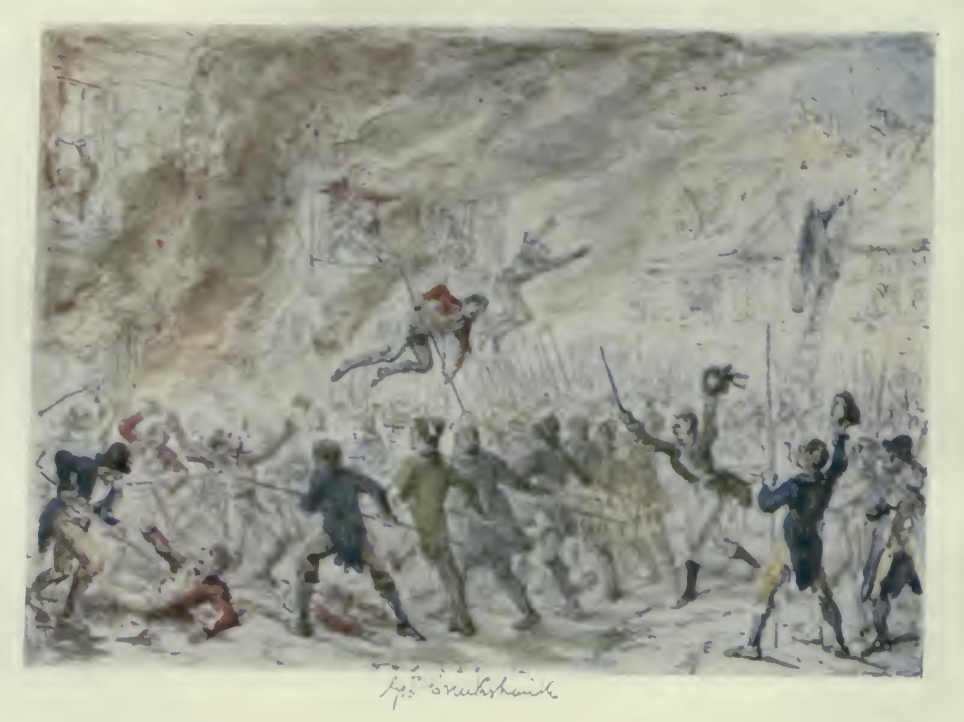
Nothing could have been more detestable than the treachery of Esmond; though lieutenant in the Armagh Militia, he actually planned and led the rebel surprise of Prosperous. He wore the royal uniform, and yet was false to the monarch to whom he had sworn allegiance. When men of desperate fortunes swerve from the path of honour poverty may be pleaded to extenuate, though not excuse. Esmond had no plea to offer—he was wealthy, well born, and respected. He might have proved a rebel, but why play the traitor? When in the house of God loyalty was on his lips, while the heart was contemplating bloodshed. Even the tie a savage venerates could not turn him from his truculent design,—and, while he devoted him to death, he shared his victim’s hospitality—dined with Captain Swayne ‘at an inn on the 23rd of May, and continued to enjoy the glow of social mirth with him, till a few hours before the perpetration of that bloody scene which he had for some time meditated.’