THE MISER’S DAUGHTER (continued 2)
Reading edition
‘Odd’s bodikins! Mr. Willars, how you do confuse me!’ exclaimed the lady, spreading her large fan before her face.
By this time they had gained the principal avenue leading towards the orchestra, and at each step he took, Mr. Cripps kissed his hand to some elegantly dressed person.
‘There’s my friend Lord Effingham, and his countess,’ he said; ‘glad to see you, my lord. That’s the pretty Mrs. Rackham—a bride, sweetheart, a bride,’ with tender emphasis—‘that’s the rich Mrs. Draper—I daren’t look at her, for she’s determined to have me, whether I will or no, and I can’t make up my mind to it, though she’s promised to settle sixty thousand pounds upon me, and to die in six months.’
‘La! Mr. Willars, you wouldn’t sell yourself to such an ojus creature as that!’ cried Mrs. Nettleship—‘why, she’s a perfect fright, and so dressed!’
‘Precisely what you describe her, ‘pon rep!’ replied Mr. Cripps. ‘But do listen to the music. Isn’t it inspiring?’ And they paused for a moment to listen to the lively strains proceeding from the orchestra, which was placed at one end of a large building facing the principal walk. By this time the company had almost entirely assembled. The main walk was completely thronged, and presented the appearance of the Mall at high tide, while all the boxes and alcoves were filled with persons discussing bowls of punch, plates of ham, chickens, salads, and other good things. The band in the orchestra was excellent, and the lively airs and symphonies added to the excitement and spirit of the scene. Mr. Cripps created a great sensation. Many persons thought they had seen him before, but no one could tell who he was. Meanwhile, the object of this attention continued to dispense his bows and smiles, flourished his clouded cane, tapped his magnificent snuff-box, and after astonishing all the beholders with his coxcombry, glided off with his companion into one of the side walks. He had scarcely disappeared, when Lady Brabazon and her party entered the main walk. Her ladyship led her little spaniel by its string, and was attended on one side by the beau, and on the other by Trussell. Behind them walked Clementina, who had contrived to allure Randulph from her mother, and to attach him to her, while on the young man’s left walked Sir Singleton Spinke. Everybody whom Mr. Villiers encountered told him of the prodigious beau who had just been seen on the walk—Lord Effingham, Major Burrowes, Lord Dyneover, Sir John Fagg—all described him.
‘Who the devil is he?’ cried Villiers.
‘Haven’t the least idea,’ replied Sir John Fagg. ‘But I’ll speak to him, if I meet him again. He’s your very double, Villiers. I’ll swear he has employed Desmartins to make him a suit precisely like your own.’
‘Has he?’ cried the beau indignantly—‘Then I’ll never employ a rascally Frenchman again! and what is more, I won’t pay him his bill.’ The same thing was told him by twenty other persons, and the beau looked anxiously round for his personator, but was for some time unable to discern him.
Meanwhile, Mr. Cripps had sought this secluded walk to give him an opportunity of making a declaration to the widow, and though he was not positively accepted he was not decidedly refused,—the lady only asking time to consider over the proposal. The audacious valet was on his knees, and rapturously kissing her hand, vowing he would never rise till he received a favourable answer to his suit, when two persons were seen approaching, whom, to his infinite mortification and surprise, he recognised as Abel Beechcroft and his uncle, Mr. Jukes.
‘We are interrupted, my charmer!’ he cried, getting up, with a countenance of angry dismay. ‘Let us return to the public promenade. You won’t refuse me? I shall kill myself, ‘pon rep, if you do.’
‘I’ll think of it, Mr. Willars,’ said Mrs. Nettleship, twirling her fan. ‘But it would be a dreadful thing if I was to break my engagement to Mr. Rathbone!’
‘Oh! curse Mr. Rathbone! I’ll cut his throat!’ cried Mr. Cripps, glancing anxiously down the walk. But unfortunately there was no outlet at the lower end, and he was compelled to turn and face the intruders. He looked also to the right and left, but on neither side was there an alcove into which he could retreat. Nothing was left for it but impudence, and luckily for him, this quality seldom deserted him at a pinch. Putting on his boldest manner, he strutted gaily, and with affected nonchalance, towards Abel and his uncle, who, as he advanced, stepped a little aside to look at him.
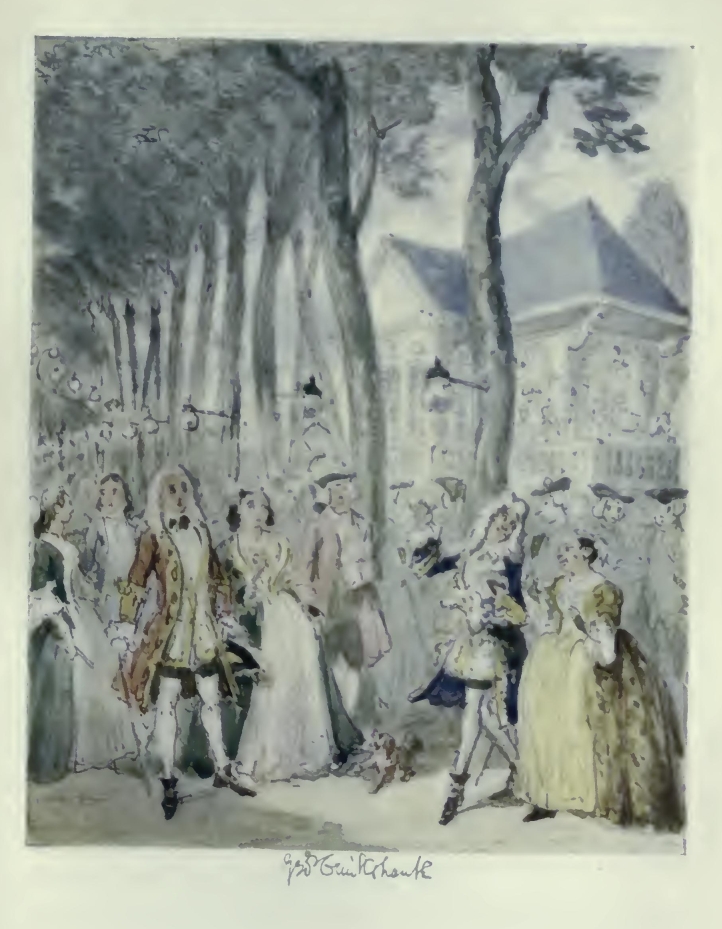

‘Why, as I live!’ cried Abel, ‘that’s Mr. Villiers’s valet—your nephew, Jukes.’
‘Lord save us! so it is,’ cried Mr. Jukes, lifting up his hands in astonishment. ‘Why, Crackenthorpe, what are you doing here—and in your master’s clothes?’
‘Truce to your jests, old fellow,’ said Mr. Cripps, waving him off, ‘and let me pass.’
‘What! disown your uncle!’ cried Mr. Jukes angrily, ‘and in the presence of his worthy master! The rascal would deny his own father. Pay me the ten crowns you borrowed yesterday.’
‘La! Mr. Willars, what’s the meaning of all this?’ asked Mrs. Nettleship.
‘Pon my soul, my angel, I don’t know, unless the old hunks has been drinking,’ replied Mr. Cripps. ‘The ‘rack punch has evidently got into his head, and made him mistake one person for another.’
‘’Rack punch!’ cried Mr. Jukes furiously. ‘I haven’t tasted a drop! You call him Mr. Willars, ma’am,’ he added to Mrs. Nettleship. ‘He’s deceiving you, ma’am. He’s not Mr. Willars—he’s Mr. Willars’s gentleman—his valet.’
‘A truce to this folly, you superannuated old dolt!’ cried Mr. Cripps, raising his cane, ‘or I’ll chastise you.’
‘Chastise me!’ exclaimed the butler angrily. ‘Touch me, if you dare, rascal; Crackenthorpe, Crackenthorpe—you’ll certainly be hanged.’
‘Let him alone, Jukes,’ interposed Abel. ‘He’ll meet his master at the corner of the walk, and I should like to see how he’ll carry it off.’
Taking advantage of the interference, Mr. Cripps passed on with his inamorata, who was as anxious to escape from the scene as himself; while Abel and Mr. Jukes followed them at a short distance. It fell out as Abel had foreseen. As Mr. Cripps issued into the broad walk, right before him, and not many yards off, were his master and Lady Brabazon, together with the rest of the party. If the valet ever had need of assurance, it was now. But though ready to sink into the earth, he was true to himself, and exhibited no outward signs of discomposure. On the contrary, he drew forth his snuff-box, took a pinch in his airiest manner, and said to Mrs. Nettleship—‘There’s Lady Brabazon—accounted one of the finest women of the day, but upon my soul, she’s not to be compared with you.’ With this he made a profound salutation to Lady Brabazon, who looked petrified with astonishment, and kissed his hand to Trussell, who was ready to die with laughing. As to the beau, he grasped his cane in a manner that plainly betokened his intention of laying it across his valet’s shoulders. But the latter, divining his intention, and seeing that nothing but a bold manoeuvre could now save him, strutted up to him, and said in a loud voice—‘Ah! my dear fellow—how d’ye do?—glad to see you—plenty of company’—adding, in a lower tone—‘for Heaven’s sake, sir, don’t mar my fortune. I’m about to be married to that lady, sir—large fortune, sir—to-day will decide it—‘pon rep!’
Mr. Villiers regarded him in astonishment, mixed with some little admiration; and at length his good-nature got the better of his anger. ‘Well, get you gone instantly,’ he said; ‘if I find you in the gardens in ten minutes from this time, you shall have the caning you merit.’
‘Good day, sir,’ replied Mr. Cripps—‘I’ll not forget the favour.’ And with a profound bow, he moved away with the widow.
‘And so you have let him off?’ cried Lady Brabazon, in amazement.
‘Upon my soul, I couldn’t help it,’ replied the beau. ‘I’ve a fellow-feeling for the rascal—and, egad, all things considered, he has played his part so uncommonly well, that I hope he may be successful.’
DAY MASQUERADE IN RANELAGH GARDENS
And now, before entering Ranelagh, it may be proper to offer a word as to its history. Alas for the changes and caprices of fashion! This charming place of entertainment, the delight of our grandfathers and grandmothers, the boast of the metropolis, the envy of foreigners, the renowned in song and story, the paradise of hoops and wigs, is vanished,—numbered with the things that were!—and we fear there is little hope of its revival.
Ranelagh, it is well known, derived its designation from a nobleman of the same name, by whom the house was erected, and the gardens, esteemed the most beautiful in the kingdom, originally laid out. Its situation adjoined the Royal Hospital at Chelsea, and the date of its erection was 1690-1.
Ranelagh House, on the death of the earl in 1712, passed into the possession of his daughter, Lady Catherine Jones; but was let, about twenty years afterwards, to two eminent builders, who relet it to Lacy, afterwards patentee of Drury Lane Theatre, and commonly called Gentleman Lacy, by whom it was taken with the intention of giving concerts and breakfasts within it, on a scale far superior, in point of splendour and attraction, to any that had been hitherto attempted.
In 1741 the premises were sold by Lacy to Messrs. Crispe and Meyonnet for £4000, and the rotunda was erected in the same year by subscription. From this date the true history of Ranelagh may be said to commence. It at once burst into fashion, and its entertainments being attended by persons of the first quality, crowds flocked in their train, shortly after its opening, Mr. Crispe became the sole lessee; and in spite of the brilliant success of the enterprise, shared the fate of most lessees of places of public amusement, being declared bankrupt in 1744. The property was then divided into thirty shares, and so continued until Ranelagh was closed.
The earliest entertainments of Ranelagh were morning concerts, consisting chiefly of oratorios, produced under the direction of Michael Festing, the leader of the band; but evening concerts were speedily introduced, the latter, it may be mentioned, to show the difference of former fashionable hours from the present, commencing at half-past five, and concluding at nine.
Thus it began, but towards its close, the gayest visitors to Ranelagh went at midnight, just as the concerts were finishing, and remained there till three or four in the morning. In 1754 the fashionable world were drawn to Ranelagh by a series of amusements called Comus’s Court; and notwithstanding their somewhat questionable title, the revels were conducted with great propriety and decorum. A procession which was introduced was managed with great effect, and several mock Italian duets were sung with remarkable spirit. Almost to its close, Ranelagh retained its character of being the finest place of public entertainment in Europe, and to the last the rotunda was the wonder and delight of every beholder.
The coup-d’oeil of the interior of this structure was extraordinarily striking, and impressed all who beheld it for the first time with surprise. It was circular in form, and exactly one hundred and fifty feet in diameter. Round the lower part of the building ran a beautiful arcade, the intervals between each arch being filled up by alcoves. Over this was a gallery with a balustrade, having entrances from the exterior, and forming a sort of upper boxes. Above the gallery was a range of round-headed windows, between each of which was a carved figure supporting the roof, and forming the terminus of the column beneath. At first, the orchestra was placed in the centre of the amphitheatre, but being found exceedingly inconvenient, as well as destructive of the symmetry of the building in that situation, it was removed to the side.
It contained a stage capable of accommodating thirty or forty chorus singers. The original site of the orchestra was occupied by a large chimney, having four faces enclosed in a beautifully proportioned, hollow, hexagonal column, with arched openings at the sides, and a balustrade at the base. Richly moulded, and otherwise ornamented with appropriate designs, this enormous column had a charming effect, and gave a peculiar character to the whole amphitheatre. A double range of large chandeliers descended from the ceiling; others were placed within the column above mentioned, and every alcove had its lamp. When all these chandeliers and lamps were lighted, the effect was wonderfully brilliant.
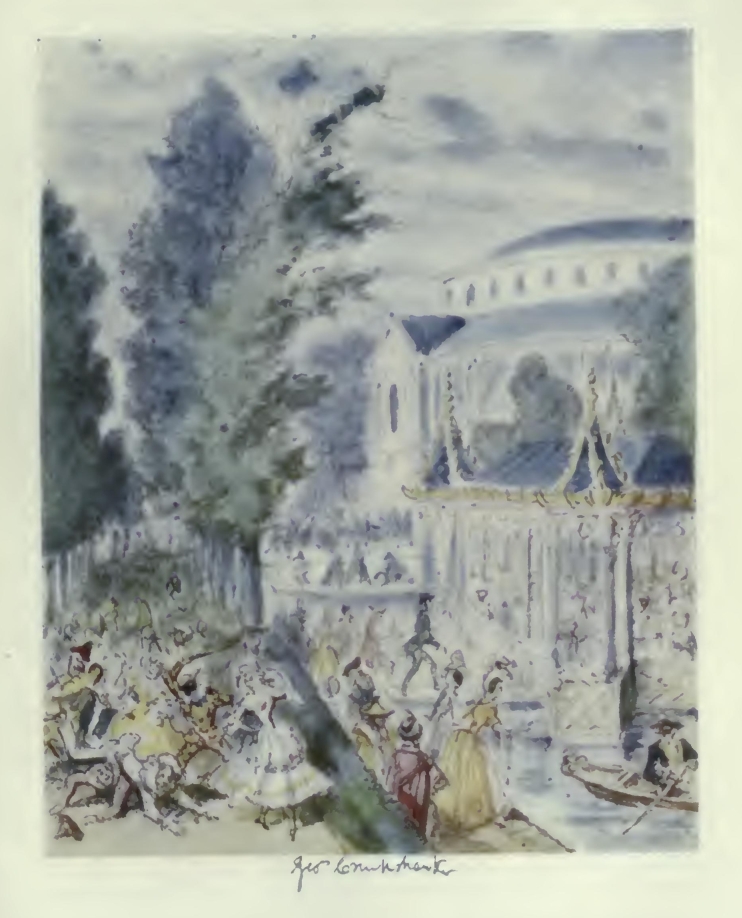
The external diameter of the rotunda was one hundred and eighty-five feet. It was surrounded on the outside by an arcade similar to that within, above which ran a gallery with a roof supported by pillars, and defended by a balustrade. The main entrance was a handsome piece of architecture, with a wide, round, arched gate in the centre, and a lesser entrance at either side.
On the left of the rotunda stood the Earl of Ranelagh’s old mansion, a structure of some magnitude, but with little pretensions to beauty, being built in the formal Dutch taste of the time of William of Orange. On the right, opposite the mansion, was a magnificent conservatory, with great pots of aloes in front. In a line with the conservatory, and the side entrance of the rotunda, stretched out a long and beautiful canal, in the midst of which stood a Chinese fishing temple, approached by a bridge. On either side of the canal were broad gravel walks, and alleys shaded by lines of trees, and separated by trimly clipped hedges. The gardens were exquisitely arranged with groves, bowers, statues, temples, wildernesses, and shady retreats.
Though Lady Brabazon’s carriage was within a hundred yards of the entrance of Ranelagh when Mr. Cripps and his party passed it, owing to the crowd and confusion it was nearly a quarter of an hour in setting down. Before getting out, the whole party put on their masks; and Lady Brabazon wrapped herself in a yellow silk domino. Trussell took charge of Clementina, and her ladyship fell to Randulph’s care.
It was yet extremely early, but the crowd was prodigious,—many hundred persons being assembled in the area before the entrance to the rotunda. At least a thousand others were dispersed within the gardens, for the rotunda was not opened till the evening; and it was afterwards computed that more than four thousand persons attended the masquerade.
At the entrance, Lady Brabazon and her daughter were joined by Beau Villiers, Sir Bulkeley Price, and Firebras, Sir Singleton Spinke having disappeared. Randulph had already been more than once at Ranelagh, but it was only to attend the ordinary concerts, and never having seen a masquerade, he was extraordinarily struck with the spectacle presented to him.
Most of the characters were grotesquely dressed, as was the taste of the time, for it was not a period when the niceties of costume were understood or regarded; still, the general effect was admirable. A May-pole, surmounted by a crown, with long ribands dangling from it, was planted in front of the conservatory, and several dancers were chasing each other round it, while lively strains were played by a band of musicians beside them. Other and less melodious sounds were heard. Now a drummer would go by, beating a rub-a-dub enough to deafen every listener. Then came the vile scraping of a fiddle, or the shrill notes of a fife. The shouts, the laughter, the cries of all kinds baffled description, and equally vain would it be to attempt any delineation of the motley assemblage. It consisted of persons of all countries, all periods, and all ranks, for the most part oddly enough jumbled together. A pope in his tiara would be conversing with a Jew; a grave lawyer in his gown and wig had a milk-girl under his arm; a highland chief in his full equipments escorted a nun; a doge in his splendid habiliments was jesting with a common sailor, with a thick stick under his arm.
But frolic and fun everywhere prevailed; and to judge from the noise, everybody seemed to be merry. No one could escape from the tricks and jests of the buffoons with whom the crowd abounded. The humour of the last century was eminently practical; cuffs and kicks were liberally dealt around, and returned in kind; and whenever a sounding blow was heard, it elicited shouts of laughter like those that are heard at the feigned knocks in a pantomime. The clowns, punches, pierrots, doctors, and harlequins, of whom there were several besides our friend, Mr. Cripps, were the chief creators of this kind of merriment.
While Randulph, greatly diverted by all he saw, was gazing around, a few words pronounced by a voice whose tones thrilled to his heart caught his ear. He turned, and saw close behind him, attended by a tall personage, whose stiffness left no doubt as to its being Sir Norfolk Salusbury, a beautiful female mask, whose snowy skin and dark streaming ringlets would have told him, if his heart had not informed him of the fact, that it was Hilda, but before he could summon resolution to address her, she had passed by; and Lady Brabazon, who had likewise heard the voice and recognised the speaker, dragged him in the opposite direction towards the May-pole. He looked eagerly backwards, but the fair mask was lost amid the throng, nor could he even discern the tall figure of Sir Norfolk.
RANDULPH AND HILDA DANCING IN THE ROTUNDA AT RANELAGH GARDENS
Some hours passed on in this way, and Randulph was still held in bondage. At length the rotunda was opened. Of course, the royal party was ceremoniously ushered in, in the first place; but immediately afterwards crowds poured-in, and the whole area of the amphitheatre, together with the boxes and gallery above, were filled with company. What with the innumerable lights, and the extraordinary variety of dresses, the whole scene had a most brilliant effect. There was an excellent band in the orchestra, and a concert was commenced, but little attention was paid to it by the assemblage, who continued promenading round and round the amphitheatre—laughing and talking loudly with each other.
As soon as the concert was over, the loud blowing of a horn attracted general observation to a platform near the central column, on which the quack doctor and his attendant were stationed—the latter of whom began dispensing his medicines, and vaunting their efficacy, in a highly ludicrous manner. This and other entertainments consumed the time till ten o’clock; before which, however, a magnificent supper was served to the royal party in a private refreshment room.
A bell was then rung, to announce that a grand display of fireworks was about to take place, and the company hurried to the outer galleries and to the gardens to witness the exhibition. Much confusion ensued, and amidst it, the fair Thomasine, somehow or other, got separated from her party. The little barber was almost frantic. He rushed hither and thither among the crowd, calling for her by name, and exciting general ridicule. At last, in an agony of despair, he stationed himself near the scaffold where the fireworks were placed; and when the first signal-rocket ascended, he perceived her pretty face turned upwards at a little distance from him. She was standing near the trees with the old beau, whose transports at his enviable situation were somewhat disturbed by the descent of a heavy rocket-stick on his head. At this juncture the little barber reached his truant mistress, and forcing her from Sir Singleton, placed her rounded arm under his own, and held it fast.
‘Oh, dear, how glad I am to see you,’ said the naughty little Thomasine, for ‘fair’ she does not deserve to be called; ‘we’ve been looking for you everywhere’—(here she told a sad story). ‘That odious old beau has been trying to persuade me to run away with him. He offers to settle—I don’t know what—upon me, and to make me Lady Spinke.’
‘And why don’t you accept his offer?’ said the barber, in an ecstasy of jealous rage.
‘Because I’m engaged, and engagements with me are sacred things,’ replied the fair Thomasine theatrically, yet tenderly. ‘But do look at that beautiful wheel.’
The fireworks were really splendid. Flights of rockets soared into the skies; magnificent wheels performed their mutations; star-pieces poured forth their radiant glories; maroon batteries resounded; Chinese fountains filled the air with glittering showers; pots-des-aigrettes, pots-des-brins, and pots-des-saucis-sons discharged their stars, serpents, and crackers; yew-trees burnt with brilliant fire; water-rockets turned the canal to flame; fire-balloons ascended; and a grand car with flaming wheels, drawn by sea-horses snorting fire, and containing a figure of Neptune, which, traversed the whole length of the canal, and encircled the Chinese temple—the bridge being removed to make way for it—and finally exploded, scattering serpents and crackers in every direction, concluded the exhibition, amid the general plaudits of the assemblage. Darkness for a few minutes enveloped the crowd, during which a few cries were heard in timid female tones; but the lamps were as soon as possible lighted, and the majority of the assemblage returned to the rotunda, where they repaired to the alcoves, and many a bowl of punch was emptied, many a bottle of champagne quaffed; after which dancing was resumed with greater spirit than ever.
Mr. Rathbone gave a capital supper to his party, in which the old beau contrived to get himself included. He contrived also to sit near the fair Thomasine, and pledged her so often and so deeply that he fell beneath the table. Here he was left by the others, and a minuet being struck up, Mr. Cripps offered his hand to the widow, and led her forth to dance; while Mr. Rathbone, greatly exhilarated by the punch he had drunk, stood by, laughing at them ready to split his sides; and the little barber took the opportunity of their being left alone together, to reprove the fair Thomasine for her improper conduct towards the old beau during supper.
Liberated by the departure of the Prince of Wales, who quitted the gardens on the conclusion of the fireworks, Randulph immediately returned to the rotunda, in the hope of finding Hilda still there. He had scarcely entered it when he perceived Firebras at supper by himself in one of the alcoves, and instantly joined him.
‘She is still here,’ said Firebras, ‘and as soon as I have finished my supper I will take you to her. There would be no use in going now, for Sir Norfolk has only just ordered supper, and I can merely introduce you as a partner for a dance. Sit down, and take a glass of champagne.’
Randulph declined the latter offer, and was obliged to control his impatience until Firebras thought fit to rise. Crossing the amphitheatre, they proceeded to an alcove, in which Sir Norfolk and Hilda were seated, and Firebras, bowing to the old knight, said—
‘Sir Norfolk, permit me to have the honour of presenting the friend I mentioned some hours ago to your fair charge. Miss Scarve,’ he added, after a significant look at Hilda, ‘this gentleman wishes to have the honour of dancing a minuet with you. I am sorry there is no time for a more ceremonious introduction to yourself, Sir Norfolk, but the musicians are striking up the dance.’
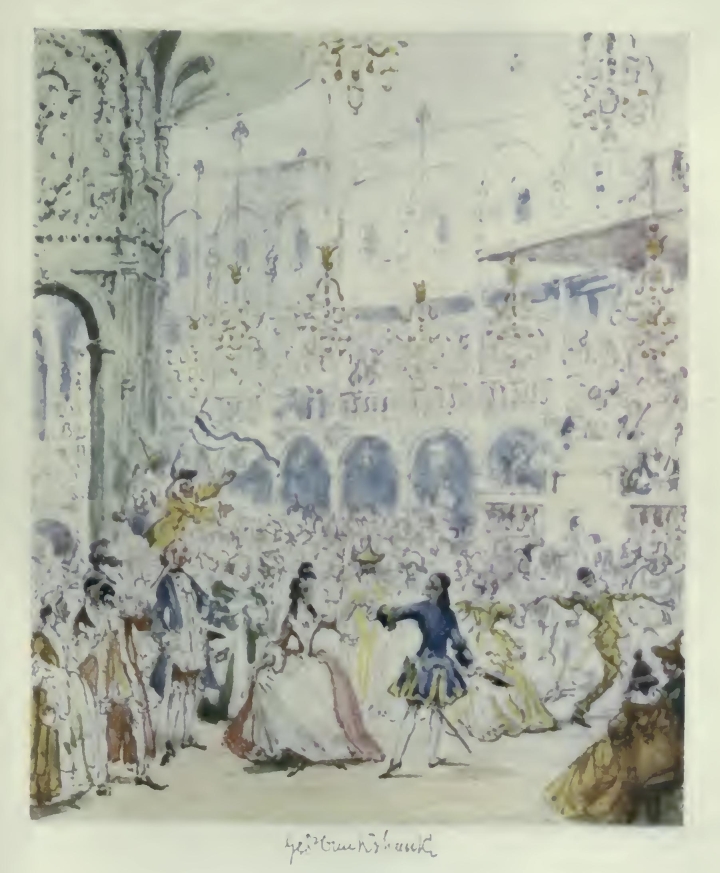
Upon this Hilda arose, and tendered her hand, with some trepidation, to Randulph, who, with a breast thrilling with joyful emotion, led her to the open space cleared for the dancers, and part of which was already occupied, as before related, by Mr. Cripps and the widow. No time was allowed Randulph to hazard a word to his partner. Scarcely were they placed when the minuet commenced. The grace with which they performed this charming, though formal dance, excited the admiration of all the beholders, and contrasted strongly with the exaggerated style in which it was executed by Mr. Cripps and Mrs. Nettleship. Indeed, a better foil—had such been desired—could not have been found than the two latter personages presented. Sir Norfolk planted himself on one side to view the dance, and there was unwonted elation in his countenance as he witnessed the graceful movements of his fair cousin and her partner. Trussell in his Turkish dress was among the spectators; and not far from him stood Cardwell Firebras. There were two other personages, also, who watched the dance, but who regarded it with other sentiments than those of satisfaction. These were Lady Brabazon and Beau Villiers.
‘So you see, Villiers, notwithstanding all your scheming, he has contrived to dance with her,’ said the former.
‘He has,’ replied the beau, partly removing his mask, and displaying a countenance inflamed with passion—‘but he has not exchanged a word with her, and I will take care he shall not exchange one.’
‘You are desperately in love with this girl, Villiers,’ said Lady Brabazon angrily. ‘I thought it was her fortune merely you aimed at.’
‘I have been foiled, and that has piqued me,’ replied Villiers.
‘Le jeu ne vaut pas la chandelle,’ rejoined Lady Brabazon. ‘After the failure of your attempt to carry her off, I wonder you will persevere.’
‘Hush!’ exclaimed the beau. ‘Some one may overhear us. I would have carried her off to-night, if I had known she would have been here. Your ladyship ought to be obliged to me for the trouble I am taking. I shall remove your rival, and you will then have young Crew entirely to yourself. And now to put Sir Norfolk on his guard.’
With this, he passed on to the Welsh baronet, and addressed him. The latter bowed stiffly in return, and approached nearer the dancers; and while Hilda was curtseying to her partner at the close of the minuet, he took her hand and led her away. The young man would have followed them, but Cardwell Firebras came up, and arrested him.
‘It won’t do,’ he said; ‘Villiers has told the old baronet who you are. I must go after him instantly, and make some excuse for my share in the matter, or I shall have to cross swords with him to-morrow morning. I have done all I can for you. Goodnight.’
Soon after this, Randulph quitted the masquerade with Trussell. With some difficulty a boat was procured to convey them home. Finding his nephew in no mood for conversation, Trussell, who was rather tired, and moreover had drunk a good deal of punch and champagne, disposed himself to slumber, nor did he awake till they reached Lambeth Stairs. Another boat had just landed, and two persons in dominos marched before them in the very direction they were going.
‘Why, who the deuce have we here?’ cried Trussell, running forward to overtake the party in advance. ‘Zounds, brother, is it you? Have you been at the masquerade?’
‘I have,’ replied Abel; ‘and I have seen all that has occurred there.’
THE SUPPER AT VAUXHALL—BEAU VILLIERS’s ATTEMPT TO CARRY OFF HILDA DEFEATED BY RANDULPH
Celebrated throughout Europe, and once esteemed the most delightful place of recreation of the kind, Vauxhall Gardens were in existence considerably more than a century. They were first opened with a ridotto al fresco, about the year 1730, and speedily rising to a high reputation, were enlarged, and laid out in the most superb manner.
A magnificent orchestra, of Gothic form, ornamented with carving and niches, and provided with a fine organ, was erected in the midst of the garden. There was likewise a rotunda, though not of equal dimensions with that of Ranelagh, being only seventy feet in diameter, with a dome-like roof, supported by four handsome Ionic columns, embellished with foliage at the base, while the shafts were wreathed with a Gothic balustrade, representing climbing figures. From the centre depended a magnificent chandelier.
A part of the rotunda, used as a saloon, was decorated with columns, between which were paintings by Hayman. The entrance from the gardens was through a Gothic portal. Moreover, there were pavillions or alcoves, ornamented with paintings, from designs by Hogarth and Hayman, appropriate to the place; each alcove having a table in it capable of accommodating six or eight persons, and leading in an extensive sweep to a magnificent piazza, five hundred feet in length, of Chinese architecture. This semicircle led to a further sweep of pavilions.
A noble gravel walk, nine hundred feet in length, bordered with lofty trees, and terminated by a broad lawn, in which there was a Gothic obelisk, faced the entrance. But the enchantment of the gardens commenced with the moment of their illumination, when upwards of two thousand lamps, lighted almost simultaneously, glimmered through the green leaves of the trees, and shed their radiance on the fairy scene around. This was the grand charm of Vauxhall. One of its minor attractions was a curious piece of machinery representing a miller’s house, a water-wheel, and a cascade, which, at that period of the art, was thought quite marvellous. There were numberless walks and wildernesses in the grounds, and most of the vistas were adorned with statues. In one of them, at a date a little posterior to this history, was a statue of Handel as Orpheus holding a lyre.
It was nearly ten o’clock when Randulph reached the gardens. He proceeded along the grand walk, which was brilliantly illuminated, and filled with company, as far as the obelisk, but he could see nothing of Sir Norfolk or Hilda.
He then turned into one of the side walks, and approached the orchestra, in front of which stood Kitty Conway, preparing to sing. She instantly detected him, and made a slight movement of recognition. As he passed the range of alcoves beneath the orchestra, he perceived Jacob, who instantly came towards him.
‘I’ve found it all out,’ said the porter—‘I knew I should. Mr. Willars is the contriver of the plot. He means to carry off Miss Hilda, and has engaged a coach for that purpose, which is stationed at the back o’ the gardens. Luckily, the coachman is a friend o’ mine, and it’s through him I’ve detected the scheme.’
‘But where is your mistress?’ cried Randulph.
‘There,’ replied Jacob, pointing to a party seated at supper beneath the grove of trees in front of the orchestra.
‘I see,’ replied Randulph. ‘By Heaven!’ he cried, ‘Mr. Villiers is coming this way. Two persons stop him. As I live, one of them is his valet, and the other Captain Culpepper, a fellow whom my uncle Trussell told me was a sort of bravo, and would cut any man’s throat for hire. Doubtless they are planning the abduction.
‘You may take your oath of it,’ replied Jacob. ‘I’ll manage to get near ‘em unobserved. Come back to this place when they separate, and you shall know all.’
So saying, he slouched his hat over his eyes, and mingling with the crowd, got within ear-shot of the beau, who, as has been intimated, was addressing Captain Culpepper and Mr. Cripps.
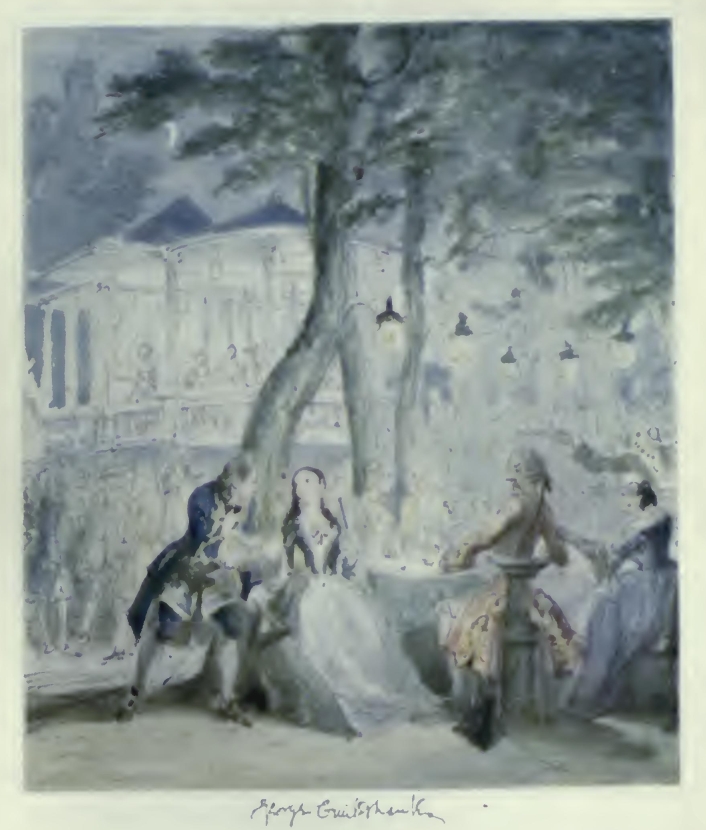
Randulph, meanwhile, felt irresistibly drawn towards the table where Hilda was seated, and as he kept behind the trees, he was not noticed by the party, though he was noticed by Kitty Conway, from the orchestra, who, guessing his intention, was so much agitated, that, for the first time in her professional career, she made some false notes in her singing. Hilda’s seat was placed against a tree. On her right was Sir Norfolk Salusbury; and on the right of the baronet, Lady Brabazon; next her ladyship was a vacant chair—no doubt just quitted by Beau Villiers; then came Lady Fazakerly; then Sir Bulkeley Price; and lastly, Clementina Brabazon, who occupied the seat on the left of the miser’s daughter.
Partly screened by the tree against which Hilda was seated, Randulph bent forward, and breathed her name in the gentlest accents. Hilda heard the whisper, and looking round, beheld the speaker. How much may be conveyed in a glance! She read the intensity of his passion and the depth of his devotion in his eyes, and for the first time returned his gaze with a look of kindness, almost of tenderness; Randulph was transported; he could not resist the impulse that prompted him to advance and take her hand, which she unresistingly yielded to him. All this was the work of a minute; but the action had not been unobserved, either by Kitty Conway or Lady Brabazon. Both had felt a similar pang of jealousy, but revenge instantly occurred to the latter. While Randulph was in the act of raising Hilda’s hand to his lips, she touched Sir Norfolk’s arm, and, pointing in the direction of the lovers, whispered, ‘Look there!’
Sir Norfolk arose, and in a stern and peremptory voice, said to the young man, ‘Set free that lady’s hand, sir!’
‘Not unless she chooses to withdraw it,’ replied Randulph.
‘I am wholly to blame for this, Sir Norfolk,’ said Hilda, withdrawing her hand, and blushing deeply.
‘You are pleased to say so, Miss Scarve,’ returned Sir Norfolk; ‘but the young man has been guilty of a great indecorum, and I shall call him to a strict account for it.’
‘I shall be ready to answer the call whenever you please, Sir Norfolk,’ rejoined Randulph. ‘But this is not the place for menaces. You will do well to look after your charge.’
‘I shall take care to keep off impertinents like you,’ replied Sir Norfolk.
‘Better guard her against other dangers, which require more penetration than you care to practise,’ retorted Randulph. ‘I have only one answer to make to such insolence,’ said Sir Norfolk, ‘and that shall be given to-morrow. You shall hear from me, Mr. Crew.’
‘As soon as you please, Sir Norfolk,’ replied Randulph.
‘For my sake, Mr. Crew,’ interposed Hilda, ‘let this quarrel go no further. I have been the innocent cause of it. Promise me it shall not.’
‘I would willingly obey you in anything, Miss Scarve,’ replied Randulph; ‘but in this case it is not in my power. Farewell!’ Fixing one passionate look upon her, he then bowed haughtily to Sir Norfolk, who returned his salutation in kind, and withdrew.
As he walked away, he encountered Beau Villiers, who was returning from his conference. Villiers started on seeing him, but instantly recovered himself, and would have addressed him, but Randulph turned abruptly away.
‘What the devil has brought Randulph Crew here?’ said Villiers to Sir Singleton, as he joined the party. ‘I thought he was at Drury Lane.’
‘Devil knows!’ cried the old beau. ‘But he has made a pretty scene.’ And he proceeded to relate what had occurred. Villiers laughed heartily at the recital.
‘I hope old Salusbury will cut his throat,’ he said, in an undertone.
‘Why, it would be desirable to get him out of the way, certainly,’ replied the old beau. ‘The women are all mad about him.’
‘Especially Kitty Conway,’ observed Villiers. ‘Odds life! this accounts for her having feinted in the orchestra. I wondered what could be the matter with her, but now I understand it. All is prepared,’ he added, in a deep whisper to Lady Brabazon.
‘Be careful how you act,’ she replied, in a low tone. ‘You’ll find Sir Norfolk dangerous, and Randulph Crew is on the watch.’
‘Fear nothing,’ he rejoined, ‘I’ve taken my measures securely. Make towards the dark walk, and contrive to lead him and the others away.’
Lady Brabazon nodded. Soon after this she arose, and, without ceremony, took Sir Norfolk’s arm, while Villiers very gallantly offered his to Hilda. The rest of the party paired off in like manner. Leading the way in the direction agreed upon, Lady Brabazon expressed a desire to view the scenic representation of the mill and waterfall before mentioned, which was exhibited in a hollow of the great walk; and they proceeded towards it. Hilda was much displeased by the assiduities of her companion, and she could not help remarking that he contrived, on various pretences, to linger behind the rest of the party, and though she repeatedly urged him to rejoin them, he always made some excuse for not doing so. At last, on pausing longer than usual, they quite lost sight of them, and were hurrying forward at Hilda’s urgent request, when, as they passed one of the side vistas, Mr. Cripps, who was standing at the end of it, advanced towards his master.
‘Fortunately encountered, sir,’ said the valet, bowing; ‘Lady Brabazon sent me to look for you, to tell you that she and the party are gone down a walk on the left to see a fine painting in the Chinese pavilion at the end of it. With your permission, I’ll show you the way.’
‘Oh, yes, let us go to them, by all means,’ said Hilda unsuspectingly.
‘Lead on, then!’ cried the beau, scarcely able to conceal his satisfaction at the success of the scheme.
A few steps brought them to the end of a narrow walk, arched over by trees, the branches of which were so thickly interlaced, that the moonlight could not penetrate through them. Alarmed by its appearance, Hilda drew back. ‘How thoughtless of Sir Norfolk to leave me thus!’ she exclaimed.
‘Why, you are surely not afraid of accompanying me down this walk, Miss Scarve,’ laughed the beau. ‘My valet is with us, and shall protect you. The Chinese pavilion is not more than a hundred yards off; and the walk, though dark, is not solitary.’
Fancying she perceived some persons within it, Hilda suffered herself to be led on; but she had not advanced many steps when all her uneasiness returned, and she bitterly regretted having assented. But it was too late. The beau’s grasp had tightened upon her arm, and he drew her quickly forward, while Mr. Cripps proceeded at the same rapid pace. Once or twice, she thought she heard footsteps behind her, and almost fancied she could distinguish a figure walking near them, but she did not dare to express her terrors.
They had proceeded, so for as she could judge, about a hundred yards, when a sudden turn in the walk disclosed a low hedge; beyond was the open country bathed in moonlight. Coming to a sudden halt, the beau said, in a hurried, but imperative tone—
‘Miss Scarve, I love you to desperation, and am determined to make you mine. You are now in my power, and must accompany me.’
‘Never,’ replied Hilda resolutely. ‘And I command you to release me.’ She would have screamed for help, if Villiers, who grasped her more tightly, had not taken out his handkerchief, and, placing it over her mouth, prevented her cries. While this was passing, Captain Culpepper emerged from the trees, and hastened with Mr. Cripps towards him.
‘Bravo, sir,’ cried the captain. ‘All goes well this time. We’ll have her in the coach in a twinkling.’
‘Not so fast, villains!’ thundered Randulph, rushing forward. ‘I have allowed you to go thus far to see to what lengths your villainy would carry you. But you shall pay dearly for it.’
As he spoke, he rushed to the beau, and snatching Hilda from him, dashed him backwards with such force that he fell upon the ground. Another person likewise came to the rescue. This was Jacob, who, brandishing his cudgel, hurried to the scene of action. On seeing him the valet whipped out his blade, but it was beaten from his grasp, and he only avoided a terrible blow from the cudgel by a nimble leap aside. Without waiting for a second blow, he plunged into the wood, and made his escape.
Captain Culpepper fared no better. Before he could draw his sword, he received a blow on the head that stretched him senseless and bleeding on the ground. Hilda, meantime, had murmured her thanks to her deliverer, who felt, as he pressed her to his bosom, that the whole of his previous anxiety was more than repaid by the unutterable joy of the moment.
‘Hilda!’ he cried passionately, ‘I would risk a thousand lives for you. Forgive me if, at this moment, I dare to ask if I may hope?’
She murmured a faint response in the affirmative.
‘I am the happiest of men!’ cried Randulph, transported with delight.
‘Alas!’ exclaimed Hilda, ‘my avowal can give you little happiness. I can never be yours.’
‘There you speak truth!’ cried Villiers, who by this time had regained his feet, and furiously approached them. ‘You never shall be his.’
‘This is the leader of the gang!’ cried Jacob, who having just disposed of Captain Culpepper, now rushed towards the beau, brandishing his cudgel in a formidable manner. ‘I’ll soon settle him.’
‘Leave him alone, Jacob,’ cried Randulph authoritatively; ‘his punishment belongs to me.’
‘You’re wrong, sir,’ rejoined Jacob, ‘but I shan’t disobey you. He doesn’t deserve to be treated like a gen’l’man.’
‘Oblige me by stepping aside for a moment, Mr. Crew!’ said the beau, with forced politeness. And as Randulph complied, added—‘I shall expect satisfaction for the injury you have here done me.’
‘I might well refuse it,’ replied Randulph; ‘but I am too eager for vengeance myself to do so. You shall have the satisfaction you seek as soon as you please.’
‘To-morrow morning, then, at the earliest hour—at five—in Tothill Fields,’ said Villiers.
‘I will be there,’ replied Randulph. And, quitting the beau, he rejoined Hilda, to whom he offered his arm. They walked down the avenue together, Jacob following close beside them. Hilda allowed her hand to remain in his, while he poured the warmest protestations of attachment into her ear. She did not attempt to check him; and perhaps it would be difficult to say which of the two felt the most regret when that brief dream of happiness was ended, as they emerged into the lighted vista.
Almost immediately on entering the great walk, they met Sir Norfolk and Lady Brabazon and the rest of the party. Her ladyship was at first greatly confused at seeing Randulph, but she instantly guessed what had happened, and tried to put a good face on the matter. Advancing to Hilda, she hastily inquired what had happened; but the latter turned coldly from her, and taking the arm of Sir Norfolk Salusbury, desired to be led home.
‘Your ladyship is perfectly aware of the peril in which I have been placed,’ she said. ‘But I have been delivered from it by the courage and address of Mr. Crew.’
‘Before you go, Miss Scarve,’ said Lady Brabazon, ‘I beseech you to give me some explanation of what has happened.’
‘It must suffice, then, to say, that Mr. Villiers has attempted to carry me off,’ replied Hilda—‘but his purpose has been defeated.’
‘What is this I hear?’ cried Sir Norfolk. ‘Mr. Villiers guilty of so base an attempt? I will go in search of him instantly!’
‘I have undertaken the punishment of Mr. Villiers’s offence, sir,’ said Randulph.
‘You have an account to settle with me yourself, sir,’ rejoined Sir Norfolk sternly.
‘I will settle it at five o’clock to-morrow morning, in Tothill Fields,’ replied Randulph, in a low tone, ‘after I have arranged with Mr. Villiers.’
‘Be it so,’ replied Sir Norfolk. And he strode off with Hilda, followed by Jacob; while Randulph, without staying to exchange a word with Lady Brabazon, walked away in the opposite direction.
THE DUEL IN TOTHILL FIELDS, WESTMINSTER
It was a fresh and beautiful morning, though the sun was scarcely risen, and a thin silvery mist hung like a veil over the smooth surface of the water. Two or three watermen were lying asleep in their tilts, and they roused one of them, who speedily rowed them to the opposite bank, near which they found Mr. Hewitt, with two brace of swords under his arm, in addition to the one by his side, accompanied by a tall stout man, with a red face, dressed in a well-powdered wig, and a suit of purple velvet, and carrying a gold-headed cane, who was introduced as Mr. Molson, the surgeon.
‘You look famously,’ said the fencing-master to Randulph.
‘Follow my instructions, and you’re sure to come off victoriously.’
The party then walked along the Horseferry Road, which speedily brought them to Tothill Fields. They were the first on the ground, and Mr. Hewitt, after looking about for a short time, discovered a spot excellently adapted for the encounters. By this time, the sun having risen, the morning’s early promise of beauty was fully confirmed.
The spot selected for the combats commanded a fine view of Westminster Abbey, which reared its massive body and tall towers above a range of mean habitations masking its base. Cawing jackdaws in clouds wheeled in the sunny air above its pinnacles.
A calmer or more beautiful scene could not be imagined. Randulph’s reflections were interrupted by the approach of two persons from the left of the fields, who proved to be Sir Norfolk Salusbury and Cardwell Firebras. Sir Norfolk bowed stiffly to Randulph, and also to Trussell, and seeing that the beau was not arrived, said to the former, ‘As I am first in the field, I am entitled to the first bout.’
‘I am sorry I cannot oblige you, Sir Norfolk,’ replied Randulph; ‘but I must give Mr. Villiers priority.’
‘Well, as you please, sir,’ said the baronet, walking aside.
Cardwell Firebras then advanced to Randulph.
‘I am here as Sir Norfolk’s second,’ he said; ‘but I hope the matter may only serve as a little breathing for you both before breakfast. It is an idle quarrel. We must talk about Villiers’s attempt anon. But here he is.’
As he spoke, two chairs were seen approaching from the lower end of the fields. When they came within a hundred yards of the party they stopped, and from the first issued Mr. Villiers, and from the other Sir Bulkeley Price. Mr. Cripps walked by the side of his master’s chair, bearing a water-bottle and a glass. The new-comers advanced slowly towards the party, and Mr. Villiers, having bowed with much haughtiness to Randulph, gracefully saluted the rest of the company.
‘Have we anything to wait for, gentlemen?’ he asked.
‘Nothing,’ replied Trussell; ‘we are all ready.’
‘To business, then,’ rejoined the beau.
At a motion from his master, Mr. Cripps advanced towards him, and receiving his clouded cane, proceeded to divest him of his coat, leaving him on a light striped silk waistcoat, with sleeves of the same material. Randulph, meantime, threw off his upper garment, and rolled up the shirt sleeve on his right arm. Mr. Hewitt then stepped up to him, and gave him the German sword he had promised; while Mr. Villiers received an exquisitely tempered blade from the valet.
These preparations made, the seconds and bystanders fell back a few paces, Trussell, Firebras, and Hewitt standing on one side, and the two baronets on the other, while the surgeon stood at a little distance in the rear with Mr. Cripps. Advancing towards each other, the combatants saluted, and in another moment their blades were crossed, and several rapid passes exchanged.
The spectators watched the conflict with the greatest interest, for both parties appeared admirably matched, and the beau’s superior skill was counterbalanced by Randulph’s extraordinary vigour and quickness. Thrusts were made and parried on both sides, but not a single hit was given, until Randulph, finding his adversary engaged in tierce with a high point, made a firm thrust in carte over the arm, and passed his sword through the fleshy part of the other’s shoulder. At this successful hit, the seconds rushed forward, but before they reached the spot, the beau’s sword fell from his grasp.
‘It is nothing,’ said Villiers, surrendering himself to the surgeon, who likewise hurried towards him; ‘but I acknowledge myself defeated.’
While the beau’s wound was bound up by the surgeon, and he was led to the chair by Mr. Cripps, Sir Norfolk Salusbury, who had been a watchful spectator of the conflict, stepped forward, and said to Randulph—
‘Whatever may be the issue of our encounter, Mr. Crew, I shall declare that in the combat which has just taken place, you have conducted yourself like a man of honour and spirit.’
‘I am glad to receive the acknowledgment from you, Sir Norfolk,’ replied Randulph, bowing.
‘Pray do not hurry yourself on my account,’ said the baronet courteously.
‘I am quite ready for you,’ replied Randulph. ‘What I have gone through has only served to steady my nerves.’
With the assistance of Firebras, who had come over to him, Sir Norfolk then took off his coat, waistcoat, and shirt, and in this state presented so extraordinary an appearance, that Randulph could scarcely repress a smile. The punctilious old knight’s first step was to deliver his sword to Mr. Hewitt, who, on measuring it with that of Randulph, found that it exceeded the latter in length by two inches. He therefore gave him one of his own swords, and Sir Norfolk, beating an appeal with his right foot, bade his youthful opponent come on. Having gone through their salutes with the greatest formality, they commenced the combat with the utmost caution.
Sir Norfolk acted chiefly upon the defensive, and contented himself almost entirely with parrying the thrusts aimed at him. Randulph soon found that he had a formidable antagonist to deal with, and altering his plan, tried to compel him to attack him. He made several feints with great dexterity, and just touched his adversary’s breast with an inside thrust in carte, causing a slight effusion of blood.
This had the effect of rousing the old baronet into exertion, and in his turn he became the assailant. He attacked Randulph with such force and fury, that he drove him back several paces. The young man returned to the charge, and pressed his adversary in his turn, so that he regained his ground; but while making a pass in carte, his sword was turned near the wrist by a dexterous and sudden lunge on the part of the baronet, whose point entered his side just below the elbow, and inflicted a severe wound. Maddened by the pain, Randulph continued to fight desperately, but the seconds rushed between the combatants, and interposing their blades, declared that the strife must terminate, and that Sir Norfolk was the victor. The baronet immediately dropped his sword, and Randulph, whose strength had been fast failing, fell to the ground insensible.
THE DISCOVERY OF THE MYSTERIOUS PACKET—TREATS OF THE MISER’S ILLNESS, AND OF THE DISCOVERY OF THE MYSTERIOUS PACKET BY HILDA
His mind lightened, apparently, by what had taken place, Mr. Scarve remained perfectly quiet during the rest of the day, and retired early to rest; but he passed another sleepless night, and was seized with a new panic about his money.
The next day, finding himself unable to go downstairs, he ordered Jacob to bring up all his boxes, and to place them near him. His fever increasing, and assuming somewhat the character of an ague, he consented to have a small fire kept up constantly in his bedroom, and set his chair close beside it. In addition to his dressing-gown he wrapped an old blanket over his shoulders, and tried to keep his lower limbs warm by clothing them in a couple of pairs of worsted hose. His bed being totally destitute of hangings, he had a sheet hung up against the lower end of it to keep off the blaze of the fire, which he fancied disturbed him during the night. These slight comforts were all he permitted himself, and he remained as inflexible as ever on the score of medicine and medical advice.
‘A doctor can do no good,’ he said to Jacob, who urged him to send for one; ‘if abstinence won’t cure a man, no physic will.’
‘Well, perhaps you’re right, sir,’ said Jacob; ‘but I wish you’d think less o’ your worldly affairs, and more o’ your sperretual ones. Look at that pictur’ over your chimney-piece, and see how Death is takin’ away the covetous man’s treasures before his very eyes. It might be intended as a warnin’ to you.’
But he grew daily worse and worse, and his faculties became more and more enfeebled. He rambled about the house at night, almost in a state of somnambulism, muttering strange things about his treasure, and frequently visiting the cellar where he had buried the chest, unconscious that it was gone. At such times, Jacob constantly followed, to prevent him from doing himself a mischief, but took care not to be seen. His groans and lamentations were pitiful to hear, for he had begun to fancy himself a ruined man, and not even the sight of his money could assure him to the contrary. It was vain to reason with him. The distressing idea was too strongly impressed upon his mind to be removed. His next whim was to have his boxes opened by Hilda, to whom he had entrusted his keys, and he insisted upon certain deeds and papers being read to him, the meaning of which he only very imperfectly comprehended.
One night, when seated by the fireside wrapped in his blanket, and with his feet on a straw hassock, he desired his daughter to read him some more papers. The fire burnt as cheerily as it could in the starveling grate, and Hilda insisting upon having two candles to read by, there was more light than usual. Having got through several mortgages, leases, and bonds, to the innumerable clauses of which he listened in his usual apathetic manner, he suddenly turned round to her, and pointing to the strong box which formerly stood under his table in the room downstairs, signed to her to open it. Well aware that this box contained his most private papers, Hilda had hitherto avoided meddling with it, but thus enjoined, she no longer hesitated. Placing it on the table, therefore, she took the large bunch of keys, and soon finding the right one, unlocked it.
‘Is there anything in particular you wish me to read, dear father?’ she said, taking out some papers tied together with red tape. ‘Here is a bond for two thousand pounds from George Delahay Villiers, Esquire; another from Lady Brabazon; and another from Sir Bulkeley Price. Shall I read any of them?’
The miser shook his head.
‘Here are several bills,’ she continued, taking up a roll of smaller papers—‘and another bundle of mortgages, will you hear any of them?’
THE DISCOVERY OF THE MYSTERIOUS PACKET
The miser shook his head. The movement was almost mechanical with him.
‘Then I will go on,’ pursued Hilda. ‘Ah! what is this letter with the black seal? Shall I read it?’
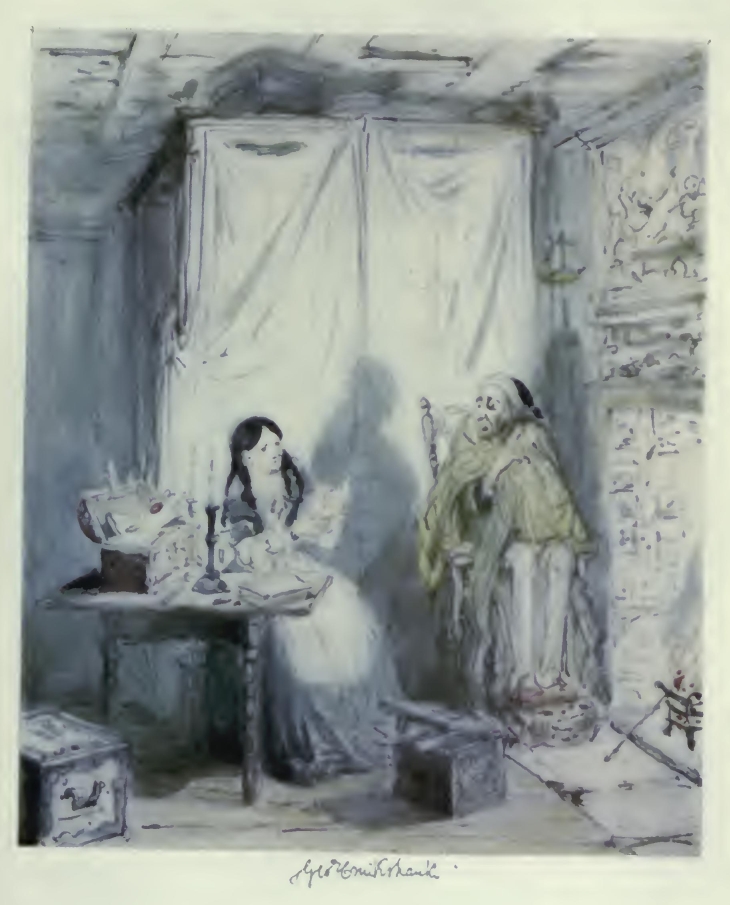
The miser made no reply. He was gazing listlessly into the fire, and watching the wreaths of smoke ascend the chimney with childish delight. Hilda, therefore, opened the letter, and found a small memorandum enclosed in it, which she placed upon the table. Trembling with emotion, she then began to read aloud the following lines:—
‘“Old and valued Friend—If this should ever meet your eye, I shall have been a year in my grave, for, in accordance with our agreement, it will not be delivered to you until the expiration of that time after my death. The agreement, I need not remind you, was so formed that in case we should both die within the year, the contract entered into by us respecting the marriage of our children should be null and void.”’
Here Hilda was startled by a sharp cry from her father, and looking up, she saw that he was staring wildly and inquiringly at her.
‘What are you reading?’ he asked.
‘The letter delivered to you by Randulph Crew,’ she replied; ‘the letter from his father.’
‘And what business have you to read it?’ he cried. ‘Who gave you leave to do so?’
‘Having gone so far, I shall go on,’ rejoined Hilda; and she resumed her reading, ‘“now call upon you to fulfil your share of the contract, and to give your daughter to my son. When we entered into the engagement, I was supposed to be the richer of the two; but I am now sadly reduced, and if my son fulfils his word, and gives up the estates to pay my creditors, he will have little or nothing.”’
‘He has nothing—he has nothing!’ cried the miser, ‘I will never give my consent—never!’
‘“But under whatever circumstances he may be placed,”’ said Hilda, continuing the letter, ‘“whether he gives up the property or not, I call upon you to fulfil your part of the contract, as I would have fulfilled mine, whatever might have happened to you; and to make, as you have agreed to do, a settlement upon your daughter proportioned to your means.”’
‘I made no such agreement!’ cried the miser; ‘it is false—false!’
“‘I enclose a copy of the memorandum,”’ pursued Hilda, still reading; ‘“the original, as you know, is in the possession of Cardwell Firebras. He will see it executed. God so requite you as you shall fulfil your agreement or neglect it!
“‘Randulph Crew.’”
‘And here is the memorandum,’ she added, taking up the smaller piece of paper. ‘It is signed by Randulph Crew and John Scarve.’
‘It is a forgery!’ shrieked the miser.
‘The original is in the possession of Cardwell Firebras,’ said Hilda. ‘Father, you have dealt unjustly by Randulph Crew. You owe him a great reparation, and I trust you will make it.’
‘I owe him nothing,’ replied the miser; ‘it is all a fabrication. Give me the papers, that I may burn them! Give them to me directly.’
And getting up, he staggered towards her, and snatched the letter and memorandum from her, with the intention of throwing them into the fire. But before he could do so, the door opened, and admitted Abel Beechcroft.
RANDULPH DEFENDING HIMSELF AGAINST PHILIP FREWIN AND HIS MYRMIDONS—RANDULPH AGAIN DINES WITH LADY BRABAZON—HE RECEIVES A NOTE FROM KITTY CONWAY, AND IS ASSAULTED BY PHILIP FREWIN AND HIS MYRMIDONS ON HIS WAY TO SUP WITH HER.
The dinner passed off delightfully. It was a small party, consisting of Sir Bulkeley Price, Sir Norfolk Salusbury, and Lady Fazakerly. Everything was done to please Randulph, and the efforts were perfectly successful. The wine flowed freely after dinner—for it was a hard drinking age—and Randulph, who had been exceedingly temperate since the duel, began to feel the effect of it. As he was about to ascend to the drawing-room with the rest of the gentlemen, a note was handed him by a servant, which he instantly opened.
‘What says your billet, nephew?’ inquired Trussell, who was standing by.
‘Oh! it’s from Kitty Conway,’ said Randulph. ‘She has found out, I know not how, that I am here, and wishes me to sup with her to-night for the last time.’
‘And you will go, won’t you?’ said Trussell.
‘Not I,’ replied Randulph irresolutely.
‘Oh yes, you will,’ said Trussell; ‘and I’ll accompany you on your last visit, as I did on the first.’
And they went upstairs laughingly to the drawing-room.
Time passed by so fleetly in the fascinating society of Lady Brabazon, that Randulph was surprised, on glancing at his watch, to find it nearly eleven o’clock. ‘Jacob will be gone,’ he thought, ‘and will think I have forgotten him.’
Hastily taking leave of Lady Brabazon, who chided him playfully for running away so early, and engaged him to call upon her on the following morning, he went downstairs accompanied by Trussell. They found Jacob at the door, and in no very bland humour at having been kept so long.
‘My time’s more than up,’ said the latter gruffly, ‘and I was just goin’ away. What I want to say is this,—I’ve received a hint that master’s miserly nevy, Philip Frewin, is about to decamp with the money I gave Mr. Diggs t’other day. He’s at the Crown Inn, Ox-yard, King Street. Suppose you pay him a visit.’
‘I’ll readily do so to-morrow, Jacob,’ said Randulph; ‘but tonight I’m engaged. Come along with me. My way lies in the same direction as yours, and I want to talk to you about your master and young mistress.’
Jacob complied, and accompanied Randulph to the corner of Hedge Lane, a narrow thoroughfare running into Cockspur Street, where he took his leave. Randulph and his uncle then tracked the lane above mentioned, until they came to Whitcomb Street, where Kitty Conway then resided, having removed from the Hay-market to an old house in the latter street, erected three years after the Great Fire of London—namely, 1669.
Never having visited the pretty actress in her new abode, but having been told in the note that this date, which was inscribed in large figures on a shield over the door, would guide him to it, Randulph was looking out for the house, when he observed three men at a little distance behind him, who seemed to be dogging him and his uncle. The foremost was a tall thin man; the second a stout, square-set personage, attired in a shabby military garb; and the third a great hulking fellow with an atrociously black muzzle, dressed in a blue jacket, short trousers, and woollen cap.
Randulph could not help fancying he had seen these personages before, though he could not tell where, but he did not concern himself much about them, until just as he had discovered Kitty Conway’s dwelling, and was about to knock at the door, he saw that they were quickening their pace towards him. On a nearer approach, he was at no loss to detect Philip Frewin, and in his companions, Captain Culpepper and the fellow who had officiated as Jack-in-the-water at the Folly on the Thames.
‘Here is your man!’ shouted Philip, pointing out Randulph to the others; ‘upon him! don’t leave an unbroken bone in his body.’
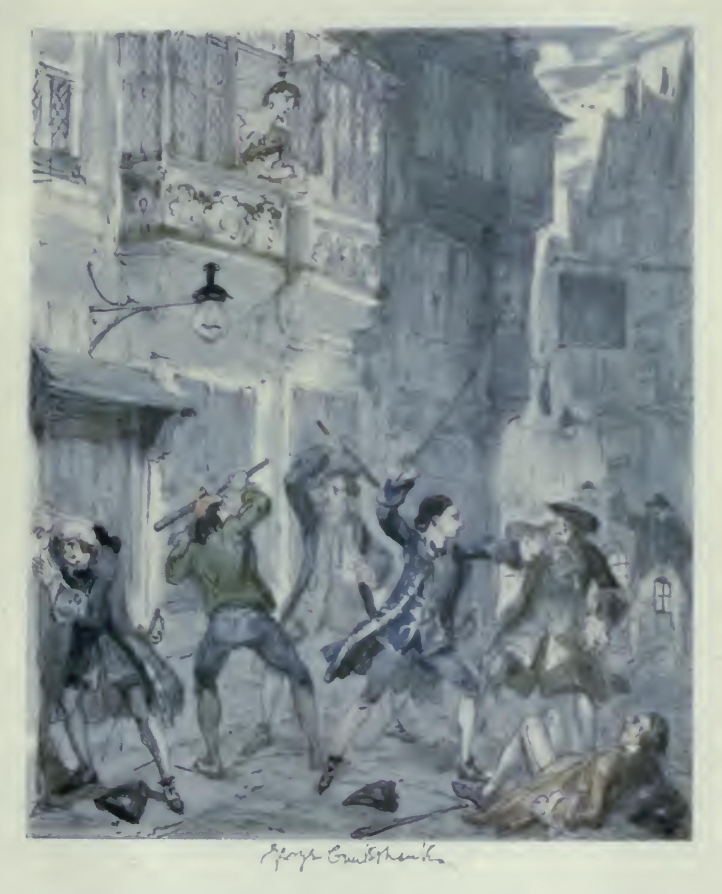
Randulph, however, was prepared for the attack. Grasping the stout cane he held in his hand, he dealt Philip so severe a blow on the head with it that he stretched him on his back on the ground. At the same moment, Trussell received a blow from the cudgel of the athletic sailor, which sent him reeling against the door, to the posts of which he clung for support, while the ruffian turning to assault Randulph, encountered an unexpected adversary in the person of Jacob Post.
‘I thought what you were after, you scoundrels, when I saw you doggin’ these gen’l’men,’ cried Jacob; ‘I’m glad I got up in time. Turn your cudgel this way, you black-muzzled hound! Two can play at your game.’
While Jacob and his antagonist rapped away at each other as hard as they could, making the welkin ring with their blows, Randulph turned upon Culpepper, who attempted to draw his sword to assail him, and belaboured him so lustily with his cane, that the latter was soon fain to cry for quarter.
The sound of the cudgels, and the vociferations of the combatants, had alarmed the watch, who sprang their rattles, and hastened to the scene of strife, while Kitty Conway, hearing the noise, opened a window above, and seeing what was passing in the street, added her shrieks to the general clamour. Before, however, the watch could come up, Jacob had brought his athletic antagonist to the ground, and Culpepper had taken to his heels without being able to strike a single blow.
MR. CRIPPS DETECTED—HOW MR. CRIPPS’S MARRIAGE WITH THE WIDOW WAS INTERRUPTED
It was arranged that the ceremony should take place in the upper chamber, where Randulph first breakfasted with the beau, and the clergyman selected to perform it was Doctor Gaynam. Thus nothing seemed wanting on the valet’s part to complete the matter; and late on Wednesday evening he went to Billiter Square, to inform Mrs. Nettleship that all was ready. After a brief visit, for he was somewhat fatigued, he took a tender adieu of her, saying, as he squeezed her hand at parting—
‘We shall meet to-morrow, to part no more!’
The next morning, betimes, Mr. Cripps placed himself under the hands of Antoine, who proceeded to array him in a magnificent suit, which had never been worn by his master, it having only been sent home the night before by Desmartins.
It consisted of a coat of crimson-embossed velvet, richly laced with gold, breeches of the same material, and a white satin waistcoat flowered with gold. To these were added, pink silk hose rolled above the knee, superb diamond buckles, and point-bee cravat, and his master’s handsomest Ramillies periwig, which had been dressed by Peter Pokerich.
Nearly three hours were expended in thus attiring him; and when all was completed, Antoine declared that his master had never looked half so well—a sentiment in which Mr. Cripps, as he complacently surveyed himself in the cheval-glass, entirely concurred.
A little before twelve, Peter Pokerich and the fair Thomasine arrived. The lady was dressed in white and silver, with a fly-cap with long lappets, and looked so excessively pretty that Mr. Cripps could not help wishing she had been the bride instead of Mrs. Nettleship.
While he was welcoming them, and passing some high-flown compliments on the fair Thomasine’s charms, Mr. Jukes was shown into the room; but as he was in his butler’s dress, his nephew did not condescend to speak to him.
Shortly after this Antoine announced that the bride had arrived, and Mr. Cripps hurried downstairs to meet her.
Mrs. Nettleship, who had bestowed more than ordinary pains upon her person, wore a yellow satin sack embroidered with little dots of gold. She had large pearl earrings, a garnet necklace, and a diamond solitaire. Her complexion, which was naturally rather high, had been corrected by white French powder, and was further set off with abundance of little patches on her checks, neck, and shoulders. She carried a beautiful Indian fan, the handle of which was ornamented with precious stones.
She had arrived in great state, a gilt chariot lined with pale blue satin, hired for her from a coachmaker, by Mr. Rathbone, having formed her conveyance; and she was attended by a couple of footmen out of place, likewise hired for the occasion, habited in superb liveries of sky-blue cloth trimmed with silver, with silver shoulder-knots, and point d’Espagne hats.
Mr. Rathbone, who accompanied her, was dressed in a suit of purple velvet, laced with gold. Almost bewildered by the grandeur she beheld around, the widow was led upstairs by Mr. Cripps; her wonder increased at every step she took. The two long-eared spaniels and the macaw enchanted her; but she actually screamed with delight on beholding the monkey, in his little scarlet coat and bag-wig.
Coffee, chocolate, and champagne were then handed round by Antoine and the page; and while this was going on, the clergyman and his assistant were announced.
Doctor Gaynam had a much more respectable appearance than when he officiated at Sir Singleton Spinke’s marriage. He was dressed in his full canonicals, and wore a well-powdered full-bottomed wig, which Peter Pokerich would not have disdained.
Meanwhile Mr. Cripps had seated himself by the bride on one of the couches, and was talking very tenderly to her, when he perceived his uncle approach Mr. Rathbone, as if with the intention of addressing him.
He instantly arose, and taking the latter aside, whispered a few words to him, and then, having accomplished his object, which was to prevent any communication between him and Mr. Jukes, told the clergyman to proceed with the ceremony.
Doctor Gaynam was sipping a glass of usquebaugh, but he hastily gulped it down, and declared himself perfectly ready. He then took a prayer-book from the clerk, and stationed himself between the windows, motioning the others to take their places before him.
MR. CRIPPS DETECTED
All was soon arranged. Peter Pokerich and the fair Thomasine stood near the bride; Mr. Rathbone near the bridegroom; Antoine behind him; while the group was completed by the two Africans, who had mounted a settee in the corner, to obtain a full view of the ceremony. The page was on the floor keeping the dogs quiet, who were quarrelling with the monkey, and biting its tail.
Just as Doctor Gaynam had opened his book, and uttered a preliminary cough, a noise was heard at the door, and Mr. Cripps, turning to see what was the matter, beheld it open, and admit his master.
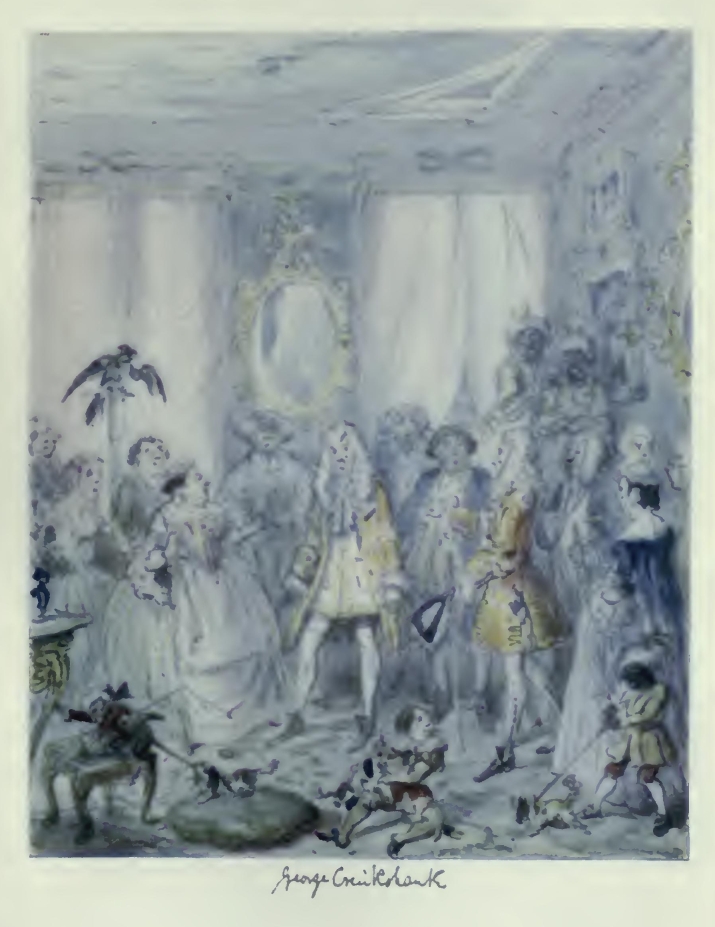
The valet’s alarm was instantly communicated to the whole assemblage. Antoine shrugged his shoulders, and lifted up his hands in affright. The two Africans exchanged glances of alarm, and all eyes were directed towards the beau, who with angry looks, and grasping his clouded cane, marched towards the valet. He was followed by Lady Brabazon, Sir Bulkeley Price, and Trussell Beechcroft.
Lady Brabazon was attended by her black page, leading her dog by a riband, and this arrival excited the anger of one of the spaniels, whose furious barking set the macaw screaming.
Mr. Cripps presented a very chopfallen appearance. All his assurance deserted him. His hands dropped to his side, and he scarcely dared to meet his master’s angry gaze.
‘Rascal!’ exclaimed Villiers, ‘I have at last fairly detected you. I’ll teach you to put on my clothes—to assume my name——’
‘What!’ screamed Mrs. Nettleship, dropping a bottle of salts which she had placed to her nose—‘isn’t it really himself—isn’t it Mr. Willars?’
‘No, madam,’ replied the beau—‘I am Mr. Villiers; and this rascal is only my valet, Crackenthorpe Cripps.’
‘This looks like the real gentleman, I must say,’ cried Mr. Rathbone, who was thunderstruck with surprise.
‘Oh, the villain!—the base deceiver!—the impostor!’ shrieked Mrs. Nettleship, clenching her hands, and regarding the valet as if she would annihilate him. ‘I’ll tear his eyes out! To deceive and expose me in this way—to—to—to—oh! I shall never survive it. Support me!’ she added, falling into the arms of the fair Thomasine.
‘This is really too bad of you, sir,’ said Mr. Cripps, who began to recover himself a little. ‘You’ve deceived me. I thought you were at Newmarket.’
‘I received information of your practices, rascal,’ replied the beau, ‘and resolving to see to what extent you carried them, I only went to a short distance from town, and then returned with Sir Bulkeley Price, with whom I have remained till now. And a pretty discovery I’ve made, i’faith! My house filled with company—my servants turned into your servants—a dinner, supper, confectionery, wine, fruit, musicians, and the devil knows what, ordered at my expense.’
‘Well, they’re not thrown away, sir,’ replied Mr. Cripps.
‘You can marry the lady yourself, if you think proper. I’ve no doubt she’ll consent to the exchange, and she has fifty thousand pounds.’
‘Oh, the impudence!’ exclaimed Mrs. Nettleship, jumping up.
‘I’ll not be taken in a second time. I’ll be revenged on all the sex!’
‘You are not aware, Mr. Willars, of the extensive frauds this rascal has practised upon you,’ said Mr. Rathbone. ‘He has actually signed a bond for five thousand pounds in your name, which I have in my pocket.’
‘The devil he has!’ exclaimed Villiers.
‘But it is of no effect, since the marriage has not taken place,’ said Mr. Cripps; ‘and if Mr. Villiers chooses to take the lady, he will of course pay you himself.’
In spite of himself, the beau could not help laughing.
‘Bad as Mr. Cripps is, he is not worse than the other party,’ said Trussell, stepping forward; ‘while he was duping them, they tried to dupe him. I understand from Mr. Jukes, who has it on unquestionable authority, that Mrs. Nettleship, so far from being a wealthy widow, is greatly in debt, while her friend there, Mr. Rathbone, hoped to pocket the five thousand pounds secured by the bond he has mentioned.’
‘Gadso! then it seems I’ve had an escape!’ cried Mr. Cripps.
‘You have,’ replied Trussell; ‘and your uncle would have told you all this before, if you had not kept him at a distance.’
‘I won’t stay here to be laughed at!’ cried the widow, looking defiance at the jeering countenances around her. ‘Mr. Rathbone, your arm. I’ll make you marry me yourself, or pay the penalty of the contract,’ she added, in a whisper.
‘You’ll not mistake a valet for a gentleman after this, Monsieur Rathbone,’ said Antoine—‘ha! ha!’
‘You had better go away by the back stairs,’ said Trussell, stopping them; ‘for there are a couple of officers in the hall waiting to arrest you!’
‘Curse on it! I sent them myself!’ said Mr. Rathbone, ‘to compel the rascal I supposed to be Mr. Wiliars to pay your debts.’
And hurrying out of the room, he acted upon Trussell’s suggestion.
‘And now, rascal,’ said the beau to the valet, ‘you are no longer in my service—I discharge you. And you may thank your stars that I let you off so easily.’
‘I was about to discharge you. sir,’ rejoined the valet, impertinently. ‘I don’t desire to live with a gentleman who takes his servants by surprise. He’s as bad as a jealous husband.’
‘Stay!’ cried the beau—‘you don’t leave me in that way. Antoine, stand by him. Now, sir, take off that peruke—take it off carefully—now the sword.’
The orders were obeyed, and the wig and sword delivered to the French valet.
‘Now take off the coat.’ Mr. Cripps complied with a sigh.
‘Now the waistcoat.’ The order was obeyed.
‘Now the cravat.’ And it was taken off.
‘Now the diamond buckles.’
‘Anything else?’ inquired Mr. Cripps, as he gave up the buckles. ‘Recollect there are ladies in the room, sir.’
‘Yes; take yourself off,’ rejoined the beau.
Even thus shorn of his splendour, Mr. Cripps maintained his customary assurance. He bowed profoundly and gracefully round, and quitted the room amid the laughter of the company.
ABEL BEECHCROFT DISCOVERING THE MISER IN THE CELLAR—DEATH OF THE MISER
No sooner, however, was one source of dread removed, than another was aroused. His hoards might be gone! Terrified by this idea, he flew to all his hiding-places, and placed their contents on the table. His dim eyes sparkled with unnatural brilliancy as he gloated over them.
While telling over the pieces, and weighing them in his hand, a new recollection crossed him. Snatching up the candle, he hurried to a small cupboard at one side of the room, at the bottom of which lay a heap of old rags and rubbish, apparently put there out of the way. Hastily removing this dusty pile, some half dozen leathern bags were exposed to view.
‘Here they are—here they are!’ he exclaimed, with a cry of childish delight. ‘Oh, my darlings!—my treasures!—-how glad I am to see you. You give me new life. Talk of physic—pshaw! there is none like gold. The sight of it cures me in an instant. I feel well—quite well; no, not quite,’ he added, as a sudden giddiness seized him, and he had to catch at the closet door for support; ‘not quite well; but better—much better. What a memory mine must be to forget these bags—each containing two hundred guineas—that’s twelve hundred! Twelve hundred guineas! and I had forgotten them. I hope I have not forgotten anything else. Let me see—oh! my head!—my head!’ he continued, shaking it mournfully. ‘My memory’s clean gone!—clean gone! But what shall I do with these bags? they’re not safe here. Jacob may find them in clearing the room. I’ll hide them in the cellar with the other treasure.’
Utterly forgetful that the chest had been removed, he immediately set about executing his design.
Listening at the door to hear that all was still, he took up two of the bags with the intention of carrying them downstairs; but finding them too heavy for him, he was obliged to content himself with one, and thus in transporting them all to the cellar, he had to perform six journeys. The last had nearly proved fatal, for as he tottered down the cellar steps, he missed his footing, and rolled to the bottom.
With some difficulty he got up again; but heedless of the bruises he had received, he picked up his candle, which was extinguished in the fall, and returned to his bedchamber to light it at the fire. This done, he procured the shovel, and repairing to the cellar commenced his task.
In his present state of debility and exhaustion, it cost him infinite labour to get up the bricks, and he was frequently obliged to desist from the toil and rest himself; but though he shook in every limb—though thick damps burst from every pore, he still persevered.
Having got out the bricks, he carefully scraped off the surface of the loose sandy soil. Surprised that the spade met with no resistance, his alarm was instantly excited, and he plunged it deeply into the ground.
But no chest was there!
For a few minutes he stood transfixed with despair. It never occurred to him that he had himself removed his treasure, but he concluded he had been robbed of it.
At length his anguish found vent in a piercing cry, and he rushed towards the door with the intention of calling up Jacob; but the recollection that forced itself upon him, that the porter was from home, checked him.
Other imperfect ideas thronged upon his bewildered brain. A glimmering recollection of digging up the chest crossed him, but he fancied he must have taken out its contents and buried them deeper in the ground. Somewhat calmed by the idea, he commenced digging anew with frightful ardour, and soon cleared out the soil to nearly the depth of three feet. But as he found nothing, his apprehensions returned with new force and paralysed his efforts.
Throwing aside the spade, he groped about in the sandy soil with his hands, in the hopes of finding a few pieces of gold. A single piece would have satisfied him; but there was none—nothing but little pebbles mixed with the sand. His moans, while thus employed, were truly piteous.
At this juncture, his candle, which had long been expiring in the socket, went out, leaving him in total darkness. A mortal faintness seized him at the same time. He tried to get out of the hole, but fell back with the effort—his head striking against the bricks. He struggled to get up again, but in vain—his limbs refused their office. He tried to cry out for help, but a hollow rattling sound alone issued from his throat.
At length, by a convulsive effort, he did contrive to lift his head from the ground; but that was all he could do. His hands clutched ineffectually at the sandy soil; his frame was powerless; and a stifled groan broke from his lips. But this condition was too horrible for long endurance. The muscles of the neck relaxed; his head fell heavily backwards; and after a gasp or two, respiration ceased.
Thus died this unhappy man, unattended, in a cellar, half entombed in the hole digged as a hiding-place for a portion of his wealth—wealth for which he had sacrificed all his comforts, all his feelings, all his affections, and for which alone of late he had seemed to live. Thus he perished—a fearful example of the effects of the heart-searing vice of which he was the slave and the victim.
After some little consideration, Abel went up alone to the miser’s room, and knocking two or three times, and receiving no answer, opened the door. Approaching the bed, he found it empty, with the clothes turned down, as left by the miser; and casting a hurried glance into the closet to satisfy himself that no person was there, he hastily ran downstairs to Hilda, to acquaint her with the alarming discovery he had made.
She was greatly terrified; but after a moment’s reflection, suggested that her father might possibly have gone down to the cellar, and related the circumstance which she herself had once witnessed there.
Concurring in the opinion, Abel offered immediately to go in search of him; and dissuading Hilda, who secretly shared his worst apprehensions, from accompanying him, took a candle and descended to the cellar.
As he entered the vault, he indistinctly perceived a ghastly object; and springing forward, held up the light, so as to reveal it more fully. His fancy had not deceived him. There, in a grave—evidently digged by his own hands—lay his old enemy—dead—dead!
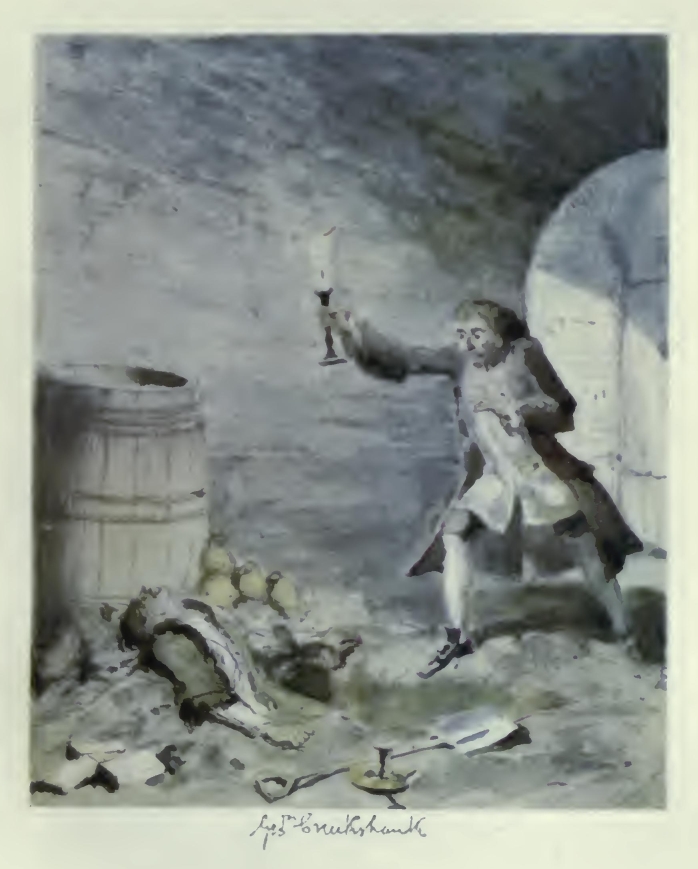
While Abel was wrapt in contemplation of this miserable spectacle, and surrendering himself to the thoughts which it inspired, heavy steps were heard behind him, and Jacob rushed into the cellar.
‘Where is he?’ cried the porter, in accents of alarm. ‘Has anything happened? Ha! I see.’
And pushing past Abel Beechcroft, he precipitated himself into the hole with his master.
‘All’s over with him,’ he cried, in a voice of agony and self-reproach, and grasping the cold hand of the corpse. ‘This would never have happened if I had been at home. I’m in a manner his murderer.’
‘Another hand than yours has been at work here, Jacob,’ said Abel; ‘and terrible as your poor master’s fate has been, it may prove a salutary lesson to others. There he lies, who a few hours ago was the possessor of useless thousands, the value of which he knew not—nay, the very existence of which he knew not—for the few bags of gold beside him were the only palpable treasure he owned.
DISPERSION OF THE JACOBITE CLUB, AND DEATH OF CARDWELL FIREBRAS—THE SUMMER-HOUSE AT THE CHEQUERS—THE OLD MILL—THE JACOBITES BETRAYED
A glance satisfied Firebras that all was right, and he returned slowly to the house, the landlord stamping upon the floor as he quitted the building, as a signal to the grenadiers that they might now come forth from their concealment. On reaching the house, Firebras dismissed the landlord, and going up to Randulph, clapped him on the shoulder, and said, ‘I have rare news for you.’
‘And I have rare news for you,’ replied the other.
‘Hear mine first!’ cried Firebras. ‘What if I tell you I am come to offer you your estates and the hand of Hilda, if you join the Jacobite party?’
‘There would be no use in joining you now!’ returned Randulph.
‘You think I’m trifling with you!’ cried Firebras, producing a packet; ‘but this will speak to the contrary. Here is the assignment of your estates to Isaac Isaacs. A receipt in full of all claims is attached to it. The deed is yours, provided you join us.’
‘You amaze me,’ cried Randulph, gazing at the packet; ‘that is unquestionably the deed I executed.’
‘Most certainly it is,’ replied Firebras. ‘It is too long a story to tell you how I became possessed of it,’ he added, replacing it in his pocket, ‘but I have other intelligence for you. Mr. Scarve is dead!’ Randolph uttered an exclamation of surprise.
‘He died last night,’ pursued Firebras, ‘and left his property to Philip Frewin, in case of Hilda’s refusal to marry him.’
‘But Philip may not live to claim the fulfilment of the condition,’ cried Randulph.
‘Philip, also, is dead,’ replied Firebras. And smiling at Randulph’s astonishment, he added, ‘Now you see that all is in your grasp. Fate has given you the lady of your love. I offer you your fortune. Can you refuse to join us?’
‘Mr. Firebras,’ said Randulph, composing himself, ‘this is not the time to put such a question to me.’
‘Pardon me,’ cried Firebras sternly, ‘I must have an answer now—at this moment—or you lose your estates and Hilda for ever. Do not suppose I threaten lightly. I can, and will, make good my words.’
‘You mistake me altogether,’ rejoined Randulph. ‘I mean to say it would be useless for me to assent. You are betrayed.’
‘Betrayed!’ exclaimed Firebras, in a voice of thunder. ‘How! by whom? But this is a mere assertion made to turn me from my purpose.’
‘You will find it too true,’ replied Randulph. ‘The house is environed on all sides by grenadiers.’
‘I have just visited the summer-house,’ said Firebras. ‘There was no one there.’
‘The men were concealed in a lower chamber,’ said Randulph.
‘It’ may be so,’ cried Firebras, with a terrible imprecation. ‘But they shall not take me easily. My pistols! ha! they have been removed! The landlord, then, is our betrayer.’
‘He is,’ replied Randulph. ‘Your only chance of escape is apparent unconsciousness of the design. You might perhaps make good your own retreat—but the others——’
‘I will never desert them,’ said Firebras. ‘There is a boat at hand, for I ordered Jacob Post to be in waiting for you off the summer-house, for another purpose, and I caught a glimpse of him just now. Ha! here come our friends.’ And, as he spoke, Sir Norfolk Salusbury, Sir Bulkeley Price, Father Verselyn, Mr. Travers, and four or five other gentlemen entered the room.
‘Leave us, landlord,’ said Firebras; ‘we will call you when we want you.’ And the order being obeyed, he bolted the door. ‘We are betrayed, gentlemen,’ said Firebras, in a low tone; ‘the house is surrounded by guards, and our retreat is cut off by the river.’
As the words were uttered, the door was tried by some persons without, who, finding it fastened, proceeded to burst it open. ‘To the garden! to the garden!’ cried Firebras. And the party made for the window.
Before, however, the whole of them could pass through it, the officer and a party of grenadiers burst open the door, and endeavoured to seize them.
Firebras and the others, with the exception of Randulph, drew off.
DEATH OF TUE JACOBITE CLUB, AND OF CARDWELL FIREBRAS—DISPERSION
The Miser’s Daughter their swords, and the next instant an encounter took place. But, as all was buried in darkness, little mischief was done. In spite of the efforts of the soldiers to prevent them, five or six of the Jacobites contrived to get across the ditch, and gaining the mill, took shelter within it. They were followed by a party of grenadiers, who fired a few shots at them. Whether the circumstance was the result of accident or design is immaterial, but a few minutes afterwards the mill was found to be on fire. Flames burst from the upper windows, throwing a fierce glare on the groups below, and brightly illumining the towers of Westminster Abbey.
Repeated loud explosions were next heard, threatening each moment to shake the mill to pieces; while some of the unfortunate Jacobites were seen springing from a side window upon the waterwheel, and trying to descend by it. Two others, at the risk of breaking their necks, dropped from a window facing the river, and endeavoured to gain the vessel moored beside it. The fugitives on the water-wheel were held in check by a party of grenadiers, who, having thrown a couple of planks over the little stream, were enabled to reach them.
Meanwhile, favoured by the previous darkness, for all was now as bright as day, Firebras, Salusbury, and the rest of the Jacobites made good their retreat as far as the summer-house. Some of them even managed to force their way to the platform. Here a desperate struggle took place, in which Sir Norfolk was severely wounded in the side by a bayonet. By this time the fire had broken out in the mill, and its glare showed Jacob at a little distance in a skiff. Notwithstanding the menaces of the soldiers, who pointed their guns at him, and threatened to fire if he approached nearer, Jacob pushed resolutely towards the summer-house.
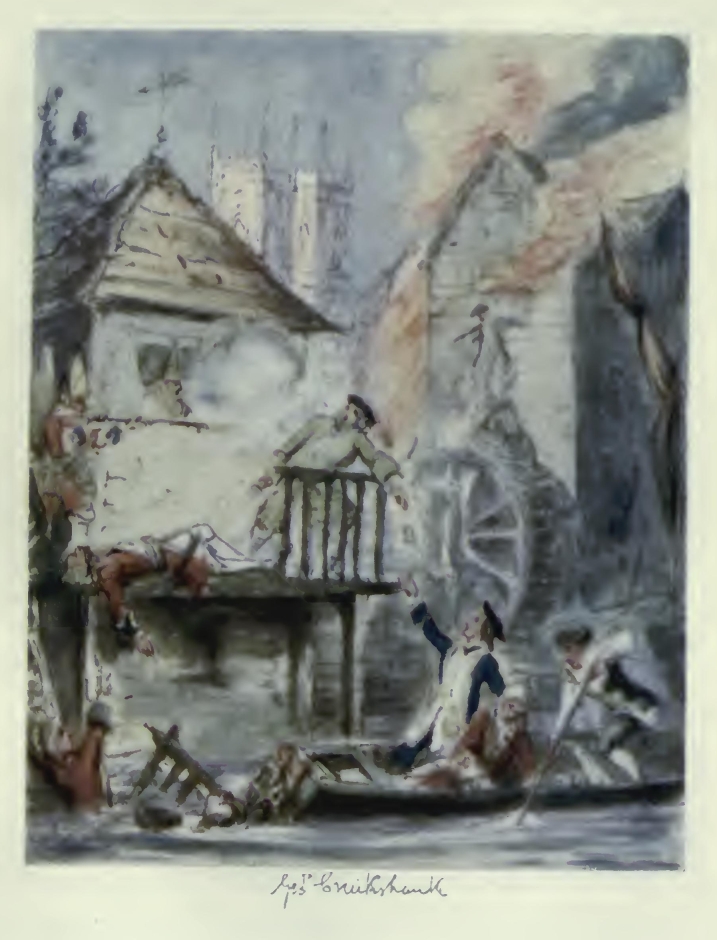
He was now close under the platform, and made signs to Randulph to descend, but the latter would not desert Sir Norfolk, who had been seized by a couple of grenadiers. He threw himself upon the old baronet’s captors, and in the struggle that ensued, the railing gave way, precipitating Sir Bulkeley Price, the Jesuit, and the grenadiers into the tide. Before the other soldiers had recovered from their surprise at this occurrence, Randulph had lowered Sir Norfolk into the skiff and sprung in after him.
Jacob’s efforts to push off were impeded by Sir Bulkeley Price, who clung to the stern of the skiff, earnestly imploring them to take him in. Father Verselyn caught hold of the steps, and apprehensive of some further disaster, crept along the side of the summer-house, and took refuge in a small sewer, in the slime of which it is supposed he perished, for he was never heard of more.
Meanwhile, Cardwell Firebras—engaged hand to hand with the officer, who, having vainly summoned him to surrender, attacked him in person—had reached the platform. Seeing escape impossible, Firebras, while defending himself against the officer, called to Randulph, whom he descried below, and held out the packet to him. The latter ordered Jacob to keep the skiff steady, and to bring it as near the combatants as possible.
While Jacob obeyed the injunction, a successful thrust from Firebras stretched his adversary upon the platform, but the next moment he received his own death-wound from Long Tom, who stepped forward as his officer fell, and discharged his musket into his breast. With a dying effort, Firebras stretched his hand over the rail, and consigning the packet to Randulph, fell backwards into the water. Possessed of the packet, Randulph turned to the aid of Sir Bulkeley Price, and pulling him into the skiff, Jacob instantly pushed off. Assisted by the stream, which ran very strong, they soon got under the sides of the vessel near the mill, and were sheltered from the fire of the soldiery.
Meanwhile, the conflagration raged fast and furiously, and before the skiff containing the fugitives had got half way to Westminster Bridge, a tremendous explosion took place, scattering the blazing fragments of the old mill far and wide into the river.
RANDOLPH CREW’S MARRIAGE WITH HILDA AT LAMBETH CHURCH—DETAILING AN EVENT WHICH MAY POSSIBLY HAVE BEEN ANTICIPATED
We shall hurry over the intervening period as rapidly as the lovers themselves would have hurried it over, and proceed at once to the wished-for day.
A little before nine o’clock, on this eventful morning, Randulph, who had taken up his quarters with Sir Bulkeley Price, in Saint James’s Square, entered the breakfast-room, arrayed in his bridal attire, which had been prepared for him by the skilful hands of Desmartins. He found Sir Bulkeley Price and Sir Norfolk Salusbury at the table—the latter having come up from Wales, whither he had retired to recruit himself after his wound, expressly to attend the ceremony. After receiving their congratulations, Randulph sat down with them, but as he could only swallow a cup of chocolate, he underwent much rallying on his want of appetite.
Breakfast over, the party drove to Whitehall Stairs, where a six-oared barge was in readiness to convey them across the river. Jacob Post was appointed coxswain of this barge, and he wore a waterman’s coat of scarlet cloth, and velvet jockey-shaped cap of the same colour. The six rowers were attired in the same livery, and presented a very gay appearance.
The morning was bright and beautiful, and everything seemed to Randulph to participate in his happiness. Each boat that passed them, seeing the purpose on which they were bent, cheered them cordially, and Jacob, who was greatly elated, returned their greetings lustily.
As they passed through Westminster Bridge, and shaped their rapid course to Lambeth, they passed a boat containing a couple in bridal attire, and rowed by watermen with favours in their caps. These were Mr. Rathbone and Mrs. Nettleship, who, having made a composition with their creditors, had come to the conclusion that the best thing they could do would be to fulfil their original agreement, and having heard that Randulph and Hilda were to be united at Lambeth, they determined, like Peter Pokerich and the fair Thomasine, to be married at the same time, and at the same church. The boats cheered each other as they passed. Shortly after this, they came up with a four-oared cutter, in which was a still more gaily dressed bridal party, consisting of Mr. and Mrs. Deacle, the fair Thomasine, and Peter Pokerich. The sunny tresses, bright eyes, and dimpling cheeks of the bride attracted Sir Bulkeley’s admiration, and he called out to Peter that he ought to consider himself a very happy man; to which the little barber replied, ‘that he was the happiest man in the world—Mr. Crew excepted.’
Another cheering passed between the rowers; and Randulph’s barge swept over the sparkling waters to the stairs near Lambeth Palace, where he and his companions disembarked.
As Abel Beechcroft was extremely well known and highly respected in the neighbourhood, great preparations were made to lend éclat to his nephew’s wedding. A band of music was stationed on a lighter moored near the stairs; and the lighter itself was hung all over with flags and streamers. The band was playing, the bells ringing, and as Randulph leaped ashore, a loud shout from the crowd collected to see him land, welcomed him, while many flattering comments, in no very low key, were made upon his handsome appearance by the female part of the assemblage. In passing towards his uncle’s residence, Randulph noticed with interest a troop of pretty little girls with wreaths round their heads, and baskets of flowers in their hands, standing in the path leading to the church.
The party were admitted by Mr. Jukes, whose portly figure was well displayed in an expansive snowy waistcoat, a brown coat, spick and span new for the occasion, and a well-powdered bob-wig. The worthy butler gave Randulph a hearty welcome, and wished him many years of happiness, and having ushered him and the others into the parlour, returned to the hall to Jacob, to give him wedding favours for himself and the watermen, which the other hastened to distribute.
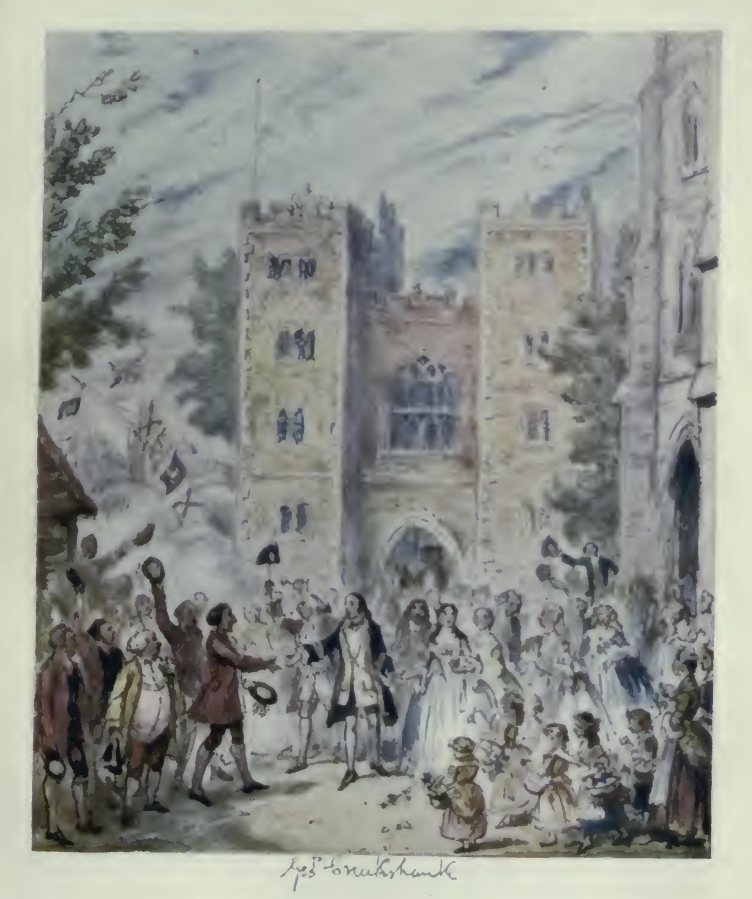
The meeting between the young bride and bridegroom was full of agitated delight. Abel looked perfectly happy, but thoughtful, as did Mrs. Crew, whose emotion found relief in an occasional sigh—not the sigh of misgiving, but the relief of a joy-oppressed heart.
Trussell was, as usual, in very high spirits. He shook Randulph heartily by the hand, wished him all sorts of happiness, and then cordially greeted the Welsh baronets. Besides Mrs. Clinton, there was another young lady present, the daughter of an old friend of Mrs. Crew’s, a Miss Wilbraham, who acted as bridesmaid to Hilda.
Soon afterwards, all being in readiness, the bride prepared to set forth under the care of Abel Beechcroft, who, before they quitted the house, in an earnest tone, invoked a blessing on her head and on that of his nephew. And both felt that the blessing of so good a man would not be thrown away.
Cheered by the good wishes and smiling countenances of the groups through which they had passed, and enlivened by the sunshine, the party entered the church. Peter Pokerich and the fair Thomasine, with Mr. Rathbone and Mrs. Nettleship, were already standing beside the altar. The young couple advanced, and took the central place, and the church was instantly crowded with spectators. The service was admirably performed by a venerable clergyman—an old and valued friend of Abel’s, and at its close, the concourse issued from the church, dividing into two lines, so as to allow a passage for the wedding train.