HISTORY OF THE IRISH REBELLION IN 1798 AND EMMETT’S INSURRECTION IN 1803 (continued 2)
Reading edition
The work of death at Prosperous was interrupted by intelligence conveyed to the insurgents, that at Clane, three miles off, their friends had been defeated—for although partly surprised, that little garrison succeeded in beating off their assailants.
ATTACK ON THE GARRISON AT CLANE
Clane was occupied by a party of the Armagh Militia and some yeomanry cavalry. Early on the morning of the 24th a large body of armed rebels stole into the street. Fortunately there was just time to beat to arms, although such of the soldiers as were at single billets in the town were attacked as they issued from the houses where they had been quartered, and several of them killed and wounded before they could join their comrades. The guards, however, with great gallantry, held the rebels in check until their comrades hastily turned out and formed. A few well-directed volleys routed the rebels, and they were driven with considerable loss from the town; but deeming pursuit imprudent, the royalists returned, and again formed in the streets.
At five in the morning the rebels made a second attempt, reinforced by the exulting rebels who had returned from their bloody deeds at Prosperous; supported by a column of pikemen and musketeers, a party mounted on the horses and furnished with the arms of the slaughtered Ancient Britons, whom they had cut off at Prosperous, charged boldly into Clane. A rolling volley from the royalists brought down half the party and dispersed the rest. They retired at gallop from the rebel column, which, from previous success of superior numbers, cut a strange but formidable appearance.
An affair highly honourable to the royalists resulted. ‘As they were not strong enough to attack so numerous a party, and thinking it dishonourable to retreat, the captain, Griffiths, in concurrence with the militia officers, resolved to take post on an elevated spot near the commons, where they could not be surrounded or outflanked, and there they waited for the enemy, who began a smart fire on them, but without effect, as the elevation was too great. Our troops, having returned the fire, killed and wounded a considerable number of them, on which they fled in great dismay, and were charged by the captain and his sixteen yeomen, who cut down many of those whose heads were ornamented with the helmets of the Ancient Britons or the hats of the Cork regiment.’
A disorderly flight succeeded—the rebels totally disbanding, by throwing away their own ruder weapon the pike, with the firearms and sabres they had captured in the morning, and held in but brief possession.
On re-entering Clane, Captain Griffiths was privately informed by a soldier named Philip Mite, that his own treacherous lieutenant had actually carried out the surprise of Prosperous. Having been ordered to march to Naas, at the moment when the troop were mounting, Esmond, in full accoutrements, joined it. The rash confidence that his treason was unsuspected proved ruinous to the unhappy man. He was arrested, forwarded to Dublin, tried, convicted, and hanged on Carlisle Bridge on the 14th of June.
The insurrectionary occurrences at Ballymore-Eustace and Dunlavin simultaneously with those described, offer fearful pictures of the atrocious spirit with which a civil war is carried through.
MURDER OF GEORGE CRAWFORD AND HIS GRAND-DAUGHTER
Uncompromising severity does not always produce the intended effect. On some example may strike terror, in others it will excite undying hatred, and foster the worst spirit of the human heart—thirst for vengeance. Of this truth a retrospect of the events of these calamitous days gives evidence enough, and it is difficult now to determine on which side the excess of cruelty should be awarded. Assassination on one side was met upon the other with military executions—the royalists extenuating the act under the plea of necessity, while the rebel proclaimed that his murders were committed only from revenge.
When admitting that a similar savageness of purpose might in many cases be charged against both sides, there all comparison must cease. No matter what the acts might be, the causes which produced them were totally dissimilar. The royalists took up arms for the protection of home and altar, which the fanaticism of Popery, or the accursed doctrines of the French revolutionists, were alike bent upon overturning. Allegiance to the king, and the maintenance of social order and an established government, urged the former to come forward; thousands perilled life and property from the purest motives; and when the insurrection was suppressed, sheathed the sword, drawn in the support of a matchless constitution, unstained by any act save those which resistance to rebellion had imperatively demanded. Those who have led a soldier’s life and seen service in the field know that men become the creatures of circumstances.
Let the gentlest spirit—and such are frequently united to the boldest heart—one that would not tread upon a worm or harm a sparrow, let him crown a defended breach, and he will use the bayonet unscrupulously. The feelings are influenced by the times; and if the royalists were sanguinary and unsparing, they could point to the atrocities of the insurgents, and bring forward established facts, so truculent and unwarranted, as to place those who committed them almost without the pale of mercy.
Making every allowance for the political colouring given to his history of the times, and recollecting that he felt and wrote as a partisan, Sir Richard Musgrave narrates two well-authenticated instances of unprovoked cruelty among the many that marked the rebel outbreak in Kildare, which will sufficiently exhibit the ferocious spirit of the insurgents from the moment they flew to arms.
‘The following horrid circumstances,’ relates the historian, ‘attended the murder of George Crawford and his grandchild, a girl of only fourteen years of age. He had formerly served in the 5th Dragoons, retired on a pension, and was permanent sergeant in Captain Taylor’s corps of yeoman cavalry. He, his wife, and grand-daughter were stopped by a party of the rebels, as they were endeavouring to escape, and were reproached with the appellation of heretics because they were of the Protestant religion. One of them struck his wife with a musket, and another gave her a stab of a pike in the back, with an intent of murdering her. The husband, having endeavoured to save her, was knocked down, and received several blows of a firelock, which disabled him from making his escape. While they were disputing whether they should kill them, his wife stole behind a hedge and concealed herself. They then massacred her husband with pikes; and her grand-daughter having thrown herself on his body to protect him, received so many wounds that she instantly expired.
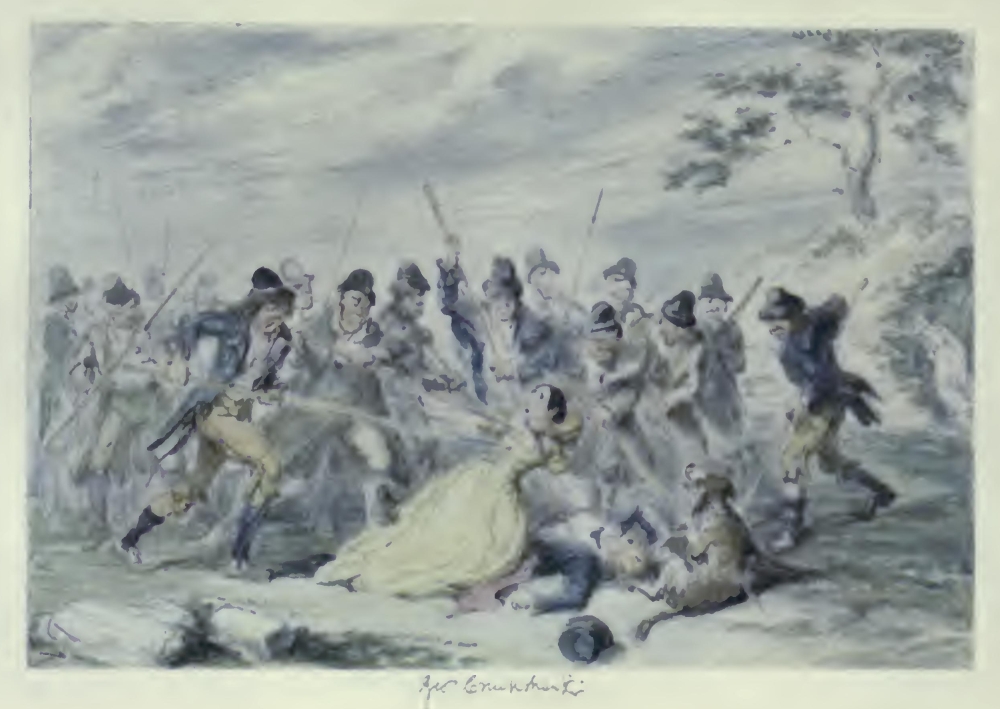

These circumstances of atrocity have been verified by affidavit, sworn by Crawford’s widow, the 20th day of August 1798. The fidelity of a large dog, belonging to this poor man, deserves to be recorded, as he attacked those sanguinary monsters in defence of his master, till he fell by his side perforated with pikes.’
STOPPAGE OF THE MAIL AND MURDER OF LIEUTENANT GIFFARD
‘The second murder occurred on the same night. About eleven o’clock the Limerick mail was stopped by a numerous banditti, and a gentleman was slaughtered under circumstances which elicited a lively sympathy. The sufferer was Lieutenant William Giffard, of the 82nd regiment, son of Captain John Giffard of the Dublin regiment.’ The savages having shot one of the horses so effectually to prevent the coach from proceeding, demanded of Lieutenant Giffard who and what he was, to which he answered, without hesitation, that he was an officer proceeding to Chatham in obedience to orders he had received. They demanded whether he was a Protestant; and being answered in the affirmative, they held a moment’s consultation, and then told him that they wanted officers, that if he would take an oath to be true to them, and join them in an attack to be made next morning upon Monastereven, they would give him a command, but that otherwise he must die. To this the gallant youth replied, ‘That he had already sworn allegiance to the king, that he would never offend God Almighty by a breach of that oath, nor would he disgrace himself by turning a deserter and joining the king’s enemies; that he could not suppose a body of men would be so cruel as to murder an individual who had never injured them, and who was merely passing through them to a country from whence possibly he never might return; but if they insisted on their proposal he must die, for he never would consent to it!’ This heroic answer, which would have kindled sentiments of humanity in any breasts but those of Irish rebels, had the contrary effect, and with the utmost fury they assaulted him. He had a case of pistols, which natural courage and love of life, though hopeless, prompted him to use with effect, and being uncommonly active he burst from them, vaulted over a six feet wall, and made towards a house where he saw a light and heard people talking. Alas! it afforded no refuge! It was the house of poor Crawford whom, with his grand-daughter, they had just piked. A band of barbarians returning from this exploit met Lieutenant Giffard. There he fell, covered with wounds and glory, and his mangled body was thrown into the same ditch with honest Crawford and his innocent grandchild.
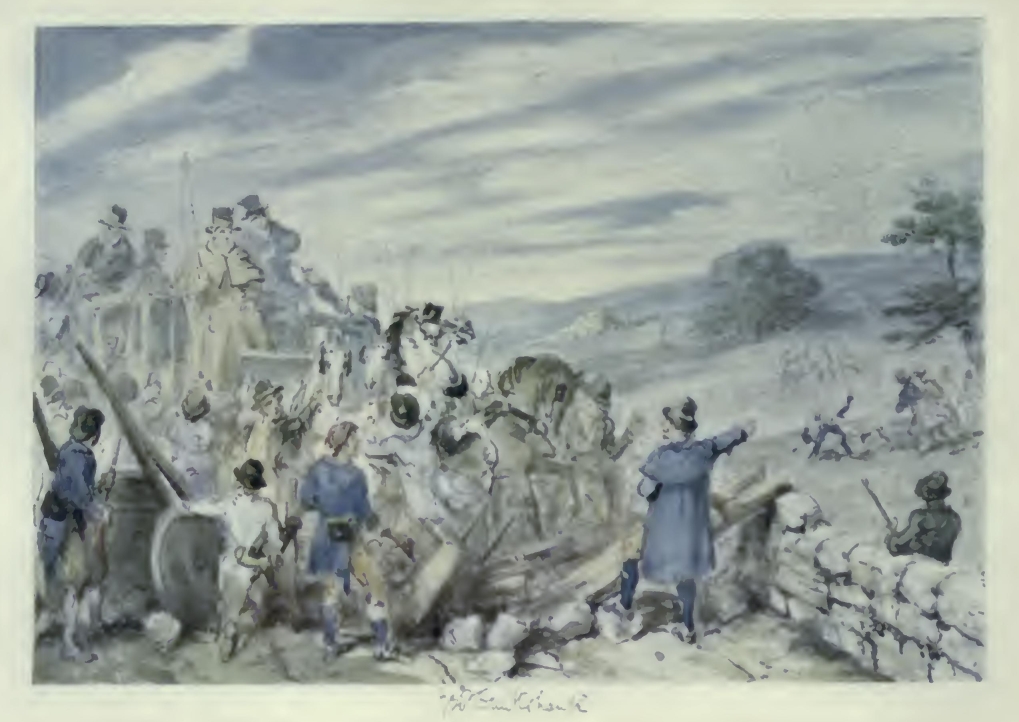
‘Thus expired, at the age of seventeen, a gallant youth—the martyr to religion and honour—leaving a memory behind that will ever be respected by the virtuous and the brave.’
Shortly, in the course of his campaign, struggling to suppress the rebellion, Sir James Duffs movable column entered Kildare, when it passed close to the scene of slaughter, and poor Giffard’s body was removed from the ditch and interred with military honours.
COURSE OF THE INSURRECTION
A course of cowardly assassination thus commenced was continued by the insurgents in their progress to attack Monastereven. Their numbers had increased to ten or twelve hundred men, and they were commanded by a ruffian called M’Garry. Such Protestants as they unfortunately met with were put to death, and a solitary dragoon, seized as he crossed the Curragh, was inhumanly murdered. About four in the morning they approached the town and made their preparations for attacking it.
On the 24th of May there was not a regular soldier in Monastereven; and an infantry company, with a troop of horse, both yeomanry, formed the little garrison. After a feint on the canal, and a movement by the high road, which was repulsed by a charge of the cavalry, they pushed boldly into the town, and a warm conflict took place in the main street. The well-sustained musketry of the infantry threw the head of the rebel column into confusion, when the cavalry charged home, and the rout was complete. Fifty bodies were found lifeless in the town; and as the horsemen followed the flying rebels vigorously, as many more were cut up in the pursuit. The repulse of this attack was most honourable to the defenders of Monastereven. The gallant action was achieved by loyalists alone, and of the brave men who fought and bled that day fourteen of the troop were Roman Catholics.
The outbreak of the 23rd of May was attended by many acts of cruelty inflicted upon isolated families, who, either from mistaken confidence or inability to reach a place of safety, exposed themselves to the fury of savages, whose natural truculence was often inflamed to madness by intoxication. Many individuals of great worth and respectability perished thus. Mr. Stamers, the chief proprietor of the town of Prosperous, was torn from the house of a lady where he had obtained a temporary shelter, and murdered in cold blood. Rathangan was, indeed, a scene of extensive butchery. Mr. Spencer and Mr. Moore were slaughtered there, although they had surrendered their arms on the assurance of being protected. They were murdered in the open street, and their wives had the horrible assurance that, with the shots they heard, the existence of their beloved partners had terminated. Thus Mr. Spencer, that worthy gentleman, ‘who was an active and intelligent magistrate, and as remarkable for the amiableness and affability of his manner as the benevolence of his heart, fell a sacrifice to the fanaticism of those savages, to whom he had been unremittingly a kind and generous benefactor. As his house, at the hall door of which he was so brutally murdered, was a short distance from the town, Mrs. Spencer, who was led to it in the midst of these monsters, had the anguish to see the mangled corpse of her husband lying at his door’ (Musgrave).
A number of other victims were immolated by these bloodthirsty savages, and, until relieved by Colonel Longfield on the morning of the 28th, Rathangan was a constant scene of atrocity, in which even woman forgot her sex and barbarously participated. The murders at Rathangan, while they exasperated the royalists to acts of desperate retaliation, operated against the perpetrators in another and unexpected way. The few Protestants in Leinster and the south, who had mixed themselves with the conspiracy, suddenly became alarmed, for the war had now assumed a religious rather than a revolutionary complexion. Suspicion once aroused finds abundant causes to confirm it; and while some Protestants quietly seceded from their fellow-traitors, not a few sought favour with the Government by a secret betrayal of their guilty companions.
Musgrave illustrates this point:—‘I shall mention here an incident which throws light on the spirit of the conspiracy and rebellion, and the secret designs of the great body of the rebels. One Dennis, an apothecary and a Protestant, was the county delegate and chief conductor of the plot in the King’s County, which was to have exploded in a few days; but the wanton massacre of Protestants at Prosperous and Rathangan having convinced him that their extirpation was the main object of the Romanists, though they had with singular dissimulation concealed it from him who was their leader, he repaired to Tullamore to General Dunn, who commanded the district, threw himself on the mercy of Government, exposed the whole plot, and betrayed the names of the captains, who were immediately arrested. He said to the general, “I see, sir, that it will soon be my own fate.”’ In the course of this history nothing will be more apparent than the incompetency, military and diplomatic, of many of the functionaries to whom extensive powers were confided. One while unnecessary severity was employed, and at another mistaken lenity marred every advantage which stringent measures might have effected. In military conduct the royalist commanders were too often found deficient, and almost in every instance, either to imprudence or imbecility, the insurgents were alone indebted for moments of doubtful and envanescent success. The affair at Old Kilcullen was about one of the worst military offences committed by an incompetent commander. Yeomanry officers always behaved with boldness, and frequently displayed both tact and talent when left to their own resources, while many from whose high military rank and standing something like ability might have been looked for, proved the truism of the adage, that as ‘the cowl does not make the monk,’ neither does an aiguilette constitute a general. Learning that some three hundred well-appointed rebels had assembled at Old Kilcullen, and that they had entrenched themselves in the churchyard, General Dundas proceeded to dislodge them. His force consisted of only forty dragoons and some twenty Suffolk militiamen. The rebel position was on a height—one side protected by a high wall, the other secured by a double fence—a hedge with a dike in front. Would it be credited that an English general could be mad enough to assail three hundred men thus posted with forty dragoons? Mus-grave thus narrates the transaction, and his account has been considered by those engaged to be perfectly correct:—
General Dundas ordered the Romneys and the 9th Dragoons to charge the rebels, though it was uphill, though the ground was broken, and many of the rebels were in a road close to the churchyard in which not more than six of the cavalry could advance in front.
‘They, however, charged with great spirit, though their destruction was considered by all the spectators to be the certain and inevitable consequence of it; for what could cavalry do, thus broken and divided, against a firm phalanx of rebels armed with long pikes? Nevertheless they made three charges, but were repulsed in each; and at every repulse the general urged them to renew the attack.
‘It was with the utmost difficulty that Captain Cooks and Captain Erskine could prevail upon their men to renew the charge after the first defeat. In the last charge, Captain Cooks, to inspire his men with courage by example, advanced some yards before them; when his horse, having received many wounds, fell upon his knees; and while in that situation the body of that brave officer was perforated with pikes; and he, Captain Erskine, and twenty-two privates were killed on the spot, and ten so badly wounded that most of them died soon after.’
Shamefully discomfited, Dundas fell back on the village of Kilcullen bridge, and occupied a pass in every way defensible. So thought the successful peasants who had garrisoned the churchyard and deforced an English general. They prudently declined any attempt to force the bridge, forded the Liffey at Castlemartin, and took up a position between Naas and Kilcullen—thus cutting off General Dundas’s communication with the capital.
Nothing remained for the royalist commander but to drive them from these grounds and open his road to Naas. He advanced accordingly, found them in line three deep, and with his cavalry in hand, boldly attacked the position with half a company of the gallant Suffolks. Small as the party was, three rounds broke the rebels. The cavalry charged, and the same body which had so recently inflicted a severe repulse were scattered like a flock of sheep, leaving the ground covered with their dead and wounded. After a brief but bloody pursuit, Dundas marched on Naas, to concentrate his troops and assist in covering the capital.
ATTACK ON NAAS
‘If one can imagine such a thing as a tableau, or bird’s-eye view of the rebellion from the 23rd to the 30th of May (1790), the appearance it would present would be this. Seven or eight comparatively minor explosions, lighting up the atmosphere for a short space and then going gradually out, viz. one in Meath (Tara), one in Wicklow (Mount Kennedy), a good blaze in Carlow, and four or five in Kildare, which its being Lord Edward Fitzgerald’s own county accounts for—these were Naas, Prosperous, Kilcullen, and Rathangan. The eye should then be drawn to the mighty and absorbing eruption of Wexford; taking Vinegar Hill as its crater, it would observe two streams of lava pouring forth, one due west to Ross, one due north towards Wicklow, and a third, of somewhat less importance, north-west to Newtown Barry. I rather think the first shot was fired by my regiment at Naas, as Mick Reynolds, who led the rebels, was one of the promptest of the insurgent leaders.’—The MS. Journal of a Field Officer.
The garrison of Naas consisted of a hundred and fifty of the Armagh Militia, with two battalion guns, and seventy cavalry, consisting of small detachments of the Fourth Dragoons, Ancient Britons, and sixteen mounted yeomen. The whole were under the command of Colonel Lord Gosford.
On the evening of the general insurrection (the 23rd of May) anonymous letters were received by the commanding officer, apprising him that a night attack would be made upon the town by a numerous body of well-armed rebels, and necessary dispositions of the garrison were made to receive the threatened assault. The guards were doubled, the outskirts of the town carefully patrolled, and a plan of defence prearranged to prevent any confusion when the hour for action came. Midnight passed without anything occurring to cause alarm, and as morning dawned, it was believed that the information received the preceding evening had been incorrect, and the officers retired to their quarters. At half-past two, however, an outlying dragoon galloped in, announcing the advance of a numerous body of rebels; the drums beat to arms, and the garrison occupied their alarm posts.
Perhaps the commanding officer and his staff were more than a trifle incautious and premature in deciding there was nothing in the timely warning.
In spite of the precautionary vigilance, Lord Gosford had the very narrowest possible escape from death by assassination. His lodging was situated at the summit of the hill which the Dublin road ascends. The sentinel at his door, having his attention attracted by the entrance of the rebel columns at the foot of the hill, was inexcusably so far off his guard as to allow two pikemen, belonging to the town, to slip into the hall, where they were ready to receive his lordship with their pikes as he hurried from his chamber on the alarm. And they were very near succeeding—but the sentinel turning about at the critical moment, shot one and bayoneted the other, just as his lordship was rushing down the stairs. The sentinel’s name was John Sandford; he was afterwards made a sergeant, and his son a drummer.
The rebels, who had assembled at the quarries of Tipper, advanced on the town in four divisions, each entering by a different approach, and the heaviest column moving by the Johnstown Road. The latter was commanded by Michael Reynolds, and it made a bold effort to carry the jail, in front of which a party of the Armagh Militia, the Ancient Britons, and a battalion gun were posted. But the attack was completely repulsed, and the rebel loss would have been more considerable had not the cavalry, irritated by the fall of their officer, Captain Davis, who had been fatally piked, charged too prematurely, and interrupted the play of the gun; the execution of the latter was so trifling compared to what it should have produced upon a body in close column and at canister range, that it was ascribed rather to treachery than want of skill. For forty minutes, however, desultory firing continued.
‘Large parties of the rebels, who stole unnoticed into the town through the houses and narrow lanes, fought some time in the streets, and stood three volleys from the Armagh Militia, posted opposite to the barrack, before they gave way; at last they fled precipitately in every direction, when the cavalry charged, and killed a great number of them in the pursuit. Thirty of the rebels were killed in the streets; and from the numbers found dead in back houses and in the adjacent fields a few days afterwards, it is imagined that no less than three hundred must have fallen.
‘They dropped in their flight a great quantity of pikes and other arms, of which a number were found in pits near the town, where also three men with green cockades were seized, and instantly hanged in the public streets. Another prisoner was spared in consequence of useful information which he gave. He informed the commanding officer that the rebel party was above one thousand strong, and was commanded by Michael Reynolds, who was well mounted, and dressed in yeoman uniform. He made his escape, but his horse fell into the hands of our troops.’
KILDARE AND CARLOW
The entire of the county of Kildare was now in open insurrection, and not less than six rebel encampments were formed, and multitudes of the peasantry flocked to them. The houses were almost entirely deserted. Of the Protestant clergy not a man remained, and indeed the ferocity of party feeling had attained an intensity of violence which now can scarcely be imagined or believed. An infernal spirit actuated the opposite religionists. On one side, Catholics were too generally regarded with hatred and distrust; on the other, Protestants and Orangemen were held synonymous, and to all who dissented from the Church of Rome the most abominable feelings and intentions were attributed.
The MS. Journal of a Field Officer relates: ‘One of the completest things during the rebellion was the defeat of the rebels at Carlow, in which a company of my regiment had a share. There was full information of the intended attack, but “not a drum was heard.” The soldiers, who were chiefly in billets, were allowed to repair to their quarters as usual, and remain there until it was ascertained that the town rebels had quitted it to join their fellows and arm themselves, which they did about two miles from the town. A number of sergeants then went round, and the men were brought to their posts without the least alarm.
‘The rebel column entered Carlow by Tullow Street, unopposed—the street terminating in a place or open space where stood the horse barracks and jail. Arrived here they raised a loud shout or yell, and it was fearfully responded to by a destructive fire which opened upon them from different points. Seized with a panic at this unexpected reception they endeavoured to escape in various directions. The greater part retraced their steps through Tullow Street, but a picket had by this time occupied the further end of it, and opened a withering fire. They now sought refuge in the houses: these the soldiers set fire to; a number were shot in attempting to escape the flames, but a great many of the unfortunate wretches perished in them.’
About eighty houses were consumed in this conflagration; and for some days the roasted remains of unhappy men were falling down the chimneys in which they had perished.
It will be here necessary to mention that in Kildare, within a few days after the outbreak, an amnesty for the past was solicited by many of the rebels, and, with the consent of Government, the generals commanding in that county entered into negotiations with their chiefs. How far this was a prudent measure is questionable. In the spirit of the proclamations issued—with arms in their hands, rebels should have been placed outside the pale of treaty; while at the same time the most extensive forgiveness should have been extended to such as should disband themselves and reoccupy their abandoned dwellings. In diplomatic, as well as in field abilities, the royal generals were defective, and the amnesty produced nothing but treachery and bloodshed. The former charge rests with the insurgents, the latter must be laid at the hands of the royalists.
TREACHERY IN THE MIDST OF THE CAPITAL
While the counties in the immediate vicinity of the capital were thus in open insurrection, in the city the spirit and hopes of the disaffected were still buoyant as to the prospect of ultimate success; and although the failure of the 23rd had for a time paralysed the traitors of the metropolis, they were disappointed, but not despairing, and rebellion was ‘scotched, not killed.’
The committees and ‘directories’ continued their meetings, pikes were fabricated in large quantities, the sentries were assaulted on isolated posts, the doors of royalists were marked, domestic servants were corrupted. Musgrave records:—‘The Lord Mayor’s servant acknowledged to his employer that he was at the head of a numerous body of servants who were to have assassinated their masters; that he and his party were to have murdered the Lord Mayor and his family, with two others of his servants who had refused to join this precious association, and that this atrocious deed was to have been the signal for the other servants in the vicinity to rise and commit similar enormities. Another certain proof that a revolution was not only contemplated but expected, many of the Dublin tradesmen refused to receive bank notes in payment from their customers.’
Another serious cause of alarm also was the discovery that into many of the yeomanry corps disaffected persons had been introduced, and in some the traitors outnumbered ‘the true men.’
In Kildare almost every corps was tainted, and the same remark applied to many in the metropolis. Of the country corps, the Sleamarigue laid down their arms, the Castledermot had but five well-affected men, the Athy cavalry were publicly disarmed in the market-place, and their captain, Fitzgerald of Geraldine, committed to prison. The Rathangan, North Naas, and Furnace yeomanry were all extensively disaffected, and the Clane, nominally amounting to sixty-six, could only muster five-and-twenty when the insurrection broke out.
Of the metropolitan corps many were exclusively loyal, but others were not without traitorous members. One instance will be sufficient to show how extensive and dangerous was the disaffection.
On the 29th of May, the St. Sepulchre’s corps, in turn of duty, took the guard at Dolphin’s Barn, an outpost on the southwest side of the metropolis. While on the march to the bridge, a Roman Catholic yeoman, named Raymond, entered into conversation with his comrade, a notorious United Irishman, and communicated the secret plot. He told Jennings, ‘that in case of an attack, which was hourly expected, and which it was believed he had previously concerted with the rebels, the disaffected members of the corps were to massacre their officers and the Protestants, and to deliver up the bridge to the assailants. They were then to proceed to the battery in the park, inform the guard that they had been defeated, ask admittance, and on being let in, murder the guard, take possession of the battery and ammunition, and turn it to their own use.
‘Jennings had been sworn a United Irishman, and was attached to the cause from republican principles; but being a Protestant, and having discovered from the massacres which had taken place in the counties of Dublin, Meath, and Kildare, that the extirpation of his own order was intended, he informed Lieutenant Mathurin of the plot; and he, having communicated it to the Government, Raymond was taken up, tried, convicted, and hanged on the Old Bridge on the 1st of June.’
As the Roman Catholic members of that corps, who formed the majority of it, were discovered to be disaffected, they were disarmed on parade the Sunday following, and disbanded.
The fears of the inhabitants of the city were not abated when, on the 26th of May, the Lord Mayor caused the following placard to be circulated throughout the metropolis:—
‘A Caution
‘Lest the innocent should suffer for the guilty.
‘The Lord Mayor requests his fellow-citizens to keep within their houses as much as they can, suitable to their convenience, after sunset, in this time of peril; as the streets should be kept as clear as possible, should any tumult or rising to support rebellion be attempted, in order that the troops and artillery may act with full effect in case of any disturbance.’
THE HILL OF TARA
At this period, after plundering, and a commission of other outrages at Dunboyn, the rebels, from the borders of Meath and Dublin, proceeded in the first instance to Dunshaughlin, and afterwards to the hill of Tara. Their numbers had rapidly increased; there were no military parties in the immediate neighbourhood; and unchecked and unresisted, they devastated the country for miles round their camp, to which they carried an immense quantity of booty. A few corps of yeomanry still remained in the vicinity, but they were not sufficiently numerous to attack a very strong and defensible position. Accident, however, interposed, and the royalists obtained the assistance they required.
Three companies of the Reay Fencibles, with a battalion gun, were on the march to the metropolis, and halted in Navan on the night of the 25th of May. Captain Preston, who commanded the yeomanry of that town, solicited the co-operation of Captain M’Clean to deforce the rebels....
‘After going some time in quest of the rebels they found them very strongly posted on Tara hill, where they had been four hours, and about four thousand in number, while the country people were flocking to them in great multitudes from every quarter. They had plundered the houses in all the adjacent country of provisions of every kind, and were proceeding to cook their dinners, having lighted nearly forty fires, and hoisted white flags in their camp.
‘The hill of Tara is very steep, and the upper part surrounded by three circular Danish forts, with ramparts and fosses; while on the top lies the churchyard surrounded with a wall, which the rebels regarded as their citadel, and considered impregnable.
‘The king’s troops, including the yeomanry, might have amounted to about four hundred. As soon as the rebels perceived them they put their hats on the tops of their spikes, sent forth some dreadful yells, and at the same time began to jump, and put themselves in singular attitudes, as if bidding defiance to their adversaries. They then began to advance, firing at the same time, but in an irregular manner.
‘Our line of infantry came on with the greatest coolness, and did not fire a shot until they were within fifty yards. One part of the cavalry, commanded by Lord Fingal, was ordered to the right, the other to the left, to prevent the line from being outflanked, which the enemy attempted to accomplish. The rebels made three desperate onsets, and in the last laid hold of the cannon; but the officer who commanded the gun laid the match to it before they could completely surround it, prostrated ten or twelve of the assailants, and dispersed the remainder. The Reay Fencibles preserved their line, and fired with as much coolness as if they had been exercising on a field-day.
‘At length they routed the rebels, who fled in all directions, having lost about four hundred in killed and wounded. In their flight they threw away arms and ammunition, and everything that could encumber them. Three hundred horses, all their provisions, arms, ammunition, and baggage fell into the hands of the victors, with eight of the Reay Fencibles, whom they had taken prisoners two days before, and whom they employed to drill them.
‘It is to be lamented that the Reay Fencibles lost twenty-six men in killed and wounded, and the Upper Kells infantry six men.
‘The king’s troops would have remained on the field all night, but they had not a cartridge left either for the gun or small arms, The prisoners, of whom they took a good many, informed our officers that their intention was to have proceeded that night to plunder Navan, and then Kells, where there was a great quantity of ammunition, and little or no force to protect it; and that when they had succeeded they expected, according to a preconcerted plan, to have been joined by a great number of insurgents from Meath, Westmeath, Lough, Monaghan, and Cavan.’
The defeat of the insurgents, and their complete dispersion at Tara hill and on the Curragh, were highly advantageous, as they opened the communications north and south with the metropolis, which had been seriously interrupted.
Many partial affairs took place at this time between the royalists and the rebels in Kildare, and barbarities on the one side produced on the other a terrible retaliation. The insurgents burned and murdered as they went along; the troops and yeomen shot and hanged liberally in return. The record of crimes inhumanly committed and ruthlessly revenged would only disgust a reader.
While thus Kildare was exhibited for nearly a week one wide blaze of general insurrection, another county, which in the annals of rebellion assumed afterwards a sanguinary pre-eminence, remained in ominous tranquillity. The storm burst at last, and in crime and bloodshed Wexford left every other scene of tumultuary violence completely in the shade.
WEXFORD INSURRECTION AND CONSEQUENT ATROCITIES
Wexford had long withstood the anarchy of the evil days. While many counties in Ireland were disgraced by nocturnal robbery and assassination, committed by Defenders and United Irishmen, for five years previous to ‘97, it was the pride of the Wexford gentlemen to boast that their county had remained in perfect tranquillity. But in the autumn and winter of that year, and in the spring of ‘98, there were well-grounded suspicions that the mass of the people had begun to be infected by those baneful principles which since proved fatal to the kingdom, that pikes were manufactured, and clubs had been formed, in which illegal oaths had been administered. In April, however, unequivocal symptoms that a disaffected spirit actuated the peasantry became evident; and although the priests laboured hard to lead the resident gentry to believe that no danger was impending, and the people by thousands swore allegiance in the chapels, and expressed open attachment to the Government, there is too much reason to conclude that the plot had been long in preparation, and that the ferocious spirit which marked the proceedings of the insurgents was not the wild ebullition of a resentment produced by injudicious severity, but the fruits of a long-cherished antipathy to those who dissented from them in faith. It was the explosion of a frantic effort of the Papists to stamp out and exterminate their Protestant fellow-countrymen.
There is no doubt violent measures produced great exasperation, and that possibly a conciliatory policy might have averted the outbreak altogether. ‘Not above six hundred men at most of the regular army or militia were stationed in the county, the defence of which was almost abandoned to the troops of yeomen and their supplementaries. The magistrates in several districts employed themselves in ordering the seizure, imprisonment, and whipping of numbers of suspected persons. These yeomen being Protestants, prejudiced against the Romanists by traditionary and other accounts of the former cruelties that sect committed, fearing similar cruelties in case of insurrection, and confirmed in this fear by papers found in the pockets of some prisoners, containing the old sanguinary doctrines of the Romish Church, which authorised the extermination of heretics, acted with a spirit ill-fitted to allay religious hatred and prevent any feeling to rebels.
CAPTAIN FATHER JOHN MURPHY OF BOULAVOGUE
Until Saturday, the 26th of May, the flame of rebellion remained smouldering; but on that evening John Murphy, the curate or coadjutor-priest of Boulavogue, gave the signal for a general rising, which was too fatally responded to. A fire lighted on the hill of Corrigrua was answered by another kindled on Boulavogue, and the rapidity with which the volcano burst appears almost incredible. Murphy, the rebel general, was the son of a petty farmer in the parish of Ferns, where he was educated at a hedge school kept by a man of the name of Gun. It appears by his testimonium and diploma, that he received holy orders at Seville in Spain in the year 1785, and probably graduated there as a doctor of divinity, as he assumes that title in his journal, which was dropped in his retreat from Vinegar Hill, and found by Captain Hugh Moore of the 5th Dragoons, aide-de-camp to General Needham.
Nothing could be more ferocious than the church-militant career of this savage man. Every Protestant house in the parish of Kilcormick was reduced to ashes, and such of their unfortunate owners as could be seized were ruthlessly destroyed. These outrages proceeded entirely from a truculent disposition—for mostly his victims were men who offered no opposition—and when rashly attacked at a place called the Harrow, he beat off the Camolin cavalry, and killed Lieutenant Bookey who commanded it.
Whether the demon spirit which Murphy afterwards exhibited had been provoked or not is a matter of controversy; some say that his house and chapel had been burnt before he took the field, and others as positively deny it. In searching through the evidence on record dispassionately, I incline to the Tatter opinion, for when his house was burned the furniture had been previously removed and hidden in a sand-pit, and when his vestments were brought from the same concealment, the leader of the loyalists observed, in reply to some insulting remark, ‘Punish the rebel if you can, but offer no mockery to his religion.’
Early in his martial career Murphy commenced his murderous treacheries, destroying the glebe house at Kyle and murdering the rector of Kilmuckridge, Doctor Burrowes, and his family, under circumstances of peculiar atrocity. The house was defended with barricades by the rector and his parishioners at sunrise it was attacked by about five hundred rebels. ‘It was vigorously defended for some time, many shots having been fired by the assailants and the besieged. At last the rebels set fire to the out-offices, which were quickly consumed, and soon after to the dwelling-house, which in a short time was in a state of conflagration. The rapid spread of the flames in the latter was caused by the application of some unctuous combustible matter applied to the doors and windows of the house, which the rebels frequently used in the course of the rebellion.
‘The besieged being in danger of suffocation from the thickness of the smoke, resolved to quit the house, however perilous it might be, and this they were encouraged to do by Father Murphy, who assured them they should not be injured if they surrendered themselves without further resistance. Relying on his promise they quitted the house, on which the rebels treacherously murdered Mr. Burrowes and seven of his parishioners, and gave his son, a youth of sixteen, so severe a wound in the belly with a pike, that it subsequently caused his death.
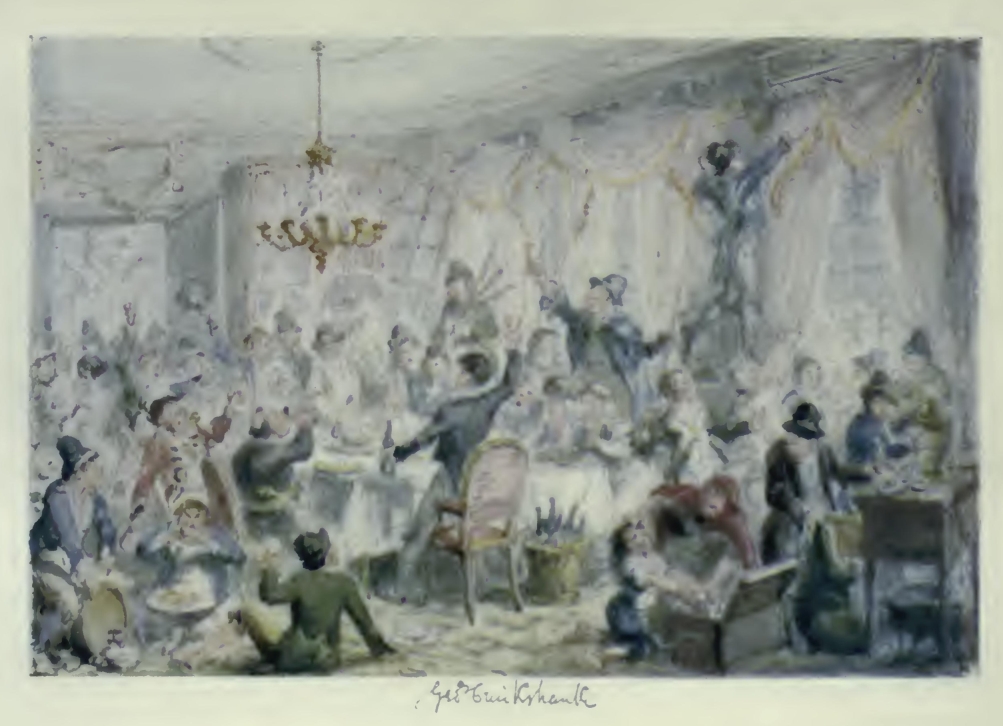
CAROUSAL AND PLUNDER AT THE PALACE OF THE BISHOP OF FERNS
George Cruikshank has seized this characteristic incident for one of his graphic pictures. It will be remembered that Murphy’s father came from the parish of Ferns. The illustration is in itself sufficiently graphic, and filled with pictorial details descriptive of the incident. Maxwell has related, in reference to the plunder of the bishop’s palace, an anecdote connected with it, which marks the total subversion of principle, religious feelings, badly excited, will produce. An orphan boy, whom the bishop had found naked and starving at the age of seven years, and whom he had fed, clothed, and instructed afterwards, was the leader of these marauders, showed them every valuable article of furniture, and assisted them in breaking open the cellar. The bishop’s fine library was plundered of its antique folios; these the rebels converted into saddles.
CAMPS OF KILTHOMAS AND OULART HILLS
The first consequences of the Wexford rising was the assemblage of two large bodies of insurgents, the one occupying the hill of Oulart, ten miles southward of Gorey, in the direction of the town of Wexford; the second taking a position nine miles westward of the former place, on a ridge of the Slieve Buoye mountain, called Kilthomas hill. Camps were established on the heights, and an immense number of the peasantry, including every age and sex, flocked immediately to join the rebels.
Both camps were attacked, but with results painfully different. The garrison of the little town of Carnew, consisting of nearly three hundred yeomanry, mounted and dismounted, marched boldly against the insurgents collected on Kilthomas, roughly estimated at about three thousand men. Although, with favourable ground and enormous superiority of numbers, it might have been expected that an attempt to dislodge the rebels from their position would have failed, nothing could have been more successful than the attack, and the royalists obtained a bloodless victory. Here again, the unrelenting spirit of the times appeared, and a very gallant and daring exploit was sullied by impolitic severity. The attempt to disperse the second camp at Oulart was attended with consequences not only disastrous to the troops engaged, but its results caused afterwards an immensity of bloodshed. Through the imprudence of an incompetent commanding officer, a very gallant detachment perished, while the insurgents, encouraged by accidental success, acquired a false but dangerous confidence which involved a fearful amount of atrocity, with a reaction, in many cases to be excused, and in more to be lamented.
On the morning of the 27th of May, Mr. Turner of Newfort arrived at Wexford and announced that his own house had been attacked and robbed of a quantity of arms, previously surrendered, and that the insurrection had unequivocally broken out.
Intelligence presently came in of the murders and atrocities everywhere committed in the neighbourhood, and also of the formation of a rebel camp at Oulart. Thinking it advisable to crush the outbreak in its birth, the yeomanry cavalry proceeded to scour the country, while Captain Foote with a detachment of the North Cork militia, amounting to no men, rank and file, marched in the direction of the rebel camp; and in route to Oulart he was joined by a troop of yeomanry cavalry; however, most of the yeomen in face of the enemy proved traitors and deserted to the enemy. In rough numbers, the insurgent force might have been set down at four to five thousand combatants. Although the advance was made with every disregard of military caution, accident more than determination enabled the rebels to profit from the gross mismanagement of the force opposed to them. Contempt of an enemy, which creates incaution, has often proved fatal. The rebels fled at the first onset, and were pursued at full speed by the militia, who were so little apprehensive of resistance, that no rank or order was observed. While the rebels were making their escape with precipitation towards the northern side of the hill, they were apprised that a large body of cavalry had been seen that morning advancing against them in the opposite direction, apparently with a design to intercept their flight and co-operate with the militia by a double attack. As the Wexfordian insurgents as yet were totally unacquainted with warfare, the onset of cavalry was, to the imaginations of many among them, more terrible than that of infantry. They therefore ignorantly supposed the cavalry to be still in the neighbourhood; and while Father John Murphy exclaimed that they must either conquer or perish, they turned desperately against the militia, who had now arrived near the summit, almost breathless, and charging them with their pikes, killed the whole detachment in an instant, except the lieutenant-colonel, a sergeant, and three privates. ‘It appears,’ says Musgrave, ‘that the rebels were rendered bold and desperate by intoxication, and that from twelve to fifteen of them singled out, cut off, and attacked each of the soldiers, who did not resign their lives but at a dear rate to their assailants.’
The consequences of this unfortunate disaster speedily evinced themselves. Numbers of the peasantry who had hitherto remained neutral repaired to the camp and joined the rebel standard; and in the same ratio that the confidence of the insurgents increased, the spirit of the royalists was abated. Fearful of an attack by numbers of savage men under the intoxication of a first success, the little garrison of Gorey determined to retreat at once on Arklow; and the movement was conceived and executed with a celerity that caused the most afflicting distress to crowds of helpless loyalists, who, dreading the ferocity of the rebels, abandoned their homes and followed the retiring garrison as they best could; the situation of these unfortunates was truly deplorable, and their subsequent sufferings pitiable in the extreme.
DESTRUCTION OF THE CHURCH AT ENNISCORTHY
Flushed with success, Murphy, the fighting priest of Boulavogue, now turned his attention to the town of Enniscorthy, six miles distant from his encampment. Its possession would be important; and as the garrison amounted only to about three hundred men, of whom a hundred were North Cork Militia and the remainder local yeomanry, there was every reason to believe that an open town, accessible in many quarters and protected by a feeble garrison, would offer to the overwhelming masses which should assail it a short and unavailing defence. Accordingly, Father Murphy determined to attack the place, and he carried his resolution into effect early on the afternoon of the 28th of May.
From its dangerous vicinity to the rebel encampment the garrison of the town apprehended, naturally enough, that the first effort of the victorious insurgents would be directed against them, and they were obliged, in consequence, to be vigilant and prepared. The duty of patrolling and giving pickets was therefore most harassing; for three days and nights they had been continually under arms; but though worn out and exhausted, while reports and appearances were most discouraging, they determined nevertheless to offer a gallant defence, and nobly they realised their resolution.
Certain intelligence having been received on the morning of the 28th that the town would be attacked early that afternoon, the drums beat to arms and the garrison took the posts previously assigned to them. The North Cork Militia occupied the bridge, a cavalry corps holding the street connecting it with the town, while the Duffry gate hill, upon the Carlow road, was protected by the yeomanry and infantry. The market-house and castle had each a sergeant’s guard allotted for its defence.
The ground taken up by the yeomanry was three or four hundred yards in front of the Duffry gate, and on that point the rebels made their opening attack. On perceiving the yeomanry in line, the insurgent column halted and deployed, extending largely to the right and left, to outflank the small body in their front and cut it from the town. This done, they advanced, driving cattle in their front, and at the same time opening a heavy and well-directed fire. (As the county of Wexford abounds with water-fowl, the occupation of a fowler is so profitable that numbers of the lower class of people are not only experts in the use of fire-arms, but excellent marksmen.) The yeomanry replied to it with effect, but dreading, from the extension of the rebel wings, that they should be ultimately turned, they retired into the town, covered by a charge of cavalry, which dispersed a body that pressed them too closely, but inflicted on the gallant horsemen a very heavy loss.
The suburbs and the town itself were now on fire. A number of the assailants had got in through by-ways unperceived, the rebel inhabitants fired on the royalists from their windows (many lives of officers were thus picked off in ambuscade), while, repulsed from an attempt upon the bridge, the insurgents attempted to ford the river beyond the reach of the fire of the North Cork Militia. Pressed by numbers totally disproportionate, the yeomanry obstinately held their ground, and although suffering heavily themselves, they cheered as they observed that their own heavy and well-supported fusilade cut down the head of the rebel column and checked its advance.
‘The streets,’ relates Musgrave, ‘were entirely involved in smoke, so that the yeomen could not perceive the rebels till they were charged by their pikes. The flames from the houses at each side of the street were so great as to unite and form a fiery arch, by which their hair was singed and the bear-skin in their caps was burnt. The loyalists, bravely disputing every inch of ground, retreated to the market-house, an open space like a square, where they made a determined stand and killed great numbers of the enemy. By this effort the loyalists turned the scale and drove the rebels completely out of the town, the streets of which at each side of the river presented an awful scene of conflagration. While the troops were thus engaged in the south side of the town, another body of the rebels crossed the river, about three-quarters of a mile above the bridge, but were soon routed by Captain Snowe. On this occasion his men showed great dexterity as marksmen, seldom failing to bring down such individual rebels as they aimed at. Captain Snowe then ordered Captain Richards to charge, which he did most effectually, but with heavy loss in killed and wounded.
‘As a party of the rebels, which came from Vinegar Hill towards the glebe, still remained unassailed and their numbers seemed increasing, they were attacked by Captain Drury, with half a company of the North Cork Militia, and dispersed with considerable slaughter.’
Thus ended an action which lasted more than three hours, fought on a very hot day, in the midst of a burning town, the disaffected inhabitants of which set fire to their own houses to annoy the loyalists, and fired on them from their windows with deadly effect, picking out the loyalist leaders. In this action the yeomen and Protestant inhabitants performed prodigies of valour in support of the constitution and in defence of their property and their families.
‘It was generally believed that not less than five hundred of the rebels were killed or wounded. The banks of the river and the island in it were strewed with their dead bodies, and numbers of them fell in the streets. To keep up the courage of the insurgents every artifice was used; for even women, as if insensible of danger, were seen in the midst of the carnage administering whiskey to their rebel friends.’
In this most gallant defence the loss sustained by the garrison fell chiefly on the yeomanry and loyalists; nearly a third of the whole amount employed were placed hors de combat, the greater proportion being slain.
After the rebels were repulsed, the necessity of an instant retreat became apparent. The town was on fire, and no longer tenable by a garrison equally reduced in strength and numbers, the insurgents were hanging in an immense force about the town, a night attack seemed almost certain, and no hope could be held out that under existing circumstances it could be repulsed. A council of war was held, and, after mature deliberation, it was resolved to abandon the town and march on Wexford by the eastern side of the river, by St. John’s. ‘From the suddenness of the retreat, only a few of the Protestant inhabitants could accompany the troops, and they could carry with them no other comforts or necessaries but the apparel which they wore. Imagination cannot form a more tragic scene than the melancholy train of fugitives, of whom some were so helpless from their wounds, from sickness, the feebleness of old age or infancy, that they could not have effected their escape had not the yeomen cavalry mounted them on their horses. Some parents were reduced to the dreadful necessity of leaving their infants in cottages on the roadside, with but faint hope of ever seeing them again.
‘The town, the morning after the rebels got possession of it, presented a dreadful scene of carnage and conflagration; many bodies were lying dead in the streets, and others groaning in the agonies of death; some parts of the place were entirely consumed, and in others the flames continued to rage with inextinguishable fury. No less than 478 dwelling-houses and cabins were burned in the town and its suburbs, besides a great number of stores, malt-houses, and out-offices.’
The rebel entrance of the town was marked by the atrocities of a barbarous force, irritated by resistance, and now excited by the accidental success which circumstances had given them.
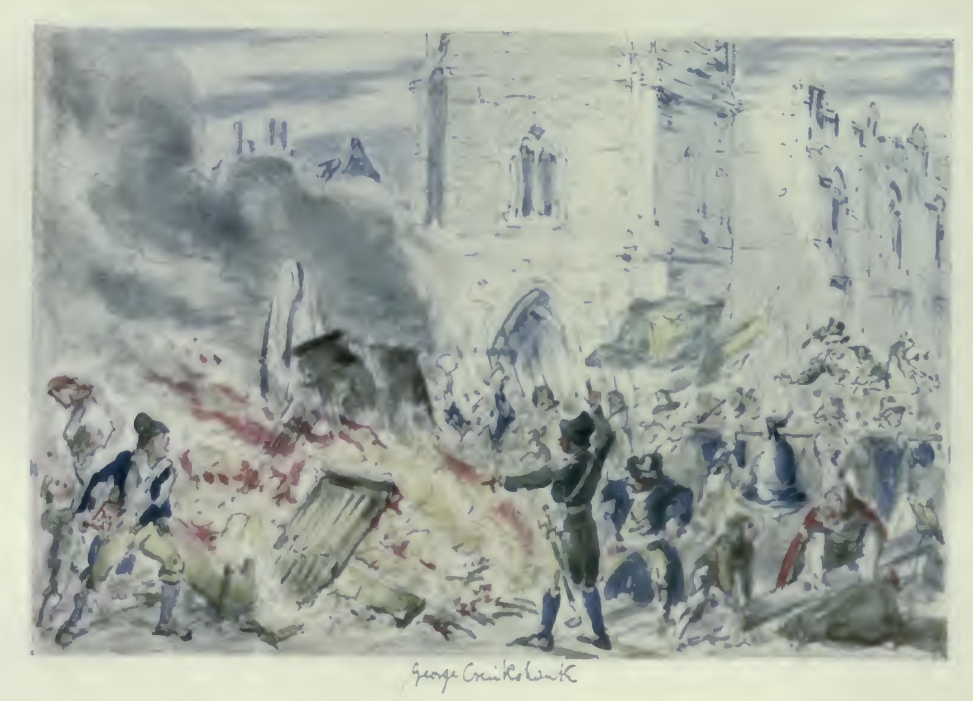
AN ACT OF VENGEANCE
In the spirit of sheer destructiveness the rebels turned their exertions to wrecking the Protestant church. Our artist has graphically pictured the wild and lurid spectacle attending the wilful destruction of the church at Enniscorthy; vestments, benches, the organ, the pulpit, Bibles, and church furniture were devoted to feed the flames and make a bonfire; meanwhile the triumphant insurgents are shown carrying off the church bell as a trophy, which we find set up subsequently, a prominent feature of the vast rebel camp in the vicinity.
THE CAMP ON VINEGAR HILL
Immediately after obtaining possession of Enniscorthy the rebels proceeded to form an extensive encampment on Vinegar Hill, from which the town, after its seizure, was garrisoned by rebel reliefs, sent down from headquarters on the mountain. Immense numbers of the peasantry flocked to this camp, and in a few days it was believed that fully ten thousand men were there collected. As this was the point on which the insurgents concentrated in greater force and for a longer time than on any other during the brief period that elapsed from the émeute to its final suppression, and as it was also, unhappily, the scene, were its atrocities recorded, that would picture civil war in revolting colours—which may be fancied but not detailed—it may be interesting here to describe its local position and the appearance it then presented.
In a military point of view Vinegar Hill is strong. High grounds, gradually rising, are crowned by a cone of bold ascent, while the country beneath, being cultivated fields, is divided into numerous enclosures, and intersected by stone walls, hedges, and trenches. On the apex of the hill stood the ruins of a windmill; round the upper height some rude field-works were thrown up, as well as on a lower ridge which the rebels occupied as part of their position. For defence by irregular troops, who trusted rather to numbers than to discipline, Vinegar Hill was particularly favourable, for the numerous enclosures afforded safe cover for skirmishers, who could with perfect impunity severely annoy any columns advancing to assail the hill, and oblige an enemy to feel his way with caution. Good roads wound round the base of the position, and a command of the Slaney added to its military value.
Its local appearance was singular and picturesque, and perfectly in keeping with a wild and guerilla sort of warfare. Although the weather was particularly hot and night but nominal, a part of the insurgents placed themselves under cover, and the position exhibited rather the varied colouring of an Indian camp than the dazzling whiteness of ‘the tented field.’ Wattles—as thin and flexible poles are termed in Irish parlance—were overhung with blankets, tablecloths, chintz furniture, and window curtains, plundered from the surrounding neighbourhood, while in the centre, from the top of the ruined windmill, a green flag ‘dared the battle and the breeze.’ A few guns and swivels were rudely placed in battery, and in whatever else the rebel executive might have been deficient, their commissariat, as the figures and records show, was carefully attended to. A local board of field officers assembled every day, and after their deliberations the larders and cellars of the neighbouring gentry were put into extensive requisition. Vinegar Hill was better provided with rude accommodations than any of the insurgent stations, for the heights on which the rebel masses herded were generally mere bivouacs, hurriedly taken up and as suddenly abandoned. These posts they termed camps, though they were destitute of tents, except a few for their chiefs, while the people remained in the open air in vast multitudes, men and women promiscuously, some lying covered with blankets at night, and some without other covering than the clothes which they wore during the day. This mode of warfare was favoured by an uninterrupted continuance of dry and warm weather, to such a length of time as is very unusual in Ireland in that season, or any season of the year. This was regarded by the rebels as a particular interposition of Providence in their favour, and some among them are said to have declared, in a prophetic tone, that not a drop of rain was to fall until they should be masters of all Ireland. On the other hand, the same was considered by the fugitive loyalists as a merciful favour of Heaven, since bad weather must have miserably augmented their distress and caused the death of many. In these encampments or stations, among such crowds of riotous, undisciplined men, under no regular authority, the greatest disorder may be supposed to have prevailed. Often when a rebel was in a sound sleep in the night he was robbed by some associate of his gun or some article considered valuable; and hence to sleep flat on the belly, with the hat and shoes tied under the breast for the prevention of stealth, was the general custom.
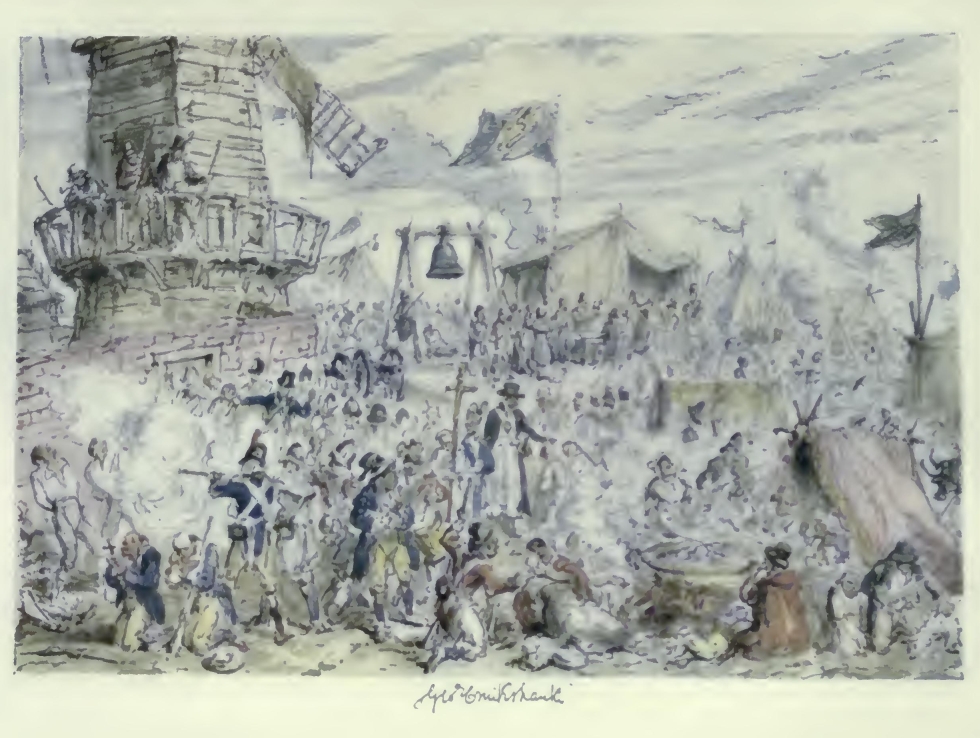
THE CAMP ON VINEGAR HILL
‘The camp at Vinegar Hill presented a dreadful scene of confusion and uproar. A number of female rebels, more vehement than the male, were marching out to meet the army from Newtown Barry; this was a large body which Father Roche led from Vinegar Hill to the attack of that town, which took place the 1st of June. Great numbers of women were in the camp. Some men were employed in killing cattle and in boiling them in pieces in large copper brewing-pans; others were drinking, cursing, and swearing; many of them were playing on various musical instruments which they had acquired by plunder in the adjacent Protestant houses, the whole producing a most disagreeable and barbarous dissonance.’—Visit to the Camp, Rossiters Affidavit, printed in Musgrave’s Appendix, No. XX.
They were in nothing more irregular than in the cooking of provisions, many of them cutting pieces at random out of cattle scarcely dead without waiting to dismember them, and roasting those pieces on the points of their pikes, with the parts of the hide which belonged to them still attached. The heads of cattle were seldom eaten, but generally left to rot on the surface of the ground, as were often large portions of the carcases after a few pieces had been cut away. From this practice the decay of animal matter was rapid, and the stench of the encampment in a few days became intolerable.
THE FATAL PASS OF TUBBERNEERING
This incident, one of the most fatal episodes of the insurrection, was due, like several others recounted, to the incompetence of the leaders; a fine body of men were thus sacrificed, and the situation of the loyalists was aggravated in consequence. The abandonment of Wexford followed the succession of military mistakes. The peasantry, hounded on by truculent priests and ferocious partisans, committed every enormity which can be imagined, while the royalists and yeomanry emulated this abominable cruelty, and, under the name of loyalty, too frequently perpetrated wanton and savage reprisals. Confidence between men was ended, and while the rebels dissimulated to obtain their end, the royalist, shielded by the hand of power still predominant, robbed and slaughtered ‘in the king’s name.’ On both sides there were violence and treachery. It was an unholy contest, and while Popish massacres were revolting, it cannot be denied that Protestant atrocities were neither ‘few nor far between.’ Colonel Walpole was detached from Dublin to reinforce General Loftus, that on his junction he arrogated for himself an independent command, that it was culpably acceded to, that he was ambitious to fight an action without delay, and that to oblige a minion of a Lord-Lieutenant an attack on the rebel position, the hill of Ballymore, was planned, it being considered the safest method of gratifying ‘a carpet-knight’ whose services had as vet been confined to the duties of the drawing-room. The result may be imagined. Walpole led his fine division into a well-prepared ambuscade in the fatal pass of Tubberneering, the guns were taken, the commanders shot. ‘Suddenly from the enclosures a wild yell burst forth, accompanied by a stream of musketry. Colonel Walpole fell on the first fire; the confusion was tremendous, and to fight or retreat impossible. The height and number of the fences on every side made the ground most favourable for irregular and desultory warfare, as the long pikes of the rebels reached nearly across the narrow road, and those of the distracted soldiers who escaped the first close fire were perforated from behind the hedges’ by invisible opponents. The surprise of the troops was complete, dragoons and infantry were thrown in helpless disorder on each other, and a scene of butchery ensued. The column was now completely surrounded, discipline unavailing; an attempt made by a detachment of the 4th Dragoon Guards to turn the enemy’s right flank failed. After having sustained the attack for about three-quarters of an hour with considerable disadvantage on the part of the king’s troops, and having lost their commander and three pieces of artillery, which were immediately turned against them, a retreat began in all the confusion which might be expected from raw and inexperienced troops.
‘The rebels pressed them hard, a general dismay took place, which would probably have been fatal to the whole of the column had not Lieutenant-Colonel Cope of the Armagh Militia, who had been fortunately in the rear of the column with a detachment of his own regiment, rallied and formed them on the road to impede the progress of the enemy. He gallantly disputed every inch of it for three miles. To this small band of brave men, under the command of a cool and gallant officer, the safety of those who escaped on that disastrous day may be entirely attributed.
‘Walpole, a mere Castle attache, had been very improperly employed to collect what troops could be spared from Naas, Kilcullen, and Baltinglas to reinforce General Loftus.... Walpole assumed the duties of his superior, planned ridiculous attacks, and finally sacrificed one of the finest detachments in the field.’
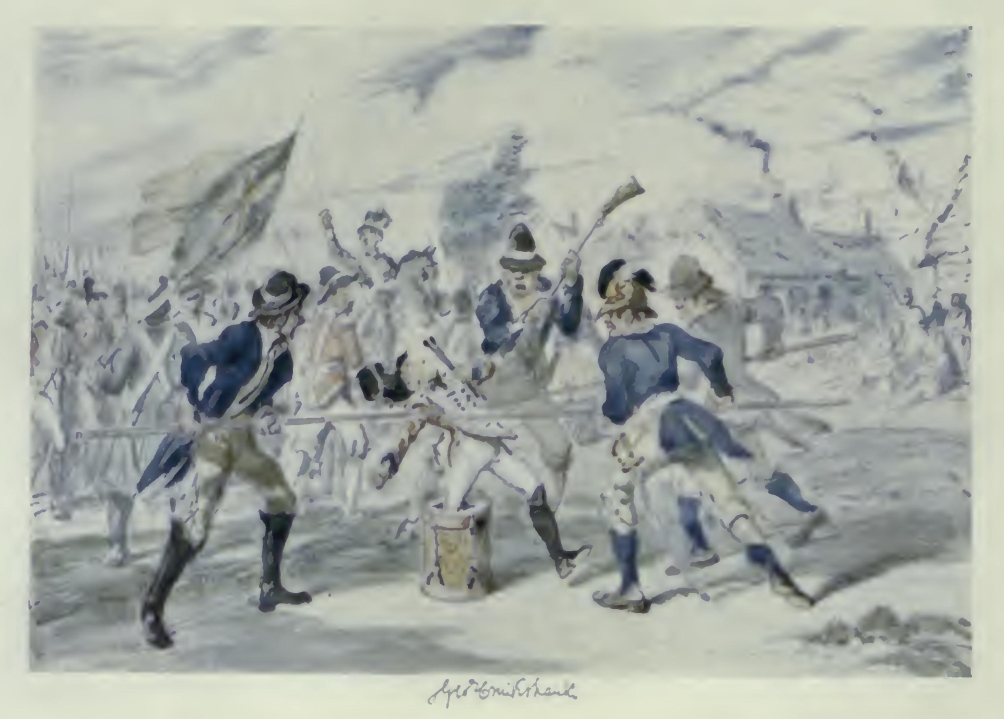
THE LOYAL LITTLE DRUMMER-BOY
Musgrave has thus related the touching incident of which George Cruikshank has made an effective picture:—‘A drummer, named Hunter, of the Antrim regiment, only some twelve years old, fell into the hands of the rebels in the unfortunate affair in which Colonel Walpole lost his life. He carried his drum with him, and when conducted to the town of Gorey with some other prisoners, being ordered to beat it, actuated by a spirit of enthusiastic loyalty, he exclaimed, “That the King’s drum should never be beaten for rebels,” and at the same instant leaped on the head and broke through the parchment. The inhuman villains, callous to admiration of an heroic act even in an enemy, instantly perforated his body with pikes.’
The consequences of the slaughter at Tubberneering were precisely such as might be expected. The royalists lost heart, and the insurgents acquired a dangerous audacity. Every Protestant abandoned home and property in despair, and more than a thousand individuals fled from their once happy dwellings, with wives and children, and, without food or shelter, endeavoured to seek safety elsewhere, and obtain eleemosynary support from those who still possessed a home. In the first place all, soldiers and civilians alike, fell back to Arklow, but, feeling themselves insecure even there, the retreat was continued to Wicklow.
As we have seen, the results of the insurgent success reacted most disastrously; the rebels at once became masters of Gorey, and to the army of Irish liberty in ‘98 the conquest of this town proved the reverse of advantageous to the captors.
INSURGENT OCCUPATION OF GOREY
For five days they halted in and about the town, drinking and pillaging, destroying property not portable, and, as at Enniscorthy, visiting their vengeance on the church. Had their fury been expended on the building alone it would have been a matter of little import, but unhappily the contest had now taken a religious colouring, so rancorous and sanguinary that blood alone could satisfy party hatred and thirst for vengeance, and the best interests of the cause itself were sacrificed to stupid and unproductive brutalities, from which gray hairs afforded no protection, nor boyhood could claim no immunity. To satisfy this insensate vengeance upon inoffensive victims, military expediency was disregarded, and important advantages lost sight of and utterly sacrificed.
The MS. Journal of a Field Officer, in every sense an invaluable guide to the true situation of those affairs which come within the observations of this keen professional critic, dwells conclusively on this point: ‘Providentially, the rebels had too many commanders; those of the Wexford force being mostly priests, their attention was more directed to the interests of their church by purging the land of heretics than to the concerns of the “Irish Republic,” which the northern leaders had in view. Consequently time was wasted in collecting and piking Protestants, which might have been employed with far greater advantage to the cause.’
THE BATTLE OF ROSS
The operations of the rebel armies which we have already detailed, namely, the attempt on Newtown Barry by the corps under Father Kearns, and that on Gorey by the insurgents under the two Murphys and Perry of Inch, with the intervening occurrence of Walpole’s defeat at Tubberneering, must be connected by a simultaneous transaction, probably, in military importance, the most interesting which marked the outbreak.
The strongest of the insurgent corps had assembled on the hill of Carrickbyrne, under the chief command of B. Baganel Harvey, with Father Roche acting en second. Their encampment was six miles from the town of Ross, of which it was their first and greatest object to obtain possession.
The dangerous proximity of the rebel host had caused alarm for the safety of the town, and, consequently, the garrison had been strengthened. On the 5th of June the County Dublin Militia, commanded by the popularly beloved Lord Mountjoy, with detachments from the Clare, Donegal, and Meath Militia, 5th Dragoons, Midlothian Fencibles, and English Artillery, occupied the place—a force amounting to 1400 men of all arms, of which 150 were yeomen. General Johnson, a veteran officer, commanded, and his heroic exertions won the day, and must shed a lasting lustre upon his reputation as a courageous and able leader.
On the evening of the 4th June the rebel camp at Carrick-byrne broke up, and the insurgents moved bodily to Corbethill, within a mile and a half of Ross. The rebel hordes ‘moved by parishes and baronies, each having a particular standard; in their way they stopped at a chapel, where mass was said at the head of each column by priests, who sprinkled an abundance of holy water on them.’—Musgrave. After driving in a distant outpost they bivouacked on Corbethill for the night. The royalists, fearing a surprise, remained under arms, the infantry and guns in position on the southern and eastern faces of the town, the yeoman infantry holding the bridge, and the cavalry formed on the quay. Night passed, however, without alarm; and it was four o’clock on the morning of the 5th before Baganel Harvey, who had been a few days before elected to the chief command, sent a formal summons to General Johnson, which unfortunately (as some say) was not delivered. Furlong, the rebel leader, who carried it, was shot, through the ignorance of the advanced sentry, who paid no respect to a white handkerchief he waved on approaching the outposts.
The MS. Journal of a Field Officer sums up the actual military situation: ‘The movement upon Ross showed some head on the part of Baganel Harvey, the object being to force the principal passage of the Barrow, and, in conjunction with the insurgents of Kilkenny, bear down upon Waterford, which was then very disaffected, weakly garrisoned, and presented strong temptations in the way of plunder. But Harvey had no idea of attacking Ross when that event took place, and there were evidently no preparations made for it. Harvey expected, and with reason, that the appearance of his masses on the hills which domineered the town would have secured the active co-operation of the Kilkenny men from the other side of the Barrow. And this would have been the case had time allowed it, but Furlong was a popular leader among the rebels, and when he was shot by a sentinel at the outpost the mass of the rebels, maddened by the occurrence, rushed by a sudden impulse, in a mighty but disordered torrent, along one side of the road on the Three-bullet Gate, instead of making a combined movement on an open town, by which facility of approach and enormous preponderance in numbers could not but have succeeded.’ This argument is supported by the communication which Furlong carried. On searching the pockets of the dead man the following cartel was found:—
Sir—As a friend to humanity I request you will surrender the town of Ross to the Wexford forces, now assembled against that town. Your resistance will but provoke rapine and plunder, to the ruin of the most innocent. Flushed with victory, the Wexford forces, now innumerable and irresistible, will not be controlled if they meet with resistance. To prevent, therefore, the total ruin of all property in the town I urge you to a speedy surrender, which you will be forced to in a few hours, with loss and bloodshed, as you are surrounded on all sides. Your answer is required in four hours. Mr. Furlong carries this letter, and will bring the answer.—I am, Sir,
B. B. Harvey,
General commanding, etc., etc.
Camp at Corbethill, half-past three o’clock morning,
June 5, 1798.
The death of Furlong is said to have precipitated the attack, for immediately afterwards the rebels moved forward in dense masses, cheering and yelling, and directing their march on the Three-bullet Gate. The advance of this armed multitude—by some estimated as from 20,000 to 25,000 men—was described to me by an eye-witness as the most singular spectacle imaginable. The irregularity of their array—partly in close column and partly in line—had the effect of displaying their enormous strength to full advantage; while the presence of several priests, who were observed flitting through their ranks and haranguing their deluded followers with certain assurances of victory, inspired an enthusiastic fanaticism, which blinded them to danger and rendered them additionally formidable. They pushed forward four guns and a cloud of musketeers, some in extended order, and others heading the pikemen, whose crowded columns occupied the whole road, far as the eye could range.
As might have been expected, the pickets were roughly driven in, and, in a wild rush made by the rebels on the troops in front of the Three-bullet Gate, the latter were obliged to recede, and one of the guns was captured. In turn, however, the troops rallied and drove back the insurgents, and, perceiving their unsteadiness when mobbed together in the repulse, General Johnson ordered the 5th Dragoons to charge. For cavalry effect the ground was totally un suite, the numerous fences enabling the rebels to avoid the charge, while, protected themselves, they inflicted a heavy loss on men who very gallantly, but very ineffectively, had thus assailed them at disadvantage.
An entrance to the town was gained, and while some of the rebels fired the houses, others pushed forward towards the bridge. But the advance by Neville Street was swept by the steady fire of a gun placed in the market-place, which looked directly down the approach. Notwithstanding the murderous fire which fell on a dense mass of men, wedged together in a narrow street, and which shore the head of the column down as frequently as it came forward, others succeeded those who fell, and fresh numbers momentarily appeared. The troops, terrified at the armed crowds who swarmed through the Three-bullet Gate, and who, maddened by inebriety and fanaticism, seemed rather to court death than avoid it, the defenders at last despairing of offering a longer resistance against myriad hordes of infuriated fiends, retreated across the bridge.
BATTLE OF ROSS—‘COME ON, BOYS! HER MOUTH’S STOPPED!’
George Cruikshank, with his native genius for selecting effective and sensational episodes for pictorial delineation, has seized an actual incident which more resembles the effort of a romancer’s imagination than an actuality of stern warfare. The illustration is founded upon one of the paragraphs given by Maxwell in confirmation of his statement that the hordes of rebels apparently courted destruction rather than safety.
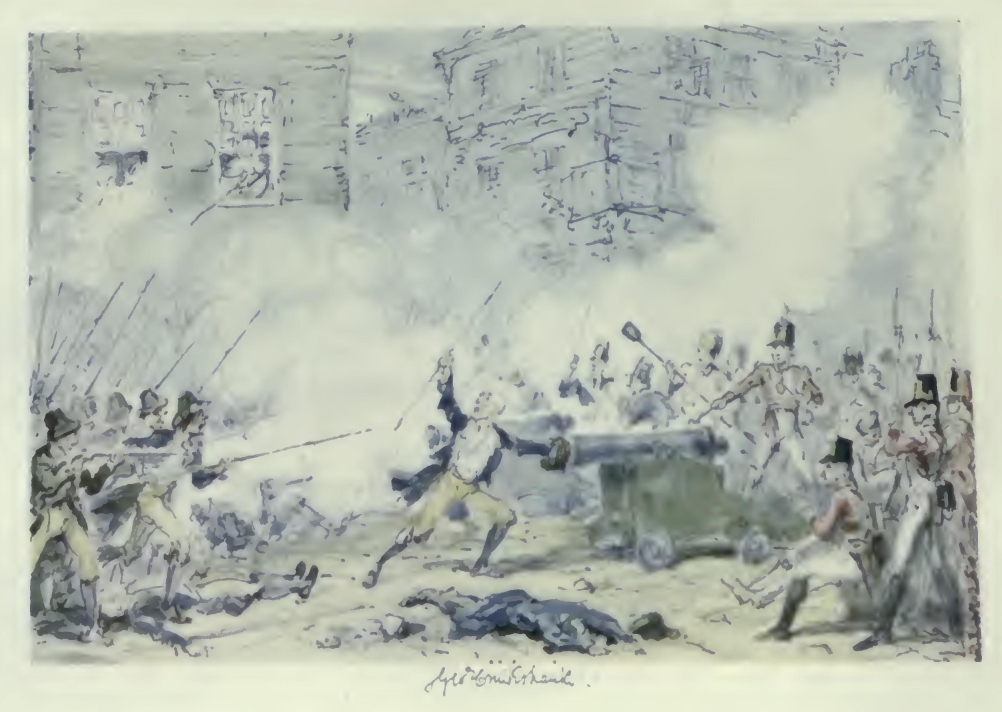
Says our historical authority:—‘One rebel, emboldened by fanaticism and drunkenness, advanced before his comrades, seized a gun, crammed his hat and wig into it, and cried out, “Come on, boys! her mouth is stopped!” At that instant the gunner laid the match to the gun and blew the unfortunate savage to atoms. Incredible as this instance of savage ignorance may appear, the fact has been verified by the affidavit of a person who saw it from a window.’
BATTLE OF ROSS—GENERAL JOHNSON RETRIEVES THE WANING FORTUNES OF THE DAY
It appeared, beyond the causes already related as having induced Harvey and his rebel myriads to feel confident of easily securing the strategically important town of Ross, that the insurgents had been induced to think that the militia regiments at Ross, from being almost entirely composed of Romanists, would have either joined them in the action, or offered a feeble opposition. The Clare regiment was considered friendly, and the Dublin County were believed not particularly loyal or trustworthy. The MS. Journal of a Field Officer is enlightening upon these points:—‘Be this as it may, their colonel, Lord Mountjoy, was heading them up the street leading to the Three-bullet Gate when he met his death by a traitorous shot, and the attachment which his men bore him superseded every other feeling but a desire for revenge. Although they had retired at first before the torrent, they rallied instantly, and showed no appearance of disaffection afterwards, but fought stoutly at Vinegar Hill. Lord M. was riding a little way ahead of the regiment when he was treacherously shot from a window by a baker’s boy. Such were the results of the fall of Furlong on the one side, and the death of Lord Mountjoy on the other.’
The forced abandonment of the bridge was a heavy repulse. Virtually the day was lost, for although a small party of the royalists, under Sergeant Hamilton, still held most gallantly a position in the vicinity of the Three-bullet Gate, had the insurgents followed up their success, a total and bloody defeat of the king’s troops must have been unavoidable. But, once within the town, drink and plunder engrossed the attention of the majority, while the admirable gallantry of that brave old man who commanded the retreating royalists retrieved the fortunes of the day.
Crossing to the Kilkenny side, General Johnson rallied the fugitives and urged them to follow him once more. ‘Will you desert your General?’ he exclaimed to the disheartened militia; but this appeal was coldly heard. ‘And your countryman, too?’ he added. The chord of national honour was touched, a cheer answered it, the old man wheeled his horse round, and, riding in front, brought back his rallied troops to the fight, and, rejoining the staunch few who still held the post beside the Three-bullet Gate, announced that a large reinforcement had just arrived from Waterford. When the fortune of a doubtful day is in the balance, a feather turns it frequently. Such was the case at Ross. The troops cheered, and plied their musketry with additional spirit and excellent effect, and, turning the rebel rear, put their massive column into a confusion which proved irretrievable, and at last, with desperate slaughter, drove them fairly from the town. The exhaustion of the garrison prevented anything being attempted beyond a brief pursuit in the direction of Corbet Hill, while the rebels made no effort to rally and renew the action, but went off dispersedly, some to their old camp at Carrickbyrne, and others to a new position which they had taken on a height called Slieve Keilter, some four miles’ distance from the town.
In this, the most sanguinary and hardly contested action of the insurrection, commencing at five in the morning and ending at three in the afternoon, the loss on both sides was immense, although in gross numbers wholly disproportionate. Musgrave states the rebels killed to have exceeded 2500, besides the many ‘carried off on cars.’ Before the walls, between Three-bullet and Bunnion Gates, and in the cross lanes and streets which led directly to the market-place, the slaughter was enormous.
In Chapel Lane the rebels lay three deep, and throughout the approaches to the main guard the streets were heaped with corpses.
The defence of this post, and the assistance afforded to the few brave men who held it, were characteristic of the desperate fighting which marks the uncompromising spirit that religious and political antipathies produce. A most gallant soldier, Sergeant Hamilton of the Donegal Regiment, with sixteen men and two ship-guns, indifferently mounted, were posted at the intersection of four streets in the immediate vicinity of the jail. When the troops retreated over the bridge, Hamilton was recommended to remove the spare ammunition he had in charge and quit a post where now he must remain isolated and unsupported. His reply was, ‘Never, but with life!’ and though frequently assailed by hundreds, he laned them literally with grape-shot, covering the approach to the guns with dead and dying men, and through every turn of a doubtful conflict resolutely maintaining his ground.
Although the leading streets were completely under his fire, the gallant sergeant was open to attack from a narrow lane immediately beside the main guard, where, sheltered from the cannon, the rebels could form in security; and, no doubt, from that point they would have carried the post by a sudden onset had not a fortunate circumstance afforded the Donegal soldiers protection from the threatened danger.
The house of a loyalist called Dowesley was in the Backhouse Lane, and occupied by the family and a lame pensioner. The part of the lane where the rebels were safe from the fire of Hamilton’s guns was, however, commanded by Dowesley’s windows; and whenever the insurgents attempted to form and attack the main guard, a close and constant fusilade from the little garrison of the house drove them from a place where they expected to find shelter while collecting for their intended attack. As fast as the muskets were discharged the old soldier quickly reloaded them, adding half a dozen buck-shot to the bullet, and so deadly was the fire from Dowesley’s dwelling that upwards of fifty bodies were found after the action heaped together in the lane.
Mr. Tottenham, the proprietor of Ross, employed six carts and a great many men for two entire days in collecting the bodies of the slain. Most of those found in the town were thrown into the river and carried off with the tide. The remainder were flung into a fosse outside the town wall and buried there. The conflict at Ross might have been shortened had the Roscommon regiment, which had been detached from Waterford early on the morning of the action, completed its march and brought its timely reinforcement to the exhausted garrison. It was also very fortunate the Roscommon regiment returned to Waterford that night, as the rebels, who were numerous and well organised there, meditated an insurrection, imagining Ross had been taken. The next day the Roscommon regiment moved a second time from Waterford and reached Ross with little opposition, although during the short interval which had occurred the country had risen en masse. On the adjacent hills parties of rebels were seen, and an arch of the Glynmore bridge had been partially broken, but the colonel planked it and passed his guns easily across. A body of rebels, who showed themselves upon a height, gave way after a round or two from the cannon, previously murdering fifteen of the refugee militiamen who had fled from Ross the day before, fell into these ruffians’ hands, and now paid the penalty of their cowardice.
With the battle of Ross subsequent atrocities, which have placed the Wexford insurrection fearfully pre-eminent in crime, were connected. One foul deed, the massacre at Scullabogue, infinitely surpassed all others, and, with the massacres perpetrated wholesale on Wexford Bridge and Vinegar Hill, has cast a stain on Irish character that another century will scarcely remove. One reads, almost with incredulity, of Autos-da-fe and Eves of St. Bartholomew, and blesses God, when he finds the narrative is true, that his lot was not cast in an age of cruelty and darkness. But the narration of scenes which discoloured the Irish rebellion makes one blush to think that the wolfish wretches who were the actors therein bore the common name of man. It is a revolting detail that historic impartiality forces on the writer, and it shall be briefly despatched.
MASSACRE AT SCULLABOGUE
When the rebels encamped on Carrickbyrne they established an outpost at the house of Scullabogue, which had been deserted by its proprietor, Captain King. A large barn was attached to the mansion; it was 34 feet long, 15 feet in breadth, and 12 feet high. This outhouse and the mansion itself had been made a prison wherein to deposit the unfortunate prisoners who by their loyalty or their difference in religious faith had incurred the displeasure of the rebels, and fell after the outbreak into their hands; and on the morning when the rebels marched on the attack of Ross, 230 ill-fated victims were then confined in a building, which proved at once their prison and their grave. A rebel guard was left to secure the captives, amounting to 300 men, under the command of three subordinate leaders, named Murphy of Loughnageer, Devereux, and Sweetman. The particulars of the butchery which took place on the fatal 5th of June will be best understood by abstracts from evidence upon oath, given on the trials of some of the monsters implicated in this hellish sacrifice. Any person who wishes for more extensive details of this most atrocious transaction will find them duly verified in the voluminous appendix attached to Musgrave’s Memoirs.
The depositions of sundry persons are briefly abridged. One who escaped the massacre, by the bribery of a rebel and the virtue of a priest’s protection, gives the following account of this horrible transaction. He states that, when the rebel army began to give way at Ross, an express was sent to Murphy to put the Protestant prisoners to death, as the king’s troops were gaining the day; but Murphy refused to comply without a direct order from the general. That he soon after received another message to the same purpose, with this addition, that ‘the prisoners, if released, would become very furious and vindictive.’ That, shortly after, a third express arrived, saying, ‘the priest gave orders that the prisoners should be put to death.’ That the rebels, on getting the sanction of the priest, became outrageous, and began to pull off their clothes, the better to perform the bloody deed. That, when they were leading the prisoners out from the dwelling-house to shoot them, he turned away from such a scene of horror, on which a rebel struck him with a pike upon the back, and said he would ‘let his guts out if he did not follow him!’ That he then attended the rebels to the barn, in which there was a great number of men, women, and children, and that the rebels were endeavouring to set fire to it, while the poor prisoners, shrieking and crying out for mercy, crowded to the back door of the building, which they forced open for the purpose of admitting air. That for some time they continued to put the door between them and the rebels, who were piking or shooting them. That, in attempting to do so, their hands or fingers were cut off. That the rebels continued to force into the barn bundles of straw to increase the fire. At last, that the prisoners having been overcome by the flame and smoke, their moans and cries gradually died away in the silence of death—and all became still.
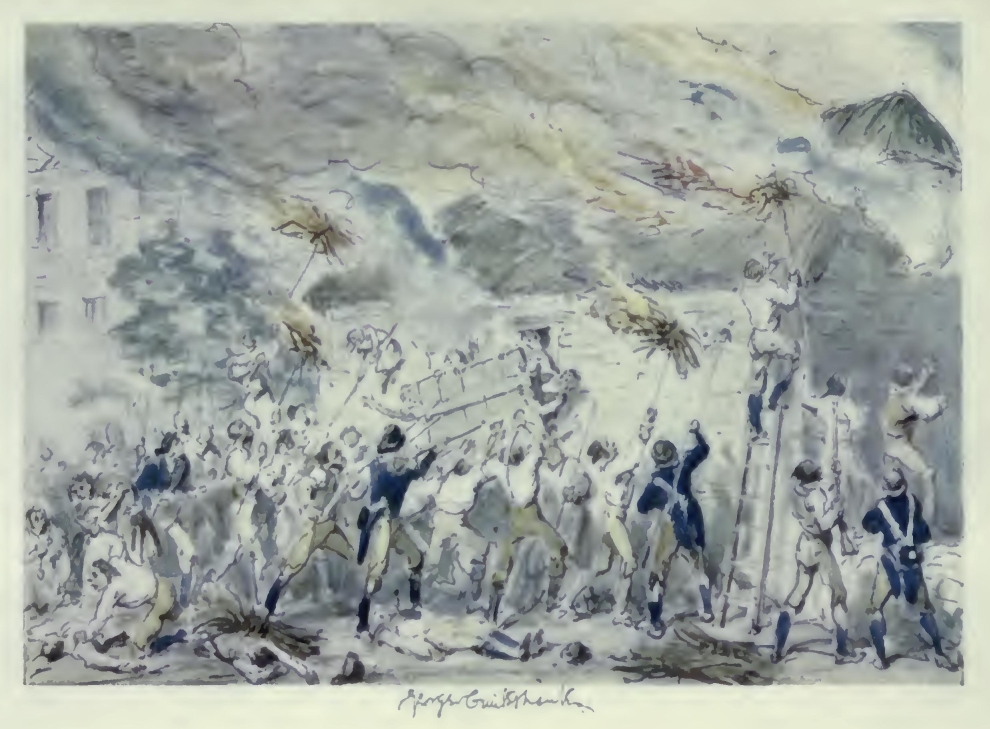
The witness, during this dreadful scene, saw a child, who got under the door and was likely to escape, although much hurt and bruised, when a rebel perceiving it, thrust his pike through it and threw it into the flames. While the rebels were shooting the prisoners in front of the dwelling-house, a party of men and women were engaged in stripping and rifling the dead bodies; and the prisoner, Phelim Fardy, called out to them to avoid the line of his fire (as he was busily employed in shooting the prisoners), and after saying so, he fired at a man who was on his knees, who instantly fell and expired. Another ruffian, whose barbarities made him conspicuous, trampled on the dead and wounded bodies, and behaved otherwise in such a ferocious manner as to obtain from the rebels the appellation of ‘the true-born Roman.’
The barn was so limited in size that suffocation must have soon taken place from the great number of people compressed into a space so small; for besides the burning of the thatched roof of the barn, the rebels fed it by introducing blazing faggots on their pikes.
Richard Grandy, who was present, swore the prisoners were led out by fours to be shot, and that the rebels who pierced them when they fell took a pleasure in licking their spears.
A gentleman present, who had a narrow escape, assured the writer that a rebel said he would try the taste of orange blood, and that he dipped a tooth-pick in the wound of one of the Protestants who was shot and put it into his mouth.
Whenever a body fell on being shot, the rebel guards shouted and pierced it with their pikes.
They burned there several wives and some of the children of the North Cork Militia in the barn, who were Roman Catholics; but it was sufficient to provoke their vengeance that they were connected with the soldiers of an heretical king.
The most innocent victims were sacrificed; a girl was brought there in place of her sister; she was seized and sent to the barn, and her father shortly after, having gone there with his poor old wife to solicit her liberation; the parents and child were thrust into the barn together, and burned with the other unfortunates. No less than twenty-four Protestants were taken from the village of Tintern, about eight miles distant, many of them old and feeble, and led in one drove to the barn, where they perished. Two Romanists, serving-men, were burnt in the barn because they would not consent to the massacre of their Protestant masters. Another Romanist, who was travelling with a royalist pass for his protection, was intercepted by the rebels, who considered the pass an emblem of loyalty; they committed him to the barn, with a son who happened to accompany him, and both perished in the flames.
In his history of these events Taylor, after recording the dreadful massacre of Scullabogue, thus describes the retreat of the rebels from New Ross, and pictures Baganel Harvey’s feelings when he viewed the scene of the fearful tragedy enacted at the fatal barn: ‘After ending this horrid massacre, the rebels marched (exulting in their diabolical achievements) towards New Ross, but the destroying angel had gone before them, and miserably defeated that huge army in which they trusted. As they proceeded to reinforce their brother rebels they met multitudes of the wounded returning, some crawling along as well as they could, others on horses and on cars; some were shot through different parts of the body, while others had broken arms, legs, and thighs. Going on further, they met the remnant of the main body retreating in the greatest confusion, hurry, and noise, bringing with them cars full of the dead and wounded. They took their station on Carrickburn that night; several stole home, and never joined them more, particularly those of Barony Forth, who, though a race of cowards, were cruel in the extreme.’
The next morning Baganel Harvey was in the greatest anguish of mind when he beheld Scullabogue House and the barn, where the murdered Protestants were to be seen in every attitude. They lay so close, that several were standing up against the walls, and many lying in heaps in each other’s arms among the ashes of the timber of the house, while their bodies looked frightful, being burned to a cinder. He turned from the scene with horror, wrung his hands, and told those around him that ‘as innocent people were burned there as ever were born, and that their conquests for liberty were at an end.’ He then said privately to a friend, ‘I see now my folly in embarking in any cause with these people. If they succeed I shall be murdered by them; if they are defeated, I shall be hanged.’ Now convinced of the sanguinary feelings of his followers, he was determined to put a stop to it, as far as in his power lay, and that day he issued a proclamation, had it printed, sent many copies to Vinegar Hill, Wexford, and Gorey, and distributed them over the country.
On Saturday, the 9th of June, 184 skeletons were cleared out of the barn, thrown into a ditch near the place, and slightly covered with clay.
There is every reason to believe that this horrible atrocity occasioned to all but the lowest barbarians, who were banded with the rebel forces, feelings of alarm and disgust. Almost the last act of Baganel Harvey before he was deprived of his command was the publication of a general order to restrain future acts of violence, under the penalty of death; and he originated a subscription—in which many rebel leaders joined—to pay for the interment of the poor sufferers.
Years afterwards, record all the authorities who have dwelt on this cruel episode, it was the greatest wish of such of the Wexford rebels as survived, to prove that, in whatever crimes they might have participated largely, they were wholly unconnected with the burning of Scullabogue.
FATHER M. MURPHY OF BALLYCANOO AND THE HERETIC BULLETS
Of the rebel chiefs, the priests were decidedly the most despotic, and too often the most unrelenting, to the unhappy men who became prisoners to the banditti they commanded. One of the most truculent of these spiritual chiefs was Father Michael Murphy of Ballycanoo, a prominent church-militant general in the Wexford campaigns, who met his fate at the battle of Arklow. After the priest’s death the following edifying epistle, addressed to a Dublin tradesman, was found on his body; this letter, as Musgrave suggests, in the constant hurry and confusion in which he had been kept, probably in preparing for the attack of Arklow, the Father had neither time nor opportunity to forward:—
Gorey, 6th June 1798.
Friend Houston—Great events are ripening. In a few days we shall meet. The first-fruits of your regeneration must be a tincture of poison and pike in the metropolis against heretics. This is a tribunal for such opinions. Your talents must not be buried as a judge. Your sons must be steeled with fortitude against heresy, then we shall do; and you shall shine in a higher sphere. We shall have an army of brave republicans, 100,000, with fourteen pieces of cannon, on Thursday before Dublin; your heart will beat high at the news. You will rise with a proportionate force.—Yours ever, M. Murphy.
Decipher B.I.K.M.Q.Y....
The plans disclosed in this letter came near to complete realisation; but for the events of Ross and Arklow, who can say that the results foreshadowed in the intercepted letter of the slain priest might not have been realised to the very letter?
The lowest ruffians had become leaders of the mob, and several monsters, who desecrated the holy orders intrusted to them, encouraged the barbarities of their besotted followers and pandered to their superstitions. Among these wretches Murphy of Bannow and Roche of Paulpearsay were conspicuous. The latter, like Murphy of Ballycanoo, was a bullet-catcher, and while he occasionally distributed to his flock balls which had been caught in action, he promised an immunity from danger to the faithful—for a consideration. ‘He would give them gospels,’ he said (they were generally sewed to a brown-coloured tape), ‘to hang about their necks, which would make the person who wore it proof against all the powers of heretical artillery; but that notwithstanding their extraordinary utility to the Irish army, they would be of no avail unless they were purchased. The price to the better sort of people was half-a-crown; but as the poorer were zealous in the glorious cause, he would only ask from them a sixpence.’ Says Taylor, ‘Thousands of these gospels were made and speedily sent round the country.’