Front matter (continued 6)
Reading edition
I passed an uncomfortable moment of indecision. Our uniforms were packed in our bundles, stowed below. We would have to fight off arrest and take the ship in the guise, not of naval soldiers but of civilians, and as civilians we would have to raise our weapons against soldiers. That not only went against the grain, but it went against the unwritten laws of the game. There are many sporting traditions that are carefully inculcated in every German naval officer. If we could have fought in our uniforms, it would have been as honourable naval men. In the end, the odds would be all against us and the chances were at least a hundred to one that we would be captured before getting back home. If we fought as naval men and were later captured, we would be entitled to the treatment due honourable prisoners of war. If we fought in citizen's clothes, we were nothing more than international bandits and as such almost sure to hang finally from a yard arm. They say that all is fair in love and war, but this does not alter the fact that there are things you can do that are not playing the game. Of course, each side has its spies, and a spy, if caught, expects no quarter and gets none.
But during the War of 1870, and during the late war, too, we Germans were most severe with franctireurs, civilians who sniped at soldiers. It has been one of our cardinal principles that war must be waged by uniformed soldiers. In the World War, both sides were charged with introducing new methods of warfare that were not in accordance with the ethics of the game. But you will recall that even Allied cargo and passenger ships armed with guns to fire on submarines made it a general rule to carry gun crews of uniformed marines to handle the guns.
"No," I said to my men, "in the uniforms of our country we can fight. As civilians we cannot. At any rate, we are not going to drop a bomb down there and kill that poor defenseless police officer and his men in those short pants! There would be neither fun nor glory in that."
My officers were with me, and the men also saw the point, but agreed with much reluctance. Certainly, none of us wanted to go to a British prison camp. But there seemed no help for it.
It was the twenty-first of September, just two days short of a month since our departure from Mopelia. The lieutenant and his four men in those short pants and bare knees came aboard. Followed by his men, he stepped up to me.
"I've got to arrest you," he began decently enough. "Who are you?"
"Allow me," I responded, "to introduce myself. I am Count Luckner, commander of the Seeadler. These men here are part of my crew."
"Are you Count von Luckner?"
"Yes."
He gazed around bewildered, frightened, and certainly nonplussed. I imagined I could see his legs shake. Apparently, he was digesting the fact that he and his men were practically unarmed and the certainty that we must be armed to the teeth.
"We have," I continued, "hand grenades and firearms enough to send you and your knee-pants army here to Kingdom Come, and if we were in uniform, you would be our prisoners. However, be that as it may, you have caught us in civilian clothes—but look here."
We took our weapons out of our pockets. I had had two of our men bring up our bundles. We cut them open and displayed the grenades, pistols, and machine guns. The lieutenant stared, still aghast in spite of my reassuring speech. The soldiers were funny. You could see the goose pimples on the skin below the lower edge of those short pants. They edged to the rail, evidently ready to tumble overboard. The captain of the schooner and his crew now knew what kind of guests they had welcomed aboard. They stood gaping.
"I must ask you to stand back a moment, Lieutenant," I exclaimed, "while I destroy my war material. Overboard with it all!" I called to my men.
Pistols, grenades, and machine guns dropped splashing into the water.
"And now, Lieutenant," I saluted, "at your service!"
"Right ho, Count," he replied, "you men have made a great name for yourselves on your cruise, and now you have played cricket with me. You will receive decent treatment. You have my word as a Briton for that." He emphasized the word "Briton."
Aboard the Amra we heard a different tune piped. They had an old black stewardess aboard, a particularly bad-tempered scold. The moment she saw us her shrewish tongue began to wag.
"Just look at those Huns, and look at their muddy boots, soiling our clean deck. And then the black men are supposed to scrub it after them. These Huns should be painted black, and with tar. I'd rather be black than one of those Germans. Sinking ships with women and children is all they can do. I'd like to get a gun and shoot every one of them."
She certainly had been filled right up to her ear lobes with this war of frightfulness propaganda, and that old Jezebel knew how to do her bit of spiteful tongue-lashing. A ducking in cold water would have done her no harm. But we were prisoners now, and the berating of an ill-tempered old Melanesian woman was likely to be the smallest of our troubles.
I had no doubt as to what our first ordeal was to be. Unless the British had more recent news than we concerning our comrades whom we had left at Mopelia, which was not probable, we would be questioned as to the whereabouts of the Seeadler and the remainder of her crew. I told my men that they should give the same reply to all interrogations, namely that I had bidden them to keep silent and that I would answer for all. That would prevent us from tripping one another up. We had taken care to throw away any notes or papers we had that gave any hint as to where we had gone ashore in the Society Islands. They could search us as much as they liked, but they would find nothing. One mischance, though, befell us. I was to learn in a few days that one of my comrades had dropped a notebook, which presently was found. In it he had a brief diary of the Seeadler's voyage. I questioned the diarist who had kept the unfortunate record, and he told me that his notes about Mopelia were very sketchy. He remembered clearly that he had written we had captured the sailing ship Manila. After that was a single entry.
"Landed stores at Mopelia."
There his diary broke off. There was no mention of our having sunk the Manila or of our having lost the Seeadler at Mopelia or taken refuge on the island.
"And now," I said to my men as we came in sight of Suva, "you keep your mouths shut, by Joe. Let me do the lying. They've got us, but they must not get the boys back at Mopelia."
XXIX JAILED IN FIJI WHILE THE OTHERS ESCAPE TO EASTER ISLAND
Our arrival as prisoners was the event of the year at Suva, the capital city of the Fiji Islands. Our capture was the only warlike happening that had come along in those parts to break the monotony of life in the dreary South Seas. The newspaper got out a lurid special edition filled with a harrowing account of the capture of the captain and a part of the crew of the desperate raider, the Seeadler. It gave the hour when we were expected to reach Suva. So a huge crowd, that is, a huge one as crowds go in Fiji, had gathered at the pier to look us over. A company of infantry lined both sides of the approach to the pier with bayonets fixed. They certainly were a comic-opera-looking lot in their hot-weather knee pants.
During our march down the street between the gauntlet of bayonets and the crowd behind them, a half-caste fellow, seeing us unarmed and helpless, stepped forward and spat in the face of one of my boys. I jumped out of line and gave him a blow straight from the shoulder that sent him down in a heap. His friends had to carry him away. I had acted on the impulse of the moment and expected to be run through with a bayonet, but the officer in command of the soldiers shouted:
"Serves him right! Good for you, Count!" Then addressing himself to the crowd he added: "These men have done nothing to deserve such treatment." He said it as though he meant it, too. That Englishman was a real fellow, I tell you.
We were promptly questioned. Where were the Seeadler and the remainder of its crew? Of course, my boys kept mum. I, on the other hand, invented a story about accidentally getting separated from the rest, who were still aboard the Seeadler—where, we didn't know. The story, of course, was not believed.
At first they kept us at the Governor's Rest House, a fine place with a garden, where visiting white people often stopped. Our meals were borne to us by coolies from the local hotel. The temporary commandant of the Rest House was a Lieutenant Wodehouse, a fine fellow. After a day or so he was replaced by a Lieutenant Whitehouse, whom we didn't like so well. He was what the British themselves would call "a bit of an ass, y'know." Whenever he talked with me he kept his hand on his pistol. He apparently thought me a sort of ogre, a bad man sent to frighten nice young lieutenants. Presently he came, hand on pistol, and announced:
"General Mackenzie wants to see you, all of you."
"More questions, by Joe," I thought.
Appearing before a general was an event of some moment. We felt we had to look worthy of the German Navy. We had our uniforms, which were somewhat faded after the long trip at sea. But we slicked them up as best we could and generally made ourselves as presentable as possible. They loaded us into stinking cattle cars. For a visit to a general? Qurre! we thought. They led us to a stone building and ushered us in. It was a jail!
"Is this your General Mackenzie?" I sneered at Whitehouse. "You're a fine British officer."
He walked away, ashamed, himself, of the dodge he had used to get us to the jail without the desperate attempts he, in his stupid timidity, expected us to make.
But the jail was not so bad. We got our meals from a restaurant. They separated me from my men, which I did not like. Nor was it exactly military ethics to confine prisoners of war in a common calaboose. But the authorities were nervous. They believed the Seeadler was lurking somewhere near by, and they expected our comrades to come raiding ashore and try to rescue us. Of course, they kept on trying to get us to tell them where the Seeadler was, but they learned nothing.
Lieutenant Whitehouse was still our jailer. Keeping a good hold of his pistol, he came up to me again. He spoke very politely this time:
"A Japanese admiral wants to see you, sir."
I laughed at him.
"First it was General Mackenzie, and now it is the Japanese admiral. Ho! Ho! What tricks are you up to this time?"
"No, really, upon my word, really, Count, the Japanese admiral wants to see you."
"By Joe, Lieutenant, I was fool enough to get all slicked up to see your General Mackenzie. But I'll be hanged if I'll budge an inch to see your old Japanese admiral."
I didn't know what kind of foolishness it was this time, and intended to protest and stall as long as I could. He went away rather sheepishly. In a few minutes another lieutenant showed up.
"There is a Japanese admiral who really does want to see you, Count Luckner, you know," he said.
"Oh, since you say so, Lieutenant, it must be so," I replied.
I brushed up my uniform and accompanied him through the courtyard to a pier. A splendid cruiser, the Ysuma, lay out there at anchor in the harbour. A boat manned by Japanese sailors was waiting there for me at the landing. Aboard the cruiser, the magnificent deck contrasting with the dingy jail that now was my home, I felt like a man who, long confined in darkness, suddenly walks into sunlight.
My feelings changed to those of discomfort as the Admiral welcomed me. He was a grave, courteous little man, clad in an immaculate white uniform. My own uniform had once been white, but in spite of all the washing I had given it, it was now a dingy gray. The gold braid had turned green from the corrosion of the sea water. So I tried to make up in dignity of bearing what I lacked in perfection of dress. He introduced me to his officers:
"Here is the man we have chased for three months." And then turning to me:
"I am sorry, sir, to meet you in this situation. I would rather it had been in a good, square fight."
"I should far rather be your prisoner, Admiral," I answered, "than the ignominy of living in this beastly Fiji Island jail."
The Japanese had not known of the jail part of it. The officers looked in cold astonishment at the British lieutenant, who was much embarrassed.
In the luxurious saloon I was extended gracious, indeed ceremonious hospitality, the hospitality of Japan. The admiral offered me cigars and cigarettes and poured out the champagne for me. I took a cigar, but refused the wine.
"I am a teetotaller," I said, "a prohibitionist, as the Americans would say."
I suspected that I would be questioned about the Seeadler, and didn't want my tongue lubricated with champagne!
The admiral placed three books before me. The frontispiece of one was the picture of the Emden; of the other, a picture of the Moewe. He turned the pages. Both were filled with Japanese writing. The third book was empty. The admiral placed this book before me and presented me with a pen.
"Write something about your cruise," he asked. "In our country we write about the deeds of the enemies we have met. We tell what they did for their countries, so that it may fill our youth with enthusiasm to do as much for our country. Write down one or two things that I can use."
"Gladly," I replied, and began to write briefly of our experiences while rounding Cape Horn.
"Just a question first," interrupted the admiral. "Did you put to sea from a neutral port, the United States, Argentine, or Chile?"
"We sailed from Hamburg," I responded. "We flew the Norwegian flag and were searched for an hour and a half by a British cruiser."
"Examined by the British?"
"Yes."
Those grave Japanese faces lighted up with smiles of exquisite amusement.
After I had written my short piece, the admiral spoke again.
"And now, Count, tell me where you have been."
"Admiral," I responded, "that is a question I should prefer not to answer right away. First tell me where you looked for me."
He brought out a big chart. A quick glance, and I saw the island of Mopelia. Around it was a faint line in pencil. That told me what I wanted to know. Undoubtedly, they had found the diary my boy had lost, the last entry of which mentioned Mopelia.
The admiral pointed to the Tasman Sea, between Australia and New Zealand.
"I was on your trail here, Count, but I lost you near New Zealand."
"I am sorry to say, Admiral, that my ship was never within six thousand miles of those waters."
"But," he responded, "the ships you sank in the Pacific were all to or from Australia."
"I know, but—" A little judicious hesitation.
"But where were you, Count? Tell me."
"I cruised back and forth south of the Hawaiian Islands over the waters where the Australia-San Francisco ships, the eastbound and westbound, pass." There is nothing like the truth.
"You are right, Count. I should have thought of it."
"I am glad you didn't," I replied, "or you would have captured me."
He dropped the questioning for a while and asked me about the Battle of Jutland, which always seems to interest Japanese naval men tremendously. When I said I had been through the battle, they made me tell them every detail I could remember. They were interested in everything. The admiral's comment on what I told him was interesting.
"Another proof," he exclaimed, "that the smaller fleet was superior per ship to the larger."
And now the admiral came square to the point.
"Tell me, Count, where your Seeadler is."
I was in a tight hole. I must strike a blow for my comrades out there on Mopelia. The elements I had to work upon lay in the fact that the diary which had been found mentioned merely that we had put stores aboard at Mopelia and told of the capture of the Manila and said nothing of the fact that we had sunk that ship. Then, also, the truth is rarely believed. I proceeded to skate very near the truth.
"The Seeadler," I replied, "was lost."
"How was it lost?"
"We got on the coral reef at Mopelia. We tried our best to get off, put our stores ashore to lighten the ship. But it was no use."
"What did you do then?"
"We went aboard the Manila."
"The four-masted schooner, Manila?"
"Yes, we captured her and took her along with us."
"Where is the Manila now?"
"She is waiting for me off Mopelia. My men are having a good vacation on the island until I come back."
"I say, Count, we Japanese are not such fools. You had the four-master Manila, and you sailed from Mopelia to the Fijis in a small boat."
"Yes," I replied. "There was not room enough for all of us aboard the Manila."
The admiral looked at me with a sly Oriental smile. Fine, I thought. I had figured out their minds correctly. They had not set straight out for Mopelia, in spite of their knowing that we had landed stores there, because it seemed wildly impossible that I with my five men had sailed from Mopelia to the Fijis in an open boat.
"Count," exclaimed the admiral, "I will tell you where your crew is. You did not leave a four-masted schooner and sail twenty-three hundred miles in a lifeboat. You sailed here in the Manila, and, having got here, you put out in your lifeboat to capture another ship in a near-by harbour. You tell me your crew is at Mopelia, hoping I will get up steam immediately, go hurrying away for a few thousand miles on a wild-goose chase, and leave them in peace. The Manila is in these waters. In four days, your crew will be my prisoners."
He respected me too much to think that I would ever give my crew away. He knew I would try to throw him off the scent. His object was to outwit me, to get my story and read between the lines.
"Very good, Admiral," I thought, "let us see how it will work out."
We parted the best of friends. He was an excellent fellow. Our meeting had been one of mutual deceit with lies that no gentleman would tell in ordinary times. Now they were quite respectable, as ruses of war.
The ironical thing was that my men, who under the command of Lieutenant Kling were still living like lords at Mopelia, were destined to have much better luck in getting a ship than my little party had had through all our terrible hardships.
They caught a wireless message one day telling of our capture. So, fearing that their own whereabouts might soon be discovered, they hastily began to build a boat to sail away in, but, with the materials at their disposal, they were unable to construct anything like a seaworthy craft, capable of carrying that whole crowd. Then Dame Fortune smiled on them.
A French square-rigged schooner sighted the island and the wreck of the Seeadler.
"By Joe," exclaimed the captain, "we passed here six months ago and there was no wreck here! We may find castaways on the island. It looks as though we may find a good profit, too."
You see, a captain gets a third of the value of any wreck, ship, or cargo, that he saves. The schooner quickly veered toward the island.
It was a Sunday morning. On the island the men were sitting around, washing clothes, writing diaries, and so on. The chef was shooting snipe for dinner. Then the cry:
"Ship ahoy."
Kling took out a lifeboat with a boarding party, the strongest men he had, some of them the champion wrestlers. As they approached the schooner, the captain leaned over the rail and shouted down to them:
"Don't row so hard, boys. We will come for you."
Our sailors swarmed aboard. Pistols out.
"Hands up!"
The Frenchmen recognized the German uniform.
"Mon Dieu—des Allemands. I turn off my course to save castaways and I am captured by the Boches! Mon Dieu!"
The schooner was not big enough, nor had aboard provisions enough, for both the Germans and the prisoners. Kling decided to leave the prisoners, including the crew of the schooner, on the island, where they would be comfortable enough. When he was a week or so out, he would send a wireless that would bring ships to their rescue. So, the whole of Seeadler-town was given over to the prisoners, and the schooner sailed away. She was named the Lutece, but my men discovered that she had been the German ship, the Fortuna. She had been seized by the French during the war. So she got her old name back. She was German again—a German auxiliary cruiser. For Kling fully intended to go right on buccaneering.
Three days after the Fortuna sailed, our former prisoners saw a cloud of smoke on the horizon. Steaming at full speed, her funnels belching smoke, the Japanese cruiser, Usuma, steered to the island. On her bridge the admiral swore in Japanese.
"By Joe, the Count fooled me all right. He told me the truth. There is the wreck, and there are his men. Everything except the Manila. He tricked me with the tale about the Manila."
The Japanese found only men of the Allied nations.
"Where are the Germans?"
"I'm sorry," replied the French captain, "but they sailed away three days ago in my ship, the Lutece."
The Japanese admiral was thoroughly disgusted at that, but of course he took the whole crowd aboard and took them back to the Fijis. It was of no use to go racing about the immense spaces of the Pacific looking for a solitary sailing square-rigged schooner.
Kling's plan was to sail around Horn into the Atlantic, sink a few ships there, and then try to steal through the blockade and get back home. His course took him to Easter Island, a small, remote possession of Chile where there was no wireless station. There he intended to overhaul the ship, which was in bad condition, and take aboard supplies and fresh water. On October 4th, they sighted the island, but while sailing into the harbour struck an uncharted, sunken rock. The Fortuna was old and worm-eaten. The rock crashed right through her planks. The ship pounded and quickly broke up. The men had to swim for it.
The lives of some of them, at least, were saved in a curious way—by two pigs. These animals we had brought from Germany aboard the Seeadler to serve as fresh pork. They soon became pets, however, and we kept them. They were quite companionable and romped around the decks with the men. Kling had them aboard the Fortuna. When the ship sank, the swimmers, including the two pigs, found themselves among sharks. These seemed to prefer pork to human flesh. They seized the two pigs and began to fight over them among themselves. You bet the men in the water swam as hard as they could. They were quickly picked up by native canoes that had put out as soon as the wrecking of the ship had been seen from shore.
The cargo of the Fortuna consisted of Parisian fineries, silk stockings and underclothing, handkerchiefs, parasols, tennis shoes, brilliantine, scented soaps, perfumes, and such. It had been destined for the natives of the South Seas, to whom the French bring a truly Parisian elegance. In the breaking up of the ship, many cases filled with these swanky trappings of civilization remained afloat. The natives salvaged them, and pretty soon it seemed as if the whole island had been on a shopping tour through Paris and had visited the women's shops chiefly, or the Galeries Lafayette. Men and women alike arrayed their dusky selves in all manner of silk and lingerie! The population was delighted. Kling and his men were the bringers of this treasure. They graciously told the natives they could have anything they found, and in return they were granted all the hospitality the island could muster. The Chilean governor, an excellent fellow, placed a house at the disposal of the officers, while the sailors were sought after by the natives as guests in their huts.
They remained on the island for nearly two months enjoying life and surveying the strange monuments there, huge monoliths that tell of an ancient, forgotten civilization of people who long since have passed into oblivion. On November 25th, a Chilean steamer that made regular trips to the island hove in sight. When it raised steam for its return voyage, our men were aboard. The Chilean authorities on the mainland received them with friendly hospitality, regarding them as shipwrecked sailors and therefore not interning them. They lived as guests of German colonists in Chile from then on until the end of the war.
XXX THE ESCAPE FROM NEW ZEALAND TO THE SMOKING ISLE
The thought of every prisoner is—escape! That was what we thought about, by Joe, and what we dreamed about. Occasionally, I'd wake up with a start, dreaming we were still in our small boat and about to be dashed against that coral reef. Usually my sleep was not troubled with such nightmares. But I often dreamed of getting away, capturing another ship, and continuing our cruise. This did finally come about, but not for many months.
No opportunity of escape presented itself during our stay at Suva, which was not long. Kircheiss and I were shipped from the Fijis to a little isle off the coast of the north island of New Zealand, right near the entrance to Auckland harbour. The other four went to the island of Somes, where they had a hard time under a bad camp commander, a Major Matthis. No chance to escape came their way, but with Kircheiss and me it was different. We had a highly exciting time, and thus were spared the mental and physical stagnation that is the lot of the average prisoner of war.
The public of New Zealand was inflamed against us. When we arrived there was a great outcry and demand that we be shot. This amazed us, but we discovered the reason a few days later. You see the inhabitants of these islands thought that we had sunk the big New Zealand passenger steamer Wairuna, with all on board. As a matter of fact, we knew nothing of the Wairuna and hadn't even heard of her. Later, it developed that she had been captured by our fast auxiliary cruiser Wolf, sister ship of the Moewe, and her crew taken aboard as prisoners. But so far as the New Zealanders were concerned, their ship and all on board her had vanished as though swallowed up by the sea. So they were frantic about it, and my boys and myself nearly lost our lives as a result. After carrying out her raid, the Wolf slipped through the blockade again and back into Germany. At the time of our arrival in New Zealand from Fiji, nothing was known of the Wolf, and it was supposed that we had sunk the Wairuna with her passengers and crew. The rage of the public was such that the authorities had to hide us away in their naval barracks at the Devonport Torpedo Yard, and then transfer us secretly to a prison camp on the island of Motuihi, near by. Meanwhile, the populace clamored for us to be turned over to them so they could lynch us.
The little island of Motuihi, a beautiful strip of land, had long been the internment place of many Germans who had been captured when the British seized our possessions in Samoa and in other parts of the South Seas. They were all civilians, from ten to seventy years of age, traders, plantation owners, and officials. They greeted us with pride and affection, but more particularly with anxiety. They said we were sure to be shot. I laughed at this. "By Joe, who wants to kill us? On what grounds could mere prisoners of war be shot down in captivity?" I asked.
But things looked a little less rosy when, forty-eight hours later, we were taken by boat to Auckland and then whisked by automobile, under cover of night, through valley and forest to a freight train pulled up in a wild, remote place. They locked us up in a freight car, where there were two beds. They told us it was to protect us against the public. The train pulled out and, after an all-night journey, stopped near the outskirts of the city of Wellington, the capital of the islands that comprise New Zealand. Here they put us into another automobile and rushed us to the Danish Barracks in Wellington, an old jail, an almost prehistoric relic of more primitive days in New Zealand. A native keeper who led us along a corridor tugged at my coat and pointed into a cell. There were my boys, Leudemann, Krauss, Parmien, and Erdmann. They were in chains. We were all to stand trial together. We spoke to one another for a minute, and then Kircheiss and I were led to our cells.
On the following day, Kircheiss and I were taken aboard an old cruiser in the harbour and ushered into the saloon, where there were about a dozen men who wore black coats and four-cornered caps with tassels. Our four boys were standing in a corner. I was boiling mad.
"What's this?" I said. "Is justice becoming ridiculous? Why are we put in jail like this and some of my boys in chains? Is that for prisoners of war? And what man of you is able to judge of our warfare? You are civilians. Are we to be judged by civilians? I will answer only to naval men."
Just then Sir Hall Thompson, British naval commander in New Zealand waters, came down the stairway. I turned to him.
"I am glad to see you, sir. Why are we treated like this? And are prisoners of war to be tried by civilians?"
"Count," he replied, "public opinion forces it. The public has demanded that within three days of your arrival in this country you must reveal where you sank the Wairuna and why you sank her without saving a single life, and also where your ship Seeadler is."
"But I know nothing about the Wairuna," I replied. "I did not sink her. In every single capture that we made, I took the crews aboard my ship, kept them there until we were overcrowded, and then sent them home."
"You say you didn't sink the Wairuna?"
"No! Nor ever even heard of her!"
"Will you give me your word of honour on this?"
"I give it to you now."
"Very well, Count, that is good."
"But why do you keep my men in chains?"
"We want to know where the Seeadler is."
"I want to tell you, sir, that my men will die before they will say anything. They have orders from me not to talk. If anyone is to tell anything about the Seeadler, it is I. You would give your men the same command under the same circumstances, and you would want them to obey as my men are obeying."
"You are the one to ask, Count, about information of the Seeadler?"
"Yes."
"Then tell me where she is."
"Captain, may I sink deep in the earth if I ever betray my crew. I respect you. I would not put such a question to you if you were my prisoner."
"Count," he replied, "your men have set an example to our sailors. I understand and appreciate your attitude. So long as your men show themselves to be disciplined sailors, they will have excellent treatment. And I hope that you, yourself, will have a pleasant stay with us and find nothing of which to complain. Gentlemen," he addressed the judges, "the court martial is over."
My four men were taken back to their island, and Kircheiss and I to ours.
At Motuihi things were not so bad. The food was good and discipline was not too strict. The camp commander, Turner by name, seemed very proud to have a couple of real war prisoners in his charge. He had really excellent cause to be pleased. Now that he had enemy naval officers in his camp, he was raised to the rank of Lieutenant Colonel, and his force of guards was increased to eighty men. It likewise seemed to add to his dignity that he had among his captives someone whom he could call Count. The principal annoyance now was the strict watch they felt obliged to keep over us to prevent our escape. Headquarters at Auckland had to be telephoned every other hour and told that everything was all right. Colonel Turner was also provided with a fine new motor boat, so that, if anything went wrong with the telephone wire, he would still have a means of swift communication with the mainland.
"By Joe, what a fine motor boat," I exclaimed when I saw it.
"Maybe we could use it," commented Kircheiss.
You couldn't blame the authorities for being a bit nervous. They still did not know where the remainder of the Seeadler's crew was, and were worried about a possible raid to liberate us. Likewise, Kircheiss and I had the idea of escape buzzing furiously in our heads. In fact, the prisoners on Motuihi before we arrived had already thought of a jail break. They had formed no definite plan, but had gathered materials that might be useful. One had contrived to filch and hide away a number of tools. Another had found a derelict floating mine and taken the fuses from it and also a large quantity of guncotton, which he stowed in his mattress. He slept on the guncotton every night. Another had succeeded in "finding" charts of the harbour with the location of the mine fields. In any plan of flight, I could, by including the men who had collected them, have these materials at my disposal.
The motor boat was, of course, the centre of all scheming. The idea was to sail away in it with an able-bodied company of prison camp comrades, capture a sailing ship, and go buccaneering again. One of the prisoners, a young fellow, was a motor expert. The camp commander had assigned him to look after the engine of his motor boat. So he was one man whom we would have to have with us. I didn't think there would be much trouble in getting away with the boat. Although there were sentries all over the island, we were sure we could invent some way of outwitting them. We would have to stow the boat with a large amount of supplies. This, our motor expert could do while pretending to tinker with the engine. He could hide the material away in the air chambers of the boat. Much more difficult was the job of collecting all the food, weapons, and other equipment. This took a long time, and all the patient manœuvring that is traditional of prisoners and their schemes of escape.
First it was necessary to quiet the uneasiness of the camp commander. He apparently expected me to go breaking out of his camp breathing fire from my nostrils. The camp doctor was a German Pole, quite intelligent, but of degenerated spirit, who was used by the commandant to spy on the prisoners. He made the friendliest sort of overtures to me, and I, having been told that he was an informer, made it seem as though I were being completely taken in by his smooth ways.
Nearly everybody in the camp suffered severely from rheumatism. I was one of the few who had the good luck to escape the malady. But I pretended to get it badly, so badly that I was only able to walk with crutches. The commandant was pleased when he found that I was almost helpless. For how could a cripple attempt an escape? The doctor pretended to try his best to cure my supposed ailment, but gave me a kind of treatment that was designed to make it worse. His hoodwinking was complete when I asked him to help me to get word to my people in Germany to send me five thousand pounds, and promised him part of this in return for his aid. I kept the hypothetical five thousand pounds dangling before his nose, and his avarice blinded him so much that I was able to make a ready tool of him.
My crew for the projected flight consisted of nine men, seven of whom were North German Lloyd merchant-ship cadets captured by the British in Samoa. When war broke out, they happened to be at the American South Sea port of Pagopago. Slipping away in a small boat, they got to German Samoa, only to find it in the hands of the New Zealanders.
I did my recruiting secretly. The plan of escape was kept from the other prisoners. Always to keep your secret among as few as possible is a good rule even among prisoners. You never know who is a spy. The fellows I chose were all lively lads, ready for anything.
One day a couple of the prisoners said to me:
"Count, let's get up a show for Christmas, a play."
Show, play, theatre—that was an idea for me.
"Certainly I will," I replied. "I often got up shows in the navy. We will have a theatre here at Motuihi that will beat the best in Berlin. But you must leave everything to me. I will direct everything."
"All right," they said.
I got permission from the commandant to produce the show. In fact, he waxed quite enthusiastic about it. Not only would it give the prisoners something to do, but it would also provide amusement for the jailers. Life on the island was mighty boresome to all of them.
In a little while, the prison camp was humming with preparations for the grand spectacle I was going to stage. This was the cover under which my fellows and I prepared all of our equipment for our escape. It deluded the guards, and also fooled the prisoners whom we couldn't take with us. When we wanted material, always apparently innocent things, we asked for it and said it was for the show. When we built anything, it was for the show.
We even built a wireless set out of things supposed to be for our grosses shauspielhaus. We made bombs out of tin cans and the guncotton that had already been procured. The bombs had fuses that could be lighted from a cigarette. One of my men worked on a farm in the interior of the island, and got a lot of dynamite and blasting powder used in blowing up stumps. We stole a couple of pistols from the camp arsenal. We made a fake contrivance which looked like a perfect Lewis or Maxim machine gun, but it worked well enough and it looked even more formidable. Cadet von Zartowsky took odds and ends and made a sextant that afterward took us fifty nautical miles off our course, pretty fair, considering the circumstances.
We had no great trouble in hiding away a considerable supply of food in the air chambers of the motor boat. Of course, I not only had talked of elaborate plans for the supposed theatrical events that I was directing, but I also had the prisoners prepare a lot of bona-fide stage props, more even than could be used. These were made up by the rest of the fellows who were not in our plot. Most of the actual material needed for our escape and subsequent raiding cruise had to be fixed up stealthily by the boys who were to make the dash for freedom with me.
One midnight, a guard happened to notice three of my men busily at work. One was painting a large German flag. Another was making a red pistol holster. The third was sewing a sail out of bed sheets. We intended hoisting a sail on the motor boat in order to conserve fuel if we had to cruise about in that little boat for a long time. The guard reported what he had seen to the commandant.
"Oh, it's all right," said Colonel Turner, "it's stuff for the theatre."
But next day he came and questioned me:
"Look here, Count, I can understand how you might need a flag and a pistol holster for your show, but what about the sail?"
"Oh, that's the curtain!" I replied.
Of all the people I met in New Zealand, there was but one for whom I had a complete contempt. He was a fellow named Hansen, a German by birth and a naturalized New Zealander. In spite of his naturalization, he had been interned. He happened to notice that the motor expert, while supposedly working on the engine of the Pearl, the colonel's boat, had carried something suspicious aboard. Anxious to curry favour with the commandant, he reported that we were acting suspiciously. The commandant was contemptuous of a rat like that in the first place, and then he was utterly infatuated with our theatre. He said that whatever we were doing could only be in preparation for our show. Nevertheless, he tried to investigate, but found nothing to confirm what the squealer had told him.
After weeks of hard labour, we were ready. At night we cut the wires connecting the island with the mainland and set a barracks afire. That created the diversion we needed. Everybody, guards and all, flocked to put the blaze out. I was among the foremost, and attracted all attention to myself. I seemed to have a passion for fighting fires. My boys were with me. When the excitement was at its highest, we stole away singly and boarded the motor boat. The engine purred, and we were away in the darkness.
We were safe from pursuit for a while, anyway. There was no other boat at the island, and Motuihi could not communicate with the mainland. It was only when the wires were repaired or when the mainland was due to get its next report that the chase after us could begin. When our escape did become known on the mainland on that night of December 13, 1917, every kind of craft available went out to look for us. Private owners took up scouting for us as a sport. Boats chased one another and shot at one another, and one steamer went on the rocks. Finally, a false rumour spread that we had capsized and drowned, and the weary pursuers were glad to accept it as true and return home.
We had our difficulties in finding our way in the night through the Hauraki Gulf on which Auckland lies, but at an hour or so past midnight we saw sweeping shafts of light. The authorities at Auckland were looking for us with a searchlight, a ridiculous procedure, but one calculated to impress the population. We steered by the searchlight beams now, and picked our way along easily enough.
Of course, it would take a separate volume to record all of the details of our work of preparation and our final escape. I am only giving you a description of the high spots. But, by the way, I almost forgot to tell you how we were dressed. We all had New Zealand uniforms. Mine was the most interesting of the lot and provided material for Australian humorists and cartoonists for many weeks. As the commander of a man-o'-war, even of a twelve-foot wooden one, with the unwarlike name of Pearl, I absolutely had to have a sword. One of my boys, just an hour before our escape, slipped into the wardrobe of the prison camp commandant. Not only did he take Colonel Turner's best dress uniform, but he also swiped his sword and scabbard.
We lay off an isolated bay of Red Mercury Island, northwest of the Bay of Plenty, for two days, during which we had a couple of narrow escapes from searching boats. A government cutter had almost sighted us when she damaged her propeller on the rocks and had to limp back home. The third day we put out to sea, and as we bounced about on the waves I swore in the cadets as regular midshipmen of the Imperial Navy and promoted Vice Corporal von Egidy to the rank of naval junior lieutenant. As commander of a war vessel, even though she was only the colonel's motor boat, I had the authority to do this. Then each helped the other cut his hair short in naval fashion.
Two sailing vessels came by. We decided to seize them both, sink one, and keep the other. We went after the first one, but a sudden puff of wind carried her along at a great rate, and we could not catch her. This was very unfortunate, for she reported our capture of the second boat, which she witnessed. Bombs poised, machine gun pointing, and German flag raised, we swiftly approached the Moa. She hove to. My boys and I clambered on deck. With Colonel Turner's sword in my hand, I ordered the captain and crew herded below, the captain, an excellent old salt, growling:
"You're escaped prisoners, eh? Our boys are doing their bit in France, and at home they can't even guard prisoners."
The Moa was a fine craft but as flat as a match box. Intended for coastwise trade, she had no keel and drew only three feet of water, but she had huge masts. A storm blew up, and we scudded before the wind. The Moa's captain rushed up bristling with excitement. His boat, he protested, was not adapted for sailing on the high sea, much less through a storm. We were risking our lives, he expostulated. We should take down sail.
"We are sailing for our lives, by Joe," I responded, and kept all canvas up.
The skipper stayed on deck all night and poured out oil to quiet the waves. We went on our watches, undisturbed. Ordinarily, we would have been somewhat worried, but the storm was taking us along swiftly—away from pursuit. The waves began to break over our stern, and the Moa bobbed up and down. She had a deckload of lumber. Overboard with it. We started to work and were ably assisted by a breaker that crashed over us and in an instant swept most of the lumber into the sea. We were towing the motor boat we had taken from the commandant at Motuihi. A wave swamped her, and she tore loose from the towline and sank.
We steered to the Kermadec Islands, an uninhabited group where the New Zealand government keeps a cache of provisions for castaway sailors. Curtis Island, one of the group, came in sight on December 21st. It appeared in a cloud of smoke, a land of volcanoes and geysers. Presently we spied the sheet-iron shed where the provisions were stored. Kircheiss and four men landed on the inferno-like coast and in due time returned, their boat loaded deep with provisions. The New Zealand government was kind enough to provide many useful things for shipwrecked sailors and sometimes for escaped prisoners of war. There were tools, oars, sails, fishing tackle, blankets, bacon, butter, lard, canned beef—in short, everything. We had intended to leave our prisoners on Curtis Island, but that den of steam and sulphur fumes seemed unfit for anyone. So we decided to take them on to near-by Macauley Island, there put them ashore with a supply of provisions, and send a wireless message to summon aid for them.
"Smoke to the north, behind island," sang the lookout.
Two men were still on the island. I sent hastily for them. The Moa raised sail and ran before the wind. The steamer was in sight now. She sailed toward us. We changed our course. She, too, changed her course. The skipper of the Moa recognized her as the New Zealand government's cable steamer, Iris, an auxiliary cruiser. She had cannon, and we had none. Our goose was cooked.
We still tried hopelessly to run away. She gained on us, and signalled us to stop. We kept on. A flash, a distant roar, a hissing in the air, a splash in front of us. She was firing on us.
"Heave to," I commanded, and we were prisoners once again.
The Iris was manned, not by naval men, but by a nondescript crowd that put pistols to our backs as we came aboard, and searched us to the soles of our shoes. Then these gentry robbed us of our personal possessions. They were wildly jubilant over their victory. I gathered from them that the ship that had escaped us having brought the news of our capture of the Moa to Auckland, the authorities there had surmised that we must be headed for the cache of supplies at Curtis Island. When we arrived at Auckland, the New Zealanders had their own little victory celebration. Sightseers in all sorts of boats came out to have a look as the Iris with the Moa in tow steamed into harbour, the victor of the Battle of the Kermadecs.
We were jailed at Mount Eden, the local prison of Auckland, as a punishment for our flight. For a calaboose, it was not bad. After twenty-one days there, we were distributed among various prison camps. Kircheiss and I went to River Island near Lyttelton on the south island of New Zealand. Even the yard of our prison in Fort Jervois was a veritable cage. It was screened not only around but also across the top with lines of barbed wire. The commander of the camp, Major Leeming of Tasmania, was one of the best fellows I have ever met. He, too, felt himself a prisoner here on this lonely island and soon became our third man at cards, which we played to while away the hours during the long evenings.
A drawbridge that had been smashed by a hurricane was being repaired, and we prisoners had access to the waterside for a while. In the yard stood a row of empty tar barrels. One of the barrels fell over, and I happened to notice that it was picked up by a small coastwise schooner that often lay at dock farther down the shore. I threw in another barrel. It floated. The boat picked it up. My plan was made. I could arrange one of those barrels so that I could float out in it. I would pick the time when the little schooner was at shore. Then I would get into the barrel and roll myself off the dock. The boat would pick the barrel up. It might seem a bit heavy, but they would think it had tar in it. The barrel once aboard, its lid would open and a man armed with a knife would step out, like a jack-in-the-box. Thus I would have a boat. I would pick up Kircheiss, who would be waiting, and we would go sailing and perhaps get to some neutral island.
I had everything, and waited. Major Leeming had been so kind to me that I did not want to embarrass him by escaping under his command. He, expecting an addition to his family, was to take a furlough. I would do my jail-breaking while he was away. But soon after Major Leeming went on his furlough, Kircheiss and I were ordered back to the prison camp at Motuihi. Of course, there was a new commandant at Motuihi now, a Major Schofield. Most of the prisoners there received us with enthusiasm. Even the treacherous Polish doctor brought me a bottle of champagne, hoping that I would not mention our former little business transaction in which he was to get a percentage of that $25,000.
Some of our own countrymen who had spent so many hours learning parts for that theatrical show seemed to hold it against us. But, after all, had I not treated them to a far better melodrama from the life of a sailor?
Presently, several fellows came to me and asked if I did not think something could be undertaken. They had already contrived to get a few pistols and build a folding canvas boat. We could not very well go to sea in that. But if we could contrive to station ourselves at some other part of the island, we could wait until a sailing ship came along, put out in our flimsy little craft, and attack her. We consulted with the former governor of German Samoa, Dr. Schultz-Ewarth by name, who was a prisoner at Motuihi. He with his personal servant, a giant fellow, formerly a German baker, was allowed to wander where he pleased on the island. It was his man who hit upon the idea of hiding in the interior of the island by building a cave in the side of a dry river bed that he had discovered, the cave to be so disguised that searchers would not notice it. We could easily get out of the camp and into the other parts of the island, and, at the same time, give the impression that we had escaped over a cliff to the shore and been picked up by a boat. We could keep to our retreat until the search had died down, and then we could watch for a passing sailship and attack it. The plan seemed an excellent one.
We gathered more weapons, while Dr. Schultz-Ewarth and his man, on their long rambles, began the construction of the cave. Things progressed rapidly. Then the Armistice came. If it had been delayed a week, there would have been another escape at Motuihi.
After the Armistice, we were prisoners for four more months on the north island near Auckland, but were allowed visitors. One day, a Maori chieftain's wife from the tribe of the Waikotas, a people who made a name for themselves as warriors against the English in their heroic struggle for freedom in 1860-61, called with her retinue. This lady, whose name was Kaihau, handed me a letter. It was written in Maori, and translated read as follows:
I come to you, O illustrious chieftain, and pass on to you for the future preservation of an old tradition the mat of the great chieftain Wai-Tete.
As she handed me the letter, she brought forth from under her dress a mat that she had hidden there while passing the prison guard.
My surprise was great, and I nudged Kircheiss, but he was as mystified as I. Fortunately, there was a German lady present who had been living in New Zealand for some time. She understood the customs of the handsome aborigines who once ruled in New Zealand, and explained to me that I was about to receive the highest honour that the Maoris can bestow upon anyone.
The chieftain's wife began to dance around me with great rapidity and wild abandon. The name of this dance was the Haka-Haka, or something like that, and at the conclusion of it she presented me with a green stone found only in New Zealand. Again she spoke.
"O great warrior from across the seas, we greet you as a chieftain of the Waikatos, and among my people you shall be known henceforth as 'Ai-Tete,' meaning 'Holy Water.' We believe that the spirit of our Maori hero Ai-Tete has returned to us in you."
I accepted the stone and pressed the Maori woman's hand to express my gratitude. As she was about to take her departure, she requested that I hide the mat and stone and carry them to Germany with me, which I did. But before concealing them, I had my picture taken wearing nothing but the garb of a Maori chieftain, this simple mat. Except for the absence of full war paint and the usual tattooing, my friends said I made a perfect aborigine. Perhaps so. Even in Germany there are those who look upon me as more of an aborigine than a civilized being.
When the day on which we were to sail drew near, the president of the Soldiers' Mothers' League visited me and wished me a pleasant trip on behalf of the mothers of 80,000 soldiers. She said she came because New Zealand's sons who had been war prisoners in Germany had returned home in good health to their mothers. Therefore, she considered it her duty to pray God that I, too, might soon be restored to my mother's arms.
So at last we sailed away from New Zealand, "the land down under," where we had had the last of our adventures, enjoyed a few hardships, spent many weary and delightful hours, and met many hospitable and kindly people. On the whole, I have happy memories of the Antipodes.
In July of 1919, I stepped on German soil again and hurried home, just in time to pass a few more weeks with my father, who died on September 3d. The old warrior held steadfast to his faith in the Fatherland to the last. But to his dying hour he was filled with regret because his government would not let him take an active part in the Great War.
On January 3, 1920, all my men returned—that is, all save one. Their clothes were faded from the tropical sun and corroded by the sea water, but they returned without a stain upon either their honour or their loyalty.
The only gap in our ranks after those long adventures was the excellent Dr. Pietsch, our ship surgeon. The news of Germany's collapse reached the remote part of Chile where he was living. When he heard it, he fell dead of heart failure.
Returned to my beloved Fatherland, I found so many things changed and different from what I had hoped. In this connection, there is one memory always before me. It is of my mother. I was sitting at her sick bed when even the doctors had given up hope. Only then did I realize how much I loved her, but I also realized with sorrow and regret how much more I should have done for her. Exactly the same feeling I have to-day when I find my country lying low. Never have I loved my homeland so much as now.
To the youth of America I would like to send a message: Europe is one continent attached to still another even greater land mass. That other is the continent of Asia, filled with many strange races, all speaking different languages. Even Europe itself is split up into many nations speaking more than thirty different tongues. This I believe is largely responsible for the constant wars that are the curse of Europe. As an old sailor who has sailed before the mast around this world many times, I want to tell you Americans how lucky you are to live in a great country occupying a large part of this continent, with the wide Atlantic for a barrier on one side and the Pacific on the other. Yours is a great inheritance. You should be proud of it. You should make yourselves worthy of it.
As a sailor who has sailed under many flags and whose friends and pals are the citizens of many countries and many climes, it is my dream that one day we shall all speak the same language and have so many common interests that terrible wars will no longer occur. But keep your bodies fit, and if your country needs you, just remember the motto of the sea:
"Don't jump overboard! Stay with the ship!"
To all my countrymen, wherever they may be, I would like to say: Look up to the bright sun and not into mouse holes where it is dark. Take my lads for your example. When their ship was wrecked on the coral reef of that atoll in the South Seas there was one thing that was not wrecked—their courage. Even when the Seeadler met her fate, from stem to stern went up the cry, taken from an old refrain, "The German oak still stands."
AUF WIEDERSEHEN!
Mopelia
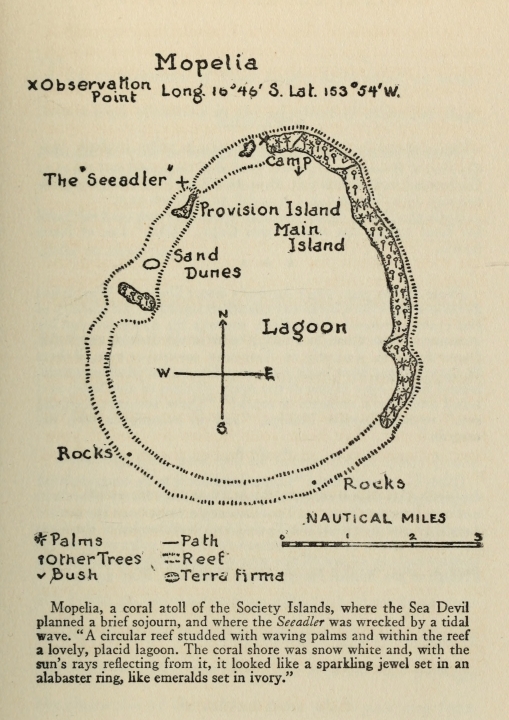
Mopelia, a coral atoll of the Society Islands, where the Sea Devil planned a brief sojourn, and where the Seeadler was wrecked by a tidal wave. "A circular reef studded with waving palms and within the reef a lovely, placid lagoon. The coral shore was snow white and, with the sun's rays reflecting from it, it looked like a sparkling jewel set in an alabaster ring, like emeralds set in ivory."
APPENDIX
(Note A, see page 107.) Lloyd's Register of 1917-18 describes the Pass of Balmaha as follows: Steel ship (captured and taken to Cuxhaven), built 1888 by R. Duncan & Co., Port Glasgow, gross tonnage 1571, length 245.4, breadth 38.8, depth 22.5.
Until the World War, she was British-owned, and up until her fatal voyage her master was Capt. "Dick" Lee of Nova Scotia.
* * *
(Note B, see page 209.) Author's note: Since the War, it has developed that the Count was mistaken regarding the identity of this cruiser. Instead of the Kent, she was the Lancaster, and her commander was Captain Phillips, now of the British battleship Queen Elizabeth. Recently an American newspaper man, Robert H. Davis of the New York Sun, met him in the Mediterranean, loaned him a copy of one of the early editions of this book, and asked him: "Is it romance or truth?" "Quite accurate, I should say," replied Captain Phillips, "and in accordance with the records."
* * *
(Note C, see page 216.) "Count Luckner is to be congratulated on getting his ship through without being seen. Every effort was made to intercept him.... Those messages came from the cruiser Lancaster and not from the Kent. I was commander of the Lancaster. The raider must have passed within 200 miles of us on the inside waters as we lay off the west coast of Chile," said Captain Phillips of the British Navy.—New York Sun, May 24, 1928.