Front matter (continued 2)
Reading edition
Then we reached the centre of the storm. From that howling hurricane of wind and rain we passed suddenly into a deathly calm. In the sky above the stars gleamed down. The sea was like a kettle of boiling water. Stirred up from the outer edges it came pouring in toward the centre. The danger is greatest in the vortex of a hurricane. The water rushes upon the ship from all sides. Lacking wind, the vessel cannot be steered. It lies helpless and tossing. The rigging cannot forever bear the strain of the tremendous and convulsive jerking and rolling. We lost our top-masts and topgallant masts. They had stood in the blasting wind and the head-on plunging of the ship, but could not sustain the dizzy reeling at the centre. For a full half hour we stayed in that circle of death, with its peaceful air and starry sky. It seemed as though the ship were turned inside out. Then, with a sudden blow, we were in the rush and wild fury of the wind again. The remainder of the rigging, now thoroughly weakened, came down, except the mainmast and its lower yards. The wreckage fell over the stern and tangled with the rudder. The deck was flooded and there seemed little hope of our riding the storm, when, as suddenly as it had burst upon us, the wind shifted eight points, and soon we were out of the hurricane.
We reached Plymouth after one hundred and twenty days, and only the older mate, Nauke, and I remained aboard for another voyage. Smutje left, but before going ashore said to me:
"Phelax, God knows whether we will ever see each other again. We have been good comrades ever since that scoundrel stole the flapjacks. You are an honest fellow. Therefore, let us go ashore and have a 'pain expeller.'"
"All right, Smutje," said I, and we went ashore.
At a bar the cookie ordered up two big "pain expellers." The glasses had just been put in front of us, when I thought to myself, "Phelax, if you are an honest fellow, surely this is the time to show your honesty."
"Smutje," I said, "I know who took your flapjacks."
"You know? Who was it?"
"Me."
"You?"
"Yes, me."
He took his stick, took his hat, turned his back on me, and walked right out, never touching his pain expeller. I looked at the two glasses, and thought to myself:
"Phelax, it is the reward of your honesty. First for your honesty you get the compote of cranberries. Now you get two pain expellers instead of one—for your honesty."
Eleven years later, as an officer in the Imperial Navy, I went from Kiel to attend a dinner in Hamburg. At the Hamburg railway station, as I called for a taxi, I heard a voice quite close to me.
"Hello there, Phelax."
"Hello, Smutje."
"How have you changed, Phelax! Are you an officer in the Imperial Navy?"
"Yes, Smutje."
"How have you changed, Phelax! Do you still remember your old cookie?"
"You bet I remember you, Smutje."
"Well, how have you changed, Phelax!"
"By Joe, Smutje, I have an invitation to dinner, but I'd rather have dinner with you. Come along."
I took him in the taxi to Hotel Atlantic, the finest in Hamburg. Bellboys came to open the door and usher us in. Cookie looked around.
"This too, Phelax?"
"Yes, Smutje."
"How have you changed, Phelax!"
I ordered champagne and cigarettes brought to a private room. There Smutje and I sat talking over old times. The waiter brought the wine. Cookie looked at the waiter's evening clothes in awe and then looked at me.
"How have you changed, Phelax!"
He essayed to grow friendly with the waiter, and ventured a familiar, joking remark. But the pompous waiter disdained to talk to such a fellow, ignored him, and turned to me.
"Do you wish anything else, Count?"
"Hey, Phelax, did you hear what he called you? Count! Are you a count?"
"Yes, Smutje."
"How have you changed, Phelax!"
He thought for a while, and then gave me his two hands.
"You swiped my fourteen pancakes, Phelax. I haven't forgotten it. I shall be proud all my life that a count swiped my pancakes."
The Cæsarea took on a cargo for New York. It consisted chiefly of chalk packed in barrels. Abaft we had a load of arsenic, three hundred tons packed in small barrels, which, because of its great weight, took up little room. It was a badly stowed, ill-balanced load. Of our new crew, some were sent from Hamburg and some were signed in England. These latter were stokers and trimmers who had never been on a sailing ship before. They could neither steer nor set sails. They received higher wages than we, and yet we had to do all the work. As a consequence, we treated them pretty roughly. Even our Hamburg cabin boys, whose duty it was to clean the sailors' quarters, were loath to do this for the green hands who knew less than they.
The captain had hopes of a fast run to New York, which certainly seemed an easy jump after our trip through the latitudes of the hurricanes. But we had storm after storm from the first day out, and could make scarcely any headway at all. With our worthless crew, it was particularly miserable and trying. Christmas came, and with it the first fine weather and a fair wind. After a long time, we could set the topgallant sails again. It was fine to see the deck dry once more. The captain said:
"This is a sign from God. Let us celebrate Christmas properly."
So thankful was he that the old skinflint gave orders for Christmas cheer regardless of expense. In sailor fashion, we made a Christmas tree out of a broomstick and decorated it with coloured paper. The captain sent down a ham and a bowl of punch. When the candles were lit, a committee called on him to wish him a Merry Christmas and invite him to look at the tree. He accepted, and came down jovial and merry. Our new Smutje brought the flowing bowl, and we stood in line, each glass in hand, ready to toast the captain.
Then a white squall struck us.
A squall is called white when you have not seen it coming. It hit us square on the bow. The ship shivered from one end to the other, and was pushed stern-wise. The foremast went overboard. Its yard smashed upon my bunk. The main topmast followed. Everything went to pieces. Only the lower masts remained. We tumbled on deck. The captain ran to the steering wheel, where the helmsman had been knocked down and could not get up. (He died two days later.) The combers were sweeping over the ship. With axes we cut away the wreckage. The sails on the lower yards, the only ones that were in place, had to be braced into the wind. In four hours we had the ship under control again. The green crew had hidden themselves below. We were so enraged with them now that they did not dare to show their faces.
The storm turned into a hurricane. It blew throughout Christmas night and the next day. On the second afternoon of the storm, at eight bells, the steerage deck broke under the heavy load of arsenic. That broke several rivets, and the ship began to leak. We hurried to shift the barrels. Several had burst. We did not realize our danger from the arsenic dust. It produced terrible inflammation, and after several days most of us were badly swollen and bloated. Nevertheless, the arsenic was stowed again.
The ship started going down at the bow, and the carpenter reported three feet of water in the hold.
"Clear the pumps!"
We pumped, by Joe. The water in the hold grew deeper. We pumped until we grew weak. They gave us liquor to strengthen us. When we felt we could go on no longer, the cry went up:
"Grog ahoy!"
The grog made us pump again, although we doubted that we would win out.
A breaker came over the deck and swept away the galley. The cookie was making coffee for us and warming himself at the fire. He went overboard with his stove, pots, pans, and the coal box. He hung for a moment on the chimney, crying out for help at the top of his voice. There was no chance to save him. An old sailmaker next to me shouted:
"Smutje, you're all right. You've got plenty of coal for your trip to the devil."
That joke in the teeth of death made me shiver, since death was so close to us all.
We worked at the pumps for forty-eight hours. The water in the hold rose higher and higher. We were at the end of our rope. The constant drink, too, had worn us out. We could pump no longer. The captain, harpoon in hand, threatened:
"The one who stops pumping, I'll harpoon him."
A voice from abaft sang out:
"Lookout! Breaker!"
At the pumps we could not see the comber, but we heard it roaring. It broke over us. Six men were swept away from the pumps. Two were washed straight overboard. A third was thrown against the shrouds. His arm was smashed, and then he was washed overboard. Another's skull was fractured. Still another was left on the deck in a heap with several broken bones. I was lucky. There were several timbers on the deck. I braced myself with one foot between two of them. The wave drove them together and pinned my foot. I fell, and my leg snapped. The timbers still held my foot, while the swirling water tugged and twisted me as though it were determined to carry me into the sea.
The mate released me with a crowbar, and the captain had me taken to his cabin. My leg was bent like an L.
"We have lost seven men," he said, "and we cannot afford to lose another. Carpenter!"
They tied me to one wall and fastened a block and tackle to the drawer of the sideboard. They hitched the tackle to the foot of my broken leg, and pulled slowly until the leg was straight and the bones in place. By Joe, it hurt. The carpenter measured me and made a pair of splints, which they fastened tightly to the leg. The splints were long enough to act as a wooden leg, and I could walk around, painfully, but enough to be of some use.
The Cæsarea was sinking now. We cleared the lifeboats. But first we poured out oil to calm the sea. The boats were swung overboard and lowered into the water with long ropes attached to them. A man tied a rope around his body, jumped overboard, and swam over to the boat and climbed in. The next one followed and was hauled in by the first one. They tied a rope to me and threw it to the men in a boat. Then they threw me overboard, and the men pulled me to the boat. One boat was under the command of the captain. The first mate had the other. We could make no headway rowing, so we simply held the boats against the heavy sea to keep them from overturning. In spite of my broken leg, I did my share of the work. The boats drifted apart. I was in the captain's boat. The mate's boat was lost and never seen again.
The storm lasted for four days. We had a little hardtack soaked with salt water, and a small supply of fresh water. It was bitterly cold. What wood we might have burned was soaking wet. It was almost impossible to sleep. On the fourth day, we sighted a steamer. Its course would take it some distance away from us, but we were certain that we could hail it. With great jubilation, we hoisted a pair of pants on a mast as a signal. We were certain we saw the vessel change its course. We were overjoyed. Nevertheless, the steamer gradually disappeared.
All our food was gone now, and only a very little water was left, which the captain, with an inflexible will, doled out in minute quantities. The weather was fair now, and we could sleep. Our thirst increased. We sucked our hands to start the spittle in our mouths. We wanted to drink sea water, knowing that it would hasten our end. The captain encouraged us:
"Don't throw away your young lives. Look at me, an old man. I won't give up."
On the sixth day, we decided to draw lots to determine which one should be sacrificed so the others might drink his blood. No one proposed a start of the drawing of lots, each afraid that he would draw the fatal number. The authority of the captain still preserved a remnant of drinking water to be doled out. Late in the afternoon, we defied him, seized the water, and drank the last drop.
The next morning we sighted a steamer. We waved feebly, and she bore down upon us.
At that moment our last strength left us. We were delirious with joy, but we could not move. We lay dumped in our boat. The ship, the Italian steamer Maracaibo, came alongside, and dropped rope ladders. We were as if asleep. The Maracaibo had to get its cranes out and hoist us aboard like pieces of freight. Afterward, we were unable to remember how we had reached the steamer's deck. We slept for sixteen hours. When we awakened, all the doctor would give us was a little milk. Three of our men died. In New York, where we arrived the next day, they went ashore and gorged on ham and eggs. It killed them.
I was taken to the German hospital. My leg was in such condition that at first they thought they would have to amputate it, but finally the head surgeon decided that he might be able to save it, and he did save it. After eight weeks I left the hospital and was ready to go to sea again.
VII THE BEACH COMBERS ADVENTURE WITH THE PANTHER
The leg I had broken aboard the Cæsarea was scarcely well knit when I broke the other leg. This was after I had shipped on the Flying Fish. But let me jump ahead a few years and tell you this tale exactly as I related it to the Emperor. That was after I had realized my boyhood ambition and become a lieutenant commander in the Imperial Navy.
H. M. S. Kaiser was one of the proudest ships of the German Navy. She was always kept spick and span. You can bet that she was shining now. His Majesty was aboard for a visit. We sat in the saloon after dinner, smoking, drinking, talking. For several days the Kaiser had amused himself by having me tell stories of my adventures before the mast. To-night the Emperor said to me:
"Luckner, what was your worst experience?"
I thought of the fight with the albatross, the scurvy and beri-beri aboard the Pinmore, the flogging at the rope's end aboard the Cæsarea, the three days in the dungeon in Chile, the setting of my broken leg with block and tackle, the plan to draw lots and see whose blood would be drunk in the drifting lifeboat.
"My worst time, Your Majesty? It was aboard Your Majesty's ship, the Panther."
The Panther was a small ship but a memorable one in the German Navy. You will recall that it was the part she played in the Tangier dispute of 1908 that nearly brought on a world war at that time.
Von Plessen, the stately old courtier, glared at me. An admiral across from me scowled. The Emperor smiled.
"By thunder, you must tell me about it."
I told my story.
I had sailed on the Canadian schooner, Flying Fish, bound from Novia Scotia to Jamaica with a cargo of lumber. We had already entered the harbour of Kingston when the wind left us. While we were becalmed, we made ready for discharging the cargo. The ship lurched with a slight but unexpected roll. A beam slipped and fell against my leg. The bone snapped just above the ankle. They took me to a hospital ashore. On German ships, the owner is responsible for all accidents aboard, but on Canadian ships, you pay your own hospital bills.
"How much money have you?" they asked me at the hospital.
I replied that I had six pounds coming to me from the ship, which, according to regulations, the captain would deposit for me with the German consul, together with whatever articles of property I had on the ship. The hospital was not expensive, and the surgeon said the money would be enough.
Three weeks after I entered the hospital, they sent to the German Consulate for my money. Only three pounds was to my credit there. The captain of the Flying Fish had sailed away, taking half of my money with him. None of my belongings were at the Consulate either. He hadn't even bothered to leave them for me. At the hospital, they called me a liar and threw me out into the street. The plaster cast was still on my leg and foot. For clothing I had only what I had worn to the hospital, trousers, jacket, and one boot.
I could not walk unaided, but I dragged myself to a stick of bamboo, which I broke into a length that I could use as a cane. With this support I could limp along.
"Phelax," I said to myself, "you must go to the ocean. It is your element. You must go to the beach."
I went to the sandy shore and lay there. When night came, I buried myself in the sand and slept all night, slept well. In the morning, I was half starved. I found some cocoanuts. Although terrible food for an empty stomach, I tried to eat them. While sitting there wondering what would become of me, a steamer arrived.
"Phelax," I said, "you are a sailor and there is a ship."
I took my stick and hobbled along the beach and down the long pier. The ship was a British collier, and they were making ready to unload coal. I went to the mate, told him what had happened to me, and asked him for a chance. The plaster cast was still on, and below my trouser leg my huge white foot looked like a club. In the hospital, I hadn't had a haircut or a shave. My hair was long and matted. My beard was half grown. My face was burned red from lying in the sun. The mate eyed me up and down.
"You look like a bum, by Joe. Clear out, by Joe, get out."
So they kicked me out, kicked me off a dirty collier, by Joe.
The collier discharged its coal in bags, and I found an empty bag. I was glad to have any new possession, even a gunny bag. I washed it out on the beach, and at night used it for a pillow. I still had my sheath knife, and a Negro helped me cut the plaster cast from my leg and foot. Half of the skin went with it. The tropical sun burned the raw flesh until it swelled and ached dreadfully. The coal sack did me good service now. I stepped into it and wrapped the rest of it around my leg. It was a stocking and a shoe for me.
I saw a Negro cutting bamboo and gave him a hand. He took me to his hut and handed me sixpence and some maize to eat. It was cooked and warm. For days I had had only cocoanuts to eat. It was delicious. Rain began to fall, a heavy, tropical rain. It would not be good sleeping on the beach that night. I asked him to give me shelter in his hut. He looked at me just like the mate of that collier had done. Although he wouldn't have me in his hut, he said I might sleep in an old shanty covered with palm leaves where he kept his tools. It was dry, but all night I could hear cockroaches running around, on the walls, on the palm leaves, and big rats chasing them. Whenever I fell off to sleep, they ran over my face. Next morning the Negro gave me cooked maize again, and then we went out to cut bamboo.
Over the bay I saw a white boat, a wonderful white boat. It looked like a yacht. Oh, by Joe, if I could only get a chance on a beautiful boat like that. I hobbled down to the pier. The boat was coming in. It was a warship. Then I recognized the flag, the German flag. It was the Panther, the first German warship I had ever seen. It was so white and clean, oh, home, so white and clean! I was miserable and hungry, and there were my countrymen, a warship of my country. I felt my tangled beard and my long tangled hair. I looked down at my tattered clothes and the coal sack on my foot. Could I go to my country's ship looking as I did? I only stood and watched. Four officers in white uniforms came down the gangway and down the pier. I went toward them to hear the sound of German, and when I heard it I was never so ashamed of myself. They passed near me, but did not look at me.
"Phelax," I said, "that was what you might have been if you had stayed at home and studied those lessons."
I felt I could not look at the Panther any longer, and went wandering miserably around the town. It was dark. Three or four sailors came down the street. They were talking and laughing. One of them, a gigantic fellow, spoke in broad Saxon. When I heard my native dialect, I thought to myself: "In the darkness nobody can see how you look. It would be good to talk a few words in Saxon."
"Hello, Landsmann," I sang out, and I never let myself go so broadly in the Saxon dialect as I did then.
He stopped and talked with me. He was a stoker on the Panther and hailed from Zwickau in Saxony.
Those fellows made me tell them about my plight. Could they spare me a piece of bread? I asked.
"Sure," replied the Saxon. "Meet me at the end of the pier at six bells. I have no more time now. I must go back on board."
I was at the end of the pier fifteen minutes ahead of time. The Saxon came off the ship and gave me a great loaf of rye bread.
"Come to-morrow at the same time," he said, "and there will be another loaf for you."
I did not sleep that night, but passed the hours on the beach eating that bread. I nibbled it in slow bites so that I might not lose any of the delight.
The Saxon gave me a loaf of bread every night, and finally said:
"To-morrow is Sunday, and on Sunday we have coffee and cakes aboard. Come aboard the Panther at half-past three to-morrow, and have coffee and cakes."
"By Joe, mate, can I come aboard a German warship like this?"
"Never mind, boy, we'll receive you." And he persuaded me to do what I wanted to do more than anything else.
When the sun rose the next morning, I started to make my toilet. The beach was my dressing room. The ocean was both mirror and wash basin. I scrubbed my hands and face with sand and water. I ran my fingers through my hair and beard, trying to comb them. I tried to smoothe the wrinkles out of my coat and trousers. I tucked the coal bag around my leg and foot fifty times, to make it look its best. I sneaked on board like a criminal. The sailors gave me a good reception. Everybody sat on benches, and had coffee and cake. There was a cannon under a tarpaulin. I tried to get a glimpse of it. I was bashful and ill at ease. I felt as though I was among rich people in a mansion.
The young officer of the watch passed and saw me. The sailors jumped up, and stood at attention. I stood up, putting the foot with the coal sack behind the other one to hide it. The officer called the boatswain.
"In the future," he said, "I want you to see that no such tramps get aboard. Throw this unspeakable creature off.
"Get out of here," yelled the boatswain.
I slunk across the deck to the gangplank like a beaten dog. I had seen this beautiful ship. I had seen a German warship for the first time. Poor castaway that I was, the sailors had welcomed me aboard. Holy feelings had been aroused in me. And now...
I heard the sailors mutter. One of them said quietly to me:
"Don't worry, Phelax. We will get you fine clothes. The lieutenant, we will take his pants. The boatswain, we will take his shirt. We will give you a coat, shoes, and a cap. The barber will be there too. At eight bells on the pier."
At eight bells on the pier they brought me the boatswain's blue shirt, the lieutenant's white trousers, and the remainder of a highly presentable outfit. The barber was along. He took me to the edge of the pier and cut my hair. My long hair fell down into the water. Then he shaved me. I could scarcely wait till morning to dress. Every article of my new clothes that I put on made me feel more like a millionaire, and when I threw away my coal bag and put on those fine shoes, I walked like the finest dandy in Berlin.
I went to the captain in charge of the piers. My smart clothes got for me an excellent post as dock inspector. After a month I went to sea again. With my dock inspector's recommendation, I got a good berth on the Nova Scotia, running between the West Indian islands.
The Kaiser listened to the story attentively, and when I had finished he looked queerly at the other officers. There was a twinkle in his eye.
"It would be appropriate and poetic," he said, "if Luckner went back to the Panther now."
So, a few months later, by order of the Emperor, I was transferred to the Panther, which was stationed in the Cameroons. I went down to Africa, and the moment I boarded the Panther I went to the fo'c'sle. None of the men I had seen there before were on the ship. It was the custom to transfer officers and crews every three years. I looked around, half expecting to see poor tattered Phelax sitting there somewhere. I sat down where I sat before. Although an officer now in a trim, white uniform with gold braid, in reality I was that miserable beach comber Phelax, again. I dreamed I had the coal bag on my foot once more. I reached down and felt smooth hose and a smart shoe. I leaned back and dreamed of the coal bag.
VIII PITFALLS FOR THE SAILOR, AND THE CANARY THAT SPOKE LOW DEUTSCH
That's a sailor's life, glorious one day, miserable the next. I went on month after month drinking down in deep draughts the experience of the sea. A heady drink it is.
The sea is the sailor's power, yet he is always eager to get to port. There are two places that are ever in his mind: his home, if he has any, and the port where he will be paid off. For months Jack Tar handles no money. He dreams of the wad of bank bills that will be placed in his hands and of ways to spend it. Aboard, no magazine or newspaper, no matter how old, is left unread. Old fashion plates go from hand to hand. An evening suit with a waistcoat cut as low as possible so as to show a vast expanse of festive shirt front arouses a general discussion.
"Hans, my boy, look at that rig. What would your sweetheart in Düsseldorf say if she saw you in that?"
Mail-order catalogues are thoroughly thumbed.
"What! a gramophone like that for forty marks? I must have it, and all the latest songs."
They plan trips into the interior of the Fatherland.
"We will go to Munich in Bavaria. They say you can see the Alps from there."
The homegoings are anticipated with elaborate talk.
"Won't the old woman be glad to see me, particularly when I unwrap that silk dress I bought for her in Singapore."
The most disagreeable thing that can happen aboard a sailing vessel is to be becalmed on the homeward voyage, and the nearer the home port the more irritating it is. The captain begins to look for a Jonah. The first unfortunate for him to vent his rage upon is the helmsman. Nothing he does is right. The skipper is certain that as long as that hoodoo is at the wheel there will never be any wind. He is driving it away. Taking the helm himself, however, seems to do no good. He calls the youngest cabin boy and orders him to scratch the mainmast, which is supposed to bring wind. When this does not help, he gives the boy a broom and chases him to the top of the mainmast, to sweep the sky. Then he takes either an old pair of pants or an old boot and throws it overboard. Wind must certainly come now. He stamps down to his cabin and sits and smokes for a while awaiting the wind. When he returns to the deck, the calm is still unbroken. He starts in with the helmsman again, angered by the leering grin on the face of the Jonah.
"Here, Jan, you are such a fine fellow. You take the helm, by Joe, and see if you cannot get some wind up. You are good luck. You are an old friend of St. Peter."
Presently, indeed, far away on the horizon you can see a slight curling of the water. A slight breeze is coming.
"Jan, what did I tell you? You shall have half a pound of tobacco."
The other sailors watch these manœuvres with profound sympathy.
On shore everything is different from what Jack Tar expected. He has had the experience a hundred times, but he always has it again. The crowds do not give companionship. Everything is too much in a hurry. What people talk about does not interest him. He is out of touch with things. Besides, people do not sit and talk except for a little while. Someone always interrupts, or people grow impatient and go away, too much in a hurry. Jack Tar misses the usual hour for intimate conversation, on watch at night. The sea heaves slowly. The stars are bright above. The ship follows her course. Conversation is never interrupted by outsiders, and you can talk as long as the watch lasts.
Jack Tar is ever a mark for thieves. Aboard ship the comradeship of man with man will not tolerate dishonesty. A theft between shipmates is the worst of crimes. No sea chest is ever locked. On land Jack Tar likes bright lights and gaieties, and there, for some reason, a great abundance of swindlers are found to take him in. You go about Sankt Pauli, all sails set. You join a group and find that a horse has fallen down and broken its leg. You hear a groan. You turn around, and somebody says:
"Please, young man, can't you tell me the shortest way to a pawn shop?"
"A pawn shop? I don't know of any."
"That is too bad. I am forced to pawn the last heirloom from my dear mother."
"What is it?"
"A diamond ring."
He takes the ring from his finger, kisses it, and hands it to me. While I look at it, a well-dressed man sidles up and addresses me.
"I beg your pardon for having been curious enough to listen to your conversation. It is luck for you that I happen to be a jeweller. I should not like to see you taken advantage of. Real diamond rings are seldom offered in the streets."
The first fellow gets mad:
"Do you think I would try to cheat anyone with the ring that belonged to my sainted mother?"
"I have nothing to do with you. I am trying to protect this young man."
The jeweller examines the ring through a glass, and then whispers to me.
"Ask him how much he wants for it."
I ask, and receive the reply.
"Ten marks at least."
"He must have stolen it," the jeweller whispers again. "It is valuable. Give him twenty marks for it to get it quickly. Then follow me to my store, and I will give you a hundred."
Delighted at the opportunity to make some money on land, I give the man twenty marks for the ring. He hurries away. I look for the jeweller, whom I am to follow. He has disappeared. At a bona fide jeweller's I am told:
"It is a rhinestone, not a bad value for three marks."
Tedje and I take in the Hamburg Dom. From the rows of booths come promises of unparalleled sights. The sights we see in strange lands don't interest us, but at carnivals ashore it is different.
"Step in, step in," a barker howls, "and see what nobody ever saw or ate."
"What is it?" Tedje demands cautiously.
"Step in, and you will hear a canary bird talking Plattdeutsch, Low German. Five hundred marks reward if the bird does not talk Plattdeutsch."
We have never heard a canary bird talking any language, least of all Plattdeutsch. We join the crowd going in.
A canary bird in a cage is brought on to the platform. An elegantly dressed gentleman announces:
"Permit me to introduce this bird to you. His name is Hans."
"Never mind," shouts a sailor, "we want to hear him talk Deutsch."
"You will hear him, gentlemen. Hans—" and now he speaks in the Plattdeutsch dialect—"Hans, tell me what I should smoke, a cigar or a pipe." He pronounces the word pipe as "peep," in Plattdeutsch fashion.
In response the canary bird twitters:
"Peep."
"There, you see, gentlemen, the bird has talked Plattdeutsch."
There is loud laughter, and we all go out and tell the other suckers that the bird talked Deutsch. Why should we be the only fools?
Perhaps Jack Tar gets engaged to be married to the daughter of a "crimp." That costs him all his money. Or he gets drunk and everything is taken away from him.
Hein and Tedje meet back on their ship.
"Well, Tedje, how did Munich strike you?"
Tedje, who did not get away from the Hamburg water front, merely asks in turn:
"Did you get your gramophone?"
Although the North Sea may not be exactly the sailor's friend, the disillusioned tars are glad when sail is raised and they see water all around them once more.
At sea the sailor is on terms of intimacy with nature. He is friendly with the stars. He understands the clouds, and upon them he relies to tell him about the weather. He knows most of the fishes he encounters, although there are very few kinds that can be caught with hook and line from deck. When a school of porpoises appears, the command comes:
"Get the harpoons ready!"
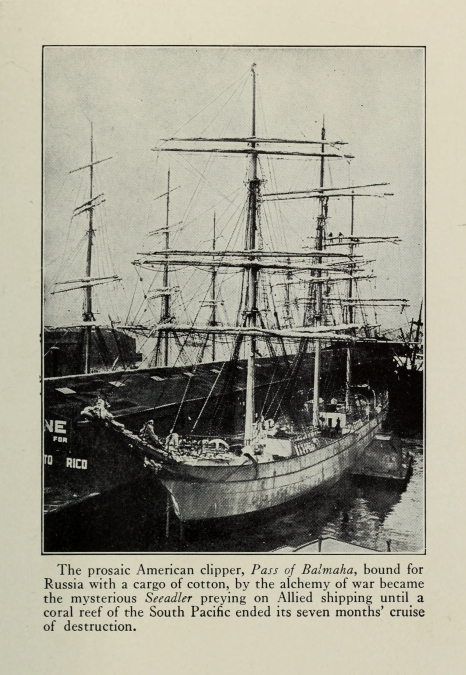
The prosaic American clipper, Pass of Balmaha, bound for Russia with a cargo of cotton, by the alchemy of war became the mysterious Seeadler preying on Allied shipping until a coral reef of the South Pacific ended its seven months' cruise of destruction.
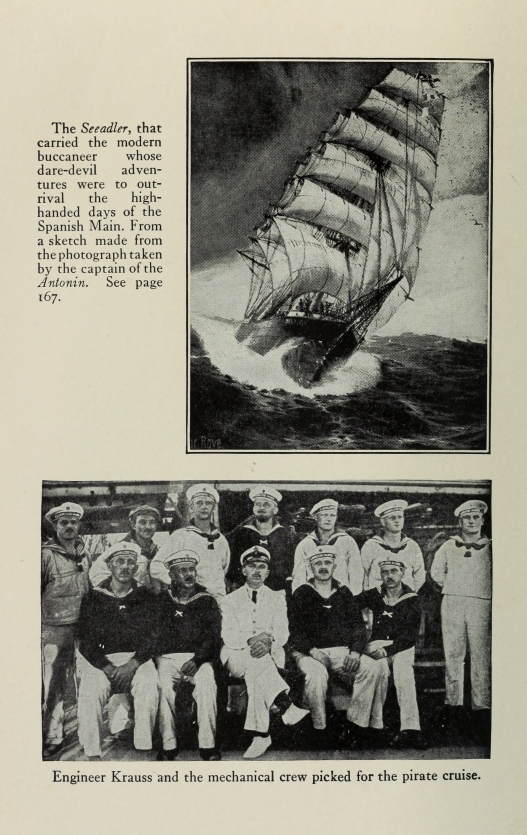
The Seeadler, that carried the modern buccaneer whose dare-devil adventures were to out-rival the high-handed days of the Spanish Main. From a sketch made from the photograph taken by the captain of the Antonin. See page 167. Engineer Krauss and the mechanical crew picked for the pirate cruise.
It takes a skilful harpooner to overhaul a porpoise on its darting, leaping course. When one is taken, there is great rejoicing. Fresh meat will be served on board.
Near the Cape of Good Hope, Cape Horn, and the Falkland Isles you encounter many birds, albatross, cape pigeons, mulehogs, and all varieties of gulls. They feed on the waste thrown overboard and escort the ship halfway to Australia. You greet them as old friends whom you met a year ago and are glad to see back again. The gull and albatross are regarded as sacred, for it is the belief of the seaman that some day he will return to earth as a gull or albatross. Each one of these birds is the soul of a seaman. The white gulls are good souls. The brown or black gulls are bad souls, the "sea devils." When you are running before the trade wind south of the equator, the appearance of the albatross is a great event in the monotony of the voyage. Majestically the great white bird sweeps up and down, now before the bow now behind the stern, and circles the ship. He is the ruler of the Southern seas. It is a common belief among seamen that nobody ever succeeded in bringing an albatross alive to the Northern Hemisphere.
Sometimes off the coast of Africa hundreds of swallows that have lost their way in a fog alight on a ship's rigging, exhausted. Sometimes dozens of storks do. They never rise again. There is no suitable food on board for them. It is pitiful to see them waste away and drop dead on deck or into the sea. There is no help for it. They die a seaman's death, like sailors adrift without food or water.
Our ship lay idle in Tampico. A comrade and I got shore leave. We were allured by the romantic life of the lasso-throwing vaqueros, with their herds of long-horned cattle, their fiery broncos, their silver-mounted saddles. A German settler put two horses at our disposal, and, to shame the idea that sailors cannot ride, we went galloping around the country on a tour that lasted several days. When we returned to Tampico, our ship had sailed.
In a country so rich as Mexico, it was not hard to make a living. All you had to do was to stand around the market-place and lend a hand. You earned enough to live and had a few coins left to squander in the gambling houses. For a couple of weeks, we made our living by carrying market baskets.
We joined the Mexican Army. Anybody could become a soldier. Life was pleasant and lazy, although the quarters were poor. We were sent to Mexico City, and there for several days stood on guard at the palace of the great Porfirio Diaz, under whose dictatorship Mexico was then enjoying her golden days.
We quit the army and worked on a railroad construction in the interior. In a gang of Italians, Poles, Germans, and Jamaica Negroes we transported sand, soil, and materials for railroad trestles. Then we worked for a German who had a ranch on which he raised poultry and fruit.
At Vera Cruz we signed on a petroleum tanker for Havana, and there shipped on a Norwegian craft which made the old New York-Australia run. The return voyage was via Honolulu to Vancouver, where we took a cargo of lumber aboard for Liverpool. On this voyage I acquired a fair knowledge of Norwegian, which was destined to play an important part in running the British blockade with the Seeadler.
Back in Hamburg I tried my hand as a tavern keeper and bartender. I frequented Mother Schroth's familiar old place. The Frau, a typical old friend of Jack Tar ashore, suffered from asthma and had put on too much weight altogether. She wanted to go to a watering place. One of my pals, Ulhorn, and I, told her that we would take over her place and run it while she was away. She was greatly pleased.
It was easy enough to run the business, as only bottled beer was handled. The food was brought from a near-by restaurant, each portion in a pail, at sixty pfennigs a portion. All Ulhorn and I had to do was to circulate among the guests and see that they drank plenty of beer by drinking with them. In the evening a blind man came and played the accordion.
Business boomed. The sailors came, and felt at home. We had to get in an extra supply of beer. When we reckoned our accounts, however, we were astonished to find that we had a deficit. We chalked on a blackboard each bottle of beer that was drunk. That was all right so long as we stayed sober. Then, when we began to feel good, we allowed some of our guests to assist in the bookkeeping. They chalked up their own accounts, but instead of increasing their scores with every bottle of beer they drank, they reduced them. After a short while at this, we quit with less money than when we started. I decided that the saloon business was not the career for me.
After sundry other voyages, I shipped on the Lisbon, bound for the Mediterranean. By now, a little sense had been knocked into my head. I had saved 3,600 marks, which interest brought up to 3,800—enough to see me through a period of special training that would enable me to become a mate. This preparation called for a period of steamship service and a course at a navigation school. The Lisbon was a steamer, the first on which I had served. My voyage on her marked a turning point in my life.
IX THE RUNAWAY COMES HOME
In the Café Niederegger in Lübeck I sat and drank my glass of beer, a trifle self-conscious. I had registered in Professor Schultze's School for Navigation, and felt that as a navigation student it was required of me to affect better ways than I had followed when I was a common sailor. I bought a decent wardrobe. I wore linen collars now, and neckties that you tie, and a scarf pin that you thrust into the necktie, instead of the eternally enduring celluloid collar which you share on board with a friend who wants to go ashore, and the indestructible tin necktie, made in America, with the scarfpin, a tiny revolver, riveted to it. I was conscious likewise that I must frequent better cafés than the saloons I had frolicked in as a sailor. That was what had brought me to the Café Niederegger, famous for its almond paste. The tables were covered with spotless white cloths, the waiters wore frock coats, and on a table, as a final mark of elegance, lay a handsomely bound book, the Almanach de Gotha.
Overcome with curiosity, I took up the volume and turned to the L's. Yes, there were the Von Luckners, and there was Count Felix von Luckner with the note attached—"missing." That was as I had thought. At home they had given me up for lost, dead.
"Phelax," I thought, "perhaps it is you who will be missing before long. Perhaps before many months are gone Count Felix von Luckner will go home—as a naval officer in the Imperial Service."
For the present, I ordered another glass of Pilsener and drank to my demise.
At Professor Schultze's school, I was faced with that old and almost forgotten enemy of mine—study. I was past twenty now and more ignorant than the average ten-year-old child. The professor was tolerant and wise enough to expect almost anything, but I astounded him. When he examined me in fractional arithmetic I did not know what a fifth was. A half and a quarter I understood from the clock, but a fifth was a quantity unknown to me. And I was to acquire grammatical German, something of a general education, and the large amount of higher mathematics and astronomy necessary in the science of navigation. I should not have blamed the professor if he had despaired and turned me away. I told him my history, begging him to keep my identity secret, and he vowed, by Joe, that he would make a learned navigator of me.
I lived quietly. My face lost its tan and roughness. Month after month I had to buy smaller collars. I tried especially to keep my hands clean. By and by they lost their tarry wrinkles and calluses. I studied from morning till night. To reduce something to a common denominator is no joke. The whole Schultze family helped me and shared in my worries.
Examination day came, with all the professors in full dress. My handwriting was still clumsy. With my hard, big hands I used the bulkiest penholder I could find. It was as thick as a cane, an instrument designed for victims of apoplectic stroke who would have to grasp it with both hands.
Early one morning, a good citizen of Lübeck went out to water his garden and saw a navigation student lying among his tomatoes.
"What are you doing there?"
The wretch, not knowing what to answer, merely asked in turn:
"What are you watering?"
For two days I had been celebrating the fact that I had passed the examination.
Again I was tempted to rush straightway to my parents. Professor Schultze had investigated quietly on his own account and found that my father and mother were alive and well and that my brother, like myself, had turned his mind to the sea. He was an ensign in the navy. Once more I denied myself, and remembered my vow not to go home save as a naval officer.
I got a post as petty officer aboard the Hamburg-South American liner Petropolis. I bought white kid gloves and white shoes, and can still see myself buying my first pair of cuff links. As I promenaded the deck of the Petropolis in my new uniform, I felt myself a god, only my cuffs kept bothering me and saluting seemed queer. I read all the learned books I could find, but there was much I could not understand.
After three quarters of a year aboard the Petropolis, I was eligible to enter the navy as a one-year service volunteer, for naval training and study. That was a method of training mercantile marine officers for naval service in case of war, of creating a class of reserve officers. After I had served my year as a volunteer and had mastered my studies, I would be entitled to wear a lieutenant's uniform. I would walk out a naval officer in the Imperial Service.
A comrade and I took the railroad from Hamburg to Kiel to be mustered in for volunteer service. It was the first time I had ever been in an expensive railroad compartment. Opposite us sat a gentleman with a pointed beard whom we took to be a naval officer. That made us behave in very dignified fashion.
"Luckner," said my comrade, "is it not a fine view?"
"It is, indeed," I replied.
The gentleman with the pointed beard looked at me several times.
The daily drill at slow step on the parade ground at Kiel gave me a great deal of pain in the places where my legs had been broken before. An orderly came looking for a volunteer private named Luckner. I was required to go to the station. My officer asked me whether I had a relative at the station. I said, "No," and wondered whether it was a police station. Which one of my sins had been discovered?
I went to a red building and waited in an anteroom. A corporal bade me enter an inner office. Admiral Count Baudissin wanted to see me. How was I to behave in the presence of such a high dignitary? I supposed the principal thing was to stand at attention. The admiral was seated. He had gold braid on his sleeves. He was the same gentleman with the pointed beard who had looked at me on the train. I stood there at attention, elbows and hands held tight against me.
"Tell me, which Luckner are you?"
"The son of Heinrich Luckner."
"What is your first name?"
"Felix."
"He is missing."
"I am that Felix, sir."
"How did you get here?"
"I have passed my examination as mate, which entitles me to volunteer service, I hope to become a reserve officer through good behaviour."
"How do you expect to pay your way?"
"I have 3,400 marks."
"You have earned that much?"
"Yes, sir."
"Why did you not write to your parents?"
"I want to go home an officer in the Emperor's service. I did not write because I did not want my parents to know I was a common sailor. I don't want them to know until I return home an officer."
Then the admiral said:
"I am your uncle Fritz."
"Eh," I thought, "what a noble uncle!"
I had never heard of this relationship. I rolled my eyes right and left, not knowing whether to address the admiral as Uncle then and there.
"Your Excellency," I said, "I wish it could be arranged that my parents do not learn of my being here until I have qualified as a reserve officer."
"Very well," he answered, "but you must not expect any help from me."
Not being able to say "Uncle," I replied:
"No, sir."
"Do not in any sense think that you are under my protection."
"No, sir."
"By the way, Felix, you may come to my house twice a week. My daughter will teach you a little, my lad. You speak a dreadful German."
I had considered myself, after all my studies, a tolerably educated man, but lapses in grammar have been my bane, more than storms at sea or shell fire during the war.
In the admiral's family, as a side line to my grammatical studies, I was required to write out a history of my adventures, which I did with judicious omissions, such as service in the Salvation Army and stealing a horse from a lighthouse-keeper. Such details would have spoiled my career at the outset.
I soon felt at home in the navy. There was a tremendous amount of studying to be done in mechanics, engineering, and the mathematics of gunnery. I was beginning to get used to study, as a slave gets used to the treadmill.
One day I tried to prevent a boat collision, and was too confident of my strength, alas. I was forced against an iron support, which pierced my abdomen and tore my intestines twice. That sent me to the hospital for a long spell. I was convalescing. A visitor brought some plums to a ward mate. I was starving. I begged some of the plums from him, and ate them. The next day, when the surgeon changed my bandage, he was dumbfounded to find the plums in the bandage. My imprudent act had caused a breaking of the intestines where they had been sewn. It was necessary to sew them again. I was threatened with arrest when I got well again, and a guard was placed over my bed to see that I ate no more plums.
Instead of arrest, however, and possible trouble about getting my commission, the naval authorities were kind enough to credit me with the time I passed in the hospital. In due time, I was mustered in as a reserve naval lieutenant. I called on my Uncle Fritz once more, and started out for home. I wore my uniform, a cocked hat, epaulettes, and a sword sash.
In Halle, the quiet home on the "Old Promenade" had changed not at all in those eight years. I climbed the steps to the door, quite a figure in my brilliant uniform. To the maid, whom I did not know, I handed my visiting card, which she took inside. I heard the well remembered voice of the old gentleman questioning:
"Naval Lieutenant Felix Luckner? There is no such man of our name. But show him in."
I entered and said:
"Good-morning, Father. I hope I have kept my word to wear the Emperor's uniform with honour."
He could not find anything to say to me. He called for Mother in a choking voice.
She came down the stairs, looked at me for a moment, and sat down on a step in weak surprise. Then she began to cry, and came running to me. The old gentleman by now was wiping his eyes too.
Where had I been? What had I done? There were so many questions that I could not answer half. We sat there, and I told as much as I could. Soon the old gentleman had gathered his wits. He began to boast.
"You see, my dear wife. Did I not always tell you 'He is a Luckner—he will amount to something—do not worry about him'? Behold I was right. He is a Luckner."
Telegrams were sent to sisters, brothers, cousins, uncles, and aunts. There was a great family reunion, and I was petted like a child.
X FROM PIG-STY CLEANER TO KAISER'S PROTÉGÉ
More studying and then more studying. It seemed as though I never would get through. I served as a mate with the Hamburg-American Line for two years, and prepared myself for the captain's examination. More mathematics, more astronomy, more mechanics. I plugged and plugged. Study is no good, but you've got to do it. Finally, I was ready for the test. I went to a school for a little more preparation, and succeeded in passing the examination with flying colours. I was proud, but I was also glad that there would be no more studying for me now. I was eligible to become a captain. What further rank was there to make me study again? I served the Hamburg-American Line until 1911.
Then more school and studies!
I often spent an afternoon with several comrades sailing on the lower Elbe near Neumuehlen. One day we saw a small catboat and in it a man who obviously did not know how to sail. He was, in fact, a merchant of Cologne possessed of more courage than sense. Pretty soon a jibbing boom knocked him overboard. He couldn't swim, either. He sank out of sight. I swam and dove for him. I got hold of him and pushed him up above me, so that he would reach the surface before I did. When I came up he seized me, wound his arms and legs around me, and dragged me down. I struggled free, and everything turned black. I came to the surface, caught my breath, and dove again for him. I reached him, but an eddying current dragged us both down and down. Luckily, he was unconscious now, and I was able to grasp him and fight my way with him to the surface. I swam with my burden to shore. I was in reaching distance of the pier when I collapsed. Men waiting there pulled the drowning man out. An old gentleman claims he fished me out with his umbrella.
A week later, I was called before the authorities who awarded life-saving medals. They asked me to produce witness of my life-saving feat. That formality was necessary before they could give me a medal. I didn't want to bother producing any witnesses, The matter was dropped there.
I had the good fortune to be able to rescue three other people from drowning, and then a fifth. That occurred on Christmas Eve, 1911. I attended a celebration in Hamburg, and returned late to get aboard my ship, the Meteor. I waited on the slip for the ferry. Next to me stood a customs official. It was bitterly cold. In the flickering light I saw a man in the water some distance out. He was struggling faintly. I started to throw off my great-coat. The customs official held me.
"Are you crazy? Into that icy water? Is it not enough for one man to drown?"
"But surely I cannot let that man go down."
I slipped out of my overcoat, which he held, and jumped. By Joe, when I was in there I had the sensation of somebody holding a red-hot wire around my neck. After a hard swim, I reached my man. It was lucky for him that it was so cold and that he was so drunk. He was perfectly rigid now. If you lie still, you don't drown easily. It was no trouble to swim in with him, except that it was so cold. The customs man pulled us on to the pier. I could never have got up alone.
"What a crazy fool," the customs man said. "If I had not been here you would have jumped in just the same, and you would have drowned."
They took us to a saloon, where they put us between blankets and gave us grog. I soon got my strength back, likewise my man, an English sailor named Pearson. He soon had his second load of liquor.
After that exploit, the Hamburg newspapers made much of me, particularly since I still refused to bother about producing the witnesses necessary before I could get a life-saving medal. The editors denounced this instance of red tape. The controversy came to the notice of Prince Henry of Prussia. A little while later, when I took part in the yearly manœuvres for reserve officers, I received an order to appear before him, and he asked me whether I should like to enter active service. That, I replied, was my greatest desire, but I was afraid I was too old. He kindly bade me not to worry about that, and on February 3, 1912, I received the official dispatch:
"Count Luckner is ordered to the navy for active service."
By Joe, now I would have to study. I would have to learn in a few months what cadets ordinarily learned in three and a half years. The Emperor had heard of me from Prince Henry and had interested himself in my case. My tuition was paid for out of his private purse. If I did not make good marks in my classes, what kind of a Luckner ... well, by Joe. This was the climax of my whole unhappy career of study.
After an infantry course came a torpedo course. A torpedo has a thousand complexities for the student to master. There were four kinds of torpedoes. One had a hundred and fifty screws. You had to memorize the names of all the parts and familiarize yourself with the apparatus so well that you could put it together without help.
"Luckner," I thought, "you will never learn all that. You are as stupid as when you were in the third grade."
I was afraid and felt pretty bad. I did not do so well with my studies.
One of my teachers was Lieutenant Commander Pochhammer, whose father was a professor of Italian literature. His especial subject was Dante. He gave lectures to the naval students on the Divine Comedy. Strange, I hated study, but I liked these lectures on Dante and I liked to study Dante. I did not understand much of it, but I found great pleasure in it. It was because of Beatrice, the Divine Maiden. I thought she must be the same as my fairy princess. Whenever Professor Pochhammer spoke of her in his lectures, or whenever I read about her in the pages of Dante, I was reminded of that fairy princess I knew must live on the green island the Niobe had sailed by, the fairy princess I had dreamed of aboard the Cæsarea, when old Smutje had whistled "My Heart Is Like a Beehive" and I had taken up the refrain. The fairy princess, of whom I had had visions many another time, had been a blessing to me before, and surely, in a singular way, she was a blessing to me now.
My interest in Dante and Beatrice, as propounded by Professor Pochhammer, made an excellent impression, not only on the professor himself, but also on his son Lieutenant Commander Pochhammer and my other teachers. For Dante's and Beatrice's sake they winked at some of my most glaring deficiencies. They built up my confidence. I passed the necessary examination. The Emperor ordered that my commission be antedated, so that I might have seniority rights of a longer service than I had actually rendered.
I was assigned to duty aboard the Preussen, and there, during my leisure time, built models of sailing ships.
One night, in a Hamburg café, I sat talking with a friend, a shipowner.
"When I crossed the harbour to-day," I said, "and saw the sailing ships. I remembered how I used to sit on a spar while the sun was setting and listen to a fellow playing a squealer. You know what a squealer is? An accordion. I wish I could be a sailor back on a ship again."
"Don't be foolish," my friend replied. "I have never yet heard of a certified engineer wanting to go back to the anvil."
"But," I insisted, "I want to be a sailor again if only for a few days, and you must help me."
I made him give me a muster certificate for one of his ships, the Hannah, which was lying in port and taking on a crew. I went to a seaman's supply store and bought a pair of overalls, a shirt, a blue and white blouse such as sailors wear, a cap, a blanket, and a mattress. The blanket and mattress I had sent to the Hannah. The clothing I took with me. I took a cab, and bade the driver go to the docks. Inside, I took off my naval uniform and packed it in the bag I had with me, and donned my sailor's togs. At my destination, I got out. The driver, a decent old fellow, opened his eyes wide.
"Are you the naval officer who got in?"
"Yes."
"Say, what are you going to do? You have changed your clothes so they won't recognize you when they find you. You are going to drown yourself."
Rather baffled, I tried to assure him that I had no intention of drowning myself.
"No, don't tell me that. I know what you are going to do. Please tell me your troubles. You should not throw away your young life like that."
I had to give him a long and convincing story about some confidential mission for the government that I was engaged in, the truth of which statement I had to swear to solemnly. Then he agreed to leave me and take my satchel back to the hotel. As he started his horse, he turned around once more imploringly.
"You are surely not going to do it?"
I rubbed my hands in the dirt, rehearsed my old-time rolling sailor's gait, and tried to forget my fine manners. I practised an especial bit to see if I could still light my pipe and spit like a jack-tar. Hands in pockets, I sauntered on to the ship.
"Ahoy there," I called to the mate, and handed him my muster certificate.
After a few questions, he bade me the usual welcome.
"All right, Phelax Luedige, come on and get to work."
"No. In the morning I start."
You can tell an old-time competent seaman by his argumentative independence. The mate gave me a bad look, but was convinced that I would not go to work until morning.
I strolled back to the galley. The cook, a broad fellow with a red beard, was standing there. I watched a little fellow washing dishes, and thought:
"He is just as clumsy as you were once, Phelax."
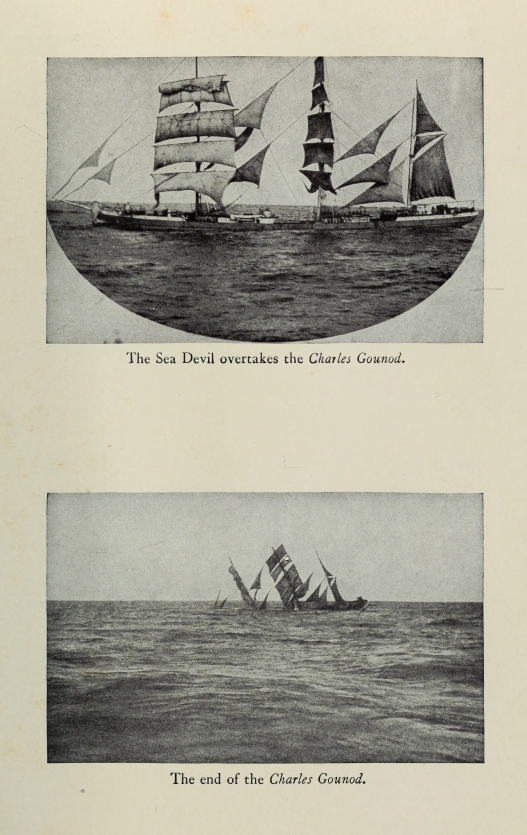
The Sea Devil overtakes the Charles Gounod. The end of the Charles Gounod.
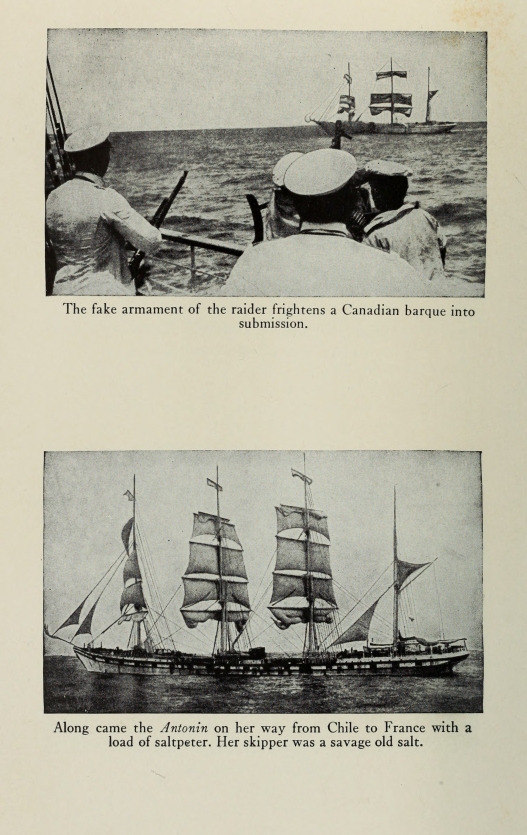
The fake armament of the raider frightens a Canadian barque into submission. Along came the Antonin on her way from Chile to France with a load of saltpeter. Her skipper was a savage old salt.
In the fo'c'sle two fellows were sitting on a box, smoking their pipes. They were shirking work, just as I had shirked it. I wondered whether they would find anything strange in me, and walked up to them. One of them named Hein said:
"What's your name?"
"Phelax."
"I guess you have been ashore a long time."
"Why?"
"Your hair is cut so neat. Are you married?"
"No."
"Well, I am. My old woman was married three times before, but never got the right mate. Now she says she has got the right one. How happy she is. She is a laundress, and when we are in port here she brings me my warm supper every night."
Now comes the mate.
"Get out of here and get to work. Phelax can unpack his things and get to work."
"No, I told you not until to-morrow morning."
The captain came on board and asked the mate what kind of help he had got.
"One who is mighty independent."
"Send him to me."
The cabin boy comes.
"Phelax, go over to the captain."
To the captain I say:
"Good-day, sir!"
"Good-day. How long have you been at sea?"
"Fifteen years."
"Do you know how to mend sails?"
"I know how very well."
"We have no time to mend sails at anchor. But you will have to do a lot of sewing at sea."
"I have done it often."
The captain sizes me up as a fellow who knows his business and good at the sail-mending which he is anxious to have done. He agrees that I do not have to go to work until to-morrow morning.
Once again I eat bean soup, leaning over the table with a large enamel pot, my "mug." After dinner I lie in my bunk, and ask:
"Is there no squealer?"
"Hein has one."
"Play, Hein, and I'll treat to a case of beer."
A motor boat selling beer is alongside. I buy a case, and we drink. The squealer begins to wheeze, while the evening sun shines on the water.
At half-past six Hein's laundress arrived. She was passably good-looking except that she was all pitted with smallpox and her hair stuck out like a flying jib. She certainly loved her Hein. She brought him a pot of supper, some of which he divided among the rest of us.
I noticed that Hein had some paint and a brush such as artists use. Was he an artist? On the girl's arm he painted a big heart with an arrow. In the middle of the heart he signed his initials. He had to stop at times, because she could not bear the burn of the turpentine in the paint.
"She is a fine girl," said Hein. "She stands for everything. She is as true as gold."
She did not exactly look it.
Night came on, the stars appeared, and Hein's squealer gave forth music. That was the life, a sailor's life.
On the following day I worked. I could not get along with the mate. He thought me too independent, and tattled on me to the captain, who restrained himself and had patience with me, since he did not want to lose so experienced a sailor. At night Hein's laundress came again, and the squealer sounded long and merrily.
On the third day my friend the shipowner came to the boat to get me. I managed to say to him without being observed.
"Don't give me away. Have the captain meet us for dinner at the hotel to-night."
The shipowner invited the captain, who accepted with alacrity.
That night at the Atlantic Hotel I dressed myself in full uniform, and joined the shipowner and the captain in the dining room. In such a glittering place, the captain was bashful.
"Captain Erdmann of the Hannah—Lieutenant Commander Count von Luckner."
Erdmann eyed me curiously and then looked down for a long time, turning his wineglass around in his hand. Evidently he thought he saw a certain resemblance. In a little while, I stepped out.
"Is he a count?" the captain asked the shipowner.
"Yes."
"And just think, I almost made the break of telling him he looked like a sailor aboard our ship. They might be twins, though. You never saw such a resemblance."
"It would be dreadful indeed to say anything like that," responded the other.
When I returned, we drank a little more and then I said to the captain:
"Don't you recognize me?"
He squirmed.
"Well—yes—but——"
"You mean you don't recognize me?"
"But, Count, have I really met you before?"
"Of course, don't you remember me?"
He wrestled with a temptation to speak out, but fought it down.
"Yes, Count, you do look familiar to me. But where have we met?"
He sat there, as the saying goes, with both feet in the trough.
"Don't you know me from the ship?"
"Man, man, are you Phelax?"
"Captain, Captain," warned the shipowner.
"Oh, excuse me, excuse me," stammered the captain.
"Well, I am Phelax," I laughed. "I went aboard your ship to see how it felt to be a sailor again."
"Well, well," stuttered the captain, "and now it is my turn to treat."
I told him my story, how I had been born a count, had become a sailor and then an officer of sailing ships, and now was an officer of the Imperial Service. He had tears in his eye.
"And my mate—think of it—my mate said you were too independent."
The old fellow became so enthusiastic that he insisted that we take a trip through Sankt Pauli with him. We went, and had a high old time. The captain got quite drunk, and he revealed a secret regret that lingered in his mind. What a sail-mender he had missed!
"Who will believe it on board," he muttered, "when I tell them that that my fine sail-mender turned out to be a count?"
XI IN THE CAMEROONS, AND THE FAIRY OF FUERTEVENTURA
I have told of how the Emperor transferred me to the Panther, which was then assigned to our West African station, the Cameroons. If my being aboard the Panther inspired, in itself, vivid recollections of my past life, my service as an officer of the ship presently brought me to another and far more delightful memory of my sailing-ship days. This was an incident that not merely returned to me in imagination, but one that brought to me that rarest gift of fortune, a dream come true.
The events that preceded the climax of which I speak were such as to provide the ever-striking qualities of contrast. The African jungle, the pursuit of savage beasts, black warriors, an extraordinary black king, fantastic war dances and all the unearthly sights and sounds that are Africa, and then...
The commander of the Panther was reluctant to have his officers go big-game hunting in the interior and, as he said, risk their lives uselessly. We were forbidden to take rifles on shore with us. But a comrade and I smuggled our rifles out, and took a big canoe upstream. With a dozen Negroes at the paddles, we raced against the sluggish current of the Mungo River, between giant, overhanging walls of trees. After eighteen hours, we reached Mundame. Our only worth-while trophy so far was a crocodile—and crocodiles are hard to shoot, too, as they dive with surprising speed. We had also shot a few vultures, sea eagles, and monkeys. We could not quite bring ourselves to eat the flesh of the monkeys, which the natives consider a great delicacy. When wounded, a monkey cries and screams just like a child, but when skinned it loses its half-human appearance and looks like a big squirrel, or a woodchuck.
At Mundame the black people greeted us with eager cries:
"Massa, massa, plenty elephant."
We proceeded on an elephant hunt in which my friend Bryer and I must have cut rather poor figures as sportsmen! Our chase of the great beasts did not turn out to be quite what we had expected.
The elephants had broken into a Negro's plantation, and were not far away. With each a Negro as a guide, we went into the thicket of banana plants.
"Massa," my guide whispered eagerly, "massa, look, elephant."
I looked but could see no elephant. My guide kept repeating in tones of excitement that gradually turned into despair.
"Elephant, massa, look, elephant!"
I could have looked for a year and would not have seen the fraction of gray wall revealed between the leaves. Finally, the elephant began to move, and I saw at least the great disturbance among the foliage. I walked toward it, hoping to find some definite point of the beast's anatomy to shoot at. The elephant moved away at about the same speed, and I could get no closer to it. I came upon one of those huge ant hills you find in Africa, and clambered upon it. I now had a much better view.
"Ostriches!" I exclaimed.
There were many elephants plucking up at the bananas. Their trunks reaching high and curving and wavering gave me the impression of giant ostriches. One of the great beasts came out of the thicket right in front of the ant hill on which I was standing. Several others followed him. I remembered hastily that I must aim at the head a little lower than the eyes. I point the gun, pull the trigger, and then crash! The giant turned around in a circle giving a tremendous bellow. With a roar and a great sound of rushing, the beast plunged forward, right past the hill on which I was standing. The rest of the herd followed and passed very near me. I nearly fell off the ant hill, and made the deplorable blunder of losing sight of the elephant I had shot at. Fortunately, the natives, who were to get their share of the meat, did not allow themselves to become so readily confused. They followed the wounded animal, and found it with its tusks rammed deeply in the soil. It took several more shots in the head to kill the brute.
Nobody travelling in the Cameroons in those days ever passed up a chance to visit Banum Joja, the most intelligent chieftain in all Southwest Africa. He was an advocate of what modern improvements he could introduce into his kingdom, and had invented an especial alphabet with which to reduce the native language to writing. He was a great admirer of the Germans, and willed his beautifully carved antique throne to a German museum.
We went the long distance by train from the coast to the interior territories of Banum Joja. The palaver drums having advised him of our arrival, the chief met us with his staff. A long procession of cattle, goats, and other animals were paraded past us as a sign of his wealth. The old boy himself majestically arrived in his royal conveyance, a hammock carried by two slaves, slung on a long pole. We were considerably surprised at the figure he made. He wore a glittering cuirassier's helmet, a tremendous battle sword, and a tight-fitting red hussar's tunic on the breast of which was pinned the German Order of the Crown. His black, shiny legs, however, were bare. His pride as a sovereign increased visibly as he observed our surprise at his appearance.
In his palace, a large thatched hall surrounded by a high wall of loam, Joja showed us vaingloriously the many smoke-blackened heads of his ancestors' enemies and a large elephant's tusk decorated with the lower jaws of slain foes. Pottery is highly developed in those parts, for everywhere we saw vessels of clay. The only ornament in the palace, besides the grisly trophies of war and massacre, was the top of a European butter dish. It represented a setting hen. We drank palm wine, which was excellent.
In the courtyard of the palace, Joja ascended a stairway in a great hollow tree. Placed in the branches was the war drum which only the King may beat. Majestically he clambered out to it, and under the monarch's hand a muffled beat resounded. The four portals in the wall of the corral opened and files of black warriors rushed in, three thousand of them, a magnificent picture. They danced the war dance, a methodical evolution in which they rushed against each other with a tremendous clashing of shields. Then followed a spear-throwing contest with extraordinary displays of skill. The women entered, and there was another ballet, the women dancing around the men and then the men dancing around the women. Amid general rejoicings, the King treated his subjects to palm wine.
Joja arranged a buffalo hunt for us. A place is chosen where the grass is brown and dry and fallen, else it would be so high that a horse and rider might disappear in it. On this open hunting field a dozen warriors take their place with big shields of buffalo hide. By means of fire and beaters, the buffalo herd is driven toward them. When they come to the open place, the male stares from the thicket with his dull brown eyes. He seems to study the black warriors waiting there. Now he sends his cows to safety through the thicket surrounding the open place. Then he attacks. The warriors' spears pierce him in the front. He comes thundering upon them, but with a fabulous speed they have thrown themselves on the ground, covering themselves completely with their staunch shields. The enraged beast passes over them without harming them. He is powerless now. The spears protruding from his front prop themselves against the ground, making running difficult. He cannot attack without driving the barbs farther into his flesh. He turns around. In a flash the Negroes are up, and the beast receives spears from the back. He can neither advance nor retreat now. He raves, wants to attack, the sweat streams down him. He throws himself on the ground. Some of the spears break off. But now the Negroes are on top of him, thrusting their spears into him. He receives the final blow and is still.
Religion was a much discussed question in Joja's kingdom. The German Evangelical missionary comes with Protestant theology. He asks Joja's people to picture an invisible God. This they are unable to do. The Catholic missionaries come, visiting the territories previously covered by their Evangelical colleagues. They talk little theology, but have a gorgeous display. A miraculous image is mounted and decorated with mirrors. The Virgin Mary with the Child Jesus sits in the centre. To the right are the Three Wise Men from the East. These wise men are particularly interesting to Joja's subjects, because one of them is a black king. The priest, in gorgeous vestments, kneels before the beautiful display. The natives think:
"This is a real God. He is much richer than the Evangelical missionaries' God."
Joja was a skeptic toward the Christian religion. He asked me whether our God was black or white, but thought He could hardly be white, since He had made man in his own image and had made the black people too. He asked me when Jesus had come to Earth. I told him. Then he asked when America was discovered. I told him that. He asked me why Jesus did not go there too and preach his gospel.
While I was in the Cameroons, a German squadron circling the globe put in at Duala and anchored near shore. It consisted of the Kaiser, the King Albert, and the Strassburg. The black chieftains from the interior were entertained on the magnificent ships. They particularly admired the cannon in the turrets as they slowly swung around and fired. They asked whether the guns would shoot over the Cameroon mountains. When this fact was affirmed, their respect was great. The champagne with which they were served increased their respect.
The English instigated the Haussa, a mercantile tribe that roams the entire country plying trade, to spread the story that the ships were English ships which the English had merely loaned to the Germans.
Having to take the Panther back to Germany for overhauling, we steamed north. Our first stop was to be for provisions at Fuerteventura, one of the islands of the Canaries, a vacationing and health resort. I was on watch. Straight ahead, a speck of land appeared on the horizon, Fuerteventura, the island for which we were bound.
It was a green island. Presently, through my glass, I could distinguish waving palms and white houses, white houses with green shutters and red roofs. A vague feeling made my heart jump.
"Luckner," I thought, "it is the same island, the island you saw when you were a cabin boy aboard the Niobe, the island of the fairy princess."
It was. There could be no doubt of it. So clear was memory impressed by a great feeling that I could recognize individual houses I had gazed upon seventeen years before while I had leaned on the rail dreaming a happy dream.
"Luckner," I said, "you are Phelax once again. They call you 'pig,' and you clean the pigs and the pharmacy. There is the island. Open your eyes wide. Is it not lovely and beautiful?"
It was as beautiful as when I had seen it from aboard the Niobe. The houses still looked pretty and clean. There were terraces with gardens and white paths lined with palms.
"Phelax," I thought, "it is fit to be the home of the fairy princess. It is the home of the fairy princess. She must be there, with her delicate blue eyes and golden hair, she whom you have thought about all these years."
We put into port. I attended to my duties. The other officers asked me why I was so preoccupied. I answered their questions silently to myself.
"Phelax, now you must go and inspect your island. Perhaps you may find your fairy princess."
I went ashore by myself, and sauntered over the island all day. It was small, with gentle hills and an abundance of vegetation. Flowers were everywhere. It was truly an island of flowers. I went on through perfumed valleys and over breezy hills, lost in reverie, lost in my former life. A kind of hypnotism was upon me.
"Phelax," I thought, "of course you do not see the fairy princess. She is hidden beyond the flowers there. She will stay hidden. Is she to come to Phelax, a common sailor? Or even if you were a naval officer, would she come? She is too lovely for any mortal being."
So deep was I in fantasy that these thoughts inspired me to a sad regret and resignation. When evening came, I returned to the ship happy and yet downhearted.
That night we entertained on board members of the Royal Spanish Club and their guests. Some came for dinner, some afterward. It was a jolly meal. Then we gave an after-dinner entertainment, and I was called upon to entertain and amuse our guests. During my days as a sailor I was often in demand to amuse the company. The tricks I had learned among the Indian fakirs in Australia I had retained and cultivated. To this day I am somewhat skilful at various kinds of sleight of hand. I put on Oriental robes and turban. My face, freshly tanned by the sun of the Cameroons, needed no darkening. I had learned from the fakirs the solemn mystical demeanour and slow impressive movements that they cultivated. I must say that as I appeared before the guests in the salon of the Panther I cut quite an Oriental, wonderworking figure.
I had performed several tricks and had come to the one in which I snapped a ring on to a cane held at both ends by an assistant, when two newcomers arrived and entered through a door not far from me.
"Luckner," I thought, "are you going crazy? Phelax, there is she, your fairy princess."
She was on the arm of a stately old gentleman. She had the rosy lips, the short, pretty nose, the childlike eyes, and the rich blonde hair that had haunted my imagination. She came close to me and watched me with an expression of interest and something of awe. As I learned later, she thought I was truly an Indian fakir.
"Phelax," I said to myself, "she has come to you, your fairy princess. She knows you are on her island, and she has come."
I tried to go on with my trick, but my hands shook and were clumsy. I could not control them. Nor could I keep my eyes away from the blonde girl who stood there.
"I'm sorry," I said to my assistant, one of our officers. "The other ones went all right, but I can't seem to do this one. We've had enough anyway."
"Ladies and gentlemen," he announced jocularly, "the great fakir has reconsidered and thinks it would be wrong to disclose this last marvellous trick. He feels that it is his duty to retain it and exhibit it for the first time before his sovereign, the King of England."
Everybody laughed. I went out and changed into my naval uniform as quickly as I could. When I returned, I asked one of the other officers to present me to the blonde young lady. I have never felt so bashful as when I made my bow before her.
She was much amused at having taken me for a genuine Indian fakir, and talked merrily. Her laughter was very sweet. She told me her name was Irma. Her father owned great plantations on the island of Sumatra. She was with him at Fuerteventura on a sojourn for his health.
The remainder of my stay on the island was perfect happiness. Irma's father entertained us officers at his bungalow. Irma and I were together all of the time. We took long walks among the white houses and through the green glades the sight of which had so gladdened poor Phelax long years before. When the Panther steamed north again, I was happy with the assurance that Irma had given me that she and her father were sailing for home in a short time and that I would see her there.
I did see her there, and we became engaged to be married. The Panther was to sail for the Cameroons again on July 17th. We were ready to start when we received an unexpected telegram from the Admiralty—"Do not start." On August 1st, Germany declared war on Russia, and the world was ablaze. I told Irma that our marriage must be put off. It would be wrong to have her become the wife of a man who might so soon leave her a widow. She wanted an immediate marriage, but I was determined.
XII FAKE NORWEGIANS FOR A PIRATE CRUISE
It was in a gay café in Hamburg. In 1916, war times were growing hard in Germany, but still the cafés were astir with life and gaiety. A naval officer on shore leave could soon find surroundings that would enable him to forget the harsh life on dreadnaught and cruiser. My friend Dalstroem and I, over glasses of Swedish punch, chatted for an hour and then another hour. But our confab had nothing to do either with battle cruisers going down or with destroyers lifted out of the sea by exploding torpedoes, or the other sights I had beheld off Skagerrak. We talked of sailing ships, by Joe, and of the years I had served before the mast.
An orderly wedged his way through the crowd and handed me a message. It was from the Admiralty, ordering me to report at Imperial headquarters on the morrow. Such a summons to a mere lieutenant commander was decidedly unusual, and of course I was itching with curiosity. I never was any good at waiting.
The following morning found me in Berlin, entering the naval holy of holies, standing expectantly at attention before an old German sea lord with a face as stern as the cliffs at Heligoland. The orders I had come to hear were barked at me quick and short.
"You are to take command of a vessel," said the admiral. "We want you to run the blockade and raid enemy commerce. Since we have no coaling stations, a sailing ship will be the best. Do you think you can do it?"
"Allow me," I felt like saying, "allow me to throw my arms around your neck, my dear fellow."
"Yes, sir! I'd like nothing better."
Good health and high spirits had given me boundless confidence. I was the sort of fellow who believes he can do almost anything—at any rate, anything with a sailing ship. The admiral replied that the mission was mine. And it turned out that I had been picked for this venture because I happened to be the only officer in the German Navy who had served "in sail."
But what if we should slip through? What then? What could one lone windjammer do against the naval might of John Bull and his allies? What chance had a romantic clipper ship in this era of giant ocean liners, of hush-hush armoured cruisers, of speedy destroyers, and against the combined strength of Jellicoe and Beatty's super-dreadnaughts? For that matter, what chance had a poetic sailing ship against an ordinary tramp steamer?
Well, it may sound mad, but the sea lanes of commerce can even be disrupted by a lone sailing ship in wartime. But whether the idea was mad or not, I was itching for action and ready for anything.
"What," the admiral asked, "should you consider of the greatest importance for the venture?"
"Luck," I replied.
"All right; then take the Pass of Balmaha. She has already carried British prisoners for us. She has been lucky for us once, she may be lucky for us again."
The Admiralty officials had picked the Pass of Balmaha because she was a staunch ship, an American clipper, built in Glasgow.[1] They had also picked her because she had suddenly arrived in a German port with an unexpected present of some British prisoners for us. We sailors believe in good and bad omens, and we are right. Some ships are lucky and some unlucky. If something has happened to indicate a certain ship is lucky for you, take that ship. You want Lady Luck on your side when you put to sea.
Now, about the past record of this Yankee clipper that was to be converted into a German raider. The Pass of Balmaha had sailed from New York with a cargo of cotton for Archangel. Her commander was a Captain Scott, a well-known American shipmaster, a big-hearted, bushy-bearded, New England skipper with a very red face. Off the Norwegian coast, a British cruiser hailed her. Uncle Sam was then a neutral, and the blockade was getting tighter every month. The British were becoming suspicious of everybody, including neutrals and themselves. The overcautious commander of this cruiser, although he had no grounds for suspicion, ordered the Pass of Balmaha to turn back to the search port of Kirkwall in the Orkneys.
"Bah!" said Captain Scott, "here I am with a cargo for your allies, the Rooshians, and you patrol fellows order me back to Kirkwall. What do yuh mean by such nonsense? The wind is agin me, it'll take me three weeks to reach Scapa Flow and the Orkneys, and I'll be several months late in delivering my cargo to the Rooshians. Are you chaps trying to win a war or lose one?"
"Never mind," replied John Bull; "you do as you are told."
Leaving an officer and prize crew of six marines on board, with her funnels belching columns of black smoke, the British patrol cruiser continued on her North Sea beat. As soon as the Pass of Balmaha had turned her nose toward Kirkwall and Scapa Flow, the British prize officer ordered the American flag pulled down and the British flag run up.
"Go to blazes," bristled the irate Captain Scott, and he refused to obey.
"Right ho," said the Britisher, and he told his men to haul down the Stars and Stripes and hoist the Union Jack.
"I wish the Germans would come," raged the Yankee skipper. And the very next morning his wish was granted! A U-boat popped up to the surface about a half mile away. Captain Scott waggled his beard in the Englishman's face.
"Serves you right! With the Stars and Stripes up there, they wouldn't bother us. Now they'll take us all to Germany. So far as you chaps are concerned, the war is over right now. You will get cocky, will you?"
The Britisher was alarmed. He saw visions of himself locked in a Prussian prison for "the duration." So he climbed down from his high horse in a hurry and meekly placed himself in Captain Scott's hands, begging the Yankee still to try and save the day.
"I ought to let you go as prisoners, by Joe, but I don't want to lose my ship," said Scott. "So go below with your men and hide in the hold while I put my flag back where it belongs. Maybe they haven't seen yours. Soon the submarine was alongside and one of her officers climbed aboard. The Germans had seen the Union Jack, all right, but they hadn't seen it hauled down. Now they found themselves on a ship flying the American flag, and they were puzzled.
"What's this?" the submarine officer demanded of Scott. "First we see a British flag, and now it's an American."
"You must be mistaken," replied the skipper, "this here ain't no Britisher."
The officer was bewildered and suspicious, so ordered the Pass of Balmaha to head for Hamburg. Leaving only a German ensign aboard, he announced that his submarine would follow close behind. Of course, this was only a threat, for the U-boat soon vanished beneath the waves.
Now the ensign grew worried. Something told him that everything was not right on the Pass of Balmaha. Had he known there were seven Britishers on board, he would have been still more worried!