Front matter (continued 3)
Reading edition
"Captain," said he, "I am going to stay at your side all day and sleep with you at night. I've a hand grenade here in my pocket. At night I am going to fix it so that if anybody opens the door of our cabin it will explode."
Naturally Captain Scott lost no time in whispering to his mate: "Fasten down the hatches and don't let those Britishers come up. If they do, our goose is cooked. Don't say anything to them, or there will be trouble. This German smells a rat."
So the prize crew in the hold was kept there. Two days later, outside the entrance to the harbour at Cuxhaven, another party of Germans came aboard, so Captain Scott said to the U-boat ensign:
"You wanted to know what was wrong here? All right, now I'll show you." Then he opened the hatches and yelled for the Britishers to come up. The tall officer of the Royal Navy, one eye blinking and the other be-monocled, put his head up first.
"I say, where are we now?"
"You're in Germany. If you had left my flag alone, everything would have been all right. But you are prisoners now."
So you see how the Pass of Balmaha turned out to be unlucky for Englishmen and lucky for Germans. That was just the ship we wanted, by Joe.
The American flag that the Englishman pulled down was still there when I took her over. So I kept it as a souvenir. We lost the ship in the South Seas, but not the flag. It served as mascot on two other ships that I lost. But on my present world cruise I hope to visit San Francisco and return it to the original owner and tell him what a fine raider his clipper made.
Our hope was to run the blockade disguised as a neutral—a thing entirely fair according to the laws of war. Although on land a soldier must wear service uniform, at sea you can fly a neutral flag and wear ordinary seaman's clothes. But you must hoist your true colours before going into action with the enemy.
We altered that British-built Yankee clipper from stem to stern, with concealed places for our guns, rifles, grenades, bombs, and other armament, with special quarters for prisoners, two ultra-modern 500-horse-power motors to fall back on in case of calm or when in a big hurry, a tank holding 480 tons of fuel oil, another tank containing 480 tons of sweet water, and provisions for a cruise of two years.
In addition to 400 bunks for prospective "guests," I had special de luxe quarters made for "visiting" captains and mates. These were spacious cabins to accommodate two or three. We also designed a separate dining saloon for them, with an assortment of books and magazines in French and English, and a gramophone with late English and French records. War or no war, I still considered all sailors my pals, and had my own ideas as to how our prisoners should be treated. A sailor is a sailor, no matter what his nationality, and if I took any prisoners I wanted them to feel as though they were my guests.
Then, of course, we had to arrange quarters for my crew of fighting marines as well as for the regular seamen required on a clipper of this size. Moreover, we had to do all this so it would not be noticeable to uninvited visitors.
When the work was done, below deck, the Pass of Balmaha was an auxiliary cruiser, armed to the teeth. Above deck she was merely a poetic old sailing ship loaded with a prosaic cargo of lumber.
Timber made the ideal cargo for our purposes, because a ship carrying lumber loads her deck as well as her hold. The piles of lumber even cover your hatches, so no one can go below until you unload. Hence no search crew would be likely to inspect us carefully at sea. They would either order us to Kirkwall, or let us go.
Norway exports lumber and Australia imports it. So we decided to pose as a Norwegian clipper bound for Melbourne. Having served on various Norwegian ships, I spoke Norse, and I knew I would have no difficulty finding men for my crew who could speak it also. But first I had secret doors and hatches cut in the floor of the closets in the officers' cabins, and another under the stove in the galley. From keel to top deck we converted this American three-master into a mystery ship of trick panels and trick doors.
But what would happen if we were ordered into Kirkwall to have our deckload of lumber shifted and our hold searched, you ask? Ah! we were ready for that.
Of course, if an enemy patrol vessel picked us up, a special prize crew of half a dozen men would be put aboard us to make sure we headed for the right port. I would have sixty-four men of my own to handle the small prize crew.
Dinner time would come. I would say to the Britishers: "Gentlemen, may you dine well."
"Cookie," I would call, "serve up the best we've got."
On their way to my private captain's quarters, they would leave their coats and weapons in the vestibule, within sight and just out of reach.
Right in the middle of the meal, I would signal to my fighting men hidden on the lower deck. Seizing their rifles they would jump to their appointed places. At another signal, the crew above deck would clamber up the iron masts, open small secret doors, reach down into the hollow chambers where their arms and uniforms were hidden, and a moment later German jack-tars would appear where humble Norwegian sailors had been a moment before. We would not attempt to recapture our own ship dressed in civilian togs.
Although the floor of my saloon where the prize crew would be dining looked like any other floor, it was in reality an elevator! All I had to do was press a secret button hidden behind the barometer in the chart room. Presto! down would drop floor, prize crew and all.
Before a man jack could jump for a weapon they would find themselves dining on the next deck below. With the difference that they now would be gazing down the barrels of twenty German rifles.
Then I would step forward, throw open my greatcoat, and present myself as the skipper of a wind jammer suddenly metamorphosed into the commander of an auxiliary cruiser.
I had carefully arranged all this because I knew full well that British naval men will put up a stiff fight even with all odds against them. Most naval men will. Of course, it would be easy to overpower a prize crew of only six or seven men, but I wanted to avoid spilling any blood. It is better sport to capture men than to take their lives. The Allies were calling us Huns, and I for one wanted to show the world how wrong they were.
And now, by Joe, suppose a British cruiser seized us and then we seized the British prize crew. Then supposing another cruiser should pick us up! We might have to do a bit of fighting, maybe take to the boats with our prisoners, and then sink our own ship. So we prepared for this by placing bombs where they could be touched off at a moment's notice. We had no intention of letting our raider fall into enemy hands.
I felt that it was so important to keep all of our plans secret that I even fooled the workmen who were altering the ship. Had they known what we were up to, the rumour might have gotten out. There were spies everywhere. You must admire the British. They had a great espionage system, and they paid their spies well. We Germans were stingy. Bah! That was one reason we bungled.
So I told everyone, including the foremen, that the Pass of Balmaha was being transformed into an up-to-date training ship, to be used in training mechanics' apprentices who later on were to run motors on submarines and zeppelins. That alibi was to explain our two motors. The war had shown that German cabin boys were deficient in knowledge of nautical rigging. So I also announced that one purpose of this sailing ship was to give them a chance to learn a little about handling sails. As to the accommodations in the hold for prisoners, and the bunks for our big crew, I explained that these were to be for apprentices and cabin boys. I even put up signs marking off one part of the ship "for 150 cabin boys," another "for 80 Apprentices," and so on.
It would have looked suspicious for a naval officer to be directing work of this kind with such infinite pains, so at the ship yards I posed as Herr von Eckmann, Inspector for the Naval Ministry.
An old retired captain of the Ship Inspection Service happened to be stopping in the same hotel. His love for his old profession caused him to take a most embarrassing interest in my work. One day, he met a bona-fide ship inspector and asked him whether he knew me.
"Von Eckmann? Let's see, I know everybody in the service. There is no Von Eckmann on the roster."
"Then," blurted out the old captain, "he must be a spy. I always said he had a typically English face. I'll watch him."
Through mistake, two letters came for me without the usual cover address. Both of them gave my full name and rank. I argued with the head waiter, trying to get him to give me the letters for delivery to "my friend, Count Luckner." The old captain happened to be snooping near by, although I didn't know it. By now, anything I did was suspicious. He already had me hung and quartered as his country's arch enemy.
"What did that fellow want?" he inquired of the head waiter.
"He asked me to give him the letters for Lieutenant Commander Count von Luckner."
"Ha!"
I suspected nothing. That evening I took the train for Bremen. A detective entered my compartment and demanded my papers. I gave them to him.
"Count von Luckner," he exclaimed, astonished and embarrassed, "I must have made a mistake. I am looking for a spy from Geestemunde."
I grew worried. Could it be that enemy secret agents were watching the work on my auxiliary cruiser?
"Where was the spy reported?"
"He lives at Beermann's Hotel."
That was my hotel. The spy was watching me. I told him that I would take upon myself the responsibility of saying that there were the most urgent reasons why this spy must be caught, and that he must wire his principals that the utmost vigilance must be used.
"We already have the railroad covered at both ends. But we will increase our precautions," he replied. "The spy will surely be caught."
In Bremen at Hillman's Hotel I was again stopped by a detective who demanded my papers. Again my papers confounded and bewildered him.
"The description of the spy fits you exactly," he said.
Once more I urged that the headquarters of the secret police be commanded to catch the secret agent at any cost.
At the Trocadero, I sat with a bottle of wine in front of me. A provost officer with two men in uniform came up to me.
"Come with us. You are under arrest."
I flew into a rage at these repetitions of stupidity, as I thought them to be.
"I am a naval officer."
"You are a spy. Come with us!"
The usual spy mania spread throughout the restaurant. Blows were threatened, chairs were brandished, and there were shouts of "Kill the spy, kill him!" on all sides. If the officers hadn't fought the crowd off, I would have been badly beaten.
At headquarters I was shown a description and even a picture of myself. So there was no doubt but what I was their man.
"Under what name does this spy travel?" I demanded.
"Under the name of Marine Inspector von Eckmann.
"Why, I am he."
"But you just said you were Count von Luckner."
I was compelled, with great injunctions of secrecy, to take them into my confidence, and had them telephone the Admiralty for confirmation.
The prying old captain at Geestemunde soon took himself to other parts—by request!
As I explained, my plan was to slip through the British blockade as a neutral and if possible disguised as some other ship that actually existed. There happened to be a Norwegian vessel that was almost a dead ringer for the Pass of Balmaha. She was scheduled to sail from Copenhagen. I decided that we would take her name, and sail the day before she sailed, so that if the British caught us and wirelessed to Copenhagen to confirm our story they would receive word that such a craft had left port at the time we claimed. This other ship was named the Maleta. For some time she had been discharging grain from the Argentine. From Denmark she was to proceed to Christiania and there pick up a cargo. Why not a cargo of lumber for Melbourne?
I went to Copenhagen, donned old clothes, and got a job as a dock walloper on the pier where the real Maleta was moored. That enabled me to study her. There was one thing that promised to be difficult to counterfeit. That was the log book. This precious volume contained the life history of the Maleta, when she left the Argentine, what kind of cargo she carried, what course she steered, the wind, the weather, observations of sun and stars, etc., etc. That log book must be in the captain's cabin and I must have it. But a watchman was stationed aft, so how could it be done?
I discovered that the captain and both mates were still in Norway with their families. So it would be some days before the loss of the book would be noticed—if I got it.
So one night, in the uniform of a customs inspector, I stole aboard the Maleta. The watchman, as usual, was sitting near the captain's cabin. The ship was moored to the pier with ropes fore and aft. Stealthily I tiptoed to the bow and cut the ropes, not quite through but almost. A stiff wind was blowing. The ropes cracked and broke. The ship swung around. The watchman ran forward shouting, and at the same moment I ran aft. Fumbling around the captain's cabin I at first failed to locate the log. Finally, I discovered it under the skipper's mattress. Shoving it beneath my belt, I slipped out.
On board now, and also on the pier, half a dozen men were shouting and throwing ropes to haul her back so she wouldn't side-swipe a near-by ship. I joined in the shouting, pretended to help them for a minute, then clambered on to the dock and hurried off in the dark.
We now put on the final touches that were to turn the Pass of Balmaha into the Maleta. We painted her the same colour as the Maleta, arranged her deck the same, and decorated the cabins with the same ornaments. In my captain's cabin, I hung pictures of the King and Queen of Norway and also of their jovial relative, King Edward VII of England. The barometer, thermometer, and chronometer, and all the other instruments were of Norwegian make. I had a Norwegian library and a Norwegian phonograph and records. We had enough provisions from Norwegian firms to last us through the blockade. It would hardly do to have any Bismarck herring, sauerkraut, and pretzels in sight if the British boarded us, would it?
The names of the tailors sewn inside my suits and my officers' suits were replaced with labels from Norwegian tailors. On my underclothing we embroidered the name of the captain of the Maleta—Knudsen.
I had learned in Copenhagen that a donkey engine was being installed on the Maleta. Very well, we got a donkey engine of the same make from Copenhagen and installed it on our ship. The log book of the Maleta was solemnly put in place, and the first entry was made, "To-day put in a new donkey engine."
We got up our cargo papers in regular form, signed and sealed by both the Norwegian port authorities and British consul. We also had a letter signed by His Majesty's consul at Copenhagen stating that the Maleta was carrying lumber for the use of the Government of the Commonwealth of Australia. The letter requested all British ships to help us if any emergency arose. To prove that this document was genuine, it was even stamped with the British Imperial Seal (made in Germany!).
I also had a letter which a British officer had supposedly written to my shipowner and which my ship-owner had forwarded to me, warning us against German search officers, but advising us to place our trust in the British!
A sailor with the loneliness of the sea upon him nearly always takes with him on his voyages photographs of his people. Now the crews on British warships know sailor ways, so I inquired all about the procedure from captains of neutral ships who had had their ships searched. They told me that the British always inspected the fo'c'sle to see that everything looked right there. I immediately got together a lot of photographs to pass as those of Norwegian sailors' parents, brothers and sisters, uncles and aunts, sweethearts, wives and mothers-in-law. What did it matter whether the sweethearts were good-looking or not? Sailors' sweethearts are not always prize beauties. We sent a man to Norway for the pictures in order to have the names of Norwegian photographers stamped on them.
The British are smart people, by Joe, and they know how to search a ship. They attach special importance to sailors' letters. The sailor eagerly looks forward to the letter he will receive at the next port. He never throws the letters away either, but always keeps a stack of them in his sea chest. Sometimes you will see him reading a letter that his mother sent him eight years before. So we had to get up a whole set of letters for our "Norwegian" sailors, each set totally different from the other.
Of course, the stolen log of the Maleta gave us a lot of useful information about her crew, and our fake letters were made to tally with this information. Women in the Admiralty and Foreign offices who knew Norwegian wrote them for us. We got old Norwegian stamps and Norwegian postmarks and postmarks of various ports the letters were supposed to have been sent to. Then we aged the letters in chemicals, and tore and smudged some of them.
I picked as my officers men who like myself had spent long years before the mast, who knew Norwegian, and were of the right spirit. First Officer Kling had been a member of the Filchner Expedition, in which he had distinguished himself. The officer whom I selected to go aboard captured ships was a former comrade of mine, a fellow of six feet four, whom I met by chance on a dock. In response to my question whether he wanted to accompany me, he asked:
"Is it one of those trips that is likely to send you to heaven?"
"Yes."
"Then I'm with you. My name is Preiss, and you are after prizes. So I'll bring you luck."
My artillery and navigation officer, Lieutenant Kircheiss, was a wizard navigator. Engineer Krauss was our motor expert. The boatswain, the carpenter, and the cook, the three mainstays of a voyage in a sailing vessel, I picked with like care. Of the men who were to go with me I only needed twenty-seven with a knowledge of Norwegian. There were just twenty-seven aboard the real Maleta. In selecting my men, I interviewed each candidate personally but gave him no hint of why I wanted him. I tried to read these men's souls in order to discover in them the qualities of courage and endurance that would be needed.
Without giving them any clue concerning the adventure on which they were soon to engage, I sent them home on furlough to prevent them from meeting one another and talking over the questions I had put to them. Not until the hour of departure did I send for them.
Now we needed a name for our raider. We needed one that she could take for her official name as an auxiliary cruiser after running the blockade. I wanted to call her the Albatross out of gratitude to the albatross that saved me from drowning when I was a lad. But I discovered that there was already a vessel with that name, a mine-layer. Then I wanted to call the ship the Sea Devil, the name by which I personally was afterward to be called. My officers favoured some name that would suggest the white wings of our sailship. So we compromised on Seeadler, or Sea Eagle.
On a pitch-dark November night, the Seeadler, with a small emergency crew, raises anchor and sails out of the mouth of the Weser into the North Sea. There, some distance offshore, we drop anchor.
At a remote place along the docks at Wilhelmshaven, men appear one by one. By the light of a dimly burning lantern I gather my crew. None of them has any inkling of what is afoot. I hear them ask:
"Where are we off to? What is it?"
We piled them into a little steamer, and off. Soon they saw an imposing ship riding through the night.
"Hello, what sort of craft is this, a sailship?"
Aboard everything is ready, and everything is Norwegian. Their bunks are all prepared. Photographs are on the walls. Norwegian landscapes, photographs of Norwegian girls, Norwegian flags hang draped. A fully equipped Norwegian ship awaiting the arrival of its crew.
"Do you speak Norwegian, Karl?"
"Yes. Do you?"
"Yes."
"Strange business this!"
Some of the men do not speak Norwegian. The ones that do, have their bunks above deck. The ones that don't, have their bunks below. Germany below decks. Norway above. Strange!
We were away from all communication with land now. There was no longer need for secrecy.
"Boys, the British say not even a mouse can get through their blockade. But we will show them, by Joe, and under full pressure of sail. Then, once we reach the high seas, we will sink their ships, by Joe. Can we do it?"
"Sure, Count, we can do it! By Joe, you bet we can do it!" Not a man quailed, and I was happy to be in command of such a crew.
Next morning a scow of lumber lay alongside, and we stacked timber to a height of six feet over all the deck, and fastened it down with wire and chains.
Every man had his rôle. Every man must now prove his mettle as an actor. Officers and sailors were given the names of officers and sailors aboard the Maleta. They had to get used to their new names. Fritz Meyer was now Ole Johnsen, Miller became Bjornsen, Hans Lehman became Lars Carlsen, and they knew me only as Captain Knudsen. We had long practice drills until the new names slid off our tongues without getting stuck.
Each man also had to learn a lot about his native town that he never knew before! I had already assembled as much information as I could about the towns listed in the stolen log book, and the rest we invented. Each man had to learn the names of the main streets of his town, the principal hotels, taverns, and drug stores, as well as the names of the mayor and other officials. Much of this sort of material had already been woven into the letters we had prepared for the sailors. Each man had to familiarize himself with the set of photographs that had been allotted to him, and the names of them all, the contents of his letters, and fix in his mind a whole new past life, according to the life of the sailor of the real Maleta whose rôle he was to play.
One of the mechanics' helpers, Schmidt by name, I had taken for a principal rôle in our strategy. He was slender, beardless, and of delicate appearance, and could pass well enough in woman's clothes. Norwegian skippers often take their wives with them on their voyages. The captain's wife aboard the false Maleta would seem natural and tend to disarm suspicion, and, besides, British naval officers are always courteous and considerate toward women. In the presence of the captain's wife, a prize officer who might board us would be more obliging toward us all. We had a blonde wig for Schmidt and an outfit of women's clothes. We took great pains in schooling him to play the part of the captain's wife correctly. One difficulty was his big feet. Not even a Norwegian skipper's wife had such feet. There was, unfortunately, no way to make them smaller, so we arranged that the captain's wife should be slightly ill and remain seated during any possible search and have a rug thrown over her feet to keep them warm. The other difficulty was Schmidt's voice. It was too deep, and he knew no Norwegian. Well, the captain's wife can't talk because she has an awful toothache. A wad of cotton stuffed into Schmidt's cheek, and there was the swelling. He did know enough English to say "all right." We trained him to say a high-pitched "all right" something like a woman with a toothache. Except for that phrase, he was to keep his mouth shut. We had a large photograph made of Schmidt in his costume, signed it "thy loving Josephine," and hung it in my cabin. Now the Britishers could compare the photograph of the captain's wife with the lady in person. So from now on poor Schmidt's name was "Josefeena" as the Norwegians pronounce it.
We were ready to sail when, by Joe, what comes but a telegram from the Kaiser's aide. I am to report immediately direct to His Majesty. I guessed what was up. I had gone into the navy from the mercantile marine instead of through the usual cadet route. I had been a common ordinary sailor, and this had aroused a lot of antagonism in naval circles. There had been jealousy about my getting an independent command—highest of all naval honours. So attempts were being made to have my assignment annulled.
And now they had gone to the Emperor! Maybe I would lose this fine sailship of mine. Already it had given me a new lease on life, just by getting back into the old life, the life that had been so difficult to survive and so delightful to recall. Maybe I would have to go back to the navy, to the modern war of hissing steel, and deafening guns of superdreadnaughts. I had an affection for them too, but it was the enthusiasm of the mind. Here on the sailship was my heart. Well, I would fight them.
"Luckner," I thought, "you always have to fight, or you sink. That's life."
The Emperor had been very kind to the man who had risen from a common sailor to a naval officer. He had paid for my naval training out of his own private purse, and had taken a personal interest in my promotions. Many a time on board ship he had commanded me to tell stories of my adventures. I could talk to him. I could talk to him more boldly than other officers dared. I knew that he understood me.
Even to appear in the Imperial presence was a trying ordeal for most officers. Many took refuge in rigid "attention." Well, I had never quite got used to high class manners at sea, and the ramrod "attention" left me more embarrassed than otherwise. Even in the Emperor's presence, I kept the same free, brusque manner of an old-time seaman that was natural to me.
The Kaiser spoke bluntly.
"Well, Luckner, at the Admiralty they now tell me it is madness to attempt the blockade with a sailing ship. What do you think?"
"Well, Your Majesty, if our Admiralty says it's impossible and ridiculous, then I'm sure it can be done," I replied. "For the British Admiralty will think it impossible also. They won't be on the lookout for anything so absurd as a raider disguised as a harmless old sailing ship."
The Emperor looked at me with a frown, and then his face relaxed into a smile.
"You are right, Luckner. Go ahead! And may the hand of the Almighty be at your helm."
I knew now that there would be no more official interference. The true Maleta was now due to sail in a day, so we made ready to pull up anchor. Then a wireless came from the Admiralty:
Wait till the Deutschland makes port.
Our giant merchant submarine, the Deutschland, was on her way home from her famous transatlantic cruise to America. In an attempt to cut her off, the British had set a double watch. So the Seeadler would have to slip past twice as many cruisers and destroyers as otherwise. I still hoped that, if only detained a day or so, we might yet be able to slip across the North Sea ahead of the Maleta. But we lay there for three and a half weeks, and the sad news came that the real Maleta had sailed and passed through the blockade. If we now attempted to use her name and a search party boarded us, the jig would be up.
So we hurriedly examined Lloyd's Register in the hope of finding another Norwegian ship that might correspond to us. We picked out one called the Carmoe. We had no idea where she was, but hoped she might be in some distant port unbeknown to the wary British. It was a long chance, but we could think of nothing better. Now we had to change our ship from the Maleta to the Carmoe. Painting out one name and substituting another was easy enough, but changing all our ship's papers was far more difficult. But with much use of chemical eraser we finally accomplished it, and we had papers that would pass if the visibility was not too bright during the search. Then, when we were all set again, we picked up a copy of a Norwegian commercial paper and found that the real Carmoe had just been seized by the British and taken to Kirkwall for examination.
"By Joe, and they said this Pass of Balmaha was a lucky ship! We must have a Jonah on board!"
Now, if you haven't any luck, you must go and get some! All you have to do is know how to do that, and you will be a great success at sea, or anywhere!
So away with Lloyd's Register! Let's take life's register and name our sea eagle after the girl of my heart. Surely she will bring us luck. So, out with the paint and on with another new name—the name of my sweetheart, Irma.
In that name was concentrated most of the beauty that I had found in life. It symbolized strange moments of beauty that had crossed my path during the most trying days I had so far known. It seemed to be a lovely silken thread that had run through the years since that first voyage, when as a miserable cabin boy I sailed to Australia on that Russian tramp.
Of course, there was no such name as Irma listed with Lloyd's, and all any British officer would have to do would be to consult his Register and the jig would be up. But somehow I had a premonition that the name Irma would bring us through.
When we applied eraser and ink to our shipping papers and wrote in the name of Irma—disaster. Two erasures were too much. The ink blotted. If we should be stupid enough to take the British for fools, then we ourselves would be the real fools. Where was our luck now? Fate seemed to be against us, but I had no intention of giving up. Calling the carpenter I said:
"Come on, Chips, I am going to make you admiral of the day. Get the ax and smash all the bull's-eyes, windows, portholes, and everything."
Poor Chips! He thought I had gone off my head, but he obeyed. The smashing began.
"Bo's'n," I called, "half a dozen men with buckets of sea water! Throw it around, drench everything."
And now the water flew in the cabins, in the drawers of chests, in the officers' bunks, all over my Norwegian library, water everywhere. I took my shipping papers and put each page between sheets of wet blotting paper so that not only the name of Irma and the other entries we had changed were blotted; but every line. I even soused the log book in a bucket of water.
Then I called the carpenter again.
"Now repair everything you have smashed, Chips. Nail everything."
He hammered planks over the smashed portholes and bull's-eyes, and put the smashed chairs together as well as he could.
Now, if the Britisher came aboard, he would say:
"By Joe, Captain, you must have had a hard blow to get knocked about like this."
And I would growl, "Yes, by Joe, everything is drenched, even my papers."
Two days later a southwest wind sprang up. The moment was at hand. To go raiding in a sailing ship and that sailing ship with the name of Irma painted on her bows—ah, it seemed more like a dream than like setting out on a real adventure. It seemed as though all the events of my life had been designed to converge to this one glorious point. Our one hundred-and-seventy-foot masts creaked. Our nine thousand square feet of sail bellowed before the wind. We sailed north under a full spread.
XIII RUNNING THE BRITISH BLOCKADE IN A HURRICANE
Sails bellied and motor humming, we parted the waves and left a path of foam in our wake. On deck we devoted all our spare time to more dress rehearsals. My boys took a particular relish in putting me through the "third degree," as you call it. One of them played the part of a British search officer.
"Now, Captain, what is the name of your ship?" he bellowed.
"She is the Irma, and as good a full-rigged ship as ever crossed the North Sea."
"Have you any brothers and sisters, Captain?"
"Oh, yes, a lot of them. There are Olga, Ingaborg, and Oscar who live in Hatfjelddalen. Dagmar and Christian are seamen like myself. Lars runs a salmon cannery in British Columbia, Gustaf and Tor are lumbermen somewhere in America. And then we have another brother, Eric, whom we've lost track of."
While trying to make the narrow channel of Norderaue we hit a sand bank. The ship creaked and the masts trembled, but somehow we pushed across—further proof that the Scots of Glasgow still know how to turn out a sturdy clipper ship.
At ten o'clock we passed the Horns reef and continued along the Danish coast. At eight bells we hoped to reach the Skagerrak, and then turn her west to give the enemy the impression that we had come from a Scandinavian port. Shortly before daybreak, the wind shifted abruptly from southwest to due north. Against such a stiff breeze, we could make little headway. On our right were the low rocky fjords and reefs along the coast of Ringkjobing and Thisted. To the left were British mine fields. We didn't dare run into a Danish harbour for fear of being interned. So we must either turn back or take a chance on slipping through the mine fields. It is always possible to sail through a mine field—provided you sail under a lucky star with a guardian angel at the helm.
"Hard aport! We'll risk it, boys." With a full spread of sail, we turned straight west.
Now, a tacking ship heels over. The more sail you carry the more she lays over, and the less water she draws. That was our chance. The mines were nearly always planted several feet under water, just out of sight. Perhaps we could slide right over them. Lifeboats were lowered, and every man adjusted his lifebelt. Before the mast, the sailors; aft, the captain. But we all kept to the foreship. We were lower aft than fore, and if a mine went off it probably would be aft. But our luck held and we got through in safety.
Our course lay around the northern end of Scotland, along the usual shipping route from Norway to the Atlantic. To be sure, we could have hugged the Norwegian coast, but the blockade was even tighter there. That was the natural course for one of our raiding armoured cruisers to take, so, if she were headed off by Beatty, she could turn quickly into a neutral Norwegian port and accept internment rather than capture. We didn't even keep to the middle of the North Sea, but with the idea that our one path of safety lay right under John Bull's nose, followed the coast of England and Scotland.
There were three lines of the blockade. The first lay across the North Sea from the Scottish to the Danish coast. We must run this one first.
The wind grew stronger. The barometer fell. Anyone on the North Sea on the twenty-third of December, 1916, will remember the hurricane that came. It was one of the worst storms of years. The wind was cyclonic in force, and lashed the shallow North Sea into a cauldron. Running before it we carried every foot of sail we dared, every stitch except the royals and gallantsails and smaller staysails. We could take chances. We had no shipowner to answer to. Every mile through the storm now meant a mile through the blockade. The ship lay over so far that all our leeboard was under water. Every plank quivered from the strain on the rigging. The rigging sang like a violin. Heavy waves swept over us. It looked at times as if Niagara Falls were descending upon us. Two men were needed to hold the helm, and had to be lashed there. Some of our stays broke and some of our canvas ripped. But we made fifteen knots, and that hurricane was a godsend to us, for we knew no British cruiser could search us or even keep track of us in such a heavy gale.
We sped right through the first line of the blockade without sighting a ship and as though the whole North Sea were ours. Instead of going up, the barometer continued to fall. Louder roared the storm, and more and more mountainous became the waves. We passed the second line of the blockade. Still not a ship in sight.
"At twelve o'clock, boys, we will know whether we are going to get through or not. At this speed, we will pass through the third and most important line. Half the Grand Fleet is said to guard this third stretch from the Shetlands to Bergen."
Midnight grew near, and still that wild heaven-sent hurricane kept up. We ran before it like a frightened bird, fearing every minute that our sails and masts would go overboard. We lay on the yards and scanned the horizon with our glasses. Half-past eleven! We were in the midst of the blockade line. Where were the cruisers and destroyers? All we could hear was the whistling of the wind and the rushing of the water beneath our bows. All we could see, the blackness of the night. Twelve o'clock and still no sign of the enemy. Even our binnacle and compass lights were out, for any ray of light might betray us. By one o'clock we knew we had passed the last line.
The British, warned by the falling barometer, had taken their guard ships to shelter in the lee of the islands. There was nothing else for them to do in such a storm. Even if they saw a ship, it would be hopeless to try to board her. And if Beatty's fleet had kept to sea, there would have been grave danger of their running one another down. We couldn't help recalling the old saying that it is indeed an ill wind that blows no one any good.
I thought now that, under cover of darkness and with the aid of the storm, we might shorten our voyage to the Atlantic by cutting through the channel between the Orkney Islands and the Shetlands. I was about to order the helm changed, when the hurricane shifted abruptly from southwest to southeast. The change came so suddenly that the twisting winds nearly ripped our masts out by the roots. Somehow, that seemed to be a warning to us, a warning not to go through that channel.
A sailor believes in signs. And something told me to take a more northerly course, nearer the Arctic Circle and the Faroes. Later, we learned that the German submarine Bremen had tried to pass through that channel and was never seen again. The channel had recently been mined. But for that sudden shift of the storm, we too would have shared the fate of the Bremen. With sails still full spread, we continued north, nearer and nearer the Polar zone. It grew bitterly cold. The waves dashed over us, and the water froze where it fell. Our timber cargo was so coated with ice that not a stick of lumber could be seen. The deck was like a skating rink, and the ship's bow one huge cake of ice. Everything froze, including the sails. The ropes became coated and would no longer run through the blocks. We tried to thaw them with oxygen flame, but they froze again the moment the flame was removed. Unable to change the sails, we were helpless. To turn on the motor would only make matters worse, because that would carry us toward the Pole all the faster. We knew that unless the Hand of God intervened within a few days we would be hopelessly caught in the Polar pack and probably never heard of again. So long as the wind blew from the south, we were sure to continue on north. We were in the region of eternal night now, except for a few minutes each day. The sun rose at eleven and set at half-past eleven. If we continued this crazy, frozen voyage to the North Pole we would be smashed in the ice, by Joe.
Christmas Eve came, and we prayed God to send us the one Christmas present, the only one that could save us—a north wind to blow us south. My men in the hold, my fighting crew, huddled together to keep from freezing. They were prisoners, for the waves and spray had swept over everything until our secret hatches were frozen as solid as concrete. My false Norsemen on deck slid about on the icy planks, and every man suffered from frostbite. No one tried to turn in to sleep. The tension on our nerves was too great. Only one thing was warm and steaming—the kettle of grog. You landsmen have no idea of what grog means to a sailor under such conditions. No wonder seamen call a glass of schnapps "an ice-breaker!"
At heart every sailor is a child, and he has a child's love of Christmas. And how he enjoys a Christmas present! He turns it around in his hands, and says:
"By Joe, it's good to have Christmas."
And surely the present that came to us was the finest that any sailor ever had.
As suddenly as it had come, the south wind died down and a breeze sprang up in the north. Our frozen ship creaked, laid over, and came around with the new wind, and our hearts sang for joy. Each day we seemed to thaw out a bit more. Soon we passed to the east of Iceland and reëntered the Atlantic. Axes and picks were busy chipping away the ice. It was hard work, but who cared now that we were getting warm again? We were through the blockade and out of the Arctic—and now to test the "Freedom of the Seas" and give the Allies a touch of high life.
"By Joe," I said to my boys, "and they call it a blockade!"
You would have thought the fellow in the lookout was answering me.
"Steamer ahoy," he sang out.
What? A steamer in these parts?
I climbed aloft with my glasses. Sure enough, there was a British armoured cruiser steaming toward us at full speed. She had the signal flying:
"Stand by or we fire!"
Such bad luck after such good luck! This second Christmas present was not so amusing. But now for our test.
"Hustle you non-Norwegian chaps. Get below deck! Throw water everywhere to explain why our papers are blurred and wet. The storm we just passed through will make it seem the more natural. Schmidt, get into your finery. Remember, from now on you are the shy 'Josefeena' (Josephine), the Captain's wife. If they put a prize crew aboard, we will capture the prize crew. If they suspect we are an auxiliary cruiser, bombs fore, midship, and aft, and we blow up the ship!"
Now for a big quid of tobacco in my mouth. I have never had the habit of chewing tobacco, but a Norwegian skipper would not be true to type without his quid. Besides, a chew of tobacco gives you time to think. If somebody asks you an embarrassing question, you can roll your quid around in your mouth, pucker up your lips slowly, and spit deliberately and elegantly. I had practised rolling the quid and spitting until I thought myself a past master at the art.
But that smell, by Joe! The unexpected always happens to mar the best-laid plans—and help the worst. We had been running our motor full open. Because of the cargo of wood that sealed the deck, there had not been enough ventilation to get rid of the fumes. The characteristic reek of crude oil burning in a Diesel engine seeped up through the secret entrances placed in my cabin, and everything smelled of it. What will the search officer think when he smells a Diesel engine aboard a sailing ship? No use to burn punk or sprinkle eau de cologne.
"Stuff a rug in the chimney of the kerosene stove," I yelled, "and turn up the wicks of the oil lamps as high as you can."
Stench against stench, kerosene smoke against the fumes of the motor. In five minutes my cabin smelled to high heaven of kerosene smoke.
The Britisher had hove to now, and we saw that she was the Avenger, an armed merchant cruiser of some 15,000 tons.
"How's that?" I thought. "Why are the guns pointing? We are a peaceable Norwegian sailing ship. Why the guns?"
She had her big guns trained on us, and her officers were on the bridge looking us over with their glasses.
"Can we have been betrayed?" I asked myself. "Of what use is the best mask, of what use are the best men, if a traitor has done his dirty work?"
The thought of treachery always makes the fighting man tremble. I went into my cabin, and like the drowning man who grasps at a straw, I remembered how before leaving port a friend gave me a parcel, saying:
"My boy, take this package with you. But never open it unless you are in a tight fix. Then it may save you."
Well, we were in a tight fix all right, so I opened the package. I took off one wrapper after another. Ah! It was a bottle of rare old Napoleon brandy, almost priceless, made more than a hundred years ago.
"What was good for Napoleon ought to be good for me. He fought against the British, too. Maybe this is just what we need."
I took sixteen or eighteen swallows, and with each gulp felt my cares getting lighter and lighter. Never did I thank God so much that I am not a teetotaller.
The cruiser had put out a small boat. Two officers and sixteen sailors were rowing toward us. We must receive them cordially, I thought. Going to the gramophone I put on, "It's a Long Way to Tipperary." That will make the officers feel good. I also told the cook to stand in the door of the galley with a bottle of whisky in his hand. I know the British! I know what they like, and I guessed that while the officer proceeded with his job, his jack-tars would go poking about to see if they might find anything suspicious. I also suspected that they would go to the galley and sing out:
"'I there, Cookie, got any grog?"
Always give a British sailor a drink, or a German sailor, or an American sailor, or any kind of a sailor, for that matter.
The boat was alongside. I began to swear at my men. It was hard for them to forget their naval habits, and, with an officer coming aboard, they were standing as stiffly as if at attention.
"Take the line, by Joe. Give a hand, by Joe. Don't stand there like wooden men, by Joe."
Then, too, it would sound natural to hear a Norwegian skipper swearing at his men.
The search officer clambered aboard.
"Merry Christmas, Captain."
"Merry Christmas, Mister Officer," I replied, using the kind of broken English I thought a Norwegian skipper would use. I talk English with an accent, luckily about the same brand you would hear in a Scandinavian port. "But," I continued, "if you want to see what kind of Christmas we have had come along down to my cabin."
"A bit of a nasty blow this past week, eh, what!" agreed the officer, "and from the look of your deck you've had more than your share of it. We went in behind the islands and waited for her to blow over."
"Yes, luckily for us," I thought to myself.
"I must see your papers, Captain." He got right down to business. Just then the gramophone struck up "Tipperary," and he began to whistle the tune while his men made for the galley. I ushered the two officers to the cabin. The one who stuck his head in first retreated holding his nose.
"What a hell of a smell!"
"Excuse me, Mister Officer, but my stove is out of order. I could not know you gentlemen were giving me a visit to-day."
"Oh, never mind, Captain, that's all right, that's all right."
I had purposely hung my underwear up to dry so it would be in their way and so that, in stooping to get under it, they would see the name "Knudsen" embroidered on it. As the chief search officer crossed the cabin he suddenly saw my charming wife Josephine, with her blonde wig, her swollen jaw, and the rug hiding her big feet.
"Oh, excuse me."
"That is my wife, Mister Officer. She has been having a bad go with the toothache."
He was chivalrous, just as most Englishmen are. He might have been talking to a court lady, instead of that rascal Schmidt.
"Sorry, madam, to intrude like this, but we must do our duty."
"All right!" said my lovely but somewhat distorted better half in a high falsetto voice out of one corner of her mouth.
"By Joe, Captain, you haven't much cabin left, have you? You have been through some rough weather!"
"I wouldn't mind the rest, Mister Officer, but look at my papers. They are soaked, too."
"I can understand that, after the weather you've had."
"Yes, Mister Officer, it's all right for you to see them in this condition, because you saw the storm yourself, but later, if I meet some of your comrades who didn't hit the blow that we had, they may not take my word for it. That's what's worrying me."
"Oh, don't worry, Captain, I'll give you a memorandum explaining the condition of your papers. You are lucky to have saved your ship."
That memorandum was just what I wanted. There was no telling when we might be searched again.
I had the papers scattered all over the cabin to dry, and each time I handed one to him I spat a stream of tobacco juice on the cabin floor. He examined the papers with a practised eye and made entries in his notebook. Each page in his book was for a ship, and I could see that thirty or forty pages had been used already. Yes, he was an experienced officer.
When he came to the last document, the one signed with the false signature of the British Consul at Copenhagen and sealed with a false British Imperial seal, and read the formal statement that the Irma's cargo of lumber was destined for the use of the British government in Australia, he turned to me suddenly.
"These papers are all right, Captain."
In the excitement of the moment I suddenly swallowed my chew of tobacco. I was afraid this might give our whole sham away. So I coughed and coughed as though with a bad cold, trying to cover up what had happened. What would a British search officer think if a Norwegian skipper got seasick? My mate Leudemann was standing next to me holding the log book. I had told him to have it ready in case the Britisher should want to examine it. Leudemann saw there was something wrong with me, and was quick-witted enough to divert the search officer's attention, by handing him the book.
"Oh, yes, the log," exclaimed the officer, and opened the wet pages.
The quid of tobacco seemed to be moving up and down my gullet. I struggled with myself, and to show an outward calm I said to Leudemann in Norwegian:
"I wish I'd had that officer's camel's hair cape and hood. It would have been fine to keep a fellow warm while up there north of the Circle."
"For rain and spray, too." The Englishman spoke up in Norwegian to show that he knew the language.
You must admire how careful those English are. The officer examined every page of the log.
"How is this, Captain?" he exclaimed. "You were laid up three weeks and a half?"
There was a discrepancy in dates which represented our wait after the Admiralty had ordered us not to sail because of the return of the submarine, Deutschland, and the consequent increased vigilance of the blockade. I had not thought of it. Here was the one detail that we had neglected to provide for in our elaborately detailed preparations. Even if I had been in the best of health, I should not have known what to reply. With that tobacco quid running around inside of my body I could only pray to God for help.
Again Leudemann saved the situation. He was a little fellow and simple-hearted, but a great character. When bad times came, Leudemann was at his best.
"We didn't lie there for pleasure," he said in his dry way as he looked up at the big Englishman. "We had orders from our owner not to sail until we got word."
"How so?"
"Haven't you been warned then about German cruisers?"
"What's that?"
"Haven't you heard about the Moewe and the auxiliary cruiser, Seeadler?"
The search officer turned to me.
"What about this that your mate is saying, Captain?"
My stomach felt much better, now that Leudemann had spoken. So I thought I might as well give the Englishman a good dose.
"There were rumours at home in Norway that two cruisers and sixteen German submarines had put out of port."
The search officer's comrade, who had been looking around the cabin, came over to us when he heard all this.
"I think we had better be going," he spoke up suddenly.
"Yes," replied the other, and they went on deck.
They made no attempt at questioning the sailors or investigating the sailors' belongings.
"Your papers are all right, Captain," said the search officer, "but you will have to wait here for an hour until you get a signal to proceed."
"All right, Mister Officer."
One of my boys, who was of a pessimistic turn of mind, heard this. As he walked away from my cabin he said out loud to himself:
"Everything is lost."
Down below were the members of my other crew, waiting in the dark. They were right beneath the floor of the deck, straining their ears to catch any word that might give them an idea how things were going on deck. They heard the exclamation, "Everything is lost," and took it for the official word that we were discovered and for the command to do what was to be done in that case. They lit the fuses of the three bombs that were to blow up the ship, and waited for the hatches to be opened to let them on deck to the boats. The fuses would burn for fifteen minutes.
The British were in their boat now, trying to push off. But you can't hold a sailing ship in one place like a steamer. She keeps drifting. And the suction of the Seeadler as she drifted held their boat so it couldn't get away. What was still worse, it kept slipping aft, and if it got under our stern, they would have been sure to see our propeller. A sailship with a propeller? Yes, sometimes, but we would have been done for, as there was nothing to that effect in our papers. Seizing a rope, I tossed it overboard toward them.
"Take the rope, Mister Officer, take the rope," I shouted as though clumsily trying to help them.
That made them look up, so that the rope might not fall on their heads. I heaved the rope just as they were sliding around our stern and away. The officers thanked me, and one of them, angry with his men for not being able to push the boat off, exclaimed:
"I have only fools on my boat."
"Yes, maybe you have," I thought, "and maybe you are the worst-fooled one of all!"
My stomach was quite normal now. I was so happy that I even felt as though I could digest that quid of tobacco. The men on deck felt like cheering and singing, but they had orders to go on about their jobs as though nothing unusual had been going on, until the cruiser was far and away. They just grinned, but so broad were the grins that I thought they would split their faces.
My first thought was to bring the happy news to the boys in the darkness down below. I went to one of the secret hatches, which they had fastened from within.
"Open," I shouted.
There were vague sounds below.
"Open up," I called again.
Then I heard a muffled voice say:
"Open the flood valves."
"What's that?" I yelled. "What's the matter? Open the hatch!"
The hatch opened. I saw troubled faces. I could hear water rushing into the ship.
"By Joe," I shouted, "are you trying to sink my boat?"
I could hear men running below to all parts of the ship. I climbed down roaring. One of the men spoke up.
"They are cutting the fuses and closing the flood valves."
"Fuses, flood valves, by Joe. How's that happen, by Joe?"
Then one of the men said: "But someone called down that all was lost! Afterward you called 'open' and we thought you meant open the flood valves."
The fuses had been burning for eight minutes out of their fifteen, and hundreds of gallons of water were pouring into the ship.
By Joe, I looked for the fellow who said: "All is lost." He came forward at once and confessed.
"I wasn't calling to the men below. I merely said it to myself."
"Why do you say 'all is lost,' by Joe, just when everything is fine?"
"Well, Captain, when the Englishman said that we would have to wait for an hour, I thought to myself that the game was up. It means that he is keeping us waiting while he sends a wireless to Copenhagen asking about the Irma, when there is no Irma."
"By Joe," I said, "that's right."
In our excitement, neither I nor my officers had thought about the wireless. It had not occurred to us to ask ourselves why we had been ordered to stand by for a whole hour. We didn't even think of Lloyd's Register. The search officer might have gone back to his ship to look up the Irma in the Register, where there was no Irma.
For days I had been on deck in the storm and in the ice regions. For the past half hour I had gone through worse turmoil even than that. And now, when everything seemed clear, the sky looked black again and that quid of tobacco started getting in its dirty work. I went to the rail and hung there on my elbows, staring through my binoculars at the Avenger and watching for the flag signal. My hand shook, and instead of only one I could see three cruisers in my glass. I handed it to Leudemann and while he took a look I leaned there with the code book in my hand, ready to decode the signal when it came.
I don't know how long it was, fifteen minutes or an hour, but finally three little flags went up the signal rope. Old imperturbable Leudemann steadied his glass. At last he made out the signal:
"T-M-B."
I thumbed the book clumsily. It seemed as though I would never find T-M-B. But there it was. It meant "Planet." Nonsense. Read the signal again.
I was getting weaker and weaker, whether from the anxiety or from that quid, I don't know. This time he read:
"T-X-B."
Pages, columns, and then the right place.... Continue voyage.
I felt as though my heart had two valves instead of one and was pumping madly through both. I sat down and breathed heavily. Instead of going about their ordinary tasks, my men wanted to yell like Indians.
Hello, what's this? The Avenger, with her 15,000 tons driven by 100,000-horsepower engines, was racing straight at us. Huge streams of smoke and great flames like torches poured out of her three funnels as her safety valves blew out from the over-pressure of her boilers. Just as she got on top of us she swerved off. At her stern flew a signal. I did not need a code book. I knew that signal by heart—Happy Voyage. We raised the signal—thanks—and dipped our Norwegian flag three times.
The British had behaved like gentlemen toward us. I think the way they pointed their guns at us when they came up to us was a bit of a joke. The hour they made us wait was, I think, to enable them to make wireless inquiries about the story we told of German cruisers and submarines. The search officer did his work courteously and well. No seaman should try to make another seaman ridiculous. We were disguised so well that he could have suspected nothing. In his place, I should have been fooled exactly as he was, and so would any other officer.
"And now, boys, let's celebrate Christmas!"
We dumped our deck load of lumber into the sea, and cleared the deck for a big time. I had a Christmas tree that I had brought from home. We set it up. Before the Seeadler left port, Fraulein Bertha Krupp had sent us a huge box full of Christmas presents, something for every man. We opened it and found clothing, cigars, pipes, cigarettes, cigar holders, knives, liquor, soft drinks, and musical instruments.
It was the merriest Christmas of our lives. Singing "Yo-ho" and cheered up with many good bottles of rum, we headed south to play our rôle as buccaneers.
XIV WE CAPTURE THE GLADYS ROYAL AND THE LUNDY ISLAND
"All hands on deck!"
Aloft my boys flew, into the rigging and up the ratlines like monkeys.
"Loose the fore-taups'l!" boomed up from the quarter deck.
"All gone, the fore-taups'l," they sang out. "Loose the ga'nts'ls and stays'ls!"
The sails were sheeted home and were filling out. We didn't lose much time in getting her away. Lying over on her beam ends and running before the wind, we set our course for Madeira.
We knew that just off Gibraltar would be one of our best hunting grounds, so we cleared away the remains of our Norwegian camouflage, and after a few days we were as spick and clean and orderly as a German auxiliary cruiser should be. We were the Irma no longer, but the Seeadler now, although I felt a pang of regret at letting go the name that had served us so well and brought us luck.
There was constant labour on the motor. The lubricating oil we had was of poor quality. Oil, like many other things, had become scarce in Germany. Our enterprise had the enthusiastic support of only a few of the officials at the Admiralty. The others thought it certainly foredoomed to failure, and did not want to risk too much on it. Among these were the heads of the department that supplied us with oil. A sailing vessel under the pressure of sail nearly always lists to one side. The work of the motor was hampered by a leaning position. We sailed most of the time throughout our cruise with the motor dismantled and under repairs.
We had only two guns, and only one at a time could be brought into action against an enemy. Our orders were to attack sailing ships only. Windjammer against steamship was considered a ridiculous idea. We would not need great broadsides of cannon in capturing sailing vessels. We tried to make up for our lack of gun power by skill and precision in handling the guns we had. Our gun crew worked incessantly at drill and target practice, and schooled themselves to such quickness and accuracy of fire that the power of our armament, in effect, was doubled.
Our lookout posts were excellent. We had a crow's nest with a comfortable seat high up on the mast. Only a man at ease watches well. A second lookout was on the foremast, where a petty officer was perched. I offered ten pounds sterling and a bottle of champagne to whoever should report a ship first. A jealous rivalry grew up between the lookouts. In each raged a tremendous thirst for that bottle of champagne. All day long eager eyes swept the horizon.
On January 9th, off Gibraltar, the shout rang out:
"Ship ahoy."
On our larboard side was a large steamer heading toward us. Flying our Norwegian colours, we turned to meet her. She flew no flag and carried no name. The British were the only people who sent their boats out without names. She looked of British build, too. Our orders were not to tackle steamers. Well, you can promise a lot. We raised the signal:
"Chronometer time, please."
A sailing ship long away from port rarely has the correct time. Our request was reasonable enough. The steamer signalled that she understood us, and came to the windward so that we could heave to. I wore my great-coat to conceal my uniform. Those of the crew that had rifles hid themselves behind the railings.
The steamer came near, ready to give the sleepy old Norwegian the time.
"Shall we tackle him?" I asked one of my sailors who was crouched next to me peering through a loophole.
"Sure, let's take him. He's an Englishman."
I shouted the command, and the drum beat "clear for action." A section of the rail could be lowered and raised as a gun shield. It dropped clattering and revealed the muzzle of the cannon. Up with the German flag and fire, one across her bows.
It was the Seeadler's first shot against the enemy.
What's that, by Joe? Nothing happened, no movement on deck, no slowing down of the ship. Then a flag went up the mast, the British flag. It was like the fantastic things that happen in a dream. I thought I must be asleep. Another shot across her bows. She suddenly changes her course. Hello, she wants to get away. A shot over the stern, another over the smokestack, and now she hove to.
A boat was in the water rowing toward us. We all put on our best manners, and I welcomed Captain Chewn aboard the Seeadler. What did we want of him, he asked, so bewildered that he stuttered. "Well, first a friendly chat," I replied. He was an old salt with a scraggly gray beard. I liked him right off. His ship was the Gladys Royal, bound from Cardiff with five thousand tons of coal for Buenos Aires. I told him that, much as I disliked sending any ship to the bottom of the sea, nevertheless, we must sink the Gladys Royal.
"Oh, no," he argued, "we are bound for a neutral port and won't harm anything. It will be bad for me to lose my ship, and I have a wife and children at home."
"Do you believe, Captain Chewn, that, under the same circumstances, a British naval officer would show any mercy to a German ship?"
He made no reply.
We now got an explanation of the queer behaviour of his ship that had so puzzled us after our first shot. Captain Chewn, an old-timer at sea, simply thought we were trying to compare time in the old traditional way, by firing a blank mortar. He had raised his flag to serve as the mortar shot on his side. He would afterward lower it to give the exact moment. That is the way in vogue to-day. But when our second shot was fired, the cook on the Gladys Royal saw the shell strike the water and thought we had sighted a submarine and were firing at it. He gave the alarm, and the captain started to zigzag. It was only after the third shot that they saw our cannon pointed at them and the German battle flag at our masthead.
"By Joe," and the captain pounded the rail with open admiration, "you fooled me bloody well. It was the damnedest trap I ever saw."
I sent a prize crew aboard the Gladys Royal with orders to have her follow the Seeadler. I wanted to wait and blow her up after nightfall. Cruisers might be roaming somewhere in these parts, and it would be unwise to run the risk of attracting their attention with the sound of an explosion.
We photographed our capture carefully. At dusk we transferred the steamer's twenty-six men, white and black, to our ship. The captain brought his belongings aboard. I also sent Lieutenant Preiss to pack up everything aboard the captured vessel that he thought we might need and ferry it over. He displayed excellent judgment, too, and turned up with a welcome store of excellent provisions. We sailors could be content with a sailor's fare whenever need be, but we wanted our guests to dine well at all times to help make up for the sorrow of losing their ships.
Preiss and his men planted a bomb in her hold, lit the time fuse, and took to the boats. Fifteen minutes passed. Then the Gladys Royal trembled fore and aft.
She went down stern first, and in ten minutes her forward quarter stuck straight out of the sea. Her bow remained above water for a long time. A steamer hove into sight. She carried side lights, and from that we judged her to be a neutral. Suddenly a second explosion, from the accumulation of air pressure, burst the bow of the Gladys Royal. With a final quiver, she took her last plunge into the depths and slid out of sight, while we scurried away into the night with all sails set.
We wanted nothing of neutral ships. We would not bother them even if we thought their neutrality a pretense. If we stopped one and searched her and found her really to be a neutral, we could only release her, and she would spread the news about us. We had a trump card in our hand—nobody imagined that an old sailing ship could be out buccaneering in this age of fast battle cruisers. It was our plan also to molest only those ships that we were fairly certain did not carry wireless sets and therefore could not broadcast our attack before we had boarded them.
Captain Chewn was agreeably surprised to find himself assigned to a cozy cabin. His only complaint was that he had no one to enjoy it with him. This sociable mariner liked company. So we promised to supply him with companions as soon as possible.
Much as we wanted to please Captain Chewn and show him that we were accommodating hosts, we allowed the next ship to sail by in peace. She was a British passenger steamer bound through Gibraltar. We had room enough for all her passengers, but we did not want to be bothered with women and children. Having lived at sea among men nearly all my life, I regarded all women as flowerlike creatures sent to beautify and soften the harshness of this world. In my opinion, women should see nothing of war. Their lovely eyes should only gaze on the beautiful, the pleasant things of life. Women are too graceful and delicate for the sights of war, with men shot down, wounds and blood, and men dead and dying. I had resolved to carry out my raiding cruise without any killing, if I could help it, but in my nautical career I had found many a thing I couldn't help. Anyway, to me women were synonymous with romance and love—not with war.
At noon, with a heavy sea running, we sighted a steamer cutting diagonally across our course. No flag, no name. We signalled her for information, but there was no response. Surely she must be an Englishman with a hard-boiled efficient skipper. You know how a British captain often is, with his nose right down on his job, with no thought except his cargo and his lookout for submarines and cruisers? Well, evidently this chap couldn't be bothered with a funny old Norwegian windjammer. Sails set and motor running, we held across his course and got in front of him. Now, at sea, a sailing vessel always has the right of way over a steamship because the latter can manœuvre more rapidly. But that meant nothing to this steamship. She swerved not an inch, and seemed quite content to run us down.
"This businesslike skipper must have an important cargo, since he doesn't care a rap, by Joe, about ploughing into a clumsy old Norwegian bumboat," said I to myself. And I could imagine how he was swearing there on his bridge.
"Stupid blighter, by Joe," no doubt he was saying, "get out of my way or I'll ram you!"
We had to jib and let him go in the wind, or there would have been a collision. The Englishman passed us at three hundred yards.
The German flag was climbing swiftly to our masthead.
"Fire," I commanded, "let's see if that will make him change his mind."
The gun boomed and a shell went screaming over the steamer.
"By Joe," I said, "he sticks to his opinions."
The steamer's stacks belched fresh clouds of smoke. Her course changed not at all. Another shot, this one, by way of emphasis, just over the smokestack. The steamer turned into the wind.
"A wise baby, that skipper," commented Leudemann sarcastically. "He knows a windjammer can't sail against the wind."
We, of course, couldn't catch him in a chase, but our range was still point-blank. A shot through the smokestack and a couple into the hull. We could see the crew running around wildly. A siren was screaming. A shell exploded on deck. The propeller stopped, and the steamer slowed down and lay rolling in the trough of the sea.
"This new invention of war without killing, what do you think of it now?" Leudemann looked up at me satirically. "I guess you'll find there are a couple of casualties over there."
The Englishman must have known that he hadn't a ghost of a chance to escape under fire at such close range. First of all, he had been discourteous in ignoring our friendly signals. Then he had violated the rules of ocean traffic in not giving our clipper the right of way. And now in cold blood he had endangered the life of his crew. According to the unwritten rules of etiquette among pirates and raiders, it was up to us to put out a boat and board a prize. But instead I signalled the steamer:
"Captain, come aboard!" Let him come over to us. If he's such a tough guy, we'll show him who rules the waves in this part of the Atlantic.
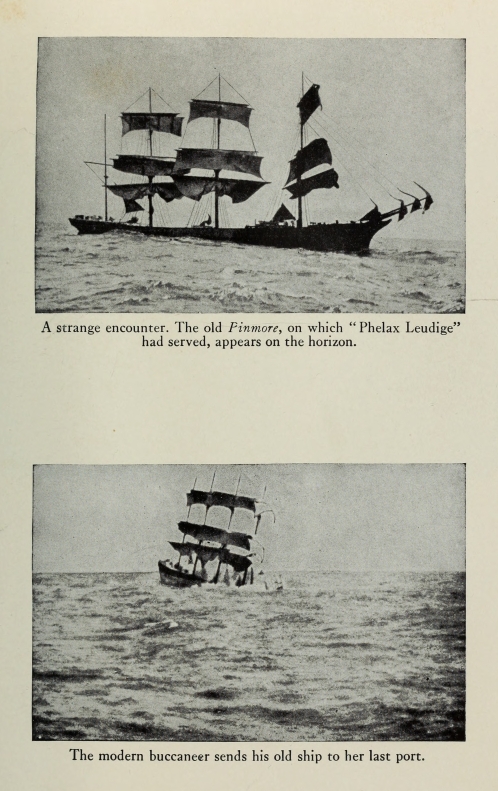
A strange encounter. The old Pinmore, on which "Phelax Leudige" had served, appears on the horizon. The modern buccaneer sends his old ship to her last port.
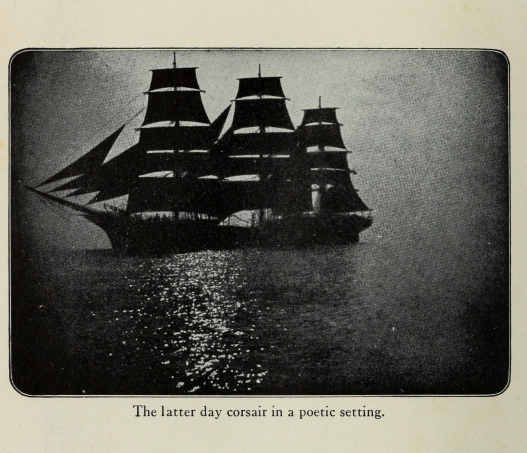
The latter day corsair in a poetic setting.
It was funny. Finally, I had to laugh. The ship was the Lundy Island bound for France with a cargo of Madagascar sugar. An important cargo, sure enough. Sugar was scarce in all the countries at war, and we Germans, whose supply of sugar consisted mostly of a great longing for it, could sympathize with the captain's eagerness to get his precious merchandise to port. When the first shot struck the Lundy Island, the crew, black, brown, and yellow, fell into a panic. With shells falling, running the ship or staying with it meant nothing to them. The captain roared and stormed, but that was all the good it did. So he seized the helm, himself. Just then a shot hit the rudder chain, and when he turned the wheel nothing happened. The crew started taking to the boats, and the tough old salt was left alone on deck. Our signal for him to come on board left him helpless. His boats were out there with the crew floundering at the oars. The sea was pitching and rolling, and they were so frightened they could hardly row. He paced the bridge with his handbag in his hand, a solitary, woebegone figure. We finally had to send a boat for him.
On our deck he got a stern, formal reception.
"Any casualties among your men, Captain?"
"No, worse luck. Not a man scratched, by Joe, and the blighters scurried around like rabbits at a dog show. Look at them in the boats out there. They haven't got here yet, the beggars. Let me at that gun, by Joe, and I'll sink them."
It was hard not to sympathize with him, but still his conduct had apparently been inexcusable.
"Why did you endanger your men's lives like that, Captain? It not only was the height of folly, but it was inhuman!"
Just then our ship's surgeon, Dr. Pietsch, came along.
"Hello, Captain."
"Hello, Doctor."
They greeted each other like long-lost friends, save that there was a shadow of uneasiness in the captain's fraternal demonstrations.
Dr. Pietsch had gone out with our armoured cruiser Moewe on one of her freebooting expeditions. Among the captured captains of that cruise was our present guest, who, while aboard the Moewe, had struck up a pleasant comradeship with the doctor. Now he, along with the other captains, had been released on parole. They had signed written promises that they would engage in no further war activity. Believing he had broken his parole, he thought the Germans would hang him from a yardarm if they ever caught him. When he saw we were an auxiliary cruiser, he already felt a rope tightening around his neck. That was why he had tried so desperately to get away.
We amused ourselves with a formal discussion, after which I addressed our guest with suitable gravity.
"We are of the opinion, Captain, that your parole did not cover your calling as a merchant captain. Only direct combatant service was included under the heading of war activity. Therefore, we feel ourselves under no unhappy necessity of hanging you."
Well, the smile on that hard, weather-beaten face was like a sunrise. We now understood the all-too-human motives behind his actions, and we respected his plucky attempt to get away in the face of point-blank gunfire. Sailors ourselves, we could only salute this skipper who, with a worthless, spineless crew, had to take the wheel himself, and then only to find his rudder chain smashed.
"All right, Captain," I said, "it's the way things go at sea when there's war on. God help us sailor chaps."
After he had roundly cursed his crew when finally they came aboard, we took him below and introduced him to his new quarters with Captain Chewn. The two skippers found themselves mutually agreeable and became great old sidekicks. Some of the crew found old friends among the sailors we had already captured, and none of them appeared particularly grieved over the loss of their ship. We now had fifty-odd guests, apparently representing half the races on earth. The Seeadler was becoming populous and quite convivial.
The sea was so rough now that we did not send a bombing party to board the Lundy Island, but sank her by direct gunfire.
That night Leudemann and I sat over bottles of beer and talked about our prospects.
"Well, old chap," said I, "everything has begun well. It's a fine cruise. But when will they sink us?"
"Not, at any rate," he replied, "until our hotel is full."
You see our buccaneering raid was pretty certain to remain a secret until the time came when lack of space would compel us to release our prisoners and send them to port. Then the news of our freebooting jaunt would be out, and cruisers would be hot after us in every part of the world.
"And if we don't capture any more ships," I reflected, "we can go on cruising indefinitely."
"Then let's catch some more quickly," laughed Leudemann. "It will be great sport to play hide and seek with cruisers."
That mate of mine was always itching for trouble. But then that was what we had all come through the blockade in hope of finding, so if we wanted plenty of excitement, then the sooner we sent the crews of eight or ten ships into some port the sooner would the alarm go out—"German raider in the Atlantic!" Then, too, Lloyd's insurance rates would start to soar when the news got out, and ships with supplies that the Allies needed badly would be held in port. Also, a number of cruisers would no doubt be detached from blockade patrol duty across the North Sea. That was the interesting part of it—those cruisers and how to elude them.
"Leudemann," I said, "the better the lookout, the more ships we will catch. We already have a good lookout, but I've thought of a way to have a better one. A hundred pair of eyes are better than two pair."
"What do you mean?"
"Well, from now on, I'm going to change that offer of ten pounds and a bottle of champagne that we promised to the first of our two lookouts to spy a ship. I'm going to open it to everyone on board!"
"To all of our crew?"
"Yes, to our crew, and to all of our prisoners, too! Ten pounds sterling and a bottle of champagne! I'll bet that'll send everybody into the rigging, including the captains."
"By Joe, you're right," said my mate, slapping his knee, "particularly since they know that, as soon as we are full up with prisoners, they will all be sent into some port."
"Exactly," I responded. "It won't be long before we have several hundred aboard. That will make a fine flock of birds perched in the rigging, forces of the Allies on the lookout for Allied ships to sink!"
Leudemann and I roared with laughter the longer we thought of it. I at once had notices posted up:
"Ten pounds and a bottle of champagne to the first man who sights a ship. Offer open to all."
You should have seen the rigging crowded with crew and prisoners from then on. Every man who had any kind of glass brought it out. There were up-to-date binoculars, old-fashioned spyglasses, and cheap opera glasses. Even those without any glasses took their places on the yardarms, trusting to luck and the power of the naked eye. The two captains, with the dignity and poise that became their exalted rank, climbed aloft and sat next to each other on a yard, sweeping the horizon with their excellent binoculars.
Never had a ship such a lookout. I often stood and watched the curious flock perched in the rigging, all colours, sizes, and styles of beauty. And, believe me, they were wonders at spotting ships. Sometimes two or three would spot the same ship at the same moment. Then there would be an argument, a riddle for Solomon himself to answer. Once or twice the argument got so hot that I had to pay two rewards for a ship, and then the champagne flowed freely. That night, if the weather was balmy and a gentle breeze was blowing from the Gulf Stream, the deck of the Seeadler became a veritable beer garden, and our guests frolicked like tourists on a Mediterranean cruise.
XV RAIDING ALONG THE EQUATOR, AND AN INTERRUPTED HONEYMOON
There are some memories that are painful to recall. To this day I can see the Charles Gounod going down, her bowsprit plunging first and her tall masts sinking slowly, first one spar disappearing and then another. It fills me with sadness, for she had behaved like a gallant craft, and she was a large barque with all the air of an argosy, and as we bore toward her, she proudly saluted our Norwegian flag by raising the tricolour of France.
"What news of the war?" she signalled.
We steered close to her, unmasked our gun, and raised the German battle flag.
"Heave to," was our reply.
Incredulity, consternation! The officers and sailors on deck stood paralyzed for a long moment. Then the barque hove to.
Our prize crew went aboard and commandeered a batch of fine red wine from among the ship's provisions, and three fine fat hogs. The Frenchmen packed their belongings, and came aboard the Seeadler. They were a glum-looking, disgusted lot.
The French sailor bitterly hates to leave his ship. He is almost as attached to it as the average Frenchman is attached to his native land. No French sailor willingly serves on a foreign ship. The crews of other nations are made up of men from every corner of the world, from Chittagong and Malacca to Senegal and Jamaica, from Hull to Helsingfors, but no foreigner is taken on a French ship. The French sea laws are more severe than those of other nations. Desertion from a French ship is a very serious offense, while on most German ships it is punished by a mere fine of twenty marks.
The captain was painfully correct in his manner toward us. He was a tall, impressive fellow with deep voice and black beard. A man of fine education and studious mind, he was scrupulously polite, but knew how to make the hostility he felt toward us clearly and rather amusingly evident. He was our prisoner. Very well, he conceded that. But we were the enemies of his country and the destroyers of his ship. Therefore he preserved a demeanour appropriate to that attitude of mind throughout his entire voyage with us. For our part, we could not but admire him for his superb, unbending spirit.
His barque was loaded with a cargo of corn and bound for Bordeaux. Now, I don't know much music, and I don't care for this modern jazz school at all. Faust I enjoy. Give me the duet in the Garden scene, and, since I am called the "Sea Devil," I don't mind admitting a secret fondness for old Mephisto and his serenade beneath the window. Now I had to sink my favourite composer. The thought of it made me hum a phrase of Valentine's dying lament.
But the sinking of the Charles Gounod meant much more than any such superficial melancholy. One shouldn't ever have to sink a sailing ship. They are the last survivors of the golden days at sea, crueler days and finer days. Take any old salt who has sailed before the mast, and ask him. The shipyards are not building many of them any more, and the day of the schooner, the barque, the clipper, and the barquentine is fast passing. Every one that goes down to Davy Jones is a loss that will not be replaced. I have an old-time seaman's love for sailships. A steamer? Train the guns and light the fuses. I could sink a steamer and laugh as she takes her last dive. But I never did get used to sinking sailing ships, although we had to send many of them on their last voyage before our own final adventure in the South Seas.
Our bombs exploded in the hold of the Charles Gounod. She lurched like a living thing. Her tall masts trembled. The majestic ship seemed to bow her head as she nosed down into the sea. The last we saw of her was a glimpse of her tallest mast and waving from it the tricolour of France. With her departure, I somehow thought I saw the passing of the whole age of sailing ships.
Three days later, a tremendous commotion in the rigging. Six men were reporting "Sail ho!"
"Hold there," I roared, "let's have done with the argument until we've settled with the ship."
She was a fine three-masted schooner. We thought she might be an American. The Americans favour that type of ship. And the United States was not yet in the war. However, the Canadians also have a weakness for the three-masted schooner. We raised our flag, hoping to induce the skipper to raise his flag, which would be the polite response for him to make. But her skipper didn't seem to be in any mood for returning compliments that day. Perhaps he had had a bad night and was saying to himself:
"What do I care for that old Norwegian tub?"
We backed our main-topsail and dipped our flag three times as a salute, hoping that this exceptional courtesy would induce the schooner to follow the amenities of the sea.
It happened now that our freebooting led us to intrude unwittingly into the rose-covered field of romance, where our rough pirate's boots were not adapted to walk among the delicate plants. However, buccaneers that we were, we were not without a high regard for the tender sentiment. Aboard the schooner, the captain had his newly married bride. The voyage was their honeymoon. He saw no reason why he should bother to raise his flag in response to ours. She, however, inspired by the enchantment of a honeymoon voyage, was full of romance and the spirit of the sea. She remonstrated with her bridegroom for his impoliteness toward the Norwegian ship.
"Oh, to blazes with the —— old Norwegian," grumbled the bridegroom, and she thought him a very cruel and hard-bitten husband, and told him so.
When we dipped our flag three times and he still proposed not to answer the salutation, she felt it was an outrage. I don't know whether she broke into tears, as brides always do in books, but, at any rate, she talked a lot. He got angry, and they had a real row—their first quarrel, we afterward learned.
Leudemann and I stood on the bridge.
"Better leave the lubber alone," I said.
Just then the ensign in the lookout on the mainmast sang out:
"That's no American. They're raising the British flag."
Sure enough, there were the British colours. Up went our battle flag! Across her bows went a shot from our gun. But it required a second shot before she hove to.
"Hey!" cried Leudemann, "there's a woman."
The captain's bride was running around the deck in a tailspin, as aviators say. I don't know whether she was afraid of shot and shell or the righteous ire of her husband. Maybe he was chasing her.
Prize Officer Preiss had an added dignity as he climbed into the boat with his boarding crew. He was always a great hand at quieting excited people—especially the ladies. With his six feet four, his deep voice, and his imperturbable manner, he was the kind of man to raise his hand and calm the tumult of the howling mob. He had a certain streak of gallantry, too, which made him a second Siegfried when it came to the task of quieting an excited young woman.
The schooner was the H.M.S. Percy bound from Nova Scotia with a cargo of gaberdine. The captain told me he saw our first shot splash into the water in front of his ship, and thought it merely a whale spouting. With our second shot he heard the report of the gun, and saw that we were an auxiliary cruiser. The Percy's cargo was so light that we did not use bombs, but shot her full of holes.
We were worried about having fair company aboard. There might be rough work that would not be good for the eyes of woman. And then a woman needs attention. She must be treated with care and consideration. Suppose this new and undesired captive should start to complain. Women like to complain. Suppose she should grow angry at being kept a prisoner. What could we do? You couldn't put her in the brig.
"Well, Leudemann," said I, "the only thing we can do is to treat her so well that she will be happy all the time."
"I treated a dame well once," growled Leudemann, "and then she ran off with another man the first time I left her alone."
The skipper's bride turned out to be the best fellow you could want. She had one of those sunny temperaments that simply spread mirth and good cheer everywhere. She had a smile for everyone and in every circumstance. She took her stay aboard the Seeadler as an unexpected, exciting, and appropriate phase of her honeymoon, and resolved to get the greatest possible fun out of it. We all made much of her, did everything to make her comfortable, gave her presents, and got up amusements for her. Her husband was a little annoyed with her at first for having caused the loss of his ship, but he could not stay angry with her for long, and when he saw what a reigning queen aboard she was, he became very proud of her—and seldom left her side.