Front matter (continued 5)
Reading edition
"I don't care what arrangements you two fellows make with your fair playmate, but it has got to be kept quiet. The sailors must think that she is the wife of the officer of the ... and that ... is only a friend."
They made some kind of change, I believe. I never could figure just how it was. I never was much good at mathematics or at figuring out anything, for that matter. At any rate, they kept it quiet. The other prisoner was married, too, and he didn't want anything of the complicated romance to get around either.
I had come to expect my prisoners to be good company. Our former Captains' Club had been one of the most delightful social organizations ever formed. These two sentimental swains, however, were not much good for comradeship. It was difficult to get together with them for a pleasant chat or game of cards. They were always thinking about the girl, and, although they were acquaintances in captivity, their feelings toward each other had become slightly strained. There is something about the air down there in the South Seas, I guess.
One of the captains made up for the companionship that had been lacking. He was a fine fellow. He was jovial and intelligent, and a thorough seaman if there ever was one. We became fast friends and had many a long and sympathetic talk about the war.
Weeks passed, and we did not see another ship. The idle days became very boresome. It was broiling hot, and we had little exercise. Our water turned stale, and we had no fresh provisions. Our prisoners did not find their stay with us so pleasant now, but we could not find a vessel on which to ship them. One decided that he could not stand it any longer, He wanted to put his feet on land at any price. He came to me with a strange idea. Would I not land him on a desert island and leave him there a castaway? Anything was better than shipboard. But the principal part of his plan was more subtle. He would be reckoned dead at home, and his people would collect his insurance money. Perhaps I would be so kind as to make it seem certain that he was lost. Yes, no? On the island he could live as a Robinson Crusoe, a kind of existence which he fancied would be quite agreeable. Unfortunately for him, I felt obliged to decline. I was not interested in swindling insurance companies.
XXIII SHIPWRECKED IN SOUTHERN SEAS
We amused ourselves by playing with the sharks. The landlubber can scarcely imagine the hatred the sailor feels for those bloodthirsty monsters. We had a particular grievance against them. A swim now and then would have provided us with needed baths and would have been a pleasant and vigorous diversion from the endless monotony of cabin and deck, our wooden prison. Many a time I looked down into the cool, refreshing element, and a shark would idle beneath my gaze, as though waiting for me there. The sailors passed the time by angling for the voracious monsters. They would catch a couple, tie their tails together and throw them back into the water. The sharks, unable to agree on the direction of their mutual movement, would have a great tug of war. The sailors thought the plight of their loathed enemies quite comical.
Or they would take a large shark, tie an empty and watertight barrel to his tail, and heave him over. The fish would dart downward, but the barrel would stay relentless at the surface. Now would ensue a desperate struggle which we could follow by watching the gyrations of the barrel. The sharks displayed an excellent eye for chunks of bacon with hand grenades in them. When the bomb went off in the creature's stomach, pieces of shark would go flying in all directions.
We had been in the Pacific for five months now, and had sailed 35,000 miles. With our stale water and the lack of fresh food, scurvy was breaking out among our men, and then beri-beri, which "turns the blood to water." Limbs and joints were swelling. We imperatively needed fresh water and food and a rest on shore. But where could we go? All the islands of the Pacific were in the hands of the French, British, and Japanese. We certainly felt it keenly, now that the whole world was against us. There was no inhabited place that would welcome us. It made us feel very lonely.
"Well," I said to my boys, "we will pick out some nice deserted island where there will be no hand raised against us and no wireless to call the cruisers, and we will get water and some kind of vegetables and maybe shoot some game and have a fine shore leave. Then, after we have rested up, what ho, boys, and away for more adventure."
Buccaneering in the Pacific, with only three ships sunk in five months, seemed much too unprofitable. I planned that, after a brief sojourn on some peaceful South Sea Isle, we would sail for the Antipodes. Then we would destroy the English whaling station and oil tanks at South Georgia, sink a few ships, capture one on which to ship our prisoners, and, if we got away safely, continue our cruise in the prosperous waters of the Atlantic.
Our first plan was to sail direct to one of the larger Cook Islands. But we gave that up for fear of finding a wireless station there that might give us away. We did not want to move east of our present longitude, for that would have taken us against the trade wind and compelled us to use our motor. It was necessary to save the engine as much as possible and not have it wear out on us. We hoped we would need it for further captures and escapes. Mopelia, one of the Society Islands (some geographies include it in the Scilly Isles), seemed about right for our purpose. It was a French possession, and, so far as we knew, uninhabited. It was one of those isles of the South Seas so fantastically beautiful and so awkward for the sailor to approach. Only seldom does he find one with a decent anchorage, and nowhere in the world are the winds and currents more treacherous.
On the morning of July 29th, we sighted Mopelia, and steered toward it. Words fail me when I try to describe its beauties. From the blue ocean rises a mass of green palms. The sunlight glows in the green. It somehow even seems to turn the sunlight green. Against the dark blue of the sea and the light blue of the sky, the sunlight seems to be drawing the green island out of the water, and the soft south wind carries the scent of flowers far out to sea. It is the greeting of the island, and we inhale it deeply.
Here was a typical coral atoll—the kind you dream about. A circular reef studded with waving palms and within the reef a lovely, placid lagoon. The coral shore was snow white, and, with the sun's rays reflecting from it, it looked like a sparkling jewel set in an alabaster ring, like emeralds set in ivory. There were coral terraces below the water. The shallower ones were white or pale green, and as you peered deeper into the water you saw every conceivable tint of green and blue, sea green, emerald green, blue green, azure blue, sapphire blue, navy blue, violet.
As we sailed nearer and nearer that alluring coral shore, we saw flowers among the palms, flowers of all colours, and immense numbers of orchids. The hues of the flowers were reflected in the water over the white coral that deepened and turned green. Within the circular reef the lagoon seemed fully as deep as the sea outside, only at perfect peace and smooth like a mirror. It would have made a perfect anchorage for us, save that it had one entrance so narrow that only a small boat could pass through it.
A strong current ran through the opening. We cast our anchor on the coral and tethered our ship to it with a long cable. The pull of the current kept her far enough offshore. I was afraid, for a while, that a shift of the wind might blow her on the reef, but we saw, after a while, that she had dragged anchor. If the current were strong enough for that, why surely it would be strong enough to keep her from blowing ashore. Leaving several men aboard as a watch, we went on land for a glorious shore leave, sailors, officers, prisoners, and all.
What would we find? We wanted water and fresh food. When we got inside of the lagoon, we found to our astonishment that it was a breeding place for turtles. There were hundreds of them in the water and on the shore, huge fellows weighing two or three hundred pounds. The water was full of beautiful fish. I recognized the moray, a fish like the eel, which is a great delicacy and will provide you with a substantial meal, too. It weighs from fifteen to twenty pounds. They say the Romans used to feed their slaves to this fish. There were big lobsters without claws that promised to be the best of food. The atoll was alive with birds, hundreds of thousands of them, with nests and eggs everywhere. They were so tame that one of my boys whom I sent to collect enough eggs for an omelette returned, saying:
"I didn't get an egg. The birds were so tame and trusting that I hadn't the heart to disturb them and take their eggs."
Nor was the island without human inhabitants. We found three Kanakas, Polynesians who had been left there by a French firm to catch turtles. They were greatly frightened when they found that we were Germans. The French had told them frightful tales about the Boches. We, however, quickly made friends with them. They were much relieved when they found that we did not intend to injure them, and when we made amicable overtures, they were only too glad to respond.
First, my boys ran hither and thither to satisfy their curiosity about this strange island. Then they quickly settled down to useful occupations. Some set about catching fish and lobsters. Others gathered birds' eggs. A few brought armfuls of cocoanuts. Three boys turned a big turtle on its back and pulled it along with a rope. There were wild pigs on the island. We shot a couple. Soon the boat put out to the ship loaded deeply with a huge collection of epicurean delicacies. That night the mess was fit for the table of a royal palace—turtle soup with turtle eggs, broiled lobster, omelettes of gull's eggs, roast pork, and, for dessert, fresh cocoanut.
For days we lived a delightful poetic life, dining in a way that millionaires could not afford. We smoked quantities of fish and pork and stowed it away. We found fresh water on the island and refilled our tanks. Our traces of scurvy and beri-beri disappeared, and we were rapidly getting ready to continue our cruise and work of havoc in Australian waters.
On the second of August, we made ready to leave the ship for another day ashore. At nine-thirty I noticed a strange bulge on the eastern rim of the sea. I called my officers' attention to it. At first we thought it a mirage. But it kept growing larger. It came toward us. Then we recognized it—a tidal wave such as is caused by submarine earthquake and volcanic disturbances. The danger was only too clear. We lay between the island and the wave.
"Cut the anchor cable. Clear the motor. All hands on deck."
We dared not raise sail, for then the wind would drive us on the reef. So our only hope of getting clear of the island was our motor. The huge swell of the tidal wave was rushing toward us with breakneck speed.
The motor didn't stir. The mechanics were working frantically. They pumped compressed air into the engine. We waited in vain for the sound of the ignition. Now, right at the critical moment, our motor had failed us, just as it had so often failed us before. By this time, the tidal wave was only a few hundred yards away. We were lost. To our frightened eyes it looked like a whole mountain range of water. It must have been thirty or forty feet high. It came rushing with a roar that drowned out our voices.
A gigantic, violent hand seemed to grasp the ship. The wave swung her on high and threw her forward. It flung us crashing on the coral reef. Our masts and rigging went over, broken like matchsticks. The shattering impact of the ship smashed the coral, and pieces flew in all directions like shrapnel from an exploding shell. The swirling water seized great pieces of coral and whipped them around, beating them against the ship. The Seeadler had heeled over until her deck was almost perpendicular. The water swept over the deck, and the swirling eddies bombarded us with chunks of coral. I clung to an iron post near the lower rail. The rail saved me from the tons of shattered coral that were hurled up by the blow of the falling ship. In a moment, the wave had ebbed away, leaving us high and dry. It had passed over the circling reef and the lagoon, though not over the main part of the island. And on its way it had swept hundreds of thousands of birds' nests into the lagoon.
I arose, scarcely knowing whether I was alive or dead, and stood alone with one foot on my slanting deck and the other on the rail. For a moment, I thought I was the only one saved.
"Boys, where are you?" I shouted weakly.
"Here," came the reply, "still standing like an oak."
My men and the prisoners had taken refuge in the bow, and had been sheltered by the rail, as I had been. Not a one was injured. For that at least we could be thankful. For that and not much else. The Seeadler was a total wreck. The jagged coral was rammed deep into our hull.
We stand like an oak! I adopted the reply of my sailors as our motto henceforth. We were castaways on this coral atoll in one of the loneliest and least-visited reaches of the South Pacific. Everything lost, but "we stand like an oak."
XXIV CASTAWAYS ON A CORAL ATOLL
The last German colony! We founded it on this beautiful, isolated coral atoll in the middle of the Pacific. The Imperial German flag of war flew from the top of the tallest palm. I was the viceroy, by chance and not by desire, of course, and my sailors and our prisoners were my subjects. The only visiting nationals from elsewhere were the three Kanakas, the turtle catchers. "The White King of the Society Isle of Mopelia," my mate facetiously called me. One of the Yankee captains put it differently. He called me "the Sea Devil King of the South Seas." And he caustically described our lovely isle as "a poisoned paradise." Everybody was good-humoured, despite our hard luck.
But our little South Sea colony passed its first nights uneasily. For sleeping places, we slung hammocks between the palms. At intervals, a cocoanut would fall from a height of fifty or sixty feet and go whizzing close by a man's head. While our fellow countrymen back in the cities along the Rhine were complaining about the night raids of the French and British bombing squadrons, we had our bombing problem also. It didn't make much difference whether you were bumped off with a falling cocoanut or a falling bomb. The result was all the same. After one whizzed by your ear, you would very likely go down to the open beach to quiet your nerves. Then if you tried to sleep there, the land crabs would soon convince you that the beach was no place for a weary war veteran either. Patrols of fighting marine crabs would raid that beach every night. After being chased out by the crabs, you would go back to your hammock and lie awake wondering when the next aërial cocoanut bombardment would commence. So life during those first days on our tropic isle was not all skittles and beer or orchids and cocoanut milk. You can bet we worked hard getting up huts! Luckily, there were no casualties from either crabs or cocoanuts. We cleared a large space for our village, and built huts out of timbers, sailcloth, and palm leaves. The first one up was a queer-looking thing, but our architecture improved with practice. Our prisoners, who were all Americans, helped us a great deal. They understood the art of pitching tents. They built a special town for themselves, and gave the streets such names as Broadway, State Street, Pennsylvania Avenue, and the Bowery. In time we contrived to arrange quite decent dwelling places. We had plenty of furnishings. From the wrecked Seeadler, which remained perched forlornly on the coral reef, we took everything we could carry. We even built a chapel, took the Bible from the Seeadler, and from parts of the wreck we built a fine altar and crucifix. Of course, we also installed our wireless set ashore in order to keep in touch with passing ships and events happening out on this side of the world. Nor did we neglect to take ashore a heavy arsenal of arms and ammunition, including rifles, Luger pistols, hand grenades, and dynamite. In short, we had a perfect little town with everything except a calaboose. Some of our men who had romantic tendencies constructed "country homes" for themselves a few hundred yards away in the jungle. Then we named the place Seeadlerburg, Sea Eagle Town.
There were gull's eggs everywhere along the shore, but the birds were brooding now, and most of the eggs we collected had half-formed little gulls in them. We got around this by clearing a large section of beach and throwing the old eggs into the lagoon. Then the gulls flocked back and laid more eggs, and thus a supply of fresh eggs was assured.
Our American prisoners were nearly all cheery fellows. Some of them fitted in with the new life better than my men. They seemed to know all about the art of fishing, and taught us Germans things we had never dreamed of. They were accustomed to what in the States, along the Gulf of Mexico, is called spearing eels. They fastened iron barbs to shafts of wood and with these speared big fish in the coral lagoon. They also showed us a clever way of catching fish on a grand scale. They took some forty men and boys and, just as high tide was turning, formed in a line about fifty yards offshore. Then the line came splashing in, driving the fish before it toward shore, just as the natives round up tigers for a rajah in India. Many of the fish floundered into shallow water, and a few minutes later were left stranded by the receding tide. You see, the water, as it backed offshore, left large pools on top of the irregular coral reef, and there the fish were trapped. Sometimes we caught five or six hundred pounds a day, and it was exciting sport.
One night, while we were sitting around our fire, we heard a scratching sound. It seemed to come from everywhere. We looked and found a lot of crabs with big claws. They were hermit crabs. We caught several and put them in boiling water to cook. Meanwhile, the crab invasion continued, and more from behind kept pushing the rest forward. We tried the ones we had cooked, and they were delicious. They were as good as the best lobster.
"By Joe," I said, "boys, let's get busy."
We spread out a large sail and filled it up with crabs, like a sack. We must have had several thousand of them. For days we lived on them, until most of us couldn't look a crab in the face. We had 'em boiled, broiled, and in soup. Then that invasion of these hermits passed as mysteriously as it had come, and we never saw them again. But the turtles were always with us. We caught a number of them and kept them in a coral basin at one end of the lagoon.
The wild pigs on the island provided us with more fun and more food. They fed on cocoanuts, which is the best kind of fodder to make good pork. These animals were said to be the descendants of swine brought to the South Seas by early explorers long ago. They are found on many islands, and New Zealand is a regular paradise for them and for the hunter who likes to chase wild pigs. After generations of living on cocoanuts, they had changed a lot and had developed a special kind of tusk and jaw.
There were snipe on our island, too, and we hunted them with great success, thereby varying our sea food and pork diet. Using cocoanut shells for fuel, we smoked what flesh and fish we could.
By way of vegetables, we had cocoanuts, and bread made of cocoanut flour, which the Kanakas taught us to prepare, and hearts of palms. This latter is one of the rarest of delicacies, and outside the tropics only multimillionaires can afford it. The price, when you get palm hearts in Europe, is higher than that of Russian caviar. For the most part, it is reserved for castaway sailors and buccaneers like ourselves. It is the core taken from the very tip of the cocoanut palm, right where the new leaves form. For each heart, weighing about ten pounds, a noble palm has to be sacrificed. The taste is between that of hazel nuts and asparagus, only finer and sweeter than either.
But I must tell you more about that invasion of hermit crabs. It caused the first and only fatality in the course of all our adventures. My dog Schnaeuzchen had all of the prying, curious nature of the dachshund. The island, with its teeming life, was an endless source of wonder to her. She investigated everything, forever had her nose sniffing somewhere or other. The swarming hermit crabs, which covered the ground almost like a carpet, sent her into a perfect spasm of astonishment. She jumped and barked and yelped. She cocked one eye and studied the strange creatures, and quite obviously did not like their looks. They crawled on all sides of her, and she was filled with bewilderment and fright. She was furious with them, but kept nimbly out of their way. Finally, however, the pugnacity of her dachs nature got the better of her, and she felt she must attack something. A particularly large and villainous-looking crab excited her ire. She leaped upon it to devour it. The crab raised its great, ferocious claws to strike at her. Schnaeuzchen gave a strange yelp of fright, and rolled over in a spasm. She kicked convulsively for a few moments, and then was still—dead. Poor little Schnaeuzchen! The exotic life of the South Seas had been too much for her. She was only two years old, and on the island she had for the first time found an opportunity to give vent to her passion for hunting. We gave her a fine grave, and planted a cocoa palm on it. Her comrade, Piperle, looked around disconsolately for her and was sad for a long time.
Piperle had an adventure with the birds. He undertook one day to invade one of the densely populated rookeries. Somehow or other, he contrived to antagonize the birds. I suppose he tried to raid a nest. The angry gulls swarmed above him. One seized one ear. Another seized the other. Several struck at his eyes. One hung on to his tail. Piperle howled and struggled. It was at this point that one of our men saw him execute an intelligent bit of strategy. There was a clump of underbrush near by. He struggled toward it, taking the birds with him. He dragged himself into the brush and thereby shook off the birds. He returned to camp a sadly mishandled dog, and never went near any of the rookeries again. From then on he confined his courage and daring to chasing the wild pigs at night, which he did with a prodigious barking and yelping. The pet opossum that our prisoners had carefully rescued from the wreck picked up an excellent living on the island, and came into the messroom every night, asking for water.
If our new home teemed with useful, edible creatures, it was not lacking in pestilential forms of life, either, these both of native origin and imported from ships. A thousand kinds of insects were everywhere. If you awakened thirsty at night and reached for your glass of water, you were likely to find that it contained more cockroaches than water. You had to reconcile yourself to getting up in the morning and finding your toothbrush alive with ants. The ants were particularly pervasive. We could only guard against them by putting the legs of tables, chairs, and other articles of furniture in cups of water. We slept at night to the ceaseless shuffle of rats, huge insolent fellows, running about on the tops of our tents. Piperle waged war against them, but the odds were too great. It would have taken a whole regiment of terriers to end that plague.
Flashing birds of paradise flew from palm to palm. Gorgeous humming birds with green and yellow breasts darted among the branches. With every flower there seemed to be a great butterfly. The whole island was aglow with butterflies. They floated on wide, beating wings of greens, violets, and reds.
Once, in the middle of the night, I was awakened by a small, sharp, repeated sound—knick, knick, knack. It was the opening of tropical flowers. I went outside and there I saw the lovely Queen of Night, which blossoms by the light of the tropical stars. It is a great, gorgeous bloom, eight or ten inches across. There were thousands of them. Scores of glowworms, far brighter than any we know, hovered above each, eager to catch the magnificent perfume that the opening Queen of Night gives forth. In the darkness I could see the flowers only by the light of the glowworms. On every side were these eerie nocturnal lights, a dancing lamp of gathered glowworms illuminating each flower. In that unearthly gleaming, like a kind of moonlight only stranger, the odorous petals shone with the ghostly nuances of their naturally flaming colours, white, crimson, sapphire blue, violet blue. In the South Seas, the flowers have little scent by day, while the sun shines on them. At night, when the dew falls, perfume awakens. It is truly a perfumed night. And the nostrils of man are excited by the rich and almost oppressive blending of odours. The Queen of Night gives off the perfume of vanilla. Mingled with it comes the scent of hyacinth, orchid, mayflower, and heliotrope. Sweet-smelling breezes blow, and above is the tropical sky with its clustered flashing stars and gorgeous Milky Way. Hanging above the horizon is the far-famed Southern Cross.
XXV LET'S GO RAIDING AGAIN
My "subjects" somehow managed to get along on terms of general amity. Our American prisoners took no exception to my mandates handed on to them by Leudemann, my prime minister. They said that, since they had been treated so well aboard the Seeadler, they wanted no other command over our colony. The two captains and their lady had made mutually satisfactory arrangements among themselves, and, so far as we knew, there was no unpleasant incident, although, for the purposes of my tale, it would have helped a lot if they had fought a duel with swords or cocoanuts or chunks of jagged coral on the shore of our tropic lagoon.
The three Kanakas proved to be thoroughly good fellows and helped us in many ways. We got along with them in pidgin English at first until one of them picked up a little German.
In the middle of the camp we made a sort of plaza. The Seeadler's batteries furnished electric light for it, and there we gathered every night. We still had plenty of champagne and cognac left from the capture of the champagne ship. So, in the cool of the evening, we sat out there on the edge of this equatorial Potsdammer Platz sipping drinks out of wine and brandy glasses, just as we might have at the Adlon in Berlin. There was plenty of pipe tobacco, and Dr. Pietsch had taken care to rescue from the wreck a store of his endless cigars. The wind blew, the stars shone, and the orchestra alternately played German classics from the operas and American ragtime melodies. Ah, yes, this last bit of the once glorious overseas German Empire wasn't such a bad little paradise at all. We castaways out there in the solitude of the South Seas felt as though we were the only people left in the world, like Noah and his family on Mount Ararat.
But after about three weeks of this Garden-of-Eden-without-an-Eve existence, the monotony of it began to get on our nerves. Of course, there was the "wife" of the officer of the ... but she was far too busy to be interested in the rest of us. We hadn't been sent out to colonize the South Seas and take life easy. So we cast about for a way to go buccaneering again. Our first need was for a ship to take the place of our unfortunate three-master impaled out there on the coral reef. The Kanakas told us that a French sailing vessel visited the island every year to take away turtle meat. The best guess that they could make was that it would be another six months or so before she arrived. Well, after six months, we would have a ship. We could always fall back on that. But, by Joe, six months was a long time to wait. The war might be won or lost by then. And it was highly unlikely that any other ship would stray into those waters for Heaven knows how long. We all grew impatient. Few sailors are keen about remaining cast away on a tropical isle for long, and especially on an atoll as small as Mopelia. We felt the itch to get out to sea again. I was particularly anxious to set something stirring. Before long the tropical sun and lazy life would sap my men's vitality, and all they would be good for would be to loll around.
We still had our lifeboats, and the hurricane season was not on. So why not put to sea in one of them? We devised rigging and sails for our best lifeboat, mast, jib boom, main boom, gaff, stays, and back stays. We scraped, caulked, and painted her. She was not in any too good condition, and despite our labour she continued to leak a bit and needed constant bailing. Even in calm weather, we had to bail forty pails a day. We loaded her with provisions for half a dozen men over a long voyage. She was eighteen feet in length and only about fourteen inches above water amidship. Into this small space we stored water, hardtack, machine guns, rifles, hand grenades, and pistols. The only luxuries we allowed ourselves were a few tins of pemmican, a side of bacon, and an accordion. The music of the squealer was to be our solace during a cruise the length of which none could foretell. The great question was, could our tiny craft survive a storm? At any rate, she could sail, and that was something. We christened her the Kronprinzessin Cecilie—without, however, painting her name on the stern.
Of course, everybody wanted to go, but there could be only six of us at the most. So I picked the men who seemed to be in the most vigorous health at the time, Mate Leudemann, Lieutenant Kircheiss, Engineer Krauss, Boatswain Parmien, and Yeoman Erdmann. This left the colony on the atoll in the hands of Lieutenant Kling.
Our overloaded cockleshell with a crew of six was the smallest auxiliary cruiser in the war. For cruiser we were, and we were setting out to capture a ship, sail back to Mopelia, pick up our comrades there, and continue our raid. To find and take a ship on the high sea was a doubtful proposition, but we might get to some of the other islands, not too well populated and guarded, and find a vessel at anchor. We could board her at night, overpower the captain and crew, and sail off with her. We planned first of all to visit the Cook Islands, some eight hundred miles distant, and if we found no ship there, continue on another thousand miles farther to the Fiji Islands, where there were sure to be ships loading with copra for the ammunition factories of Europe. We figured on making around sixty nautical miles a day, so that, if we had to go all the way to the Fijis, it would take us approximately thirty days. Thus we should be back with a ship in three months at most. We discussed our tactics thoroughly for the expected capture. We would steal aboard. Half-past three in the morning was the best hour. Men sleep their soundest then. A couple of us would go to the officers' cabins, the rest to the forecastle. We would show our pistols, disarm them, and herd them below. It would be good to sneak to their clothing first and take away their belts and snip the buttons off their trousers. Then, when you have them put on their clothes they stand, without belts, suspenders, or buttons, holding up their trousers. Thus they are helpless. We had a few bombs loaded only with powder, harmless, but capable of making a terrific noise. If there is any trouble, you throw one. It hurts nobody, but the terrible explosion creates a general panic. A couple of men with their heads about them can do wonders with dozens in a panic. Another good thing is to have a couple of fellows outside shout suddenly and make a great disturbance. That creates excitement and throws people off their guard. I said to my bo's'n:
"Don't hurt anybody unless you have to. We don't want to spoil our clean record by killing anybody. But, by Joe, if a captain or a watchman raises a rifle or a pistol, don't wait till he shoots. Get him first."
On a bright summer morning—August 23, 1917, to be exact—we all shook hands. There was no cheering, merely quiet, earnest words of friendship and good luck. It was the first time that we sixty-four seamen had parted since the Seeadler had set sail to run the blockade eight months before, and it was only now, at the moment of saying good-bye, that we realized how closely attached to one another we had become. We who were going could see a brooding question in the eyes of those who were staying behind:
"How will that overloaded cockleshell stand heavy weather?"
Never mind, we would probably find out soon enough. The understanding was that, if we did not return in three months, something had happened to us. They should wait for us until then. Afterward, Kling and his men were to get away from the atoll as best they could.
We sailed out of the lagoon, through the coral entrance, into the open sea. The hulk of the Seeadler lay there helpless on the reef. The tide was high, and the breakers swept over the coral. She was a red brown now from rust and weathering. Each flooding billow raised her a bit, and then she sank back hopelessly with loud groans and creaks of despair on the coral bed. As we passed her she seemed to call over to us:
"Come aboard, I want to take you on your voyage. Don't desert your old friend."
And as a wave raised her it seemed as though she were struggling to get on an even keel again and come to us, only to find that the coral held her in a relentless grasp. Tears filled our eyes.
"Good-bye, Seeadler" I called; "perhaps we shall never see you more. And even if we do, you can never sail again. Nevermore will songs resound on your decks. Nevermore will you raise your sails and fly a flag from your masts."
A brisk wind carried us westward with a swelling of our sails. The happy island receded. The last German colony and the wreck of the Seeadler slowly dropped out of sight over the rim of the horizon.
To-day the Seeadler still remains on the reef at Mopelia. After we had gone, Lieutenant Kling, afraid that the stumps of her mast might attract a passing warship, blew them out with dynamite. The explosion set a fire that burned away part of the woodwork. A quantity of ammunition still aboard blew up and cracked the forepart of the hulk. Afterward, when the Seeadler's history became generally known, the Harris-Irby Cotton Company of New York, which had originally owned the ship as the Pass of Balmaha, investigated the possibilities of salvaging the ship. A party of engineers was sent to Mopelia. They reported that the ship was unsalvageable. In my cruise around the world aboard the Vaterland I shall stop at the island and survey what once was my tropical domain. And again I shall board the old Seeadler on which we sailed and raided. So, until then, old ship! Auf wiedersehen!
XXVI FROM THE SOCIETY ISLANDS TO THE COOK ISLANDS IN AN OPEN BOAT
It has been something of a sport of recent years to cross the Atlantic and even the Pacific in a small boat, sometimes under sail and sometimes under motor power. Tiny craft have done it, and at best it is not a comfortable kind of voyage. In sporting events, your ocean-going small boat always had a cabin, or an imitation of one. That is what we should have had, but we were not so lucky, and, besides, the load we carried made existence aboard our lifeboat that had been converted into a cruiser a cramped affair indeed.
There was only one place we could trust to be dry, the buoyant air tanks at the sides of the boat. In these we packed our hardtack, a few pieces of clothing, photographic apparatus, and the all-important tobacco. It affected the buoyancy of our craft, but we had to keep some things away from the sea water. In the body of the boat were placed the water tanks, our large supply of weapons and ammunition, cordage for the rigging, and several spare sails. Canvas shields at the side, which could be drawn over at the top and be made to form some kind of tent, sheltered us somewhat from waves and dirty weather. Without these we should have been practically drowned. Four mattresses could be stretched on the bottom, where four men could sleep while two kept watch. As a concession to civilization, we had six pairs of knives and forks, six mugs, a coffee pot, and $5,000 in silver, gold, and paper, much of it in pounds sterling.
At six in the morning, the two men on watch filled the coffee pot and applied fire to it from a soldering lamp. With the slightest breeze and a rocking of the boat, it was impossible to bring the water to a boil. Then we were glad to get tepid coffee-bean soup instead of coffee. After toilets had been made with salty sea water, we squatted in the cockpit for breakfast of coffee and hardtack. Navigation was difficult in so small a boat. It was impossible to spread the charts out properly, and with the slightest carelessness the wind might take our priceless navigation papers overboard. We had to use the sextant and other navigation instruments in a boat that often pitched so much we could scarcely stand. The papers, charts, tables, logarithms, and so on, got sopping wet, and when we dried them in the sun they grew swollen and difficult to handle.
It was cool at night, but not unpleasant so long as our clothes were dry. The weather was fair, but an occasional whale would come alongside and douse us with the spray of his spout. Then, in our damp clothing, we felt the chill of the night. The days were broiling hot, but even while taking advantage of what little shade we had, we grew heavy and torpid. We had, above all things, to be careful of our water supply. We never dared drink enough to quench our thirst completely, and were, in fact, continually thirsty.
By way of amusement, we had readings aloud from the one book we had brought along, Fritz Reuter's comic story, A Trip to Constantinople, and at night the squealer wheezed and blared, and we whiled away the tedious hours singing old German folk songs.
After three days we sighted Atiu, the first island of the Cook group and a British possession. There was no ship in sight. Too bad, but perhaps a ship might be expected soon. Anyway, we had to make port and get fresh food. Aside from the danger of storm, if our voyage continued for any length, we feared most of all beri-beri and scurvy, which our diet of hardtack would inevitably bring upon us unless we varied it with fresh vegetables.
A crowd of natives, fine-looking Polynesians, watched curiously as our little craft drew up to the dock. Kircheiss and I went ashore and straight to the house of the British resident. He lay stretched out in his shirt and trousers on a Borneo long chair on his porch, and didn't even get up when we approached. He was a good-looking fellow, but lazy as the devil. The lassitude of the South Seas had certainly got him.
"My name is Van Houten," I began, "and this is my chief officer Southart."
The resident looked at me suspiciously. It was a true British mistrust. Ordinarily, your Englishman is the best of fellows, a pleasant chap to meet, a perfect host. But in wartime you had to admire them. They were on the lookout for everything. Their brains seemed made only of suspicions. Kircheiss, who spoke English better than I did, continued:
"We are Americans of Dutch birth. A few months ago we made a bet at the Holland Club in San Francisco that we would sail from Honolulu in an open boat via the Cook Islands to Tahiti and back to Honolulu. The wager is for twenty-five thousand dollars. Would you, my dear sir, kindly give me a certificate that we have been here in accordance with the terms of our bet? Also, we should like to lay in a supply of fresh water, canned goods, and fresh fruit."
The resident yawned, looked us over with a watery eye and replied:
"Well, a man must be a hell of a fool to go in for that kind of sport."
"Sure," Kircheiss said politely, "but, just the same, we should like to have the certificate. Won't you give it to us or tell us who will?"
"Oh, to hell with you, don't bother me. I've just had dinner and want to take my nap."
Even his British mistrust, with which he first regarded us, subsided into the indescribable something that comes over a white man who yields to the soft enervation of the tropics. He now looked at us merely as mad fellows who wanted him to do something too crazy to merit his consideration.
"Any news from the bloody war?" he asked. "Why are they so stupid as to carry on with this fighting business? In the end, it will only help these yellow races."
He continued like this and spoke highly of the Germans. Naturally, we did not express any pro-German sentiments.
"We simply must get this old bird to give us that certificate," I said to my comrade in Low German, pretending that it was Dutch.
"Yes," he replied in the same dialect, "it may come in mighty useful later on."
The resident, as he told us, had served in the Boer War, and should have known better, but he took our Plattdeutsch for the language of Holland. Presently he scribbled a note saying that we had called on him in the course of our sporting cruise.
"Any ships expected in port soon?" Kircheiss asked quite casually.
"How in hell do I know?" the resident responded wearily. "Everything goes to the bloody war, and we don't see anything around here but these Kanakas." He continued in this strain and cursed his boredom on the island.
The resident was still rambling on in his lazy monotone when along came a man who wore a cassock and had a beard down to his waist. He was a French missionary priest who was overjoyed when we saluted him with a few words of French. The resident and an English trader were the only two white men on the island besides himself, and neither talked any French.
"Allons, allons," he shouted, "by Joe, boys, you must pay me a visit."
And straightway he seized our arms and took us over to his mission house. There he poured out glasses of excellent wine.
"You are Americans," he cried, "you fight for la France? You are Hollanders? Ah, it is too bad that your country is not in the war with France. But I can see that you love la belle France."
With that he put on the gramophone a record of La Marseillaise, and had us sing it along with him, which we did with all our lungs. Since it had been written and dedicated to my great-grandfather, I didn't mind a bit. He chattered in French incessantly, in an ecstasy over having someone with whom he could talk his native tongue. He embraced us a dozen times and made us sit down to dinner. It was an excellent meal. The wine was particularly good. The conversation made us squirm a little. The good father was the best fellow possible, but patriotic to the very finger tips. He treated us to some choice denunciations of the Germans.
After another rendition of the Marseillaise, we took our leave.
"What will be your next stop?" asked the jovial missionary in parting.
"I think we will put in at Aitutaki," I replied. That was the nearest island and the next field of action in our hunt for a ship.
"Fine," exclaimed the priest cordially. "I have a friend there. You must call on him. Just mention my name. He will be delighted to see you. He is a Hollander, too."
A Hollander, too? And our knowledge of the Dutch language was so strongly salted with a German accent! In that case, when we got to Aitutaki we certainly would be anything but Hollanders, probably Norwegians.
Everywhere on the island were trees and fruits, cocoanuts, bananas, mangoes, and oranges. On the streets of the village, with its thatched huts, were South Sea beauties who wore wreaths of flowers and had dark, flashing eyes. They gazed with interest on the foreign sportsmen, the story of whose cruise on a bet had spread among the natives. We took aboard what provisions we needed and set sail for Aitutaki.
The weather turned miserable, by Joe. It rained every day, those drenching tropical downpours. Our sailcloth covering was not tight enough to hold the water out. The sea was heavy and continually washed into the boat. Often we bailed as many as two hundred and fifty pails an hour. Everything not stowed in the side tanks got wet. When the rain stopped for a while, the waves and spray kept things from drying. We were soaked to the skin and never did get dry. Our blankets and mattresses were dripping wet. When we lay in the sodden bedding, we were freezing cold, and could sleep scarcely at all. Often it was a relief to be called to go on watch. Then at least we could thresh our arms about and get warm. Cooking was almost impossible now, and we seldom ever got coffee anything like hot.
Once we saw a waterspout forming right before our eyes. A fine, whirling drizzle close to the water attracted our eyes. It revolved ever more rapidly, seizing wider masses of water. In the sky was a little black thundercloud extending downward in the shape of a funnel. The whirl of spray on the water ran up swiftly. The cone of the thundercloud stretched down to meet it. They came together and united. A roaring and sound of bursting, a tremendous suction of water, and sky and sea were connected by a whirling column. Gyrating and swaying, it moved in our direction. Our boat lay in a calm. Not a breath of air around us. Will this wandering giant strike us and break upon us, deluge and swamp us? Automatically Leudemann at the rudder tries to steer us. Without wind our boat cannot move, much less steer. But the roaring monster collapses with a deafening clap. Its mass of water falls upon the sea, and from it a circular swell spreads out. We rock uncomfortably and thank heaven. During our voyages among the islands we narrowly escaped several similar spouts.
After three days we found ourselves steering our way through the maze of reefs, very beautiful but perilous, that extend out in front of the landing place at Aitutaki. Again there was no ship in sight, but again one might be scheduled to arrive within some reasonable time. That was our hope. A crowd of natives gathered to watch us come in, also half a dozen white men, among whom was the British resident. He was a tall, lanky fellow who wore glasses, and looked a perfect picture of President Wilson. We found this resident to be full of the same British suspicion. Unlike his colleague at Atiu, he was in no wise lost in tropical indolence, but was active and shrewd. We saw that he entertained the liveliest doubts about us. Might we not be wandering Germans? Of course, he could not venture any forcible measures to investigate our case, such as searching our boat, for if we really were Germans we would doubtless be armed to the teeth, and in that case where would he be? He had no force to match ours. We tried our level best to quiet his suspicions by our offhand natural behaviour. We thought our sporting voyage explanation and our request for a certificate, such as we had got from the resident at Atiu, plausible enough. It was too bad that we could not use the other resident's certificate, but in it were written our supposed Dutch names, and now we were Norwegians.
The resident began by saying to us that we would no doubt be delighted to meet a fellow countryman of ours. This "countryman" turned out to be a Norwegian carpenter. We surmised at once that he had been instructed by the resident to talk with us and see whether we were really Norwegians. My Norwegian was bad, but Kircheiss spoke the language like a native. I kept severely out of the way, and let Kircheiss have a long, friendly talk with the carpenter. Kircheiss convinced his man that he was as Norse as the Vikings. The carpenter was delighted to meet a fellow countryman so jovial and, as Kircheiss represented, so wealthy. He promptly reported to the resident that we were the truest Norsemen alive and could in no wise be Germans.
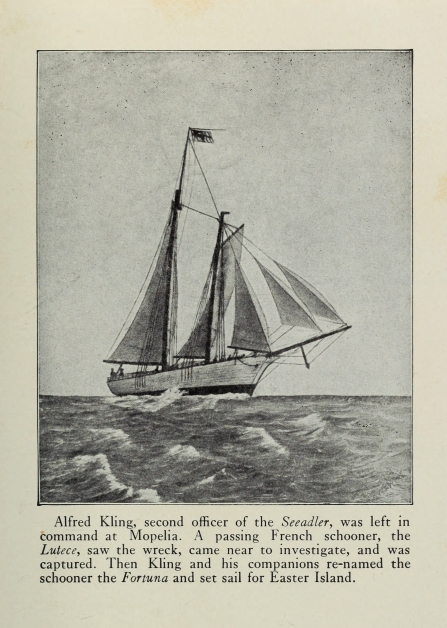
Alfred Kling, second officer of the Seeadler, was left in command at Mopelia. A passing French schooner, the Lutece, saw the wreck, came near to investigate, and was captured. Then Kling and his companions re-named the schooner the Fortuna and set sail for Easter Island.
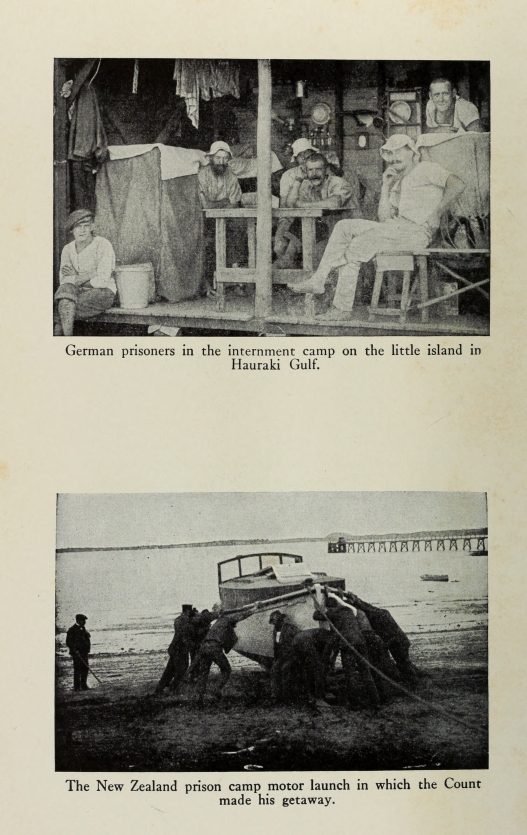
German prisoners in the internment camp on the little island in Hauraki Gulf. The New Zealand prison camp motor launch in which the Count made his getaway.
The resident, with his inscrutable President Wilson face, invited me to his house for dinner. I accepted. A British merchant named Low invited my lieutenant to his house. We suspected it was a dodge to separate us. Seemingly, the Norwegian's assurance had not fully allayed the mistrust of these uneasy Britons. Kircheiss and I made every excuse we could to keep together, but the hospitality was so pressing that we could not refuse any longer without practically giving ourselves away.
"Even if we are apart," I said to Kircheiss on the side, "we have our pistols and hand grenades, by Joe. We will keep our eyes open, and we can take care of ourselves single-handed. If anything looks wrong, we will fight our way to the boat."
At the resident's house, a fine stone structure, I had a much-needed bath and shave. When I rejoined him, the resident studied my smooth jaws.
"Why," he exclaimed, "you are shaved."
"Yes, thanks to you, and I feel a hundred per cent. better."
"But one doesn't shave on a sporting trip, does one?"
He did not believe in anything, that Englishman. He was a true sceptic.
We dined pleasantly enough. The resident talked a lot, although he did not seem to be naturally a talkative kind. He asked me many questions, which I answered cautiously. A native servant brought him a note, and he scribbled a note in return. After a few minutes, the servant brought him another message, and again he answered it. This happened several times.
"Important messages?" I asked.
"Oh, no," he replied hastily, "they are from my friend Low. He wants to arrange to have us all take coffee at his bungalow."
It was very queer. I was prepared, though, and thanked my stars for the pistol and hand grenade in my pockets. I learned later that their scheme was, in fact, to question Kircheiss and me separately. The purpose of the notes was to arrange questions to be asked of us, so that they might check up our separate answers to the same questions. These answers, it happened, had jibed fairly well, although not well enough to disarm suspicion altogether.
I thought it an imprudent time to ask when a ship might be expected, and hoped that some voluntary information on the subject might be vouchsafed. None was, however. I resolved to let the subject wait. People suspected of being a boatload of armed Germans might too readily be suspected of being interested in the arrival of ships.
When the time for leaving came, the resident told me that, if we would return on the following day, he would give us the certificate we desired, certifying that in the course of our sporting voyage we had called at the island of Aitutaki. The delay about the certificate was, of course, to detain us a day longer.
Away from this unsatisfactory interview, we encountered the Norwegian carpenter who informed Kircheiss that the natives believed we were Germans. The British had been recruiting soldiery among them for service in France, and for the purpose of getting recruits had stirred them up with a bit of war fever. The islanders therefore hoped that we were enemies so they could seize us. They planned to get our boat ashore and capture it. Upon hearing of this, I ordered that two men be on watch all the time, ready to repel any attack.
"Any ships expected in port?" Kircheiss asked the carpenter.
"There may be one to-morrow," was the reply, "or it may not be here for a month."
We held a council of war that night. Should we sail straight on? That would make them certain that we were Germans, but there was no wireless station on the island, and they could not warn the other islands until a ship arrived to take away the news. Or should we capture the island, which we could easily do with our extensive armament, and then wait for a ship? Or should we still try to convince the resident that we were the Norwegian sportsmen we pretended? This latter temporizing measure we adopted, and decided to call on the resident the following day and try to get our certificate from him. In preparation for the visit, I instructed the men who remained behind to be ready for trouble ashore. If we needed them, they would hear a pistol shot. They should immediately open fire with machine guns and hand grenades. They should shoot into the air and throw the grenades into the water, where they would make the most noise. The row would create a diversion, and then they should hurry ashore with machine guns, rifles, and grenades to rescue us if need be.
The following day provided us with plenty of thrills. When Kircheiss and I went to the resident's house, crowds of natives followed us. The resident greeted us with a worried expression but came straight to the point.
"I shall have to examine your boat and papers," he said sternly.
"How so?" said I.
"The natives think you are Germans. I know you are not, but I must inspect your boat to satisfy them."
He vacillated between the desire of not letting us get away and the fear of a fight.
Outside, the Polynesians were gathering from all quarters. They made a menacing, ugly-looking mob. Left hand in pocket, I attached a carbine hook to the fuse of the grenade. With that mob of heathens on the rampage, there was no use in trying to carry the deception any further.
"It is true," I said to the resident, "we are Germans. But don't you think it would be better if we remained friends? We are white men. I am with you in front of these natives. Act the part that will impress them. Come and examine our boat."
"Very well," he replied, growing pale, "but you won't take me with you?"
"No, upon my word, no."
When we stepped out on the porch, the islanders raised a howl. I never thought there were so many Polynesians in the world. I had never before stood in the face of a mob. Sailors or soldiers would not have made me so afraid.
"Don't be a coward," I said to myself. "On, by Joe, on."
Kircheiss and I stayed close together. The resident led us through the mob, which was overawed by his presence. We were halfway to the boat when a native in Colonial uniform stepped up. He had seen service with the British in France, we were afterward told.
"Shall I arrest them, sir?" he asked.
"Arrest what?" I shouted. "Shut your trap. Why should a fool like you try to arrest Norwegians?" Then I muttered to the resident: "If that fellow makes any fuss, I'll shoot him dead."
"Don't talk that way," he replied nervously, and waved the native soldier away.
The crowd followed us to the landing. A small rowboat picked us up.
"You won't keep me with you?" the resident asked again.
I assured him that we would not. So we rowed over and climbed into my boat, impelled less by his own desire than by the attitude of the natives.
"Here is the log," Kircheiss, with an impassive face, handed him a log we had taken from one of our captured ships. He perfunctorily turned the pages and came upon a chronometric diary we kept in the book. Above was stamped in fat type: KAISERLICHE MARINE.
"What is that?" he stammered.
"Something in Norwegian," Kircheiss grinned sardonically. "I don't understand it."
The resident saw: GAND UND STAND.
"What language is that?" This time he was a trifle ironical.
"Oh, Norwegian, of course," said Kircheiss.
The resident raised a tarpaulin, but dropped it quickly. He had seen rifles. He raised another. There were neat rows of hand grenades, as easy to pick up as apples.
"Keep those covered," he exclaimed, as pale as ashes.
"Well," I asked, "how do you find everything?"
"Quite all right—quite all right." He smiled a very acid smile.
"Won't you tell your people here that everything is all right?" I suggested.
He turned to the crowd on the pier.
"Everything is in order," he called. "These gentlemen are Norwegian sportsmen, as they say."
"And now the certificate," I reminded him.
He wrote a note just as the resident at Aitu had done.
"You don't intend to take me with you?" he repeated.
"No," I responded, "but I should like to have your company until we can get some fruit and tobacco."
I stood chatting with him on the pier while Kircheiss went to procure the fruit and tobacco. Hadn't we better take the island and wait for a ship instead of sailing off? I debated the question with myself, and then decided we had better go.
The last scene of this little drama was played as the resident and I shook hands and bade each other an apparently cordial farewell. He was a decent fellow, even if he had been suspicious, and I had eaten an excellent dinner at his house. I was glad that we didn't have to humiliate him before the natives, a dreadful fate for an Englishman.
As we hoisted anchor and raised sail, a cheer went up from the natives lined along the shore. They were trying to make amends for having treated us so shabbily and for having taken us for Germans!
But there at Aitutaki I had made the great mistake of our cruise. We should have captured that island. Three days later a schooner arrived. We could have taken it, rejoined our comrades, and continued our raids. Instead, the resident told the officers the story of our visit. The schooner sailed the next day and in a little while met a steamer to which it transferred the news about us. The steamer in turn radioed a warning to the whole South Seas. So we were now in for a warm welcome.
XXVII THROUGH A SEA OF FLOATING BRIMSTONE TO FIJI
At Rarotonga, another island of the Cook group, we had a fright. By Joe, we were scared. It was night. We suddenly saw, right before us, in the shadow of the shore, a big steamer. She had no lights. She must be an auxiliary cruiser. Hard on the helm and every stitch of canvas up. We turned and sailed the other way as fast as the wind would carry us. We expected every moment to be spotted by their lookout and then see the ghostlike searchlight beam fingering toward us through the dark.
"Our luck is with us," I said to Leudemann, when finally we were far enough out at sea to consider ourselves past danger.
Months later, while discussing our adventures with a group of ship's officers, I was told by one of them that the supposed auxiliary cruiser that had frightened us at Rarotonga was really nothing more than a wreck. Several months before our approach to the island, a steamer had gone aground on a reef just offshore, and had been abandoned. The position of the wreck was such that at night it might readily be taken for a ship lying at anchor.
But we had decided when we got well away from Rarotonga that the Cook group of islands was no place for us. At Atiu we had found no ship to capture. At Aitutaki no ship either, only a lot of trouble, including the misfortune of being recognized as Germans. And now at Rarotonga we had nearly sailed into what we supposed to be an auxiliary cruiser in the dark.
"By Joe," I said to the boys, "we'd better clear out of here and try our luck in other waters."
"Aye, but where? The Fijis?"
"The Fijis," I responded. "We'll find plenty of ships there."
We had all along figured that we might have to go to the Fiji Islands, where a constant stream of sailing ships was always taking aboard copra for the munition factories in the United States. But we also were fully aware that sailing in a little open boat from the Cook Islands to the Fijis might easily be a perilous venture. Our voyage so far had gone fairly smoothly. There had been no hurricanes, and we thanked God for that. Our itinerary from our starting point at Mopelia in the Society group to the adjoining Cook group and among the islands of the latter represented jumps of several hundred miles each and quite a few days at sea. On to the Fijis, however, meant a sail across twenty degrees of longitude. The first half of the jaunt, or about a thousand miles, was over a vast open space of sea where there were no islands on which to find fresh food or on which to take refuge in case of need. In fact, we were to sail for thirteen days out of sight of land. We had expected, when we left Mopelia, that the leg to the Fijis would be a hard one, even if we had fair weather all the way. But now the weather turned against us for a whole week, and we began to think we had run across St. Swithin's day. We had forgotten—if we had ever known it—that this was the time when the equinoctial storms broke in those waters. Had we known it, we never would have headed for the Fijis.
For ten days we sailed through a drenching downpour, the rainy season. The sea was choppy. The wind whipped the spray and the crests of waves over us in driving sheets. In our cockleshell, things were afloat, and it was bitter cold o' nights. We threw our mattresses overboard. In their soaked condition they were far worse to sleep on than the wet planks, and there was no use keeping them any longer. When the sun occasionally shone, our drenched clothes would dry quickly and stiffen like boards of salt. They rubbed and scratched the skin off our bodies. When they got wet again, which they promptly did, the salt would soak into the raw flesh and inflame it. Our bodies felt as though they were on fire. We had no regular sleep. Instead, a man would doze away suddenly at almost any time. Even the helmsman would drowse off like that, and, with a free rudder, the boat would veer around crazily.
One morning, when dawn came, we could hardly believe our eyes. The sea had turned from its normal blue to yellow. On scooping up a pail of it we found a scum that we concluded must be brimstone and ash. We were sailing through a field of brimstone. For three days we saw from horizon to horizon this yellowish expanse of volcanic dust. It no doubt came from some submarine eruption, perhaps the one we could thank for the tidal wave that had wrecked the Seeadler. The waves carried the gritty dust into the boat. It penetrated everything. Every surface became like sandpaper. Our skin grew rough and caked with it. Our blankets were like sandpaper, and so were our clothes.
As the voyage grew longer, we had to be more and more sparing with our drinking water. The supply began to run low. We could no longer collect rain water in our sails. They were coated with salt. We tried to wash them out in the rain, but then the spray and the waves kept washing in and kept the sails salty and added a further salting to any water we collected. Our supply of fruit that we had picked up in the Cook Islands ran out now, and about all we had left was hardtack, not in itself a thirst-quenching kind of food. We also had a side of delicious bacon, but of course we dared not touch it for fear of increasing our thirst. You have often heard of the torments of thirst at sea? Well, they are not exaggerated, for exaggeration is impossible. When the rains stopped and the blazing tropical sun beat down on us all day and we still had days to sail on and on, then the torments of the damned, the torments of thirst smote us with a fiery agony. Our gums dried out and were like rough iron. We sucked our fingers and gnawed at our knuckles to bring a flow of saliva and refresh our burning mouths.
And then came the sailor's worst enemy, scurvy. Our diet of hardtack, lack of exercise, and general hardships brought it on. Our knees swelled up so badly that we had to cut our trousers. The rocking of the boat knocked them together or against the wooden sides, and then the pain was almost unendurable. Our lips were black and broken. Our tongues were swollen and hard. It was as if you had a stone in your mouth. Our gums became snow white and seemed to recede. Our teeth felt as though they were sticking far out of our jaws. They hurt constantly and were loose and felt as if they were going to drop out. With these shaking teeth we ate our hardtack. I never before knew how hard hardtack was. We had unending headaches, and it seemed as if something were pressing our eyes right out of their sockets. We got water in our legs, and could hardly stand any more. We had to slide around the seats to do what had to be done in navigating the boat. In scurvy, the blood turns to water, first in the legs and then upward. When it reaches the heart you die. Where the blood is water the flesh is white, and you can see the line of the white creep slowly up. We wondered who would be the first—the first to have the line of white rise to the heart. My boys made marks to show the line clearly and mark its daily progress upward. It was a kind of sport. It was keeping a daily log, a log of death. Parmien was the youngest of us, but he seemed to be on his way to win the race. The line was higher on him than on the others. He joked about it. There was nothing terrible in it. We were all in a deep apathy. Our brains were like balls of cotton. Nothing mattered, certainly not death. Death would come, we thought, as a relief from these sufferings. The prospect of its arrival became more and more attractive.
"Boys," I said, "let us take pieces of ballast iron and tie them around our necks. One plunge and in a few seconds all of our pains will be gone."
"Yes. All right." There were mutterings of assent.
But Parmien, the youngest, the one who was nearest death, picked up the comic volume, Fritz Reuter's Trip to Constantinople, and began to read a funny story. We all laughed. That book had eased many a hard hour before, on this ghastly voyage, and now, perhaps, it saved our lives.
And so we continued on with but one instinct left in us, the sailor's instinct to navigate his craft. Mechanically, without any particular hope, without any particular thought, we trimmed the sails, guided the helm, and calculated our position as best we could. Nautical science was at a low ebb among us now. We were too far gone to reckon exactly where we were, and were only vague in our steering. All we knew was that we should steer to the west where the island groups were.
You have read in many a sea story about the delight, the almost insane ecstasy, of castaway men adrift in open boats who are dying of hunger, thirst, and disease, when, at last, a rescuing ship approaches or they see land. No matter how the writers describe it, even the greatest of writers, they can tell you only a tiny bit, only a grain of sand. So, I won't try to say how we felt when we saw a speck on the horizon and the speck grew bigger and turned into the familiar green of a tropical island. We had been so much like dead men, who had thought that nothing could ever make us glad again. By Joe, that sight gladdened our hearts, though. We grew even weaker, but it was the weakness of happiness. As we drew near, we thought of nothing but land, fresh water, and soft food, a soft banana, for our loose, shaky teeth. Never mind ships or capturing ships. Never mind being taken prisoners. We headed straight toward a crude pier that stuck out into the water.
A crowd of a hundred natives, perhaps less, were gathered at the landing place watching our approach. They were ferocious-looking black warriors. We had now passed from the region of the brown, indolent Polynesians to those of the black, warlike Melanesians.
"What ugly customers," I said to Leudemann. "They look like cannibals."
The forbidding battle array on shore stirred a new strength in us. It certainly looked like a cannibal island, and miserable as we were, still we could not escape the thought of our skin and bones being fattened up in preparation for an old-time South Sea banquet.
"Clear the boat for action!" I ordered. Even in our present straits, we could still remember our old naval ways.
The German flag went jerking to our masthead, and rifles and machine guns were displayed.
A shout went up on shore and a babel of talk. Voices yelled in pidgin English.
"You Germans? How you get here from way off? Come on. Germans great warriors."
Still wary, we drew near the landing pier and talked with the natives. They were unmistakably friendly, very cordial. From what they told us they had, in the first place, grievances against their masters, the British. Then quite a number had been recruited and sent to the trenches in France. There some had been killed and some wounded, and most who survived had contracted tuberculosis from the unaccustomed climate and had been returned to the island worn-out shells of men. One of their most influential chiefs was particularly concerned about the war. He was on the pier, and he reasoned thus:
"White man send missionary. Missionary say we must not fight. Because all men children of God. All men brothers. They say we can have war no more. Then they say we must go fight. They have war. We no fight for ourselves, they say, we fight for them. How, if men are brothers? Our men killed. Our men come back sick with cough. Cough never goes away."
These people were of a warrior race. What the British had told them about how bad the Germans were had not made much impression. What stuck in their minds was the fighting power of the Germans. They had heard about it from the British, and those who had been in the trenches of Flanders knew about it first-hand. The sudden appearance of armed Germans at their remote island could but increase their admiration. Morality among them had principally to do with a man's fighting spirit.
They said there were no white men on the island, and we longed to go ashore. With our scurvy-swollen legs we could hardly stand, however. It wouldn't do to be hauled ashore as cripples. It would not increase these warriors' respect for Germans as fighting men: Cripples do not fare well among savage peoples, and we thought it best not to reveal our impotence. So, we refused the natives' invitations to partake of their hospitality, told them we must hurry on to fight the British, and asked for fresh water and bananas. They brought great gourds full of water and bunches of bananas. We drew up to the dock and they handed these precious supplies down for us.
We had our fill of bananas and water, and, with shouts resounding from the shore, set sail again. This lucky spot was Niue, an outlying isle of the Fiji group. The sun blazed down upon us, but a fair wind carried us along briskly. The first day after leaving Niue we felt better. The second day we were on the road to high good health. It is amazing the curative effect of fresh fruit, especially bananas, when you are suffering from scurvy. They seem to put new life and blood into you and draw the sickness right out of the body as though some huge and marvellous poultice had been applied.
Our cure was completed at the isle of Katafanga. It is quite a large isle and inhabited by more natives. But we hit upon a stretch of shore that seemed permanently deserted. At any rate, we remained there for five days and saw not a soul. When we went ashore, we all walked with a comical staggering gait. You know the characteristic rolling gait of the sailor accustomed to having a deck under his feet? Ours was an exaggeration of it. After two weeks in our constantly pitching boat and never a foot on land, we could not get our legs used to solid, unmoving earth. Even after five days of extensive pedestrianism on the beach we rolled along rather than walked. There was plenty of fruit around, and many streams ran down to the sea. We ate enough fruit to expel all the scurvy in the world and bathed luxuriously in the clear water.
On the island was a deserted house. We inspected it and saw that it had been owned by a German planter. We afterward learned that, at the outbreak of the war, the planter fled to the interior of the island, and an Englishman had taken possession of his house, then, not liking the island, had left it pretty much to itself. Among the rubbish in the house was a German mercantile magazine, and on the first page that I turned to I saw an advertisement of the paint firm of Erdmann and Kircheiss. One of our sailors was named Erdmann and my lieutenant was named Kircheiss. No relations of the paint firm, but we took it as a good omen. At any rate, coming upon the planter's house was certainly good luck. It had gone to seed a bit, but there still were Christian beds in it. For the first time since sailing away from Mopelia, we slept comfortably, and between sheets, too.
We were now getting near the larger islands of the Fiji group, where the sailing ships loaded with copra would be encountered. If we did not succeed in capturing a ship here, we never could hope to capture one. We found a handsome little sailboat belonging to the Englishman who had taken over the German's house, but we left her where she lay. She was more comfortable than our battered old lifeboat—but the latter was a last relic of our old Seeadler. She had brought us this far, so we wanted to keep her until we had captured a ship. We raised sail, knowing that, for better or for worse, we were on the last leg of our voyage in the lifeboat.
We came to the main body of the Fijis, and sailed into a large gulf surrounded by distant islands. It was night, and we decided to wait till morning to see how many ships were passing and what island they were bound for. We reefed our sails and threw out our sea anchor, that sacklike drag of canvas that keeps a boat from turning broadside to the wind and waves and from drifting too fast. We lay down for a decent night's sleep. We would need all our energies for the morrow.
A sudden shout. I awakened. It was just daybreak. Straight ahead was a wild white line of surf. It broke over a long, low coral reef, and just behind it was a high cliff. We had run into a strong current during the night. Krauss had awakened just in time to see that it had carried us perilously near the reef. The wind was sweeping us toward the breakers.
"Raise sail," I shouted.
We scrambled frantically and raised the canvas. The wind was inshore. We could not head into it. We were being blown slowly, inexorably on to the reef.
People accustomed to the surfs along ordinary coasts have no idea of what breakers are like off the islands of the South Pacific. The surf all over the Pacific is particularly strong. But when it breaks over a mid-oceanic coral reef nothing can live in it. The strongest swimmer is sure to be dashed to pieces against the jagged coral.
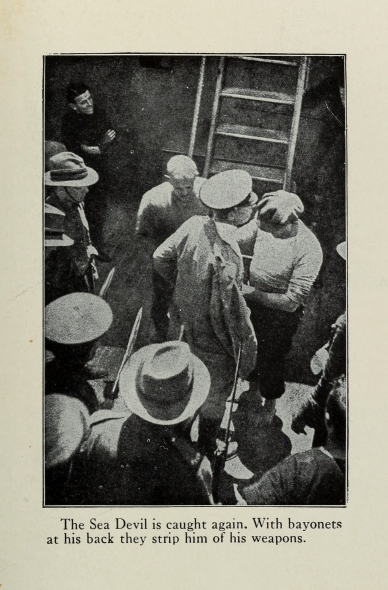
The Sea Devil is caught again. With bayonets at his back they strip him of his weapons.
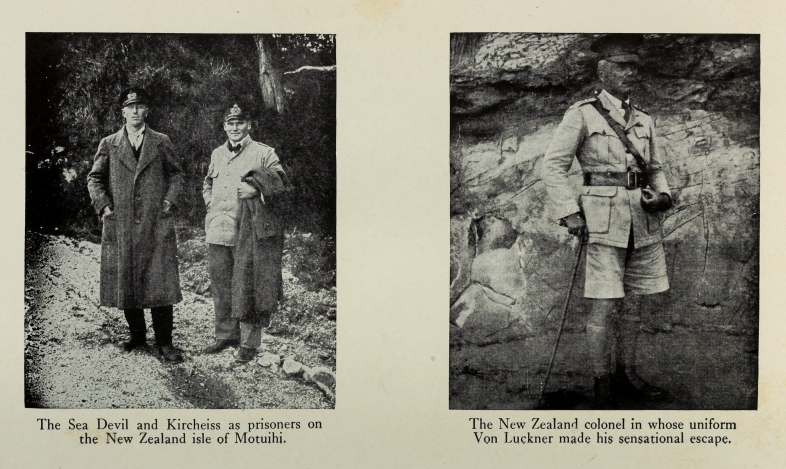
The Sea Devil and Kircheiss as prisoners on the New Zealand isle of Motuihi. The New Zealand colonel in whose uniform Von Luckner made his sensational escape
And there wasn't the slightest hope of our moving against the wind and backing away from the reef. Slowly, slowly we were nearing it. The breakers roared like thunder. In a few moments, we would be flung into that death trap of water and coral.
Pistol in hand, I shouted something to the effect that I didn't intend to be ground to death by the breakers on that jagged coral.
The others looked for their pistols. One could not find his. Between the pull of the current and the power of our sails, we were drifting along the reef, edging toward it. The wind gave us an extra push. We were in the backwash, only a few yards away from the breakers. And still one man could not find his pistol. Instinctively, we all waited. And that was what saved our lives. Suddenly we saw the reef drop away, slanting back at a sharp angle, and a moment later we were drifting parallel to the coral.
It was then that I discovered there were two kinds of breathing. In times of terrible danger, the breath comes in short, quick puffs. The danger gone, you breathe deeply. By Joe, when we got clear of that reef I breathed such a breath that it seemed to go right down to my heels. I sat looking at my boys' faces. When we got our pistols ready, their faces had set tense, as if cast from bronze. With the danger past, their faces held the same set expression. It was an hour before their old expressions came back again. Two of my fellows found patches of gray in their hair afterward. (Maybe they had been there for years only to be discovered now!) Another's leg was absolutely blue in spots. In those frightful moments he had, without knowing it, grasped his thigh in a clutch like a drowning man. I tell you, by Joe, it was the hand of God that put the curve in that reef! When one of the boys, I don't know which, said in surprise, "We are clear!" I knew it was the hand of God.
XXVIII CAUGHT BY THE BRITISH AT WAKAYA
The island was Wakaya. Several old sailing ships were in the harbour. We gazed at them with hungry eyes, and eager plans of capturing one ran through our minds. Natives on shore spied us, took us for shipwrecked sailors, and put a boat out to meet us. It suited our plans to let them go right on thinking we had been shipwrecked. That might make it much easier for us to get some information about the vessels at anchor. Leaving a couple of my boys in the boat, the other four of us accompanied the natives to their huts, where they treated us hospitably. They were a simple, trusting people. Several half-breeds and a couple of white men, however, looked at us suspiciously. One half-breed was particularly offensive and insisted on asking us many questions. We did not like his behaviour at all.
Kircheiss and I took a walk along a path in the woods to talk over what seemed another menacing situation. A white man came galloping by on horseback. He was pale with excitement. He slowed down for a moment, gazed at us, responded curtly to our greeting, and went on. Thoroughly alarmed, we hurried back to the village. Some curious business was afoot, and we were determined to find out what it was.
"Our last half gallon of rum," Kircheiss murmured regretfully.
"Yes," I responded, "it is too bad, but it will go to a useful purpose."
We got hold of the half-caste who had been so inquisitive. The white man we had seen on horseback was with him. Something, indeed, was afoot. We talked casually with them and then suggested drinking. They were interested, and became enthusiastic when we produced our half gallon of rum. In the half-breed's hut we staged a drinking bout, which lasted half through the night. Nothing like rum to make men friendly and conversational. The half-breed got so conversational that he blurted out,
"Why, you're all right. But at first we thought you were Germans. We could get fifty pounds if you were Germans."
Now, as an American sailor would say, you've got to "hand it" to the English. They know how to spend money when it is useful. We Germans are usually more niggardly, or "careful" some might call it. We will try to save a mark and then lose thousands. Having received the wireless warning from the resident at Aitutaki of mysterious armed Germans in the South Seas, the authorities in the Fijis had passed word among the natives to be on the lookout for us, and had offered a two-hundred-and-fifty-dollar reward to anyone who turned in definite information about a party of Germans posing as neutrals.
It was clear enough that the half-breed and the white man had been plotting to hand us over to the authorities, but how far they had gone we did not know. We didn't find out that night. It was not until later that we learned the white man's horseback ride had been to give a warning about us to the captain of a cutter in the harbour, and that the cutter had at once shoved off to carry the message to the officials on one of the larger islands a day's sail away. Not knowing this, we used a good deal of persuasion to put the idea firmly into the heads of the two men that we could not possibly be Germans. It may have been our eloquence, or, more likely, the genial influence of the rum, but, at any rate, they seemed to lose all of their suspicions and became convinced that we were the truest Norwegians from Scandinavia. Kircheiss and I, somewhat the worse from our session at detective work, slept at the Englishman's house.
The four others were offered quarters ashore for the night, but two of my boys remained in the boat as a precaution. It was well they did, too. During the night, native swimmers went out to her and cut the anchor rope. They were put up to it by a Malay police officer who was suspicious of us. Not knowing any or my men would remain on board her, since she was only an open lifeboat, he planned to search her. So he sent his swimmers out to pull her ashore and beach her. The wind was inshore. The anchor rope cut, the boat drifted in. Our two men were asleep, and only awakened when keel jarred against bottom. Dark figures were around in the water, trying to pull the boat on the beach. Our men, pistol in hand, drove them away and then pushed out into open water.
On the following day, we made our final costly error. The ships in the harbour weighed anchor and raised sail. We picked the one that seemed the newest and arranged with the skipper to take us along with him to Suva, on the main island Viti Levu. Of course, our plan was simply to sail a few miles out to sea with him and then take the ship ourselves after donning our uniforms and getting out all of our weapons. A sudden squall blew up and forced the vessels back to port. We returned with her. And now we should have taken her while she lay at anchor. The people ashore would have seen what was going on, but we could have held up the island and then put to sea, storm or no storm. That was our first impulse. We should have followed it. Always trust your first impulse—at any rate, if you go into the pirate business. It is the boldest and best. Instead, we chose a more cautious course. Prudence ceases to be a virtue when you are on an adventure like ours. We had been bold enough heretofore, and I have no satisfactory explanation for our caution now. It may have been that we were not quite ourselves. Our voyage down from the Societies and the Cooks to Fiji, with those days of hunger, thirst, and scurvy, had sapped our strength and vitality. Perhaps, although we felt quite well, we had not yet got back our full vigour of body and mind. Perhaps we were low on red corpuscles. At any rate, we resolved to wait until the following day and capture our ship when it had got out to sea. While we waited, another vessel arrived.
She was a beauty, too, and would have delighted any seaman's eye as she came sailing into the harbour. She had just arrived, we were told, from Suva. She ran regularly among the islands, carrying merchandise to the traders. She was a handsome three-masted schooner with auxiliary motor power, new, clean, and trim, just the kind of ship we wanted.
"By Joe," I said to my boys, "there's our ship."
We immediately dismissed all idea of the old windjammer we had intended to capture, and devoted ourselves to this new beauty. A council of war was held, after which Kircheiss went to the captain of the vessel, which now had docked, and told him that we were Norwegians who, while making a cruise in a lifeboat, had missed our ship, which was taking coal from Australia to Suva. Could we not take passage with him to Suva instead of on the other slower old craft, so that we could get back to our own ship? We would pay regular rates for the passage.
"All right," replied the captain, a jovial, unsuspecting fellow. "Come aboard at eight o'clock this evening. We sail in the morning."
It was our plan again that, once aboard this lovely ship and out at sea, we would suddenly appear in our uniforms and hoist the German flag.
We made ready to abandon the lifeboat. Our belongings required careful packing. We put rifles, machine guns, cartridges, and grenades in our canvas bags, wrapped our naval uniforms around these, and then rolled each bundle in a couple of blankets and tied it securely. A casual handling would not reveal the armament inside. Each of us took a pistol in one pocket and a hand grenade in the other. At eight o'clock we went aboard the schooner. Our manœuvres had been made carefully, and we had attracted no undue notice of the people who were suspicious of us.
Aboard, the captain received us hospitably, and we went around looking over what we expected to make our next prize of war. And a prize she was, just a year out of the shipyard and beautifully finished in every detail.
"Look at the saloon," I muttered to Leudemann as we wandered around, "think of what meals we will have here. No more hardtack with loose teeth to bite it. And look at those cabins. Won't those bunks be comfortable when it blows and rains? And what a fine big level deck to walk on, so different from the bottom of our lifeboat."
The schooner had two new motors capable of driving her along at a lively clip. They would enable us to cover a lot of the wide Pacific and run down many a copra-laden clipper.
The captain told us he had aboard a miscellaneous cargo of cloth, white shoes, helmets, silk underwear for the wives of planters and traders, silk stockings, and so on. He was provisioned for a cruise of six months, and had aboard large stores of preserved fruits and vegetables and six thousand pounds of fresh meat. I said to myself:
"Just what we want, by Joe."
Here was the perfect prize. What would our comrades marooned back there on Mopelia say when we turned up with this beautiful schooner in tip-top shape, with powerful motors, well-provisioned and all? Already we could hear the lusty cheers, as, with the German flag at our mast, we drew up and cast anchor off the coral reef. I looked up at the trim masts and spars and around at the freshly scrubbed woodwork of the deck and spoke silently to the schooner, calling her by a new name.
"Ho, there, Seeadler-the-Second! You'll like it as an auxiliary cruiser. We'll have a lot of fun together, by Joe."
I could hardly wait for her to raise anchor and set sail. But we had counted that brood of mental chickens before they had hatched, by Joe.
A steamer slid into port!
The skipper of our clipper who was standing next to me said he supposed she had brought over the proprietor of the island. The new arrival lowered a boat. In it were a military officer and four Indian soldiers. The boat rowed straight toward our ship. We surmised at once that they were coming for us. Having received the message sent by the suspicious half-breed and the white man that there were six Germans on the island, the authorities had sent a force of military police to arrest us. There had been some delay in this, as the only available boat on which to send the police was a cattle steamer, the Amra, and she could not raise anchor for some hours. She had arrived now right in the nick of time, had communicated with the shore, and been informed that we were aboard the schooner.
The storm had cleared during the early morning. The palm trees ashore were ablaze with the tropical sunshine. The water under us was of the deep blue that you see only in the South Seas. A brisk, refreshing wind blew from the west. The boat with the officer and four soldiers came rowing with long, powerful strokes. The Indians wore puttees and those funny little pants that leave the knees bare. They carried no arms other than bayonets. The officer had a sword and a revolver. We could easily have shot them down with our pistols, or thrown a hand grenade in their boat, or held them up at pistol point when they came aboard. Then we could have captured the ship and sailed away. The steamer would have been powerless in the face of our machine guns. There were mutterings among my men. They were full of fight. We should, they urged, make the capture and get away.