Front matter (continued 4)
Reading edition
When she got back to Canada, she gave the newspapers long stories about her stay on our terrible pirate raider, the Seeadler, and told what a delightful time the freebooters had shown her. When I returned to Germany after the war, I found an envelope full of clippings from her awaiting me.
We lay in the waters off Africa five degrees above the equator and thirty degrees west longitude. That region is right on the path of all sailing ships that run before the southeast trade winds and head north. The weather is seldom bad there, the air is clear, and from our masthead we had a range of vision of thirty miles.
A Frenchman, no doubt of it. The ship was scrupulously clean, her rigging trim and neat. Her hull was decorated artistically with gunports, after the manner of an old-time war frigate. Only the French keep their ships so thoroughly shined up, and there was one firm of French shipping owners whose custom it was to decorate their vessels man-o'-war fashion. She was the four-masted brig Antonin. We came up behind her diagonally, and then after her. Our motor was having one of its off days, but we did not care. What's the matter with canvas? The Seeadler was one of the fastest clippers ever turned out by an American shipyard, and there was nothing I liked better than a race under sail. We'd see if this Frenchman could outsail us. Fine chance he had. But if he did not exactly outsail us, he sailed with us. We could not gain on him. That bark was fast, and so we went on, mile after mile, quite evenly.
A sudden wind squall arose. It blew like a fury. The captain of the Antonin was a sensible skipper. He immediately lowered sail, took in his royals and upper gallant sails. That was where we had it on him, for we had no miserly shipowner to be afraid of. Our masts wouldn't break, anyway.
"Keep every stitch on, boys! After her, my hearties!"
Of course, we gained rapidly on her now.
The wind continued to howl. The gale raged, and the captain of the Antonin thought we were quite mad. Gallants and royals up during a wind squall—he had never seen such a thing in all his days at sea. The sight was so funny that he wanted a picture of it. We watched him, standing in the stern of his ship and gazing down into the finder of his camera.
"Leudemann," I said to my helmsman, "we must capture that snapshot for our collection of photographs, if we have to take a trip to Davy Jones doing it."
We were attempting to keep a thorough photographic record of our cruise, for the Imperial archives, and a picture of the Seeadler running with all sails set through a squall, particularly if that picture were snapped all unwittingly by the captain of a prize, would indeed be a gem for our collection.
We were close behind the Antonin now. The captain's picture seemed to have been satisfactorily snapped. A machine gun began to rattle. We were often bored during those long days at sea. Anything for a bit of amusement. It would be funny to watch that captain's face when he heard the typewriter of Mars rattling in his ear and when he saw us sending a stream of lead through his rigging. First he started, and then he glared. What did these lunatics mean? This kind of insanity was too much. His rigging might be injured, ropes cut or spars smashed. He began to roar at us in the most profane French. When a Frenchman swears, you can hear it far off. Then he saw the German flag at our masthead. He staggered back with a dramatic gesture that only a Frenchman can achieve.
We sank the Antonin just as we sank the others, but first we seized that kodak and roll of film, by Joe.
We added another Allied nation to our list of prizes when the Buenos Aires came bowling along. She was an Italian ship built in England, a fine vessel but filthy dirty. Everything was untidy from stem to stern. Her captain, a fat, unkempt man of about fifty-five with a bristly moustache and a month's growth of scraggly stubble on his face, came aboard the Seeadler carrying an umbrella! Can you imagine a skipper of a windjammer carrying an umbrella at sea? We couldn't, and my men all burst out in rude guffaws. I suppose he had it to protect himself during a hurricane, eh? I had once seen a photograph of the Italian commander in chief, Count Cadorna, carrying an umbrella. So we immediately dubbed our new skipper Cadorna. He was a genial fellow, full of good nature and fun. You should have seen his astonishment when he saw the fine quarters we provided for our captive skippers. He never did quite get over it. Apparently, he was better off as our prisoner than he had been before.
We sailed night and day. During the day we tacked south into the steady trades, and during the night we ran with the northeast trade winds. At nights, when we ordinarily could not see them (because in wartime they all sailed without lights even in the Pacific), we went in the same direction as the ships bound for America, so that none passed us, and it was up to us to catch them. During the day, with our zigzag tacking, we were pretty sure to come in sight of any vessel sailing along that shipping lane in either direction.
* * *
One night, our lookout saw a tiny flash of light astern. A ship was coming along behind us, and somebody on her had looked at his watch with a pocket flash. We kept along on our way. No doubt in the morning she would still be close to us. Dawn came, and there she was, a magnificent French barque, the La Rochefoucauld. We signalled her:
"Important news."
She hove to. The captain, who was on deck in his carpet slippers, saw our gun but thought we were the mother supply for a squadron of British submarines. Seeing that he was under some illusion, I decided to have a little fun with him. I called our captured sailors to deck in batches. First up came the Chinamen. They lined up along the rail so that the Frenchman could get a good look at them. Then I called the West Indian Negroes on deck. After them the white men. Now Chinese, now black men, now Caucasians—the captain of the La Rochefoucauld thought he must be having a nightmare. And a most disagreeable nightmare it was when he saw the German flag run swiftly to the tip of our mainmast. You should have heard him swear.
He climbed on to the Seeadler's deck a picture of wrath and despair. He still had on his carpet slippers, and had brought nothing with him. His name was Lecoq.
"Don't you want to send for your belongings, Captain Lecoq?" I asked.
"If I have to lose my ship, mon Dieu, I want to lose everything," he replied.
"You don't want to take anything with you?"
"No, let everything go down with the ship."
I sent a couple of his sailors back aboard the La Rochefoucauld to pack his luggage and bring it aboard the Seeadler.
One of my sailors came to me, saying:
"They met a cruiser a couple of days ago."
My men had orders to circulate among captured sailors and talk with them to see what they could pick up. This sailor had heard mention of a cruiser in the talk of the French sailors.
That was funny. I had asked Captain Lecoq whether he had sighted any ships within the past week, and he had replied no. In his log I had found no mention of being searched by a cruiser. One of my officers examined the log again and found that a page had been torn out. A thorough questioning of the French sailors brought out the fact that they had been thoroughly searched by a British cruiser. This warship had taken her position three hundred miles south of us and was cruising back and forth across the Pacific ship lane, examining every vessel that passed. So you see, we, apparently, were picking them up after she had O.K.'d them. Captain Lecoq had bidden his men to say nothing about the cruiser. Apparently he hoped that we would wander far enough south to run afoul of the Britisher and be captured.
I was momentarily displeased with him for his deception, but, after all, he was a Frenchman, and we were the enemies of his country. His action was a bit heroic, too. If we ran into the cruiser, we might be sunk, and he would go down with us. I was destined to have trouble later with this same irreconcilable Captain Lecoq.
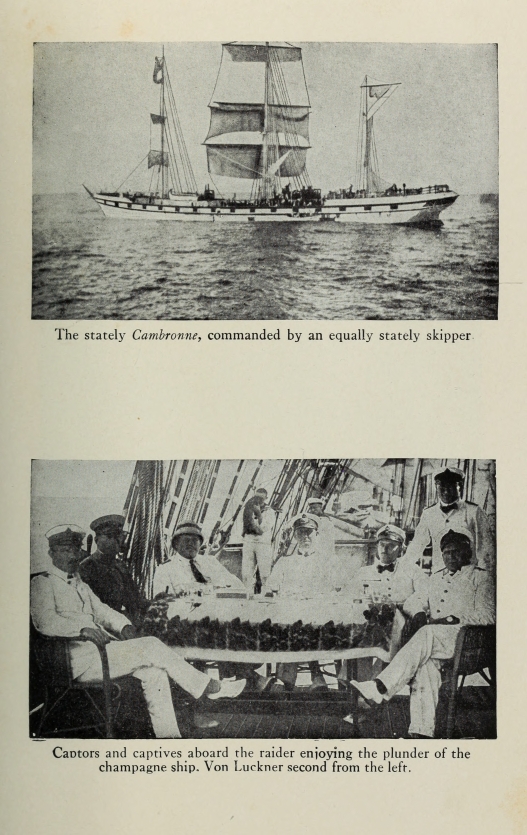
The stately Cambronne, commanded by an equally stately skipper. Captors and captives aboard the raider enjoying the plunder of the champagne ship. Von Luckner second from the left.
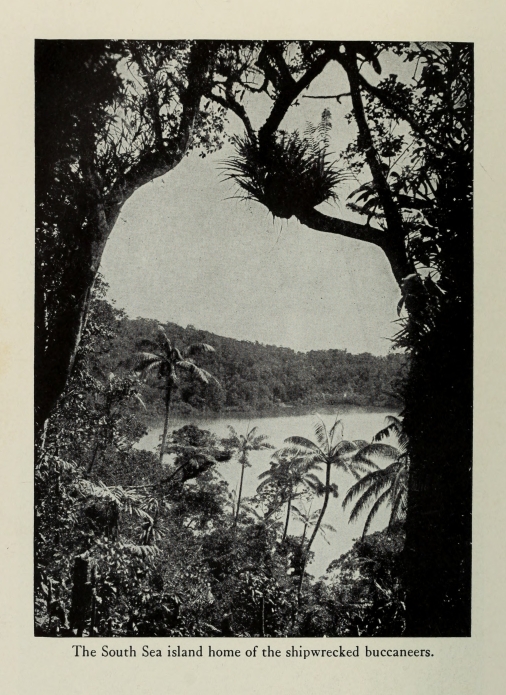
The South Sea island home of the shipwrecked buccaneers.
XVI WINDJAMMER VS. STEAMER
Now the biggest ship we captured in the Atlantic was a 9,800-ton British steamer loaded with champagne—the Horngarth. That was our banner day.
She was well armed and had a wireless. She hove into sight one morning, and we could see that she would make a tough customer for our sailing ship to handle. But why not have a good look at her? We set the signal:
"Chronometer time, please."
The way she paid no attention to the request said very clearly:
"Let that old windjammer go and buy a watch!"
But we had other devices. We had a smoke apparatus to send clouds rolling out of the galley, and on the galley roof was a dish loaded with a quantity of magnesium which when lighted produced a wicked red flame. We set the smoke and fire going, and ran up distress signals. The Seeadler now was the most dramatic-looking ship afire you ever saw. Thirty of my crew armed with rifles hid behind the rail, and Schmidt quickly dressed up as the captain's wife, the beautiful but simpering "Josefeena" of the big feet. We had another piece of apparatus which we now used for the first time. It was a kind of cannon made out of a section of smokestack. It was loaded with a charge of powder, and you touched it off with a lighted cigarette. It was quite harmless but made a terrifying noise. You would have thought it a super-dreadnaught's full broadside. I picked three sailors who had the most powerful voices aboard, gave them large megaphones, and stationed them on the topmast yards of the mainmast and mizzen.
If that steamer was short on courtesy, she was long on humanity. She came rushing heroically to the aid of the old sailship that was blazing so dramatically just astern. She had a powerful wireless set, and as I stood on my bridge watching her as she steamed toward us I could not take my eyes off the five-inch gun on her deck. What was our little popgun beside that piece of ordnance? One shot would blow us right out of the water.
The steamer had a big fat captain, who had his cap pulled down over one eye. His voice, even when he whispered, was a deep bellow. You should have heard it through the megaphone! The steamer drew near. The fat captain raised his megaphone.
"What the hell's the matter with you?" His voice boomed across like the rumble of our old cannon.
We cut off the smoke and flame. It looked as if we had fought our fire successfully. Schmidt, the captain's beautiful wife, tripped along the deck with coquettish movements of shoulders and hips. The officers on the steamer's bridge eyed the fair vision and exchanged smiles with that rogue of a Schmidt. Nor was the fat captain insensible to feminine charms. He rolled his eyes and grinned with the expression of a skipper who can easily "cut his officers out."
"Look at the wireless, Leudemann," I said, "and the five-inch gun."
"Knock the wireless over," he replied, "and let's have it out with the five-inch gun."
"Clear the deck for action," I roared.
Instantly, the beautiful Schmidt threw off his silken dress, and in the uniform of a German gob kicked his blonde wig around the deck. The Britishers stared aghast. The German flag ran up, our riflemen arose from behind the rail, ready to pick off anyone who tried to handle the five-inch gun. Bang, crash, and our gun knocked over the wireless shack. A tremendous detonation, and our false smokestack cannon added its voice to the general effect.
The steamer's crew swarmed on deck and ran around like crazy animals. The captain telephoned his order to start the engines. His engine crew was on deck as panicky as the others. He ordered the boats swung out. His men were already doing that as well as their fright allowed.
"Clear the deck for action," he howled.
That only gave the crew a greater scare than ever.
I shouted to him:
"Lay to, or I will sink you."
I had to admire that captain. The fat fellow dominated the frightened mob by sheer force of lung power. His voice seemed to sweep the deck and master everything.
"Gun crew to their posts. By Joe, you scalawags. Gun crew to their posts, I say, by Joe."
We stood watching. I didn't think he could do it, but the panic stilled. The frightened men stood at a kind of attention. The gun crew separated itself from the crowd. It looked as though there would be a fight, his cannon against our rifles. Well, we could pick them off, and that fat "soul of the situation" would be an excellent mark to shoot at.
We had one more device left. I gave the signal. From the mastheads boomed three voices through the megaphones in unison. The shout was in English and seemed to dominate the ocean to the horizon.
"Torpedoes clear!"
On the deck of the steamer a crazy yell arose:
"No torpedoes, for God's sake, no torpedoes."
Handkerchiefs, napkins, towels, and anything white was waved. The cook frantically waved his apron.
"Lay to," I shouted, "or we discharge our torpedoes."
There was no further sound. The fat captain was licked, licked by the terror the torpedo inspired in everyone who sailed on ships. He made no further protest. He could not have done anything with his men now, but I don't think he liked torpedoes either. He sat down on a deck chair, cursing and wiping the sweat off his face.
We still had to be careful. There were plenty of firearms aboard that ship, rifles, grenades, and what not. I kept our riflemen at the rail, ready to cover our boarding party and to shoot down anyone who went near the five-inch gun. Still with the idea of keeping the men on the steamer overawed, I sent my eight strongest men as the boarding crew under the command of my giant prize officer. They had been among the strongest men in Germany. One was the wrestling champion of Saxony, another the wrestling champion of Westphalia. One, a Bavarian who had been a sculptor's model. He had been in much demand for posing because of his prodigious muscular development. Any one of these fellows could bring up the 220-pound weight with one hand. They went with bare arms and shoulders. They had long bamboo poles with hooks at the end. They reached up with the poles, caught the hooks over the edge of the deck of the captured ship, and climbed up hand over hand. The men on deck looked down as they ascended.
"What fellows, by Joe. No, by Joe, we're not going to fight with those fellows!"
Our prisoners came aboard. Among them were eight British marines who had been assigned to the steamer as a gun crew. The fat captain looked around our deck with a sort of belligerent curiosity. He walked up to our smokestack gun, and you couldn't have told his face from a beet.
"Captain, is that the thing that made that hell of a racket?"
"Yes."
"Where are your torpedoes?"
"Torpedoes? We have no torpedoes."
"No torpedoes? That was a fake, too?"
"Yes."
"By Joe, Captain, don't report that, by Joe."
I promised him I would not report it, and told him heartily that he had behaved like a true British skipper, and no man could have done better.
Aye, things have changed on the sea. When I went aboard that steamer, I had to sit there and look around and think. She was a freighter, and what were freighters like when I was in the fo'c'sle? That wasn't so long ago, twenty-odd years, but ships and customs change rapidly. I was in a magnificent saloon, with heavy carpets, glittering candelabra, and big, luxurious club chairs. Paintings in heavy frames hung on the wall. In one corner was a Steinway grand piano and beside it a music rack. There were other musical instruments, a melodeon, a violin, a guitar, a ukulele. Freighters nowadays often have better officers' accommodations than passenger ships. They have more space for them and their voyages are longer, sometimes a year or more. The shipowners provide comforts and luxuries to make the long periods at sea less burdensome. The sailors, too, are put up in far better style than formerly. In my time, even on the biggest freight steamers, the officers had simple quarters and the seamen had little more comfort than they had on the sailing ships. I remembered the various ships on which I had hauled at ropes and swabbed the deck.
"By Joe," I thought, "if they had told you of anything like this, you would have thought them ready for a lunatic asylum."
The hold of the steamer was no less interesting than the officers' saloon. The cargo was valued at a million pounds sterling. It included five hundred cases of rare cognac and twenty-three hundred cases of champagne, Veuve Cliquot. That was something.
"Ho! boys," I called, "lend a hand. There's a bit of work here."
We took the musical instruments, the piano, violin, 'cello, melodeon, and all. We had aboard the Seeadler a pianist and a violinist, both excellent musicians out of the German conservatories. We had no room in our cabins to hang the paintings, so I gave them to our captive captains to take with them when they left our ship. Some of the expensive furniture fitted nicely in the Seeadler's cabins. Of the cognac and champagne we ferried aboard as much as we could stow away. We opened the sea cocks of the steamer, and she settled down peacefully beneath the waves.
XVII THE LAST CRUISE OF THE POOR OLD PINMORE
One night, the breeze having become light, we proceeded under a cloud of sail. It was a night such as you rarely find anywhere but in the tropics. The four scintillating stars of the Southern Cross twinkled merrily down upon us. Our sails were full, and the waves murmured past our bow. The sky was a gorgeous spread of blinking stars, and Old Man Moon was so bright that he seemed to be laughing and chuckling. The buccaneer's deck was crowded. We sat around in genial fraternity, officers, prisoners, and crew, each with a goblet of champagne. Midship was the orchestra, violin, 'cello, melodeon, and Steinway grand. Perhaps it was the spell of the tropic night, but as I paced the quarter-deck it seemed to me that they played as well as the musicians at the Stadt Opera in Berlin.
"Oh, lovely south wind, blow." The melody drifted along on the wind of the Southern ocean.
How remote the war seemed then! The day was not far when we would be shipwrecked, but to-night all thought of what might be our fate was wafted away by the spell of the music, the champagne, and the poetry of night beneath the tropic stars.
"What ho, a light!"
My night telescope at my eye, I saw a ship. On the horizon, brightly outlined by the light of the moon, stood a stately three-master.
"Hard aport!" We were on the dark side of the horizon, and she could not see us. After a bit of scrutiny as we approached her, we guessed her to be an enemy ship.
Our flash signal flared out across the water. "Heave to—a German cruiser." Unable to make us out, she little guessed that we were nothing more than a sailing ship, from which she could easily escape by slipping through the night. We were confident she would take us for an armoured cruiser easily able to catch her and blow her out of the sea with a broadside.
We waited at the rail to see what would happen. Presently, we heard a splashing of oars. Out of the darkness came a hail, the jolliest hail I have ever listened to. It was in nasal seaport French.
"What a relief! Instead of a Boche cruiser, I find you are an old windjammer like ourselves. But why the joke? Your signal fooled us completely. I suppose you want to tell us something about the war."
I did not wonder at his surmise. Ships long at sea, particularly Allied ships, were always keen about news from the various battle fronts, and it was common enough for vessels to stop and exchange news.
"Come on aboard," I replied. "We have lots of news."
We were in our shirt sleeves, and looked like ordinary seamen. On deck he said proudly:
"I am a Frenchman." As though we couldn't have guessed it.
"A Frenchman? Fine. How is France doing?"
"Ah! France, she is victorious, or will be very soon. Ravi de vous voir."
He fairly bubbled over with delight when we offered him a bottle of champagne. Being homeward bound, he was in a frolicsome mood. A generous taste of the champagne, and he was ready to embrace us. He thought our supposed joke, which certainly would have been somewhat cruel, was the result of our being tipsy. He slapped me on the back, as one cheery skipper to another.
"Captain, what a terrible fellow you are to have fooled me like that. But now I feel as though a stone had dropped from my heart."
"Beware," I thought, "that your stone does not come back twice as heavy."
He was such a cheery, convivial soul that I hated to break the bad news to him. I left the progress of events to do that. He wanted to have a look over our ship. So I ushered him aft to my cabin, and threw open the door. He took a step forward and recoiled. On the walls were pictures of the Kaiser, Hindenburg, Ludendorff, and Von Tirpitz, and a large German flag.
"Des allemands!" he groaned.
"Yes," I said, "we are Germans."
"Then we are lost, per Dieu!"
"Yes, per Dieu, you are lost."
He stood with his forehead in one hand. His despair was both tragic and comic to behold. I tried as best I could to say a few words of cheer.
"Well, Captain, you are not the only one to lose your ship during the war. To-morrow I, too, may be sunk, or the next day."
He replied in the most doleful tone imaginable.
"It is not so much the loss of my ship. But it's that I feel I have only myself to blame for it. In Valparaiso, where I lay in port with my Dupleix, two of my fellow captains warned me not to start until they had cabled our owners for final instructions and news about U-boats and cruisers. Possibly our owners would instruct us to keep off the usual course, they said. But the wind was fair, and I thought it best to take advantage of it. So, without waiting for a reply from our owners, I sailed from Valparaiso ahead of the other two captains. And now, because I did not take their advice, I have lost the Dupleix, my ship. Mon Dieu, what an ass I was! Now they will report it to my owners, and I will never get a ship again."
"What were the names of your friends' ships?"
"The Antonin——"
"The Antonin under Captain Lecoq?"
"Yes. And the La Rochefoucauld?"
"Orderly," I called in German, which the captain did not understand, "bring up captains numbers five and nine."
While we waited, I invited my mournful guest to have some more champagne, but he refused and continued holding his head and moaning.
A knock at the door.
"Come in."
And in walked the captains of the Antonin and the La Rochefoucauld. They had been on board ten and three days respectively.
The captain of the Dupleix gaped.
"Eh, tout la France!" he cried.
Full of ironical enthusiasm, he raised his glass of champagne and saluted them. Then with joy that he made no effort to conceal, he clasped the hands of the two captains whose advice he had scorned and who had encountered the same fate as he. They returned his welcome with a grim humour.
The presence of these three captains aboard the Seeadler represented a loss of ten thousand tons of saltpetre destined for French powder mills, and a saving of hundreds, perhaps thousands of German lives.
* * *
One Sunday morning, we sighted a large British barque and started after her. She thought we were playfully challenging her to a race, and tried to run away. I don't know whether we could have caught her in a straight sailing ship against sailing ship contest; at any rate, our motor gave us the edge.
A strange feeling came over me as we gained on her and as her lines became more distinct. It was a sense of sadness and of vague, dimly dawning recollection. Had I seen that ship before? Was it possible...
"Signal and ask her for her name," I called.
Our signal flag went aloft. The reply came back:
"Pinmore"
Ah, my old Pinmore, on which I had made the longest and most harrowing voyage of my life. Memories swept over me of those endless storms and of the disease on board, beri-beri, scurvy. My whole being seemed to leap back to the days of my youth. Homesickness seized me. I could not say a word to Leudemann, who stood beside me.
"No use, the ship must be sunk," a harsh inner voice told me.
It was hard for me to sink any sailing vessel, but doubly cruel to have to sink my old ship. I felt as though she were a kind of mother. No sailor with any kind of sailor's soul in him will raise a hand against his own ship.
We took her as we had taken the others. When her crew came aboard, I looked for familiar faces. There were none. The skipper, Captain Mullen, came up to me with a humorous, seamanly air.
"Well, Captain, our hard luck is your good luck."
"Lucky?" I felt like saying. "Do you call this lucky?"
He was a typical old seaman, afraid neither of enemy in war nor storms at sea. The seven seas had been his home. Like the sailing ship, the old-time windjammer captain is vanishing. Captain Mullen was indeed like the king of a vanishing race. He swaggered down below, and saluted our other skippers with a jovial air. He soon became the leading figure of the "Captains' Club."
When everyone had left the Pinmore, I had a boat take me over to her. I clambered aboard and sent the boat and its crew back, telling them I would give them a hail when I wanted them again.
"Why does the Count want to remain alone aboard her?" I heard one of them say.
I went to the fo'c'sle. There was my bunk, the same old bunk where I had slept night after night for months and had tumbled out countless times at the command "all hands on deck" while those endless storms bore down upon us. I paced the planks on deck where I had stood watch so often. It seemed as though I had never seen that deck save in a storm. Those gales had left so deep an imprint on my memory that it gave me a sense of strangeness to see the sun shining on the Pinmore's planks and a slowly heaving sea around.
I remembered a cunning little cat I had once owned on board her. The captain's wife wanted it. The steward got it for her. I told the steward that if he did not bring it back to me I would go to the captain. The steward laughed at me. I determined to complain to the captain about the steward and his wife and demand my cat back. I could see myself as I had wrathfully strode along the deck to the cabin. The sight of the door made me stop. I mustered up my courage and advanced again. I ventured just far enough to peep in at the door, which was ajar. The skipper was sitting there reading a paper. One glimpse of the master, and all of Phelax Luedige's bravery oozed away. He turned and tiptoed away. I never did get my cat back, and forever after held a grudge against the steward.
I could still feel the old enmity. If I could have found that steward, I would have let him know how the end of a rope felt. I went to the cabin and half opened the door. It was much as when I had seen it last. The bright rainbow glow of the coloured skylight gave me an old familiar feeling. Something restrained me from entering. I did not dare go in then. I would not now.
At the stern I looked for my name which I had once carved on the rail. I found it, half effaced by time and weather. I read it slowly, spelling it out as a child spells its first lessons: P-H-E-L-A-X L-U-E-D-I-G-E. I looked at the compass, beside which I had watched for hours. The compass is a sacred place to a sailor.
"This ship," I thought, "carried me safely. The storms were wild all the way from 'Frisco around the Horn to Liverpool. They wanted to take us, every man aboard, but the good old Pinmore fought against wind and wave over leagues and leagues of dreary waste and brought us safely to port. Yes, she was our mother, our kindly protecting mother."
The deserted ship with an unguided helm rolled back and forth. The rigging creaked and groaned. It seemed to be a voice, a voice that hurt me. Every spar seemed to say:
"So here you are, Phelax, back again. Where have you been all these years? Where is all the crew? What do you want here, alone? What are you going to do with me?"
Little had I dreamed when I was a sailor on this fine barque that one day I would walk her decks again, not as a seaman, but as the commander of a raider.
Returning to the Seeadler, I shut myself up in my cabin. In the distance I heard the roar of a bomb, and I knew that my old Pinmore had started on her last cruise.
XVIII THE LIFE OF A MODERN BUCCANEER
Ever taken a trip at sea where the company aboard was dull and dead, the passengers uncongenial to one another, and everybody sitting around day after day and bored to death? You have? Well, then, you know what it's like, eh?
Give me a lively, companionable crowd of shipmates, and I don't care how long or how stormy the cruise. On land, if you don't like the company, you can seek better mates elsewhere. On shipboard, do your darnedest and you can't get away from 'em. You have to take your company just exactly as you find it. You are married to it. A genial lot of shipmates and a long cruise, say from New York to Melbourne, and what more can any man ask for at sea?
Although our old jolly-boat was a raiding auxiliary cruiser, she also degenerated into a breed of passenger ship, too. Our passengers were our prisoners. That made the situation somewhat unusual and added a bit of spice. I've served as an officer aboard a dozen or more liners, and have seen all kinds and strata of society aboard, including dull, delightful, ill-natured, jovial—both the quick and the dead. Yes, I have had some splendid passenger lists on voyages where every hour was gay and bubbling with fun. But no group of passengers on a liner ever enjoyed such happy comradeship as did we aboard our buccaneering craft. The fact that we were captors and captives only seemed to make it all the jollier. We took the greatest pleasure in making the time agreeable for our prisoners, with games, concerts, cards, and story-telling. We tried to feed them well, and I think we did, which helps a lot, as you'll agree. We didn't throw it at them either. In fact, we served special meals for all the nations whose ships we captured. One day our own German chef cooked, and that boy was some cook, as you say. The next day an English cookie, then the French chef, then the Italian to make us some polenta. The English food was the worst. It usually is. On the other hand, the Americans fed their sailors best of all. It's long been a tradition on Yankee clippers. In the old days, the American sailing ships were famous for frightful work and much brutality, but the food was good. To-day the work is not bad and there is no brutality, but the food is still good.
The prisoners seemed to appreciate our intentions thoroughly. They wanted to do everything they could for us in return. Feelings of patriotism should have made them hope for our early destruction. But more elemental sentiments of gratitude and friendship obliterated the more artificial passions of war hatred. I am sure that very few of our passengers wished us any ill or gloated in the hope of our being sunk by the cruisers of their nations. I think it really hurt many of them to realize that the day probably would come when we would be caught and go down under a rain of Allied shellfire. That magnificent Frenchman, the captain of the Charles Gounod, kept aloof from the general fraternizing, and scrupulously kept up his manner of cold politeness and stately hostility toward us, but even he thawed out a few degrees, although he tried hard to keep from showing it.
There was only one of our prisoners who behaved himself in any way that could be considered improper. That was Captain Lecoq of the La Rochefoucauld, that same Captain Lecoq who had cherished hopes that we would run afoul of the British cruiser. You see, the skippers aboard were quite free to go where they liked on the ship, except that I asked each one, as he came aboard, not to go into the fore part of the ship, and I explained why.
"My magazines," I said, "are in the forward half of the boat. I do not want you to know exactly where they are placed. After you are released, you might reveal the secret. Then, one of these merry days, if some cruiser takes a shot at me, and if the location of my magazines is known, they'll aim right at that spot. A shell there and up in the air we go. I must ask you to give me your word of honour that you will not go into the foreship, else I will have to keep you confined."
Each skipper gave me his word, including Lecoq.
Captain Lecoq broke his promise. He not only went secretly into the foreship, but he made sketches of the layout there. Captain Mullen of the Pinmore saw the sketches, knocked Lecoq down, and reported him to me. I berated Lecoq soundly.
"And as a result of your dishonourable action," I said, "when I release my prisoners and send them off to some port, there will be one Frenchman who will remain behind, and that Frenchman will be you. You will continue your cruise with us. You know where my magazines are, and I cannot trust any promise that you now give me."
He turned a bit green around the gills at that, but there was nothing he could say in reply.
Our only woman aboard, the skipper's little bride, grew melancholy. We did everything we could to make the time pleasant for her, but she pined for the society of other women. It was rather a trial for her to be so long the only woman among several hundred men.
"Count, I do so wish there were a woman aboard that I could talk to," she said to me a bit coaxingly one day. "Why don't you catch me one?"
I always like to oblige a lady, particularly one so charming and agreeable as she, but catching another woman was a game of chance with us. You don't often find fair company aboard freighters, especially in tropical waters. However, I said:
"Madam, we will do our best."
At times I used to amuse myself by joining the crowd on the lookout in the rigging. It was a misty day, and nobody had much of a chance of seeing anything. Then it cleared a little in the west, and Boarding Officer Preiss, who was beside me, thought he saw a ship. I instructed the helmsman to steer in than direction, and after fifteen minutes a large British barque appeared through the mist. As we drew near her, I saw a white figure on the deck. Sure enough, a woman.
"Madam," I shouted, to the Canadian skipper's bride, "get ready to welcome your companion. She'll be paying you a call in a few minutes."
Everybody, prisoners and all, swarmed on deck to witness the exceptional capture. The Seeadler bore down on the unlucky barque.
The captain looked curiously at the crowded figures standing at our rail, of every colour and race. They waved gaily. Our gramophone blared out, "It's a Long Way to Tipperary."
"Hello," he shouted through his megaphone, "collecting volunteers?"
He thought we were picking up war volunteers from the Atlantic islands.
"Volunteers?" I called in return. "Oh, yes."
Our prisoners laughed a bit.
"Any news of the war?" he asked.
Officers and sailors and the woman on his deck craned their necks for a reply.
"Much news of the war," I responded. "I will signal it."
They stared, awaiting the signal.
"C-I-D," our signal flags went up; "heave to or I will fire."
I could see the captain rapidly thumbing the pages of his book. His head jerked up suddenly. His binoculars focussed themselves on our masthead where the German flag now waved. Our gun mask dropped, and the cannon peered forth. By Joe, but it raised a commotion on the deck. When she saw it, the woman darted into her cabin. The sailors ran to the boats. Even the helmsman deserted the wheel. The captain was the only one who kept his head. He seized the helm with a firm hand, and the ship hove to.
Our guests were always interested in the prospect of having new additions to their company. They had an ever-ready, cordial welcome for fresh arrivals. This time, the coming of a second feminine passenger made the occasion a gala one. Everybody put on his best manners. The members of our "Captains' Club" marshalled their forces on deck, ready to greet the officers and the lady from the captured craft with suitable dignity and formality.
Our little woman put on her best clothes and asked me for a nosegay from a supply of artificial flowers we had captured. The newly arriving woman, who scarcely knew what to expect aboard our dreadful pirate craft, was surprised when she was greeted not only by our Captains' Club with all of its stately courtesies, but also by a brightly smiling young woman who presented her with a bouquet of flowers that made up in brightness of colour what it lacked in sweetness of perfume, since they were imitation ones.
The two women immediately became the best of friends, and the convivial spirit aboard made our happiness complete.
The captured barque, the British Yeoman, carried a rare store of provisions, including some live pigs and chickens. She also had two pets, a curious pair—a rabbit and a pigeon. We promptly adopted them and called the pigeon "the dove of peace" in honour of the spirit aboard our raiding ark. That rabbit and pigeon were inseparable. If the rabbit strayed, the pigeon would coo and coo for it to come back, and the rabbit would obediently respond.
Then we also had two dachshunds aboard, Piperle and Schnaeuzchen. Piperle was a friendly little rascal and most intelligent. He seemed to understand what our work was, and grew most enthusiastic. He went out with the boarding parties, barked furiously if anything seemed to go wrong, and wagged his tail with a tremendous enthusiasm when things turned out all right. He seemed to take it as his especial task to give a friendly welcome to prisoners brought aboard. He would bark and leap upon them, as though saying:
"Hello, you'll have a good time here."
Schnaeuzchen was an ill-natured specimen of dachs bitch. She looked on satirically at Piperle's demonstrations, and people had to make many amicable overtures before she became friendly. She and Piperle were of discordant temperaments. They got along together in a resigned sort of way, with many a quarrel in dog language, something like husband and wife. I think she nagged him a lot.
We gave the rabbit and pigeon quarters in Piperle's kennel, which delighted the good-natured dog. He welcomed his guests with cordial demonstrations. He licked the rabbit's fur continually, which at first made the pigeon jealous. The bird sulked and made angry sounds. The unfortunate rabbit seemed in a quandary, torn between his liking for the new friend and the old. He must have been a diplomat, though, for presently he found a way to reconcile the pigeon to his fondness for Piperle, and the three became excellent friends. When the three were asleep in the kennel, they made an edifying picture of harmony, Piperle on his side, the rabbit huddled against his belly, the pigeon perched on his side.
Schnaeuzchen, malign and crafty, watched this beautiful friendship with a jaundiced eye. She was the villain of the piece. She often made attempts to devour the rabbit or the pigeon or both, or at least to take a bite out of them. She was quick and cunning with her snapping jaws and sharp teeth. I spent a great deal of time trying to convince her that she had better leave the three pals alone, and Piperle had to be on the alert all the time to protect his two friends. One night Schnaeuzchen, with bold and bloody resolve, raided Piperle's kennel. I suppose she reasoned that she had better end the obnoxious situation with one fell blow. She got in before Piperle knew what had happened, and the rabbit barely escaped her jaws. Piperle turned on her and chastised her properly. After that she resigned herself to the inevitable. She kept the peace with the other pets, and while she never became really friendly with them, the pigeon and rabbit were at least safe.
Talking about animals brings to mind one remarkable piece of good fortune that blessed our entire adventure. Before it was over, we were destined to suffer pretty nearly all the hardships that the sea can bestow upon the sailor—arctic ice and tropical sun, storm and calm, frightful labour and deadening idleness, shipwreck, life as castaways on a desert island, the terrors of weeks in an open boat, hunger, thirst, and scurvy. But we never had any bedbugs. I had had enough experience with those vermin in my early days before the mast. I was determined to have none of them now. Bedbugs are a constant pest aboard sailing ships, and doubtless some of the vessels we captured had plenty of them. But aboard the Seeadler we had a magnificent fumigating plant, and every article that was brought aboard was given a thorough treatment. That fumigator was one of our most treasured possessions. Without it, we would surely have been in a fix. We could not have put comfortably into a port and called for the vermin exterminator, and if we had taken aboard any bedbug guests, our long voyage would have given them plenty of time to multiply and overrun our ark. We would have been eaten alive.
I remember a time during my jack-tar days when we had a magnificent collection of bedbugs in the forecastle. A comrade and I went to the captain, a mean old German skipper, and told him we were being eaten alive and begged him to go to the slight expense of getting a vermin exterminator.
"Bedbugs," he grunted, "Gott im Himmel, catch them."
We did catch them. We caught a match box full of them, and put them in his bunk.
The next day the vermin exterminator came aboard.
XIX HOW WE MADE OUR PRISONERS WALK THE PLANK
Our floating hotel was about full. If we wanted to take any more guests aboard, we would have to get rid of our present company. The old pirates would have had a plank-walking ceremony. That was a sure way to prevent inconvenient information from getting around. Undoubtedly, it would have enabled us to keep our existence still secret. We were buccaneers in a sense, but not quite that bad. We would have to take other measures. When our prisoners got to port and our freebooting career became known, cruisers, of course, would set out after us. They would make the narrow Atlantic much too hot for us. We would have to seek other waters. The broad Pacific remained. We did not want to hold our prisoners for the always rough passage of Cape Horn, where, in addition, there were likely to be cruisers on watch, keeping a guard for suspicious ships that might be trying to take the shortest route from European waters to the Pacific. We might be shelled and sunk, but it would have been scarcely humane to take a chance of going down with all our prisoners on board. So we arranged it in a way that would enable us to get a good start on our trip around Cape Horn before the cruisers could get word of us.
The French barque, the Cambronne, came along. You should have seen her heave to and her yards come banging down when our German flag went up and we signalled the inevitable: "Stop or I shall fire."
Her captain exhibited all of the usual Gallic despair at the prospect of losing his ship. We looked the craft over. She was large and roomy and had aboard a large stock of provisions.
"No," I said to her skipper, "we are not going to sink your ship. She will go right on to port."
"Eh?" He was immensely surprised.
"She will take our prisoners."
"I will be delighted, monsieur, to have them as my guests."
"They won't be your guests, Captain. You will be the guest of the new captain of the Cambronne."
"I will not command my ship?"
"Not at all. I have a Captains' Club aboard. You, as a prisoner, are now a charter member. Your ship is my prize. I will select a member of the Captains' Club as her skipper."
He was very angry. It hurt him nearly as much to be removed from the command of his ship as to have her sunk.
It was a touchy matter to select a skipper from among a dozen captains, each of whom was full of sensitive dignity and thought he was the best navigator of the lot. The French captains thought a Frenchman should be selected, since the most numerous nationality among the prisoners was the French. The traditional principle of seniority, however, pointed to the selection of the oldest skipper. My belief in that principle was confirmed by the fact that the oldest skipper was Captain Mullen of the Pinmore. He had shown himself to be the finest of gentlemen, and then there was the memory of my old ship, which I had been compelled to sink. I appointed Captain Mullen master of the Cambronne. Since he was a Britisher, it was reasonable that his ship should sail under British colours. That necessitated the ceremony of hauling down the French flag and hoisting the Union Jack. The French captains did not like it at all.
I was rather glad that it was not I who would command the Cambronne. With all those captains aboard, especially the disgruntled French captains, the skipper of the Cambronne was certain to have an uncomfortable time. One skipper always knows more than any other skipper. Nor is any skipper ever reticent about the mistakes of another. The skipper of the Cambronne had better navigate with a perfect correctness, or there would be plenty of talk aboard.
We lopped off the Cambronne's upper masts, so that she could set only her lower sails. She could not make any speed now, and it would take her from ten to fourteen days to get to Rio de Janeiro, which was the nearest port. Then I exacted a pledge from Captain Mullen:
"Captain," said I, "we are releasing our prisoners, and they are under your command. I understand perfectly well that when you get to port our existence will be known. We will be a sailing ship in a world of armoured cruisers. We will be chased like a wild deer. We need a start. We have taken care that you do not get to port too soon. One thing remains, though. You may meet a ship within a week or within a day—it may be a steamer with a wireless plant. I ask for your word that you will not communicate with any ship until you reach port. We have, I hope, treated our prisoners fairly, and I ask this of you in return. I must have your solemn word on it."
"Count," he replied, "I give you my word that the Cambronne will not communicate with any ship until she is in port at Rio."
We shook hands on it, and my mind was at rest. It was no risk to take the word of the Pinmore's old skipper.
He played his part nobly. He passed several steamers on his way to Rio, but steered clear of them. One comical thing happened. A big steamer came toward the Cambronne one morning, and then her captain noticed the crowd of prisoners on the ship's deck. He was a cautious soul. It looked suspicious. The steamer turned and fled at full speed.
There remained the case of Captain Lecoq of the La Rochefoucauld, who had broken his word to me and whom I had promised not to release with the other prisoners. He tried to dissuade me. He was aghast at the thought of being kept aboard the Seeadler throughout her long cruise, the end of which no one could foretell. He vowed by all the saints that he would keep the position of the ship's magazines locked sternly within his bosom. I would not listen to him. I told him that the others would go but he would remain. I intended to hold him until we had caught and released our next batch of prisoners. He enlisted the other captains to intercede in his behalf. They came and asked me to relent.
"Gentlemen," I replied, "I have just now rested the safety of my ship on Captain Mullen's word. You are all ship masters. You know a captain's duty to the vessel he commands. Very well, I know that Captain Mullen's word is good. I have taken the others of you at your word, and you have not failed me. But Captain Lecoq broke his word. Can I trust him not to break it again?"
They argued so hard for their unfortunate fellow skipper that I finally gave in. After all, even if he did break his word again and tell of the position of my magazines, it did not necessarily mean disaster. I made him sign a promise and made the other captains sign as witnesses to his promise. Then I gave orders that he should go with the rest.
We paid our prisoners off, just as if they had been working for us. Each received wages for the time he had spent aboard, and each was paid the wage he ordinarily received from his shipowner. By Joe, that made them happy. We had a final banquet. The sailors feasted in their quarters. I entertained the officers and ladies in my cabin. Toasts of champagne were drunk, and at the end there were cordial handshakes. We transferred the crowd to the Cambronne in boatloads, and each boat, as it pushed off, gave three cheers for the Seeadler.
Evening was coming on. The Seeadler lay watching while the Cambronne raised sail. Now the stately barque was sliding through the water. Hands waved and farewells were shouted. The two ships saluted each other. With her snow-white canvas bellied out by the brisk wind, the Cambronne sailed toward the horizon. Aboard the buccaneer, we watched till the last tip of her mast disappeared below the skyline.
We had been away from port for eight weeks and had sunk eleven vessels, representing a total of more than forty thousand tons of Allied shipping. The Atlantic had given us its share. Now to the Pacific. And God save us from the cruisers.
XX THE BATTLE OF THE FALKLAND ISLANDS
Through an oily sea we sailed south and west toward the Falkland Islands. Many a time had I passed this way in the old days when bound for Cape Horn. These islands of the South Atlantic have long been the base for whaling schooners. But to every German the Falklands will be forever memorable as the scene of a one-sided naval engagement in which one of our best beloved admirals was overwhelmed by a British fleet.
Had you seen our deck as we sailed south during these days, you might have wondered what we were about. Along with other plunder, we had looted captured ships of several great sheets of iron. We had ripped them from iron walls and roofs of forecastles and stowed them on our deck. Now the mechanics of the Seeadler's motor crew got busy with acetylene torches, and from those sheets of metal they welded a great iron cross, ten feet high.
We drew near a spot on that lonely ocean just a bit to the east of the Falkland Islands. My navigation officer and I figured out the point carefully on our chart, and when our instruments told us we were there, I called all hands on deck. Somewhere far below on the floor of the ocean were the bodies of hundreds of our comrades and the battered hulks of a once proud German fleet. It was in these very waters that our gallant Pacific Squadron under Count von Spee sank in three thousand fathoms. For here it was that our light cruisers, the Scharnhorst, Gneisenau, Nuremburg, and Leipsic, with odds against them, fought it out with a more powerful British squadron.
With flag at half mast, we stood at solemn attention. The sky was gray and melancholy. The sea rolled with a gentle swell. In our mind's eye we could picture that disastrous day when, outranged by the guns of the great British warships, our cruisers, two large and three small, had fought a losing and hopeless fight. One, a scout cruiser, escaped. The others went down. Pounded from the distance, they trembled under the blows of the shells that rained down upon them. Exploding projectiles raked the decks and pierced the hulls of the ill-fated vessels. As if in a last struggle, trying to keep afloat for one more shot at the enemy, they staggered, lurched, and then, one after the other, plunged into the depths, entering port on their final voyage far below on the ocean floor, eighteen thousand feet beneath the surface. Every man aboard three of the ships was lost. A high sea happened to be running at the time, so the victors had little chance to rescue the men from the doomed ships. Two hundred and fifty members of the crew of the Gneisenau were picked up and got to the Falklands alive.
As if in a dream, I thought of the last time I saw my friend Count von Spee. It was in the days before the world went mad. The Navy Yard at Kiel was in gala mood. Every warship in the harbour had sent three hundred men. They stood at rigid attention while Von Spee and his staff strode by. Then he addressed them.
"By order of the Emperor, I am to take command of our cruisers in Chinese waters. My officers and men sail with me to-morrow."
The sailors all give three cheers. They think the Admiral and his men are merely going for a pleasant vacation to the Orient. It is in 1913. No war is in sight. Yet a darker note intrudes: Even then military and naval men were unable to escape the thought of war:
"We are leaving home and country for two years. We who part from you to-morrow will do our duty, knowing that every man at home will do his. If war should come, we will be across the world and you will be here. We will be too far away to lend a hand to you, and there is little that you will be able to do for us.
"Ours is a young navy, but we have had a great teacher. When England built her mighty fleet, she taught us how to build ours. The English have great naval traditions, and both their fleet and traditions have been our model. If war should come before we meet again, we along the far-off China coast may be but a few ships against many enemies, but from you of the High Sea Fleet we expect great deeds."
We of the German Navy knew and constantly gave expression to the thought that Britain was our guide on the sea. Her great seafaring tradition was our conscious and admitted pattern. We German naval men liked the English and were in sympathy with them. Our navies were alike in spirit. The French Navy was somewhat different. Its morale was perhaps not so good. French naval officers all come up from the ranks. The British and German come from cadet schools and are recruited mostly from the first families. That is best. It provides a finer corps of officers. I, myself, came up from the forecastle, but I believe that, unless you have officers and men from different worlds, your men will have little respect for their commanders. It must either be that, or your officers must inspire respect with their fists as in the old sailing-ship days. The French Navy no longer has a rich tradition. It is true that the French had far greater sea fighters than we in past centuries, and they had their fine old naval traditions. But during the Revolution the old Royal Navy of France was swept away and remained abolished for twenty years. At the end of that time, a new navy was formed, but by then the fine old French traditions seem to have been forgotten and new traditions had to be formed. We Germans, with a new fleet, took over the old, solid tradition of the British and made it our own. We did everything we could to implant it in our men, and make it a real, living thing ingrained in our people. Our sea leaders understood the importance of a tradition. That was why we were determined to keep a fleet after the war. When our great ships went down at Scapa Flow, our Socialists favoured the total abandonment of the naval arm, but fortunately enough of our people came out of their post-war trance long enough to prevent such a fatal error. Perhaps it might be only a few small ships that we could retain, but it would serve to keep traditions alive until we could again build up a fleet as great or even greater than the one we lost.
Von Spee was a sailor's admiral. He was a seaman by temperament, open, honest, and jovial, uncomfortable on land and only himself when on the bridge of his flagship. Too many of our professional fighting men, I regret to say, were more ornamental than useful. They were good at wearing gold lace and that is about all. But not Von Spee. He was at his best on a quarter-deck in a storm. I still can see him pacing back and forth, with his bushy brows and piercing blue eyes.
The day after he said auf wiedersehen to us at Kiel, he and his officers and men left by transport for the Orient, there to relieve the officers and men aboard the cruisers of our small Pacific Squadron at Tsing Tao. What was to have been their two-year term overseas began as commonplace, quiet routine. It ended under the salvos of British guns off the Falkland Islands.
Von Spee's plan, when the war caught him 15,000 miles from German waters, was to harass the Allies in the Pacific and then try to slip back through the North Sea to Kiel. Lady Luck smiled on him for a little while and then deserted him. After crossing the Pacific, he caught Craddock, the British admiral, off the coast of Chile. Von Spee's star was in its ascendancy at this time and Craddock's on the wane. A German secret agent in Chile flashed a wireless to Von Spee giving him the information that Craddock was waiting for the arrival of the big but old battleship Canopus that was rounding the Horn. Without the Canopus, Craddock's forces were weaker than Von Spee's, and Von Spee instantly dashed to the attack so as to engage Craddock before the Canopus came up. Craddock and his men met their fate like true British sailors. Outgunned, the British cruisers continued to fire until they sank. Only one, a small boat, got away. But their conqueror's days were numbered.
Von Spee now began his long race toward Kiel. Only two routes were possible, one by Cape Horn and the other by the Cape of Good Hope. Of course, he knew the British would be laying for him at both places. He knew also that they would be after him with swifter and more powerful ships than his own. His one chance was to beat them to Cape Horn, lose himself in the broad Atlantic, make a run for it, and probably fight his way through the blockade.
By now he was short of both munitions and coal. A wireless from Germany brought the good news that a supply ship had slipped through the blockade and was now on its way out to meet him. What a tremendous voyage he might now have made! What a hair-raising dash at the Allied blockade line he might have made! But he never got the chance.
As he rounded the Horn, Dame Fortune tempted him, and he made what proved to be a fatal error. He stopped a British collier and took all her coal. This delayed him for three days. Meanwhile, a fleet of Britain's mightiest battle cruisers had arrived at the Falklands. He still might have run by them unnoticed had he not determined to shell and destroy the wireless station on the Falklands. Thus he stumbled into that nest of battle cruisers. He tried to run, but they caught and sank him. That day the British had their sea giants, the Indefatigable, the Invincible, the Indomitable, and along with them a number of other battle cruisers, that later were to fight gallantly at Jutland, and then find their way to rest on the floor of the North Sea.
Only one of Von Spee's ships, the light but fleet cruiser Dresden, showed her heels to the British leviathans and slipped back around Cape Horn, But the Fates were merely playing with the poor Dresden, and a few days later she was sunk by the more powerful British cruiser Kent off San Juan Fernandez, Robinson Crusoe's island, in the Pacific. She was lying in neutral waters and should have been sheltered by the laws of war. Her captain signalled to the commander of the Kent:
"We are in Chilean territory."
"My orders are to sink you on sight," replied the Kent, "and no matter where you are."
The captain of the Dresden blew up his ship, and with his officers and crew swam ashore. The island was not quite so deserted after this shipwreck as it was in Robinson Crusoe's day!
That in brief was the story of the plucky Von Spee and his gallant men. Hence this dreary waste of waters off the Falklands was sacred to us. We hove to, and from my quarter-deck I presided over a brief memorial service above the watery graves of our comrades and their ships. First I told my boys the story of my friend Count von Spee and his men, and every one of us knew that we, too, might soon be on our way to join them. But with the difference that we might not even have a chance to fight it out.
On German ships, the captain is also the chaplain. Every Sunday aboard the Seeadler we had our hour of prayer and song. When we had "guests" aboard from enemy ships, we invited them to join with us in the worship of the Great Ruler of the Waves. Our service followed the ritual of no particular creed. It was as simple as we simple seamen could make it. The table which bore the ship's Bible was draped not only with our German flag but also with the flags of all the Allied nations whose ships we had captured and under whose colours our prisoners had sailed. I wanted to make our prisoners feel that the service was as much theirs as it was ours, and that we did not feel ourselves any more a chosen people before the Altar of God than any other people.
My life has not been altogether a pious one. On the contrary, it had been decidedly blasphemous. My character was then, and still is, far from saintly. However, I may not have been wholly unfit for the office of ship's chaplain. I am religious at heart, easily swayed by sentimental appeal. Had I not been a member of the Salvation Army in Australia? Those testimonial meetings in Fremantle were still vivid memories to me. So I was not exactly a greenhorn at conducting a prayer meeting.
Before concluding our little memorial service, I addressed our comrades three thousand fathoms below us. No mounds were raised over their graves, no green grass or kindly flowers had been placed to cheer them on their journey to the land from which no traveller has yet returned. Only the waves of the sea. I spoke to them as though my voice could somehow find its way to their resting place among the mountain ranges at the bottom of the South Atlantic:
"Glorious fallen comrades, we bring you a message from home. Your comrades have kept their promise to your commander. On sea and on land they are fighting for the Fatherland. We of the Seeadler salute you and solemnly swear that we, too, will endeavour to live and die as gloriously as you. We, too, are hunted on the sea, even as you were. So perhaps it will not be long ere we join you down there in Davy Jones's Locker. If we do, our one hope is that we will be able to fight our last fight as gallantly as did you."
I then led the sailors in a prayer that we repeated aloud, and while the chorused invocation travelled southward on the winds that blew toward the Antarctic, four men came forward bearing the great iron cross.
"A decoration for the graves of heroes!"
At this signal from me the massive emblem slid into the water with scarcely a splash and flashed swiftly down, down, three thousand fathoms, to carry our message to Admiral Count von Spee and his men.
XXI RACING THE ENEMY AROUND CAPE HORN
"Ahoy, shipmate," I said to Leudemann, "you are the fellow who likes yacht racing. By Joe, it's to be a race now—a race to see who gets to Cape Horn first."
We knew that, as soon as our former prisoners made port, the news of our presence in the South Atlantic would be flashed abroad. Then the British would send their cruisers on the double-quick down the coast of South America to keep us from doubling the Cape. To be sure, we had taken care to give ourselves a mighty good start. But in a race of windjammer against swift cruisers, what is a start of a thousand miles or so? With decent weather, we had hopes of making it. So far we had had fair winds and had made good time. But the most difficult stretch of sea in all the world now lay before us. The storms for which the Horn is famous often delay sailing ships for weeks.
"And then," responded Leudemann, "even if we do get to the Cape before any cruisers that may be sent down from the North, they may have a cruiser or two nosing around at the Pacific end of the Straits. Unless we round the Horn before those chaps reach Rio, the jig may be up."
Just south of the Falklands, we caught a wireless from a British cruiser, a warning message to Allied merchantmen.
Steer clear of Fernando Noronha. German cruiser Moewe reported there.
"Moewe" means "sea gull" in German. "Hail to you, far-distant Sea Gull, may you fare as well on your warlike flight as we hope to fare in our Sea Eagle!"
A feeling of homesickness for the old Moewe came over me, as it does over any sailor at the mention of a ship on which he has sailed. My service aboard the Moewe had been neither long nor eventful, but already she had made for herself a heroic reputation. I have always regretted that I was not with her on her raids. She made several, slipping out through the blockade, sinking quantities of Allied shipping, and stealing back into German waters.
She was built just before the war, and originally designed to carry the exotic banana from Southwest Africa and "German East" to Hamburg. Plans had just been made to flood Germany with them. Her sister ship in the banana trade was the Wolf, and she, too, became a famous raider.
All manner of ingenious devices were invented in fitting out the Moewe for her career as a raider. She was altered so that she could disguise herself and change disguises while steaming at full speed just like a quick-change actor. One day she would be a three or two funnelled steamer, the next she would look like a slow tramp with one funnel. The line of her deck could be changed in a few minutes also. She also had fake superstructures that could be raised or lowered at will. She could even be made longer or shorter in a few moments by means of a fake section that slipped out from her stern. One day she would be a tramp, the next, with fake bulls'-eyes, a liner. These startling metamorphoses were a great success and enabled her to dodge many an Allied cruiser.
Of course, the British soon got on to the Moewe's quick-change habits, and were not to be fooled by them. On one of her adventures, the Moewe was trapped off the eastern coast of South America. The British cruisers Glasgow and Amethyst were warned by wireless that the Moewe was steering south from Fernando Noronha to take coal. So they rushed out from Rio de Janeiro to trap her. Presently, the Glasgow spotted the Moewe on the horizon. The German ship had on one of her innumerable disguises, and the captain of the Glasgow could not recognize her. He was wary, however, and on to the Moewe's tricks, so he wirelessed her to stand by to be searched. The Moewe turned and ran south. The Glasgow could make twenty-five knots and easily outrace her. The Moewe was well armed with guns and torpedoes and would fight, but she would be no match for an armoured ship. The men aboard the Moewe seemed as good as at the bottom of the sea. The Glasgow knew that the fleeing ship must be the long-sought-for raider, and prepared to sink her.
The two ships steamed with straining boilers, and the Glasgow was fast creeping up on the Moewe. When almost within range, the hunted raider ran into one of those sudden rain squalls that sweep over the ocean. Like the Biblical cloud, it hid her from the pursuing cruiser. Of course, the Glasgow followed her into the squall. But as the Moewe ran through the swirling storm, she passed another steamer, this one steaming north. The cruiser saw emerging from the squall this new ship. She had three masts. The Moewe had had but two. The captain of the Glasgow thought only of the Moewe's ability to disguise herself. He presumed that the Moewe had taken advantage of the squall to run up a third mast and then double back on her trail in the hope that the Englishman would not recognize her and that she might pass safely and even have an opportunity to torpedo the Glasgow. The cruiser instantly opened fire, and blew the poor, inoffensive cargo steamer out of the water. It was only when they examined the wreckage that they discovered that they had made a mistake and sunk a British freighter! Meanwhile, the Moewe had escaped once more.
Nor was that the only ship the British sank by mistake. They shelled two harmless sailing vessels to pieces, mistaking them for our Seeadler. It all came about because of one of those familiar war rumours, a rumour to the effect that we were already somewhere off the Australian coast. An Australian cruiser encountered a Scandinavian three-master, and they seemed to think she was behaving queerly. Word had been passed around that the Seeadler carried torpedoes. So the cruiser thought she had better not run any chance of being blown up. She opened fire at long range. Only ten men aboard the Scandinavian ship were saved. Later on, the armoured cruiser Kent[1] sank another sailing vessel under similar circumstances in the Pacific.
Sailors since Magellan, by Joe, have talked about the storms around Cape Horn. Sea stories usually have something about the tough times rounding the Cape. I had seen those storms myself when I had sailed in the forecastle, and as a naval officer I had many a time told tales to my brother officers of gales and tempests I had witnessed in an old windjammer rounding Horn. But our trip this voyage was to be the most unusual of all. If the storms held us back, the cruisers would be almost certain to catch us. We had sailed south in fine time, and if we made a quick passage round that boisterous tip of South America, we might slip into the wide Pacific and continue our raids.
Well, we ran into the dirtiest weather off the Horn, gales and hurricanes. Why, there were days when even with our motor running we could make no headway at all. It took us three weeks to beat our way through the gales and around the point. By that time, the cruisers lay there in wait for us, not just one or two, but a whole half dozen of them.
Ordinarily, a sailing ship tries to hug Cape Horn as closely as it can, keeping quite near land. If you veer too far to the south, you run into icebergs. Navigating among icebergs with the wind whistling through your rigging is enough to give any skipper the chills. So the storms had held us up, and now our best chance probably would be to steer as wide a course to the south as possible, whether safe or not. The mountains of ice were there, and a hurricane was blowing. But we considered the ice the lesser of two evils. The British watch to the far south was bound to be less vigilant than up nearer the Cape. We must try to sail around them. So, ho for the Antarctic!
On our way through the blockade, we had steered into the Arctic. Now here we were heading into the Antarctic.
To make it pleasant, by Joe, the weather, which had been quite decent to us on the way south, changed in order to give us a regular Cape Horn welcome. It turned into a veritable hurricane. Nevertheless, we were determined to carry as much sail as possible. Risky, but we had to take chances in the hope of getting through. As the tempest increased, not even the Seeadler dared carry more than a rag or two of lower sail. With this we tried to hold our way. Through the mist we saw a great wall. It came moving toward us. A vast wall of white, an iceberg. The wind was driving this white spectre through the water, and we had to veer off in order to avoid collision.
To the north were the cruisers, and here, but a few hundred yards away, an equally relentless enemy bearing down upon us, as though determined to turn us into the arms of our pursuers. A shout to the helmsman. Determined as we were to go no farther north, we knew we could do no more than hug the Antarctic ice field.
The mountain of ice nearest us seemed coming closer and closer—nine times as much ice below the water as above. As every schoolboy knows, if a berg looms up two hundred feet above the waves, its base extends eighteen hundred feet below the surface! How far its sharp hard edges and spurs may extend on either side you never can tell unless one of them rips open your hull. The best way to avoid running into a spur is to turn and run the other way. An iceberg carries neither lights, lighthouses, buoys, nor sirens. She is a cold, calculating, merciless Circe, and the wise mariner gives her a wide berth. Some of us thought the berg was six thousand feet long while others thought it much more than that. We were so near it that we could hear the clattering and squawking of the thousands of sea gulls that swarmed around the ice mountain. In the wild, heaving sea, the berg rolled like some mammoth ship. There were cracking sounds as the heaving ice strained and split. Once, under the stress of the movement, one whole vast corner broke off with a tremendous rending and tearing. The block, as big as a skyscraper, crashed into the sea, and before it could start off on a cruise of its own the waves dashed it into the berg with a noise like thunder, and this continued time and again as the parent berg drove its husky offspring before it.
Suddenly, there came an even more ominous scraping sound. The Seeadler quivered, and our blood fairly froze. We had grazed a submerged snout of ice. In such a sea, there would have been no chance to launch lifeboats. Although we had not staved in our hull, nevertheless, the ship had sprung a leak. No matter who was captain. Everybody to the pumps. I took my place with the sailors in the hold, and we all fought to keep the water in check. The brush with the ice was a warning. We veered a bit more to the north, and with pumps working madly, passed the berg. The wind wrenched us, the waves struck us hard, but we kept on, beating our way to the Pacific and pumping.
"Cruiser ahoy!"
I saw through the storm a 23,000-ton auxiliary cruiser. I believe it was the Otranto, a converted passenger liner, fast and well armed, capable of blowing us out of the water before our little gun could throw a shell halfway to her.
"Hard aport," I shouted.
The ship shook as the helm was forced over, and the wind nearly turned us bottom side up. Storm or no storm, we were all dead men if that cruiser ever caught us.
"Set all sails."
We must risk it and run with all our canvas before the hurricane, and perhaps, somehow, we knew not how, in the shelter of the storm, we might be lucky enough to evade the cruiser.
Only men who have been to sea in windjammers can imagine what it is to set sail in a hurricane. The canvas whipped as though a devil had taken hold of it. The masts bent under the force of the wind as it blasted against the sails. The ship and its rigging creaked and groaned as though crying out against the sudden strain.
"The cruiser is coming," Leudemann shouted in my ear. "She is making straight for us."
"More sail on, by Joe," I sang out to the men aloft.
Never mind the hurricane. To the south we go. We'll bury ourselves in the Antarctic ice before we let them catch us, if the wind doesn't snap off our masts.
So, with the combined force of the gale and our 1,000-horsepower motor, we scudded southward. Suddenly, a flooding rain broke over us, a providential squall if there ever was one. It was like a gift of heaven. It blotted us out from the cruiser, just like the squall that rescued the raider Moewe.
"It is the hand of God," I shouted. "Our hour hasn't struck yet."
Under cover of the squall, we got away from there as fast as we could go, and after a few hours we felt certain we had given our pursuer the slip. In reality, we had not been pursued at all. The cruiser hadn't even seen us, and our lookout had been sharper than hers. We learned this from later reports. The ironical thing now would have been for us to have impaled the Seeadler on an iceberg in that mad sprint southward. But luck was with us again. The storm blew itself out.
Still, we were not out of the danger zone. Days went by before we were safely out of that boisterous region and spreading our wings on the broad expanse of the Pacific. Cruisers were still watching for us, and we had to keep a constant lookout. Our problem now was how to put them off the scent.
The Seeadler carried twenty lifeboats and a corresponding equipment of life preservers. These were much more than enough for our crew. We had taken ten of them off captured ships to accommodate our prisoners in case of necessity. Now we threw all these extra lifeboats overboard, taking care that on each boat and each life preserver was painted Seeadler. Our hope was that some of them would be picked up, and that the report would then be sent out that we had gone down off the Horn. That was exactly what happened. Two days later we picked up a wireless. It carried the news that a coastguard cutter had found one of our little boats. Later, two more were picked up. Then three. All along the coast of South America we were now given up for lost. The cruisers abandoned the chase and steamed north.
This left the way clear for us, and now we sailed out to continue our adventure on the greatest of all the seven seas.
Fourteen days after rounding the Horn, we picked an interesting and rather puzzling wireless out of the air:
Seeadler gone down with flags flying. Commander and part of crew taken prisoners and on their way to Montevideo.
"What's that?" I thought. "By Joe, Johnny Bull is telling a whopper."
Now, when old John Bull tells a fib, you can bet, by Joe, that he has good reason for it. We tried to figure it out, and came to the conclusion that it had something to do with the scare we had created. The news that our prisoners had given out at Rio had sent Lloyd's rates skyward and caused many ships to lie in harbour until the danger from the German raider had blown over. The British, in order to bring Lloyd's rates down and to liberate all the shipping that had been tied up, took pains to spread a highly coloured report of our disaster dressed up with suitable imaginative trimmings to make it more convincing.
"Well, Johnny Bull," I thought, "we'll fix you."
Our wireless operator, a very capable fellow, worked out a scheme with me. "Sparks" sent out the following message purporting to come from a British ship:
SOS—SOS—German sub....
He cut the message short, as if interrupted, to make it seem as if at that moment the ship had been torpedoed.
After a suitable interval he sent out another call, this one merely reporting German submarines off the coast of Chile.
Did Lloyd's rates go up again? And did those ships that were getting ready to put to sea put back to their berths? Well, you can bet your boots they did. And we sent out other submarine warnings every so often just to keep our little joke alive.
These were all small injuries, but we had been sent out to harass the enemy, and this was one way of doing it. What more could you expect of a lone windjammer? And then, it's these injuries all added together that more often than not win the day. It was good sport for us, anyhow.
XXII RAIDING THE PACIFIC
The wireless continued to be interesting. We picked up many messages from the cruiser Kent,[1] which was right in our waters; in fact, much too close for comfort. Our course was northward, with the Chilean coast and the Andes almost in sight. We steered almost to the Galapagos Islands, and at Robinson Crusoe's island, San Juan Fernandez, we trimmed our sails and turned our bow west. We sailed for weeks on the broad expanse of the Pacific without sighting a ship. Except for the occasional crackle of the wireless, we were alone in the world.
Our wireless antennæ kept us in touch with the latest phase of the international situation. Nor was it particularly pleasant on those long idle days at sea to sit and meditate on the fact that the United States was going into the war against us. We sailors knew better than some of our people at home the tremendous power of the great republic of the West. There were closeted statesmen and generals who might talk as they pleased about the American lack of military preparedness and the impossibility of American troops being mustered and sufficiently trained in time to be of any service in the critical hour of the war. We sailors had travelled. Many of us had been in the United States and had served on American ships. All fine technical points aside, we had had opportunity to sense the might of the North American giant with its numerous and virile population and its incalculable wealth. With such strength behind it, even an awkward, poorly aimed thrust was enough to push almost anyone over.
We caught one radio dispatch that caused us to sit and gaze hopelessly into the sky. It told of the famous Zimmermann note. What madness had dictated that extraordinary state paper, which proposed to Mexico that she join Germany in the war and receive in return a slice of American territory including Texas? I had served as a soldier in the Mexican Army, and knew something of its probable prowess in a war. A few American regiments on the Rio Grande could hold back the Mexican Army as easily as I can hold a child. And did our statesmen think the Mexicans were such fools? The folly was one that could only enrage the people of the United States and make the Mexicans laugh. We of the German fighting forces could only curse the luck that had given our country such diplomacy. All it succeeded in negotiating was new enemies and fewer friends.
The American declaration of war came as a blow expected, but hard nevertheless. Some of the more pessimistic of us could spell the doom of Germany in it. It altered the position of our buccaneering expedition somewhat, too. It reduced the number of neutral ports into which we might sail. It also increased the number of cruisers we had to look out for. However, neutral ports did not enter into our calculations much. All ports really were hostile, anyhow. Neutrals would limit us to a short, inhospitable stay, the wireless stations near by would broadcast our presence, and the cruisers would come flocking. The American naval ships didn't mean much either. They would doubtless be kept, nearly all of them, to guard the Atlantic shipping lanes for the passage of American troop transports and leave what patrol of the Pacific was necessary to the British and Japanese. The principal change of circumstance for us was that now we could take American prizes.
We steered across the Pacific past the Marquesas, far to the south of Hawaii. We made the waters near Christmas Island our cruising ground. There, near the equator, the eastbound and westbound routes for sailing ships crossed. We sailed backward and for ward, crossing the equator two and three times each day.
We captured three American ships in these waters, the A. B. Johnson, the R. C. Slade, and the Manila. Our prisoners numbered forty-five men, one woman, and a pet opossum. The captains were not half so astonished and bewildered as the former captains when we unmasked ourselves as a buccaneer. They knew that the sailing ship raider was abroad. So we were deprived of some of our former amusement of astounding and befuddling officers and crews by suddenly hoisting the German flag, unmasking our cannon, firing a machine gun into their rigging, and similar pleasantries. Everything went off according to routine.
On one occasion we ran into a most intricate complication. We had expected the complications of war and piratical strategy. That was part of the game. But at the time to which I refer we were faced with a new and tender complication, a romantic complication.
"He's got his wife along," Boarding Officer Preiss informed me.
He referred to an officer of one of the ships. Indeed, we had noticed a woman aboard the captured ship.
The officer in question presently introduced me to his helpmate, and a knockout she was, pretty, petite, and—well, just a bit roguish.
"By Joe," I thought, "the sailors of these days are marvellous fellows. Where do they get these swell-looking wives? When I was in the forecastle, it was different."
In those days, an officer's wife was something to run away from, usually fat, usually savage, and always sloppily dressed. I thought of all the windjammer captains under whom I had sailed, and I couldn't think of one who had a wife that looked like a chorus girl. Well, times do change! There was the captain we had captured in the Atlantic who had such a pleasant little bride, and now here was this officer and his sprightly beauty.
I guess I can also add myself to the list. Here I am, skipper of a peaceful windjammer now, taking my three-master the Vaterland around the world, and I have my wife along. I have already described Irma, the fairy princess of my green island in the Canaries. Yes, sailors' wives have improved in looks these days.
Aboard the Seeadler we greeted the pretty little lady with great cordiality. Our former fair company had been so pleasant that we anticipated another similar brightening of the dull monotony aboard. The monotony was indeed broken somewhat! But in a decidedly different way than we had expected. The officer had not been long aboard before he took me aside and made an awkward and somewhat embarrassed confession. He had been thinking things over.
"Count," he said, "in your reports you may say something about my having my wife along."
"Yes," I replied.
"Well, by Joe," he continued, "I wish you wouldn't say anything about it. Don't say anything about my having a wife along. My real wife might find it out, and then there would be hell to pay."
"Oho," I exclaimed, "so that's the way the wind blows, eh?"
"I said she was my wife," he continued lamely, "because I thought it might help to save her from your sailors. But I don't want my wife to find it out."
"All right, sir," I said, "I won't report it, and I won't let my officers or crew know anything about it. That will be best. Treat the girl as your wife. I will keep my mouth shut, and you keep your mouth shut."
It was a difficult point of morals aboard ship. If the sailors found out that the girl was not the officer's wife, but only a kind of stowaway, they would lose all respect for her, and there was no telling what they might try to do. Sailors are not angels, but usually, in fact, a lot of rogues, but they are highly respectable. They have a very fine code of honour, and a woman who is off the line is simply off the line to them. Certainly, I did not want them to know that the officer's wife was not the officer's wife.
One of my prisoners turned out to be an acquaintance of the officer of the ... I told him that the officer of the ... had his wife along, and introduced him to the girl. He laughed so hard he nearly fell over. He wanted to tell the joke all around. It was awkward for a moment, but I got the two men aside and talked earnestly to them.
"We must be gentlemen in this matter," I said. "She is a girl. We are men. We must protect her. The sailors must not know about it. You must both give me your word of honour that you will keep mum and tell nobody."
They both promised.
Everything went all right until this other prisoner took a shine to the girl, too. It was funny business. She kind of liked him. I kept an eye on the whole affair and saw what was happening. Here was more worry and trouble. I took the two men aside and said to them: