Volume 2 — CHEMISTRY.
Reading edition
CONVERSATION XIII. ON THE ATTRACTION OF COMPOSITION.

MRS. B.
Having completed our examination of the simple or elementary bodies, we are now to proceed to those of a compound nature; but before we enter on this extensive subject, it will be necessary to make you acquainted with the principal laws by which chemical combinations are governed.
You recollect, I hope, what we formerly said of the nature of the attraction of composition, or chemical attraction, or affinity, as it is also called?
EMILY.
Yes, I think perfectly; it is the attraction that subsists between bodies of a different nature, which occasions them to combine and form a compound, when they come in contact, and, according to Sir H. Davy’s opinion, this effect is produced by the attraction of the opposite electricities, which prevail in bodies of different kinds.
MRS. B.
Very well; your definition comprehends the first law of chemical attraction, which is, that it takes place only between bodies of a different nature; as, for instance, between an acid and an alkali; between oxygen and a metal, &c.
CAROLINE.
That we understand of course; for the attraction between particles of a similar nature is that of aggregation, or cohesion, which is independent of any chemical power.
MRS. B.
The 2d law of chemical attraction is, that it takes place only between the most minute particles of bodies; therefore, the more you divide the particles of the bodies to be combined, the more readily they act upon each other.
CAROLINE.
That is again a circumstance which we might have supposed, for the finer the particles of the two substances are, the more easily and perfectly they will come in contact with each other, which must greatly facilitate their union. It was for this purpose, you said, that you used iron filings, in preference to wires or pieces of iron, for the decomposition of water.
MRS. B.
It was once supposed that no mechanical power could divide bodies into particles sufficiently minute for them to act on each other; and that, in order to produce the extreme division requisite for a chemical action, one, if not both of the bodies, should be in a fluid state. There are, however, a few instances in which two solid bodies, very finely pulverized, exert a chemical action on one another; but such exceptions to the general rule are very rare indeed.
EMILY.
In all the combinations that we have hitherto seen, one of the constituents has, I believe, been either liquid or aëriform. In combustions, for instance, the oxygen is taken from the atmosphere, in which it existed in the state of gas; and whenever we have seen acids combine with metals or with alkalies, they were either in a liquid or an aëriform state.
MRS. B.
The 3d law of chemical attraction is, that it can take place between two, three, four, or even a greater number of bodies.
CAROLINE.
Oxyds and acids are bodies composed of two constituents; but I recollect no instance of the combination of a greater number of principles.
MRS. B.
The compound salts, formed by the union of the metals with acids, are composed of three principles. And there are salts formed by the combination of the alkalies with the earths which are of a similar description.
CAROLINE.
Are they of the same kind as the metallic salts?
MRS. B.
Yes; they are very analogous in their nature, although different in many of their properties.
A methodical nomenclature, similar to that of the acids, has been adopted for the compound salts. Each individual salt derives its name from its constituent parts, so that every name implies a knowledge of the composition of the salt.
The three alkalies, the alkaline earths, and the metals, are called salifiable bases or radicals; and the acids, salifying principles. The name of each salt is composed both of that of the acid and the salifiable base; and it terminates in at or it, according to the degree of the oxygenation of the acid. Thus, for instance, all those salts which are formed by the combination of the sulphuric acid with any of the salifiable bases are called sulphats, and the name of the radical is added for the specific distinction of the salt; if it be potash, it will compose a sulphat of potash; if ammonia, sulphat of ammonia, &c.
EMILY.
The crystals which we obtained from the combination of iron and sulphuric acid were therefore sulphat of iron?
MRS. B.
Precisely; and those which we prepared by dissolving copper in nitric acid, nitrat of copper, and so on.—But this is not all; if the salt be formed by that class of acids which ends in ous, (which you know indicates a less degree of oxygenation,) the termination of the name of the salt will be in it, as sulphit of potash, sulphit of ammonia, &c.
EMILY.
There must be an immense number of compound salts, since there is so great a variety of salifiable radicals, as well as of salifying principles.
MRS. B.
Their real number cannot be ascertained, since it increases every day. But we must not proceed further in the investigation of the compound salts, until we have completed the examination of the nature of the ingredients of which they are composed.
The 4th law of chemical attraction is, that a change of temperature always takes place at the moment of combination. This arises from the extrication of the two electricities in the form of caloric, which takes place when bodies unite; and also sometimes in part from a change of capacity of the bodies for heat, which always takes place when the combination is attended with an increase of density, but more especially when the compound passes from the liquid to the solid form. I shall now show you a striking instance of a change of temperature from chemical union, merely by pouring some nitrous acid on this small quantity of oil of turpentine—the oil will instantly combine with the oxygen of the acid, and produce a considerable change of temperature.
CAROLINE.
What a blaze! The temperature of the oil and the acid must be greatly raised, indeed, to produce such a violent combustion.
MRS. B.
There is, however, a peculiarity in this combustion, which is, that the oxygen, instead of being derived from the atmosphere alone, is principally supplied by the acid itself.
EMILY.
And are not all combustions instances of the change of temperature produced by the chemical combination of two bodies?
MRS. B.
Undoubtedly; when oxygen loses its gaseous form, in order to combine with a solid body, it becomes condensed, and the caloric evolved produces the elevation of temperature. The specific gravity of bodies is at the same time altered by chemical combination; for in consequence of a change of capacity for heat, a change of density must be produced.
CAROLINE.
That was the case with the sulphuric acid and water, which, by being mixed together, gave out a great deal of heat, and increased in density.
MRS. B.
The 5th law of chemical attraction is, that the properties which characterise bodies, when separate, are altered or destroyed by their combination.
CAROLINE.
Certainly; what, for instance, can be so different from water as the hydrogen and oxygen gases?
EMILY.
Or what more unlike sulphat of iron than iron or sulphuric acid?
MRS. B.
Every chemical combination is an illustration of this rule. But let us proceed—
The 6th law is, that the force of chemical affinity between the constituents of a body is estimated by that which is required for their separation. This force is not always proportional to the facility with which bodies unite; for manganese, for instance, which, you know, is so much disposed to unite with oxygen that it is never found in a metallic state, yields it more easily than any other metal.
EMILY.
But, Mrs. B., you speak of estimating the force of attraction between bodies, by the force required to separate them; how can you measure these forces?
MRS. B.
They cannot be precisely measured, but they are comparatively ascertained by experiment, and can be represented by numbers which express the relative degrees of attraction.
The 7th law is, that bodies have amongst themselves different degrees of attraction. Upon this law, (which you may have discovered yourselves long since,) the whole science of chemistry depends; for it is by means of the various degrees of affinity which bodies have for each other, that all the chemical compositions and decompositions are effected. Every chemical fact or experiment is an instance of the same kind; and whenever the decomposition of a body is performed by the addition of any single new substance, it is said to be effected by simple elective attractions. But it often happens that no simple substance will decompose a body, and that, in order to effect this, you must offer to the compound a body which is itself composed of two, or sometimes three principles, which would not, each separately, perform the decomposition. In this case there are two new compounds formed in consequence of a reciprocal decomposition and recomposition. All instances of this kind are called double elective attractions.
CAROLINE.
I confess I do not understand this clearly.
MRS. B.
You will easily comprehend it by the assistance of this diagram, in which the reciprocal forces of attraction are represented by numbers:
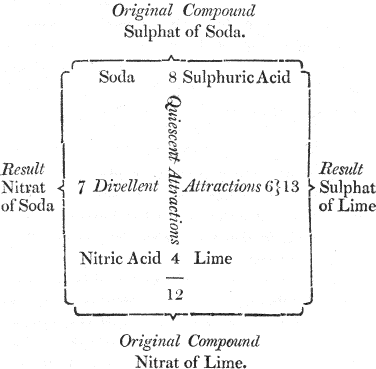
We here suppose that we are to decompose sulphat of soda; that is, to separate the acid from the alkali; if, for this purpose, we add some lime, in order to make it combine with the acid, we shall fail in our attempt, because the soda and the sulphuric acid attract each other by a force which is superior, and (by way of supposition) is represented by the number 8; while the lime tends to unite with this acid by an affinity equal only to the number 6. It is plain, therefore, that the sulphat of soda will not be decomposed, since a force equal to 8 cannot be overcome by a force equal only to 6.
CAROLINE.
So far, this appears very clear.
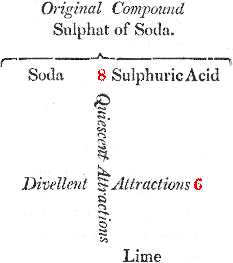
MRS. B.
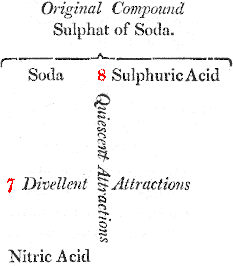
If, on the other hand, we endeavour to decompose this salt by nitric acid, which tends to combine with soda, we shall be equally unsuccessful, as nitric acid tends to unite with the alkali by a force equal only to 7.
In neither of these cases of simple elective attraction, therefore, can we accomplish our purpose. But let us previously combine together the lime and nitric acid, so as to form a nitrat of lime, a compound salt, the constituents of which are united by a power equal to 4. If then we present this compound to the sulphat of soda, a decomposition will ensue, because the sum of the forces which tend to preserve the two salts in their actual state is not equal to that of the forces which tend to decompose them, and to form new combinations. The nitric acid, therefore, will combine with the soda, and the sulphuric acid with the lime.
CAROLINE.
I understand you now very well. This double effect takes place because the numbers 8 and 4, which represent the degrees of attraction of the constituents of the two original salts, make a sum less than the numbers 7 and 6, which represent the degrees of attraction of the two new compounds that will in consequence be formed.
MRS. B.
Precisely so.
CAROLINE.
But what is the meaning of quiescent and divellent forces, which are written in the diagram?
MRS. B.
Quiescent forces are those which tend to preserve compounds in a state of rest, or such as they actually are: divellent forces, those which tend to destroy that state of combination, and to form new compounds.
These are the principal circumstances relative to the doctrine of chemical attractions, which have been laid down as rules by modern chemists; a few others might be mentioned respecting the same theory, but of less importance, and such as would take us too far from our plan. I should, however, not omit to mention that Mr. Berthollet, a celebrated French chemist, has questioned the uniform operation of elective attraction, and has advanced the opinion, that, in chemical combinations, the changes which take place depend not only upon the affinities, but also, in some degree, on the respective quantities of the substances concerned, on the heat applied during the process, and some other circumstances.
CAROLINE.
In that case, I suppose, there would hardly be two compounds exactly similar, though composed of the same materials?
MRS. B.
On the contrary, it is found that a remarkable uniformity prevails, as to proportions, between the ingredients of bodies of similar composition. Thus water, as you may recollect to have seen in a former conversation, is composed of two volumes of hydrogen gas to one of oxygen, and this is always found to be precisely the proportion of its constituents, from whatever source the water be derived. The same uniformity prevails with regard to the various salts; the acid and alkali, in each kind of salt, being always found to combine in the same proportions. Sometimes, it is true, the same acid, and the same alkali, are capable of making two distinct kinds of salts; but in all these cases it is found that one of the salts contains just twice, or in some instances, thrice as much acid, or alkali, as the other.
EMILY.
If the proportions in which bodies combine are so constant and so well defined, how can Mr. Berthollet’s remark be reconciled with this uniform system of combination?
MRS. B.
Great as that philosopher’s authority is in chemistry, it is now generally supposed that his doubts on this subject were in a great degree groundless, and that the exceptions he has observed in the laws of definite proportions, have been only apparent, and may be accounted for consistently with those laws.
CAROLINE.
Pray, Mrs. B., can you decompose a salt by means of electricity, in the same way as we decompose water?
MRS. B.
Undoubtedly; and I am glad this question occurred to you, because it gives me an opportunity of showing you some very interesting experiments on the subject.
If we dissolve a quantity, however small, of any salt in a glass of water, and if we plunge into it the extremities of the wires which proceed from the two ends of the Voltaic battery, the salt will be gradually decomposed, the acid being attracted by the positive, and the alkali by the negative wire.
EMILY.
But how can you render that decomposition perceptible?
MRS. B.
By placing in contact with the extremities of each wire, in the solution, pieces of paper stained with certain vegetable colours, which are altered by the contact of an acid or an alkali. Thus this blue vegetable preparation called litmus becomes red when touched by an acid; and the juice of violets becomes green by the contact of an alkali.
But the experiment can be made in a much more distinct manner, by receiving the extremities of the wires into two different vessels, so that the alkali shall appear in one vessel and the acid in the other.
CAROLINE.
But then the Voltaic circle will not be completed; how can any effect be produced?
MRS. B.
You are right; I ought to have added that the two vessels must be connected together by some interposed substance capable of conducting electricity. A piece of moistened cotton-wick answers this purpose very well. You see that the cotton (Plate XIII. fig. 2. c.) has one end immersed in one glass and the other end in the other, so as to establish a communication between any fluids contained in them. We shall now put into each of the glasses a little glauber salt, or sulphat of soda, (which consists of an acid and an alkali,) and then we shall fill the glasses with water, which will dissolve the salt. Let us now connect the glasses by means of the wires (e, d,) with the two ends of the battery, thus . . . .
Plate XIII.
Vol. II. page 16.
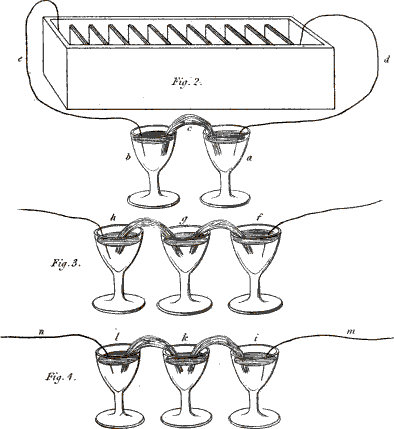
Fig. 2. 3 & 4. Instances of Chemical decomposition by the Voltaic Battery.
Larger view (complete Plate)
CAROLINE.
The wires are already giving out small bubbles; is this owing to the decomposition of the salt?
MRS. B.
No; these are bubbles produced by the decomposition of the water, as you saw in a former experiment. In order to render the separation of the acid from the alkali visible, I pour into the glass (a), which is connected with the positive wire, a few drops of a solution of litmus, which the least quantity of acid turns red; and into the other glass (b), which is connected with the negative wire, I pour a few drops of the juice of violets . . . .
EMILY.
The blue solution is already turning red all round the wire.
CAROLINE.
And the violet solution is beginning to turn green. This is indeed very singular!
MRS. B.
You will be still more astonished when we vary the experiment in this manner:—These three glasses (fig. 3. f, g, h,) are, as in the former instance, connected together by wetted cotton, but the middle one alone contains a saline solution, the two others containing only distilled water, coloured as before by vegetable infusions. Yet, on making the connection with the battery, the alkali will appear in the negative glass (h), and the acid in the positive glass (f), though neither of them contained any saline matter.
EMILY.
So that the acid and alkali must be conveyed right and left from the central glass, into the other glasses, by means of the connecting moistened cotton?
MRS. B.
Exactly so; and you may render the experiment still more striking, by putting into the central glass (k, fig. 3.) an alkaline solution, the glauber salt being placed into the negative glass (l), and the positive glass (i) containing only water. The acid will be attracted by the positive wire (m), and will actually appear in the vessel (i), after passing through the alkaline solution (k), without combining with it, although, you know, acids and alkalies are so much disposed to combine.—But this conversation has already much exceeded our usual limits, and we cannot enlarge more upon this interesting subject at present.
CONVERSATION XIV. ON ALKALIES.
MRS. B.
Having now given you some idea of the laws by which chemical attractions are governed, we may proceed to the examination of bodies which are formed in consequence of these attractions.
The first class of compounds that present themselves to our notice, in our gradual ascent to the most complicated combinations, are bodies composed of only two principles. The sulphurets, phosphurets, carburets, &c. are of this description; but the most numerous and important of these compounds are the combinations of oxygen with the various simple substances with which it has a tendency to unite. Of these you have already acquired some knowledge, but it will be necessary to enter into further particulars respecting the nature and properties of those most deserving our notice. Of this class are the ALKALIES and the EARTHS, which we shall successively examine.
We shall first take a view of the alkalies, of which there are three, viz. POTASH, SODA, and AMMONIA. The two first are called fixed alkalies, because they exist in a solid form at the temperature of the atmosphere, and require a great heat to be volatilised. They consist, as you already know, of metallic bases combined with oxygen. In potash, the proportions are about eighty-six parts of potassium to fourteen of oxygen; and in soda, seventy-seven parts of sodium to twenty-three of oxygen. The third alkali, ammonia, has been distinguished by the name of volatile alkali, because its natural form is that of gas. Its composition is of a more complicated nature, of which we shall speak hereafter.
Some of the earths bear so strong a resemblance in their properties to the alkalies, that it is difficult to know under which head to place them. The celebrated French chemist, Fourcroy, has classed two of them (barytes and strontites) with the alkalies; but as lime and magnesia have almost an equal title to that rank, I think it better not to separate them, and therefore have adopted the common method of classing them with the earths, and of distinguishing them by the name of alkaline earths.
The general properties of alkalies are, an acrid burning taste, a pungent smell, and a caustic action on the skin and flesh.
CAROLINE.
I wonder they should be caustic, Mrs. B., since they contain so little oxygen.
MRS. B.
Whatever substance has an affinity for any one of the constituents of animal matter, sufficiently powerful to decompose it, is entitled to the appellation of caustic. The alkalies, in their pure state, have a very strong attraction for water, for hydrogen, and for carbon, which, you know, are the constituent principles of oil, and it is chiefly by absorbing these substances from animal matter that they effect its decomposition; for, when diluted with a sufficient quantity of water, or combined with any oily substance, they lose their causticity.
But, to return to the general properties of alkalies—they change, as we have already seen, the colour of syrup of violets, and other blue vegetable infusions, to green; and have, in general, a very great tendency to unite with acids, although the respective qualities of these two classes of bodies form a remarkable contrast.
We shall examine the result of the combination of acids and alkalies more particularly hereafter. It will be sufficient at present to inform you, that whenever acids are brought in contact with alkalies, or alkaline earths, they unite with a remarkable eagerness, and form compounds perfectly different from either of their constituents; these bodies are called neutral or compound salts.
The dry white powder which you see in this phial is pure caustic POTASH; it is very difficult to preserve it in this state, as it attracts, with extreme avidity, the moisture from the atmosphere, and if the air were not perfectly excluded, it would, in a very short time, be actually melted.
EMILY.
It is then, I suppose, always found in a liquid state?
MRS. B.
No; it exists in nature in a great variety of forms and combinations, but is never found in its pure separate state; it is combined with carbonic acid, with which it exists in every part of the vegetable kingdom, and is most commonly obtained from the ashes of vegetables, which are the residue that remains after all the other parts have been volatilised by combustion.
CAROLINE.
But you once said, that after all the volatile parts of a vegetable were evaporated, the substance that remained was charcoal?
MRS. B.
I am surprised that you should still confound the processes of volatilisation and combustion. In order to procure charcoal, we evaporate such parts as can be reduced to vapour by the operation of heat alone; but when we burn the vegetable, we burn the carbon also, and convert it into carbonic acid gas.
CAROLINE.
That is true; I hope I shall make no more mistakes in my favourite theory of combustion.
MRS. B.
Potash derives its name from the pots in which the vegetables, from which it was obtained, used formerly to be burnt; the alkali remained mixed with the ashes at the bottom, and was thence called potash.
EMILY.
The ashes of a wood-fire, then, are potash, since they are vegetable ashes?
MRS. B.
They always contain more or less potash, but are very far from consisting of that substance alone, as they are a mixture of various earths and salts which remain after the combustion of vegetables, and from which it is not easy to separate the alkali in its pure form. The process by which potash is obtained, even in the imperfect state in which it is used in the arts, is much more complicated than simple combustion. It was once deemed impossible to separate it entirely from all foreign substances, and it is only in chemical laboratories that it is to be met with in the state of purity in which you find it in this phial. Wood-ashes are, however, valuable for the alkali which they contain, and are used for some purposes without any further preparation. Purified in a certain degree, they make what is commonly called pearlash, which is of great efficacy in taking out grease, in washing linen, &c.; for potash combines readily with oil or fat, with which it forms a compound well known to you under the name of soap.
CAROLINE.
Really! Then I should think it would be better to wash all linen with pearlash than with soap, as, in the latter case, the alkali being already combined with oil, must be less efficacious in extracting grease.
MRS. B.
Its effect would be too powerful on fine linen, and would injure its texture; pearlash is therefore only used for that which is of a strong coarse kind. For the same reason you cannot wash your hands with plain potash; but, when mixed with oil in the form of soap, it is soft as well as cleansing, and is therefore much better adapted to the purpose.
Caustic potash, as we already observed, acts on the skin, and animal fibre, in virtue of its attraction for water and oil, and converts all animal matter into a kind of saponaceous jelly.
EMILY.
Are vegetables the only source from which potash can be derived?
MRS. B.
No: for though far most abundant in vegetables, it is by no means confined to that class of bodies, being found also on the surface of the earth, mixed with various minerals, especially with earths and stones, whence it is supposed to be conveyed into vegetables by the roots of the plant. It is also met with, though in very small quantities, in some animal substances. The most common state of potash is that of carbonat; I suppose you understand what that is?
EMILY.
I believe so; though I do not recollect that you ever mentioned the word before. If I am not mistaken, it must be a compound salt, formed by the union of carbonic acid with potash.
MRS. B.
Very true; you see how admirably the nomenclature of modern chemistry is adapted to assist the memory; when you hear the name of a compound, you necessarily learn what are its constituent parts; and when you are acquainted with these constituents, you can immediately name the compound which they form.
CAROLINE.
Pray, how were bodies arranged and distinguished before this nomenclature was introduced?
MRS. B.
Chemistry was then a much more difficult study; for every substance had an arbitrary name, which it derived either from the person who discovered it, as Glauber’s salts for instance; or from some other circumstance relative to it, though quite unconnected with its real nature, as potash.
These names have been retained for some of the simple bodies; for as this class is not numerous, and therefore can easily be remembered, it has not been thought necessary to change them.
EMILY.
Yet I think it would have rendered the new nomenclature more complete to have methodised the names of the elementary, as well as of the compound bodies, though it could not have been done in the same manner. But the names of the simple substances might have indicated their nature, or, at least, some of their principal properties; and if, like the acids and compound salts, all the simple bodies had a similar termination, they would have been immediately known as such. So complete and regular a nomenclature would, I think, have given a clearer and more comprehensive view of chemistry than the present, which is a medley of the old and new terms.
MRS. B.
But you are not aware of the difficulty of introducing into science an entire set of new terms; it obliges all the teachers and professors to go to school again, and if some of the old names, that are least exceptionable, were not left as an introduction to the new ones, few people would have had industry and perseverance enough to submit to the study of a completely new language; and the inferior classes of artists, who can only act from habit and routine, would, at least for a time, have felt material inconvenience from a total change of their habitual terms. From these considerations, Lavoisier and his colleagues, who invented the new nomenclature, thought it most prudent to leave a few links of the old chain, in order to connect it with the new one. Besides, you may easily conceive the inconvenience which might arise from giving a regular nomenclature to substances, the simple nature of which is always uncertain; for the new names might, perhaps, have proved to have been founded in error. And, indeed, cautious as the inventors of the modern chemical language have been, it has already been found necessary to modify it in many respects. In those few cases, however, in which new terms have been adopted to designate simple bodies, these names have been so contrived as to indicate one of the chief properties of the body in question; this is the case with oxygen, which, as I explained to you, signifies generator of acids; and hydrogen generator of water. If all the elementary bodies had a similar termination, as you propose, it would be necessary to change the name of any that might hereafter be found of a compound nature, which would be very inconvenient in this age of discovery.
But to return to the alkalies.—We shall now try to melt some of this caustic potash in a little water, as a circumstance occurs during its solution very worthy of observation.—Do you feel the heat that is produced?
CAROLINE.
Yes, I do; but is not this directly contrary to our theory of latent heat, according to which heat is disengaged when fluids become solid, and cold produced when solids are melted?
MRS. B.
The latter is really the case in all solutions; and if the solution of caustic alkalies seems to make an exception to the rule, it does not, I believe, form any solid objection to the theory. The matter may be explained thus: When water first comes in contact with the potash, it produces an effect similar to the slaking of lime, that is, the water is solidified in combining with the potash, and thus loses its latent heat; this is the heat that you now feel, and which is, therefore, produced not by the melting of the solid, but by the solidification of the fluid. But when there is more water than the potash can absorb and solidify, the latter then yields to the solvent power of the water; and if we do not perceive the cold produced by its melting, it is because it is counterbalanced by the heat previously disengaged.*
A very remarkable property of potash is the formation of glass by its fusion with siliceous earth. You are not yet acquainted with this last substance, further than its being in the list of simple bodies. It is sufficient, for the present, that you should know that sand and flint are chiefly composed of it; alone, it is infusible, but mixed with potash, it melts when exposed to the heat of a furnace, combines with the alkali, and runs into glass.
CAROLINE.
Who would ever have supposed that the same substance which converts transparent oil into such an opake body as soap, should transform that opake substance, sand, into transparent glass!
MRS. B.
The transparency, or opacity of bodies, does not, I conceive, depend so much upon their intimate nature, as upon the arrangement of their particles: we cannot have a more striking instance of this, than is afforded by the different states of carbon, which, though it commonly appears in the form of a black opake body, sometimes assumes the most dazzling transparent form in nature, that of diamond, which, you recollect, is carbon, and which, in all probability, derives its beautiful transparency from the peculiar arrangement of its particles during their crystallisation.
EMILY.
I never should have supposed that the formation of glass was so simple a process as you describe it.
MRS. B.
It is by no means an easy operation to make perfect glass; for if the sand, or flint, from which the siliceous earth is obtained, be mixed with any metallic particles, or other substance, which cannot be vitrified, the glass will be discoloured, or defaced, by opake specks.
CAROLINE.
That, I suppose, is the reason why objects so often appear irregular and shapeless through a common glass-window.
MRS. B.
This species of imperfection proceeds, I believe, from another cause. It is extremely difficult to prevent the lower part of the vessels, in which the materials of glass are fused, from containing a more dense vitreous matter than the upper, on account of the heavier ingredients falling to the bottom. When this happens, it occasions the appearance of veins or waves in the glass, from the difference of density in its several parts, which produces an irregular refraction of the rays of light that pass through it.
Another species of imperfection sometimes arises from the fusion not being continued for a length of time sufficient to combine the two ingredients completely, or from the due proportion of potash and silex (which are as two to one) not being carefully observed; the glass, in those cases, will be liable to alteration from the action of the air, of salts, and especially of acids, which will effect its decomposition by combining with the potash, and forming compound salts.
EMILY.
What an extremely useful substance potash is!
MRS. B.
Besides the great importance of potash in the manufactures of glass and soap, it is of very considerable utility in many of the other arts, and in its combinations with several acids, particularly the nitric, with which it forms saltpetre.
CAROLINE.
Then saltpetre must be a nitrat of potash? But we are not yet acquainted with the nitric acid?
MRS. B.
We shall therefore defer entering into the particulars of these combinations till we come to a general review of the compound salts. In order to avoid confusion, it will be better at present to confine ourselves to the alkalies.
EMILY.
Cannot you show us the change of colour which you said the alkalies produced on blue vegetable infusions?
MRS. B.
Yes; very easily. I shall dip a piece of white paper into this syrup of violets, which, you see, is of a deep blue, and dyes the paper of the same colour.—As soon as it is dry, we shall dip it into a solution of potash, which, though itself colourless, will turn the paper green—
CAROLINE.
So it has, indeed! And do the other alkalies produce a similar effect?
MRS. B.
Exactly the same.—We may now proceed to SODA, which, however important, will detain us but a very short time; as in all its general properties it very strongly resembles potash; indeed, so great is their similitude, that they have been long confounded, and they can now scarcely be distinguished, except by the difference of the salts which they form with acids.
The great source of this alkali is the sea, where, combined with a peculiar acid, it forms the salt with which the waters of the ocean are so strongly impregnated.
EMILY.
Is not that the common table salt?
MRS. B.
The very same; but again we must postpone entering into the particulars of this interesting combination, till we treat of the neutral salts. Soda may be obtained from common salt; but the easiest and most usual method of procuring it is by the combustion of marine plants, an operation perfectly analogous to that by which potash is obtained from vegetables.
EMILY.
From what does soda derive its name?
MRS. B.
From a plant called by us soda, and by the Arabs kali, which affords it in great abundance. Kali has, indeed, given its name to the alkalies in general.
CAROLINE.
Does soda form glass and soap in the same manner as potash?
MRS. B.
Yes, it does; it is of equal importance in the arts, and is even preferred to potash for some purposes; but you will not be able to distinguish their properties till we examine the compound salts which they form with acids; we must therefore leave soda for the present, and proceed to AMMONIA, or the VOLATILE ALKALI.
EMILY.
I long to hear something of this alkali; is it not of the same nature as hartshorn?
MRS. B.
Yes, it is, as you will see by-and-bye. This alkali is seldom found in nature in its pure state; it is most commonly extracted from a compound salt, called sal ammoniac, which was formerly imported from Ammonia, a region of Libya, from which both these salts and the alkali derive their names. The crystals contained in this bottle are specimens of this salt, which consists of a combination of ammonia and muriatic acid.
CAROLINE.
Then it should be called muriat of ammonia; for though I am ignorant what muriatic acid is, yet I know that its combination with ammonia cannot but be so called; and I am surprised to see sal ammoniac inscribed on the label.
MRS. B.
That is the name by which it has been so long known, that the modern chemists have not yet succeeded in banishing it altogether; and it is still sold under that name by druggists, though by scientific chemists it is more properly called muriat of ammonia.
CAROLINE.
Both the popular and the common name should be inscribed on labels—this would soon introduce the new nomenclature.
EMILY.
By what means can the ammonia be separated from the muriatic acid?
MRS. B.
By chemical attractions; but this operation is too complicated for you to understand, till you are better acquainted with the agency of affinities.
EMILY.
And when extracted from the salt, what kind of substance is ammonia?
MRS. B.
Its natural form, at the temperature of the atmosphere, when free from combination, is that of gas; and in this state it is called ammoniacal gas. But it mixes very readily with water, and can be thus obtained in a liquid form.
CAROLINE.
You said that ammonia was more complicated in its composition than the other alkalies; pray of what principles does it consist?
MRS. B.
It was discovered a few years since, by Berthollet, a celebrated French chemist, that it consisted of about one part of hydrogen to four parts of nitrogen. Having heated ammoniacal gas under a receiver, by causing the electrical spark to pass repeatedly through it, he found that it increased considerably in bulk, lost all its alkaline properties, and was actually converted into hydrogen and nitrogen gases; and from the latest and most accurate experiments, the proportions appear to be, one volume of nitrogen gas to three of hydrogen gas.
CAROLINE.
Ammonia, therefore, has not, like the two other alkalies, a metallic basis?
MRS. B.
It is believed it has, though it is extremely difficult to reconcile that idea with what I have just stated of its chemical nature. But the fact is, that although this supposed metallic basis of ammonia has never been obtained distinct and separate, yet both Professor Berzelius, of Stockholm, and Sir H. Davy, have succeeded in forming a combination of mercury with the basis of ammonia, which has so much the appearance of an amalgam, that it strongly corroborates the idea of ammonia having a metallic basis.* But these theoretical points are full of difficulties and doubts, and it would be useless to dwell any longer upon them.
Let us therefore return to the properties of volatile alkali. Ammoniacal gas is considerably lighter than oxygen gas, and only about half the weight of atmospherical air. It possesses most of the properties of the fixed alkalies; but cannot be of so much use in the arts on account of its volatile nature. It is, therefore, never employed in the manufacture of glass, but it forms soap with oils equally as well as potash and soda; it resembles them likewise in its strong attraction for water; for which reason it can be collected in a receiver over mercury only.
CAROLINE.
I do not understand this?
MRS. B.
Do you recollect the method which we used to collect gases in a glass-receiver over water?
CAROLINE.
Perfectly.
MRS. B.
Ammoniacal gas has so strong a tendency to unite with water, that, instead of passing through that fluid, it would be instantaneously absorbed by it. We can therefore neither use water for that purpose, nor any other liquid of which water is a component part; so that, in order to collect this gas, we are obliged to have recourse to mercury, (a liquid which has no action upon it,) and a mercurial bath is used instead of a water bath, such as we employed on former occasions. Water impregnated with this gas is nothing more than the fluid which you mentioned at the beginning of the conversation—hartshorn; it is the ammoniacal gas escaping from the water which gives it so powerful a smell.
EMILY.
But there is no appearance of effervescence in hartshorn.
MRS. B.
Because the particles of gas that rise from the water are too subtle and minute for their effect to be visible.
Water diminishes in density, by being impregnated with ammoniacal gas; and this augmentation of bulk increases its capacity for caloric.
EMILY.
In making hartshorn, then, or impregnating water with ammonia, heat must be absorbed, and cold produced?
MRS. B.
That effect would take place if it was not counteracted by another circumstance; the gas is liquefied by incorporating with the water, and gives out its latent heat. The condensation of the gas more than counterbalances the expansion of the water; therefore, upon the whole, heat is produced.—But if you dissolve ammoniacal gas with ice or snow, cold is produced.—Can you account for that?
EMILY.
The gas, in being condensed into a liquid, must give out heat; and, on the other hand, the snow or ice, in being rarefied into a liquid, must absorb heat; so that, between the opposite effects, I should have supposed the original temperature would have been preserved.
MRS. B.
But you have forgotten to take into the account the rarefaction of the water (or melted ice) by the impregnation of the gas; and this is the cause of the cold which is ultimately produced.
CAROLINE.
Is the sal volatile (the smell of which so strongly resembles hartshorn) likewise a preparation of ammonia?
MRS. B.
It is carbonat of ammonia dissolved in water; and which, in its concrete state, is commonly called salts of hartshorn. Ammonia is caustic, like the fixed alkalies, as you may judge by the pungent effects of hartshorn, which cannot be taken internally, nor applied to delicate external parts, without being plentifully diluted with water.—Oil and acids are very excellent antidotes for alkaline poisons; can you guess why?
CAROLINE.
Perhaps, because the oil combines with the alkali, and forms soap, and thus destroys its caustic properties; and the acid converts it into a compound salt, which, I suppose, is not so pernicious as caustic alkali.
MRS. B.
Precisely so.
Ammoniacal gas, if it be mixed with atmospherical air, and a burning taper repeatedly plunged into it, will burn with a large flame of a peculiar yellow colour.
EMILY.
But pray tell me, can ammonia be procured from this Lybian salt only?
MRS. B.
So far from it, that it is contained in, and may be extracted from, all animal substances whatever. Hydrogen and nitrogen are two of the chief constituents of animal matter; it is therefore not surprising that they should occasionally meet and combine in those proportions that compose ammonia. But this alkali is more frequently generated by the spontaneous decomposition of animal substances; the hydrogen and nitrogen gases that arise from putrefied bodies combine, and form the volatile alkali.
Muriat of ammonia, instead of being exclusively brought from Lybia, as it originally was, is now chiefly prepared in Europe, by chemical processes. Ammonia, although principally extracted from this salt, can also be produced by a great variety of other substances. The horns of cattle, especially those of deer, yield it in abundance, and it is from this circumstance that a solution of ammonia in water has been called hartshorn. It may likewise be procured from wool, flesh, and bones; in a word, any animal substance whatever yields it by decomposition.
We shall now lay aside the alkalies, however important the subject may be, till we treat of their combination with acids. The next time we meet we shall examine the earths.
CONVERSATION XV. ON EARTHS.
MRS. B.
The EARTHS, which we are to-day to examine, are nine in number:
SILEX,
ALUMINE,
BARYTES,
LIME,
MAGNESIA,
STRONTITES,
YTTRIA,
GLUCINA,
ZIRCONIA.
The last three are of late discovery; their properties are but imperfectly known; and, as they have not yet been applied to use, it will be unnecessary to enter into any particulars respecting them; we shall confine our remarks, therefore, to the first five. They are composed, as you have already learnt, of a metallic basis combined with oxygen; and, from this circumstance, are incombustible.
CAROLINE.
Yet I have seen turf burnt in the country, and it makes an excellent fire; the earth becomes red hot, and produces a very great quantity of heat.
MRS. B.
It is not the earth that burns, my dear, but the roots, grass, and other remnants of vegetables that are intermixed with it. The caloric, which is produced by the combustion of these substances, makes the earth red hot, and this being a bad conductor of heat, retains its caloric a long time; but were you to examine it when cooled, you would find that it had not absorbed one particle of oxygen, nor suffered any alteration from the fire. Earth is, however, from the circumstance just mentioned, an excellent radiator of heat, and owes its utility, when mixed with fuel, solely to that property. It is in this point of view that Count Rumford has recommended balls of incombustible substances to be arranged in fire-places, and mixed with the coals, by which means the caloric disengaged by the combustion of the latter is more perfectly reflected into the room, and an expense of fuel is saved.
EMILY.
I expected that the list of earths would be much more considerable. When I think of the great variety of soils, I am astonished that there is not a greater number of earths to form them.
MRS. B.
You might, indeed, almost confine that number to four; for barytes, strontites, and the others of late discovery, act but so small a part in this great theatre, that they cannot be reckoned as essential to the general formation of the globe. And you must not confine your idea of earths to the formation of soil; for rock, marble, chalk, slate, sand, flint, and all kinds of stones, from the precious jewels to the commonest pebbles; in a word, all the immense variety of mineral products, may be referred to some of these earths, either in a simple state, or combined the one with the other, or blended with other ingredients.
CAROLINE.
Precious stones composed of earth! That seems very difficult to conceive.
EMILY.
Is it more extraordinary than that the most precious of all jewels, diamond, should be composed of carbon? But diamond forms an exception, Mrs. B.; for, though a stone, it is not composed of earth.
MRS. B.
I did not specify the exception, as I knew you were so well acquainted with it. Besides, I would call a diamond a mineral rather than a stone, as the latter term always implies the presence of some earth.
CAROLINE.
I cannot conceive how such coarse materials can be converted into such beautiful productions.
MRS. B.
We are very far from understanding all the secret resources of nature; but I do not think the spontaneous formation of the crystals, which we call precious stones, one of the most difficult phenomena to comprehend.
By the slow and regular work of ages, perhaps of hundreds of ages, these earths may be gradually dissolved by water, and as gradually deposited by their solvent in the undisturbed process of crystallisation. The regular arrangement of their particles, during their reunion in a solid mass, gives them that brilliancy, transparency, and beauty, for which they are so much admired; and renders them in appearance so totally different from their rude and primitive ingredients.
CAROLINE.
But how does it happen that they are spontaneously dissolved, and afterwards crystallised?
MRS. B.
The scarcity of many kinds of crystals, as rubies, emeralds, topazes, &c. shows that their formation is not an operation very easily carried on in nature. But cannot you imagine that when water, holding in solution some particles of earth, filters through the crevices of hills or mountains, and at length dribbles into some cavern, each successive drop may be slowly evaporated, leaving behind it the particle of earth which it held in solution? You know that crystallisation is more regular and perfect, in proportion as the evaporation of the solvent is slow and uniform; nature, therefore, who knows no limit of time, has, in all works of this kind, an infinite advantage over any artist who attempts to imitate such productions.
EMILY.
I can now conceive that the arrangement of the particles of earth, during crystallisation, may be such as to occasion transparency, by admitting a free passage to the rays of light; but I cannot understand why crystallised earths should assume such beautiful colours as most of them do. Sapphire, for instance, is of a celestial blue; ruby, a deep red; topaz, a brilliant yellow?
MRS. B.
Nothing is more simple than to suppose that the arrangement of their particles is such, as to transmit some of the coloured rays of light, and to reflect others, in which case the stone must appear of the colour of the rays which it reflects. But besides, it frequently happens that the colour of a stone is owing to a mixture of some metallic matter.
CAROLINE.
Pray, are the different kinds of precious stones each composed of one individual earth, or are they formed of a combination of several earths?
MRS. B.
A great variety of materials enters into the composition of most of them; not only several earths, but sometimes salts and metals. The earths, however, in their simple state, frequently form very beautiful crystals; and, indeed, it is in that state only that they can be obtained perfectly pure.
EMILY.
Is not the Derbyshire spar produced by the crystallisation of earths, in the way you have just explained? I have been in some of the subterraneous caverns where it is found, which are similar to those you have described.
MRS. B.
Yes; but this spar is a very imperfect specimen of crystallisation; it consists of a variety of ingredients confusedly blended together, as you may judge by its opacity, and by the various colours and appearances which it exhibits.
But, in examining the earths in their most perfect and agreeable form, we must not lose sight of that state in which they are commonly found, and which, if less pleasing to the eye, is far more interesting by its utility.
All the earths are more or less endowed with alkaline properties; but there are four, barytes, magnesia, lime, and strontites, which are called alkaline earths, because they possess those qualities in so great a degree, as to entitle them, in most respects, to the rank of alkalies. They combine and form compound salts with acids, in the same way as alkalies; they are, like them, susceptible of a considerable degree of causticity, and are acted upon in a similar manner by chemical tests.—The remaining earths, silex and alumine, with one or two others of late discovery, are in some degree more earthy, that is to say, they possess more completely the properties common to all the earths, which are, insipidity, dryness, unalterableness in the fire, infusibility, &c.
CAROLINE.
Yet, did you not tell us that silex, or siliceous earth, when mixed with an alkali, was fusible, and run into glass?
MRS. B.
Yes, my dear; but the characteristic properties of earths, which I have mentioned, are to be considered as belonging to them in a state of purity only; a state in which they are very seldom to be met with in nature.—Besides these general properties, each earth has its own specific characters, by which it is distinguished from any other substance.—Let us therefore review them separately.
Silex, or SILICA, abounds in flint, sand, sandstone, agate, jasper, &c.; it forms the basis of many precious stones, and particularly of those which strike fire with steel. It is rough to the touch, scratches and wears away metals; it is acted upon by no acid but the fluoric, and is not soluble in water by any known process; but nature certainly dissolves it by means with which we are unacquainted, and thus produces a variety of siliceous crystals, and amongst these rock crystal, which is the purest specimen of this earth. Silex appears to have been intended by Providence to form the solid basis of the globe, to serve as a foundation for the original mountains, and give them that hardness and durability which has enabled them to resist the various revolutions which the surface of the earth has successively undergone. From these mountains siliceous rocks have, during the course of ages, been gradually detached by torrents of water, and brought down in fragments; these, in the violence and rapidity of their descent, are sometimes crumbled to sand, and in this state form the beds of rivers and of the sea, chiefly composed of siliceous materials. Sometimes the fragments are broken without being pulverised by their fall, and assume the form of pebbles, which gradually become rounded and polished.
EMILY.
Pray what is the true colour of silex, which forms such a variety of different coloured substances? Sand is brown, flint is nearly black, and precious stones are of all colours.
MRS. B.
Pure silex, such as is found only in the chemist’s laboratory, is perfectly white, and the various colours which it assumes, in the different substances you have just mentioned, proceed from the different ingredients with which it is mixed in them.
CAROLINE.
I wonder that silex is not more valuable, since it forms the basis of so many precious stones.
MRS. B.
You must not forget that the value we set upon precious stones depends in a great measure upon the scarcity with which nature affords them; for, were those productions either common or perfectly imitable by art, they would no longer, notwithstanding their beauty, be so highly esteemed. But the real value of siliceous earth, in many of the most useful arts, is very extensive. Mixed with clay, it forms the basis of all the various kinds of earthen ware, from the most common utensils to the most refined ornaments.
EMILY.
And we must recollect its importance in the formation of glass with potash.
MRS. B.
Nor should we omit to mention, likewise, many other important uses of silex, such as being the chief ingredient of some of the most durable cements, of mortar, &c.
I said before, that siliceous earth combined with no acid but the fluoric; it is for this reason that glass is liable to be attacked by that acid only, which, from its strong affinity for silex, forces that substance from its combination with the potash, and thus destroys the glass.
We will now hasten to proceed to the other earths, for I am rather apprehensive of your growing weary of this part of our subject.
CAROLINE.
The history of the earths is not quite so entertaining as that of the simple substances.
MRS. B.
Perhaps not; but it is absolutely indispensable that you should know something of them; for they form the basis of so many interesting and important compounds, that their total omission would throw great obscurity on our general outline of chemical science. We shall, however, review them in as cursory a manner as the subject can admit of.
Alumine derives its name from a compound salt called alum, of which it forms the basis.
CAROLINE.
But it ought to be just the contrary, Mrs. B.; the simple body should give, instead of taking, its name from the compound.
MRS. B.
That is true; but as the compound salt was known long before its basis was discovered, it was very natural that when the earth was at length separated from the acid, it should derive its name from the compound from which it was obtained. However, to remove your scruples, we will call the salt according to the new nomenclature, sulphat of alumine. From this combination, alumine may be obtained in its pure state; it is then soft to the touch, makes a paste with water, and hardens in the fire. In nature, it is found chiefly in clay, which contains a considerable proportion of this earth; it is very abundant in fuller’s earth, slate, and a variety of other mineral productions. There is indeed scarcely any mineral substance more useful to mankind than alumine. In the state of clay, it forms large strata of the earth, gives consistency to the soil of valleys, and of all low and damp spots, such as swamps and marshes. The beds of lakes, ponds, and springs, are almost entirely of clay; instead of allowing of the filtration of water, as sand does, it forms an impenetrable bottom, and by this means water is accumulated in the caverns of the earth, producing those reservoirs whence springs issue, and spout out at the surface.
EMILY.
I always thought that these subterraneous reservoirs of water were bedded by some hard stone, or rock, which the water could not penetrate.
MRS. B.
That is not the case; for in the course of time water would penetrate, or wear away silex, or any other kind of stone, while it is effectually stopped by clay, or alumine.
The solid compact soils, such as are fit for corn, owe their consistence in a great measure to alumine; this earth is therefore used to improve sandy or chalky soils, which do not retain a sufficient quantity of water for the purpose of vegetation.
Alumine is the most essential ingredient in all potteries. It enters into the composition of brick, as well as that of the finest porcelain; the addition of silex and water hardens it, renders it susceptible of a degree of vitrification, and makes it perfectly fit for its various purposes.
CAROLINE.
I can scarcely conceive that brick and china should be made of the same materials.
MRS. B.
Brick consists almost entirely of baked clay; but a certain proportion of silex is essential to the formation of earthen or stone ware. In common potteries sand is used for that purpose; a more pure silex is, I believe, necessary for the composition of porcelain, as well as a finer kind of clay; and these materials are, no doubt, more carefully prepared, and curiously wrought, in the one case than in the other. Porcelain owes its beautiful semitransparency to a commencement of vitrification.
EMILY.
But the commonest earthen-ware, though not transparent, is covered with a kind of glazing.
MRS. B.
That precaution is equally necessary for use as for beauty, as the ware would be liable to be spoiled and corroded by a variety of substances, if not covered with a coating of this kind. In porcelain it consists of enamel, which is a fine white opake glass, formed of metallic oxyds, sand, salts, and such other materials as are susceptible of vitrification. The glazing of common earthen-ware is made chiefly of oxyd of lead, or sometimes merely of salt, which, when thinly spread over earthen vessels, will, at a certain heat, run into opake glass.
CAROLINE.
And of what nature are the colours which are used for painting porcelain?
MRS. B.
They are all composed of metallic oxyds, so that these colours, instead of receiving injury from the application of fire, are strengthened and developed by its action, which causes them to undergo different degrees of oxydation.
Alumine and silex are not only often combined by art, but they have in nature a very strong tendency to unite, and are found combined, in different proportions, in various gems and other minerals. Indeed, many of the precious stones, such as ruby, oriental sapphire, amethyst, &c. consist chiefly of alumine.
We may now proceed to the alkaline earths, I shall say but a few words on BARYTES, as it is hardly ever used, except in chemical laboratories. It is remarkable for its great weight, and its strong alkaline properties, such as destroying animal substances, turning green some blue vegetable colours, and showing a powerful attraction for acids; this last property it possesses to such a degree, particularly with regard to the sulphuric acid, that it will always detect its presence in any substance or combination whatever, by immediately uniting with it, and forming a sulphat of barytes. This renders it a very valuable chemical test. It is found pretty abundantly in nature in the state of carbonat, from which the pure earth can be easily separated.
The next earth we have to consider is LIME. This is a substance of too great and general importance to be passed over so slightly as the last.
Lime is strongly alkaline. In nature it is not met with in its simple state, as its affinity for water and carbonic acid is so great, that it is always found combined with these substances, with which it forms the common lime-stone; but it is separated in the kiln from these ingredients, which are volatilised whenever a sufficient degree of heat is applied.
EMILY.
Pure lime, then, is nothing but lime-stone, which has been deprived, in the kiln, of its water and carbonic acid?
MRS. B.
Precisely: in this state it is called quick-lime, and it is so caustic, that it is capable of decomposing the dead bodies of animals very rapidly, without their undergoing the process of putrefaction.—I have here some quick lime, which is kept carefully corked up in a bottle to prevent the access of air; for were it at all exposed to the atmosphere, it would absorb both moisture and carbonic acid gas from it, and be soon slaked. Here is also some lime-stone—we shall pour a little water on each, and observe the effects that result from it.
CAROLINE.
How the quick-lime hisses! It is become excessively hot!—It swells, and now it bursts and crumbles to powder, while the water appears to produce no kind of alteration on the lime-stone.
MRS. B.
Because the lime-stone is already saturated with water, whilst the quick-lime, which has been deprived of it in the kiln, combines with it with very great avidity, and produces this prodigious disengagement of heat, the cause of which I formerly explained to you; do you recollect it?
EMILY.
Yes; you said that the heat did not proceed from the lime, but from the water which was solidified, and thus parted with its heat of liquidity.
MRS. B.
Very well. If we continue to add successive quantities of water to the lime after being slaked and crumbled as you see, it will then gradually be diffused in the water, till it will at length be dissolved in it, and entirely disappear; but for this purpose it requires no less than 700 times its weight of water. This solution is called lime-water.
CAROLINE.
How very small, then, is the proportion of lime dissolved!
MRS. B.
Barytes is still of more difficult solution; it dissolves only in 900 times its weight of water: but it is much more soluble in the state of crystals. The liquid contained in this bottle is lime-water; it is often used as a medicine, chiefly, I believe, for the purpose of combining with, and neutralising, the superabundant acid which it meets with in the stomach.
EMILY.
I am surprised that it is so perfectly clear; it does not at all partake of the whiteness of the lime.
MRS. B.
Have you forgotten that, in solutions, the solid body is so minutely subdivided by the fluid as to become invisible, and therefore will not in the least degree impair the transparency of the solvent?
I said that the attraction of lime for carbonic acid was so strong, that it would absorb it from the atmosphere. We may see this effect by exposing a glass of lime-water to the air; the lime will then separate from the water, combine with the carbonic acid, and re-appear on the surface in the form of a white film, which is carbonat of lime, commonly called chalk.
CAROLINE.
Chalk is, then, a compound salt! I never should have supposed that those immense beds of chalk, that we see in many parts of the country, were a salt.—Now, the white film begins to appear on the surface of the water; but it is far from resembling hard solid chalk.
MRS. B.
That is owing to its state of extreme division; in a little time it will collect into a more compact mass, and subside at the bottom of the glass.
If you breathe into lime-water, the carbonic acid, which is mixed with the air that you expire, will produce the same effect. It is an experiment very easily made;—I shall pour some lime-water into this glass tube, and, by breathing repeatedly into it, you will soon perceive a precipitation of chalk—
EMILY.
I see already a small white cloud formed.
MRS. B.
It is composed of minute particles of chalk; at present it floats in the water, but it will soon subside.
Carbonat of lime, or chalk, you see, is insoluble in water, since the lime which was dissolved re-appears when converted into chalk; but you must take notice of a very singular circumstance, which is, that chalk is soluble in water impregnated with carbonic acid.
CAROLINE.
It is very curious, indeed, that carbonic acid gas should render lime soluble in one instance, and insoluble in the other!
MRS. B.
I have here a bottle of Seltzer water, which, you know, is strongly impregnated with carbonic acid:—let us pour a little of it into a glass of lime-water. You see that it immediately forms a precipitation of carbonat of lime?
EMILY.
Yes, a white cloud appears.
MRS. B.
I shall now pour an additional quantity of the Seltzer water into the lime-water—
EMILY.
How singular! The cloud is re-dissolved, and the liquid is again transparent.
MRS. B.
All the mystery depends upon this circumstance, that carbonat of lime is soluble in carbonic acid, whilst it is insoluble in water; the first quantity of carbonic acid, therefore, which I introduce into the lime-water, was employed in forming the carbonat of lime, which remained visible, until an additional quantity of carbonic acid dissolved it. Thus, you see, when the lime and carbonic acid are in proper proportions to form chalk, the white cloud appears, but when the acid predominates, the chalk is no sooner formed than it is dissolved.
CAROLINE.
That is now the case; but let us try whether a further addition of lime-water will again precipitate the chalk.
EMILY.
It does, indeed! The cloud re-appears, because, I suppose, there is now no more of the carbonic acid than is necessary to form chalk; and, in order to dissolve the chalk, a superabundance of acid is required.
MRS. B.
We have, I think, carried this experiment far enough; every repetition would but exhibit the same appearances.
Lime combines with most of the acids, to which the carbonic (as being the weakest) readily yields it; but these combinations we shall have an opportunity of noticing more particularly hereafter. It unites with phosphorus, and with sulphur, in their simple state; in short, of all the earths, lime is that which nature employs most frequently, and most abundantly, in its innumerable combinations. It is the basis of all calcareous earths and stones; we find it likewise in the animal and the vegetable creations.
EMILY.
And in the arts is not lime of very great utility?
MRS. B.
Scarcely any substance more so; you know that it is a most essential requisite in building, as it constitutes the basis of all cements, such as mortar, stucco, plaister, &c.
Lime is also of infinite importance in agriculture; it lightens and warms soils that are too cold, and compact, in consequence of too great a proportion of clay.—But it would be endless to enumerate the various purposes for which it is employed; and you know enough of it to form some idea of its importance; we shall, therefore, now proceed to the third alkaline earth, MAGNESIA.
CAROLINE.
I am already pretty well acquainted with that earth; it is a medicine.
MRS. B.
It is in the state of carbonat that magnesia is usually employed medicinally; it then differs but little in appearance from its simple form, which is that of a very fine light white powder. It dissolves in 2000 times its weight of water, but forms with acids extremely soluble salts. It has not so great an attraction for acids as lime, and consequently yields them to the latter. It is found in a great variety of mineral combinations, such as slate, mica, amianthus, and more particularly in a certain lime stone, which has lately been discovered by Mr. Tennant to contain it in very great quantities. It does not attract and solidify water, like lime: but when mixed with water and exposed to the atmosphere, it slowly absorbs carbonic acid from the latter, and thus loses its causticity. Its chief use in medicine is, like that of lime, derived from its readiness to combine with, and neutralise, the acid which it meets with in the stomach.
EMILY.
Yet, you said that it was taken in the state of carbonat, in which case it has already combined with an acid?
MRS. B.
Yes; but the carbonic is the last of all the acids in the order of affinities; it will therefore yield the magnesia to any of the others. It is, however, frequently taken in its caustic state as a remedy for flatulence. Combined with sulphuric acid, magnesia forms another and more powerful medicine, commonly called Epsom salt.
CAROLINE.
And properly, sulphat of magnesia, I suppose? Pray why was it ever called Epsom salt?
MRS. B.
Because there is a spring in the neighbourhood of Epsom which contains this salt in great abundance.
The last alkaline earth which we have to mention is STRONTIAN, or STRONTITES, discovered by Dr. Hope a few years ago. It so strongly resembles barytes in its properties, and is so sparingly found in nature, and of so little use in the arts, that it will not be necessary to enter into any particulars respecting it. One of the remarkable characteristic properties of strontites is, that its salts, when dissolved in spirit of wine, tinge the flame of a deep red, or blood colour.
CONVERSATION XVI. ON ACIDS.
MRS. B.
We may now proceed to the acids. Of the metallic oxyds, you have already acquired some general notions. This subject, though highly interesting in its details, is not of sufficient importance to our concise view of chemistry, to be particularly treated of; but it is absolutely necessary that you should be better acquainted with the acids, and likewise with their combinations with the alkalies, which form the triple compounds called NEUTRAL SALTS.
The class of acids is characterised by very distinct properties. They all change blue vegetable infusions to a red colour: they are all more or less sour to the taste; and have a general tendency to combine with the earths, alkalies, and metallic oxyds.
You have, I believe, a clear idea of the nomenclature by which the base (or radical) of the acid, and the various degrees of acidification, are expressed?
EMILY.
Yes, I think so; the acid is distinguished by the name of its base, and its degree of oxydation, that is, the quantity of oxygen it contains, by the termination of that name in ous or ic; thus sulphureous acid is that formed by the smallest proportion of oxygen combined with sulphur; sulphuric acid that which results from the combination of sulphur with the greatest quantity of oxygen.
MRS. B.
A still greater latitude may, in many cases, be allowed to the proportions of oxygen than can be combined with acidifiable radicals; for several of these radicals are susceptible of uniting with a quantity of oxygen so small as to be insufficient to give them the properties of acids; in these cases, therefore, they are converted into oxyds. Such is sulphur, which by exposure to the atmosphere with a degree of heat inadequate to produce inflammation, absorbs a small proportion of oxygen, which colours it red or brown. This, therefore, is the first degree of oxygenation of sulphur; the 2d converts it into sulphurous acid; the 3d into the sulphuric acid; and 4thly, if it was found capable of combining with a still larger proportion of oxygen, it would then be termed super-oxygenated sulphuric acid.
EMILY.
Are these various degrees of oxygenation common to all the acids?
MRS. B.
No; they vary much in this respect: some are susceptible of only one degree of oxygenation; others, of two, or three; there are but very few that will admit of more.
CAROLINE.
The modern nomenclature must be of immense advantage in pointing out so easily the nature of the acids, and their various degrees of oxygenation.
MRS. B.
Till lately many of the acids had not been decomposed; but analogy afforded so strong a proof of their compound nature, that I never could reconcile myself to classing them with the simple bodies, though this division has been adopted by several chemical writers. At present there are only the muriatic and the fluoric acids, which have not had their bases distinctly separated.
CAROLINE.
We have heard of a great variety of acids; pray how many are there in all?
MRS. B.
I believe there are reckoned at present thirty-four, and their number is constantly increasing, as the science improves; but the most important, and those to which we shall almost entirely confine our attention, are but few. I shall, however, give you a general view of the whole; and then we shall more particularly examine those that are the most essential.
This class of bodies was formerly divided into mineral, vegetable, and animal acids, according to the substances from which they were commonly obtained.
CAROLINE.
That, I should think, must have been an excellent arrangement; why was it altered?
MRS. B.
Because in many cases it produced confusion. In which class, for instance, would you place carbonic acid?
CAROLINE.
Now I see the difficulty. I should be at a loss where to place it, as you have told us that it exists in the animal, vegetable, and mineral kingdoms.
EMILY.
There would be the same objection with respect to phosphoric acid, which, though obtained chiefly from bones, can also, you said, be found in small quantities in stones, and likewise in some plants.
MRS. B.
You see, therefore, the propriety of changing this mode of classification. These objections do not exist in the present nomenclature; for the composition and nature of each individual acid is in some degree pointed out, instead of the class of bodies from which it is extracted; and, with regard to the more general division of acids, they are classed under these three heads:
First, Acids of known or supposed simple bases, which are formed by the union of these bases with oxygen. They are the following:
TheSulphuric Acids, of known and simple bases.

Carbonic
Nitric
Phosphoric
Arsenical
Tungstenic
Molybdenic
Boracic
Fluoric
Muriatic
This class comprehends the most anciently known and most important acids. The sulphuric, nitric, and muriatic were formerly, and are still frequently, called mineral acids.
2dly, Acids that have double or binary radicals, and which consequently consist of triple combinations. These are the vegetable acids, whose common radical is a compound of hydrogen and carbon.
CAROLINE.
But if the basis of all the vegetable acids be the same, it should form but one acid; it may indeed combine with different proportions of oxygen, but the nature of the acid must be the same.
MRS. B.
The only difference that exists in the basis of vegetable acids, is the various proportions of hydrogen and carbon from which they are severally composed. But this is enough to produce a number of acids apparently very dissimilar. That they do not, however, differ essentially, is proved by their susceptibility of being converted into each other, by the addition or subtraction of a portion of hydrogen or of carbon. The names of these acids are,
TheAcetic Acids, of double bases, being of vegetable origin.
Oxalic
Tartarous
Citric
Malic
Gallic
Mucous
Benzoic
Succinic
Camphoric
Suberic
The 3d class of acids consists of those which have triple radicals, and are therefore of a still more compound nature. This class comprehends the animal acids, which are,
TheLactic Acids, of triple bases, or animal acids.
Prussic
Formic
Bombic
Sebacic
Zoonic
Lithic
I have given you this summary account or enumeration of the acids, as you may find it more satisfactory to have at once an outline or a general notion of the extent of the subject; but we shall now confine ourselves to the first class, which requires our more immediate attention; and defer the few remarks which we shall have to make on the others, till we treat of the chemistry of the animal and vegetable kingdoms.
The acids of simple and known radicals are all capable of being decomposed by combustible bodies, to which they yield their oxygen. If, for instance, I pour a drop of sulphuric acid on this piece of iron, it will produce a spot of rust, you know what that is?
CAROLINE.
Yes; it is an oxyd, formed by the oxygen of the acid combining with the iron.
MRS. B.
In this case you see the sulphur deposits the oxygen by which it was acidified on the metal. And again, if we pour some acid on a compound combustible substance, (we shall try it on this piece of wood,) it will combine with one or more of the constituents of that substance, and occasion a decomposition.
EMILY.
It has changed the colour of the wood to black. How is that?
MRS. B.
The oxygen deposited by the acid has burnt it; you know that wood in burning becomes black before it is reduced to ashes. Whether it derives the oxygen which burns it from the atmosphere, or from any other source, the chemical effect on the wood is the same. In the case of real combustion, wood becomes black, because it is reduced to the state of charcoal by the evaporation of its other constituents. But can you tell me the reason why wood turns black when burnt by the application of an acid?
CAROLINE.
First, tell me what are the ingredients of wood?
MRS. B.
Hydrogen and carbon are the chief constituents of wood, as of all other vegetable substances.
CAROLINE.
Well, then, I suppose that the oxygen of the acid combines with the hydrogen of the wood, to form water; and that the carbon of the wood, remaining alone, appears of its usual black colour.
MRS. B.
Very well indeed, my dear; that is certainly the most plausible explanation.
EMILY.
Would not this be a good method of making charcoal?
MRS. B.
It would be an extremely expensive, and, I believe, very imperfect method; for the action of the acid on the wood, and the heat produced by it, are far from sufficient to deprive the wood of all its evaporable parts.
CAROLINE.
What is the reason that vinegar, lemon, and the acid of fruits, do not produce this effect on wood?
MRS. B.
They are vegetable acids, whose bases are composed of hydrogen and carbon; the oxygen, therefore, will not be disposed to quit this radical, where it is already united with hydrogen. The strongest of these may, perhaps, yield a little of their oxygen to the wood, and produce a stain upon it; but the carbon will not be sufficiently uncovered to assume its black colour. Indeed, the several mineral acids themselves possess this power of charring wood in very different degrees.
EMILY.
Cannot vegetable acids be decomposed, by any combustibles?
MRS. B.
No; because their radical is composed of two substances which have a greater attraction for oxygen than any known body.
CAROLINE.
And are those strong acids, which burn and decompose wood, capable of producing similar effects on the skin and flesh of animals?
MRS. B.
Yes; all the mineral acids, and one of them more especially, possess powerful caustic qualities. They actually corrode and destroy the skin and flesh; but they do not produce upon these exactly the same alteration they do on wood, probably because there is a great proportion of nitrogen and other substances in animal matter, which prevents the separation of carbon from being so conspicuous.
CONVERSATION XVII.
OF THE SULPHURIC AND PHOSPHORIC ACIDS; OR THE COMBINATIONS OF OXYGEN WITH SULPHUR AND PHOSPHORUS; AND OF THE SULPHATS AND PHOSPHATS.
MRS. B.
In addition to the general survey which we have taken of acids, I think you will find it interesting to examine individually a few of the most important of them, and likewise some of their principal combinations with the alkalies, alkaline earths, and metals. The first of the acids, in point of importance, is the SULPHURIC, formerly called oil of vitriol.
CAROLINE.
I have known it a long time by that name, but had no idea that it was the same fluid as sulphuric acid. What resemblance or connection can there be between oil of vitriol and this acid?
MRS. B.
Vitriol is the common name for sulphat of iron, a salt which is formed by the combination of sulphuric acid and iron; the sulphuric acid was formerly obtained by distillation from this salt, and it very naturally received its name from the substance which afforded it.
CAROLINE.
But it is still usually called oil of vitriol?
MRS. B.
Yes; a sufficient length of time has not yet elapsed, since the invention of the new nomenclature, for it to be generally disseminated; but, as it is adopted by all scientific chemists, there is every reason to suppose that it will gradually become universal. When I received this bottle from the chemists, oil of vitriol was inscribed on the label; but, as I knew you were very punctilious in regard to the nomenclature, I changed it, and substituted the words sulphuric acid.
EMILY.
This acid has neither colour nor smell, but it appears much thicker than water.
MRS. B.
It is nearly twice as heavy as water, and has, you see, an oily consistence.
CAROLINE.
And it is probably from this circumstance that it has been called an oil, for it can have no real claim to that name, as it does not contain either hydrogen or carbon, which are the essential constituents of oil.
MRS. B.
Certainly; and therefore it would be the more absurd to retain a name which owed its origin to such a mistaken analogy.
Sulphuric acid, in its purest state, would probably be a concrete substance, but its attraction for water is such, that it is impossible to obtain that acid perfectly free from it; it is, therefore, always seen in a liquid form, such as you here find it. One of the most striking properties of sulphuric acid is that of evolving a considerable quantity of heat when mixed with water; this I have already shown you.
EMILY.
Yes, I recollect it; but what was the degree of heat produced by that mixture?
MRS. B.
The thermometer may be raised by it to 300 degrees, which is considerably above the temperature of boiling water.
CAROLINE.
Then water might be made to boil in that mixture?
MRS. B.
Nothing more easy, provided that you employ sufficient quantities of acid and of water, and in the due proportions. The greatest heat is produced by a mixture of one part of water to four of the acid: we shall make a mixture of these proportions, and immerse in it this thin glass tube, which is full of water.
CAROLINE.
The vessel feels extremely hot, but the water does not boil yet.
MRS. B.
You must allow some time for the heat to penetrate the tube, and raise the temperature of the water to the boiling point—
CAROLINE.
Now it boils—and with increasing violence.
MRS. B.
But it will not continue boiling long; for the mixture gives out heat only while the particles of the water and the acid are mutually penetrating each other: as soon as the new arrangement of those particles is effected, the mixture will gradually cool, and the water return to its former temperature.
You have seen the manner in which sulphuric acid decomposes all combustible substances, whether animal, vegetable, or mineral, and burns them by means of its oxygen?
CAROLINE.
I have very unintentionally repeated the experiment on my gown, by letting a drop of the acid fall upon it, and it has made a stain, which, I suppose, will never wash out.
MRS. B.
No, certainly; for before you can put it into water, the spot will become a hole, as the acid has literally burnt the muslin.
CAROLINE.
So it has, indeed! Well, I will fasten the stopper, and put the bottle away, for it is a dangerous substance.—Oh, now I have done worse still, for I have spilt some on my hand!
MRS. B.
It is then burned, as well as your gown, for you know that oxygen destroys animal as well as vegetable matters; and, as far as the decomposition of the skin of your finger is effected, there is no remedy; but by washing it immediately in water, you will dilute the acid, and prevent any further injury.
CAROLINE.
It feels extremely hot, I assure you.
MRS. B.
You have now learned, by experience, how cautiously this acid must be used. You will soon become acquainted with another acid, the nitric, which, though it produces less heat on the skin, destroys it still quicker, and makes upon it an indelible stain. You should never handle any substances of this kind, without previously dipping your fingers in water, which will weaken their caustic effects. But, since you will not repeat the experiment, I must put in the stopper, for the acid attracts the moisture from the atmosphere, which would destroy its strength and purity.
EMILY.
Pray, how can sulphuric acid be extracted from sulphat of iron by distillation?
MRS. B.
The process of distillation, you know, consists in separating substances from one another by means of their different degrees of volatility, and by the introduction of a new chemical agent, caloric. Thus, if sulphat of iron be exposed in a retort to a proper degree of heat, it will be decomposed, and the sulphuric acid will be volatilised.
EMILY.
But now that the process of forming acids by the combustion of their radicals is known, why should not this method be used for making sulphuric acid?
MRS. B.
This is actually done in most manufactures; but the usual method of preparing sulphuric acid does not consist in burning the sulphur in oxygen gas (as we formerly did by the way of experiment), but in heating it together with another substance, nitre, which yields oxygen in sufficient abundance to render the combustion in common air rapid and complete.
CAROLINE.
This substance, then, answers the same purpose as oxygen gas?
MRS. B.
Exactly. In manufactures the combustion is performed in a leaden chamber, with water at the bottom, to receive the vapour and assist its condensation. The combustion is, however, never so perfect but that a quantity of sulphureous acid is formed at the same time; for you recollect that the sulphureous acid, according to the chemical nomenclature, differs from the sulphuric only by containing less oxygen.
From its own powerful properties, and from the various combinations into which it enters, sulphuric acid is of great importance in many of the arts.
It is used also in medicine in a state of great dilution; for were it taken internally, in a concentrated state, it would prove a most dangerous poison.
CAROLINE.
I am sure it would burn the throat and stomach.
MRS. B.
Can you think of any thing that would prove an antidote to this poison?
CAROLINE.
A large draught of water to dilute it.
MRS. B.
That would certainly weaken the caustic power of the acid, but it would increase the heat to an intolerable degree. Do you recollect nothing that would destroy its deleterious properties more effectually?
EMILY.
An alkali might, by combining with it; but, then, a pure alkali is itself a poison, on account of its causticity.
MRS. B.
There is no necessity that the alkali should be caustic. Soap, in which it is combined with oil; or magnesia, either in the state of carbonat, or mixed with water, would prove the best antidotes.
EMILY.
In those cases then, I suppose, the potash and the magnesia would quit their combinations to form salts with the sulphuric acid?
MRS. B.
Precisely.
We may now make a few observations on the sulphureous acid, which we have found to be the product of sulphur slowly and imperfectly burnt. This acid is distinguished by its pungent smell, and its gaseous form.
CAROLINE.
Its aëriform state is, I suppose, owing to the smaller proportion of oxygen, which renders it lighter than sulphuric acid?
MRS. B.
Probably; for by adding oxygen to the weaker acid, it may be converted into the stronger kind. But this change of state may also be connected with a change of affinity with regard to caloric.
EMILY.
And may sulphureous acid be obtained from sulphuric acid by a diminution of oxygen?
MRS. B.
Yes; it can be done by bringing any combustible substance in contact with the acid. This decomposition is most easily performed by some of the metals; these absorb a portion of the oxygen from the sulphuric acid, which is thus converted into the sulphureous, and flies off in its gaseous form.
CAROLINE.
And cannot the sulphureous acid itself be decomposed and reduced to sulphur?
MRS. B.
Yes; if this gas be heated in contact with charcoal, the oxygen of the gas will combine with it, and the pure sulphur is regenerated.
Sulphureous acid is readily absorbed by water; and in this liquid state it is found particularly useful in bleaching linen and woollen cloths, and is much used in manufactures for those purposes. I can show you its effect in destroying colours, by taking out vegetable stains—I think I see a spot on your gown, Emily, on which we may try the experiment.
EMILY.
It is the stain of mulberries; but I shall be almost afraid of exposing my gown to the experiment, after seeing the effect which the sulphuric acid produced on that of Caroline—
MRS. B.
There is no such danger from the sulphureous; but the experiment must be made with great caution, for, during the formation of sulphureous acid by combustion, there is always some sulphuric produced.
CAROLINE.
But where is your sulphureous acid?
MRS. B.
We may easily prepare some ourselves, simply by burning a match; we must first wet the stain with water, and now hold it in this way, at a little distance, over the lighted match: the vapour that arises from it is sulphureous acid, and the stain, you see, gradually disappears.
EMILY.
I have frequently taken out stains by this means, without understanding the nature of the process. But why is it necessary to wet the stain before it is exposed to the acid fumes?
MRS. B.
The moisture attracts and absorbs the sulphureous acid; and it serves likewise to dilute any particles of sulphuric acid which might injure the linen.
Sulphur is susceptible of a third combination with oxygen, in which the proportion of the latter is too small to render the sulphur acid. It acquires this slight oxygenation by mere exposure to the atmosphere, without any elevation of temperature: in this case, the sulphur does not change its natural form, but is only discoloured, being changed to red or brown; and in this state it is an oxyd of sulphur.
Before we take leave of the sulphuric acid, we shall say a few words of its principal combinations. It unites with all the alkalies, alkaline earths and metals, to form compound salts.
CAROLINE.
Pray, give me leave to interrupt you for a moment: you have never mentioned any other salts than the compound or neutral salts; is there no other kind?
MRS. B.
The term salt has been used, from time immemorial, as a kind of general name for any substance that has savour, odour, is soluble in water, and crystallisable, whether it be of an acid, an alkaline, or compound nature; but the compound salts alone retain that appellation in modern chemistry.
The most important of the salts, formed by the combinations of the sulphuric acid, are, first, sulphat of potash, formerly called sal polychrest: this is a very bitter salt, much used in medicine; it is found in the ashes of most vegetables, but it may be prepared artificially by the immediate combination of sulphuric acid and potash. This salt is easily soluble in boiling water. Solubility is, indeed, a property common to all salts; and they always produce cold in melting.
EMILY.
That must be owing to the caloric which they absorb in passing from a solid to a fluid form.
MRS. B.
That is, certainly, the most probable explanation.
Sulphat of soda, commonly called Glauber’s salt, is another medicinal salt, which is still more bitter than the preceding. We must prepare some of these compounds, that you may observe the phenomena which take place during their formation. We need only pour some sulphuric acid over the soda which I have put into this glass.
CAROLINE.
What an amazing heat is disengaged!—I thought you said that cold was produced by the melting of salts?
MRS. B.
But you must observe that we are now making, not melting a salt. Heat is disengaged during the formation of compound salts, and a faint light is also emitted, which may sometimes be perceived in the dark.
EMILY.
And is this heat and light produced by the union of the opposite electricities of the alkali and the acid?
MRS. B.
No doubt it is, if that theory be true.
CAROLINE.
The union of an acid and an alkali is then an actual combustion?
MRS. B.
Not precisely, though there is certainly much analogy in these processes.
CAROLINE.
Will this sulphat of soda become solid?
MRS. B.
We have not, I suppose, mixed the acid and the alkali in the exact proportions that are required for the formation of the salt, otherwise the mixture would have been almost immediately changed to a solid mass; but, in order to obtain it in crystals, as you see it in this bottle, it would be necessary first to dilute it with water, and afterwards to evaporate the water, during which operation the salt would gradually crystallise.