Volume 1 — CHEMISTRY.
Reading edition
CONVERSATION I. ON THE GENERAL PRINCIPLES OF CHEMISTRY.

MRS. B.
AS you have now acquired some elementary notions of Natural Philosophy, I am going to propose to you another branch of science, to which I am particularly anxious that you should devote a share of your attention. This is Chemistry, which is so closely connected with Natural Philosophy, that the study of the one must be incomplete without some knowledge of the other; for, it is obvious that we can derive but a very imperfect idea of bodies from the study of the general laws by which they are governed, if we remain totally ignorant of their intimate nature.
CAROLINE.
To confess the truth, Mrs. B., I am not disposed to form a very favourable idea of chemistry, nor do I expect to derive much entertainment from it. I prefer the sciences which exhibit nature on a grand scale, to those that are confined to the minutiæ of petty details. Can the studies which we have lately pursued, the general properties of matter, or the revolutions of the heavenly bodies, be compared to the mixing up of a few insignificant drugs? I grant, however, there may be entertaining experiments in chemistry, and should not dislike to try some of them: the distilling, for instance, of lavender, or rose water . . . . . .
MRS. B.
I rather imagine, my dear Caroline, that your want of taste for chemistry proceeds from the very limited idea you entertain of its object. You confine the chemist’s laboratory to the narrow precincts of the apothecary’s and perfumer’s shops, whilst it is subservient to an immense variety of other useful purposes. Besides, my dear, chemistry is by no means confined to works of art. Nature also has her laboratory, which is the universe, and there she is incessantly employed in chemical operations. You are surprised, Caroline, but I assure you that the most wonderful and the most interesting phenomena of nature are almost all of them produced by chemical powers. What Bergman, in the introduction to his history of chemistry, has said of this science, will give you a more just and enlarged idea of it. The knowledge of nature may be divided, he observes, into three periods. The first was that in which the attention of men was occupied in learning the external forms and characters of objects, and this is called Natural History. In the second, they considered the effects of bodies acting on each other by their mechanical power, as their weight and motion, and this constitutes the science of Natural Philosophy. The third period is that in which the properties and mutual action of the elementary parts of bodies was investigated. This last is the science of Chemistry, and I have no doubt you will soon agree with me in thinking it the most interesting.
You may easily conceive, therefore, that without entering into the minute details of practical chemistry, a woman may obtain such a knowledge of the science as will not only throw an interest on the common occurrences of life, but will enlarge the sphere of her ideas, and render the contemplation of nature a source of delightful instruction.
CAROLINE.
If this is the case, I have certainly been much mistaken in the notion I had formed of chemistry. I own that I thought it was chiefly confined to the knowledge and preparation of medicines.
MRS. B.
That is only a branch of chemistry which is called Pharmacy; and, though the study of it is certainly of great importance to the world at large, it belongs exclusively to professional men, and is therefore the last that I should advise you to pursue.
EMILY.
But, did not the chemists formerly employ themselves in search of the philosopher’s stone, or the secret of making gold?
MRS. B.
These were a particular set of misguided philosophers, who dignified themselves with the name of Alchemists, to distinguish their pursuits from those of the common chemists, whose studies were confined to the knowledge of medicines.
But, since that period, chemistry has undergone so complete a revolution, that, from an obscure and mysterious art, it is now become a regular and beautiful science, to which art is entirely subservient. It is true, however, that we are indebted to the alchemists for many very useful discoveries, which sprung from their fruitless attempts to make gold, and which, undoubtedly, have proved of infinitely greater advantage to mankind than all their chimerical pursuits.
The modern chemists, instead of directing their ambition to the vain attempt of producing any of the original substances in nature, rather aim at analysing and imitating her operations, and have sometimes succeeded in forming combinations, or effecting decompositions, no instances of which occur in the chemistry of Nature. They have little reason to regret their inability to make gold, whilst, by their innumerable inventions and discoveries, they have so greatly stimulated industry and facilitated labour, as prodigiously to increase the luxuries as well as the necessaries of life.
EMILY.
But, I do not understand by what means chemistry can facilitate labour; is not that rather the province of the mechanic?
MRS. B.
There are many ways by which labour may be rendered more easy, independently of mechanics; but even the machine, the most wonderful in its effects, the Steam-engine, cannot be understood without the assistance of chemistry. In agriculture, a chemical knowledge of the nature of soils, and of vegetation, is highly useful; and, in those arts which relate to the comforts and conveniences of life, it would be endless to enumerate the advantages which result from the study of this science.
CAROLINE.
But, pray, tell us more precisely in what manner the discoveries of chemists have proved so beneficial to society?
MRS. B.
That would be an injudicious anticipation; for you would not comprehend the nature of such discoveries and useful applications, as well as you will do hereafter. Without a due regard to method, we cannot expect to make any progress in chemistry. I wish to direct your observations chiefly to the chemical operations of Nature; but those of Art are certainly of too high importance to pass unnoticed. We shall therefore allow them also some share of our attention.
EMILY.
Well, then, let us now set to work regularly. I am very anxious to begin.
MRS. B.
The object of chemistry is to obtain a knowledge of the intimate nature of bodies, and of their mutual action on each other. You find therefore, Caroline, that this is no narrow or confined science, which comprehends every thing material within our sphere.
CAROLINE.
On the contrary, it must be inexhaustible; and I am a loss to conceive how any proficiency can be made in a science whose objects are so numerous.
MRS. B.
If every individual substance were formed of different materials, the study of chemistry would, indeed, be endless; but you must observe that the various bodies in nature are composed of certain elementary principles, which are not very numerous.
CAROLINE.
Yes; I know that all bodies are composed of fire, air, earth, and water; I learnt that many years ago.
MRS. B.
But you must now endeavour to forget it. I have already informed you what a great change chemistry has undergone since it has become a regular science. Within these thirty years especially, it has experienced an entire revolution, and it is now proved, that neither fire, air, earth, nor water, can be called elementary bodies. For an elementary body is one that has never been decomposed, that is to say, separated into other substances; and fire, air, earth, and water, are all of them susceptible of decomposition.
EMILY.
I thought that decomposing a body was dividing it into its minutest parts. And if so, I do not understand why an elementary substance is not capable of being decomposed, as well as any other.
MRS. B.
You have misconceived the idea of decomposition; it is very different from mere division. The latter simply reduces a body into parts, but the former separates it into the various ingredients, or materials, of which it is composed. If we were to take a loaf of bread, and separate the several ingredients of which it is made, the flour, the yeast, the salt, and the water, it would be very different from cutting or crumbling the loaf into pieces.
EMILY.
I understand you now very well. To decompose a body is to separate from each other the various elementary substances of which it consists.
CAROLINE.
But flour, water, and other materials of bread, according to our definition, are not elementary substances?
MRS. B.
No, my dear; I mentioned bread rather as a familiar comparison, to illustrate the idea, than as an example.
The elementary substances of which a body is composed are called the constituent parts of that body; in decomposing it, therefore, we separate its constituent parts. If, on the contrary, we divide a body by chopping it to pieces, or even by grinding or pounding it to the finest powder, each of these small particles will still consist of a portion of the several constituent parts of the whole body: these are called the integrant parts; do you understand the difference?
EMILY.
Yes, I think, perfectly. We decompose a body into its constituent parts; and divide it into its integrant parts.
MRS. B.
Exactly so. If therefore a body consists of only one kind of substance, though it may be divided into its integrant parts, it is not possible to decompose it. Such bodies are therefore called simple or elementary, as they are the elements of which all other bodies are composed. Compound bodies are such as consist of more than one of these elementary principles.
CAROLINE.
But do not fire, air, earth, and water, consist, each of them, but of one kind of substance?
MRS. B.
No, my dear; they are every one of them susceptible of being separated into various simple bodies. Instead of four, chemists now reckon upwards of forty elementary substances. The existence of most of these is established by the clearest experiments; but, in regard to a few of them, particularly the most subtle agents of nature, heat, light, and electricity, there is yet much uncertainty, and I can only give you the opinion which seems most probably deduced from the latest discoveries. After I have given you a list of the elementary bodies, classed according to their properties, we shall proceed to examine each of them separately, and then consider them in their combinations with each other.
Excepting the more general agents of nature, heat, light, and electricity, it would seem that the simple form of bodies is that of a metal.
CAROLINE.
You astonish me! I thought the metals were only one class of minerals, and that there were besides, earths, stones, rocks, acids, alkalies, vapours, fluids, and the whole of the animal and vegetable kingdoms.
MRS. B.
You have made a tolerably good enumeration, though I fear not arranged in the most scientific order. All these bodies, however, it is now strongly believed, may be ultimately resolved into metallic substances. Your surprise at this circumstance is not singular, as the decomposition of some of them, which has been but lately accomplished, has excited the wonder of the whole philosophical world.
But to return to the list of simple bodies—these being usually found in combination with oxygen, I shall class them according to their properties when so combined. This will, I think, facilitate their future investigation.
EMILY.
Pray what is oxygen?
MRS. B.
A simple body; at least one that is supposed to be so, as it has never been decomposed. It is always found united with the negative electricity. It will be one of the first of the elementary bodies whose properties I shall explain to you, and, as you will soon perceive, it is one of the most important in nature; but it would be irrelevant to enter upon this subject at present. We must now confine our attention to the enumeration and classification of the simple bodies in general. They may be arranged as follows:
CLASS I.
Comprehending the imponderable agents, viz.
HEAT or CALORIC,
LIGHT,
ELECTRICITY.
CLASS II.
Comprehending agents capable of uniting with inflammable bodies, and in most instances of effecting their combustion.
OXYGEN,
CHLORINE,
IODINE.*
CLASS III.
Comprehending bodies capable of uniting with oxygen, and, forming with it various compounds. This class may be divided as follows:
DIVISION 1.
HYDROGEN, forming water.
DIVISION 2.
Bodies forming acids.
NITROGEN, forming nitric acid.
SULPHUR, forming sulphuric acid.
PHOSPHORUS, forming phosphoric acid.
CARBON, forming carbonic acid.
BORACIUM, forming boracic acid.
FLUORIUM, forming fluoric acid.
MURIATIUM, forming muriatic acid.
DIVISION 3.
Metallic bodies forming alkalies.
POTASSIUM, forming potash.
SODIUM, forming soda.
AMMONIUM, forming ammonia.
DIVISION 4.
Metallic bodies forming earths.
CALCIUM, or metal forming lime.
MAGNIUM, forming magnesia.
BARIUM, forming barytes.
STRONTIUM, forming strontites.
SILICIUM, forming silex.
ALUMIUM, forming alumine.
YTTRIUM, forming yttria.
GLUCIUM, forming glucina.
ZIRCONIUM, forming zirconi.*
DIVISION 5.
Metals, either naturally metallic, or yielding their oxygen to carbon or to heat alone.
Subdivision 1.
Malleable Metals.
GOLD,
PLATINA,
PALLADIUM,
SILVER*
MERCURY†
TIN,
COPPER,
IRON,
LEAD,
NICKEL,
ZINC.
Subdiv. 2.
Brittle Metals.
ARSENIC,
BISMUTH,
ANTIMONY,
MANGANESE,
TELLURIUM,
COBALT,
TUNGSTEN,
MOLYBDENUM,
TITANIUM,
CHROME,
URANIUM,
COLUMBIUM or TANTALIUM,
IRIDIUM,
OSMIUM,
RHODIUM.*
CAROLINE.
Oh, what a formidable list! You will have much to do to explain it, Mrs. B.; for I assure you it is perfectly unintelligible to me, and I think rather perplexes than assists me.
MRS. B.
Do not let that alarm you, my dear; I hope that hereafter this classification will appear quite clear, and, so far from perplexing you, will assist you in arranging your ideas. It would be in vain to attempt forming a division that would appear perfectly clear to a beginner: for you may easily conceive that a chemical division being necessarily founded on properties with which you are almost wholly unacquainted, it is impossible that you should at once be able to understand its meaning or appreciate its utility.
But, before we proceed further, it will be necessary to give you some idea of chemical attraction, a power on which the whole science depends.
Chemical Attraction, or the Attraction of Composition, consists in the peculiar tendency which bodies of a different nature have to unite with each other. It is by this force that all the compositions, and decompositions, are effected.
EMILY.
What is the difference between chemical attraction, and the attraction of cohesion, or of aggregation, which you often mentioned to us, in former conversations?
MRS. B.
The attraction of cohesion exists only between particles of the same nature, whether simple or compound; thus it unites the particles of a piece of metal which is a simple substance, and likewise the particles of a loaf of bread which is a compound. The attraction of composition, on the contrary, unites and maintains, in a state of combination, particles of a dissimilar nature; it is this power that forms each of the compound particles of which bread consists; and it is by the attraction of cohesion that all these particles are connected into a single mass.
EMILY.
The attraction of cohesion, then, is the power which unites the integrant particles of a body: the attraction of composition that which combines the constituent particles. Is it not so?
MRS. B.
Precisely: and observe that the attraction of cohesion unites particles of a similar nature, without changing their original properties; the result of such an union, therefore, is a body of the same kind as the particles of which it is formed; whilst the attraction of composition, by combining particles of a dissimilar nature, produces compound bodies, quite different from any of their constituents. If, for instance, I pour on the piece of copper, contained in this glass, some of this liquid (which is called nitric acid), for which it has a strong attraction, every particle of the copper will combine with a particle of acid, and together they will form a new body, totally different from either the copper or the acid.
Do you observe the internal commotion that already begins to take place? It is produced by the combination of these two substances; and yet the acid has in this case to overcome not only the resistance which the strong cohesion of the particles of copper opposes to their combination with it, but also to overcome the weight of the copper, which makes it sink to the bottom of the glass, and prevents the acid from having such free access to it as it would if the metal were suspended in the liquid.
EMILY.
The acid seems, however, to overcome both these obstacles without difficulty, and appears to be very rapidly dissolving the copper.
MRS. B.
By this means it reduces the copper into more minute parts than could possibly be done by any mechanical power. But as the acid can act only on the surface of the metal, it will be some time before the union of these two bodies will be completed.
You may, however, already see how totally different this compound is from either of its ingredients. It is neither colourless, like the acid, nor hard, heavy, and yellow like the copper. If you tasted it, you would no longer perceive the sourness of the acid. It has at present the appearance of a blue liquid; but when the union is completed, and the water with which the acid is diluted is evaporated, the compound will assume the form of regular crystals, of a fine blue colour, and perfectly transparent*. Of these I can shew you a specimen, as I have prepared some for that purpose.
CAROLINE.
How very beautiful they are, in colour, form, and transparency!
EMILY.
Nothing can be more striking than this example of chemical attraction.
MRS. B.
The term attraction has been lately introduced into chemistry as a substitute for the word affinity, to which some chemists have objected, because it originated in the vague notion that chemical combinations depended upon a certain resemblance, or relationship, between particles that are disposed to unite; and this idea is not only imperfect, but erroneous, as it is generally particles of the most dissimilar nature, that have the greatest tendency to combine.
CAROLINE.
Besides, there seems to be no advantage in using a variety of terms to express the same meaning; on the contrary it creates confusion; and as we are well acquainted with the term Attraction in natural philosophy, we had better adopt it in chemistry likewise.
MRS. B.
If you have a clear idea of the meaning, I shall leave you at liberty to express it in the terms you prefer. For myself, I confess that I think the word Attraction best suited to the general law that unites the integrant particles of bodies; and Affinity better adapted to that which combines the constituent particles, as it may convey an idea of the preference which some bodies have for others, which the term attraction of composition does not so well express.
EMILY.
So I think; for though that preference may not result from any relationship, or similitude, between the particles (as you say was once supposed), yet, as it really exists, it ought to be expressed.
MRS. B.
Well, let it be agreed that you may use the terms affinity, chemical attraction and attraction of composition, indifferently, provided you recollect that they have all the same meaning.
EMILY.
I do not conceive how bodies can be decomposed by chemical attraction. That this power should be the means of composing them, is very obvious; but that it should, at the same time, produce exactly the contrary effect, appears to me very singular.
MRS. B.
To decompose a body is, you know, to separate its constituent parts, which, as we have just observed, cannot be done by mechanical means.
EMILY.
No: because mechanical means separate only the integrant particles; they act merely against the attraction of cohesion, and only divide a compound into smaller parts.
MRS. B.
The decomposition of a body is performed by chemical powers. If you present to a body composed of two principles, a third, which has a greater affinity for one of them than the two first have for each other, it will be decomposed, that is, its two principles will be separated by means of the third body. Let us call two ingredients, of which the body is composed, A and B. If we present to it another ingredient C, which has a greater affinity for B than that which unites A and B, it necessarily follows that B will quit A to combine with C. The new ingredient, therefore, has effected a decomposition of the original body A B; A has been left alone, and a new compound, B C, has been formed.
EMILY.
We might, I think, use the comparison of two friends, who were very happy in each other’s society, till a third disunited them by the preference which one of them gave to the new-comer.
MRS. B.
Very well. I shall now show you how this takes place in chemistry.
Let us suppose that we wish to decompose the compound we have just formed by the combination of the two ingredients, copper and nitric acid; we may do this by presenting to it a piece of iron, for which the acid has a stronger attraction than for copper; the acid will, consequently, quit the copper to combine with the iron, and the copper will be what the chemists call precipitated, that is to say, it will be thrown down in its separate state, and reappear in its simple form.
In order to produce this effect, I shall dip the blade of this knife into the fluid, and, when I take it out, you will observe, that, instead of being wetted with a bluish liquid, like that contained in the glass, it will be covered with a thin coat of copper.
CAROLINE.
So it is really! but then is it not the copper, instead of the acid, that has combined with the iron blade?
MRS. B.
No; you are deceived by appearances: it is the acid which combines with the iron, and, in so doing, deposits or precipitates the copper on the surface of the blade.
EMILY.
But, cannot three or more substances combine together, without any of them being precipitated?
MRS. B.
That is sometimes the case; but, in general, the stronger affinity destroys the weaker; and it seldom happens that the attraction of several substances for each other is so equally balanced as to produce such complicated compounds.
CAROLINE.
But, pray, Mrs. B., what is the cause of the chemical attraction of bodies for each other? It appears to me more extraordinary or unnatural, if I may use the expression, than the attraction of cohesion, which unites particles of a similar nature.
MRS. B.
Chemical attraction may, like that of cohesion or gravitation, be one of the powers inherent in matter which, in our present state of knowledge, admits of no other satisfactory explanation than an immediate reference to a divine cause. Sir H. Davy, however, whose important discoveries have opened such improved views in chemistry, has suggested an hypothesis which may throw great light upon that science. He supposes that there are two kinds of electricity, with one or other of which all bodies are united. These we distinguish by the names of positive and negative electricity; those bodies are disposed to combine, which possess opposite electricities, as they are brought together by the attraction which these electricities have for each other. But, whether this hypothesis be altogether founded on truth or not, it is impossible to question the great influence of electricity in chemical combinations.
EMILY.
So, that we must suppose that the two electricities always attract each other, and thus compel the bodies in which they exist to combine?
CAROLINE.
And may not this be also the cause of the attraction of cohesion?
MRS. B.
No, for in particles of the same nature the same electricities must prevail, and it is only the different or opposite electric fluids that attract each other.
CAROLINE.
These electricities seem to me to be a kind of chemical spirit, which animates the particles of bodies, and draws them together.
EMILY.
If it is known, then, with which of the electricities bodies are united, it can be inferred which will, and which will not, combine together?
MRS. B.
Certainly.—I should not omit to mention, that some doubts have been entertained whether electricity be really a material agent, or whether it might not be a power inherent in bodies, similar to, or, perhaps identical with, attraction.
EMILY.
But what then would be the electric spark which is visible, and must therefore be really material?
MRS. B.
What we call the electric spark, may, Sir H. Davy says, be merely the heat and light, or fire produced by the chemical combinations with which these phenomena are always connected. We will not, however, enter more fully on this important subject at present, but reserve the principal facts which relate to it to a future conversation.
Before we part, however, I must recommend you to fix in your memory the names of the simple bodies, against our next interview.
CONVERSATION II. ON LIGHT AND HEAT OR CALORIC.
CAROLINE.
We have learned by heart the names of all the simple bodies which you have enumerated, and we are now ready to enter on the examination of each of them successively. You will begin, I suppose, with LIGHT?
MRS. B.
Respecting the nature of light we have little more than conjectures. It is considered by most philosophers as a real substance, immediately emanating from the sun, and from all luminous bodies, from which it is projected in right lines with prodigious velocity. Light, however, being imponderable, it cannot be confined and examined by itself; and therefore it is to the effects it produces on other bodies, rather than to its immediate nature, that we must direct our attention.
The connection between light and heat is very obvious; indeed, it is such, that it is extremely difficult to examine the one independently of the other.
EMILY.
But, is it possible to separate light from heat; I thought they were only different degrees of the same thing, fire?
MRS. B.
I told you that fire was not now considered as a simple element. Whether light and heat be altogether different agents, or not, I cannot pretend to decide; but, in many cases, light may be separated from heat. The first discovery of this was made by a celebrated Swedish chemist, Scheele. Another very striking illustration of the separation of heat and light was long after pointed out by Dr. Herschell. This philosopher discovered that these two agents were emitted in the rays of the sun, and that heat was less refrangible than light; for, in separating the different coloured rays of light by a prism (as we did some time ago), he found that the greatest heat was beyond the spectrum, at a little distance from the red rays, which, you may recollect, are the least refrangible.
EMILY.
I should like to try that experiment.
MRS. B.
It is by no means an easy one: the heat of a ray of light, refracted by a prism, is so small, that it requires a very delicate thermometer to distinguish the difference of the degree of heat within and without the spectrum. For in this experiment the heat is not totally separated from the light, each coloured ray retaining a certain portion of it, though the greatest part is not sufficiently refracted to fall within the spectrum.
EMILY.
I suppose, then, that those coloured rays which are the least refrangible, retain the greatest quantity of heat?
MRS. B.
They do so.
EMILY.
Though I no longer doubt that light and heat can be separated, Dr. Herschell’s experiment does not appear to me to afford sufficient proof that they are essentially different; for light, which you call a simple body, may likewise be divided into the various coloured rays.
MRS. B.
No doubt there must be some difference in the various coloured rays. Even their chemical powers are different. The blue rays, for instance, have the greatest effect in separating oxygen from bodies, as was found by Scheele; and there exist also, as Dr. Wollaston has shown, rays more refrangible than the blue, which produce the same chemical effect, and, what is very remarkable, are invisible.
EMILY.
Do you think it possible that heat may be merely a modification of light?
MRS. B.
That is a supposition which, in the present state of natural philosophy, can neither be positively affirmed nor denied. Let us, therefore, instead of discussing theoretical points, be contented with examining what is known respecting the chemical effects of light.
Light is capable of entering into a kind of transitory union with certain substances, and this is what has been called phosphorescence. Bodies that are possessed of this property, after being exposed to the sun’s rays, appear luminous in the dark. The shells of fish, the bones of land animals, marble, limestone, and a variety of combinations of earths, are more or less powerfully phosphorescent.
CAROLINE.
I remember being much surprised last summer with the phosphorescent appearance of some pieces of rotten wood, which had just been dug out of the ground; they shone so bright that I at first supposed them to be glow-worms.
EMILY.
And is not the light of a glow-worm of a phosphorescent nature?
MRS. B.
It is a very remarkable instance of phosphorescence in living animals; this property, however, is not exclusively possessed by the glow-worm. The insect called the lanthorn-fly, which is peculiar to warm climates, emits light as it flies, producing in the dark a remarkably sparkling appearance. But it is more common to see animal matter in a dead state possessed of a phosphorescent quality; sea fish is often eminently so.
EMILY.
I have heard that the sea has sometimes had the appearance of being illuminated, and that the light is supposed to proceed from the spawn of fishes floating on its surface.
MRS. B.
This light is probably owing to that or some other animal matter. Sea water has been observed to become luminous from the substance of a fresh herring having been immersed in it; and certain insects, of the Medusa kind, are known to produce similar effects.
But the strongest phosphorescence is produced by chemical compositions prepared for the purpose, the most common of which consists of oyster shells and sulphur, and is known by the name of Canton’s Phosphorus.
EMILY.
I am rather surprised, Mrs. B., that you should have said so much of the light emitted by phosphorescent bodies without taking any notice of that which is produced by burning bodies.
MRS. B.
The light emitted by the latter is so intimately connected with the chemical history of combustion, that I must defer all explanation of it till we come to the examination of that process, which is one of the most interesting in chemical science.
Light is an agent capable of producing various chemical changes. It is essential to the welfare both of the animal and vegetable kingdoms; for men and plants grow pale and sickly if deprived of its salutary influence. It is likewise remarkable for its property of destroying colour, which renders it of great consequence in the process of bleaching.
EMILY.
Is it not singular that light, which in studying optics we were taught to consider as the source and origin of colours, should have also the power of destroying them?
CAROLINE.
It is a fact, however, that we every day experience; you know how it fades the colours of linens and silks.
EMILY.
Certainly. And I recollect that endive is made to grow white instead of green, by being covered up so as to exclude the light. But by what means does light produce these effects?
MRS. B.
This I cannot attempt to explain to you until you have obtained a further knowledge of chemistry. As the chemical properties of light can be accounted for only in their reference to compound bodies, it would be useless to detain you any longer on this subject; we may therefore pass on to the examination of heat, or caloric, with which we are somewhat better acquainted.
Heat and Light may be always distinguished by the different sensations they produce, Light affects the sense of sight; Caloric that of feeling; the one produces Vision, the other the sensation of Heat.
Caloric is found to exist in a variety of forms or modifications, and I think it will be best to consider it under the two following heads, viz.
1. FREE OR RADIANT CALORIC.
2. COMBINED CALORIC.
The first, FREE or RADIANT CALORIC, is also called HEAT OF TEMPERATURE; it comprehends all heat which is perceptible to the senses, and affects the thermometer.
EMILY.
You mean such as the heat of the sun, of fire, of candles, of stoves; in short, of every thing that burns?
MRS. B.
And likewise of things that do not burn, as, for instance, the warmth of the body; in a word, all heat that is sensible, whatever may be its degree, or the source from which it is derived.
CAROLINE.
What then are the other modifications of caloric? It must be a strange kind of heat that cannot be perceived by our senses.
MRS. B.
None of the modifications of caloric should properly be called heat; for heat, strictly speaking, is the sensation produced by caloric, on animated bodies; this word, therefore, in the accurate language of science, should be confined to express the sensation. But custom has adapted it likewise to inanimate matter, and we say the heat of an oven, the heat of the sun, without any reference to the sensation which they are capable of exciting.
It was in order to avoid the confusion which arose from thus confounding the cause and effect, that modern chemists adopted the new word caloric, to denote the principle which produces heat; yet they do not always, in compliance with their own language, limit the word heat to the expression of the sensation, since they still frequently employ it in reference to the other modifications of caloric which are quite independent of sensation.
CAROLINE.
But you have not yet explained to us what these other modifications of caloric are.
MRS. B.
Because you are not acquainted with the properties of free caloric, and you know that we have agreed to proceed with regularity.
One of the most remarkable properties of free caloric is its power of dilating bodies. This fluid is so extremely subtle, that it enters and pervades all bodies whatever, forces itself between their particles, and not only separates them, but frequently drives them asunder to a considerable distance from each other. It is thus that caloric dilates or expands a body so as to make it occupy a greater space than it did before.
EMILY.
The effect it has on bodies, therefore, is directly contrary to that of the attraction of cohesion; the one draws the particles together, the other drives them asunder.
MRS. B.
Precisely. There is a continual struggle between the attraction of aggregation, and the expansive power of caloric; and from the action of these two opposite forces, result all the various forms of matter, or degrees of consistence, from the solid, to the liquid and aëriform state. And accordingly we find that most bodies are capable of passing from one of these forms to the other, merely in consequence of their receiving different quantities of caloric.
CAROLINE.
That is very curious; but I think I understand the reason of it. If a great quantity of caloric is added to a solid body, it introduces itself between the particles in such a manner as to overcome, in a considerable degree, the attraction of cohesion; and the body, from a solid, is then converted into a fluid.
MRS. B.
This is the case whenever a body is fused or melted; but if you add caloric to a liquid, can you tell me what is the consequence?
CAROLINE.
The caloric forces itself in greater abundance between the particles of the fluid, and drives them to such a distance from each other, that their attraction of aggregation is wholly destroyed: the liquid is then transformed into vapour.
MRS. B.
Very well; and this is precisely the case with boiling water, when it is converted into steam or vapour, and with all bodies that assume an aëriform state.
EMILY.
I do not well understand the word aëriform?
MRS. B.
Any elastic fluid whatever, whether it be merely vapour or permanent air, is called aëriform.
But each of these various states, solid, liquid, and aëriform, admit of many different degrees of density, or consistence, still arising (chiefly at least) from the different quantities of caloric the bodies contain. Solids are of various degrees of density, from that of gold, to that of a thin jelly. Liquids, from the consistence of melted glue, or melted metals, to that of ether, which is the lightest of all liquids. The different elastic fluids (with which you are not yet acquainted) are susceptible of no less variety in their degrees of density.
EMILY.
But does not every individual body also admit of different degrees of consistence, without changing its state?
MRS. B.
Undoubtedly; and this I can immediately show you by a very simple experiment. This piece of iron now exactly fits the frame, or ring, made to receive it; but if heated red hot, it will no longer do so, for its dimensions will be so much increased by the caloric that has penetrated into it, that it will be much too large for the frame.
The iron is now red hot; by applying it to the frame, we shall see how much it is dilated.
EMILY.
Considerably so indeed! I knew that heat had this effect on bodies, but I did not imagine that it could be made so conspicuous.
MRS. B.
By means of this instrument (called a Pyrometer) we may estimate, in the most exact manner, the various dilatations of any solid body by heat. The body we are now going to submit to trial is this small iron bar; I fix it to this apparatus, (Plate I. Fig. 1.) and then heat it by lighting the three lamps beneath it: when the bar expands, it increases in length as well as thickness; and, as one end communicates with this wheel-work, whilst the other end is fixed and immoveable, no sooner does it begin to dilate than it presses against the wheel-work, and sets in motion the index, which points out the degrees of dilatation on the dial-plate.
Plate I.
Vol. I. p. 38.
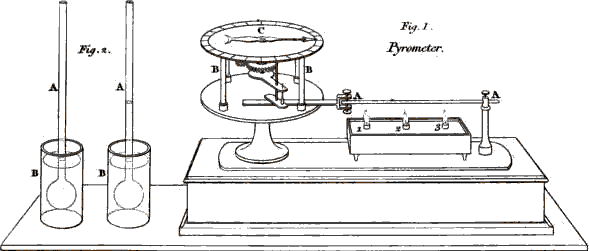
Fig. 1 A.A Bar of Metal. 1.2.3 Lamps burning. B.B Wheel work. C Index. Fig. 2 A.A Glass tubes with bulbs. B.B Glasses of water in which they are immersed.
Larger view
EMILY.
This is, indeed, a very curious instrument; but I do not understand the use of the wheels: would it not be more simple, and answer the purpose equally well, if the bar, in dilating, pressed against the index, and put it in motion without the intervention of the wheels?
MRS. B.
The use of the wheels is merely to multiply the motion, and therefore render the effect of the caloric more obvious; for if the index moved no more than the bar increased in length, its motion would scarcely be perceptible; but by means of the wheels it moves in a much greater proportion, which therefore renders the variations far more conspicuous.
By submitting different bodies to the test of the pyrometer, it is found that they are far from dilating in the same proportion. Different metals expand in different degrees, and other kinds of solid bodies vary still more in this respect. But this different susceptibility of dilatation is still more remarkable in fluids than in solid bodies, as I shall show you. I have here two glass tubes, terminated at one end by large bulbs. We shall fill the bulbs, the one with spirit of wine, the other with water. I have coloured both liquids, in order that the effect may be more conspicuous. The spirit of wine, you see, dilates by the warmth of my hand as I hold the bulb.
EMILY.
It certainly does, for I see it is rising into the tube. But water, it seems, is not so easily affected by heat; for scarcely any change is produced on it by the warmth of the hand.
MRS. B.
True; we shall now plunge the bulbs into hot water, (Plate I. Fig. 2.) and you will see both liquids rise in the tubes; but the spirit of wine will ascend highest.
CAROLINE.
How rapidly it expands! Now it has nearly reached the top of the tube, though the water has hardly begun to rise.
EMILY.
The water now begins to dilate. Are not these glass tubes, with liquids rising within them, very like thermometers?
MRS. B.
A thermometer is constructed exactly on the same principle, and these tubes require only a scale to answer the purpose of thermometers: but they would be rather awkward in their dimensions. The tubes and bulbs of thermometers, though of various sizes, are in general much smaller than these; the tube too is hermetically closed, and the air excluded from it. The fluid most generally used in thermometers is mercury, commonly called quicksilver, the dilatations and contractions of which correspond more exactly to the additions, and subtractions, of caloric, than those of any other fluid.
CAROLINE.
Yet I have often seen coloured spirit of wine used in thermometers.
MRS. B.
The expansions and contractions of that liquid are not quite so uniform as those of mercury; but in cases in which it is not requisite to ascertain the temperature with great precision, spirit of wine will answer the purpose equally well, and indeed in some respects better, as the expansion of the latter is greater, and therefore more conspicuous. This fluid is used likewise in situations and experiments in which mercury would be frozen; for mercury becomes a solid body, like a piece of lead or any other metal, at a certain degree of cold: but no degree of cold has ever been known to freeze spirit of wine.
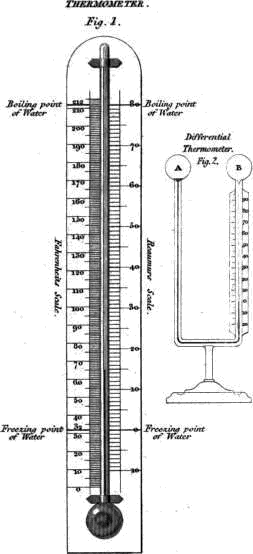
A thermometer, therefore, consists of a tube with a bulb, such as you see here, containing a fluid whose degrees of dilatation and contraction are indicated by a scale to which the tube is fixed. The degree which indicates the boiling point, simply means that, when the fluid is sufficiently dilated to rise to this point, the heat is such that water exposed to the same temperature will boil. When, on the other hand, the fluid is so much condensed as to sink to the freezing point, we know that water will freeze at that temperature. The extreme points of the scales are not the same in all thermometers, nor are the degrees always divided in the same manner. In different countries philosophers have chosen to adopt different scales and divisions. The two thermometers most used are those of Fahrenheit, and of Reaumur; the first is generally preferred by the English, the latter by the French.
EMILY.
The variety of scale must be very inconvenient, and I should think liable to occasion confusion, when French and English experiments are compared.
MRS. B.
The inconvenience is but very trifling, because the different gradations of the scales do not affect the principle upon which thermometers are constructed. When we know, for instance, that Fahrenheit’s scale is divided into 212 degrees, in which 32° corresponds with the freezing point, and 212° with the point of boiling water: and that Reaumur’s is divided only into 80 degrees, in which 0° denotes the freezing point, and 80° that of boiling water, it is easy to compare the two scales together, and reduce the one into the other. But, for greater convenience, thermometers are sometimes constructed with both these scales, one on either side of the tube; so that the correspondence of the different degrees of the two scales is thus instantly seen. Here is one of these scales, (Plate II. Fig. 1.) by which you can at once perceive that each degree of Reaumur’s corresponds to 2¼ of Fahrenheit’s division. But I believe the French have, of late, given the preference to what they call the centigrade scale, in which the space between the freezing and the boiling point is divided into 100 degrees.
Plate II.
Vol. I. p. 42.
Larger view
CAROLINE.
That seems to me the most reasonable division, and I cannot guess why the freezing point is called 32°, or what advantage is derived from it.
MRS. B.
There really is no advantage in it; and it originated in a mistaken opinion of the instrument-maker, Fahrenheit, who first constructed these thermometers. He mixed snow and salt together, and produced by that means a degree of cold which he concluded was the greatest possible, and therefore made his scale begin from that point. Between that and boiling water he made 212 degrees, and the freezing point was found to be at 32°.
EMILY.
Are spirit of wine, and mercury, the only liquids used in the construction of thermometers?
MRS. B.
I believe they are the only liquids now in use, though some others, such as linseed oil, would make tolerable thermometers: but for experiments in which a very quick and delicate test of the changes of temperature is required, air is the fluid sometimes employed. The bulb of air thermometers is filled with common air only, and its expansion and contraction are indicated by a small drop of any coloured liquor, which is suspended within the tube, and moves up and down, according as the air within the bulb and tube expands or contracts. But in general, air thermometers, however sensible to changes of temperature, are by no means accurate in their indications.
I can, however, show you an air thermometer of a very peculiar construction, which is remarkably well adapted for some chemical experiments, as it is equally delicate and accurate in its indications.
CAROLINE.
It looks like a double thermometer reversed, the tube being bent, and having a large bulb at each of its extremities. (Plate II. Fig. 2.)
EMILY.
Why do you call it an air thermometer; the tube contains a coloured liquid?
MRS. B.
But observe that the bulbs are filled with air, the liquid being confined to a portion of the tube, and answering only the purpose of showing, by its motion in the tube, the comparative dilatation or contraction of the air within the bulbs, which afford an indication of their relative temperature. Thus if you heat the bulb A, by the warmth of your hand, the fluid will rise towards the bulb B, and the contrary will happen if you reverse the experiment.
But if, on the contrary, both tubes are of the same temperature, as is the case now, the coloured liquid, suffering an equal pressure on each side, no change of level takes place.
CAROLINE.
This instrument appears, indeed, uncommonly delicate. The fluid is set in motion by the mere approach of my hand.
MRS. B.
You must observe, however, that this thermometer cannot indicate the temperature of any particular body, or of the medium in which it is immersed; it serves only to point out the difference of temperature between the two bulbs, when placed under different circumstances. For this reason it has been called differential thermometer. You will see by-and-bye to what particular purposes this instrument applies.
EMILY.
But do common thermometers indicate the exact quantity of caloric contained either in the atmosphere, or in any body with which they are in contact?
MRS. B.
No: first, because there are other modifications of caloric which do not affect the thermometer; and, secondly, because the temperature of a body, as indicated by the thermometer, is only relative. When, for instance, the thermometer remains stationary at the freezing point, we know that the atmosphere (or medium in which it is placed, whatever it may be) is as cold as freezing water; and when it stands at the boiling point, we know that this medium is as hot as boiling water; but we do not know the positive quantity of heat contained either in freezing or boiling water, any more than we know the real extremes of heat and cold; and consequently we cannot determine that of the body in which the thermometer is placed.
CAROLINE.
I do not quite understand this explanation.
MRS. B.
Let us compare a thermometer to a well, in which the water rises to different heights, according as it is more or less supplied by the spring which feeds it: if the depth of the well is unfathomable, it must be impossible to know the absolute quantity of water it contains; yet we can with the greatest accuracy measure the number of feet the water has risen or fallen in the well at any time, and consequently know the precise quantity of its increase or diminution, without having the least knowledge of the whole quantity of water it contains.
CAROLINE.
Now I comprehend it very well; nothing appears to me to explain a thing so clearly as a comparison.
EMILY.
But will thermometers bear any degree of heat?
MRS. B.
No; for if the temperature were much above the highest degree marked on the scale of the thermometer, the mercury would burst the tube in an attempt to ascend. And at any rate, no thermometer can be applied to temperatures higher than the boiling point of the liquid used in its construction, for the steam, on the liquid beginning to boil, would burst the tube. In furnaces, or whenever any very high temperature is to be measured, a pyrometer, invented by Wedgwood, is used for that purpose. It is made of a certain composition of baked clay, which has the peculiar property of contracting by heat, so that the degree of contraction of this substance indicates the temperature to which it has been exposed.
EMILY.
But is it possible for a body to contract by heat? I thought that heat dilated all bodies whatever.
MRS. B.
This is not an exception to the rule. You must recollect that the bulk of the clay is not compared, whilst hot, with that which it has when cold; but it is from the change which the clay has undergone by having been heated that the indications of this instrument are derived. This change consists in a beginning fusion which tends to unite the particles of clay more closely, thus rendering it less pervious or spongy.
Clay is to be considered as a spongy body, having many interstices or pores, from its having contained water when soft. These interstices are by heat lessened, and would by extreme heat be entirely obliterated.
CAROLINE.
And how do you ascertain the degrees of contraction of Wedgwood’s pyrometer?
MRS. B.
The dimensions of a piece of clay are measured by a scale graduated on the side of a tapered groove, formed in a brass ruler; the more the clay is contracted by the heat, the further it will descend into the narrow part of the tube.
Before we quit the subject of expansion, I must observe to you that, as liquids expand more readily than solids, so elastic fluids, whether air or vapour, are the most expansible of all bodies.
It may appear extraordinary that all elastic fluids whatever, undergo the same degree of expansion from equal augmentations of temperature.
EMILY.
I suppose, then, that all elastic fluids are of the same density?
MRS. B.
Very far from it; they vary in density, more than either liquids or solids. The uniformity of their expansibility, which at first may appear singular, is, however, readily accounted for. For if the different susceptibilities of expansion of bodies arise from their various degrees of attraction of cohesion, no such difference can be expected in elastic fluids, since in these the attraction of cohesion does not exist, their particles being on the contrary possessed of an elastic or repulsive power; they will therefore all be equally expanded by equal degrees of caloric.
EMILY.
True; as there is no power opposed to the expansive force of caloric in elastic bodies, its effect must be the same in all of them.
MRS. B.
Let us now proceed to examine the other properties of free caloric.
Free caloric always tends to diffuse itself equally, that is to say, when two bodies are of different temperatures, the warmer gradually parts with its heat to the colder, till they are both brought to the same temperature. Thus, when a thermometer is applied to a hot body, it receives caloric; when to a cold one, it communicates part of its own caloric, and this communication continues until the thermometer and the body arrive at the same temperature.
EMILY.
Cold, then, is nothing but a negative quality, simply implying the absence of heat.
MRS. B.
Not the total absence, but a diminution of heat; for we know of no body in which some caloric may not be discovered.
CAROLINE.
But when I lay my hand on this marble table I feel it positively cold, and cannot conceive that there is any caloric in it.
MRS. B.
The cold you experience consists in the loss of caloric that your hand sustains in an attempt to bring its temperature to an equilibrium with the marble. If you lay a piece of ice upon it, you will find that the contrary effect will take place; the ice will be melted by the heat which it abstracts from the marble.
CAROLINE.
Is it not in this case the air of the room, which being warmer than the marble, melts the ice?
MRS. B.
The air certainly acts on the surface which is exposed to it, but the table melts that part with which it is in contact.
CAROLINE.
But why does caloric tend to an equilibrium? It cannot be on the same principle as other fluids, since it has no weight?
MRS. B.
Very true, Caroline, that is an excellent objection. You might also, with some propriety, object to the term equilibrium being applied to a body that is without weight; but I know of no expression that would explain my meaning so well. You must consider it, however, in a figurative rather than a literal sense; its strict meaning is an equal diffusion. We cannot, indeed, well say by what power it diffuses itself equally, though it is not surprising that it should go from the parts which have the most to those which have the least. This subject is best explained by a theory suggested by Professor Prevost of Geneva, which is now, I believe, generally adopted.
According to this theory, caloric is composed of particles perfectly separate from each other, every one of which moves with a rapid velocity in a certain direction. These directions vary as much as imagination can conceive, the result of which is, that there are rays or lines of these particles moving with immense velocity in every possible direction. Caloric is thus universally diffused, so that when any portion of space happens to be in the neighbourhood of another, which contains more caloric, the colder portion receives a quantity of calorific rays from the latter, sufficient to restore an equilibrium of temperature. This radiation does not only take place in free space, but extends also to bodies of every kind. Thus you may suppose all bodies whatever constantly radiating caloric: those that are of the same temperature give out and absorb equal quantities, so that no variation of temperature is produced in them; but when one body contains more free caloric than another, the exchange is always in favour of the colder body, until an equilibrium is effected; this you found to be the case when the marble table cooled your hand, and again when it melted the ice.
CAROLINE.
This reciprocal radiation surprises me extremely; I thought, from what you first said, that the hotter bodies alone emitted rays of caloric which were absorbed by the colder; for it seems unnatural that a hot body should receive any caloric from a cold one, even though it should return a greater quantity.
MRS. B.
It may at first appear so, but it is no more extraordinary than that a candle should send forth rays of light to the sun, which, you know, must necessarily happen.
CAROLINE.
Well, Mrs. B—, I believe that I must give up the point. But I wish I could see these rays of caloric; I should then have greater faith in them.
MRS. B.
Will you give no credit to any sense but that of sight? You may feel the rays of caloric which you receive from any body of a temperature higher than your own; the loss of the caloric you part with in return, it is true, is not perceptible; for as you gain more than you lose, instead of suffering a diminution, you are really making an acquisition of caloric. It is, therefore, only when you are parting with it to a body of a lower temperature, that you are sensible of the sensation of cold, because you then sustain an absolute loss of caloric.
EMILY.
And in this case we cannot be sensible of the small quantity of heat we receive in exchange from the colder body, because it serves only to diminish the loss.
MRS. B.
Very well, indeed, Emily. Professor Pictet, of Geneva, has made some very interesting experiments, which prove not only that caloric radiates from all bodies whatever, but that these rays may be reflected, according to the laws of optics, in the same manner as light. I shall repeat these experiments before you, having procured mirrors fit for the purpose; and it will afford us an opportunity of using the differential thermometer, which is particularly well adapted for these experiments.—I place an iron bullet, (Plate III. Fig. 1.) about two inches in diameter, and heated to a degree not sufficient to render it luminous, in the focus of this large metallic concave mirror. The rays of heat which fall on this mirror are reflected, agreeably to the property of concave mirrors, in a parallel direction, so as to fall on a similar mirror, which, you see, is placed opposite to the first, at the distance of about ten feet; thence the rays converge to the focus of the second mirror, in which I place one of the bulbs of this thermometer. Now, observe in what manner it is affected by the caloric which is reflected on it from the heated bullet.—The air is dilated in the bulb which we placed in the focus of the mirror, and the liquor rises considerably in the opposite leg.
Plate III.
Vol. I. p. 54
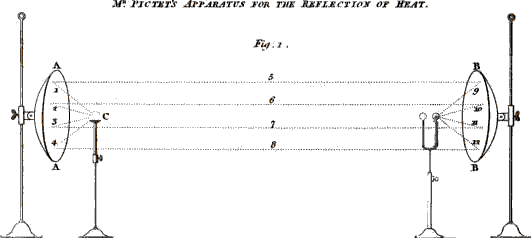
A.A. & B.B Concave mirrors fixed on stands. C Heated Bullet placed in the focus of the mirror A. D Thermometer, with its bulb placed in the focus of the mirror B. 1.2.3.4 Rays of Caloric radiating from the bullet & falling on the mirror A. 5.6.7.8 The same rays reflected from the mirror A to the mirror B. 9.10.11.12 The same rays reflected by the mirror B to the Thermometer.
Larger view
EMILY.
But would not the same effect take place, if the rays of caloric from the heated bullet fell directly on the thermometer, without the assistance of the mirrors?
MRS. B.
The effect would in that case be so trifling, at the distance at which the bullet and the thermometer are from each other, that it would be almost imperceptible. The mirrors, you know, greatly increase the effect, by collecting a large quantity of rays into a focus; place your hand in the focus of the mirror, and you will find it much hotter there than when you remove it nearer to the bullet.
EMILY.
That is very true; it appears extremely singular to feel the heat diminish in approaching the body from which it proceeds.
CAROLINE.
And the mirror which produces so much heat, by converging the rays, is itself quite cold.
MRS. B.
The same number of rays that are dispersed over the surface of the mirror are collected by it into the focus; but, if you consider how large a surface the mirror presents to the rays, and, consequently, how much they are diffused in comparison to what they are at the focus, which is little more than a point, I think you can no longer wonder that the focus should be so much hotter than the mirror.
The principal use of the mirrors in this experiment is, to prove that the calorific emanation is reflected in the same manner as light.
CAROLINE.
And the result, I think, is very conclusive.
MRS. B.
The experiment may be repeated with a wax taper instead of the bullet, with a view of separating the light from the caloric. For this purpose a transparent plate of glass must be interposed between the mirrors; for light, you know, passes with great facility through glass, whilst the transmission of caloric is almost wholly impeded by it. We shall find, however, in this experiment, that some few of the calorific rays pass through the glass together with the light, as the thermometer rises a little; but, as soon as the glass is removed, and a free passage left to the caloric, it will rise considerably higher.
EMILY.
This experiment, as well as that of Dr. Herschell’s, proves that light and heat may be separated; for in the latter experiment the separation was not perfect, any more than in that of Mr. Pictet.
CAROLINE.
I should like to repeat this experiment, with the difference of substituting a cold body instead of the hot one, to see whether cold would not be reflected as well as heat.
MRS. B.
That experiment was proposed to Mr. Pictet by an incredulous philosopher like yourself, and he immediately tried it by substituting a piece of ice in the place of the heated bullet.
CAROLINE.
Well, Mrs. B., and what was the result?
MRS. B.
That we shall see; I have procured some ice for the purpose.
EMILY.
The thermometer falls considerably!
CAROLINE.
And does not that prove that cold is not merely a negative quality, implying simply an inferior degree of heat? The cold must be positive, since it is capable of reflection.
MRS. B.
So it at first appeared to Mr. Pictet; but upon a little consideration he found that it afforded only an additional proof of the reflection of heat: this I shall endeavour to explain to you.
According to Mr. Prevost’s theory, we suppose that all bodies whatever radiate caloric; the thermometer used in these experiments therefore emits calorific rays in the same manner as any other substance. When its temperature is in equilibrium with that of the surrounding bodies, it receives as much caloric as it parts with, and no change of temperature is produced. But when we introduce a body of a lower temperature, such as a piece of ice, which parts with less caloric than it receives, the consequence is, that its temperature is raised, whilst that of the surrounding bodies is proportionally lowered.
EMILY.
If, for instance, I was to bring a large piece of ice into this room, the ice would in time be melted, by absorbing caloric from the general radiation which is going on throughout the room; and as it would contribute very little caloric in return for what is absorbed, the room would necessarily be cooled by it.
MRS. B.
Just so; and as in consequence of the mirrors, a more considerable exchange of rays takes place between the ice and the thermometer, than between these and any of the surrounding bodies, the temperature of the thermometer must be more lowered than that of any other adjacent object.
CAROLINE.
I confess I do not perfectly understand your explanation.
MRS. B.
This experiment is exactly similar to that made with the heated bullet: for, if we consider the thermometer as the hot body (which it certainly is in comparison to the ice), you may then easily understand that it is by the loss of the calorific rays which the thermometer sends to the ice, and not by any cold rays received from it, that the fall of the mercury is occasioned: for the ice, far from emitting rays of cold, sends forth rays of caloric, which diminish the loss sustained by the thermometer.
Let us say, for instance, that the radiation of the thermometer towards the ice is equal to 20, and that of the ice towards the thermometer to 10: the exchange in favour of the ice is as 20 is to 10, or the thermometer absolutely loses 10, whilst the ice gains 10.
CAROLINE.
But if the ice actually sends rays of caloric to the thermometer, must not the latter fall still lower when the ice is removed?
MRS. B.
No; for the space that the ice occupied, admits rays from all the surrounding bodies to pass through it; and those being of the same temperature as the thermometer, will not affect it, because as much heat now returns to the thermometer as radiates from it.
CAROLINE.
I must confess that you have explained this in so satisfactory a manner, that I cannot help being convinced now that cold has no real claim to the rank of a positive being.
MRS. B.
Before I conclude the subject of radiation I must observe to you that different bodies, (or rather surfaces,) possess the power of radiating caloric in very different degrees.
Some very curious experiments have been made by Mr. Leslie on this subject, and it was for this purpose that he invented the differential thermometer; with its assistance he ascertained that black surfaces radiate most, glass next, and polished surfaces the least of all.
EMILY.
Supposing these surfaces, of course, to be all of the same temperature.
MRS. B.
Undoubtedly. I will now show you the very simple and ingenious apparatus, by means of which he made these experiments. This cubical tin vessel or canister, has each of its sides externally covered with different materials; the one is simply blackened; the next is covered with white paper; the third with a pane of glass, and in the fourth the polished tin surface remains uncovered. We shall fill this vessel with hot water, so that there can be no doubt but that all its sides will be of the same temperature. Now let us place it in the focus of one of the mirrors, making each of its sides front it in succession. We shall begin with the black surface.
CAROLINE.
It makes the thermometer which is in the focus of the other mirror rise considerably. Let us turn the paper surface towards the mirror. The thermometer falls a little, therefore of course this side cannot emit or radiate so much caloric as the blackened side.
EMILY.
This is very surprising; for the sides are exactly of the same size, and must be of the same temperature. But let us try the glass surface.
MRS. B.
The thermometer continues falling, and with the plain surface it falls still lower; these two surfaces therefore radiate less and less.
CAROLINE.
I think I have found out the reason of this.
MRS. B.
I should be very happy to hear it, for it has not yet (to my knowledge) been accounted for.
CAROLINE.
The water within the vessel gradually cools, and the thermometer in consequence gradually falls.
MRS. B.
It is true that the water cools, but certainly in much less proportion than the thermometer descends, as you will perceive if you now change the tin surface for the black one.
CAROLINE.
I was mistaken certainly, for the thermometer rises again now that the black surface fronts the mirror.
MRS. B.
And yet the water in the vessel is still cooling, Caroline.
EMILY.
I am surprised that the tin surface should radiate the least caloric, for a metallic vessel filled with hot water, a silver teapot, for instance, feels much hotter to the hand than one of black earthen ware.
MRS. B.
That is owing to the different power which various bodies possess for conducting caloric, a property which we shall presently examine. Thus, although a metallic vessel feels warmer to the hand, a vessel of this kind is known to preserve the heat of the liquid within, better than one of any other materials; it is for this reason that silver teapots make better tea than those of earthen ware.
EMILY.
According to these experiments, light-coloured dresses, in cold weather, should keep us warmer than black clothes, since the latter radiate so much more than the former.
MRS. B.
And that is actually the case.
EMILY.
This property, of different surfaces to radiate in different degrees, appears to me to be at variance with the equilibrium of caloric; since it would imply that those bodies which radiate most, must ultimately become coldest.
Suppose that we were to vary this experiment, by using two metallic vessels full of boiling water, the one blackened, the other not; would not the black one cool the first?
CAROLINE.
True; but when they were both brought down to the temperature of the room, the interchange of caloric between the canisters and the other bodies of the room being then equal, their temperatures would remain the same.
EMILY.
I do not see why that should be the case; for if different surfaces of the same temperature radiate in different degrees when heated, why should they not continue to do so when cooled down to the temperature of the room?
MRS. B.
You have started a difficulty, Emily, which certainly requires explanation. It is found by experiment that the power of absorption corresponds with and is proportional to that of radiation; so that under equal temperatures, bodies compensate for the greater loss they sustain in consequence of their greater radiation by their greater absorption; so that if you were to make your experiment in an atmosphere heated like the canisters, to the temperature of boiling water, though it is true that the canisters would radiate in different degrees, no change of temperature would be produced in them, because they would each absorb caloric in proportion to their respective radiation.
EMILY.
But would not the canisters of boiling water also absorb caloric in different degrees in a room of the common temperature?
MRS. B.
Undoubtedly they would. But the various bodies in the room would not, at a lower temperature, furnish either of the canisters with a sufficiency of caloric to compensate for the loss they undergo; for, suppose the black canister to absorb 400 rays of caloric, whilst the metallic one absorbed only 200; yet if the former radiate 800, whilst the latter radiates only 400, the black canister will be the first cooled down to the temperature of the room. But from the moment the equilibrium of temperature has taken place, the black canister, both receiving and giving out 400 rays, and the metallic one 200, no change of temperature will take place.
EMILY.
I now understand it extremely well. But what becomes of the surplus of calorific rays, which good radiators emit and bad radiators refuse to receive; they must wander about in search of a resting-place?
MRS. B.
They really do so; for they are rejected and sent back, or, in other words, reflected by the bodies which are bad radiators of caloric; and they are thus transmitted to other bodies which happen to lie in their way, by which they are either absorbed or again reflected, according as the property of reflection, or that of absorption, predominates in these bodies.
CAROLINE.
I do not well understand the difference between radiating and reflecting caloric, for the caloric that is reflected from a body proceeds from it in straight lines, and may surely be said to radiate from it?
MRS. B.
It is true that there at first appears to be a great analogy between radiation and reflection, as they equally convey the idea of the transmission of caloric.
But if you consider a little, you will perceive that when a body radiates caloric, the heat which it emits not only proceeds from, but has its origin in the body itself. Whilst when a body reflects caloric, it parts with none of its own caloric, but only reflects that which it receives from other bodies.
EMILY.
Of this difference we have very striking examples before us, in the tin vessel of water, and the concave mirrors; the first radiates its own heat, the latter reflect the heat which they receive from other bodies.
CAROLINE.
Now, that I understand the difference, it no longer surprises me that bodies which radiate, or part with their own caloric freely, should not have the power of transmitting with equal facility that which they receive from other bodies.
EMILY.
Yet no body can be said to possess caloric of its own, if all caloric is originally derived from the sun.
MRS. B.
When I speak of a body radiating its own caloric, I mean that which it has absorbed and incorporated either immediately from the sun’s rays, or through the medium of any other substance.
CAROLINE.
It seems natural enough that the power of absorption should be in opposition to that of reflection, for the more caloric a body receives, the less it will reject.
EMILY.
And equally so that the power of radiation should correspond with that of absorption. It is, in fact, cause and effect; for a body cannot radiate heat without having previously absorbed it; just as a spring that is well fed flows abundantly.
MRS. B.
Fluids are in general very bad radiators of caloric; and air neither radiates nor absorbs caloric in any sensible degree.
We have not yet concluded our observations on free caloric. But I shall defer, till our next meeting, what I have further to say on this subject. I believe it will afford us ample conversation for another interview.
CONVERSATION III. CONTINUATION OF THE SUBJECT.
MRS. B.
In our last conversation, we began to examine the tendency of caloric to restore an equilibrium of temperature. This property, when once well understood, affords the explanation of a great variety of facts which appeared formerly unaccountable. You must observe, in the first place, that the effect of this tendency is gradually to bring all bodies that are in contact to the same temperature. Thus, the fire which burns in the grate, communicates its heat from one object to another, till every part of the room has an equal proportion of it.
EMILY.
And yet this book is not so cold as the table on which it lies, though both are at an equal distance from the fire, and actually in contact with each other, so that, according to your theory, they should be exactly of the same temperature.
CAROLINE.
And the hearth, which is much nearer the fire than the carpet, is certainly the colder of the two.
MRS. B.
If you ascertain the temperature of these several bodies by a thermometer (which is a much more accurate test than your feeling), you will find that it is exactly the same.
CAROLINE.
But if they are of the same temperature, why should the one feel colder than the other?
MRS. B.
The hearth and the table feel colder than the carpet or the book, because the latter are not such good conductors of heat as the former. Caloric finds a more easy passage through marble and wood, than through leather and worsted; the two former will therefore absorb heat more rapidly from your hand, and consequently give it a stronger sensation of cold than the two latter, although they are all of them really of the same temperature.
CAROLINE.
So, then, the sensation I feel on touching a cold body, is in proportion to the rapidity with which my hand yields its heat to that body?
MRS. B.
Precisely; and, if you lay your hand successively on every object in the room, you will discover which are good, and which are bad conductors of heat, by the different degrees of cold you feel. But, in order to ascertain this point, it is necessary that the several substances should be of the same temperature, which will not be the case with those that are very near the fire, or those that are exposed to a current of cold air from a window or door.
EMILY.
But what is the reason that some bodies are better conductors of heat than others?
MRS. B.
This is a point not well ascertained. It has been conjectured that a certain union or adherence takes place between the caloric and the particles of the body through which it passes. If this adherence be strong, the body detains the heat, and parts with it slowly and reluctantly; if slight, it propagates it freely and rapidly. The conducting power of a body is therefore, inversely, as its tendency to unite with caloric.
EMILY.
That is to say, that the best conductors are those that have the least affinity for caloric.
MRS. B.
Yes; but the term affinity is objectionable in this case, because, as that word is used to express a chemical attraction (which can be destroyed only by decomposition), it cannot be applicable to the slight and transient union that takes place between free caloric and the bodies through which it passes; an union which is so weak, that it constantly yields to the tendency which caloric has to an equilibrium. Now you clearly understand, that the passage of caloric, through bodies that are good conductors, is much more rapid than through those that are bad conductors, and that the former both give and receive it more quickly, and therefore, in a given time, more abundantly, than bad conductors, which makes them feel either hotter or colder, though they may be, in fact, both of the same temperature.
CAROLINE.
Yes, I understand it now; the table, and the book lying upon it, being really of the same temperature, would each receive, in the same space of time, the same quantity of heat from my hand, were their conducting powers equal; but as the table is the best conductor of the two, it will absorb the heat from my hand more rapidly, and consequently produce a stronger sensation of cold than the book.
MRS. B.
Very well, my dear; and observe, likewise, that if you were to heat the table and the book an equal number of degrees above the temperature of your body, the table, which before felt the colder, would now feel the hotter of the two; for, as in the first case it took the heat most rapidly from your hand, so it will now impart heat most rapidly to it. Thus the marble table, which seems to us colder than the mahogany one, will prove the hotter of the two to the ice; for, if it takes heat more rapidly from our hands, which are warmer, it will give out heat more rapidly to the ice, which is colder. Do you understand the reason of these apparently opposite effects?
EMILY.
Perfectly. A body which is a good conductor of caloric, affords it a free passage; so that it penetrates through that body more rapidly than through one which is a bad conductor; and consequently, if it is colder than your hand, you lose more caloric, and if it is hotter, you gain more than with a bad conductor of the same temperature.
MRS. B.
But you must observe that this is the case only when the conductors are either hotter or colder than your hand; for, if you heat different conductors to the temperature of your body, they will all feel equally warm, since the exchange of caloric between bodies of the same temperature is equal. Now, can you tell me why flannel clothing, which is a very bad conductor of heat, prevents our feeling cold?
CAROLINE.
It prevents the cold from penetrating . . . . . . . .
MRS. B.
But you forget that cold is only a negative quality.
CAROLINE.
True; it only prevents the heat of our bodies from escaping so rapidly as it would otherwise do.
MRS. B.
Now you have explained it right; the flannel rather keeps in the heat, than keeps out the cold. Were the atmosphere of a higher temperature than our bodies, it would be equally efficacious in keeping their temperature at the same degree, as it would prevent the free access of the external heat, by the difficulty with which it conducts it.
EMILY.
This, I think, is very clear. Heat, whether external or internal, cannot easily penetrate flannel; therefore in cold weather it keeps us warm; and if the weather was hotter than our bodies, it would keep us cool.
MRS. B.
The most dense bodies are, generally speaking, the best conductors of heat; probably because the denser the body the greater are the number of points or particles that come in contact with caloric. At the common temperature of the atmosphere a piece of metal will feel much colder than a piece of wood, and the latter than a piece of woollen cloth; this again will feel colder than flannel; and down, which is one of the lightest, is at the same time one of the warmest bodies.
CAROLINE.
This is, I suppose, the reason that the plumage of birds preserves them so effectually from the influence of cold in winter?
MRS. B.
Yes; but though feathers in general are an excellent preservative against cold, down is a kind of plumage peculiar to aquatic birds, and covers their chest, which is the part most exposed to the water; for though the surface of the water is not of a lower temperature than the atmosphere, yet, as it is a better conductor of heat, it feels much colder, consequently the chest of the bird requires a warmer covering than any other part of its body. Besides, the breasts of aquatic birds are exposed to cold not only from the temperature of the water, but also from the velocity with which the breast of the bird strikes against it; and likewise from the rapid evaporation occasioned in that part by the air against which it strikes, after it has been moistened by dipping from time to time into the water.
If you hold a finger of one hand motionless in a glass of water, and at the same time move a finger of the other hand swiftly through water of the same temperature, a different sensation will be soon perceived in the different fingers.
Most animal substances, especially those which Providence has assigned as a covering for animals, such as fur, wool, hair, skin, &c. are bad conductors of heat, and are, on that account, such excellent preservatives against the inclemency of winter, that our warmest apparel is made of these materials.
EMILY.
Wood is, I dare say, not so good a conductor as metal, and it is for that reason, no doubt, that silver teapots have always wooden handles.
MRS. B.
Yes; and it is the facility with which metals conduct caloric that made you suppose that a silver pot radiated more caloric than an earthen one. The silver pot is in fact hotter to the hand when in contact with it; but it is because its conducting power more than counterbalances its deficiency in regard to radiation.
We have observed that the most dense bodies are in general the best conductors; and metals, you know, are of that class. Porous bodies, such as the earths and wood, are worse conductors, chiefly, I believe, on account of their pores being filled with air; for air is a remarkably bad conductor.
CAROLINE.
It is a very fortunate circumstance that air should be a bad conductor, as it tends to preserve the heat of the body when exposed to cold weather.
MRS. B.
It is one of the many benevolent dispensations of Providence, in order to soften the inclemency of the seasons, and to render almost all climates habitable to man.
In fluids of different densities, the power of conducting heat varies no less remarkably; if you dip your hand into this vessel full of mercury, you will scarcely conceive that its temperature is not lower than that of the atmosphere.
CAROLINE.
Indeed I know not how to believe it, it feels so extremely cold.—But we may easily ascertain its true temperature by the thermometer.—It is really not colder than the air;—the apparent difference then is produced merely by the difference of the conducting power in mercury and in air.
MRS. B.
Yes; hence you may judge how little the sense of feeling is to be relied on as a test of the temperature of bodies, and how necessary a thermometer is for that purpose.
It has indeed been doubted whether fluids have the power of conducting caloric in the same manner as solid bodies. Count Rumford, a very few years since, attempted to prove, by a variety of experiments, that fluids, when at rest, were not at all endowed with this property.
CAROLINE.
How is that possible, since they are capable of imparting cold or heat to us; for if they did not conduct heat, they would neither take it from, nor give it to us?
MRS. B.
Count Rumford did not mean to say that fluids would not communicate their heat to solid bodies; but only that heat does not pervade fluids, that is to say, is not transmitted from one particle of a fluid to another, in the same manner as in solid bodies.
EMILY.
But when you heat a vessel of water over the fire, if the particles of water do not communicate heat to each other, how does the water become hot throughout?
MRS. B.
By constant agitation. Water, as you have seen, expands by heat in the same manner as solid bodies; the heated particles of water, therefore, at the bottom of the vessel, become specifically lighter than the rest of the liquid, and consequently ascend to the surface, where, parting with some of their heat to the colder atmosphere, they are condensed, and give way to a fresh succession of heated particles ascending from the bottom, which having thrown off their heat at the surface, are in their turn displaced. Thus every particle is successively heated at the bottom, and cooled at the surface of the liquid; but as the fire communicates heat more rapidly than the atmosphere cools the succession of surfaces, the whole of the liquid in time becomes heated.
CAROLINE.
This accounts most ingeniously for the propagation of heat upwards. But suppose you were to heat the upper surface of a liquid, the particles being specifically lighter than those below, could not descend: how therefore would the heat be communicated downwards?
MRS. B.
If there were no agitation to force the heated surface downwards, Count Rumford assures us that the heat would not descend. In proof of this he succeeded in making the upper surface of a vessel of water boil and evaporate, while a cake of ice remained frozen at the bottom.
CAROLINE.
That is very extraordinary indeed!
MRS. B.
It appears so, because we are not accustomed to heat liquids by their upper surface; but you will understand this theory better if I show you the internal motion that takes place in liquids when they experience a change of temperature. The motion of the liquid itself is indeed invisible from the extreme minuteness of its particles; but if you mix with it any coloured dust, or powder, of nearly the same specific gravity as the liquid, you may judge of the internal motion of the latter by that of the coloured dust it contains.—Do you see the small pieces of amber moving about in the liquid contained in this phial?
CAROLINE.
Yes, perfectly.
MRS. B.
We shall now immerse the phial in a glass of hot water, and the motion of the liquid will be shown, by that which it communicates to the amber.
EMILY.
I see two currents, the one rising along the sides of the phial, the other descending in the centre: but I do not understand the reason of this.
MRS. B.
The hot water communicates its caloric, through the medium of the phial, to the particles of the fluid nearest to the glass; these dilate and ascend laterally to the surface, where, in parting with their heat, they are condensed, and in descending, form the central current.
CAROLINE.
This is indeed a very clear and satisfactory experiment; but how much slower the currents now move than they did at first?
MRS. B.
It is because the circulation of particles has nearly produced an equilibrium of temperature between the liquid in the glass and that in the phial.
CAROLINE.
But these communicate laterally, and I thought that heat in liquids could be propagated only upwards.
MRS. B.
You do not take notice that the heat is imparted from one liquid to the other, through the medium of the phial itself, the external surface of which receives the heat from the water in the glass, whilst its internal surface transmits it to the liquid it contains. Now take the phial out of the hot water, and observe the effect of its cooling.
EMILY.
The currents are reversed; the external current now descends, and the internal one rises.—I guess the reason of this change:—the phial being in contact with cold air instead of hot water, the external particles are cooled instead of being heated; they therefore descend and force up the central particles, which, being warmer, are consequently lighter.
MRS. B.
It is just so. Count Rumford hence infers that no alteration of temperature can take place in a fluid, without an internal motion of its particles, and as this motion is produced only by the comparative levity of the heated particles, heat cannot be propagated downwards.
But though I believe that Count Rumford’s theory as to heat being incapable of pervading fluids is not strictly correct, yet there is, no doubt, much truth in his observation, that the communication is materially promoted by a motion of the parts; and this accounts for the cold that is found to prevail at the bottom of the lakes in Switzerland, which are fed by rivers issuing from the snowy Alps. The water of these rivers being colder, and therefore more dense than that of the lakes, subsides to the bottom, where it cannot be affected by the warmer temperature of the surface; the motion of the waves may communicate this temperature to some little depth, but it can descend no further than the agitation extends.
EMILY.
But when the atmosphere is colder than the lake, the colder surface of the water will descend, for the very reason that the warmer will not.
MRS. B.
Certainly: and it is on this account that neither a lake, nor any body of water whatever, can be frozen until every particle of the water has risen to the surface to give off its caloric to the colder atmosphere; therefore the deeper a body of water is, the longer will be the time it requires to be frozen.
EMILY.
But if the temperature of the whole body of water be brought down to the freezing point, why is only the surface frozen?
MRS. B.
The temperature of the whole body is lowered, but not to the freezing point. The diminution of heat, as you know, produces a contraction in the bulk of fluids, as well as of solids. This effect, however, does not take place in water below the temperature of 40 degrees, which is 8 degrees above the freezing point. At that temperature, therefore, the internal motion, occasioned by the increased specific gravity of the condensed particles, ceases; for when the water at the surface no longer condenses, it will no longer descend, and leave a fresh surface exposed to the atmosphere: this surface alone, therefore, will be further exposed to its severity, and will soon be brought down to the freezing point, when it becomes ice, which being a bad conductor of heat, preserves the water beneath a long time from being affected by the external cold.
CAROLINE.
And the sea does not freeze, I suppose, because its depth is so great, that a frost never lasts long enough to bring down the temperature of such a great body of water to 40 degrees?
MRS. B.
That is one reason why the sea, as a large mass of water, does not freeze. But, independently of this, salt water does not freeze till it is cooled much below 32 degrees, and with respect to the law of condensation, salt water is an exception, as it condenses even many degrees below the freezing point. When the caloric of fresh water, therefore, is imprisoned by the ice on its surface, the ocean still continues throwing off heat into the atmosphere, which is a most signal dispensation of Providence to moderate the intensity of the cold in winter.
CAROLINE.
This theory of the non-conducting power of liquids, does not, I suppose, hold good with respect to air, otherwise the atmosphere would not be heated by the rays of the sun passing through it?
MRS. B.
Nor is it heated in that way. The pure atmosphere is a perfectly transparent medium, which neither radiates, absorbs, nor conducts caloric, but transmits the rays of the sun to us without in any way diminishing their intensity. The air is therefore not more heated, by the sun’s rays passing through it, than diamond, glass, water, or any other transparent medium.
CAROLINE.
That is very extraordinary! Are glass windows not heated then by the sun shining on them?
MRS. B.
No; not if the glass be perfectly transparent. A most convincing proof that glass transmits the rays of the sun without being heated by them is afforded by the burning lens, which by converging the rays to a focus will set combustible bodies on fire, without its own temperature being raised.
EMILY.
Yet, Mrs. B., if I hold a piece of glass near the fire it is almost immediately warmed by it; the glass therefore must retain some of the caloric radiated by the fire? Is it that the solar rays alone pass freely through glass without paying tribute? It seems unaccountable that the radiation of a common fire should have power to do what the sun’s rays cannot accomplish.
MRS. B.
It is not because the rays from the fire have more power, but rather because they have less, that they heat glass and other transparent bodies. It is true, however, that as you approach the source of heat the rays being nearer each other, the heat is more condensed, and can produce effects of which the solar rays, from the great distance of their source, are incapable. Thus we should find it impossible to roast a joint of meat by the sun’s rays, though it is so easily done by culinary heat. Yet caloric emanated from burning bodies, which is commonly called culinary heat, has neither the intensity nor the velocity of solar rays. All caloric, we have said, is supposed to proceed originally from the sun; but after having been incorporated with terrestrial bodies, and again given out by them, though its nature is not essentially altered, it retains neither the intensity nor the velocity with which it first emanated from that luminary; it has therefore not the power of passing through transparent mediums, such as glass and water, without being partially retained by those bodies.