Volume 1 — CHEMISTRY. (continued 2)
Reading edition
EMILY.
I recollect that in the experiment on the reflection of heat, the glass skreen which you interposed between the burning taper and the mirror, arrested the rays of caloric, and suffered only those of light to pass through it.
CAROLINE.
Glass windows, then, though they cannot be heated by the sun shining on them, may be heated internally by a fire in the room? But, Mrs. B., since the atmosphere is not warmed by the solar rays passing through it, how does it obtain heat; for all the fires that are burning on the surface of the earth would contribute very little towards warming it?
EMILY.
The radiation of heat is not confined to burning bodies: for all bodies, you know, have that property; therefore, not only every thing upon the surface of the earth, but the earth itself, must radiate heat; and this terrestrial caloric, not having, I suppose, sufficient power to traverse the atmosphere, communicates heat to it.
MRS. B.
Your inference is extremely well drawn, Emily; but the foundation on which it rests is not sound; for the fact is, that terrestrial or culinary heat, though it cannot pass through the denser transparent mediums, such as glass or water, without loss, traverses the atmosphere completely: so that all the heat which the earth radiates, unless it meet with clouds or any foreign body to intercept its passage, passes into the distant regions of the universe.
CAROLINE.
What a pity that so much heat should be wasted!
MRS. B.
Before you are tempted to object to any law of nature, reflect whether it may not prove to be one of the numberless dispensations of Providence for our good. If all the heat which the earth has received from the sun, since the creation had been accumulated in it, its temperature by this time would, no doubt, have been more elevated than any human being could have borne.
CAROLINE.
I spoke indeed very inconsiderately. But, Mrs. B., though the earth, at such a high temperature, might have scorched our feet, we should always have had a cool refreshing air to breathe, since the radiation of the earth does not heat the atmosphere.
EMILY.
The cool air would have afforded but very insufficient refreshment, whilst our bodies were exposed to the burning radiation of the earth.
MRS. B.
Nor should we have breathed a cool air; for though it is true that heat is not communicated to the atmosphere by radiation, yet the air is warmed by contact with heated bodies, in the same manner as solids or liquids. The stratum of air which is immediately in contact with the earth is heated by it; it becomes specifically lighter and rises, making way for another stratum of air which is in its turn heated and carried upwards; and thus each successive stratum of air is warmed by coming in contact with the earth. You may perceive this effect in a sultry day, if you attentively observe the strata of air near the surface of the earth; they appear in constant agitation, for though it is true the air is itself invisible, yet the sun shining on the vapours floating in it, render them visible, like the amber dust in the water. The temperature of the surface of the earth is therefore the source from whence the atmosphere derives its heat, though it is communicated neither by radiation, nor transmitted from one particle of it to another by the conducting power; but every particle of air must come in contact with the earth in order to receive heat from it.
EMILY.
Wind then by agitating the air should contribute to cool the earth and warm the atmosphere, by bringing a more rapid succession of fresh strata of air in contact with the earth, and yet in general wind feels cooler than still air?
MRS. B.
Because the agitation of the air carries off heat from the surface of our bodies more rapidly than still air, by occasioning a greater number of points of contact in a given time.
EMILY.
Since it is from the earth and not the sun that the atmosphere receives its heat, I no longer wonder that elevated regions should be colder than plains and valleys; it was always a subject of astonishment to me, that in ascending a mountain and approaching the sun, the air became colder instead of being more heated.
MRS. B.
At the distance of about a hundred million of miles, which we are from the sun, the approach of a few thousand feet makes no sensible difference, whilst it produces a very considerable effect with regard to the warming the atmosphere at the surface of the earth.
CAROLINE.
Yet as the warm air rises from the earth and the cold air descends to it, I should have supposed that heat would have accumulated in the upper regions of the atmosphere, and that we should have felt the air warmer as we ascended?
MRS. B.
The atmosphere, you know, diminishes in density, and consequently in weight, as it is more distant from the earth; the warm air, therefore, rises only till it meets with a stratum of air of its own density; and it will not ascend into the upper regions of the atmosphere until all the parts beneath have been previously heated. The length of summer even in warm climates does not heat the air sufficiently to melt the snow which has accumulated during the winter on very high mountains, although they are almost constantly exposed to the heat of the sun’s rays, being too much elevated to be often enveloped in clouds.
EMILY.
These explanations are very satisfactory; but allow me to ask you one more question respecting the increased levity of heated liquids. You said that when water was heated over the fire, the particles at the bottom of the vessel ascended as soon as heated, in consequence of their specific levity: why does not the same effect continue when the water boils, and is converted into steam? and why does the steam rise from the surface, instead of the bottom of the liquid?
MRS. B.
The steam or vapour does ascend from the bottom, though it seems to arise from the surface of the liquid. We shall boil some water in this Florence flask, (Plate IV. Fig. 1.) in order that you may be well acquainted with the process of ebullition;—you will then see, through the glass, that the vapour rises in bubbles from the bottom. We shall make it boil by means of a lamp, which is more convenient for this purpose than the chimney fire.
Plate IV.
Vol. I. p. 84.
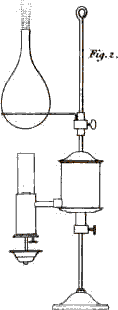
Fig. 2. Boiling water in a flask over a Patent lamp.
Larger view (complete Plate)
EMILY.
I see some small bubbles ascend, and a great many appear all over the inside of the flask; does the water begin to boil already?
MRS. B.
No; what you now see are bubbles of air, which were either dissolved in the water, or attached to the inner surface of the flask, and which, being rarefied by the heat, ascend in the water.
EMILY.
But the heat which rarefies the air inclosed in the water must rarefy the water at the same time; therefore, if it could remain stationary in the water when both were cold, I do not understand why it should not when both are equally heated?
MRS. B.
Air being much less dense than water, is more easily rarefied; the former, therefore, expands to a great extent, whilst the latter continues to occupy nearly the same space; for water dilates comparatively but very little without changing its state and becoming vapour. Now that the water in the flask begins to boil, observe what large bubbles rise from the bottom of it.
EMILY.
I see them perfectly; but I wonder that they have sufficient power to force themselves through the water.
CAROLINE.
They must rise, you know, from their specific levity.
MRS. B.
You are right, Caroline; but vapour has not in all liquids (when brought to the degree of vaporization) the power of overcoming the pressure of the less heated surface. Metals, for instance, mercury excepted, evaporate only from the surface; therefore no vapour will ascend from them till the degree of heat which is necessary to form it has reached the surface; that is to say, till the whole of the liquid is brought to a state of ebullition.
EMILY.
I have observed that steam, immediately issuing from the spout of a teakettle, is less visible than at a further distance from it; yet it must be more dense when it first evaporates, than when it begins to diffuse itself in the air.
MRS. B.
When the steam is first formed, it is so perfectly dissolved by caloric, as to be invisible. In order however to understand this, it will be necessary for me to enter into some explanation respecting the nature of SOLUTION. Solution takes place whenever a body is melted in a fluid. In this operation the body is reduced to such a minute state of division by the fluid, as to become invisible in it, and to partake of its fluidity; but in common solutions this happens without any decomposition, the body being only divided into its integrant particles by the fluid in which it is melted.
CAROLINE.
It is then a mode of destroying the attraction of aggregation.
MRS. B.
Undoubtedly.—The two principal solvent fluids are water, and caloric. You may have observed that if you melt salt in water, it totally disappears, and the water remains clear, and transparent as before; yet though the union of these two bodies appears so perfect, it is not produced by any chemical combination; both the salt and the water remain unchanged; and if you were to separate them by evaporating the latter, you would find the salt in the same state as before.
EMILY.
I suppose that water is a solvent for solid bodies, and caloric for liquids?
MRS. B.
Liquids of course can only be converted into vapour by caloric. But the solvent power of this agent is not at all confined to that class of bodies; a great variety of solid substances are dissolved by heat: thus metals, which are insoluble in water, can be dissolved by intense heat, being first fused or converted into a liquid, and then rarefied into an invisible vapour. Many other bodies, such as salt, gums, &c. yield to either of these solvents.
CAROLINE.
And that, no doubt, is the reason why hot water will melt them so much better than cold water?
MRS. B.
It is so. Caloric may, indeed, be considered as having, in every instance, some share in the solution of a body by water, since water, however low its temperature may be, always contains more or less caloric.
EMILY.
Then, perhaps, water owes its solvent power merely to the caloric contained in it?
MRS. B.
That, probably, would be carrying the speculation too far; I should rather think that water and caloric unite their efforts to dissolve a body, and that the difficulty or facility of effecting this, depend both on the degree of attraction of aggregation to be overcome, and on the arrangement of the particles which are more or less disposed to be divided and penetrated by the solvent.
EMILY.
But have not all liquids the same solvent power as water?
MRS. B.
The solvent power of other liquids varies according to their nature, and that of the substances submitted to their action. Most of these solvents, indeed, differ essentially from water, as they do not merely separate the integrant particles of the bodies which they dissolve, but attack their constituent principles by the power of chemical attraction, thus producing a true decomposition. These more complicated operations we must consider in another place, and confine our attention at present to the solutions by water and caloric.
CAROLINE.
But there are a variety of substances which, when dissolved in water, make it thick and muddy, and destroy its transparency.
MRS. B.
In this case it is not a solution, but simply a mixture. I shall show you the difference between a solution and a mixture, by putting some common salt into one glass of water, and some powder of chalk into another; both these substances are white, but their effect on the water will be very different.
CAROLINE.
Very different indeed! The salt entirely disappears and leaves the water transparent, whilst the chalk changes it into an opaque liquid like milk.
EMILY.
And would lumps of chalk and salt produce similar effects on water?
MRS. B.
Yes, but not so rapidly; salt is, indeed, soon melted though in a lump; but chalk, which does not mix so readily with water, would require a much greater length of time; I therefore preferred showing you the experiment with both substances reduced to powder, which does not in any respect alter their nature, but facilitates the operation merely by presenting a greater quantity of surface to the water.
I must not forget to mention a very curious circumstance respecting solutions, which is, that a fluid is not nearly so much increased in bulk by holding a body in solution, as it would by mere mixture with the body.
CAROLINE.
That seems impossible; for two bodies cannot exist together in the same space.
MRS. B.
Two bodies may, by condensation, occupy less space when in union than when separate, and this I can show you by an easy experiment.
This phial, which contains some salt, I shall fill with water, pouring it in quickly, so as not to dissolve much of the salt; and when it is quite full I cork it.—If I now shake the phial till the salt is dissolved, you will observe that it is no longer full.
CAROLINE.
I shall try to add a little more salt.—But now, you see, Mrs. B., the water runs over.
MRS. B.
Yes; but observe that the last quantity of salt you put in remains solid at the bottom, and displaces the water; for it has already melted all the salt it is capable of holding in solution. This is called the point of saturation; and the water in this case is said to be saturated with salt.
EMILY.
I think I now understand the solution of a solid body by water perfectly: but I have not so clear an idea of the solution of a liquid by caloric.
MRS. B.
It is probably of a similar nature; but as caloric is an invisible fluid, its action as a solvent is not so obvious as that of water. Caloric, we may conceive, dissolves water, and converts it into vapour by the same process as water dissolves salt; that is to say, the particles of water are so minutely divided by the caloric as to become invisible. Thus, you are now enabled to understand why the vapour of boiling water, when it first issues from the spout of a kettle, is invisible; it is so, because it is then completely dissolved by caloric. But the air with which it comes in contact, being much colder than the vapour, the latter yields to it a quantity of its caloric. The particles of vapour being thus in a great measure deprived of their solvent, gradually collect, and become visible in the form of steam, which is water in a state of imperfect solution; and if you were further to deprive it of its caloric, it would return to its original liquid state.
CAROLINE.
That I understand very well. If you hold a cold plate over a tea-urn, the steam issuing from it will be immediately converted into drops of water by parting with its caloric to the plate; but in what state is the steam, when it becomes invisible by being diffused in the air?
MRS. B.
It is not merely diffused, but is again dissolved by the air.
EMILY.
The air, then, has a solvent power, like water and caloric?
MRS. B.
This was formerly believed to be the case. But it appears from more recent enquiries that the solvent power of the atmosphere depends solely upon the caloric contained in it. Sometimes the watery vapour diffused in the atmosphere is but imperfectly dissolved, as is the case in the formation of clouds and fogs; but if it gets into a region sufficiently warm, it becomes perfectly invisible.
EMILY.
Can any water dissolve in the atmosphere without its being previously converted into vapour by boiling?
MRS. B.
Unquestionably; and this constitutes the difference between vaporization and evaporation. Water, when heated to the boiling point, can no longer exist in the form of water, and must necessarily be converted into vapour or steam, whatever may be the state and temperature of the surrounding medium; this is called vaporization. But the atmosphere, by means of the caloric it contains, can take up a certain portion of water at any temperature, and hold it in a state of solution. This is simply evaporation. Thus the atmosphere is continually carrying off moisture from the surface of the earth, until it is saturated with it.
CAROLINE.
That is the case, no doubt, when we feel the atmosphere damp.
MRS. B.
On the contrary, when the moisture is well dissolved it occasions no humidity: it is only when in a state of imperfect solution and floating in the atmosphere, in the form of watery vapour, that it produces dampness. This happens more frequently in winter than in summer; for the lower the temperature of the atmosphere, the less water it can dissolve; and in reality it never contains so much moisture as in a dry hot summer’s day.
CAROLINE.
You astonish me! But why, then, is the air so dry in frosty weather, when its temperature is at the lowest?
EMILY.
This, I conjecture, proceeds not so much from the moisture being dissolved, as from its being frozen; is not that the case?
MRS. B.
It is; and the freezing of the watery vapour which the atmospheric heat could not dissolve, produces what is called a hoar frost; for the particles descend in freezing, and attach themselves to whatever they meet with on the surface of the earth.
The tendency of free caloric to an equilibrium, together with its solvent power, are likewise connected with the phenomena of rain, of dew, &c. When moist air of a certain temperature happens to pass through a colder region of the atmosphere, it parts with a portion of its heat to the surrounding air; the quantity of caloric, therefore, which served to keep the water in a state of vapour, being diminished, the watery particles approach each other, and form themselves into drops of water, which being heavier than the atmosphere, descend to the earth. There are also other circumstances, and particularly the variation in the weight of the atmosphere, which may contribute to the formation of rain. This, however, is an intricate subject, into which we cannot more fully enter at present.
EMILY.
In what manner do you account for the formation of dew?
MRS. B.
Dew is a deposition of watery particles or minute drops from the atmosphere, precipitated by the coolness of the evening.
CAROLINE.
This precipitation is owing, I suppose, to the cooling of the atmosphere, which prevents its retaining so great a quantity of watery vapour in solution as during the heat of the day.
MRS. B.
Such was, from time immemorial, the generally received opinion respecting the cause of dew; but it has been very recently proved by a course of ingenious experiments of Dr. Wells, that the deposition of dew is produced by the cooling of the surface of the earth, which he has shown to take place previously to the cooling of the atmosphere; for on examining the temperature of a plot of grass just before the dew-fall, he found that it was considerably colder than the air a few feet above it, from which the dew was shortly after precipitated.
EMILY.
But why should the earth cool in the evening sooner than the atmosphere?
MRS. B.
Because it parts with its heat more readily than the air; the earth is an excellent radiator of caloric, whilst the atmosphere does not possess that property, at least in any sensible degree. Towards evening, therefore, when the solar heat declines, and when after sunset it entirely ceases, the earth rapidly cools by radiating heat towards the skies; whilst the air has no means of parting with its heat but by coming into contact with the cooled surface of the earth, to which it communicates its caloric. Its solvent power being thus reduced, it is unable to retain so large a portion of watery vapour, and deposits those pearly drops which we call dew.
EMILY.
If this be the cause of dew, we need not be apprehensive of receiving any injury from it; for it can be deposited only on surfaces that are colder than the atmosphere, which is never the case with our bodies.
MRS. B.
Very true; yet I would not advise you for this reason to be too confident of escaping all the ill effects which may arise from exposure to the dew; for it may be deposited on your clothes, and chill you afterwards by its evaporation from them. Besides, whenever the dew is copious, there is a chill in the atmosphere which it is not always safe to encounter.
CAROLINE.
Wind, then, must promote the deposition of dew, by bringing a more rapid succession of particles of air in contact with the earth, just as it promotes the cooling of the earth and warming of the atmosphere during the heat of the day?
MRS. B.
Yes; provided the wind be unattended with clouds, for these accumulations of moisture not only prevent the free radiation of the earth towards the upper regions, but themselves radiate towards the earth; under these circumstances much less dew is formed than on fine clear nights, when the radiation of the earth passes without obstacle through the atmosphere to the distant regions of space, whence it receives no caloric in exchange. The dew continues to be deposited during the night, and is generally most abundant towards morning, when the contrast between the temperature of the earth and that of the air is greatest. After sunrise the equilibrium of temperature between these two bodies is gradually restored by the solar rays passing freely through the atmosphere to the earth; and later in the morning the temperature of the earth gains the ascendency, and gives out caloric to the air by contact, in the same manner as it receives it from the air during the night.—Can you tell me, now, why a bottle of wine taken fresh from the cellar (in summer particularly), will soon be covered with dew; and even the glasses into which the wine is poured will be moistened with a similar vapour?
EMILY.
The bottle being colder than the surrounding air, must absorb caloric from it; the moisture therefore which that air contained becomes visible, and forms the dew which is deposited on the bottle.
MRS. B.
Very well, Emily. Now, Caroline, can you inform me why, in a warm room, or close carriage, the contrary effect takes place; that is to say, that the inside of the windows is covered with vapour?
CAROLINE.
I have heard that it proceeds from the breath of those within the room or the carriage; and I suppose it is occasioned by the windows which, being colder than the breath, deprive it of part of its caloric, and by this means convert it into watery vapour.
MRS. B.
You have both explained it extremely well. Bodies attract dew in proportion as they are good radiators of caloric, as it is this quality which reduces their temperature below that of the atmosphere; hence we find that little or no dew is deposited on rocks, sand, water; while grass and living vegetables, to which it is so highly beneficial, attract it in abundance—another remarkable instance of the wise and bountiful dispensations of Providence.
EMILY.
And we may again observe it in the abundance of dew in summer, and in hot climates, when its cooling effects are so much required; but I do not understand what natural cause increases the dew in hot weather?
MRS. B.
The more caloric the earth receives during the day, the more it will radiate afterwards, and consequently the more rapidly its temperature will be reduced in the evening, in comparison to that of the atmosphere. In the West-Indies especially, where the intense heat of the day is strongly contrasted with the coolness of the evening, the dew is prodigiously abundant. During a drought, the dew is less plentiful, as the earth is not sufficiently supplied with moisture to be able to saturate the atmosphere.
CAROLINE.
I have often observed, Mrs. B., that when I walk out in frosty weather, with a veil over my face, my breath freezes upon it. Pray what is the reason of that?
MRS. B.
It is because the cold air immediately seizes on the caloric of your breath, and, by robbing it of its solvent, reduces it to a denser fluid, which is the watery vapour that settles on your veil, and there it continues parting with its caloric till it is brought down to the temperature of the atmosphere, and assumes the form of ice.
You may, perhaps, have observed that the breath of animals, or rather the moisture contained in it, is visible in damp weather, or during a frost. In the former case, the atmosphere being over-saturated with moisture, can dissolve no more. In the latter, the cold condenses it into visible vapour; and for the same reason, the steam arising from water that is warmer than the atmosphere, becomes visible. Have you never taken notice of the vapour rising from your hands after having dipped them into warm water?
CAROLINE.
Frequently, especially in frosty weather.
MRS. B.
We have already observed that pressure is an obstacle to evaporation: there are liquids that contain so great a quantity of caloric, and whose particles consequently adhere so slightly together, that they may be rapidly converted into vapour without any elevation of temperature, merely by taking off the weight of the atmosphere. In such liquids, you perceive, it is the pressure of the atmosphere alone that connects their particles, and keeps them in a liquid state.
CAROLINE.
I do not well understand why the particles of such fluids should be disunited and converted into vapour, without any elevation of temperature, in spite of the attraction of cohesion.
MRS. B.
It is because the degree of heat at which we usually observe these fluids is sufficient to overcome their attraction of cohesion. Ether is of this description; it will boil and be converted into vapour, at the common temperature of the air, if the pressure of the atmosphere be taken off.
EMILY.
I thought that ether would evaporate without either the pressure of the atmosphere being taken away, or heat applied; and that it was for that reason so necessary to keep it carefully corked up?
MRS. B.
It is true it will evaporate, but without ebullition; what I am now speaking of is the vaporization of ether, or its conversion into vapour by boiling. I am going to show you how suddenly the ether in this phial will be converted into vapour, by means of the air-pump.—Observe with what rapidity the bubbles ascend, as I take off the pressure of the atmosphere.
CAROLINE.
It positively boils: how singular to see a liquid boil without heat!
MRS. B.
Now I shall place the phial of ether in this glass, which it nearly fits, so as to leave only a small space, which I fill with water; and in this state I put it again under the receiver. (Plate IV. Fig. 1.)* You will observe, as I exhaust the air from it, that whilst the ether boils, the water freezes.
Plate IV.
Vol. I. p. 84.
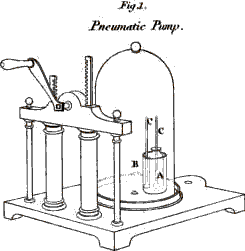
Fig. 1. Ether evaporated & water frozen in the air pump. A Phial of Ether. B Glass vessel containing water. C.C Thermometers, one in the Ether, the other in the water.
Larger view (complete Plate)
CAROLINE.
It is indeed wonderful to see water freeze in contact with a boiling fluid!
EMILY.
I am at a loss to conceive how the ether can pass to the state of vapour without an addition of caloric. Does it not contain more caloric in a state of vapour, than in a state of liquidity?
MRS. B.
It certainly does; for though it is the pressure of the atmosphere which condenses it into a liquid, it is by forcing out the caloric that belongs to it when in an aëriform state.
EMILY.
You have, therefore, two difficulties to explain, Mrs. B.—First, from whence the ether obtains the caloric necessary to convert it into vapour when it is relieved from the pressure of the atmosphere; and, secondly, what is the reason that the water, in which the bottle of ether stands, is frozen?
CAROLINE.
Now, I think, I can answer both these questions. The ether obtains the addition of caloric required, from the water in the glass; and the loss of caloric, which the latter sustains, is the occasion of its freezing.
MRS. B.
You are perfectly right; and if you look at the thermometer which I have placed in the water, whilst I am working the pump, you will see that every time bubbles of vapour are produced, the mercury descends; which proves that the heat of the water diminishes in proportion as the ether boils.
EMILY.
This I understand now very well; but if the water freezes in consequence of yielding its caloric to the ether, the equilibrium of heat must, in this case, be totally destroyed. Yet you have told us, that the exchange of caloric between two bodies of equal temperature, was always equal; how, then, is it that the water, which was originally of the same temperature as the ether, gives out caloric to it, till the water is frozen, and the ether made to boil?
MRS. B.
I suspected that you would make these objections; and, in order to remove them, I enclosed two thermometers in the air-pump; one which stands in the glass of water, the other in the phial of ether; and you may see that the equilibrium of temperature is not destroyed; for as the thermometer descends in the water, that in the ether sinks in the same manner; so that both thermometers indicate the same temperature, though one of them is in a boiling, the other in a freezing liquid.
EMILY.
The ether, then, becomes colder as it boils? This is so contrary to common experience, that I confess it astonishes me exceedingly.
CAROLINE.
It is, indeed, a most extraordinary circumstance. But pray, how do you account for it?
MRS. B.
I cannot satisfy your curiosity at present; for before we can attempt to explain this apparent paradox, it is necessary to become acquainted with the subject of LATENT HEAT: and that, I think, we must defer till our next interview.
CAROLINE.
I believe, Mrs. B., that you are glad to put off the explanation; for it must be a very difficult point to account for.
MRS. B.
I hope, however, that I shall do it to your complete satisfaction.
EMILY.
But before we part, give me leave to ask you one question. Would not water, as well as ether, boil with less heat, if deprived of the pressure of the atmosphere?
MRS. B.
Undoubtedly. You must always recollect that there are two forces to overcome, in order to make a liquid boil or evaporate; the attraction of aggregation, and the weight of the atmosphere. On the summit of a high mountain (as Mr. De Saussure ascertained on Mount Blanc) much less heat is required to make water boil, than in the plain, where the weight of the atmosphere is greater.* Indeed if the weight of the atmosphere be entirely removed by means of a good air-pump, and if water be placed in the exhausted receiver, it will evaporate so fast, however cold it maybe, as to give it the appearance of boiling from the surface. But without the assistance of the air-pump, I can show you a very pretty experiment, which proves the effect of the pressure of the atmosphere in this respect.
Observe, that this Florence flask is about half full of water, and the upper half of invisible vapour, the water being in the act of boiling.—I take it from the lamp, and cork it carefully—the water, you see, immediately ceases boiling.—I shall now dip the flask into a bason of cold water.†
CAROLINE.
But look, Mrs. B., the hot water begins to boil again, although the cold water must rob it more and more of its caloric! What can be the reason of that?
MRS. B.
Let us examine its temperature. You see the thermometer immersed in it remains stationary at 180 degrees, which is about 30 degrees below the boiling point. When I took the flask from the lamp, I observed to you that the upper part of it was filled with vapour; this being compelled to yield its caloric to the cold water, was again condensed into water—What, then, filled the upper part of the flask?
EMILY.
Nothing; for it was too well corked for the air to gain admittance, and therefore the upper part of the flask must be a vacuum.
MRS. B.
The water below, therefore, no longer sustains the pressure of the atmosphere, and will consequently boil at a much lower temperature. Thus, you see, though it had lost many degrees of heat, it began boiling again the instant the vacuum was formed above it. The boiling has now ceased, the temperature of the water being still farther reduced; if it had been ether, instead of water, it would have continued boiling much longer, for ether boils, under the usual atmospheric pressure, at a temperature as low as 100 degrees; and in a vacuum it boils at almost any temperature; but water being a more dense fluid, requires a more considerable quantity of caloric to make it evaporate quickly, even when the pressure of the atmosphere is removed.
EMILY.
What proportion of vapour can the atmosphere contain in a state of solution?
MRS. B.
I do not know whether it has been exactly ascertained by experiment; but at any rate this proportion must vary, both according to the temperature and the weight of the atmosphere; for the lower the temperature, and the greater the pressure, the smaller must be the proportion of vapour that the atmosphere can contain.
To conclude the subject of free caloric, I should mention Ignition, by which is meant that emission of light which is produced in bodies at a very high temperature, and which is the effect of accumulated caloric.
EMILY.
You mean, I suppose, that light which is produced by a burning body?
MRS. B.
No: ignition is quite independent of combustion. Clay, chalk, and indeed all incombustible substances, may be made red hot. When a body burns, the light emitted is the effect of a chemical change which takes place, whilst ignition is the effect of caloric alone, and no other change than that of temperature is produced in the ignited body.
All solid bodies, and most liquids, are susceptible of ignition, or, in other words, of being heated so as to become luminous; and it is remarkable that this takes place pretty nearly at the same temperature in all bodies, that is, at about 800 degrees of Fahrenheit’s scale.
EMILY.
But how can liquids attain so high a temperature, without being converted into vapour?
MRS. B.
By means of confinement and pressure. Water confined in a strong iron vessel (called Papin’s digester) can have its temperature raised to upwards of 400 degrees. Sir James Hall has made some very curious experiments on the effects of heat assisted by pressure; by means of strong gun-barrels, he succeeded in melting a variety of substances which were considered as infusible: and it is not unlikely that, by similar methods, water itself might be heated to redness.
EMILY.
I am surprised at that: for I thought that the force of steam was such as to destroy almost all mechanical resistance.
MRS. B.
The expansive force of steam is prodigious; but in order to subject water to such high temperatures, it is prevented by confinement from being converted into steam, and the expansion of heated water is comparatively trifling.—But we have dwelt so long on the subject of free caloric, that we must reserve the other modifications of that agent to our next meeting, when we shall endeavour to proceed more rapidly.
CONVERSATION IV. ON COMBINED CALORIC, COMPREHENDING SPECIFIC AND LATENT HEAT.

MRS. B.
We are now to examine the other modifications of caloric.
CAROLINE.
I am very curious to know of what nature they can be; for I have no notion of any kind of heat that is not perceptible to the senses.
MRS. B.
In order to enable you to understand them, it will be necessary to enter into some previous explanations.
It has been discovered by modern chemists, that bodies of a different nature, heated to the same temperature, do not contain the same quantity of caloric.
CAROLINE.
How could that be ascertained? Have you not told us that it is impossible to discover the absolute quantity of caloric which bodies contain?
MRS. B.
True; but at the same time I said that we were enabled to form a judgment of the proportions which bodies bore to each other in this respect. Thus it is found that, in order to raise the temperature of different bodies the same number of degrees, different quantities of caloric are required for each of them. If, for instance, you place a pound of lead, a pound of chalk, and a pound of milk, in a hot oven, they will be gradually heated to the temperature of the oven; but the lead will attain it first, the chalk next, and the milk last.
CAROLINE.
That is a natural consequence of their different bulks; the lead being the smallest body, will be heated soonest, and the milk, which is the largest, will require the longest time.
MRS. B.
That explanation will not do, for if the lead be the least in bulk, it offers also the least surface to the caloric, the quantity of heat therefore which can enter into it in the same space of time is proportionally smaller.
EMILY.
Why, then, do not the three bodies attain the temperature of the oven at the same time?
MRS. B.
It is supposed to be on account of the different capacity of these bodies for caloric.
CAROLINE.
What do you mean by the capacity of a body for caloric?
MRS. B.
I mean a certain disposition of bodies to require more or less caloric for raising their temperature to any degree of heat. Perhaps the fact may be thus explained:
Let us put as many marbles into this glass as it will contain, and pour some sand over them—observe how the sand penetrates and lodges between them. We shall now fill another glass with pebbles of various forms—you see that they arrange themselves in a more compact manner than the marbles, which, being globular, can touch each other by a single point only. The pebbles, therefore, will not admit so much sand between them; and consequently one of these glasses will necessarily contain more sand than the other, though both of them be equally full.
CAROLINE.
This I understand perfectly. The marbles and the pebbles represent two bodies of different kinds, and the sand the caloric contained in them; it appears very plain, from this comparison, that one body may admit of more caloric between its particles than another.
MRS. B.
You can no longer be surprised, therefore, that bodies of a different capacity for caloric should require different proportions of that fluid to raise their temperatures equally.
EMILY.
But I do not conceive why the body that contains the most caloric should not be of the highest temperature; that is to say, feel hot in proportion to the quantity of caloric it contains?
MRS. B.
The caloric that is employed in filling the capacity of a body, is not free caloric; but is imprisoned as it were in the body, and is therefore imperceptible: for we can feel only the caloric which the body parts with, and not that which it retains.
CAROLINE.
It appears to me very extraordinary that heat should be confined in a body in such a manner as to be imperceptible.
MRS. B.
If you lay your hand on a hot body, you feel only the caloric which leaves it, and enters your hand; for it is impossible that you should be sensible of that which remains in the body. The thermometer, in the same manner, is affected only by the free caloric which a body transmits to it, and not at all by that which it does not part with.
CAROLINE.
I begin to understand it: but I confess that the idea of insensible heat is so new and strange to me, that it requires some time to render it familiar.
MRS. B.
Call it insensible caloric, and the difficulty will appear much less formidable. It is indeed a sort of contradiction to call it heat, when it is so situated as to be incapable of producing that sensation. Yet this modification of caloric is commonly called SPECIFIC HEAT.
CAROLINE.
But it certainly would have been more correct to have called it specific caloric.
EMILY.
I do not understand how the term specific applies to this modification of caloric?
MRS. B.
It expresses the relative quantity of caloric which different species of bodies of the same weight and temperature are capable of containing. This modification is also frequently called heat of capacity, a term perhaps preferable, as it explains better its own meaning.
You now understand, I suppose, why the milk and chalk required a longer portion of time than the lead to raise their temperature to that of the oven?
EMILY.
Yes: the milk and chalk having a greater capacity for caloric than the lead, a greater proportion of that fluid became insensible in those bodies: and the more slowly, therefore, their temperature was raised.
CAROLINE.
But might not this difference proceed from the different conducting powers of heat in these three bodies, since that which is the best conductor must necessarily attain the temperature of the oven first?
MRS. B.
Very well observed, Caroline. This objection would be insurmountable, if we could not, by reversing the experiment, prove that the milk, the chalk, and the lead, actually absorbed different quantities of caloric, and we know that if the different time they took in heating, proceeded merely from their different conducting powers, they would each have acquired an equal quantity of caloric.
CAROLINE.
Certainly. But how can you reverse this experiment?
MRS. B.
It may be done by cooling the several bodies to the same degree in an apparatus adapted to receive and measure the caloric which they give out. Thus, if you plunge them into three equal quantities of water, each at the same temperature, you will be able to judge of the relative quantity of caloric which the three bodies contained, by that, which, in cooling, they communicated to their respective portions of water: for the same quantity of caloric which they each absorbed to raise their temperature, will abandon them in lowering it; and on examining the three vessels of water, you will find the one in which you immersed the lead to be the least heated; that which held the chalk will be the next; and that which contained the milk will be heated the most of all. The celebrated Lavoisier has invented a machine to estimate, upon this principle, the specific heat of bodies in a more perfect manner; but I cannot explain it to you, till you are acquainted with the next modification of caloric.
EMILY.
The more dense a body is, I suppose, the less is its capacity for caloric?
MRS. B.
This is not always the case with bodies of different nature; iron, for instance, contains more specific heat than tin, though it is more dense. This seems to show that specific heat does hot merely depend upon the interstices between the particles; but, probably, also upon some peculiar constitution of the bodies which we do not comprehend.
EMILY.
But, Mrs. B., it would appear to me more proper to compare bodies by measure, rather than by weight, in order to estimate their specific heat. Why, for instance, should we not compare pints of milk, of chalk, and of lead, rather than pounds of those substances; for equal weights may be composed of very different quantities?
MRS. B.
You are mistaken, my dear; equal weight must contain equal quantities of matter; and when we wish to know what is the relative quantity of caloric, which substances of various kinds are capable of containing under the same temperature, we must compare equal weights, and not equal bulks of those substances. Bodies of the same weight may undoubtedly be of very different dimensions; but that does not change their real quantity of matter. A pound of feathers does not contain one atom more than a pound of lead.
CAROLINE.
I have another difficulty to propose. It appears to me, that if the temperature of the three bodies in the oven did not rise equally, they would never reach the same degree; the lead would always keep its advantage over the chalk and milk, and would perhaps be boiling before the others had attained the temperature of the oven. I think you might as well say that, in the course of time, you and I should be of the same age?
MRS. B.
Your comparison is not correct, Caroline. As soon as the lead reached the temperature of the oven, it would remain stationary; for it would then give out as much heat as it would receive. You should recollect that the exchange of radiating heat, between two bodies of equal temperature, is equal: it would be impossible, therefore, for the lead to accumulate heat after having attained the temperature of the oven; and that of the chalk and milk therefore would ultimately arrive at the same standard. Now I fear that this will not hold good with respect to our ages, and that, as long as I live, I shall never cease to keep my advantage over you.
EMILY.
I think that I have found a comparison for specific heat, which is very applicable. Suppose that two men of equal weight and bulk, but who required different quantities of food to satisfy their appetites, sit down to dinner, both equally hungry; the one would consume a much greater quantity of provisions than the other, in order to be equally satisfied.
MRS. B.
Yes, that is very fair; for the quantity of food necessary to satisfy their respective appetites, varies in the same manner as the quantity of caloric requisite to raise equally the temperature of different bodies.
EMILY.
The thermometer, then, affords no indication of the specific heat of bodies?
MRS. B.
None at all: no more than satiety is a test of the quantity of food eaten. The thermometer, as I have repeatedly said, can be affected only by free caloric, which alone raises the temperature of bodies.
But there is another mode of proving the existence of specific heat, which affords a very satisfactory illustration of that modification. This, however, I did not enlarge upon before, as I thought it might appear to you rather complicated.—If you mix two fluids of different temperatures, let us say the one at 50 degrees, and the other at 100 degrees, of what temperature do you suppose the mixture will be?
CAROLINE.
It will be no doubt the medium between the two, that is to say, 75 degrees.
MRS. B.
That will be the case if the two bodies happen to have the same capacity for caloric; but if not, a different result will be obtained. Thus, for instance, if you mix together a pound of mercury, heated at 50 degrees, and a pound of water heated at 100 degrees, the temperature of the mixture, instead of being 75 degrees, will be 80 degrees; so that the water will have lost only 12 degrees, whilst the mercury will have gained 38 degrees; from which you will conclude that the capacity of mercury for heat is less than that of water.
CAROLINE.
I wonder that mercury should have so little specific heat. Did we not see it was a much better conductor of heat than water?
MRS. B.
And it is precisely on that account that its specific heat is less. For since the conductive power of bodies depends, as we have observed before, on their readiness to receive heat and part with it, it is natural to expect that those bodies which are the worst conductors should absorb the most caloric before they are disposed to part with it to other bodies. But let us now proceed to LATENT HEAT.
CAROLINE.
And pray what kind of heat is that?
MRS. B.
It is another modification of combined caloric, which is so analogous to specific heat, that most chemists make no distinction between them; but Mr. Pictet, in his Essay on Fire, has so clearly discriminated them, that I am induced to adopt his view of the subject. We therefore call latent heat that portion of insensible caloric which is employed in changing the state of bodies; that is to say, in converting solids into liquids, or liquids; into vapour. When a body changes its state from solid to liquid, or from liquid to vapour, its expansion occasions a sudden and considerable increase of capacity for heat, in consequence of which it immediately absorbs a quantity of caloric, which becomes fixed in the body which it has transformed; and, as it is perfectly concealed from our senses, it has obtained the name of latent heat.
CAROLINE.
I think it would be much more correct to call this modification latent caloric instead of latent heat, since it does not excite the sensation of heat.
MRS. B.
This modification of heat was discovered and named by Dr. Black long before the French chemists introduced the term caloric, and we must not presume to alter it, as it is still used by much better chemists than ourselves. And, besides, you are not to suppose that the nature of heat is altered by being variously modified: for if latent heat and specific heat do not excite the same sensations as free caloric, it is owing to their being in a state of confinement, which prevents them from acting upon our organs; and consequently, as soon as they are extricated from the body in which they are imprisoned, they return to their state of free caloric.
EMILY.
But I do not yet clearly see in what respect latent heat differs from specific heat; for they are both of them imprisoned and concealed in bodies.
MRS. B.
Specific heat is that which is employed in filling the capacity of a body for caloric, in the state in which this body actually exists; while latent heat is that which is employed only in effecting a change of state, that is, in converting bodies from a solid to a liquid, or from a liquid to an aëriform state. But I think that, in a general point of view, both these modifications might be comprehended under the name of heat of capacity, as in both cases the caloric is equally engaged in filling the capacities of bodies.
I shall now show you an experiment, which I hope will give you a clear idea of what is understood by latent heat.
The snow which you see in this phial has been cooled by certain chemical means (which I cannot well explain to you at present), to 5 or 6 degrees below the freezing point, as you will find indicated by the thermometer which is placed in it. We shall expose it to the heat of a lamp, and you will see the thermometer gradually rise, till it reaches the freezing point——
EMILY.
But there it stops, Mrs. B., and yet the lamp burns just as well as before. Why is not its heat communicated to the thermometer?
CAROLINE.
And the snow begins to melt, therefore it must be rising above the freezing point?
MRS. B.
The heat no longer affects the thermometer, because it is wholly employed in converting the ice into water. As the ice melts, the caloric becomes latent in the new-formed liquid, and therefore cannot raise its temperature; and the thermometer will consequently remain stationary, till the whole of the ice be melted.
CAROLINE.
Now it is all melted, and the thermometer begins to rise again.
MRS. B.
Because the conversion of the ice into water being completed, the caloric no longer becomes latent; and therefore the heat which the water now receives raises its temperature, as you find the thermometer indicates.
EMILY.
But I do not think that the thermometer rises so quickly in the water as it did in the ice, previous to its beginning to melt, though the lamp burns equally well?
MRS. B.
That is owing to the different specific heat of ice and water. The capacity of water for caloric being greater than that of ice, more heat is required to raise its temperature, and therefore the thermometer rises slower in the water than in the ice.
EMILY.
True; you said that a solid body always increased its capacity for heat by becoming fluid; and this is an instance of it.
MRS. B.
Yes, and the latent heat is that which is absorbed in consequence of the greater capacity which the water has for heat, in comparison to ice.
I must now tell you a curious calculation founded on that consideration. I have before observed to you that though the thermometer shows us the comparative warmth of bodies, and enables us to determine the same point at different times and places, it gives us no idea of the absolute quantity of heat in any body. We cannot tell how low it ought to fall by the privation of all heat, but an attempt has been made to infer it in the following manner. It has been found by experiment, that the capacity of water for heat, when compared with that of ice, is as 10 to 9, so that, at the same temperature, ice contains one tenth of caloric less than water. By experiment also it is observed, that in order to melt ice, there must be added to it as much heat, as would, if it did not melt it, raise its temperature 140 degrees. This quantity of heat is therefore absorbed when the ice, by being converted into water, is made to contain one-ninth more caloric than it did before. Therefore 140 degrees is a ninth part of the heat contained in ice at 30 degrees; and the point of zero, or the absolute privation of heat, must consequently be 1260 degrees below 32 degrees.
This mode of investigating so curious a question is ingenious, but its correctness is not yet established by similar calculations for other bodies. The points of absolute cold, indicated by this method in various bodies, are very remote from each other; it is however possible, that this may arise from some imperfection in the experiments.
CAROLINE.
It is indeed very ingenious—but we must now attend to our present experiment. The water begins to boil, and the thermometer is again stationary.
MRS. B.
Well, Caroline, it is your turn to explain the phenomenon.
CAROLINE.
It is wonderfully curious! The caloric is now busy in changing the water into steam, in which it hides itself, and becomes insensible. This is another example of latent heat, producing a change of form. At first it converted a solid body into a liquid, and now it turns the liquid into vapour!
MRS. B.
You see, my dear, how easily you have become acquainted with these modifications of insensible heat, which at first appeared so unintelligible. If, now, we were to reverse these changes, and condense the vapour into water, and the water into ice, the latent heat would re-appear entirely, in the form of free caloric.
EMILY.
Pray do let us see the effect of latent heat returning to its free state.
MRS. B.
For the purpose of showing this, we need simply conduct the vapour through this tube into this vessel of cold water, where it will part with its latent heat and return to its liquid form.
EMILY.
How rapidly the steam heats the water!
MRS. B.
That is because it does not merely impart its free caloric to the water, but likewise its latent heat. This method of heating liquids, has been turned to advantage, in several economical establishments. The steam-kitchens, which are getting into such general use, are upon the same principle. The steam is conveyed through a pipe in a similar manner, into the several vessels which contain the provisions to be dressed, where it communicates to them its latent caloric, and returns to the state of water. Count Rumford makes great use of this principle in many of his fire-places: his grand maxim is to avoid all unnecessary waste of caloric, for which purpose he confines the heat in such a manner, that not a particle of it shall unnecessarily escape; and while he economises the free caloric, he takes care also to turn the latent heat to advantage. It is thus that he is enabled to produce a degree of heat superior to that which is obtained in common fire-places, though he employs less fuel.
EMILY.
When the advantages of such contrivances are so clear and plain, I cannot understand why they are not universally used.
MRS. B.
A long time is always required before innovations, however useful, can be reconciled with the prejudices of the vulgar.
EMILY.
What a pity it is that there should be a prejudice against new inventions; how much more rapidly the world would improve, if such useful discoveries were immediately and universally adopted!
MRS. B.
I believe, my dear, that there are as many novelties attempted to be introduced, the adoption of which would be prejudicial to society, as there are of those which would be beneficial to it. The well-informed, though by no means exempt from error, have an unquestionable advantage over the illiterate, in judging what is likely or not to prove serviceable; and therefore we find the former more ready to adopt such discoveries as promise to be really advantageous, than the latter, who having no other test of the value of a novelty but time and experience, at first oppose its introduction. The well-informed, however, are frequently disappointed in their most sanguine expectations, and the prejudices of the vulgar, though they often retard the progress of knowledge, yet sometimes, it must be admitted, prevent the propagation of error.—But we are deviating from our subject.
We have converted steam into water, and are now to change water into ice, in order to render the latent heat sensible, as it escapes from the water on its becoming solid. For this purpose we must produce a degree of cold that will make water freeze.
CAROLINE.
That must be very difficult to accomplish in this warm room.
MRS. B.
Not so much as you think. There are certain chemical mixtures which produce a rapid change from the solid to the fluid state, or the reverse, in the substances combined, in consequence of which change latent heat is either extricated or absorbed.
EMILY.
I do not quite understand you.
MRS. B.
This snow and salt, which you see me mix together, are melting rapidly; heat, therefore, must be absorbed by the mixture, and cold produced.
CAROLINE.
It feels even colder than ice, and yet the snow is melted. This is very extraordinary.
MRS. B.
The cause of the intense cold of the mixture is to be attributed to the change from a solid to a fluid state. The union of the snow and salt produces a new arrangement of their particles, in consequence of which they become liquid; and the quantity of caloric, required to effect this change, is seized upon by the mixture wherever it can be obtained. This eagerness of the mixture for caloric, during its liquefaction, is such, that it converts part of its own free caloric into latent heat, and it is thus that its temperature is lowered.
EMILY.
Whatever you put in this mixture, therefore, would freeze?
MRS. B.
Yes; at least any fluid that is susceptible of freezing at that temperature. I have prepared this mixture of salt and snow for the purpose of freezing the water from which you are desirous of seeing the latent heat escape. I have put a thermometer in the glass of water that is to be frozen, in order that you may see how it cools.
CAROLINE.
The thermometer descends, but the heat which the water is now losing, is its free, not its latent heat.
MRS. B.
Certainly; it does not part with its latent heat till it changes its state and is converted into ice.
EMILY.
But here is a very extraordinary circumstance! The thermometer is fallen below the freezing point, and yet the water is not frozen.
MRS. B.
That is always the case previous to the freezing of water when it is in a state of rest. Now it begins to congeal, and you may observe that the thermometer again rises to the freezing point.
CAROLINE.
It appears to me very strange that the thermometer should rise the very moment that the water freezes; for it seems to imply that the water was colder before it froze than when in the act of freezing.
MRS. B.
It is so; and after our long dissertation on this circumstance, I did not think it would appear so surprising to you. Reflect a little, and I think you will discover the reason of it.
CAROLINE.
It must be, no doubt, the extrications of latent heat, at the instant the water freezes, that raises the temperature.
MRS. B.
Certainly; and if you now examine the thermometer, you will find that its rise was but temporary, and lasted only during the disengagement of the latent heat—now that all the water is frozen it falls again, and will continue to fall till the ice and mixture are of an equal temperature.
EMILY.
And can you show us any experiments in which liquids, by being mixed, become solid, and disengage latent heat?
MRS. B.
I could show you several; but you are not yet sufficiently advanced to understand them well. I shall, however, try one, which will afford you a striking instance of the fact. The fluid which you see in this phial consists of a quantity of a certain salt called muriat of lime, dissolved in water. Now, if I pour into it a few drops of this other fluid, called sulphuric acid, the whole, or very nearly the whole, will be instantaneously converted into a solid mass.
EMILY.
How white it turns! I feel the latent heat escaping, for the bottle is warm, and the fluid is changed to a solid white substance like chalk!
CAROLINE.
This is, indeed, the most curious experiment we have seen yet. But pray what is that white vapour that ascends from the mixture?
MRS. B.
You are not yet enough of a chemist to understand that.—But take care, Caroline, do not approach too near it, for it has a very pungent smell.
I shall show you another instance similar to that of the water, which you observed to become warmer as it froze. I have in this phial a solution of a salt called sulphat of soda or Glauber’s salt, made very strong, and corked up when it was hot, and kept without agitation till it became cold, as you may feel the phial is. Now when I take out the cork and let the air fall upon it, (for being closed when boiling, there was a vacuum in the upper part) observe that the salt will suddenly crystallize. . . .
CAROLINE.
Surprising! how beautifully the needles of salt have shot through the whole phial!
MRS. B.
Yes, it is very striking—but pray do not forget the object of the experiment. Feel how warm the phial has become by the conversion of part of the liquid into a solid.
EMILY.
Quite warm I declare! this is a most curious experiment of the disengagement of latent heat.
MRS. B.
The slakeing of lime is another remarkable instance of the extrication of latent heat. Have you never observed how quick-lime smokes when water is poured upon it, and how much heat it produces?
CAROLINE.
Yes; but I do not understand what change of state takes place in the lime that occasions its giving out latent heat; for the quick-lime, which is solid, is (if I recollect right) reduced to powder, by this operation, and is, therefore, rather expanded than condensed.
MRS. B.
It is from the water, not the lime, that the latent heat is set free. The water incorporates with, and becomes solid in the lime; in consequence of which, the heat, which kept it in a liquid state, is disengaged, and escapes in a sensible form.
CAROLINE.
I always thought that the heat originated in the lime. It seems very strange that water, and cold water too, should contain so much heat.
EMILY.
After this extrication of caloric, the water must exist in a state of ice in the lime, since it parts with the heat which kept it liquid.
MRS. B.
It cannot properly be called ice, since ice implies a degree of cold, at least equal to the freezing point. Yet as water, in combining with lime, gives out more heat than in freezing, it must be in a state of still greater solidity in the lime, than it is in the form of ice; and you may have observed that it does not moisten or liquefy the lime in the smallest degree.
EMILY.
But, Mrs. B., the smoke that rises is white; if it was only pure caloric which escaped, we might feel, but could not see it.
MRS. B.
This white vapour is formed by some of the particles of lime, in a state of fine dust, which are carried off by the caloric.
EMILY.
In all changes of state, then, a body either absorbs or disengages latent heat?
MRS. B.
You cannot exactly say absorbs latent heat, as the heat becomes latent only on being confined in the body; but you may say, generally, that bodies, in passing from a solid to a liquid form, or from the liquid state to that of vapour, absorb heat; and that when the reverse takes place, heat is disengaged.*
EMILY.
We can now, I think, account for the ether boiling, and the water freezing in vacuo, at the same temperature.†
MRS. B.
Let me hear how you explain it.
EMILY.
The latent heat, which the water gave out in freezing, was immediately absorbed by the ether, during its conversion into vapour; and therefore, from a latent state in one liquid, it passed into a latent state in the other.
MRS. B.
But this only partly accounts for the result of the experiment; it remains to be explained why the temperature of the ether, while in a state of ebullition, is brought down to the freezing temperature of the water.—It is because the ether, during its evaporation, reduces its own temperature, in the same proportion as that of the water, by converting its free caloric into latent heat: so that, though one liquid boils, and the other freezes, their temperatures remain in a state of equilibrium.
EMILY.
But why does not water, as well as ether, reduce its own temperature by evaporating?
MRS. B.
The fact is that it does, though much less rapidly than ether. Thus, for instance, you may often have observed, in the heat of summer, how much any particular spot may be cooled by watering, though the water used for that purpose be as warm as the air itself. Indeed so much cold may be produced by the mere evaporation of water, that the inhabitants of India, by availing themselves of the most favourable circumstances for this process which their warm climate can afford, namely, the cool of the night, and situations most exposed to the night breeze, succeed in causing water to freeze, though the temperature of the air be as high as 60 degrees. The water is put into shallow earthen trays, so as to expose an extensive surface to the process of evaporation, and in the morning, the water is found covered with a thin cake of ice, which is collected in sufficient quantity to be used for purposes of luxury.
CAROLINE.
How delicious it must be to drink liquids so cold in those tropical climates! But, Mrs. B., could we not try that experiment?
MRS. B.
If we were in the country, I have no doubt but that we should be able to freeze water, by the same means, and under similar circumstances. But we can do it immediately, upon a small scale, in this very room, in which the thermometer stands at 70 degrees. For this purpose we need only place some water in a little cup under the receiver of the air-pump (Plate V. fig. 1.), and exhaust the air from it. What will be the consequence, Caroline?
Plate V.
Vol. I. page 138.
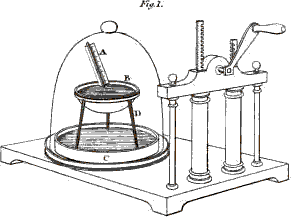
Fig. 1. The air-pump & receiver for Mr. Leslie’s experiment. C a saucer with sulphuric Acid. B a glass or earthen cup containing Water. D a stand for the cup with its legs made of Glass. A a Thermometer.
Larger view (complete Plate)
CAROLINE.
Of course the water will evaporate more quickly, since there will no longer be any atmospheric pressure on its surface: but will this be sufficient to make the water freeze?
MRS. B.
Probably not, because the vapour will not be carried off fast enough; but this will be accomplished without difficulty if we introduce into the receiver (fig. 1.), in a saucer, or other large shallow vessel, some strong sulphuric acid, a substance which has a great attraction for water, whether in the form of vapour, or in the liquid state. This attraction is such that the acid will instantly absorb the moisture as it rises from the water, so as to make room for the formation of fresh vapour; this will of course hasten the process, and the cold produced from the rapid evaporation of the water, will, in a few minutes, be sufficient to freeze its surface.* We shall now exhaust the air from the receiver.
EMILY.
Thousands of small bubbles already rise through the water from the internal surface of the cup; what is the reason of this?
MRS. B.
These are bubbles of air which were partly attached to the vessel, and partly diffused in the water itself; and they expand and rise in consequence of the atmospheric pressure being removed.
CAROLINE.
See, Mrs. B.; the thermometer in the cup is sinking fast; it has already descended to 40 degrees!
EMILY.
The water seems now and then violently agitated on the surface, as if it was boiling; and yet the thermometer is descending fast!
MRS. B.
You may call it boiling, if you please, for this appearance is, as well as boiling, owing to the rapid formation of vapour; but here, as you have just observed, it takes place from the surface, for it is only when heat is applied to the bottom of the vessel that the vapour is formed there.—Now crystals of ice are actually shooting all over the surface of the water.
CAROLINE.
How beautiful it is! The surface is now entirely frozen—but the thermometer remains at 32 degrees.
MRS. B.
And so it will, conformably with our doctrine of latent heat, until the whole of the water is frozen; but it will then again begin to descend lower and lower, in consequence of the evaporation which goes on from the surface of the ice.
EMILY.
This is a most interesting experiment; but it would be still more striking if no sulphuric acid were required.
MRS. B.
I will show you a freezing instrument, contrived by Dr. Wollaston, upon the same principle as Mr. Leslie’s experiment, by which water may be frozen by its own evaporation alone, without the assistance of sulphuric acid.
This tube, which, as you see (Plate V. fig. 2.), is terminated at each extremity by a bulb, one of which is half full of water, is internally perfectly exhausted of air; the consequence of this is, that the water in the bulb is always much disposed to evaporate. This evaporation, however, does not proceed sufficiently fast to freeze the water; but if the empty ball be cooled by some artificial means, so as to condense quickly the vapour which rises from the water, the process may be thus so much promoted as to cause the water to freeze in the other ball. Dr. Wollaston has called this instrument Cryophorus.
Plate V.
Vol. I. page 138.
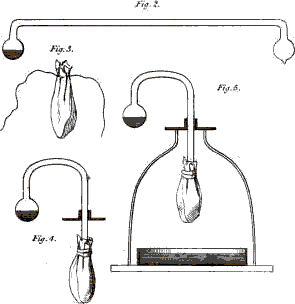
Fig. 2. Dr. Wollaston’s Cryophorus. Fig. 5. Dr. Marcet’s mode of using the Cryophorus. Fig. 3. & 4. the different parts of Fig. 5. seen separate.
Larger view (complete Plate)
CAROLINE.
So that cold seems to perform here the same part which the sulphuric acid acted in Mr. Leslie’s experiment?
MRS. B.
Exactly so; but let us try the experiment.
EMILY.
How will you cool the instrument? You have neither ice nor snow.
MRS. B.
True: but we have other means of effecting this.* You recollect what an intense cold can be produced by the evaporation of ether in an exhausted receiver. We shall inclose the bulb in this little bag of fine flannel (fig. 3.), then soke it in ether, and introduce it into the receiver of the air-pump. (Fig. 5.) For this purpose we shall find it more convenient to use a cryophorus of this shape (fig. 4.), as its elongated bulb passes easily through a brass plate which closes the top of the receiver. If we now exhaust the receiver quickly, you will see, in less than a minute, the water freeze in the other bulb, out of the receiver.
EMILY.
The bulb already looks quite dim, and small drops of water are condensing on its surface.
CAROLINE.
And now crystals of ice shoot all over the water. This is, indeed, a very curious experiment!
MRS. B.
You will see, some other day, that, by a similar method, even quicksilver may be frozen.—But we cannot at present indulge in any further digression.
Having advanced so far on the subject of heat, I may now give you an account of the calorimeter, an instrument invented by Lavoisier, upon the principles just explained, for the purpose of estimating the specific heat of bodies. It consists of a vessel, the inner surface of which is lined with ice, so as to form a sort of hollow globe of ice, in the midst of which the body, whose specific heat is to be ascertained, is placed. The ice absorbs caloric from this body, till it has brought it down to the freezing point; this caloric converts into water a certain portion of the ice which runs out through an aperture at the bottom of the machine; and the quantity of ice changed to water is a test of the quantity of caloric which the body has given out in descending from a certain temperature to the freezing point.
CAROLINE.
In this apparatus, I suppose, the milk, chalk, and lead, would melt different quantities of ice, in proportion to their different capacities for caloric?
MRS. B.
Certainly: and thence we are able to ascertain, with precision, their respective capacities for heat. But the calorimeter affords us no more idea of the absolute quantity of heat contained in a body, than the thermometer; for though by means of it we extricate both the free and combined caloric, yet we extricate them only to a certain degree, which is the freezing point; and we know not how much they contain of either below that point.
EMILY.
According to the theory of latent heat, it appears to me that the weather should be warm when it freezes, and cold in a thaw: for latent heat is liberated from every substance that it freezes, and such a large supply of heat must warm the atmosphere; whilst, during a thaw, that very quantity of free heat must be taken from the atmosphere, and return to a latent state in the bodies which it thaws.
MRS. B.
Your observation is very natural; but consider that in a frost the atmosphere is so much colder than the earth, that all the caloric which it takes from the freezing bodies is insufficient to raise its temperature above the freezing point; otherwise the frost must cease. But if the quantity of latent heat extricated does not destroy the frost, it serves to moderate the suddenness of the change of temperature of the atmosphere, at the commencement both of frost, and of a thaw. In the first instance, its extrication diminishes the severity of the cold; and, in the latter, its absorption moderates the warmth occasioned by a thaw: it even sometimes produces a discernible chill, at the breaking up of a frost.
CAROLINE.
But what are the general causes that produce those sudden changes in the weather, especially from hot to cold, which we often experience?
MRS. B.
This question would lead us into meteorological discussions, to which I am by no means competent. One circumstance, however, we can easily understand. When the air has passed over cold countries, it will probably arrive here at a temperature much below our own, and then it must absorb heat from every object it meets with, which will produce a general fall of temperature.
CAROLINE.
But pray, now that we know so much of the effects of heat, will you inform us whether it is really a distinct body, or, as I have heard, a peculiar kind of motion produced in bodies?
MRS. B.
As I before told you, there is yet much uncertainty as to the nature of these subtle agents. But I am inclined to consider heat not as mere motion, but as a separate substance. Late experiments too appear to make it a compound body, consisting of the two electricities, and in our next conversation I shall inform you of the principal facts on which that opinion is founded.
CONVERSATION V. ON THE CHEMICAL AGENCIES OF ELECTRICITY.
MRS. B.
Before we proceed further it will be necessary to give you some account of certain properties of electricity, which have of late years been discovered to have an essential connection with the phenomena of chemistry.
CAROLINE.
It is ELECTRICITY, if I recollect right, which comes next in our list of simple substances?
MRS. B.
I have placed electricity in that list, rather from the necessity of classing it somewhere, than from any conviction that it has a right to that situation, for we are as yet so ignorant of its intimate nature, that we are unable to determine, not only whether it is simple or compound, but whether it is in fact a material agent; or, as Sir H. Davy has hinted, whether it may not be merely a property inherent in matter. As, however, it is necessary to adopt some hypothesis for the explanation of the discoveries which this agent has enabled us to make, I have chosen the opinion, at present most prevalent, which supposes the existence of two kinds of electricity, distinguished by the names of positive and negative electricity.
CAROLINE.
Well, I must confess, I do not feel nearly so interested in a science in which so much uncertainty prevails, as in those which rest upon established principles; I never was fond of electricity, because, however beautiful and curious the phenomena it exhibits may be, the theories, by which they were explained, appeared to me so various, so obscure and inadequate, that I always remained dissatisfied. I was in hopes that the new discoveries in electricity had thrown so great a light on the subject, that every thing respecting it would now have been clearly explained.
MRS. B.
That is a point which we are yet far from having attained. But, in spite of the imperfection of our theories, you will be amply repaid by the importance and novelty of the subject. The number of new facts which have already been ascertained, and the immense prospect of discovery which has lately been opened to us, will, I hope, ultimately lead to a perfect elucidation of this branch of natural science; but at present you must be contented with studying the effects, and in some degree explaining the phenomena, without aspiring to a precise knowledge of the remote cause of electricity.
You have already obtained some notions of electricity: in our present conversation, therefore, I shall confine myself to that part of the science which is of late discovery, and is more particularly connected with chemistry.
It was a trifling and accidental circumstance which first gave rise to this new branch of physical science. Galvani, a professor of natural philosophy at Bologna, being engaged (about twenty years ago) in some experiments on muscular irritability, observed, that when a piece of metal was laid on the nerve of a frog, recently dead, whilst the limb supplied by that nerve rested upon some other metal, the limb suddenly moved, on a communication being made between the two pieces of metal.
EMILY.
How is this communication made?
MRS. B.
Either by bringing the two metals into contact, or by connecting them by means of a metallic conductor. But without subjecting a frog to any cruel experiments, I can easily make you sensible of this kind of electric action. Here is a piece of zinc, (one of the metals I mentioned in the list of elementary bodies)—put it under your tongue, and this piece of silver upon your tongue, and let both the metals project a little beyond the tip of the tongue—very well—now make the projecting parts of the metals touch each other, and you will instantly perceive a peculiar sensation.
EMILY.
Indeed I did, a singular taste, and I think a degree of heat: but I can hardly describe it.
MRS. B.
The action of these two pieces of metal on the tongue is, I believe, precisely similar to that made on the nerve of a frog. I shall not detain you by a detailed account of the theory by which Galvani attempted to account for this fact, as his explanation was soon overturned by subsequent experiments, which proved that Galvanism (the name this new power had obtained) was nothing more than electricity. Galvani supposed that the virtue of this new agent resided in the nerves of the frog, but Volta, who prosecuted this subject with much greater success, shewed that the phenomena did not depend on the organs of the frog, but upon the electrical agency of the metals, which is excited by the moisture of the animal, the organs of the frog being only a delicate test of the presence of electric influence.
CAROLINE.
I suppose, then, the saliva of the mouth answers the same purpose as the moisture of the frog, in exciting the electricity of the pieces of silver and zinc with which Emily tried the experiment on her tongue.
MRS. B.
Precisely. It does not appear, however, necessary that the fluid used for this purpose should be of an animal nature. Water, and acids very much diluted by water, are found to be the most effectual in promoting the developement of electricity in metals; and, accordingly, the original apparatus which Volta first constructed for this purpose, consisted of a pile or succession of plates of zinc and copper, each pair of which was connected by pieces of cloth or paper impregnated with water; and this instrument, from its original inconvenient structure and limited strength, has gradually arrived at its present state of power and improvement, such as is exhibited in the Voltaic battery. In this apparatus, a specimen of which you see before you (Plate VI. fig. 1.), the plates of zinc and copper are soldered together in pairs, each pair being placed at regular distances in wooden troughs and the interstices being filled with fluid.
Plate VI.
p. 151.
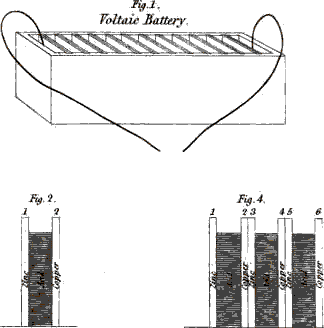
Fig. 1. 2. & 4. Voltaic Batteries
Larger view (complete Plate)
CAROLINE.
Though you will not allow us to enquire into the precise cause of electricity, may we not ask in what manner the fluid acts on the metals so as to produce it?
MRS. B.
The action of the fluid on the metals, whether water or acid be used, is entirely of a chemical nature. But whether electricity is excited by this chemical action, or whether it is produced by the contact of the two metals, is a point upon which philosophers do not yet perfectly agree.
EMILY.
But can the mere contact of two metals, without any intervening fluid, produce electricity?
MRS. B.
Yes, if they are afterwards separated. It is an established fact, that when two metals are put in contact, and afterwards separated, that which has the strongest attraction for oxygen exhibits signs of positive, the other of negative electricity.
CAROLINE.
It seems then but reasonable to infer that the power of the Voltaic battery should arise from the contact of the plates of zinc and copper.
MRS. B.
It is upon this principle that Volta and Sir H. Davy explain the phenomena of the pile; but notwithstanding these two great authorities, many philosophers entertain doubts on the truth of this theory. The principal difficulty which occurs in explaining the phenomena of the Voltaic battery on this principle, is, that two such plates show no signs of different states of electricity whilst in contact, but only on being separated after contact. Now in the Voltaic battery, those plates that are in contact always continue so, being soldered together: and they cannot therefore receive a succession of charges. Besides, if we consider the mere disturbance of the balance of electricity by the contact of the plates, as the sole cause of the production of Voltaic electricity, it remains to be explained how this disturbed balance becomes an inexhaustible source of electrical energy, capable of pouring forth a constant and copious supply of electrical fluid, though without any means of replenishing itself from other sources. This subject, it must be owned, is involved in too much obscurity to enable us to speak very decidedly in favour of any theory. But, in order to avoid perplexing you with different explanations, I shall confine myself to one which appears to me to be least encumbered with difficulties, and most likely to accord with truth.*
This theory supposes the electricity to be excited by the chemical action of the acid on the zinc; but you are yet such novices in chemistry, that I think it will be necessary to give you some previous explanation of the nature of this action.
All metals have a strong attraction for oxygen, and this element is found in great abundance both in water and in acids. The action of the diluted acid on the zinc consists therefore in its oxygen combining with it, and dissolving its surface.
CAROLINE.
In the same manner I suppose as we saw an acid dissolve copper?
MRS. B.
Yes; but in the Voltaic battery the diluted acid is not strong enough to produce so complete an effect; it acts only on the surface of the zinc, to which it yields its oxygen, forming upon it a film or crust, which is a compound of the oxygen and the metal.
EMILY.
Since there is so strong a chemical attraction between oxygen and metals, I suppose they are naturally in different states of electricity?
MRS. B.
Yes; it appears that all metals are united with the positive, and that oxygen is the grand source of the negative electricity.
CAROLINE.
Does not then the acid act on the plates of copper, as well as on those of zinc?
MRS. B.
No; for though copper has an affinity for oxygen, it is less strong than that of zinc; and therefore the energy of the acid is only exerted upon the zinc.
It will be best, I believe, in order to render the action of the Voltaic battery more intelligible, to confine our attention at first to the effect produced on two plates only. (Plate VI. fig. 2.)
If a plate of zinc be placed opposite to one of copper, or any other metal less attractive of oxygen, and the space between them (suppose of half an inch in thickness), be filled with an acid or any fluid capable of oxydating the zinc, the oxydated surface will have its capacity for electricity diminished, so that a quantity of electricity will be evolved from that surface. This electricity will be received by the contiguous fluid, by which it will be transmitted to the opposite metallic surface, the copper, which is not oxydated, and is therefore disposed to receive it; so that the copper plate will thus become positive, whilst the zinc plate will be in the negative state.
This evolution of electrical fluid however will be very limited; for as these two plates admit of but very little accumulation of electricity, and are supposed to have no communication with other bodies, the action of the acid, and further developement of electricity, will be immediately stopped.
EMILY.
This action, I suppose, can no more continue to go on, than that of a common electrical machine, which is not allowed to communicate with other bodies?
MRS. B.
Precisely; the common electrical machine, when excited by the friction of the rubber, gives out both the positive and negative electricities.—(Plate VI. Fig. 3.) The positive, by the rotation of the glass cylinder, is conveyed into the conductor, whilst the negative goes into the rubber. But unless there is a communication made between the rubber and the ground, but a very inconsiderable quantity of electricity can be excited; for the rubber, like the plates of the battery, has too small a capacity to admit of an accumulation of electricity. Unless therefore the electricity can pass out of the rubber, it will not continue to go into it, and consequently no additional accumulation will take place. Now as one kind of electricity cannot be given out without the other, the developement of the positive electricity is stopped as well as that of the negative, and the conductor therefore cannot receive a succession of charges.
Plate VI.
p. 151.
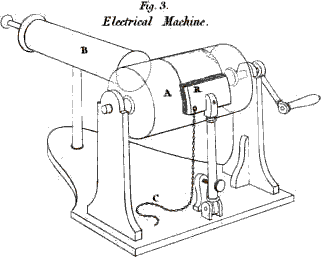
Fig. 3. A the Cylinder. B the Conductor. R the Rubber. C the Chain.
Larger view (complete Plate)
CAROLINE.
But does not the conductor, as well as the rubber, require a communication with the earth, in order to get rid of its electricity?
MRS. B.
No; for it is susceptible of receiving and containing a considerable quantity of electricity, as it is much larger than the rubber, and therefore has a greater capacity; and this continued accumulation of electricity in the conductor is what is called a charge.
EMILY.
But when an electrical machine is furnished with two conductors to receive the two electricities, I suppose no communication with the earth is required?
MRS. B.
Certainly not, until the two are fully charged; for the two conductors will receive equal quantities of electricity.
CAROLINE.
I thought the use of the chain had been to convey the electricity from the ground into the machine?
MRS. B.
That was the idea of Dr. Franklin, who supposed that there was but one kind of electricity, and who, by the terms positive and negative (which he first introduced), meant only different quantities of the same kind of electricity. The chain was in that case supposed to convey electricity from the ground through the rubber into the conductor. But as we have adopted the hypothesis of two electricities, we must consider the chain as a vehicle to conduct the negative electricity into the earth.
EMILY.
And are both kinds of electricity produced whenever electricity is excited?
MRS. B.
Yes, invariably. If you rub a tube of glass with a woollen cloth, the glass becomes positive, and the cloth negative. If, on the contrary, you excite a stick of sealing-wax by the same means, it is the rubber which becomes positive, and the wax negative.
But with regard to the Voltaic battery, in order that the acid may act freely on the zinc, and the two electricities be given out without interruption, some method must be devised, by which the plates may part with their electricities as fast as they receive them.—Can you think of any means by which this might be effected?
EMILY.
Would not two chains or wires, suspended from either plate to the ground, conduct the electricities into the earth, and thus answer the purpose?
MRS. B.
It would answer the purpose of carrying off the electricity, I admit; but recollect, that though it is necessary to find a vent for the electricity, yet we must not lose it, since it is the power which we are endeavouring to obtain. Instead, therefore, of conducting it into the ground, let us make the wires, from either plate, meet: the two electricities will thus be brought together, and will combine and neutralize each other; and as long as this communication continues, the two plates having a vent for their respective electricities, the action of the acid will go on freely and uninterruptedly.
EMILY.
That is very clear, so far as two plates only are concerned; but I cannot say I understand how the energy of the succession of plates, or rather pairs of plates, of which the Galvanic trough is composed, is propagated and accumulated throughout a battery?
MRS. B.
In order to shew you how the intensity of the electricity is increased by increasing the number of plates, we will examine the action of four plates; if you understand these, you will readily comprehend that of any number whatever. In this figure (Plate VI. Fig. 4.), you will observe that the two central plates are united; they are soldered together, (as we observed in describing the Voltaic trough,) so as to form but one plate which offers two different surfaces, the one of copper, the other of zinc.
Now you recollect that, in explaining the action of two plates, we supposed that a quantity of electricity was evolved from the surface of the first zinc plate, in consequence of the action of the acid, and was conveyed by the interposed fluid to the copper plate, No. 2, which thus became positive. This copper plate communicates its electricity to the contiguous zinc plate, No. 3, in which, consequently, some accumulation of electricity takes place. When, therefore, the fluid in the next cell acts upon the zinc plate, electricity is extricated from it in larger quantity, and in a more concentrated form, than before. This concentrated electricity is again conveyed by the fluid to the next pair of plates, No. 4 and 5, when it is farther increased by the action of the fluid in the third cell, and so on, to any number of plates of which the battery may consist; so that the electrical energy will continue to accumulate in proportion to the number of double plates, the first zinc plate of the series being the most negative, and the last copper plate the most positive.