Volume 1 — CHEMISTRY. (continued 4)
Reading edition
CAROLINE.
Are all oxyds capable of being converted into acids?
MRS. B.
Very far from it; it is only certain substances which will enter into that peculiar kind of union with oxygen that produces acids, and the number of these is proportionally very small; but all burnt bodies may be considered as belonging either to the class of oxyds, or to that of acids. At a future period, we shall enter more at large into this subject. At present, I have but one circumstance further to point out to your observation respecting acids: it is, that most of them are susceptible of two degrees of acidification, according to the different quantities of oxygen with which their basis combines.
EMILY.
And how are these two degrees of acidification distinguished?
MRS. B.
By the peculiar properties which result from them. The acid we have just made is the first or weakest degree of acidification, and is called sulphureous acid; if it were fully saturated with oxygen, it would be called sulphuric acid. You must therefore remember, that in this, as in all acids, the first degree of acidification is expressed by the termination in ous; the stronger, by the termination in ic.
CAROLINE.
And how is the sulphuric acid made?
MRS. B.
By burning sulphur in pure oxygen gas, and thus rendering its combustion much more complete. I have provided some oxygen gas for this purpose; it is in that bottle, but we must first decant the gas into the glass receiver which stands on the shelf in the bath, and is full of water.
CAROLINE.
Pray, let me try to do it, Mrs. B.
MRS. B.
It requires some little dexterity—hold the bottle completely under water, and do not turn the mouth upwards, till it is immediately under the aperture in the shelf, through which the gas is to pass into the receiver, and then turn it up gradually.—Very well, you have only let a few bubbles escape, and that must be expected at a first trial.—Now I shall put this piece of sulphur into the receiver, through the opening at the top, and introduce along with it a small piece of lighted tinder to set fire to it.—This requires being done very quickly, lest the atmospherical air should get in, and mix with the pure oxygen gas.
EMILY.
How beautifully it burns!
CAROLINE.
But it is already buried in the thick vapour. This, I suppose, is sulphuric acid?
EMILY.
Are these acids always in a gaseous state?
MRS. B.
Sulphureous acid, as we have already observed, is a permanent gas, and can be obtained in a liquid form only by condensing it in water. In its pure state, the sulphureous acid is invisible, and it now appears in the form of a white smoke, from its combining with the moisture. But the vapour of sulphuric acid, which you have just seen to rise during the combustion, is not a gas, but only a vapour, which condenses into liquid sulphuric acid, by losing its caloric. But it appears from Sir H. Davy’s experiments, that this formation and condensation of sulphuric acid requires the presence of water, for which purpose the vapour is received into cold water, which may afterwards be separated from the acid by evaporation.
Sulphur has hitherto been considered as a simple substance; but Sir H. Davy has suspected that it contains a small portion of hydrogen, and perhaps also of oxygen.
On submitting sulphur to the action of the Voltaic battery, he observed that the negative wire gave out hydrogen; and the existence of hydrogen in sulphur was rendered still more probable by his observing that a small quantity of water was produced during the combustion of sulphur.
EMILY.
And pray of what nature is sulphur when perfectly pure?
MRS. B.
Sulphur has probably never been obtained perfectly free from combination, so that its radical may possibly possess properties very different from those of common sulphur. It has been suspected to be of a metallic nature; but this is mere conjecture.
Before we quit the subject of sulphur, I must tell you that it is susceptible of combining with a great variety of substances, and especially with hydrogen, with which you are already acquainted. Hydrogen gas can dissolve a small portion of it.
EMILY.
What! can a gas dissolve a solid substance?
MRS. B.
Yes; a solid substance may be so minutely divided by heat, as to become soluble in a gas: and there are several instances of it. But you must observe, that, in this case, a chemical union or combination of the sulphur with the hydrogen gas is produced. In order to effect this, the sulphur must be strongly heated in contact with the gas; the heat reduces the sulphur to such a state of extreme division, and diffuses it so thoroughly through the gas, that they combine and incorporate together. And as a proof that there must be a chemical union between the sulphur and the gas, it is sufficient to remark that they are not separated when the sulphur loses the caloric by which it was volatilized. Besides, it is evident, from the peculiar fetid smell of this gas, that it is a new compound totally different from either of its constituents; it is called sulphuretted hydrogen gas, and is contained in great abundance in sulphureous mineral waters.
CAROLINE.
Are not the Harrogate waters of this nature?
MRS. B.
Yes; they are naturally impregnated with sulphuretted hydrogen gas, and there are many other springs of the same kind, which shows that this gas must often be formed in the bowels of the earth by spontaneous processes of nature.
CAROLINE.
And could not such waters be made artificially by impregnating common water with this gas?
MRS. B.
Yes; they can be so well imitated, as perfectly to resemble the Harrogate waters.
Sulphur combines likewise with phosphorus, and with the alkalies, and alkaline earths, substances with which you are yet unacquainted. We cannot, therefore, enter into these combinations at present. In our next lesson we shall treat of phosphorus.
EMILY.
May we not begin that subject to-day; this lesson has been so short?
MRS. B.
I have no objection, if you are not tired. What do you say, Caroline?
CAROLINE.
I am as desirous as Emily of prolonging the lesson to-day, especially as we are to enter on a new subject; for I confess that sulphur has not appeared to me so interesting as the other simple bodies.
MRS. B.
Perhaps you may find phosphorus more entertaining. You must not, however, be discouraged when you meet with some parts of a study less amusing than others; it would answer no good purpose to select the most pleasing parts, since, if we did not proceed with some method, in order to acquire a general idea of the whole, we could scarcely expect to take interest in any particular subjects.
PHOSPHORUS.
Phosphorus is considered as a simple body; though, like sulphur, it has been suspected of containing hydrogen. It was not known by the earlier chemists. It was first discovered by Brandt, a chemist of Hamburgh, whilst employed in researches after the philosopher’s stone; but the method of obtaining it remained a secret till it was a second time discovered both by Kunckel and Boyle, in the year 1680. You see a specimen of phosphorus in this phial; it is generally moulded into small sticks of a yellowish colour, as you find it here.
CAROLINE.
I do not understand in what the discovery consisted; there may be a secret method of making an artificial composition, but how can you talk of making a substance which naturally exists?
MRS. B.
A body may exist in nature so closely combined with other substances, as to elude the observation of chemists, or render it extremely difficult to obtain it in its separate state. This is the case with phosphorus, which is always so intimately combined with other substances, that its existence remained unnoticed till Brandt discovered the means of obtaining it free from other combinations. It is found in all animal substances, and is now chiefly extracted from bones, by a chemical process. It exists also in some plants, that bear a strong analogy to animal matter in their chemical composition.
EMILY.
But is it never found in its pure separate state?
MRS. B.
Never, and this is the reason that it has remained so long undiscovered.
Phosphorus is eminently combustible; it melts and takes fire at the temperature of one hundred degrees, and absorbs in its combustion nearly once and a half its own weight of oxygen.
CAROLINE.
What! will a pound of phosphorus consume a pound and half of oxygen?
MRS. B.
So it appears from accurate experiments. I can show you with what violence it combines with oxygen, by burning some of it in that gas. We must manage the experiment in the same manner as we did the combustion of sulphur. You see I am obliged to cut this little bit of phosphorus under water, otherwise there would be danger of its taking fire by the heat of my fingers. I now put into the receiver, and kindle it by means of a hot wire.
EMILY.
What a blaze! I can hardly look at it. I never saw any thing so brilliant. Does it not hurt your eyes, Caroline?
CAROLINE.
Yes; but still I cannot help looking at it. A prodigious quantity of oxygen must indeed be absorbed, when so much light and caloric are disengaged!
MRS. B.
In the combustion of a pound of phosphorus, a sufficient quantity of caloric is set free to melt upwards of a hundred pounds of ice; this has been computed by direct experiments with the calorimeter.
EMILY.
And is the result of this combustion, like that of sulphur, an acid?
MRS. B.
Yes; phosphoric acid. And had we duly proportioned the phosphorus and the oxygen, they would have been completely converted into phosphoric acid, weighing together, in this new state, exactly the sum of their weights separately. The water would have ascended into the receiver, on account of the vacuum formed, and would have filled it entirely. In this case, as in the combustion of sulphur, the acid vapour formed is absorbed and condensed in the water of the receiver. But when this combustion is performed without any water or moisture being present, the acid then appears in the form of concrete whitish flakes, which are, however, extremely ready to melt upon the least admission of moisture.
EMILY.
Does phosphorus, in burning in atmospherical air, produce, like sulphur, a weaker sort of the same acid?
MRS. B.
No: for it burns in atmospherical air, nearly at the same temperature as in pure oxygen gas; and it is in both cases so strongly disposed to combine with the oxygen, that the combustion is perfect, and the product similar; only in atmospherical air, being less rapidly supplied with oxygen, the process is performed in a slower manner.
CAROLINE.
But is there no method of acidifying phosphorus in a slighter manner, so as to form phosphorus acid?
MRS. B.
Yes, there is. When simply exposed to the atmosphere, phosphorus undergoes a kind of slow combustion at any temperature above zero.
EMILY.
But is not the process in this case rather an oxydation than a combustion? For if the oxygen is too slowly absorbed for a sensible quantity of light and heat to be disengaged, it is not a true combustion.
MRS. B.
The case is not as you suppose: a faint light is emitted which is very discernible in the dark; but the heat evolved is not sufficiently strong to be sensible: a whitish vapour arises from this combustion, which, uniting with water, condenses into liquid phosphorus acid.
CAROLINE.
Is it not very singular that phosphorus should burn at so low a temperature in atmospherical air, whilst it does not burn in pure oxygen without the application of heat?
MRS. B.
So it at first appears. But this circumstance seems to be owing to the nitrogen gas of the atmosphere. This gas dissolves small particles of phosphorus, which being thus minutely divided and diffused in the atmospherical air, combines with the oxygen, and undergoes this slow combustion. But the same effect does not take place in oxygen gas, because it is not capable of dissolving phosphorus; it is therefore necessary, in this case, that heat should be applied to effect that division of particles, which, in the former instance, is produced by the nitrogen.
EMILY.
I have seen letters written with phosphorus, which are invisible by day-light, but may be read in the dark by their own light. They look as if they were written with fire; yet they do not seem to burn.
MRS. B.
But they do really burn; for it is by their slow combustion that the light is emitted; and phosphorus acid is the result of this combustion.
Phosphorus is sometimes used as a test to estimate the purity of atmospherical air. For this purpose, it is burnt in a graduated tube, called an Eudiometer (Plate XI. fig. 2.), and from the quantity of air which the phosphorus absorbs, the proportion of oxygen in the air examined is deduced; for the phosphorus will absorb all the oxygen, and the nitrogen alone will remain.
EMILY.
And the more oxygen is contained in the atmosphere, the purer, I suppose, it is esteemed?
MRS. B.
Certainly. Phosphorus, when melted, combines with a great variety of substances. With sulphur it forms a compound so extremely combustible, that it immediately takes fire on coming in contact with the air. It is with this composition that phosphoric matches are prepared, which kindle as soon as they are taken out of their case and are exposed to the air.
EMILY.
I have a box of these curious matches; but I have observed, that in very cold weather, they will not take fire without being previously rubbed.
MRS. B.
By rubbing them you raise their temperature; for, you know, friction is one of the means of extricating heat.
EMILY.
Will phosphorus combine with hydrogen gas, as sulphur does?
MRS. B.
Yes; and the compound gas which results from this combination has a smell still more fetid than the sulphuretted hydrogen; it resembles that of garlic.
The phosphoretted hydrogen gas has this remarkable peculiarity, that it takes fire spontaneously in the atmosphere, at any temperature. It is thus, probably, that are produced those transient flames, or flashes of light, called by the vulgar Will-of-the Whisp, or more properly Ignes-fatui, which are often seen in church-yards, and places where the putrefactions of animal matter exhale phosphorus and hydrogen gas.
CAROLINE.
Country people, who are so much frightened by those appearances, would soon be reconciled to them, if they knew from what a simple cause they proceed.
MRS. B.
There are other combinations of phosphorus that have also very singular properties, particularly that which results from its union with lime.
EMILY.
Is there any name to distinguish the combination of two substances, like phosphorus and lime, neither of which are oxygen, and which cannot therefore produce either an oxyd or an acid?
MRS. B.
The names of such combinations are composed from those of their ingredients, merely by a slight change in their termination. Thus the combination of sulphur with lime is called a sulphuret, and that of phosphorus, a phosphuret of lime. This latter compound, I was going to say, has the singular property of decomposing water, merely by being thrown into it. It effects this by absorbing the oxygen of water, in consequence of which bubbles of hydrogen gas ascend, holding in solution a small quantity of phosphorus.
EMILY.
These bubbles then are phosphoretted hydrogen gas?
MRS. B.
Yes; and they produce the singular appearance of a flash of fire issuing from water, as the bubbles kindle and detonate on the surface of the water, at the instant that they come in contact with the atmosphere.
CAROLINE.
Is not this effect nearly similar to that produced by the combination of phosphorus and sulphur, or, more properly speaking, the phosphuret of sulphur?
MRS. B.
Yes; but the phenomenon appears more extraordinary in this case, from the presence of water, and from the gaseous form of the combustible compound. Besides, the experiment surprises by its great simplicity. You only throw a piece of phosphoret of lime into a glass of water, and bubbles of fire will immediately issue from it.
CAROLINE.
Cannot we try the experiment?
MRS. B.
Very easily: but we must do it in the open air; for the smell of the phosphorated hydrogen gas is so extremely fetid, that it would be intolerable in the house. But before we leave the room, we may produce, by another process, some bubbles of the same gas, which are much less offensive.
There is in this little glass retort a solution of potash in water; I add to it a small piece of phosphorus. We must now heat the retort over the lamp, after having engaged its neck under water—you see it begins to boil; in a few minutes bubbles will appear, which take fire and detonate as they issue from the water.
CAROLINE.
There is one—and another. How curious it is!—But I do not understand how this is produced.
MRS. B.
It is the consequence of a display of affinities too complicated, I fear, to be made perfectly intelligible to you at present.
In a few words, the reciprocal action of the potash, phosphorus, caloric, and water are such, that some of the water is decomposed, and the hydrogen gas thereby formed carries off some minute particles of phosphorus, with which it forms phosphoretted hydrogen gas, a compound which spontaneously takes fire at almost any temperature.
EMILY.
What is that circular ring of smoke which slowly rises from each bubble after its detonation?
MRS. B.
It consists of water and phosphoric acid in vapour, which are produced by the combustion of hydrogen and phosphorus.
CONVERSATION IX. ON CARBON.

CAROLINE.
To-day, Mrs. B., I believe we are to learn the nature and properties of CARBON. This substance is quite new to me; I never heard it mentioned before.
MRS. B.
Not so new as you imagine; for carbon is nothing more than charcoal in a state of purity, that is to say, unmixed with any foreign ingredients.
CAROLINE.
But charcoal is made by art, Mrs. B., and a body consisting of one simple substance cannot be fabricated?
MRS. B.
You again confound the idea, of making a simple body, with that of separating it from a compound. The chemical processes by which a simple body is obtained in a state of purity, consist in unmaking the compound in which it is contained, in order to separate from it the simple substance in question. The method by which charcoal is usually obtained, is, indeed, commonly called making it; but, upon examination, you will find this process to consist simply in separating it from other substances with which it is found combined in nature.
Carbon forms a considerable part of the solid matter of all organised bodies; but it is most abundant in the vegetable creation, and it is chiefly obtained from wood. When the oil and water (which are other constituents of vegetable matter) are evaporated, the black, porous, brittle substance that remains, is charcoal.
CAROLINE.
But if heat be applied to the wood in order to evaporate the oil and water, will not the temperature of the charcoal be raised so as to make it burn; and if it combines with oxygen, can we any longer call it pure?
MRS. B.
I was going to say, that, in this operation, the air must be excluded.
CAROLINE.
How then can the vapour of the oil and water fly off?
MRS. B.
In order to produce charcoal in its purest state (which is, even then, but a less imperfect sort of carbon), the operation should be performed in an earthen retort. Heat being applied to the body of the retort, the evaporable part of the wood will escape through its neck, into which no air can penetrate as long as the heated vapour continues to fill it. And if it be wished to collect these volatile products of the wood, this can easily be done by introducing the neck of the retort into the water-bath apparatus, with which you are acquainted. But the preparation of common charcoal, such as is used in kitchens and manufactures, is performed on a much larger scale, and by an easier and less expensive process.
EMILY.
I have seen the process of making common charcoal. The wood is ranged on the ground in a pile of a pyramidical form, with a fire underneath; the whole is then covered with clay, a few holes only being left for the circulation of air.
MRS. B.
These holes are closed as soon as the wood is fairly lighted, so that the combustion is checked, or at least continues but in a very imperfect manner; but the heat produced by it is sufficient to force out and volatilize, through the earthy cover, most part of the oily and watery principles of the wood, although it cannot reduce it to ashes.
EMILY.
Is pure carbon as black as charcoal?
MRS. B.
The purest charcoal we can prepare is so; but chemists have never yet been able to separate it entirely from hydrogen. Sir H. Davy says, that the most perfect carbon that is prepared by art contains about five per cent. of hydrogen; he is of opinion, that if we could obtain it quite free from foreign ingredients, it would be metallic, in common with other simple substances.
But there is a form in which charcoal appears, that I dare say will surprise you.—This ring, which I wear on my finger, owes its brilliancy to a small piece of carbon.
CAROLINE.
Surely, you are jesting, Mrs. B.?
EMILY.
I thought your ring was diamond?
MRS. B.
It is so. But diamond is nothing more than carbon in a crystallized state.
EMILY.
That is astonishing! Is it possible to see two things apparently more different than diamond and charcoal?
CAROLINE.
It is, indeed, curious to think that we adorn ourselves with jewels of charcoal!
MRS. B.
There are many other substances, consisting chiefly of carbon, that are remarkably white. Cotton, for instance, is almost wholly carbon.
CAROLINE.
That, I own, I could never have imagined!—But pray, Mrs. B., since it is known of what substance diamond and cotton are composed, why should they not be manufactured, or imitated, by some chemical process, which would render them much cheaper, and more plentiful than the present mode of obtaining them?
MRS. B.
You might as well, my dear, propose that we should make flowers and fruit, nay, perhaps even animals, by a chemical process; for it is known of what these bodies consist, since every thing which we are acquainted with in nature is formed from the various simple substances that we have enumerated. But you must not suppose that a knowledge of the component parts of a body will in every case enable us to imitate it. It is much less difficult to decompose bodies, and discover of what materials they are made, than it is to recompose them. The first of these processes is called analysis, the last synthesis. When we are able to ascertain the nature of a substance by both these methods, so that the result of one confirms that of the other, we obtain the most complete knowledge of it that we are capable of acquiring. This is the case with water, with the atmosphere, with most of the oxyds, acids, and neutral salts, and with many other compounds. But the more complicated combinations of nature, even in the mineral kingdom, are in general beyond our reach, and any attempt to imitate organised bodies must ever prove fruitless; their formation is a secret that rests in the bosom of the Creator. You see, therefore, how vain it would be to attempt to make cotton by chemical means. But, surely, we have no reason to regret our inability in this instance, when nature has so clearly pointed out a method of obtaining it in perfection and abundance.
CAROLINE.
I did not imagine that the principle of life could be imitated by the aid of chemistry; but it did not appear to me ridiculous to suppose that chemists might attain a perfect imitation of inanimate nature.
MRS. B.
They have succeeded in this point in a variety of instances; but, as you justly observe, the principle of life, or even the minute and intimate organisation of the vegetable kingdom, are secrets that have almost entirely eluded the researches of philosophers; nor do I imagine that human art will ever be capable of investigating them with complete success.
EMILY.
But diamond, since it consists of one simple unorganised substance, might be, one would think, perfectly imitable by art?
MRS. B.
It is sometimes as much beyond our power to obtain a simple body in a state of perfect purity, as it is to imitate a complicated combination; for the operations by which nature separates bodies are frequently as inimitable as those which she uses for their combination. This is the case with carbon; all the efforts of chemists to separate it entirely from other substances have been fruitless, and in the purest state in which it can be obtained by art, it still retains a portion of hydrogen, and probably of some other foreign ingredients. We are ignorant of the means which nature employs to crystallize it. It may probably be the work of ages, to purify, arrange, and unite the particles of carbon in the form of diamond. Here is some charcoal in the purest state we can procure it: you see that it is a very black, brittle, light, porous substance, entirely destitute of either taste or smell. Heat, without air, produces no alteration in it, as it is not volatile; but, on the contrary, it invariably remains at the bottom of the vessel after all the other parts of the vegetable are evaporated.
EMILY.
Yet carbon is, no doubt, combustible, since you say that charcoal would absorb oxygen if air were admitted during its preparation?
CAROLINE.
Unquestionably. Besides, you know, Emily, how much it is used in cooking. But pray what is the reason that charcoal burns without smoke, whilst a wood fire smokes so much?
MRS. B.
Because, in the conversion of wood into charcoal, the volatile particles of the former have been evaporated.
CAROLINE.
Yet I have frequently seen charcoal burn with flame; therefore it must, in that case, contain some hydrogen.
MRS. B.
Very true; but you must recollect that charcoal, especially that which is used for common purposes, is not perfectly pure. It generally retains some remains of the various other component parts of vegetables, and hydrogen particularly, which accounts for the flame in question.
CAROLINE.
But what becomes of the carbon itself during its combustion?
MRS. B.
It gradually combines with the oxygen of the atmosphere, in the same way as sulphur and phosphorus, and, like those substances, it is converted into a peculiar acid, which flies off in a gaseous form. There is this difference, however, that the acid is not, in this instance, as in the two cases just mentioned, a mere condensable vapour, but a permanent elastic fluid, which always remains in the state of gas, under any pressure and at any temperature. The nature of this acid was first ascertained by Dr. Black, of Edinburgh; and, before the introduction of the new nomenclature, it was called fixed air. It is now distinguished by the more appropriate name of carbonic acid gas.
EMILY.
Carbon, then, can be volatilized by burning, though, by heat alone, no such effect is produced?
MRS. B.
Yes; but then it is no longer simple carbon, but an acid of which carbon forms the basis. In this state, carbon retains no more appearance of solidity or corporeal form, than the basis of any other gas. And you may, I think, from this instance, derive a more clear idea of the basis of the oxygen, hydrogen, and nitrogen gases, the existence of which, as real bodies, you seemed to doubt, because they were not to be obtained simply in a solid form.
EMILY.
That is true; we may conceive the basis of the oxygen, and of the other gases, to be solid, heavy substances, like carbon; but so much expanded by caloric as to become invisible.
CAROLINE.
But does not the carbonic acid gas partake of the blackness of charcoal?
MRS. B.
Not in the least. Blackness, you know, does not appear to be essential to carbon, and it is pure carbon, and not charcoal, that we must consider as the basis of carbonic acid. We shall make some carbonic acid, and, in order to hasten the process, we shall burn the carbon in oxygen gas.
EMILY.
But do you mean then to burn diamond?
MRS. B.
Charcoal will answer the purpose still better, being softer and more easy to inflame; besides the experiments on diamond are rather expensive.
CAROLINE.
But is it possible to burn diamond?
MRS. B.
Yes, it is; and in order to effect this combustion, nothing more is required than to apply a sufficient degree of heat by means of the blow-pipe, and of a stream of oxygen gas. Indeed it is by burning diamond that its chemical nature has been ascertained. It has long been known as a combustible substance, but it is within these few years only that the product of its combustion has been proved to be pure carbonic acid. This remarkable discovery is due to Mr. Tennant.
Now let us try to make some carbonic acid.—Will you, Emily, decant some oxygen gas from this large jar into the receiver in which we are to burn the carbon; and I shall introduce this small piece of charcoal, with a little lighted tinder, which will be necessary to give the first impulse to the combustion.
EMILY.
I cannot conceive how so small a piece of tinder, and that but just lighted, can raise the temperature of the carbon sufficiently to set fire to it; for it can produce scarcely any sensible heat, and it hardly touches the carbon.
MRS. B.
The tinder thus kindled has only heat enough to begin its own combustion, which, however, soon becomes so rapid in the oxygen gas, as to raise the temperature of the charcoal sufficiently for this to burn likewise, as you see is now the case.
EMILY.
I am surprised that the combustion of carbon is not more brilliant; it does not give out near so much light or caloric as phosphorus, or sulphur. Yet since it combines with so much oxygen, why is not a proportional quantity of light and heat disengaged from the decomposition of the oxygen gas, and the union of its electricity with that of the charcoal?
MRS. B.
It is not surprising that less light and heat should be liberated in this than in almost any other combustion, since the oxygen, instead of entering into a solid or liquid combination, as it does in the phosphoric and sulphuric acids, is employed in forming another elastic fluid; it therefore parts with less of its caloric.
EMILY.
True; and, on second consideration, it appears, on the contrary, surprising that the oxygen should, in its combination with carbon, retain a sufficient portion of caloric to maintain both substances in a gaseous state.
CAROLINE.
We may then judge of the degree of solidity in which oxygen is combined in a burnt body, by the quantity of caloric liberated during its combustion?
MRS. B.
Yes; provided that you take into the account the quantity of oxygen absorbed by the combustible body, and observe the proportion which the caloric bears to it.
CAROLINE.
But why should the water, after the combustion of carbon, rise in the receiver, since the gas within it retains an aëriform state?
MRS. B.
Because the carbonic acid gas is gradually absorbed by the water; and this effect would be promoted by shaking the receiver.
EMILY.
The charcoal is now extinguished, though it is not nearly consumed; it has such an extraordinary avidity for oxygen, I suppose, that the receiver did not contain enough to satisfy the whole.
MRS. B.
That is certainly the case; for if the combustion were performed in the exact proportions of 28 parts of carbon to 72 of oxygen, both these ingredients would disappear, and 100 parts of carbonic acid would be produced.
CAROLINE.
Carbonic acid must be a very strong acid, since it contains so great a proportion of oxygen?
MRS. B.
That is a very natural inference; yet it is erroneous. For the carbonic is the weakest of all the acids. The strength of an acid seems to depend upon the nature of its basis, and its mode of combination, as well as upon the proportion of the acidifying principle. The same quantity of oxygen that will convert some bodies into strong acids, will only be sufficient simply to oxydate others.
CAROLINE.
Since this acid is so weak, I think chemists should have called it the carbonous, instead of the carbonic acid.
EMILY.
But, I suppose, the carbonous acid is still weaker, and is formed by burning carbon in atmospherical air.
MRS. B.
It has been lately discovered, that carbon may be converted into a gas, by uniting with a smaller proportion of oxygen; but as this gas does not possess any acid properties, it is no more than an oxyd; it is called gaseous oxyd of carbon.
CAROLINE.
Pray is not carbonic acid a very wholesome gas to breathe, as it contains so much oxygen?
MRS. B.
On the contrary, it is extremely pernicious. Oxygen, when in a state of combination with other substances, loses, in almost every instance, its respirable properties, and the salubrious effects which it has on the animal economy when in its unconfined state. Carbonic acid is not only unfit for respiration, but extremely deleterious if taken into the lungs.
EMILY.
You know, Caroline, how very unwholesome the fumes of burning charcoal are reckoned.
CAROLINE.
Yes; but, to confess the truth, I did not consider that a charcoal fire produced carbonic acid gas.—Can this gas be condensed into a liquid?
MRS. B.
No: for, as I told you before, it is a permanent elastic fluid. But water can absorb a certain quantity of this gas, and can even be impregnated with it, in a very strong degree, by the assistance of agitation and pressure, as I am going to show you. I shall decant some carbonic acid gas into this bottle, which I fill first with water, in order to exclude the atmospherical air; the gas is then introduced through the water, which you see it displaces, for it will not mix with it in any quantity, unless strongly agitated, or allowed to stand over it for some time. The bottle is now about half full of carbonic acid gas, and the other half is still occupied by the water. By corking the bottle, and then violently shaking it, in this way, I can mix the gas and water together.—Now will you taste it?
EMILY.
It has a distinct acid taste.
CAROLINE.
Yes, it is sensibly sour, and appears full of little bubbles.
MRS. B.
It possesses likewise all the other properties of acids, but, of course, in a less degree than the pure carbonic acid gas, as it is so much diluted by water.
This is a kind of artificial Seltzer water. By analysing that which is produced by nature, it was found to contain scarcely any thing more than common water impregnated with a certain proportion of carbonic acid gas. We are, therefore, able to imitate it, by mixing those proportions of water and carbonic acid. Here, my dear, is an instance, in which, by a chemical process, we can exactly copy the operations of nature; for the artificial Seltzer waters can be made in every respect similar to those of nature; in one point, indeed, the former have an advantage, since they may be prepared stronger, or weaker, as occasion requires.
CAROLINE.
I thought I had tasted such water before. But what renders it so brisk and sparkling?
MRS. B.
This sparkling, or effervescence, as it is called, is always occasioned by the action of an elastic fluid escaping from a liquid; in the artificial Seltzer water, it is produced by the carbonic acid, which being lighter than the water in which it was strongly condensed, flies off with great rapidity the instant the bottle is uncorked; this makes it necessary to drink it immediately. The bubbling that took place in this bottle was but trifling, as the water was but very slightly impregnated with carbonic acid. It requires a particular apparatus to prepare the gaseous artificial mineral waters.
EMILY.
If, then, a bottle of Seltzer water remains for any length of time uncorked, I suppose it returns to the state of common water?
MRS. B.
The whole of the carbonic acid gas, or very nearly so, will soon disappear; but there is likewise in Seltzer water a very small quantity of soda, and of a few other saline or earthy ingredients, which will remain in the water, though it should be kept uncorked for any length of time.
CAROLINE.
I have often heard of people drinking soda-water. Pray what sort of water is that?
MRS. B.
It is a kind of artificial Seltzer water, holding in solution, besides the gaseous acid, a particular saline substance, called soda, which imparts to the water certain medicinal qualities.
CAROLINE.
But how can these waters be so wholesome, since carbonic acid is so pernicious?
MRS. B.
A gas, we may conceive, though very prejudicial to breathe, may be beneficial to the stomach.—But it would be of no use to attempt explaining this more fully at present.
CAROLINE.
Are waters never impregnated with other gases?
MRS. B.
Yes; there are several kinds of gaseous waters. I forgot to tell you that waters have, for some years past, been prepared, impregnated both with oxygen and hydrogen gases. These are not an imitation of nature, but are altogether obtained by artificial means. They have been lately used medicinally, particularly on the continent, where, I understand, they have acquired some reputation.
EMILY.
If I recollect right, Mrs. B., you told us that carbon was capable of decomposing water; the affinity between oxygen and carbon must, therefore, be greater than between oxygen and hydrogen?
MRS. B.
Yes; but this is not the case unless their temperature be raised to a certain degree. It is only when carbon is red-hot, that it is capable of separating the oxygen from the hydrogen. Thus, if a small quantity of water be thrown on a red-hot fire, it will increase rather than extinguish the combustion; for the coals or wood (both of which contain a quantity of carbon) decompose the water, and thus supply the fire both with oxygen and hydrogen gases. If, on the contrary, a large mass of water be thrown over the fire, the diminution of heat thus produced is such, that the combustible matter loses the power of decomposing the water, and the fire is extinguished.
EMILY.
I have heard that fire-engines sometimes do more harm than good, and that they actually increase the fire when they cannot throw water enough to extinguish it. It must be owing, no doubt, to the decomposition of the water by the carbon during the conflagration.
MRS. B.
Certainly.—The apparatus which you see here (Plate XI. fig. 3.), may be used to exemplify what we have just said. It consists in a kind of open furnace, through which a porcelain tube, containing charcoal, passes. To one end of the tube is adapted a glass retort with water in it; and the other end communicates with a receiver placed on the water-bath. A lamp being applied to the retort, and the water made to boil, the vapour is gradually conveyed through the red-hot charcoal, by which it is decomposed; and the hydrogen gas which results from this decomposition is collected in the receiver. But the hydrogen thus obtained is far from being pure; it retains in solution a minute portion of carbon, and contains also a quantity of carbonic acid. This renders it heavier than pure hydrogen gas, and gives it some peculiar properties; it is distinguished by the name of carbonated hydrogen gas.
CAROLINE.
And whence does it obtain the carbonic acid that is mixed with it?
EMILY.
I believe I can answer that question, Caroline.—From the union of the oxygen (proceeding from the decomposed water) with the carbon, which, you know, makes carbonic acid.
CAROLINE.
True; I should have recollected that.—The product of the decomposition of water by red-hot charcoal, therefore, is carbonated hydrogen gas, and carbonic acid gas.
MRS. B.
You are perfectly right now.
Carbon is frequently found combined with hydrogen in a state of solidity, especially in coals, which owe their combustible nature to these two principles.
EMILY.
Is it the hydrogen, then, that produces the flame of coals?
MRS. B.
It is so; and when all the hydrogen is consumed, the carbon continues to burn without flame. But again, as I mentioned when speaking of the gas-lights, the hydrogen gas produced by the burning of coals is not pure; for, during the combustion, particles of carbon are successively volatilized with the hydrogen, with which they form what is called a hydro-carbonat, which is the principal product of this combustion.
Carbon is a very bad conductor of heat; for this reason, it is employed (in conjunction with other ingredients) for coating furnaces and other chemical apparatus.
EMILY.
Pray what is the use of coating furnaces?
MRS. B.
In most cases, in which a furnace is used, it is necessary to produce and preserve a great degree of heat, for which purpose every possible means are used to prevent the heat from escaping by communicating with other bodies, and this object is attained by coating over the inside of the furnace with a kind of plaster, composed of materials that are bad conductors of heat.
Carbon, combined with a small quantity of iron, forms a compound called plumbago, or black-lead, of which pencils are made. This substance, agreeably to the nomenclature, is a carburet of iron.
EMILY.
Why, then, is it called black-lead?
MRS. B.
It is an ancient name given to it by ignorant people, from its shining metallic appearance; but it is certainly a most improper name for it, as there is not a particle of lead in the composition. There is only one mine of this mineral, which is in Cumberland. It is supposed to approach as nearly to pure carbon as the best prepared charcoal does, as it contains only five parts of iron, unadulterated by any other foreign ingredients. There is another carburet of iron, in which the iron, though united only to an extremely small proportion of carbon, acquires very remarkable properties; this is steel.
CAROLINE.
Really; and yet steel is much harder than iron?
MRS. B.
But carbon is not ductile like iron, and therefore may render the steel more brittle, and prevent its bending so easily. Whether it is that the carbon, by introducing itself into the pores of the iron, and, by filling them, makes the metal both harder and heavier; or whether this change depends upon some chemical cause, I cannot pretend to decide. But there is a subsequent operation, by which the hardness of steel is very much increased, which simply consists in heating the steel till it is red-hot, and then plunging it into cold water.
Carbon, besides the combination just mentioned, enters into the composition of a vast number of natural productions, such, for instance, as all the various kinds of oils, which result from the combination of carbon, hydrogen, and caloric, in various proportions.
EMILY.
I thought that carbon, hydrogen, and caloric, formed carbonated hydrogen gas?
MRS. B.
That is the case when a small portion of carbonic acid gas is held in solution by hydrogen gas. Different proportions of the same principles, together with the circumstances of their union, produce very different combinations; of this you will see innumerable examples. Besides, we are not now talking of gases, but of carbon and hydrogen, combined only with a quantity of caloric sufficient to bring them to the consistency of oil or fat.
CAROLINE.
But oil and fat are not of the same consistence?
MRS. B.
Fat is only congealed oil; or oil, melted fat. The one requires a little more heat to maintain it in a fluid state than the other. Have you never observed the fat of meat turned to oil by the caloric it has imbibed from the fire?
EMILY.
Yet oils in general, as salad-oil, and lamp-oil, do not turn to fat when cold?
MRS. B.
Not at the common temperature of the atmosphere, because they retain too much caloric to congeal at that temperature; but if exposed to a sufficient degree of cold, their latent heat is extricated, and they become solid fat substances. Have you never seen salad oil frozen in winter?
EMILY.
Yes; but it appears to me in that state very different from animal fat.
MRS. B.
The essential constituent parts of either vegetable or animal oils are the same, carbon and hydrogen; their variety arises from the different proportions of these substances, and from other accessory ingredients that may be mixed with them. The oil of a whale, and the oil of roses, are, in their essential constituent parts, the same; but the one is impregnated with the offensive particles of animal matter, the other with the delicate perfume of a flower.
The difference of fixed oils, and volatile or essential oils, consists also in the various proportions of carbon and hydrogen. Fixed oils are those which will not evaporate without being decomposed; this is the case with all common oils, which contain a greater proportion of carbon than the essential oils. The essential oils (which comprehend the whole class of essences and perfumes) are lighter; they contain more equal proportions of carbon and hydrogen, and are volatilized or evaporated without being decomposed.
EMILY.
When you say that one kind of oil will evaporate, and the other be decomposed, you mean, I suppose, by the application of heat?
MRS. B.
Not necessarily; for there are oils that will evaporate slowly at the common temperature of the atmosphere; but for a more rapid volatilization, or for their decomposition, the assistance of heat is required.
CAROLINE.
I shall now remember, I think, that fat and oil are really the same substances, both consisting of carbon and hydrogen; that in fixed oils the carbon preponderates, and heat produces a decomposition; while, in essential oils, the proportion of hydrogen is greater, and heat produces a volatilization only.
EMILY.
I suppose the reason why oil burns so well in lamps is because its two constituents are so combustible?
MRS. B.
Certainly; the combustion of oil is just the same as that of a candle; if tallow, it is only oil in a concrete state; if wax, or spermaceti, its chief chemical ingredients are still hydrogen and carbon.
EMILY.
I wonder, then, there should be so great a difference between tallow and wax?
MRS. B.
I must again repeat, that the same substances, in different proportions, produce results that have sometimes scarcely any resemblance to each other. But this is rather a general remark that I wish to impress upon your minds, than one which is applicable to the present case; for tallow and wax are far from being very dissimilar; the chief difference consists in the wax being a purer compound of carbon and hydrogen than the tallow, which retains more of the gross particles of animal matter. The combustion of a candle, and that of a lamp, both produce water and carbonic acid gas. Can you tell me how these are formed?
EMILY.
Let me reflect . . . . Both the candle and lamp burn by means of fixed oil—this is decomposed as the combustion goes on; and the constituent parts of the oil being thus separated, the carbon unites to a portion of oxygen from the atmosphere to form carbonic acid gas, whilst the hydrogen combines with another portion of oxygen, and forms with it water.—The products, therefore, of the combustion of oils are water and carbonic acid gas.
CAROLINE.
But we see neither water nor carbonic acid produced by the combustion of a candle.
MRS. B.
The carbonic acid gas, you know, is invisible, and the water being in a state of vapour, is so likewise. Emily is perfectly correct in her explanation, and I am very much pleased with it.
All the vegetable acids consist of various proportions of carbon and hydrogen, acidified by oxygen. Gums, sugar, and starch, are likewise composed of these ingredients; but, as the oxygen which they contain is not sufficient to convert them into acids, they are classed with the oxyds, and called vegetable oxyds.
CAROLINE.
I am very much delighted with all these new ideas; but, at the same time, I cannot help being apprehensive that I may forget many of them.
MRS. B.
I would advise you to take notes, or, what would answer better still, to write down, after every lesson, as much of it as you can recollect. And, in order to give you a little assistance, I shall lend you the heads or index, which I occasionally consult for the sake of preserving some method and arrangement in these conversations. Unless you follow some such plan, you cannot expect to retain nearly all that you learn, how great soever be the impression it may make on you at first.
EMILY.
I will certainly follow your advice.—Hitherto I have found that I recollected pretty well what you have taught us; but the history of carbon is a more extensive subject than any of the simple bodies we have yet examined.
MRS. B.
I have little more to say on carbon at present; but hereafter you will see that it performs a considerable part in most chemical operations.
CAROLINE.
That is, I suppose, owing to its entering into the composition of so great a variety of substances?
MRS. B.
Certainly; it is the basis, you have seen, of all vegetable matter; and you will find that it is very essential to the process of animalization. But in the mineral kingdom also, particularly in its form of carbonic acid, we shall often discover it combined with a great variety of substances.
In chemical operations, carbon is particularly useful, from its very great attraction for oxygen, as it will absorb this substance from many oxygenated or burnt bodies, and thus deoxygenate, or unburn them, and restore them to their original combustible state.
CAROLINE.
I do not understand how a body can be unburnt, and restored to its original state. This piece of tinder, for instance, that has been burnt, if by any means the oxygen were extracted from it, would not be restored to its former state of linen; for its texture is destroyed by burning, and that must be the case with all organized or manufactured substances, as you observed in a former conversation.
MRS. B.
A compound body is decomposed by combustion in a way which generally precludes the possibility of restoring it to its former state; the oxygen, for instance, does not become fixed in the tinder, but it combines with its volatile parts, and flies off in the shape of gas, or watery vapour. You see, therefore, how vain it would be to attempt the recomposition of such bodies. But, with regard to simple bodies, or at least bodies whose component parts are not disturbed by the process of oxygenation or deoxygenation, it is often possible to restore them, after combustion, to their original state.—The metals, for instance, undergo no other alteration by combustion than a combination with oxygen; therefore, when the oxygen is taken from them, they return to their pure metallic state. But I shall say nothing further of this at present, as the metals will furnish ample subject for another morning; and they are the class of simple bodies that come next under consideration.
CONVERSATION X. ON METALS.
MRS. B.
The METALS, which we are now to examine, are bodies of a very different nature from those which we have hitherto considered. They do not, like the bases of gases, elude the immediate observation of our senses; for they are the most brilliant, the most ponderous, and the most palpable substances in nature.
CAROLINE.
I doubt, however, whether the metals will appear to us so interesting, and give us so much entertainment as those mysterious elements which conceal themselves from our view. Besides, they cannot afford so much novelty; they are bodies with which we are already so well acquainted.
MRS. B.
You are not aware, my dear, of the interesting discoveries which were a few years ago made by Sir H. Davy respecting this class of bodies. By the aid of the Voltaic battery, he has obtained from a variety of substances, metals before unknown, the properties of which are equally new and curious. We shall begin, however, by noticing those metals with which you profess to be so well acquainted. But the acquaintance, you will soon perceive, is but very superficial; and I trust that you will find both novelty and entertainment in considering the metals in a chemical point of view. To treat of this subject fully, would require a whole course of lectures; for metals form of themselves a most important branch of practical chemistry. We must, therefore, confine ourselves to a general view of them. These bodies are seldom found naturally in their metallic form: they are generally more or less oxygenated or combined with sulphur, earths, or acids, and are often blended with each other. They are found buried in the bowels of the earth in most parts of the world, but chiefly in mountainous districts, where the surface of the globe has suffered from the earthquakes, volcanos, and other convulsions of nature. They are spread in strata or beds, called veins, and these veins are composed of a certain quantity of metal, combined with various earthy substances, with which they form minerals of different nature and appearance, which are called ores.
CAROLINE.
I now feel quite at home, for my father has a lead-mine in Yorkshire, and I have heard a great deal about veins of ore, and of the roasting and smelting of the lead; but, I confess, that I do not understand in what these operations consist.
MRS. B.
Roasting is the process by which the volatile parts of the ore are evaporated; smelting, that by which the pure metal is afterwards separated from the earthy remains of the ore. This is done by throwing the whole into a furnace, and mixing with it certain substances that will combine with the earthy parts and other foreign ingredients of the ore; the metal being the heaviest, falls to the bottom, and runs out by proper openings in its pure metallic state.
EMILY.
You told us in a preceding lesson that metals had a great affinity for oxygen. Do they not, therefore, combine with oxygen, when strongly heated in the furnace, and run out in the state of oxyds?
MRS. B.
No; for the scoriæ, or oxyd, which soon forms on the surface of the fused metal, when it is oxydable, prevents the air from having any further influence on the mass; so that neither combustion nor oxygenation can take place.
CAROLINE.
Are all the metals equally combustible?
MRS. B.
No; their attraction for oxygen varies extremely. There are some that will combine with it only at a very high temperature, or by the assistance of acids; whilst there are others that oxydate spontaneously and with great rapidity, even at the lowest temperature; such is in particular manganese, which scarcely ever exists in the metallic state, as it immediately absorbs oxygen on being exposed to the air, and crumbles to an oxyd in the course of a few hours.
EMILY.
Is not that the oxyd from which you extracted the oxygen gas?
MRS. B.
It is: so that, you see, this metal attracts oxygen at a low temperature, and parts with it when strongly heated.
EMILY.
Is there any other metal that oxydates at the temperature of the atmosphere?
MRS. B.
They all do, more or less, excepting gold, silver, and platina.
Copper, lead, and iron, oxydate slowly in the air, and cover themselves with a sort of rust, a process which depends on the gradual conversion of the surface into an oxyd. This rusty surface preserves the interior metal from oxydation, as it prevents the air from coming in contact with it. Strictly speaking, however, the word rust applies only to the oxyd, which forms on the surface of iron, when exposed to air and moisture, which oxyd appears to be united with a small portion of carbonic acid.
EMILY.
When metals oxydate from the atmosphere without an elevation of temperature, some light and heat, I suppose, must be disengaged, though not in sufficient quantities to be sensible.
MRS. B.
Undoubtedly; and, indeed, it is not surprising that in this case the light and heat should not be sensible, when you consider how extremely slow, and, indeed, how imperfectly, most metals oxydate by mere exposure to the atmosphere. For the quantity of oxygen with which metals are capable of combining, generally depends upon their temperature; and the absorption stops at various points of oxydation, according to the degree to which their temperature is raised.
EMILY.
That seems very natural; for the greater the quantity of caloric introduced into a metal, the more will its positive electricity be exalted, and consequently the stronger will be its affinity for oxygen.
MRS. B.
Certainly. When the metal oxygenates with sufficient rapidity for light and heat to become sensible, combustion actually takes place. But this happens only at very high temperatures, and the product is nevertheless an oxyd; for though, as I have just said, metals will combine with different proportions of oxygen, yet with the exception of only five of them, they are not susceptible of acidification.
Metals change colour during the different degrees of oxydation which they undergo. Lead, when heated in contact with the atmosphere, first becomes grey; if its temperature be then raised, it turns yellow, and a still stronger heat changes it to red. Iron becomes successively a green, brown, and white oxyd. Copper changes from brown to blue, and lastly green.
EMILY.
Pray, is the white lead with which houses are painted prepared by oxydating lead?
MRS. B.
Not merely by oxydating, but by being also united with carbonic acid. It is a carbonat of lead. The mere oxyd of lead is called red lead. Litharge is another oxyd of lead, containing less oxygen. Almost all the metallic oxyds are used as paints. The various sorts of ochres consist chiefly of iron more or less oxydated. And it is a remarkable circumstance, that if you burn metals rapidly, the light or flame they emit during combustion partakes of the colours which the oxyd successively assumes.
CAROLINE.
How is that accounted for, Mrs. B.? For light, you know, does not proceed from the burning body, but from the decomposition of the oxygen gas?
MRS. B.
The correspondence of the colour of the light with that of the oxyd which emits it, is, in all probability, owing to some particles of the metal which are volatilised and carried off by the caloric.
CAROLINE.
It is then a sort of metallic gas.
EMILY.
Why is it reckoned so unwholesome to breathe the air of a place in which metals are melting?
MRS. B.
Perhaps the notion is too generally entertained. But it is true with respect to lead, and some other noxious metals, because, unless care be taken, the particles of the oxyd which are volatilised by the heat are inhaled in with the breath, and may produce dangerous effects.
I must show you some instances of the combustion of metals; it would require the heat of a furnace to make them burn in the common air, but if we supply them with a stream of oxygen gas, we may easily accomplish it.
CAROLINE.
But it will still, I suppose, be necessary in some degree to raise their temperature?
MRS. B.
This, as you shall see, is very easily done, particularly if the experiment be tried upon a small scale.—I begin by lighting this piece of charcoal with the candle, and then increase the rapidity of its combustion by blowing upon it with a blow-pipe. (Plate XII. fig. 1.)
Plate XII.
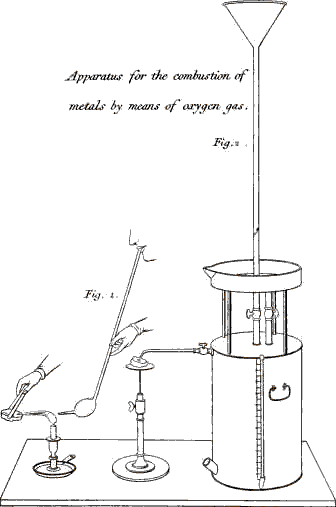
Fig. 1. Igniting charcoal with a taper & blow-pipe. Fig. 2. Combustion of metals by means of a blow-pipe conveying a stream of oxygen gas from a gas holder.
Larger view
EMILY.
That I do not understand; for it is not every kind of air, but merely oxygen gas, that produces combustion. Now you said that in breathing we inspired, but did not expire oxygen gas. Why, therefore, should the air which you breathe through the blow-pipe promote the combustion of the charcoal?
MRS. B.
Because the air, which has but once passed through the lungs, is yet but little altered, a small portion only of its oxygen being destroyed; so that a great deal more is gained by increasing the rapidity of the current, by means of the blow-pipe, than is lost in consequence of the air passing once through the lungs, as you shall see—
EMILY.
Yes, indeed, it makes the charcoal burn much brighter.
MRS. B.
Whilst it is red-hot, I shall drop some iron filings on it, and supply them with a current of oxygen gas, by means of this apparatus, (Plate XII. fig 2.) which consists simply of a closed tin cylindrical vessel, full of oxygen gas, with two apertures and stop-cocks, by one of which a stream of water is thrown into the vessel through a long funnel, whilst by the other the gas is forced out through a blow-pipe adapted to it, as the water gains admittance.—Now that I pour water into the funnel, you may hear the gas issuing from the blow-pipe—I bring the charcoal close to the current, and drop the filings upon it—
CAROLINE.
They emit much the same vivid light as the combustion of the iron wire in oxygen gas.
MRS. B.
The process is, in fact, the same; there is only some difference in the mode of conducting it. Let us burn some tin in the same manner—you see that it is equally combustible.—Let us now try some copper—
CAROLINE.
This burns with a greenish flame; it is, I suppose, owing to the colour of the oxyd?
EMILY.
Pray, shall we not also burn some gold?
MRS. B.
That is not in our power, at least in this way. Gold, silver, and platina, are incapable of being oxydated by the greatest heat that we can produce by the common method. It is from this circumstance, that they have been called perfect metals. Even these, however, have an affinity for oxygen; but their oxydation or combustion can be performed only by means of acids or by electricity. The spark given out by the Voltaic battery produces at the point of contact a greater degree of heat than any other process; and it is at this very high temperature only that the affinity of these metals for oxygen will enable them to act on each other.
I am sorry that I cannot show you the combustion of the perfect metals by this process, but it requires a considerable Voltaic battery. You will see these experiments performed in the most perfect manner, when you attend the chemical lectures of the Royal Institution. But in the mean time I can, without difficulty, show you an ingenious apparatus lately contrived for the purpose of producing intense heats, the power of which nearly equals that of the largest Voltaic batteries. It simply consists, you see, in a strong box, made of iron or copper, (Plate X. fig. 2.) to which may be adapted this air-syringe or condensing-pump, and a stop-cock terminating in a small orifice similar to that of a blow-pipe. By working the condensing syringe, up and down in this manner, a quantity of air is accumulated in the vessel, which may be increased to almost any extent; so that if we now turn the stop-cock, the condensed air will rush out, forming a jet of considerable force; and if we place the flame of a lamp in the current, you will see how violently the flame is driven in that direction.
Plate X.
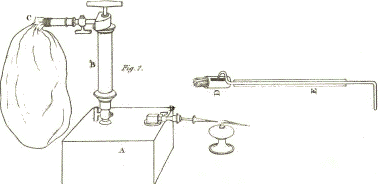
Fig. 2. A. the reservoir of condensed air. B. the condensing Syringe. C. the bladder for Oxygen. D. the moveable jet.
Larger view (complete Plate)
This part of the Plate was printed sideways to fit alongside the illustration of the miner’s lamp, added for this edition.
CAROLINE.
It seems to be exactly the same effect as that of a blow-pipe worked by the mouth, only much stronger.
EMILY.
Yes; and this new instrument has this additional advantage, that it does not fatigue the mouth and lungs like the common blow-pipe, and requires no art in blowing.
MRS. B.
Unquestionably; but yet this blow-pipe would be of very limited utility, if its energy and power could not be greatly increased by some other contrivance. Can you imagine any mode of producing such an effect?
EMILY.
Could not the reservoir be charged with pure oxygen, instead of common air, as in the case of the gas-holder?
MRS. B.
Undoubtedly; and this is precisely the contrivance I allude to. The vessel need only be supplied with air from a bladder full of oxygen, instead of the air of the room, and this, you see, may be easily done by screwing the bladder on the upper part of the syringe, so that in working the syringe the oxygen gas is forced from the bladder into the condensing vessel.
CAROLINE.
With the aid of this small apparatus, therefore, we could obtain the same effects as those we have just produced with the gas-holder, by means of a column of water forcing the gas out of it?
MRS. B.
Yes; and much more conveniently so. But there is a mode of using this apparatus by which more powerful effects still may be obtained. It consists in condensing in the reservoir, not oxygen alone, but a mixture of oxygen and hydrogen in the exact proportion in which they unite to produce water; and then kindling the jet formed by the mixed gases. The heat disengaged by this combustion, without the help of any lamp, is probably the most intense known; and various effects are said to have been obtained from it which exceed all expectation.
CAROLINE.
But why should we not try this experiment?
MRS. B.
Because it is not exempt from danger; the combustion (notwithstanding various contrivances which have been resorted to with a view to prevent accident) being apt to penetrate into the inside of the vessel, and to produce a dangerous and violent explosion.—We shall, therefore, now proceed in our subject.
CAROLINE.
I think you said the oxyds of metals could be restored to their metallic state?
MRS. B.
Yes; this is called reviving a metal. Metals are in general capable of being revived by charcoal, when heated red hot, charcoal having a greater attraction for oxygen than the metals. You need only, therefore, decompose, or unburn the oxyd, by depriving it of its oxygen, and the metal will be restored to its pure state.
EMILY.
But will the carbon, by this operation, be burnt, and be converted into carbonic acid?
MRS. B.
Certainly. There are other combustible substances to which metals at a high temperature will part with their oxygen. They will also yield it to each other, according to their several degrees of attraction for it; and if the oxygen goes into a more dense state in the metal which it enters, than it existed in that which it quits, a proportional disengagement of caloric will take place.
CAROLINE.
And cannot the oxyds of gold, silver, and platina, which are formed by means of acids or of the electric fluid, be restored to their metallic state?
MRS. B.
Yes, they may; and the intervention of a combustible body is not required; heat alone will take the oxygen from them, convert it into a gas, and revive the metal.
EMILY.
You said that rust was an oxyd of iron; how is it, then, that water, or merely dampness, produces it, which, you know, it very frequently does on steel grates, or any iron instruments?
MRS. B.
In that case the metal decomposes the water, or dampness (which is nothing but water in a state of vapour), and obtains the oxygen from it.
CAROLINE.
I thought that it was necessary to bring metals to a very high temperature to enable them to decompose water.
MRS. B.
It is so, if it is required that the process should be performed rapidly, and if any considerable quantity is to be decomposed. Rust, you knew, is sometimes months in forming, and then it is only the surface of the metal that is oxydated.
EMILY.
Metals, then, that do not rust, are incapable of spontaneous oxydation, either by air or water?
MRS. B.
Yes; and this is the case with the perfect metals, which, on that account, preserve their metallic lustre so well.
EMILY.
Are all metals capable of decomposing water, provided their temperature be sufficiently raised?
MRS. B.
No; a certain degree of attraction is requisite, besides the assistance of heat. Water, you recollect, is composed of oxygen and hydrogen; and, unless the affinity of the metal for oxygen be stronger than that of hydrogen, it is in vain that we raise its temperature, for it cannot take the oxygen from the hydrogen. Iron, zinc, tin, and antimony, have a stronger affinity for oxygen than hydrogen has, therefore these four metals are capable of decomposing water. But hydrogen having an advantage over all the other metals with respect to its affinity for oxygen, it not only withholds its oxygen from them, but is even capable, under certain circumstances, of taking the oxygen from the oxyds of these metals.
EMILY.
I confess that I do not quite understand why hydrogen can take oxygen from those metals that do not decompose water.
CAROLINE.
Now I think I do perfectly. Lead, for instance, will not decompose water, because it has not so strong an attraction for oxygen as hydrogen has. Well, then, suppose the lead to be in a state of oxyd; hydrogen will take the oxygen from the lead, and unite with it to form water, because hydrogen has a stronger attraction for oxygen, than oxygen has for lead; and it is the same with all the other metals which do not decompose water.
EMILY.
I understand your explanation, Caroline, very well; and I imagine that it is because lead cannot decompose water that it is so much employed for pipes for conveying that fluid.
MRS. B.
Certainly; lead is, on that account, particularly appropriate to such purposes; whilst, on the contrary, this metal, if it was oxydable by water, would impart to it very noxious qualities, as all oxyds of lead are more or less pernicious.
But, with regard to the oxydation of metals, the most powerful mode of effecting it is by means of acids. These, you know, contain a much greater proportion of oxygen than either air or water; and will, most of them, easily yield it to metals. Thus, you recollect, the zinc plates of the Voltaic battery are oxydated by the acid and water, much more effectually than by water alone.
CAROLINE.
And I have often observed that if I drop vinegar, lemon, or any acid on the blade of a knife, or on a pair of scissars, it will immediately produce a spot of rust.
EMILY.
Metals have, then, three ways of obtaining oxygen; from the atmosphere, from water, and from acids.
MRS. B.
The two first you have already witnessed, and I shall now show you how metals take the oxygen from an acid. This bottle contains nitric acid; I shall pour some of it over this piece of copper-leaf . . . . . . .
CAROLINE.
Oh, what a disagreeable smell!
EMILY.
And what is it that produces the effervescency and that thick yellow vapour?
MRS. B.
It is the acid, which being abandoned by the greatest part of its oxygen, is converted into a weaker acid, which escapes in the form of gas.
CAROLINE.
And whence proceeds this heat?
MRS. B.
Indeed, Caroline, I think you might now be able to answer that question yourself.
CAROLINE.
Perhaps it is that the oxygen enters into the metal in a more solid state than it existed in the acid, in consequence of which caloric is disengaged.
MRS. B.
If the combination of the oxygen and the metal results from the union of their opposite electricities, of course caloric must be given out.
EMILY.
The effervescence is over; therefore I suppose that the metal is now oxydated.
MRS. B.
Yes. But there is another important connection between metals and acids, with which I must now make you acquainted. Metals, when in the state of oxyds, are capable of being dissolved by acids. In this operation they enter into a chemical combination with the acid, and form an entirely new compound.
CAROLINE.
But what difference is there between the oxydation and the dissolution of the metal by an acid?
MRS. B.
In the first case, the metal merely combines with a portion of oxygen taken from the acid, which is thus partly deoxygenated, as in the instance you have just seen; in the second case, the metal, after being previously oxydated, is actually dissolved in the acid, and enters into a chemical combination with it, without producing any further decomposition or effervescence.—This complete combination of an oxyd and an acid forms a peculiar and important class of compound salts.
EMILY.
The difference between an oxyd and a compound salt, therefore, is very obvious: the one consists of a metal and oxygen; the other of an oxyd and an acid.
MRS. B.
Very well: and you will be careful to remember that the metals are incapable of entering into this combination with acids, unless they are previously oxydated; therefore, whenever you bring a metal in contact with an acid, it will be first oxydated and afterwards dissolved, provided that there be a sufficient quantity of acid for both operations.
There are some metals, however, whose solution is more easily accomplished, by diluting the acid in water; and the metal will, in this case, be oxydated, not by the acid, but by the water, which it will decompose. But in proportion as the oxygen of the water oxydates the surface of the metal, the acid combines with it, washes it off, and leaves a fresh surface for the oxygen to act upon: then other coats of oxyd are successively formed, and rapidly dissolved by the acid, which continues combining with the new-formed surfaces of oxyd till the whole of the metal is dissolved. During this process the hydrogen gas of the water is disengaged, and flies off with effervescence.
EMILY.
Was not this the manner in which the sulphuric acid assisted the iron filings in decomposing water?
MRS. B.
Exactly; and it is thus that several metals, which are incapable alone of decomposing water, are enabled to do it by the assistance of an acid, which, by continually washing off the covering of oxyd, as it is formed, prepares a fresh surface of metal to act upon the water.
CAROLINE.
The acid here seems to act a part not very different from that of a scrubbing-brush.—But pray would not this be a good method of cleaning metallic utensils?
MRS. B.
Yes; on some occasions a weak acid, as vinegar, is used for cleaning copper. Iron plates, too, are freed from the rust on their surface by diluted muriatic acid, previous to their being covered with tin. You must remember, however, that in this mode of cleaning metals the acid should be quickly afterwards wiped off, otherwise it would produce fresh oxyd.
CAROLINE.
Let us watch the dissolution of the copper in the nitric acid; for I am very impatient to see the salt that is to result from it. The mixture is now of a beautiful blue colour; but there is no appearance of the formation of a salt; it seems to be a tedious operation.
MRS. B.
The crystallisation of the salt requires some length of time to be completed; if, however, you are so impatient, I can easily show you a metallic salt already formed.
CAROLINE.
But that would not satisfy my curiosity half so well as one of our own manufacturing.
MRS. B.
It is one of our own preparing that I mean to show you. When we decomposed water a few days since, by the oxydation of iron filings through the assistance of sulphuric acid, in what did the process consist?
CAROLINE.
In proportion as the water yielded its oxygen to the iron, the acid combined with the new-formed oxyd, and the hydrogen escaped alone.
MRS. B.
Very well; the result, therefore, was a compound salt, formed by the combination of sulphuric acid with oxyd of iron. It still remains in the vessel in which the experiment was performed. Fetch it, and we shall examine it.
EMILY.
What a variety of processes the decomposition of water, by a metal and an acid, implies; 1st, the decomposition of the water; 2dly, the oxydation of the metal; and 3dly, the formation of a compound salt.
CAROLINE.
Here it is, Mrs. B.—What beautiful green crystals! But we do not perceive any crystals in the solution of copper in nitrous acid?
MRS. B.
Because the salt is now suspended in the water which the nitrous acid contains, and will remain so till it is deposited in consequence of rest and cooling.
EMILY.
I am surprised that a body so opake as iron can be converted into such transparent crystals.
MRS. B.
It is the union with the acid that produces the transparency; for if the pure metal were melted, and afterwards permitted to cool and crystallise, it would be found just as opake as before.
EMILY.
I do not understand the exact meaning of crystallisation?
MRS. B.
You recollect that when a solid body is dissolved either by water or caloric it is not decomposed; but that its integrant parts are only suspended in the solvent. When the solution is made in water, the integrant particles of the body will, on the water being evaporated, again unite into a solid mass by the force of their mutual attraction. But when the body is dissolved by caloric alone, nothing more is necessary, in order to make its particles reunite, than to reduce its temperature. And, in general, if the solvent, whether water or caloric, be slowly separated by evaporation or by cooling, and care taken that the particles be not agitated during their reunion, they will arrange themselves in regular masses, each individual substance assuming a peculiar form or arrangement; and this is what is called crystallisation.
EMILY.
Crystallisation, therefore, is simply the reunion of the particles of a solid body that has been dissolved in a fluid.
MRS. B.
That is a very good definition of it. But I must not forget to observe, that heat and water may unite their solvent powers; and, in this case, crystallisation may be hastened by cooling, as well as by evaporating the liquid.
CAROLINE.
But if the body dissolved is of a volatile nature, will it not evaporate with the fluid?
MRS. B.
A crystallised body held in solution only by water is scarcely ever so volatile as the fluid itself, and care must be taken to manage the heat so that it may be sufficient to evaporate the water only.
I should not omit also to mention that bodies, in crystallising from their watery solution, always retain a small portion of water, which remains confined in the crystal in a solid form, and does not reappear unless the body loses its crystalline state. This is called the water of crystallisation. But you must observe, that whilst a body may be separated from its solution in water or caloric simply by cooling or by evaporation, an acid can be taken from a metal with which it is combined only by stronger affinities, which produce a decomposition.
EMILY.
Are the perfect metals susceptible of being dissolved and converted into compound salts by acids?
MRS. B.
Gold is acted upon by only one acid, the oxygenated muriatic, a very remarkable acid, which, when in its most concentrated state, dissolves gold or any other metal, by burning them rapidly.
Gold can, it is true, be dissolved likewise by a mixture of two acids, commonly called aqua regia; but this mixed solvent derives that property from containing the peculiar acid which I have just mentioned. Platina is also acted upon by this acid only; silver is dissolved by nitric acid.
CAROLINE.
I think you said that some of the metals might be so strongly oxydated as to become acid?
MRS. B.
There are five metals, arsenic, molybdena, chrome, tungsten, and columbium, which are susceptible of combining with a sufficient quantity of oxygen to be converted into acids.
CAROLINE.
Acids are connected with metals in such a variety of ways, that I am afraid of some confusion in remembering them.—In the first place, acids will yield their oxygen to metals. Secondly, they will combine with them in their state of oxyds, to form compound salts; and lastly, several of the metals are themselves susceptible of acidification.
MRS. B.
Very well; but though metals have so great an affinity for acids, it is not with that class of bodies alone that they will combine. They are most of them, in their simple state, capable of uniting with sulphur, with phosphorus, with carbon, and with each other; these combinations, according to the nomenclature which was explained to you on a former occasion, are called sulphurets, phosphorets, carburets, &c.
The metallic phosphorets offer nothing very remarkable. The sulphurets form the peculiar kind of mineral called pyrites, from which certain kinds of mineral waters, as those of Harrogate, derive their chief chemical properties. In this combination, the sulphur, together with the iron, have so strong an attraction for oxygen, that they obtain it both from the air and from water, and by condensing it in a solid form, produce the heat which raises the temperature of the water in such a remarkable degree.
EMILY.
But if pyrites obtain oxygen from water, that water must suffer a decomposition, and hydrogen gas be evolved.
MRS. B.
That is actually the case in the hot springs alluded to, which give out an extremely fetid gas, composed of hydrogen impregnated with sulphur.
CAROLINE.
If I recollect right, steel and plumbago, which you mentioned in the last lesson, are both carburets of iron?
MRS. B.
Yes; and they are the only carburets of much consequence.
A curious combination of metals has lately very much attracted the attention of the scientific world: I mean the meteoric stones that fall from the atmosphere. They consist principally of native or pure iron, which is never found in that state in the bowels of the earth; and contain also a small quantity of nickel and chrome, a combination likewise new in the mineral kingdom.
These circumstances have led many scientific persons to believe that those substances have fallen from the moon, or some other planet, while others are of opinion either that they are formed in the atmosphere, or are projected into it by some unknown volcano on the surface of our globe.
CAROLINE.
I have heard much of these stones, but I believe many people are of opinion that they are formed on the surface of the earth, and laugh at their pretended celestial origin.
MRS. B.
The fact of their falling is so well ascertained, that I think no person who has at all investigated the subject, can now entertain any doubt of it. Specimens of these stones have been discovered in all parts of the world, and to each of them some tradition or story of its fall has been found connected. And as the analysis of all those specimens affords precisely the same results, there is strong reason to conjecture that they all proceed from the same source. It is to Mr. Howard that philosophers are indebted for having first analysed these stones, and directed their attention to this interesting subject.
CAROLINE.
But pray, Mrs. B., how can solid masses of iron and nickel be formed from the atmosphere, which consists of the two airs, nitrogen and oxygen?
MRS. B.
I really do not see how they could, and think it much more probable that they fall from the moon.—But we must not suffer this digression to take up too much of our time.
The combinations of metals with each other are called alloys; thus brass is an alloy of copper and zinc; bronze, of copper and tin, &c.
EMILY.
And is not pewter also a combination of metal?
MRS. B.
It is. The pewter made in this country is mostly composed of tin, with a very small proportion of zinc and lead.
CAROLINE.
Block-tin is a kind of pewter, I believe?
MRS. B.
Properly speaking, block-tin means tin in blocks, or square massive ingots; but in the sense in which it is used by ignorant workmen, it is iron plated with tin, which renders it more durable, as tin will not so easily rust. Tin alone, however, would be too soft a metal to be worked for common use, and all tin-vessels and utensils are in fact made of plates of iron, thinly coated with tin, which prevents the iron from rusting.
CAROLINE.
Say rather oxydating, Mrs. B.—Rust is a word that should be exploded in chemistry.
MRS. B.
Take care, however, not to introduce the word oxydate, instead of rust, in general conversation; for you would probably not be understood, and you might be suspected of affectation.
Metals differ very much in their affinity for each other; some will not unite at all, others readily combine together, and on this property of metals the art of soldering depends.
EMILY.
What is soldering?
MRS. B.
It is joining two pieces of metal together, by a more fusible metal interposed between them. Thus tin is a solder for lead; brass, gold, or silver, are solder for iron, &c.
CAROLINE.
And is not plating metals something of the same nature?
MRS. B.
In the operation of plating, two metals are united, one being covered with the other, but without the intervention of a third; iron or copper may thus be covered with gold or silver.
EMILY.
Mercury appears to me of a very different nature from the other metals.
MRS. B.
One of its greatest peculiarities is, that it retains a fluid state at the temperature of the atmosphere. All metals are fusible at different degrees of heat, and they have likewise each the property of freezing or becoming solid at a certain fixed temperature. Mercury congeals only at seventy-two degrees below the freezing point.
EMILY.
That is to say, that in order to freeze, it requires a temperature of seventy-two degrees colder than that at which water freezes.
MRS. B.
Exactly so.
CAROLINE.
But is the temperature of the atmosphere ever so low as that?
MRS. B.
Yes, often in Siberia; but happily never in this part of the globe. Here, however, mercury may be congealed by artificial cold; I mean such intense cold as can be produced by some chemical mixtures, or by the rapid evaporation of ether under the air-pump.*
CAROLINE.
And can mercury be made to boil and evaporate?
MRS. B.
Yes, like any other liquid; only it requires a much greater degree of heat. At the temperature of six hundred degrees, it begins to boil and evaporate like water.
Mercury combines with gold, silver, tin, and with several other metals; and, if mixed with any of them in a sufficient proportion, it penetrates the solid metal, softens it, loses its own fluidity, and forms an amalgam, which is the name given to the combination of any metal with mercury, forming a substance more or less solid, according as the mercury or the other metal predominates.
EMILY.
In the list of metals there are some whose names I have never before heard mentioned.
MRS. B.
Besides those which Sir H. Davy has obtained, there are several that have been recently discovered, whose properties are yet but little known, as for instance, titanium, which was discovered by the Rev. Mr. Gregor, in the tin-mines of Cornwall; columbium or tantalium, which has lately been discovered by Mr. Hatchett; and osmium, iridium, palladium, and rhodium, all of which Dr. Wollaston and Mr. Tennant found mixed in minute quantities with crude platina, and the distinct existence of which they proved by curious and delicate experiments.
CAROLINE.
Arsenic has been mentioned amongst the metals. I had no notion that it belonged to that class of bodies, for I had never seen it but as a powder, and never thought of it but as a most deadly poison.
MRS. B.
In its pure metallic state, I believe, it is not so poisonous; but it has such a great affinity for oxygen, that it absorbs it from the atmosphere at its natural temperature: you have seen it, therefore, only in its state of oxyd, when, from its combination with oxygen, it has acquired its very poisonous properties.
CAROLINE.
Is it possible that oxygen can impart poisonous qualities? That valuable substance which produces light and fire, and which all bodies in nature are so eager to obtain?
MRS. B.
Most of the metallic oxyds are poisonous, and derive this property from their union with oxygen. The white lead, so much used in paint, owes its pernicious effects to oxygen. In general, oxygen, in a concrete state, appears to be particularly destructive in its effects on flesh or any animal matter; and those oxyds are most caustic that have an acrid burning taste, which proceeds from the metal having but a slight affinity for oxygen, and therefore easily yielding it to the flesh, which it corrodes and destroys.
EMILY.
What is the meaning of the word caustic, which you have just used?
MRS. B.
It expresses that property which some bodies possess, of disorganizing and destroying animal matter, by operating a kind of combustion, or at least a chemical decomposition. You must often have heard of caustic used to burn warts, or other animal excrescences; most of these bodies owe their destructive power to the oxygen with which they are combined. The common caustic, called lunar caustic, is a compound formed by the union of nitric acid and silver; and it is supposed to owe its caustic qualities to the oxygen contained in the nitric acid.
CAROLINE.
But, pray, are not acids still more caustic than oxyds, as they contain a greater proportion of oxygen?
MRS. B.
Some of the acids are; but the caustic property of a body depends not only upon the quantity of oxygen which it contains, but also upon its slight affinity for that principle, and the consequent facility with which it yields it.
EMILY.
Is not this destructive property of oxygen accounted for?
MRS. B.
It proceeds probably from the strong attraction of oxygen for hydrogen; for if the one rapidly absorb the other from the animal fibre, a disorganisation of the substance must ensue.
EMILY.
Caustics are, then, very properly said to burn the flesh, since the combination of oxygen and hydrogen is an actual combustion.
CAROLINE.
Now, I think, this effect would be more properly termed an oxydation, as there is no disengagement of light and heat.
MRS. B.
But there really is a sensation of heat produced by the action of caustics.
EMILY.
If oxygen is so caustic, why does not that which is contained in the atmosphere burn us?
MRS. B.
Because it is in a gaseous state, and has a greater attraction for its electricity than for the hydrogen of our bodies. Besides, should the air be slightly caustic, we are in a great measure sheltered from its effects by the skin; you know how much a wound, however trifling, smarts on being exposed to it.
CAROLINE.
It is a curious idea, however, that we should live in a slow fire. But, if the air was caustic, would it not have an acrid taste?
MRS. B.
It possibly may have such a taste; though in so slight a degree, that custom has rendered it insensible.
CAROLINE.
And why is not water caustic? When I dip my hand into water, though cold, it ought to burn me from the caustic nature of its oxygen.
MRS. B.
Your hand does not decompose the water; the oxygen in that state is much better supplied with hydrogen than it would be by animal matter, and if its causticity depend on its affinity for that principle, it will be very far from quitting its state of water to act upon your hand. You must not forget that oxyds are caustic in proportion as the oxygen adheres slightly to them.
EMILY.
Since the oxyd of arsenic is poisonous, its acid, I suppose, is fully as much so?
MRS. B.
Yes; it is one of the strongest poisons in nature.
EMILY.
There is a poison called verdigris, which forms on brass and copper when not kept very clean; and this, I have heard, is an objection to these metals being made into kitchen utensils. Is this poison likewise occasioned by oxygen?
MRS. B.
It is produced by the intervention of oxygen; for verdigris is a compound salt formed by the union of vinegar and copper; it is of a beautiful green colour, and much used in painting.
EMILY.
But, I believe, verdigris is often formed on copper when no vinegar has been in contact with it.
MRS. B.
Not real verdigris, but compound salts, somewhat resembling it, may be produced by the action of any acid on copper.
The solution of copper in nitric acid, if evaporated, affords a salt which produces an effect on tin that will surprise you, and I have prepared some from the solution we made before, that I might show it to you. I shall first sprinkle some water on this piece of tin-foil, and then some of the salt.—Now observe that I fold it up suddenly, and press it into one lump.
CAROLINE.
What a prodigious vapour issues from it—and sparks of fire I declare!
MRS. B.
I thought it would surprise you. The effect, however, I dare say you could account for, since it is merely the consequence of the oxygen of the salt rapidly entering into a closer combination with the tin.
There is also a beautiful green salt too curious to be omitted; it is produced by the combination of cobalt with muriatic acid, which has the singular property of forming what is called sympathetic ink. Characters written with this solution are invisible when cold, but when a gentle heat is applied, they assume a fine bluish green colour.