Volume 1 — CHEMISTRY. (continued 3)
Reading edition
CAROLINE.
But does the battery become more and more strongly charged, merely by being allowed to stand undisturbed?
MRS. B.
No, for the action will soon stop, as was explained before, unless a vent be given to the accumulated electricities. This is easily done, however, by establishing a communication by means of the wires (Fig. 1.), between the two ends of the battery: these being brought into contact, the two electricities meet and neutralize each other, producing the shock and other effects of electricity; and the action goes on with renewed energy, being no longer obstructed by the accumulation of the two electricities which impeded its progress.
EMILY.
Is it the union of the two electricities which produces the electric spark?
MRS. B.
Yes; and it is, I believe, this circumstance which gave rise to Sir H. Davy’s opinion that caloric may be a compound of the two electricities.
CAROLINE.
Yet surely caloric is very different from the electrical spark?
MRS. B.
The difference may consist probably only in intensity: for the heat of the electric spark is considerably more intense, though confined to a very minute spot, than any heat we can produce by other means.
EMILY.
Is it quite certain that the electricity of the Voltaic battery is precisely of the same nature as that of the common electrical machine?
MRS. B.
Undoubtedly; the shock given to the human body, the spark, the circumstance of the same substances which are conductors of the one being also conductors of the other, and of those bodies, such as glass and sealing-wax, which are non-conductors of the one, being also non-conductors of the other, are striking proofs of it. Besides, Sir H. Davy has shewn in his Lectures, that a Leyden jar, and a common electric battery, can be charged with electricity obtained from a Voltaic battery, the effect produced being perfectly similar to that obtained by a common machine.
Dr. Wollaston has likewise proved that similar chemical decompositions are effected by the electric machine and by the Voltaic battery; and has made other experiments which render it highly probable, that the origin of both electricities is essentially the same, as they show that the rubber of the common electrical machine, like the zinc in the Voltaic battery, produces the two electricities by combining with oxygen.
CAROLINE.
But I do not see whence the rubber obtains oxygen, for there is neither acid nor water used in the common machine, and I always understood that the electricity was excited by the friction.
MRS. B.
It appears that by friction the rubber obtains oxygen from the atmosphere, which is partly composed of that element. The oxygen combines with the amalgam of the rubber, which is of a metallic nature, much in the same way as the oxygen of the acid combines with the zinc in the Voltaic battery, and it is thus that the two electricities are disengaged.
CAROLINE.
But, if the electricities of both machines are similar, why not use the common machine for chemical decompositions?
MRS. B.
Though its effects are similar to those of the Voltaic battery, they are incomparably weaker. Indeed Dr. Wollaston, in using it for chemical decompositions, was obliged to act upon the most minute quantities of matter, and though the result was satisfactory in proving the similarity of its effects to those of the Voltaic battery, these effects were too small in extent to be in any considerable degree applicable to chemical decomposition.
CAROLINE.
How terrible, then, the shock must be from a Voltaic battery, since it is so much more powerful than an electrical machine!
MRS. B.
It is not nearly so formidable as you think; at least it is by no means proportional to the chemical effect. The great superiority of the Voltaic battery consists in the large quantity of electricity that passes; but in regard to the rapidity or intensity of the charge, it is greatly surpassed by the common electrical machine. It would seem that the shock or sensation depends chiefly upon the intensity; whilst, on the contrary, for chemical purposes, it is quantity which is required. In the Voltaic battery, the electricity, though copious, is so weak as not to be able to force its way through the fluid which separates the plates, whilst that of a common machine will pass through any space of water.
CAROLINE.
Would not it be possible to increase the intensity of the Voltaic battery till it should equal that of the common machine?
MRS. B.
It can actually be increased till it imitates a weak electrical machine, so as to produce a visible spark when accumulated in a Leyden jar. But it can never be raised sufficiently to pass through any considerable extent of air, because of the ready communication through the fluids employed.
By increasing the number of plates of a battery, you increase its intensity, whilst, by enlarging the dimensions of the plates, you augment its quantity; and, as the superiority of the battery over the common machine consists entirely in the quantity of electricity produced, it was at first supposed that it was the size, rather than the number of plates that was essential to the augmentation of power. It was, however, found upon trial, that the quantity of electricity produced by the Voltaic battery, even when of a very moderate size, was sufficiently copious, and that the chief advantage in this apparatus was obtained by increasing the intensity, which, however, still falls very short of that of the common machine.
I should not omit to mention, that a very splendid, and, at the same time, most powerful battery, was, a few years ago, constructed under the direction of Sir H. Davy, which he repeatedly exhibited in his course of electro-chemical lectures. It consists of two thousand double plates of zinc and copper, of six square inches in dimensions, arranged in troughs of Wedgwood-ware, each of which contains twenty of these plates. The troughs are furnished with a contrivance for lifting the plates out of them in a very convenient and expeditious manner.*
CAROLINE.
Well, now that we understand the nature of the action of the Voltaic battery, I long to hear an account of the discoveries to which it has given rise.
MRS. B.
You must restrain your impatience, my dear, for I cannot with any propriety introduce the subject of these discoveries till we come to them in the regular course of our studies. But, as almost every substance in nature has already been exposed to the influence of the Voltaic battery, we shall very soon have occasion to notice its effects.
Plate XIII.
Vol. II. page 16.
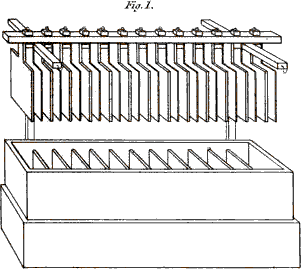
Fig. 1. Voltaic Battery of improved construction with the Plates out of the Cells.
Larger view (complete Plate)
CONVERSATION VI. ON OXYGEN AND NITROGEN.

MRS. B.
To-day we shall examine the chemical properties of the ATMOSPHERE.
CAROLINE.
I thought that we were first to learn the nature of Oxygen, which come next in our table of simple bodies?
MRS. B.
And so you shall; the atmosphere being composed of two principles, Oxygen and Nitrogen, we shall proceed to analyse it, and consider its component parts separately.
EMILY.
I always thought that the atmosphere had been a very complicated fluid, composed of all the variety of exhalations from the earth.
MRS. B.
Such substances may be considered rather as heterogeneous and accidental, than as forming any of its component parts; and the proportion they bear to the whole mass is quite inconsiderable.
Atmospherical air is composed of two gasses, known by the names of OXYGEN GAS and NITROGEN or AZOTIC GAS.
EMILY.
Pray what is a gas?
MRS. B.
The name of gas is given to any fluid capable of existing constantly in an aeriform state, under the pressure and at the temperature of the atmosphere.
CAROLINE.
Is not water, or any other substance, when evaporated by heat, called gas?
MRS. B.
No, my dear; vapour is, indeed, an elastic fluid, and bears a strong resemblance to a gas; there are, however, several points in which they essentially differ, and by which you may always distinguish them. Steam, or vapour, owes its elasticity merely to a high temperature, which is equal to that of boiling water. And it differs from boiling water only by being united with more caloric, which, as we before explained, is in a latent state. When steam is cooled, it instantly returns to the form of water; but air, or gas, has never yet been rendered liquid or solid by any degree of cold.
EMILY.
But does not gas, as well as vapour, owe its elasticity to caloric?
MRS. B.
It was the prevailing opinion; and the difference of gas or vapour was thought to depend on the different manner in which caloric was united with the basis of these two kinds of elastic fluids. In vapour, it was considered as in a latent state; in gas, it was said to be chemically combined. But the late researches of Sir H. Davy have given rise to a new theory respecting gasses; and there is now reason to believe that these bodies owe their permanently elastic state, not solely to caloric, but likewise to the prevalence of either the one or the other of the two electricities.
EMILY.
When you speak, then, of the simple bodies oxygen and nitrogen, you mean to express those substances which are the basis of the two gasses?
MRS. B.
Yes, in strict propriety, for they can properly be called gasses only when brought to an aeriform state.
CAROLINE.
In what proportions are they combined in the atmosphere?
MRS. B.
The oxygen gas constitutes a little more than one-fifth, and the nitrogen gas a little less than four-fifths. When separated, they are found to possess qualities totally different from each other. For oxygen gas is essential both to respiration and combustion, while neither of these processes can be performed in nitrogen gas.
CAROLINE.
But if nitrogen gas is unfit for respiration, how does it happen that the large proportion of it which enters into the composition of the atmosphere is not a great impediment to breathing?
MRS. B.
We should breathe more freely than our lungs could bear, if we respired oxygen gas alone. The nitrogen is no impediment to respiration, and probably, on the contrary, answers some useful purpose, though we do not know in what manner it acts in that process.
EMILY.
And by what means can the two gasses, which compose the atmospheric air, be separated?
MRS. B.
There are many ways of analysing the atmosphere: the two gasses may be separated first by combustion.
EMILY.
You surprise me! how is it possible that combustion should separate them?
MRS. B.
I should previously remind you that oxygen is supposed to be the only simple body naturally combined with negative electricity. In all the other elements the positive electricity prevails, and they have consequently, all of them, an attraction for oxygen.*
CAROLINE.
Oxygen the only negatively electrified body! that surprises me extremely; how then are the combinations of the other bodies performed, if, according to your explanation of chemical attraction, bodies are supposed only to combine in virtue of their opposite states of electricity?
MRS. B.
Observe that I said, that oxygen was the only simple body, naturally negative. Compound bodies, in which oxygen prevails over the other component parts, are also negative, but their negative energy is greater or less in proportion as the oxygen predominates. Those compounds into which oxygen enters in less proportion than the other constituents, are positive, but their positive energy is diminished in proportion to the quantity of oxygen which enters into their composition.
All bodies, therefore, that are not already combined with oxygen, will attract it, and, under certain circumstances, will absorb it from the atmosphere, in which case the nitrogen gas will remain alone, and may thus be obtained in its separate state.
CAROLINE.
I do not understand how a gas can be absorbed?
MRS. B.
It is only the oxygen, or basis of the gas, which is absorbed; and the two electricities escaping, that is to say, the negative from the oxygen, the positive from the burning body, unite and produce caloric.
EMILY.
And what becomes of this caloric?
MRS. B.
We shall make this piece of dry wood attract oxygen from the atmosphere, and you will see what becomes of the caloric.
CAROLINE.
You are joking, Mrs. B—; you do not mean to decompose the atmosphere with a piece of dry stick?
MRS. B.
Not the whole body of the atmosphere, certainly; but if we can make this piece of wood attract any quantity of oxygen from it, a proportional quantity of atmospherical air will be decomposed.
CAROLINE.
If wood has so strong an attraction for oxygen, why does it not decompose the atmosphere spontaneously?
MRS. B.
It is found by experience, that an elevation of temperature is required for the commencement of the union of the oxygen and the wood.
This elevation of temperature was formerly thought to be necessary, in order to diminish the cohesive attraction of the wood, and enable the oxygen to penetrate and combine with it more readily. But since the introduction of the new theory of chemical combination, another cause has been assigned, and it is now supposed that the high temperature, by exalting the electrical energies of bodies, and consequently their force of attraction, facilitates their combination.
EMILY.
If it is true, that caloric is composed of the two electricities, an elevation of temperature must necessarily augment the electric energies of bodies.
MRS. B.
I doubt whether that would be a necessary consequence; for, admitting this composition of caloric, it is only by its being decomposed that electricity can be produced. Sir H. Davy, however, in his numerous experiments, has found it to be an almost invariable rule that the electrical energies of bodies are increased by elevation of temperature.
What means then shall we employ to raise the temperature of the wood, so as to enable it to attract oxygen from the atmosphere?
CAROLINE.
Holding it near the fire, I should think, would answer the purpose.
MRS. B.
It may, provided you hold it sufficiently close to the fire; for a very considerable elevation of temperature is required.
CAROLINE.
It has actually taken fire, and yet I did not let it touch the coals, but I held it so very close that I suppose it caught fire merely from the intensity of the heat.
MRS. B.
Or you might say, in other words, that the caloric which the wood imbibed, so much elevated its temperature, and exalted its electric energy, as to enable it to attract oxygen very rapidly from the atmosphere.
EMILY.
Does the wood absorb oxygen while it is burning?
MRS. B.
Yes, and the heat and light are produced by the union of the two electricities which are set at liberty, in consequence of the oxygen combining with the wood.
CAROLINE.
You astonish me! the heat of a burning body proceeds then as much from the atmosphere as from the body itself?
MRS. B.
It was supposed that the caloric, given out during combustion, proceeded entirely, or nearly so, from the decomposition of the oxygen gas; but, according to Sir H. Davy’s new view of the subject, both the oxygen gas, and the combustible body, concur in supplying the heat and light, by the union of their opposite electricities.
EMILY.
I have not yet met with any thing in chemistry that has surprised or delighted me so much as this explanation of combustion. I was at first wondering what connection there could be between the affinity of a body for oxygen and its combustibility; but I think I understand it now perfectly.
MRS. B.
Combustion then, you see, is nothing more than the rapid combination of a body with oxygen, attended by the disengagement of light and heat.
EMILY.
But are there no combustible bodies whose attraction for oxygen is so strong, that they will combine with it, without the application of heat?
CAROLINE.
That cannot be; otherwise we should see bodies burning spontaneously.
MRS. B.
But there are some instances of this kind, such as phosphorus, potassium, and some compound bodies, which I shall hereafter make you acquainted with. These bodies, however, are prepared by art, for in general, all the combustions that could occur spontaneously, at the temperature of the atmosphere, have already taken place; therefore new combustions cannot happen without the temperature of the body being raised. Some bodies, however, will burn at a much lower temperature than others.
CAROLINE.
But the common way of burning a body is not merely to approach it to one already on fire, but rather to put the one in actual contact with the other, as when I burn this piece of paper by holding it in the flame of the fire.
MRS. B.
The closer it is in contact with the source of caloric, the sooner will its temperature be raised to the degree necessary for it to burn. If you hold it near the fire, the same effect will be produced; but more time will be required, as you found to be the case with the piece of stick.
EMILY.
But why is it not necessary to continue applying caloric throughout the process of combustion, in order to keep up the electric energy of the wood, which is required to enable it to combine with the oxygen?
MRS. B.
The caloric which is gradually produced by the two electricities during combustion, keeps up the temperature of the burning body; so that when once combustion has begun, no further application of caloric is required.
CAROLINE.
Since I have learnt this wonderful theory of combustion, I cannot take my eyes from the fire; and I can scarcely conceive that the heat and light, which I always supposed to proceed entirely from the coals, are really produced as much by the atmosphere.
EMILY.
When you blow the fire, you increase the combustion, I suppose, by supplying the coals with a greater quantity of oxygen gas?
MRS. B.
Certainly; but of course no blowing will produce combustion, unless the temperature of the coals be first raised. A single spark, however, is sometimes sufficient to produce that effect; for, as I said before, when once combustion has commenced, the caloric disengaged is sufficient to elevate the temperature of the rest of the body, provided that there be a free access of oxygen. It however sometimes happens that if a fire be ill made, it will be extinguished before all the fuel is consumed, from the very circumstance of the combustion being so slow that the caloric disengaged is insufficient to keep up the temperature of the fuel. You must recollect that there are three things required in order to produce combustion; a combustible body, oxygen, and a temperature at which the one will combine with the other.
EMILY.
You said that combustion was one method of decomposing the atmosphere, and obtaining the nitrogen gas in its simple state; but how do you secure this gas, and prevent it from mixing with the rest of the atmosphere?
MRS. B.
It is necessary for this purpose to burn the body within a close vessel, which is easily done.—We shall introduce a small lighted taper (Plate VII. Fig. 1.) under this glass receiver, which stands in a bason over water, to prevent all communication with the external air.
Plate VII.
Vol. I. p. 181.
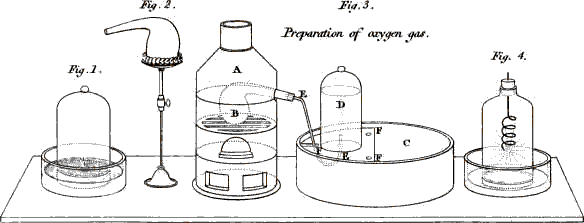
Fig. 1. Combustion of a taper under a receiver. Fig. 2. A Retort on a stand. Fig. 3. A Furnace. B Earthen Retort in the furnace. C Water bath. D Receiver. E.E Tube conveying the gas from the Retort through the water into the Receiver. F.F.F Shelf perforated on which the Receiver stands. Fig. 4. Combustion of iron wire in oxygen gas.
Larger view
CAROLINE.
How dim the light burns already!—It is now extinguished.
MRS. B.
Can you tell us why it is extinguished?
CAROLINE.
Let me consider.—The receiver was full of atmospherical air; the taper, in burning within it, must have combined with the oxygen contained in that air, and the caloric that was disengaged produced the light of the taper. But when the whole of the oxygen was absorbed, the whole of its electricity was disengaged; consequently no more caloric could be produced, the taper ceased to burn, and the flame was extinguished.
MRS. B.
Your explanation is perfectly correct.
EMILY.
The two constituents of the oxygen gas being thus disposed of, what remains under the receiver must be pure nitrogen gas?
MRS. B.
There are some circumstances which prevent the nitrogen gas, thus obtained, from being perfectly pure; but we may easily try whether the oxygen has disappeared, by putting another lighted taper under it.—You see how instantaneously the flame is extinguished, for want of oxygen to supply the negative electricity required for the formation of caloric; and were you to put an animal under the receiver, it would immediately be suffocated. But that is an experiment which I do not think your curiosity will tempt you to try.
EMILY.
Certainly not.—But look, Mrs. B., the receiver is full of a thick white smoke. Is that nitrogen gas?
MRS. B.
No, my dear; nitrogen gas is perfectly transparent and invisible, like common air. This cloudiness proceeds from a variety of exhalations, which arise from the burning taper, and the nature of which you cannot yet understand.
CAROLINE.
The water within the receiver has now risen a little above its level in the bason. What is the reason of this?
MRS. B.
With a moment’s reflection, I dare say, you would have explained it yourself. The water rises in consequence of the oxygen gas within it having been destroyed, or rather decomposed, by the combustion of the taper.
CAROLINE.
Then why did not the water rise immediately when the oxygen gas was destroyed?
MRS. B.
Because the heat of the taper, whilst burning, produced a dilatation of the air in the vessel, which at first counteracted this effect.
Another means of decomposing the atmosphere is the oxygenation of certain metals. This process is very analogous to combustion; it is, indeed, only a more general term to express the combination of a body with oxygen.
CAROLINE.
In what respect, then, does it differ from combustion?
MRS. B.
The combination of oxygen in combustion is always accompanied by a disengagement of light and heat; whilst this circumstance is not a necessary consequence of simple oxygenation.
CAROLINE.
But how can a body absorb oxygen without the combination of the two electricities which produce caloric?
MRS. B.
Oxygen does not always present itself in a gaseous state; it is a constituent part of a vast number of bodies, both solid and liquid, in which it exists in a much denser state than in the atmosphere; and from these bodies it may be obtained without much disengagement of caloric. It may likewise, in some cases, be absorbed from the atmosphere without any sensible production of light and heat; for, if the process be slow, the caloric is disengaged in such small quantities, and so gradually, that it is not capable of producing either light or heat. In this case the absorption of oxygen is called oxygenation or oxydation, instead of combustion, as the production of sensible light and heat is essential to the latter.
EMILY.
I wonder that metals can unite with oxygen; for, as they are so dense, their attraction of aggregation must be very great; and I should have thought that oxygen could never have penetrated such bodies.
MRS. B.
Their strong attraction for oxygen counterbalances this obstacle. Most metals, however, require to be made red-hot before they are capable of attracting oxygen in any considerable quantity. By this combination they lose most of their metallic properties, and fall into a kind of powder, formerly called calx, but now much more properly termed an oxyd; thus we have oxyd of lead, oxyd of iron, &c.
EMILY.
And in the Voltaic battery, it is, I suppose, an oxyd of zinc, that is formed by the union of the oxygen with that metal?
MRS. B.
Yes, it is.
CAROLINE.
The word oxyd, then, simply means a metal combined with oxygen?
MRS. B.
Yes; but the term is not confined to metals, though chiefly applied to them. Any body whatever, that has combined with a certain quantity of oxygen, either by means of oxydation or combustion, is called an oxyd, and is said to be oxydated or oxygenated.
EMILY.
Metals, when converted into oxyds, become, I suppose, negative?
MRS. B.
Not in general; because in most oxyds the positive energy of the metal more than counterbalances the native energy of the oxygen with which it combines.
This black powder is an oxyd of manganese, a metal which has so strong an affinity for oxygen, that it attracts that substance from the atmosphere at any known temperature: it is therefore never found in its metallic form, but always in that of an oxyd, in which state, you see, it has very little of the appearance of a metal. It is now heavier than it was before oxydation, in consequence of the additional weight of the oxygen with which it has combined.
CAROLINE.
I am very glad to hear that; for I confess I could not help having some doubts whether oxygen was really a substance, as it is not to be obtained in a simple and palpable state; but its weight is, I think, a decisive proof of its being a real body.
MRS. B.
It is easy to estimate its weight, by separating it from the manganese, and finding how much the latter has lost.
EMILY.
But if you can take the oxygen from the metal, shall we not then have it in its palpable simple state?
MRS. B.
No; for I can only separate the oxygen from the manganese, by presenting to it some other body, for which it has a greater affinity than for the manganese. Caloric affording the two electricities is decomposed, and one of them uniting with the oxygen, restores it to the aëriform state.
EMILY.
But you said just now, that manganese would attract oxygen from the atmosphere in which it is combined with the negative electricity; how, therefore, can the oxygen have a superior affinity for that electricity, since it abandons it to combine with the manganese?
MRS. B.
I give you credit for this objection, Emily; and the only answer I can make to it is, that the mutual affinities of metals for oxygen, and of oxygen for electricity, vary at different temperatures; a certain degree of heat will, therefore, dispose a metal to combine with oxygen, whilst, on the contrary, the former will be compelled to part with the latter, when the temperature is further increased. I have put some oxyd of manganese into a retort, which is an earthen vessel with a bent neck, such as you see here. (Plate VII. Fig. 2.)—The retort containing the manganese you cannot see, as I have enclosed it in this furnace, where it is now red-hot. But, in order to make you sensible of the escape of the gas, which is itself invisible, I have connected the neck of the retort with this bent tube, the extremity of which is immersed in this vessel of water. (Plate VII. Fig. 3.)—Do you see the bubbles of air rise through the water?
CAROLINE.
Perfectly. This, then, is pure oxygen gas; what a pity it should be lost! Could you not preserve it?
MRS. B.
We shall collect it in this receiver.—For this purpose, you observe, I first fill it with water, in order to exclude the atmospherical air; and then place it over the bubbles that issue from the retort, so as to make them rise through the water to the upper part of the receiver.
EMILY.
The bubbles of oxygen gas rise, I suppose, from their specific levity?
MRS. B.
Yes; for though oxygen forms rather a heavy gas, it is light compared to water. You see how it gradually displaces the water from the receiver. It is now full of gas, and I may leave it inverted in water on this shelf, where I can keep the gas as long as I choose, for future experiments. This apparatus (which is indispensable in all experiments in which gases are concerned) is called a water-bath.
CAROLINE.
It is a very clever contrivance, indeed; equally simple and useful. How convenient the shelf is for the receiver to rest upon under water, and the holes in it for the gas to pass into the receiver! I long to make some experiments with this apparatus.
MRS. B.
I shall try your skill that way, when you have a little more experience. I am now going to show you an experiment, which proves, in a very striking manner, how essential oxygen is to combustion. You will see that iron itself will burn in this gas, in the most rapid and brilliant manner.
CAROLINE.
Really! I did not know that it was possible to burn iron.
EMILY.
Iron is a simple body, and you know, Caroline, that all simple bodies are naturally positive, and therefore must have an affinity for oxygen.
MRS. B.
Iron will, however, not burn in atmospherical air without a very great elevation of temperature; but it is eminently combustible in pure oxygen gas; and what will surprise you still more, it can be set on fire without any considerable rise of temperature. You see this spiral iron wire—I fasten it at one end to this cork, which is made to fit an opening at the top of the glass-receiver. (Plate VII. Fig. 4.)
EMILY.
I see the opening in the receiver; but it is carefully closed by a ground glass-stopper.
MRS. B.
That is in order to prevent the gas from escaping; but I shall take out the stopper, and put in the cork, to which the wire hangs.—Now I mean to burn this wire in the oxygen gas, but I must fix a small piece of lighted tinder to the extremity of it, in order to give the first impulse to combustion; for, however powerful oxygen is in promoting combustion, you must recollect that it cannot take place without some elevation of temperature. I shall now introduce the wire into the receiver, by quickly changing the stoppers.
CAROLINE.
Is there no danger of the gas escaping while you change the stoppers?
MRS. B.
Oxygen gas is a little heavier than atmospherical air, therefore it will not mix with it very rapidly; and, if I do not leave the opening uncovered, we shall not lose any——
CAROLINE.
Oh, what a brilliant and beautiful flame!
EMILY.
It is as white and dazzling as the sun!—Now a piece of the melted wire drops to the bottom: I fear it is extinguished; but no, it burns again as bright as ever.
MRS. B.
It will burn till the wire is entirely consumed, provided the oxygen is not first expended: for you know it can burn only while there is oxygen to combine with it.
CAROLINE.
I never saw a more beautiful light. My eyes can hardly bear it! How astonishing to think that all this caloric was contained in the small quantity of gas and iron that was enclosed in the receiver; and that, without producing any sensible heat!
CAROLINE.
How wonderfully quick combustion goes on in pure oxygen gas! But pray, are these drops of burnt iron as heavy as the wire was before?
MRS. B.
They are even heavier; for the iron, in burning, has acquired exactly the weight of the oxygen which has disappeared, and is now combined with it. It has become an oxyd of iron.
CAROLINE.
I do not know what you mean by saying that the oxygen has disappeared, Mrs. B., for it was always invisible.
MRS. B.
True, my dear; the expression was incorrect. But though you could not see the oxygen gas, I believe you had no doubt of its presence, as the effect it produced on the wire was sufficiently evident.
CAROLINE.
Yes, indeed; yet you know it was the caloric, and not the oxygen gas itself, that dazzled us so much.
MRS. B.
You are not quite correct in your turn, in saying the caloric dazzled you; for caloric is invisible; it affects only the sense of feeling; it was the light which dazzled you.
CAROLINE.
True; but light and caloric are such constant companions, that it is difficult to separate them, even in idea.
MRS. B.
The easier it is to confound them, the more careful you should be in making the distinction.
CAROLINE.
But why has the water now risen, and filled part of the receiver?
MRS. B.
Indeed, Caroline, I did not suppose you would have asked such a question! I dare say, Emily, you can answer it.
EMILY.
Let me reflect . . . . . . The oxygen has combined with the wire; the caloric has escaped; consequently nothing can remain in the receiver, and the water will rise to fill the vacuum.
CAROLINE.
I wonder that I did not think of that. I wish that we had weighed the wire and the oxygen gas before combustion; we might then have found whether the weight of the oxyd was equal to that of both.
MRS. B.
You might try the experiment if you particularly wished it; but I can assure you, that, if accurately performed, it never fails to show that the additional weight of the oxyd is precisely equal to that of the oxygen absorbed, whether the process has been a real combustion, or a simple oxygenation.
CAROLINE.
But this cannot be the case with combustions in general; for when any substance is burnt in the common air, so far from increasing in weight, it is evidently diminished, and sometimes entirely consumed.
MRS. B.
But what do you mean by the expression consumed? You cannot suppose that the smallest particle of any substance in nature can be actually destroyed. A compound body is decomposed by combustion; some of its constituent parts fly off in a gaseous form, while others remain in a concrete state; the former are called the volatile, the latter the fixed products of combustion. But if we collect the whole of them, we shall always find that they exceed the weight of the combustible body, by that of the oxygen which has combined with them during combustion.
EMILY.
In the combustion of a coal fire, then, I suppose that the ashes are what would be called the fixed product, and the smoke the volatile product?
MRS. B.
Yet when the fire burns best, and the quantity of volatile products should be the greatest, there is no smoke; how can you account for that?
EMILY.
Indeed I cannot; therefore I suppose that I was not right in my conjecture.
MRS. B.
Not quite: ashes, as you supposed, are a fixed product of combustion; but smoke, properly speaking, is not one of the volatile products, as it consists of some minute undecomposed particles of the coals that are carried off by the heated air without being burnt, and are either deposited in the form of soot, or dispersed by the wind. Smoke, therefore, ultimately, becomes one of the fixed products of combustion. And you may easily conceive that the stronger the fire is, the less smoke is produced, because the fewer particles escape combustion. On this principle depends the invention of Argand’s Patent Lamps; a current of air is made to pass through the cylindrical wick of the lamp, by which means it is so plentifully supplied with oxygen, that scarcely a particle of oil escapes combustion, nor is there any smoke produced.
EMILY.
But what then are the volatile products of combustion?
MRS. B.
Various new compounds, with which you are not yet acquainted, and which being converted by caloric either into vapour or gas, are invisible; but they can be collected, and we shall examine them at some future period.
CAROLINE.
There are then other gases, besides the oxygen and nitrogen gases.
MRS. B.
Yes, several: any substance that can assume and maintain the form of an elastic fluid at the temperature of the atmosphere, is called a gas. We shall examine the several gases in their respective places; but we must now confine our attention to those that compose the atmosphere.
I shall show you another method of decomposing the atmosphere, which is very simple. In breathing, we retain a portion of the oxygen, and expire the nitrogen gas; so that if we breathe in a closed vessel, for a certain length of time, the air within it will be deprived of its oxygen gas. Which of you will make the experiment?
CAROLINE.
I should be very glad to try it.
MRS. B.
Very well; breathe several times through this glass tube into the receiver with which it is connected, until you feel that your breath is exhausted.
CAROLINE.
I am quite out of breath already!
MRS. B.
Now let us try the gas with a lighted taper.
EMILY.
It is very pure nitrogen gas, for the taper is immediately extinguished.
MRS. B.
That is not a proof of its being pure, but only of the absence of oxygen, as it is that principle alone which can produce combustion, every other gas being absolutely incapable of it.
EMILY.
In the methods which you have shown us, for decomposing the atmosphere, the oxygen always abandons the nitrogen; but is there no way of taking the nitrogen from the oxygen, so as to obtain the latter pure from the atmosphere?
MRS. B.
You must observe, that whenever oxygen is taken from the atmosphere, it is by decomposing the oxygen gas; we cannot do the same with the nitrogen gas, because nitrogen has a stronger affinity for caloric than for any other known principle: it appears impossible therefore to separate it from the atmosphere by the power of affinities. But if we cannot obtain the oxygen gas, by this means, in its separate state, we have no difficulty (as you have seen) to procure it in its gaseous form, by taking it from those substances that have absorbed it from the atmosphere, as we did with the oxyd of manganese.
EMILY.
Can atmospherical air be recomposed, by mixing due proportions of oxygen and nitrogen gases?
MRS. B.
Yes: if about one part of oxygen gas be mixed with about four parts of nitrogen gas, atmospherical air is produced.*
EMILY.
The air, then, must be an oxyd of nitrogen?
MRS. B.
No, my dear; for there must be a chemical combination between oxygen and nitrogen in order to produce an oxyd; whilst in the atmosphere these two substances are separately combined with caloric, forming two distinct gases, which are simply mixed in the formation of the atmosphere.
I shall say nothing more of oxygen and nitrogen at present, as we shall continually have occasion to refer to them in our future conversations. They are both very abundant in nature; nitrogen is the most plentiful in the atmosphere, and exists also in all animal substances; oxygen forms a constituent part, both of the animal and vegetable kingdoms, from which it may be obtained by a variety of chemical means. But it is now time to conclude our lesson. I am afraid you have learnt more to-day than you will be able to remember.
CAROLINE.
I assure you that I have been too much interested in it, ever to forget it. In regard to nitrogen there seems to be but little to remember; it makes a very insignificant figure in comparison to oxygen, although it composes a much larger portion of the atmosphere.
MRS. B.
Perhaps this insignificance you complain of may arise from the compound nature of nitrogen, for though I have hitherto considered it as a simple body, because it is not known in any natural process to be decomposed, yet from some experiments of Sir H. Davy, there appears to be reason for suspecting that nitrogen is a compound body, as we shall see afterwards. But even in its simple state, it will not appear so insignificant when you are better acquainted with it; for though it seems to perform but a passive part in the atmosphere, and has no very striking properties, when considered in its separate state, yet you will see by-and-bye what a very important agent it becomes, when combined with other bodies. But no more of this at present; we must reserve it for its proper place.
CONVERSATION VII. ON HYDROGEN.
CAROLINE.
The next simple bodies we come to are CHLORINE and IODINE. Pray what kinds of substances are these; are they also invisible?
MRS. B.
No; for chlorine, in the state of gas, has a distinct greenish colour, and is therefore visible; and iodine, in the same state, has a beautiful claret-red colour. The knowledge of these two bodies, however, and the explanation of their properties, imply various considerations, which you would not yet be able to understand; we shall therefore defer their examination to some future conversation, and we shall pass on to the next simple substance, Hydrogen, which we cannot, any more than oxygen, obtain in a visible or palpable form. We are acquainted with it only in its gaseous state, as we are with oxygen and nitrogen.
CAROLINE.
But in its gaseous state it cannot be called a simple substance, since it is combined with heat and electricity?
MRS. B.
True, my dear; but as we do not know in nature of any substance which is not more or less combined with caloric and electricity, we are apt to say that a substance is in its pure state when combined with those agents only.
Hydrogen was formerly called inflammable air, as it is extremely combustible, and burns with a great flame. Since the invention of the new nomenclature, it has obtained the name of hydrogen, which is derived from two Greek words, the meaning of which is, to produce water.
EMILY.
And how does hydrogen produce water?
MRS. B.
By its combustion. Water is composed of eighty-five parts, by weight, of oxygen, combined with fifteen parts of hydrogen; or of two parts, by bulk of hydrogen gas, to one part of oxygen gas.
CAROLINE.
Really! is it possible that water should be a combination of two gases, and that one of these should be inflammable air! Hydrogen must be a most extraordinary gas that will produce both fire and water.
EMILY.
But I thought you said that combustion could take place in no gas but oxygen?
MRS. B.
Do you recollect what the process of combustion consists in?
EMILY.
In the combination of a body with oxygen, with disengagement of light and heat.
MRS. B.
Therefore when I say that hydrogen is combustible, I mean that it has an affinity for oxygen; but, like all other combustible substances, it cannot burn unless supplied with oxygen, and also heated to a proper temperature.
CAROLINE.
The simply mixing fifteen parts of hydrogen, with eighty-five parts of oxygen gas, will not, therefore, produce water?
MRS. B.
No; water being a much denser fluid than gases, in order to reduce these gases to a liquid, it is necessary to diminish the quantity of caloric or electricity which maintains them in an elastic form.
EMILY.
That I should think might be done by combining the oxygen and hydrogen together; for in combining they would give out their respective electricities in the form of caloric, and by this means would be condensed.
CAROLINE.
But you forget, Emily, that in order to make the oxygen and hydrogen combine, you must begin by elevating their temperature, which increases, instead of diminishing, their electric energies.
MRS. B.
Emily is, however, right; for though it is necessary to raise their temperature, in order to make them combine, as that combination affords them the means of parting with their electricities, it is eventually the cause of the diminution of electric energy.
CAROLINE.
You love to deal in paradoxes to-day, Mrs. B.—Fire, then, produces water?
MRS. B.
The combustion of hydrogen gas certainly does; but you do not seem to have remembered the theory of combustion so well as you thought you would. Can you tell me what happens in the combustion of hydrogen gas?
CAROLINE.
The hydrogen combines with the oxygen, and their opposite electricities are disengaged in the form of caloric.—Yes, I think I understand it now—by the loss of this caloric, the gases are condensed into a liquid.
EMILY.
Water, then, I suppose, when it evaporates and incorporates with the atmosphere, is decomposed and converted into hydrogen and oxygen gases?
MRS. B.
No, my dear—there you are quite mistaken: the decomposition of water is totally different from its evaporation; for in the latter case (as you should recollect) water is only in a state of very minute division; and is merely suspended in the atmosphere, without any chemical combination, and without any separation of its constituent parts. As long as these remain combined, they form WATER, whether in a state of liquidity, or in that of an elastic fluid, as vapour, or under the solid form of ice.
In our experiments on latent heat, you may recollect that we caused water successively to pass through these three forms, merely by an increase or diminution of caloric, without employing any power of attraction, or effecting any decomposition.
CAROLINE.
But are there no means of decomposing water?
MRS. B.
Yes, several: charcoal, and metals, when heated red hot, will attract the oxygen from water, in the same manner as they will from the atmosphere.
CAROLINE.
Hydrogen, I see, is like nitrogen, a poor dependant friend of oxygen, which is continually forsaken for greater favourites.
MRS. B.
The connection, or friendship, as you choose to call it, is much more intimate between oxygen and hydrogen, in the state of water, than between oxygen and nitrogen, in the atmosphere; for, in the first case, there is a chemical union and condensation of the two substances; in the latter, they are simply mixed together in their gaseous state. You will find, however, that, in some cases, nitrogen is quite as intimately connected with oxygen, as hydrogen is.—But this is foreign to our present subject.
EMILY.
Water, then, is an oxyd, though the atmospherical air is not?
MRS. B.
It is not commonly called an oxyd, though, according to our definition, it may, no doubt, be referred to that class of bodies.
CAROLINE.
I should like extremely to see water decomposed.
MRS. B.
I can gratify your curiosity by a much more easy process than the oxydation of charcoal or metals: the decomposition of water by these latter means takes up a great deal of time, and is attended with much trouble; for it is necessary that the charcoal or metal should be made red hot in a furnace, that the water should pass over them in a state of vapour, that the gas formed should be collected over the water-bath, &c. In short, it is a very complicated affair. But the same effect may be produced with the greatest facility, by the action of the Voltaic battery, which this will give me an opportunity of exhibiting.
CAROLINE.
I am very glad of that, for I longed to see the power of this apparatus in decomposing bodies.
MRS. B.
For this purpose I fill this piece of glass-tube (Plate VIII. fig. 1.) with water, and cork it up at both ends; through one of the corks I introduce that wire of the battery which conveys the positive electricity; and the wire which conveys the negative electricity is made to pass through the other cork, so that the two wires approach each other sufficiently near to give out their respective electricities.
Plate VIII.
Vol. I. p. 206
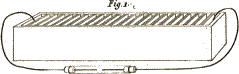
Fig. 1. Apparatus for the decomposition of water by the Voltaic Battery.
Larger view (complete Plate)
CAROLINE.
It does not appear to me that you approach the wires so near as you did when you made the battery act by itself.
MRS. B.
Water being a better conductor of electricity than air, the two wires will act on each other at a greater distance in the former than in the latter.
EMILY.
Now the electrical effect appears: I see small bubbles of air emitted from each wire.
MRS. B.
Each wire decomposes the water, the positive by combining with its oxygen which is negative, the negative by combining with its hydrogen which is positive.
CAROLINE.
That is wonderfully curious! But what are the small bubbles of air?
MRS. B.
Those that appear to proceed from the positive wire, are the result of the decomposition of the water by that wire. That is to say, the positive electricity having combined with some of the oxygen of the water, the particles of hydrogen which were combined with that portion of oxygen are set at liberty, and appear in the form of small bubbles of gas or air.
EMILY.
And I suppose the negative fluid having in the same manner combined with some of the hydrogen of the water, the particles of oxygen that were combined with it, are set free, and emitted in a gaseous form.
MRS. B.
Precisely so. But I should not forget to observe, that the wires used in this experiment are made of platina, a metal which is not capable of combining with oxygen; for otherwise the wire would combine with the oxygen, and the hydrogen alone would be disengaged.
CAROLINE.
But could not water be decomposed without the electric circle being completed? If, for instance, you immersed only the positive wire in the water, would it not combine with the oxygen, and the hydrogen gas be given out?
MRS. B.
No; for as you may recollect, the battery cannot act unless the circle be completed; since the positive wire will not give out its electricity, unless attracted by that of the negative wire.
CAROLINE.
I understand it now.—But look, Mrs. B., the decomposition of the water which has now been going on for some time, does not sensibly diminish its quantity—what is the reason of that?
MRS. B.
Because the quantity decomposed is so extremely small. If you compare the density of water with that of the gases into which it is resolved, you must be aware that a single drop of water is sufficient to produce thousands of such small bubbles as those you now perceive.
CAROLINE.
But in this experiment, we obtain the oxygen and hydrogen gases mixed together. Is there any means of procuring the two gases separately?
MRS. B.
They can be collected separately with great ease, by modifying a little the experiment. Thus if instead of one tube, we employ two, as you see here, (c, d, Plate VIII. fig. 2.) both tubes being closed at one end, and open at the other; and if after filling these tubes with water, we place them standing in a glass of water (e), with their open end downwards, you will see that the moment we connect the wires (a, b) which proceed upwards from the interior of each tube, the one with one end of the battery, and the other with the other end, the water in the tubes will be decomposed; hydrogen will be given out round the wire in the tube connected with the positive end of the battery, and oxygen in the other; and these gases will be evolved, exactly in the proportions which I have before mentioned, namely, two measures of hydrogen for one of oxygen. We shall now begin the experiment, but it will be some time before any sensible quantity of the gases can be collected.
Plate VIII.
Vol. I. p. 206
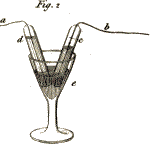
Fig. 2. Apparatus for decomposing water by Voltaic Electricity & obtaining the gasses separate.
Larger view (complete Plate)
EMILY.
The decomposition of water in this way, slow as it is, is certainly very striking; but I confess that I should be still more gratified, if you could shew it us on a larger scale, and by a quicker process. I am sorry that the decomposition of water by charcoal or metals is attended with so much inconvenience.
MRS. B.
Water may be decomposed by means of metals without any difficulty; but for this purpose the intervention of an acid is required. Thus, if we add some sulphuric acid (a substance with the nature of which you are not yet acquainted) to the water which the metal is to decompose, the acid disposes the metal to combine with the oxygen of the water so readily and abundantly, that no heat is required to hasten the process. Of this I am going to shew you an instance. I put into this bottle the water that is to be decomposed, as also the metal that is to effect that decomposition by combining with the oxygen, and the acid which is to facilitate the combination of the metal and the oxygen. You will see with what violence these will act on each other.
CAROLINE.
But what metal is it that you employ for this purpose?
MRS. B.
It is iron; and it is used in the state of filings, as these present a greater surface to the acid than a solid piece of metal. For as it is the surface of the metal which is acted upon by the acid, and is disposed to receive the oxygen produced by the decomposition of the water, it necessarily follows that the greater is the surface, the more considerable is the effect. The bubbles which are now rising are hydrogen gas——
CAROLINE.
How disagreeably it smells!
MRS. B.
It is indeed unpleasant, though, I believe, not particularly hurtful. We shall not, however, suffer any more to escape, as it will be wanted for experiments. I shall, therefore, collect it in a glass-receiver, by making it pass through this bent tube, which will conduct it into the water-bath. (Plate VIII. fig. 3.)
Plate VIII.
Vol. I. p. 206
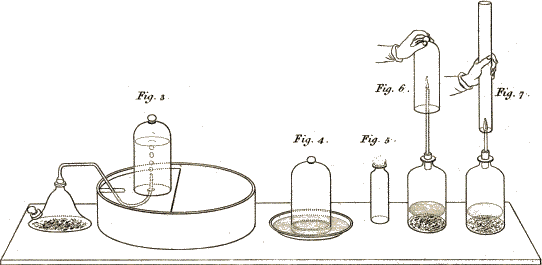
Fig. 3. Apparatus for preparing & collecting hydrogen gas. Fig. 4. Receiver full of hydrogen gas inverted over water. Fig. 5. Slow combustion of hydrogen gas. Fig. 6. Apparatus for illustrating the formation of water by the combustion of hydrogen gas. Fig. 7. Apparatus for producing harmonic sounds by the combustion of hydrogen gas.
Larger view (complete Plate)
EMILY.
How very rapidly the gas escapes! it is perfectly transparent, and without any colour whatever.—Now the receiver is full——
MRS. B.
We shall, therefore, remove it, and substitute another in its place. But you must observe, that when the receiver is full, it is necessary to keep it inverted with the mouth under water, otherwise the gas would escape. And in order that it may not be in the way, I introduce within the bath, under the water, a saucer, into which I slide the receiver, so that it can be taken out of the bath and conveyed any where, the water in the saucer being equally effectual in preventing its escape as that in the bath. (Plate VIII. fig. 4.)
EMILY.
I am quite surprised to see what a large quantity of hydrogen gas can be produced by such a small quantity of water, especially as oxygen is the principal constituent of water.
MRS. B.
In weight it is; but not in volume. For though the proportion, by weight, is nearly six parts of oxygen to one of hydrogen, yet the proportion of the volume of the gases, is about one part of oxygen to two of hydrogen; so much heavier is the former than the latter.
CAROLINE.
But why is the vessel in which the water is decomposed so hot? As the water changes from a liquid to a gaseous form, cold should be produced instead of heat.
MRS. B.
No; for if one of the constituents of water is converted into a gas, the other becomes solid in combining with the metal.
EMILY.
In this case, then, neither heat nor cold should be produced?
MRS. B.
True: but observe that the sensible heat which is disengaged in this operation, is not owing to the decomposition of the water, but to an extrication of heat produced by the mixture of water and sulphuric acid. I will mix some water and sulphuric acid together in this glass, that you may feel the surprising quantity of heat that is disengaged by their union—now take hold of the glass——
CAROLINE.
Indeed I cannot; it feels as hot as boiling water. I should have imagined there would have been heat enough disengaged to have rendered the liquid solid.
MRS. B.
As, however, it does not produce that effect, we cannot refer this heat to the modification called latent heat. We may, however, I think, consider it as heat of capacity, as the liquid is condensed by its loss; and if you were to repeat the experiment, in a graduated tube, you would find that the two liquids, when mixed, occupy considerably less space than they did separately.—But we will reserve this to another opportunity, and attend at present to the hydrogen gas which we have been producing.
If I now set the hydrogen gas, which is contained in this receiver, at liberty all at once, and kindle it as soon as it comes in contact with the atmosphere, by presenting it to a candle, it will so suddenly and rapidly decompose the oxygen gas, by combining with its basis, that an explosion, or a detonation (as chemists commonly call it), will be produced. For this purpose, I need only take up the receiver, and quickly present its open mouth to the candle——so . . . .
CAROLINE.
It produced only a sort of hissing noise, with a vivid flash of light. I had expected a much greater report.
MRS. B.
And so it would have been, had the gases been closely confined at the moment they were made to explode. If, for instance, we were to put in this bottle a mixture of hydrogen gas and atmospheric air; and if, after corking the bottle, we should kindle the mixture by a very small orifice, from the sudden dilatation of the gases at the moment of their combination, the bottle must either fly to pieces, or the cork be blown out with considerable violence.
CAROLINE.
But in the experiment which we have just seen, if you did not kindle the hydrogen gas, would it not equally combine with the oxygen?
MRS. B.
Certainly not; for, as I have just explained to you, it is necessary that the oxygen and hydrogen gases be burnt together, in order to combine chemically and produce water.
CAROLINE.
That is true; but I thought this was a different combination, for I see no water produced.
MRS. B.
The water resulting from this detonation was so small in quantity, and in such a state of minute division, as to be invisible. But water certainly was produced; for oxygen is incapable of combining with hydrogen in any other proportions than those that form water; therefore water must always be the result of their combination.
If, instead of bringing the hydrogen gas into sudden contact with the atmosphere (as we did just now) so as to make the whole of it explode the moment it is kindled, we allow but a very small surface of gas to burn in contact with the atmosphere, the combustion goes on quietly and gradually at the point of contact, without any detonation, because the surfaces brought together are too small for the immediate union of gases. The experiment is a very easy one. This phial, with a narrow neck, (Plate VIII. fig. 5.) is full of hydrogen gas, and is carefully corked. If I take out the cork without moving the phial, and quickly approach the candle to the orifice, you will see how different the result will be——
EMILY.
How prettily it burns, with a blue flame! The flame is gradually sinking within the phial—now it has entirely disappeared. But does not this combustion likewise produce water?
MRS. B.
Undoubtedly. In order to make the formation of the water sensible to you, I shall procure a fresh supply of hydrogen gas, by putting into this bottle (Plate VIII. fig. 6.) iron filings, water, and sulphuric acid, materials similar to those which we have just used for the same purpose. I shall then cork up the bottle, leaving only a small orifice in the cork, with a piece of glass-tube fixed to it, through which the gas will issue in a continued rapid stream.
CAROLINE.
I hear already the hissing of the gas through the tube, and I can feel a strong current against my hand.
MRS. B.
This current I am going to kindle with the candle—see how vividly it burns——
EMILY.
It burns like a candle with a long flame. But why does this combustion last so much longer than in the former experiment?
MRS. B.
The combustion goes on uninterruptedly as long as the new gas continues to be produced. Now if I invert this receiver over the flame, you will soon perceive its internal surface covered with a very fine dew, which is pure water——
CAROLINE.
Yes, indeed; the glass is now quite dim with moisture! How glad I am that we can see the water produced by this combustion.
EMILY.
It is exactly what I was anxious to see; for I confess I was a little incredulous.
MRS. B.
If I had not held the glass-bell over the flame, the water would have escaped in the state of vapour, as it did in the former experiment. We have here, of course, obtained but a very small quantity of water; but the difficulty of procuring a proper apparatus, with sufficient quantities of gases, prevents my showing it you on a larger scale.
The composition of water was discovered about the same period, both by Mr. Cavendish, in this country, and by the celebrated French chemist Lavoisier. The latter invented a very perfect and ingenious apparatus to perform, with great accuracy, and upon a large scale, the formation of water by the combination of oxygen and hydrogen gases. Two tubes, conveying due proportions, the one of oxygen, the other of hydrogen gas, are inserted at opposite sides of a large globe of glass, previously exhausted of air; the two streams of gas are kindled within the globe, by the electrical spark, at the point where they come in contact; they burn together, that is to say, the hydrogen combines with the oxygen, the caloric is set at liberty, and a quantity of water is produced exactly equal, in weight, to that of the two gases introduced into the globe.
CAROLINE.
And what was the greatest quantity of water ever formed in this apparatus?
MRS. B.
Several ounces; indeed, very nearly a pound, if I recollect right; but the operation lasted many days.
EMILY.
This experiment must have convinced all the world of the truth of the discovery. Pray, if improper proportions of the gases were mixed and set fire to, what would be the result?
MRS. B.
Water would equally be formed, but there would be a residue of either one or other of the gases, because, as I have already told you, hydrogen and oxygen will combine only in the proportions requisite for the formation of water.
EMILY.
Look, Mrs. B., our experiment with the Voltaic battery (Plate VIII. fig. 2.) has made great progress; a quantity of gas has been formed in each tube, but in one of them there is twice as much gas as in the other.
MRS. B.
Yes; because, as I said before, water is composed of two volumes of hydrogen to one of oxygen—and if we should now mix these gases together and set fire to them by an electrical spark, both gases would entirely disappear, and a small quantity of water would be formed.
There is another curious effect produced by the combustion of hydrogen gas, which I shall show you, though I must acquaint you first, that I cannot well explain the cause of it. For this purpose, I must put some materials into our apparatus, in order to obtain a stream of hydrogen gas, just as we have done before. The process is already going on, and the gas is rushing through the tube—I shall now kindle it with the taper——
EMILY.
It burns exactly as it did before——What is the curious effect which you were mentioning?
MRS. B.
Instead of the receiver, by means of which we have just seen the drops of water form, we shall invert over the flame this piece of tube, which is about two feet in length, and one inch in diameter (Plate VIII. fig. 7.); but you must observe that it is open at both ends.
EMILY.
What a strange noise it makes! something like the Æolian harp, but not so sweet.
CAROLINE.
It is very singular, indeed; but I think rather too powerful to be pleasing. And is not this sound accounted for?
MRS. B.
That the percussion of glass, by a rapid stream of gas, should produce a sound, is not extraordinary: but the sound here is so peculiar, that no other gas has a similar effect. Perhaps it is owing to a brisk vibratory motion of the glass, occasioned by the successive formation and condensation of small drops of water on the sides of the glass tube, and the air rushing in to replace the vacuum formed.*
CAROLINE.
How very much this flame resembles the burning of a candle.
MRS. B.
The burning of a candle is produced by much the same means. A great deal of hydrogen is contained in candles, whether of tallow or wax. This hydrogen being converted into gas by the heat of the candle, combines with the oxygen of the atmosphere, and flame and water result from this combination. So that, in fact, the flame of a candle is owing to the combustion of hydrogen gas. An elevation of temperature, such as is produced by a lighted match or taper, is required to give the first impulse to the combustion; but afterwards it goes on of itself, because the candle finds a supply of caloric in the successive quantities of heat which results from the union of the two electricities given out by the gases during their combustion. But there are other circumstances connected with the combustion of candles and lamps, which I cannot explain to you till you are acquainted with carbon, which is one of their constituent parts. In general, however, whenever you see flame, you may infer that it is owing to the formation and burning of hydrogen gas*; for flame is the peculiar mode of burning hydrogen gas, which, with only one or two apparent exceptions, does not belong to any other combustible.
EMILY.
You astonish me! I understood that flame was the caloric produced by the union of the two electricities, in all combustions whatever?
MRS. B.
Your error proceeded from your vague and incorrect idea of flame; you have confounded it with light and caloric in general. Flame always implies caloric, since it is produced by the combustion of hydrogen gas; but all caloric does not imply flame. Many bodies burn with intense heat without producing flame. Coals, for instance, burn with flame until all the hydrogen which they contain is evaporated; but when they afterwards become red hot, much more caloric is disengaged than when they produce flame.
CAROLINE.
But the iron wire, which you burnt in oxygen gas, appeared to me to emit flame; yet, as it was a simple metal, it could contain no hydrogen?
MRS. B.
It produced a sparkling dazzling blaze of light, but no real flame.
EMILY.
And what is the cause of the regular shape of the flame of a candle?
MRS. B.
The regular stream of hydrogen gas which exhales from its combustible matter.
CAROLINE.
But the hydrogen gas must, from its great levity, ascend into the upper regions of the atmosphere; why therefore does not the flame continue to accompany it?
MRS. B.
The combustion of the hydrogen gas is completed at the point where the flame terminates; it then ceases to be hydrogen gas, as it is converted by its combination with oxygen into watery vapour; but in a state of such minute division as to be invisible.
CAROLINE.
I do not understand what is the use of the wick of a candle, since the hydrogen gas burns so well without it?
MRS. B.
The combustible matter of the candle must be decomposed in order to emit the hydrogen gas, and the wick is instrumental in effecting this decomposition. Its combustion first melts the combustible matter, and . . . .
CAROLINE.
But in lamps the combustible matter is already fluid, and yet they also require wicks?
MRS. B.
I am going to add that, afterwards, the burning wick (by the power of capillary attraction) gradually draws up the fluid to the point where combustion takes place; for you must have observed that the wick does not burn quite to the bottom.
CAROLINE.
Yes; but I do not understand why it does not.
MRS. B.
Because the air has not so free an access to that part of the wick which is immediately in contact with the candle, as to the part just above, so that the heat there is not sufficient to produce its decomposition; the combustion therefore begins a little above this point.
CAROLINE.
But, Mrs. B., in those beautiful lights, called gas-lights, which are now seen in many streets, and will, I hope, be soon adopted every where, I can perceive no wick at all. How are these lights managed?
MRS. B.
I am glad you have put me in mind of saying a few words on this very useful and interesting improvement. In this mode of lighting, the gas is conveyed to the extremity of a tube, where it is kindled, and burns as long as the supply continues. There is, therefore, no occasion for a wick, or any other fuel whatever.
EMILY.
But how is all this gas procured in such large quantities?
MRS. B.
It is obtained from coal, by distillation.—Coal, when exposed to heat in a close vessel, is decomposed; and hydrogen, which is one of its constituents, rises in the state of gas, combined with another of its component parts, carbon, forming a compound gas, called Hydrocarbonat, the nature of which we shall again have an opportunity of noticing when we treat of carbon. This gas, like hydrogen, is perfectly transparent, invisible, and highly inflammable; and in burning it emits that vivid light which you have so often observed.
CAROLINE.
And does the process for procuring it require nothing but heating the coals, and conveying the gas through tubes?
MRS. B.
Nothing else; except that the gas must be made to pass, immediately at its formation, through two or three large vessels of water, in which it deposits some other ingredients, and especially water, tar, and oil, which also arise from the distillation of coals. The gas-light apparatus, therefore, consists simply in a large iron vessel, in which the coals are exposed to the heat of a furnace,—some reservoirs of water, in which the gas deposits its impurities,—and tubes that convey it to the desired spot, being propelled with uniform velocity through the tubes by means of a certain degree of pressure which is made upon the reservoir.
EMILY.
What an admirable contrivance! Do you not think, Mrs. B., that it will soon get into universal use?
MRS. B.
Most probably, as to the lighting of streets, offices, and public places, as it far surpasses any former invention for that purpose; but as to the interior of private houses, this mode of lighting has not yet been sufficiently tried to know whether it will be found generally desirable, either in regard to economy or convenience. It may, however, be considered as one of the happiest applications of chemistry to the comforts of life; and there is every reason to suppose that it will answer the full extent of public, expectation.
I have another experiment to show you with hydrogen gas, which I think will entertain you. Have you ever blown bubbles with soap and water?
EMILY.
Yes, often, when I was a child; and I used to make them float in the air by blowing them upwards.
MRS. B.
We shall fill some such bubbles with hydrogen gas, instead of atmospheric air, and you will see with what ease and rapidity they will ascend, without the assistance of blowing, from the lightness of the gas.—Will you mix some soap and water whilst I fill this bladder with the gas contained in the receiver which stands on the shelf in the water-bath?
CAROLINE.
What is the use of the brass-stopper and turn-cock at the top of the receiver?
MRS. B.
It is to afford a passage to the gas when required. There is, you see, a similar stop-cock fastened to this bladder, which is made to fit that on the receiver. I screw them one on the other, and now turn the two cocks, to open a communication between the receiver and the bladder; then, by sliding the receiver off the shelf, and gently sinking it into the bath, the water rises in the receiver and forces the gas into the bladder. (Plate IX. fig. 1.)
Plate IX.
Vol. I. p. 228
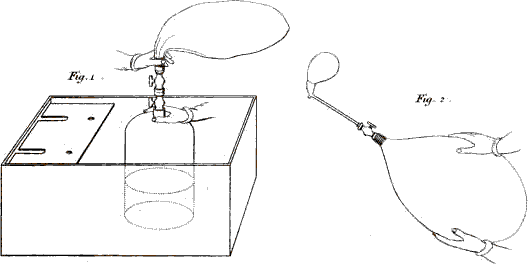
Fig. 1. Apparatus for transferring gases from a Receiver into a bladder. Fig. 2. Apparatus for blowing Soap bubbles.
Larger view
CAROLINE.
Yes, I see the bladder swell as the water rises in the receiver.
MRS. B.
I think that we have already a sufficient quantity in the bladder for our purpose; we must be careful to stop both the cocks before we separate the bladder from the receiver, lest the gas should escape.—Now I must fix a pipe to the stopper of the bladder, and by dipping its mouth into the soap and water, take up a few drops—then I again turn the cock, and squeeze the bladder in order to force the gas into the soap and water at the mouth of the pipe. (Plate IX. fig. 2.)
EMILY.
There is a bubble—but it bursts before it leaves the mouth of the pipe.
MRS. B.
We must have patience and try again; it is not so easy to blow bubbles by means of a bladder, as simply with the breath.
CAROLINE.
Perhaps there is not soap enough in the water; I should have had warm water, it would have dissolved the soap better.
EMILY.
Does not some of the gas escape between the bladder and the pipe?
MRS. B.
No, they are perfectly air tight; we shall succeed presently, I dare say.
CAROLINE.
Now a bubble ascends; it moves with the rapidity of a balloon. How beautifully it refracts the light!
EMILY.
It has burst against the ceiling—you succeed now wonderfully; but why do they all ascend and burst against the ceiling?
MRS. B.
Hydrogen gas is so much lighter than atmospherical air, that it ascends rapidly with its very light envelope, which is burst by the force with which it strikes the ceiling.
Air-balloons are filled with this gas, and if they carried no other weight than their covering, would ascend as rapidly as these bubbles.
CAROLINE.
Yet their covering must be much heavier than that of these bubbles?
MRS. B.
Not in proportion to the quantity of gas they contain. I do not know whether you have ever been present at the filling of a large balloon. The apparatus for that purpose is very simple. It consists of a number of vessels, either jars or barrels, in which the materials for the formation of the gas are mixed, each of these being furnished with a tube, and communicating with a long flexible pipe, which conveys the gas into the balloon.
EMILY.
But the fire-balloons which were first invented, and have been since abandoned, on account of their being so dangerous, were constructed, I suppose, on a different principle.
MRS. B.
They were filled simply with atmospherical air, considerably rarefied by heat; and the necessity of having a fire underneath the balloon, in order to preserve the rarefaction of the air within it, was the circumstance productive of so much danger.
If you are not yet tired of experiments, I have another to show you. It consists in filling soap-bubbles with a mixture of hydrogen and oxygen gases, in the proportions that form water; and afterwards setting fire to them.
EMILY.
They will detonate, I suppose?
MRS. B.
Yes, they will. As you have seen the method of transferring the gas from the receiver into the bladder, it is not necessary to repeat it. I have therefore provided a bladder which contains a due proportion of oxygen and hydrogen gases, and we have only to blow bubbles with it.
CAROLINE.
Here is a fine large bubble rising—shall I set fire to it with the candle?
MRS. B.
If you please . . . .
CAROLINE.
Heavens, what an explosion!—It was like the report of a gun: I confess it frightened me much. I never should have imagined it could be so loud.
EMILY.
And the flash was as vivid as lightning.
MRS. B.
The combination of the two gases takes place during that instant of time that you see the flash, and hear the detonation.
EMILY.
This has a strong resemblance to thunder and lightning.
MRS. B.
These phenomena, however, are generally of an electrical nature. Yet various meteorological effects may be attributed to accidental detonations of hydrogen gas in the atmosphere; for nature abounds with hydrogen: it constitutes a very considerable portion of the whole mass of water belonging to our globe, and from that source almost every other body obtains it. It enters into the composition of all animal substances, and of a great number of minerals; but it is most abundant in vegetables. From this immense variety of bodies, it is often spontaneously disengaged; its great levity makes it rise into the superior regions of the atmosphere; and when, either by an electrical spark, or any casual elevation of temperature, it takes fire, it may produce such meteors or luminous appearances as are occasionally seen in the atmosphere. Of this kind are probably those broad flashes which we often see on a summer-evening, without hearing any detonation.
EMILY.
Every flash, I suppose, must produce a quantity of water?
CAROLINE.
And this water, naturally, descends in the form of rain?
MRS. B.
That probably is often the case, though it is not a necessary consequence; for the water may be dissolved by the atmosphere, as it descends towards the lower regions, and remain there in the form of clouds.
The application of electrical attraction to chemical phenomena is likely to lead to many very interesting discoveries in meteorology; for electricity evidently acts a most important part in the atmosphere. This subject however, is, as yet, not sufficiently developed for me to venture enlarging upon it. The phenomena of the atmosphere are far from being well understood; and even with the little that is known, I am but imperfectly acquainted.
But before we take leave of hydrogen, I must not omit to mention to you a most interesting discovery of Sir H. Davy, which is connected with this subject.
CAROLINE.
You allude, I suppose, to the new miner’s lamp, which has of late been so much talked of? I have long been desirous of knowing what that discovery was, and what purpose it was intended to answer.
MRS. B.
It often happens in coal-mines, that quantities of the gas, called by chemists hydro-carbonat, or by the miners fire-damp, (the same from which the gas-lights are obtained,) ooze out from fissures in the beds of coal, and fill the cavities in which the men are at work; and this gas being inflammable, the consequence is, that when the men approach those places with a lighted candle, the gas takes fire, and explosions happen which destroy the men and horses employed in that part of the colliery, sometimes in great numbers.
EMILY.
What tremendous accidents these must be! But whence does that gas originate?
MRS. B.
Being the chief product of the combustion of coal, no wonder that inflammable gas should occasionally appear in situations in which this mineral abounds, since there can be no doubt that processes of combustion are frequently taking place at a great depth under the surface of the earth; and therefore those accumulations of gas may arise either from combustions actually going on, or from former combustions, the gas having perhaps been confined there for ages.
CAROLINE.
And how does Sir H. Davy’s lamp prevent those dreadful explosions?
MRS. B.
By a contrivance equally simple and ingenious; and one which does no less credit to the philosophical views from which it was deduced, than to the philanthropic motives from which the enquiry sprung. The principle of the lamp is shortly this: It was ascertained, two or three years ago, both by Mr. Tennant and by Sir Humphry himself, that the combustion of inflammable gas could not be propagated through small tubes; so that if a jet of an inflammable gaseous mixture, issuing from a bladder or any other vessel, through a small tube, be set fire to, it burns at the orifice of the tube, but the flame never penetrates into the vessel. It is upon this fact that Sir Humphry’s safety-lamp is founded.
EMILY.
But why does not the flame ever penetrate through the tube into the vessel from which the gas issues, so as to explode at once the whole of the gas?
MRS. B.
Because, no doubt, the inflamed gas is so much cooled in its passage through a small tube as to cease to burn before the combustion reaches the reservoir.
CAROLINE.
And how can this principle be applied to the construction of a lamp?
MRS. B.
Nothing easier. You need only suppose a lamp enclosed all round in glass or horn, but having a number of small open tubes at the bottom, and others at the top, to let the air in and out. Now, if such a lamp or lanthorn be carried into an atmosphere capable of exploding, an explosion or combustion of the gas will take place within the lamp; and although the vent afforded by the tubes will save the lamp from bursting, yet, from the principle just explained, the combustion will not be propagated to the external air through the tubes, so that no farther consequence will ensue.
EMILY.
And is that all the mystery of that valuable lamp?
MRS. B.
No; in the early part of the enquiry a lamp of this kind was actually proposed; but it was but a rude sketch compared to its present state of improvement. Sir H. Davy, after a succession of trials, by which he brought his lamp nearer and nearer to perfection, at last conceived the happy idea that if the lamp were surrounded with a wire-work or wire-gauze, of a close texture, instead of glass or horn, the tubular contrivance I have just described would be entirely superseded, since each of the interstices of the gauze would act as a tube in preventing the propagation of explosions; so that this pervious metallic covering would answer the various purposes of transparency, of permeability to air, and of protection against explosion. This idea, Sir Humphry immediately submitted to the test of experiment, and the result has answered his most sanguine expectations, both in his laboratory and in the collieries, where it has already been extensively tried. And he has now the happiness of thinking that his invention will probably be the means of saving every year a number of lives, which would have been lost in digging out of the bowels of the earth one of the most valuable necessaries of life. Here is one of these lamps, every part of which you will at once comprehend. (See Plate X. fig. 1.)
Plate X.
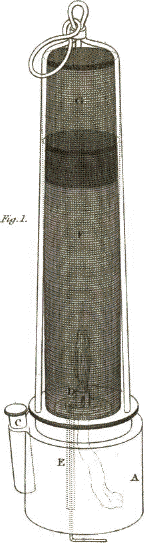
Fig. 1. A. the cistern containing the Oil B. the rim or screw by which the gauze cage is fixed to the cistern. C. apperture for supplying Oil. E. a wire for trimming the wick. D. F. the wire gauze cylinder. G. a double top.
Larger view (complete Plate)
CAROLINE.
How very simple and ingenious! But I do not yet well see why an explosion taking place within the lamp should not communicate to the external air around it, through the interstices of the wire?
MRS. B.
This has been and is still a subject of wonder, even to philosophers; and the only mode they have of explaining it is, that flame or ignition cannot pass through a fine wire-work, because the metallic wire cools the flame sufficiently to extinguish it in passing through the gauze. This property of the wire-gauze is quite similar to that of the tubes which I mentioned on introducing the subject; for you may consider each interstice of the gauze as an extremely short tube of a very small diameter.
EMILY.
But I should expect the wire would often become red-hot, by the burning of the gas within the lamp?
MRS. B.
And this is actually the case, for the top of the lamp is very apt to become red-hot. But, fortunately, inflammable gaseous mixtures cannot be exploded by red-hot wire, the intervention of actual flame being required for that purpose; so that the wire does not set fire to the explosive gas around it.
EMILY.
I can understand that; but if the wire be red-hot, how can it cool the flame within, and prevent its passing through the gauze?
MRS. B.
The gauze, though red-hot, is not so hot as the flame by which it has been heated; and as metallic wire is a good conductor, the heat does not much accumulate in it, as it passes off quickly to the other parts of the lamp, as well as to any contiguous bodies.
CAROLINE.
This is indeed a most interesting discovery, and one which shows at once the immense utility with which science may be practically applied to some of the most important purposes.
CONVERSATION VIII. ON SULPHUR AND PHOSPHORUS.
MRS. B.
Sulphur is the next substance that comes under our consideration. It differs in one essential point from the preceding, as it exists in a solid form at the temperature of the atmosphere.
CAROLINE.
I am glad that we have at last a solid body to examine; one that we can see and touch. Pray, is it not with sulphur that the points of matches are covered, to make them easily kindle?
MRS. B.
Yes, it is; and you therefore already know that sulphur is a very combustible substance. It is seldom discovered in nature in a pure unmixed state; so great is its affinity for other substances, that it is almost constantly found combined with some of them. It is most commonly united with metals, under various forms, and is separated from them by a very simple process. It exists likewise in many mineral waters, and some vegetables yield it in various proportions, especially those of the cruciform tribe. It is also found in animal matter; in short, it may be discovered in greater or less quantity, in the mineral, vegetable, and animal kingdoms.
EMILY.
I have heard of flowers of sulphur, are they the produce of any plant?
MRS. B.
By no means: they consist of nothing more than common sulphur, reduced to a very fine powder by a process called sublimation.—You see some of it in this phial; it is exactly the same substance as this lump of sulphur, only its colour is a paler yellow, owing to its state of very minute division.
EMILY.
Pray what is sublimation?
MRS. B.
It is the evaporation, or, more properly speaking, the volatilisation of solid substances, which, in cooling, condense again in a concrete form. The process, in this instance, must be performed in a closed vessel, both to prevent combustion, which would take place if the access of air were not carefully precluded, and likewise in order to collect the substance after the operation. As it is rather a slow process, we shall not try the experiment now; but you will understand it perfectly if I show you the apparatus used for the purpose. (Plate XI. fig. 1.) Some lumps of sulphur are put into a receiver of this kind, which is called a cucurbit. Its shape, you see, somewhat resembles that of a pear, and is open at the top, so as to adapt itself exactly to a kind of conical receiver of this sort, called the head. The cucurbit, thus covered with its head, is placed over a sand-bath; this is nothing more than a vessel full of sand, which is kept heated by a furnace, such as you see here, so as to preserve the apparatus in a moderate and uniform temperature. The sulphur then soon begins to melt, and immediately after this, a thick white smoke rises, which is gradually deposited within the head, or upper part of the apparatus, where it condenses against the sides, somewhat in the form of a vegetation, whence it has obtained the name of flowers of sulphur. This apparatus, which is called an alembic, is highly useful in all kinds of distillations, as you will see when we come to treat of those operations. Alembics are not commonly made of glass, like this, which is applicable only to distillations upon a very small scale. Those used in manufactures are generally made of copper, and are, of course, considerably larger. The principal construction, however, is always the same, although their shape admits of some variation.
Plate XI.
Vol. I. p. 237.
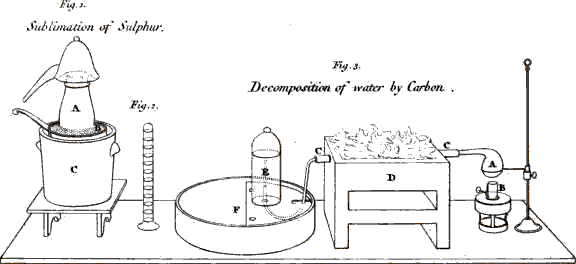
Fig. 1. A Alembic. B Sand-bath. C Furnace. Fig. 2. Eudiometer. Fig. 3. A Retort containing water. B Lamp to heat the water. C.C Porcelain tube containing Carbone. D Furnace through which the tube passes. E Receiver for the gas produced. F Water bath.
Larger view
CAROLINE.
What is the use of that neck, or tube, which bends down from the upper piece of the apparatus?
MRS. B.
It is of no use in sublimations; but in distillations (the general object of which is to evaporate, by heat, in closed vessels, the volatile parts of a compound body, and to condense them again into a liquid,) it serves to carry off the condensed fluid, which otherwise would fall back into the cucurbit. But this is rather foreign to our present subject. Let us return to the sulphur. You now perfectly understand, I suppose, what is meant by sublimation?
EMILY.
I believe I do. Sublimation appears to consist in destroying, by means of heat, the attraction of aggregation of the particles of a solid body, which are thus volatilised; and as soon as they lose the caloric which produced that effect, they are deposited in the form of a fine powder.
CAROLINE.
It seems to me to be somewhat similar to the transformation of water into vapour, which returns to its liquid state when deprived of caloric.
EMILY.
There is this difference, however, that the sulphur does not return to its former state, since, instead of lumps, it changes to a fine powder.
MRS. B.
Chemically speaking, it is exactly the same substance, whether in the form of lump or powder. For if this powder be melted again by heat, it will, in cooling, be restored to the same solid state in which it was before its sublimation.
CAROLINE.
But if there be no real change, produced by the sublimation of the sulphur, what is the use of that operation?
MRS. B.
It divides the sulphur into very minute parts, and thus disposes it to enter more readily into combination with other bodies. It is used also as a means of purification.
CAROLINE.
Sublimation appears to me like the beginning of combustion, for the completion of which one circumstance only is wanting, the absorption of oxygen.
MRS. B.
But that circumstance is every thing. No essential alteration is produced in sulphur by sublimation; whilst in combustion it combines with the oxygen, and forms a new compound totally different in every respect from sulphur in its pure state.—We shall now burn some sulphur, and you will see how very different the result will be. For this purpose I put a small quantity of flowers of sulphur into this cup, and place it in a dish, into which I have poured a little water: I now set fire to the sulphur with the point of this hot wire; for its combustion will not begin unless its temperature be considerably raised.—You see that it burns with a faint blueish flame; and as I invert over it this receiver, white fumes arise from the sulphur, and fill the vessel.—You will soon perceive that the water is rising within the receiver, a little above its level in the plate.—Well, Emily, can you account for this?
EMILY.
I suppose that the sulphur has absorbed the oxygen from the atmospherical air within the receiver, and that we shall find some oxygenated sulphur in the cup. As for the white smoke, I am quite at a loss to guess what it may be.
MRS. B.
Your first conjecture is very right: but you are mistaken in the last; for nothing will be left in the cup. The white vapour is the oxygenated sulphur, which assumes the form of an elastic fluid of a pungent and offensive smell, and is a powerful acid. Here you see a chemical combination of oxygen and sulphur, producing a true gas, which would continue such under the pressure and at the temperature of the atmosphere, if it did not unite with the water in the plate, to which it imparts its acid taste, and all its acid properties.—You see, now, with what curious effects the combustion of sulphur is attended.
CAROLINE.
This is something quite new; and I confess that I do not perfectly understand why the sulphur turns acid.
MRS. B.
It is because it unites with oxygen, which is the acidifying principle. And, indeed, the word oxygen is derived from two Greek words signifying to produce an acid.
CAROLINE.
Why, then, is not water, which contains such a quantity of oxygen, acid?
MRS. B.
Because hydrogen, which is the other constituent of water, is not susceptible of acidification.—I believe it will be necessary, before we proceed further, to say a few words of the general nature of acids, though it is rather a deviation from our plan of examining the simple bodies separately, before we consider them in a state of combination.
Acids may be considered as a peculiar class of burnt bodies, which during their combustion, or combination with oxygen, have acquired very characteristic properties. They are chiefly discernible by their sour taste, and by turning red most of the blue vegetable colours. These two properties are common to the whole class of acids; but each of them is distinguished by other peculiar qualities. Every acid consists of some particular substance, (which constitutes its basis, and is different in each,) and of oxygen, which is common to them all.
EMILY.
But I do not clearly see the difference between acids and oxyds.
MRS. B.
Acids were, in fact, oxyds, which, by the addition of a sufficient quantity of oxygen, have been converted into acids. For acidification, you must observe, always implies previous oxydation, as a body must have combined with the quantity of oxygen requisite to constitute it an oxyd, before it can combine with the greater quantity that is necessary to render it an acid.