THE BIOLOGY AND ECOLOGY OF MARINE BIRDS IN THE NORTH (continued 3)
Reading edition
Thus, the energy demands of nestlings are not easy to predict. Brood size differences multiply variation in food demand on adults (except in precocial birds whose young feed themselves). Energy demands are labile, however, particularly in requirements for activity and growth, and adults can frequently raise young successfully without providing optimum amounts of food (Spaans 1971; Kadlec et al. 1969; LeCroy and Collins 1972; Lemmetyinen 1972; Cody 1973; E. H. Dunn and I. L. Brisbin, manuscript in preparation). Studies of double-crested cormorants by Dunn (1975b) and pigeon guillemots (Cepphus columba) by Koelink (1972) have suggested that each adult providing optimum amounts of food to a normal-sized brood would have to approximately double the amount of food gathered each day over the amount gathered by nonbreeders. This relation does not imply, however, that the time and energy allocation of the adults would be the same for the two species.
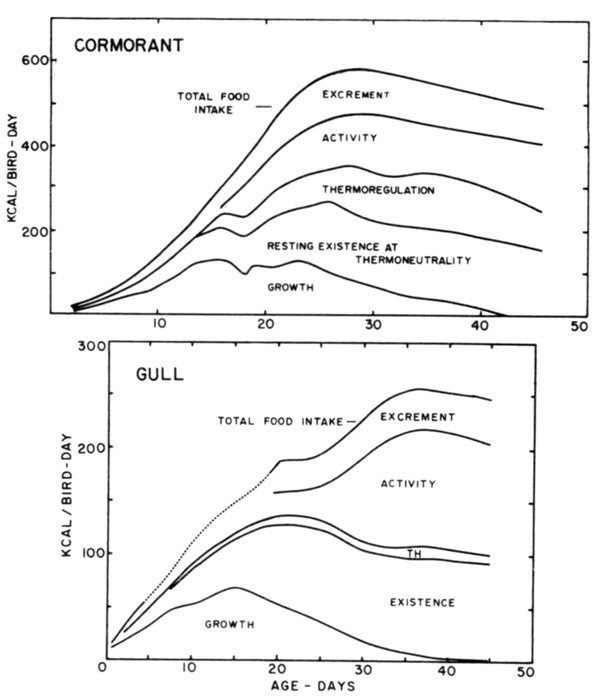
Fig. 12. Energy budgets of nestling double-crested cormorants and herring gulls. Data from E. H. Dunn (1973) and Brisbin (1965).
Cost-benefit ratios of food gathering in the nestling period differ from those at other times. Besides facing increased food demands, costs of delivery to the nest, and changes in food availability, the parents' choice of foods is constrained by the need to forage within reasonable commuting distance of the nest and perhaps by concentrated competition with conspecifics and other seabird species. In addition, small nestlings are frequently unable to eat foods normally eaten by adults (Drent 1965; personal observation). In the face of these constraints, adults often shift food preferences while raising nestlings (Belopol'skii 1961). For example, female mew gulls in the Barents Sea forage in the tidal zone, eating more small invertebrates than at other times of the year, while males continue to forage at sea and consume larger quantities of fish (Fig. 13).
Table 5.
Age of thermoregulatory control in various species of northern seabirds.
Species Age when moderate temperature control is attained (days) Source
Common eider 0.1-0.3[41] V. V. Rolnik, in Belopol'skii (1961)
Herring gull 1.5-2 V. V. Rolnik, in Belopol'skii (1961)
Herring gull 2-3 E. H. Dunn (1976b)
Leach's storm-petrel [2] Ricklefs (1974)
Mew gull 2-3 V. V. Rolnik, in Belopol'skii (1961)
Lesser black-backed gull 2-3 E. K. Barth (in Farner and Serventy 1959)
Greater black-backed gull 2-3 E. K. Barth (in Farner and Serventy 1959)
Pigeon guillemot 2-4 Drent (1965)
Common tern 3 LeCroy and Collins (1972)
Roseate tern (Sterna dougallii) 3 LeCroy and Collins (1972)
Common murre 3 V. V. Rolnik and Yu. M. Kaftonowski (in Sealy 1973b)
Razorbill (Alca torda) 3 V. V. Rolnik and Yu. M. Kaftonowski (in Sealy 1973b)
Black guillemot 3-4 V. V. Rolnik, in Belopol'skii (1961)
Tufted puffin 3.5[42] Cody (1973)
Northern phalarope 4-5[43] Hilden and Vuolanto (1972)
Cassin's auklet 5-6 Manuwal (1974a)
Horned puffin (Fratercula corniculata) 2-6 Sealy (1973a)
Common puffin 6-7 V. V. Rolnik and Yu. M. Kaftonowski (in Sealy 1973b)
Black-legged kittiwake 6-7 V. V. Rolnik, in Belopol'skii (1961)
Double-crested cormorant 14 Dunn (1976a)
Shag 12-15 V. V. Rolnik, in Belopol'skii (1961)
Commuting distances vary tremendously among species (Fig. 14), but the number of feeding trips to the nest per day does not correlate with foraging distance (Cody 1973; Sealy 1973a, 1973b). There is not, therefore, a simple relationship between time and energy expenditures of the adults and foraging distances. Nocturnality, on the other hand, correlates with reduced feeding rates (usually one visit to the nest each night). Seabirds feeding far from the colony tend to show adaptations for bringing larger amounts of food per visit, such as carrying more than one fish at a time, as in tufted puffins, Lunda cirrhata, and rhinoceros auklets, Cerorhinca monocerata, vs. guillemots and murres (Richardson 1961; Cody 1973; Sealy 1973a, 1973b); developing a sublingual storage pouch, as in Cassin's auklets (Speich and Manuwal 1974); or concentration of food into stomach oil, as in petrels and albatrosses (Ashmole 1971). Commuting costs are largely eliminated when the young leave the nest, but only in the alcids does nest leaving occur long before attainment of full growth. Early nest leaving may allow adults and young to disperse to better feeding areas than are exploitable from the colony site (Sealy 1973b) and probably involves a major change in optimal food size and type as well (Lind 1965).
Patterning of adult time budgets may differ between geographical regions. For example, rhinoceros auklets are nocturnal in the far north (where the summer night is particularly short), crepuscular in the Olympic Peninsula, and mainly diurnal in the Farallon Islands (Manuwal 1974a).
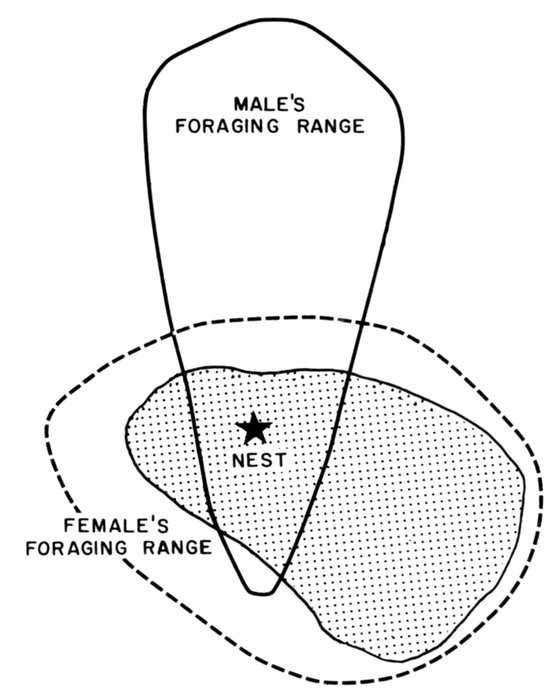
Fig. 13. Foraging ranges of a pair of mew gulls during the breeding season, on a Barents Sea colony. From Belopol'skii (1961).
Food demands of nestlings have a great influence on the time and energy allocation of breeding over nonbreeding seabirds. Because food is particularly abundant in the reproductive season, however, one cannot ascertain whether the vulnerability of breeding birds to time or energy crises is far different from that at other times of the year.
Post-fledging Care
Little is known about the amount of care provided by adults to young after they are fully grown. At least some species, such as gannets and procellariiformes (Ashmole 1971), are known to desert their young, whereas others are known to feed their young, at least occasionally, for some weeks or months after they can fly—e.g., terns and gulls, many alcids, and shags (Snow 1963; Vermeer 1963; Drury and Smith 1968; Ashmole and Tovar S. 1968; Potts 1968; Ashmole 1971; LeCroy 1972).
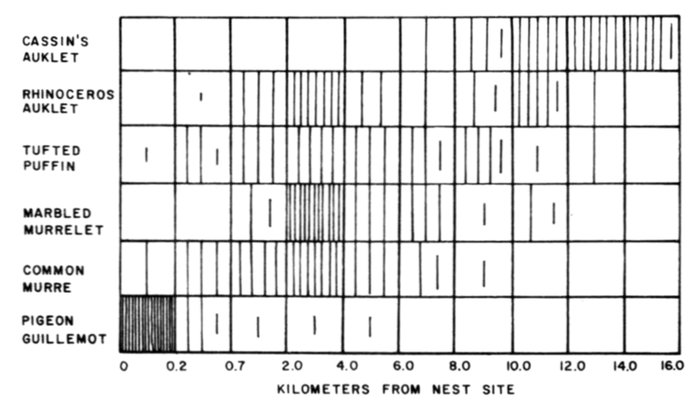
Fig. 14. Percentage observations of foraging seabirds at different distances from the nest site. After Cody (1973). Each vertical bar represents 5% of total observations. Note nonlinear horizontal scale.
Annual Time and Energy Budgets
The discussion of time and energy allocation during reproduction was complex and detailed because so much more is known about the influences altering budgeting during this period than during other times of the year. It is likely that influences on molt and migration will prove to be equally complicated, once more is learned about them.
If all data on time and energy allocation for a single species were known, it would be possible to make up detailed budgets for birds of different age, sex, and experience throughout the year. However, such detailed data have not been collected for any species. An annual time budget for male and female yellow-billed magpie, Pica nuttalli (Verbeek 1972), points out the great amount of difference between the sexes (Fig. 15). A time and energy budget for the reproductive season only (Fig. 16) shows large differences between two closely related species, as well as between sexes; it also indicates the wide difference between the budgeting of energy as opposed to budgeting of time. All other time-energy budgets to date are for nonseabird species and for only a portion of the annual cycle (Verbeek 1964; Verner 1965; Schartz and Zimmerman 1971; Stiles 1971; Wolf and Hainsworth 1971; Smith 1973; Utter and LeFebvre 1973).
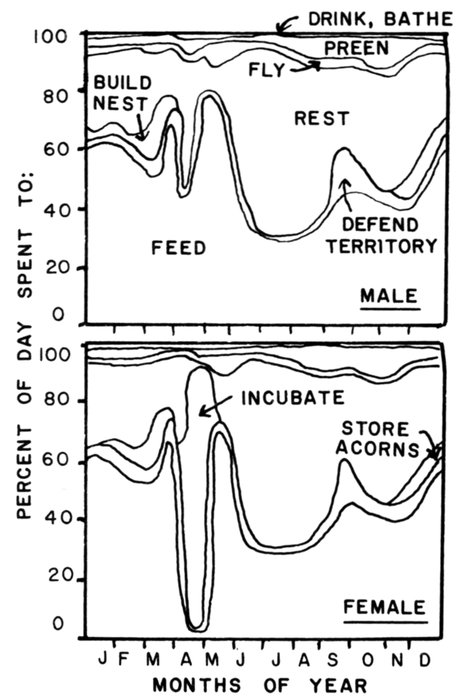
Fig. 15. Time budget of male (upper panel) and female (lower panel) yellow-billed magpies throughout the year. From Verbeek (1972). Non-labeled portions in each graph correspond to labeled sections in the other.
Time-energy budget analysis can be useful in determining the leeway a bird has in surviving unusual stress at different times of the year. For example, a study by Feare et al. (1974) showed that rooks (Corvus frugilegus) in the dry part of the summer spent 90% of 15 h of daylight to collect 150 kcal of food energy. In winter, foraging in snow, the same birds were able to collect 240 kcal of food in only 30% of a 10-h day. This suggests that rooks would be far more vulnerable to unexpected periods of stress in late summer than in winter. Such information would clearly be useful in making management decisions.
A more precise measure of vulnerability, although much more difficult to determine, is that of productive energy—the amount of caloric intake left over after the birds' cost of living (metabolic functions and procurement and processing of food) have been accounted for. Costs are highest when temperatures are extremely hot or cold or when food is most difficult to obtain. Productive energy is highest in summer (Kendeigh 1972), and that is presumably why reproduction normally takes place then. It is unknown whether birds are more vulnerable to time and energy shortages in the harder nonbreeding season or in the breeding season after the extra demands of reproduction have been accounted for. Vulnerability may also differ between sexes and among age groups.
Time-energy studies, although useful in comparing ecology, determining vulnerability, and cataloging location of birds, do have limitations. Careful studies are time-consuming and are not the best approach to determining key factors influencing population increase or decrease. Even when different kinds of data are being sought, however, it is worthwhile keeping the time-energy framework in mind as a "big picture" into which other facts can be fitted and their significance considered.
Life History Strategies
The study of life history strategies is largely theoretical, and in the following discussion I do not comment on current theoretical arguments. On the other hand, life history strategies can be regarded as time and energy allocation on a grand scale, and it therefore seems appropriate to look briefly at their implications for seabird management.
Annual reproduction evidently has a negative effect on resources remaining for other functions, and may reduce the chances for an organism to reproduce again in a later season (Cody 1966, 1971; Williams 1966; Gadgil and Bossert 1970; Gadgil and Solbrig 1972; Hussell 1972; Trivers 1972; Calow 1973). If the chances of survival to another breeding season are small, the selective advantage lies with the bird putting the most effort into early reproduction, in spite of its negative effects on survival, because future chances of reproduction are small. If chances of survival are good, however, it may be more advantageous to reduce annual reproductive effort and allocate resources to other functions.
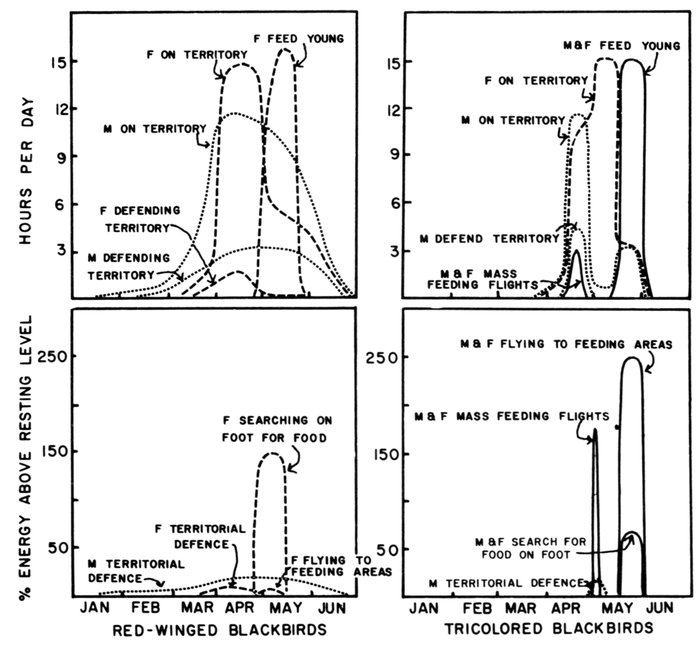
Fig. 16. Time and energy budgets of male and female red-winged (Agelaius phoeniceus) and tricolored (A. tricolor) blackbirds in the breeding season. From Orians (1961). Dotted lines show male (M) activity, dashed lines show female (F) activity, and solid lines show shared activities.
Seabirds are generally long-lived, have small clutches, and generally delay first breeding until at least the 2nd year, and usually longer (Table 6). Phalaropes seem to differ from this pattern (Hilden and Vuolanto 1972; Howe 1975). Several ecological factors (not entirely independent) are believed to contribute to the evolution of the long life and low reproductive effort pattern favored by seabirds.
First, if population size is determined largely by density-dependent mortality, individuals may be favored that allocate resources to attaining longer life (and more chances to reproduce) or insuring greater chances of survival of their offspring (Murphy 1968; Hairston et al. 1970). Density-independent mortality, on the other hand, is so unpredictable that there is no advantage in allocating resources toward protection against it (Gadgil and Solbrig 1972).
Two factors closely linked with density-dependence are high levels of competition, and perennial difficulties in obtaining food. In adapting to these difficulties, a bird may be selected which develops more efficient foraging techniques, wider dispersal, or better abilities to defend nesting territory—all of which may reduce resources available for reproduction. As mentioned earlier, marine foods tend to be patchily distributed, and a long learning period seems to be necessary before seabirds become proficient at foraging. In addition, there is evidence that food availability is low, at least in the tropics, and perhaps in the winter in other regions (Ashmole 1971). If nesting places are in short supply, long life may be favored so that the bird can live long enough for a place to become vacant. Several authors feel that competition is a serious factor in the life of seabirds, both for food (Lack 1966; Cody 1973) and for nesting space (Snow 1960; Belopol'skii 1961; Lack 1966; Manuwal 1974b). Others, however, disagree, at least for the breeding season (e.g., Pearson 1968).
Table 6.
Life history data for certain northern seabirds.
Species Annual adult survival (%) Age at first breeding (years) Clutch size
Fulmar 94 7+ 1
Gannet (Morus bassanus) 94 (4)-5+ 1
Manx shearwater 93-96 (4)-5+ 1
Shag 85 (♂) (2)-3 3-4
80 (♀)
Herring gull 91-96 3.5 (♂) (2)-3
5 (♀)
Black-legged kittiwake 88 4-5 (♂) 3
3-4 (♀)
Arctic tern 89-91 (2)-3+ 2
75
82[45]
Common murre 87 3+? 1
There is some evidence of density-dependent population size control in seabirds, although much of it is circumstantial. For example, there are large nonbreeding populations in such diverse species as shags, herring gulls, and Cassin's auklets, which move into a breeding area when established adults are removed or colonize new breeding areas (J. C. Coulson, personal communication; Kadlec and Drury 1968; Drury and Nisbet 1972; Manuwal 1974b). Lack (1966) and Ashmole (1971) presented other arguments for density-dependence. Density-dependent mortality is difficult to demonstrate, at best, and may be obscured by interpopulation movements (Drury and Nisbet 1972).
If long life is a life history option, a low annual reproductive effort could be favored in several ways. First, it may be necessary for insuring long life, if breeding has a serious negative feedback on life expectancy (Calow 1973). Second, if survival of offspring is more unpredictable than that of adults, low annual effort may be selected so that reproductive effort will not be wasted in years when young have poor chances of survival. Unpredictable and variable first-year survival in seabirds has been documented (Potts 1968; Drury and Nisbet 1972). In addition, some seabirds show adaptations that allow high reproductive success in any given year but which do not drain off resources if the season turns out to be poor (e.g., small last eggs in the clutch or asynchronous hatching, both of which lead to elimination of the smallest chicks when conditions are poor [Parsons 1970; E. H. Dunn 1973]).
It should be emphasized that the factors involved in the evolution of life histories are complex and poorly understood, and simple formulas should not be expected to apply to all situations (Wilbur et al. 1974).
In the framework of life-history strategies, small clutch sizes and slow growth rates exhibited by some seabirds can be explained as adaptive reductions in annual reproductive effort, rather than as responses to immediate food shortages. Arguments for this view are presented on theoretical grounds (Dunn 1973) and by the fact that many seabirds are able to raise larger than normal broods in certain situations (Vermeer 1963; Nelson 1964; Harris 1970; Hussell 1972; Ward 1972; Corkhill 1973). In addition, seabirds with particularly slow growth rates all grow at about the same rate, regardless of body size (contrary to the situation in other birds). This suggests that low growth rates do not reflect variations in feeding abilities among species (Ricklefs 1968).
Several conclusions relating to management of seabird populations can be drawn from the above discussion. First, if population size is determined largely by density-dependent factors, the birds are not adapted to precipitous and unexpected declines in population levels. Because there is low annual reproductive effort geared to a world in which there is slow turnover in population, seabirds are not able to rebound quickly from disasters. Provision of excess food should not be expected to improve breeding performance, at least in experienced birds.
Second, because seabirds are able to reproduce in many different seasons and are adapted to a low reproductive effort within a given season, one should expect them to be easily disturbed and to fail to complete the reproductive cycle during any given breeding attempt. A few indications of such failures have already been observed (Erskine 1972; Manuwal 1974a; Nettleship 1975).
Again, the tentative nature of this discussion should be emphasized, and conclusions drawn from it may not apply equally to all seabird species.
Conclusions
In this discussion I have tried to emphasize the variety of factors affecting seabird life cycles and the diverse responses among different species to their environment. The main conclusion I stress is that each species (and age group and sex within that species) has a different vulnerability to stress, which may be most severe at different times of the year for each group. To determine these periods of stress, researchers may find a time-energy approach to be useful.
As for northwestern North American seabirds in particular, ignorance is vast. Twelve years ago, Bourne (1963:846) noted the following needs in seabird research (among others): "The investigation of seabird biology has been reduced to a routine, but there is a great need for more study of some other aspects of the life or annual cycle, including events in the period immediately after fledging, and behaviour and survival in the immature period and outside the breeding season. Much more accurate information is needed about breeding distribution and seasons in many parts of the world, about molting seasons and ranges in most parts, and the distribution of birds of different age groups during these periods in practically all areas."
Since the time of Bourne's remarks, a number of excellent studies have provided data on the breeding biology of certain northwestern seabird species. Scientists remain largely ignorant, however, about where birds of different age groups are located throughout the year. Such knowledge is necessary for effective protection and is basic to understanding population dynamics, even if it does not elucidate causes. Studies of timing of annual cycles and movements should be carried out hand in hand with resource analysis—not just finding what birds eat, but discovering where the food is at what times, how hard it is to catch, and what the nutritional return is. Much careful field work must be done before effective management of most of our northwestern seabirds can become a reality.
References
Andersson, M. 1973. Behaviour of the pomarine skua Stercorarius pomarinus Temm. with comparative remarks on Stercorariinae. Ornis Scand. 4:1-16.
Ashmole, N. P. 1971. Seabird ecology and the marine environment. Pages 223-286 in D. S. Farner and J. R. King, eds. Avian biology. Vol. I. Academic Press, New York.
Ashmole, N. P., and H. Tovar S. 1968. Prolonged parental care in royal terns and other birds. Auk 85:90-100.
Barash, D. P., P. Donovan, and R. Myrick. 1975. Clam dropping behavior of the glaucous-winged gull (Larus glaucescens). Wilson Bull. 87:60-64.
Bateson, P. P. G., and R. C. Plowright. 1959. The breeding biology of the ivory gull in Spitsbergen. Br. Birds 52:105-114.
Bédard, J. 1969a. Feeding of the least, crested and parakeet auklets around St. Lawrence Island, Alaska. Can. J. Zool. 47:1025-1050.
Bédard, J. 1969b. Adaptive radiation in alcidae. Ibis 111:189-198.
Belopol'skii, L. O. 1961. Ecology of sea colony birds of the Barents Sea. (Transl. from Russian.) Israel Program for Scientific Translations, Jerusalem. 346 pp.
Bengtson, S. 1968. Breeding behavior of the grey phalarope in west Spitzbergen. Var Fågelvärld 27:1-13.
Berger, M., and J. S. Hart. 1974. Physiology and energetics of flight. Pages 415-477 in D. S. Farner and J. R. King, eds. Avian biology. Vol. IV. Academic Press, New York.
Berger, M., J. S. Hart, and O. Z. Roy. 1970. Respiration, oxygen consumption and heart rate in some birds during rest and flight. Z. Vgl. Physiol. 66:201-214.
Birkhead, T. R. 1974. Movement and mortality rates of British guillemots. Bird Study 21:241-254.
Blackmore, F. H., Jr. 1969. The effect of the temperature, photoperiod and molt on the energy requirements of the house sparrow, Passer domesticus. Comp. Biochem. Physiol. 30:433-444.
Bookhout, T. A. 1958. The availability of plant seeds to bobwhite quail in southern Illinois. Ecology 39:671-681.
Bourne, W. R. P. 1963. A review of oceanic studies of the biology of seabirds. Proc. Int. Ornithol. Congr. 13:831-854.
Brisbin, I. L., Jr. 1965. A quantitative analysis of ecological growth efficiency in the herring gull. M.S. Thesis. Univ. of Georgia, Athens. 28 pp.
Brown, R. G. B., N. G. Blurton-Jones, and D. J. T. Hussell. 1967. The breeding behaviour of Sabine's gull, Xema sabini. Behaviour 28:110-140.
Bryant, D. M. 1973. The factors influencing the selection of food by the house martin (Delichon urbica (L.)). J. Anim. Ecol. 42:539-564.
Buckley, F. G., and P. A. Buckley. 1974. Comparative feeding ecology of wintering adult and juvenile royal terns (Aves: Laridae, Sterninae). Ecology 55:1053-1063.
Calder, W. A. 1974. Consequences of body size for avian energetics. Pages 86-144 in R. A. Paynter, ed. Avian energetics. Publ. Nuttall Ornithol. Club 15.
Calder, W. A., and J. R. King. 1974. Thermal and caloric relations of birds. Pages 259-413 in D. S. Farner and J. R. King, eds. Avian biology. Vol. IV. Academic Press, New York.
Calow, P. 1973. The relationship between fecundity, phenology, and longevity: a systems approach. Am. Nat. 107:559-574.
Cody, M. L. 1966. A general theory of clutch size. Evolution 20:174-184.
Cody, M. L. 1971. Ecological aspects of reproduction. Pages 461-512 in D. S. Farner and J. R. King, eds. Avian biology. Vol. I. Academic Press, New York.
Cody, M. L. 1973. Coexistence, coevolution and convergent evolution in seabird communities. Ecology 54:31-44.
Cohen, D. 1967. Optimization of seasonal migratory behavior. Am. Nat. 101:5-17.
Cone, C. D., Jr. 1964. A mathematical analysis of the dynamic soaring flight of the albatross with ecological interpretations. Va. Inst. Mar. Sci., Spec. Sci. Rep. 50:1-104.
Corkhill, P. 1973. Food and feeding ecology of puffins. Bird Study 20:207-220.
Coulson, J. C. 1961. Movements and seasonal variation in mortality of shags and cormorants ringed on the Farne Islands, Northumberland. Br. Birds 54:225-235.
Coulson, J. C. 1963. Egg size and shape in the kittiwake (Rissa tridactyla) and their use in estimating age composition in populations. Proc. Zool. Soc. Lond. 140(2):211-227.
Coulson, J. C., and M. G. Brazendale. 1968. Movements of cormorants ringed in the British Isles and evidence of colony-specific dispersal. Br. Birds 61:1-21.
Coulson, J. C., G. R. Potts, and J. Horobin. 1969. Variation in the eggs of the shag (Phalacrocorax aristotelis). Auk 86:232-245.
Coulson, J. C., and E. White. 1958. The effect of age on the breeding biology of the kittiwake, Rissa tridactyla. Ibis 100:40-51.
Coulson, J. C., and E. White. 1960. The effect of age and density of breeding birds on the time of breeding of the kittiwake, Rissa tridactyla. Ibis 102:71-80.
Cox, G. W. 1968. The role of competition in the evolution of migration. Evolution 22:180-192.
Cramp, S. 1972. The breeding of urban wood pigeons. Ibis 114:163-171.
Cullen, J. M. 1957. Plumage, age and mortality in the arctic tern. Bird Study 4:197-207.
Dawson, W. R., and J. W. Hudson. 1970. Birds. Pages 223-310 in G. C. Whittow, ed. Comparative physiology of thermoregulation. Vol. I. Academic Press, New York.
Dawson, W. R., J. W. Hudson, and R. W. Hill. 1972. Temperature regulation in newly hatched laughing gulls (Larus atricilla). Condor 74:177-184.
Dolnik, V. R. 1971. Comparative energy expenditure in migration and wintering birds. Ekologiya 2(3):88-89. In Russian.
Dorst, J. 1961. The migrations of birds. William Heinimann Ltd., London.
Drent, R. H. 1965. Breeding biology of the pigeon guillemot Cepphus columba. Ardea 53:99-160.
Drent, R. H. 1970. Functional aspects of incubation in the herring gull (Larus argentatus Pont.). Behaviour Suppl. 17:1-132.
Drent, R. 1972. Adaptive aspects of the physiology of incubation. Proc. Int. Ornithol. Congr. 15:255-280.
Drent, R. H., and C. J. Guiguet. 1961. A catalogue of British Columbia seabird colonies. B. C. Prov. Mus., Occas. Pap. 12:1-173.
Drent, R., G. F. van Tets, F. Tompa, and K. Vermeer. 1964. The breeding birds of Mandarte Island, British Columbia. Can. Field-Nat. 78:208-263.
Drury, W. H., and I. C. T. Nisbet. 1972. The importance of movements in the biology of herring gulls in New England. Pages 173-212 in Population ecology of migratory birds: a symposium. U.S. Fish Wildl. Serv., Wildl. Res. Rep. 2.
Drury, W. H., Jr., and W. J. Smith. 1968. Defense of feeding areas by adult herring gulls and intrusion by young. Evolution 22:193-201.
Dunn, E. H. 1973. Energy allocation of nestling double-crested cormorants. Ph.D. Thesis. Univ. of Michigan, Ann Arbor. 153 pp.
Dunn, E. H. 1975a. Growth, body components and caloric value of nestling double-crested cormorants. Condor 77:431-438.
Dunn, E. H. 1975b. Caloric intake of nestling double-crested cormorants. Auk 92:553-565.
Dunn, E. H. 1976a. Development of endothermy and existence energy expenditure of nestling double-crested cormorants. Condor 78:350-356.
Dunn, E. H. 1976b. Development of endothermy and existence energy expenditure in herring gull chicks. Condor 78:493-498.
Dunn, E. K. 1972. Effect of age on the fishing ability of sandwich terns Sterna sandvicensis. Ibis 114:360-366.
Dunn, E. K. 1973. Changes in fishing ability of terns associated with wind speed and sea surface conditions. Nature (Lond.) 244:520-521.
Eliassen, E. 1963. Preliminary results from new methods of investigating the physiology of birds during flight. Ibis 105:234-237.
Emlen, J. M. 1966. The role of time and energy in food preference. Am. Nat. 100:611-617.
Erskine, A. J. 1972. The great cormorants of eastern Canada. Can. Wildl. Serv. Occas. Pap. 14:1-23.
Evans, R. M., and M. K. McNicholl. 1972. Variations in reproductive activities of arctic terns at Churchill, Manitoba. Arctic 25:131-141.
Farner, D. S., and D. L. Serventy. 1959. Body temperature and the ontogeny of thermoregulation in the slender-billed shearwater. Condor 61:426-433.
Feare, C. J., G. M. Dunnet, and I. J. Patterson. 1974. Ecological studies of the rook (Corvus frugilegus L.) in north-east Scotland: food intake and feeding behaviour. J. Appl. Ecol. 11:867-896.
Fisher, H. 1972. The nutrition of birds. Pages 431-469 in D. S. Farner and J. R. King, eds. Avian biology. Vol. II. Academic Press, New York.
Fisher, R. A. 1958. The genetical theory of natural selection. 2nd rev. ed. Dover Publishers, Inc., New York.
Gadgil, M., and W. H. Bossert. 1970. Life historical consequences of natural selection. Am. Nat. 104:1-24.
Gadgil, M., and O. T. Solbrig. 1972. The concept of r-and K-selection: evidence from wild flowers and some theoretical considerations. Am. Nat. 106:14-31.
Gavrilov, V. 1974. Metabolism of molting birds. Zool. Zh. 53(9):1363-1374. In Russian, English summary.
Gross, A. O. 1935. The life history cycle of Leach's petrel (Oceanodroma leucorhoa leucorhoa) on the outer sea islands of the Bay of Fundy. Auk 52:382-399.
Hainsworth, F. R., and L. L. Wolf. 1975. Wing disc loading: implications and importance for hummingbird energetics. Am. Nat. 109:229-233.
Hairston, N. G., D. W. Tinkle, and H. M. Wilbur. 1970. Natural selection and the parameters of population growth. J. Wildl. Manage. 34:681-690.
Harris, M. P. 1970. Breeding ecology of the swallow-tailed gull, Creagus furcatus. Auk 87:215-243.
Harris, M. P. 1971. Ecological adaptations of moult in some British gulls. Bird Study 18:113-118.
Harris, S. W. 1974. Status, chronology, and ecology of nesting storm petrels in northwestern California. Condor 76:249-261.
Hart, J. S., and M. Berger. 1972. Energetics, water economy and temperature regulation during flight. Proc. Int. Ornithol. Congr. 15:189-199.
Henderson, B. A. 1972. The control and organization of parental feeding and its relationships to the food supply for the glaucous-winged gull, Larus glaucescens. M.S. Thesis. Univ. of British Columbia, Vancouver.
Hilden, O., and S. Vuolanto. 1972. Breeding biology of the red-necked phalarope Phalaropus lobatus in Finland. Ornis Fenn. 49:57-81.
Högstedt, G. 1974. Length of the pre-laying period in the lapwing Vanellus vanellus L. in relation to its food resources. Ornis Scand. 5:1-4.
Höhn, E. O. 1971. Observation on the breeding behavior of grey and red-necked phalaropes. Ibis 113:335-348.
Howe, M. A. 1975. Behavioral aspects of the pair bond in Wilson's phalarope. Wilson Bull. 87:248-270.
Hunt, G. L., Jr. 1972. Influence of food distribution and human disturbance on the reproductive success of herring gulls. Ecology 53:1051-1061.
Hussell, D. J. T. 1969. Weight loss of birds during nocturnal migration. Auk 86:75-83.
Hussell, D. J. T. 1972. Factors affecting clutch size in arctic passerines. Ecol. Monogr. 42:317-364.
Ingolfsson, A. 1969. Behaviour of gulls robbing eiders. Bird Study 16:45-52.
Ingolfsson, A. 1970. The moult of remiges and rectrices in great black-backed gulls Larus marinus and glaucous gulls L. hyperboreus in Iceland. Ibis 112:83-92.
James-Veitch, E., and E. S. Booth. 1974. Behavior and life history of the glaucous-winged gull. Walla Walla Coll. Publ. 12:1-39.
Johnston, D. W. 1961. Timing of annual molt in the glaucous gulls of northern Alaska. Condor 63:474-478.
Kadlec, J. A., and W. H. Drury. 1968. Structure of the New England herring gull population. Ecology 49:644-676.
Kadlec, J. A., W. H. Drury, Jr., and D. K. Onion. 1969. Growth and mortality of herring gull chicks. Bird-Banding 40:222-233.
Källender, H. 1974. Advancement of laying of great tits by the provision of food. Ibis 116:365-367.
Katz, P. L. 1974. A long-term approach to foraging optimization. Am. Nat. 108:758-782.
Kendeigh, S. C. 1970. Energy requirements for existence in relation to size of bird. Condor 72:60-65.
Kendeigh, S. C. 1972. Monthly variations in the energy budget of the house sparrow throughout the year. Pages 17-43 in S. C. Kendeigh and J. Pinowski, eds. Productivity, population dynamics and systematics of granivorous birds. Institute of Ecology, Polish Academy of Science, Warsaw.
Kendeigh, S. C. 1973. [Discussion.] Pages 311-320 in D. S. Farner, ed. Breeding biology of birds. National Academy of Sciences, Washington, D.C.
King, J. R. 1973. Energetics of reproduction in birds. Pages 78-107 in D. S. Farner, ed. Breeding biology of birds. National Academy of Science, Washington, D.C.
King, J. R. 1974. Seasonal allocation of time and energy resources in birds. Pages 4-70 in R. A. Paynter, ed. Avian energetics. Publ. Nuttall Ornithol. Club 15.
Koelink, A. F. 1972. Bioenergetics of growth in the pigeon guillemot, Cepphus columba. M.S. Thesis. Univ. of British Columbia, Vancouver.
Koskimies, J., and L. Lahti. 1964. Cold-hardiness of the newly hatched young in relation to ecology and distribution in ten species of European ducks. Auk 81:281-307.
Lack, D. 1966. Population studies of birds. Clarendon Press, Oxford.
Lack, D. 1968. Ecological adaptations for breeding in birds. Methuen, London.
Lasiewski, R. C. 1963. Oxygen consumption of torpid, resting, active and flying hummingbirds. Physiol. Zool. 36:122-140.
Lasiewski, R. C., and W. R. Dawson. 1967. A reexamination of the relation between standard metabolic rate and body weight in birds. Condor 69:13-23.
Lasiewski, R. C., and G. K. Snyder. 1969. Responses to high temperature in nestling double-crested cormorants and pelagic cormorants. Auk 86:529-540.
LeCroy, M. 1972. Young common and roseate terns learning to fish. Wilson Bull. 84:201-202.
LeCroy, M., and C. T. Collins. 1972. Growth and survival of roseate and common tern chicks. Auk 89:595-611.
Lemmetyinen, R. 1972. Growth and mortality in the chicks of arctic terns in the Kongsfjord area, Spitzbergen in 1970. Ornis Fenn. 49:45-53.
Lind, H. 1965. Parental feeding in the oystercatcher Haematopus o. ostralegus (L.). Dan. Ornithol. Foren. Tidsskr. 59:1-31.
Lustick, S. 1970. Energy requirements of molt in cowbirds. Auk 87:742-746.
Manuwal, D. A. 1974a. The natural history of Cassin's auklet (Ptychoramphus aleuticus). Condor 76:421-431.
Manuwal, D. A. 1974b. Effects of territoriality on breeding in a population of Cassin's auklet. Ecology 55:1399-1406.
Martin, E. W. 1968. The effects of dietary protein on the energy and nitrogen balance of the tree sparrow (Spizella a. arborea). Physiol. Zool. 41:313-331.
McKinney, F. 1961. An analysis of the displays of the European eider Somateria mollissima mollissima (Linnaeus) and the Pacific eider Somateria mollissima v. nigra Bonaparte. Behaviour Suppl. 7:1-124.
Moss, R. 1972. Food selection by red grouse (Logopus logopus scoticus (Lath.)) in relation to chemical composition. J. Anim. Ecol. 4:411-428.
Moyle, P. 1966. Feeding behavior of the glaucous-winged gull on the Alaskan salmon stream. Wilson Bull. 78:175-190.
Murphy, G. I. 1968. Patterns in life history and the environment. Am. Nat. 102:391-403.
Myrberget, S. 1962. Contribution to the breeding biology of the puffin Fratercula arctica (L.). Eggs, incubation and young. Pap. Norw. State Game Res. Inst. Ser. 2, 11:1-49.
Myton, B. A., and R. W. Ficken. 1967. Seed size preference in chickadees and tits in relation to ambient temperatures. Wilson Bull. 79:319-321.
Nelson, J. B. 1964. Factors influencing clutch-size and chick growth in the North Atlantic gannet Sula bassana. Ibis 106:63-77.
Nettleship, D. N. 1972. Breeding success of the common puffin (Fratercula arctica L.) on different habitats at Great Island, Newfoundland. Ecol. Monogr. 42:239-268.
Nettleship, D. N. 1975. A recent decline of gannets, Morus bassanus, on Bonaventure Island, Quebec. Can. Field-Nat. 89:125-133.
Nice, M. M. 1962. Development of behavior in precocial birds. Trans. Linn. Soc. N. Y. 8:1-211.
Nisbet, I. C. T. 1963. Weight-loss during migration. Part II: Review of other estimates. Bird-Banding 34:139-159.
Nisbet, I. C. T. 1973. Courtship feeding, egg-size and breeding success in common terns. Nature (Lond.) 241:141-142.
Orians, G. H. 1961. The ecology of blackbird (Agelaius) social systems. Ecol. Monogr. 31:285-312.
Orians, G. H. 1969. Age and hunting success in the brown pelican (Pelecanus occidentalis). Anim. Behav. 17:316-319.
Orians, G. 1971. Ecological aspects of behavior. Pages 513-546 in D. S. Farner and J. R. King, eds. Avian biology. Vol. I. Academic Press, New York.
Parsons, J. 1970. Relationship between egg size and post-hatching chick mortality in the herring gull (Larus argentatus). Nature (Lond.) 228:1221-1222.
Payne, R. B. 1965. The molt of breeding Cassin auklets. Condor 67:220-228.
Payne, R. B. 1972. Mechanisms and control of molt. Pages 103-155 in D. S. Farner and J. R. King, eds. Avian biology. Vol. II. Academic Press, New York.
Pearson, T. H. 1968. The feeding biology of sea-bird species breeding on the Farne Islands, Northumberland. J. Anim. Ecol. 37:521-552.
Pennycuick, C. J. 1960. Gliding flight of the fulmar petrel. J. Exp. Biol. 37:330-338.
Porter, W. P., and D. M. Gates. 1969. Thermodynamic equilibria of animals with environment. Ecol. Monogr. 39:227-244.
Potts, G. R. 1968. Influence of eruptive movements, age, population size and other factors on the survival of the shag. J. Anim. Ecol. 37:53-102.
Potts, G. R. 1971. Moult in the shag Phalacrocorax aristotelis, and the ontogeny of the "Staffelmauser." Ibis 113:298-305.
Preston, F. W., and E. J. Preston. 1953. Variation of the shapes of birds eggs within the clutch. Ann. Carnegie Mus. 33:129-139.
Preston, W. C. 1968. Breeding ecology and social behavior of the black guillemot, Cepphus grylle. Ph.D. Thesis. Univ. of Michigan, Ann Arbor.
Pulliam, H. R. 1974. On the theory of optimal diets. Am. Nat. 108:59-74.
Richardson, F. 1961. Breeding biology of the rhinoceros auklet on Protection Island, Washington. Condor 63:456-473.
Ricklefs, R. E. 1968. Patterns of growth in birds. Ibis 110:419-451.
Ricklefs, R. E. 1973. Patterns of growth in birds. II. Growth rate and mode of development. Ibis 115:177-201.
Ricklefs, R. E. 1974. Energetics of reproduction in birds. Pages 152-292 in R. A. Paynter, ed. Avian energetics. Publ. Nuttall Ornithol. Club 15.
Royama, T. 1970. Factors governing the hunting behavior and selection of food by the great tit (Parus major L.). J. Anim. Ecol. 39:619-668.
Schamel, D. L. 1974. The breeding biology of the Pacific eider (Somateria mollissima v-nigra Bonaparte) on Barrier Island in the Beaufort Sea, Alaska. M.S. Thesis. Univ. of Alaska, Fairbanks.
Schartz, R. L., and J. L. Zimmerman. 1971. The time and energy budget of the male dickcissel (Spiza americana). Condor 73:65-76.
Schmidt-Nielsen, K. 1972. Locomotion: energy cost of swimming, flying, and running. Science 177:222-228.
Schoener, T. 1971. Theory of feeding strategies. Annu. Rev. Ecol. Syst. 2:369-404.
Schönwetter, M. 1967. Handbuch der oologie. Vol. I. Akademie-Verlag, Berlin.
Sealy, S. G. 1973a. Breeding biology of the horned puffin on St. Lawrence Island, Bering Sea, with zoogeographical notes on the North Pacific puffins. Pac. Sci. 27:99-119.
Sealy, S. G. 1973b. Adaptive significance of post-hatching developmental patterns and growth rates in alcidae. Ornis Scand. 4:113-121.
Sealy, S. G. 1975a. Feeding ecology of the ancient and marbled murrelets near Langara Island, British Columbia. Can. J. Zool. 53:418-433.
Sealy, S. G. 1975b. Aspects of the breeding biology of the marbled murrelet in British Columbia. Bird-Banding 46:141-154.
Sealy, S. G. 1975c. Influence of snow on egg-laying in auklets. Auk 92:528-538.
Smith, C. R. 1973. Time budget of the loggerhead shrike in southwest Florida. Abstracts of papers presented to the Wilson Society meeting, Cornell University.
Smith, N. G. 1966. Evolution of some arctic gulls (Larus): an experimental study of isolating mechanisms. Am. Ornithol. Union Monogr. 4. 99 pp.
Snow, B. K. 1960. The breeding biology of the shag Phalacrocorax aristotelis on the Island of Lundy, Bristol Channel. Ibis 102:554-575.
Snow, B. K. 1963. The behaviour of the shag. Br. Birds 56:77-103; 164-186.
Southern, W. E. 1967. Dispersal and migration of ring-billed gulls from a Michigan population. Jack-Pine Warbler 45:102-111.
Spaans, A. L. 1971. On the feeding ecology of the herring gull Larus argentatus Pont. in the northern part of the Netherlands. Ardea 59:73-189.
Speich, S., and D. A. Manuwal. 1974. Gular pouch development and population structure of Cassin's auklet. Auk 91:291-306.
Stiles, F. G. 1971. Time, energy and territoriality of the Anna hummingbird (Calypte anna). Science 173:818-821.
Storer, R. W. 1952. A comparison of variation, behaviour and evolution in the seabird genera Uria and Cepphus. Univ. Calif. Publ. Zool. 52:121-222.
Storer, R. W. 1960. Evolution in the diving birds. Proc. Int. Ornithol. Congr. 12(Vol. II):694-707.
Stresemann, E., and V. Stresemann. 1966. Die Mauser der Vögel. J. Ornithol. 107 (suppl.):1-448.
Thoresen, A. C. 1964. The breeding behavior of the Cassin auklet. Condor 66:456-476.
Tinbergen, N. 1935. Field observations of east Greenland birds. I. The behaviour of the red-necked phalarope (Phalaropus lobatus L.) in spring. Ardea 24:1-42.
Tinbergen, N. 1960. The herring gull's world. Basic Books, Inc., New York.
Trivers, R. L. 1972. Parental investment and sexual selection. Pages 136-179 in B. Campbell, ed. Sexual selection and the descent of man, 1871-1971. Aldine-Atherton, Chicago, Illinois.
Tschanz, B. 1959. Zur brutbiologie der trottellumme (Uria aalge aalge Pont.). Behaviour 14:1-100.
Tuck, L. 1960. The murres. Canadian Wildlife Service Series 1. 260 pp.
Tucker, V. A. 1969. The energetics of bird flight. Sci. Am. 220(5):70-78.
Tucker, V. A. 1970. Energetic cost of locomotion in animals. Comp. Biochem. Physiol. 34:841-846.
Tucker, V. A. 1972. Metabolism during flight in the laughing gull, Larus atricilla. Am. J. Physiol. 222:237-245.
Tucker, V. A. 1974. Energetics of natural flight. Pages 298-328 in R. A. Paynter, Jr., ed. Avian energetics. Publ. Nuttall Ornithol. Club 15.
Utter, J. M., and E. A. LeFebvre. 1970. Energy expenditure for free flight by the purple martin (Progne subis). Comp. Biochem. Physiol. 35:713-719.
Utter, J. M., and E. A. LeFebvre. 1973. Daily energy expenditure of purple martins (Progne subis) during the breeding season: Estimates using D_{2}O18 and time budget methods. Ecology 54:597-604.
Verbeek, N. A. M. 1964. A time and energy budget of the Brewer blackbird. Condor 66:70-74.
Verbeek, N. A. 1972. Daily and annual time budget of the yellow-billed magpie. Auk 89:567-582.
Vermeer, K. 1963. The breeding ecology of the glaucous-winged gull (Larus glaucescens) on Mandarte Island, B. C. B. C. Prov. Mus. Occas. Pap. 13:1-104.
Verner, J. 1965. Time budget of the male long-billed marsh wren during the breeding season. Condor 67:125-139.
Ward, J. G. 1972. Studies on the feeding ecology and breeding success of the glaucous-winged gull (Larus glaucescens) on Mandarte and Cleland Islands. Ph.D. Thesis. Univ. of British Columbia, Vancouver.
Weaver, D. K. 1970. Parental behavior of the herring gull (Larus argentatus smithsonianus) and its effect on reproductive success. Ph.D. Thesis. Univ. of Michigan, Ann Arbor.
West, G. C. 1967. Nutrition of tree sparrows during winter in central Illinois. Ecology 48:58-67.
Wilbur, H. M., D. W. Tinkle, and J. P. Collins. 1974. Environmental certainty, trophic level, and resource availability in life history evolution. Am. Nat. 108:805-817.
Williams, G. C. 1966. Adaptation and natural selection. Princeton Univ. Press, Princeton, N. J.
Willson, M. F. 1971. Seed selection in some North American finches. Condor 73:415-429.
Willson, M. F., and J. C. Harmeson. 1973. Seed preferences and digestive efficiency of cardinals and song sparrows. Condor 75:225-233.
Wolf, L., and F. R. Hainsworth. 1971. Time and energy budgets of territorial hummingbirds. Ecology 52:980-988.
Zar, J. H. 1968. Standard metabolism comparisons between orders of birds. Condor 70:278.
FOOTNOTES:
Zoogeography and Taxonomic Relationships of Seabirds in Northern North America
by
M. D. F. Udvardy
California State University Sacramento, California 95819
Abstract
The zoogeography and taxonomic relationships among 42 living and 1 extinct species of marine birds from the northern and northwestern coasts of North America are described. Seventeen species are circumpolar in distribution; 17 are endemic to Beringia, and 8 have origins in the North Pacific.
This discussion concerns the northern and western coasts of the continent, from about the Mackenzie Delta westward and southward to the mouth of the Columbia River. Besides bona fide seabirds, I include marine birds that predominantly breed and feed on or around the marine littoral, but exclude two groups: shorebirds, jaegers, and phalaropes, which breed inland and move out from the Arctic after an undetermined postbreeding period; and Anseriformes which become "marine birds" in their southern winter quarters. What remains is 42 living species (Table 1).
The Procellariiformes, or tube-nosed seabirds, have a predominantly southern hemispheric, Gondwanan distribution. The North Pacific basin is an important feeding ground of several shearwaters (Puffinus spp.) that breed in the South Pacific and subantarctic. Only three species breed in the area under consideration: the fulmar (Fulmarus glacialis) and two storm-petrels (Oceanodroma spp.), all of which are still relatively widespread.
Of the Pelecaniformes, the very successful, worldwide cormorants (Phalacrocorax spp.)—inland water as well as coastal and "amphibious" species are on every continent—are ancient Pacific dwellers, with a high grade of endemism here: Of the two subarctic species, one (P. perspicillatus) became extinct long ago, and the other, the red-faced cormorant (P. urile), is very restricted, and deserves our greatest attention. The pelagic cormorant (P. pelagicus), Brandt's cormorant (P. penicillatus), and the double-crested cormorant (P. auritus) are widespread and successful, extending south of the area here considered; double-crested cormorants also breed inland and across toward the North Atlantic coast. As fish-eaters they are often persecuted where coastal fishermen possess firearms, and thus are sensitive to increasing human influence on the coasts.
Two species of arctic geese need special attention. The emperor goose (Philacte canagica) is a Beringean endemic and lives in a very restricted area of both sides of this sea; its status (endangered?) is unknown to me. Since the black brant (Branta bernicla) is a long-range migrant, it is hunted as a game bird at its winter grounds, and subject to management measures. Whereas the emperor goose is a unique offshoot of the genus Anser, the Pacific brant is considered a subspecies; its general distribution is circumpolar.
Five arctic ducks, and one other, constitute the sea ducks of the area. The common eider (Somateria mollissima), king eider (S. spectabilis), and the oldsquaw (Clangula hyemalis) are widespread, and circumpolar or nearly so; hunting and down-robbing in other parts of the Arctic may provide clues as to their relative tolerance of primitive or advanced civilization. The spectacled eider (S. fischeri) and Steller's eider (Polysticta stelleri) are restricted to the Bering Sea coasts and neighboring High Arctic coasts, respectively; their status is precarious.
Table 1.
Seabirds in northwestern North America.
(x = breeding, w = wintering or transient, () = either scarce or restricted distribution, * = stragglers only, nesting status unclear)
Species Distribution
Circumpolar Widespread in North Pacific North coast of Alaska Beringia[48] Aleutian Islands South coast of Alaska[49] Temperate northeast Pacific coast[50]
Fulmarus glacialis x w x x x w
Oceanodroma furcata x x x x
O. leucorhoa x x x x x
Phalacrocorax auritus x x x
P. penicillatus (x) x
P. pelagicus x x x x x
P. urile x x x
Branta bernicla x x x (w) (w) w
Anser canagicus x w w
Clangula hyemalis x w x x w w w
Histrionicus histrionicus x w w w w w
Polysticta stelleri x x (w)
Somateria mollissima x x x x x
S. spectabilis x x x w (w)
S. fischeri x x
Larus hyperboreus x w x x w w w
L. glaucescens x x x x
L. occidentalis (x)
L. argentatus x w x (x)w
L. thayeri w x w w w w
L. canus x w x x (x)w
Rissa tridactyla x w x x x x w
R. brevirostris x x (x)
Xema sabini x x x w
Sterna paradisaea x w x x x w
S. aleutica x x
Uria aalge x x (x) x x x x
U. lomvia x x x x x x
Alle alle x *
Cepphus grylle x x w
C. columba x x x x x
Brachyramphus marmoratus x (x) x x
B. brevirostris x x x
Synthliboramphus antiquus x x x x x
Ptychoramphus aleuticus x x x
Cyclorrhynchus psittacula x x
Aethia cristatella x x
A. pusilla x x
A. pygmaea x
Cerorhinca monocerata x x x
Fratercula corniculata x x x x x
Lunda cirrhata x x x x x
Total number of nesting species 17 11 15 27 25 24 17
Total number of wintering species 9 4 7 9 9
Grand total 17 20 15 31 32 33 26
The harlequin duck (Histrionicus histrionicus) stands alone without close relatives. It often breeds far from the sea, but spends the shortest time—only a few weeks—away from the rocky coast. There is a year-round population of yearlings in the sea. The drakes of the nearest breeding pairs at lower latitudes are back to the sea, abandoning their mates at the breeding stream when the alpine stream-dwellers are still at sea awaiting the thawing of their breeding grounds. Harlequin ducks live in large parts of Siberia, from arctic Alaska to central California and Colorado, and also in the eastern Arctic. They do not seem to me to be in immediate danger globally, though perhaps they are locally.
Gulls are a highly successful group of seabirds, and of the eight species on our coasts the four more southern ones—the western gull (Larus occidentalis), glaucous-winged gull (L. glaucescens), common gull (L. canus), and herring gull (L. argentatus)—are expanding wherever civilization creates new scavenging opportunities. Nothing is said about the populations of the kittiwake (Rissa tridactyla), black-legged kittiwake (R. brevirostris) and Sabine's gull (Xema sabini), or of the other two high arctic species (Pagophila eburnea, Rhodostethia rosea) which do not nest regularly in the area considered here.
The arctic tern (Sterna paradisaea) is circumpolarly widespread and successful, whereas the Aleutian tern (S. aleutica) is a very restricted Beringean endemic, and its status needs to be exactly known.
Almost one-third of the seabirds in this area are alcids, a family centered in the North Pacific and, more specifically, in the Bering Sea. Most species breed in enormous rookeries. Any impact of civilization is highly detrimental under such circumstances. Of the four circumpolar species the two Uria guillemots (murres) are important. The dovekie (Alle alle) is a sparse pioneer of Bering Strait, as is the black guillemot (Cepphus grylle) on our side of the Arctic Sea. Its congener, the pigeon guillemot (C. columba), is common and successful all the way to coastal central California. Of the remaining 11 species, special attention should be paid to the whiskered auklet (Aethia pygmaea) of the Aleutian chain; the Kittlitz's murrelet (Brachyramphus brevirostris) of the eastern Beringean and southern Alaska coast; and to the widespread, but very sporadic rhinoceros auklet, or puffin (Cerorhinca monocerata).
To sum up, I have tabulated these 42 species, and indicated whether modern life-history and population studies are extant:
No. species No. studied
Procellariiformes 3 2
Phalacrocorax 4 2
Anseres 2 1
Anates 6 —
Lari 9 2
Sterni 2 —
Alcidae 16 7
Total 42 14
Thus, 28 species await studies preliminary to, and highly necessary for, conservation measures.
Seventeen species of marine birds are spread either circumpolarly around the northern perimeter or along the north-south coasts of the Laurasian continents. Four of these are of the High Arctic (Branta bernicla, Somateria spectabilis, Xema sabini, Alle alle); another seven penetrate the Bering Sea as well (Fulmarus glacialis, Somateria mollissima, Clangula hyemalis, Larus hyperboreus, Rissa tridactyla, Sterna paradisaea, Uria lomvia); and six are panboreal-subboreal, widespread in their distribution—Oceanodroma leucorhoa (extends far south), Histrionicus histrionicus, Larus argentatus (widespread latitudinally), L. canus (also inland), Uria aalge, and Cepphus grylle.
Seventeen species of marine birds are endemic to Beringia: Anser canagicus, Polysticta stelleri, Somateria fischeri, Rissa brevirostris, and Aethia pusilla (and the extinct Phalacrocorax perspicillatus); P. urile, Sterna aleutica, Aethia pygmaea, A. cristatella, and Cyclorrhynchus extend westward to the Sea of Okhotsk, as do Brachyramphus brevirostris and Larus glaucescens, which also extend eastward; and Phalacrocorax pelagicus, Cepphus columba, Fratercula corniculata, and Lunda cirrhata are amphipacific species in Beringia.
Eight species of marine birds are associated with the North Pacific. Four are found on both sides of the ocean—Oceanodroma furcata, Brachyramphus marmoratus, Synthliboramphus antiquus, and Cerorhinca monocerata (very disjunct). The four others occur on only the North American side—Phalacrocorax auritus (also inland), P. penicillatus, Larus occidentalis (albeit barely), and Ptychoramphus aleuticus.
Finally, one species, Larus thayeri, is endemic at the central Canadian Arctic, extending westward into the area here considered.