CONFLICTS BETWEEN THE CONSERVATION OF MARINE BIRDS AND USES OF OTHER RESOURCES (continued 2)
Reading edition
The U.S.-Japan Migratory Bird Convention of 1973 specifically protects all of the species thought to be subject to gill-net mortality in the Pacific. Thus, the Japanese salmon fleet apparently operates in constant violation of this convention.
Mortality of Albatrosses
A recent analysis of recoveries of Laysan albatrosses (Diomedea immutabilis) and black-footed albatrosses (D. nigripes) banded on the northwest Hawaiian chain from 1937 to 1969 showed that of a sample of 532 recovered birds, 57.4% of the Laysan species and 49.5% of the black-footed species were caught on fishhooks or in nets, and the means of recovery of many additional birds was thought to have been the same (Robbins and Rice 1974). It is likely that the large majority are taken on Japanese and U.S.S.R. longline tuna fishing gear. Although this cause of mortality is insignificant in terms of the total population of either species (only 0.2% of banded Laysan and 0.8% of banded black-footed albatrosses have been recovered by any means away from their breeding grounds), these species are protected by the U.S.-Japan Migratory Bird Convention. Furthermore, the possibility exists that individuals of the endangered short-tailed albatross (Diomedea albatrus) might be killed in this manner.
Long-term Effects of Developing Capelin Fishery in Northwest Atlantic
Capelin are important food fish for many seabirds in the northwest Atlantic, and the development and expansion of this fishery off eastern Canada must be carefully monitored. In theory, the capelin fishery ought not to seriously affect the birds because it is designed to exploit a surplus of capelin artificially created by the overfishing of Atlantic cod, the capelin's most important predator. It is hoped that there is no prospect of the overfishing that may have contributed to the recent drastic decline of the Peruvian anchovy (Engraulis ringens) and the seabird species dependent on it (Paulik 1971). However, the relative influence of overfishing and "El Niño" oceanographic conditions on the decline remains unclear. North Atlantic seabirds are, in any case, more versatile in their feeding habits (Belopol'skii 1961). But, the threat may be a subtle one. The important point to the seabirds may well be not merely the survival of a reasonably large capelin stock, but the presence of capelin schools in high densities in certain areas or at certain seasons. Lower densities might, for example, reduce the foraging efficiency of breeding birds, and hence their nesting success. The very large common murre colony on Funk Island, Newfoundland (500,000 pairs: Tuck 1960), might be particularly vulnerable. It lies close to an area where capelin are especially abundant and one which is already being exploited by the developing fishery.
References
Anonymous. 1969. Seabird slaughter. Sports Fish. Inst. Bull. 203:5.
Belopol'skii, L. O. 1961. Ecology of sea colony birds of the Barents Sea. (Transl. from Russian.) Israel Program for Scientific Translations, Jerusalem. 346 pp.
Biddy, C. J. 1971. Auks drowned by fishnets. Seabird Rep. No. 2.
Bourne, W. R. P. 1971. General threats to seabirds. ICBP [Int. Counc. Bird Preservation] Bull. 11:200-219.
Brown, R. G. B., D. N. Nettleship, P. Germain, C. E. Tull, and T. Davis. 1975. Atlas of eastern Canadian seabirds. Canadian Wildlife Service, Ottawa. 220 pp.
Collins, J. W. 1884. Notes on the habits and methods of capture of various species of seabirds that occur on the fishing banks off the east coast of North America and which are used as bait for catching codfish by New England fishermen. U.S. Comm. Fish Fish. Rep. 1882:311-335.
Evans, P., and G. Waterston. 1976. The decline of the thick-billed murre in Greenland. Polar Rec. 18:283-286.
Holgersen, H. 1961. On the movements of Norwegian Uria aalge. (In Norwegian, English summary.) Sterna 4:229-240.
Lucas, F. A. 1890. Expedition to the Funk Island, with observations on the history and anatomy of the Great Auk. Rep. U.S. Natl. Mus., 1887-1888:493-529.
Murie, O. J. 1959. Fauna of the Aleutian Islands and Alaska Peninsula. U.S. Fish Wildl. Serv., N. Am. Fauna 61. 406 pp.
Paulik, A. J. 1971. Anchovies, birds, and fishermen in the Peru Current. Pages 156-185 in W. W. Murdoch, ed. Environmental Resources and Society. Sinauer Associates, Inc., Stamford, Conn.
Robbins, C. S., and D. W. Rice. 1974. Recoveries of banded Laysan albatrosses (Diomedea immutabilis) and black-footed albatrosses (D. nigripes). Pages 232-271 in W. B. King, ed. Pelagic studies of seabirds in the Central and Eastern Pacific Ocean. Smithson. Contrib. Zool. 158.
Templeman, W. 1945. Observations on some Newfoundland seabirds. Can. Field-Nat. 59:136-147.
Tuck, L. M. 1960. The murres. Canadian Wildlife Service, Ottawa. 260 pp.
Tull, C. E., P. Germain, and A. W. May. 1972. Mortality of thick-billed murres in the west Greenland salmon fishery. Nature (Lond.) 237 (5349):42-44.
U.S. Department of the Interior, Alaska Planning Group. 1974. Final environmental impact statement, proposed Alaska Coastal National Wildlife Refuges. 678 pp.
FOOTNOTES:
Interactions Among Marine Birds and Commercial Fish in the Eastern Bering Sea
by
Richard R. Straty and Richard E. Haight
National Marine Fisheries Service Auke Bay Fisheries Laboratory Auke Bay, Alaska 99821
Abstract
The high primary and secondary productivity of the eastern Bering Sea makes it one of the greatest producers of commercial fish and largest congregating areas of marine birds in the world. The fish and birds are so interrelated that fluctuations in the abundance of one may well be responsible for changes in the abundance of the other. The seasonal and annual variation in the impact of birds on fish is a function of the life history, food habits, growth rate, and final size of the fish species of concern and of the distribution, abundance, and feeding habits of bird populations—plus the effects of the environment on these factors. Stages in the life history of some of the important commercial fish and shellfish of the Bering Sea directly or indirectly influenced by marine birds are identified.
The eastern Bering Sea is one of the world's richest fish-producing areas and is also one of the world's major congregating areas for marine birds. The large extent of the continental shelf and the climatic and oceanographic characteristics of the eastern Bering Sea combine to make this region extremely productive biologically. The distribution and abundance of plankton, benthos, and fish determine the distribution, time, and character of the migration of marine birds in the eastern Bering Sea (Shuntov 1961). Several studies have illustrated the close relation between marine birds and the biological properties of surface waters (Tuck 1960; Bourne 1963; Solomensen 1965). Spatial and temporal variations in the abundance of the fish families Clupeidae (herring), Gadidae (codfish), Osmeridae (capelin), and Ammodytidae (sand lance) are thought to be major determinants of the breeding seasons, breeding places, and movements of boreal seabirds (Ashmole 1971). The timing of breeding among larids and alcids is related to the seasonal changes in the surface waters inhabited by Ammodytidae and Clupeidae in the North Sea (Pearson 1968).
The eastern Bering Sea contains members of these and other fish families that are extensively exploited by man; the fish are also important as forage for other species of commercial fish, marine mammals, and marine birds. During some part of their life cycles, all fish species feed on plankton, nekton, benthos, or other fishes.
The incidental use or dependence of marine birds on commercial fish and the items on which the fish feed account for the major interaction between man and these two groups of animals.
In this paper, we consider how marine birds and fish interact. Although some of what we present is only speculative, we identify certain areas that have received little or no scientific study, areas in which further research is needed for a better understanding of the role of commercial fish in the ecology and dynamics of marine birds in the eastern Bering Sea.
Commercial Fish Resources of the Eastern Bering Sea
Most of the fishing in the eastern Bering Sea is done by Japan and the Soviet Union. Japan resumed fishing in the Bering Sea in 1953 (7 years after World War II), the Soviet Union started fishing in the region in 1959, and since the early 1960's both nations have accelerated their exploitation of Bering Sea fish stocks (Chitwood 1969).
Species of major concern to Japan and the Soviet Union include fish—walleye pollock (Theragra chalcogramma), yellowfin sole (Limanda aspera), Pacific cod (Gadus macrocephalus), Pacific ocean perch (Sebastes alutus), Pacific herring (Clupea harengus pallasi), and sablefish (Anoplopoma fimbria)—and snow crabs (Chionoecetes spp.). The distribution of the principal species being harvested in Bristol Bay and the eastern Bering Sea are shown in Figs. 1, 2, and 3. The weight of each of the major species in the total catches made by foreign and domestic fishermen in 1973 is shown in Table 1. In 1972, the catch of commercial finfish in the eastern Bering Sea alone amounted to 5% of the total world catch of marine fishes (H. Larkins, personal communication).
Most species of commercial fish in the Bering Sea are in a state of decline or in a depressed condition from overexploitation (Table 1). This is indicated by a reduction in the catch per unit of effort and in the mean size of fish in the commercial catch (H. Larkins, personal communication). The notable exception is the king crab (Paralithodes sp.), which has increased in abundance in recent years as a result of reduced foreign fishing.
Table 1.
Foreign and domestic catch of fish and shellfish in the eastern Bering Sea, including Bristol Bay, 1973.
Species Catch (metric tons)
Fish
Pollock 1,500,000
Flatfish 125,000
Pacific cod 45,000
Herring 35,033
Salmon 11,785
Sablefish 7,000
Pacific halibut 222
Other 40,000
Shellfish
King crabs 26,798
Snow crabs 17,694
Shrimp Minor
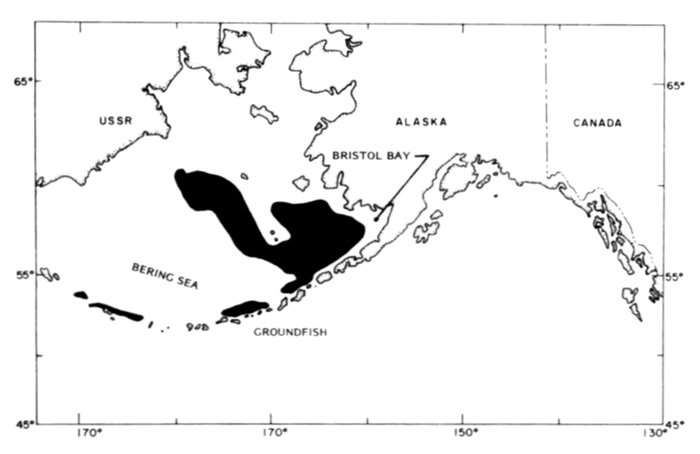
Fig. 1. Areas of major concentrations of ground fish (Pacific pollock, halibut, yellowfin sole, rock sole, flathead sole, Pacific ocean perch, and Pacific cod) in Bristol Bay and the Bering Sea.
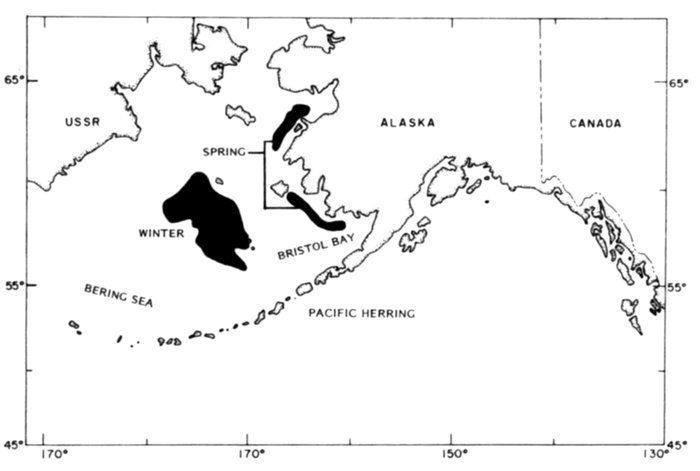
Fig. 2. Areas of major winter and spring concentrations of Pacific herring in Bristol Bay and the Bering Sea.
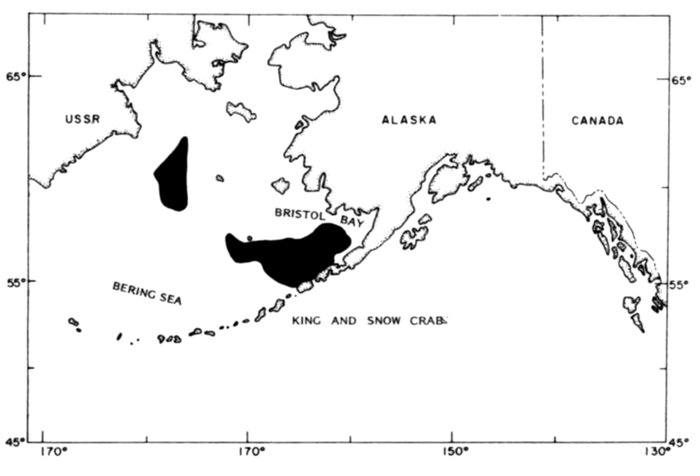
Fig. 3. Areas of major concentrations of king and snow crab in Bristol Bay and the Bering Sea.
Routes of Interaction Between Marine Birds and Commercial Fish
The obvious ways in which marine birds and fish of commercial importance interact in the eastern Bering Sea are illustrated by the simplified food web diagram in Fig. 4. The major animal groups and species included in two of the categories in this figure—secondary producers (invertebrate forage) and intermediate carnivores (commercial and forage marine fish and shellfish)—are as follows:
Secondary producers
Zooplankton and micronekton
Copepods
Calanus spp.
Eucalanus spp.
Euphausiids
Thysanoessa spp.
Amphipods
Parathemisto spp.
Gammarus spp.
Pteropods
Spiratella spp.
Clione spp.
Chaetognaths
Sagitta spp.
Benthos
Polychaetes
Nereis spp.
Euroe spp.
Molluscs
Mytilus edulis
Tonicella spp.
Fusitriton oregonensis
Echinodermata
Strongylocentrotus spp.
Crustacea
Gammaridae
Mysidae
Idothea spp.
Pagurus spp.
Hapalogaster spp.
Sclerocrangon spp.
Intermediate carnivores
Eggs (littoral, adhesive)
Clupeidae
Pelagic larvae
Gadidae
Pleuronectidae
Osmeridae
Ammodytidae
Salmonidae
Gadidae
Pandalidae
Juvenile and small adults
Clupeidae
Osmeridae
Ammodytidae
Salmonidae
Gadidae
Pandalidae
Large adults
Clupeidae
Gadidae
Pleuronectidae
Salmonidae
Scorpaenidae
Lithodidae
Majidae
Pandalidae
Marine birds
Alcidae
Procellariidae
Laridae
Phalacrocoracidae
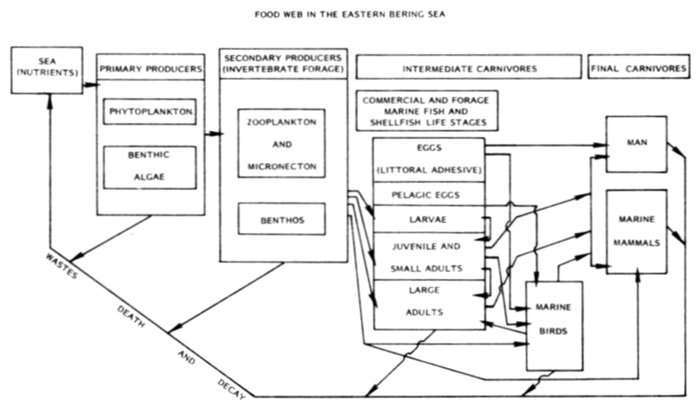
Fig. 4. Food web in the eastern Bering Sea, showing routes of interaction between marine birds and the various life history stages of commercial fish and shellfish.
In our discussion, we mainly consider predation by birds on commercial fish and competition between birds and commercial fish for food. The extent of these interactions determines the potential for birds and fish to influence each other's abundance. The extent of the interactions also determines the impact of man's commercial harvest of fish on the abundance of birds or of the bird's harvest on the abundance of fish.
The extent of the interaction between marine birds and commercial fish depends on the abundance, distribution, feeding habits, and life history of the fish species of concern. We have limited our discussion to examples of the major commercial pelagic and demersal fish and shellfish of the eastern Bering Sea. We also use as examples those species of marine birds whose abundance in the eastern Bering Sea and feeding habits give them the greatest potential for influence on, or being influenced by, fish abundance.
Abundance and Feeding Habits of Marine Birds in the Eastern Bering Sea
Information on the general abundance and distribution of the most important marine birds in the eastern Bering Sea in the summer and winter is scattered among many published and unpublished reports: Shuntov (1961, 1966), Sanger (1972), Bartonek and Gibson (1972), and Ogi and Tsujita (1973); and surveys by D. T. Montgomery and W. E. Oien ("Bristol Bay waterbird survey, 1972," unpublished report of the U.S. Bureau of Sport Fisheries and Wildlife, Alaska area) and by J. G. King and D. E. McKnight (1969, "A waterbird survey in Bristol Bay and proposals for future studies," unpublished report of the U.S. Bureau of Sport Fisheries and Wildlife and the Alaska Department of Fish and Game, Juneau, Alaska).
In summer, the most abundant birds appear to be the procellariids, mainly the slender-billed shearwater (Puffinus tenuirostris) and Pacific fulmar (Fulmarus glacialis); the alcids, mainly the common murre (Uria aalge), thick-billed murre (U. lomvia), tufted puffin (Lunda cirrhata), horned puffin (Fratercula corniculata), and the ancient murrelet (Synthliboramphus antiquus); and the larids, mainly the glaucous-winged gull (Larus glaucescens) and the black-legged kittiwake (Rissa tridactyla).
In winter, the alcids and larids appear to be the most abundant groups, the procellariids having been reduced by the departure of the slender-billed shearwaters for breeding grounds in the southern hemisphere. The selection of the types of food to be consumed by these marine birds is a function of their morphological and physiological adaptations and of the resultant feeding behavior. Ashmole (1971) classified the feeding behavior of various genera of marine birds and the relative importance of the kinds of food eaten by each group; this information for some of the Bering Sea bird species occurring in the genera listed by Ashmole (1971) is summarized in Fig. 5.
Fish and invertebrates are evidently of moderate to major importance in the diet of these marine birds (Fig. 5). The extent to which a given fish species is fed upon by or is in competition with marine birds for food is determined by the life history of the fish. Most pelagic and some demersal fish and shellfish are more subject to predation by pursuit diving birds than by birds restricted to the near-surface waters. Invertebrates appear to be equal to or more important than fish in the diets of birds feeding in near-surface waters (Fig. 5).
Predation by Marine Birds
The literature contains numerous accounts of marine birds feeding on marine fish and shellfish of commercial importance. Some studies quantify the impact of some bird species on certain species of commercial fish (Outram 1958; Shaefer 1970; Wiens and Scott 1976) and shellfish (Glude 1967). Other studies have shown that in some regions the value of guano produced by birds may exceed the value of the commercial fish they consume (Jarvis 1970). Some fish of worldwide commercial importance that are important in the diets of marine birds are listed in Table 2.
Table 2.
Fish of worldwide commercial importance in the diets of some marine birds.
Fish Shearwaters Murres Puffins Fulmars Gulls
Anchovy X — — — —
Sardines X — — — —
Herring X X X X X
Sprat X — — — —
Pilchard X — — — —
Capelin — X X — X
Salmon — X — — —
Mackerel — X — — —
Pollock — X — X —
Haddock — X — — —
Cod — X — — —
The significance of bird predation on pelagic or demersal fish and shellfish (Fig. 5) depends on the feeding behavior of the birds and on the life history of the fish (e.g., distribution, abundance, growth, and adult size). Pursuit diving birds, such as murres and puffins, can consume fish at greater depths than can birds that feed near the surface, such as shearwaters, kittiwakes, fulmars, and gulls.
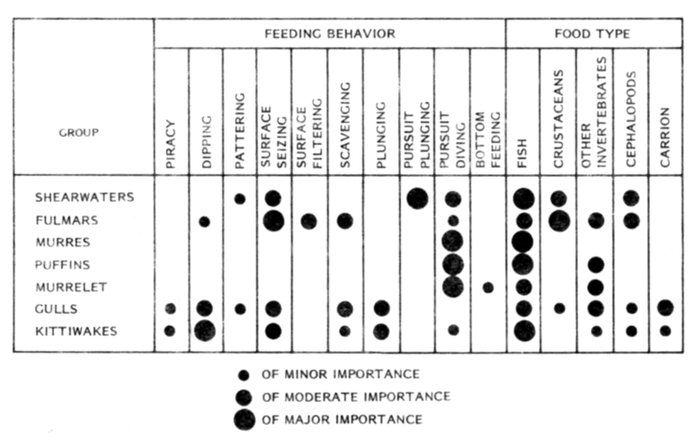
Fig. 5. Feeding behavior and relative importance of food of some groups of marine birds that occur in the eastern Bering Sea.
Aspects of the Life Histories of Fish Related to Predation by Marine Birds
Fish that are pelagic during part of their lives, such as salmon and herring, and forage fish like smelt, capelin, and sand lance, are vulnerable to greater predation by a wider variety of marine birds than are bottom-dwelling demersal fish, such as pollock, cod, sole, ocean perch, and halibut, as well as king and snow crabs. Some species that live on the bottom as adults have pelagic stages during which they are vulnerable to predation by marine birds. Juveniles of some demersal species (pollock, cod, halibut, some species of sole, and king crabs) are sometimes found in shallow water where they might be subject to predation by birds.
Demersal Fish and Shellfish
The early life histories of the commercially important demersal fish of the eastern Bering Sea are quite different (Table 3). For example, the eggs and larvae of Pacific halibut (Hippoglossus stenolepis) generally occur at depths greater than 100 m (Hart 1973), whereas those of pollock and yellowfin sole are found at or near the surface (Musienko 1963, 1970). The eggs of Pacific cod are demersal, but the larvae are oceanic (pelagic) and occur from 25-150 m (Mukhacheva and Zviagina 1960).
In their juvenile stages, many demersal fish frequent the near-surface waters (Table 3), where they become vulnerable to predation by piscivorous marine birds. Juvenile pollock, for example, form into small schools that usually move about close to the bottom but sometimes move into areas as shallow as 3 m. Juvenile Pacific cod prefer the warmer water close to shore and may be found within 10 m of the surface (Moiseev 1953). The young of many species of flatfish, such as yellowfin sole, rock sole (Lepidopsetta bilineata), and flathead sole (Hippoglosoides elassodon), remain for a time in shallow warm water after assuming a demersal existence. Yellowfin sole 2-2.5 cm in total length may be found in abundance in areas as shallow as 5 m (Fadeev 1965; Moiseev 1953).
Table 3.
Informal listing of life history information on selected species of commercial and forage fish and shellfish to show vulnerability to predation by marine birds.
(? indicates no information available.)
Fecundity Spawning season
Length of female (cm)[54] Mean no. of eggs Total period Peak period Life stage Total length (cm)[56] Depth from surface (m) Seasonal period of pelagic life Duration of life stages (days) Source of data
Walleye pollock (Theragra chalcogramma Pallas)
31-35 95,700 Feb.- June April-May Egg 0.1-0.2 0-10 Feb.-June 12 at 6-7°C Yusa 1954; Tanino et al. 1959; Kobayashi 1963; Musienko 1963, 1970; Serobaba 1968; Hart 1973[55]
20.5 at 3.4°C[57]
Larval 0.4-0.9 10-25 March-? > 25 at 6-7°C
46-50 324,400 — — Larval 0.9-? 25-? ?-Sept. ?
— — — — Juvenile 2.2-4.1 0-?[58] Summer —
— — — — Juvenile 6.0-30.0 4-37 Summer —
— — — — Adult 30.0-70.0 0-386 — —
Pacific cod (Gadus macrocephalus Tilesius) Egg 0.1-0.11 100-250 Demersal 8-9 at 11°C Moiseev 1953; Mukhacheva and Zviagina 1960; Musienko 1970; Hart 1973[55]
60 1,200,000 Jan.-March ? 17 at 5°C
28 at 2°C
Larval 0.5-3.2 25-150 Feb.-Aug. ?
78 3,300,000 — — Juvenile ? 10-? Summer —
— — — — Adult 40.0-99.0 0-900 — —
Pacific herring (Clupea harengus pallasi Valenciennes) Egg 0.1-0.2 0-12 Demersal 10-20[57] Stevenson 1962; Musienko 1970; Rumyantsev and Darda 1970; Reid 1972; Hart 1973[55]
20.5-22.0 26,600 May-June Varies Larval 0.9 0.5-8 May-June 42-56
28.0-31.0 77,800 — — Larval 1.3 0.5-8 June-July
— — — — Larval 2.5 1-6 July-Aug.
— — — — Juvenile 2.5-20.5 0-? March-Nov. —
— — — — Adult 20.5-31.0 0-140 March-Nov. —
Capelin (Mallotus villosus (Muller)) Egg 0.1 <20 Demersal 14-? Clemens and Wilby 1961; Musienko 1970; Hart 1973
? 3,000 June-July ? Larval 0.5-? ? June-? ?
? 6,000 — — Juvenile ? ? March-Nov.(est.) —
10.3 6,670 — —
? 60,000 — — Adult ? 0-? March-Nov. —
Pacific sand lance (Ammodytes hexapterus Pallas)
— ? June- Aug. [59] Egg ? ? Demersal ? Musienko 1963, 1970; Kashkina 1970; Hart 1973
— — — — Larval 0.7-3.4 0-? June-Sept. ?
— — — — Juvenile 3.6-9.6 0-? ? —
— — — — Adult 26 0-? ? —
Pacific ocean perch (Sebastes alutus (Gilbert))
26 10,000 March-May ? Egg[61] — — — — Paraketsov 1963; Lisovenko 1965; Lyubimova 1965; Kashkina 1970[60]
— — — — Juvenile 6.2 37-128 — —
— — — — Juvenile 10.4 37-154 — —
— — — — Juvenile 14.7-21.3 37-230 — —
— — — — Adult 21.3-51.0 37-420 — —
Pacific halibut (Hippoglossus stenolepis Schmidt)
75 101,723 Oct.-March ? Egg 0.3-0.4 40-935 Oct.-March 48 at ? Novikov 1964; Hart 1973
135 2,800,837 — — Larval 0.8-1.5 >200 Nov.-May 70-98
— — — — Larval 1.5-2.9 <100 May-Sept.
— — — — Juvenile 3.4-4.2 7-43 — —
— — — — Juvenile 19-25 7-45 — —
Yellowfin sole (Limanda aspera (Pallas))
26.1-28.0 1,295,000 June-Aug. July Egg 0.07-0.09 >0 June-Aug. 9.4 at 13.1°C[57] Moiseev 1953; Pertseva-Ostraumova 1954; Musienko 1963; Fadeev 1965; Kashkina 1965a, 1965b[55]
40.1-42.0 3,319,500 — — Larval 0.2-1.2 >0 July-Oct. ?
— — — — Juvenile 2.1-2.5 5-15 — —
King crabs (Paralithodes camtschatica (Tilesius))
9.4 55,408 April-June ? Egg — 100-200[63] — ? Kurata 1960, 1964; Korolev 1964; Rodin 1970
17.1 444,651 — — Zoeal 0.55-0.65 ? April-July 33 at 7-10°C
— — — — Zoeal 23 at 12.3-12.5°C
— — — — Glaucothoeal 0.38x0.18 ? May-? ?
— — — — Juvenile ? 1-? — ?
Snow crabs (Chionoecetes bairdi Rathbun)
— — — — Prezoeal 0.22-0.28 ? May-? 1-2 at 2.5°C
— — — — 1st zoeal 0.50-0.56 ? Summer ?
— — — — 2d zoeal ? 0-10 Summer ?
— — — — Megalopal 0.30-0.35x ? Summer —
0.18-0.21
— — — — Juvenile 0.44-0.48x ? — —
0.32-0.35
Snow crabs (Chionoecetesopilio (O. Fabricius)) Egg ? 93[60] — ? Ito 1968; Kon 1970; Haynes 1973; Motoh 1973; Jewett and Haight[64]
? ? ?[65] ? Prezoeal — ? May-? 63-66 at 11-13°C
— — — — 1st zoeal 0.48-0.54 ? Summer
— — — — 2d zoeal 0.62-0.71 ? Summer
— — — — Megalopal 0.29-0.33 ? Summer
— — — — 0.19
— — — — Juvenile 4.4-4.8x ? — —
— — — — 3.2-3.5
The commercially important king and snow crabs of the eastern Bering Sea also have larval stages that are pelagic (Table 3). Zoeae and megalopa of snow crabs are found near the surface where they are vulnerable to plankton-feeding marine birds. The eggs of king crabs are attached to the abdomen of the female, but after hatching, the larvae become pelagic and occur near the surface. They are planktonic through five larval stages before settling to the bottom to take up demersal residence (Kurata 1960, 1964). These larvae attain a length of 5.5-6.5 mm and spend 33 days or more in the plankton (Kurata 1960). Even after the young king crabs have settled to the bottom, they may still frequent water shallow enough to make them vulnerable to predation by some marine birds. Juvenile king crabs 1 and 2 years of age appear to prefer shallower water than do older crabs. In southeastern Alaska, during the spring, small juvenile crabs have been observed in pods at depths as little as 1 m below the low tide level.
The available life stages of king and snow crabs and commercially important demersal fish (Table 3) represent an enormous food supply for other fishes and marine birds. Predation by marine birds on pelagic eggs and on the larval and juvenile stages of demersal fish is not well documented, probably because the rapid digestion rate of birds makes species identification of these stages difficult. Investigators must often depend on the presence of the hard parts of fish (such as scales and otoliths) in the stomachs of birds to identify the species eaten. Because these hard parts have not yet formed in the larvae and most juveniles, predation by marine birds on older fish is more apparent on examination of stomach contents. Full understanding of predation by marine birds on demersal fish and shellfish requires additional data on when and where the egg, larval, and juvenile stages are present.
Pelagic Fish
Many fish, such as herring, capelin, smelt, and salmon, are pelagic for part of their lives, particularly during the spring and summer feeding periods. The extent of predation by marine birds on these species depends primarily on the location of their spawning grounds, their growth rates, and the size of the adults. The spawning location determines the extent of predation on eggs, whereas growth rate and adult size determine during how much of its lifetime a given fish species is vulnerable to the wide variety of marine birds.
Herring spawn in intertidal and subtidal zones and spend most of their post-larval lives in bays or estuaries near the coast. They deposit their adhesive eggs primarily on vegetation, and the eggs are particularly vulnerable to predation by a wide variety of marine and terrestrial birds. Outram (1958) estimated that gulls alone accounted for 39% of the egg loss on the spawning grounds at Vancouver Island, British Columbia. When herring larvae hatch, they are between 0.7 and 0.8 cm long; when they metamorphose about 6-8 weeks later, they are between 2.6 and 3.5 cm long. Thereafter, juvenile herring grow rapidly and reach a length of about 7-10 cm before winter. Although herring as old as 13 years and up to 38 cm long have been reported in Alaska, they seldom exceed 30 cm and 11 years of age (Rounsefell 1929). During spring and summer, herring are commonly within 10 m of the surface, but in winter, they are in water 100-140 m deep. Although herring are particularly vulnerable to predation in spring and summer, they are available to marine birds during most of their life.
The life history of capelin is somewhat different than that of herring—they live in the open sea near the surface and throughout the water column most of their lives. Sometime in June or early July, they migrate in large schools toward shore to spawn (Musienko 1970). In British Columbia, capelin bury their eggs in coarse sand and gravel in the intertidal and subtidal zones. The larvae are 0.5-0.7 cm long at hatching and are carried by currents to the open sea where they develop in the plankton. Capelin attain an age of 5 years and a maximum length of about 22 cm; their small size makes them vulnerable to predation by marine birds most of their lives, and they are an important pelagic food fish for other commercial fish in the Bering Sea.
The sand lance reaches a maximum size of 20-26 cm and is vulnerable to bird predation during most of its life. Little information is available on the maximum age attained by this species in the Bering Sea, but because of its size, it is an important forage fish for many commercial fish species.
The five species of Pacific salmon of the eastern Bering Sea spawn in fresh water, unlike herring, capelin, and sand lance. Their eggs are not vulnerable to extensive predation by marine birds; gulls take mainly salmon eggs which have been dislodged from the gravel and are drifting or being rolled along the stream bottom by the current (Moyle 1966). After a few months to several years in fresh water, the juvenile salmon (5-14 cm long) enter the Bering Sea during late spring or early summer and migrate through these waters to feeding grounds, primarily in the north Pacific Ocean. At maturity, the survivors return to their home streams and rivers to spawn. It is during the seaward migratory phase of their life cycle that salmon are most vulnerable to predation by marine birds.
The sockeye salmon (Oncorhynchus nerka) is the most abundant and valuable species harvested by American fishermen in the waters adjacent to the Bering Sea and, as a result, the one that has been most extensively studied during early marine life. Juvenile sockeye salmon are between 8 and 14 cm long when they enter the Bering Sea between late May and early July. They are most abundant in the upper 1 m of water at night and the upper 2 m during the day (Straty 1974)—well within the regime that can be exploited by many species of marine birds.
The numbers of juvenile sockeye salmon migrating seaward from the Bristol Bay region of the Bering Sea in a single year has ranged between 46.3 and 370.4 million (H. Jaenicke, personal communication). This is equivalent to between 409 and 3,267 metric tons (on the basis of the mean weight of the juveniles when they enter the Bering Sea). These large numbers of juvenile sockeye salmon, plus juvenile chinook salmon (O. tshawytscha), coho salmon (O. kisutch), chum salmon (O. keta), and pink salmon (O. gorbuscha) from all other rivers entering the Bering Sea, represent a considerable input of energy from fresh water in the form of prime forage fish for other fishes, marine birds, and mammals. Young salmon enter the Bering Sea each year over a period of only 6 to 8 weeks and may follow rather discrete coastal migration routes through the Bering Sea (Fig. 6), with the result that predators have access to an abundant but transient food supply.
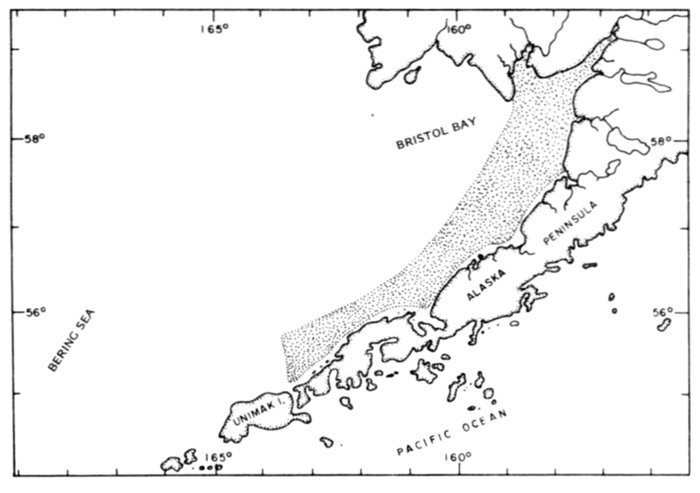
Fig. 6. Distribution of juvenile sockeye salmon in Bristol Bay and the eastern Bering Sea (adapted from Straty 1974).
The only published account of predation by marine birds on juvenile salmon in the Bering Sea is that of Ogi and Tsujita (1973). They found juvenile sockeye salmon in the stomachs of murres captured in gill nets in the eastern Bering Sea. The predation did not appear extensive, but most of the birds were captured outside or on the fringes of the main seaward migration route of the salmon. The foods of marine birds should be studied in conjunction with studies of the migrations of juvenile salmon.
Influence of Growth Rate and Adult Size of Fish on the Extent of Predation
Incubation time for fish eggs, the length of the pelagic larval period (Table 3), and the growth rate of juvenile fish are species-specific and temperature-dependent. The extent to which a fish species is subjected to predation by marine birds is directly related to the rate at which development and growth occur. For example, the less time it takes the pelagic eggs of demersal fish and shellfish to hatch and complete pelagic larval life, the less is the time they will be preyed on by marine birds. For fish species that are pelagic during their entire life, the rate of growth will determine how long they remain small enough for birds to eat. Some of the smaller pelagic fish, such as herring, capelin, and smelt, are vulnerable to bird predation most of their lives; larger pelagic species like salmon may be preyed on for only a very short time. The maximum size fish that can be eaten by marine birds is, therefore, important in evaluating predation on a given species of fish.
The literature on the food habits of marine birds contains little on the sizes of fish consumed. Tuck (1960) stated that murres probably will take fish up to 18 cm long. Ogi and Tsujita (1973) estimated the lengths of Pacific pollock in the stomachs of murres taken in the eastern Bering Sea at 24 cm.
Herring in the eastern Bering Sea reach an age of 11 years and grow to about 33 cm. Herring could, therefore, be taken during most of their lives by murres but during only the first few years by smaller birds such as fulmars and shearwaters. Capelin and some species of smelt would be vulnerable to birds during all their lives. Although the size of adult Pacific salmon varies with the species, they are all so large that they are not preyed upon by marine birds. Once in the ocean, juvenile salmon grow at such a rapid rate that they are probably not very vulnerable to marine birds after their first 4 to 6 months at sea. Limited studies on the growth of juvenile sockeye salmon in the eastern Bering Sea (Straty 1974) indicate they may double their size in their first 8 weeks at sea. A sockeye salmon that entered the Bering Sea at 12 cm in mid-June would be 24 cm long in August—the maximum size that a murre could eat; the fish could be eaten by smaller marine birds for much less time. Pink and chum salmon enter the sea at a smaller size than sockeye salmon and would be vulnerable to predation both by a greater variety of marine birds and for a longer period of time.
Competition Between Commercial Fish and Marine Birds
We do not know the importance of competition between marine birds and commercial fish in the eastern Bering Sea. Only a few investigators have even alluded to competition between marine birds and fish for food. Ogi and Tsujita (1973) mentioned that competition seemed to exist between murres and juvenile sockeye salmon for euphausiids in the eastern Bering Sea. We have listed some of the types of forage fish and invertebrates eaten by commercial fish (Table 4) and marine birds (Table 5) in the eastern Bering Sea; comparison of these two tables clearly indicates that competition could occur.
The principal factors determining the extent of competition between marine birds and fish are the numbers of birds and fish, the length of time that various life history stages of the fish are in association with the birds, and the abundance of the preferred foods at these times. The impact of competition depends on the adaptability of the birds and fish to alternative types of food.
The types and sizes of food eaten by fish vary with the life history stage—especially with size at each stage. For instance, very young herring eat the eggs and nauplii of copepods or small copepodite stages and barnacles. As herring grow, their diet includes small fish and larger zooplankton, such as mature copepods, amphipods, euphausiids, and pteropods. Pacific cod shorter than 9 cm feed on small crustaceans (Moiseev 1953), whereas larger cod eat young crabs, shrimp, and fish. Small juvenile sockeye salmon feed mainly on larval stages of euphausiids (Straty 1974), but larger juveniles also eat the more adult forms, which eventually make up a significant part of their diet (Nishiyama 1974).
The change in the diet of fishes with growth results in competition with a changing variety of marine birds. For example, deep-diving birds may replace surface feeders as the major bird competitors of the Pacific cod and pollock as these fish increase in size and seek deeper waters. The diet of cod changes from small crustaceans in shallow water to progressively larger food that eventually includes herring, sand lance, shrimp, and crabs. The change to herring and sand lance, and quite possibly small crabs, places the adult cod in competition with both the surface feeders and pursuit diving birds, but adult cod do not compete with birds for zooplankton.
Table 4.
Food items eaten by the adult stage of seven commercially important species of fish in the eastern Bering Sea.
Food item Herring Salmon Walleye pollock Pacific cod Pacific ocean perch Yellowfin sole Pacific halibut
Invertebrates
Pteropods X X — — X — —
Squid — X — X X — X
Polychaetes X X X X — X X
Copepods X X X — — — —
Amphipods X X X X X X —
Euphausiids X X X — X X —
Decapods X X X X X X X
Fish
Capelin X X X X — X —
Sand lance — X X X — — X
Table 5.
Forage fish and invertebrate foods eaten by seven species of marine birds in the eastern Bering Sea.
Food item Shearwaters Murres Puffins Murrelets Fulmars Kittiwakes Gulls
Forage fish
Sand lance X X X — — X X
Capelin — — X — — — —
Invertebrates
Copepods — — — — — X —
Euphausiids X X — — — X —
Amphipods X X — — — X —
Decapods X X — — — X —
Pteropods — X — — — — —
Chaetognaths — — — — — — —
Polychaetes — X X — — X —
Squid X X — — X — —
As pollock increase in size, they continue to feed mainly on zooplankton, but they change from copepods near the surface to euphausiids at mid-depths and near the bottom. Euphausiids are large and abundant zooplankters which, for the most part, are available only to deep-diving birds. Adult pollock also consume herring, sand lance, capelin, and other small fish.
Both marine birds and fish are capable of exploiting a wide variety of food, and often their stomach contents reflect the relative abundance of food items in the area. Ogi and Tsujita (1973) illustrated the differences in the food taken by murres captured at different locations in the eastern Bering Sea. Carlson (1977) and Ogi and Tsujita (1973) reported on differences in the diet of juvenile sockeye salmon captured at various locations in Bristol Bay and the eastern Bering Sea. The diets of many species of birds and fish, however, seem to be largely determined by their physiological and morphological adaptations and resultant feeding behavior. For instance, adult sockeye and pink salmon have well-developed gill rakers and feed largely on zooplankton, whereas chinook and coho salmon have poorly developed gill rakers and feed almost entirely on fish. In the eastern Bering Sea, murres appear to prefer the Pacific sand lance, whereas the slender-billed shearwater consumes mainly euphausiids (Ogi and Tsujita 1973). Thus, murres may be greater competitors with piscivorous fish than are shearwaters. Shearwaters are probably more important as competitors with zooplankton-eating fish that inhabit shallow water in juvenile stages and with pelagic fish species (such as pollock, herring, salmon, and capelin) that are heavily dependent on euphausiids.
Some species of marine birds may interact with fish as predators and competitors. As an example, pursuit diving birds, such as murres and puffins, may be important predators on juvenile salmon in the eastern Bering Sea, but these same birds may compete for food with adult salmon. Surface-feeding birds, such as fulmars, shearwaters, kittiwakes, and gulls, may be important as both predators and competitors with herring and capelin and some demersal fish.
Dependency of Marine Birds on Commercial Fish
The interactions of commercial fish and marine birds of the Bering Sea can be determined only if we know their distribution, abundance, and food habits, especially while they are associated with one another. Information is particularly lacking for all life history stages of commercial fish species and the seasonal movements of birds. We have some knowledge of the distribution and abundance of the various life history stages and the food habits of commercial fish in the Bering Sea. Little is known of the abundance, seasonal movements, and food habits of marine birds in this region, however, probably because marine birds have had little direct commercial value in the northern hemisphere. Food studies on marine birds are particularly difficult because their rapid digestion soon destroys the identity of the food.
We can make a reasonable guess as to some bird-fish associations for two regions of the Bering Sea where we have information on the distribution of marine birds and the various life history stages of commercial fish. For example, piscivorous birds, such as murres, puffins, black-legged kittiwakes, and slender-billed shearwaters, are extremely abundant in the summer along the seaward migration route of juvenile sockeye salmon (Fig. 7); the juvenile salmon, kittiwakes, and shearwaters all feed on plankton. Shuntov (1961) showed that kittiwakes are most abundant along the edge of the continental shelf in the Bering Sea in the summertime. This distribution coincides with the distribution of the eggs and larvae of pollock, certain flatfish, rockfish, sablefish, and several other species. These birds both exploit the fish directly (predation) and compete with them for plankton. Not enough information is available on the food habits of birds at the time fish eggs and larvae are present to evaluate this interaction.
Environmental Influence on Predation and Competition Between Marine Birds and Commercial Fish
Because fish are cold-blooded animals, temperature, through its influence on the rate of metabolism, is a major variable in determining the amount of energy needed for maintenance and for performing such essential activities as swimming and feeding—fish are less active, feed less, and grow more slowly in cold waters. For example, growth in young sockeye salmon is very slow at temperatures lower than 4°C (Donaldson and Foster 1941), and temperature profoundly affects their swimming speed (Brett et al. 1958). The rates of development of the eggs of some flatfish are closely correlated with water temperature (Ketchen 1956)—flatfish developed more rapidly at higher temperatures (Fig. 8). At lower temperatures, the rate of growth is also slower and, therefore, the duration of pelagic larval life is longer for demersal fish and shellfish.
Variations in sea temperature should, therefore, influence the extent to which fish are vulnerable to predation and competition. For example, eggs would take a longer time to hatch in colder than in warmer sea water. In both pelagic fish such as herring, whose eggs are laid in the intertidal zone, and in demersal fish with pelagic eggs such as the sole, the period of vulnerability of eggs to bird predation would be extended. At lower temperatures the length of the pelagic life of demersal fish and shellfish and their vulnerability to predation would also be greater than at higher temperatures. For example, the number of days between molts of the zoeal stages of snow crabs is temperature-dependent—the warmer the water, the less the time between molts (Kon 1970).
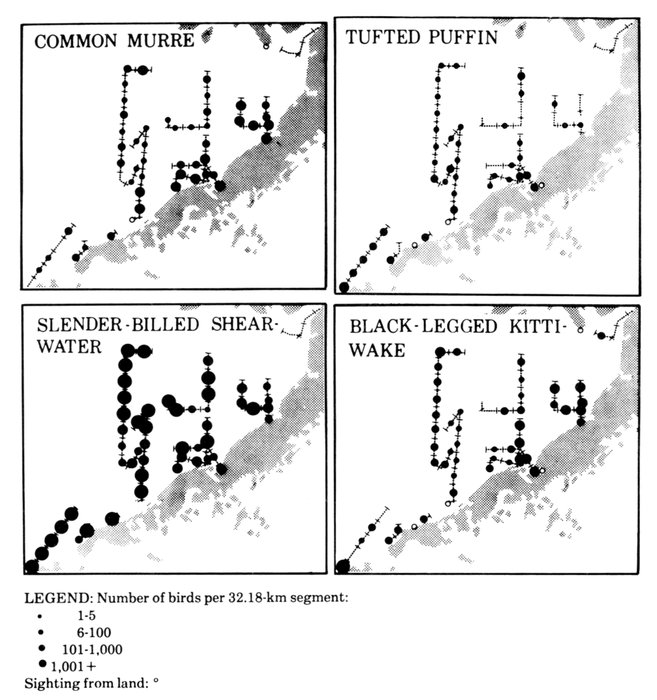
Fig. 7. Distribution and numbers of birds observed in Bristol Bay along seaward migration route of sockeye salmon (from Bartonek and Gibson 1972).
Temperature, through its effects on swimming speed, feeding activity, and growth of juvenile fish, might influence the magnitude of predation by birds on pelagic fish in the following ways: (1) lower sea temperatures would increase the vulnerability of juvenile fish to bird predation because swimming speed would decrease, and the time the fish are of a size that could be eaten by would-be predators would increase; (2) lower sea temperatures would reduce the feeding by fish and decrease the competition by fish for food exploited by birds; and (3) higher sea temperatures would have the opposite effect—the feeding by fish would increase consumption of the foods that birds feed on.
In the eastern Bering Sea, water temperatures may vary greatly between years for the same month (Fig. 9). Such variation should result in variation in the temperature-dependent activities of fish and, in turn, in magnitude of marine bird predation and competition.
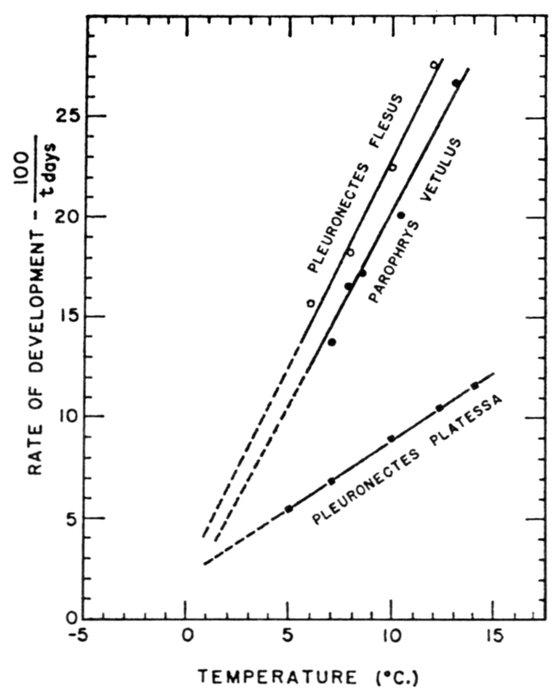
Fig. 8. The relation of temperature to the rate of development to hatching of lemon sole, as compared with two European flatfishes (Ketchen 1956).
Possible Influences of Man on the Interaction of Marine Birds with Commercial Fish
We have noted that the abundance and age and size composition of major stocks of fish in the Bering Sea have been drastically reduced by commercial fishing. This has resulted in the reduction in numbers of fish at all life history stages, including those on which marine birds and other fishes depend for food. What effect this reduction has had on the abundance and distribution of marine birds in the Bering Sea is unknown. It depends in part on the ability of birds to eat other fish or increase their use of zooplankton or nekton.
We can hypothesize on probable changes in bird and fish abundance that resulted from the heavy commercial harvest of fish but any such changes cannot be documented or quantified. A reduction in stocks of a fish species could result in a reduced supply of food for a species of bird and cause a shift in the diet of this bird to other species of fish or to more zooplankton. For a bird species with specific food preferences, this could mean a reduction in its abundance to a level supportable by the available food supply. For bird species with less specific food requirements, a reduction in a species of fish could mean a reduction in competition for food with that fish—which could increase survival of the birds.
Man's intentional harvest of marine birds, such as the shearwater in parts of the southern hemisphere, and his inadvertent harvest of other bird species which are entangled or caught in fishing gear reduce predation and competition by marine birds. This, in turn, may aid the survival of the fish stocks in the Bering Sea.
The status of most stocks of commercial fish and shellfish in the Bering Sea is such that reductions in harvest are warranted, have been proposed, or are in effect. If the 200-mile (61-km) limit of jurisdiction over the marine resources by adjacent coastal States is implemented, either as a result of the Law of the Sea Conferences or unilaterally by the United States, we can expect commercial fishing in the eastern Bering Sea to be more tightly regulated. Such action should result in a reduction in harvest of those fish species now in a depleted condition, which, in turn, could influence the abundance of marine birds. Now is an opportune time to implement the studies required to increase our knowledge of the abundance, distribution, and seasonal movements of marine birds and their relationship to commercial fish resources of the eastern Bering Sea.
Conclusions
• The eastern Bering Sea is a region of high biological productivity; it is one of the world's great producers of commercial fish and major congregating areas for marine birds.
• The vulnerability of fish to predation by marine birds depends on life history features, such as place of spawning, duration of larval stages, growth rate, sea temperature, and adult size of fish, and on the distribution, feeding behavior, and food habits of marine birds.
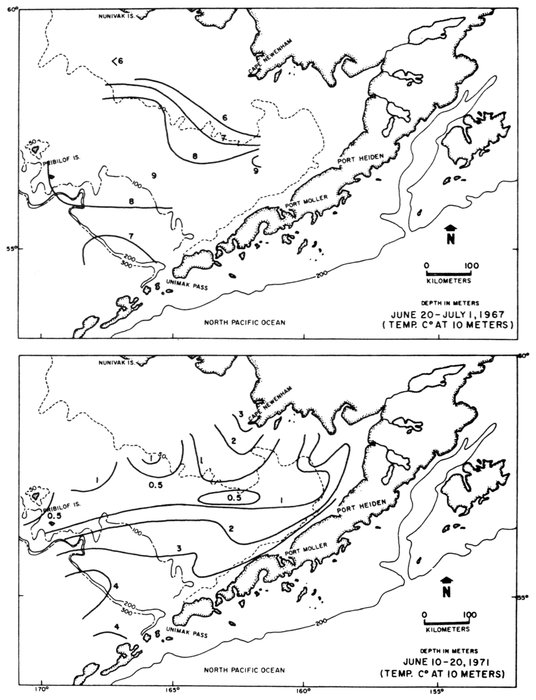
Fig. 9. Sea temperatures in Bristol Bay and southeastern Bering Sea in mid-June and early July of 1967 and 1971 (from Straty 1974).
• The most apparent predation by marine birds on fish is on fish large or mature enough that some hard body parts persist and can be found in the stomach samples of birds.
• Little is known of the extent of bird predation on the pelagic eggs and larvae of demersal fish and shellfish in the Bering Sea because of lack of investigation and the rapid digestion of eggs and larvae by birds.
• Predation by marine birds on juvenile salmon is not well documented because of the lack of investigation in areas where both birds and fish are present.
• Marine birds and commercial fish eat similar zooplankton and fish in the eastern Bering Sea. The food exploited by both generally reflects the relative abundance of the types of food in the area, but food preference is displayed by some species of fish and birds.
• More is known about the food habits of the commercial fish than of the marine birds of the Bering Sea.
• Sea water temperature may be a major environmental factor in the Bering Sea since it influences both the extent to which fish are vulnerable to predation and the amount of competition with marine birds. Sea temperatures may vary greatly from year to year in the Bering Sea, and this may result in variations in the magnitude of predation and competition between birds and fish.
• The distribution of marine birds and the various stages in the life history of commercial fish are not well known for the eastern Bering Sea. Where these have been studied, they are intimately related. Such knowledge is required to gain some insight into even the potential for predation and competition in the dynamics of the marine bird and commercial fish populations of this region. In two instances, it is known that the occurrence of marine birds and the early life history stages of fish coincide so as to result in both potential predation on the fish by the birds and competition for food between the fish and the birds.
• The possibility exists that the commercial fish resources of the eastern Bering Sea will eventually come under the jurisdiction of the United States. This could mean reduced harvests of fish to restore depleted stocks. Such action could result in changes in the abundance of the marine birds of this region by creating an increased food supply for some and decreased supply for others.
Acknowledgments
We thank J. C. Bartonek and H. R. Carlson, H. Jaenicke, H. Larkins, and B. L. Wing for supplying various materials presented in this paper.
References
Ahlstrom, E. H. 1959. Vertical distribution of pelagic fish eggs and larvae off California and Baja California. U.S. Fish Wildl. Serv. Fish. Bull. 60(161):107-146.
Ahlstrom, E. H. 1961. Distribution and relative abundance of rockfish (Sebastodes spp.) larvae of California and Baja California. Int. Comm. Northwest. Atl. Fish. Spec. Publ. 3:169-176.
Ashmole, N. P. 1971. Sea bird ecology and the marine environment. Pages 223-286 in D. S. Farner, J. R. King, and K. C. Parkes, eds. Avian Biology. Vol. 1. Academic Press, New York.
Bartonek, J. C., and D. D. Gibson. 1972. Summer distribution of pelagic birds in Bristol Bay, Alaska. Condor 74(4):416-422.
Bourne, W. R. P. 1963. A review of oceanic studies of the biology of seabirds. Proc. Int. Ornithol. Congr. 13:831-854.
Brett, J. R., M. Hollands, and D. F. Alderdice. 1958. The effect or temperature on the cruising speed of young sockeye and coho salmon. J. Fish. Res. Board Can. 15(4):587-605.
Carlson, H. R. 1977. Food habits of juvenile sockeye salmon, Oncorhynchus nerka, in the inshore coastal waters of Bristol Bay, Alaska. Fish. Bull. 74(2):458-462.
Chitwood, P. E. 1969. Japanese, Soviet, and South Korean Fisheries off Alaska, development and history through 1966. U.S. Fish Wildl. Serv. Circ. 310. 34 pp.
Clemens, W. A., and G. V. Wilby. 1961. Fishes of the Pacific Coast of Canada. Fish. Res. Board Can., Bull. 68, 2d ed. 443 pp.
Donaldson, L. R., and F. J. Foster. 1941. Experimental study of the effect of various water temperatures on the growth, food utilization, and mortality rates of fingerling sockeye salmon. Trans. Am. Fish. Soc. 70:339-346.
Fadeev, N. S. 1965. Comparative outline of the biology of flatfishes in the southeastern part of the Bering Sea and the condition of their resources. Part 4, pages 112-119 in Soviet fisheries investigations in the northeast Pacific Ocean. (Trans. from Russian.) Israel Program for Scientific Translations, Jerusalem.
Glude, J. B. 1967. The effect of scoter duck predation on a clam population in Dabob Bay, Washington. Proc. Natl. Shellfish Assoc. 55:73-86.
Hart, J. L. 1973. Pacific fishes of Canada. Fish. Res. Board Can., Bull. 180. 740 pp.
Haynes, E. 1973. Descriptions of prezoeae and stage 1 zoeae of Chionoecetes bairdi and C. opilio (Oxyrhyncha Oregoniinae). U.S. Natl. Mar. Fish. Serv. Fish. Bull. 73:769-775.
Ito, K. 1968. Ecological studies on the edible crab, Chionoecetes opilio (O. Fabricius) in the Japan Sea. II. Description of young crabs, with note on their distribution. Bull. Jpn. Sea Reg. Fish. Res. Lab. 19:43-50. (Transl. from Japanese.) Fish. Res. Board Can. Transl. Ser. 1184.
Jarvis, M. J. F. 1970. Interactions between man and the South African gannet Sula capensis. Ostrich Suppl. 8:497-513.
Kashkina, A. A. 1965a. Winter ichthyoplankton of the Commander Islands region. Part 4, pages 170-181 in Soviet fisheries investigations in the northeast Pacific Ocean. (Transl. from Russian.) Israel Program for Scientific Translations, Jerusalem.
Kashkina, A. A. 1965b. Reproduction of yellowfin sole (Limanda aspera Pallas) and changes in its spawning stocks in the eastern Bering Sea. Part 4, pages 182-190 in Soviet fisheries investigations in the northeast Pacific Ocean. (Transl. from Russian.) Israel Program for Scientific Translations, Jerusalem.
Kashkina, A. A. 1970. Summer ichthyoplankton of the Bering Sea. Part 5, pages 225-247 in Soviet fisheries investigations in the northeast Pacific Ocean. (Transl. from Russian.) Israel Program for Scientific Translations, Jerusalem.
Ketchen, K. S. 1956. Factors influencing the survival of the lemon sole (Parophrys vetulus) in Hecate Strait, British Columbia. J. Fish. Res. Board Can. 13(5):647-694.
Kobayashi, K. 1963. Larvae and young of the whiting, Theragra chalcogramma (Pallas), from the north Pacific. Bull. Fac. Fish. Hokkaido Univ. 14(2):55-63.
Kon, T. 1970. Fisheries biology of the tanner crab. IV. The duration of planktonic stages estimated by rearing experiments of larvae. Bull., Jpn. Soc. Sci. Fish. 36(3):219-224. (Transl. from Japanese.) Fish. Res. Board Can. Transl. Ser. 1603.
Korolev, N. G. 1964. The biology and commercial exploitation of the king crab, Paralithodes camtschatica (Tilesius), in the southeastern Bering Sea. Part 2, pages 102-108 in Soviet fisheries investigations in the northeast Pacific Ocean. (Transl. from Russian.) Israel Program for Scientific Translations, Jerusalem.
Kurata, H. 1960. Studies on the larva and post-larva of Paralithodes camtschatica. III. The influence of temperature and salinity on the survival and growth of the larva. Bull. Hokkaido Reg. Fish. Res. Lab. 21:9-14.
Kurata, H. 1964. Larvae of the decapod crustacea of Hokkaido. 6. Lithodidae (Anomwia). Bull. Hokkaido Reg. Fish. Res. Lab. 28:49-65.
Lisovenko, L. A. 1965. Fecundity of Sebastodes alutus Gilbert in the Gulf of Alaska. Part 4, pages 162-169 in Soviet fisheries investigations in the northeast Pacific Ocean. (Transl. from Russian.) Israel Program for Scientific Translations, Jerusalem.
Lyubimova, T. G. 1965. Main stages in the life cycle of the rockfish Sebastodes alutus Gilbert in the Gulf of Alaska. Part 4, pages 85-111 in Soviet fisheries investigations in the northeast Pacific Ocean. (Transl. from Russian.) Israel Program for Scientific Translations, Jerusalem.
Moiseev, P. A. 1953. Cod and flounders of far-eastern waters. (Transl. from Russian.) Fish. Res. Board Can. Transl. Ser. 119.
Motoh, H. 1973. Laboratory-reared zoeae and megalopa of zuwai crab from the Sea of Japan. Bull. Jpn. Soc. Sci. Fish. 39(12):1223-1230.
Moyle, P. 1966. Feeding behavior of the glaucous-winged gull on an Alaskan salmon stream. Wilson Bull. 78(2):175-190.
Mukhacheva, V. A., and O. A. Zviagina. 1960. Development of the Pacific Ocean cod Gadus morhua macrocephalus Tilesius. (Transl. from Russian.) Fish. Res. Board Can., Transl. Ser. 393.
Musienko, L. N. 1963. Ichthyoplankton of the Bering Sea (data of the Bering Sea Expedition of 1958-59). Part 1, pages 251-286 in Soviet fisheries investigations in the northeast Pacific Ocean. (Transl. from Russian.) Israel Program for Scientific Translations, Jerusalem.
Musienko, L. N. 1970. Reproduction and development of Bering Sea fishes. Part 5, pages 161-224 in Soviet fisheries investigations in the northeast Pacific Ocean. (Transl. from Russian.) Israel Program for Scientific Translations, Jerusalem.
Nishiyama, T. 1974. Energy requirement of Bristol Bay sockeye salmon in the central Bering Sea and Bristol Bay. Inst. Mar. Sci., Univ. Alaska 2:321-343.
Novikov, N. P. 1964. Basic elements of the biology of the Pacific halibut (Hippoglossus hippoglossus stenolepis Schmidt) in the Bering Sea. Part 2, pages 175-219 in Soviet fisheries investigations in the northeast Pacific Ocean. (Transl. from Russian.) Israel Program for Scientific Translations, Jerusalem.
Ogi, H., and T. Tsujita. 1973. Preliminary examination of stomach contents of murres (Uria spp.) from the eastern Bering Sea and Bristol Bay, June-August 1970 and 1971. Jpn. J. Ecol. 23(5):201-209.
Outram, D. N. 1958. The magnitude of herring spawn losses due to bird predation on the west coast of Vancouver Island. Fish. Res. Board Can., Prog. Rep. Pac. Coast Stn. 111:9-13.
Paraketsov, I. A. 1963. On the biology of Sebastodes alutus of the Bering Sea. Part 1, pages 319-327 in Soviet fisheries investigations in the northeast Pacific Ocean. (Transl. from Russian.) Israel Program for Scientific Translations, Jerusalem.
Pearson, T. H. 1968. The feeding biology of sea-bird species breeding on the Farne Islands, Northumberland. J. Anim. Ecol. 37:521-552.
Pertseva-Ostraumova, T. A. 1954. Material on the development of the far-eastern flatfish. 1. Development of the yellowfin sole. Tr. Inst. Okeanol. Akad. Nauk., SSSR-11.
Reid, G. J. 1972. Alaska's fishery resources, the Pacific herring. U.S. Natl. Mar. Fish. Serv., Fish. Facts 2, 20 pp.
Rodin, V. E. 1970. An estimation of the state of the king crab (Paralithodes camtschatica Tilesius) stock in the southeastern Bering Sea. Part 5, pages 149-156 in Soviet fisheries investigations in the northeast Pacific Ocean. (Transl. from Russian.) Israel Program for Scientific Translations, Jerusalem.
Rounsefell, G. A. 1929. Contribution to the biology of the Pacific herring, Clupea pallasii, and the condition of the fishery in Alaska. Bull. U.S. Bur. Fish. 45:227-320.
Rumyantsev, A. I., and M. A. Darda. 1970. Summer herring in the eastern Bering Sea. Part 5, pages 409-441 in Soviet fisheries investigations in the northeastern Pacific Ocean. (Transl. from Russian.) Israel Program for Scientific Translations, Jerusalem.
Sanger, G. A. 1972. Preliminary standing stock and biomass estimates of seabirds in the subarctic Pacific region. Pages 499-611 in A. Y. Takenouti, ed. Biological oceanography of the northern north Pacific Ocean.
Serobaba, I. I. 1968. On the spawning of Alaska pollock Theragra chalcogramma (Pallas) in the northeastern part of the Bering Sea. Vopr. Ikhtiol. 6(53):992-1003. (Transl. from Russian.) Israel Program for Scientific Translations, Jerusalem.
Shaefer, M. B. 1970. Men, birds, and anchovies in the Peru current—dynamic interactions. Trans. Am. Fish. Soc. 99(3):461-467.
Shuntov, V. P. 1961. Migration and distribution of marine birds in the southeastern Bering Sea during spring-summer season. Zool. Zh. 40(7):1058-1069. (In Russian, summary in English.)
Shuntov, V. P. 1966. Concerning wintering of birds in the far eastern seas and in the northern part of the Pacific Ocean. Zool. Zh. 45(11):698-711. (Transl. from Russian.) Can. Wildl. Serv.
Solomensen, F. 1965. The geographical variation of the fulmar (Fulmarus glacealis) and the zones of marine environment in the North Atlantic. Auk 82:327-355.
Stevenson, J. C. 1962. Distribution and survival of herring larvae (Clupea pallasi Valenciennes) in British Columbia waters. J. Fish. Res. Board Can. 19(5):735-810.
Straty, R. R. 1974. Ecology and behavior of juvenile sockeye salmon (Oncorhynchus nerka) in Bristol Bay and the eastern Bering Sea. Inst. Mar. Sci., Univ. Alaska, Occas. Publ. 2:285-320.
Tanino, Y., H. Tsujisaki, K. Nakamichi, and K. Kyushin. 1959. On the maturity of Alaska pollock, Theragra chalcogramma (Pallas). Bull. Hokkaido Reg. Fish. Res. Lab. 20:145-164.
Taylor, F. H. C. 1967. The relationship of midwater trawl catches to sound scattering layers off the coast of northern British Columbia. J. Fish. Res. Board Can. 25(3):457-472.
Tuck, L. M. 1960. The murres: their distribution, populations, and biology, a study of the genus Uria. Can. Wildl. Ser. 1. 260 pp.
Wiens, J. A., and J. M. Scott. 1976. Model estimation of energy flow in Oregon coastal seabird populations. Condor 77(4):439-452.
Yusa, T. 1954. On the normal development of the fish, Theragra chalcogramma (Pallas), Alaska pollock. Bull. Hokkaido Reg. Fish. Res. Lab. 10. 15 pp.
FOOTNOTES:
Interrelations Between Seabirds and Introduced Animals
by
Robert D. Jones, Jr.
U.S. Fish and Wildlife Service 1011 East Tudor Road Anchorage, Alaska 99507
and
G. Vernon Byrd[66]
U.S. Fish and Wildlife Service Aleutian Islands National Wildlife Refuge Adak, Alaska
Abstract
Animals introduced to insular seabird habitats are of both intentional and accidental origin. The results of the introductions—particularly of herbivores—cannot be predicted, but may range from severely destructive to beneficial. Herbivores are of both domestic and wild stocks of ungulates, hares, and rabbits. Rats are the most commonly introduced omnivore on a worldwide basis. In Alaska the commonest carnivore introduction has been the red fox (Vulpes fulva) and arctic fox (Alopex lagopus), and the first of these were made in the early 19th century by the Russian-American Company. These foxes nearly extirpated the Aleutian Canada goose (Branta canadensis leucopareia) from its nesting grounds. Black flies (Simuliidae), which are vectors of avian blood parasites, have been introduced to three of the Aleutian Islands.
The purpose of this paper is to discuss some influences of introduced animals, primarily mammals, on seabirds and their nesting habitat, with emphasis on the coasts of Washington, British Columbia, and Alaska. Our discussion focuses on island introductions partly because a large proportion of seabirds choose island nesting sites, and because islands present ecosystems vulnerable to such introductions.
Flightless animals have no means of immigration, hence little probability of colonizing islands. In these circumstances marine birds evolve populations in relatively simple ecosystems (Carlquist 1965; MacArthur and Wilson 1967), though the degree of simplicity depends on several variables, including the island's size and its distance from a source of immigrants. These systems have achieved ecological homeostasis through reciprocal adaptation over an extended period. Experience has shown that introductions to such systems result in severe perturbations (Odum 1971:221).
The introductions can be categorized as being either intentional or accidental events. Effects of such introductions have varied widely, depending on the type of animal introduced, the types of birds present and the habitat they occupy, the size and shape of the island, the type of nesting area used by the birds, and the status of their populations before the introduction. An example drawn from our Aleutian experience with gallinaceous birds illustrates the interaction of these variables. The dark phase of the arctic fox (Alopex lagopus) was introduced to Adak and Amchitka islands, both of which had native populations of the rock ptarmigan, Lagopus mutus (Gabrielson and Lincoln 1959). Foxes were released on Adak in 1924, and on Amchitka in 1921. Adak has an area of 751 km2 and Amchitka 350 km2. Adak is irregular in shape with extensive precipitous shorelines, relatively few beaches, and a large, central mountainous hinterland which foxes rarely penetrated. Amchitka, on the other hand, presents a zone of marine planation on its eastern two thirds, low mountains on the rest, shelving beaches around most of the island, and a long, linear, narrow shape that foxes explored completely. By 1949 ptarmigan were difficult to find on Amchitka, and then only in the highest, steepest section of the mountains. They were extirpated from the low, eastern two thirds of the island. The foxes flourished on Amchitka, but did much less well on Adak, where the ptarmigan population fluctuated in a normal cyclic manner, apparently uninfluenced by the foxes. Then the foxes were eradicated on Amchitka in the 1950's, and by 1962 the ptarmigan had spread over the whole of the island and become one of the most conspicuous avian features of the landscape.
Animal Introductions
Non-predatory Animals
Man has taken ungulates with him to many islands. Although numerous records of livestock introductions are available, few provide information relating to the effects of these animals on the habitat and their fauna unless the impact has been severe.
A most noteworthy example of destruction by ungulates occurred on Guadalupe Island off the coast of Baja California. Domestic goats (Capra hircus) were introduced in the unrecorded past with the result that little of the once abundant vegetation remains. In its place introduced species capable of withstanding heavy grazing are abundant over most of the island. Several endemic avian species are now considered extinct, including the Guadalupe storm-petrel, Oceanodroma macrodactyla (Howell and Cade 1954; Jehl 1972).
Sheep (Ovis aries) have been introduced to seabird nesting islands with varying results. In Bass Strait, Australia, Norman (1970) studied the effects of introduced sheep on vegetation and birds. He cited various papers attributing destruction of colonies of shearwaters (Puffinus sp.) to the activities of sheep, primarily their treading on the burrows. He found, however, that on Big Green Island and Phillip Island, sheep were not responsible for declines in shearwater breeding success, nor did they prevent expansion of colonies.
Other authors have reported damage to seabird nesting areas by sheep. One such example in the eastern North Pacific region concerns Protection Island, Washington. According to Richardson (1961), 100 to 300 sheep grazed freely on the island since 1958. He reported damage by grazing and frequent trampling of nesting areas of rhinoceros auklets (Cerorhinca monocerata). Landslides were initiated by these activities, rendering the slopes unusable by auklets. Of the burrows in his study area, 46% were buried by slides. He did not determine mortality.
Other avian consequences may flow from sheep introductions. Husbandry of these ungulates has been practiced with varying success for many years in the Aleutian Islands, most notably on Umnak and Unalaska islands, both of which have large native populations of bald eagles, Haliaeetus leucocephalus (Gabrielson and Lincoln 1959). Before the introduction of sheep, these raptors were oriented to the sea, hunting fish and seabirds. Sheep presented a new resource and presently the industry found itself confronted by a formidable predator, and demanded that eagles be destroyed (letter to William Egan, Governor of Alaska, from James S. Bynum, Secretary-treasurer, Umnak Company, Inc.).
Other ungulates introduced on Alaska islands include cattle (Bos taurus) on Chernofski and Chernabura islands; caribou (Rangifer tarandus) on Adak; reindeer on St. Matthew, Nunivak, Atka, Umnak, St. Paul, St. Lawrence, Hagemeister, and Kodiak as well as many interior locations; deer (Odocoileus hemionus) on Kodiak and Afognak; elk (Cervus canadensis) on Afognak; and musk oxen (Ovibos moschatus) on Nunivak. All these animals have maintained populations on islands for a time, and some appear likely to do so into the distant future. Specific effects on seabirds is generally not known, but trampling of grassy slopes such as that reported for sheep develops in some cases. Bailey et al. (1933) speculated that nests of the snow goose (Anser caerulescens) were destroyed by reindeer or their herdsmen in the Point Barrow area.
The destruction of vegetation by introduced rabbits and hares has been documented for many areas in the world. This destruction has often extended to seabirds. Perhaps the most dramatic example occurred on Laysan Island in the Hawaiian archipelago, where rabbits of unknown species were introduced in 1903. According to Warner (1963) it took less than 20 years for the rabbits to remove every green plant but three patches of Sesuvium portulacastrum. The Laysan duck (Anas laysanensis) was brought perilously close to extinction. The rabbits were eliminated in the 1920's, and the population of ducks increased to over 600 by 1963, a figure thought to approximate the pre-disturbance population.
European hares (Lepus europaeus) were introduced on Smith, San Juan, and Long islands, in Washington. On Smith Island, these burrowing animals apparently grazed nearly all the succulent vegetation close to the ground. By 1924, their burrows riddled the bluffs, causing them to cave into the ocean (Couch 1929). Couch found no seabirds nesting on the island, but found numerous tufted puffins (Lunda cirrhata) present on the bluffs, but not nesting. A removal campaign was directed against the hares in 1924 and in a few years they were gone. Smith Island now supports nesting pelagic birds (D. Manuwal, personal communication).
Accounts of hare and rabbit introductions to islands are legion, but not all such introductions have drastically affected seabirds. Manana Island, Hawaii, is such a case. Tomich et al. (1968) believed that introduced rabbits (Oryctolagus cuniculas) were not even indirectly detrimental to the nesting noddies (Anous tolidus) and sooty terns (Sterna fuscata). In some situations, introduced lagomorphs have been credited with benefiting seabirds. Lockley (1942) suggested that rabbits helped to open new breeding colonies of manx shearwaters (Puffinus puffinus) at Skomer and in west Wales in general. In Alaska rabbits were introduced to Middleton Island in 1952 (Rausch 1958) and to Ananiuliak Island at an earlier unrecorded date. Both have developed sustaining populations in the presence of large seabird populations without measurable effect on the birds. On Ananiuliak glaucous-winged gulls (Larus glaucescens) have been observed feeding on rabbits (W. S. Laughlin, personal communication).
Invertebrates have been introduced on three islands in the Aleutians. The black fly (Simulium sp.) reached Adak by 1958, Shemya by 1964, and Amchitka in connection with activities of the Atomic Energy Commission in 1968. Apparently the insects were transported on jet aircraft. The pest appears well established on Adak, but its status on the other two islands is uncertain. Like the mosquito, the female black fly sucks blood from warm-blooded animals, and in the process becomes the vector of a Leucocytozoan blood parasite of birds. In years of black fly abundance at Seney (Michigan) National Wildlife Refuge the blood parasite has been responsible for reproductive failure in Canada geese (Branta canadensis; Sherwood 1968). If black fly problems reach such a scale in the Aleutians, the parasites might prove limiting to pelagic birds as well as to waterfowl. Winds, for which the Aleutian region is famous, constitute a limiting factor for obligate blood-feeding Simuliids and may control the severity of this problem.
Predatory Animals
The list of introduced animals that prey on seabirds is extensive. Often several animals have been introduced to the same island. For example, in 1951 Amchitka Island in the Aleutians supported populations of feral dogs (Canis familiaris) and cats (Felis catus), rats (Rattus norvegicus), and arctic fox. Their presence resulted from three of the usual sources of predator introductions: escape of pets, escape from visiting ships (and aircraft), and commercial introductions. Add introductions to control pests, such as that of the mongoose (Herpestes auropunctatus) to the Hawaiian Islands, and only one source remains—the desire of man to improve on nature. In the Aleutians this impulse has taken the more innocuous form of fish and plant introductions, such as rainbow trout (Salmo gairdneri) on Adak and Shemya, and trees (mostly Sitka spruce, Picea sitkensis) on every military base in the "Chain."
Rats appear to be the most commonly introduced predators on a worldwide scale. Ships furnish the traditional source of their introduction, but one of us (R.D.J.) has observed them disembarking from a military aircraft at Cold Bay on the Alaska Peninsula. These animals probably entered the plane at Adak, which received rats from military ships early in World War II.
Rats may be able to exploit a larger percentage of the seabird species on a given island than other introduced predators because they can enter crevices and burrows in search of the birds and their eggs and young. They also destroy ground-nesters, and cliff-nesters may not be altogether safe from them. Clayton M. White (personal communication) found that Rattus norvegicus had ravaged every one of 16 eyries of the peregrine falcon (Falco peregrinus) that he checked in 1971 at Amchitka Island, Alaska. Only one egg had tooth marks, however. Kenyon (1961) ascribed the disappearance of the song sparrow (Melospiza melodia maxima) and the winter wren (Troglodytes troglodytes kiskensis) from Amchitka to predation by rats.
Many authors have mentioned potential rat damage, but few have quantitatively documented it. Imber (1974), however, provided data concerning the magnitude of rat predation on diving petrels and storm-petrels on some New Zealand islands. He found that rats were taking between 10 and 35% of the chicks of gray-faced petrels (Pterodroma macroptera gouldi) on Whale Island in the parts of the colonies where burrows were dense. On those parts of the island with a very low density of petrel burrows, rats were believed to have killed virtually every chick. Imber revealed that where Polynesian rats (Rattus exulans) occur, diving petrels and storm-petrels are rare or absent, though they are widespread on neighboring islands. Imber concluded from his studies of the ecology of petrels and Polynesian and Norway rats that a petrel colony is endangered if invaded by a species of rat whose maximum weight approaches or exceeds the mean adult weight of the petrel. Harris (1970), who worked with dark-rumped petrels (Pterodroma phacopygia) on Santa Cruz in the Galapagos Islands, indicated that black rats (Rattus rattus) were responsible for the extremely low nesting success of the petrels there.
In British Columbia, Campbell (1968) recorded predation by the Alexandrian rat (R. rattus) on ancient murrelets (Synthliboramphus antiquus) at Langara Island. The extent of damage to the murrelet population is not known.
The animals most widely introduced in Alaska seabird habitat are the red fox (Vulpes fulva) and the arctic fox. The red fox is native to the Alaska Peninsula and to the easternmost group of islands in the Aleutians, known as the Lissii or Fox Islands (Berkh 1823; Murie 1959). At the other end of the archipelago, in the group known as the Near Islands, Attu Island has a native population of the arctic fox (Tikhmenev 1861; Bancroft 1886). Between Umnak Island, the westernmost island of the Fox group, and Attu there are no native terrestrial mammals, and substantial avian populations evolved an ecology in the absence of mammalian predation (Murie 1959).
At the time of Russian contact with the Aleutians, both fox species were dominantly dark phase, and the early introductions (about 1836) by the Russian-American Company were of both species (Tikhmenev 1861). Initially both species were successful in developing insular populations, but in the long run the arctic fox proved the more successful. At Great Sitkin, Adak, and Kanaga, introduced red foxes maintained populations that were eliminated in the 1920's to be replaced by arctic foxes (unpublished records of the Aleutian Islands National Wildlife Refuge). Differential harvest of the preferred dark phase had in the meantime altered the genetic makeup of the population, and the light phase had become dominant. In the arctic fox populations, the dark phase remained generally dominant at about 95%, but in some small islands with limited genetic stock (e.g., the Semichis) the proportion approached one to one (unpublished records of the Aleutian Islands National Wildlife Refuge).
By 1936, the Aleutian archipelago constituted a large-scale fox farm, which in its 23 years of existence as a refuge had produced 25,641 fox pelts with a value of $1,162,826. During the same period, and perhaps earlier, arctic foxes were introduced on almost every island from the Aleutians to Prince William Sound, and on some of the islands in southeastern Alaska. The Aleutian Islands National Wildlife Refuge maintained records from which the above figures are quoted, but though records of other islands' use for fur farms exist in the archives of the Alaska Game Commission, no record of the fur values was kept.
Murie (1959) assessed the influence of the foxes by examining 2,501 fox droppings collected in 1936 and 1937 from 22 of the Aleutian Islands. He reported 57.8% of the food items in these droppings was avian—48.9% seabirds. The result of his investigations was the adoption of new policies governing issuance of permits for fox farming in the Refuge. The essential feature of these policies was the revocation of certain existing permits, with a view to reserving the islands concerned for wildlife use. The decision proved academic, for fur prices declined until no market for Aleutian arctic fox pelts could be found. But the foxes remained.
The most obvious damage has been the nearly complete extermination of the Aleutian Canada goose (Branta canadensis leucopareia). It has vanished from its former nesting range in the Aleutian and Kuril Islands, except for Buldir Island in the western Aleutians (Jones 1963). Clark (1910) described this goose as extremely abundant on Agattu Island in 1909; however, foxes from Attu were introduced there in 1923, 1925, and 1929. Murie (1959) found "probably less than six pairs" in 4 days of traveling over the island in 1937.
In our main area of interest, cats appear to have been widely introduced, but we found no record of extensive predation on marine birds. Jehl (1972) attributed the extinction of the Guadalupe petrel to predation by cats, in combination with the destruction of vegetation by goats. Imber (1974) reported that "serious predation by cats upon a colony of gray-faced petrels on Little Barrier Island, New Zealand was observed in 1950. Since that time, the colony has become extinct."
Though feral dogs are reported present on islands in our area of interest, they do not appear to have significant influence on seabirds. On Attu Island, the pet dogs of personnel of the Coast Guard LORAN station are reported to take common eiders (Somateria mollissima).
Conclusions
Ecological consequences of animal introductions to islands are rarely well documented. Usually no thought is devoted to such consequences until redress becomes difficult or quite impossible. Many of the introductions stem from a period before ecological understanding, and the introduced animal has acquired the status of a native. The arctic fox in the Aleutians fits all of these conditions. Until we conducted a thorough search of the literature, some of it difficult to secure and written in several languages, the original status of this animal was not known. Its elimination, now under way on selected islands, is difficult and expensive. Rapid recovery of some avian species, including certain passerines, has been observed. However, ecological homeostasis is the product of evolution, and restoration in the Aleutians must follow that course. It is not likely to proceed rapidly to a point thought desirable by man. The accidental introductions of animals such as rats and black flies in the Aleutians constitute particularly irksome events because they cannot be reversed. The new ecology of Amchitka, from which the foxes have been removed, must evolve in the presence of these species. Its face will look very different than if they were not there. We would like to suggest a means by which such introductions may be prevented, but it seems likely that more, not less, can be expected.
Preventing the introduction of ungulates seems more likely to be successful, especially if the islands lie within a National Wildlife Refuge. Even this, however, becomes less certain with an expanding human population and, with it, demands for more land on which to produce food.
Legal restrictions have been suggested as a means to control or prevent introductions, but in the northern islands, little enforcement is likely. There is a phrase bearing on this, said to have governed human behavior in the early years of Caucasoid occupation of the Aleutian Islands, "Heaven is too high and the Czar too far away."
References
Bailey, A. M., C. D. Brower, and L. B. Bishop. 1933. Birds of the region of Point Barrow, Alaska. Prog. Act. Chic. Acad. Sci. 4(2):14-40.
Bancroft, H. H. 1886. History of Alaska, 1730-1885. San Francisco.
Berkh, V. 1823. The chronological history of the discovery of the Aleutian Islands or the exploits of the Russian merchants. N. Grech., St. Petersburg.
Campbell, R. W. 1968. Alexandrian rat predation on ancient murrelet eggs. Murrelet 49:38.
Carlquist, S. 1965. Island life: a natural history of the islands of the world. Natural History Press, New York.
Clark, A. H. 1910. The birds collected and observed during the cruises of the United States Fisheries Steamer "Albatross" in the North Pacific Ocean and in the Bering, Okhotsk, Japan, and Eastern seas from April to December 1906. Proc. U.S. Natl. Mus. 38:25-74.
Couch, L. K. 1929. Introduced European rabbits in the San Juan Islands, Washington. J. Mammal. 10:334-336.
Gabrielson, I. N., and F. C. Lincoln. 1959. The birds of Alaska. Stackpole Co. and Wildlife Management Institute, Washington, D.C.
Harris, M. P. 1970. The biology of an endangered species, the dark-rumped petrel (Pterodroma phacopygia) in the Galapagos Islands. Condor 72:76-84.
Howell, T. R., and T. J. Cade. 1954. The birds of Guadalupe Island in 1953. Condor 56:283-291.
Imber, M. J. 1974. The rare and endangered species of the New Zealand region and the policies that exist for their management: petrels and predators. Paper presented to the International Council for Bird Preservation (XVI World Conference), Canberra.
Jehl, J. R. 1972. On the cold trail of an extinct petrel. Pac. Discovery 25:24-28.
Jones, R. D. 1963. Buldir Island, site of a remnant breeding population of Aleutian Canada geese. Wildfowl Trust Annu. Rep. 14:80-84.
Kenyon, K. W. 1961. Birds of Amchitka Island, Alaska. Auk 78(3):305-326.
Lockley, R. M. 1942. Shearwaters. Devin-Adair, New York.
MacArthur, R. H., and E. O. Wilson. 1967. The theory of island biogeography. Princeton Univ. Press, Princeton, N.J.
Murie, O. J. 1959. Fauna of the Aleutian Islands and Alaska Peninsula. U.S. Fish Wildl. Serv., N. Am. Fauna 61:1-364.
Norman, F. I. 1970. The effects of sheep on the breeding success and habitat of the short-tailed shearwater (Puffinus tenuirostris) (Temminch). Aust. J. Zool. 18:215-242.
Odum, E. P. 1971. Fundamentals of ecology. W. B. Saunders Co., Philadelphia, Pa. 574 pp.
Rausch, R. 1958. The occurrence and distribution of birds on Middleton Island, Alaska. Condor 60(4):227-242.
Richardson, F. 1961. Breeding biology of the rhinoceros auklet on Protection Island. Condor 63(6):456-473.
Sherwood, G. A. 1968. Factors limiting production and expansion of local populations of Canada geese. Pages 73-85 in R. L. Hine and C. Schoenfeld, eds. Canada goose management. Dembar Educational Research Service, Madison, Wis.
Tikhmenev, P. 1861. Historical review of the origin of the Russian-American Co. and its activity up to and the present time. Edward Weimar, St. Petersburg.
Tomich, P. Q., N. Wilson, and C. H. Lamoureux. 1968. Ecological factors on Manana Island, Hawaii. Pac. Sci. 12:352-368.
Warner, R. E. 1963. Recent history and ecology of the Laysan duck. Condor 65(1):2-23.
FOOTNOTES:
Oil Vulnerability Index for Marine Oriented Birds
by
James G. King
U.S. Fish and Wildlife Service P. O. Box 1287 Juneau, Alaska 99802
and
Gerald A. Sanger
U.S. Fish and Wildlife Service Anchorage, Alaska
Abstract
The 176 species of birds using marine habitats of the Northeast Pacific are graded on the basis of 20 factors that affect their survival. A score of 0, 1, 3, or 5, respectively, representing no, low, medium, or high significance is assigned for each factor. The total score is the Oil Vulnerability Index (OVI). The OVI's range from 1 to 100, an index of 100 indicating the greatest vulnerability. Using this system, one can rank the avifauna of different areas according to their vulnerability to environmental hazards as an aid in making management decisions.
Today's decision makers require an ever-increasing array of information and planning documents. The Federal Government's requirement for environmental impact statements under the National Environmental Protection Act of 1969 is but one example of this trend. These documents generally consider the effects of proposed actions on waterfowl and a few other species of birds, but the bulk of the avifauna is usually only listed, or sometimes ignored completely. A simple system for evaluating and presenting avian data is badly needed so that those interested in birds, whether technically trained or not, can easily grasp the implications of proposed actions. It is incumbent on biologists to devise new ways of presenting their knowledge so that it can be easily and effectively used by decision makers, who are often less informed. In short, biologists must do for the environmental impact statement assessors what Roger Tory Peterson did for the bird watchers by giving them a simple and comprehensible system.
The need for a system to evaluate relative vulnerabilities of bird populations is particularly great for birds that are being increasingly affected by marine oil pollution. The system needs to allow comparisons of potential impacts to birds resulting from various oil development projects in different locations and served by various modes of transport. The Oil Vulnerability Index (OVI) is our attempt to fulfill this informational need on the avifauna of the Northeast Pacific. Insofar as we know, this approach to assessing a wildlife management problem has been attempted only for ranking endangered species in a numeric ranking system that identified where restoration efforts could best be directed (Sparrowe and Wight 1975).
We are indebted to Gene Ruhr and Keith Schreiner for ideas generated in their work with endangered species. Frank Pitelka, James Bartonek, Kent Wohl, and Mary Lou King reviewed portions of the manuscript and offered helpful suggestions. Jack Hodges helped prepare the OVI tables.
Methods
A list of 176 species of birds using marine habitats in or near the States of Washington and Alaska and the Province of British Columbia (Table 1, left column) was compiled from checklists by the American Ornithologists' Union (AOU 1957) and Gibson (1970). Nomenclature is from AOU (1957). The scientific names of three species of shorebirds recently identified in the Aleutian Islands that were not listed by the AOU (1957) came from Peterson et al. (1967).
Each bird was scored on 20 factors that affect its survival (Table 1). Point scores for most birds were either 0, 1, 3, or 5, indicating no, low, medium, or high importance, respectively, in their biology or habits as related to Northeast Pacific oil development. Rare or accidental species were given only one point for occurrence, and endangered species 99 points for population size plus 1 point for occurrence. Thus the potential range of the OVI's is from 1 to 100.
The factors in Table are largely self-explanatory. The items under "range" apply to the entire world population of the species. "Productivity" is derived from a combination of clutch size and age at first nesting. Specialization is used in the biological sense to compare a versatile species like mallards (Anas platyrhynchos) with a less versatile species such as the trumpeter swan (Olor buccinator). Mortality under "history of oiling" is based on our knowledge that some species (e.g., alcids) have been more involved than others such as gulls. Exposure relates to the level of exposure within the Pacific area in any season.
Information on many of the factors for many species is scanty at best, and subjective appraisals were made by us when information was lacking. Opinions as to appropriate scores will vary among experts. References used, in part, in preparing Table 1 were: AOU 1957; Fay and Cade 1959; Gabrielson and Lincoln 1959; Isleib and Kessel 1973; Kortright 1942; Murie 1959; Palmer 1962; Robbins et al. 1966; Sanger 1972; and Stout et al. 1967.
Results
The OVI for each of 176 bird species is listed in Table 1. The average OVI for 22 avian families comprising 128 species that are neither rare stragglers nor endangered ranged from 19 to 88, with a mean of 51 (Table 3).
Tables 4 and 5 show a possible use for the OVI by comparing impacts in two large, widely separated areas. A species list from Southeast Alaska (U.S. Forest Service and Alaska Department of Fish and Game 1970) is compared with a list from the Aleutian Islands (U.S. Fish and Wildlife Service 1974). Only commonly occurring species are included. These tables graphically display rather strong differences in the vulnerability of the avifauna of each area. A person explaining comparative impacts of projects might use the tables in the following way:
• Column 1, with scores from 1 to 20 points, indicates birds with a low level of project involvement, where damage or future costs would not be expected. As this will normally be the longest list, as in Tables 4 and 5, one would expect an immediate rise of interest on the part of the planning agency, which is probably eager to learn where problems will be fewest.
• Column 2 (21 to 40 points) indicates birds for which there is a low level of concern. Perhaps all that is needed is a review to determine if special characteristics of the project might be detrimental to these species.
• Column 3 (41 to 60 points) might be called "trial and error" species. If some birds are adversely affected, it will not be catastrophic. As the project develops it will be merely necessary to monitor these to make sure their status is not adversely affected. If it is, there will be time to develop conservation measures.
• Columns 4 and 5 (61 to 80 points and 81 to 100 points, respectively) include the species where concern is high. It is for these species that research money will be needed, where project modifications may be required, where a contingency plan in case of disaster is needed, where a conservation technology will be needed, and where periodic project shutdown could be called for.
Table 1.
Oil Vulnerability Index (OVI) for waterbirds in the Northeast Pacific Region.
Family, common (AOU) name and scientific name Range Population Habits Mortality Annual exposure OVI
B r e e d i n g r a n g e s i z e M i g r a t i o n l e n g t h W i n t e r r a n g e s i z e M a r i n e o r i e n t a t i o n P o p u l a t i o n s i z e P r o d u c t i v i t y R o o s t i n g F o r a g i n g E s c a p e F l o c k i n g o n w a t e r N e s t i n g d e n s i t y S p e c i a l i z a t i o n H u n t e d b y m a n A n i m a l d e p r e d a t i o n s N o n - o i l p o l l u t i o n H i s t o r y o f o i l i n g S p r i n g S u m m e r F a l l W i n t e r T o t a l P o i n t s
Gaviidae
Common loon (Gavia immer) 1 3 3 3 1 5 5 5 5 1 1 3 1 1 3 3 1 0 1 1 47
Yellow-billed loon (G. adamsii) 3 3 5 3 5 5 5 5 5 1 1 3 1 1 0 3 5 1 5 5 65
Arctic loon (G. arctica) 3 3 3 3 3 5 5 5 5 1 1 3 1 1 3 3 3 1 3 3 58
Red-throated loon (G. stellata) 1 3 3 5 1 5 5 5 5 1 1 3 1 1 3 3 1 0 1 1 49
Podicipedidae
Red-necked grebe (Podiceps grisegena) 1 3 3 3 1 3 5 5 5 1 1 3 0 1 3 3 1 0 1 1 44
Horned grebe (P. auritus) 1 3 3 3 1 3 5 5 5 3 1 3 0 3 3 3 1 0 1 1 48
Western grebe (Aechmophorus occidentalis) 3 3 3 5 1 3 5 5 5 5 1 3 0 1 3 5 1 0 1 3 56
Diomedeidae
Short-tailed albatross (Diomedea albatrus) 99 1 100
Black-footed albatross (D. nigripes) 5 1 1 5 3 5 5 3 3 1 5 5 0 0 1 3 1 1 1 1 50
Laysan albatross (D. immutabilis) 5 1 1 5 3 5 5 3 3 1 5 5 0 0 1 3 1 1 1 3 52
Procellaridae
Fulmar (Fulmarus glacialis) 3 3 1 5 1 5 5 3 3 3 5 3 0 1 1 3 3 3 3 3 57
Pink-footed shearwater (Puffinus creatopus) 3 1 1 5 1 5 5 3 3 3 5 3 0 1 1 3 1 1 1 1 47
Pale-footed shearwater (P. carneipes) 1 1
New Zealand shearwater (P. bulleri) 1 1
Sooty shearwater (P. griseus) 1 1 1 5 1 5 5 3 3 5 5 3 1 1 1 3 1 5 1 0 51
Slender-billed shearwater (P. tenuirostris) 1 1 3 5 1 5 5 3 3 5 5 3 1 1 1 3 1 5 1 0 53
Scaled petrel (Pterodroma inexpectata) 1 1
Cooks petrel (P. cookii) 1 1
Hydrobatidae
Fork-tailed storm-petrel (Oceanodroma furcata) 3 3 3 5 1 5 5 3 3 3 5 3 0 1 1 3 5 5 5 5 67
Leach's storm-petrel (O. leucorhoa) 1 3 1 5 1 5 5 3 3 3 5 3 0 1 1 3 5 5 5 5 63
Pelecanidae
Brown pelican (Pelecanus occidentalis) 1 1
Phalacrocoracidae
Double-crested cormorant (Phalacrocorax auritus) 1 3 3 3 3 3 1 5 3 1 3 3 0 1 3 5 3 3 5 52
Brandt's cormorant (P. penicillatus) 3 3 3 5 3 3 1 5 3 1 3 3 0 1 3 5 3 3 3 3 57
Pelagic cormorant (P. pelagicus) 3 3 3 5 3 3 1 5 3 3 3 3 0 1 3 5 5 1 5 5 63
Red-faced cormorant (P. urile) 5 3 3 5 3 3 1 5 3 3 3 3 0 1 1 5 5 5 3 3 63
Ardeidae
Great blue heron (Ardea herodias) 1 3 1 1 3 3 1 1 1 1 3 3 0 1 1 1 1 1 1 1 29
Anatidae
Whooper swan (Olor cygnus) 1 1
Whistling swan (O. columbianus) 3 3 3 3 3 3 5 3 1 5 1 3 3 1 3 1 3 0 3 0 50
Trumpeter swan (O. buccinator) 5 5 3 3 5 3 5 5 1 5 1 5 1 1 3 3 3 0 3 3 63
Canada goose (Branta canadensis) 1 3 1 1 5 3 1 1 1 3 1 1 5 1 1 1 1 1 1 1 34
Black Brant (B. nigricans) 3 3 3 5 3 3 5 5 3 5 3 3 5 1 3 5 3 1 5 3 70
Emperor goose (Philacte canagica) 3 5 5 5 3 3 3 3 3 3 3 3 3 1 1 5 5 3 5 5 70
White-fronted goose (Anser albifrons) 3 3 3 1 3 3 1 1 1 1 1 1 5 1 3 1 1 1 1 1 36
Snow goose (Chen hyperborea) 1 3 1 1 3 3 1 1 1 1 1 1 5 1 3 1 1 1 1 1 32
Mallard (Anas platyrhynchos) 1 3 1 1 1 1 1 3 3 3 1 1 5 3 3 1 1 1 1 1 36
Gadwall (A. strepera) 3 3 1 1 1 1 1 3 3 3 1 1 5 3 3 1 1 1 1 1 38
Pintail (A. acuta) 1 3 1 1 1 1 1 3 3 3 1 1 5 3 3 1 1 1 1 1 36
Common teal (A. crecca) 1 1
Green-winged teal (A. carolinensis) 1 3 1 1 1 1 1 3 3 1 1 1 5 3 3 1 1 1 1 1 34
Blue-winged teal (A. discors) 1 1
Cinnamon teal (A. cyanoptera) 1 1
European wigeon (Mareca penelope) 1 1
American wigeon (M. americana) 1 3 1 1 1 1 1 3 3 3 1 1 5 3 3 1 1 1 1 1 36
Shoveler (Spatula clypeata) 1 3 1 1 1 1 1 3 3 1 1 1 5 3 3 1 1 1 1 1 34
Redhead (Aythya americana) 1 3 1 1 5 3 5 5 5 3 1 3 5 1 3 3 1 1 1 1 52
Ring-necked duck (A. collaris) 1 1
Canvasback (A. valisineria) 1 3 1 1 5 3 5 5 5 3 1 3 5 1 3 3 1 1 1 1 52
Greater scaup (A. marila) 1 3 1 5 1 3 5 5 5 3 1 3 5 1 3 3 1 1 1 1 52
Lesser scaup (A. affinis) 1 3 1 3 1 3 5 5 5 3 1 3 5 1 3 3 1 1 1 1 50
Common goldeneye (Bucephala clangula) 1 3 1 3 1 3 5 5 5 3 1 3 3 1 3 3 1 1 1 1 48
Barrow's goldeneye (B. islandica) 3 3 1 3 1 3 5 5 5 3 1 3 3 1 3 3 3 1 3 3 56
Bufflehead (B. albeola) 1 3 1 3 1 3 5 5 5 3 1 3 1 1 3 3 3 1 3 3 52
Oldsquaw (Clangula hyemalis) 1 3 1 5 1 3 5 5 5 5 1 3 3 1 1 5 5 3 5 5 66
Harlequin duck (Histrionicus histrionicus) 3 5 1 5 1 3 1 3 3 3 1 3 1 1 1 5 5 5 5 5 60
Steller's eider (Polysticta stelleri) 3 3 5 5 1 3 5 5 5 5 1 3 3 1 1 5 5 3 5 5 72
Common eider (Somateria mollissima) 3 5 3 5 1 3 5 5 5 3 1 3 1 1 1 5 5 3 5 5 68