CONFLICTS BETWEEN THE CONSERVATION OF MARINE BIRDS AND USES OF OTHER RESOURCES
Reading edition
Social and Economic Values of Marine Birds
by
David R. Cline[51] and Cynthia Wentworth
U.S. Fish and Wildlife Service Anchorage, Alaska
and
Thomas W. Barry
Canadian Wildlife Service Edmonton, Alberta, Canada
Abstract
Throughout history, marine birds have provided tangible and intangible benefits to human societies. Unregulated exploitation of some species by explorers, mariners, and colonists led to the extinction of the great auk (Pinguinus impennis) and near extinction of others, including the Bermuda petrel (Pterodroma cahow) and the North Pacific albatrosses (Diomedea spp.). Marine birds continue to provide commercial, subsistence, recreational, scientific, and educational values to people of many nations, while playing critical roles in the economies of the world's oceans.
Annual harvest of slender-billed shearwaters (Puffinus tenuirostris) known as "muttonbirds" in Australia, sooty tern (Sterna fuscata) eggs in the Caribbean, murres (Uria spp.) and eiders (Somateria spp.) in Greenland and the Soviet Union, and guano in Peru and Africa represent the principal commercial uses of marine birds and their products. Residents of the Faeroes Islands and thousands of native people in Greenland and arctic Canada and Alaska use various species for subsistence. The annual rituals of bird hunting and egg gathering are deeply ingrained in the sociocultural traditions of these peoples and continue to be important to their social welfare.
Most countries of the world are currently providing at least some protection to their marine bird resources. However, the destruction of bird habitats by man's developments and the contamination of marine environments by industrial pollutants are posing increasingly serious threats to many species. If managed and used in accordance with scientific principles of sustained yield, some of the more abundant species of marine birds can continue to provide long-term social and economic benefits to man.
Increasing numbers of people are expending considerable sums of money to reach marine bird viewing areas off the coasts of North American States and Provinces. Preliminary evidence indicates such nonconsumptive pursuits are contributing significant amounts of money to regional economies and helping businessmen earn a living. An accurate evaluation of both biological and economic impacts resulting from these nonconsumptive activities is urgently needed.
The possibility of establishing an excise tax on designated outdoor recreational equipment appears to hold considerable potential for more adequately funding marine bird programs, as well as those for other nongame wildlife.
Greater citizen involvement in sociopolitical processes will, to a large extent, determine the success of marine bird conservation programs. Sound conservation legislation that insures adequate protection of habitat and provides for enlightened and innovative thrusts in conservation, education, research, management, and law enforcement will help insure the survival of all species of marine birds and, in turn, provide social and economic benefits to people across generations.
In its 17 March 1975 issue, Time magazine reported battalions of observers from all over the country flocking to Salisbury, Massachusetts, armed with telescopes, cameras dwarfed by huge telephoto lenses, sketch pads, and binoculars. There, 1,500 strong the first weekend alone, they took up vigil along the seawall of the Merrimack River. A local businessman circulated among the chilly bird-watchers with free coffee and hot chocolate, while handing out a pamphlet advertising his restaurant.
The cause of the commotion was the appearance of a single, unassuming, pigeon-like seabird called a Ross' gull (Rhodostethia rosea), almost never seen south of the Arctic Circle and never before in the contiguous 48 States. Time stated that "for those who care about such matters the event was as electrifying as the descent of a Martian spaceship."
Meanwhile, far above the Arctic Circle at Point Barrow on the Arctic Ocean, Eskimo hunters probably puzzled at the strange ways of the white "birdmen," as they recalled the savory dishes Ross' gulls provided many of them during the previous fall hunting season. This particular gull is considered a delicacy by the Eskimos, and the birds are actively sought each year as they fly near shore during their fall wanderings from Asian breeding grounds.
Perhaps this dichotomy of people's interests in a single species is indicative of the broad spectrum of social and economic values man derives from marine birds. Perhaps, too, it represents the challenge that wildlife professionals, administrators, and citizen conservation leaders face in today's complex world in striving to sort out priorities in allocation of such common property (amenity) resources among beneficial users.
As with the Ross' gull, socioeconomic values of marine birds involve both consumptive and nonconsumptive uses. Consumptive uses may provide socioeconomic values in the form of meat, eggs, oil, feathers, down, and guano. Cultural and recreational benefits may also be involved. Nonconsumptive uses benefit the tourist and recreation industries as well as providing less tangible social values, such as esthetic appreciation and environmental education and scientific study opportunities.
In this paper we examine some social and economic indicators that are believed to demonstrate people's growing awareness and interest in marine birds. These indicators involve a broad spectrum of values and illustrate the critical need for adoption of a strong North American marine bird conservation program.
Historical Perspective
Since earliest times, marine birds have accompanied the evolution of human societies in coastal and insular environments of the world. Their social value is in part recorded in kitchen middens of ancient campsites and villages. From the time man first inhabited the seacoasts and ventured out in ships, the company of seabirds has added life and inspiration to what otherwise would be a bleak and desolate landscape. Fishermen long ago learned to use seabirds to show them where the rich fishing grounds were located, and the cries of birds were often used to guide mariners away from dangerous cliffs during foggy weather.
At the time of the first contact with Europeans, native peoples of arctic Canada and Alaska reportedly took birds with bolas, snares, spears, arrows, and nets; they herded flightless waterfowl and gathered eggs as well. Brandt (1943) said that Alaskan Eskimos would have been destitute if eiders (Somateria spp.) had not been available for food and clothing, and Ekblaw (1928) believed the dovekie (Plautus alle) saved the polar Eskimo from extinction.
Marine birds have often served as an emergency food supply for explorers, sailors, and others: according to Tuck (1960) "The accounts of early arctic explorers and marooned whalers describe many instances in which starvation was averted by eating murres" (Uria spp.). One burrowing petrel of Australia was given the title "the bird of providence" because it saved the lives of shipwrecked mariners and convicts when supply ships from Sydney failed to reach them between March and August of 1790 (Serventy 1958).
Marine birds have also been taken because of the economic values of their feathers and oil. When economic overutilization has occurred, entire species were sometimes totally destroyed. This in fact happened to the great auk (Pinguinus impennis). When Jacques Cartier visited the Funk Islands off Newfoundland in May 1534, he and his crew filled several barrels with great auks and salted them down for future consumption. So severe was the slaughter in the next 3 centuries that the species became extinct in its known breeding haunts, which originally extended from Newfoundland through Greenland and Iceland, to the Hebrides. The last one was killed at a stack rock off Iceland in 1884 (Lockley 1973).
Other species have been almost totally destroyed. Colonization of Bermuda by Spain in the 17th century resulted in the near annihilation of the Bermuda petrel (Pterodroma cahow) there. Ships' crews found the birds to be fat and delicious, and they dried and salted those that could not be eaten fresh. Today, only about 20 breeding pairs remain, and are under strict protection by the Bermudan government (Lockley 1973).
The North Pacific albatrosses (Diomedea spp.) were nearly exterminated by Japanese feather hunters near the end of the 18th century. The short-tailed albatross (D. albatrus) was also nearly wiped out at its breeding colonies west of the Hawaiian Islands (Bourne 1972).
Other species that were carelessly exploited for their meat and plumage in the past, but which have since regained their numbers, include the fulmar (Fulmarus glacialis) on St. Kilda Island in the North Atlantic; and the North Atlantic, South African, and Australian gannets (Morus bassanus, M. capensis, and M. serrator) (Bourne 1972; Lockley 1973). In some instances entire breeding colonies of a species have been destroyed while others have survived. On the Abrothos Islands in western Australia, for example, large nesting colonies of sooty terns (Sterna fuscata) and common noddies (Anous stolidus) appear to have been wiped out on Rat Island by indiscriminate "egging" for food, whereas similar-sized colonies survive on other islands, where they are now controlled by the Fisheries and Fauna Department (Serventy et al. 1971).
Historically, it has probably been man's unregulated harvest of marine birds that has been the primary cause of their destruction. Generally, the loss of a species because of unregulated harvest is no longer a matter of major concern, because most countries of the world are providing at least some protection for their marine birds. However, other factors such as habitat destruction and contamination of the marine environment by industrial pollutants are posing increasingly serious threats to many.
Social and Economic Indicators
Economic indicators concerning consumptive uses of wildlife, including marine birds, are frequently misunderstood. In a dollar-oriented and over-consumptive society like ours, economic values are usually seen as being in conflict with esthetic values. "Economic use" usually conjures up images of man's overutilization and, hence, long-term depletion of wildlife resources. However, when speaking of economic use, it is important to distinguish between such overuse and sustained-yield management.
Although both types of use have provided economic benefits over the years, overharvest that results in long-term resource depletion is not usually the most or best economic use in the long run; obviously a "harvest" cannot be sustained at a given level when the resource base is constantly being depleted. On the other hand, when certain species of marine birds are used in accordance with principles of sustained yield, they can provide long-term economic values to society in conjunction with the social, esthetic, and intangible values that their preservation insures. Of course, for many species esthetic values far outweigh economic ones derived through commercialization.
Commercial Uses
Muttonbirds
The muttonbird industry of Australia is an excellent example of the commercial use of marine birds on a sustained-yield basis. Fledgling Tasmanian muttonbirds, or slender-billed shearwaters (Puffinus tenuirostris), are commercially harvested each year from their colonies on islands of Bass Strait, mainly in the Flinders Island group.
These muttonbirds are marketed as fresh or salted "Tasmanian squab." Various by-products, including oil, body fat, and feathers, are also sold. In 1968, a total of just under one-half million young birds were taken. Prices to the producers varied from $12 to $14 (Australian dollars) per hundred salted birds and $16 per hundred fresh birds. Stomach oil brought 75¢ per gallon. Assuming the average price per hundred birds to be $14, the meat alone was worth about $70,000 per year to the producers. The retail value was of course much higher. Although the muttonbird harvest is no longer the mainstay of the Flinders Island economy, according to Serventy (1969) it is still a picturesque and important annual social event.
Serventy et al. (1971) believed the commercialization of the muttonbird preserved its numbers: "Had there been no vested interests to preserve the 'birding islands' as such, many of them would in the course of time have been 'improved' as sheep stations and the shearwater populations would have declined and vanished."
Sooty Terns
The Caribbean is the home of the world's most important wild egg producer—the sooty tern. In some years about 2 million sooty tern eggs from the Seychelles and 0.6 million from Morant and Pedro bays have reached Caribbean markets (Tuck 1960).
Eiders and Murres
Although the shooting of birds is not as important economically to Greenland's approximately 50,000 residents as are sealing, whaling, and fox hunting, the harvest of seabirds is an ancient tradition that still means production of an important food source that the many Greenlanders could not exist without. About 30 species of marine birds are harvested for human consumption, eider ducks and murres being by far the most important. In west Greenland about 750,000 birds (equivalent to about 825 tons of meat) and 10,000 eggs are harvested annually. Murres constitute the main dish in summer at small coastal outposts with access to rookeries. Great quantities are also dried and salted for use in winter. Murre canneries at Upernavik have supplied southern cities with the frozen meat of about 25,000 to 30,000 murres annually. However, this commercial activity would be prohibited by a proposed new Greenland game law (Salomonsen 1970).
Banding has shown that about 22% of Greenland's eider population, or about 150,000 birds, is shot annually. Collecting of eider eggs is now prohibited except in the Thule District, where 10,000 are taken annually. Eider down is still collected from nests for sale to a trading company for the manufacture of much demanded eider-down coverlets (Salomonsen 1970).
A growing human population, the widespread use of modern firearms, and the increasing use of speedboats in hunting have resulted in serious declines in many of Greenland's marine bird populations. The Greenland government has demonstrated its concern by instituting protective measures in response to Danish expert advice. For example, the common puffin (Fratercula arctica) was given 10 years of total protection in 1961 after bird numbers had seriously declined as a result of over-harvesting of the birds and their eggs (Lockley 1973). This protection was extended in 1970. Also, it is now illegal to discharge firearms at most marine bird rookeries in Greenland.
With protection of bird habitats from human intrusion and toxic environmental pollutants, adequate enforcement of sound conservation laws, greater efforts in conservation education, and scientific regulation of harvests, Greenland's valuable marine bird resource could probably withstand intensive utilization indefinitely (F. Salomonsen, personal communication). Salomonsen has been quick to point out, however, that people should not be encouraged to believe that the value of seabirds for food is the only reason they should be saved.
Although several species of marine birds serve as sources of food in the Soviet Union, down of eider ducks and eggs of murres are considered to be the most important to the economy. These birds are referred to as trade birds due to their commercial importance (Belopol'skii 1961).
Guano
Peruvian guano beds are currently being managed on a sustained-yield basis; the harvest, as in the days of the Incas, depends entirely on the amount of guano deposited each year. Conservation and management policies have resulted in a steady increase in the amount extracted, from around 20,000 tons in 1900 to over 200,000 tons in 1971 (Lockley 1973).
The islands off south and southwest Africa are also commercial producers of guano. The annual yield from these breeding colonies averaged 3,971 tons in the 12-year period, 1961-72. In 1969, guano brought 4.75 Rands (equivalent to $7.11) per 200-pound bag. South African gannets are apparently depositing guano that is worth twice as much as the fish they consume to produce it (Jarvis 1971).
Indirect Commercial Benefits
Marine birds also play significant roles in the economies of the world's oceans, where algae, invertebrates, fish, seabirds, mammals, and man interact in complex ways. The bioenergetics and nutrient cycling in ocean ecosystems is even less well understood than the contributions seabirds make to man's dollar economies.
Sanger (1972) has conservatively estimated that in the subarctic Pacific region alone, birds consume from 0.6 to 1.2 million tons of food and return from 0.12 million to 0.24 million tons of feces each year.
Marine bird excrement is especially rich in nitrates and phosphates, which phytoplankton, the basis of ocean food pyramids, requires. Marine birds then, at least to some extent, help to sustain the northern commercial, recreational, and subsistence fishing industries. The fisheries in turn sustain seals and certain other mammals which are also essential elements of northern subsistence and recreational economies. Thus, marine birds contribute economic benefits indirectly as well as directly by serving as critical links in ecosystem food chains (Tuck 1960).
Subsistence Uses
The use of marine birds and their products does not have to be commercial to be economic. Economics is the science of the allocation of scarce resources. Any resource, regardless of whether it is bought or sold, has value to people and is therefore an economic commodity. Thus, any society has an economy whether or not it uses cash, and when the meat, feathers, or oil of marine birds are used, the birds have economic value. The problem, of course, is that of trying to determine just what this value is when a cash medium does not exist.
One of the ways to estimate this value is to assign implicit gross dollar values to seabirds, based on what it would cost to replace products derived from them with store-bought items of a similar, or substitutable, nature (this is a gross rather than a net value because it does not include the cost of guns, ammunition, transportation, etc., required to harvest and process the resource).
There have been many occasions in the past when it would have been physically impossible to find substitutes for seabird products. In such cases, and where seabirds may well have meant the difference between life and death, the economic value of the resource could be considered a plus infinity.
There are probably few, if any, places in the world today where people would starve if they could not obtain marine birds. However, there are still many situations where available substitutes are poor, or very expensive. And there are others where, even though the birds are no longer necessary for economic survival, they are still very important in terms of sociocultural traditions. According to Tuck (1960), "Wherever a wild animal is important to the economy of a people, its capture and use become part of the tradition of that people." Thus, while economic values can be measured in terms of substitutable store-bought foods, social and cultural values cannot be. To force complete dependence on a people by flying in foods from "Outside" is often socially intolerable because it tends to remove pride, a sense of worth, and therefore the reasons for living.
Marine birds have served as important sources of food in the Faeroes Islands for centuries, the puffin being unquestionably the most valuable. Williamson (1945) reported that in a good year the total puffin catch may be between 400,000 and 500,000. In addition, as many as 120,000 murres are snared or shot annually by the Faeroese, and at least twice that many eggs are taken and Tuck (1960) stated, "The economic necessity of 'fowling' in the Faeroes has by virtue of long centuries of usage become part of the national life, affecting folklore and customs, and providing outlets for the sporting instinct inherent in the people." A Faeroese guidebook even suggests that its importance to the Faeroese culture has been in no way diminished by the influence of modern civilization. Current Faroese game laws appear to be effective in assuring a sustained yield of marine birds while guaranteeing their long-term survival.
Seabirds and their eggs constitute a small, but still very important, part of the total diet of the Eskimos and Indians living along the Arctic coast of the Northwest Territories and Alaska. In spite of the many changes occurring in the North, there is, even for the wage earner, a strong psychological attachment to the land and sea and the free life it represents. In spring, the release from the long monotonous winter is marked by the rites of ratting, fishing, sealing, whaling, or marine bird hunting and egg gathering, according to village tradition.
For those living off the land in such remote coastal outposts as Sachs Harbor on Banks Island, Holman Island on the Mackenzie Delta, Point Hope and Point Barrow in northern Alaska, Inalik on Diomede Island in the Bering Strait, or Hooper Bay on the Yukon-Kuskokwim Delta, the spring marine bird hunt represents a change of diet and activity. It offers opportunity to renew age-old traditions and continues a cultural bond among those confined to jobs in the settlements—vacationing and absenteeism from jobs and schools are always highest during late May and early June.
Marine birds yield between a few grams and 2 kg of meat, depending on the species. Usually the birds are either consumed soon after they are taken or stored in an icehouse for use throughout the summer. Most often the meat is cooked into a soup or stew with rice, noodles, and onions. A few birds may be dried or salted so that they can be used for special holiday feasts during the winter. Sometimes feathers are saved for the manufacture of parkas, ceremonial fans, and masks. In some areas of the Yukon Delta, goose and duck down is still saved and used in quilts that can be found in nearly every home. In the spring 1975 issue of the catalog of a Seattle, Washington, outfitter, down quilts for single beds were listed at $95. Thus, there is a substantial cash savings by home manufacture of such items.
The Yukon Delta in western Alaska is the area where the use of marine birds is most extensive and significant. Klein (1966) provided harvest data by village for the entire area and showed that, in general, geese were more important than ducks, representing about two thirds of the take in both the spring and the fall. The average numbers of ducks (mostly pintails, Anas acutus) and geese (primarily white-fronted geese, Anser albifrons); emperor geese, Philacta canagica; cackling Canada geese, Branta canadensis minima; and black brant, Branta nigricans, taken per household were 77 by the Yukon River villages, 69 by the Kuskokwim River and tundra villages, and 94 by the Bering Sea coastal villages. Although eggs gathered by Yukon River villagers averaged less than a dozen per household, Kuskokwim people took about 3 dozen and coastal people about 6.5 dozen on the average. Eggs of black brant and cackling Canada geese were especially favored, but even those of small passerines were acceptable. The average size of households for all areas was believed to be between 5.5 and 6.5 persons.
A 1968 survey of waterfowl taken in the Mackenzie Delta region, made by the Canadian Wildlife Service, showed an average take per household of about 70 birds, a figure comparable to that for the Yukon Delta. In the Mackenzie region, however, ducks were more important than geese, representing about 60% of the harvest.
More recent data on Alaska waterfowl harvest per household is available for other coastal regions. Data provided by two regional native corporations for the Joint Federal-State Land Use Planning Commission for Alaska in 1973 showed an average per-household waterfowl harvest of 33 ducks and geese for Kotzebue area villages, 68 for Norton Sound villages, 24 for northwest Seward Peninsula villages, and 37 for St. Lawrence, Diomede, and King Island villages.
A 1974 subsistence survey carried out jointly by the University of Alaska and the Bristol Bay Native Corporation showed that, in 20 Bristol Bay villages, 57% of the households harvested waterfowl. The average kill was 32 birds per household.
Eider ducks are the most important marine birds taken by residents of Barrow, Alaska. Johnson (1971) interviewed 31 adult hunters with average kills of 88 birds per hunter. Barrow people also take substantial numbers of geese at Atkasook, a summer camp on the Meade River 80 miles southeast of Barrow.
Point Hope, Alaska, villagers also favor eider ducks above all others. Pederson (1971) indicated that each household that hunted took about 150 eiders in the summer of 1971. Each summer, Point Hope and Kivalina residents travel to the Cape Thompson and Cape Lisburne cliffs to gather murre eggs. Both Pederson (1971) and Kessel and Saario (1966) showed an average harvest of 5 to 10 dozen eggs per household (equivalent in weight to 10 to 20 dozen chicken eggs).
To our knowledge, there is no available evidence to indicate that the number of migratory birds taken in the North in spring and fall is a significant factor in the survival of a particular species. The birds are, however, a significant factor in the economy and culture of the people of the Mackenzie Delta region and much of coastal Alaska. This may not always be true, for their social and economic conditions are changing rapidly.
With the native birthrate twice the national average and with hunting technology improving yearly, the day will undoubtedly come when marine birds and other wildlife resources are not able to withstand intensified harvest pressures without more regulation and control. An obvious need exists for government conservation agencies to work more closely with the native people of northern regions in conservation education and development of sound harvest regulations.
Recreational Uses
No attempt was made in this evaluation to affix dollar values to every marine bird enjoyed by recreationists. Goldstein (1971), in his economic study of wetlands, found it impossible to fix the value of the production and harvest of migratory waterfowl in Minnesota.
The amount of money spent by recreationists in seeking enjoyment from marine birds does not measure the values they derive; it measures only their costs to participate in such ventures. The analogy that could be made is that the value of a diamond is equal to the cost of mining it. Nevertheless, expenditure data for services and goods provided by air-taxi and charter boat operators and merchants selling bird guides, binoculars, and other outdoor recreational equipment are useful indicators in establishing the secondary or indirect benefits of recreational activities associated with marine birds.
The normal economic concept of net benefits from marine bird recreation would include only those accruing to individuals who provide goods and services to the recreationists, gross revenues minus the costs (Wollman 1962; Pearse and Bowden 1969). This economic return, however, in no way measures direct benefits of marine bird resources to the recreationists.
Another important consideration in evaluating recreational use of marine birds is to recognize that many of the nonparticipants either value the option of being able to take advantage of them in the future, or simply believe that the availability of such resources benefits society (Stegner 1968). Such benefits are difficult, if not impossible, to quantify yet may be exceedingly important due to the uniqueness of the marine bird resource and because many decisions affecting it may prove irreversible.
Increasing numbers of bird enthusiasts throughout North America are discovering the excitement and pleasures derived from visiting marine bird rookeries. As pointed out by Sowl and Bartonek (1974), and as anyone can attest who has ever had the privilege of watching the antics of tufted puffins (Lunda cirrhata) near their colonies on a day when the sun is obscured and the air buoyant, watching seabirds is fun.
We have found that organizations and businesses in practically every North American coastal State and Province, from Nova Scotia to Florida and Alaska to California, are busy scheduling boat or airplane excursions to marine-bird viewing areas off their shores. The Alaska and Washington State ferry systems have for years been providing passengers opportunity to enjoy seabirds of the North Pacific coast. Audubon chapters in San Diego, Los Angeles, Monterey, Seattle, Anchorage, and other cities sponsor annual excursions to seabird colonies.
In 1975 a charter airline service in Anchorage, Alaska, booked 530 people in 51 tours to fly to the Pribilof Islands in the Bering Sea to view the outstanding seabird and fur seal colonies there. Included in the bookings were three National Audubon Society International Ecology Workshops, the Massachusetts Audubon Society, the National Wildlife Federation, and Canadian Nature Federation. Participants paid from $1,500 to $2,000 for these tour packages to Alaska. At $300 to $380 per person, depending on the length of the excursion, the air charter service grossed about $160,000 from these tours (Reeve Aleutian Airways, personal communication).
Fairweather Outings, a small cruise business based in Sitka, Alaska, takes people on wilderness excursions in the west Chichagof-Glacier Bay area of the southeastern part of the State. The seabird rookeries are one of the principal attractions for the 90 people taking these trips each year. Over one-third of the clientele has been from outside Alaska; thus their dollars are new dollars to the State's economy. Fairweather Outings grossed about $11,000 in 1974 (Charles Johnstone, personal communication).
These examples illustrate how seabirds, both directly and indirectly, help small coastal businessmen earn a living. It is also important to recognize that the multiplier effects generated by the expenditures in all of the above examples ripple through the regional and State economies.
Despite the great social and economic significance of such activities along our coasts, apparently no attempt is being made to determine the number of people involved in such pursuits and how much they are spending. A study of the phenomenon would undoubtedly produce startling results.
The Wildlife Management Institute (1975) revealed that the national estimated value of manufacturers' shipments in 1972 was $157 million for camping equipment, $5 million for binoculars, and $19.9 million for bird feed. Sales of wild bird feed have been increasing 5 to 10% per year recently. These are all economic indicators of recreation trends of which enjoyment of marine birds is a part.
A major use of photographic equipment and related products and services is in the natural and scenic areas of the nation. Manufacturers' shipments of photographic equipment, and photofinishing, were valued at $2.3 billion in 1972. A 5% excise tax on these items would have generated nearly $118 million (Wildlife Management Institute 1975).
Since inadequate funding plagues most nongame management initiatives, the Wildlife Management Institute (1975) recommended that Congress authorize a matching grant-in-aid program to benefit nongame fish and wildlife. Funds would be obtained from new manufacturers' excise taxes on designated outdoor recreational equipment to initially yield at least $40 million annually.
The Executive Committee of the International Association of Game, Fish and Conservation Commissioners and the Council of the Wildlife Society have already endorsed model legislation for a State program for nongame wildlife conservation (Madson and Kozicky 1972). We urge that these proposals be given serious consideration in terms of future funding of marine bird conservation programs in North America.
It is encouraging to note that several States, including Washington, Oregon, and California, have recently initiated nongame wildlife programs that have resulted in substantial benefits to their citizens. The California legislature, for example, enacted a law in 1974 to provide a means for individuals and organizations to donate funds for supporting nongame species management. The California Department of Fish and Game has increased its nongame staff and appointed a citizen Nongame Advisory Committee to help develop and implement nongame programs.
Because most species of marine birds are not hunted by sportsmen in North America, this increased emphasis on nongame species may eventually benefit research and management programs for seabirds substantially.
Scientific Research
Even now, marine-bird research studies and inventories require the expenditure of several million dollars annually along our coasts. In Alaska a multimillion dollar Federal effort has been initiated to assess the environmental risks of developing offshore petroleum potential in the Gulf of Alaska and five other key areas of the State. These areas represent 60% of the nation's total continental shelf and support some of the largest marine-bird populations in the world. The program to examine life-forms and the physical environment of the petroleum lease areas will require 4 to 5 years to complete. Approximately $1.5 million has been allocated to conduct an environmental assessment of marine bird resources in the first 18 months alone.
The U.S. Fish and Wildlife Service is spending about $40,000 to determine the seasonal occurrence, density, and distribution of marine birds in coastal waters adjacent to new national wildlife refuges in Alaska being proposed pursuant to the Alaska Native Claims Settlement Act of 1971, and almost $200,000 to study and manage migratory birds—including marine birds—on existing refuges.
Although generated by external events (including requirements pursuant to the National Environmental Policy Act of 1969) rather than by the resources themselves, these expenditures at least indirectly reflect a social concern for the welfare of marine birds.
Citizen Involvement (Social Indicator)
Another encouraging aspect of seabird conservation and its meaning to society is the increasing involvement of citizens in the issue. Although agencies have not been as responsive as many would like, administration of government at all levels has been shaken and stimulated by citizen participation. As Russell W. Peterson, Chairman of the Council on Environmental Quality, has stated, "Citizen action is the essence of democracy. Citizen movements should be encouraged and expanded. The involvement of people is necessary to counterbalance the disproportionate influence of the professional lobbyists and public relations operators hired to further the special interests of their clients." Mr. Peterson further emphasized that government thrives much better on citizen concern and attention than on indifference and neglect.
Therefore, it is highly significant that the Pacific Seabird Group has many nonprofessional, as well as professional, members and that the 1975 International Symposium on Conservation of Marine Birds of Northern North America had strong citizen involvement and participation. As everyone recognizes, nothing works in government unless people, be they doctors, lawyers, college professors, students, environmentalists, or Indian chiefs, make it work.
Educators must upgrade training in environmental sciences so that an environmental awareness (conservation ethic) is instilled in young people. In this regard, an Alaskan bird study program proposed for Alaska schools by J. G. King, Jr., of the U.S. Fish and Wildlife Service in 1962 deserves close scrutiny. This highly innovative and practical environmental education proposal apparently arrived before its time, for nothing was ever done to institute it. Possibly, now would be a good time to give it a closer look.
Conclusions
Success in more adequately recognizing and using social and economic indicators to strengthen and broaden seabird programs will depend on the ability of the resource management agencies to blend the old with the new. It is obvious to most that new alignments, programs, authorities, and sources of funds are needed, but by themselves, they will not be enough to overcome the continuing massive losses of wildlife habitat due to population growth and technological impacts resulting from various developmental programs.
No marine bird programs will be successful without a strong political base. If this is to be assured, resource agencies must be more responsive to the needs of both consumptive and nonconsumptive users and involve them in their programs from early in the planning process. Because marine birds and the natural environments they inhabit are jointly valued over time and are jointly owned, it is important to ask not only what is efficient from the point of view of the present generation but also what is equitable across generations.
References
Belopol'skii, L. O. 1961. Ecology of sea colony birds of the Barents Sea. (Transl. from Russian.) Israel Program for Scientific Translations, Jerusalem. 346 pp.
Bourne, W. R. P. 1972. Threats to seabirds. Int. Counc. Bird Preserv. Bull. II:200-218.
Brandt, H. 1943. Alaskan bird trails: adventures of an expedition by dogsled to the delta of the Yukon River at Hooper Bay. Bird Research Foundation, Cleveland, Ohio. 464 pp.
Ekblaw, W. E. 1928. The material response of the polar Eskimo to their far arctic environment. Ann. Assoc. Am. Geog. 17(4):147-195.
Goldstein, J. H. 1971. Competition for wetlands in the Midwest: an economic analysis. Resources for the Future, Inc., Washington, D.C. 105 pp.
Jarvis, M. J. F. 1971. Interactions between man and the South African gannet. Biol. Conserv. 3(4):269-273.
Johnson, L. L. 1971. The migration, harvest and importance of waterfowl at Barrow, Alaska. M.S. Thesis. Univ. of Alaska, Fairbanks. 87 pp.
Kessel, B., and D. Saario. 1966. Human ecological investigations at Kivalena. Pages 969-1039 in N. J. Wilimovsky and J. N. Wolfe, eds. Environment of the Cape Thompson region, Alaska. U.S.A.E.C., Div. Tech. Inf., Oak Ridge, Tennessee.
Klein, D. R. 1966. Waterfowl in the economy of the Eskimos on the Yukon-Kuskokwim Delta, Alaska. Arctic 19(4):319-335.
Lockley, R. M. 1973. Man and seabirds. Pages 74-90 in R. M. Lockley. Ocean wanders: the migratory seabirds of the world. Stackpole Books, Harrisburg, Pennsylvania.
Madson, J., and E. Kozicky. 1972. A law for wildlife: model legislation for a State nongame wildlife conservation program. Winchester-Western Division, Conservation Department, East Alton, Illinois. 20 pp.
Pearse, P. H., and G. K. Bowden. 1969. Economic evaluation of recreational resources: problems and prospects. Trans. N. Am. Wildl. Nat. Resour. Conf. 34:283-293.
Pederson, S. 1971. Status and trends of subsistence resource use at Point Hope. Pages 37-89 in B. MacLean, ed. Point Hope project report. Univ. of Alaska, Fairbanks.
Salomonsen, F. 1970. Birds useful to man in Greenland. Pages 169-175 in Productivity and conservation in northern circumpolar lands. International Union for Conservation of Nature and Natural Resources, Morges, Switzerland.
Sanger, G. A. 1972. Preliminary standing stock and biomass estimates of seabirds on the subarctic Pacific region. Pages 589-611 in A. Y. Yakenouti et al., eds. Biological oceanography of the North Pacific. Idemitsy Shoten, Tokyo.
Serventy, D. L. 1958. Mutton-birding. Pages 233-234 in A. H. Chisholm, ed. The Australian Encyclopedia, Vol. 6. Angus and Robertson, Sydney.
Serventy, D. L. 1969. Mutton-birding. Pages 53-60 in K. Taylor, ed. Bass Strait Australia's last frontier. Australian Broadcasting Company, Sydney.
Serventy, D. L., U. Serventy, and J. Warham. 1971. Seabird conservation problems in Australia. Pages 40-44 in D. L. Serventy, U. Serventy, and J. Warham. The handbook of Australian birds. A. H. and A. W. Reed, Sydney.
Sowl, L. W., and J. C. Bartonek. 1974. Seabirds: Alaska's most neglected resource. Trans. N. Am. Wildl. Nat. Resour. Conf. 39:117-126.
Stegner, W. 1968. The meaning of wilderness in American civilization. Pages 192-197 in R. Nash, ed. The American environment: readings in the history of conservation. Addison-Wesley Publishing Co., Reading, Massachusetts.
Tuck, L. M. 1960. The murres. Ottawa, Can. Wildl. Ser. 1. 260 pp.
Wildlife Management Institute. 1975. Current investments, projected needs, and potential new sources of income for nongame fish and wildlife programs in the United States. Wildlife Management Institute, Washington, D.C. 55 pp.
Williamson, K. 1945. The economic importance of seafowl in the Faeroes Islands. Ibis 87:249-269.
Wollman, N., chairman. 1962. The value of water in alternative uses, with special application to water use in the San Juan and Rio Grande basins of New Mexico. Univ. of New Mexico Press, Albuquerque. 426 pp.
FOOTNOTES:
Resource Development Along Coasts and on the Ocean Floor: Potential Conflicts with Marine Bird Conservation
by
Donald E. McKnight
Alaska Department of Fish and Game Subport Building Juneau, Alaska 99801
and
C. Eugene Knoder
National Audubon Society Lakewood, Colorado
Abstract
Although development of hard mineral resources, expansion of the timber industry, and resultant increases in human pressures along the North Pacific and Arctic coasts will ultimately adversely affect northern marine bird populations, current and proposed activities of the petroleum industry are the most immediate threat to marine birds. The Federal Government's recently announced plans for oil and gas leasing on the Pacific outer continental shelf eclipse the significance of North Slope and Cook Inlet oil developments. Within a few years, onshore storage facilities and supertankers plying these waters will undoubtedly result in widespread chronic and localized catastrophic contamination of northern marine ecosystems.
Coastal and offshore waters south of the reaches of the seasonal ice pack are tremendously productive, supporting a diverse wealth of bird life throughout the year. Because these ecosystems are relatively stable and the impact of temporal oscillations on the physical environment is not as great as in the Arctic, birds in these areas are probably least susceptible to man's influence on a long-term basis.
Avifaunal associations of the Arctic are less diverse and have shorter food chains than more southerly ones; consequently they are more susceptible to environmental perturbations. Slow growth and maturation rates of arctic species and resultant prolonged population recovery periods further aggravate this situation.
Available knowledge of northern seabirds and their environmental requirements is in inverse relation to the latitude at which they are found and to the ecological stability of the ecosystems involved. Arctic bird associations and their fragile environments are least understood, but are doubtless the most vulnerable to the detrimental effects of man-caused environmental degradation. The paucity of knowledge about them limits the possibility of predicting the consequences of petrochemical exploitation and thereby safeguarding against potential problems. Existing technology and support system capabilities of the oil industry are more poorly defined for arctic areas, further compounding this problem. Regardless of information amassed in the future and precautionary measures taken during exploitation of arctic petroleum reserves, the potential for disastrous and perhaps irrecoverable losses to northern marine bird species and populations is great. Losses of major magnitude could appreciably alter the productivity of northern marine ecosystems.
Although the coastal waters of the northwestern United States and western Canada support a plenitude of marine life, including marine birds, relatively little is known about these ecosystems. Sustained interest in quantitative aspects of this area's marine bird populations has developed only within the past few years. As Sowl and Bartonek (1974) indicated, seabirds are the most visible component of a marine ecosystem and, at the same time, they are the least understood. Management information has been haphazardly gathered, and because seabirds occur in incredibly large numbers in north Pacific and arctic waters, it has been convenient to assume that, in the absence of problems, systematized data gathering and analysis were unnecessary.
The sudden emergence in the late 1960's of Alaska and portions of northwest Canada as potential major oil production areas has changed this situation dramatically. Ongoing and planned petroleum development in the North and the concurrent expansion of hard mineral extraction and logging activities now threaten to adversely affect these marine bird resources. Alaska's human population, which numbered only slightly over 400,000 in 1975, will probably double within the present decade. Doubtless, increased numbers of people, oriented toward mineral and other resource exploitation rather than toward traditional wildland values, will compound these problems. Pressures on State and local governments for increased services necessitated by increasing populations will require additional expenditures. In Alaska, at least, these demands are being imposed before revenues from minerals become available. This necessitates additional oil leases, timber sales, and other means for obtaining immediate funding, thereby adding to the acceleration and irreversibility of industrial expansion into the North.
This atmosphere of change has spawned major government-and industry-supported programs to broaden knowledge of northern marine ecosystems, including their avifauna. There has been a recent flurry of publications on seabird populations and biology and a proliferation of papers stressing the need to learn more about the biota of this area. Nevertheless, environmental impact statements on proposed developmental programs in the North still raise more questions than are being answered. Attempts are being made to apply available information on oil spills, human disturbance, and other aspects of environmental degradation gathered from experiences in other areas to expected problems in northern environments, but one must realize that much of the information gained from experience elsewhere is not applicable to these areas. It is realistic to assume that, until development-related problems occur in the North, biologists cannot estimate the magnitude or ecological dimensions of their effects. However, existing knowledge of ecological "laws" and of the biology of some species provides the base for limited predictive efforts.
It is the purpose of this paper to describe significant current and proposed resource development along the coasts and the ocean floors, to summarize existing knowledge of the ecology of marine birds in these areas, and to identify potential conflicts with marine bird conservation. We hope that identification of these problems will provide impetus to data gathering and management programs necessary for conservation of these valuable resources.
The Region and its Avifauna
The region discussed here encompasses nearly half of the United States and Canadian coastlines, extending from Washington to the eastern edge of the Northwest Territories. Alaska alone has two-thirds of the United States' continental shelf (Bartonek et al. 1971). This region's marine and estuarine waters are some of the most productive in the world and support a diverse wealth of bird life throughout the year. Sanger (1972), for example, estimated total summer standing stocks of some 21 million birds in an area approximating the outer continental shelf from the Bering Strait south along the coasts of the Aleutian Islands and North America to central California. Sanger and King (this volume), to whom more data were available, revised this estimate upward to 45 million. Bartonek et al. (1974) provided estimates of year-round standing stocks of 27 million birds in the Bering Sea alone.
North and east of the Bering Strait, population estimates of the bird fauna are less complete. Swartz (1966) estimated, however, that seabird populations of five colonies in the vicinity of Cape Thompson in the Chukchi Sea exceeded a total of 420,000 breeding birds in 1960. Information provided by Bartonek and Sealy (this volume) indicates that large colony complexes at Cape Lisburne and Little Diomede Island each number, in aggregate, over 1 million breeding birds, mainly alcids, kittiwakes (Rissa spp.), gulls (Larus spp.), fulmars (Fulmarus glacialis), and cormorants (Phalacrocorax spp.). Although the Chukchi Sea coast north of Cape Lisburne has no rocks suitable for cliff-nesting seabirds, large numbers of tundra-nesting species use the inshore waters as a migratory pathway, and many nonbreeding cliff nesters summer in these waters (J. M. Scott, comments by Pacific Seabird Group on U.S. Department of the Interior Draft Environmental Statement 74-90). According to Scott, sea ducks and gulls are the most numerous birds in the Beaufort Sea. Observations by Thompson and Person (1963) of an estimated 1 million eiders, mostly king eiders (Somateria spectabilis) and Pacific eiders (S. mollissima), passing over Point Barrow en route to molting areas, reflect the numbers involved. Oldsquaws (Clangula hyemalis) use coastal waters of the Beaufort Sea for postbreeding wing molts; Bartels (1973) estimated their numbers at nearly 400,000 in the fall and perhaps more during the molting period. Shorebirds, jaegers (Stercorarius spp.), gulls, and terns, most of which use coastal waters at some time during the summer season, swell bird numbers by several millions in this area (Arctic Institute of North America 1974).
As indicated by Sanger (1972), the seabirds inhabiting coastal areas south of Bering Strait are mainly members of the Procellariidae in summer and Alcidae in winter. Sooty shearwaters (Puffinus griseus) are the prevalent summer species and ancient murrelets (Synthliboramphus antiquus) and marbled murrelets (Brachyramphus marmoratus) are the most abundant winter species. Sanger's central subarctic domain (offshore waters including the Gulf of Alaska) had a different species composition. During the summer, procellariids—mostly slender-billed shearwaters (Puffinus tenuirostris) and sooty shearwaters—made up 94% of the biomass. Procellariids, including fulmars, larids (largely glaucous-winged gulls, Larus glaucescens), black-legged kittiwakes (Rissa tridactyla), and large alcids, including the tufted puffin (Lunda cirrhata), made up 87% of the winter biomass in this domain (Sanger 1972).
Although most of the arctic waters, including the Bering, Chukchi, and Beaufort seas, are unavailable to birds during the winter because of pack ice, they seasonally host an avifauna dominated by colony nesters, such as common and thick-billed murres (Uria aalge and U. lomvia), and tundra nesters, such as oldsquaws and eiders. In far northern waters, sea ducks (mainly eiders and oldsquaws), red phalaropes (Phalaropus fulicarius), and gulls are the predominant species.
Intertidal areas throughout the Alaska, British Columbia, and Washington coasts support characteristic assemblages of shorebirds, including the black oystercatcher (Haematopus bachmani), rock sandpiper (Erolia ptilocnemis), wandering tattler (Heteroscelus incanum), surfbird (Aphriza virgata), and black turnstone (Arenaria melanocephala) as reported by J. M. Scott (comments by Pacific Seabird Group to U.S. Department of the Interior Draft Environmental Statement 74-90). Perhaps the greatest concentrations of shorebirds in this whole region occur during spring and fall migrations in Prince William Sound. The tremendous numbers of migrating birds using these tidal and marsh areas are hard to imagine, but densities of up to 250,000 shorebirds per 259 hectares (ha) on portions of the more than 51,820-ha tidal flats of the Copper River Delta have been recorded (Isleib and Kessel 1973).
Although this region's avifauna is remarkable from the numerical standpoint, it is important to remember also that some of its species are limited in distribution to this area. According to Bartonek et al. (1971), Alaska is the only known breeding area for black turnstones, bristle-thighed curlews (Numenius tahitiensis), surfbirds, western sandpipers (Ereunetes mauri), and Kittlitz's murrelets (Brachyramphus brevirostris). Several waterfowl species, including the dusky Canada goose (Branta canadensis occidentalis), cackling Canada goose (B. c. minima), Aleutian Canada goose (B. c. leucopareia), and Aleutian common teal (Anas crecca nimia) nest only in Alaska coastal areas (Bartonek et al. 1971). Izembek Lagoon on the Alaska Peninsula annually hosts the entire population of black brant, Branta nigricans (Hansen and Nelson 1957), and many other waterfowl, seabird, and shorebird species nest or live in this region in numbers important to their worldwide welfare.
Current and Planned Resource Development
The immense nonrenewable resource wealth of Alaska and other arctic regions has remained virtually unrecognized or unexploited until recently because of the availability of these resources in more accessible locations. As supplies have diminished or been exhausted elsewhere and demands have increased, however, it has become economically feasible or necessary to tap supplies in less-accessible regions. For this reason, the petroleum industry has recently expanded its exploratory efforts in the far North with well-known success. Deposits of metallic ores, coal, and other raw materials to feed industry have likewise been discovered and plans devised for their extraction and sale. Pressed with decreased availability of commercial timber elsewhere, the logging industry has similarly begun to broaden its efforts into Alaska. Expansion of industrial activities into the North is proceeding at a rapidly accelerating pace, and these industries, their associated support industries, and expanded human populations are having and will continue to have unprecedented impact on these marine ecosystems, including their avifauna.
Petroleum Development
The existence of potentially marketable oil and gas deposits in Alaska has been recognized since the early 1900's, but it was not until the Swanson River, Alaska, oil field was discovered in 1957 and later developed that the Arctic entered the modern era of oil development (McKnight and Hiliker 1970). This field and offshore fields in the Upper Cook Inlet basin have been producing oil for nearly a decade. The discovery of petroleum reserves on Alaska's North Slope and Canada's Mackenzie River Delta is common knowledge, and a pipeline has been constructed to transport Alaska oil to a tanker facility at Valdez in Prince William Sound. Alternative proposals to pipe North Slope natural gas along the existing corridor to a facility in Prince William Sound or to build a new pipeline to take this gas to existing fields, and a planned pipeline on the Mackenzie River Delta and south through Canada, are being considered. Construction of a gas liquefaction facility in Prince William Sound and tanker traffic through the Sound and the Gulf of Alaska are potential ramifications of an Alaska gas pipeline.
As McKnight and Hiliker (1970) and Bartonek et al. (1971) pointed out, the greatest potential problem for marine bird populations from North Slope oil will be associated with the operations of the Alyeska Pipeline system's terminal at Valdez. Oil storage and ship-loading facilities at this port and heavy tanker traffic through Prince William Sound represent a pollution source that could result in significant seabird and waterfowl mortalities. Certainly, development of gas liquefaction facilities in the Sound, with inherent increases in human populations and tanker traffic, would compound this potential problem.
Although future impacts from existing petrochemical developments are cause for concern, the Federal Government's recently announced plans for oil and gas leasing on the Pacific outer continental shelf (Fig. I) eclipse the significance of North Slope and Cook Inlet oil developments. It now appears the Gulf of Alaska is the most favorable area of the outer continental shelf for oil and gas production (Council on Environmental Quality 1974). This area, covering more than 10.3 million ha, has already been subjected to extensive seismic investigations, and estimates of its undiscovered, economically recoverable crude oil and natural gas resources range from 3 to 25 billion barrels and 15 to 30 trillion cubic feet, respectively (Council on Environmental Quality 1974).
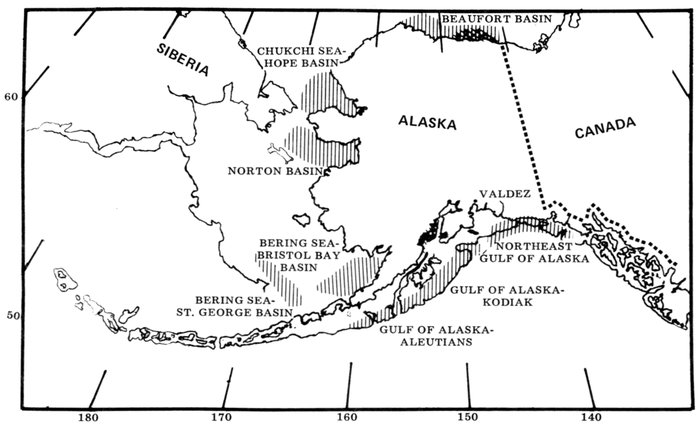
Fig. 1. North Pacific, showing portions of the outer continental shelf being considered for gas and oil leasing by the Federal Government (vertical hatching) and areas leased or proposed for leasing by the State of Alaska (cross hatching).
Kinney et al. (1970) reported that in Cook Inlet, Alaska, an estimated 0.3% of the oil produced and handled in offshore platform wells is spilled. Several routine offshore operations result in discharges of oil and other materials into water, and, unlike accidental spills, the probability of their occurrence is 100% (Council on Environmental Quality 1974). During drilling operations, cleaned drilling mud and drill cuttings are discharged overboard. Drilling mud may consist of such substances as bentonite clay, caustic soda, organic polymer, proprietary defoamer, and ferrochrome lignosulfate. Waters from geological formations are often produced and discharged into the sea while the wells are in production. These waters may be fresh or saline, and often contain small amounts of oil. All of these pollutants increase the adverse effects of offshore oil production, and when potential spills are also considered, the ultimate impact on the marine ecosystem may be substantial.
The State of Alaska has already leased offshore sites in Kachemak Bay, and present considerations for future leases in the lower Cook Inlet and Beaufort Sea further reflect the widespread and massive nature of petrochemical developments in the Arctic planned for the next 2 decades (Fig. 1). Proved crude oil reserves are less than 1 billion barrels and natural gas reserves are less than 2 trillion cubic feet in Cook Inlet, but it appears that undiscovered recoverable oil and gas resources may be much greater (Council on Environmental Quality 1974). There are also indications that known onshore oil reserves along Alaska's northwest coast will soon be opened for development by the Arctic Slope Regional Corporation, landowners in the area as a result of the Native Land Claims Act of 1971. This group is at least considering the transportation of these petroleum products to market in tankers, from an open-water port in the Chukchi Sea—thereby adding to the tanker traffic in northern waters.
Hard Mineral Resource Development
As indicated by Bartonek et al. (1971), there has been renewed interest in opening up Alaska's hard mineral resources to economic development as new transportation routes and modes have been developed. Plans are being completed to develop the Bering River coal field, with the eventual goal of exporting coking coal to Japan. Although mining operations might ultimately affect freshwater environments to the detriment of several waterfowl species, including the trumpeter swan (Olor buccinator), the chief cause for concern will be additional freighter traffic through Prince William Sound. Similar plans to develop Klukwan and Snettisham iron deposits in southeastern Alaska for the use of Japanese industry (Bartonek et al. 1971) may result in the imposition of further traffic in Alaska shipping lanes.
Plans are under way to strip-mine coal deposits in the Beluga field near the west side of Cook Inlet and transport a coal slurry via pipeline to a thermal electric generation plant opposite Anchorage on the Inlet. Impact on tidal areas may be minor, but thermal pollution of the waters is a possibility.
Development plans for tin and tungsten deposits in the Lost River area of Alaska's Seward Peninsula are under way after several years of faltering starts and stops. These activities and possible extraction of gold lying offshore from Nome may ultimately have some effect on these coastal areas. Methods for recovering gold, regardless of the type, would disrupt marine and estuarine environments used by marine birds (Bartonek et al. 1971), and transportation of ores would also increase freighter traffic in the Bering Sea.
Timber Resource Development
Although the timber industry has long been established along the coast from Washington north through southeastern Alaska, timber harvests are rapidly expanding on U.S. Forest Service lands in Alaska. The impact of this industry is principally on terrestrial ecosystems, but certainly log rafting in estuarine areas, disposal of wastes from pulp mills, and freighter traffic transporting wood pulp or logs to Japan and west coast markets contribute to the chronic degradation of marine bird environments. Recent meager studies on the Vancouver Canada goose (Branta canadensis fulva) in southeastern Alaska have pointed out the importance to this species of coastal timber stands for nesting and estuarine environments for brood rearing and wintering. This essentially nonmigratory goose (Hansen 1962) may be particularly vulnerable to logging activities in these areas. Similarly, recent evidence indicates that marbled murrelets may nest in large conifer trees adjacent to the coast, from northwestern California to northern southeastern Alaska (Harris 1971; Savile 1972). If this is true, logging may eventually greatly restrict the breeding of this numerically important inhabitant of northern coastal waters.
Assessment of Resource Development and Potential Conflicts with Marine Bird Conservation
Although extraction of hard mineral resources, expansion of the timber industry, and resultant increases in human pressures along North Pacific and Arctic coasts will ultimately affect northern marine bird populations, current and proposed activities of the petroleum industry pose the most immediate threat to marine birds. Chronic degradation of estuarine and marine coastal waters by logging wastes, pulp mill and sewage effluents, and bilge oils is an insidious process, the impacts of which will be difficult, at best, to quantify. Results of a major oil spill or even low-level contamination of marine ecosystems with oil will be more apparent, however. For this reason, and the fact that the industry is expanding rapidly into the North, most of this discussion will be directed at the impacts of oil development on northern marine birds.
Potential sources of adverse environmental degradation affecting these birds resulting from oil and gas exploration, development, and production include: (1) oil discharges into marine waters, both chronic and catastrophic, (2) gravel excavation and dumping in coastal areas, (3) seismic activities, (4) discharge of drilling mud and drill cuttings into marine waters, including toxic heavy metal constituents of drilling mud, (5) disturbance resulting from petrochemical activities, and (6) increased human populations resulting in interference with critical life processes and increased hunting of game species. Each source of environmental change will vary by latitudinal and seasonal factors in their effects upon the birds. We consider herein only coastal and ocean floor developments and their anticipated generalized impacts on populations.
Although this is a discussion of "northern" marine birds, it is important to remember that we are considering a diverse avifauna existing in an environmental gradient from temperate to polar regions. In general, the more southerly portions of this marine environment are characterized by a greater diversity of species, more complex food chains, and a resultant greater stability (Dunbar 1968). Arctic marine ecosystems, on the other hand, are characterized by numerical dominance by a few species, relatively simple food chains, and an inherent instability or fragility (Dunbar 1968). According to Dunbar, arctic systems are regulated primarily by temporal oscillations in the physical environment, whereas biological interactions (e.g., competition, predation) are considered more significant in the maintenance of temperate and tropical ecosystems.
Because of their relative instability, arctic ecosystems are more susceptible to alteration by extreme environmental perturbation, either natural or man-imposed (Burns and Morrow 1973). Slow growth and maturation rates of the avian constituents of these ecosystems and resultant long recovery periods (Ashmole 1971) further aggravate this situation.
Regardless of their seasonal availability, these arctic waters constitute some of the most productive areas for seabirds in the western hemisphere (Bartonek et al. 1974). Upwelling, nutrient-rich waters, combined with intense and prolonged incident radiation, result in lush phytoplankton "blooms" that form the foundation of relatively simple but numerically strong plant and animal communities (Ashmole 1971). A relatively small number of avian species have evolved to take advantage of this seasonally available food supply, and the ability to migrate to lower latitudes in winter is a characteristic of most arctic-nesting species. Because summers are short in arctic regions, early arrival and a synchronous breeding schedule are necessary to enable the young to leave the breeding grounds before severe weather conditions prevail (Ashmole 1971). Arrival of these birds generally coincides closely with the earliest availability of nesting habitat and food (Williamson et al. 1966). Migration, molting, and reproduction place tremendous stresses on these birds, and as a result, arctic-nesting species tend to reproduce less often and at older ages than do those of more temperate regions (Ashmole 1971).
In spite of these adaptations, arctic bird species tread a thin line between extinction and survival, and natural disasters take a heavy toll. Bailey and Davenport (1972) reported a massive mortality in a pelagic population of common murres in Bristol Bay, Alaska, during April 1970. They felt that this disaster, resulting in the death of probably 100,000 or more birds, most likely resulted from starvation precipitated by severe weather. Barry (1968) reported a similar loss to starvation of about 100,000 eiders along the Beaufort Sea coast during the extremely cold spring of 1964. Observers along Alaska's Beaufort Sea reported finding eiders and oldsquaws dead and dying from the effects of cold weather in 1970 (Bartonek et al. 1971). It is readily apparent that the tenuous existence into which these birds have evolved leaves them particularly vulnerable to the man-induced stress of developments during the arctic summer.
Direct Effects of Oil Pollution
The most obvious, and perhaps the most disastrous consequence of petrochemical development on northern marine bird populations is that of a major oil spill or a well blowout into marine waters. Although temperate and tropical waters are apparently able to assimilate oil spills and chronic pollution from petroleum and its products (Nelson-Smith 1972), this has not been demonstrated to be true for arctic waters. In fact, studies in the Beaufort Sea have shown that the bacteria that degrade oil do not use hydrocarbons at the ambient temperatures of the Arctic (Glaeser and Vance 1971). Therefore, a large oil spill in the Arctic could persist for many years. As demonstrated by Campbell and Martin (1973), the diffusion and transport mechanisms generated by the pack-ice dynamics of the Beaufort Sea and the slow rate of oil biodegradation under arctic conditions would combine to diffuse an oil spill over the sea and eventually deposit oil on the ice surface. This, in turn, would lower the natural albedo over a large area and melt the ice in the area of the spill. This pack ice supports an under-ice community which is an important food source for phalaropes, jaegers, gulls, terns, and other seabirds (Watson and Divoky 1972).
As indicated by Nelson-Smith (1972) many investigators have stated that a spot of oil "no bigger than a dollar" on the breast of a bird is enough to bring about death by exposure, at least in the colder seas. It is easy to see the relative vulnerability of already stressed birds in arctic areas to a spill, and because of the concentration of these birds in available open-water areas, possibilities for catastrophic mortalities are evident.
Such disasters already have occurred in north Pacific waters. Dickason (1970) reported an incident in which diesel oil reaching the Alaska coast, probably from the sinking of two Japanese freighters some distance offshore, affected an estimated 90,000 murres. J. G. King, Jr. (cited in Bartonek et al. 1971) estimated that at least 100,000 birds, mostly alcids and waterfowl, died in the vicinity of Kodiak Island during winter 1970 as a result of oil pollution (probably ballast dumped by tankers entering Cook Inlet). It must not be forgotten that chronic pollution in similar areas where oil development and transport activities are taking place probably kills more birds every year than die after a single catastrophic spill. Total annual losses due to oil in the North Sea and North Atlantic, excluding disasters, amount to 150,000 to 450,000 seabirds (Nelson-Smith 1972).
That oil pollution, both chronic and catastrophic, can dramatically affect populations of marine birds has already been demonstrated elsewhere. Uspenskii (1964) reported that more than 30,000 wintering oldsquaws perished from oil pollution near Botland Island in the Baltic and that in later years this species had almost disappeared from Swedish Lapland. Jackass penguins (Spheniscus demersus), found only in South Africa, have suffered losses from pollution caused by oil traffic around the Cape of Good Hope (Stander and Venter 1968). Their total population was estimated at 100,000 in 1960, and in two separate but not isolated incidents 1 to 2% of this number were known to have been killed by oil. Unknown but considerable numbers were uncounted or were lost at sea. Colony nesters, including puffins (Fratercula arctica), razorbills (Alca torda), and murres in the southerly portions of the North Sea are declining rapidly (Nelson-Smith 1972). Puffins, which numbered 100,000 on Annet in the Scilly Isles in 1907, were reduced to 100 birds by 1967; by then, colonies farther east on the Great Britain coast were already extinct. Pollution from the Torrey Canyon disaster alone killed five-sixths of the puffins in the main French colony on the Sept Isles in Brittany and reduced the razorbills to a mere 50 birds, one-ninth of previous numbers (Bourne 1970).
There is every reason to believe that similar reductions in numbers could occur along the tanker route from Valdez to Puget Sound, with localized extirpation of colonies. Even more disastrous, however, would be an inopportune well blowout or other major spill in arctic waters. Massed concentrations of birds, already stressed by severe weather and food shortages, would be extremely vulnerable to this type of situation.
As pointed out by Nelson-Smith (1972), peculiarities of bird behavior determine, to some extent, the vulnerability of a species to oil spills. Auks, murrelets, and puffins (all Alcidae), loons (Gavia spp.), grebes (Podiceps spp.), and diving ducks may be most susceptible to oiling. Auks and loons, because they float low in the water, may more readily become completely covered by oil. Diving species that become flightless during their molt, such as alcids and waterfowl, or which do not fly because of social bonds between adults and flightless young (common murre) and spend most of their lives on the water, would be particularly vulnerable (J. M. Scott, comments by Pacific Seabird Group on U.S. Department of the Interior Draft Environmental Statement 74-90). All divers can easily surface into oil, and their reaction is to dive again, which in a large spill could result in surfacing into more oil. Phalaropes (Phalaropus spp.), which flock to feed in eddies which concentrate drift, may similarly be vulnerable to adverse effects of oil that would also concentrate in these areas. On the other hand, gulls swimming along the surface are likely to take wing before becoming seriously contaminated.
Nelson-Smith (1972) reported that gannets (Morus bassana), which collected oiled sea-weed for building nest mounds, contaminated themselves and their eggs. Behavioral problems associated with oil spills can be more subtle, however, and Darling's (1938) conclusions that the display of adjacent males contributes to stimulation of the female during courtship in seabirds breeding in massed colonies, is a good example. If Darling was correct, this behavioral characteristic could further impede the recovery of a population of auks, for example, from mortalities resulting from catastrophic losses to spills.
On the basis of this information it is possible to predict that alcids, which make up the bulk of the birds inhabiting the coastal areas during winter (Sanger 1972), would be very susceptible to oil spills from future tanker traffic in these waters. The potential exists, therefore, for a tremendous impact (from a single inopportune oil spill) upon these species and upon the entire ecosystem. Sea ducks too, because of their diving behavior, propensity for flocking, and flightless molt period, would be very vulnerable to oil spills. Wintering flocks of oldsquaws and several species of scoters along the coasts of Alaska, British Columbia, and Washington can be expected to dwindle as North Slope oil begins to be transported to Puget Sound ports.
It is recognized now that seabirds transfer and recycle nutrients and energy between trophic levels and between regions of an ocean (Sowl and Bartonek 1974). Although the significance of this role in the marine ecosystem can only be surmised at present, conservative estimates by Sanger (1972) indicated that birds consume from 0.6 to 1.2 million tons of food and return from 0.12 to 0.24 million tons of feces into the subarctic Pacific region annually. G. A. Sanger's (personal communication) revised estimates of these bird populations indicated that his 1972 estimates should be doubled. Regardless, it appears that the disastrous effects of such a spill would extend beyond the bird populations involved.
Indirect Effects of Oil Pollution and Petrochemical Developments
By no means would direct losses attributable to contamination by oil be the only threat to marine bird populations as a result of petrochemical expansions into these waters. Some water birds that become contaminated with nonlethal doses of petroleum during the breeding season are not likely to breed (J. M. Scott, comments by Pacific Seabird Group on U.S. Department of the Interior Draft Environmental Statement 74-90). Viability of embryos is greatly reduced when the eggshell becomes smeared with oil from the contaminated plumage of the female (Hartung 1965). Degradation of habitat, particularly to nesting areas and food supplies, will certainly occur, and its most pronounced effects will be felt in the Arctic. Gravel removal for construction of offshore drilling pads, causeways, and onshore production facilities would displace nesting birds and, combined with subsequent discharge of drill cuttings, perhaps have an adverse impact on bottom food organisms. Nesting habitat loss through destruction or the inability of birds to accept disturbance could be substantial, particularly along the Beaufort Sea coasts of Alaska and Canada, where offshore barrier islands and tundra-covered islands provide protection from mammalian predators for nesting by Pacific eiders, Sabine's gulls (Xemia sabini), Arctic terns (Sterna paradisaea), black guillemots (Cepphus grylle), and other species (Arctic Institute of North America 1974). Flaxman Island near the mouth of the Canning River is a tundra island supporting a nesting population of whistling swans (Olor columbianus), and the only nesting colony of the Alaska snow goose (Chen caerulescens) is on Howe Island in the Sagavanirktok River Delta (Arctic Institute of North America 1974).
Although there would probably be little actual nesting habitat loss for cliff-nesting species, human disturbance to colonies during the nesting period, particularly from helicopter and fixed-wing aircraft flybys, could have considerable impact (Sowl and Bartonek 1974). The "living waterfall" effect of thousands of seabirds pouring off a rookery is truly spectacular, but each such occurrence during incubation and brooding periods causes a rain of eggs or young to fall from the cliffs (Sowl and Bartonek 1974). Temporarily abandoned chicks and eggs are susceptible to predation by gulls or jaegers.
Even for species nesting on level ground, aircraft overflights close to breeding colonies may cause major losses to young and eggs. Sladen and LeResche (1970) reported that flights by an LH-34 helicopter (at 305 m altitude) over an Adelie penguin (Pygoscelis adeliae) colony caused some egg loss. Landing this aircraft 183 m from the colony caused 50 to 80% of the birds to flee territories, resulting in egg and chick loss. Disturbance caused by visitors walking through or near nesting areas of the South African gannet (Sula capensis) on Bird Island, Lamberts Bay, South Africa, caused desertion of nesting sites (Jarvis and Cram 1971). Studies of disturbance on breeding black brant, Pacific eiders, glaucous gulls (Larus hyperboreus), and arctic terns at Nunaluk Spit and Phillips Bay, Yukon, in July 1972 indicated that human presence was the most critical form of disturbance affecting incubating behavior of these species (LGL Limited 1972a). Disturbance by aircraft—especially helicopters—affected the normal incubating behavior of all species except Pacific eiders. Nesting success of black brant and arctic terns was reduced by this disturbance.
Disturbance can adversely affect molting birds. The process of molting places heavy energy demands on birds, and particularly on waterfowl whose molt results in a flightless period; few areas provide adequate protection from predators necessary during this period. Prime molting areas are scarce along the arctic coast, yet are vital to the welfare of thousands of sea ducks and seabirds. Studies conducted by LGL Limited (1972b) indicated that aircraft traffic over sea duck molting areas altered normal behavior, and therefore had a detrimental effect. Recommendations resulting from these studies were that air traffic be suspended over these areas during the molting season.
For some arctic-nesting waterfowl, premigration staging activity, during which fat reserves to sustain southward migration are stored, is a very important component of the annual cycle (Delacour 1964). Snow geese, breeding mainly in arctic Canada, concentrate in large numbers on staging grounds along the Beaufort Sea coast of eastern Alaska and the Yukon. Because gas compressor stations would be required along the proposed arctic gas pipeline route, experimental studies were conducted in September 1972 to determine the effect of disturbance from sounds generated by compressors (LGL Limited 1972c). These studies indicated that compressor noise was disruptive to staging geese.
Indirect effects on marine bird resources resulting from development activities may ultimately prove to be more detrimental than the aforementioned direct factors. It is conceivable that the impact of these industries, mainly on the benthic and demersal fauna of the coastal areas, could greatly lower the carrying capacity of this habitat for marine birds (Bartonek et al. 1974). Because of the simplified and short arctic food chains and the lack of alternative food sources in these areas, arctic ecosystems would be particularly vulnerable to this type of problem (Burns and Morrow 1973).
Ecological or toxic influences on several food species could result in substantial declines in bird populations. In the Arctic, where temperatures are low, and bacterial and other decompositional activities are consequently slow, spilled oil would persist for many years, with concomitant deleterious effects on the marine organisms of the area (Burns and Morrow 1973). Reduced recruitment of young would no longer balance inevitable or density-independent population mortality (Ashmole 1971). Although indications are that arctic species are the most vulnerable to this type of impact, the lack of knowledge of the feeding niches of most seabirds discourages further evaluation of this potential problem. It is obvious, however, that ecology of arctic birds is least understood, and these species are the most vulnerable to the detrimental effects of man-caused environmental degradation.
Conclusions
Predictability of the impact of resource development on marine birds in northern waters is limited by our relative ignorance of these birds and their ecology. Just as there exists a latitudinal gradient in the ecological stability of the ecosystems involved, available knowledge of these ecosystems is in inverse relationship to the latitude at which they occur. Arctic bird associations and their fragile environments are least understood but are doubtless the most vulnerable to the detrimental effects of man-caused environmental degradation. Existing technology and support system capabilities of the oil industry are poorly defined for Arctic areas, further compounding this problem (Arctic Institute of North America 1974).
Although activities associated with the extraction of hard minerals and the timber industry will ultimately affect northern seabirds, petrochemical developments pose the most immediate threat to this resource. Exploration and development of many coastal and offshore sedimentary basins with a potential for oil or gas production are proceeding rapidly. Within a few years, oil storage and loading facilities at Valdez, Alaska, and supertankers plying northern waters will probably result in widespread chronic and localized catastrophic contamination of northern marine environments. Experience in other areas has demonstrated that oil spills are a considerable potential threat to these bird populations, directly through widespread mortality and indirectly through effects on the environment. This threat is of such magnitude that entire populations or species could be lost to a single spill if it occurred at the wrong place at the wrong time of year. Because many of these species require 3 to 4 years for maturation and may rear only one or two young per year, recovery time for their populations is great (Ashmole 1971). For these and other reasons, the Council on Environmental Quality (1974) concluded that the Gulf of Alaska appeared more vulnerable to major environmental damage from outer continental shelf oil and gas development than sites off the Atlantic coast.
As Bartonek et al. (1971) pointed out, it would be a national tragedy if the great nongame bird populations along Alaska's coast were decimated during the "Environmental Decade" without even being properly described. Regardless of information amassed in the future and precautionary measures taken during exploitation of arctic petroleum reserves, the potential for disastrous and perhaps irrecoverable losses to northern marine bird species and populations is great. Losses of major magnitude could appreciably alter the productivity of northern marine ecosystems, to the detriment of other renewable resources.
Knowledge of northern marine birds, their environments, and their ecology must be greatly expanded if the consequences of petrochemical exploitation are to be predicted and safeguards established against potential problems. To the extent possible, oil exploration and development activities should be limited to temperate, more stable, marine ecosystems, at least until more northerly areas are better understood. Similarly, these activities must be conducted in such places and at such times that impact on the environment will be minimized. State and federal governments and the petroleum industry are ultimately answerable for this responsibility.
The Nation must be aware of the potential costs of energy independence set forth as a goal of proposed oil and gas leasing of Alaska's outer continental shelf. We must ask ourselves if we are willing to risk extermination of species to reach this goal, or if we can afford the luxury of reducing the biological productivity of these waters.
References
Arctic Institute of North America. 1974. The Alaskan arctic coast—a background study of available knowledge. 551 pp.
Ashmole, N. P. 1971. Seabird ecology and the marine environment. Pages 223-286 in D. S. Farner and J. R. King, eds. Avian biology. Vol. I. Academic Press, New York.
Bailey, E. P., and G. H. Davenport. 1972. Die-off of common murres on the Alaska Peninsula and Unimak Island. Condor 74(2):215-219.
Barry, T. W. 1968. Observations on natural mortality and native use of eider ducks along the Beaufort Sea coast. Can. Field-Nat. 82(2):140-144.
Bartels, F. B. 1973. Bird survey techniques on Alaska's north coast. M.S. Thesis. Iowa State Univ., Ames. 47 pp.
Bartonek, J. C., J. G. King, and H. K. Nelson. 1971. Problems confronting migratory birds in Alaska. Trans. N. Am. Wildl. Nat. Resour. Conf. 36:345-361.
Bartonek, J. C., R. Elsner, and F. H. Fay. 1974. Mammals and birds. Pages 23-28 in E. J. Kelley and D. W. Hood, eds. Probes: a prospectus on processes and resources of the Bering Sea shelf, 1975-1985. Univ. Alaska, Inst. Mar. Sci. Publ. Inf. Bull. 74-1.
Bourne, W. R. P. 1970. Special review after the "Torrey Canyon" disaster. Ibis 112:120-125.
Burns, J. J., and J. E. Morrow. 1973. The Alaskan Arctic marine mammals and fisheries. Arctic oil and gas problems and possibilities, 5th International Congress. 24 pp.
Campbell, W. J., and S. Martin. 1973. Oil and ice in the Arctic Ocean: possible large-scale interactions. Science 181:56-58.
Council on Environmental Quality. 1974. OCS oil and gas—an environmental assessment. Vol. I. Washington, D.C. 214 pp.
Darling, F. F. 1938. Bird flocks and the breeding cycle; a contribution to the study of avian sociability. Cambridge Univ. Press, N.Y.
Delacour, J. 1964. The waterfowl of the world. Vol. IV. Country Life Ltd., London. 364 pp.
Dickason, O. E. 1970. Center for short-lived phenomena event report. Smithsonian Institution, Cambridge, Massachusetts, 36(1970):926.
Dunbar, M. J. 1968. Ecological development in polar regions. A study in evolution. Prentice-Hall, Inc., Englewood Cliffs, N.J. 119 pp.
Glaeser, J. L., and G. P. Vance. 1971. A study of the behavior of oil spills in the Arctic. U.S. Coast Guard, Office of Research and Development, Washington, D.C. 60 pp.
Hansen, H. A. 1962. Canada geese of coastal Alaska. Trans. N. Am. Wildl. Nat. Resour. Conf. 27:301-320.
Hansen, H. A., and U. C. Nelson. 1957. Brant of the Bering Sea—migration and mortality. Trans. N. Am. Wildl. Nat. Resour. Conf. 22:237-256.
Harris, R. D. 1971. Further evidence of tree nesting in the marbled murrelet. Can. Field-Nat. 85(1):67-68.
Hartung, R. 1965. Some effects of oiling on reproduction of ducks. J. Wildl. Manage. 29(4):872-874.
Isleib, M. E., and B. Kessel. 1973. Birds of the north gulf coast—Prince William Sound region, Alaska. Biol. Pap. Univ. Alaska 14. 149 pp.
Jarvis, M. J. F., and D. L. Cram. 1971. Bird Island, Lamberts Bay, South Africa: an attempt at conservation. Biol. Conserv. 3(4):269-272.
Kinney, P. J., D. K. Button, D. M. Schell, B. R. Robertson, and J. Groves. 1970. Quantitative assessment of oil pollution problems in Alaska's Cook Inlet. Univ. Alaska Inst. Mar. Sci. Rep. R-69-16. 43 pp.
LGL Limited. 1972a. Disturbance studies of breeding black brant, common eiders, glaucous gulls and Arctic terns at Nunaluk Spit and Phillips Bay, Yukon Territory. Report prepared for Northern Engineering Service, Ltd. 50 pp.
LGL Limited. 1972b. Aircraft disturbance to molting sea ducks, Herschel Island, Yukon Territory. Report prepared for Northern Engineering Service, Ltd. 31 pp.
LGL Limited. 1972c. Gas compressor noise simulator disturbance to snow geese, Kamakuk Beach, Yukon Territory. Report prepared for Northern Engineering Service, Ltd.
McKnight, D. E., and B. L. Hiliker. 1970. The impact of oil development on waterfowl populations in Alaska. Proc. Western Assoc. State Game Fish Comm. 50:286-297.
Nelson-Smith, A. 1972. Oil pollution and marine ecology. Paul Elek, Ltd., London. 260 pp.
Sanger, G. A. 1972. Preliminary standing stock and biomass estimates of seabirds on the subarctic Pacific region. Pages 589-611 in A. Y. Takenouti et al., eds. Biological oceanography of the North Pacific. Idemitsu Shoten, Tokyo.
Savile, D. B. O. 1972. Evidence of tree nesting by the marbled murrelet in the Queen Charlotte Islands. Can. Field-Nat. 86(4):389-390.
Sladen, W. J. L., and R. E. LeResche. 1970. New and developing techniques in antarctic ornithology. Pages 585-616 in M. W. Holdgate, ed. Antarctic Ecology. Vol. I. Academic Press.
Sowl, L. W., and J. C. Bartonek. 1974. Seabirds—Alaska's most neglected resource. Trans. N. Am. Wildl. Nat. Resour. Conf. 39:117-126.
Stander, G. H., and J. A. V. Venter. 1968. Oil pollution in South Africa. Pages 251-259 in Proceedings of the International Conference on Oil Pollution of the Sea.
Swartz, L. G. 1966. Sea-cliff birds. Pages 611-678 in N. J. Wilimovsky and J. N. Wolfe, eds. Environment of the Cape Thompson region, Alaska. U.S.A.E.C., Div. Tech. Inf., Oak Ridge, Tennessee.
Thompson, D. Q., and R. A. Person. 1963. The eider pass at Point Barrow, Alaska. J. Wildl. Manage. 27(3):348-356.
Uspenskii, S. M. 1964. Present day problems of nature conservation in the Arctic. Problems of the North 7:171-178.
Watson, G. E., and G. J. Divoky. 1972. Pelagic bird and mammal observations in the eastern Chukchi Sea, early fall 1970. Pages 111-172 in C. I. Merton et al., eds. An ecological survey in the eastern Chukchi Sea. U.S. Coast Guard Oceanogr. Rep. 50.
Williamson, F. S. L., M. C. Thompson, and J. Q. Hines. 1966. Pages 437-480 in N. J. Wilimovsky and J. N. Wolfe, eds. Environment of the Cape Thompson region, Alaska. U.S.A.E.C., Div. Tech. Inf., Oak Ridge, Tennessee.
Mortality to Marine Birds Through Commercial Fishing
by
Warren B. King
International Council for Bird Preservation Smithsonian Institution, Washington, D.C.
R. G. B. Brown
Canadian Wildlife Service Dartmouth, Nova Scotia, Canada
and
Gerald A. Sanger[52]
U.S. National Marine Fisheries Service Seattle, Washington
Abstract
Commercial fishing has been responsible for incidental mortality of seabirds for centuries, but with the advent of offshore salmon gill-net fishing in the North Pacific in 1952 and in the North Atlantic in 1965, the magnitude of this kill has increased, and there is strong indication that populations of some seabirds are being adversely affected. Murres (Uria spp.) are most frequently killed, although several other species are caught in lesser numbers. The seabird resources of several nations are involved in this mortality. Longline fishing and inshore gill-net fishing for salmon and cod also are responsible for mortality of seabirds, although usually not in significant numbers.
That the activities of commercial fishermen have caused mortality of marine birds surprises no one nowadays. Traditions of exploitation of marine birds by fishermen date from previous centuries, and fishing has contributed to the extinction of some species. For example, great auks (Pinguinus impennis) and other birds were used as food by fishermen fishing for Atlantic cod (Gadus morhua) on the Grand Banks of Newfoundland since the beginning of that fishery in the early 16th century (Collins 1884; Lucas 1890). The last great auk died in 1844, but smaller species, such as storm-petrels (Hydrobatidae), greater shearwaters (Puffinus gravis), and black-legged kittiwakes (Rissa tridactyla), were used for food until rather recently (Templeman 1945). This practice has now lapsed, however.
Inshore Fisheries
Until the advent of the offshore salmon gill-net fisheries in the North Pacific in 1952 and the North Atlantic in 1965, most seabird mortality in these areas was the result of local fishing close to shore. Several records of such bird mortality have been published. For example, 8,000-10,000 seabirds—presumably mostly alcids—were reported caught annually off Hammerfest in northern Norway (Holgersen 1961). E. Brun (personal communication) reported that the longline fishery off the coast of Norway is having serious consequences on Norwegian populations of murres.
Numbers of alcids are caught in nets set for Atlantic salmon (Salmo salar) around the coasts of Ireland and Scotland (Biddy 1971). A similar situation exists along the west Greenland coast, although it is overshadowed there by the direct exploitation of huge numbers of alcids by hunting. Nonetheless, in 1967 for example, 15,000 alcids were recovered from fish nets in southwestern Greenland, where they were sold as food (Evans and Waterston 1976). The annual salmon catch of the west Greenland inshore fishery has fluctuated between 60 and 1,500 metric tons and has averaged about 1,000 tons. There are no data comparing the relative catch of birds and fish in this fishery.
Atlantic cod follow the spawning capelin (Mallotus villosus) inshore along the east coast of Newfoundland in late June and early July. They are traditionally fished with traps and handlines along this coast, but there has been a recent trend toward using drift nets set on the bottom. Since alcids feed extensively on capelin at this time, many are caught in the cod nets set in areas close to the large colonies off Witless Bay (D. N. Nettleship, personal communication). Additionally, gill nets are set at the surface for salmon in the same area. Common murres (Uria aalge) are most affected, but Atlantic puffins (Fratercula arctica) are also taken.
There are as yet no estimates of the total alcid mortality from this fishery, although the annual catch of birds is believed to be smaller during the present than during the last decade because the fishing effort is reduced, and fishermen in the area now avoid setting nets near alcid concentrations because of the annoyance of having to remove the birds from their nets. The Witless Bay colonies contain over 77,000 pairs of common murres, or 11% of the total eastern North American population, and over 235,000 pairs of Atlantic puffins, or 71% of the North American population outside of Greenland (Brown et al. 1975). The potential danger is obvious.
There are few data on mortality of seabirds from inshore commercial fisheries in the North Pacific. Some mortality of alcids has been shown to take place in Cook Inlet, Alaska, from beach-netting for Pacific salmon (Oncorhynchus spp.) adjacent to seabird rookeries and from drift-netting in the inlet (D. A. Snarski, personal communication), but this mortality has not been quantified.
Bilateral agreements between the United States and Japan, the U.S.S.R. and the Republic of Korea, concerning the use of inshore waters adjacent to some of the Aleutian Islands, Kodiak, Nunivak, St. Matthew, St. George, Kayak, and Forrester Islands permit trawling, longlining, and loading fish and fuel in some of these areas and at certain periods. Although these activities may affect the seabirds of these areas, the extent of the effects are not known (U.S. Department of the Interior, Alaska Planning Group 1974). Murie (1959) indicated, however, that the disappearance of the ancient murrelet (Synthliboramphus antiquus) from Sanak Island, Gulf of Alaska, was probably due as much to fisheries as to the blue fox industry. It has been suggested that the Japanese murrelet (Synthliboramphus wumizusumi) may have declined as the result of fishing activities near breeding sites off the coast of Japan (Bourne 1971).
Atlantic Offshore Gill-net Fishery
In 1965, Denmark began an offshore gill-net fishery for Atlantic salmon in the Davis Strait off the coast of west Greenland. The offshore fishery catch increased from 36 metric tons in 1965 to more than 1,200 metric tons in 1969, and then gradually decreased.
The fact that large numbers of seabirds—almost entirely thick-billed murres (Uria lomvia)—were being drowned in the salmon gill nets was brought to the attention of the International Council for Bird Preservation at its 15th World Conference in 1970. The Council's recommendation was submitted to the Danish government and stated: "... having noted that during the 1969 fishing season about 250,000 individuals of Brunnich's guillemot or thick-billed murre (Uria lomvia), a pelagic diving bird, were caught in these drift nets and drowned, which number represents no less than 25 percent of the Greenland population and exceeds its annual reproductive capacity; urges the Danish Government, and the national governments of all other countries involved in this fishing, to take all possible measures to eliminate this very serious problem."
The figures in the recommendation were not supported by research; they appeared instead to have been derived from the observed mortality on an offshore fishery vessel in 1965, which was then related to the salmon catch on that vessel and applied to the total catch of the inshore fishery in 1964 (Anonymous 1969). Studies in 1969 and 1970 by the Fisheries Research Board of Canada finally gave a firm basis for the earlier, though poorly substantiated concern. On the basis of the assumption that the ratio of salmon to murres caught in experimental fishing applied to the commercial fishery, an estimate of an annual mortality of 0.5 million murres (±50%) was made on the basis of a salmon catch of 1,200 metric tons (Tull et al. 1972).
The birds being killed were from colonies in west Greenland, the eastern Canadian Arctic, and possibly east Greenland and Spitzbergen. Coupled with other known causes of mortality (particularly hunting on the Greenland and Newfoundland coasts, an unknown but definitely substantial kill from oil pollution, a calculated mortality of pre-fledging young, and an unknown natural post-fledging mortality) there is no doubt that the estimated annual production of 1.5 million chicks from west Greenland and the Canadian Arctic was less than the estimated total annual mortality (Tull et al. 1972). Thus, it comes as no surprise that recent surveys of murre populations of west Greenland and the Canadian Arctic have revealed massive declines in numbers (Evans and Waterston 1976; D. N. Nettleship, personal communication). It is therefore encouraging news that, as a result of an agreement between the United States and Denmark, the offshore salmon gill-net fishery was terminated at the end of the 1975 season. The inshore fishery remained in operation, however, but was restricted to a total annual salmon catch of 1,100 metric tons.
Pacific Offshore Salmon Gill-net Fishery
In the north Pacific Ocean, the Japanese gill-net fisheries for salmon (Oncorhynchus spp.), which have operated since 1952, might be expected to have an even more destructive effect on seabirds, since the annual salmon catch by the three Japanese salmon drift-net fisheries was about one hundred times that in west Greenland in recent years. The first, the mothership fishery, comprising about 369 catcher-boats[53] serviced by 11 mother-ships, operates west of 175°W and generally north of 46°N during the summer. The second, the land-based fishery of about 325 ocean-going vessels, operates west of 175°W and south of 46°N; and the third, the coastal fishery, made up of about 1,380 short-haul vessels, operates off Hokkaido. The relative salmon catches of these three fisheries is on the order of 1:1.34:0.65.
Data collected on U.S. National Marine Fisheries Service research vessels in 1974 (obtained through the cooperation of Francis M. Fukuhara and Richard Bakkala, Northwest Fisheries Center, Seattle, Washington) give, for the first time, an estimate of the magnitude of the incidental seabird kill of the Japanese salmon gill-net fishery. The kill data are available only from the mothership area and from an area east of it to 165°W. The Japanese salmon fishery is restricted to waters west of 175°W by agreement with the United States. Bird kills from the other two areas may be estimated by the relative salmon catch figures for the areas, assuming that seabird densities, species composition, and catch effort are similar.
An estimate of the total kill of seabirds in the mothership area may be made by calculating the bird mortality per length of gill-net set by research vessels, multiplied by the total length of gill nets set by the 369 catcher-boats of the Japanese mothership fishery. About 4,666 km of nets are set and retrieved daily during the approximately 65-day fishing season. The estimated annual mortality in the mothership area is about 75,000 to 250,000 birds. The lower number is based on data from 10 cruises (450 km of nets set) west of 175°W, within the area of the mothership fishery. The higher number is based on data from 20 cruises, including those in the first figure, west of 165°W, and covering the period 18 April to 3 September 1974 (956 km of nets set), whereas the mothership fishery usually operates between mid-May and late July. Assuming similar seabird densities and catch per unit of effort in the areas of the land-based and coastal fisheries, the estimated annual mortality is between 214,500 and 715,000 birds. Since 1952, as many as 4.7 million birds may have been killed by the Japanese salmon gill-net fishery. It must be stressed that seabird densities and catch per unit of effort are not known to be similar for the areas in question; consequently the projection of bird kill figures from one area to all three is speculative.
In the mothership area and adjacent seas to the east, in addition to murres (48% of birds killed), significant numbers of shearwaters, Puffinus spp. (27%); puffins (9%); and fulmars, Fulmarus glacialis (5%) are killed, as are lesser numbers of small alcids, albatrosses (Diomedea spp.), and storm-petrels. The murres and puffins taken in the mothership area are of U.S. and U.S.S.R. origin, and the shearwaters come from New Zealand, Australia, and Chile. In the coastal fishery area, Japanese and U.S.S.R. alcids are taken. Available knowledge of the populations of the species making up the bulk of the kill, which has been taking place for 20 years, is insufficient to suggest whether their annual reproduction can tolerate such losses. Prohibition of fishing within 160 km of North Pacific seabird breeding islands would help to decrease losses of alcids of U.S. origin, but would not help the shearwaters from the southern hemisphere.
Comparison of statistics of the salmon fisheries and associated bird kills from the North Atlantic and the North Pacific shows that the North Atlantic salmon fishery is concentrated in a relatively small area which is also along a major migration pathway of murres. Virtually all seabird mortality is confined to one species. Enough information is at hand to indicate that this cause of mortality, in conjunction with others known to be significant, is causing a drastic decline in the thick-billed murre population.
In the North Pacific, on the other hand, the fishery is more widely dispersed and the ratio of seabirds to salmon caught is much lower. Furthermore, several species are subject to mortality. No information is available to indicate whether alcid populations (which make up two-thirds of the kill) are stable or decreasing. The shearwaters, primarily sooty (Puffinus griseus) and slender-billed (P. tenuirostris), appear to be able to sustain not only these losses but also a sizable harvest of birds of the year (the so-called muttonbirds) on their New Zealand and Australian breeding grounds. Thus, although the latest estimates of the total standing stock of seabirds in the North Pacific in summer may be as high as 100 million (Sanger and King, this volume), and thus only about 1 of every 200 birds in the North Pacific region may be caught, the fact that a few species, particularly murres, are selectively caught raises questions about the impact of this fishery on populations of these species.