Chapter V · COMMERCIAL CLASSIFICATION AND DESCRIPTION.
Reading edition
Coffee in commerce is the seed which grows in the pod or fruit of the coffee plant, like the pea or the bean. Geographically, it is divided into African, Asian, American and Polynesian coffees, and, topographically, into “Mountain,” or upland, and “Plaingrown,” or lowland Coffees, while commercially they are generally classified as “Mild” and “Strong,” the former comprising in trade the product of all countries, with the exception of Brazil. Grown in so many different and widely separated countries, provinces, districts and situations, it is but natural that the different products should vary materially in size, style, color, form, flavor and character, and which also accounts for the almost innumerable commercial divisions and subdivisions of names, grades and values.

AFRICAN COFFEES.
Africa is the original home of coffee, it being indigenous to almost the entire Continent; but while it is to be found growing in a wild state almost all over the entire of tropical Africa, more particularly between the fifth and fifteenth parallels, its cultivation for commercial purposes on the “Dark Continent” is very light and partial at the present time, although it affords a field of boundless development in the future. African Coffees are divided into West and East Coast, the former comprising Liberian, Loango, Angola, Benguelan, Congo and Natal; the latter including Abyssinian, Egyptian, Zanzibar, Mozambique, Nubian, Madagascar, Bourbon and Mauritius.
Liberian—Is produced in the Americanized colony known as the “Black Republic,” and is principally cultivated in the district of Mesurado, on the St. Paul river. It is an extremely large dark-brown bean, possessing very marked peculiarities, being “concave-convex”—technically termed “Male or pea-berry”—in form; that is, round on top, with long, deep furrow extending longitudinally down the face, tightly rolled or “folded” in appearance and very hard and solid in texture. When roasted and infused the liquor is dark in color, heavy in body and from 30 to 40 per cent. stronger in flavor than that of any other variety grown, and is considered too strong to use alone, but when blended in the proportion of about one to three parts of some of the milder growths it makes a fairly smooth and rich drinking coffee. The annual production is limited—about 10,000,000 pounds—put up in large, coarse bags, averaging 200 pounds, and is principally exported to England and the continent of Europe, where it is used principally, on account of its ultra strength, for mixing with chicory, and sold chiefly in the form of ground coffee.
Loango—Also an indigenous variety, is grown in the interior province of Encougé, deriving its trade name from the port of shipment. It closely resembles Liberian in form and color, but is much smaller in size and greatly inferior in quality, and is sometimes termed “African pea-berry.” The raw or natural bean is dark-brown in color, light or “chaffy” in weight, very brittle and poorly prepared, while the liquor is almost black and insipid, if not actually rank or nauseous, in flavor, the decoction tasting more like an infusion of char-bones than anything else it may be likened to. It is principally shipped to Spain, Portugal and other European countries, very little, fortunately, ever reaching the United States.
Angola—Produced in the Portuguese colony of that name, is medium in size, concave in form, light-brown in color, strong and pungent in flavor, but lacking in smoothness and aroma. Not being regularly cultivated, its production is limited, that grown by the settlers on the uplands of the interior being much superior to the wild or native sorts.
Benguelan—Is another variety of Angola, grown in the adjoining province to the south and closely resembles it in size, color and general character. Being also limited in supply, it is rarely if ever shipped to this country, what is not retained for home consumption being forwarded to Lisbon, Madrid and the Canaries.
Congo—Is a medium-sized, heavy bean, strong and rich in the cup, and, taken altogether, a desirable sort.
Natal Coffee—Is a large light-brown bean, closely resembling the Liberian product, being grown from that species, but greatly modified in body and strength. Coffee culture in Natal is struggling against adverse conditions, owing to the spread of the bark disease in that colony and for which no cure has been found. This is much to be regretted, as the quality of the product is very fair, the demand for the article continually growing. Some Coffees are also grown in the States of Senegal, Gambia, Sierra Leone, St. Helena and the Cape of Good Hope, but, being limited in supply and unknown to commerce, do not need description here.
Abyssinian.—The Coffee plant and its product have been known in Abyssinia from time immemorial, its fruit being used there in a roasted state, but in solid form, for centuries before its introduction to the civilized world, receiving its now universal name from the district of Kaffa or Caffa, in the southeastern part of that country, and becoming the parent-plant of all the numerous varieties now to be found on the Red Sea littoral. At the present time it is grown there in all its native luxuriance and primitive abundance, from the borders of Narla to the banks of the Nile, forming the chief wood of the country. It is also cultivated there in almost all situations, on plateaus and table-lands, mountain and valley, hill and plain, growing as luxuriantly and producing as prolifically on low as on upland sites. The bean is small in comparison with the average coffee of commerce, but long and narrow in shape, hard and “flinty” in texture, and varying in color from a translucent green to a yellowish hue, according to its age. In body and flavor it ranks next to Mocha, to which coffee it is analogous, and is by many connoisseurs preferred to it as being smoother and less heating in effect. It is little known to commerce under its true name, being principally shipped from Massowah to Aden and Alexandria, where it loses its identity, masquerading under the head of “Long-berry Mocha,” and going principally to the Mediterranean and other European markets. The annual crop is large and the yield excellent, but communication and transport facilities being difficult and crude, the bulk of the product does not reach the outside world. It is to be hoped, however, that whenever this rich country which produces coffee in such wild abundance shall be permitted, by civilized man, to enjoy its fertility it will rapidly become an article of extensive cultivation and commerce.
Egyptian—Comprises the product of the Upper Nile region, and that grown around Berber and the Soudan, very little being produced in the country itself. Being the product of different districts, they vary in size and quality, ranging from small to medium, are palish-green in color, flat or regular in shape, and possess superior drinking properties; so much so that many of the smaller bean varieties are put up in Mocha bales at Alexandria and sold under the name of “Short-berry Mocha,” being shipped principally to France and England, where they are known to the initiated as “Alexandrian or Egyptian Mochas.”
Nubian—Is a small-bean coffee, hard and flinty in texture, oval in shape, pale-green in color, heavy in body, and unusually rich in flavor. This variety is usually forwarded to Alexandria for conversion into a so-called Mocha, seldom finding its way into the American or European markets under its legitimate name.
Zanzibar—Is medium in size, regular in appearance, full in body and pleasing in flavor, but also very limited in quantity. Increased effort is now being made, however, by the French, German and Italian colonists to increase and extend its cultivation in that country.
Mozambique—The product is fairly good, ranking with the average of mild coffees, medium in size, greenish in color, heavy and mellow in the cup.
Madagascar—Grown on the immense island of that name, to the east, is a small-bean variety, solid and firm, but shorter and rounder than the latter. It is of a pea-green color when first picked, but gradually assumes that of a silver-gray as it matures; in body it is round and full, in flavor rich and fragrant. The supply of this variety is very small when compared with the extent of area that may be utilized for its profitable culture in that island, the entire product being chiefly retained for home consumption, only small lots occasionally reaching the outer world.
Bourbon—Is a small, hard and flinty bean, being chiefly mountain grown, pale-yellow in color and closely resembling the Arabian product, for which coffee it is extensively substituted, large quantities of the smaller beans being annually shipped to Aden to be repacked in the inimitable Mocha bales and sold as “genuine Aden Mocha.” The larger beans are usually exported to France and the continent, where it is held in high esteem for its rich, fragrant flavor and aroma, but rarely found in the American market unless specially ordered.
Mauritius—Like Bourbon is also an island coffee, the average bean being medium-sized, heavy and well developed, light-green in color, full in body and mellow in flavor, the liquor, in general, comparing favorably with that of finest of the mild grades. The smaller beans are separated and sold for shipment to Aden for the purpose of adulterating, or, what is worse, substituting for Mocha, where it sinks its identity, reappearing in the European market as “Short-berry” Mocha coffee.
More or less Coffee is also produced in Sofala, Somali, and the Soudan, in Usumbara, the Zambesi, Nyassa, Nyanza, and other districts as far west as the base of the Kilimanjaro mountains, the total yield of which, however, so far as its influence on the world’s supply is considered, is insignificant, the export capacity of the whole not exceeding 150,000 pounds annually. The entire product of the Eastern provinces of Africa taken in connection with the comparatively small crops raised on the West coast makes that country contribute only between 5,000 to 6,000 tons to the world’s supply, this amount including all coffees grown in Egypt and the interior countries of the continent of Africa.
ASIAN COFFEES
Comprise Arabian, East Indian, Ceylon, Malayan and all coffees grown in the Straits Settlements.
ARABIAN COFFEE
Is universally but erroneously known to trade as the far-famed “Mocha,” as no coffee is or ever was grown there. Mocha itself, being comparatively a modern town, which rose with the coffee trade to a short-lived prosperity, the term “Mocha” as applied to Arabian coffee, being derived solely from the shipment of its product from there in former times. The internal disorders of Arabia and the efforts of Mohamed Ali to make the coffee trade pass through India accelerated its decline, the place being now nothing more than a mere village. The shipment of coffee is no longer carried on there, being transferred further south to the ports of Aden and Hodeida, yet, although, still known to trade as “Mocha,” and notwithstanding the fact that Arabian coffee has been popularly and commercially known for centuries as Mocha, it never produced any coffee, being situated as it is in a sterile plain. Seeing that Arabia is the parent soil of most of the coffees of commerce, and comparatively little known as a coffee-producing country, it may be interesting to transcribe some particulars of the cultivation and trade in the article in that country. The Coffee plant is claimed by some authorities to be indigenous to Arabia, and by others to be simply exotic, and as having been introduced there from Abyssinia, but at what period of the world’s history has never been definitely decided. The plant or its product is not mentioned in the Koran, was certainly unknown to Mahomet, and his contemporaries make no reference to it up to the seventh century, although the many commodities and beverages in use among his followers in Mecca and Medina during his Calyphate are accurately and minutely detailed by his biographers, both Arab and Christian. But while to Abyssinia belongs the honor of its first discovery, it is to Arabia that the civilized world is indebted, not only for the first knowledge of the plant and its virtues, but also for the first plants from which it is now so extensively propagated as well as for the first knowledge of preparing it in liquid form. Yet, although exotic to Arabia, it has been cultivated there for centuries, attaining its most extensive distribution and highest standard of production in the province of Yemen, a highland country formed by a labyrinth of precipitant hills and fertile valleys, the air being pure, and even cold in some parts. These mountains are well supplied with water, but no considerable rivers find their way from them to the sea, tropical evaporation, coupled with the light and porous quality of the soil, drying up the torrent beds: nor do any natural lakes exist there. Artificial pools and reservoirs have, however, been constructed, in which water is preserved all the year round, and are numerous in the district.
In the province of Yemen, where the best Mocha coffees are produced, the plant is cultivated in both situations, upland and lowland, that raised on the latter being greatly inferior to that cultivated on the former sites. The best being that grown on the mountain slopes under the greatest difficulties and natural disadvantages of climate, soil and site, the small gardens, for they cannot be called plantations, being situated on terraces ranged one above the other, forming an amphitheatre on the mountain slope and literally covering its sides from almost base to apex. The plant is cultivated throughout more than half these upland districts, the finest qualities of the berry being produced on the western slopes of the mountains in the neighborhood of Bulgosa and Sanaar, the capital of the province, at elevations estimated at 5,000 feet above sea-level. The soil in these situations is composed chiefly of basaltic columns, the detached rocks forming grand objects of landscape, especially where cascades of water rush from their summits. Indications of volcanic action, long since extant, abound; basalt formations comprising a considerable portion of the soil in the most favored gardens of the coffee-bearing districts, while in others it is composed of jurassic rock, basalt-granite patches also occurring in many of them. The basalts are of great utility to the inhabitants of this region, the columns, which are usually separated, serving as steps where the ascent is difficult, and as walls to support the gardens of coffee trees, which are principally situated on the steep declivities of the mountain sides, and although requiring the well-diffused heat of an equatorial climate and a rich soil for its most successful and profitable growth, it is in this region and under these great disadvantages and peculiarities of soil, climate and situation—hot, sandy and stony—that the far-famed Mocha coffee obtains its finest, richest and most valuable developments, and to which its superior excellence is attributed.
The gardens are arranged on rocky terraces, situated one above the other, the slopes being densely covered and close together and are watered from large reservoirs built upon the heights above them, into which spring water is collected and sprinkled in a novel and ingenious manner, being first conducted to the top terrace and then allowed to fall gradually from one terrace to another, where the plant and shade grow so thick together that the sun’s rays can hardly penetrate among the branches. The plants yield ripe fruit twice a year and frequently a third crop is gathered; the produce of the latter is, however, greatly inferior to that of the previous ones. The cultivation and preparation of coffee in Arabia are also of the simplest and most primitive kind. When the berries have been gathered they are carefully and assiduously picked over and separated by hand by experienced pickers and sorters. So constant and frequent is this selecting and separating process carried on, that a graduation almost as regular as the degrees upon a map may be discerned in the grades and qualities of Mocha coffee. The operations of hulling and cleaning being performed with the utmost seriousness and scrupulous exactness, reminding one of the diligence ascribed to diamond searchers and gold hunters, when sorting the torrent sands for the minute but precious treasure.
The coffee is dispatched by caravan from the interior to the ports of Aden and Hodeida at almost every season of the year, but principally in February, March and April, the export consisting of crude and prepared beans; the former is dried in the husk, and is termed by the Arabs “Jaffal coffee.” The dealers are chiefly Arabs, who frequently barter English manufactured goods for the article, the producers seldom attending the seaport markets. The principal coffee dealers at the shipping ports being Arabs from Hadramant, Syrians, Armenians, Bhuddists, Brahmins and Musselmans from Hindustan, who also trade in drapery and other English goods, which they send through their agents in the interior to pursue the aforesaid system of barter for the coffee. There are, however, three or four Anglo-Indian firms in Hodeida, and one or two American houses in Aden, who deal in coffee on their own account. Before reaching the harbor of Aden, from which port the coffee intended for the aristocracy of Alexandria and Constantinople is chiefly shipped, the beans are sifted and re-sifted by the Arab merchants en route, the best being retained for their own use; the less generous, flattened, opaque and whitish beans alone reaching their destination, the last stage seldom conveying the genuine article except on rare occasions, and only then by previous arrangement, personal influence or interest. That intended for the Syrian and Persian markets is forwarded by caravan from Jaffa and Beyrouth under the same conditions, as whenever mere sale and traffic is concerned, substitution of an inferior quality or an adulteration equivalent to a substitution is frequently resorted to in the storehouses of Aden, and the other points from which it is forwarded, until whatever Mocha coffee intended for the general European or American markets is no more the real offspring of the Yemen plant than the logwood preparations of a fourth-rate wine resembles the pure libation of an Oporto vineyard.
Arabian coffee, like that of all other countries, though one in name is manifold in fact. Geographically they are classified as Yemen and Tehama, but are known to trade almost universally as “Mocha” coffee, from being at one time all shipped from that port; but since the opening of the Suez Canal, the bulk of the crop is now shipped from the ports of Aden and Hodeida.
Yemen Mocha—Is grown on the mountain slopes surrounding the towns of Bulgosa, Sanaar and the valley of the Oudien, and constitutes the true Mocha coffee, which is rarely if ever exported, being consumed chiefly within the limits of Arabia itself; very little, so little, indeed, of this variety finds its way west of Constantinople that it is almost inappreciable. Nor, indeed, do the latter always get the best or purest, Arabia, Syria, Persia and Egypt consuming over two-thirds of the limited product of the Yemen hills, the remainder being reserved for the Turkish and Armenian æosophagi, from which fact it is sometimes termed the “Aristocrat of Coffees.”
The true “Mocha” or Yemen bean is exceedingly small, hard, round, and symmetrical in form, regular and uniform in general appearance, of a translucent, olive-green color when new, but assuming a rich semi-transparent yellowish hue with age. It is perfectly clean, being entirely free from stems, stones, chaff and all other extraneous matter. When fresh roasted it exhales a pleasing if not delicious odor, not even approached by that of any other variety grown or known; the liquor is heavier in body than that of Java, but creamy and rich, and the flavor fragrant and aromatic to an eminent degree. The superior excellence attributed to this particular variety of Mocha coffee is said to be due to two causes, first to the extreme dryness of the climate, hard granitic nature of the soil, and second to the fact that the berries are never picked, but allowed to fall from the trees of their own accord when ripe, and then allowed to dry naturally, after which they are gathered and hulled by the simplest and most primitive methods, which process of drying cannot be pursued in countries where the rainfall is great, as sudden showers spoil the crop if left unprotected. While others claim that the high reputation which it so long held in the European markets, is not to be ascribed to either superior cultivation or improved stock, but to the fact that the coffee was formerly shipped to India, and thence by circuitous routes to Europe, so that it was generally two to three years old when it reached its destination, all coffees improving with age and keeping. Still growing as it does high up on the sandy terraces of the Yemen hills, sparse of leaves, gaunt and stunted, as becomes a plant of the desert as well as from its condensed vitality, it appears difficult to understand the aromatic pungency of its small berries, a quality that has never been even approached by any achievement of scientific cultivation.
Tehama Coffee—Is grown in the low, level sandy plain of that name, extending from the Red sea littoral to the base of the Yemen hills, formed by the arc of their curve, and reaching from the province of Hejaz in the north down as far as Aden on the southern extremity of the peninsula. As might be expected from its geographical situation towards the coast, it is an exceedingly hot, dry and sandy region, being only of moderate fertility, the soil being composed of an agglomeration of coral debris. The rains are periodical, sometimes flooding the plantations, and hardly drying up through the year, the coast being indented with several small harbors. The coffee produced in this district—like all plain-grown or lowland coffees—is greatly inferior to the mountain product of Yemen. The bean is small, irregular, immature and chaffy, having a gnarled or shriveled appearance, greenish in color when new but assuming a yellowish hue as it dries. Being only imperfectly cured it frequently contains fragments of hull, fibre and small stones. It is invariably “quakery” when roasted, and in body and flavor is inferior to the average run of what are known in trade as “mild coffees.” Yet, though not a palatable coffee when drunk alone, it makes a fairly fragrant infusion when combined with a Preanger or other good Java. It is principally shipped from Hodeida, now the second considerable port in the Red sea, from which it is known to trade as “Hodeida Mocha,” and in contradistinction to that shipped from Aden, and known as “Aden Mocha.” At Hodeida the coffee is sold in the custom house, whither it is brought from the interior. The Hodeida dealers also receiving large quantities of Malabar, Bourbon and other small-bean varieties to mix with or substitute for the original sort.
OTHER VARIETIES.
There are several other varieties known to trade and sold as Mocha coffee, but having little or no relation to it. Among these are:—
Lechia.—Shipped from a small port to the north of Hodeida and from which it derives its trade name. It is very inferior in quality, roasting and drinking poorly, and on the whole not a desirable sort.
Djebelli.—Which is imported into Aden from the African coast, and is a mountain-grown coffee possessing valuable cup qualities.
Berberah.—Also an African coffee recognized by its large and tapering bean, heavy body and rich infusion, and used principally for mixing with or substituting for genuine Mocha coffee.
Havar.—Another variety of Mocha coffee known to trade as “Havar” or “Hazar,” which comes from the south African coast of the Red sea, is being recently shipped from Aden. The bean is long and pointed, greenish in cast, and solid in structure; it roasts and drinks exceedingly well, being preferred by many connoisseurs to the true Mocha bean.
Mussowah—Is an Abyssinian variety, previously described, deriving its trade name from being shipped from that port on the African coast of the Red sea.
Egyptian Mocha.—In Alexandria, Mocha coffee is imitated by the substitution of small-bean African varieties, principally produced in Berber, Nubia, Somali and the interior of the Soudan, which are carefully picked over and assorted by hand, the larger beans being separated from the smaller, the better to adapt them to their respective markets, being usually shipped to France and other continental European countries.
Arabian or “Mocha” Coffee is put up in large grass-mat bales—containing two smaller packages termed “quarters” or four termed “eights”—distinctive in shape and material, being made of a coarse, grassy substance and sewn with a fibrous ligature that becomes excessively hard and tough as it seasons. The exports, the amount of which it is difficult to determine owing to the fact that there is no real custom-house control in the country, consists of about 8,000,000 to 10,000,000 pounds only, about half of which only is pure Mocha, the product being so badly manipulated and so extensively substituted with other coffees of foreign origin and inferior quality.
EAST-INDIAN COFFEES.
Unlike tea, coffee was not introduced into India by European enterprise, and even in the present day its cultivation there is largely followed by the natives only. The Malabar coast has always enjoyed a direct commerce with Arabia, and at an early date in the world’s history gave many converts to Islam, one of whom, Baba Bouden by name, is said to have gone on a pilgrimage to Mecca and to have brought back with him “seven coffee-berries,” which he planted on the hill range of Mysore and which is still called after him, and which, according to local tradition, occurred about two centuries ago. The shrubs thus said to be sown lived on, but their systematic cultivation did not spread until the beginning of the present century. While another account states that the coffee-plant was first introduced into India, on the Malabar coast, by the Arabs themselves, as far back as 1740, yet no official mention is made of the plant or its product in that country up to 1822, when its cultivation as a curiosity was first began in the Wynaad district, another plantation being formed later in the adjoining district of Manjarabad. The Baba Bouden range, in the State of Mysore, also witnessed the first opening of a coffee plantation by an English planter in 1840, the success of this experiment leading to the extension of coffee cultivation in the neighboring districts of Madras and Malabar. In 1840, a plantation was also started in Manautoddy, and in 1842 it was found growing well in Belgaum. From 1842 to 1860, however, the enterprise made but slow progress, but since the latter date it has spread with great rapidity along the whole line of the Western Ghauts, clearing away the primeval forest and opening up a new era of prosperity to the laboring classes in that country, its cultivation for commercial uses increasing at a most remarkable rate.
Coffee at the present time in India is grown all along the summits and slopes of the Western Ghauts from the northern limits of Kanura south to Cape Comorin, the chief centres of production being located in the Presidencies of Madras, Mysore, Malabar, Coorg and Travancore, attempts being also made to introduce the plant into the Bengal district of Chittagong and the northern districts of Nepaul, the Punjaub and British Burmah, the cultivation extending within the past few years to the Shevaroy hills in the Salem district as well as to the Neilgherry and Pulmey mountains in Madras, the slopes adjacent to Octacamund being literally covered with coffee plantations on every side. In India, after the berries, or “cherries,” as they are called there, have been harvested, they are cured in one of two ways, one of which is to pulp them in the soft state, the coffee being known as “Cherry-dried,” while by the other they are dried first and the pulp removed by a huller. Where the latter method is adopted, they are spread upon terraces and there kept until complete desiccation takes place, the coffee prepared in this manner being known as “thick-hull” or “sun-dried” coffee. They are classified in trade as “Malabar,” “Mysore,” “Wynaad,” “Tellicherry,” “Coorg,” “Neilgherry” and “Travancore,” grading commercially in the order named.
Malabar—Produced on the western slopes of the Ghaut mountains, is a small, hard, whitish bean, closely resembling a Bourbon, being frequently shipped to Aden for substitution or conversion into Mocha coffee. It is full in body, high in color and rich in flavor, particularly when old, ranking high commercially in the European markets, where it is principally disposed of.
Mysore—Is a mountain coffee grown on the slopes of the Eastern Ghauts, and, like all mountain-grown coffees, is large or bold in style, bluish-green in color, hard and solid in texture, heavy in body, but apt to be somewhat “grassy” in flavor when new, mellowing considerably, however, with age. It commands a higher price in the English market than Java, not on account of its intrinsic worth, but from the fact that English merchants favor the products of their own colonies to the prejudice of all others.
Wynaad—Is simply a Malabar coffee, grown in the interior of that province, and deriving its trade-name from the district of growth, and possessing the same intrinsic qualities of body, color and flavor, being heavy, rich and fragrant in the cup.
Tellicherry—Is another variety of Malabar, deriving its commercial cognomen from the port of shipment, but is generally conveyed to the coast for curing, and is classed commercially with it, being used for the same purpose of mixing or substituting for Mocha.
Coorg—Is a plain-grown or lowland coffee, large and flat in appearance, dark-greenish when new, but becoming a dull-white with age, and while regular and uniform in the roasted state is apt to be “quakery.” The liquor is thin and flat in the cup, while the flavor is somewhat “mawkish” to the taste.
Neilgherry—Although a mountain coffee, seems to be an exception to the general character of this variety, for while the bean is fairly large in size and uniform in appearance, it is usually moist and soft in substance, losing heavily in the roast, and yielding a flat, almost insipid liquor.
Travancore—Grown in the extreme South, is a lowland variety having an average-sized, flat, but whitish bean, soft or “spongy” when new, but becoming light and brittle as it dries. It is invariably “quakery” in the roast, thin and watery in the cup, and lacking in even an approach to fragrance.
Burmah Coffee—Is a comparatively new variety to commerce, being only recently introduced, and very limited in supply to the present. The bean is fairly large and regular in form, greenish in color and soft in texture in the natural state, tough or “leathery” when roasted, and wild or “grassy” in the infusion—defects due to its newness, which may, however disappear in the later crops. A very large portion of the surface of Burmah is admirably adapted for the cultivation of fine coffees, but it still remains in its primeval state of unproductive jungle, owing to the entire absence of natural energy on the part of the natives, who have been described as the laziest under the sun. At the present time, however, the government is making liberal offers to Europeans and others who understand the art of coffee-planting in order to develop the industry in that country; such settlers being offered free grants of land in the celebrated Tavoy district, the only conditions being the cost of survey and demarcation.
India coffees are classed in the English market as “Bold,” “Middling” and “Small,” the bulk of the small-bean Mysore, Malabar and Wynaad being shipped to Aden and Alexandria, where they are repacked and sold as Mocha. The average quantity and value of the coffee product of India is about 40,000,000 pounds, valued at $75,000,000, fully one-half of which is retained for home consumption, the balance being shipped to England and France, which are the two next largest consumers of India coffee, although in both countries it is subject to excessively heavy duties. The average product per acre is only about 350 pounds, but the drought having affected the plantations would of itself sufficiently account for the diminished exports if the leaf disease and borer did not also help to keep down the yield.
CEYLON COFFEES.
The history of coffee cultivation in the island of Ceylon is one fraught with interest and full of instructive lessons, which, since the year 1845, has assumed a position of great and ever-increasing importance. Although coffee is claimed to have been an article of growth and export from Ceylon even as far back as the time of the Portuguese, it only grew wild there without any attempt at cultivation. Small patches of it were to be found around the Kandyan villages, growing in wild luxuriance, the berries being gathered before they were ripe and imperfectly cured, seldom possessed much flavor, they were but lightly esteemed as an article of commerce. Its systematic cultivation was first commenced in 1824, by Sir E. Barnes, the then governor, who hoped by his example to introduce coffee planting by Europeans into the island. Up to 1834, however, public attention does not seem to have been occupied with the industry, but in that year the falling off in supplies from other countries brought capitalists into the field, and when, in 1836, the duty in England was reduced to six pence per pound, a great impulse was given to coffee planting in Ceylon. During that and the following year about 7,000 acres of the finest lands were purchased for the purpose, until, at the end of a few years, it became a matter of notoriety that the soil and climate of Ceylon were capable of producing coffee equal in value to most kinds then grown, when the influx of capital from England for investment in this new branch of industry became simply enormous. In 1840, nearly 10,000 acres of mountain forest were felled and planted in coffee, and in an exceedingly short space of time the sale of crown-lands for coffee culture averaged 40,000 acres per annum. The mountain ranges on all sides of the district of Kandy became speedily covered with plantations, the great valleys of Ambogamoa, Doombera, Kotmalie and Pusilawa were occupied by speculators, others settling in the steep passes of Neurailla and penetrating the Ouvah and Badulla districts, coffee-trees quickly blooming on every solitary hill, even up to and around the very base of Adam’s peak. The first ardent adventurers pioneering their way through pathless woods, living in log-cabins whilst felling the forest and making their preliminary preparations for planting, until, in a few years, the paths by which they came were converted into roadways and their cabins replaced by comfortable “bungalows.” The coffee cultivation mania in Ceylon, however, reached its climax in 1845, when the governor, council, military, judges, civil servants, and even the clergy penetrated the hills in their mad haste to become purchasers of crown lands for coffee growing. The East India Company’s officers crowded to Ceylon to invest their savings in coffee lands, capitalists from England at the same time arriving by every vessel, the bulk of the emigrants as a class being more than ordinarily aristocratic, and who, if not already opulent, were still in haste to become more so. So dazzling was the prospect that expenditure was unlimited, its profusion being only equalled by the ignorance and inexperience of those to whom it was intrusted; five millions sterling being sunk in the “Coffee craze” in less than as many years. The rush for coffee lands at this period in Ceylon was only paralleled by the movement towards the gold mines of California and Australia, but with this painful difference, that the wild enthusiasts in Ceylon instead of thronging to disinter were hurrying to bury their gold, for in the very midst of their visions of riches a crash suddenly came which awakened the victims to the reality of their ruin. The financial panic of 1845 in England rapidly extended its destructive influences to Ceylon; remittances ceased, credit failed, prices fell, and the first announcement on the subsidence of the turmoil was the doom of protection and the withdrawal of the distinctive duty which had so long screened the British coffee plantations from competition with those of Java and Brazil. The consternation thus produced in Ceylon was proportionate to the extravagance and hopes that were blasted, coffee plantations being forced into the market, and many sold off for a twentieth part of the outlay incurred in forming them, while others that could not be sacrificed at any price were abandoned and allowed to return to their natural jungle. For over three years the enterprise appeared paralyzed, the ruined disappeared and the timid retreated, but those who, combining judgment with capital, persevered, succeeded eventually, not alone in restoring energy to the enterprise, but in imparting to it the prudence and experience gleaned from former similar disasters. Still, the crisis, had it not been precipitated by the calamities of 1845, must have ensued eventually, from the indiscretion of the previous period; and the healthy condition which coffee planting appears to have attained at the present day in Ceylon results from the correction of the errors then committed; and it is no exaggeration to state that there is not a single well-established principle now governing the management of the plantations and the conduct of the proprietors that was not preceded by a directly opposite policy in 1845.
Since the explosion of this second edition of the “South-sea bubble” in Ceylon, the island has made rapid strides in coffee growing, the mountain forests have been replaced by extensive plantations, of which there are at the present day no less than 1,000 under cultivation, yielding an average annual crop of nearly 80,000,000 pounds exclusive of that raised by the natives. Observation has also since discerned the true tests of soil, climate and aspect, former delusions as to high altitudes have been exploded, unprofitable districts avoided and unproductive localities abandoned. And in lieu of the belief that the coffee tree, once rooted, would continue ever after to bear crops without further attention or manure, and flourish perennially in defiance of weeds and neglect, every plantation is now tended like a garden, and the soil enriched artificially in proportion to the produce it bears, expenditures also being reduced within the bounds of discretion. An acre of forest land can now be purchased for one-tenth of what it cost in 1844, and though the extravagant prices and the still more extravagant expectations of that period have been entirely dissipated, coffee planting at the present day in Ceylon under careful supervision, promises as sound an investment as moderate enterprise can hope for. Systematic coffee cultivation is almost exclusively confined to the hill region, which embraces the districts of Kandy, Pusilawa, Doombera, Kotmalie and Ambogama, although irregular native gardens are to be found everywhere in the southwestern portion of the island, even close to the seashore. The favorite and most productive elevation is, however, between 3,000 and 4,000 feet above sea-level, but in a few exceptional cases plantations descend almost to the foot of the hills, others being situated nearly 6,000 feet above. While native gardens, sometimes bearing good crops, may be met with along the coast actually at sea-level; in such instances, however, the gardens are limited in extent, and are generally richly manured and well watered during the dry season.
The principal coffee-producing zone of Ceylon of the present day is chiefly situated in what is known as the Gampola district, in which the scientific cultivation of coffee was first attempted, and the point at which the great roads converge connecting the rich coffee districts of Doombera, Kotmalie and Pusilawa with the ports of Kandy and Colombo. The soil and situation of the Gampola district have proved so favorable to the growth of the coffee-plant that there is hardly one of the magnificent hills seen from it that has not been taken possession of by planters, the plantations being situated chiefly in the mountain ranges on all sides of it. Ceylon coffees are classified commercially as “Native,” “Plantation,” “Liberian” and “Mountain” or “Mocha,” the latter being nothing more than a small-bean plantation coffee usually separated.
Native.—What is known to commerce as “Native Ceylon” is principally produced in the district of Ouvah by native growers, from which fact it derives its trade-name. Being a plain-grown or lowland coffee, the bean is large and flat in style, greenish, moist and “flabby” when first picked, but becoming almost white, broken and “chaffy” as it dries. It is a poor “roaster,” being invariably “quakery,” weak and thin in the infusion, and devoid of any distinctive flavor or aroma in the cup.
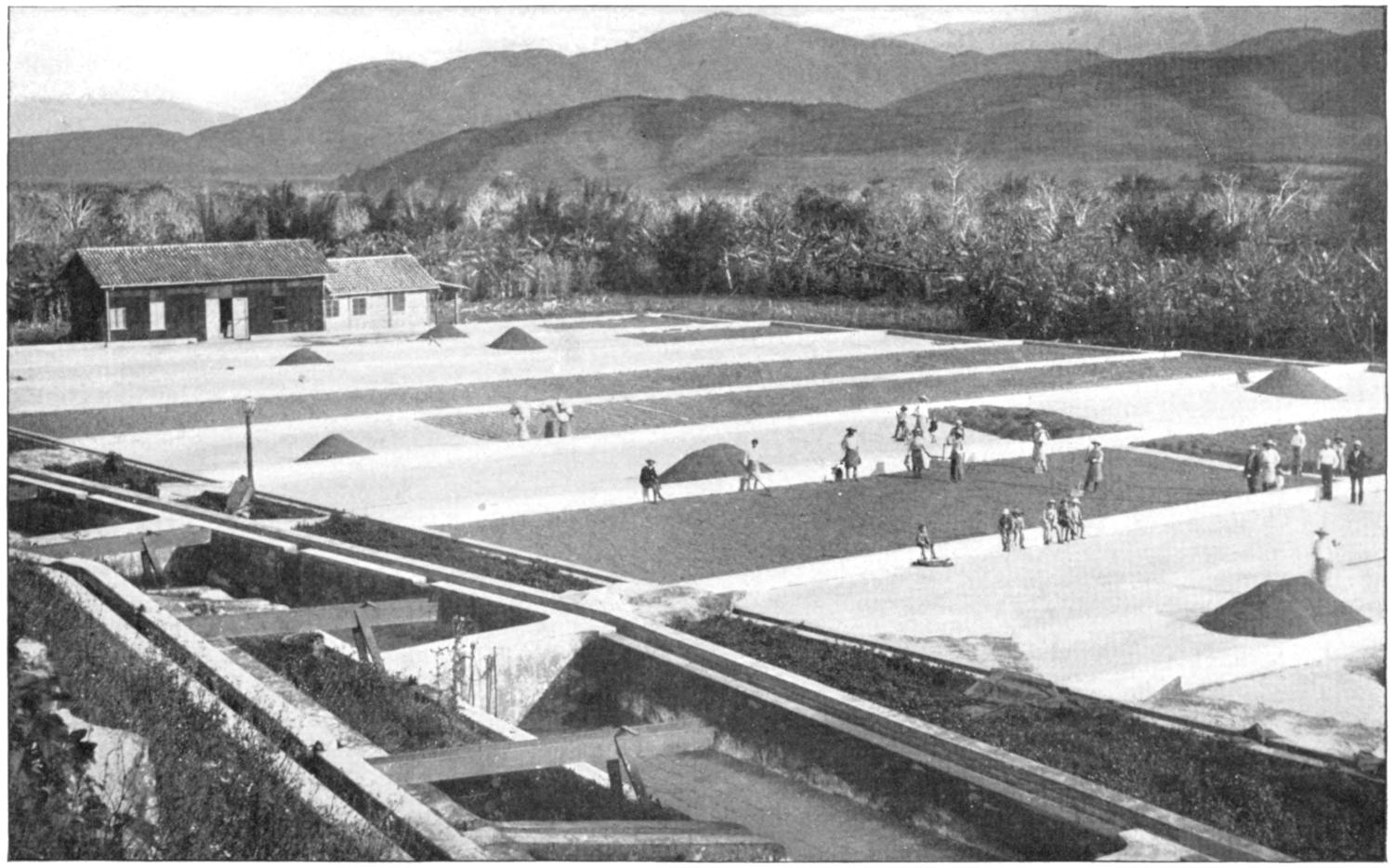
Drying Coffee on the Patio or Terrace.
Plantation—Derives its trade-name from its being systematically cultivated in regularly-laid-out plantations, by scientific methods under intelligent management, and is without doubt one of the finest varieties grown, ranking high commercially for its intrinsic value. The raw or natural bean is large, bold, symmetrical and exceedingly well developed, of a light bluish or translucent-green tint or cast, very regular and invariably uniform in general appearance. It roasts even and handsomely, as fine, if not more so, than any variety known, while in the infusion it is rich and strong, but smooth and creamy in body, fragrant and aromatic in flavor; an equal quantity of this variety yielding a heavier-bodied and richer liquor than that of the finest Java, but will not be quite as high in flavor.
Liberian-Ceylon—Is produced from a transplant of the Liberian species, which, owing to the destruction caused by the “leaf disease” on the Ceylon plantations, has been introduced to that island, on account of its being considered much stronger, hardier and better able to withstand disease than the native trees, but while it was found specially adapted to the plains and low-lying situations, it would not bear so well on the upland or mountain slopes. A hybrid species was at length evolved, the product of which is known to trade as “Ceylon-Liberian,” the bean of which in the natural state is not quite as large as that of the parent plant, not as convex in shape, the color being paler, bordering on a rich yellow instead of brown, while the infusion though not as heavy in body or dark in color, is much smoother and more palatable, the too-heavy properties of the original being greatly modified by climatic and other causes.
Ceylon-Mocha—Is a small bean, mountain-grown, coffee, very even and uniform, usually separated from the regular plantation variety. The raw or unroasted bean is of a steel-blue or silvery-grey color, according to age, exceedingly rich in liquor and fragrant in flavor, and considered by some experts to be equal in drinking qualities to any variety grown, being frequently shipped to Aden for substitution or mixing with Mocha coffee.
Ceylon coffees are usually packed in casks and in hogsheads (except Native, which is put up in bags), the former weighing 400 and the latter 1,000 pounds, and shipped to England, where it commands a high price, relatively, and where they are graded as No. 1 (largest); 2 (medium); 3 (small), and “Triage,” or common, but generally as “Plantation” and “Native” in the American market. In 1880 it was estimated that the capital invested in coffee culture amounted to over $70,000,000, a notable increase having taken place since that year, there being at the present time some forty districts on the island in which coffee culture is carried on for commercial uses. While the native product is usually calculated to extend over 50,000 acres, which, however, varies very much, according to the character of the season, the prices obtained, and the cheapness of money. The annual exports are about 80,000,000 pounds, giving an average yield from old and new plantations of a little over 400 pounds per acre.
MALAYAN COFFEES
Include the products of the islands of Java, Sumatra, Celebes, the Sunda and many other of the smaller islands of the Malayan Archipelago.
JAVA COFFEES.
Java is a generic term applied to all coffees grown in the Eastern Archipelago, and is almost a synonym for coffee. While the coffee plant, which is only known in Java by its European appellation and its intimate relation with European despotism, was first introduced into that island by the Dutch at the close of the seventeenth century, and has ever since remained one of their chief articles of exclusive monopoly. The labor by which it is planted and its produce collected is included among the oppressions or “forced services” of the natives at inadequate rates. Previous to the year 1808 the cultivation of coffee in Java was principally confined to the Sunda districts, there being, up to that year, but few plantations comparatively in the eastern districts, the product of which they were capable of yielding not amounting to one-tenth of the whole. But under the rapacious administration of the Dutch East India Company and government the cultivation of coffee has usurped the soil of almost the entire island, otherwise destined for yielding the subsistence of the people, the cultivation of all other products being made subservient to it and the withering effects of a government monopoly, extending their influence indiscriminately throughout every province and district in the island. In the Sunda districts particularly each native family is compelled to care for 1,000 coffee plants, and in the eastern districts, where new and extensive plantations are being formed from time to time in soils and situations in many instances by no means favorable to its profitable culture, 650 plants is the prescribed allotment. No negligence can be practised in the performance of this duty, the whole operations of planting, picking and pulping being conducted under the immediate superintendence of the government officials, who select the sites where the new plantations are to be formed, seeing that they are preserved from weeds and rank grasses and overseeing its selection and removal to the “go-downs” or warehouses when prepared. Under this system the Sunda districts are estimated to yield an annual produce of 100,000 piculs, and it was at one time calculated that the young plantations of the eastern districts, when they should come into full bearing, would produce an equal quantity, but in the latter section many of the plantations had been formed on ill-judged sites, the natives being also averse to the new and additional burden which this increase of cultivation imposed upon their labor. Had the system been persevered in or enforced by a despotic authority, it is questionable whether the quantity anticipated in the above estimate, or even one-half of it, would have been obtained from the eastern districts. The Sundas living in an island and mountainous country, and having been long accustomed to the hardships of coffee culture, are less sensible of its pressure than the rest of their countrymen, time and habit having reconciled them to a system of servitude, which was at first revolting to them, and a state of slavery, which the philanthropist laments as degrading, is scarcely felt to be even a grievance by themselves. Instances, however, are not wanting in which the usual measure of exaction having been surpassed they have been awakened to a sense of their wretchedness, a government of colonial monopolists, eager only for profit, and heedless of the sources from which it is derived, subjecting its native subjects to privations and distresses, the recital of which shock the ear of humanity. In brief, the system of coffee culture in the island of Java has sometimes been so severely exacted that, together with the other constant and heavy demands made upon them by the government authority on the native labor of the country, that they deprived the unfortunate peasants of the time necessary to raise food for their own support, many thus perishing by famine, while others fled to the mountains, where, raising a scanty subsistence in patches, or often dependent for it upon the roots of the forest, they congratulated themselves on their escape from the reach of their oppressors; numbers of these people, with their descendants, remaining in these haunts to the present time. In their annual migrations they frequently pass over the richest lands, which still remain uncultivated, awaiting their return to till it, but they prefer their wild independence and precarious subsistence to the horrors of being again subjected to forced servitude and forced deliveries at inadequate compensation.
In the Java highlands the tree yields fruit for a period of twenty years, while on the plains or lowlands it seldom attains a greater age than nine or ten, bearing only during six or seven of these, the fruit being larger comparatively, but the flavor less as a general rule. About the end of the rainy season such plants as have not thriven are replaced by others and the plantations cleared, this latter operation in well-managed plantations being generally performed from three to four times in the year, the tree being never topped or pruned, but universally allowed to grow in all its native luxuriance. In this state it often, in favored situations, reaches a height of sixteen feet, and plants eight inches broad have been frequently procured from the trunks. The average product of a coffee tree in Java is not estimated at much more than 1¹⁄₄ pounds, but there are instances on record where as much as from twenty to thirty pounds have been yielded by a single plant in a season. Again, in Java there does not appear to be any fixed or certain season for the plant to arrive at maturity, as in the Western countries, the gathering usually commencing in June or July, and it is not until late in the following April that the entire crop is delivered to the go-downs. The picking season in general, however, consists of three pickings or crops of which the first or “roor-pluk,” which is small, begins in February, the second or “main-pluk” in May or June, when the heaviest portion is gathered. It is also termed the “full-pluk,” from being the most abundant of the season the third or “after-pluk,” being what is left to open on the trees, may be considered more of a gleaning, as it is merely a general sweep of the fallen berries. When the berries become of a dark crimson color they are plucked off one by one with the assistance of a light bamboo ladder, the greatest care being taken not to shake off the blossoms which still remain on the tree or to pluck the unripe fruit. The women and children of the country usually do the picking, the men attending to the heavier work around the plantations. Attached to every village near which there are coffee plantations of any extent, there is a “drying-house,” to which the newly-gathered coffee is carried and where it is placed on hurdles about four feet from the floor, under which a slow wood-fire is kept up during the night; the roof is opened in the mornings and evenings to admit the air, the berries being frequently stirred meanwhile to prevent fermentation. As the excessive heat of the sun is considered prejudicial, the roof of the “drying-house” is closed during mid-day, this operation being continued until the husk is thoroughly dried. The coffee dried in this manner is generally small, sea-green or grayish in color and is supposed to acquire a peculiar flavor from the smoke, although it does not appear that any particular kind of wood is used as fuel. On the other hand, when the coffee is dried in the sun the bean becomes of a pale yellowish color, is larger in size, specifically lighter in weight and more pungent in flavor than the former. The most common method of pulping in Java among the natives is to pound the berries when dried in a bag made of buffalo hide, care being taken not to break or mutilate the beans. A mill of the most elementary construction is, however, sometimes used for the purpose, but is said not to answer as well. When the operations of pulping and cleaning are completed the coffee is then put in bags and baskets and stood on raised platforms until the period of delivery arrives, when it is carried to the “go-downs” or storehouses, sometimes by men but more generally on the backs of buffaloes and mules in strings of from 1,500 to 2,000 at a time. In the Sunda district there are three principal depots for receiving the coffee from the cultivators—Chikan, Karang and Buitzenorg. From Buitzenorg it is either sent direct to Batavia by land in carts or by way of Linkong, whence it is forwarded in boats by the Chidana river, while from Chikan the coffee is sent in boats down the river Chitaram and thence along the sea-coast to Batavia, where it is received into extensive warehouses and from which it is in turn generally exported to the European and American markets.
Up to a very recent period almost all coffee in Java was cultivated by the natives under supervision of the Dutch government, which had a monopoly of the product, deriving an enormous revenue from its cultivation. Under this system, each family was compelled to cultivate, pick, dry, hull and deliver the coffee at the nearest government warehouse for transport to the port of shipment, the natives being allowed but a small percentage of the crop as compensation for their labor in many instances, but more generally the government placing a figure so low as to enable it to sell the coffee at an enormous profit, and also deducting again a heavy duty from the gross price paid to the growers, thereby deriving an almost fabulous revenue from this system of cultivation.
It is difficult to state what recompense the native cultivator of coffee receives in Java for his services and his product, the complicated system of accounts which prevails there seem only calculated to puzzle or mystify the investigator and allow the Dutch commissary to derive an income of from eighty to one hundred thousand dollars per annum at the expense of the government by whom he is employed, on the one hand, and that of the natives whom he oppresses, on the other. Latterly, however, it has been directed that the cultivators should receive, on delivery at the government storehouses, “three rix-dollars (copper) for each “mountain” picul (225 pounds) of coffee, being very little more than one dollar per hundred, while this same coffee has frequently been sold in Batavia, within fifty miles of the spot where it was raised, at twenty dollars per hundred, and has been seldom sold in the European or American markets at less than twenty cents per pound. It is, also, difficult to fix the exact rate at which the coffee might be produced under the free system, but that it can be raised for exportation at ten dollars per hundred with profit is beyond doubt. The price paid the natives, however, is deemed liberal by the Dutch government, though in many cases it has to be transported over sixty miles of an almost impassible country, where two men are required to carry a hundred pounds of coffee on their shoulders and at an expense of labor which one would suppose at least equal to the remuneration.
All the available mountain slopes on the island of Java are literally covered with coffee plantations, owned and operated by the Dutch government, which assigns to each Javanese family the cultivation and care of from 600 to 1,000 trees under severe penalties, the natives being compelled to deliver their crops, hulled and cleaned, to the nearest government stores at the end of the harvest, accepting in return whatever price the government is pleased to put on it. Considerable coffee is, however, cultivated by the natives themselves, independently of that raised directly for the government, being chiefly grown along the borders of the government plantations and other unused patches, as well as along the fences around their farms, being generally raised in the shade; the berry of some of this coffee attains a high excellence rivalling if not actually excelling the government product in many instances.
A considerable portion of the peasantry having—as already observed—been long accustomed to the cultivation of coffee, it is owing to their skill and experience that the coffee owes its excellence as much as to any direct knowledge, superintendence or interference of the Dutch officials, who derive their information from the natives, having little more to do than occasionally ride around the plantations with a pompous suite, keep the accounts and examine the coffee, as it is received from the cultivators. The plantations are generally laid out in squares, the distances between the plants varying according to the fertility of the soil, that is, in a soil not considered fertile, a distance of six feet is preserved, and in each interval is planted a “dadap” tree for the purpose of affording shade to the plants; while in a rich soil where the plant grows more luxuriantly, fewer shade trees are required and the plants are placed at greater distances from each other. But in Java, a certain degree of shade appears to be necessary at all times to the health of the coffee plant, especially during its earlier stages, and in low situations, for which purpose the dadap tree is found to be better calculated for affording this protection than any other kind in the country, it being a common saying on that island that “where the dadap flourishes, there also will flourish coffee.” But it must not be inferred from this that they are always constant or even necessary companions, for in the highlands many of the most flourishing plantations are to be observed with but very few dadaps in the vicinity.
Coffee is cultivated for commercial use in all of the twenty-two residencies into which the island is divided, including Bantam, Batavia, Bezoeki, Bagelen, Banjoewanjie and Banjoemas, Cheribon, Japara, Kadoe, Kediri and Krawang, Madioen, Rembang, Preanger, Probolingo, Passoeren and Pekalongan, Soerabaya, Soerakarta and Djokjakarta, Bali, Timour, Malang and Samarang, each of which residencies or districts containing from five to fifty plantations, by which they are further distinguished. In trade they are generally divided into “Government” and “Free Coffees,” the free cultivation being now permitted in the residencies of Bantam, Cheribon and many other of the Eastern districts. And, as with the coffees of all other countries, the product of the different districts of Java varies considerably in quality and value, many of them possessing a richness and mellowness not approached by that of any other country; others, again, being so inferior that were it not for the fact of being grown on that island they would not be deserving of the name.
Bantam and Batavia—Are medium-sized, yellowish in color, regular and uniform in appearance, roasting and drinking exceeding well, being generally clean and free from quakers.
Bagalen and Bezoeki—Are rather bold and plump in style, rich yellow in color, solid and compact in form, full in body and fragrant in flavor, ranking with the best of the Java growths.
Banjoewanjie and Banjoemas—While not plentiful sorts, rarely coming to this market, being principally shipped to Holland, where they are much appreciated for their great strength and rich flavor, are medium-sized, heavy and round in body, creamy and fragrant in the cup.
Cheribon and Japara—Are rather light in weight and color, inclined to be “chaffy” in the natural state and “quakery” in the roasted, but nevertheless yield a pleasing and palatable liquor on infusion.
Kadoe and Kediri—Are small, hard-bean coffees, approaching brown, and usually good drinkers, being a favorite in the European market, where they rank high commercially.
Rembang and Krawang—Rank next to Kadoe in general cup qualities, but are somewhat irregular in the raw state, roasting and drinking well, however.
Preanger and Probolingo—The soil of these districts being pre-eminently adapted for the cultivation of fine coffees, they are noted for their products. The bean is round, full and well developed, high-yellow in color, but assuming a rich-brown with age, firm and regular in style, rich, mellow and creamy in liquor, fragrant and aromatic in flavor, rivalling the best product of Arabia itself.
Passoeren and Pekalongen—Rank next to Preanger, being usually brown, regular and uniform, full in body, round in flavor and as a general rule very fragrant, particularly when the crop is good.
Madioen and Soerabaya—Belong to the yellow-bean class, and are rather light in weight and body but pleasing and agreeable in the cup, approximating to a fine Cucuta Maracaibo in form, liquor and general characteristics.
Soerakarta and Djokjakarta—Are among the best of the Java growths, large, heavy and well-developed in bean, handsome and attractive in the roasted state, yielding a rich golden-yellow liquor, creamy in body and aromatic in flavor.
Bali and Timoor—Are grown on the small islands to the south of Java, and though fair in size and quite brown in color, are nevertheless deceptive in roasting and drinking qualities.
Malang and Samarang—Are light in weight and in color, somewhat chaffy in the natural state and “quakery” in the roasted, thin, flat and flavorless in liquor.
OTHER VARIETIES.
Old Government Java—Is a trade term applied to coffee grown and stored under the supervision of the officers of the Dutch government, and in contradistinction to that raised by the natives, but is now an almost obsolete term. It is produced principally in the Preanger district, where the greatest care and attention is bestowed on its cultivation and curing, its cultivation never being entirely entrusted to the natives; the primary object of the government officials being to improve the berry and enhance its value to the exclusion of increased quantity. After being picked and cured, it is stored in “go-downs” or storehouses for a number of years, frequently seven, before being offered for sale, the go-downs being erected expressly for the purpose, being open at the sides so as to admit the sun and air in order to mature and season the coffee, which, like wine, improves with age, the bean assuming with time a dark-brown color and the flavor becoming richer and more mellow by the development of the volatile or essential oil contained in the beans. By prolonged keeping in the raw state it is found that the richness of any seeds in this peculiar oil is increased, and with increased aroma the coffee yields a blander and more mellow beverage. Stored coffees, for this reason, lose weight at first with great rapidity, sometimes as much as 8 per cent. having been found to dissipate in the first year of keeping, 5 per cent. in the second and 2 per cent. in the third; but such loss of weight is more than compensated for by the improvement in quality and consequent enhancement of value. Old Government Java is for this reason celebrated for its superior excellence, and justly deserving of its high repute. Latterly, however, the term has been indiscriminately used and applied to all Java coffees of a brown color, irrespective of age, grade or district of production and has thereby ceased to possess any real significance as implying any extra merit or superiority over the average run of Java coffees. The natural bean of the true Old Government Java Coffee is large, round and well developed, of a rich brown color, exceedingly regular and uniform in general appearance and entirely free from defects of any kind, while the infusion is round and heavy in body, creamy, mellow and fragrant in flavor, surpassing in general “cup qualities” that of any other variety grown. All coffees raised under the supervision of the government are disposed of through the agency of the “Netherlands’ Maatschappy,” or Trading Company, at the periodical (quarterly) auction sales held in Batavia or Amsterdam, the sales occurring in the months of March, June, September and December. It is offered for sale only in limited quantities—from one to two hundred picul lots—no purchaser being permitted to buy more at a single bidding, the prices varying at each sale, being regulated by the quantity offered and the number of orders received by the agents or brokers to buy, so that parties purchasing two or more lots cannot calculate what the average cost will be until the sale is ended.
Plantation—Or “Private Growth Javas,” are so termed from being grown on plantations owned and operated by private or individual planters, and in contradistinction to that raised under government supervision. Being grown from selected seed, under the best agricultural conditions and scientific cultivation, it produces a quality of coffee that cannot be surpassed for size, style, color, regularity and general intrinsic merit. It is also marketed differently from the government system, being disposed of by contract or tender, that is, as soon as the quantity and quality of the crop can be estimated, the planters issue a circular letter or note to the principal firms of Batavia and to the representatives of European and American houses, informing them of the facts and soliciting bids for the entire crop. Proposals are received and the coffee sold to the highest bidder; but if, according to the planter’s views, the offers are too low, he claims the right to reject them and hold the coffee for a better market. If accepted the coffee is carefully picked over, assorted and transported to the shipping port by the planter and delivered in bulk, the purchaser furnishing his own bags and marks, the coffees being of such high repute and quality they sell high, there being great competition to obtain them. Many of these plantations were in existence prior to the introduction of the government monopoly system, or are situated on the estates of the native princes, who have been permitted to retain some portion of their sovereign privileges.
Liberian-Java—Is the product of a transplant of the Liberian species introduced into the island about ten years ago, where it was found to prosper well and vigorously; a great demand springing up for its seed, the cultivation increasing and yielding a bean much larger than that produced by the parent plant, full and well developed, yellow to brown in color, concave in form and closely resembling “Padang” in liquor and flavor.
W.I.P.—Or “West India Prepared” Java is so termed from being pulped and prepared by the “Washed” or West India process, being also known to trade as “Blue-bean Java.” The raw bean is bold, regular and bluish-green in color, hard and solid in substance, heavy, rich and flavory in liquor. Some authorities, however, contend that this new process is detrimental to the coffee, claiming that by the old or “dry-hulled” method the bean retained all the properties of the coffee to a much greater degree, whereas by the new process, considerable of the active principle (caffeine) is carried off in the washing.
Loeke or “Tiger-cat Java”—Is a variety of Java coffee highly prized for the intrinsic merits imparted to it by a peculiar process. It is composed simply of the undigested beans which have passed through the intestinal canal of the “Loeke,” a small species of tiger found in Java, which, climbing the trees, selects the ripest and richest of the berries, feeds on them, swallowing both pulp and beans, the latter being left in the jungle and afterwards collected by the natives. It is analogous to the “Monkey coffee” of Brazil and the “Jackal coffee” of India, the excellent qualities of which is due to the chemical process which the beans undergo in the stomach of the animal that has stolen them, the appreciation of such stercoraceously deposited beans by the natives being an undoubted fact. The bean is large and bold, but whitish in color, heavy, round and creamy in body, exceedingly fragrant and aromatic in flavor and not excelled by that of any coffee grown or known to commerce.
At the time of shipment all Java coffees are of a light-green shade unless—as in the case of government and other coffees—they have been previously stored for the purpose of seasoning or to await a better market. During the long voyage through the tropics the bean gradually changes to a deep-yellow, and finally to a dark-brown, particularly if the voyage be materially lengthened, as it frequently is; the darker the color becomes the more valuable the coffee on arrival. This distinctive feature being characteristic of Java coffees only, no other variety acquiring this color except by artificial means. Color is the standard of value and the principal consideration in appraising its price in the American market, there being a wide difference made in the values of “Pale,” “Yellow” and “Brown” Java coffees in favor of the latter. As stated before, by being stored for a certain length of time, Java coffees improve in quality, the bean becoming browner and the flavor more mellow, probably in the same manner as wine. The moisture evaporates from the bean and the aciduous, astringent taste, of the young, new bean is entirely dissipated and lost by the process, which, by becoming thoroughly dry and seasoned, enhances its value commercially. Yet color cannot always be taken as an indication of age or genuineness, as much of the coffee offered under the head of Brown Java at the present time is nothing more than Malang and other varieties “sweated,” and colored by a steaming process or artificially faced with a preparation of kaolin or soapstone. Again if this feature of turning brown with time, were always an indication of age, it may be taken for granted that “Brown Javas,” possessed finer roasting and drinking qualities, than the “Light” or Yellow-bean varieties, but it is an acknowledged fact that this brown color, even when natural, neither adds or detracts from its value in the cup. Practically the demand for “Brown Java” coffee is but an American caprice, enhancing its commercial value from two to three cents per pound beyond its intrinsic worth; this caprice being also directly responsible for the immense amount of other so-called Java coffees that are annually sweated and colored to imitate or counterfeit the naturally colored and genuine kinds. While in Europe the yellow-colored coffees are preferred to the brown, being quite as good, if not superior, to them, and less liable to manipulation.
Java coffees are packed for export in bags containing one picul (133 pounds) when intended for the European markets, and in mats of one-half picul for the American, the latter style being preferred in this country. In the European markets they are classed as “Green,” “Pale-green,” “Greenish” and “Extra-green” when new, but as “Yellow,” “Dark-yellow,” “Light-brown” and “Brown” when old, grading in the order named. While in the United States they are generally classed as “Light,” “Yellow” and “Brown,” according to color, the packages being usually marked with the initials of the importer, underneath which is a letter or letters denoting the district or plantation where grown. The average annual production is about 100,000,000 pounds, of which 30,000,000 pounds is produced on private plantations.
SUMATRA COFFEES.
Sumatra known to the Arabians as Srimata (“the happy”), lies to the northwest of Java, being separated only from it by the narrow Sunda strait, and is much richer in products than the latter island. The coffee-plant was first introduced into Sumatra from Java, by the Dutch, in the latter part of the eighteenth century, but its cultivation made little or no progress on that island until about the year 1800, when measures were taken by the government to promote and stimulate its production there, since which period there has been a rapid increase in its output. The system of coffee cultivation is nearly identical with that in Java, each native family being furnished with seed by the government on condition that they keep in good bearing order not less than 650 trees, the crop, “if up to standard,” being purchased by the government, that is, taken, at an arbitrarily fixed price. The coffee, after being inspected and accepted, is stored in go-downs or warehouses adjacent to the districts of growth, until a sufficient quantity has been collected, when it is transported to the ports of Padang or Benkoolen, where, after being duly advertised, it is sold at auction, under the immediate supervision of the officers of the Dutch government, the sales being held quarterly during the months of March, June, September and December, as in Batavia and Amsterdam. Latterly, however, the cultivation of coffee in Sumatra has been further encouraged by the government leasing or selling coffee-lands to independent planters, the product of such plantations being termed “Free coffee,” in contradistinction to that raised with restrictions by the natives, such coffees being sold only by tenders, as in Java.
Like Java, Sumatra is geographically divided into a number of districts politically termed “Residencies,” under Dutch control, the coffee-producing districts comprising Painan, Padang, Palembang, Ankola, Ayerbanjies and Mandheling, grading relatively in the order named.
Painan—Is a medium-sized bean brownish in color, hard, solid and regular in appearance, generally clean and well prepared, and though fairly heavy in body and pungent in flavor is yet devoid of the mellowness and fragrance which characterize Sumatra sorts in general, but is still superior in many respects to a number of the Java growths.
Padang—Known to trade generally as “Interior” from being raised in a somewhat desultory manner by the natives on government lands, in the Padang plateau or highlands of the interior, which furnishes the largest quantity. Padang or Interior coffees are not, as a rule, as stylish or uniform as the other district growths, owing to careless cultivation and the primitive methods of preparation in use by the natives. Yet, notwithstanding these drawbacks, Interior coffees frequently comprise invoices rivalling in roasting and drinking qualities many of the regularly cultivated district coffees, and at all times far outrank the average of the Java product. The raw bean as a rule is of fair proportions, but very irregular in general appearance, fairly uniform, and though lacking in the style and finer qualities of the plantation grades, is nevertheless strong, rich and fragrant in the cup, possessing a characteristic flavor entirely their own.
Palembang—Differs from Padang both in size, style, color and drink, being smaller in bean, lighter in color, but stronger and more pungent in liquor, and not, as a general rule, as highly valued, except when the crop is good.
Ankola—Ranks among the finest of the Sumatra sorts in point of size, color and general character, the natural bean being round, full and firm, rich dark-brown in color, bright and mellow in liquor, and very fragrant if not aromatic in flavor, and much superior in every respect to the best of the Java growths, excepting alone that produced in the Preanger district.
Ayerbanjies—Is closely allied to Ankola in all its leading features of size, color, structure and character, being classed commercially as on an entire parity with it, commanding the same price, and frequently substituted for it when the former is scarce or difficult to obtain.
Mandheling—Is without exception the finest of the Sumatra products, and is valued high commercially, not alone for its undisputed intrinsic merits, but also on account of the comparatively small amount produced, forming only about ten per cent. of the entire product of the island. The bean is much larger, almost as large as Liberian, of a rich dark, natural-brown color, round, full, well developed and symmetrical in form, very stylish and attractive in the roasted state, and equalling, if not positively surpassing, the much-vaunted Old Government Java itself.
Lahat—Is another of the Sumatra varieties, but not deserving of being classed with them. Being of lowland growth, the bean, while large, is flat in shape, whitish in color, and chaffy in substance, approaching a Malang in general contour. It is invariably “quakery” in the roast, flat in liquor, insipid in flavor, or more correctly, almost devoid of “cup” qualities.
Sumatra coffees, in general, possess a peculiarly characteristic flavor in the raw or natural state, described by some dealers as “musty,” but claimed to be acquired in transit through the tropics, the coffee sweating in the hold of the vessel during the long voyage. Certain it is, however, that this mustiness, or whatever it may be termed, enhances rather than detracts from the value or flavor of the coffee. And, more singular to add, Sumatra forms nine-tenths of the coffee imported and sold in the United States under the head of Java, being preferred to the latter by the American dealers in general, on account of its usually dark-brown color and distinctive “musty” flavor. The annual product, like that of all other countries, varies materially from various and obvious causes, both in quantity and quality, the average annual export being about 20,000,000 pounds, of which the United States takes upwards of 75 per cent., the product of “Free” or private plantation coffee forming about one-fifth of the annual yield. It is packed in grass mats, and shipped from the port of Padang, when purchased for account in the United States, and from Benkoolen, in the north, when intended for the European market.
CELEBES COFFEES
Are grown in the Dutch island of that name, situated to the northeast of Java, the coffee plant being introduced there from Java as far back as 1750, but except where Dutch influence was felt little or no attention was paid to it by the native races until about 1822, when it was discovered by the Dutch rulers that the soil of the mountain sides was admirably adapted to the cultivation of fine coffees and a system established which stimulated the native chiefs to foster the industry and undertake the management of coffee plantations. A law was subsequently enacted by the Dutch government, however, compelling the native princes to direct the total annihilation of the cultivation of coffee in their dominions and to secure by treaty with them the destruction and confiscation of all coffee found in the hands of the natives. The island is divided into thirteen districts, in nearly all of which more or less coffee is produced. The principal coffees being known to commerce as Menado, Bonthyne and Macassar.
Menado—Produced in the district of Minnahassa situated in the extreme north of the island, is not only the finest grown on that island, but, also excels the best products of both Java and Sumatra. The bean is uniformly large and regular, of a rich dark-yellow color, solid and heavy in weight, magnificent in the roast, creamy and aromatic to a high degree in the cup. It is claimed to possess the “highest standard of excellence,” no other variety containing the same all-round qualities of size, style, color, liquor, flavor and aroma to the same extent. The supply, however, is very limited, and is generally shipped to Holland, where it commands a price in accordance with its merits, but rarely reaching the United States.
Bonthyne—Is medium in size, flat in form, reddish in color, inferior in roast and flavor, and not a desirable sort by any means.
Macassar—Is the poorest of the Celebes sorts, closely resembling Lahat and Malang, and on a parity with them in appearance, character and value.
Singapore Javas.—What are known to commerce as “Singapore Java Coffees” are not produced on that island, which, although lying directly in the coffee zone, produces little or no coffee, except small quantities of the Liberian species, which has recently been introduced there. 90 per cent. of the coffee shipped from Singapore is chiefly composed of the products of Bali, Timour, the Mollucas and smaller Sunda islands, its position making it the only entrepot for the commerce of the entire archipelago. The coffees are usually small in size, reddish in color, irregular in grade and inferior in quality, being generally produced from wild or carelessly cultivated plants, and also possessing a peculiar spicy or “peppery” flavor, said to be contracted from being imported with cargoes of pepper, but more probably from being grown in the vicinity of pepper plantations in the Spice islands. Formerly these coffees were marketed under their true titles, but as their character became known they were palmed off as Padang and other district Javas, to the detriment of the latter.
The systematic cultivation of the Liberian species of coffee was commenced about ten years ago in Siam, Malacca and many of the smaller islands of Malaysia, where it was found to prosper so well at first that the demand for Liberian seed became very great. But after a fair trial it does not seem to have been a great success, what little is produced in these new districts being generally classed as “Jahore Liberian” coffee.
POLYNESIAN COFFEES
Embrace Phillipine, Borneo, Guinea, Fijian, Samoan, Hawaiian, Australian, New Zealand, and other islands in the South Pacific Ocean.
Phillipine Coffees.—Opinions differ as to whether the coffee plant is indigenous to the Phillipine Islands or only exotic there, some authorities declaring that it was first brought there by Spanish priests from the Malay. Others again claiming that the plant was found in a wild state in the island of Luzon prior to its introduction, but that the natives, being ignorant of its properties, allowed the fruit to decay on the trees. Be this as it may, coffee thrives there remarkably well, the product possessing a peculiarly rich flavor, for which it is highly esteemed on the continent of Europe, and, although it is by no means well prepared or uniform, the worst grades bring a higher price there than the Java growths, the value on the spot exceeding the current rates for the latter in the foreign markets, and is generally classed as “Luzon,” “Manilla” and “Zamboango,” from the ports of shipment.
Luzon—Is a small-bean variety, hard and flinty in texture, rich and aromatic in the infusion, but poorly or indifferently cleaned or prepared, for which causes it is not as well appreciated as it deserves.
Manilla—Is principally produced on the islands of Indan, Laguna, Batangas and Cavité, its price on the spot varying from twenty to twenty-two dollars per picul. The bean is medium in size, regular in form, and pale-green in color, perfect in roast and aromatic in flavor.
Zamboango—Comes chiefly from Mindano and the southern islands generally. The bean is much larger than that of Manilla, yellowish-white in color, but somewhat flabby in texture, and containing much extraneous matter, being poorly prepared, while the liquor is thin, flat and apt to be wild or “grassy” in flavor.
Recently the natives have planted patches of coffee in the islands of Cebu and Bohol, small quantities of which have appeared in the European markets, some also being secured from the islands of Yligan and Amboyana. The area of land under coffee cultivation in the Phillipines, and the amount of coffee raised annually is not definitely known, as the plantations are widely scattered over the islands of the archipelago, but is usually estimated at about 10,000,000 pounds. The largest plantations are situated in the province of Batangas in the island of Luzon, but considerable coffee is also produced independently by the natives in small plots which they sell to speculators, who hold it until they make up a fair-sized shipment, collected in this manner, from the neighboring islands. The increase in production, however, has been marked during the past five years, from about 10,000,000 pounds in 1888, to over 16,000,000 pounds in 1893, about 6,000,000 pounds coming direct to this country, the remainder being taken by Spain, France and Continental Europe generally.
Borneo Coffee.—The Liberian plant has been recently introduced into Borneo on a small scale, where it has been found to thrive well but producing a bean greatly modified in size, color and flavor of the original species. It is much smaller, not as convex or brown, but smoother and more pleasing, if anything, in the drink.
Guinea Coffee.—Rapid strides are being made in the cultivation of coffee in New Guinea, the product ranking with the average of the mild grades of the older countries.
Samoan Coffee.—The coffee plant has been in existence here for some years, and though thriving luxuriantly, and the soil and climate being well adapted, it has never been scientifically treated, and as a consequence is not as yet an article of commerce.
Fijian Coffee.—Some coffee of fair quality was exported from these islands as early as 1877, the industry making but little progress there since that time, notwithstanding the fact that the islands possess abundant facilities for the production of a superior variety. Several of the most wealthy and enterprising planters are now, however, engaged in its cultivation, and it is expected soon to become one of the chief exports of those islands. The bean is medium sized, green in color, as with all new coffees, and, owing to improper curing, somewhat grassy in flavor.
Hawaiian Coffee.—Coffee has been cultivated in Hawaii and other islands of that group with considerable success for many years past, although the production has varied greatly there. The first plantations formed in the island were only a few feet above sea-level, to which fact is attributed the failure or rather slow progress of the industry there. New plantations at higher elevations have recently been established, from which better returns are expected. They are classified, and known to trade as Puna, Hilo, Kona and Hamakua, of which Kona is the finest, the others varying in size, color and flavor. The exports have declined from 415,000 pounds in 1870, which in 1885 fell to as low as 1,675 pounds, but for 1892 it had again increased to 13,000 pounds, the total exports since 1881 amounting to 215,782 pounds.
Australian Coffee.—Coffee has been found to prosper well in Queensland, a yield of over 600 pounds per acre being obtained there so far and selling in Brisbane at twenty cents per pound, the smaller farmers finding it paying better than corn or potatoes. Efforts are also being made to introduce the industry into New Zealand and other of the Antipodean colonies. This list does not by any means exhaust the possible spots or sections in Polynesia where coffee is or may be grown with the greatest advantage, touching only the chief centres of the industry, and as suggesting some eligible sites for the extension of the planting enterprise. Fair quantities of coffee being also produced in the Hebrides, Society, Friendly and many other of the island groups in the South Pacific Ocean.
AMERICAN COFFEES.
As previously stated, the history of the first introduction of the coffee plant into the American continent is as romantic as it is interesting. In 1714 the magistrates of Amsterdam presented to Louis XIV a specimen of the coffee tree, which was carefully nursed in one of the botanic gardens of Paris, until it eventually yielded fruit. In 1717 the French king sent several of the shoots from it to the island of Martinique in care of one De Clieux, an officer in the French naval service. The voyage being long and stormy, the ship’s crew were reduced to a short allowance of water; for lack of which essential all but one of the young plants died. De Clieux to save this remaining slip shared with it his own scanty allowance, eventually succeeding in bringing it safely to its destination. From this single plant thus heroically preserved, according to De Tour, was propagated the numerous varieties now to be found in the West Indies, Mexico, Central, and the northern countries of South America. And where, notwithstanding the fact that Coffee is indigenous to the Old World it has evidently found its true habitat in the New, its production at the present being many times greater than in the East; its cultivation also constantly and immensely increasing there.
The climatic and topographic conditions of the American continent are pre-eminently adapted to the cultivation of fine coffees, the great mass of coffee lands, consisting of an elevated plateau formed by an expansion of the Cordilleras from which terraced slopes descend with a more or less rapid inclination towards both the Atlantic and Pacific oceans. This vast tract comprises one of the richest and most varied zones of the world, for while its geographical position secures to it a tropical vegetation, the rapid differences of elevation which characterize it afford it the advantages of more temperate climates, thus combining within its borders an almost unparalleled exuberance and multiplicity of natural products, lands favorable to the cultivation of coffee being found not only on the entire Andean range but also on its sea and land slopes from Mexico to Paraguay. While in addition to these immense stretches of mountain range, the plant is also found to flourish in the numerous valleys and plains of the interior of the continent, and wherever the great tablelands of the Cordilleras are sufficiently depressed to reach the level of tropical vegetation.
American Coffees are geographically divided into Mexican, West Indian, Central and South American, and, as with the products of the Old World, the commercial divisions and subdivisions of the numerous varieties are based rather on the districts of production and the ports of export than upon any great material difference in the appearance or even quality of the various kinds produced.
MEXICAN COFFEES.
It is also a fact not generally known to Americans that at our very doors there exists the climatic conditions and capacity for the production of all the coffee that is required for consumption in the United States, the area adapted to the cultivation of coffee in Mexico being almost illimitable, and bounded only by the extent of land brought under cultivation. Its suitability as a coffee-producing country has been tested by more than fifty years of experience, and that it has not heretofore assumed first place in point of production, exportation, and the rank to which the merit of its product entitles it, is to be attributed to the same causes that have so long retarded its other agricultural and commercial developments. But while coffee is chiefly produced for export only in the States of Vera Cruz, Oaxaca, Michacoan, Colima, Chiapas, Jalisco and Tabasco, excellent coffee is also grown on the plains of the interior as far north as Sinaloa, as well as in the coast States from Yucatan to Tamaulipas. They are commercially classified as Oaxaca, Cordova, Urupuan, Tepic, Tabasco, Soconusco and Caracolillo, varying materially in size, style and quality.
Oaxaca—Is a “Sierra,” or mountain coffee, large, bold and blue when new, but bleaching with time. It is one of the best of the Mexican varieties, being regular in roast, heavy in body, strong and rich in flavor and aroma.
Cordova.—Grown in the State of Vera Cruz, is usually a large yellow-bean coffee, from which fact it is sometimes termed “Mexican Java.” It makes a handsome roast, yielding a round, full liquor, approaching to that of a fine Maracaibo or medium Java.
Urupuan—Produced in the State of Michacoan is also a mountain grade, rather small in size, greenish-blue in color but somewhat irregular in appearance, not being well prepared. In flavor it is, however, high and fragrant, approximating most to that of a Plantation Ceylon.
Tepic,—or “Mexican Mocha,” grown in the State of Jalisco is claimed to be a transplant of the Arabian berry, which has by careful and scientific cultivation been so improved in flavor and aroma as to rival, if not actually excel, the product of the parent plant. The natural bean is exceedingly small, hard and “flinty” in texture, steel-blue in color, faultless in roast, rich and creamy in body and highly aromatic in flavor. The supply being limited it is rarely exported, being principally consumed in the district of production, where it commands a very high price, selling on the spot for as much as one dollar per pound.
Tabasco—Is a coast-grown coffee cultivated in the hot, moist low-lands of the Campeachy gulf, and is the poorest of the Mexican varieties. The bean is of a sickly-green hue, medium in size, and moist or “spongy” in substance, bitter and astringent in flavor, and taken altogether a most undesirable sort for any purpose.
Soconusco—Produced in Chiapas, close to the rich coffee lands of Guatemala is another high-grade coffee, ranking among the finest of the Mexican varieties. It is a large, mature bean, varying in color, according to age, from a bluish-green to a pale-yellow, full and round in body, ripe and mellow in flavor as a rule.
Colima—Raised on the west coast is a medium-sized bean, flat in form, fairly solid, but varying in color from greenish to pale, even in roast, rather round in liquor and pleasing in flavor, and generally shipped to the Pacific States.
Caracolillo—or “Mexican pea-berry,” is a concave-convex bean, grown on the new wood at the end of branches of trees that are pruned year after year; but though not confined to any particular species, such trees yield almost entirely male or pea-berry coffee, being the only instance on record, and is considered the fanciest grade grown in Mexico.
Mexico possesses more and better coffee lands than many other countries where it is now extensively grown, a small proportion of which only are under cultivation. The popularity of the product increases as it becomes better known, besides being the nearest and most accessible coffee producing country to the United States, the largest and best coffee market in the world. More attention is now being directed to the cultivation of coffee in Mexico, however, by both natives and foreigners than has ever before been given to the industry in that country. Native Mexicans are quietly, but steadily laying out new coffee plantations or enlarging and reviving old ones and many large tracts of land adapted to the growth of coffee have recently been purchased there by foreigners with that object. But while Mexico practically has no limit to her production of coffee, yet the average annual exports amounts only to about 10,000,000 pounds, the bulk of which is shipped to France, where it is graded as “Verde,” or Green, and “Blanco,” or White, the United States receiving the largest proportion of the remainder.
WEST INDIAN COFFEES.
The West India Islands at the beginning of the present century were noted for the extensive quantity and excellent quality of their coffee product, ranking at that period with the largest coffee-growing countries of the world. Its cultivation has rapidly and materially declined there in recent years, still continuing to do so at a disproportionate rate; the decrease since the emancipation of the negroes almost amounting to abandonment. But while commonly attributed in a great measure to the ravages of the blight, already described, it is more evidently traceable to social influences and a faulty system of cultivation. Latterly, however, attempts are being made to restore the industry to something like its former importance by new and improved methods of culture, so that it remains to be seen what art can do to combat the difficulty. They are classified in trade as Cuban, Jamaica, Haytian, San Domingo, Porto Rico, Trinidad, Dominica, Martinique and Guadeloupe.
Cuban—Though at one period one of the largest coffee-producing countries in proportion to its size, yielding nearly 50,000,000 pounds annually, Cuba now ranks lowest in the scale, not raising sufficient to supply the home demand, its cultivation being replaced in that island by that of sugar and tobacco. The districts most noted for the richness and excellence of their coffees are situated on the Sierra Maistra range, in the vicinity of Vuelta Abajo, as well as in the districts of Alquizar and San Marcos, and from the fact that these latter are among the oldest coffee-producing sections on the island, their product bears a high reputation for fragrance and excellence. But the coffee grown in the mountain district of Guantanamo is now considered the finest, its cultivation there being on the increase, while decreasing rapidly in the former districts. The bean of what little is produced on that island is large in size, whitish in color and peculiar in form, somewhat resembling a “male” or pea-berry. In roast and drink it is superior to many of the mild grades, with which it is usually ranked.