Chapter IV · CULTIVATION AND PREPARATION.
Reading edition
The principal points which determine the value of a location for the successful and profitable cultivation of Coffee are:—(1) Soil and climate; (2) Situation and aspect; (3) Temperature and rainfall; (4) Proximity to a river, and (5) Shelter from wind and wash. Most of which are necessarily subject to variation, according to country and locality, shelter from wind being perhaps of the most paramount importance, and which should not be sacrificed for a richer soil, as the latter can be artificially supplied much quicker than the former.

SOIL AND CLIMATE.
Soil and climate are subjects of primitive importance in the cultivation of Coffee. The soil of Coffee lands varies as widely almost as the different countries in which it is grown. In Africa, where the plant is indigenous, it is chiefly composed of a reddish clay on the West Coast, with a hard sandy subsoil, while on the East Coast it is found to be composed chiefly of a dark loamy earth. The Arabian soil, where the plant is exotic and where the finest Coffee is produced, is purely an artificial one, while in India it is successfully grown in five different kinds of soil, ranging from a dark chocolate clay to a deep jungle mould. The soil of Ceylon consisting of a rich, dark earth, friable and mixed with blocks and small stones. On the island of Java, to the contrary, where some of the finest varieties are produced, the soil is principally composed of a black leaf-mould, intermixed with fine sand and small stones, whereas in the principal Coffee-growing countries of the American continent the best crops produced, as a general rule, are raised on rich, dark loamy lands, the subsoil of which are too rocky to be worked with a plow. The only exception to the rule being Brazil, where the soil varies to a great extent, a clay of terra rocha forming the chief upper and lower subsoil. The most suitable soil for Coffee cultivation, however, is that which grows soft timber, to be found on high quartzy ridges, where the land is of a dark chocolate color, mixed with small stones, and overspread here and there with boulders of granite, as where the soil is dark, loose and full of roots, it is sure to be rich in organic matter, and therefore good for Coffee, which is a hardy plant and not on the whole difficult to please in this matter; such a soil generally contains about 5 per cent. of its weight of organic matter in combination with other fertilizing substances. Looking at Coffee soil from an analyst’s standpoint, it consists of an organic part, which when placed in the fire will burn away, and an inorganic or mineral part which will not burn. The constitution of the first is well known to planters, being formed of the remains of animals, insects, or minute visible and invisible organisms of various kinds, from the dung of animals, birds, caterpillars and worms, to that of roots, stems and leaves of decayed vegetable matter. The inorganic part, consisting of sand, clay, lime, magnesia and the oxides of soda, potash and manganese, including carbonic, sulphuric and phosphoric acids. The preponderance of one or more of these natural divisions, making the soil productive or unproductive as the case may be, while certain plants make certain calls upon one or more of these substances, and, consequently, such must be present and available in a soil that is to suit them. A rich soil for Coffee generally contains about five per cent., or one-twentieth of its weight, of organic matter in combination with other fertilizing substances. But as to the best soil for Coffee in particular the leading authorities differ, so that as a broad principle it may be laid down that the best soil is the richest, no matter what its color, whether it be the valley silt of Arabia, the volcanic mould of Java, the jungle soil of India and Ceylon, or the rich red earth of Brazil. But the deeper, freer and richer the soil, whatever it may be, the better as long as it is specially tested for phosphoric acid and potash. The latter is found in abundance wherever a large forest has been felled, burned grass-land being also considered good for this purpose, as it also contains those very requisite properties of Coffee soil.
If the soil be naturally light and poor and washed by every shower, the more soluble portions, together with the salts of the manure applied to the trees, is generally robbed by the heavy rains. In such a case it is next to impossible to keep a plantation in a high state of cultivation without an enormous expense in the constant application of manure. Many plantations are again subject to landslips, which are likewise produced by the violence of the rains; in such cases the destruction is most disastrous, and whenever landslips are frequent they may be taken as an evidence of a poor clay subsoil. The rain soaks through the surface, and not being able to percolate through the clay with sufficient rapidity, it lodges between the two strata, loosening the upper surface, which slides from the greasy clay, launched, as it were, by its own gravity, into the valley below. This is the worst kind of soil for the coffee tree, whose long tap-root is ever seeking nourishment from beneath. On such a soil it is very common to see a young plantation giving great promise, but as the trees increase in growth the tap-root reaches the clay subsoil, and the plantation immediately falls off. The subsoil is of far more importance to the coffee tree than the upper surface, as the latter may be improved by manure, while if the former is bad there is no remedy. The first thing to be considered being the soil, and the planter being satisfied with its quality, there is another item of equal importance to be taken into consideration when choosing a locality for a coffee plantation. This is an extent of grazing land sufficient for the support of cattle that may be required for producing manure. In countries with large proportions of forests this is, however, not always practicable, the planter having recourse to artificial manure.
The subject of climate, though quite as important as that of soil, can yet be described with more accuracy. The extreme limits of coffee cultivation lie between the isothermal lines of the 25° north and the 30° south of the equator, but the best zone of latitude is that lying between the 20° north and south of the equator, one having a mean temperature of 65° to 75° Fahrenheit. A constant and uniform moisture, either natural or artificial, is especially requisite and indispensable to the free development of the trees, together with a rainfall of from 75 to 150 inches per annum, falling early in the season, but must be well distributed at the same time. The regions, however, found to be best adapted for the most successful and profitable cultivation of Coffee, are well-watered mountain slopes at an elevation ranging from 1,000 to 4,000 feet above sea-level, in latitudes lying between 15° north and 15° south of the equator, although it is profitably grown at the present time from 25° north to 30° south of that line, but only in situations where the temperature does not fall below 55° at any time.
SELECTING LAND.
As a general rule, virgin forest land has been found the most suitable to break up for Coffee plantations, it having become naturally enriched by decayed vegetable matters, and the burning, to which it must first be subjected, frees it from all weeds and insects. But exceptional tracts of land, that have been once under cultivation and then allowed to run wild, also form good properties, and although the soil is rarely rich, it is generally exposed, and always entails great trouble and expense to keep down the weeds. A temperate climate within the tropics is to be preferred at all times, a certain degree of warmth and humidity combined being essential—in other words, an atmosphere resembling that of a northern hot-house produces the finest crops of Coffee, but, unfortunately, it is inimical to the unacclimated planter and favorable to weeds. The most suitable climate, under these circumstances, is precisely that which Americans prefer; frost, even though it be only at night and for a short period, is fatal, while the presence of water, preferably a running stream, is most essential for watering the young plants, as well as for the “pulping” process. In a wooded country the plantation may be laid out in blocks of fifty acres, encircled by natural belts of forest; but flat land must be avoided, as a wet soil is fatal to profitable coffee-growing, and flat lands also would entail great expenditure for drainage, while steep slopes, on the other hand, are also objectionable on account of the wash occasioned by rains carrying away both soil and manure, thus exposing the roots of the shrubs. The top or surface-soil must be fairly good in all cases, the subsoil may be, but must never be, composed of stiff clay, the shrub being essentially a lateral feeder.
In opening a plantation, which is in all cases to be shaded by preserving a portion of the original forest trees, the first thing to be done is—after having ascertained the amount of land that can be conveniently planted in one season—to clear a wide road through the underwood from one end of the block of forest to the other, and as many at right angles to the line as may facilitate easy examination and of thoroughly inspecting the land to be cleared. The next thing to be done is to cut another wide line round the entire portion to be cleared, leaving a belt of from fifteen to twenty yards wide as a margin which is always to be kept uncleared, as this marginal belt will be found useful for shelter. The amount of shade must be regulated according to the value of the exposure as shown in the aspect. A great deal of shade being required on southern slopes, very little on northern ones, and only a moderate degree of shade being required for eastern and western slopes. The preliminary lines having been cleared, the whole of the underwood should then be cut down from one end to the other, and while it is yet green such portions of the larger trees as it may be difficult to remove by carting or dragging along the ground, should be cut up in pieces, but never burned, as is frequently the custom. This work should be completed by the end of December. The land being thus thoroughly cleared, lines of road should be laid out and the usual linings and pit diggings carried out, and the plants put down immediately after. The next point to be attended to is to plant out such trees as are particularly suited to coffee shading, and to remove any kinds which experience has proved to be injurious; these latter vary in the different countries. As the shade trees grow up, the same care must be taken of them as of the coffee tree, as regards pruning or topping, the lower branches being judiciously removed, the object being to grow a tree not only luxuriant but lofty, in order that it may throw a long shadow and so afford greater protection to the plants in its vicinity. Another point to be considered in the location of a successful Coffee plantation is situation, as regards shade, sun and wind, as a location and method of cultivation suited to one climate may be entirely unsuited to another. In sea-coast or moist climates planting without shade is generally the custom, while in dry arid climates shade is indispensable, as in wet or damp districts Coffee cannot be grown to advantage under the shade of the largest trees; the methods of cultivation therefore should be entirely different in the differing districts or localities. To be emphatic, climate should regulate shade, that is, shade plantations thrive best in hot, dry climates, and unshaded in moist or humid ones.
SITUATION AND ASPECT.
The Coffee-plant in most countries has been found to flourish best, and produce more abundantly, and reach a greater longevity on upland or mountain situations at altitudes ranging from one to four thousand feet above sea-level; but a mean elevation of three thousand feet has been found by experience to be best adapted for its most profitable culture. In the selection of a site for the establishment of a coffee plantation the same general rules are observed throughout all the coffee-growing countries; and, while an eastern or southern exposure is preferable at all times, it is not essential under all conditions, this general principle being subject to modifications from such causes as local peculiarities of climate, abundance of forest shade and methods of special cultivation. Many plantations situated at sea-level are generally overshadowed by thickets of dense foliage, while those situated on mountain slopes are usually much exposed to winds and wash. In the older coffee-growing countries of the East an eastern aspect is considered the most desirable, a western exposure being generally selected on the American continent, as it loses less of its moisture. The opposite slope being more exposed to the vertical rays of the sun thereby preserves a more equal temperature.
Before clearing and burning the planter should take considerable pains to ascertain the values of the different aspects as regards sun and wind with the view of regulating the amount of shade accordingly, as it is impossible to exaggerate the importance of the various exposures. For the effects the sun’s rays have on certain aspects in heating the soil and drying up the plant are such as would be extremely difficult to believe had the effects not been verified by competent observers and with the aid of a thermometer. And as regards sites, northern and southern slopes in particular, the difference between the one exposure and the other is just what constitutes the difference between green and dried grass, and between leaves luxuriously green and leaves dried and withered. The grass on the northern aspects being green and comparatively fresh, while even in a valley sheltered from drying winds the grass on the southern slopes is completely withered. An equally striking difference is observable in the coffee plants grown on these situations, those on the northern slopes being full of health and life, while those situated on the southern are yellow, drooping and sickly; even in districts where coffee will not thrive without a considerable amount of shade the plants thrive well with little or even none on a northern bank, and look better than on a moderately shaded southern aspect. Nor in the nursery is the effect less of aspect, less striking, a nursery situated on a northern slope requiring less water and far less shade over the young plants than in a nursery sloping towards the south.
With regard to the aspect of wind the subject is an infinitely more difficult one than aspect as regards the sun’s rays, the value of the latter being mathematically ascertained, for in countries full of hills and ravines one is constantly liable to be deceived as to the points that are exposed and those that are sheltered from the force of the wind; what is the right side of the hill for one planter is often the wrong side for another, whose plantation is perhaps only a few miles distant. While one planter may rail against the east wind, another will be equally loud against a west. The winds, however, that are most to be dreaded as being absolutely fatal to a coffee plantation are the fierce gales accompanied by torrents of rain. These winds are injurious in two ways: first, the plants are blown about, their hold on the soil weakened and the tender rootlets broken as fast as they are formed, and in the second case, the rain which accompanies such winds is driven into the hillsides with such force as to occasion a certain amount of wash, the particles of soil being lifted and valuable top soil swept away and utterly lost. The southwest winds are only fatally injurious on the first barrier; further inland their force is greatly modified, and to such an extent that little or no injury results from them.
In estimating the value and importance of exposures, planters and others of experience are frequently deceived; as aspects that one would naturally conclude are very much exposed often remain untouched by the wind, while on others apparently sheltered it has been known to burst with tremendous force. Of aspects as regards wind there are two points that may fairly be relied upon. The first is the appearance of the soil on the slopes, and the second the inclination of the forest trees. The soils on windy slopes will be found invariably to present a hardened and washed appearance, and are deficient in decayed vegetable matter on the surface. The inclination of the trees, also, and especially the extent to which their heads are bent, denotes how forcibly the wind strikes on these sites. In summing up on these important points of aspect it may be observed, as regards the sun’s rays, it is patent that a northern aspect is the best, and a southern one the worst, because the latter is exactly twice as hot as the former. And as regards the eastern and western aspects there is not, as regards heat arising from the sun’s rays, much to choose between them.
SHELTER AND SHADE.
The worst enemy of the Coffee shrub is wind, its effects becoming apparent in pinched and stunted growth or in lack of foliage. In situations where the soil is soft and yielding it does equal mischief by working the stems in the ground, so that in a short time a funnel is formed round the neck of the plant, and this being continually chafed the bark is worn off, the roots are loosened, and the plant dies of what is called “wind-wrung.” Should it be rescued before the bark is entirely worn off the plant may live, but it will be extremely liable to attacks from “lug worm” or any other blight that may be prevalent in the locality. Belts of jungle or forest land are sometimes left standing as a protection from wind, but opinions differ as to the advantage of this plan, some planters holding that more harm is likely to result from the wind being concentrated into eddies instead of taking its natural and more equitable course. This question can only be decided by the local surroundings in each case. Such belts being sure to form nurseries for weeds and vermin are not intended to be permanent, and should gradually give way to fruit or other useful trees. Sometimes artificial shelter is erected, but is considered too costly to find general favor; indeed, in moderately sheltered situations, staking, combined with low topping, ought to be sufficient to secure the stability of the plant. Where they are not, the situation has little to recommend it for successful Coffee culture.
Shade is also a consideration of great importance, and the opinion now generally adopted is that the wholesale felling of the forest in some sections has been altogether a mistake, and that plantations which are now extinct might still be flourishing had the forest shade been at least partially retained. The history of Coffee cultivation in the East proves that in hot climates, and where prolonged periods of drought may recur, Coffee will not flourish permanently, except under shade. In a state of nature the Coffee plant universally affects shade. This is the more remarkable, though the seeds are deposited by wild animals and birds as freely on open grass-lands as in forests. The suspicion that the “bover leaf disease,” and other immediate causes of decay, are only induced by weakened state of the shrubs consequent upon their exposure to light and periods of drought, is supported by the fact that where shade trees are found standing upon an abandoned plantation, they are still surrounded by a surviving remnant of Coffee bushes. The question as to where shade is necessary is, however, one of climate, as it has been proved that it is not universally beneficial. The advantages to be derived from it in very hot climates being: diminished exhaustion and consequently increased longevity of the plant, reduced cost of cultivation, a conservation of the nutritious properties of the soil, and an actual increase of them, as the cover given to the ground causes the surface vegetable matter to decay more rapidly. And provided the tree be a subsoil feeder, the shedding of the leaves will yield a positive gain of surface matter which the roots of the Coffee plant would otherwise never have reached. In addition to these there is the direct value of the timber grown on the estate. The only serious drawback to shade would seem to be a diminished yield of Coffee, but this is fully atoned for by the increased longevity of the plant.
CLEANING AND BURNING.
When forest land is taken for cultivation the first step is to effectually clear it of all timber and underwood, the latter being first cut by means of a “cattie” or machete, the large trees being felled from the top, and their branches lopped off so as to compact the pile, as otherwise the “burn” will only be partial. A fine day, after the night’s dew has evaporated, is best for setting fire to the prostrate mass, the advantages of a thorough burn being that subsequent operations are greatly facilitated, and that the weeds and insects are thoroughly destroyed, while the disadvantage is that the upper soil is burnt and rendered unfit for filling into the holes. That injury may, to a great extent, be obviated by “lining and pitting” the land beforehand, by which means the surface soil would be mostly covered over with the earth taken out of the pits, and thus be protected from the fire. On the other hand, the “lines” could not be marked out with accuracy or with any regularity, so that the estate would subsequently suffer to some extent in appearance, though it is an open question how far this drawback is worth considering in comparison with the other advantages gained. When there is not sufficient timber to make a good burn, the brush is felled and burnt in heaps, after which the ground is carefully gone over for the purpose of rooting up the tree stumps which remain, but these are sometimes so difficult to eradicate that they are left to decay, care being taken, however, to knock off shoots as fast as they appear. It is, however, a bad method and one seldom followed, as the rotting stumps harbor vermin of all kinds. After burning the wood the ashes should be scattered evenly over the ground as manure to enrich the soil.
LINING AND MARKING.
Immediately after the burn the plantation is “lined and marked out” for the reception of the plants, the two following methods being most in vogue among old and experienced planters: (1) A base line is laid down as nearly as possible straight up and down the slope, and a cross line is set off exactly at right angles to it; on this line stakes are driven into the ground at the distances determined upon for the final position of the young plants, to each stake a rope is fixed and stretched parallel with the base line, and as straight as possible, smaller stakes being provided along these lines, a rope is then finally held across them at succeeding stages of equal width as guided by measuring poles and the small stakes, and the small stakes are put in where the movable rope crosses the fixed ones, each stake indicating the site of the plant. (2) A rope is furnished with bits of scarlet rag or flannel at the distances decided on between the plants and stretched across the plot, stakes being inserted at each rag, the rope is then moved forward a stage at a time, gauged by measuring rods. The first plan is the better, especially in broken ground, but is more laborious, the second being best available in even grass-land, but the stretch of the rope must be estimated and allowed for, the great object being to have the lines perfectly regular, and instead of making any deviation where stumps or other obstacles occur, the rope is laid over them and the corresponding plant omitted.
ROADING AND DRAINING.
Efficient roads not only greatly facilitate the making of a Coffee plantation, but they should be so laid out as to serve the additional purpose of drainage. A cart road should pass through the centre of the plantation wherever it is possible to avoid a steeper gradient than one in fifteen, emerging upon the main highway. From this branch roads should be cut at right angles with as easy gradients as possible, and not more than from one hundred to one hundred and fifty feet apart; these branch roads should cross the lay of the ground so as to check, to the fullest extent, the effects of waste, and a boundary path encircling the estate is also useful for many reasons, but the main central road should be set out before pitting and planting. An excess of road accommodation as regards both the number and width of the paths is far preferable to insufficient roadway, despite the extra first outlay, and if the ground be such, it may cost a great deal to keep the roads clean and free from weeds. This, however, may be greatly lessened by plowing them up and planting them with an annual crop until the land is exhausted, as not only will the roads be bounded by the plowing but weeds will not so readily grow.
Nothing is more important than the thorough drainage of a Coffee plantation, in order to carry away the excess of moisture during heavy rains without allowing the surface soil to be washed away. For this purpose continuous open trenches are cut in parallel lines across the face of the slope and at from ten to fifteen yards apart; their gradient, however, should never exceed one in twelve, one in twenty or even one in thirty will be still better, their width may be from fifteen to eighteen inches and their depth not less than one foot on the lower side. They will need constant cleaning out and repair, especially after a heavy shower, and must in all cases empty into a natural or artificial channel amply capable of carrying off the water; if furnished with breaks to catch the suspended or detached soil so much the better, as the latter can be collected and returned to the plantation as a dressing.
LAYING OUT THE NURSERY.
The Coffee plant is propagated in three different ways, by “Seeds,” “Buddings,” and “Cuttings,” the two last being the most troublesome and objectionable, there being at the same time no branch of Coffee cultivation of more importance and none so frequently mismanaged or neglected as that of the production of the plant in the nursery, the greatest care and most constant watching being absolutely necessary to the attainment of success.
For this purpose should be selected a patch of gently sloping virgin soil, warm and dry, soft in nature and not richer than that to which the plants are to be subsequently transferred, but close to water, running water, if possible. The seed-beds must be somewhat shaded, but not so as to entirely exclude the sun nor so that the shading plant may gather rain and send it in streams upon the beds; it must also be cleared of all the largest stumps and thoroughly dug to a depth of from nine to twelve inches and made very friable and at the same time slightly raised to promote drainage, and divided by paths into narrow strips. A deep trench is cut above the bed in an oblique direction to prevent damage by rain and wash. The seeds are sown in rows six to nine inches apart and about two feet deep and strewn about one inch apart in the holes, after which they are lightly covered with mould and shaded. A cheap and efficient shading may be secured by laying branches across a light framework of poles. All watering must be done in the morning or toward sunset. A bushel of coffee-seed should yield from 20,000 to 30,000 plants, the best seed being what is known as “parchment” coffee, picked when fully ripe, pulped by hand, unfermented, unwashed and dried in the shade. When the plants produce from two to four leaves, exclusive of the seed-leaves, they are carefully loosened and transferred, in damp, cloudy weather, from the seed-beds to the nurseries and placed there from nine to twelve inches apart. Great care must be taken meantime not to double up the tender tap-roots, but if the tap-root is very long, it is best shortened by an oblique cut, which soon shoots again. But when transplanting from seed-beds to nurseries is not practiced the plants are left in the seed-beds until they grow larger. Many planters, however, strongly recommend the former plan, as by checking the growth of the plants the young roots become hardened and better able, when finally planted out in the field, to resist insects, disease and unfavorable weather. A practical suggestion for preventing young seedlings from being eaten off at the surface of the ground by grubs is to lightly wrap them with a piece of paper about three inches broad where the stem joins the roots when planting. The risk of having the young seedlings burnt up just after planting is best guarded against by various simple measures for shading them. In about a year, or when the plants have attained the height of about eighteen inches, they are ready for transfer to the permanent positions on the plantation which has been meantime prepared for their reception.
In selecting a plot for a nursery such a command of water as will facilitate the flooding of every bed so as to thoroughly saturate the soil, will be found indispensable, as it has been found by experience that it is much cheaper to carry soil to water than water to soil. If a good supply of water cannot be conveniently had on forest land by erecting a tank or directing a stream, the cheapest plan will be found to be to transport the soil already prepared and lay it down to the depth of a foot to eighteen inches on any land that has a good command of water. A couple of boys can effectually irrigate a large nursery by this means if the water be conducted to each bed, while twenty men will be required to carry water as many yards to a nursery of the same size, and even then the beds will be but one-half watered. But economy alone is not the only advantage to be gained by this method of flooding the beds, as this process can be carried on at any time of the day, while watering-pots cannot be used except early in the morning or late in the afternoon without scorching the leaves.
If the nursery is formed on forest land as, if possible, it should be, the timber should be felled, cut up and carried or rolled off the ground—and not, as is too commonly the case, burnt on it—to obtain the best results. The former plan is the most expensive but will be found to pay better in the end, as the surface mould is not injured and the friable nature of the soil is preserved intact, whereas burning by consuming the vegetable matter on the surface renders the soil more tenacious and less suitable to the springing of the seed. The beds should never exceed five feet in breadth, and each bed should be sixteen in length. Between each row of beds shallow channels should be cut along which the water may be conducted to the head of each bed, and in these channels during the dry season water should be allowed to run continuously, penetrating by this means gradually into the land, keeping it cool and moist. During the extreme hot weather the longitudinal division between the beds should consist of earth heaped up to the height of three inches, which will not only render the flooding of the beds more complete, but will also prevent them drying up as rapidly as they otherwise would. But during any storm these divisions should be removed and each converted into a channel to convey away the superfluous rain-water.
As regards seed there is very little to be said, except that it should, as a matter of importance, be selected from the finest and healthiest trees, and consist only of the ripest and finest berries to be had. These precautions are seldom attended to, however, as it has never been ascertained definitely that plants from carefully selected seeds are any better than from those grown at random. Seeds have been sown from trees both native and imported—on some plantations, of all ages and in every kind of way—pulped by hand, pulped by machinery, and not pulped at all, sometimes fresh and as frequently six months old. Yet no difference could be perceived in the way the seeds come up, or in the plants produced from them, but, as a matter of convenience, it is much preferable to separate the seeds from the pulp and put them down in drills. In the drills the seed should be planted at least a quarter of an inch apart, and between each drill should be left a space of from four to five inches. The seed should be planted in March or April, except where a crop of plants has been previously taken from the soil, when the seed should be put down a month earlier; in from fourteen to eighteen months excellent plants ought to be had, if the soil consists of virgin land. Many planters put down nursery seedlings that have sprung up under the old coffee trees, but this plan is not to be adopted when seed can be procured, and especially where the water is good.
An excellent soil for sowing the seed is prepared from an admixture of loam and leaf-mould, obtained from the decayed leaves of trees and vegetable matter, ground fine, well sifted and then mixed with an equal quantity of sand; while for the successful propagation of the young plants a manure composed of finest soil, cattle and sheep dung, dried, pulverized, sifted and then blended with proportionate quantities of a fine sandy loam has been found specially adapted for the purpose. The tap-roots of the young plants being extremely long and tender, an abundant supply of the latter will be found requisite, a good depth being very necessary to nourish and maintain them during the early period of growth. During the hot weather the young plants should be shaded, the most approved method of shading being to place posts about four feet high, with forked heads, driven into the ground at the corner of each bed, long sticks being then laid across them from post to post, resting in the forks and also laterally, the whole being then covered with grass, reeds or other material. Some months before the plants are required this shade should be judiciously thinned, and ultimately removed altogether, in order to harden the plants gradually by exposure to the sun and air. The plants, too, at this period, should be allowed to grow nearly to the required size, stinted of water and brought to a stand-still, in order that the heads of the plants and the extremities of them may solidify, for if the plants be transferred to the plantation with newly-formed and tender shoots they run great risk of being nipped off by the scorching rays of the sun, which frequently makes its appearance when least expected in rainy or cloudy weather. And when the nursery is at all exposed to dry, east winds the rows and divisions between the row of beds should be thickly planted with rose and fruit trees, as these not only add to the appearance of the nursery, but are also extremely valuable as shelters.
The next branch of planting that demands special attention is that of transferring or transplanting the young shrubs or plants at the best possible distance from one another. Distances should be altered in accordance with the poorness or richness of the soil; the richer and stronger the land, the greater distance should they be planted apart; and the poorer the soil and more exposed the location, the closer and more thickly they should be grown. If roads are made across the slopes and about midway up them, it may be laid down as a general rule that the plants above the roads should be planted far closer than those in the richer soil below. Thus, if six feet by six feet be found a convenient distance in the best land, four and a half feet by five and a half feet will be found the best distance in the poorer and more exposed positions. One prime object must always be borne in mind, i.e., to cover the soil, in order the better to shade it, to keep down weeds, and at the same time leave sufficient room between the rows to allow of passing up and down the lines with ease, and for the pickers to get about without forcing their way and breaking the branches. Bearing these objects in mind, a planter should regulate his distances carefully in accordance with his soil, situation and climate. But on these points a planter must, in a great measure, rely upon his own judgment, and these suggestions are mainly intended to caution the planter against fixing on any arbitrary distance as being the best.
DISTANCES OF PLANTS.
Scarcely any two planters are agreed as to the best distances to allow between the plants, the question being governed to a great extent by the richness of the soil, as well as by climate and situation, the object in view must be that with the greatest convenient number of trees in a given space none shall interfere with or incommode its neighbor. In cold or exposed situations where the plants cannot obtain any great size, close planting is necessary, the reverse being the case where the climate is warm and humid and the soil is productive, and consequently likely to produce large bushes. In Java and the West Indies the space is often 10 × 12 feet, but other crops are there usually planted between the Coffee rows, while in India and Ceylon distances vary from four feet each way to eight feet, the best being perhaps seven feet between the rows and six feet between the plants. The number of trees contained in an acre planted 6 × 7 feet will be about 1,000; 6 × 6, 1,200; 6 × 5, 1,450; 5 × 5, 1,750; 5 × 4, 2,150; and 4 × 5, 2,700. The advantages to be gained in wide planting are that field labor is facilitated and the shrubs grow larger, the disadvantage being that more room is left for weeds.
HOLING AND PITTING.
Around or beside each stake a hole is next dug, its size depending much upon the kind of soil; in stiff or poor land two feet each way is not too large, but in good light ground eighteen inches will suffice, but they had better be too deep than not deep enough. The implement commonly used for this purpose is a kind of grubbing-hoe or spade-bar. The earth thrown out is usually left to mellow until just before planting, after which the hole is filled in with the best of the mould, which must have been previously carefully freed from stones, roots and other extraneous matter, and mixed with a little manure. The filling-in must be done very lightly and the loose earth should rise in a heap above the hole. This operation is best performed while the ground is moist, but it is also a good plan to break down the sides somewhat, more especially if they are hardened.
PLANTING AND PICKING.
When the holes have been duly prepared the young plants are removed from the nursery with the same care as they are transplanted to the nursery from the seed-beds; for taking up the young plants an ordinary prong is much superior to the spade-bar, but hand-pulling must be rigidly guarded against. The fibrous roots of each plant as taken up are carefully pruned off to about four inches so that they may not be doubled up in the planting, the tap-root being also shortened to about nine inches by a clean sloping cut for the same reason, and a ball of earth should surround the roots and if the plants are exposed to the air for more than a few minutes, the roots should be covered with wet moss or some other damp material. A dull, cloudy day should be chosen for this operation whenever possible, as in bright sunshine the plants would be all burnt up. The plants are carried in batches in wicker trays or baskets to the plantation and are placed in the ready prepared holes by hand, great care being taken that no roots are doubled up, that the plants are upright and that they are placed no deeper in the ground than they were before, and in treading the earth down around the plant every precaution is necessary to prevent leaving holes for the accumulation of water around the roots. The surface must also be made firm and level as possible, but on a steep slope the outer edge may be slightly higher than the inner, to check the effect of any wash that may occur, but in subsequent weeding it will be necessary to guard against exposing the lateral roots. There is some diversity of opinion as to the size and age most suitable for putting out nursery plants, but when dull, rainy weather can be depended on for some little time, nursery plants of the second year are the most satisfactory, plants of one season only being too tender for the operation, but under ordinary conditions and with due care no serious loss of plants should be incurred in this way. A novel plan, one which may be advantageously adopted on small plantations, is the one resembling the method of planting Cinchona. A number of calabashes are deprived of their small end and emptied of their contents, into these the seedlings are placed and gradually exposed to the sun as they grow and finally planted in the calabashes; the latter soon rot and form manure for the plants. A new plan that has been much followed is the substitution of “stumps” for nursery plants—that is, plants that have been in the nursery for about three years are dug up and pruned back leaving only about six to eight inches of stem; they are hardier and safer in a general way than whole plants, more especially in uncertain weather, as they will strike readily, even without rainfall for some little time after being put in, provided the ground has become sufficiently moist to prevent their being burnt up, but they cannot be used in districts where a long period of drought may be expected to succeed to a wet season. The planting of stumps is performed in the usual way, the plants send up several shoots from the parent stem of these, the finest are retained to form the future tree and the rest are pulled off carefully. The shoot that is left grows rapidly, but from the way it springs from the stem it is liable to be accidentally broken off either by a high wind or by the weeders. The crookedness of the stump from native-grown seed renders them very inferior; the best size for stumps is the thickness of a common pencil.
DIBBLING AND STAKING.
When the land is very rich and friable holing may be replaced by the less expensive plan known as “dibbling,” which is performed in two ways: (1) by the aid of the spade-bar is made a sufficiently deep hole into which the plant is dropped, and secured by treading the earth lightly around; (2) a patch of ground measuring about one foot each way is thoroughly loosened without the soil being taken out, in the disturbed earth a hole is made with the hand, the plant is then inserted and trodden around as before; the latter method is preferable. Dibbling is only practicable in exceptionable cases, and is, moreover, open to objection, as a hole is often left in which water may accumulate and rot the plant, and the roots are more liable to injury than in ordinary planting, but, on the other hand, much labor is saved. When the plants are exposed to the wind they should be provided with supports as soon as they are ten to twelve inches high, and present a resisting surface. For the first season’s plants lining pegs may be used, but larger plants will need strong, inflexible stakes, three to four feet long, entering the ground on the windward side at about six inches distant from the plant, and at such an angle as to meet the stem at about its middle. The plant is attached to the stake by a broad loop of some vegetable fibre, firmly tied to the stake but loose around the stem of the plant. If the plants have already been worked round by the wind they will need earthing up to five or six inches as well. The ties should be brushed with coal-tar, as a protection against theft, insects and decay.
SUPPLYING VACANCIES.
Every precaution should be taken to guard against failures, as “supplies,” as they are called, will seldom, if ever, do as well as young plants put into virgin soil, but in new land failures can be entirely guarded against by care, and their number may subsequently be limited by keeping the ground free from weeds, and by good draining, manuring and pruning. A certain number of vacancies, however, will occur from time to time. And they must be filled up in the following manner: The original pit having been re-emptied should be enlarged an inch or two all around, but especially in depth, and this should be done in dry weather, the pit being left open for some time, and only filled in when the time for planting has arrived, but in most cases it will be desirable to refill the pit with the soil which has been taken out of it. Where the vacancy is in the midst of old trees a large pit is necessary to protect the new plant from being interfered with by these roots, and it will be also well to isolate the young plant by surrounding it with a ring trench, six to eight inches wide and one foot deep. It is also desirable to put a basketful or so of new soil from the first into the pit near the top, but where this cannot be managed a few handfuls of manure should be mixed with surface mould, for only strong, healthy plants must be used for this purpose. Stumps are, by some planters, considered more suitable than nursery plants for supplying vacancies, as, being hardier, they throw out from three to four “suckers,” the best of which are selected when they have attained a height of from six to nine inches, the others being carefully pulled off. Well-formed nursery plants, with three or four pairs of primaries and about twelve to fifteen inches high, put in just as they come from the beds with a good ball around the roots, are to be preferred when steady wet weather can be calculated on for some time, but in any case supplies ought to be put in early in the wet season, so as to give them every advantage; they should also be marked by a tall stake, and should be allowed to bear a maiden crop before being topped or pruned.
CATCH-CROPS.
Much has been said for and against the growing of other crops on the plantation among the Coffee shrubs. In Java and other Coffee-growing countries of the East it is grown between the rows. In Ceylon two catch-crops were long in vogue, but they appear now to have gone out of fashion, it being claimed that they exhausted the soil and produced too much there. While in Mexico, the West Indies, Central and South America, the culture of plantains, yams, cocoa and bananas was carried to such an extreme on many plantations that the Coffee became, in fact, of only secondary importance, or was even entirely killed out. There is nothing, however, to object to in the simultaneous cultivation of several crops, so long as each has proper space and sufficient manure, and the plants are not antagonistic to each other, as many claim, and the failure of one crop may be compensated for by the success of the other. Rice and tobacco have been found to yield good returns as catch-crops, but they possess a disadvantage, in not affording any shade to the young Coffee plants. Cocoa, yams, bananas and plantains are perhaps even less advisable, and similar attempts with cotton have proved altogether failures, while maize, on the other hand, is highly recommended from experiences in Brazil and other countries. When adopted, it should be planted thinly in three rows, eighteen inches apart between the Coffee rows, and two plants apart in the Coffee rows between the Coffee plants. The seed should be sown immediately after the Coffee is planted. It grows very quickly and should early be thinned out to eighteen inches apart in the rows, and will soon be high enough to completely shelter and partially shade the Coffee, which will grow all the faster in consequence, the latter being also greatly benefited by the extra working of the ground. In the fall a dressing of manure—the same manure will suit both Coffee and maize—is applied and the ground plowed or deeply hoed, preferably the former. The crops may also be repeated the following spring, reducing it, however, to two rows and one Coffee plant and repeating the manuring and plowing or hoeing, but this time the choice between the plow and hoe must be governed by the size of the Coffee shrubs; if too high, the latter is best.
MANURES AND MANURING.
It is commonly said that Coffee is an unusually exhaustive crop, but the exhaustion of the soil consequent upon Coffee culture is only the result of the peculiar conditions under which the industry is prosecuted rather than of the nature of the plant itself. Better than any amount of artificial manuring is the retention of the naturally rich surface soil by the effective prevention of wash as a secondary adjunct; however, judicious manuring will prove highly beneficial, and even necessary in almost all cases after the first or two. But it is impossible to lay down any hard and fast rule for manuring, the most that can be done is to indicate the essential elements of coffee soils, the best artificial substitutes and the best methods of applying these substitutes. The best coffee soils appear to contain about 15 per cent. of combined iron and alumnia, the iron, if as red oxide may amount to about 20 or even 30 per cent. being a good absorbent of fertilizing constituents, but the alumnia should not exceed 10 per cent. Lime is also an essential, which must be supplied, if wanting in the soil; this is too often overlooked in the anxiety to furnish stimulants. The percentage of organic matter may be too high, it should represent only about 0.2 to 0.3 per cent. of nitrogen, so that the best average manure for supplying nitrogen and potash is well-rotted dung, but its frequent application should be accompanied by a little lime unless the soil is already very rich in that constituent, for, without the presence of lime, the shrubs will not receive the full benefit of the nitrogenous principles, but its use in a tropical climate must be governed by caution. Thoroughly fermented coffee pulp is also a useful manure, but it is only half as valuable as dung and costs more to apply, it should be kept covered as it is produced, and is best mixed with fermented dung, failing which it should be well-limed, while alone is of small benefit, but forms a good vehicle for concentrated fertilizers. Almost all coffee soils requires a constant renewal of phosphoric acid and lime, which are not supplied by the dung alone; these constituents are best furnished in the form of bones steamed and ground or by concentrated superphosphate containing from 40 to 45 per cent., while phosphate of lime. Nitrogenous manures alone are too stimulating and help only to produce premature exhaustion, therefore bones may with great advantage be added to the dung. Composts of pulp and cake are useful nitrogenous manures, but they must be accompanied by phosphates and lime. Potash seldom requires to be directly applied, but is very advantageous after attacks of leaf-disease, while magnesia seems to be a necessary constituent of all good coffee soils in the proportion of 0.5 to 2 per cent., but when wanting dolomite may be applied in its place. The great object of manuring is to apply all the constituents required and in a soluble form, but for coffee the nitrogen is better applied in an insoluble form—as in dung, cake and fish manure—than in a soluble form—as in guano, nitrate of soda or sulphate of ammonia. Phosphates are best supplied in bones, when a lasting effect is required, but high-grade superphosphates are always preferable for immediate effect as in cases of leaf-disease. Again in tropical countries, all manures are best applied frequently and in small quantities. Regular manuring after each crop would doubtless be most generally economical and advantageous, the quantity depending in local conditions, but should always be extra liberal after a full harvest. Artificial manures should be put out only in damp weather, dung may be applied at almost any time, while lime must never be in a caustic state; when applied its best forms are gas-lime and gypsum.
The manure most freely applied and most relied on in countries where it is available, is cattle dung, and with the view of keeping up a regular supply of it, many estates keep a considerable stock of cattle for this purpose alone, and which are, in many instances, stall-fed with grass and oil-cake. But in many of the coffee-growing countries this form, owing to a fatal obstacle in climate is not obtainable, for while, in some countries, grass can be readily grown all the year round, in others it is found impossible to provide any quantity of grass for even any part of the year, and cattle have to be grazed all day to support them at all. Besides the fatal objections to the foregoing kind of manure, there are others which serve to show that it is only under very favorable circumstances that cattle manure could be used with advantage. The first is the bulky nature of the manure and the consequent cost and labor of application, and the second, and by no means the least, is the great risk run of losing stock by disease. The latter consideration should be sufficient to deter the planter from depending on a manurial source which is liable to be suddenly cut off at any moment.
Another form of manure in use among planters is bone manure, the value of which for all crops and in all countries, combined with its extreme portability and cheapness of application, renders it by far the most important of fertilizers for coffee. This form, mixed with the pulp of the coffee is a popular one on many plantations. The pulp being moist prevents the bone dust from being blown away, and when heaped up before using, the heat that is thereby generated seems to exercise a considerable effect upon the bone dust. Still another excellent manure is made from alternate layers of farm yard manure and bone dust, making a splendid compost. The former is generally composed of horse, cattle and sheep manure, wood ashes and general sweepings. The best results have been obtained from this latter form, and if sufficient quantities of the first substance could always be obtainable, readily and cheaply, it is without exception, the best yet discovered for coffee manure. Bone dust, when used alone fails, though valuable as a berry producer, to give that dark green leaf and growth of strong young wood which is absolutely necessary to produce abundantly.
The manner of applying manure is not the same in all countries or cases and no manure should be put more than one foot below the surface of the ground, nor less than eighteen inches from the stem of the coffee bush. On flat land, where there is no danger of wash, the manure may be spread over the surface and hoed into a depth of from nine to twelve inches, or, better still, a square hole may be cut between each four shrubs and the manure buried in it; while on slopes it is customary to dig a hole above each bush. For bulky manures it may be two feet long by one and a half feet wide and one foot deep, but for concentrated manures these dimensions must be considerably reduced. The holes should be filled up with any prunings of other vegetable matter at hand and then covered down firmly with the loose top-soil and the new earth from the hole should be spread around the stem of the neighboring tree to protect its roots. Ordinary manuring is sometimes supplemented by other methods of improving the soil, one of which is to loosen it by driving a long bar or a manure-fork deeply into the ground and then prying up the earth without turning it over. Another operation is that known as “mulching” or “ground thatching,” which consists in simply covering the ground under the bushes with a layer of long, hard grass six to nine inches thick, the effect of which in cold, wet soils is to keep the ground warm and throw off excessive moisture, while in hot, dry situations it is equally useful to retain moisture. But in any case weeds are kept down and wash is quite prevented, and when rotten the grass may be hoed or dug in as manure; this thatching has been found a perfect cure for black bug. A third operation, termed “trenching” or “water hoeing,” is where trenches are made across the slope, which may be either opened or closed. In the former case holes three to four feet long, twelve to fifteen inches broad and from fifteen to eighteen inches deep are cut between each four trees, the soil taken from them is spread over the roots of the trees, while the holes are left open to act as catch drains and receptacles for wash, weeds, prunings and other vegetable refuse, being emptied twice a year and their contents spread around the roots of the shrubs. Closed trenches are ditches cut across the entire length of the coffee rows two feet wide and deep and filled with any vegetable rubbish at hand, they are then covered with earth and well trodden down, while the remaining soil is spread under the trees. The benefit of trenching is greatest in stiff soils. The refuse matter in the trenches should be well limed in all cases, in order to kill the grubs and other vermin for which it will otherwise form a nursery.
WEEDING AND PRUNING.
By “weeding,” on a Coffee plantation, is meant the eradication of every plant which is not being intentionally cultivated. The operation is performed in different ways, according to the nature of the soil. On light soils and sloping situations hand-weeding is much the best. The laborer is provided with a pointed stick to help in getting up obstinate roots, and carries at his waist a small bag, into which the weeds are at once thrust, and afterwards turned out of the bags into pits dug at convenient intervals, or are heaped up on the roads and finally buried or burned, the latter being the surer method of effectually destroying them. By weeding early and repeating the operation as often as necessary, the ground may be kept clean by hand alone. But when hand-weeding will not suffice, recourse must be had to “scraping” the ground, which is, however, attended with a serious drawback—the first inch or more of the best surface-mould is removed, at the same time thus robbing the plants of nourishment and exposing the earth to the full effects of the wash. On stiff clay soils, on level plantations and in damp, cool climates on the other hand, hoeing is not only necessary for the perfect eradication of the weeds, but is of itself exceedingly beneficial to the soil, and except during the dry season should be regularly done, whether weeds are present or not. When scraping or hoeing it is imperative that the operation should be conducted from the outside towards the trees, so that the roots may be kept well covered and the wash easily escape into the drains.
The coffee tree, if allowed to grow to its natural height, will commonly be found to measure from twelve to fifteen feet. But the most experienced planters reduce their shrubs to at the most four and a half feet, and sometimes as little as three feet, and in windy and exposed situations two and a half feet in some countries have been adopted as the best height. And here, as in distance, the planter should be guided by the nature of the soil and partly by the aspect as regards wind. In thoroughly sheltered situations and in the finest land a tree may be allowed four and a half to five feet with advantage, but in all medium situations, as regards soil and exposure, four feet should be the limit, or even a few inches less; in very poor and much exposed situations three feet will be found ample for all purposes. The height being determined on the next point is to consider the best time for topping or pruning them. By many planters the safest and most sensible time for performing this operation is considered to be when the tree has exceeded the height it is intended to keep it at, and when the bark has become brown and fully developed. Pruning should, if possible, be all completed before blossoming season, except when it is confined to the removal of plainly superfluous wood that is past bearing, or has, perhaps, only a berry or two on it, when pruning may be continued without injury or inconvenience until up to the commencement of May. When all these are removed it will generally be found that sufficient has been done; but on very luxuriant trees the shoots growing in the right direction will be still too numerous, and will require further thinning so as to reduce the number to two shoots at every point of the branch. If this process of handling be fully and regularly attended to there will be very little and very simple work for the knife to do, and the pruner will merely have to remove the very driest and oldest secondaries and shorten back such primaries as may be too long and whippy.
Fermenting Coffee.
In the old neglected trees the process is more difficult, but may, with a little patience, be got into good order easy and cheaply. The first thing to be done with them is to cut out all secondary and tertiary branches that are past bearing, and to clear out the centre of the head on the trees. The removal of this superfluous wood will be followed by a sufficiently rapid growth of young wood which should be carefully handled, and after the next crop a fair proportion of cross branches may be cut out, but only to a slight extent, so as not to diminish the crop prospect. Others, again, contending that the proper time is immediately before or after the first blossoming season. In the former case it is claimed that topping before the blossoming season has a tendency to turn out a heavy crop on the pruning branches, while in the latter instance other planters boldly sacrifice the heavy yield in order to add to the permanent strength of the tree, invariably refraining from topping the plant until just after the blossoming period. By this latter method several pairs of branches, with their blossoms, are cut off and lost, but the sacrifice will be amply repaid by the increased strength added to the young tree, and also by the advantage of having a small crop on the primary branches below.
The style of pruning first required by Coffee bushes is that known as “topping,” the age and height at which this operation is performed depending in a great measure upon local circumstances, this question also being a much-debated one. The object of “topping,” or removing the top of the bush, is to restrain its upward growth within convenient limits, and, as a natural consequence, to strengthen and concentrate its lateral growth. In some countries of the East topping is commenced at the age of twelve to eighteen months, the maximum ordinary height being four feet, which is sometimes reduced to two feet, the operation being postponed until the shrubs have borne their maiden crop, even though extra staking is required to withstand the wind; the best plan being to remove the two primaries at the required height by a sloping outward cut close to the stem, and then to remove the top by an oblique cut so that the stumps resemble a cross, and a firm, natural knot remains to guard against the stem splitting down. But some planters contend that the plants should be topped as soon as they have reached the required height, when the soft wood is easily severed by a pinch between the finger and thumb, as in the case of tea. In other countries the shrubs are topped either at their full height—four and one-half to five feet—or at three feet, allowing a “sucker” to grow up on the weather side, the latter plan being preferred. There is much advantage gained in limiting the height to five feet, as not only is the crop gathered more easily, and without damage to the tree, but it is actually heavier, and the shrubs are more readily made to cover the ground. The first result of “topping” is to induce the growth of a number of shoots, the removal of which is termed “handling” or “searching.” The first to appear are vertical “suckers” or “gormandizers,” from under the primary boughs; these are immediately rubbed off without injuring the bark. From the primaries spring secondary branches in pairs, and at very short intervals. All such appearing within six inches of the stem are removed at once, so that a passage of at least a foot high is left in the centre of the tree for the admission of the air and sun. The object of pruning is to divert the energies of the tree from forming wood, and to concentrate them upon forming fruit. The fruit of the Coffee tree is borne by young wood, and as the secondaries are reproduced when they are removed, they are cut off as soon as they have borne. A constant succession of young wood is thus secured. In order that this may be regular, and to avoid weakening the shrub, the secondaries that grow outside of the foot space are left on alternate sides of the primary, their opposites being removed each year in turn; thus one is growing while the other is bearing. The one point in view must be the equal development of the tree and the yearly growth of as much as it will bear, but no more. Branches must not be allowed to grow into or cross each other, and if two or more secondaries spring from one spot the strongest only must be retained; where a gap occurs tertiaries may be trained to free it in the same way. When practicable, the bushes should be handled twice before the crop, and the pruning should be commenced immediately after the crop and finished before the blossom comes out, but should this be impossible, it must be suspended during the three or four days of blossom-time, and then be carried to completion. When it is evident that the crop on a tree will exhaust it if allowed to mature, a portion of it must be sacrificed by pruning. The loss thus occasioned is more apparent than real, as in every prolific season much fruit is wasted for lack of labor, and the trees are unreasonably overtaxed and bear poorly for some time afterwards. Everything should be done to insure regular and even crops; the cuttings should be trenched in among the plants as manure, and no branch should be allowed to bear more than two or three crops before removal. Regular and systematic pruning is one of the first essentials to successful and profitable Coffee culture. Where Coffee plantations have been neglected on this score they must be very gradually reduced to proper condition by sawing out the branches and opening up the centre of the trees in the first year, and trimming out about half the remaining wood in the second year.
ENEMIES AND REMEDIES.
The profits derived from healthy Coffee growing are so large that were it not for the many enemies which hamper the planter’s struggles and stultify his best efforts, his occupation would be one of the most profitable in the world. But as it is he has to contend with numerous foes, and the more lowly and minute forms have proved themselves the most difficult to combat in these long struggles which have been waged since Coffee cultivation first rose to its present importance in the various countries in which it is grown. From the mammalian kingdom he has not much to fear or is generally able to devise efficient remedies against their ravages. But besides the peculiar conditions of climate, aspect, drainage, shade, shelter and the many other drawbacks already alluded to, particular attention must be paid to the prevention or cure of certain maladies to which the Coffee shrub is specially liable. The number of these insect forms and fungoid pests is considerable, but the only ones of sufficient importance to merit description are leaf-blight, fly, bug, borer and canker.
Leaf-blight.—Is a fungus known as Homilica Vasatux, allied to the moulds, and is present in some form or other all the year round, first attacking the under side of the leaves causing spots or blotches, at first yellow, but subsequently turning black. These blotches are covered with a pale orange-colored dust or powder, which easily rubs off; they gradually grow in size until at last they have one part of the former with three parts of the latter, thoroughly incubating them before use. A disease known as leaf-rot, rather prevalent in some countries, is distinguished from the above, and which is referred to as a fungus named Pelicaalana Kolorga, sometimes appears when the leaves of affected shrubs become covered with slimy, gelatinous matter, turn black and drop off, the clusters of berries also rotting and falling. There is every probability, however, that the sulphur and lime treatment will be effective in this case also, but the shed leaves and fruit should be collected and burned as a precaution.
The Coffee Borer.—This pest, formerly known as the “worm” and “coffee-fly,” is most troublesome in the East, where in former years it destroyed whole plantations. It has been identified as the Xycotrechen quadmepes, and in its complete stage the insect appears as a winged beetle, having from one-half to three-quarters of an inch in length, rather finer in shape than a wasp, with hard, shiny coat, red and black in color, but in some cases yellow and black in alternate transverse lines, boring a passage into the stem of the coffee tree usually a few inches above the ground.
The Coffee-fly.—This disease has been known for many years in San Domingo and Brazil, having also spread to Venezuela, the Antilles, Porto Rico, Martinique, Mexico, and all down the Atlantic coast of South America. It is caused by the larvæ of a moth scarcely half an inch long, named Comistana coffcalaun, the color of the insect being dull-white or pale-gray, with a bar across the posterior end when quiet. Its motions are very active and it readily takes alarm. This insect prefers young and delicate leaves, and is most active about the commencement of the wet season, when demolition spread over the leaves, which then drop off, leaving the trees unable to produce any crop, or to bring to maturity that which may have already been produced. In districts affected by the northwest winds, the fungus generally exists as an external parasite, in the form of long, filamentous threads, covering every part of the back of the leaves, but so minute as to be invisible to the naked eye. Of the many remedies experimented with for the suppression of this disease, one only is invariably effective—that is a mixture of the best quality of flowers of sulphur and caustic lime.
The majority of the eggs are deposited, but are dormant during the wet season—that is, from March to May. The disease manifests itself by the appearance of large, discolored blotches on the leaves, causing their decay and fall. As a remedy, it has been stated that by picking the leaves at such a time, as to take the greatest number of the larvæ when about two weeks old, it would be easy to destroy the pest, as the size of the blotches would then easily distinguish the diseased foliage. Again, each of these contains several hundred eggs undergoing incubation, and in a short time the whole of the green wood of the tree will become covered with the young insects and coated with a black, soot-like powder, which renders the tree easily discernible at a distance. The bug will soon spread over the whole plantation, entirely checking the growth of the trees, the fresh, young shoots being always first attacked, and such wood as is allowed to mature, produces hardly any crops; the berries, moreover, are in the earliest stages destroyed by these insects, which cut them off with the stalk. The measures recommended for checking this scourge are to dust the bushes with a mixture of powdered saltpetre and quicklime in equal parts, or to brush or sponge the affected parts with a mixture of soft-soap, tar, tobacco and spirits of turpentine, in about equal quantities. The white bug is a distinct species of insect, known as Psedococcus adombrum, and is a small, flat, oval inspect, about one-sixteenth of an inch long, covered with a white down or fur, having parallel ridges running across its back from side to side, like the wood-louse, though on a much smaller scale. It is found in various stages of development all the year round, and takes up its quarters on the roots of the Coffee trees, to start one part beneath the surface, at the axils of the leaves, and among the stalks of the crop-clusters, which it cuts off wholesale, either during the blossoms’ stage or just after the young berries have formed. In the latter case, its operations may be easily recognized by the large quantities of young, green berries with which the ground beneath the trees will be strewn, and is also discerned by a white, flour-like excretion, which it deposits around the axil-works where it has made its abode. The prescription alike recommended for black-bug will be here found equally efficacious, but in either case probably a decoction of common tobacco might be sufficient when much more evenly prepared.
The Coffee-bug.—The Coffee tree is attacked by various species of coccida in most countries, where they are known by different names, but careful cultivation has greatly reduced the evil. There are two distinct species of bug found in the Coffee-growing countries, called respectively the “black” or “scaling,” and the “white” or “mealy.” The former, Lecumimum Coffea, is a minute insect which attaches itself to the tenderest shoots of the plant, the females having the appearance of small scallop-shells, of a brown color, and adhering to the leaf or twig in the same manner as the scallop-shell to a rock; at first horizontal, soon takes an upward, spiral direction, and proceeds until a safe shoot is found in which the larvæ may be deposited. The tree soon droops and dies down to the point at which the entry has been effected, and where it can be easily broken off by a sharp pull at the upper part. The only course in this case is to break off the tree in this manner, and then burn the stem with the larvæ secreted in its centre. Young shoots will proceed from the stump, and one of these may be trained to succeed the original stem. The insect is very susceptible to the effects of wood smoke, and may be easily driven off or destroyed by the smoke of ordinary wood or grass fires.
Canker, or Bark Disease.—Is a disease of the Coffee plant which has created great havoc in Africa and other countries of the East, and which causes an annual loss of about one per cent. of the trees of Jamaica and other West India Islands. The first symptoms is the withering of a secondary or tertiary branch, when it will be found that the bark under the primary branches is decayed and blue-mouldy, the blue mould gradually extending downwards over the whole stem; a tree once attacked never recovering, but dying in a few months. All soils and situations seem liable to this disease, the trees beginning to suffer when about six years old. Though the mould is the proximate cause of death, the ultimate cause is undoubtedly due to some unfavorable external condition.
The opinions of experienced planters as to what this may be are various, being generally attributed to neglect of cultivation, to unstability of climate and to a want of sufficient depth of soil. All may be practically right, but the last seems the most probable, and is the reason given for it in many countries. Rot, grubs, rats and squirrels are accounted for in the following manner: “Rot,” or the blacking and withering of the young leaves and shoots, is due to wet and cold, and may be cured by good drainage and mulching. Grubs of a large and yellow kind, destroy the tap-roots of the plants, cattle-manure being a fertile source of them, must be well-limed. Rats, squirrels, grasshoppers, ants and spiders collectively do considerable mischief, and should be exterminated whenever possible.
GATHERING AND HARVESTING.
The cluster of buds which duly make their appearance are at first little dark-green spikes, but as they grow they become straw-colored, then, under the influence of a few showers, almost white, and finally burst into snowy blossoms, and after a day or two the flowers turn brown and fade away, the more gradually the better; when the bloom is out, the rainfall is unwelcome, but after it is “set” the shower is beneficial. The pistils of the flowers now assume the form of berries, gradually growing and changing their color from dark-green to light-yellow, which finally drys out to red or crimson. As soon as a sprinkling of red berries is seen, picking should begin and continue as long as any berries ripen, that is to say, from one to three months, but the berries or “cherries” as they are more frequently called, must not be picked until they are fully ripe, which is best indicated by a deep, purplish-crimson color, and as the crop rarely or never ripens all at once, two to three pickings are required, the second being the principal one, the others being rather gleanings than pickings. Each mature berry should be picked separately off its stalk and never stripped off; the cherries as picked are dropped into a small bag about eighteen inches square, suspended from the neck of the picker, and the bags are then emptied into one or two bushel sacks or hampers placed at intervals on the paths of the pickers. If the berries are allowed to get over-ripe in wet weather, they will be liable to burst and drop the beans, or to fall off bodily, but if on clean ground much of them may be recovered, while in very hot weather they are more likely to dry up and hold on to trees. In order to convey the berries to the curing-houses in some countries a great saving is effected in long distances, by running them with water down galvanized iron spouting, made in 8-inch lengths, laid with even gradients and curves duly secured. The berries are then despatched from the cisterns, to which a due proportion of water has been admitted, provision being made for collecting and utilizing the latter at the mills.
PULPING AND PREPARING.
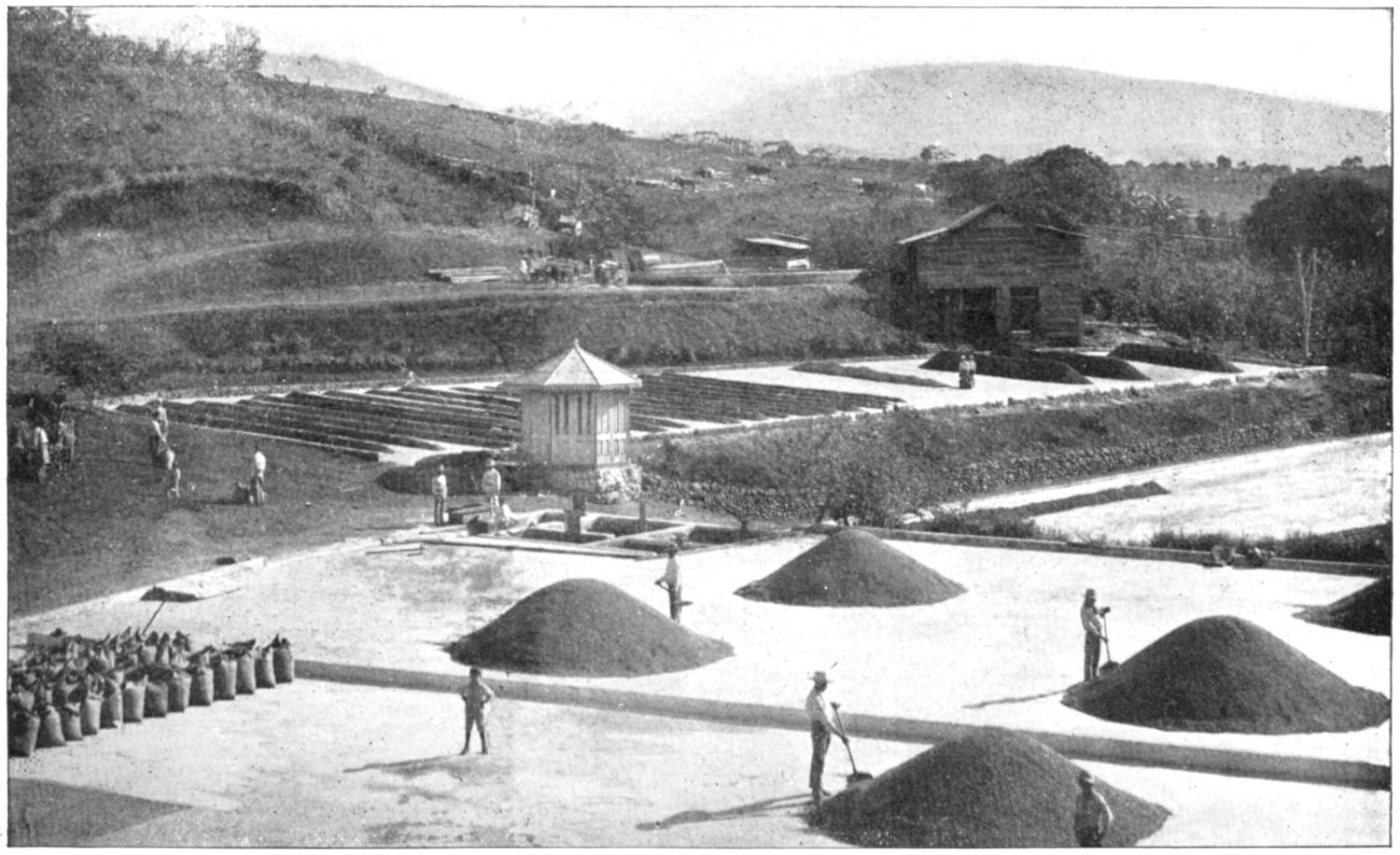
The preparation of Coffee for market necessitates the erection of extensive buildings and machinery on large estates, for which no specific plans can be given, because much depends upon the size and situation of the estate, and as much upon the kind and degree of the preparation contemplated. But the site selected for the works should be as near the centre of the plantation as is compatible with securing a patch of open, airy ground to which a good stream of water can be brought. The first requisite building should be the “pulping-house,” comprising three floors—the berry loft, the pulping platform and the cistern floor—and whenever possible it should be built against a shallow cliff or embankment, so that the berry coffee may be delivered into the loft without being hauled upstairs by hand, while the berry loft is usually placed immediately over the pulping platform.
The operation known as “pulping” consists in clearing the coffee “beans” from the pulp in which they are enveloped, which with ripe berries is most easily and effectively accomplished immediately after picking, efforts being usually made to complete the pulping of a day’s picking during the same evening. If over-ripe or shriveled, but still comparatively moist inside, the berries should first be soaked in water for a few hours previous. A number of machines have been invented for this purpose, the chief objects in all cases being to pulp rapidly, thoroughly and without injury to the bean, for if the inner or “silver-skin” of the bean be broken the latter is wasted.
But the latest and most simple form of “pulping”-machine is what is known as the “Disc Pulper,” in which the separation of the bean and the pulp is effected by means of rotating discs, covered with a thin sheet of copper, whose surface has been “knobbed,” is raised into sort of oval knobs by the application of a blend punch. Pulpers of this class being portable and cheap, are most frequently used in the opening of distant estates. The “single” form is very light, and when driven by three plantation hands, it will pulp all the way from 20 to 25 bushels of berries an hour. The “double” form, which has two discs and which is furnished with a feeding-roller inside the hopper, requires from four to six hands to pulp 40 bushels an hour, but when driven by power, it will hull from 70 to 80 bushels in the same time. In the machine the discs are placed between “cushions” of smooth iron, set at such a distance that the berries cannot pass without being bruised. The cushions rest in a movable bed of iron, set so that no bean can pass downwards. When the disc revolves, the berries are driven forward and squeezed, the corrugations then catch the skins and drag them between the disc and bed. These small pulpers have an advantage over the larger ones, in that each can be set to suit the size of a portion of the crop—which always varies in size—and in that, with two or more machines, there is less likelihood of complete stoppage in case of accident. One disc pulper to every 30 or 40 acres—that is, about three to every 100 acres, two to be set alike for large size and one for smaller berries—should be ample in a fair-sized estate.
There are times, however, when it is impossible to pulp Coffee; the pulpers may get out of repair, or the weather may be so untoward that the berry does not ripen sufficiently, or become too dry for pulping. In these cases the berries must first be fermented. The best way to do this is to place them in one of the tanks, or if the quantity is too small to nearly fill a tank, in an old box or cask, and cover it with sacks or grass, and let it remain until it acquires a good warmth; then, when the berries in squeezing are no longer slippery, they may be taken out and spread in the sun to dry. For two or three nights it need not be housed, nor will rain hurt it. When dry, it may be stored for curing like parchment Coffee, but must not be mixed with it. To ferment the berries by leaving them in a heap on the ground is a bad plan for two reasons: First, when fermented in this manner it becomes very wet and collects dirt, which, in the after treatment, will affect the color of the Coffee. Second, because in a heap the fermentation cannot be equalized throughout the Coffee. Pulping may be performed whenever possible, as the increased trouble entailed by the latter process is not compensated for by the alleged improvement of the flavor and no better price is received for it.
FERMENTING AND DRYING.
The “parchment” coffee as it comes from the pulper is next submitted to a fermentation process for the purpose of removing the saccharine matter, without which the beans would not dry. This operation is performed in a series of tanks, whose capacity varies with the size of the estate, and which may be arranged in squares. The pulpers are placed on a platform above the tanks and in such a position that the pulped coffee can be run by water into the tanks, which must also be so situated that the coffee will always advance by the aid of running water and may finally be conveniently conveyed to the drying ground, while the water and refuse run off. The amount of cistern accommodation necessary for a plantation maybe based on the allowance of one cubic foot for each bushel of berries picked in one day. The tanks are seldom less than three in number—two receiving cisterns, each large enough for the greatest possible daily picking and a third for washing the parchment, nearly as large superficially, as the two others combined, that is, the “washing” tanks from twelve to fifteen feet long, two feet deep and separated by a causeway three and one-half feet wide, and the “fermenting” tanks eight by eighteen feet long and two and one-half feet deep. These tanks are usually made of brick-work, lined with cement or asphalt, but wood is much better because less cold, but all should have a slight incline in order to assist the drainage. The receiving tanks are provided at the lowest corner with a good-sized outlet, fitted with a plug and with a movable sieve of perforated zinc or woven-wire, fine enough to keep back the coffee when draining off the water, but not so fine as to choke with saccharine scum; the receiving cisterns being used alternately. All the coffee pulped in one day is allowed to remain in the receiving cistern until a slight fermentation has set in; this occurs in from twelve to eighteen hours in mild weather, but in cold weather it may take from thirty to forty hours and even more. There are two ways of conducting fermentation—the dry and the wet—the former consists in allowing the berries to be without water, the bottom of the tank being perforated so as to draw off the liquid, but by the latter process the tank remains full of water. The dry system, however, is the better as long as care is taken to turn the mass so that the fermentation shall be equal throughout; the presence of water equalizes the fermentation but retards it and slightly injures the quality of the coffee. When fermentation is not sufficiently prolonged, the beans will assume a yellowish color—called “blankety”—and will be difficult to dry, becoming liable to absorb moisture at the same time. But when properly fermented the separation of the saccharine matters is easily effected in the washing tanks, to which the pulped beans and a good supply of water is admitted. The washing cistern is provided with a sluice door at the lowest corner, this door commonly measuring six inches wide by three inches deep. The coffee is meanwhile constantly agitated by a wooden scraper or rake, by which the light coffee and refuse matter float and may be skimmed off, the dirty water flowing off through a tall cistern provided with a grating to catch the skins and stray parchment, while the sound berries are placed in draining boxes to remove the excess of moisture and are then transferred to the drying ground with the least possible delay. But should the climate be uncertain it will be necessary to provide for the emergency of a succession of wet days, when drying cannot be proceeded with. Parchment coffee may be kept in the undried state for two weeks without injury by placing it in a cistern exposed to a continuous flow of cold water.
In drying, the berries to be dried are first spread out on a flat surface exposed to the heat of the sun. The material forming the terrcino (terrace) or drying ground varies greatly in the different coffee-producing countries, but most commonly the ground is leveled and then covered with a kind of concrete, sometimes asphalt is laid down, but, besides being expensive it is not sure in hot climates to withstand the heat, and such a surface is liable to crack and give way if not carefully drained. A very good and much better plan is to lay down coir-matting on ground which has simply been made smooth and hard; the advantages of this plan are its cheapness, the ease with which extra ground can be requisitioned in case of need, and the use of the matting as a temporary covering in case of a sudden shower; modifications of this method are to stretch coir or gunny cloth across modern frames, or across trays with or without wheels. Shed accommodations must always be provided ready for the reception of the coffee at any moment, and the beans must be constantly turned over and over, either by light rakes or shovels. The drying must also be rendered equable and must not proceed too rapidly so as not to crack the parchment before the bean is quite dry, for this reason also, the coffee should not be exposed too long to a strong sun for the first day or so. During the drying it is gathered in each day when the sun is hot, but will then continue to dry under cover. Every care must be taken to prevent overheating, which may happen by prolonged drying in mild weather; rather than permit this the coffee should be returned to a tank, and kept washed with running water.
A new method, known as “artificial drying,” has recently been adopted in Brazil and other countries, being much quicker and cheaper. An easy means of applying artificial heat is by passing an iron pipe, open at both ends, through a fire outside the stove and below the level of the floor, continuing it into the stove just beneath the floor; the heated air, by passing upwards through the coffee, will carry off much of the damp. Revolving drying machines are also in use; one of the best of these is one introduced originally for drying corn. It consists of cylinders into which steam enters and agitators arranged so that the coffee is impelled forwards and caught up and rained down as the cylinder revolves. The central cylinder works in a steam packet, outside which is a light casing of sheet iron, perforated at one end so that the air may be drawn through by a fan to assist in the drying and carry off the liberated moisture; this machine obviates the necessity for respreading the coffee in the terraces before hulling. Three days’ thorough sunning usually suffices to render the coffee quite dry and brittle, in which condition it is known as “parchment coffee,” in which state, in many countries, it is sent to port, its further curing being left to the shippers, for not only is considerable expenditure in buildings and machinery necessary for the purpose, but the experience gained by manipulating various lots of coffee will enable those who make the subject a special study to bring the sample up to the best standard of appearance and keeping properties, but the coffee retains its color better if allowed to remain for several weeks in the parchment, and its quality continues to improve for months, even years, the process being known as “curing;” as, however, protracted curing causes great subsequent difficulty in removing, the “silver-skin” coffee is never kept in the parchment longer than is compulsory.
HULLING AND PEELING.
This operation consists in the removal of the “parchment” and the “silver-skin,” after which the beans are again exposed to the sun for a period which is difficult to define. Some planters say that they should be dried till they resist pressure of the thumb-nail, but there is really no infallible test, as no two samples are exactly alike. It needs much experience to prevent loss of weight by over-drying, or of color by under-drying, but they peel best while still warm. A variety of hullers have been tried, but preference is commonly given to the old-fashioned edge-runner mill, composed of a circular trough with two large wheels revolving in it and suspended about two inches from the bottom. The trough is one-half to two-thirds filled with beans, which remain until the grinding action of the revolving-wheels has separated their skins, when they are let out by a lateral aperture. A trough fifteen feet in diameter should turn out at least 1,200 pounds of marketable coffee an hour, four bushels of good parchment coffee yielding 100 pounds clean coffee. The appearance of the coffee immediately after hulling is very light colored, but it soon assumes a fern-green hue, which it will retain unless exposed to damp, when it becomes dingy or mottled-gray, and is classed as “country damaged.”
WINNOWING AND SIZING.
The peeled Coffee as it comes from the huller in company with the detached skins is submitted to the influence of a fan whose force must be so adjusted that it will effectually remove the skins without carrying off the Coffee. When the Coffee has been cleaned from the skins, it is necessary to separate it into various sizes for market, chiefly with the object of rendering the subsequent roasting process more equable in effect. Formerly the sizing was performed by hand-picking, but it is now the custom to employ a machine called a “separator,” which consists of an inclined, revolving cylindrical sieve formed of perforated sheet-iron or steel wires, and divided into sections of different meshes. The Coffee is fed in at the hopper, which is furnished with a regulator and an internal worm for the purpose of distributing it equally, while a revolving brush prevents the meshes from being choked. Sand and dust pass through the first section and fall into the space while the small and broken beans are delivered below, the best and largest beans are caught up and the peaberry rolls freely out at the end.