Chapter V · COMMERCIAL CLASSIFICATION AND DESCRIPTION. (continued 2)
Reading edition
Jamaica—The coffee plant was first introduced into Jamaica in 1730, a special act of Parliament being passed in that year to encourage and foster its cultivation. The island is famous for the production of fine coffees, those grown on the regularly conducted plantations rivalling the best products of any country. It is divided into two kinds, “Blue Mountain” and “Plain-grown,” the latter being graded commercially as “Ordinary” in contradistinction to the former, which is always choice. “Blue Mountain Jamaica” is a bold, well-developed bean, bluish almost translucent in cast, very solid and attractive in style and appearance, and developing a characteristic peculiarity, that of opening and exposing a whitish hull or silver-skin down the furrow when roasted, while the liquor is heavy, round, full and rich, fragrant and aromatic to a high degree. It is packed for export in barrels and large casks, the bulk of the choicer grades being compulsorily exported to England, where it commands a higher figure relatively than Java and other equally fine coffees. Nearly all the coffee plantations on the Island of Jamaica being mortgaged to London brokers and dealers, the contracts containing a clause or stipulation compelling the planter to dispose of their crops through the holders, who, by the harsh terms of the contract, not only secure the best of the product and the interest on the money advanced but also the commissions or profits on its sale.
“Ordinary” or plain-grown Jamaica is a large, whitish, flat and broken-bean coffee, moist or spongy in the raw state, and invariably stony and hully, being imperfectly cleaned. The roast is usually either “quakery” or “niggery,” the liquor is strong, almost to rankness, and apt to be “wild” or “grassy” in flavor, more particularly when new, approximating close to a Travancore or Native Ceylon, to which coffees it bears a striking resemblance in character and value. It is put up in large coarse bags, averaging about 200 pounds, and shipped principally to the United States.
Haytian Coffees.—Coffee is claimed to have been first introduced into this island by wild fowl, being steriocaceously deposited there after the manner of Monkey, Jackal and Tiger-cat coffees. Its systematic cultivation was first begun there about 1740 by the French, the industry flourishing during the French régime, but rapidly declining after the island passed under native rule. It is cultivated there now by natives exclusively, principally in the districts of Jeremie, Jacmel and Gonaives, by which terms it is more familiarly known to commerce. They are generally large, flat, white and broken in appearance, invariably stony and stemy, being but crudely cultivated and prepared for market. Yet, notwithstanding these defects, they are elegant roasters, yielding an excellent liquor, full of snap and rich in flavor, but owing to its indifferent treatment its commercial value is reduced far below its intrinsic worth. The coffee itself being mild and pleasant, added to its low price, would commend it to many consumers were it but properly cleaned and graded. Usually all of it received into this country is reshipped to France, Belgium and Germany, where it is picked over by hand, the consumers in these countries not being as exacting as regards cleaning and grading as in this country. The production of coffee in Hayti has fallen from over 80,000,000 pounds in 1789 to less than 50,000,000 at the present time, although the island offers an excellent and extensive field for the industry, which, it is hoped, will be taken advantage of as soon as the country devotes its energies more closely to the improvement of its internal affairs and the encouragement of capital.
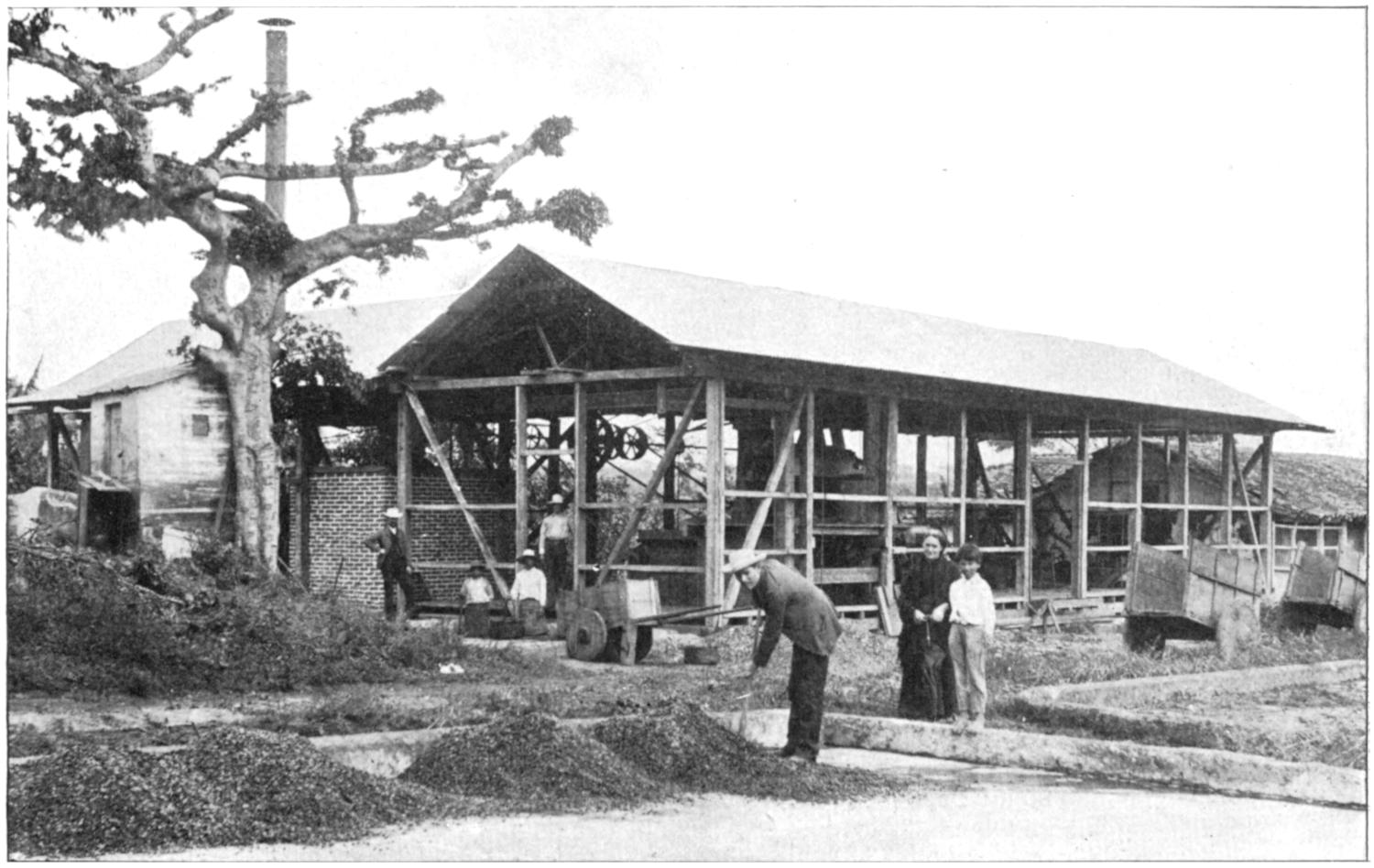
Hulling Coffee.
San Domingo—Known to trade as “Cape,” is grown on the same island to the west of Hayti, and approximates very closely in size, style and color to ordinary Jamaica—so much so that it is frequently substituted and sold in lieu of it. Its cultivation being also principally conducted by natives, who are so indifferent to its proper preparation for market—machinery being employed only to a very limited extent—that most of the product is shipped in a stony and otherwise dirty condition, thus reducing its value commercially far below its intrinsic worth.
Porto Rico—Is grown chiefly in the province of Ponce, small quantities being also produced in the districts of Arecibo, Mayaguez and Aguadilla. The bean is regular and well formed, but varying in color from yellow to greenish, the quality is fairly good, and though, not well known in the American market is much valued in Spain and the European markets generally.
Dominica—Known to trade as “Souffriere,” from the district of growth, is a peculiarly shaped bean, said to be produced from Mocha seed, but much inferior to the product of the parent plant. From the effects of Negro emancipation and the coffee blight, the annual production of Dominica has fallen from over 2,000,000 pounds to almost nominal.
Trinidad—The coffee export from Trinidad is only about 25,000 pounds yearly, yet there is scarcely any part of the island where coffee culture may not be profitably undertaken, particularly in the districts of Aripo and Maracas, where the conditions are unsurpassed. Both the Arabian and Liberian species are grown there, the product being commercially divided into “Large” and “Small” and generally shipped to Spain.
Martinique.—Although originally introduced into the New World through Martinique, which island was for a long time celebrated for the quantity and quality of its coffee, it produces very little comparatively at the present day. In fact, barely sufficient to supply the home demand, the excess going to France, where it is highly esteemed for its intrinsic merits. The bean is exceedingly small, hard and flinty, somewhat resembling that of a Mocha, bluish-gray in color, heavy and round in body, pungent and piquant in flavor, and grading with the finest of the milder sorts.
Guadeloupe.—More or less coffee is produced in Guadeloupe and other of the smaller islands of the Antilles, but chiefly to supply the home demand, and, with the exception of the former, are almost entirely unknown to commerce. It is grown principally in the districts of Bonfleur and Hatrant, what little is exported being shipped to France, where it is valued high commercially for its superior drinking qualities. A century ago the island exported nearly 8,000,000 pounds, being now reduced to less than 500,000. The total annual production of the entire West India Islands not exceeding 90,000,000 pounds at the present time, but strenuous efforts are being made to increase the product.
CENTRAL AMERICAN COFFEES.
Coffee forms the principal staple of the Central American States, the soil and climate being eminently adapted to the cultivation of fine coffees, but, as in all other countries, the best grades are produced on the upland or mountain slopes. In some of these countries, however, the most primitive system of cultivation and elementary methods of preparing are still in use, while in others, notably Guatemala, the most improved modern machinery is employed. They embrace Guatemala, Nicaragua, San Salvador, Honduras and Costa Rica coffees.
Guatemala—Produces the finest, ranking in intrinsic merit with that of any variety grown—more particularly that grown in the now famous Coban district, in Vera Paz, which rivals, if it does not actually excel, all other varieties in size, style, roasting and drinking qualities. The average bean is large, bold and symmetrical in form, of a translucent blue cast, and exceedingly handsome in general appearance, making a perfect roast, yielding a rich brown liquor, sparkling and aromatic in the cup. The next best coffees in Guatemala are those grown in the “Costa Chica” and “Costa Grande,” a prolongation of the chain of mountains crossing the southern boundary of Mexico. The production of coffee has more than doubled in Guatemala in the past ten years, the price during the same period being more than quadrupled. The total product for 1892 was over 700,000 quintals, representing a total value of 16,000,000 dollars. The extraordinary high price of coffee now ruling has led to a transformation of the country, small land-owners who heretofore realized from their crops scarcely sufficient for working expenses, now find themselves with considerable capital, with which they improve and enlarge their plantations. These results have led to unbridled speculation, large companies being formed there for still increasing the area and yield of coffee, every speculator and small trader who has been enabled to save a little money, abandoning his former occupation, turning his attention to coffee growing. This condition may last as long as the present high prices of coffee continues, but a reaction may occur at any time, when complete ruin will be the natural consequence to the suddenly increased number of producers, of which the reflex cannot be but felt in the economic conditions of the country. Land which was but a few years ago uninhabited, has been suddenly converted into smiling and well-cultivated coffee plantations, towns and villages long in decay have risen around them as if by magic and are steadily increasing in wealth. New roads to facilitate transportation to the ports are being constructed, commercial transactions are multiplied, the revenue of the country is increasing, public credits re-established on a sounder basis, and what was but a short time ago a poor, declining and almost ruined State has been suddenly, by the cultivation of coffee, converted into a rich and prosperous commonwealth.
Nicaragua—Is a medium-sized regular-formed bean, solid and heavy in the hand, greyish-yellow in color, what is technically termed “foxy,” and a smooth roaster. The drinking qualities, however, are only fair, the liquor, while heavy, being devoid of snap and fragrance, approximating more to a Rio in flavor.
Salvador—Is allied to Nicaragua in appearance and character, and classed the same, but possesses much finer roasting and drinking properties. The natural bean of the finer grades is, if anything, better developed and more uniform, while the poorer ones are very uneven, broken and “mottled” in appearance; the liquor thin in body and lacking aroma.
Honduras—Is a yellowish, heavy-bean coffee, assuming a rich straw color with age, and having an attractive appearance in the hand. As a general rule it roasts even and smooth, becoming a rich brown color when parched; the liquor, while thin, gives out a pleasant odor, resembling that exhaled by cocoa or chocolate, said to be acquired from being grown in close proximity to cocoa plantations.
Costa Rica—Is one of the most deceptive coffees grown, the raw bean being large and bold in style, a rich pea-green in color, uniform and shapely; but is invariably what is termed “hidey,” which is in reality due to the soil in which it is grown, and, while it makes an almost perfect roast, is “grassy” and bitter in the infusion, particularly when roasted for any length of time, it becomes sour and unpalatable, making its purchase at all times risky.
SOUTH AMERICAN COFFEES
Comprise Venezuelan, Colombian, Equador, Bolivian, Guiana, Peruvian, Paraguayan and Brazilian, small quantities being also produced in Chili and Argentina.
VENEZUELAN COFFEES.
The chief coffee-producing districts of Venezuela lie in a central division, having Caracas and Valencia as a base, with the ports of La Guayra and Puerto Cabello as shipping points, the district surrounding the Lake of Valencia being one of the most productive coffee countries in the world in the quantity and quality of its product. They include La Guayra, Caracas, Maracaibo, Curaçoa and Angostura coffees.
La Guayra—Also known as “Coro” and “Port,” or Puerto Cabello, from the ports of shipment, varies in size from small to medium, and from a pale to a dark-green in color. It is usually graded on a parity with Rio, to which coffee it most approximates in roast and drink, it being frequently polished and sold as such, particularly when Rios are scarce, and, although classed as a “Mild coffee,” develops more or less of a Rio flavor in the cup.
Caracas—Is of two kinds—Trilliado Milled or “dry-hulled” and Descerazado (Washed) or “wet-hulled”—from the different methods employed in pulping and preparing for market. The former is a yellowish, medium-sized bean, regular and uniform in the natural state, but apt to be “quakery” in the roasted, and only fair in the drink. While “Washed Caracas,” on the other hand, is bold and bluish in color, opening at the furrow when roasted like a Mountain Jamaica or Plantation Ceylon, exceedingly heavy and rich in body and fragrant in flavor, and may be classed as one of the best varieties grown.
Maracaibos—Consist of five different varieties or grades—Cucuta, Merida, Bocono, Tovar and Trujillo—district terms, ranking in the order named, “Cucuta” being, when the season is favorable, one of the best coffees grown, grading with many of the products of Java itself. The raw or natural bean of the finer grades is large, round and solid in substance, deep, rich-yellow in color, approximating to that of the best yellow-bean Java sorts in style, appearance and drink. While “Merida” is a mountain-grown coffee, large, bold and bluish in color, frequently excelling “Cucuta,” particularly when the crop is good, and possessing a full ripe liquor with round full body and distinctive flavor very pleasing to the average consumer.
“Bocono,” “Tovar” and “Trujillo,” are inferior grades to the above, small and gnarled in the natural state, generally stony and broken, “quakery” and shriveled when roasted, light in liquor, but smooth and pleasing in flavor withal, making good useful coffees for blending purposes. Maracaibo coffees are packed in Sisal-hemp bags averaging 130 pounds, and principally shipped to the United States, where they are held in high esteem for their many excellent qualities, the regular grades of Cucuta being marked “C” under the importers’ initials, and the choicer grades “C C.” Merida is indicated by the letter “M” in the same manner, Bocono by “B,” Tovar by “T” and Trujillo by “To.” But owing to the too common practice of substituting and repacking indulged in by unscrupulous dealers, these distinguishing marks cannot always be relied on with any certainty.
Curaçoa—Is a small, yellowish, shriveled or shrunken bean coffee, evidently immature or blighted in growth from some unknown cause. It is generally “quakery” in the roast, but yields a not disagreeable liquor in the cup, making a valuable variety in combination to reduce cost.
Angostura—Is a large, flabby, yellowish bean variety, shapely in form but light and “chaffy” in substance, and invariably “quakery” when roasted, the liquor being thin, watery and almost flavorless.
Venezuela supplies about one-tenth of all the coffee consumed in the United States, the total imports being in round numbers about 60,000,000 pounds per annum, and growing steadily.
COLOMBIAN COFFEES.
The coffee-producing districts in Colombia are situated chiefly in the departments of Boyaca, Santander and Cundamarca, these three departments having an area of over 160,000 square miles, of which nearly one-half is adapted to the cultivation of some of the finest varieties of coffee grown. The possibility of this extensive area promises a future supply of almost six times the amount consumed in the United States; in fact, coffee-growing in Colombia, like Mexico, has no limit except that caused by the lack of labor and capital to work it. They are known in trade as Ocana, Bogota, Panama, Savanilla and Bucaramanga.
Ocana.—While bold in bean and regular in form, inclining to a yellowish in color, is still light in weight and thin in body, approaching that of a Trujillo Maracaibo in flavor, with which coffee it is usually graded.
Bogota—Is a mountain-grown coffee, raised on the western slopes of the Andes. It is usually a large and well-developed bean, bluish-green and very uniform in general appearance, solid, compact, and faultless in the roast. The liquor is heavy, full, round and fragrant in flavor, comparing favorably with Caracas, Jamaica, Guatemala and Plantation Ceylon in general style and character.
Savanilla—Is a large, light and “spongy” bean coffee, brittle and chaffy in the roast, devoid of body and almost flavorless. It closely approximates to a Native Ceylon or Angostura in appearance and character, with which coffees it is commercially classed.
Panama—Is comparatively a new variety, recently produced on the isthmus, and like all new productions immature in appearance. It is of the average size, greenish in color, but moist and spongy in the natural state, and as yet but poorly prepared. The liquor is heavy and strong almost to rankness, possessing a grassy or uncooked taste, defects, it is claimed, that will be overcome in time when its cultivation and preparation is better understood there.
Bucaramanga—Known to trade as “Bucaramanga Maracaibo,” ranks among the finest of the South American varieties, being large and bold in style, solid and weighty in substance, perfect in roast, heavy, round and full in liquor, fragrant and aromatic in flavor, the finest grades being superior to many of the Java sorts. The department of Chinqui in the interior of Colombia also offers a good field for coffee culture, the fine lands along the slopes of the mountain ranges being admirably adapted for the purpose. The annual product is about 20,000,000 pounds, going chiefly to the United States and France.
Equador Coffees—Include Cuenca, Tacunga and Machala, but are generally classed under the name of “Guayquil,” being shipped from that port and consumed principally on the Pacific coast, but are limited in production, little being left for export after the home demand has been supplied. They range from medium to large in size, are somewhat bold in style, hard and flinty in texture, pale to greenish in color, and only fairly uniform, being rather imperfectly prepared, but roast and drink well, nevertheless, yielding a light-brown liquor, full in body and fairly fragrant in flavor. Increasing attention is being given to coffee cultivation in Equador, the produce of the new districts being of good quality. The exports from Guayquil average about 1,000,000 pounds per annum, but in some years the crop is entirely spoilt by heavy rains, the yield being inferior in quality and so low in quantity as not to suffice for local needs.
Bolivian Coffees—Are comparatively new to commerce and bid fair to become popular sorts in time, when their cultivation and methods of properly preparing are better understood in that country. They are produced principally in the provinces of Yungas and Mapin, small quantities being also grown in the other provinces. The finest kind is that cultivated in the valley of Yungas, which though small in size and pale in color possesses a peculiarly rich and delicate flavor, commanding a very high price relatively. The product, however, is limited, only about 300,000 pounds per annum, or equal to one-fourth the entire supply. The product of Mapin is much larger in size, greenish in color, but not near as rich in flavor, bringing a much less price, the annual product being three times greater. Bolivian coffees in general produce an intoxicating effect, this peculiar action being as yet unaccounted for, but is claimed by some authorities to be acquired from being grown in the immediate vicinity of the cactus plant, from which pulque is distilled, the coffee plant being of such a sensitive and absorbent nature that it readily acquires any foreign flavor within range. Whether this claim is correct or not has not as yet been ascertained, but certain it is that what is known as Singapore coffee usually tastes of spices, Honduras of cocoa and Costa Rica of what is called, for want of a more applicable term, “hide,” but which is in reality due to the presence of oxide of iron in the soil.
Guiana Coffees.—Known to trade as “Surinam,” “Demerara” and “Cayenne,” from the ports of shipment, are produced in the French and Dutch colonies of South America. But although the cultivation of coffee was introduced into these countries about the same period as to Martinique, its cultivation there has made but little progress, the total production being limited in supply, and going chiefly to the mother countries.
Peruvian Coffee.—Coffee grows luxuriantly on the mountain slopes of Peru, the crops often being so heavy as to necessitate artificial support for the branches, yet the export from Mollendo, the shipping port, amounts only to about 16,000 pounds per annum. It ranges in size from medium to bold, varying in color from bluish to yellow, roasting and drinking with the average of other South American sorts.
Paraguayan Coffee.—The total production of coffee in Paraguay is exceedingly small in comparison with what might be grown there under more favorable circumstances, little or no attention being given to its cultivation, owing to lack of labor and capital, and notwithstanding that it offers a fine field for its more extensive growth.
BRAZILIAN COFFEES.
Brazil being the most extensive coffee-growing country in South America and the largest producer of coffee in point of quantity of any country in the world needs more than a passing notice in this work. The gigantic extent to which its production has been carried there, the enormous, almost fabulous, amount of capital invested in its cultivation, the multitude of people employed in its preparation and handling, including the quantity of shipping employed in its transportation invests it with great importance. One must have been an eye-witness of the immense bustle occasioned by the coffee trade of Rio and Santos, must have observed the feverish excitement and the unprecedented rapidity with which it is prepared, transported, bagged, unbagged, mixed, rebagged, loaded, marketed and shipped before he can form any conception of the extent of the coffee industry in Brazil.
In 1718 the Dutch colony of Surinam began to introduce and cultivate coffee in Guiana from plants received from Java, and in 1722 De la Motte, the French Governor of the adjoining colony of Cayenne, having business in Surinam, contrived by an artifice to bring away with him from there a small coffee plant, which in 1725 had produced many thousands which were distributed among all the French colonies on the mainland, its propagation extending to Para in 1732, the first coffee plantation formed in Brazil being commenced in that province a few years later. Its cultivation, however, made but little progress there until about 1767, when its cultivation was still further extended to the province of Maranhao, where it soon increased rapidly under a more careful and systematic management. In 1774 a Belgian monk named Molke procured some coffee plants from a prosperous plantation in Maranhao, which had previously been obtained from Surinam, and planted them in the garden of the Capucin monastery of Adjuda, then situated in what is now the centre of the city of Rio de Janeiro. The plants prospered so well, and he becoming convinced of their importance as a valuable acquisition to the industries of the country that he established a plantation in the vicinity for its more systematic cultivation. Joachim Bruneo, the then Bishop of Rio de Janeiro, perceiving the valuable benefits that would result from its more extensive cultivation, distributed seeds and plants raised on Molke’s plantation among the religious institutions and planters of the country, recommending and encouraging its cultivation among them, but it was not until 1800 that Brazilian coffee came to be so highly valued in the markets of the world. In that year a planter named Dr. Lecesne, expelled by the revolution from San Domingo, settled near Rio and introduced the latest improved methods of cultivating the coffee plant into that country. From these simple and unostentatious beginnings has grown the now enormous coffee industry of Brazil, which at present produces more coffee than all the other countries in the world combined; it being calculated that upwards of 1,500,000 acres of land are under coffee culture there, containing nearly 600,000,000 trees, hundreds of millions of dollars of capital being invested in its culture, sale and transport. The cultivation of coffee in Brazil now extends from the banks of the Amazon to the southern province of Sao Paulo, and from the coast to the western limits of the country, the plant seeming to find the requisite conditions of soil and climate in almost every part of this vast region, and nearly everywhere giving an abundant yield. Its chief zone of production for commercial purposes, however, is chiefly confined to the coast provinces of Bahia, Ceara, Rio Janeiro, Sao Paulo, Minas Geraes and Espiritu Santo.
In Brazil it was formerly the custom to propagate the coffee plant by slips or “shoots” cut from the older plants on the plantations, but at present it is more generally grown from the seed, as in the Eastern countries. The seeds are sown in nurseries planted with advanced stalks of the mandioca, which serve to shade the sprints while young and tender from the extremes of heat and cold alike, but are gradually thinned out as the growth of the young plants advance, the nursery at this period resembling a young plum thicket. When the plants have reached a height of from eighteen to twenty-four inches, they are transferred to the plantations and planted from six to ten feet apart, according to the district and conditions. As a general rule a crop is not expected until four years after setting out the young plants, unless when the plants are from eighteen months to two years old before transplanting, in which case a partial crop is obtained at the end of the third year. Nearly all over the Brazilian coffee zone the plantations extend with the greatest regularity, as far as the eye can reach, presenting a most attractive and pleasing effect, some fazendas (plantations) having as many as 350,000 trees, others again having as low as 30,000, but all averaging from 500 to 800 trees to the half fanegada (acre), the average annual produce of each tree ranging from one to seven pounds of prepared coffee, or about one to one and a half pounds per picking of cleaned coffee. The plantations situated on high lands and exposed to the east being the most productive, but prospering equally well in the lowland districts, although the product is much inferior in quality and flavor. The trees are grown in lines and squares, the face of the country in the coffee-growing districts being undulating and hilly, a plantation of coffee being at every season of the year an object of beauty and interest. The leaves are perennially bright and polished, resembling those of the laurel when in full bloom, but of a much darker green in color, the flowers or blossoms of the purest white, growing in tufts along the top of the branches, and blooming so suddenly that in the morning the trees look as if snow had fallen on them in flaky wreaths during the night, their jasmine-like perfume being powerful enough to be oppressive, but lasting only for a single day, being succeeded immediately by branches of immature green and the dark-crimson hull of the ripe berries—resembling cherries in their brilliancy and size—and following each other in quick succession, which added to the thick foliage of the trees presents altogether a magnificent spectacle.
In Brazil the coffee trees continue to bear from fifteen to twenty years, but it is found necessary to the healthy development of the plants to keep the ground in good condition, and when the interspaces are not cultivated with other plants—principally corn and beans—as is usually the custom, it is annually cleared around the roots, a compost of dead leaves and coffee-hulls being placed about them. In some districts—notably Sao Paulo—many of the trees have been producing continuously for twenty-five years, still presenting a vigorous appearance and yielding an average each year, while others that had attained an age of thirty-five years were cut off within eighteen inches of the ground, and two years later put forth new branches, presenting all the appearance of thriving trees, bearing fruit like much younger trees. This is a new and interesting feature in the management of the old trunks of coffee trees, one having the advantage of new growth being secured in one-half the time it could be obtained from seedlings, as even should these stumps require to be dug around and manured frequently, it is much more preferable and profitable to the trouble, expense and uncertainty connected with the raising of new plants from seed, and certainly presents greater advantages over the latter method. In Brazil the picking is latterly—since the abolishment of slavery—done by contract with the fazendon, or proprietor, who only requires the services of the pickers to gather the berries from the trees, for which labor they are paid what is considered to be one-half the value of the crude coffee that is gathered by them. The estimate placed upon an alquerie (bushel) of crude berries being about seventy-five cents, which, unless the crop is good, ordinary hands do not gather more than two bushels per diem; yet, again, when the crops are large, an industrious and skillful picker can average from five to eight bushels without effort. The berries are picked by hand, the ground being raked clean under the trees previous to picking, an immense, broad, flat receptacle of bamboo being placed underneath the trees, the berries that fail to fall into this being carefully swept up from the clean, smooth ground and emptied into it until filled, when it is carried to a point convenient to the roadside and emptied in piles, from which the coffee is afterwards hauled in ox-carts to a large building known as the terreiro or drying-yard. Picking commences in April, and is continued almost uninterruptedly until November, and after the coffee is gathered it is carted just as it comes from the plantations, mixed with leaves, stalks and stones to the drying-house and spread out on the terraces, large smooth, concrete pavements, to dry in the sun until the berries become black and crisp, after which they are “hulled” or cleaned by one of two methods: one the old or “Monjola process,” and the other the new or “Despolpodor” process.
Brazilian coffees are known to commerce as Bahia, Ceara, Capatinea, Rios, Santos and Maragogipi.
Bahia—Is a small, uneven greenish bean, very inferior in style and appearance, usually “stemmy” and stony and thickly interspersed with black or immature beans, and is usually branded “S” or “S S.” The roast is poor, irregular and quakery, the liquor thin and grassy or unripe in flavor.
Ceara—Resembles Bahia somewhat in general character, being poorly prepared and very unsightly in the natural state, the body and flavor being still more inferior.
Capatinea—Grown in the province of Espiritu Santo, but also known to trade as “Victoria” from the port of shipment, is a large whitish, soft and flabby bean coffee, quakery in the roast and watery and flavorless in the cup.
Rio Coffees—Are almost too well known to need description; the bean, however, varies widely in size and color, ranging from small to large, and from dark green to light yellow, being known to trade as “Light,” “Dark” and “Golden.” They are heavy in body, possessing a flavor and aroma peculiarly distinct from that of all other coffees, and which is so marked in degree as to be readily detected by the most inexpert, excepting “Golden Rio” which, aside from its rich color, possesses a markedly pungent liquor and pleasing flavor.
Pole-cat Rio—Is a very dark, almost black bean coffee, which, although muddy and dark in liquor, is nevertheless much appreciated by many coffee drinkers.
Liberian Rio—Grown from Liberian plants in Brazil, is little thought of, producing little, and that irregularly. The fruit also requires special machinery to prepare it, the husk being too thick and leathery to pass through the regular machines.
Rio Hache—Though frequently classed with Rio coffees, as a matter of fact is not grown in that country, but in Colombia. The bean is yellowish-brown in color, light in weight and liquor, and somewhat mawkish in flavor. Like all other coffees, Rios improve with age, and with time lose their harsh flavor, which becomes greatly modified by storing, disappearing altogether in from three to four years, particularly when kept in an even temperature.
Santos Coffees—Produced in the adjoining province of Sao Paulo, but deriving its trade-name from the port of shipment, ranges from small to large in size and from green and yellow to a full white in color according to its maturity, it is an immensely popular sort among American consumers as well as in Europe, having more than doubled in consumption in recent years. It is fast supplanting the milder growths of other countries, the finer grades being frequently substituted for Maracaibo, and even Java, by unprincipled dealers. While many of them roast “quakery,” they are nevertheless almost invariably smooth and pleasing in liquor and flavor.
Red-bean Santos—Grown in the Campinas district, is medium in size and reddish in color—a peculiarity derived from the soil, which is composed of terra rocha (red earth)—and is claimed to be richer and more flavory than either the white or yellow bean varieties.
Mocha-seed Santos—Is a small-bean variety, grown from Bourbon seed or transplants, and is fast becoming a very popular sort. It is shipped principally to France, where it masquerades under the name of Mocha, thereby diminishing the demand for this favorite sort in proportion to the amount distributed.
Maragogipi—Which was discovered in the province of Bahia some years since, is claimed to be an indigenous variety and is called after the district where it was first found. The bean is as large as Liberian, but flat in form and varies in color from a very light to a dark-green, but while heavy and full in body and fair in quality, it is yet lacking in all the essentials of a fine coffee, disappointing the great expectations at one time formed of it.
OTHER BRAZILIAN VARIETIES.
Cafe des Aguas—Is so termed from blossoming in the rainy season, and which has the effect of stunting and deforming the beans. The bean is oblong in shape and imperfectly formed, while the liquor is thin and watery and devoid of flavor.
Cafe Vermelho—Is the regular “Red-berry” species, and is so named to distinguish it from a new variety said to have been recently discovered and termed
Cafe Amarello—Or “Yellow-berry,” recently found in the district of Botucatu, and is so called because the ripe berry is yellow instead of red. It is superior to the ordinary sort, not on account of any difference in the size of the bean, but according to the chemical analysis of experts, who claim that it is much richer in caffeine.
Brazilian Java.—Extensive plantations of Java coffee plants have lately been formed in Brazil as an experiment, but does not produce such heavy and regular crops as in the original soil.
Goyaz Coffee—Is a wild species, discovered a few years ago in the province of Goyaz, but is little thought of by planters or dealers, being wild and grassy in flavor.
In Brazil the planters generally forward their crops to a Commissario or factor at the shipping port, who acts as their agent, the coffee being received in varying lots and conditions from different growers, no uniformity being observed in the kind of bag or quantity. The commissarios again disposes of it to the Ensaccaderes, who are the actual buyers at first hands, and who store it in large warehouses, where it is graded and bagged, and stored until required for shipment to the foreign markets. The sacks of coffee being piled on either side, each being numbered and further distinguished by some special mark or brand. At the present time many commissarios have the coffee weighed as they sell it, but sales between the commissarios and ensaccaderes are never concluded in Rio without the assistance of a Corretor or broker, while in Santos, where the exporter buys his coffee direct from the commissario, it is sold mostly without the intervention of a broker, the terms of payment being fixed at thirty days.
Brazilian coffees are generically classed in the Rio and Santos markets as “Highland” and “Lowland” and are graded as Superior or “Choice,” Primera or “First,” Primera boa or “Good first,” Primera regular or “Regular first,” Primera ordinaria or “Ordinary first,” Segunda or “Second,” Segunda boa or “Good second,” and Segunda ordinaria or “Ordinary second.” Importations are generally in “Cargoes” divided into “Invoices” or “Lines,” designated by letters. An invoice consisting of a number of “Chops” denoted by figures, each chop varying from the other in quality, size and color. In the American market the coffee is subdivided into six grades, known to trade as “Fancy,” “Choice,” “Prime,” “Good,” “Fair,” “Ordinary” and “Common,” the first four grades being further distinguished by the terms “Light,” “Medium” and “Dark,” and by prefixing the term “Strict” or “Strictly” correct selections of each grade may be secured.
There is no standard grade, nor is it possible to establish one, owing to the changes made by time in the appearance of the coffee, which causes the different grades to vary with the size, color and quality of the coffee and the condition of the market on arrival. On an active and rising market the coffee that on a steady market would be denominated only “Fair,” suddenly becomes “Prime” or “Good,” and on a dull or declining market may be classed as “Ordinary.” The following constitutes the different grades as they are generally accepted on this market:—
Fancy Rio or Santos—Is large, bold and uniform in size and color, free from all imperfections, and attractive in style and appearance.
Prime—Is very clean and regular in size and color, but deficient in the rich, pleasing appearance of the former.
Good—Is acknowledged as the average or “Standard” grade, and ranges from clean to strictly clean, and is uniform in bean and color.
Fair—Is only moderately clean, containing some black or broken beans and other slight imperfections.
Ordinary—Is irregular in size and color, and unsightly in appearance, containing much black beans and other extraneous matter.
Common—Is the poorest grade, and is generally full of black and broken beans, stems, hulls and chaff, having no definite color, and very unsightly in general appearance. On the Coffee Exchanges they are graded numerically from No. 1 to No. 10, No. 7, or “Low ordinary,” being adopted as the “Standard grade,” upon which all transactions are based. In point of quantity Brazil heads the list of coffee-producing countries, its annual product ranging from 7,000,000 to 8,000,000 bags of 130 pounds each, 75 per cent. of which is exported to the United States, the remainder going chiefly to Europe.
OTHER VARIETIES.
Pea-berry Coffees,—Also known to trade as “Male-berry” and “Pearl-bean,” are concave-convex in form and may belong to any variety, from Rio to Java. Their peculiar shape being accounted for as follows: Each perfect coffee berry should contain two oval seeds or beans placed facing each other in the fruit or pod, but it most frequently occurs that only one seed will form in it, the other becoming abortive. The one forming receiving all the nourishment of the investing coats, forces itself against the dividing membranes and encountering no opposition naturally develops into a larger bean, which in the process of growth assumes a shape different from that of the regular or “flat bean” of commerce.
Cherry-dried Coffee—Is a term applied in the East to coffees cured by the old or sun-dried process. After the berries have been harvested they are spread out on “patios” or terraces exposed to the sun’s rays for a period covering from six to eight weeks, or until they are thoroughly dried, before being pulped and hulled. Meanwhile they are raked and turned over once a day during the drying period, in order to prevent heating and fermentation, and at night heaped up and covered over with matting or other material to protect them in case of rain, and from the heavy dews, until the process is completed, after which they are pulped and hulled by crushing in a mill.
Washed Coffees—Are so termed from being prepared by the new or West India process, by which the coffee is pulped immediately after being picked, the berries being placed in a large vat and the pulp soaked off. The coffee in the parchment left in the vat is kept in constant motion by agitation with a kind of rake or shovel to wash it well, the water being constantly changed also while the washing continues, to remove the débris with which the coffee charges the water, the coffee sinking, while the pulp, blighted berries and other extraneous matter such as stems and leaves are floated off by the water, after which the beans are again washed and spread out on mats to dry. By this method the coffee must be crushed the same day, otherwise it will ferment and the flavor be greatly injured.
Triage—Is composed chiefly of dead or decayed beans, which are invariably sour, bitter and black, being entirely destitute of the active principle of coffee, containing no aroma and invariably injuring and detracting from any coffee in which they may be mixed—as they usually are—no matter how small the quantity used.
Screenings—Are composed of the dust, chaff and mutilated beans separated from the regular grades of coffee in the process of milling, and drink well according to the variety or grade from which they are obtained, but are generally roasted, ground and mixed with chicory, and sold in package form.
Skimmings—Are usually composed of that portion of the cargo stowed in the bottom or sides of the vessels in which it is imported, or of the storehouse sweepings after the regular coffee has been delivered. A greater or less portion of all cargoes are found damaged by dampness or bilge-water during the voyage, thus staining and discoloring the coffee, rendering it mouldy or musty. The strained and damaged bags are emptied and the tainted coffee “skimmed” off, milled, rebagged and sold under the head of “Skimmings.” They are generally branded “G. S.” (Good skimmings), “G. L. S.” (Good light skimmings), “G. D. S.” (Good dark skimmings), “F. S.” (Fair skimmings), and “S. S.” (Store or ship sweepings). Notwithstanding their origin many of those coffees roast and drink exceedingly well, but great care must be exercised by the dealer in selecting them, as they may taste of the bilge-water or be mixed with coal, iron, chips and other extraneous substances.
United States Coffee—The Department of Agriculture at Washington has recently issued a circular relative to the possibility of coffee culture in some of the Southern States, in which it is led to believe that the soil and climatic conditions of Texas, Florida and Lower California will be found suitable to the profitable cultivation of coffee. It is also claimed that a species of wild coffee has been discovered in the two latter States, and that in California seed has been planted obtained from Costa Rica with satisfactory results. A coffee planter from Guatemala has recently been investigating the soil and climate of San Bernardino in Lower California with a view to the introduction of coffee culture in that section. The conditions there, it is stated, are very favorable for its profitable production, and he has offered to invest capital in a company to be organized to start the industry.