Part 5 — CHAPTER XXXIIIToC
Reading edition
CHAPTER XXXIIIToC
HEREDITY BUGABOOS AND HEREDITY TRUTHS
One of the red-letter days of my life was that on which I learned that I could not have inherited tuberculosis from two uncles who died of consumption. For years I had known that I was a marked victim. Silently I carried my tragedy, suspecting each cold and headache to be the telltale messenger that should let others into my secret. He was a veritable emancipator who informed me that heredity did not work from uncle to nephew; that not more than a predisposition to consumption could pass even from parent to child; that a predisposition to consumption would come to nothing without the germ of the disease and the environmental conditions which favor its development; and that if those so predisposed avoid gross infection, lead a healthy life, and breathe fresh air they are as safe as though no tuberculous lungs had ever existed in the world. Some years later I learned to understand the other side of the case; I realized how I had been in real danger of contracting consumption in the darkened, ill-ventilated sick room of the uncle who taught me my letters and gave me my ideal of God's purpose in sending uncles to small boys.
There are two distinct things which make each individual life: the living stuff, the physical basis of life, handed down from parent to child; and the environmental conditions which surround it and play upon it and rouse its reactions and its latent possibilities. It is like the seed and the cultivation. You cannot grow corn from wheat, but you can grow the best wheat, or you may let your crop fail through careless handling.
It is well that we should think seriously about the part played by heredity, for the living stuff of the future depends upon our sense of responsibility in this regard. The intelligent citizen would do well to read such a book as J. Arthur Thompson's Heredity (1908), in which the latest conclusions of science are clearly and soundly set forth.
The main problem of to-day, however, is to use well the talents that we have. Here two things should always be kept in mind: First, the inherited elements which make up our minds and bodies are complex and diverse. Health and strength are inherited as well as disease and weakness; they have indeed a better chance of survival. In the most unpromising ancestry there are latent potentialities which may be made fruitful by effort. No limit whatever can be set to the possibilities of improvement in any individual.
In the second place, if science has shown anything more clearly than the importance of heredity, it is the importance of environment. This influence upon human lives is within our control, and it is a grave error to neglect what lies clearly within our power and to bemoan what does not. Science has wrought no benefits greater than those which result from drawing a clear line between heredity bugaboos and heredity truths. An overemphasis on the hereditary factor in development at the expense of the environmental factor, I call a heredity bugaboo; and it is a tendency which cannot be too strongly condemned. To fight against the sins and penalties of one's grandfather is a forlorn task that quickly discourages. To overcome diseases of environment, of shop and street, of house and school, seems, on the contrary, an easy task. Heredity bugaboos dishearten, enervate, encourage excesses and neglect. Heredity truths stimulate remedial and preventive measures.
We may well watch with interest the progress of eugenics, that new science which biologists and sociologists hope will some day remake the very living stuff of the human race. But meanwhile let us take up with hope and courage and enthusiasm the great hemisphere of human fate which lies within our grasp. Good food and fresh air, well-built cities, enlightened schools and well-ordered industries, stable and free and expert government,—given these things, we can transform the world with the means now at our disposal. We can reap, if we will, splendid possibilities now going to waste, and by intelligent biological and sociological engineering we can hand on to the next generation an environmental inheritance which will make their task far easier than ours.
"Physical deterioration" is a bugaboo that is discovered by some in heredity and by others in modern industrial evils. The British director general called attention a few years ago to the fact that from forty to sixty per cent of the men who were being examined for military service were physically unfit. A Commission on Physical Deterioration was appointed to investigate the cause, and to learn whether the low physical standard of the would-be Tommy Atkins was due to inherited defects. The results of this study were published in a large volume called Report on Physical Deterioration, 1904, in which is set forth a positive programme for obtaining periodically facts as to the physique of the nation. In the course of the commission's exhaustive investigation there was found no evidence that any progressive deterioration was going on in any function of the body except the teeth. "There are happily no grounds for associating dental degeneracy with progressive physical deterioration." The increase in optical defects is attributed not to the deterioration of the eye, but to greater knowledge, more treatment, and better understanding of the connection between optical defects and headache.
The commission hoped "that the facts and opinions they have collected will have some effect in allaying the apprehensions of those who, as it appears, on insufficient grounds, have made up their minds that progressive deterioration is to be found among people generally." In regard to the facts which started the fear, the report says: (1) the evidence adduced in the director general's memorandum was inadequate to prove that physical deterioration had affected the classes referred to; (2) no sufficient material (statistical or other) is at present available to warrant any definite conclusions on the question of the physique of the people by comparison with data obtained in past times.
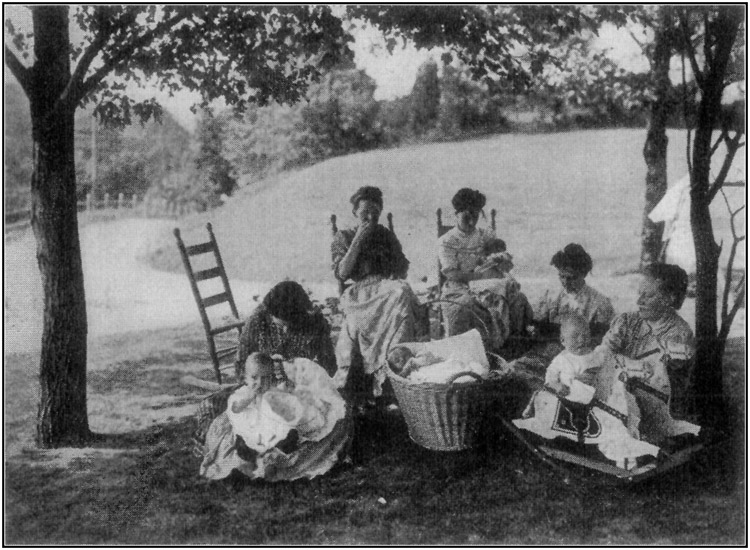
THE BEST INHERITANCE IS A MOTHER WHO KNOWS HOW TO KEEP HER BABY WELL
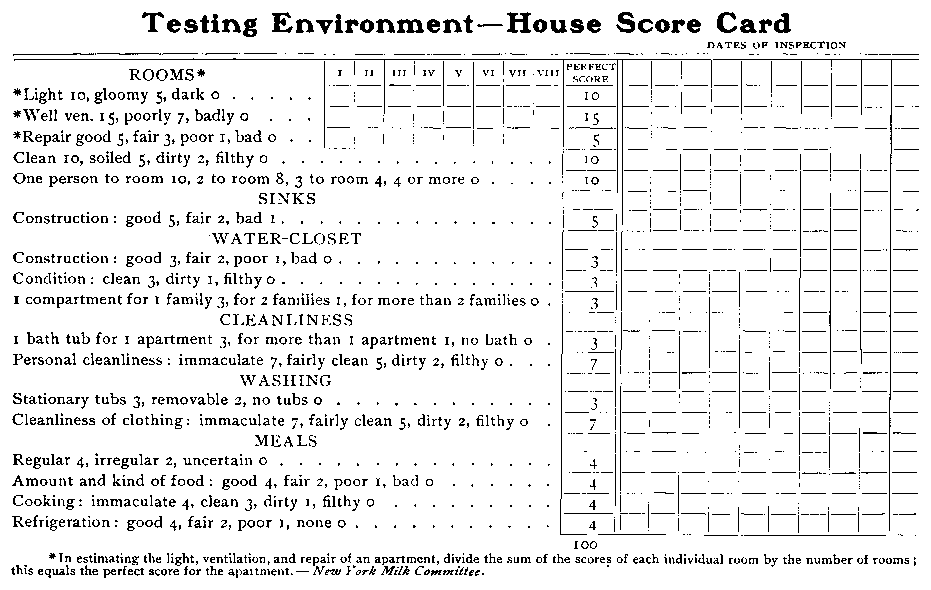
The topics dealt with in the report refer to only a partial list of conditions that need to be carefully studied before we can know what environment heredity we are preparing for those who follow us:
I. As to Babies
Training of mothers, provident societies and maternity funds, feeding of infants, milk supply, milk depots, sterilization and refrigeration of milk, effect of mother's employment upon infant mortality, still births, cookery, hygiene and domestic economy, public nurseries, crèches.
II. As to Children
Anthropometric measurements, sickness and open spaces, medical examination of school children, teeth, eyes, and ears, games and exercises for school children, open spaces and gymnastic apparatus, physical exercise for growing girls and growing boys, clubs and cadet corps, feeding of elementary school children, partial exemption from school, special schools for "retarded" children, special magistrate for juvenile cases, juvenile smoking, organization of existing agencies for the welfare of lads and girls, education, school attendance in rural districts, defective children.
III. As to Living and Working Conditions
Register of sickness, medical certificates as to causes of death, overcrowding, building and open spaces, register of owners of buildings, unsanitary and overcrowded house property, rural housing, workshops, coal mines, etc., medical inspection of factories, employment of women in factories, labor colonies, overfatigue, food and cooking, cooking grates, adulteration, smoke pollution, alcohol, syphilis, insanity.
IV. As to Health Machinery
Medical officers of health, local, district, and national boards, health associations.
Scientists of the next generation will continue to differ as to heredity truths and heredity bugaboos unless records are kept now, showing the physical condition of school children and of applicants for work certificates and for civil service and army positions. The British investigators declared that "anthropometric records are the only accredited tests available, and, if collected on a sufficient scale, they would constitute the supreme criterion of physical deterioration, or the reverse.... The school population and the classes coming under the administration of the Factory Acts offer ready material for the immediate application of such tests." In addition to the physical tests proposed in other chapters, there is great educational opportunity in the records of private and public hospitals. Every nation, every state, and every city should enlist all its educational and scientific forces to ascertain in what respects social efficiency is endangered by physical deficiencies that can be avoided only by restricting parenthood, and the environmental deficiencies that can be avoided by efficient health machinery.
The greatest of all heredity truths are these: (1) the deficiencies of infants are infinitesimal compared with the deficiencies of the world with which we surround them; (2) each of us can have a part in begetting for posterity an environment of health and of opportunity.