Part 1 — CHAPTER IIIToC
Reading edition
CHAPTER IIIToC
WHAT HEALTH RIGHTS ARE NOT ENFORCED IN YOUR COMMUNITY?
Laws define rights. Men enforce them. For definitions we go to books. For record of enforcement we go to acts and to conditions.[3] What health rights a community pretends to enforce will, as a rule, be found in its health code. What health rights are actually enforced can be learned only by studying both the people who are to be protected and the conditions in which these people live. A street, a cellar, a milk shop, a sick baby, or an adult consumptive tells more honestly the story of health rights enforced and health rights unenforced than either sanitary code or sanitary squad. Not until we turn our attention from definition and official to things done and dangers remaining can we learn the health progress and health needs of any city or state.
The health code of one city looks very much like the health code of every other city. This is natural because those who write health codes generally copy other codes. Even small cities are given complicated sanitary legislative powers by state legislatures. Therefore those who judge a community's health rights by its health laws will get as erroneous an impression as those who judge hygiene instruction in our public schools from printed statements about the frequency and character of such instruction. Advocates of health codes have thought the battle won when boards of health were given almost unlimited power to abate nuisances and told how to exercise those powers.
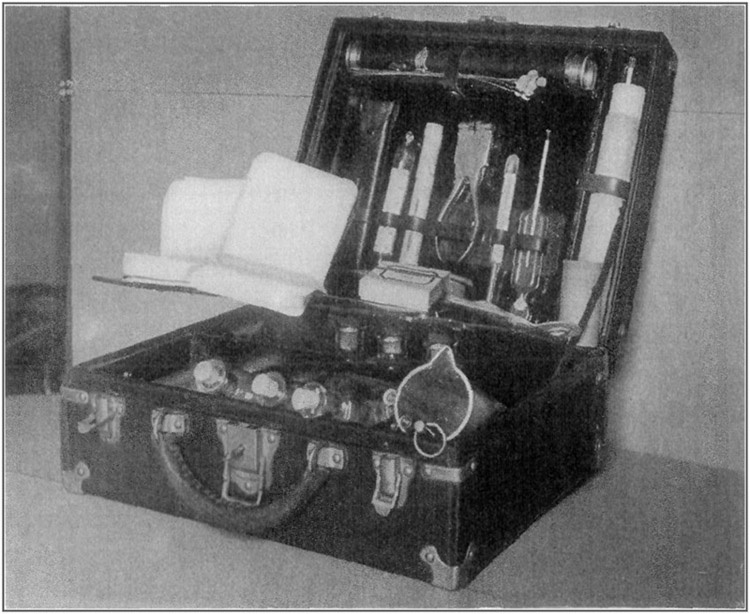
A DAIRY INSPECTOR'S OUTFIT
The slip 'twixt law making and law enforcement is everywhere found. In 1864 New York state prohibited the sale of adulterated milk. Law after law has been made since that time, giving health officials power to revoke licenses of milk dealers and to send men to jail who violated milk laws. We now know that no law will ever stop the present frightful waste of infant lives, counted in thousands annually, unless dairies are frequently inspected and forced to be clean; unless milk is kept at a temperature of about fifty degrees on the train, in the creamery, at the receiving station, and in the milk shop; unless dealers scald and thoroughly cleanse cans in which milk is shipped; unless licenses are taken from farmers, creameries, and retailers who violate the law; unless magistrates use their power to fine or imprison those who poison helpless babies by violating milk laws; and unless mothers are taught to scald and thoroughly cleanse bottles, nipples, cups, and dishes from which milk is fed to the baby. We know that these things are not being done except where men or women make it their business to see that they are done. Experience tells us that inspectors will not consistently do their duty unless those who direct them have regular records of their inspections, study those records, find out work not done properly or promptly, and insist upon thorough inspection.
Whether work is done right, whether inspectors do their full duty, whether babies are protected, can be learned only from statements in black and white that show accurately the conditions of dairies and milk shops, the character of milk found and tested by inspectors, and the number of babies known to have been sick or known to have died from intestinal diseases chiefly due to unsafe milk. Any teacher or parent can learn for himself, or can teach children to learn, what steps are taken to guarantee the right to pure milk by using a table such as Table III. Whether conditions at the dairy make pure milk impossible can be told by any one who can read the score card used by New York City (Table IV).
Table III
MILK INSPECTION WITHIN NEW YORK CITY, 1906
New York Each borough
Stores Wagons Stores Wagons
FIELD
Permits issued during 1906
Permits revoked during 1906
For discontinuance of selling
For violation of law
Average permits in force in 1906
INSPECTION
Regular inspections
Inspections at receiving stations
Total
Average inspections per permit per year
Specimens examined
Samples taken
CONDITIONS FOUND
Inspections finding milk above 50°
% of such discoveries to total inspections
Inspections finding adulteration
Warning given
Prosecuted
% of adulterations found to inspections
Rooms connected contrary to sanitary code
Ice box badly drained
Ice box unclean
Store unclean
Utensils unclean
Milk not properly cooled
Infectious disease
Persons found selling without permit
ACTION TAKEN
DESTRUCTION OF MILK
Lots of milk destroyed for being over 50°
Quarts so destroyed
Lots of milk destroyed for being sour
Quarts so destroyed
Lots of milk destroyed for being otherwise adulterated
Quarts so destroyed
Total quarts destroyed
NOTICES ISSUED
To drain and clean ice box
To clean store
CRIMINAL ACTIONS BEGUN
For selling adulterated milk
For selling without permit
For interference with inspector
Total
Table IV
Perfect Score 100% Score allowed ...%
File No............