Part 3 — CHAPTER XXVToC
Reading edition
CHAPTER XXVToC
THE FIGHT FOR CLEAN MILK
"With the approval of the President and with the coöperation of the Department of Agriculture,[15] the [national quarantine] service has undertaken to prepare a complete report upon the milk industry from farm to the consumer in its relation to the public health." This promise of the United States Treasury insures national attention to the evils of unclean milk and to the sanitary standards of farmer and consumer. Nothing less than a national campaign can make the vivid impression necessary to wean dairymen of uncleanly habits and mothers of the ignorant superstition that babies die in summer just because they are babies. When two national bureaus study, learn, and report, newspapers will print their stories on the first page, magazines will herald the conclusions, physicians will open their minds to new truths, state health secretaries will carry on the propaganda, demagogues and quacks will become less certain of their short-cut remedies, and everybody will be made to think.
The evolution of this newly awakened national interest in clean milk follows the seven stages and illustrates the seven health motives presented in Chapter II. I give the story of Robert M. Hartley because he began and prosecuted his pure-milk crusade in a way that can be duplicated in any country town or small city.
Robert M. Hartley was a strong-bodied, strong-minded, country-bred man, who started church work in New York City almost as soon as he arrived. He distributed religious tracts among the alleys and hovels that characterized lower New York in 1825. Meeting drunken men and women one after another, he first wondered whether they were helped by tracts, and then decided that the mind befogged with alcohol was unfit to receive the gospel message. Then for fifteen years he threw himself into a total-abstinence crusade, distributing thousands of pamphlets, calling in one year at over four thousand homes to teach the industrial and moral reasons for total abstinence. Finally, he began to wonder whether back of alcoholism there was not still a dark closet that must be explored before men could receive the message of religion and self-control. So in 1843 he organized the New York Association for Improving the Condition of the Poor, which ever since has remembered how Hartley found alcoholism back of irreligion, and how back of alcoholism and poverty and ignorant indifference he found indecent housing, unsanitary streets, unwholesome working conditions, and impure food.
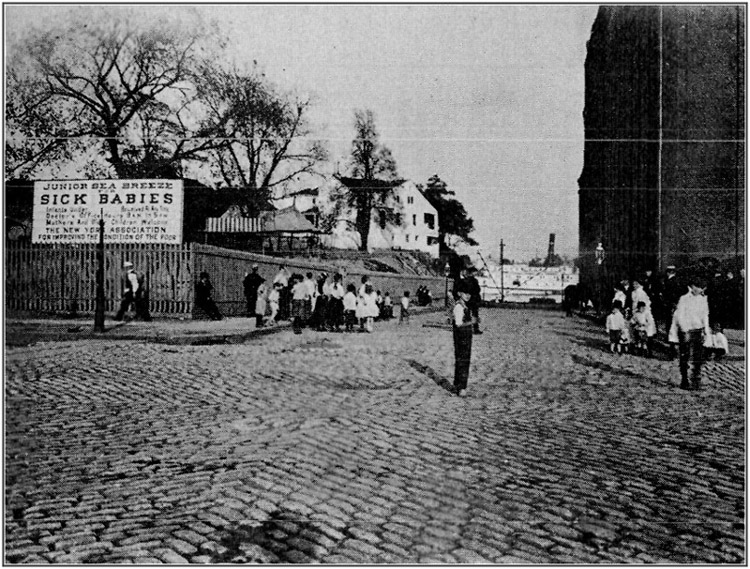
FIGHTING INFANT MORTALITY BY A SCHOOL FOR MOTHERS IN THE HEART OF NEW YORK CITY,—JUNIOR SEA BREEZE
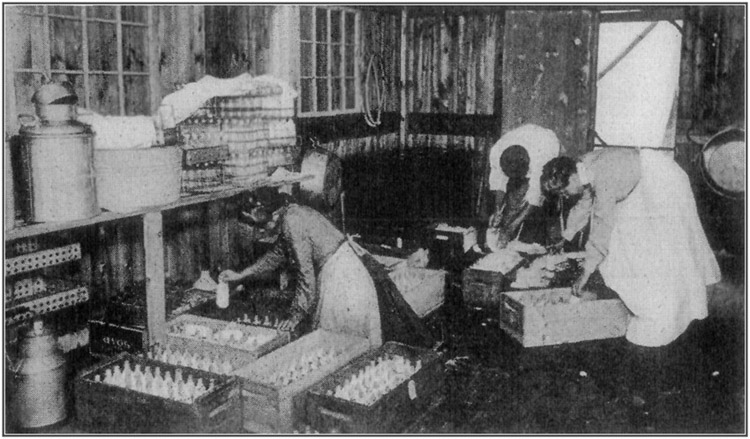
PROVIDING AGAINST GERM GROWTH AND ADAPTING MILK TO THE INDIVIDUAL BABY'S NEED,—ROCHESTER'S MODEL DAIRY
Hartley's instinct started the first great pure-milk agitation in this country. While visiting a distillery for the purpose of trying to persuade the owner to invest his money in another business, he noticed that "slops smoking hot from the stills" were being carried to cow stables. He followed and was nauseated by the sights and odors. Several hundred uncleaned cows in low, suffocating, filthy stables were being fed on "this disgusting, unnatural food." Similar disgust has in many other American cities caused the first effort to better dairy conditions. Hartley could never again enjoy milk from distillery cows. Furthermore, his story of 1841 made it impossible for any readers of newspapers in New York to enjoy milk until assured that it was not produced by distillery slops. The instinctive loathing and the discomfort of buyers awakened the commerce motives of milk dealers, who covered their wagons with signs declaring that they "no longer" or "never" fed cows on distillery refuse. But Hartley could not stop when the anti-nuisance stage was reached. He did not let up on his fight against impure or adulterated milk until the state legislature declared in 1864 that every baby, city born or country born, no matter how humble its home, has the right to pure milk.
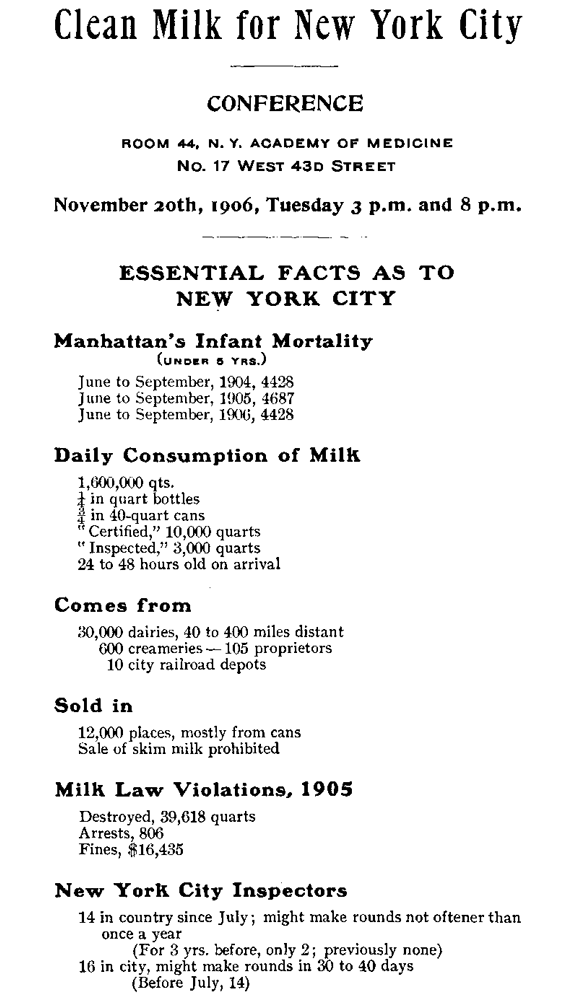
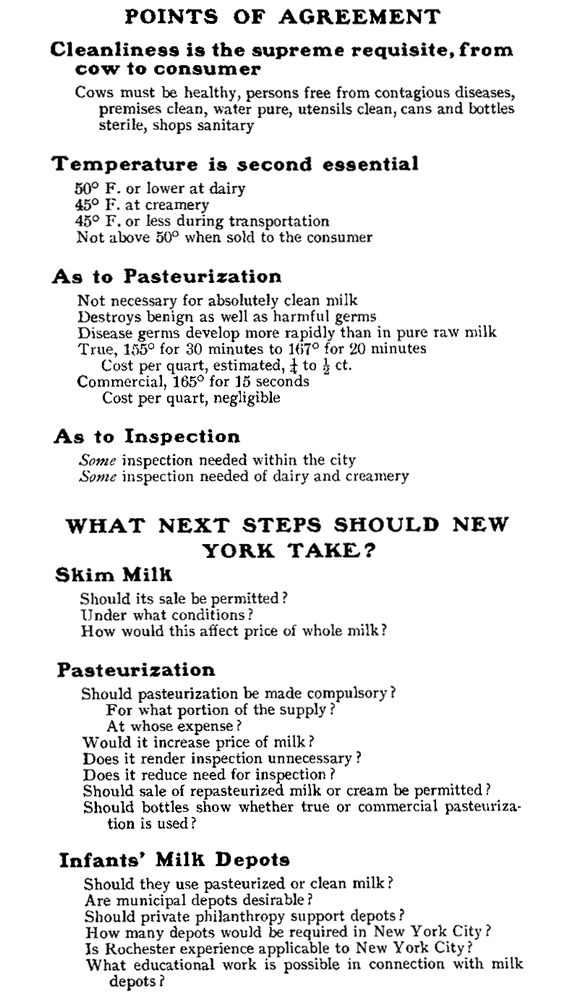
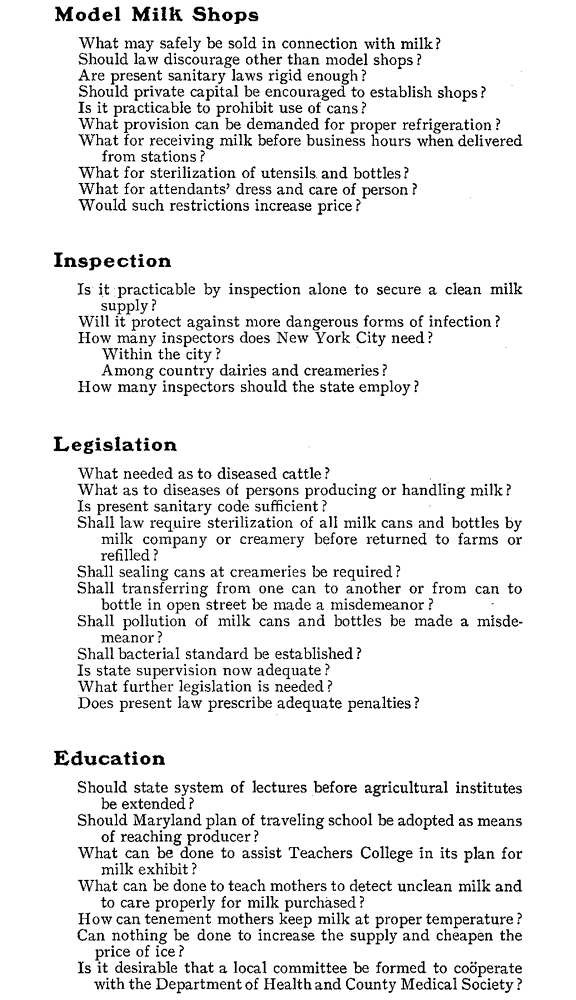
Unfortunately Hartley and his contemporaries had never heard of disease germs that are carried by unclean milk into the human stomach. Science had not yet proved that many forms of barnyard filth could do quite as much harm as distillery refuse. Commerce had not invented milk bottles of glass or paper. The law of 1864 failed in two particulars: (1) it did not demand cleanliness from cow to consumer; (2) it did not provide means for its own enforcement, for learning whether everything and everybody that had to do with milk was clean. Not knowing of germs and their love for a warm climate and warm food, they naturally did not prohibit a temperature above fifty degrees from the time of milking to the time of sale. How much has been left for our generation to do to secure pure milk is illustrated by the opening sentence of this chapter, and more specifically by the programme of a milk conference held in New York in November, 1906, the board of health joining in the call. The four-page folder is reproduced in facsimile (excepting the names on the fourth page), because it states the universal problem, and also because it suggests an effective way to stimulate relevant discussion and to discourage the long speeches that spoil many conferences.
This conference led to the formation of a milk committee under the auspices of the association founded by Hartley. Business men, children's specialists, journalists, clergymen, consented to serve because they realized the need for a continuing public interest and a persisting watchfulness. Such committees are needed in other cities and in states, either as independent committees or as subcommittees of general organizations, such as women's clubs, sanitary leagues, county and state medical societies. Teachers' associations might well be added, especially for rural and suburban districts where they are more apt than any other organized body to see the evils that result from unclean milk. The New York Milk Committee set a good example in paying a secretary to give his entire time to its educational programme,—a paid secretary can keep more volunteers and consultants busy than could a dozen volunteers giving "what time they can spare." Thanks chiefly to the conference and the Milk Committee's work, several important results have been effected. The general public has realized as never before that two indispensable adjectives belong to safe milk,—clean and cool. Additional inspectors have been sent to country dairies; refrigeration, cans, and milk have been inspected upon arrival at night; score cards have been introduced, thanks to the convincing explanations of their effectiveness by the representatives of the Bureau of Animal Industry of the national Department of Agriculture; 8640 milch cows were inspected by veterinary practitioners (1905-1907), to learn the prevalence of bovine tuberculosis (of these thirty-six per cent reacted to the tuberculin test); state societies and state departments have been aroused to demand an efficient live-stock sanitary board; magistrates have fined and imprisoned offenders against the milk laws, where formerly they "warned"; popular illustrated milk lectures were added to the public school courses; illustrated cards were distributed by the thousand, telling how to keep the baby well; finally, private educational and relief societies, dispensaries, settlements, have been increasingly active in teaching mothers at home how to prepare baby's milk. In 1908 a Conference on Summer Care of Babies was organized representing the departments of health and education, and fifty private agencies for the care of sick babies and the instruction of mothers. The superintendent of schools instructed teachers to begin the campaign by talks to children and by giving out illustrated cards. Similar instructions were sent to parochial schools by the archbishop.
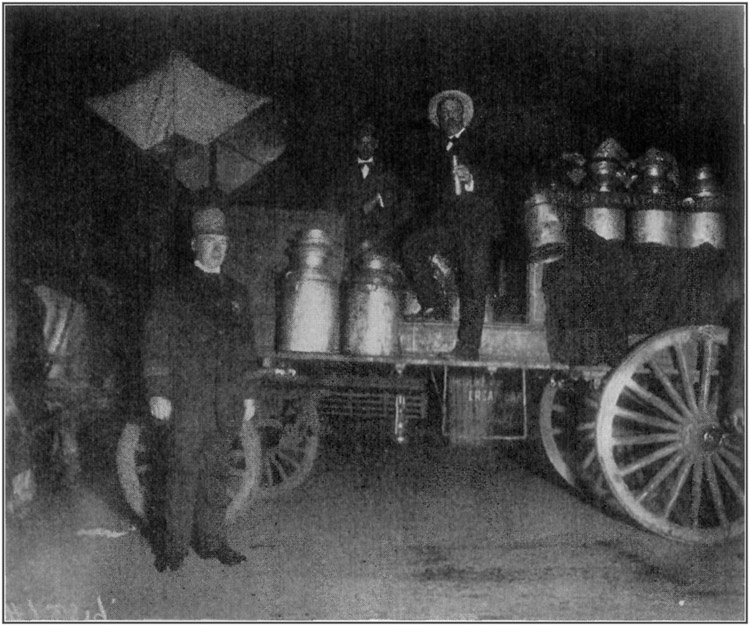
NIGHT INSPECTION OF COUNTRY MILK UPON ARRIVAL IN NEW YORK CITY
As elsewhere, there are two schools of pure-milk crusaders: (1) those who want cities to do things, to pasteurize all milk, start milk farms, milk shops, or pure-milk dispensaries; and (2) those who want cities and states to get things done. So far the New York Milk Committee has led the second school and has opposed efforts to municipalize the milk business. The leader of the other school is the noted philanthropist, Nathan Strauss, who has established pasteurization plants in several American and European cities. The discussion of the two schools, similar in aim but different in method, is made more difficult, because to question philanthropy's method always seems to philanthropy itself and to most bystanders an ungracious, ungrateful act. As the issue, however, is clean milk, not personal motive, it is important that educators and parents in all communities benefit from the effective propaganda of both schools, using what is agreed upon as the basis for local pure-milk crusades, reserving that which is controversial for final settlement by research over large fields that involve hundreds of thousands of tests.
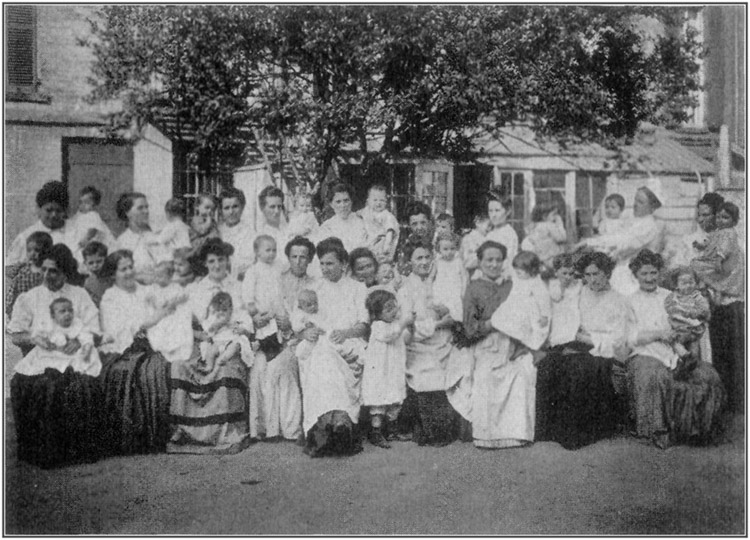
A NEW YORK MILK COMMITTEE'S INFANT DEPOT AND SCHOOL FOR MOTHERS
Pasteurization, municipal dairies, municipal milk shops, municipal infant-milk depots, are the four chief remedies of the doing things school. European experience is cited in support of each. We are told that cow's milk, intended by nature for an infant cow with four stomachs, is not suited, even when absolutely pure, to the human infant's single stomach. Cow's milk should be modified, weakened, diluted, to fit the digestive powers of the individual infant; hence the municipal depot or milk dispensary that provides exactly the right milk for each baby, prescribed by municipal physicians and nurses who know. That the well-to-do and the just-past-infancy may have milk as safe as babies receive at the depot, municipalization of farm and milk shop is advocated. Some want the city to run only enough farms and milk shops to set a standard for private farmers, as has been done in Rochester. This is city ownership and operation for educational purposes only. Finally, because raw milk even from clean dairies may contain germs of typhoid, scarlet fever, or tuberculosis, pasteurization is demanded to kill every germ. There are advocates of pasteurization that deprecate the practice and deny that raw milk is necessarily dangerous; they favor it for the time being until farms and shops have acquired habits of cleanliness. Likewise many would prefer private pasteurization or laws compelling pasteurization of all milk offered for sale; but they despair of obtaining safe milk unless city officials are held responsible for safety. Why wait to discuss political theories about the proper sphere for government, when, by acting, hundreds of thousands of lives can be saved annually? These methods of doing things will not add to the price of milk; it is, in fact, probable that the reduction in the cost of caring for the sick and for inspecting farms and shops will offset the net cost of depots, farms, and dairies.
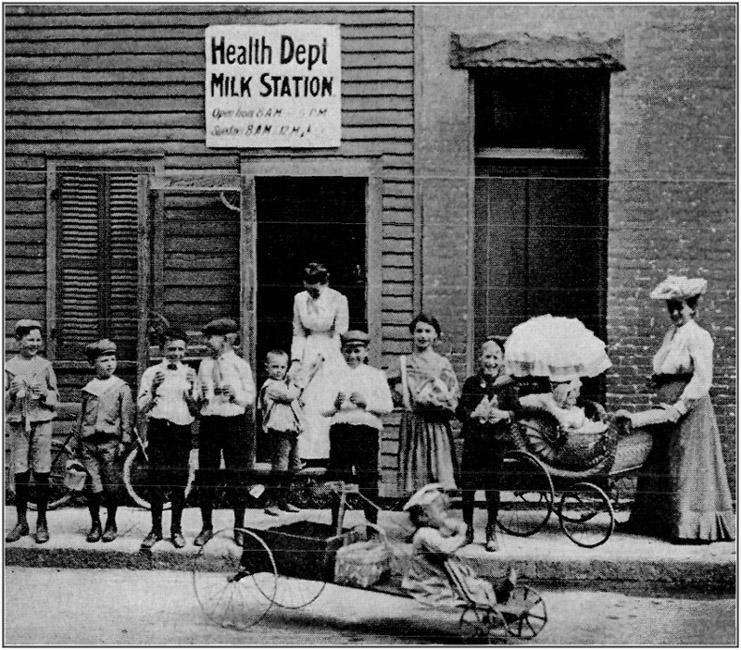
ONE OF ROCHESTER'S SCHOOLS IN CLEANLINESS
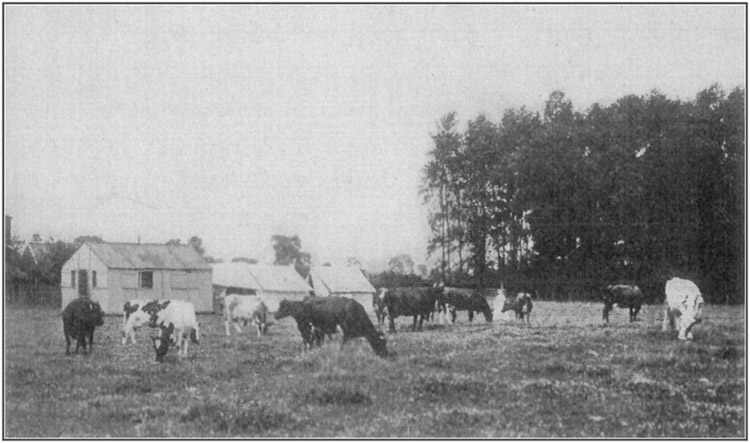
ROCHESTER'S MODEL DAIRY FARM
As to pasteurization, its cost is negligible, while the cost of cleanliness is two, four, or ten cents a quart. Whether ideally clean milk is safe or not, raw milk that is not clean is unfit for human consumption. All cities should compel evidence of pasteurization as a condition of sale. Large cities should have their own pasteurizing plants, just as many cities now have their own vaccine farms and antitoxin laboratories. Parents in small towns and in the country should be taught to pasteurize all milk.
The getting things done school admits the need for modified milk of strength suited to the infant's stomach; affirms the danger of milk that contains harmful germs; demands educational work by city, state, and nation; confesses that talk about cleanliness will not make milk safe. On the other hand, it denies that raw milk is necessarily dangerous; that properly modified, clean, raw milk is any safer when pasteurized; that talking about germ-proof milk insures germ extinction. It maintains that pasteurization kills benign germs essential to the life of milk, and that after benign germs are killed, pasteurized milk, if exposed to infection, is more dangerous than raw milk, for the rapid growth of harmful germs is no longer contested by benign germs fighting for supremacy. While it is admitted that raw milk produced under ideal conditions may become infected by some person ignorant of his condition, and before detection may cause typhoid, scarlet fever, or consumption, it has not been proved that such instances are frequent or that the aggregate of harm done equals that which pasteurized milk may do. Pasteurization does not remove chemical impurities; boiling dirt does not render it harmless. The remedy for germ-infected milk is to keep germs out of milk. The remedy for unclean milk is cleanliness of cow, cow barn, cowyard, milker, milk can, creamery, milk shop, bottle, nipple. If the sale of unclean milk is prevented, farmers will, as a matter of course, supply clean milk. By teaching farmers and milk retailers the economic advantages of cleanliness they will cultivate habits that guarantee a clean milk supply. By punishing railroads and milk companies that transport milk at a temperature which encourages germ growth, and by dumping in the gutter milk that is offered for sale above 50 degrees, the refrigerating of milk will be made the rule. Purging magistrates' courts of their leniency toward dealers in impure, dangerous milk is better than purging milk of germs. Boiling milk receptacles will save more babies than boiling milk. Teaching mothers about the care of babies will bring better results than giving them a false sense of safety, because only one of many dangers has been removed by pasteurization. Educating consumers to demand clean milk and to support aggressive work by health departments leaves fewer evils unchecked than covering up uncleanliness by pasteurization.
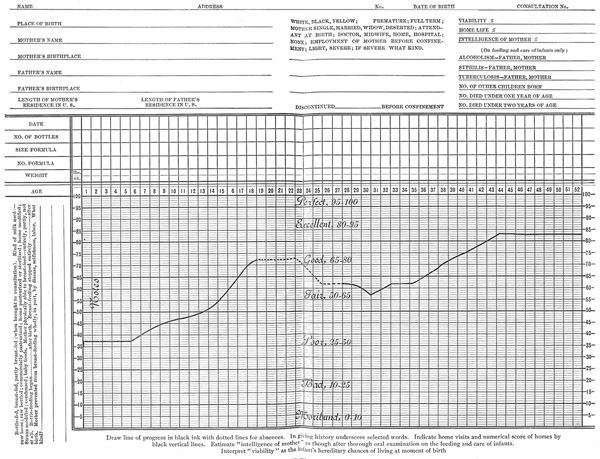
NEW YORK MILK COMMITTEE'S GRAPHIC METHOD OF SHOWING BABIES' PROGRESS
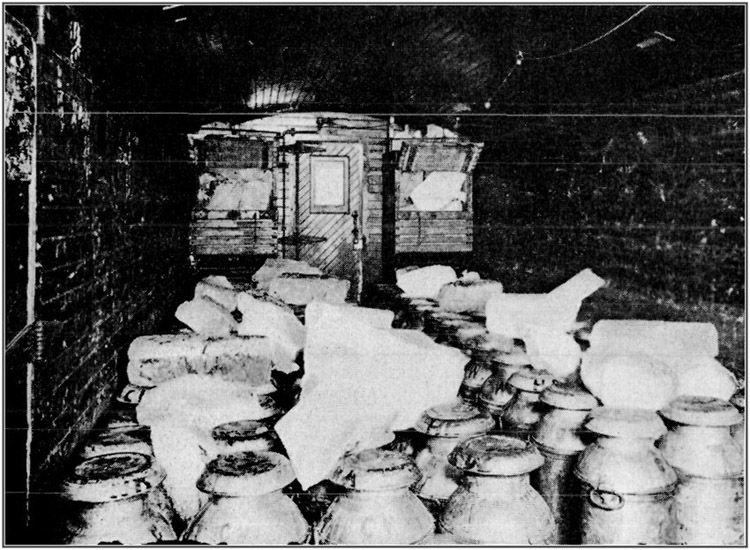
PRODUCING WINTER CONDITIONS IN MIDSUMMER BY PROPER REFRIGERATION FOR MILK IN FREIGHT CARS
When doctors disagree what are we laymen to do? We can take an intelligent interest in the inquiries that are now being made by city, state, and national governments. Because everybody believes that clean milk is safer than unclean milk, that milk at 50 degrees will not breed harmful germs, we can demand milk inspection that will tell our health officers and ourselves which dealers sell only clean milk at 50 degrees and never more than 60 degrees, that never shows over 100,000 colonies to the cubic centimeter. We can get our health departments to publish the results of their scoring of dairies and milk shops in the papers, as has been done in Montclair. We can tell our health officers that the best results in fighting infant mortality are at Rochester, which city, winter and summer, by inspection, correspondence, and punishment, educates farmers and dealers in cleanliness, not only censuring when dirty or careless, but explaining how to make more money by being clean. Finally, mothers can be taught at home how to cleanse the bottles, the nipples, all milk receptacles, and all things in rooms where milk is kept. Absolutely clean milk of proper temperature at the shop may not safely be given to a baby in a dirty bottle. Infant milk depots, pasteurization, the best medical and hospital care, breast feeding itself, cannot prevent high baby mortality if mothers are not clean. The most effective volunteer effort for pure milk is that which first makes the health machinery do its part and then teaches, teaches, teaches mothers and all who have to do with babies.
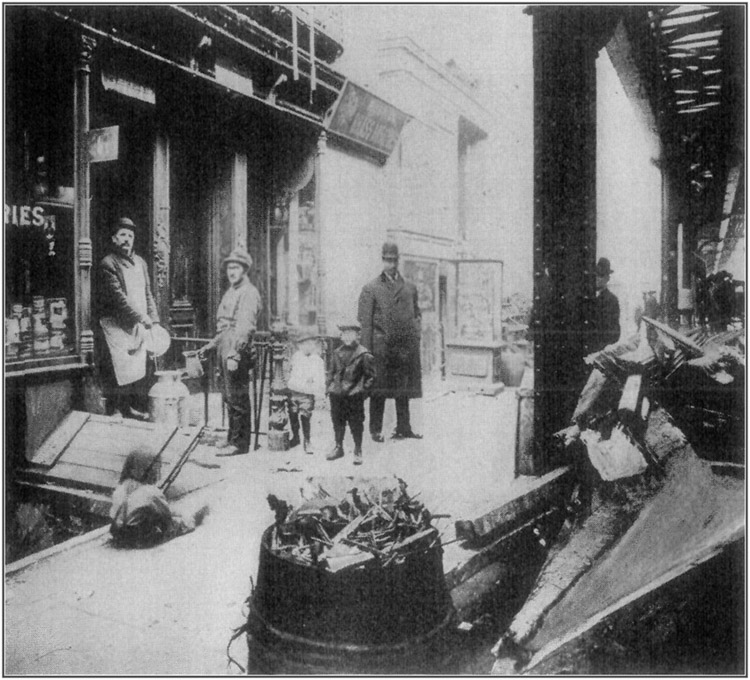
NEITHER PASTEURIZATION NOR INSPECTION CAN MAKE IT SAFE TO SELL "DIP MILK" UNDER SUCH UNCLEAN CONDITIONS
"Clean air, clean babies, clean milk," has been the slogan of Junior Sea Breeze,—a school for mothers right in the heart of New York's upper East Side. In the summer of 1907 twenty nurses went from house to house telling 102,000 mothers how to keep the baby well. This was the only district that had fewer baby deaths than for 1906. Had other parts of the city shown the same gain, there would have been a saving of 1100 babies. The following winter a similar work was conducted by nurses from the recently founded Caroline Rest, which has an educational fund for instruction of mothers in the care of babies, especially babies not yet born and just born. Heretofore the baby has been expected to cry and to have summer complaint before anybody worried about the treatment it received. If the baby lived through its second summer, it was considered great good fortune. Junior Sea Breeze and Caroline Rest start their educational work before the baby is sick, in fact, before it is born. Their results have been so notable that several well-to-do mothers declare that they wish they too might have a school. Dispensaries and diet kitchens and more particularly maternity wards of hospitals, family physicians, nurses, and midwives, should be required to know how to teach mothers to feed babies regularly, the right quantities, under conditions that insure cleanliness whether the breast or the bottle is used. Perhaps some day no girl will be given a graduating certificate, or a license for work, teaching, or marriage, until she has demonstrated her ability to give some mother's baby "clean air, clean body, clean milk."