Chapter XVIII · FROM NICOLAS POUSSIN TO COROT
Reading edition
FRENCH seventeenth-century Art does not offer any such difficult problems as those presented to us by the portrait-painters who lived and laboured during the period of the Clouets, for the artists of this latter period in most cases were accustomed to sign their names to at least a certain number of their works, whereby they can be easily identified.
On the very threshold of this new Art-development we find the Brothers le Nain, who, choosing a totally different type of work, kept aloof from kings, princes and courtiers and devoted their attention chiefly to scenes of peasant life. Le Repos des Paysans at the Louvre is one of their best and most characteristic works. So also are La Forge and a portrait of Henry II de Montmorency, the last of his race, which ought to be at Chantilly. There is in the Cabinet Clouet at the Musée Condé a powerful portrait of Dr. Fagon, physician to Louis XIV, by Mathias le Nain. Chardin, who continued in their tradition a century later, is unfortunately not represented in the Musée Condé.
Nicolas Poussin also adopted a style of his own, although it was of a different kind. He was greatly attracted by the antique and his heart was set on visiting Rome, whither, after long struggles in Paris, he at length found his way. There he received from the painter Domenichino the necessary training for the work which he desired to take up. The French sculptor Quesnoy befriended him, and the poet Marino introduced him to Cardinal Barberini, who commissioned from him two pictures: The Death of Germanicus and The Capture of Jerusalem. When fame came to him France reclaimed him. He was greatly favoured by Richelieu and entrusted with the decoration of the Louvre. He found, however, a rival in this enterprise in the person of Simon Vouet; and difficulties arose, because Poussin claimed his right to carry out the whole work independently and on his own responsibility. Finding that he could not attain this object, he returned to Rome under the pretext of fetching his wife and never returned. He lived thenceforth in Italy; for, like the Brothers le Nain, he had no desire to become a Court Painter. His pictures were, nevertheless, greatly admired in France during his lifetime; and there are no less than nine large canvases by him in the Galerie des Peintures at the Musée Condé, besides numerous drawings. Amongst these may be noted: The Infancy of Bacchus; Theseus finding his Father’s Sword (with a striking architectural background); and Numa Pompilius and the Nymph Egeria, a composition wherein the artist displays to the full his skill in dealing with romantic landscape. A drawing of Daphne[131] flying to her father’s protection who transforms her into a laurel-bush, has special charm and shows those characteristics which he handed on to his brother-in-law and pupil Dughet, called after him “Gaspar Poussin.” There are two landscapes by the latter at Chantilly (Galerie des Peintures): An Alley in a Wood, and A View of the Roman Campagna, a subject of which he never tired. His sunsets foreshadow those of Claude Lorraine, who in his power of rendering atmospheric effect and the rays of the sun was only equalled by Turner some centuries later. The National Gallery and the Louvre possess some of Claude’s finest landscapes, while Chantilly has chiefly drawings, amongst which the most noteworthy are the Castello di S. Angelo and the Aqueducts of the Roman Campagna.[132]
Plate LXXII.

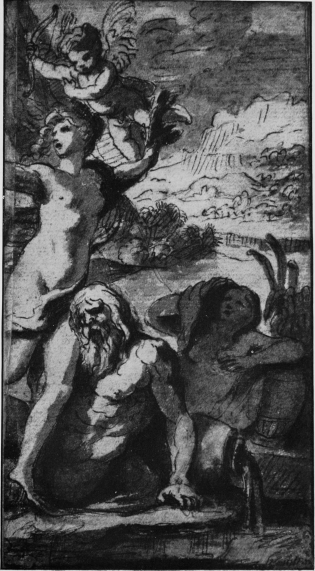
Photo. Giraudon.
DAPHNE METAMORPHOSED INTO A LAUREL TREE. Musée Condé.
Nicolas Poussin.
Philippe de Champaigne, who came in his youth to France from Brussels, was a college friend of Poussin at Laon in 1623; and shares with him that same sense of freedom in his work. Poussin reached his goal in Rome through classical work, whilst Philippe de Champaigne devoted himself to portraiture, in which class of work he was most assiduous. His portraits of Cardinals Richelieu and Mazarin in the Musée Condé came from the Gallery in the Palais-Royal and are magnificent examples of his methods.
Another portrait-painter who deserves mention here is Jacques Stella, who painted the Grand Condé as the Hero of Rocroy, at the age of twenty-two—a portrait which is singularly attractive and has a special historical interest. This painting, which was always highly prized by the Bourbon-Condé family, now hangs in the Galerie des Batailles.
Another portrait of the same personage, painted after he had reaped further laurels at Fribourg and at Nördlingen, is by Beaubrun, the same artist who painted his only sister Geneviève de Bourbon. Both these pictures are in the Cabinet Clouet.
A figure which stands out with some insistence amongst French artists of the seventeenth century is Charles Le Brun. He was first of all a pupil of Simon Vouet, but becoming acquainted with Nicolas Poussin and urged on by enthusiasm for his work, followed this master to Rome. Returning to Paris with an established reputation, he fell in with Colbert, who perceived in him the very person needed for the Gobelins Factory. Le Brun fully realised these expectations since he not only organised this great concern but subsequently, with the assistance of Van Meulen, furnished designs for a History of the Kings of France, which was presently reproduced in tapestry in those celebrated workshops. He was also the founder of the French Academy in Rome; and Louis XIV, who conferred on him the office of Court Painter, took him to Flanders during the campaign of 1676. The portrait at Chantilly of Pomponne de Bellièvre, first President of the Parlement of Paris (engraved by Van Schuppen), represents his skill as a painter of portraits. His work can, however, be more profitably studied in the Galerie d’Apollon at the Louvre.
Eustache Le Sueur, another pupil of Simon Vouet, earned fame by his decorative work in the Hotel Lambert at Paris and by his Scenes from the Life of St. Bruno, now in the Louvre. He is represented at the Musée Condé by some fine drawings.
When Colbert was supplanted by Louvois another painter came to the front in the person of Mignard, also a pupil of Vouet. He studied in Rome, where he copied a number of paintings in the Farnese Gallery for the Cardinal of Lyons, Richelieu’s brother. He married the beautiful Anna Avolara, daughter of a Roman architect and model for his Madonnas, for which there was a great demand. No sooner had he acquired a certain amount of fame than the King of France commanded him to return home. On the way, however, he fell ill, and had to stop at Avignon. Here he first became acquainted with Molière; and the portrait which he painted of this great poet is beyond doubt his chef d’œuvre.[133] It occupies a prominent position in the Tribune at Chantilly, where it commands much attention and admiration. The great esteem in which the author of Tartuffe was held by the Grand Condé is well known and it is by a singular piece of good fortune that the best of all the existing portraits of Molière should have found its way into the Musée Condé. If Mignard—and not without reason—is sometimes accused of superficiality, this complaint must surely be modified by the evidence of this portrait, which displays an artist of very considerable power.
There is at Chantilly another portrait by Mignard of special interest. It is that of Madame Henriette d’Angleterre, the beautiful and ill-fated daughter of Charles I, first wife of Philippe, Duc d’Orléans, the King’s brother. He also repeatedly painted likenesses of the young King himself, including one sent to Spain to be shown to his intended bride the Infanta Marie Thérèse.
At a maturer age Louis XIV was painted by Rigaud, a pupil of Le Brun. The portrait of him at Chantilly (Cabinet Clouet) is a smaller replica, signed by the painter himself, of the larger work executed in 1701 for his son, Philip V of Spain—a painting which was, however, kept back at Versailles and is now in the Louvre.
Hyacinthe Rigaud was considered a great portrait-painter and many personages of note gave him commissions. There is also a fine portrait at Chantilly by his younger contemporary and follower, Largillière, of Mademoiselle Duclos, a celebrated tragédienne who made her début at the Comédie Française in 1683. She is here portrayed in the rôle of Ariane (Salle Caroline), and her sumptuous robes are painted with all the care and minuteness so characteristic of this artist. These qualities are again displayed in a portrait of the Princess Palatine, Charlotte Elizabeth, second wife of Philippe d’Orléans and mother of the Regent. In this portrait Largillière shows his highest talents, and had it not been for the fact that “Liselotte” (although already middle-aged) followed the taste of her time by permitting herself to be painted as a Naiad this would perhaps have been one of the most faithful likenesses of this interesting princess.
Plate LXXIII.
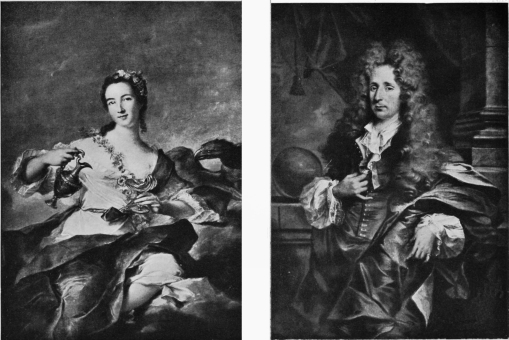
Photo Braun & Co.
LOUISE-HENRIETTE DE BOURBON CONTI. J. M. Nattier. A FRIEND OF THE CONDÉS. Largillière.
Largillière resided for many years in England and studied for some time under Sir Peter Lely. On his return to Paris he was taken up by Charles Le Brun. His style belongs as much to the seventeenth as to the eighteenth century. Elegance and luxury, and a touch of serenity prevail in all his portraits. Mariette was greatly struck by his personal vigour and tells us that he went on working even up to his eighty-sixth year. Although too often over-exuberant he generally succeeded in imparting to his patrons great liveliness of aspect, and they live still, clad in their most sumptuous apparel. Such is the portrait of the elegant “Unknown”[134] at Chantilly, once in the Collection at the Palais Bourbon; from which circumstance we may suppose that the sitter was some intimate friend of the Condé family.
By Jean Marc Nattier there is at Chantilly a life-size portrait of Mademoiselle Nantes, daughter of Louis XIV by Madame de Montespan, and wife of the Duc de Bourbon, grandson of the Grand Condé. Her daughter Louise Henriette, who married the Prince de Bourbon Conti, was also painted by Nattier[135]; and by the same artist—one of his best works—is the above-mentioned portrait of Charlotte Elizabeth Soubise,[136] the young wife of Louis Joseph, Prince de Condé, represented plucking carnations in the gardens at Chantilly.
Nattier’s portraits of the Royal Family of Bourbon, both in the Louvre and at Versailles, are very numerous. He painted every one of Louis XV’s daughters[137] and many other fair women, who, however, bear a strong general resemblance to one another, whereby his portraits are often rendered conventional and monotonous.
It is therefore rather refreshing to turn from Jean Nattier to Desportes and Oudry, who both stand on the threshold of the eighteenth century and who revived realistic landscape painting—an art which had practically lain dormant since the days of Pol de Limbourg; for Claude Lorraine and the Poussins had directed it into wholly diverse channels. Briados and Balthazar, two Spanish hounds formerly belonging to the House of Condé, are exquisitely painted by Desportes, who was highly thought of by all lovers of the chase and was a constant guest at the hunting-parties held in the various French châteaux. A painting by him in the Louvre representing a Huntsman with his dog and bag of game standing in a fine landscape shows his skill at its very best.
Oudry’s compositions come very near those of Desportes: for example, his Chasse du Loup and Chasse du Renard at Chantilly, both of which are noted in the Inventory of the Palais Bourbon. Oudry was encouraged by Largillière to take up decoration also, which he did with conspicuous success. He was admitted into the Academy in 1699, and being appointed to the Directorship of the Tapestry Factory at Beauvais instilled new life into that interesting branch of art, which had sadly decayed under the direction of Charles Le Brun’s imitators. His graceful talent shows itself in certain exquisite designs from La Fontaine’s Fables executed in tapestry at this factory. His favourite abode was the forest around Chantilly; and there he spent much time in painting animals direct from nature. By insisting that his ideas should be accurately transcribed he trained the weavers at Beauvais with much care, thus preparing the way for Boucher, the decorative genius of the next generation. A splendid Gobelins tapestry, executed after a cartoon by Boucher, adorns one side of the Grand Staircase at Chantilly. It represents a young woman seated in a garden to whom a boy and girl are offering fruit and flowers. On the opposite wall there is another tapestry from the workshop of Audran, executed after de Troy.
A copy in this collection (intended for the purposes of an engraving) by Boucher of a portrait of Watteau by himself is not devoid of interest; but it is in the Louvre, at Versailles, and above all in the Wallace Collection, rather than at Chantilly, that we derive a clear idea of Boucher’s light and graceful style. His Sunrise and Sunset on the staircase of Hertford House are considered to be among the finest of his creations. Madame de Pompadour, who was his enthusiastic patroness, frequently sat to him in a variety of attitudes; although his great talent was not portraiture, but decorative work, whereby he marks a decidedly new phase in French Art.
After an exceptionally long reign Louis XIV had at last passed away. He had asserted himself as strongly in Art as he had done in politics and it is worthy of note that, immediately after his death, artists were once more able to take their own independent courses. At this point, therefore, in the history of French Art we come upon a somewhat sudden change, visible also in the art of the cabinet-maker and the decorator. The later Bourbon Kings and Queens left their gorgeous salons and took refuge (with evident personal relief) in smaller and homelier chambers. These less imposing apartments, however, also required suitable decoration and serviceable furnishings: and it was here that Boucher found his opportunity. The boudoir with its delicate colouring and elegant upholstery played a significant rôle under the reigns of Maria Leczinska and Marie Antoinette, and the petits appartements at Versailles became examples of a new style. Paintings on a smaller scale suitable for these graceful bonbonnières were soon in demand; and from these it was but a step to the taste of Watteau, who is perhaps the most typical artist of this period. Plaisir Pastoral, l’Amante Inquiète, and l’Amour Désarmé at Chantilly are fine examples of this artist’s work. Le Donneur des Sérénades in the Musée Condé, of which there is a similar composition at Buckingham Palace belongs to his later period, that is to say, to the last five years of his life. This work is said to represent Mezetin (one of the leading actors at the Comédie Italienne established at the Hôtel du Bourgogne) seated on a bench in a classic garden tuning his guitar. The Amante Inquiète, which forms a pendant to this picture, is of equal merit. Everything in these small paintings is refined and elegant, even to Nature herself—a style far more typical of Watteau, than the scenes of camp-life which mark his stay at Valenciennes in 1709. A study in red chalk of a Warrior, preserved in the Rotunda at Chantilly, recalls this period. In his sketches, of which a great number are in the Louvre, Watteau exhibits his talent as a draughtsman of the highest order and as a worthy pupil of Claude Gillot, the earliest creator of the style for which Watteau became so famous. His relations with Crozat, the famous financier and collector, who was the first to recognise his genius, began in 1612, and it was in his palace that he had an opportunity of studying paintings by the great Venetian masters and landscapes by Rubens, both of which so decidedly influenced his subsequent style. There are exquisite pictures by him in the Louvre and in the Wallace Collection. His Ball under the Colonnade at Dulwich is very famous.
Plate LXXIV.
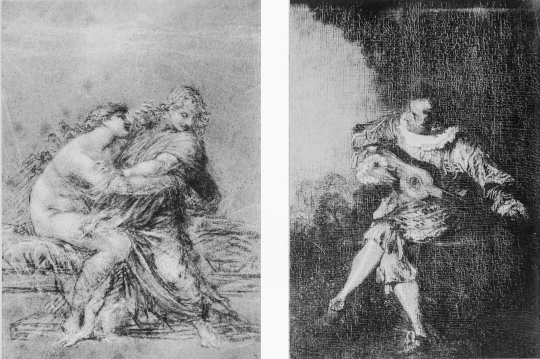
Photo. Giraudon.
JOSEPH AND POTIPHAR’S WIFE. By Prud’hon. THE GUITARPLAYER. By Watteau.
Musée Condé.
To face page 25
Lancret was a younger contemporary of Watteau, and observing his success adopted his style; without, however, attaining to his eminence. His Déjeuner de Jambon in the Galerie des Peintures at Chantilly presents a company of merry-makers on the point of becoming riotous; and opposite to it hangs a companion picture by de Troy entitled Le Déjeuner d’Huîtres. The host in this latter composition—a figure dressed in scarlet—is probably a Prince of the House of Orleans presiding at a feast in the Palais Royal. Many of the guests represented are said to be personages well known in their day: for King Louis Philippe was still able to distinguish them by name. They are certainly enjoying their oysters and iced champagne; and the satisfaction of the well-fed is clearly exhibited in their features and gestures.
Together with this group of artists mention must be made of Christophe Huet, designer and decorator of the Grande Chinoiserie at Chantilly. These decorations in a style so much in vogue in the seventeenth and eighteenth centuries were once attributed to Watteau, Gillot, Oudry, and others until an Account, dated 1741, was found in the Archives of Chantilly disclosing the name of Christophe Huet. They cover the panels of the so-called “Salon des Singes.” Scenes and episodes from the chase and the tea-party, architectural effects and other subjects, all are carried out in a pseudo-Chinese style. Apes clad in Condé uniforms and carrying flags act as outriders or grooms under the direction of grim-looking mandarins robed in gorgeous Oriental apparel. Besides the decorations here there is on the ground floor of the Château a “Petite Singerie” decorated in very much the same style: humorous scenes, wherein female monkeys are riding or occupied with their toilet. Jean Baptiste Huet, son of this Christophe, was also repeatedly commissioned by Prince Louis Joseph de Condé to paint pictures of his favourite animals.
The celebrated painter of pastels, Latour, is represented at Chantilly by a portrait of Madame Adelaide de France, daughter of Louis XV. His portraits, now recognised as even superior to those of Boucher and Lancret, are fine studies of character, but they are very rare. The pastel of the handsome Marie Fel, an opera-singer from Bordeaux by whom this artist was befriended, is very celebrated; and a group of portraits at St. Quentin place him in the foremost rank of French portrait-painters. His pre-eminent talents have been fully recognised by modern students of the French School.
His contemporary, Peronneau—till recently known chiefly as an engraver of the works of Boucher, Van Loo, and others—is now known to be the artist who painted a charming Portrait of a Girl in the Louvre and other pastels. Rosalba Carriera’s great success in that medium is also well known. The young King Louis XV, the Regent, and many other important personages were painted by her, and in her time she put into the shade both Latour and Peronneau.
Duplessis brings us to the time of the Revolution, when ruin fell upon so many of the artists of that day. His portrait of the Duchesse de Chartres, mother of Louis Philippe and grandmother of the Duc d’Aumale, is at Chantilly. She is seated in a garden, lost in profound sorrow at the departure of her husband to a naval engagement, symbolised by a ship disappearing in the distance: a refined and graceful presentation of a charming woman capable of winning the hearts of all around her. The portraits of Louis XVI and of the Comte de Provence by this painter in the Musée Condé are considered to be among the best likenesses of the last Bourbon Kings. Duplessis held the post of Administrator of the Galleries at Versailles.
Greuze, like Watteau, marked out a special line of his own; and with him French bourgeois Art reappears once more. His domestic scenes were described by Diderot as follows: “Cet artist est le premier entre nous qui se soit avisé de donner des murs dans l’art.” This remark applies to his Malédiction Paternelle, l’Accordée du Village, etc.
Plate LXXV.
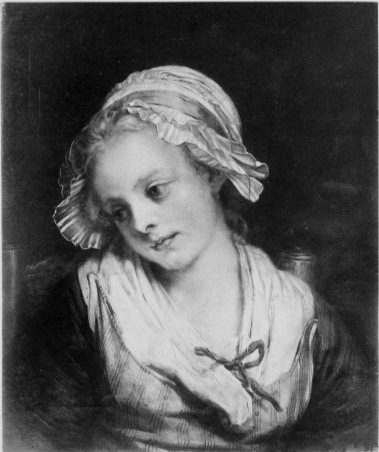
Photo. Giraudon.
Young Girl. By Greuze. Musée Condé.
His charming Portrait of a Young Girl in a little cap at Chantilly represents Georgette, daughter of his concierge in Paris; and she can be recognised again in the same artist’s l’Accordée du Village in the Louvre, and perhaps also in the painting of a Young Girl winding Wool, lately added to Mr. Pierpont Morgan’s Collection. The pendant to Georgette in the Musée Condé is a portrait of a Young Boy, her brother. These two paintings, together with Le Tendre Desir, belong to the artist’s best period, whilst La Surprise is a work of his old age. This last work exhibits to us the curious fact that a problem which had steadily pursued him throughout his long life—namely, how to paint the first awakenings of love in a maiden’s mind—still puzzled him at the age of nearly eighty. It is certainly an irony of fate that after a romantic attachment to a young Italian Countess—whose portrait he painted, but whom he was prevented from marrying—he should have returned to Paris, to become the husband of a woman much older than himself, who presently made his life almost unendurable. It was perhaps the memory of this youthful idyll which induced him to paint so often those young maidens whose faces smile at us from the walls of so many Galleries throughout Europe. The Young Woman in a Hat in the Wallace Collection is perhaps the most fascinating of them all, since nothing can surpass the grace and piquancy of expression in her lovely countenance.
Greuze was in high favour with the Royal Family, and it is believed that he painted a portrait of the Dauphin at the Tuileries after the unfortunate flight to Varennes, and another of his elder sister, Madame Royale, when in the Temple. The great upheaval of the Revolution struck Greuze also, and as a painter he became no longer the fashion. His wife squandered his fortune and he died in poverty, slaving to the very last.
The portraits at Chantilly of Marie Antoinette (in 1795) and of Madame de Pompadour, two of the loveliest women of their day, are by Drouais, a pupil of Van Loo and Boucher. The happy days of Trianon were not yet over when these were painted, and the Dauphine of France, presented here as Hebe, seems to be at the height of her glory and charms. How different to the careworn and haggard woman whose portrait hangs in the Musée Carnevalet over the very bed occupied by her in the Temple before her execution!
Madame Vigée Le Brun carried the style of Greuze, at one time her master, into the middle of the nineteenth century. She is represented in the Musée Condé (Cabinet Clouet) by several small portraits: Marie Caroline, Queen of Naples, painted in 1768, and her two daughters, Marie Thérèse Caroline, wife of Francis II Emperor of Austria, and Marie Louise Josephine, wife of the Grand Duke of Tuscany. Whilst the first two of these appear to be copies of already existing pictures the portrait of Marie Louise Josephine, Queen of Etruria, shows special merits and seems to be taken directly from life, probably during one of Madame Le Brun’s tours in Italy. A strong vitality is expressed in her beautiful face, forming a marked contrast to the portrait of her mother, the Queen of Naples. Madame Le Brun, who, in spite of her sex became a member of the French Academy, was one of Marie Antoinette’s favourite painters. After the Revolution she established herself in St. Petersburg and did not return to Paris until 1801, when she was enthusiastically welcomed. She painted many of the most celebrated beauties of her day, but all these portraits seem to bear the mark of a period then fast disappearing.
Louis Joseph de Bourbon, about 1787, commissioned Fragonard to paint small portraits of the Princes and Princesses of the Royal House[138] of Bourbon and the House of Bourbon Condé. Among these are portraits of the Dauphin Louis, son of Louis XVI, and of the Duc d’Enghien by whose tragic death the Condé family became extinct. Fragonard was a pupil of both Boucher and Chardin. He went to Italy with the Prix de Rome and in 1765 was elected a member of the Academy. He excelled in every style of painting—genre, landscape, portraits, interiors, and historical subjects. When in 1765 he exhibited his Callirhoé and Corésus (a subject taken from the poet Roy) Diderot and Grimm thought for a moment that he might resuscitate the art of historical painting in France. This picture was bought by King Louis XV but was never paid for, and Fragonard returned to his portrait-painting, which he accomplished with very great brilliance and rapidity. There is a series of these portraits in the La Caze section of the Louvre, chiefly representing the actors and actresses of his day. His remarkable talent for decorative painting reveals itself in certain designs destined for Madame Du Barry’s pavilion, but stupidly condemned by her advisers. When the Revolution broke out, the artist fled to Grasse to escape imprisonment and the scaffold taking these paintings with him, and there completed the series by a fifth composition. The whole set are now in the collection of the late Mr. J. F. Pierpont Morgan.
Fragonard in some of his work rose to the level of Watteau and he certainly surpassed Boucher: but, like Greuze, he suffered the humiliation of seeing himself pass out of fashion, supplanted by the rising sun of Louis David.
It certainly is to be regretted that Fragonard was not also commissioned to paint the above-mentioned life-size portrait of Louis Joseph de Bourbon at the Musée Condé. This privilege was given to a Madame de Tott, an artist quite unknown in the history of Art. She was a contemporary of Bartolozzi, who engraved her picture, and thus handed down her name to posterity; for we read upon it, “Madame de Tott pinxit—Bartolozzi sculpsit.”
Louis Petit, another indifferent painter of the same period, executed a portrait of the last Prince de Conti in hunting costume. This Prince left France with his Orleans cousins during the Revolution and died in Spain. To the same artist is attributed the portrait of Louis Henri de Bourbon, Duc d’Enghien. He has an interesting face, recalling that of his ancestor the Great Condé, but there is a touch of melancholy in his expression, telling of adversity endured and apparently foreshadowing his tragic death. His father, the last Prince de Condé, who during the French Revolution lived chiefly in England, was painted by Danloux, a Frenchman who had also sought shelter on the hospitable shores of Great Britain. This Prince is here represented as leader of the Condé forces, that is, of the French émigrés; and we can detect the influence of Reynolds and Gainsborough in the light, harmonious colouring of the composition, which was bought by the Duc d’Aumale from a descendant of Robert Claridge, in whose house the last Condé lived during his exile.
By Charles Vernet, son of the celebrated marine painter Joseph Vernet, there is at Chantilly a large landscape with a hunting scene. It was painted during the Directoire, and Philippe Egalité and his son the Duc de Chartres (afterwards Louis Philippe) may be distinguished in the foreground. Charles Vernet delighted in depicting horses and scenes of sport, a style rendered even more famous by his son Horace Vernet. There are no less than four pictures by the latter in the Musée Condé: The Duc d’Orleans (Louis Philippe) asking for hospitality from the Monks of St. Bernard; a portrait of Louis Philippe, while still Duc d’Orléans; Le Parlementaire et le Medjeles, in which the various Algerian types are represented in glowing colours; and Louis Philippe entering the gates of Versailles attended by his sons. This latter is a reduced copy by Perrault of the large original at Versailles, painted to commemorate the occasion when Louis Philippe handed over the Palace of Versailles, with all its treasures of art and historical reminiscences, to the French Nation as a Public Museum.
We now come to an artist whose place is upon the threshold of the nineteenth century—namely, Pierre Prudhon. A sketch of a Venus at Chantilly is a study for the picture Venus and Adonis, which made his name at the Salon of 1812. Most fascinating are Le Sommeil de Psyché, Homage à Beauté, and a sketch[139] of Joseph and Potiphar’s Wife: elegant and graceful creations recalling the style of Greuze; who in point of fact admired his work greatly, and said of him, “This man will go farther than I have done.” David and his set contemptuously designated him as the “Boucher of to-day”; but Napoleon commissioned him to paint portraits of both his Empresses, Josephine and Marie Louise, and conferred upon him the Cross of the Legion of Honour.
For his own portrait the Emperor chose his official painter, Gérard, who was at that time considered so great an exponent of this branch of art that he was styled “the painter of kings” and “the king of painters.” Napoleon is represented by him as First Consul; and the expressive eyes, the mouth displaying power to command and the broad forehead partially concealed by a mass of hair, recall the great Roman whom he emulated and with whom he loved to be compared. The painter, no doubt, purposely accentuated in this portrait such facial resemblances as he was able. This commission was executed at the Tuileries in 1803.
At the Fall of the Empire Gérard was presented by Talleyrand to Louis XVIII; and later still in 1820 Louis Philippe commissioned him to paint a portrait of the Duchesse d’Orléans (afterwards Queen Marie Amélie) in a white robe adorned with pearls. This painting was highly treasured by the Duc d’Aumale, who out of filial affection hung it above his bed, where it still remains.
Another portrait by Ary Scheffer of the same royal lady as a widow is also here. This was painted at Claremont during the exile of the Orleans family; and by the same artist is a portrait of the Duc d’Orléans, Louis Philippe’s eldest son, who met with an untimely end in a carriage accident. But Ary Scheffer’s chef d’œuvre at Chantilly is a portrait of Talleyrand, the most renowned and brilliant man of the Revolution,—a painting bequeathed to the Duc d’Aumale by his friend Lord Holland.
Ary Scheffer’s greatest pupil was Puvis de Chavannes, who far surpassed his master in the art of exquisite line—a characteristic especially noticeable in his painting of Ste. Geneviève in the Pantheon, where he shows us the Patron Saint of Paris watching over her beloved city; and again in another painting of St. Mary Magdalen at Frankfort. This artist is unfortunately not represented at Chantilly; nor is Jacques Louis David, whose vast canvases, the Sacre et l’Intronisation de l’Empereur and La Distribution des Aigles, are so conspicuous in the Louvre. In spite of the comments of Diderot—who very wisely pointed out that the chief aim of the ancients was to reproduce Nature and that those who merely copied archaic painters were doing just the reverse of those whom they were trying to imitate,—public taste followed David and discarded their former favourites, Greuze and Watteau.
Ingres, David’s pupil, is represented at Chantilly by some of his finest work. There is in the first place His Own Portrait painted at the age of twenty-four—a fine work, grand in its very simplicity—which Prince Napoleon always desired to possess and which the artist could hardly refuse to present to him. It passed thence into the possession of Reiset in 1868 and eventually in 1879 became the property of the Duc d’Aumale.
A most impressive picture is Stratonice (Tribune), painted for the Duc d’Orléans, who desired it as a pendant for Delaroche’s Assassination of the Duc de Guise. It was painted at the Villa Medici in Rome, where it aroused great enthusiasm. His princely patron generously gave him 63,000 francs for it, which was double the price agreed upon.
Another greatly admired composition by him at Chantilly is a Venus Anadyomène, which bears close affinity to the famous La Source in the Louvre.
The genius of Paul Delaroche brings us into the nineteenth century. His style has been characterised as the juste milieu; for he neither affected the manner of the Neo-Classics nor did he lean too much toward the Romantics. Never was a cowardly and dastardly murder better depicted than in his treatment of the Assassination of Henri, Duc de Guise. The King, Henri III, pale and trembling, emerges from behind a curtain to gaze upon his slaughtered victim, whilst the hired assassins gloat over their ghastly deed. This picture, which hangs in the Tribune, was painted by Delaroche specially for the Duc d’Orléans.
We now come to Eugène Delacroix, who, in company with Gericault, is considered as the pioneer of Romanticism. His Capture of Constantinople by the Crusaders at Chantilly is a vividly composed representation of this important event. The Two Foscari (Tribune) depicts one of the greatest tragedies in Venetian history. The Doge Francesco Foscari is shown to us sitting in judgment upon his own son, whom he is condemning to torture and banishment as a traitor to his country. The anguish of the son and the stern despair of the old father are suggested with wonderful skill. Delacroix’s greatest efforts were, however, directed against the paralysing influences of Academism; and his paintings in the Palais Bourbon and in the Galerie d’Apollon in the Louvre prove him to have been the finest colourist of the later French School.
Another artist of the Romantic School is Descamps, who is represented at Chantilly by no less than ten paintings and several water-colours. Amongst these a Turkish Landscape, painted during the artist’s early period, is perhaps the most attractive. On one side of the picture all is mystery and darkness, whilst upon the other fall the rays of a golden sunset. The problems of light and shade, to which he devoted himself so earnestly up to the very end of his career, are here treated with great effect. The same idea pervades his painting of Turkish Guards on their way from Smyrna to Magnesia. A town with minarets is to be seen in the background; a dark blue sky flecked with luminous white clouds; camels and their riders; all breathing that dreamy oriental sensation which appealed to him so strongly, and which he was never weary of reproducing.
Eugène Fromentin, who was as celebrated as a writer as he was as a painter, is represented in the Musée Condé by one of his finest landscapes. Transported to the Marshes of Medeah, a country so well described by him in his book Un Éte dans le Sahara, we see in the foreground three Bedouin chiefs, mounted on splendid Arab steeds, engaged in hawking. The atmosphere is transparent and clear, refreshed as it were by a recent shower, and the sky is flecked by white clouds. This artist, who died in 1876, was one of the most accomplished men of his time.
By his contemporary Meissonier there are several paintings at Chantilly; the most important being Les Cuirassiers de 1805 avant le Combat. The moment is just before a projected attack; and the look of strained expectation upon the faces of the combatants is admirably expressed. Napoleon, surrounded by his staff, is easily recognised; and in the varying expressions of the long line of horsemen we perceive looks of determination to win or die. The reproach made by Mauclair to Meissonier that his style suffered from lack of originality and was copied from Dutch artists, if sometimes well founded, may at any rate be questioned by this picture. His La Vedette des Dragons sous Louis XV, though small in dimensions, is another important historical picture, whilst Les Amateurs des Tableaux recalls a similar composition in the Wallace Collection.
Plate LXXVI.
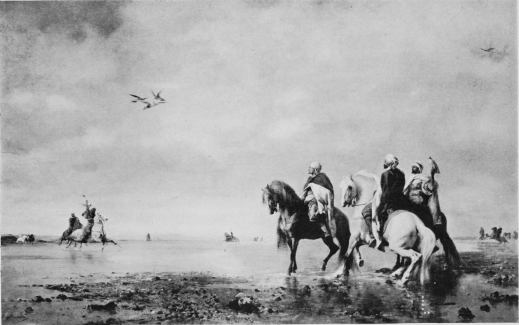
Photo. Giraudon.
ARAB CHIEFS HAWKING IN THE DESERT. Musée Condé.
Eugène Fromentin.
Meissonier’s best pupil was Jean Baptiste Detaille, the famous painter of battle-pieces. There is a picture of his at Chantilly entitled Les Grenadiers à cheval à Eylau,[140] where a gallant French officer with the cry “Haut les Têtes” leads his regiment on to victory. This is one of the chef d’œuvres of this artist, whose recent death is so much to be deplored.
Of quite a different nature are the allegorical paintings of P. J. Aimé Baudry. The excellence of this master lies principally in decoration, as may be seen by his Vision of St. Hubert in the Galerie des Cerfs; and he may be considered one of the most talented of the French artists who flourished during the second half of the nineteenth century.
Winterhalter, who, although a native of Baden, acquired his artistic education in Paris and Rome, was one of the Court Painters to both Louis Philippe and Napoleon III. His portrait of the Duc d’Aumale at the age of eighteen, as Commander of his regiment before his victorious campaign in Algiers, is at Chantilly; and there is here also a companion portrait of the Duchesse as a young bride. She is clad in white, with a single rose in her fair hair, and her face is full of refinement and delicacy.
Landscape-painting in France at the beginning of the nineteenth century had undeniably become conventional and tame; but quite suddenly this stagnant condition came to an end, and a revolution set in, caused by the exhibition of Constable’s paintings The Hay Wain and A View near London in the Paris Salon of 1827. These pictures, purchased and exhibited in Paris by a French connoisseur, created intense interest in the French World of Art; and it is alleged that they were the immediate cause whereat French artists suddenly emerged from the studios wherein they had lingered so long and proceeding to the woods of Fontainebleau, began working from Nature herself. They awoke to recognise their own defects, already denounced by Chateaubriand, who had declared that French landscape-painters ignored Nature.
Throughout the studios French artists warmly discussed the work of Constable, upon whom Charles X, at their special desire, conferred the Médaille d’Or; and it was suggested that the Charette (The Hay Wain, now in the National Gallery) should be acquired by the French Nation.
S. W. Reynolds, Constable’s friend and pupil, whose exquisite little picture of the Pont de Sèvres hangs in the Tribune at Chantilly, at this time also removed to Paris in order to satisfy the general demand for engravings of his master’s works.
But if the Barbizon School owed much to Constable, it is also certain that Constable and Wilson owed an equal debt to Claude Lorraine; and Turner perhaps even more so.
By Corot there is but one painting at Chantilly, but it is one of his finest works. Everything in this picture breathes a spirit of peace and joy; the sky, the earth and the graceful young women—one of whom is playing a viola and another singing, whilst their companions listen or are plucking fruit—give a cheerful note to this vision of content.
Plate LXXVII.
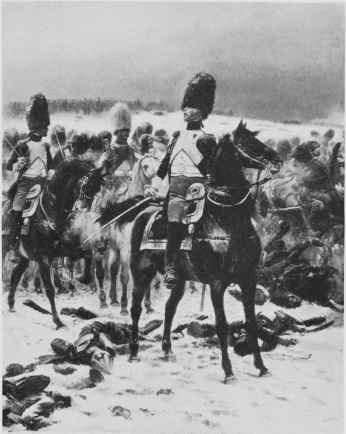
Photo. Giraudon.
THE GRENADIERS AT EYLAU.
Détaille.
It is styled Le Concert Champêtre[141] and recalls his series of paintings entitled Souvenir d’Italie. Corot appears to have commenced his studies in the woods at Fontainebleau even before Millet, Rousseau and Diaz, so that he may fairly be styled the doyen of the now famous Barbizon School.
By his pupil A. P. C. Anastasi there are several landscapes at the Musée Condé, one of which represents Amsterdam at Eventide.
That Millet is absent from this collection is much to be regretted; but by Theodore Rousseau there are several landscapes, small in point of size, but nevertheless exhibiting this artist at his best; as for example, Le Crépuscule en Sologne and Fermes en Normandie. Ary Scheffer was the first artist to understand and befriend Rousseau when he started away on lines of his own, and it was through the kind offices of this painter that one of his first pictures was bought by the Duc d’Orléans. His landscapes in Auvergne are early works; and those painted at Barbizon—such as the pictures above named—are later and more finished achievements.
Dupré, by whom there are three early works, Port St. Nicholas, Paris and Le Soleil Couchant, accompanied Rousseau in 1841 to the neighbourhood of Monsoult, where they were frequently visited by Barye, Corot, and Daubigny. There is at Chantilly by this last artist a sketch of the Château de St. Cloud, a charming record of a spot full of memories, now no more. By Diaz de la Pena, the last of this group of painters, there is a wreath of flowers and birds painted in vivid colours upon the ceiling in the boudoir of the Petit Château once used by the Duchesse d’Aumale; and by Ziem (known as the “Painter of Venice”) there is a landscape, Les Eaux Douces d’Asie, a subject magnificently treated by Diaz in a composition now in the Wallace Collection. Monticelli, Diaz’s greatest pupil, the leading painter of the Second Empire and a great admirer of the Empress Eugenie, is unfortunately not represented here; nor are there any examples of the early French Impressionists. For here the Hand of Death intervened.
Plate LXXVIII.
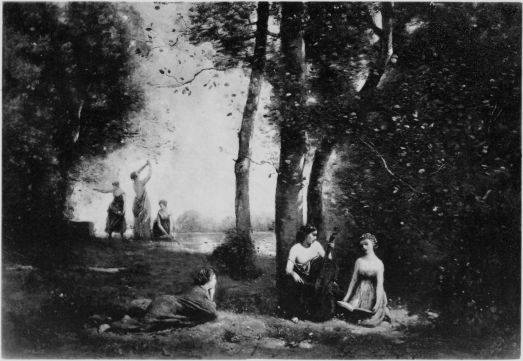
Photo. Giraudon.
“Concert Champêtre.” By Corot. Musée Condé.
With Léon Bonnat’s fine portrait of the Duc d’Aumale our description of the paintings at Chantilly comes to an end; but attention should yet be drawn to various pieces of sculpture exhibited in the apartments of the Château, on the terraces, in the gardens and in the Park. A fine figure of Jeanne d’Arc by Chapu is in the Rotunda, whilst a group of Pluto and Proserpine plucking daffodils by the same sculptor is on the Great Terrace. Here also is the equestrian statue of the Grand Montmorency by Dubois; and not far from it a life-size figure of the Grand Condé by Coysevox, surrounded by busts of Bossuet, La Bruyère, Molière and Le Nôtre. Copies in marble from the antique and the renaissance adorn the niches and plinths of the mansion and the avenues of the Park. A figure of St. Louis by Marqueste surmounts the roof of the Chapel and Jean Goujon’s reliefs ornament the Altar within. The famous portrait in wax of Henri IV is in the Galerie de Psyché; and busts in marble of the Grand Condé and of Turenne by Derbais, of Richelieu and of the last Princes of the House of Bourbon-Condé, are placed in the Cabinet des Livres and in various other rooms. Fine bronzes by Barye, Mène, Fremiet and Cain, adorn the mantel-pieces and consoles; whilst some exquisite enamel portraits by Limousin are exhibited in the Salle des Gardes.
Most interesting, and worthy of more than a passing notice, is the collection of Chantilly Porcelain, an industry founded in 1730 by the Duc de Bourbon. A set of porcelain made at that time was placed in the King’s Bedroom.[142]
In the centre of the Galerie des Peintures stands a fine bust of the Duc d’Aumale by Dubois, and in the Marble Hall lies his recumbent figure in full uniform by the same artist, a cast[143] of the marble figure upon his tomb in the Cathedral at Dreux.
And so with the death of the man his work came to a close. But his genius as a collector has furnished France with one of the finest Homes of Art in the World; and she does well to remember with gratitude this scion of the Bourbon race, who stretched out his hand to expiate much. Every lover of Art throughout the world, and every wayfarer who in his wanderings finds his way to Chantilly, may well stand amazed at this collection and praise its creator. Nor in passing out should he fail to give a last glance at the silent effigy: a glance in which gratitude should be mingled with that emotion which ever holds the thoughtful spectator of departed greatness.
Plate LXXIX.
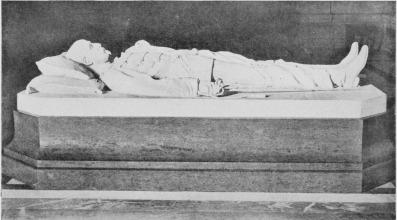
TOMB OF THE DUC D’AUMALE. In the Cathedral at Dreux. Cast at Chantilly.
Paul Dubois.
INDEX
A, B, C, D, E, F, G, H, I, J, K, L, M, N, O, P, Q, R, S, T, U, V, W, Y, Z
Abdul Kader, Duc d’Aumale’s victory over, 117 Accordée du Village, Le, by Greuze, 262 Adoration of the Magi, by Jean Fouquet, 190, 191 Ahasuerus. See King Ailly, Heures de. See Books of Hours Aix-la-Chapelle, Peace of, 79 Albano, a work by, 132 Albret, Duc de. See Condé, fifth Prince de Albret, Henri de, King of Navarre, portraits of, 136, 141, 223 Albret, Jeanne de, Queen of Navarre, marriage, 16; a Protestant, 17; helps the Huguenots, 21; sudden death, 22, 243; portraits of, 22, 141, 224, 225, 226, 230, 235 Aldine editions in the Standish Library, 129 Alençon, Duc de, portraits of, 141, 182, 245 Alençon, Mme. Vendôme de, portraits of, 222, 223, 239 Alençon, Mlle. de, and Duc d’Enghien, 69 Alexandra, Queen, visits Chantilly, 122 Alley in the Wood, An, by Dughet, 250 Allori, Alexander. See Bronzino All Saints’ Day, by Fouquet, 194 Amante Inquiète, by Watteau, 258 Amateurs des Tableaux, Les, by Meissonier, in the Wallace Collection, 272 Amazon of the Vatican, a statuette, 137 Amboise, Cardinal George de, owner of Valere Maxime, 158 Ambrogio di Spinola, Marchese. See Spinola Amélie, Queen, and the Duc d’Aumale’s marriage, 117 “Amico di Sandro,” 149 Amour Désarmé, Le, by Watteau, 258 Amphitryon, poem by Molière, 75 Amsterdam at Eventide, by Anastasi, 275 Anastasi, A. P. C., 275 Angelic Choir, miniature by Simon Marmion, 197 Angers, disaster of, 25 Angleterre, Mme. Henriette de, portrait of, 253 Angoulême, Duc de. See Francis I Angoulême, Duchesse de (formerly Diane de France), marriage, 9; portrait of, 151 Angoulême, Marguerite (sister of Francis I), portraits of, 141, 216, 228; manuscript of, 158 Anjou, Duc de. See Henri III Anjou, Louis II of, King of Sicily, portrait of, 201 Anne of Austria, character, 40; and the Grand Condé, 44, 45, 47, 55, 56, 64; and Princesse de Condé, 52, 54 Anne of Bavaria, marriage of, 69 Anne de Bretagne (wife of Louis XII), miniature of, 138; Prayer Book of, 198; portrait of, 208; Tournois tapestry, 208, 209; medal of, 210; her daughter’s marriage, 216 Annunciation, by Francia, 145; by the Limbourgs, 173; by Jean Fouquet, 184, 189, 193 Antioch, Jean de, translates Cicero’s Rhetorics, 157 Antiochus and Stratonice, The Story of, by Ingres, 135 Antiquitates Judæorum of Josephus, miniatures by Jean Fouquet, 155, 181, 182, 185, 189, 200 Arab Chiefs Hawking in the Desert, by Fromentin, 272 Architecture, Treatise on, by Filarete, 180 Ariane. See Duclos Mille. Aristotle’s Ethics, 157 Armagnac, Comte de, war with Duc de Bourbon, 162 Arsenal MS., 159 n. Artemisia, History of, 244 Artois, Duc de (afterwards Charles X), marriage, 101, 102; leaves France, 104; at Coblenz, 109, 110 Ascension, The, by Jean Fouquet, 192 Ashmolean Collection at Oxford, 241 Assassination of the Duc de Guise, The, by Delaroche, 134, 269, 270 Athena of Lemnos, famous bronze, 136 Aumale, Duc de (Henri d’Orléans), Lord of Chantilly: Histoire des Princes de Condé, 38, 40, 74, 132; military success in Algiers, and marriage, 117; birth of a son, 118; an exile in England and return to Chantilly, 119-123; his scheme to bestow Chantilly on the French nation, 122-124; his second banishment, 124; return and welcome back to Chantilly, 124, 125; equestrian statue of, 125; portraits of, 126, 137, 177 n., 220, 273, 276, 277; collects the art treasures of the Musée Condé, 129-153; Victor Hugo’s letter, 147; on Raphael’s Three Graces, 149; French illuminated manuscripts at Chantilly, 154-164; the Cabinet des Livres, 156; Les Très Riches Heures du Duc de Berry, 165-178; works of Jean Fouquet, 179-195; Jean Perréal, Bourdichon, and others, 196-210; Jean Clouet, 211-226; François Clouet, 225-247; from Nicholas Poussin to Corot, 248 et seq.; tomb of, 278 Aumont, Duc de, portrait by Quesnel, 142 Auneau, Victory of, 26 Austria, Elizabeth of, portrait of, 234, 235; miniature of, 243 Austria, Margaret of, and the Très Riches Heures, 162, 163; and Jean Fouquet, 181; and Jean Perréal, 209 Autumn, by Botticelli, 145 Avant et après le Combat, by Protais, 135 Averoldi family, Ecce Homo purchased from, 135 Ayr Collection, portrait of Prince Orlant, 198
Bacchus and Ariadne, antique sarcophagus, 137 Baccio del Bene, Italian author, 220 Ball under the Colonnade, by Watteau, 259 Balthazar, a Spanish hound, by Desportes, 255 Bandol, Johannes, painter, 200 Barbançon, Princesse de, by Van Dyck, 132 Barberini, Cardinal, and Quesnoy the sculptor, 249 Barbizon school, 274, 275 Bardon, M., painter, 8 Baroccio, Federigo, painter, 132 Bartolozzi, Louis Joseph de Bourbon, 265 Barye, bronzes by, 277 Bassompère, Maréchal de, his marriage, 11 Battave, Godfrey le, his work, 204 Baudrey, P. J. Aimé, allegorical painter, 273 Bavaria, Marie Anne of, portrait of, 138 Béarn, Henri de, and the Protestants, 21 Beaubrun, his portraits of Comte de Cossé Brissac, Mme. and Mlle. de Longueville, 12, 133; the Grand Condé, 251 Beaujeu, Anne de, and Jean Perréal, 207 n. Beaujeu, Pierre de, 183 Beauneveu, André, a Book of Hours, 177 n.; Antiquitates Judæorum, 182 Bellay, Du, poet, and Marguerite de France, 220, 221 Belles Heures de Jean de Berry. See Book of Hours Bellièvre, Pomponne de, portrait of, 252 Benedict XIV, Pope, portrait by Subleyras, 142 Berenson, Bernard, A Sienese Painter of the Franciscan Legend, 145 n. Berghe, Comte de, portrait by Van Dyck, 132 Bernal Sale, 133, 134 Berry, Duc de, Les Très Riches Heures, 130, 160, 161, 165 et seq.; his illuminated manuscripts, 157; portrait of, 201 Berry, Duchesse de, at Chantilly, 91 Bersuire, Pierre, translator of Livy’s Second Decade, 157 Bethune album, 241 Bethune, Philippe de, portrait by François Quesnel, 246 Betrayal, by Jean Fouquet, 191 Bible Historiée, 200 Bible Moralisée, 179 Birth of St. John the Baptist, by Jean Fouquet, 188, 190 Bissolo, Madonna holding the Infant Christ, 145 Boccaccio at Munich, 181, 182, 185 Bodleian Library (Oxford), 151 Boileau, N., celebrated French poet, a guest at Chantilly, 75 Boissy, Gouffier de, Battle of Marignan, 6 Boisy, Le Grand Ecuyer de, portrait of, 244 Bonheur, Rosa, A Shepherd in the Pyrenees, 135 Bonnat, Léon, portrait of Duc d’Aumale, 126, 276 Bonnivet, Gouffier de, Battle of Marignan, 6 Book of Hours: (1) of fourteenth century, owned by François de Guise, 150 (2) of Anne de Beaujeu, 198 n. (3) of Anne de Montmorency, 158 (4) of Catherine de Medicis, 215 (5) of Étienne Chevalier, miniatures by Jean Fouquet, 152, 181 (6) belonging to Maurice de Rothschild, 160 (7) Belles Heures de Jean de Berry, also called Heures d’Ailly, by Limbourg brothers, 179, 184, 185 (8) Heures d’Anjou, 200 (9) Heures d’Aragon, by Bourdichon, 198 (10) Livres d’Heures, 202 (11) Très Belles Heures, or Hours of Turin, by Hesdin, 165, 177 n. Book of Hours—Cont. (12) Très Riches Heures du Duc de Berry, by the Limbourg brothers, 130, 152, 154, 156, 158, 160, 162, 164 et seq. Bora, Catherine de, portrait by Pourbus, 142 Bordeaux, Claire-Clemence at, 52, 53; as a Republic, 59, 60; surrenders to the King, 62 Bossuet, Jacq., the famous Prelate, at Chantilly, 83; and the Grand Condé, 86-88; statue of, 89; on Fouquet’s Enthronement of the Virgin, 194; bust of, 276 Botticelli, Sandro, Autumn, 145; Simonetta Vespucci, 146; other drawings, 147 Boucault, Jeanne, wife of Jean Clouet, 211, 224; portrait of, 222 Boucher, François, French painter, Watteau, 143, 257; cartoon by, 256 Bouchot, Henri, 199, 204, 208, 235 Bouillon, Duchesse, joins the Fronde, 45; portrait of, 242 Bourbon, Anne Marie de, death of, 92 Bourbon, Antoine de (afterwards King of Navarre); portraits of, 16, 136; and the Guises, 18, 20 Bourbon, Caroline Auguste de, marriage to the Duc d’Aumale, 117 Bourbon, Charles de, the famous Constable, death, 16 Bourbon, Duc de. See Bourbon, Louis Henry Joseph; Condé, sixth, seventh, and eighth Princes de Bourbon, Geneviève. See Longueville, Mme. de Bourbon, Henri I de. See Condé, second Prince de Bourbon, Henri II de. See Condé, third Prince de Bourbon, Henri de, King of Navarre. See Henri IV Bourbon, Henri Jules de. See Condé, fifth Prince de Bourbon, Jacob de, 16 Bourbon, Louis I de. See Condé, first Prince de Bourbon, Louis II de. See Condé, fourth Prince de Bourbon, Louis Henry Joseph de (Duc d’Enghien, son of eighth Prince de Condé, known as Duc de Bourbon, last of the Condés), birth, 96; early marriage, 97; at Chantilly, 98, 99; separated from his wife, 100; leaves France, 104, 105; return to Chantilly, 111; death of his father, 113; reconciliation with and death of his wife, 113; and his godson, 114; death, 114, 115; portraits of, 114, 266 Bourbon, Louis Joseph de. See Condé, eighth Prince de Bourdelot, Jean, and the Grand Condé, 84 Bourdichon, a follower of Jean Fouquet, 197, 207; his works, 198, 199 Bourdillon, Lescueur, portrait of, 203 Bourgogne, Antoine de, the Grand Bâtard, portraits of, 62, 142 Bouts, Dierick, Procession, 146 Braganza, Duc de (afterwards King of Portugal), betrothal, 124; assassination, 124 n. Brandenburg, William, Margrave of, guards the Rhine, 82 Brantôme, P. de: Diane de France, 9; Louis de Bourbon, 19; Duc d’Anjou, 24 n.; the Dauphin, 217; Diane de Poitiers, 231; Henri de Mesmes, 242 “Brasseu,” daughter of Diane de Poitiers, a member of la petite band, 228; portrait of, 239 Brentano, Herr, purchase and sale of forty miniatures by Jean Fouquet, 152, 186 Bretagne, Anne de. See Anne de Bretagne Bretagne, François, the Duke of, tomb of, 42, 209 Breviary, fourteenth century, 150, 151; of Belleville, 160; Grimani, sixteenth century, 162, 163, 168 Brézé, Maréchal de, 35 Briados, a Spanish hound, by Desportes, 255 Bridgewater Madonna, 140 Brignole, Marie Catherine de, the widowed Princess of Monaco, marries eighth Prince de Condé, 109 Brissac, Maréchal, portrait of, 238, 239 British Museum, the Gallic War, 157; Book of Hours, 186; Salting Collection, 230, 231, 242 Bronzes, 136, 277 Bronzino, Le (Alexander Allori), painter, 132 Broussel, Councillor, and Cardinal Mazarin, 44, 45 Bruges, Jean de, 200 n. Bruisbal, Scipion, 240 Brun, Charles Le, Court-painter to Louis XIV, 84; and the Gobelin Factory, 251, 252 Brun, Mme. Vigée Le, her works, 137, 263, 264 Bruyère, La, educates the Condés, 85; and Mme. de Langeron, 87; bust of, 276 Budos, Louis de, death of, 9 Buffant, Jean, once possessor of Breviary Grimani, 163 Bugato, Zanetta, 148 Bugenhagen, Jean de, portrait of, 142 Bullant, Jean, architect, 6, 240; altar of Senlis marble, 123 Bussel, a follower of François Clouet, 245 Buti, Catherine, in La Toussaint, 194
Cabinet des Livres at Chantilly, 156 Cabotière, La, 32 Cæsar’s Commentaries, 157 Cain, bronzes, 277 Calendar of months in Book of Hours, 152, 154, 156, 158, 160, 162, 164, 166 et seq., 178 Callirhoé and Corésus, by Fragonard, 264 Canaletto, Antonio, 147 Canaples, Mme. de, portrait of, 244 Canaples, Sieur de, portraits of, 223 Cantillius, a Gallo-Roman, origin of name Chantilly, 3 Capture of Constantinople by the Crusaders, by Delacroix, 270 Capture of Jerusalem, by Poussin, 249 Carlisle, Lord, his collection of French drawings, 151 Carmontelle, M., collection of, 143, 144; portrait of, 144 Carracci, Annibale, paintings in Musée Condé, 84, 132, 135 Carriera, Rosalba, 261 Carron, M., his designs from the History of Artemisia, 244 Castello di S. Angelo, by Claude, 250 Cellini, Benvenuto, Apollo guiding the Chariot of the Sun, 141; Life of, by R. H. Cust, 222 n. Champaigne, Philippe de, portraits of Mazarin and Richelieu, 134; his work, 250 Champion, Jean, 212 Chandus, portrait of, 223 Chantilly, Château of (see also Musée Condé), owners of, 1 et seq.; origin of name, 3; the Montmorencys, 3-15; improvements and restorations, 5, 66 et seq., 89, 90, 92, 118, 119, 121; windows, 5, 8; pictures of, 6, 50; the Petit-Château, 7; its beauty, 9, 10; and the Condés, 16 et seq.; confiscation and restoration of, 32, 106, 109, 111, 112, 119, 121, 124, 125; the Grand Condé, 33-46; portraits, 42, 50; return of Prince and Princesse de Condé, 56; festivities at, 69-77, 90-92, 97, 99; illustrious visitors, 83, 90, 92, 97-99, 118, 121-123; famous waterworks at, 84; pictures, 84; used as a prison, 106, 108; during the French Revolution, 106 et seq.; races at, 116; Duc d’Aumale, Lord of Chantilly, 116 et seq.; Musée Condé erected, 122, 123; bequeathed to the nation, 124, 125; Grand Chinoiserie, 259 Chapeau-Rouge party, 61 Chapu, Jeanne d’Arc, 276 Chariot of the Sun, 167 Charlemagne, Coronation of, 182 Charles IV of Germany, portrait of, 201 n. Charles V of France, portraits of, 142, 200; his Inventory, 159; imprisons the two Dauphins, 217 Charles VII, portraits by Fouquet, 181, 182, 185, 186, 191 Charles VIII, by Perréal, 203, 208 Charles IX and Prince de Condé, 23; death, 24; portraits by François Clouet, 141, 229, 230, 231, 244 Charles X confers the Médaille d’Or on Constable, 274 Charlotte, Elizabeth. See Princess Palatine Charolais, Count de, at Chantilly, 95, 96 Charonton, Enguerrand, works by, 42, 146, 176, 193 Charost, by Quesnel, 142 Chartres, Duc de (afterwards Louis Philippe), portrait by Charles Vernet, 266 Chartres, Duchesse de, portrait by Duplessis, 261 Chasse au Faucon en Algérie, La, by Fromentin, 139 Chasse du Loup and du Renard, by Oudry, 256 Château de St. Cloud, by Daubigny, 275 Chateaubriand, Monsieur de, 239 Châteauroux, Castle of, Claire-Clemence exiled to, 73 Châtillon, Mme. de, 50 Chaudin, capitaine de la porte du Roy, 239 Chavannes, Puvis de, his works, 269 Chavignard, Lechevallier, cartoon by, 123 Chess. See Game of Chevalier, Étienne, Book of Hours, executed for, 152, 184; portraits of, 180, 181, 182, 185, 187, 189, 194 Chevreuse, Duchesse de, 55 Chiaroscuro, introduction of, 177, 192 Chigi, Prince, collection of, 150 Children of Israel led into Captivity by King Shalmaneser, 184 Chinon, Château de, 191 Christ, Life of, scenes from, 173 Christ on the Cross, miniature, 139 Christina of Denmark, Queen, at Chantilly, 123 Christina of Sweden, Queen, and Claire-Clemence, 54 Chronique de France, 181, 182 Cicero’s Rhetorics, 157 Cigongue, Armand, collection of, 130 Cité de Dieu, 157 Claire-Clemence (wife of the Grand Condé), early marriage and excellent qualities of, 34; retires to a convent, 35; with her son at Chantilly, 41; sudden departure, 45; her husband’s imprisonment, 49; her escape, 51; at Bordeaux, 52, 53, 59, 60; obtains her husband’s freedom, 54, 55; entry into Paris, 56; retirement to Saint-Maur, 57; birth of second son, 61; retires to Flanders, 62; return to France, 64, 75; and her son’s marriage, 69; ill-health, 70; and the page Duval, 71; her husband’s ill-treatment, 71, 72; exile and death, 73, 74 Claridge, Robert, and the Condés, 266 Claude, Queen (wife of Francis I), portraits of, 216, 217, 218, 239 Clementia, 184 Clermont, Louise de, portrait of, 228, 255 Clève, Marie de, marriage, 22; and Charles IX, 23; death, 24 Clève, Philippe de, portrait by Holbein, 142 Clouet, François, his works, 8, 20, 22, 26, 141, 151, 205, 208, 214, 215, 219, 223, 226-243, 246; succeeds his father as Court-painter to François I, 225, 226; his style of work, 227, 234, 238, 247; death, 243 Clouet, Jean, painter to the Duke of Burgundy, 211 Clouet of Tours, Jean (son of above), court-painter to Francis I, 151, 204-208; medal of, 210; marriage, 211; his methods and works, 212-226, 228, 242; death, 227 Clouet of Navarre (son of above), 211 Clovio, Giulio, Christ on the Cross, 139 Coche de Marguerite, de la, manuscript, 158 Codex with Fouquet’s miniatures, 182-184 Colbert, pastel of, 142; and Le Brun, 251 Coligny, Admiral de, portrait of, 141 Coligny, Dandelot de, 42 Coligny, Gaspard, on the death of Francis II, 19; and the Condés, 21; death, 23 Coligny, Odet de, a Cardinal, portrait of, 133, 236; history of, 237 Colnaghi, Messrs., sell portraits and pictures to Duc d’Aumale, 133, 138 Colombe, Jean de, works of, 162, 171, 178, 197 Colombe, Michel, 209 Colonel Lepic à Eylau, by Détaille, 152 Comptes de Lyon, by Perréal, 207 Concert Champêtre, by Corot, 152, 275, 276 Conches Collection, 186 Condé family, the, 4, 16 et seq. Condé, first Prince de (Louis de Bourbon), 16; religion and marriage, 17; imprisonment, 17, 18; release, 19; infidelities, 19; death, 20; portraits of, 18, 136 Condé, second Prince de (Henri I de Bourbon), portrait of, 18; and Mlle. de Saint-André, 19; and his mother, 20; succeeds his father, 21; marriage, 22; and the Protestant faith, 23, 24; death of his wife, 24; second marriage, 24, 25; the War of the Four Henris, 25, 26; becomes heir-presumptive, 27; death, 28 Condé, third Prince de (Henri II de Bourbon), portrait of, 12; marriage and its result, 12-15, 30; imprisonment, 31; and Louis XIII, 32; death, 43; bronze monument of, 123 Condé, fourth Prince de (Louis II de Bourbon, Duc d’Enghien, the “Grand Condé”), baptism and education, 33; early marriage, 34; life in Burgundy, 35, 36; elected general, 37; victor of Rocroy, Thionville, and Nordlingen, 38-41; illness, 41; influence of women on, 42; death of his father, 43; victor of Lens, 43, 44; reception by the King, 44; puts down the Fronde, 45; Mazarin an implacable enemy, 47 et seq.; imprisoned at Vincennes, 48, 49; removed to Havre, 54; his wife obtains his freedom, 55, 56; betrayed by his enemies, 57; his faults, 57; retires to Montroux, 58; alliance with Spain, 59 et seq.; entry into and retreat from Paris, 60; financial difficulties, 61, 62; a lost battle, 63; returns to France, 64; his regrets, 65; retires to Chantilly, 66; improvements at Chantilly, 66, 67; refuses Crown of Poland, 69; cruel treatment to his wife, 70-73; her death, 73; illustrious visitors and festivities at Chantilly, 75-77, 83; war with Holland, 78 et seq.; wounded, 81; return to Chantilly and death, 83; interest in scientific discoveries and passion for the chase, 84; protects the Huguenots, 85; and his grandson, 85; a free-thinker, 87; his death, 88; statues of, 89, 276; portraits of, 251; bust of, 277 Condé, fifth Prince de (Henri Jules de Bourbon, Duc d’Albret, Duc d’Enghien), son of the Grand Condé, 41; escapes with his mother, 50, 51; educated by Jesuits, 62; Louis XIV’s entry into Paris, 65; at Chantilly, 67; marriage, 69; sad interview with his mother, 73; his mother’s death, 73; his father wounded, 81; character, 81, 85, 90; death of his father, 87; succeeds and carries out his father’s improvements at Chantilly, 89; violent temper and death, 90 Condé, sixth Prince de (Louis III, Duc de Bourbon), early marriage and education, 85, 86; death, 91 Condé, seventh Prince de (Louis Henri, Duc de Bourbon), early succession, 91; improvements and illustrious visitors at Chantilly, 91, 95; Prime Minister of France, 92; death of his wife, 92; and the Marquise de Prie, 92-94; resignation, 94; second marriage, 94, 95; death, 95 Condé, eighth Prince de (Louis Joseph), condemns the Grand Condé’s treatment of his wife, 74; early succession, 95; marriage and birth of a son, 96; gained victories of Grinningen and Johannesberg, 97; death of his wife, 97; illustrious visitors at Chantilly, 98-104; leaves France owing to Revolution, 104; at Worms, 109; retires to Wanstead House, Wimbledon, 109; second marriage, 109; returns to Chantilly, 111; restores Chantilly, 111, 112; death, 113; and Jean Baptiste Huet, 260; and Fragonard, 264; portrait of, 265 Condé, ninth Prince de. See Bourbon, Louis Henri Joseph, Duc de Condé, Henriette de Bourbon (Mme. de Vermandois), Abbess, 100 Condé, Histoire des Princes de, by Duc d’Aumale, 38, 74 Condé, Louise de (daughter of eighth Prince de Condé), birth, 96; life at Chantilly, 100, 101; and the Marquis de Gervaisais, 102, 103; the French Revolution, 104; retires to a convent, 109; tragic death of Duc d’Enghien, 109, 110; reception in England, 110; death, 115 Condé, Mme. la Princesse Douarière de, 35 Condé, Musée, erection of, 122, 123; bequeathed to the French nation, 124, 125; art treasures of, and how they were brought together, 129 et seq.; French illuminated manuscripts at, 154-164; Les Très Riches Heures du Duc de Berry, 165-178; works of Jean Fouquet of Tours, 179-195; of Jean Perréal and Bourdichon, 196-210; of Jean Clouet, 211-226; of François Clouet, 227-248; Catalogue Raisonnée of, 247; works of painters from Nicolas Poussin to Corot, 248-278 Condé, Sur la femme du Grand, 34 Confession of St. Peter, 189 Constable, John, effect of his work on French painters, 273, 274 Constantine, Emperor, medal of, 175 Conti, Prince de, brother of the Grand Condé, 48; illness, 49; at Bordeaux, 60, 61; and Mazarin, 64 Conti, François, Prince, nephew of the Grand Condé, 85 Conti, Louise Henriette de Bourbon, portrait by Nattier, 254 Corneille de Lyon, his works, 26, 141, 147, 218, 231, 242, 244 Corneille, Pierre, the Poet at Chantilly, 75, 83 Coronation of Charlemagne, by Fouquet, 82 Coronation of the Virgin, the. See Virgin Corot, Jean B. C., Le Concert Champêtre, 152, 274, 275, 276 Cosimo, Piero di, Simonetta Vespucci, 146 Coste, Jean de, the Château de Vaudreuil, 200 Court, Jean de, Court-painter to Henri III, 244 Courtils de Merlemont, M. des, Knight of St. Louis, imprisoned at Chantilly, 106 Coutras, Battle of, 26 Cowley, Lord, occupies Chantilly, 119 Coysevox, statue of the Grand Condé, 276 Crépuscule en Sologne, Le, by Rousseau, 275 Croix, Mlle. de la, 35 Crozat, M., the financier and collector, owned the Orleans Madonna, 140; and Watteau, 259 Crucifixion, The, in Les Très Riches Heures, 177, 192 Cuirassiers, Les, by Meissonier, 152, 272 Cupid and Psyche, in windows at Chantilly, 5 Cust, H. Hobart, The Life of Benvenuto Cellini, 222 n. Cust, Lionel, History of Art in England, 201 Czartoysky, Prince Ladislas, marriage, 121
Damartin, Guy de, architect, 166 Dance of Angels, 135 Danloux, M.; portraits by, 114, 266 Danté’s Inferno with Commentary by Guido of Pisa, 157 Daphne flying to her father’s protection, by Poussin, 250 Daumet, M., rebuilds the Grand Château, 122 Dauphin, the Grand (only son of Louis XIV.), at Chantilly, 90; portraits of, 138, 217 Dauphin François, portraits of, 212, 217, 218, 220, 239, 244 Dauphin Louis (son of Louis XVI), portrait of, 264 David, Jacques Louis, and Prud’hon, 267; his works, 269 Dawes, Sophie, known as Baronne de Feuchères, 115 Death of Germanicus, The, by Poussin, 249 Déjeuner d’Huîtres, by de Troy, 134, 259 Déjeuner de Jambon, by Lancret, 134, 259 Delacroix, Eugène, his works, 141, 270, 271 Delaroche, Paul, his works, 134, 269, 270 Delessert Sale, 139 Deligand Collection, 228 n., 239 Delisle, Count Leopold, 161 Delormes, Philibert, 240 Denmark and Louis XIV, 81 Derbais, M., his works, 277 Descamps, Jean Baptiste, painter, works of, 134, 139, 271 Descartes, René, and the Grand Condé, 87 Descent from the Cross, by Fouquet, 192, 193 Descent of the Holy Ghost, by Fouquet, 193 Desportes, P., poet, his works, 132, 255, 256; and Jean de Court, 244 Detaille, Jean Baptiste, his works, 272, 273, 274 Détaille, M., his finest work, 152; album, 241 Devançay, Mme. de, by Ingres, 147 Diane de France. See Angoulême, Duchesse de Diane de Poitiers. See Poitiers Diaz de la Pena, works of, 275, 276 Diderot, M., on Greuze, 261; on David, 269 Dimier, L., 204; Bulletin de la Société Nationale des Antiquaires de France, 240 n. Dinier, Louis, Les Portraits peints de François I, 151 n. Diodorus Siculus, translation of, 158 Disraeli, Benjamin, in praise of Duc d’Aumale, 131 Distribution des Aigles, La, by David, 269 Divina Commedia, by Dante, 194 Domenichino, Domenico, and Poussin, 249 Donato, San, Sale, 139 Donneur des Sérénades, La, by Watteau, 258 Dourdan, Castle of, in Les Très Riches Heures, 168 Dragons sous Louis XV, Les, 138 Dream of a Knight, The, by Raphael, 148 Drouais, M., portraits by, 142, 263 Duban, M., architect, 118, 122 Dubois, P., a follower of François Clouet, 245; statue of the Grand Montmorency, 276; bust and tomb of Duc d’Aumale, 277, 278 Duccio’s famous altar-piece at Siena, 193 n. Dûchatel, Comte, at Chantilly, 119 Duclos, Mlle., portrait of, 254 Dudley, Earl of, owner at one time of The Three Graces, 148, 149 Duel après le Bal, Le, by Gérome, 135 Duff-Gordon-Duff Collection, 144 Dugardin, the goldsmith, frames the miniature of Elizabeth of Austria, 243 Dughet, Gaspar, works by, 133, 146, 250 Dumoustier, M., works by, 42, 143, 147, 151, 245, 246 Dunes at Scheveningen, by Ruysdael, 139 Duplessis, M., administrator of the galleries at Versailles, 261 Dupré, M., works by, 275 Duras, Duchesse de, a prisoner at Chantilly, 107 Dürer, Albert, celebrated artist, Virgin, 131 Durrieu, Comte Paul, 148; and the Très Riches Heures, 161, 163; made reproduction of Hours of Turin, 165; and the medal of Emperor Constantine, 175; and the Fouquet miniatures, 182; and the MS. de Saint Michel, 202
Eaux Douces d’Asie, Les, by Diaz, 276 Ecce Homo, by Titian, 135 Edward III, portrait of, 201 n. Edward VII, visits Chantilly when Prince of Wales, 122; presentation of Fouquet’s miniatures to President Fallières, 184 Elbœuf, Mme. de, by Corneille, 244 Eleonore, Queen, portrait of, 133 Elizabeth of Austria, portraits of, 133, 234 Enghien, Duc de (see also Bourbon, Louis Henri Joseph), son of Louis Henri, Duc de Bourbon, 103; the French Revolution, 104, 105; execution by Napoleon, 110; portrait of, 264 Enthronement of the Virgin, by Fouquet, 193, 194 Epéron, Duc de, the hated Governor of Bordeaux, 52 Erasmus, portrait of, 204 Estampes, Château de, in the Calendar of Months, 170 Estampes, Duchesse de (mistress of Francis I), intrigues of, 6 Este, Cardinal Ippolito de, 222 Esther as Queen, walking in her garden, in the Lichtenstein Gallery at Vienna, 150, 151 Estrange, Madame le, portrait by Clouet of, 223, 224 Estrées, Gabrielle de (mistress of Henri IV), portraits of, 136, 142, 246, 247 Eugenius IV, Pope, portrait of, 180 Eve and the Apple, in Les Très Riches Heures, 173 Everdingen, the master of Ruysdael, 146 Evreux, Jeanne de (wife of Charles IV), Breviary executed for, 151, 160 Eyck, Hubert Van, works by, 146, 165 n.
Fables de Marie de France, Les, 130 Fabre Collection, 149 Fagon, Dr. (physician to Louis XIV), portraits of, 248 Fall of the Rebel Angels, 175, 176 Fallières, President, presentation of the Fouquet MSS. to, 184 Faure Sale, 141 Fel, Marie, opera singer, pastel of, 260 Fénélon, François, at Chantilly, 83 Ferdinand III, Emperor, Peace of Westphalia, 44 Fermes en Normandie, by Rousseau, 275 Ferrara, Ercole, Duc de, marriage, 221 Ferrara, Duchesse de. See Rénée de France Filarete, Treatise on Architecture, 180 Flanders, invaded by Louis XIV, 78 Fleuranges, Maréchal de, portrait of, 205 Fleury, Cardinal, and the Marquise de Prie, 94 Fleury, Robert, works by, 138 Foix, Odet de, portraits of, 205, 208 Fontaine, La, at Chantilly, 75; designs executed in tapestry from his Fables, 256 Foscari, The Two, by Delacroix, 141, 270, 271 Foulon, Benjamin, and the Lecurieur album, 235 Fouquet of Tours, Jean (Court-painter to Louis XI), his works, 152, 153, 155, 156, 179-195, 202, 207 n.; early history of, 180 Four Evangelists, 173 Fragonard, J. Honoré, painter, his works, 264, 265 France, Chronique de. See Chronique France, Diane de. See Angoulême, Duchesse de France, Henriette de, portrait of, 245 France, Histoire litteraire de la, 157 France, History of the Kings of, 251, 252 France, Jeanne de (Queen of Navarre, daughter of Charles VII), 148; Book of Hours designed for, 160 France, Les Fables de Marie de, 130 France, Margot de (daughter of Catherine de Medicis), engagement, 22; portraits of, 233, 234, 238; marriage, 243 France, Marguerite de (sister of Henri II), portraits of, 141, 218, 244; history of, 218-221; marriage, 219 France, Mme. Adelaide de, portrait of, 260 France, Rénée de. See Rénée France, war with Spain, 38 et seq.; the Fronde rising, 44, 45; civil war, 55, 59; Peace of the Pyrenees, 64; invasion of Holland, 78-82; Revolution, 104, 105; gift of Musée Condé to the nation, 124 Francia, his Annunciation, 145 Francis I (formerly Duc d’Angoulême), Battle of Marignan, 6; jealous of Anne de Montmorency, 6; portraits of, 138, 141, 151, 158, 204, 206, 207, 213-215, 216, 228, 241; and Jean Perréal, 205; his daughter Marguerite de France, 220; Princesse Jeanne, 224 Francis II, imprisonment of Louis de Bourbon-Condé, 17, 18; illness, 18; death, 19; portraits of, 20, 229, 232 Fremiet, M., bronze by, 277 Fresnes, Comte de, 150 Frizzoni, Dr. G., 146 Froissart, Jean, French poet, manuscript, 143; description of the castle of Mehun-sur-Yevre, 177 Fromentin, Eugène (a celebrated writer and painter), his works, 139, 271, 272 Fronde, outbreak of the, 44, 45 Fry, Roger, and the Maître de Moulins, 199
Gaignière, Robert, collection of French drawings, 141, 151, 156; his Receuils, 185, 188, 201; discovers portrait of Jean le Bon, 200; miniatures, 207; portraits, 208, 218, 245 Gallic War, manuscript history of, 157, 204, 206 Game of Chess, A, by Carmontelle, 144 Gardiner, Mrs. John, owner of The Virgin and the Holy Child, 150 Gautier, Leonard, Cupid and Psyche, 6; Kings of France, 215 Gazette des Beaux Arts, 172, 198, 203 n. Genealogy of the Blessed Virgin, a Mariensippe, 186 George I, portrait of, 142 Georgette, by Greuze, 262 Gerard, François (styled “the painter of Kings” and “King of Painters”), Queen Marie Amélie, 137; Napoleon, 146, 268 Gericault, M., 147; a pioneer of Romanticism, 270 Gérome, M., Le Duel après le Bal, 135 Gervaisais, Marquis de, and Princess Louise de Condé, 102, 103 Ghirlandajo frescoes, 190 Gillott, Claude, earliest creator of the Watteau style, 258, 259 Giorgione, M., The Woman taken in Adultery, 135 Giotto’s Death of the Virgin, 145 Giovanni del Ponte di San Stefano, The Coronation of the Virgin, 145 Gobelins tapestry, the, 132, 251, 256 Goes, Ugo Van der, the Grand Bâtard, 142 Goldschmidt, Leopold, 149, 150 Gondi, Albert de, portrait of, 235 Gondi, Henri, Archdeacon of Paris, portrait of, 245 Gondi, Paul (subsequently known as Cardinal Retz), Archbishop of Paris and the Fronde rising, 44; and the Queen Regent, 56, 57 Gonzague, Princesse Anne de (known as Princesse Palatine), and the Grand Condé, 42, 43, 54, 70; at Chantilly, 75; a free-thinker, 87; death, 87 Gonzague, Princesse Louise Marie de (afterwards Queen of Poland), and the Grand Condé, 42, 43, 54; and the Crown of Poland, 69; a free-thinker, 87 Gouffier, Artur and Guillaume, portraits of, 205 Goujon, Jean, the altar of Senlis marble, 123; his altar reliefs, 277 Gourdel, Pierre, a follower of François Clouet, 245 Graces, The Three, by Raphael, 148, 149, 187 Grammont, Duchesse de, on the death of Henri de Bourbon-Condé, 28 Grammont, Maréchal de, at Chantilly, 75 Grenadiers à Cheval à Eylau, Les, by Detaille, 272, 274 Greuze, J. B. (French painter), his style and works, 139, 261-263, 267 Grimani. See Breviary Grinningen, victory of, 97 Gros, Antoine Jean, Baron, painter, 139 Gruyer, M. F., a Catalogue Raisonnée of the Musée Condé, 144, 247; on Les Très Riches Heures, 160; his works, 251 Guercino, works of, 84, 132 Guido of Pisa, Commentary, 157 Guido Reni, a celebrated Italian painter, 132 Guifard, M., 9 Guise, Duc de (son of Duc d’Aumale), at Chantilly, 120, 121; death, 122; portrait by Clouet, 214 Guise, Duc de (le Balafré), miniature of, 138 Guise, Duc Claude de, portrait of, 213 Guise, Henri, Duc de, the War of the Four Henris, 25, 26; death, 26, 27; Assassination of, by Delaroche, 134, 269, 270; portrait by Dumoustier, 245, 246 Guises of Lorraine, the, 17 Guitar Player, The, by Watteau, 258
Hagford album, in Salting Bequest, 242 Hainau, Count, 165 n. “Hameau,” a, at Chantilly, 98 Hamilton Palace Sale, 147, 150 Haros, Louis de (minister of Philip IV), Peace of the Pyrenees, 64; portrait of, 143 Hauteville, Elizabeth de (afterwards Comtesse de Beauvais), marries Cardinal Coligny, 237 Hawking, art revived by the Grand Condé, 84 Hay Wain, The, by Constable, 273 “Hegli,” 6 Heidelberg, Capture of, 82 Henri I de Bourbon. See Condé, second Prince de Henri II creates Anne de Montmorency a Duke, 8; portraits of, 26, 133, 151, 236 Henri II de Bourbon. See Condé, third Prince de Henri III (formerly Duc d’Anjou), admiration for Marie de Clève, 22, 24; and the Huguenots, 23; battle at Coutras, 26; assassination of, 27; portraits of, 133, 141, 244 Henri IV (Henri de Bourbon, King of Navarre), admiration for Charlotte de Montmorency of Chantilly, 10, 11, 28; murder of, 15; marriage, 22, and the Protestant faith, 23, 24; War of the Four Henris, 25, 26; succeeds to the throne, 27; portraits of, 138, 142, 277 Henri, Duc de Guise. See Guise Henri of Navarre. See Henri IV Herbert of Cherbury, Lord, his Memoirs, 9 Hery, Claude de, 242 Hesdin, Jaquemart de, executes Très Belles Heures, 165, 177 n. Heseltine Collection, 207 n., 214 n. Heures d’Ailly. See Book of Hours Heures d’Anjou. See Book of Hours Heures d’Aragon. See Book of Hours Heuzey, Léon, on date of Minerva, 136 Histoire des Princes de Condé, by Duc d’Aumale, 38, 74 Histoire litteraire de la France, 157 History of Art in England, 201 n. Hoe, Robert, sale of his collection, 198 n. Holbein, Jean, portrait by, 131; Jean de Bugenhagen, 142; the Hagford Collection, 242 Holland submerged to stay the French advance, 79 Holland, Lord, presents Talleyrand’s portrait to Duc d’Aumale, 138 Holy Family, by Jacopo Palma, 145 Hommes Illustres, Thevet’s, 212, 215 Hôpital, Michael de le, resignation of, 20 Hortense, Queen, owner of Chantilly, 109 Hours of Anne de Beaujeu. See Book of Hours Hours of Turin. See Book of Hours Howard Collection, 151, 152, 242 Huet, Christophe, works by, 132; designer and decorator of the Grande Chinoiserie at Chantilly, 259, 260 Huet, Jean Baptiste (son of above), painter, 260 Hugo, Victor, his letter to the Duc d’Aumale, 147, 148 Huguenots, Prince de Condé one of their leaders, 17; religious wars, 20, 21, 23-26; protected by the Grand Condé, 85 Hulin, M., 199 Huntsman with his dog and bag of game, by Desporte, 256 Husband and Wife, 146
Infancy of Bacchus, by Poussin, 135, 249 Inferno, Dante’s, 157 Ingeburge, Psalter of Queen, 158, 159 Ingres, Jean D. A., works by, 133, 135, 147; his pupil David, 269 Inventory of Charles V, 159; of the Palais de Tournelle, 241 Isabella, Archduchess, and the Princesse de Condé, 14, 15 Italian enamel, 141 Italian manuscripts, 138
James V of Scotland, marriage, 218 Jarnac, Battle of, 20 Jean II, Baron de Montmorency, 4 Jean le Bon (father of Charles V of France), portrait of, 200 Jeanne d’Arc, by Chapu, 276 Joconde, La, Reiset Collection, 131 Johannesberg, Grand Condé’s victory at, 97 Jones Collection in Victoria and Albert Museum, 232 Joseph and Potiphar’s Wife, by Prud’hon, 258, 267 Josephine, portrait by Prud’hon, 267 Josephus, Antiquitates Judæorum of, 155, 181, 182, 185, 189, 200 Jott, Madame de, portrait by, 104 Joyeuse, Duc de, battle of Coutras, 26 Jupiter, a bronze, 136 Just de Tournon. See Tournon Juvenal des Ursins, portrait of, 181
Kahn, Rudolph, presented Madame d’Elbœuf to the Louvre, 244 Kaiser Friedrich Collection at Berlin, 185 King Ahasuerus and Esther, 149 Kings of France. See Gautier
Laborde, Comte de, his discoveries, 197 Laborde, Jean de, Songs of, 130; La Renaissance and Comptes des Bâtiments, 212 n. Labruyère, Jean de, statue of, 89 Lagneau Brothers, their work, 245 Lami, Eugène (painter), his work, 118 Lansac, Madame de, portrait by Corneille, 141 Lancret, Nicolas, his Déjeuner de Jambon, 134, 259 Langeais, Châteaux of, bequeathed to the French nation, 7 Langeron, Mme. de, hostess at Chantilly, 87 Largillière, Nicolas, his works, 133, 254 Last Judgment, by Signorelli, 131 Latour, Maurice Quentin de (painter), his works, 260 Lawrence, Sir Thomas, 149 Leclerc, Nicolas, sculptor, 210 Lecomte, Sauveur, painter of the Grand Condé’s famous deeds, 39, 68, 90 Lecurieur Album, the famous, 235 Leczinska of Poland, Maria, marriage with Louis XV, 93; at Chantilly, 95 Legenda Aurea of Jacopo da Voragine, the property of Charles V of France, 158, 188, 193 Lenet accomplishes with Claire-Clemence the release of the Grande Condé, 49, 50, 52, 54; at Bordeaux, 61; financial difficulties of the Grand Condé, 62, 63 Lenoir, Alexander, a faithful guardian of French treasures during French Revolution, 112, 141 Lens, Battle of, 43 Lepic à Eylau, Le Colonel, by Détaille, 152 Leprieur, M., Gazette des Beaux Arts, 198 n. Lestrange, Madame, portrait by Clouet, 223, 224 Leyden, Lucas van, The Return of the Prodigal Son, 131 Lichtenstein Gallery at Vienna, 150, 181 Ligny, Comte, portraits by Perréal, 202, 203 Lille made a French town, 78 Limbourg, Pol, and his brothers, miniatures by, 153, 155, 172; illuminated manuscripts by, 162; Très Riches Heures, 152, 154, 156, 158, 160, 162, 164-179, 192, 193; Belles Heures, 184 Limeuil, Isabelle de, and the Grand Condé, 19 Limoges enamel, portraits in, 136 Limousin, M., painter, 215; enamel portraits by, 277 Lippi, Filippo, his works at Chantilly, 145; Filippino, 149 Liselotte as a Maid, by Largillière, 254 Livres d’Heures. See Book of Hours Livy’s Second Decade translated by Pierre Bersuire, 157 Lochis Collection at Bergamo, 223 Longhi, Luca (painter), 132 Longueville, Duc de, and Grand Condé’s arrest, 48; death, 64 Longueville, Duc de (son of above), death 80 Longueville, Duchesse de (formerly Geneviève de Bourbon), portraits of, 12, 133, 251; birth, 31; beautiful but vain, 34; and Claire-Clemence, 34, 35, 73; joins the Fronde, 45; escape from Mazarin, 49; at Saint-Maur, 57; wins over her brother the Grand Condé to ally himself with Spain, 58; at Bordeaux, 61, 62; retires to a convent on death of her husband, 64; her son’s death, 81; becomes a pious Jansenite, 87 Loo, Van, portraits by, 133, 147 Lorraine, Cardinal de, and Queen Mary Stuart, 21 n. Lorraine, Catherine de, portrait of, 136 Lorraine, Claude, his wonderful atmospheric effects, 250 Louis II of Anjou, King of Sicily, portrait of, 201 Louis XI, portrait as founder of the Order of St. Michael, 181; as one of the Magi, 191 Louis XII, portraits of, 203, 207-210; appoints Jean Perréal Court-painter, 205; Tournois tapestry, 208; medal of, 210 Louis XII, Lettres de, by Just de Tournon, 205 Louis XIII regrets his cruelty to the Condé family, 32; and Richelieu, 37; last words and death, 39; portraits of, 143, 245 Louis XIV and Isabelle de Montmorency, 42; reception of the Grand Condé, 44, 64, 66; the Fronde rising, 45; proclaimed King, 57; recovers Paris, 60; entry into Paris, 65; refuses a lettre de cachet against Claire-Clemence, 71; at Fontainebleau, 75; and Mme. de Montespan, 75; at Chantilly, 76, 77; war with Holland and Spain, 78-82; portrait of, 134; and the Gaignières bequest, 156; appoints Charles Le Brun Court-painter, 252; death, 257 Louis XV at Chantilly, 92, 95; intrigues of Mme. de Prie, 93, 94; and the Duchesse de Bourbon, 95; and the pacte de famine, 101; portrait of, 261 Louis XVI and the French Revolution, 104, 105, 107; portrait of, 261 Louis Bordeaux (son of the Grand Condé), rejoicings at his birth, 61; early death, 62 Louis Philippe. See Orléans, Duc de Lucifer, 175 Luignes, Duc de, his Mémoires, 95 Luini, Bernardino, his paintings at Chantilly, 145 Lusignan, Fortress in the Calendar of Months, 168 Lustrac, Marguerite de, and Louis de Bourbon, 19
McCall, Colonel, administers the estate of Chantilly, 119 Madonna, by Sassoferrata, 133; the Maison d’Orléans, by Raphael, 140, 187; the Bridgewater, 140; by Bissolo, 145; by Fouquet, 181, 185; by Bourdichon, 198; by Mignard, 252 Magdalen, portrait by Mignard, 198 Magi. See Adoration and Procession of Maison de Sylvie, 32 Maison, Marquis, collection of, 139 Maître de Moulins, 199 Malatesta. See Paolo Malebranche, Nicolas, philosopher and theologian, 83 Malediction Paternelle, by Greuze, 262 Malonel, M., Court-painter to the Duke of Burgundy, 173 Man and Woman, A, 131 Man with a Glass of Wine, by Fouquet, 181 Mangin, Jean, Cupid and Psyche, 6 Mannheim, Capture of, 82 Mannier, Les le, by G. Moreau Nélaton, 229 Manuscripts, French illuminated, 154 et seq., 204 Marchand, insults the Duchesse de Duras, 107 Marck, Robert de la, portrait of, 235 Margot de France. See France, Margot de Marguerite, Princesse (daughter of Duc de Nemours), marriage, 121; portrait of, 226 Marie Amélie, Princesse (daughter of Comte de Paris), betrothal to Duke of Braganza, 124 Marie Amélie, Queen (wife of Louis Philippe), portrait by Gerard, 137; her collection, 138; visit from her son the Duc d’Aumale, 160 Marie Anne of Bavaria, portrait of, 138 Marie Antoinette (wife of Louis XVI), visits Chantilly, 97; portraits of, as Hebe, 142, 263 Marie Caroline, Queen of Naples, portrait by Mme. Vigée Le Brun, 263 Marie de Medicis, portrait of, 138 Marie Louise (wife of Napoleon), portrait by Prud’hon, 267 Marie Louise Josephine (wife of Grand Duke of Tuscany), portrait by Mme. Vigée le Brun, 263, 264 Marie Thérèse of Spain, Infanta, marriage to Louis XIV, 64; portrait of, 138 Marie Thérèse Caroline (wife of Francis II, Emperor of Germany), portrait by Mme. Vigée Le Brun, 263 Mariensippe, a, 186, 188 Mariette, M., his bequests to the Louvre, 156; on Largillière’s personal vigour, 254 Marignan. See Preux de Marilhat, M., his works at Musée Condé, 139 Marmion, Simon, his fine altar-piece at Saint-Bertin, 178, 197 Marqueste, M., his figure of St. Louis, 276 Marriage of St. Francis of Assisi to Poverty, by Sassetta, 145 Marriage of the Virgin, The, 188 Mars and Venus, by Paolo Veronese, 135 Martel, M. le Comte, 145 Martigné Briant, Madame de, portrait of, 244 Martini, Simone, 173 Martyrdom of St. Stephen, The, by Carracci, 135 Mary Stuart, portraits of, Frontispiece, 229, 232, 241; King’s insulting words to, 242 Mary’s Obsequies, by Fouquet, 193 Mary Tudor, portrait of, 242 Masaccio, Tomaso, 171 n.; his work in the Brancacci Chapel in Florence, 192 Massacre of the Innocents, by Poussin, 135 Maulde, M. de, and the Maître de Moulins, 199 May Day, miniature of, 168 Mazarin, Cardinal, created Cardinal, 36; an implacable enemy to the Grand Condé, 40, 47-49, 53, 55, 57, 59-66; his attempt to force taxation on merchandise, 44; his exile, 55, 56, 57; helps the King to recover Paris, 60; Peace of the Pyrenees, 63, 64; reconciliation with Grand Condé, 65; portraits of, 134, 142, 251 Mazzola, Giuseppe, his works in the Musée Condé, 132 Mecklenburg-Schwerin, Duke of, marriage, 42 Medici, Giuliano del, and Simonetta Vespucci, 146 Medicis, Queen Catherine de (wife of Henri II), her dislike for Anne de Montmorency, 8; appointed Regent, 18-20; her character, 22; her son’s treachery, 26; portraits of, 26, 141, 151, 230; her Book of Hours, 215; and M. Humières, 229; and Cardinal Odet de Coligny, 237; as a collector and severe critic, 238-245 Medicis, Queen Marie de (wife of Henri IV of France), 12; murder of Henri IV, 15; and the Grand Condé, 38; miniature of, 138 Mehun-sur-Yèvre, Castle of, 177 Meissonier, Jean L. E., his works, 138, 152 Méjanés Collection at Aix, 214 Mely, M. de, Gazette des Beaux Arts, 172 n. Memling, painting by, 62 Mène, M., bronzes by, 277 Mercure de France, description of entertainments at Chantilly, 90 Mesangère, Pierre de la, his collection, 144 Mesmes, Henri de, Psalter of Queen Ingeburge presented to, 159; and Catherine de Medicis, 242, 243 Meulen, Van, History of the Kings of France, 251 Michelangelo’s Slaves, 276 Michel de l’Hôpital, resignation of, 20 Mierevelt’s, Elizabeth Stuart, 133 Mignard, Pierre, and the Grand Condé, 84; portraits by, 84, 133, 142; life of, 252, 253 Millet, François, painter of the Barbizon School, 169, 275 Minerva, a famous bronze, 136, 137 Miracle of the Loaves, 177 Missal of St. Denis in the Victoria and Albert Museum, 160 Molière, J., at Chantilly, 75, 83; his poem Amphitryon, 75; portraits of, 84, 142, 253; statues of, 89, 276 Monatshefte für Kunstwissenschaft, by Louise M. Richter, 204 n. Montaigne, Michel de, portrait of, 147; his Journal du voyage, 196 Montbas, the Dutch General, and William of Orange, 80 Montecucoli, Comte de, Austrian General, battle of Salzbach, 82 Montespan, Mme., mistress of Louis XIV, 75; her daughter’s marriage, 85, 86; portrait of, 143 Montfaucon, Bernard de, and the Book of Hours, 186 Months. See Calendar Monticelli, painter of the Second Empire, 276 Montjoies, 175 Montmorency, Anne de (known as the Grand Connétable), history of, 5 et seq.; his artistic taste, 5, 6; as a warrior, 6, 8; jealousy of Francis I, 6; Diane de Poitiers, 7; created Duke, and death, 8; portraits of, 8, 205, 230; and Emperor Charles V, 10; Book of Hours, 158; statue by Dubois, 276; bust, 277 Montmorency, Charlotte de (wife of third Prince de Condé), her beauty, 9; Henri IV’s admiration for, 10-15; marriage and retirement to the country, 12; flight to the Netherlands and life there, 12-14; shares her husband’s imprisonment, 30, 31; flight from Paris, 45; at Chantilly, 50 Montmorency, François de, succeeds Anne de Montmorency as Lord of Chantilly, and marriage, 9 Montmorency, Guillaume de, history of, 4, 5; portraits of, 4, 206 Montmorency, Henri II de, Lord of Chantilly, imprisonment and execution of, 4, 31; portrait of, 248 Montmorency, Isabelle de, her pernicious influence over the Grand Condé, 42 Montmorency, Jean de, 4 Montmorency, Jean II de, marriage, 4 Montroux, escape of Claire-Clemence to, 51, 52, 54 Mordecai on Horseback in the Lichtenstein Gallery in Vienna, 150 Morgan, J. F. Pierpont, his collection, 262, 265 Moro, Antonio, his works in the Musée Condé, 84 Moroni, Giovanni, a portrait by, 132 Moulins, Maître de, 199, 200 Mulhouse, victory at, 82 Munich Public Library, works by Fouquet at, 181, 182 Musée Carnevalet, 263 Musée Condé. See Condé Museo Nationale at Florence, 203 Mystic Marriage of St. Francis, The, Gassetta, 146
Nain, Brothers le, their paintings, 248 Nantes, Edict of, 85 Nantes, Mlle. (daughter of Louis XIV), child marriage, 85, 86; portrait of, 255 Naples, Queen of. See Marie Caroline Napoleon I, his Memoirs, 105; Chantilly the property of the State, 109; portraits by Gérard, 146, 268; by Meissonier, 272; and Prud’hon, 267 National Gallery, Claude Lorraine’s finest landscapes in, 250 Nativity of Christ, by Fouquet, 191 Nattier, Jean Marc, his paintings, 96, 254, 255 Navarre, Henri de. See Henri IV Navarre, King of. See Bourbon, Antoine de Navarre, Queen of. See Albret, Jeanne de Navarre, Nicholas Baron, his manuscripts, 185 Nélaton, Moreau, 203, 239; his drawing in red chalk of Cardinal Odet de Coligny, 237; Erasmus, 238; Le Portrait à la cour des Valois, 239 n. Nemours, Duc de, 56; portraits by Fouquet, 141; Antiquitates Judæorum, 183 Nemours, Duchesse de, her description of the Grand Condé, 57 Neubourg, Duc of, portrait by Van Dyck, 133 Nevers, Louis de, portraits of, 214, 223, 238 Nieuwenhuys, M., sells Mars and Venus, 135 Nolivos Sale, 137 Nord, Comte du (afterwards Emperor Paul of Russia), his visit to Chantilly, 98-100 Nördlingen, Battle of, 40 Northbrook Collection, 208 Northwick Sale, 135 Nôtre, André Le, lays out the Gardens at Chantilly, 66, 67; statues of, 89, 276 Numa Pompilius and the Nymph Egeria, by Poussin, 249
Oberkirch, Baroness, describes the visit of the Comte du Nord to Chantilly, 99, 100 Odet de Foix. See Foix. Old Man, by Brothers Lagneau, 245 Orgemont, Pierre de (Chancellor to Charles V of France), owned Chantilly, 3 Orlant, Prince, portrait of, 198 Orléans, Charles Maximilian, 239 Orléans, Duc de (afterwards King Louis Philippe), death of Louis Joseph de Condé, 113; breeds English racehorses in France, 116; visit to Chantilly, 118; abdication, 118, 119; portraits of, 137, 266, 267 Orléans, Duchesse de (wife of above), portrait by Gérard, 268 Orléans, Duc de (son of above), portrait of and death, 268 Orléans, Gaston, Duc de (brother of Louis XIII), and the Grand Condé, 55, 56, 57, 60; portraits of, 137, 143; owned Vierge de la Maison d’Orléans, 139 Orléans, Girard de, assists Jean de Coste to decorate the Château de Vaudreuil, 200 Orléans, Henri de. See Aumale, Duc de Orléans, Louise Marie Thérèse Bathilde de, marriage, 97 Orme, Nicolas, translates Aristotle’s Ethics, 157 Oronce Finé, portrait by Clouet of, 212, 213 Orsini, Marie Felice, pleads in vain for her husband Henri de Montmorency’s life, 31, 32 Otto I, Emperor, portrait of, 138 Oudry, M., his works, 132, 256; Mary Stuart, 233; character of his work, 255, 256 Oursine, meaning of name, 174; portrait of, 176
Palatine, Princess. See Princess Palisse, Seigneur de la, portraits of, 202, 205 Pallavicini, villa at Pegli, illness of Queen Marie Amélie, 161 Palma, Jacopo, Holy Family, 145 Panizzi, Sir Antonio, Principal Librarian of the British Museum, 161 Paolo Malatesta and Francesca da Rimini, by Ingres, 133 Paon, Le, a hunting-scene by, 100 Papal Legate, by Fouquet, 207 n. Parement de Narbonne, now in the Louvre, 154 Paris, breaking out of the Fronde, and blockade of, 44, 45; welcome of the Grand Condé, 55; capture of Paris by the Grand Condé and retreat from, 60; entry of Louis XIV, 65; painting by Dupré, 275 Paris, Comte de. See Louis Philippe Paris, Comte de, abdication of his grandfather Louis Philippe in his favour, 119 Paris, Gaston, Histoire litteraire de la France, 157 Pazet, Jean, a follower of Fouquet, 197 Pembroke, Earl of, owner of the Parement de Narbonne, 154 Penni, Luca, his works in Musée Condé, 132 Peronneau, M., his works, 261 Perrault, M., 267 Perréal, Jean (Court-painter to Louis XII), his works, 4, 151, 189 et seq., 199-210, 218; a follower of Fouquet, 197; history of, 199, 202-210 Perugino, 135 Petit-Château, 6, 123 Philip II, King of Spain, and the Princesse de Condé, 14 Philip le Beau, portrait of, 208 Philippe Augustus, illustrations of events in his life in Chronique de France, 182 Philippe Egalité, portraits by Sir Joshua Reynolds, 134; by Fleury, 137; by Vernet, 266 Philobiblon Miscellanies, The, 164 Pichius, Albertus, The Gallic War, 157 Pichon, Baron, his collection, 246 Pierre des Iles, known as “Macon” of Chantilly, 8 Pisanello, 131 Pisseleu, Jossine (niece of Duchesse d’Estampes), portraits of, 227, 234 Pitt, William, reception in England of Louise de Condé, 110 Pius V, Pope, and Cardinal Odet de Coligny, 237 Plaisir Pastoral, by Watteau, 258 Pluto and Proserpine plucking Daffodils, by Chapu, 276 Poitiers, Castle of, in Calendar of Months, 170 Poitiers, Diane de (mistress of Henri II), intimate friend of Anne de Montmorency, 7, 230; portraits of, 141, 240, 241; her beautiful daughter “Brasseu,” 228; reception at Lyons, 231 Poliziano, writer of sonnets on Simonetta Vespucci, 146 Pollaiuolo, Antonio, 146 Pompadour, Mme. de, and Boucher, 257; portraits of, 257, 263 Pompey enters the Temple in Triumph in Antiquitates Judæorum, 189 Pont de Sèvres, by S. W. Reynolds, 274 Porcelain, collection of Chantilly, 277 Port St. Nicholas, by Dupré, 275 Pot, Anne de (mother of Anne de Montmorency), marriage, 5 Pourbus, portrait of Henri IV, 142 Pourtales vase, the famous, 136 Poussin, Nicolas, his works, 135, 146, 249, 250; history of, 249, 250; and Simon Vouet, 251 Prayer Book of Anne de Bretagne, 198 Precieuses Ridicules, The, acted at Chantilly, 75 Presler, Raoul de, translates St. Augustine’s Cité de Dieu, 157 Preux de Marignan, 151, 157, 202, 204; painted by Perréal, 204, 206 Prie, Mme. de (mistress of the Duc de Bourbon), charms and machinations of, 93, 94; exile and death, 94 Primaticcio, Francesco, his portrait of Henri II, 133, 236; the frescoes at Fontainebleau, 228 Princess Palatine, Charlotte Elizabeth (devoted friend of the Grand Condé), portrait of, 245; Charlotte Elizabeth (second wife of Philippe d’Orléans), 254 Procession, A, by Bouts, 146; of the Magi, by the Limbourgs, 174, 201 n. Prophets, by Michael Angelo, 131 Protais, Avant et après le Combat, 135 Protestant cause in France, 17-19, 21, 23, 85; disaster at Vimory and Auneau, 26 Provence, Comte de, portrait by Duplessis, 261 Prud’hon, Pierre, works by, 139, 147, 258, 267; Napoleon confers the Legion of Honour on, 267 Psalter of Queen Ingeburge of Denmark, 150, 158 Pucelle, Jean, 160 Pyrenees, Peace of the, 64