Chapter XII · FRENCH ILLUMINATED MANUSCRIPTS AT CHANTILLY
Reading edition
Plate XXVII.

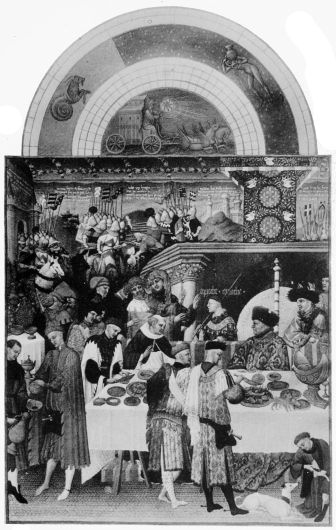
Photo. Giraudon.
JANUARY Pol de Limbourg. From The “Très Riches Heures du Duc de Berry.”
To face page 154.
THE leading part taken by French Art in the twelfth and thirteenth centuries was not continued in the same degree during the fourteenth and fifteenth. Nevertheless records have survived which afford sufficient information whence we may conclude that France was at that period not as entirely unproductive as has been hitherto supposed. It is true that, owing to the fact that the wall-decorations in the Hôtel St. Paul, the old Louvre, and the Hôtel de Savoisie in Paris, of the châteaux of Bicêtre and Vaudreuil in Normandy, and of the castles of the Comtesse d’Artois, have been almost entirely destroyed or demolished by fire, siege or climate, native works of art of that period have become extremely rare. Still those few which remain, such as the diptych belonging to the Earl of Pembroke at Wilton,[30] the Parement de Narbonne, now in the Louvre, the wall-paintings in the Cathedral at Cahors and in the Church of Saint-Savin at Poitiers, etc., testify amply to the importance of the work of that period. Moreover, the miniatures of that period have not shared the disastrous vicissitudes of the larger works. Thus the illuminated MSS. preserved at Chantilly offer a special interest and are of an almost unique value in the general history of Art.
By a fortunate chance an Inventory has come down to us, compiled in 1416, immediately after the death of the Duc de Berry, brother of King Charles V of France. This document contains a catalogue of all the art-treasures in his possession; but hardly any names of artists are mentioned except those of Pol Limbourg and his brothers. Among the entries the following is worth quoting: “Plusiers cayers d’une Très Riches Heures qui faisoient Pol et ses frères, très richement historiez et enluminez”—a note which refers without a doubt to the MS. of Les Très Riches Heures now at Chantilly. Another document of no less importance is one drawn up by François Robertet, Secretary to the Duc de Bourbon, which informs us that several of the miniatures in the MS. of Josephus’ Antiquities are by Jehan Fouquet, Court-Painter to Louis XI. Thus it has been possible to identify the authentic work of the Limbourgs and of Fouquet, some of the finest examples of which are to be found in the Musée Condé.
Unfortunately these flashes of light are very rare; and absence of record is no doubt one of the chief reasons why French paintings of this period were so little known and appreciated in France, and why the valuable collection bequeathed by Robert Gaignières to Louis XIV was but little valued by that monarch. Trusting to the advice of the ignorant critics of the time His Majesty reckoned them as of no importance and did not consider the collection worthy of a place in the Louvre; so that eventually, in 1717, it was scattered by public auction under the directions of the painter de Troy.
Thus it happened that, whilst France was acquiring valuable antiques and important examples of the art of the Italian Renaissance, she was unable to estimate or retain the art which had sprung up on her own soil. To cite one example only: Fouquet’s diptych from Melun has been lost to France for ever, one portion of it being at Antwerp, another at Berlin, whilst the beautiful enamelled frame has disappeared altogether.
Fortunately, however, connoisseurs like Reiset and Mariette arose, who bequeathed French fifteenth and sixteenth century pictures to the Louvre; and later still this remarkable legacy from the Duc d’Aumale restored to France some of her own most valuable treasures. By means of these acquisitions this patriotic Prince has constructed a monument to French Art which is as interesting as it is unique.
Plate XXVIII.
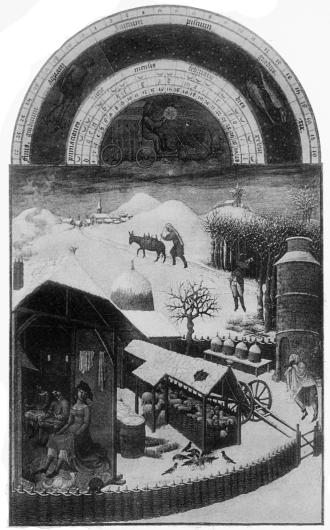
Photo. Giraudon.
FEBRUARY. Pol de Limbourg. From The “Très Riches Heures du Duc de Berry.”
To face page 156.
The Cabinet des Livres at Chantilly, still just as it was when occupied by the Duc d’Aumale, with his chair, his writing-table, his reading-lamp and half-burnt candle, contains no less than fourteen thousand manuscripts of the very highest importance. The most noteworthy amongst these are: the first ten books of St. Augustine’s Cité de Dieu (translated by Raoul de Presles); Aristotle’s Ethics (translated by Nicolas Oresmes); Livy’s Second Decade (translated by Pierre Bersuire); all of which at one time belonged to the Duc de Berry. Then there is the third volume of the Gallic War, a free translation of the Commentaries of Cæsar,[31] on the last page of which is the following inscription: Albertus Pichius, auxilio Godofredi pictoris Batavi faciebat praecipiete Francisco Molinio mense novembris anno quinquimillesimo vigesimo; whence we derive information regarding the date of its completion, the names of the artists who were entrusted with it and even the name of the man who commissioned it on behalf of Francis I.
Most interesting are a selection of the Table Ronde used by Gaston Paris in Vol. XXX of the Histoire littéraire de la France and a copy of Dante’s Inferno with a Commentary by Guido of Pisa. Furthermore a French translation of Cicero’s Rhetorics written in 1282 by Master Jean d’Antioch and commissioned by a monk called Guillaume de Saint-Etienne of the Order of St. John of Jerusalem: a MS. which throws interesting light on still more ancient translations and is ornamented with fine old miniatures; a French translation of Valere Maxime (in two volumes), which belonged to the Cardinal George d’Amboise; a translation of Diodorus Siculus, with a frontispiece representing King Francis and his Court; and an illuminated manuscript, known to have been the Book of Hours of Anne de Montmorency, offer more than ordinary interest. This last belongs to the sixteenth century and contains miniatures in the style of Jean Cousin.
Next comes a Legenda Aurea, which once belonged to Charles V of France and which in its time has travelled back and forth between England and France (as was so often the case with old books and manuscripts); for on the last page we read in an unknown hand:
And yf my pen were better Better shuld be my letter.
Plate XXIX.
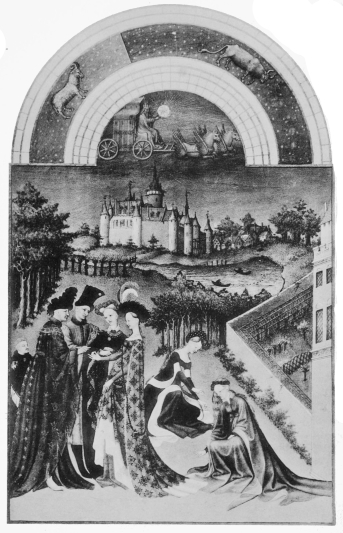
Photo. Giraudon.
APRIL. Pol de Limbourg. From The “Très Riches Heures du Duc de Berry.”
To face page 158.
Other extremely important MSS. acquired by the Duke himself are the MS. de la Coche de Marguerite d’Angoulême and the Psalter of Queen Ingeburge, of which the Duke was particularly proud. It commences with a Calendar, followed by a series of paintings on gold backgrounds representing scenes from the Old and New Testaments, and dates from the thirteenth century. It belonged to Queen Ingeburge, the unhappy and neglected wife of Philippe Auguste and in it are entered the names of her father, Waldemar the Great, King of Denmark, of her mother, Queen Sophia, and of the Comtesse Eleanore de Vermandois, her faithful friend during long years of trial, thus proving unquestionably her ownership of this precious volume. She has, moreover, entered in it the date 1214, the year in which she was recognised as Queen of France. On the last page appears the following entry: “Ce psaultier fut de Saint Loys,” showing that the MS. subsequently came into the possession of St. Louis, King of France, himself. In Charles V’s Inventory, dated 1380, it is described as “mon gros psaultier, nommé le Psaultier St. Loys, très richement enlumyne d’or et d’ancien ymages,” and we learn that in 1428 it was preserved in the Château of Vincennes. From that time, however, it disappeared for nearly two hundred years until it was found in England by Pierre de Bellièvre, who secured it and presented it in 1649 to Henri de Mesmes. The miniatures are similar in style to those found in English MSS. of the thirteenth century; the colours are luminous, black and blue being predominant, and the whole work is painted on a gold ground. The initial letters and the decorative caligraphy show skilful technique and were evidently designed at the period of which Dante speaks as “L’onor di quell’arte ch’alluminare è chiamata in Parisi.”[32] It is very probable that this Psalter of Queen Ingeburge[33] served as the model for many other illuminated manuscripts.
Another noteworthy royal MS. acquired by the Duc d’Aumale which is of special importance is the Breviary of Jeanne d’Evreux. Amid the delicate decorations of the border around the illuminated text may be seen the coats-of-arms of France, Navarre, and Evreux; and it contains no less than one hundred and fourteen miniatures in grisaille upon coloured and gold backgrounds. The Gothic attitudes and graceful figures recall the style of Jean Pucelle, which, dating from the years 1327-1350, had been introduced into Paris before the coming of Northern realism.
Jeanne d’Evreux, wife of Charles IV, was well known as a connoisseur in illuminated books, and this exquisite work of art passed to Charles V, by whom it was kept at Vincennes in a coffer along with the Breviary of Belleville.
The small Book of Hours belonging to M. Maurice de Rothschild (published in facsimile by Count Delisle), the Missal of St. Denis in the Victoria and Albert Museum, the Book of Hours designed for Jeanne de France, Queen of Navarre, in the Yates Thomson Collection, form a group of beautiful codices which have rightly been compared with this MS. of Queen Jeanne d’Evreux.
Plate XXX.
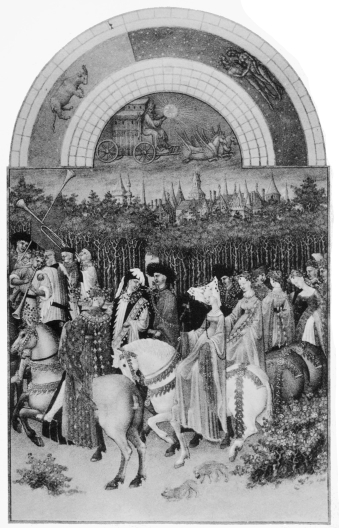
Photo. Giraudon.
MAY. Pol de Limbourg. From The “Très Riches Heures du Duc de Berry.”
To face page 160.
The greatest gem, however, of all these illuminated MSS. is unquestionably the precious volume known as Les Très Riches Heures of the Duc de Berry. The Duc d’Aumale himself relates the history of its acquisition in 1855. On his way to visit his mother Queen Marie Amélie, then lying ill at Nervi, he visited the Villa Pallavicini at Pegli, near Genoa—at that time a boarding-school for young ladies—in order to examine a MS. to which his attention had been drawn by Sir Antonio Panizzi, Principal Librarian of the British Museum. Without any hesitation he arranged on the spot to purchase the work of art for a sum of 18,000 francs. On his return to Twickenham (where he was then residing), the Duchess herself carefully unfolded the newly acquired treasure from its “cassetta foderato di velluto” and every connoisseur of note at once hastened to examine the wonderful MS. which the Duke had been so fortunate as to acquire. As early as 1857 Waagen wrote about it with much detail; later Count de Laborde, Anatol Gruyer, and Leopold Delisle followed; and recently, and more exhaustively, Paul Durrieu also. But it was Delisle who made the important discovery that the Très Riches Heures could be identified with the MS. described in the Inventory of the Duc de Berry: “Item une layette plusiers cayers d’une ‘Très Riches Heures’ que faisoient Pol et ses frères, très richement historiez et enluminez.” The same writer also discovered that these leaflets were valued at 500 livres tournois (about 20,000 francs), a very large price for that time, and one which showed the high value in which this manuscript was held even at that date.
The death of the Duc de Berry brought these precious pages, begun under such brilliant auspices, to a sudden standstill; and in consequence of that prince’s debts—which arose chiefly from his expensive artistic tastes—a sale of his property immediately took place. The Duc de Bourbon and the Comte d’Armagnac (the husbands of his two daughters and co-heiresses) were making war upon one another on account of the murder of the Duc d’Orléans by Jean Sans Peur—a war known in history as the War of the Armagnacs and the Burgundians. Amid these disturbances there was scarcely time to think of illuminated MSS.; for which reason the work of Pol de Limbourg and his brothers was suspended, and was not resumed until the year 1454, long after their death—unfortunately by a far inferior hand—that of Jean de Colombe. By that time the volume had come into the possession of Charles of Savoy and his wife Blanche of Monferrat. It is not difficult to explain how this Breviary came into the House of Savoy—a fact which is proved by the armorial bearings and two miniature portraits of Charles—because both husband and wife were descendants in direct line from Bonne de Berry (one of the daughters of the Duc de Berry), who had first been married to a Count of Savoy. In 1501 the MS. passed to Margaret of Austria, wife of Philibert of Savoy, a Royal patroness of the Arts who corresponded with Jean Perréal regarding the tomb of her husband in the church at Brou. By her this MS. was provided with a velvet cover and a silver padlock; and she no doubt took it to Flanders with her after her husband’s death.
Plate XXXI.
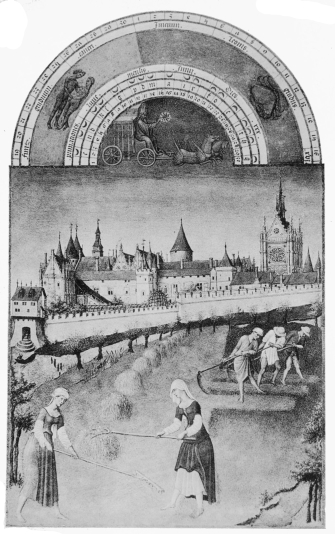
Photo. Giraudon.
JUNE. Pol de Limbourg. From The “Très Riches Heures du Duc de Berry.”
To face page 162.
Comte Paul Durrieu identifies the Très Riches Heures with a MS. mentioned also in an Inventory of 1523 as “une grande heure escripte à la main,” whereby it can be explained how the Grimani Breviary,[34] executed about the end of the sixteenth century, and other Flemish MSS. have obviously taken this famous Codex as a model; and even in some points copied it very closely.
When Margaret of Austria died in 1530 the volume passed into the hands of one of her executors, Jean Buffant, Treasurer to the Emperor Charles V; and from that time there occurs a gap which even Paul Durrieu has so far been unable to fill. The present binding of red morocco leather belongs to the eighteenth century and bears the coat-of-arms of the Spinola family, which points strongly to the probability that the volume also once belonged to the celebrated General Spinola, who captured the town of Breda—an historical event immortalised by Velasquez. From the Spinolas it came into the family of the Sèvres, a fact proved by another coat-of-arms amongst the illuminations; and from a member of that family it was acquired by the Duc d’Aumale, by whom it was deposited at Chantilly.
From this amazing list of MSS. we may see that nearly all the important books and manuscripts of the fifteenth and sixteenth centuries are represented at Chantilly. Some portions of the collection go back to the old Montmorency and Condé acquisitions; whilst the Duc d’Aumale himself has described the origin and vicissitudes of the articles gathered in by himself in his admirable work The Philobiblon Miscellanies, which will always remain the best guide to the Cabinet des Livres at Chantilly.
Plate XXXII.
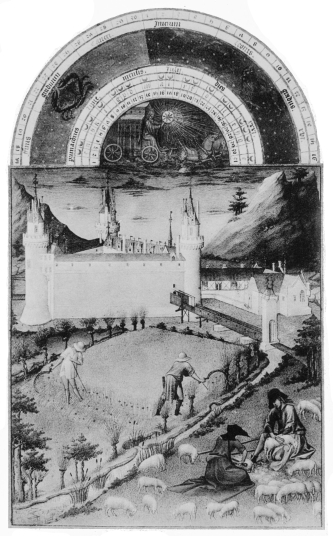
Photo. Giraudon.
JULY. Pol de Limbourg. From The “Très Riches Heures du Duc de Berry.”
To face page 164.