Chapter XVI · JEAN CLOUET
Reading edition
THE veil of oblivion which so undeservedly fell upon Perréal is gradually lifted as we approach the period of Jean Clouet. Even if we except some drawings which we are bound to assign to an earlier period there still remain a great number which, judging by the age and style of costume of the characters represented, must necessarily be reckoned as falling within his period and may be reasonably attributed to him. Mention is made of no less than four persons bearing the surname of Clouet: Jean the grandfather, who painted for the Duke of Burgundy at Brussels about 1485; Jean Clouet, Court-Painter to Francis I; and his two sons—Clouet of Navarre[88] and François, who brought to its zenith the art of drawing in sixteenth-century France.
Plate LIV.

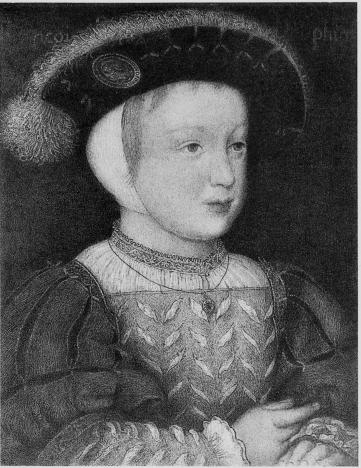
THE DAUPHIN FRANCOIS, ELDEST SON OF FRANCIS I. Antwerp Museum.
To face page 212.
Jean Clouet,[89] also known as Jeannet, migrated to France and settled at Tours, where he presently married Jeanne Boucault, the daughter of a goldsmith. He first appears in the Royal Accounts in 1516 as receiving 160 livres per annum—a sum which, on the death of Bourdichon in 1522, was increased to 240 livres. Subsequently we find special references to several portraits by him, taken from life[90] which the King was so anxious to see that he sent for them by “diligence and post-horses.” Again we read further on that his wife, Jeanne, travelled expressly from Paris[91] to Fontainebleau in order to convey to His Majesty portraits done by her husband: “Pour apporter et monstrer au dict seigneur aucuns ouvrages du dict Jeannet.” After the death of Perréal in 1528 Jean Clouet remained practically without a rival. Only one artist—a certain Jean Champion who seems to have been in receipt of a very small salary—is mentioned besides him; but none of this man’s work is actually recorded. Amongst the numerous works attributed to Jean Clouet absolute certainty may be given to a portrait of Oronce Finé, which, however, has only come down to us through a mediocre engraving in Thevet’s series of Hommes Illustres. Thevet speaks of this portrait as an authentic work by Jean Clouet on the authority of the mathematician’s own son but it is not easy to judge fairly the work of any artist by an engraving. We can, however, gather enough from it to justify us in concluding that Jean Clouet’s craftsmanship was of a more elaborate nature than that which may be observed in the portraits of the Preux de-Marignan. The portrait of Oronce Finé, for example, bears far more resemblance to that of Duc Claude de Guise,[92] of which there is a drawing at Chantilly and a coloured copy in the Pitti Gallery at Florence, both executed at about the same time. Then again there is at Hampton Court an excellent portrait of an Unknown Man holding a volume of Petrarch, which is attributed to Jean Clouet. The original drawing for this somewhat later and more artistic piece of work is also at Chantilly. Another drawing likewise at Chantilly (a capital example of the artist’s methods) represents Francis I after his reverses at Pavia, wherein His Majesty has lost that expression of youthful buoyancy so conspicuous in the oil-painting in the same collection. He wears his cap adorned with a white plume no longer close-set as formerly and straight on his forehead, but according to the fashion of the day with the hair projecting from underneath it and slightly tilted to the left. His beard has also been allowed to grow, in order, it is said, to hide a scar on his cheek. This drawing was unquestionably taken from life, and was used for the portrait in oils now in the Louvre; which serves to prove how much care and diligence Jean Clouet expended upon his portraits. Just as a sculptor uses the clay for his models, so with equal faithfulness the artist made his drawings serve for his final portraits in a heavier medium. This small painting,[93] now recognised as an original work, is infinitely superior to the larger portrait,[94] also in the Louvre, although both have evidently been copied from one and the same drawing. Both portraits were formerly at Fontainebleau, where tradition had always assigned them to Jean Clouet. This likeness of King Francis seems to have been a very favourite one for we find numerous copies of it: for example, in the Méjanés Collection at Aix; in the Recueil Marriette; and in the Recueil d’Orange in England.[95] There are no less than eight copies of it in St. Petersburg, and the one in Florence is said to have been made by Queen Catherine herself. A later portrait of this King, likewise at Chantilly, represents him in middle age, when years had already begun to tell upon him and the lines of his face had become heavy and drawn. The original drawing for this—perhaps also by Jean Clouet—is lost, but a copy survives in the Recueil Lenoir. A miniature in oil at Florence, in which the King is represented on horseback, seems to have been designed from this drawing; whilst another similar miniature in the Louvre (Collection Sauvageot) is generally considered to be the work of François Clouet, who had at that time just begun his artistic career under his father’s direction. This is probably the last likeness of Francis designed by Jean Clouet. It appears to have been painted in 1539 and may be regarded as the official portrait of this King. It is certainly vastly superior to another even later portrait, of which there is a copy in the Louvre and a miniature in the Recueil du Tillet (Bibliothèque Nationale), where His Majesty is shown to have greatly increased in girth. Another similar miniature is in the ante-room at Chantilly, the King being again represented on horseback after a fashion affected by the succeeding Valois Kings; and the same original reappears in the Book of Hours of Catherine de Medicis, where Francis figures as King David; appearing to be older than he really was, for he was but fifty-three when he died. Both Thevet in his Hommes Illustres and Gautier in his Kings of France reproduce this same portrait.
Plate LV.
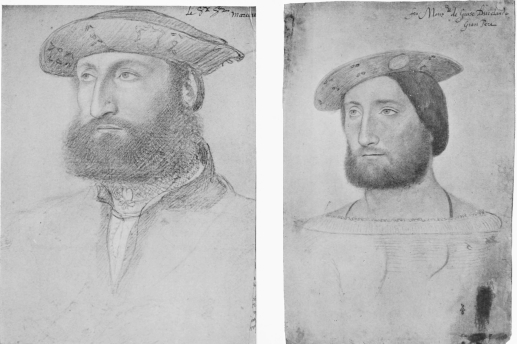
MONSIEUR DE NEVERS. DUC DE GUISE. Musée Condé. Jean Clouet.
The likeness of Francis I at Hampton Court, though painted by some mediocre copyist, has a special interest, inasmuch as it once belonged to Henry VIII of England. This portrait is reproduced in pencil in the Recueil d’Arras, and another, though superior, presentation of this same King in the Tribune at Chantilly seems to be of the same type. The King is here shown in profile, a treatment copied repeatedly by Limousin, an example being in the Gallerie d’Apollon at the Louvre, where he is seen kneeling beside Queen Claude. The latest portrait of all of this monarch is a drawing at Chantilly taken full face, which seems to have been made as a post-mortem effigy, such as, according to the Royal Accounts, François Clouet was commissioned to make. This again is only a copy; so that of these many and varied types of portrait few only can claim to be the original work of Jean Clouet. In this connection we should like to mention an exquisite drawing recently acquired by the British Museum which represents Marguerite d’Angoulême, sister of King Francis, in the bloom of her youth.[96]
Portraits of Queen Claude[97] are as rare as those of her royal husband are numerous. There is a slight drawing at Chantilly representing the daughter of Louis XII: presumably taken soon after her marriage to the heir to the French throne (which under the Salic Law she could not ascend herself). This marriage took place after the death of her mother, Anne de Bretagne, whose dearest wish it had been that she should marry Charles V, a suitor to whom she had been affianced in infancy. According to Brantôme the shrewd Queen Anne foresaw that her timid little daughter could not have a particularly happy life between so fickle a husband as Francis and so ambitious a mother-in-law as Louise of Savoy; but King Louis thought otherwise and sacrificed his daughter to his patriotism. This drawing, albeit very slight, is not without considerable charm. It dates probably from the same period as the portrait of the young King at Chantilly and may perhaps be attributed to the same artist. It is nothing like so elaborately finished as the drawing of Queen Claude’s sister Renée, which in craftsmanship recalls the drawing of Duc Claude de Guise in the Musée Condé. Another far more finished and far more elaborate drawing, now in Florence, represents Queen Claude some ten years later as Queen-Mother; and it bears upon it marginal notes in no less august a hand than that of Catherine de Medicis herself, which enhances its importance. Apparently this too is a copy of one of Jean Clouet’s lost originals.
Plate LVI.
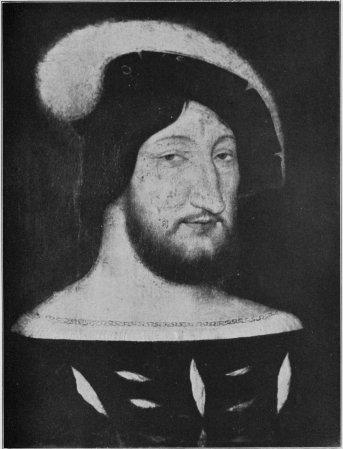
Photo. Giraudon.
FRANCIS I. Louvre. Jean Clouet.
The next drawings of interest by this artist in the portfolios at Chantilly are likenesses of the two Dauphins of France[98] and of the other Royal Children: a portrait of the Dauphin François, which was repeated in colours in an exquisite little panel now at Antwerp,[99] with the slight difference that the Royal Child has exchanged his simple cap for a plumed hat; and likenesses of Monsieur d’Orléans (afterwards the Dauphin Henri), and of the third son, Charles, so great a favourite with his aunt Marguerite. This latter Prince had the good fortune to be kept at home when his two elder brothers were given as hostages to the Emperor Charles V after the disastrous defeat at Pavia to be subjected by him to four years of most inhuman imprisonment. Bodin, who was sent by their Royal Father to attend upon his unfortunate sons, relates that he found them in a dark chamber seated upon small wooden chairs. The hardest of straw mattresses were provided for them, and they were not allowed to wear the plumed caps which he brought for them, for fear that by some exercise of necromancy they might perhaps contrive to fly away! According to Brantôme, the poor Dauphin had almost forgotten his native French, so that his younger brother had to assist him in making himself understood. The charming sketch at Chantilly of the Dauphin François wearing a plumed hat was evidently made after his safe return to France.
Plate LVII.
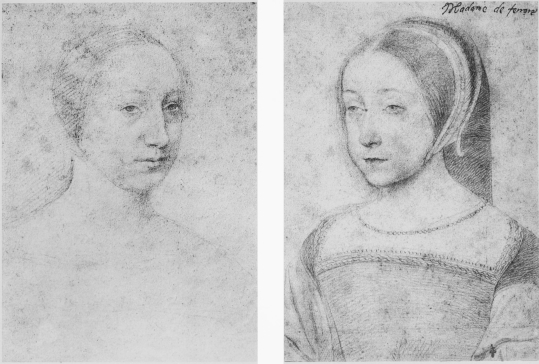
Photo. Giraudon.
QUEEN CLAUDE OF FRANCE. RENEE OF FRANCE, DUCHESS OF FERRARA. Attributed to J. Perréal. About 1515. Attributed to Jean Clouet. Musée Condé.
To face page 21.
A slight sketch shows Madeleine de Valois as a child. This princess was married at the age of seventeen to King James V of Scotland; and she is said to have been so delighted at the prospect of becoming a Queen that she soon consoled herself for having to leave la douce France for so rigorous a climate. She was, however, extremely delicate and died six months later, to the unbounded grief of her husband, who for years could not be persuaded to remarry. Princess Marguerite, on hearing of her elder sister’s untimely death, shut herself up in her own apartments and refused food to the great injury of her health; and it was only by the urgent persuasions of her aunt Marguerite d’Angoulême that she was induced to resume her morning walks in the gardens of Fontainebleau and so by degrees to recover. A variety of drawings at Chantilly present this young princess at different periods of her life; and in the earlier of these, as in the portraits of her sister and two brothers, we can trace the handiwork of Jean Clouet. A painted portrait of her (which formerly belonged to Gaignières) in the Tribune at Chantilly, is attributed to Corneille de Lyon, and on the margin is written “Marg. de France, Duchesse de Berry.” She is represented with auburn hair and blue eyes like her brother the Dauphin, whose portrait hangs in the same room. The words “Corneille fecit” are written on the back of the frame by Gaignières himself, who in so doing settled its authorship. Whilst the Dauphin seems in his portrait to be but eighteen years of age his sister Marguerite looks thirty, so that we may conclude that she sat at a much later period. The numerous drawings that François Clouet made of this Princess[100] reveal that amiable disposition so much praised by Brantôme. He speaks of her as “la bonté du monde, charitable, magnifique, liberale, sage, vertueuse, si accostayle et douce que rien plus.” She remained unmarried until she had reached the age of thirty-six, because she declined (it is said) to marry one of her brother’s subjects and yet did not wish to leave her beloved France. When quite young she had accompanied her aunt Marguerite to Nice, where she fixed her choice upon the heir of the House of Savoy, to whom after twenty-one years’ interval she was, when adverse political complications had finally passed away, eventually united.
She was meanwhile much admired at the French Court for her learning. A Latin and Greek scholar of merit, she studied Aristotle’s Ethics and is reported to have sent to Paris for at least three different editions of Cicero. She had no special gift in the use of the pen like her versatile aunt,[101] the authoress of the Heptameron, although she occupied her mind with continual study and much careful reading. She patronised the poet Du Bellay, who translated for her Bembo and Naugerius and she induced him to assert that no century would ever extinguish the memory of Boccaccio and Petrarch. Moreover, she attracted to the French Court Baccio del Bene, of whom Ronsard said that he was the only Italian author worthy of earnest consideration at this period. Her learning acquired for her the sobriquet of “Pallas”; her emblem was an olive-branch; and she was looked upon as the symbol of Platonism in its highest form. Her father, King Francis, paid but little attention to her; but her brother, Henri II, loved and esteemed her greatly and when she married ordered for her adornment magnificent robes, costly lace and jewels, and organised great festivities. It was on the occasion of these nuptials, however, that the terrible tragedy occurred which brought about His Majesty’s death. Like her aunt Rénée at Ferrara Marguerite[102] in her home in Piedmont never ceased to long for her “sweet France”; and every Frenchman who passed through Turin, on presenting himself at her Court, was warmly welcomed and munificently entertained. With her enlightened views she was able to act as mediator in the religious differences which raged so violently in France during the sixteenth century, and which extended into the country of her adoption; and she protected, as far as she was able, the persecuted Waldenses. The last years of her life were devoted chiefly to the education of her son, Charles Emmanuel of Savoy; and Michel de l’Hôpital declared that this Prince owed the success of his career entirely to her. The French Ambassador at Constantinople left to her his entire fortune, and the poet Du Bellay on his death-bed wept bitterly because he was unable to take a last farewell of her. When she herself died there perished with her all that was best in the spirit of the neo-Platonism initiated by her aunt, the first Marguerite; so that it presently fell entirely to pieces under the influence of the third Marguerite, youngest daughter of Catherine de Medicis.
Plate LVIII.
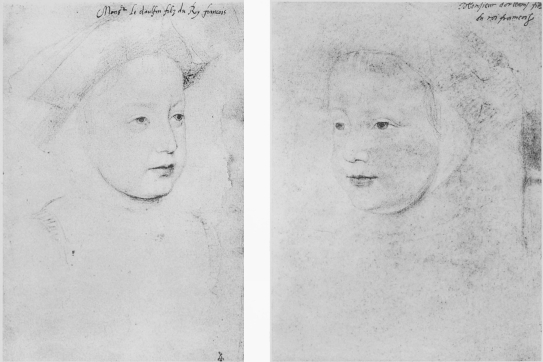
Photo. Giraudon.
THE DAUPHIN FRANCOIS, ELDEST SON OF FRANCIS I. Jean Clouet. HENRI D’ORLEANS, AFTERWARDS HENRI II. Attributed to Jean Clouet.
Musée Condé.
To face page 220.
A likeness of Rénée de France[103] which bears some affinity to the portrait of her sister Queen Claude is also to be found at Chantilly. It represents her at the time of her marriage to Ercole, Duke of Ferrara, son of Lucrezia Borgia: nuptials which were celebrated in the Sainte Chapelle at Paris. Like the other French princesses of her day she was extremely intelligent and studious, and during her time the Court of Ferrara became renowned as an intellectual centre to which French visitors were always warmly welcomed. To the complaints of her Italian courtiers that she spent too much money upon her compatriots she replied, “Que voulez-vous? Ces sont pauvres Français de ma nation lesquelles si Dieu m’eut donné barbe au menton, et que je fusse homme, seraient maintenant tous mes sujets, et si cette méchante loi Salique ne me tenait trop de rigueur.” Rénée was a strong adherent of the Reformed Faith and welcomed Calvin to her Court, thereby giving serious annoyance to her husband, the Duke, whose policy it was to keep on good terms with the Pope. The poor Duchess therefore presently found herself compelled to part with all her French ladies-in-waiting on account of their Protestant views. Furthermore, her brother-in-law, Cardinal Ippolito d’Este, was sent to the French Court to discuss these matters with the King, upon which occasion those two connoisseurs and patrons of Art became fast friends.[104]
After the death of her husband the Dowager Duchess was exiled by her son, Alfonso, to Montargis,[105] and there she was visited by the Cardinal—who, in spite of her heretical leanings, had never ceased to be on good terms with her. According to Brantôme she here provided shelter and food for 300 Huguenots who had been despoiled of their goods; and she even went so far as to remonstrate with her son-in-law, François de Guise, for his cruel treatment of the Prince de Condé; saying that “whoever had advised the King to take this course of action had done a great wrong.” Notwithstanding her Calvinistic views she was always reckoned by the Royal Family as a true Daughter of France and was held in high honour by them. Her portraits, like those of her sister Queen Claude, are extremely rare.
Plate LIX.
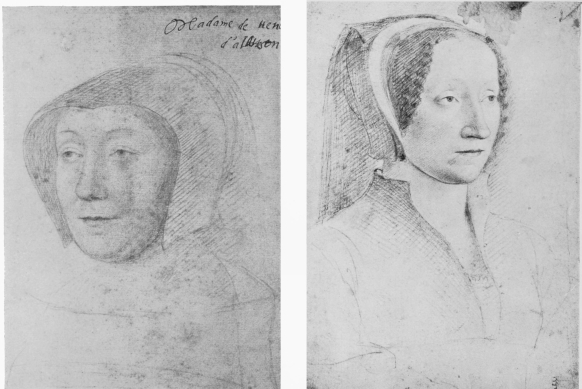
MADAME DE VENDÔME D’ALENÇON. JEANNE BOUCAULT.
Photo. Giraudon.
Jean Clouet. Musée Condé.
Besides the portraits of the Valois princes and princesses at Chantilly there are a great number of likenesses of other interesting historical personages. It would, however, lead us too far afield were we to attempt to enumerate them all. Amongst them, however, the most remarkable are as follows: Madame Vendôme d’Alençon,[106] mother of Antoine de Bourbon and of Louis I Prince de Condé (a drawing on a larger scale than most of the others); of the same size, Madame l’Estrange,[107] a lady renowned for her beauty and greatly beloved by the Dauphin François; Henri d’Albret, King of Navarre; Chandus, one of King Francis’ most faithful officers; and various portraits of Unknown Young Men. All these are excellently drawn, may be assigned to Jean Clouet and are evidently taken from life. In some of the portraits we can detect a point of transition between the joint work of father and son: for example, in a drawing representing Louis de Nevers,[108] son of a Princesse de Bourbon and related to the Princes of the House of Cleves. This drawing is incorrectly designated Saint Marsault; but a copy supplies the right name. There is a copy of it in colours in the Lochis Collection at Bergamo, which long passed under the name of Holbein until Dr. G. Frizzoni assigned it to François Clouet, who evidently executed it from the drawing at Chantilly. In this same connection may be mentioned the Sieur de Canaples,[109] and the portrait of an Unknown Lady of singular force of expression, very plainly clad and without ornaments, who may perhaps be Jeanne Boucault[110] of Tours, Jean Clouet’s own clever and devoted wife.
Plate LX.
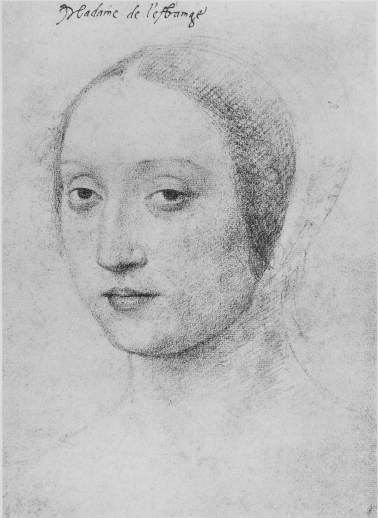
Photo. Giraudon.
MADAME L’ESTRANGE. Attributed to Jean Clouet. About 1535. Musée Condé.
To face page 224.
Before we take leave of Jean Clouet and pass on to his brilliant son attention should be called to a fascinating portrait of a young girl inscribed “la reine Jehanne de Navarre petite,”[111] which, on account of its excellence, might well be attributed to the master himself. In this instance history comes to our aid, for we are informed that Princesse Jeanne (known as “la mignonne de deux rois” on account of the marked affection shown to her by both King Francis, her uncle, and King Henry of Navarre, her father) was in her fourth year removed from the charge of her own parents and transported to Plessis-le-Tours, a château on the Loire; where there was provided for her a suite consisting of a lady-in-waiting, a master of the horse, two chaplains and other attendants. The reason for this strange arrangement was political, inasmuch as Francis feared that Henry of Navarre would negotiate a marriage between this child and Philip of Spain, eldest son of Charles V. In vain the little Princess wept and implored her Royal uncle to allow her to rejoin her mother. Her wish was not to be granted until she had reached her twelfth year, and then only on condition that she should be betrothed at once to the Duke of Cleves, whose sister Anne was wife of King Henry VIII of England—a political scheme to unite the Protestant Princes of Germany and England against the Emperor Charles V. It was probably at the moment when the Princess was about to leave the lonely château on the Loire that Francis commissioned Jean Clouet to secure for him a likeness of his niece before her departure for Béarn. Jeanne, who was born at Fontainebleau in 1528, appears here to be about twelve years of age; so that the drawing may perhaps have been executed in 1539-40, and, since it was one of the artist’s last works it gains greatly in interest.
That François Clouet succeeded his father as Court-Painter in 1541 is proved by a document in the “Trésor des Chartres” which runs as follows: “François par la grace de Dieu, roy de France, etc.... Savoir faisons ... que voulant reconnoistre envers nostre cher et bien aimé painctre et varlet de chambre ordinaire, François Clouet les bons et agréables services que feu Me Jehannet Clouet, son père, aussi de son vivant nostre painctre et varlet de chambre, nous a durant son vivant faictz en son dict estat et art, auquel il estoit très expert et en quoy son dict fils la jà très bien imité, et espérons qu’il fera et continuera encores de bien en mieux cy après, a icelluy, François Clouet pour ces causes et affin que de ce faire il ayt meilleure voullonté, moïen et occasion, avons donné, octroïé, cedé et délaissé, tous et chacuns les biens meubles et immeubles qui furent et appartendrent au dict Me Jehannet Clouet, son père, à nous advenuy et escheuz, adjugez et declarez appartenir par droit d’aubène au moïen de ce que le dict deffunt estait estranger et non natif ne originaire des nostre royaume et n’avoit obtenu de nos predecesseurs roys ny de nous aucunes lettres de naturalité et congié de tester” (published by E. de Freville, Arch. de l’art Français, t. iii, p. 98).
From the above document we learn the following important facts, namely: (a) that Jean Clouet was not of French origin; (b) that he was highly esteemed by the King; and (c) that after his death François Clouet, his son, inherited all his privileges and favours.
Plate LXI.
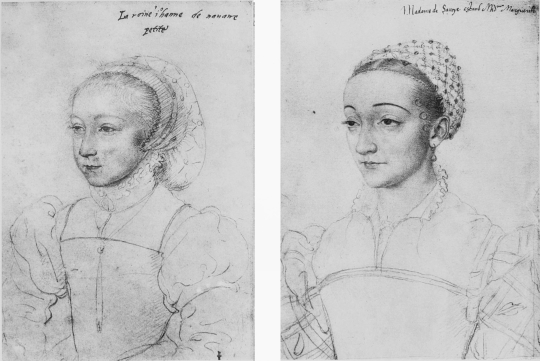
Photo. Giraudon.
JEANNE D’ALBRET, WHEN A CHILD. MADAME MARGUERITE, SISTER OF HENRI II. Attributed to Jean Clouet. Attributed to François Clouet. Musée Condé.
To face page 226.