Chapter XVII · FRANÇOIS CLOUET AND HIS FOLLOWERS
Reading edition
FRANCIS I, King of France, survived Jean Clouet but a few years, so that the artistic career of his celebrated son, François, chiefly developed during the reigns of Henri II, Francis II and Charles IX.
It is difficult to determine what effect Jean Clouet’s death had upon his son, but we are led to suppose that at first he continued closely to adhere to parental teaching. Indeed from 1540 to 1545 it is scarcely possible to discern any of those differences of style so conspicuous a decade later.
Two female portraits, still existing, seem to give weight to this argument. These likenesses, although in the style of the elder Clouet, from the age and the attire of the sitters can only have been drawn during the years 1544-5, by which date that artist had already vanished from the scenes and his son was at work alone.
These drawings represent Jossine Pisseleu[112] (niece of the famous Duchesse d’Estampe), better known under the name of “Hegli,” and the beautiful daughter of Diane de Poitiers, called “Brasseu.”[113] Both of these portraits are rendered specially interesting by the fact that their respective names are written on the margin by Queen Catherine de Medicis. These two ladies, Hegli and Brasseu, are known to have belonged to that gay company known as la petite bande, of which the young Catherine herself, when Dauphine, was also a member.
Francis I, thanks to his own great taste for Art, comprehended to the full the different talents of the artists in his employ; and whilst he commissioned Rosso and Primaticcio to execute the frescoes at Fontainebleau, the two Clouets were successively entrusted with such portrait painting as he required.
At Chantilly there is an exquisite portrait of Louise de Clermont, Duchesse d’Uzez, another of the fair members of the petite bande whom the King nicknamed “la Grenouille” on account of her husky voice and projecting eyes: a drawing which belongs to the same series already referred to; that is to say, an early work with which François Clouet was commissioned after his father’s demise. A miniature taken from this drawing is preserved in the Louvre.
Plate LXII.

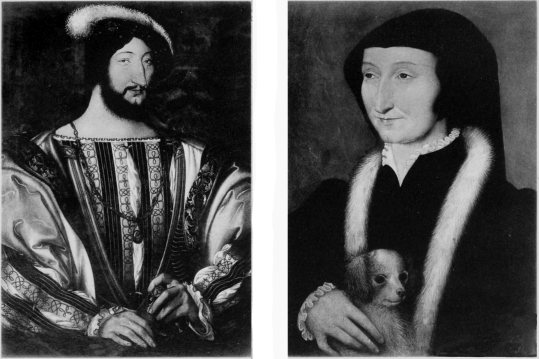
Photo. Hanfstaengl.
Photo. Giraudon.
Francis I. Attributed to Jean Clouet. Louvre. Marguerite of Angoulême. (Sister of Francis I. and Queen of Navarre). Attributed to François Clouet. Musée Condé.
Henri II, whilst Dauphin, had apparently not much chance to employ either of the Clouets, since their time was almost entirely monopolised by the King; but there is evidence to prove that Catherine de Medicis’ children were repeatedly painted by Germain le Mannier[114] and his brother Alois. There exist pencil sketches of Francis II at the age of five, and again at eight years and five months; to which latter there is a pendant representing his fiancée, Mary, Queen of Scots, at the age of nine and a half. There is another of Charles IX aged between four and five years. All of these were executed by this artist and are now in the portfolios at Chantilly.
With reference to these drawings there is a letter still extant, written on June 1 1552 by Queen Catherine to M. Humières (who with his wife were in charge of the Royal nurseries at Saint-Germain-en-Laye), in which she expresses a desire to have all her children, sons and daughters, including la Royne d’Ecosse,[115] painted “sans rien oublier de leur visages.” There is also a letter from Henri II, written on the eve of his accession, expressing a desire to recompense the painter Mannier.
This, however, did not prevent him, as soon as he became King, from taking up François Clouet, whom he commissioned not only to make a post-mortem effigy of the late King, but also to prepare an official representation of himself. His own portrait bears a note upon it, apparently in the artist’s own handwriting, “Le Roy Henry 2”[116]: handwriting which bears close similarity to an existing quittance signed F. Clouet. This drawing, now in the Bibliothèque Nationale at Paris, became very popular. A version completed in colours, is now in the Louvre: it was reproduced in miniature; and many copies were subsequently made by lesser hands.
Contemporary with this portrait is a powerful likeness of the Grand Connétable, Anne de Montmorency,[117] evidently taken from life. In this drawing the individuality of the artist is very marked: more realistic in his tendencies than his father, he is on that account more French. This great warrior, the Lord of Chantilly, is shown here when at the height of his fame, in high favour with the King and with l’amie du roi, Diane de Poitiers.[118] This famous lady herself sat to François Clouet, and so apparently about the same time did Catherine de Medicis, and also Jeanne d’Albret,[119] Queen of Navarre. It is interesting to compare the likeness of this latter princess, so eloquent of a noble mind and a frank disposition, with that of Catherine de Medicis, past mistress in the art of dissimulation.
Plate LXIII.
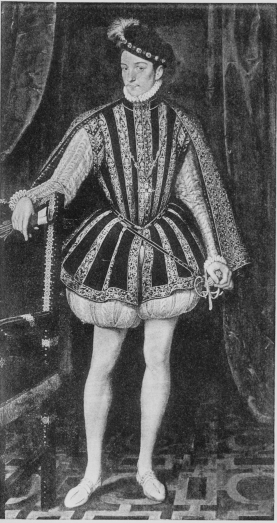
Photo. Hanfstaengl.
CHARLES IX. François Clouet. About 1569. Vienna Gallery.
To face page 230.
Drawings and portraits of Catherine as Dauphine and as Queen of France are comparatively rare. It is as a Queen-Dowager, growing old and well away on her career of dangerous intrigue, that we chiefly meet her in the Galleries of Europe. No small value can therefore be attached to the drawing in the British Museum which came to the nation through the Salting Bequest, inasmuch as it brings her before us at the period when her husband had just ascended the throne of France; and to another likeness at Chantilly, attributed to Corneille de Lyon, which is supposed to be the one executed when she passed through Lyons with Henri II in 1564. Brantôme relates that upon this occasion the great Diane de Poitiers received more homage than the Queen herself, and that portraits were drawn of all the royal ladies, amongst whom was the King’s sister Marguerite (soon to become Duchess of Savoy). The writer further tells us how Catherine, when fifteen years later she revisited Lyons as Queen-Mother, displayed much amusement at the old-fashioned attire in which she and her Court ladies had then been portrayed.
To the years between 1559 and 1570 belong the drawings in the Bibliothèque Nationale, which are considered as marking the height of this artist’s power. Such, for instance, are the portraits of Maréchal Strozzi (1567) and of Maréchal de Vielville[120] (1566), supposed to have been dated by the artist himself, a circumstance which greatly adds to their value.
We are on certain ground with regard to the genuineness of the signed and dated portrait of Charles IX now at Vienna; but, strange to say, the date has here clearly been tampered with. We can ascertain this from the fact that the young King in the portrait seems certainly only about twenty years of age, and since he was born in 1550 the date upon the picture ought to be 1569 instead of 1563. Furthermore, the original drawing (now at St. Petersburg) from which this finished painting was executed is dated 1569. There is also a miniature taken from it in the Louvre.
It would lead us too far if we were to mention all the drawings which bear the stamp of this master’s own hand, but there are some on which we ought to dwell as being examples of his finest work. Amongst these are the drawings in the Bibliothèque Nationale of the boy-King Francis II[121] and of his young and beautiful bride, Mary Stuart, Queen of Scots.
In the delicate and subtle pencil drawing of the latter, more than in all her other portraits, we can detect traces of her world-renowned beauty; and this is how she must have looked when, with her young husband beside her, and surrounded by the great dignitaries of State, she entered the Cathedral of Notre Dame for her Coronation. Clouet has succeeded in conveying to us something of the sweetness of her smile, her wistful expression, and the thoughtful look in her eyes. In the miniature at Windsor, which is said to have been reproduced from this drawing, much of the refinement has been lost, and more attention has been paid to accessories, i.e. her dress and her ornaments.[122]
Plate LXIV
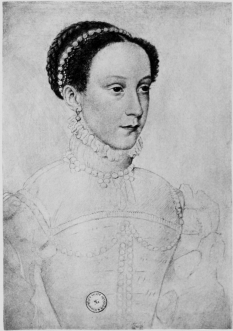
Mary Stuart as Dauphine of France From the drawing in the Bibliothèque Nationale at Paris.
A later drawing, in which the young Queen is represented in her deuil blanc as a widow, is among the framed drawings at Chantilly: a portrait probably executed by François Clouet when she was on the point of leaving her beloved France. This is apparently a reproduction from a lost original, and it found its way to Chantilly with the Lenoir Collection. It is no doubt the last likeness of Mary Stuart made in France. The charm which Clouet so deftly imparted to the portraits of this unhappy Queen seems entirely absent from all the numerous likenesses subsequently made in England by other artists. How hard and set, for instance, do her features seem in the life-size oil-painting by Oudry at Hardwick Hall. All that we can perceive in it is the only too-evident havoc wrought by fate upon that beautiful face.
François Clouet’s highest capabilities may be traced in the water-colour sketch at Chantilly which represents Margot de France,[123] youngest daughter of Catherine de Medicis, in her girlhood. It is exhibited in the Psyche Gallery and is considered one of the gems of the collection. Since correct drawing from life was the artist’s first thought this preparatory sketch is superior to the painting, also in all probability executed by the artist himself, which a rare chance has brought into the same gallery. This latter is supposed to be the actual portrait sent by Catherine to her daughter Elizabeth, wife of Philip II of Spain, which the Infante Don Carlos admired so much. Comparing the portrait with those of the other marriageable princesses of Europe, he exclaimed, “This little one is the prettiest of all”; whereat Elizabeth de Valois in a letter to her mother writes: “Le Prince était demeuré en extase devant le miroir délicieuse de la mignonne.”
Clouet has painted the little Princess in a robe of delicate silver tissue adorned with pearls; more pearls are round her neck and intertwined amid the tresses of her hair. Her expression displays that joie de vivre which is known to have been one of her most marked characteristics throughout her whole life.
It is, however, in the sketch that the high qualities of François Clouet as a portrait-painter specially assert themselves. Here he appears as a refined Holbein, endowed with graceful and elegant French qualities. Light and shadow are barely perceptible but are nevertheless sufficiently present to produce the necessary plastic feeling. The costume and the jewels, though reproduced with closest accuracy, do not mar the harmony, nor do they overpower the clearly defined features which retain their fullest importance and prominence.
Plate LXV.
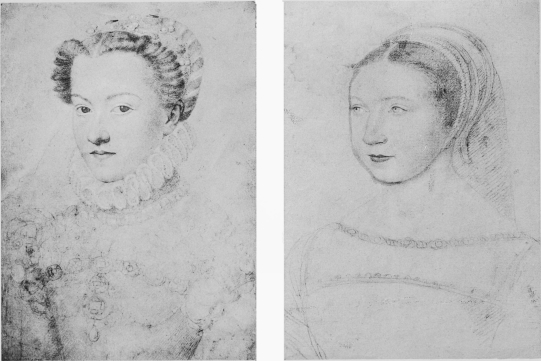
Photo. Giraudon.
ELISABETH OF AUSTRIA, QUEEN OF FRANCE. François Clouet (About 1567). Bibl. Nat. Paris. JOSSINE DE PISSELEU, NICKNAMED HEGLI. François Clouet (About 1542). Musée Condé.
To face page 234.
Another portrait by François Clouet, equalling this in excellence, is that of la bonne petite reine, Elizabeth of Austria in the Louvre—the youthful consort of Charles IX, whose simple virtues shone out so conspicuously during a most degenerate period in the history of the French Court. The perfection of draughtsmanship in the delicate features is astonishing; and the colouring, of a pale rosy hue, is most effective. The hands, placed one over the other, have in their graceful movements been justly likened to the petals of a white lily. There is a copy of this picture at Chantilly, probably also by François Clouet, but the exquisite hands are absent. Nor are they to be found in the original drawing in the Bibliothèque Nationale, in the famous Lecurieur album which once belonged to François Clouet’s own nephew, Benjamin Foulon. Maréchal Strozzi, Madame de Retz, Albert de Gondi the Duc de Retz, Robert de la Marck, the Duc de Bouillon, Jeanne d’Albret in deep mourning, and many others, have the same provenance and all bear notes in Foulon’s[124] handwriting. It has been suggested by Henri Bouchot that these admirable designs came to the nephew from his uncle who had preserved them in his studio in order to reproduce them subsequently in colour. We may presume then that these original pencil drawings were the immediate work of François Clouet, whilst the coloured portraits were reproduced from them either by himself (as in the case of the portraits of Elizabeth of Austria in the Louvre and at Chantilly) or by the hands of his pupils.
There is, however, one exception to this proposition in the case of the portrait of Pierre Quthe recently acquired for the Louvre. It certainly appears to be a portrait painted direct from life and not reproduced from a drawing; and it reveals to us a new and more intimate characteristic of the artist; since he has here shown us one of his own personal friends, with whom he, no doubt, had many tastes in common. Had this not been so he would not have appended to the picture the following inscription: FR. JANETT OPUS PE. QUTTIO. AMICO SINGULARI ETATIS SVE XLIII, 1562. This portrait, therefore, when compared, for instance, with that of Charles IX at Vienna, gives the impression of being less conventional and more sympathetic. It has the same bluish curtain in the background, and an open book lies on the table, in which may be seen representations of certain plants, alluding to the fact that the person represented was well known as a botanist.
Since the discovery of the portrait of Pierre Quthe we can have no hesitation in attributing to François Clouet another life-size portrait at Chantilly: namely, that of Cardinal Odet de Coligny, hitherto—though with some reserve—assigned to Primaticcio on account of a misleading signature evidently posterior to the painting. This portrait and that of Henri II (Cabinet Clouet) (also attributed, and with much more reason, to Primaticcio), clearly exhibit the difference between the respective artists without need for any further comment. The curtain in the background, for which François had so decided a predilection, is also to be found in the portrait of Odet; and it appears to have been Clouet’s latest work. It exhibits very decidedly his appreciation for Italian methods, more especially those affected by Morone and Moretto of Brescia, to whose work these two large portraits by François Clouet bear a marked analogy.
Plate LXVI.
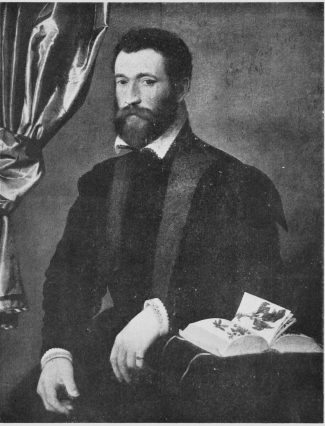
PIERRE QUTHE. Louvre.
François Clouet.
Besides a fine drawing in red chalk of this same Cardinal, presented to the Musée Condé by M. Moreau Nélaton, there exist two other drawings, evidently preliminary sketches for the same picture. One of these is in the British Museum (Salting Bequest) and the other in the Albertina at Vienna. These form a further proof that the painting at Chantilly is by François Clouet and not by Primaticcio.
Odet de Coligny, created a Cardinal by Clement VII at the early age of seventeen, was the eldest brother of Admiral Coligny and of Dandelot. In spite of the countless honours showered upon him by the Catholic party he all at once in 1561 astonished the world by openly confessing the Protestant Faith. Like his brothers he became a staunch supporter of Calvin, proceeded publicly to marry Elizabeth de Hauteville—to whom he had for many years previously been deeply attached—and presented her at Court, where she received the title of Comtesse de Beauvais. The scandalised Pope, Pius V, erased his name from the list of Cardinals, whilst Catherine de Medicis merely smiled. It suited her purpose on the death of Francis II to dismiss the Guises from her Court and to admit thereto the Calvinistic party, even to the extent of attending their sermons. This freak of hers did not, however, last long, but by it she enticed the Protestants into her net. Odet de Coligny subsequently retired to England, where in 1570, just when he was intending to return to France, he died suddenly at Hampton Court, not without suspicion of poison.
Plate LXVII.
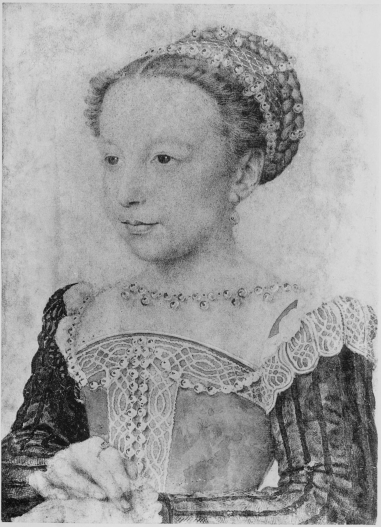
Photo. Giraudon.
MARGOT OF FRANCE. François Clouet. Musée Condé.
To face page 238.
Before concluding this chapter on François Clouet attention should be directed to a specially interesting feature about these drawings. Upon the margins, and also on the reverse sides of most of them, are to be found annotations and legends of the utmost historical and iconographic value. Sometimes they appear to be in the handwriting of the artists themselves: often notes with regard to subsequent reproduction in colours; but more often they seem to be the remarks of the connoisseurs and collectors who at different times possessed the drawing—such as was Catherine de Medicis herself. Her handwriting is to be found upon at least sixteen of the drawings in the Musée Condé, easily identified by existing fragments of her letters in the archives at Chantilly and elsewhere. There is, for example, a drawing of Erasmus which had hitherto passed unnoticed until Moreau Nélaton discovered that the Queen had written his name upon it in her own hand. Her autograph is clear enough also on the drawings which present her favourite ladies-in-waiting Hegli[125] and Montchenu and la Romène; whilst she has also annotated the drawings representing Monsieur de S. Valier, “le père de la Grande Senechalle,” and “Monsieur de Nevers,” “le père de Madame de Nevers.” Then upon a drawing of Brissac (so celebrated for his good looks) she notes “brassac depuis maréchal.” Again, “le fu roy de Navarre, Henri,” “Monsieur de Chateaubriand,” “Monsieur de Voldemont,” and “Chandu, capitaine de la porte du Roy.” Besides the sixteen drawings at Chantilly which so obviously bear the Queen’s handwriting, there is as already mentioned in the Deligand Collection a likeness of “Brasseu,” daughter of Diane de Poitiers, and in the Uffizi a drawing representing Queen Claude, “mère du roi Henri,” on both of which we also find Her Majesty’s angular writing. She has corrected, moreover, the title upon one pencil drawing wrongly entitled Madame de Nevers d’Albret into Madame de Vendôme d’Alençon.
Yet by far the larger number of the drawings bear notes in a variety of different handwritings: at Chantilly, the Bibliothèque Nationale, in the Uffizi and in the British Museum (Salting Bequest). M. Moreau Nélaton is strongly of opinion that these notes were all made either by the Queen herself or by secretaries written at her dictation. He is certainly right in regard to one of these, for we can trace the same handwriting in a private letter “a ma cousine Madame la Connetable” signed by the Queen; and again on the margin of the three drawings representing “François Dauphin,” “Marie Royne d’Ecosse,”[126] and “Charles Maximilian d’Orleans” respectively. It is a well-formed caligraphy with a peculiar trick of abbreviating “et” into “&,” which appears both in the letter and in the notes. There is no proof, however, as to who were the other annotators, whether Court secretaries or not. They may just as well, as M. Dimier[127] suggests, be other collectors through whose hands in the course of time the drawings have passed. This much, however, is quite certain: that all are posterior to the drawings themselves. The different handwritings—of which there are at least four, if not five (including that of the Queen), have puzzled Bouchot as much as Dimier and Moreau Nélaton, and all these authorities have their own special theories upon the subject. It is evident that in most cases the notes do identify the persons represented in the drawings upon which they are found, and they are thus of greatest historical value: and more especially is this the case with the drawings at Chantilly (many of which are stained with blotches of colour), since they are the originals from which were derived the copies and portraits found now in other collections.
Plate LXVIII.
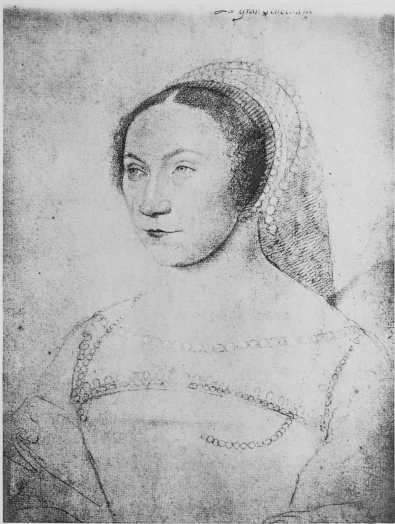
DIANE DE POITIERS. François Clouet. About 1543. Musée Condé.
To face page 240.
There is ample evidence to prove how much interest was taken by Catherine de Medicis in French portrait-painting. A list has been found, bearing the heading of “Les peintures qu’il faut,” of the pictures which she desired should be reproduced. Numerous “gens de maîtres” like Philibert Delormes, Jean Bullant, Scipion Bruisbal, and others were busily employed in making these copies from Clouet originals, in order to satisfy the great demand which then existed for them.
After Catherine’s death an Inventory of not less than 476 paintings (amongst which were 341 portraits) was made at the Palais de Tournelle, where she habitually resided; whilst another Inventory notes 39 small pictures executed in enamel, and 32 portraits in colour, 1 foot square each, of ladies and gentlemen of the Court.
An original drawing of Diane de Poitiers is preserved in the portfolios at Chantilly; and a portrait of the same lady executed in colour hangs in the next room (Cabinet Clouet). Similarly the Bethune and Destailleur albums at Chantilly, as well as the Ashmolean collection at Oxford, contain numerous copies from originals in the Musée Condé. Many of these copies were made by enamellers and goldsmiths for the purposes of their respective trades. These, however, are usually of inferior workmanship, although they have a certain value attached to them; especially when, as in the case of Mary Tudor, the original has been lost.
In this connection the Mejanés album at Aix should not be forgotten; for it is no doubt the most important amongst the various albums which contain copies of these original drawings at Chantilly and elsewhere. This collection is supposed to have been copied by Madame de Berry, wife of Arthur de Gouffier, one of the Preux de Marignan. Francis I, whose own portrait is at the beginning of the album, when on a visit to this lady, is said to have composed the remarks which are written on the margins. They are suggestive and often witty; indeed none but the King himself would have dared to fling at Mary Tudor[128] of England the insulting words “plus sale que royale”; whilst Diane de Poitiers is greeted with the flattering remark, “fair to see and virtuous to know.” Perhaps even more important especially, from an artistic point of view, is the Hagford album bequeathed to the British Museum by Mr. Salting, since it includes not only a number of old copies but also several very valuable originals. This collection was made by an English painter, Ignatius Hagford, who lived in Florence in the eighteenth century. He believed them to be the work of Holbein, as is indicated by the frontispiece; and he seems to have even bought also old copies of originals which he already owned. Part of his collection is now in the Pitti Palace; and seeing that the Howard Collection, now at Chantilly, was also originally acquired in Florence, there is strong reason to believe that probably these two collections were once united.
Plate LXIX.
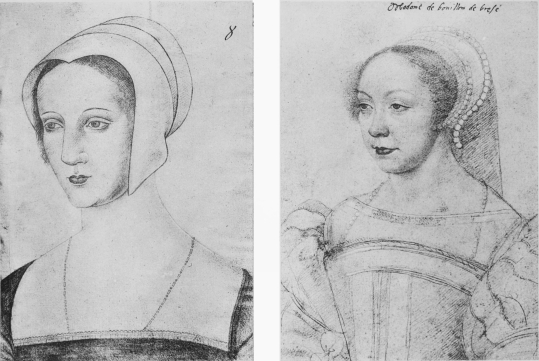
Photo. Giraudon.
MARY TUDOR, QUEEN OF FRANCE. Copy after Perréal. MADAME DE BOUILLON. Attributed to Jean Clouet.
Musée Condé.
To face page 232.
Henri de Mesmes, a gentleman of whom Brantôme speaks as “un très grand habile et subtil personnage d’état d’affaires de science et de toute gentillesse,” often acted as go-between for Catherine in her art dealings; and it was he who corresponded on her behalf with a certain Claude de Hery, who had been commissioned to make a new engraving from a portrait of Charles IX on his accession to the throne. This artist had failed to satisfy the Queen-Mother and the King, in spite of the fact that his work had been fully approved of by no less a personage than François Clouet himself.
One of the last works of François Clouet was a miniature of Elizabeth of Austria, executed in 1572 and destined for her sister-in-law, the Queen of Spain. The goldsmith Dugardin designed for it a golden frame; and here also Henri de Mesmes acted as medium, as is shown by a memorandum referring to it in the handwriting of Catherine de Medicis herself.
It was in this same year (1572) that the artist died; a year which was also fatal to Jeanne d’Albret, Queen of Navarre, who did not live to attend the nuptials of her son Henri IV with Margot de France. This took place shortly after her demise and not long before the Massacre of St. Bartholomew; a terrible event which reveals Catherine de Medicis in a very different light from that of a connoisseur and collector of works of art. There is a portrait of her in the Cabinet Clouet at Chantilly which dates from about this period. From it the bloom of youth has fled, the face has grown heavier and the smile is more than ever fixed and conventional.
The ablest contemporary and follower of the Clouets was Corneille de Lyon; but he in turn developed a decided individuality of his own. By him are those small portraits, painted upon light-green or light-blue backgrounds, which may be found scattered throughout the Galleries of Europe. As already mentioned, a likeness of the Dauphin François[129] at Chantilly (Tribune) has been attributed to him by Gaignières, to whom it once belonged. It is on the authority of this connoisseur that other portraits in the Musée Condé exhibiting the same style are by comparison assigned to him: such, for instance, as Le Grand Ecuyer de Boisy, Marguerite de France (sister of Henri II), Madame de Martigné Briant, a portrait supposed to be of Madame de Canaples, and a portrait of a young woman, erroneously styled Claude de Valois. [An authentic portrait of this latter lady, attributed to Clouet himself, is at Munich.] Madame d’Elbœuf, presented to the Louvre by the late Rudolph Kahn, is a fine example of Corneille’s skill.
Another artist who followed the Clouet style was Jean de Court, Court Painter to Henri III, the last of the Valois Kings, whose portrait in the Cabinet Clouet at Chantilly is probably an example of his work. His talent is much praised by Desportes; and this likeness of Henri III does not suffer in comparison with the portraits of Charles IX attributed to François Clouet. The pencil drawing of Marie Touchet, Charles IX’s mistress, in the Bibliothèque Nationale is also attributed to him.
Plate LXX.
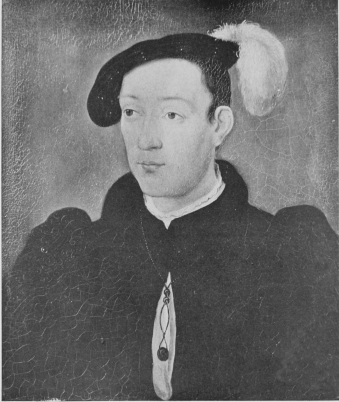
Photo. Giraudon.
FRANÇOIS, DAUPHIN. Musée Condé.
Corneille de Lyon.
The painter who acquired the old Queen’s special favour after the death of François Clouet was Carron, who made a series of designs (reproduced in tapestry) from the History of Artemisia, in which Catherine herself is represented mourning for Henri II in the guise of the Queen of Caria. A drawing by Carron representing the Duc d’Alençon, her youngest son, on horseback is in the passage of the Tribune at Chantilly.
Pierre Gourdel, Dubois and Bussel, followers of François Clouet, are only known to us by mediocre engravings, but numerous drawings by the Brothers Lagneau have come down to us. These may be met with in the Louvre, in the portfolios at Chantilly and elsewhere. They suffer from an exaggerated taste for realism; and representations of old, wrinkled men and women seem to have been their favourite themes. A good example of their work is the portrait of an Old Man at Dijon, where, however, it is erroneously assigned to Daniel Dumoustier. This latter artist, on the contrary (according to his own statement), took particular pleasure in representing his sitters as younger and more beautiful than they really were. By him there are at Chantilly portraits of Louis XIII (in coloured chalk), of Albert de Gondi Archdeacon of Paris, of Henri Duc de Guise,[130] of the Princess Palatine (the devoted friend of the Grand Condé), and an interesting portrait of Henriette de France in her girlhood. Numerous other examples of his work are in the Louvre; and he is certainly the most important of the artists who followed François Clouet. In company with his sons Pierre and Nicolas he carried on the art of pencil drawing in France from the sixteenth well into the seventeenth century. Saint-Simon speaks of him as a man who was fond of books and knew both Italian and Spanish. He lived in the Louvre, and throughout his lifetime retained his hold upon public taste.
There is yet one more artist-family to be mentioned: that of the Quesnels, who were held by the two first Bourbon Kings, Henri IV and Louis XIII, in the same high estimation as were the Clouets by the Valois. There are two portraits at Chantilly (Cabinet Clouet) which are attributed to François Quesnel: that of the Duc de Sully and of his brother Philippe de Bethune. These paintings markedly display the strong tendencies to realism so characteristic of the Brothers Quesnel.
Plate LXXI.
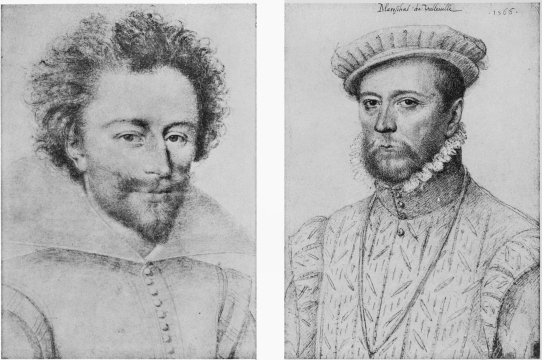
HENRI DE GUISE. Dumoustier. Musée Condé. MARECHAL DE VIELVILLE. François Clouet. (Salting Collection). British Museum.
To face page 246.
Yet another French picture at Chantilly of the Clouet School has to be recorded, the authorship of which is uncertain. It represents Gabrielle d’Estrées, mistress of Henri IV, seated in her bath, with her infant sons (one being on the arm of his nurse) beside her. It is a composition which occurs frequently and seems to be rather meant for an allegory than for a portrait. Other versions of it are in the Louvre, at Doughty House Richmond, and in the Collections of Baron Pichon and the Viscomtesse de Zanzé. In this last example one of Gabrielle’s sisters is also introduced. She turns her back to the spectator, whilst Gabrielle herself—her bare neck adorned with a string of fine pearls—faces full round. At the Musée Condé (Cabinet des Gemmes) there is a miniature representing Gabrielle d’Estrées and her two Children, which bears unmistakable likeness to this portrait. The late M. Gruyer in his Catalogue Raisonnée of the Musée Condé justly points out that this composition testifies to the decadent turn taken by the late sixteenth-century French School; and we sadly miss the good taste and the refinement which are such marked qualities in the portraiture of François Clouet.