Chapter XV · JEAN PERRÉAL AND BOURDICHON
Reading edition
IT is hardly conceivable that a master like Fouquet, so famous as a painter of miniatures and portraits, should really have left no followers. Indeed, it has been said that he ought to have been succeeded by a French Raphael. Unfortunately the adverse circumstances which surrounded French Art at that period prevented Fouquet’s followers from arriving at the eminence achieved by their master.
We hear of frescoes in the house of Joan of Arc, executed by some unknown artist in 1481 (the year of Fouquet’s demise), which represented that great heroine and her noble deeds. Had they but survived an interesting page of history would have come down to us and we might have even possessed an authentic likeness of her. Montaigne, when passing through the country of Lorraine on his way to Italy, saw these paintings, and makes mention of them in his Journal[65] as follows: “La maisonette où naquit Jeanne d’Arc est toutes peintes de ses gestes; mais l’orage en a fort corrompu la peinture”—a further proof of the havoc played upon early French Art by time and neglect.
A younger contemporary of Fouquet was Simon Marmion, who lived at Valenciennes and is chiefly known to us by his fine altarpiece at Saint-Bertin: a composition now divided between Berlin and London. Moreover, two of Fouquet’s sons served their father as assistants and to them may be ascribed some of the works of his school—such, for instance, as a miniature representing an Angelic Choir shown at the Exhibition of Illuminated MSS. arranged by the Burlington Fine Arts Club in 1908.
Bourdichon and Jean Perréal, Jean Payet and Jean Colombe may be considered as followers of Fouquet; yet documentary evidence is very scanty. It is true, however, that there exist some fragments of historical information which would seem to allude to their work; as, for example, the following fact. Some fifty years ago cartridges which had been made up during the time of the Revolution in default of other material out of old manuscripts and contracts were found in the arsenal of the Hôtel des Invalides; and it was to Comte de Laborde that the idea occurred of making a closer investigation of the composition of these cartridges. After a careful study of those time-worn and crumpled fragments he discovered upon one of them the name of Bourdichon and with it the additional facts that he resided in the town of Tours, where Fouquet was born; that his birth took place in 1457; that at the early age of twenty-one he was entrusted with the execution of certain frescoes in a chapel; and that he was Court-Painter to Charles VIII, whose portrait he painted, as well as that of his Queen, Anne de Bretagne. A small portrait of her son, Prince Orlant,[66] who died in childhood, has been attributed to Bourdichon; and a similar portrait, representing his younger brother Charles, which came to light only recently[67] and was acquired by the Louvre, is evidently by the same hand.[68]
Bourdichon’s skill can be traced with greater certainty in various Books of Hours[69]: i.e. the “Heures d’Aragon,” a small volume adorned with graceful miniatures considered by M. E. Mâle to be one of his early works; while the Prayer Book of Anne de Bretagne, which is authenticated by a document dated 1508 (Bibl. Nat.), is a later and more finished achievement. Compared, however, with Fouquet’s style, the work of Bourdichon seems like wine diluted with water, whilst the total absence of landscape from the backgrounds of his miniatures gives to his figures an unusually cold appearance. His Madonna is distinguished-looking but rather rigid and devoid of expression; his Magdalen though poetical seems lifeless; and as for the portrait of Queen Anne herself and her companions on the Frontispiece it is purely conventional without attempt at aiming at a likeness. Instead of the landscapes which form so fascinating a part of the work of his predecessors we find him introducing great masses of flowers on the margins of the illuminations. The Queen who commissioned the book evidently was devoted to flowers; and thus Bourdichon, probably at her express command, brought them in wherever he could. We must indeed give him credit for a vast amount of charm and delicacy in the execution of these lovely flowers and they form a very perfect and beautiful decoration.
Although M. Bouchot mentions the name of Bourdichon more than once in reference to certain drawings at Chantilly there is nothing amongst the treasures of the Musée Condé which really can be attributed to him with any certainty.
With Jean Perréal it is different. He is the artist who has been identified by some authorities with the mysterious Maître de Moulins. It was M. de Maulde and Henri Bouchot who first propounded this theory; and they were supported by Mr. Roger Fry and M. Hulin after the Exhibition of the French Primitifs in 1904, where a number of works supposed to be by this master were arranged in definite order for comparison purposes.
We know that Perréal at the beginning of his career lived at Moulins, where he held the post of Court-Painter to Duc Pierre de Bourbon; and that there he had the opportunity of studying Fouquet’s miniatures in the Antiquitates Judæorum, then an heirloom in the Ducal Library. Like Bourdichon Perréal appears to have had no taste for landscape, and it was chiefly portraiture that attracted him. This branch of art was, in fact, the prevailing interest of his time, and that so-called inquiétude du portrait manifested itself more or less strongly in the miniature-painting of the fifteenth and sixteenth centuries until it almost entirely superseded all landscape work. We find an excellent portrait, for instance, of Charles V of France in the Heures d’Anjou[70] and another in the Bible Historiée[71].
The well-known portrait of Jean le Bon, father of Charles V of France, in the Bibliothèque Nationale is considered to be the prototype of French portraits, and it is therefore not inopportune to compare it with the later portraiture. It was discovered by Gaignières at Oyron, an old château of the Gouffier family, and was the only painting which the Regent in 1717 thought worth keeping out of the sale of this collector’s treasures. It is ascribed to Girard d’Orléans, who is recorded as having assisted Jean de Coste to decorate the Château de Vaudreuil. Girard is also known to have accompanied the King to England, when the latter was held prisoner there after the Battle of Poitiers. It is not improbable that this portrait—which is one of a set of four—was painted during his captivity.[72] Executed in England it no doubt gave an impulse to English Art of the same kind; although it is an undisputed fact that at that period there already existed the paintings in St. Stephen’s Chapel at Westminster,[73] through which England would appear to have a reason to claim—as suggested by Mr. Lionel Cust[74]—priority in time over France. On the other hand, there is nothing in England to compare with the exquisite miniature portrait of the Duc de Berry in the Très Riches Heures or with the work of Fouquet half a century later. The portrait in the Très Riches Heures of the Duc de Berry—who, by the way, along with his brother Louis d’Anjou, shared their father’s captivity in England—was most probably painted from life, since it has that note of realism which is so characteristic of all French Art.
Another remarkable portrait is that of Louis II of Anjou, King of Sicily, also copied by Gaignières. Its date is 1415 and a miniature of it is to be found in the Livre d’Heures which once belonged to King René.[75]
We hear also of an artist whom Charles VI, when choosing a consort, sent to the various Courts of Europe to paint the portraits of eligible Princesses. The name of this artist has, unfortunately, not come down to us.
Plate XLIX.

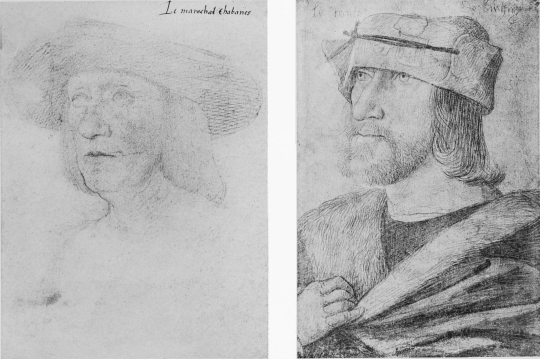
Photo. Giraudon.
SEIGNEUR DE PALISSE. COMTE DE LIGNY. Attributed to J. Perréal. (About 1515). Attributed to J. Perréal. (About 1505). Musée Condé.
To face page 202.
Fouquet, following in the steps of the Limbourgs, unquestionably gave fresh impetus to French portraiture and it is not unreasonable to suggest that the portraits of the so-called Preux de Marignan at Chantilly are sufficiently similar to his style as to be attributable at least to the same school. Before, however, bringing forward the proposition that these drawings may reasonably be ascribed to Jean Perréal we must first refer to the MS. de Saint Michel,[76] which is assigned to that master by no less an authority than Comte Paul Durrieu. And here, at least, we have some historical proof on which to rely. The Dedication to the King on the first page shows that this manuscript was a present from the Duc de Bourbon to his young Sovereign; and it is unlikely that the Duke would have employed upon this occasion anyone else rather than his own Court-Painter whom he might perhaps have desired to bring under the King’s notice. On one of the pages of this manuscript Charles VIII, who was delicate and small of stature, appears wrapped in a wide mantle which imparts to him an air of importance. As St. Michael, he stands between two courtiers and is surrounded by angels, who bear a strong resemblance to the floating angels in the triptych at Moulins attributed to Perréal. Moreover, in the same MS. there is a drawing of a head in profile which recalls a drawing at Chantilly attributed to Perréal, representing the Comte de Ligny, a patron of the artist and confidant of Charles VIII, whom he accompanied to Naples. It is not at all unlikely that de Ligny should have commissioned Perréal to paint his portrait, in which he is represented in a fur coat and cap, similar to that worn by his master the King in the well-known bust in the Museo Nationale at Florence.
A drawing, also at the Musée Condé, representing Lescueur, Bourdillon, and another which, although supposed by Bouchot to be Anne de Montmorency, is apparently meant for Louis XII,[77] have decided affinity with this portrait of de Ligny and with the profile-head in the St. Michel manuscript assigned to Perréal. We must remark, however, that these drawings are inferior in craftsmanship to the supposed portrait of Louis XII. The supposition therefore arises that they may be merely copies from lost originals. The interesting drawing on which Moreau Nelaton[78] discovered the name of Erasmus in the strange, almost illegible handwriting of Catherine de Medicis is most likely by the same hand, and this group of drawings all betray an unmistakeable relationship to another group likewise at Chantilly; namely, the well-known portraits of the Preux de Marignan from which the miniatures in the second volume of the MS. of the Gallic War are reproduced. Bouchot and also Dimier have tentatively ascribed both drawings and miniatures to Jean Clouet. But others, and amongst them both M. de Maulde and the present author,[79] assign the original drawings of the Preux to Perréal.
Plate L.
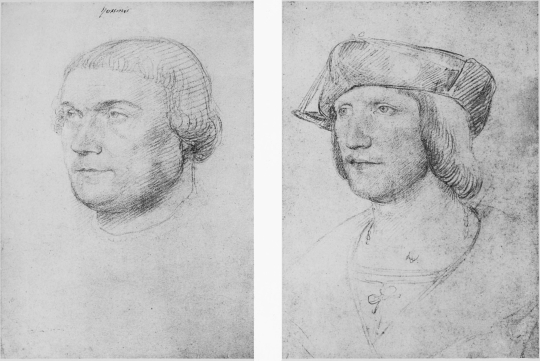
ERASMUS. JUST DE TOURNON. Attributed to J. Perréal. Attributed to J. Perréal. (About 1515). Musée Condé.
To face page 204.
It is strange that Bouchot and Dimier, and also Maulde La Clavière, accept as a foregone conclusion that both drawings and miniatures must necessarily be by the same hand. Yet everything points to the fact that the miniatures in question were copied subsequently (about 1519-20) from these very same drawings by Godfroy le Battave, the author of the excellent grisailles with which this manuscript is ornamented. It stands to reason that it was he who also reproduced the miniature of Francis I on the frontispiece of the first volume of the MS. in question. To judge from the costumes and headgears of these heroes they cannot be dated later than 1514-15, a period anterior to Clouet. It is therefore quite plausible to suggest that Perréal, who at the time of the Battle of Marignan was Court-Painter, received from Francis I the commission to portray his famous comrades, Artur and Guillaume Gouffier, Just de Tournon,[80] Odet de Foix,[81] Fleuranges, the Seigneur de la Palisse,[82] and Anne de Montmorency.
It is a curious fact that all the numerous sixteenth-century French drawings at Chantilly and in other collections should have been formerly attributed indiscriminately to “Janet,” a name employed to designate both the Clouets, Jean and François. Yet we know that Perréal was Court-Painter to Louis XII and that the latter was so enchanted with his work that when he was in Italy he sent for them “pour monstrer aux dames de par deça,” and referred to him as a “portraitiste de visages, qui peint de petits portraits sur parchemin, et sans rival en Italie.”[83] Some years later, after the death of his Queen, the aged monarch sent Perréal to England to paint a portrait of his affianced bride, Mary Tudor. He had previously been sent to Germany for a similar object, so that it was the most natural thing in the world for the young King Francis on ascending the throne to commission a painter, who had already been employed by his predecessor, to portray also himself and his warrior friends.
Yet another drawing at Chantilly may be attributed to Perréal representing Guillaume de Montmorency,[84] father of the celebrated Anne. Judging by the age and the attire this portrait must necessarily be assigned to an artist working before Jean Clouet’s time.
After having adduced these proofs in support of our argument it would seem to be going purposely out of our way not to prefer Perréal as the author of the Preux de Marignan rather than Jean Clouet; and especially as there are a vast number of drawings belonging to the period when Clouet was Court-Painter—1523-39—which clearly prove the greater elaboration of his style.
Plate LI.
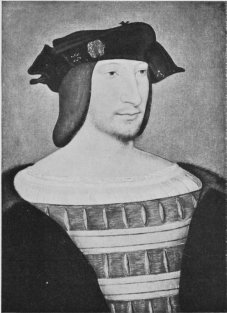
FRANCIS I. Photo Braun & Co. Musée Condé. Attributed to Jean Perréal.
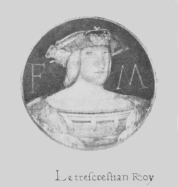
FRANCIS I. British Museum.

CÆSAR. British Museum.
As for the miniatures in the MS. of the Gallic War there can be no doubt that they were reproduced from the original drawings at Chantilly, not because the author of the grisailles in that manuscript was unable to execute portraits himself—for he was evidently an excellent draughtsman—but because it was the fashion of the time to have such drawings taken from life and then reproduced in colour in order to spare their noble patrons the inconvenience of sitting so often. We have already stated that Godfroy le Battave reproduced in miniature on the frontispiece of the first volume of this MS. the effigy of Francis I. Beneath on the same page is a miniature of Cæsar, probably copied from an old cameo; whilst the miniature of the King can be traced to a painting now at Chantilly, attributed to Perréal, and formerly in the possession of Gaignières. It represents Francis I at the time of his accession and is so subtle in its representation of character that it fascinates by its obvious verisimilitude.
Another circumstance in favour of our proposition is found in the notes with reference to an intended execution in colours inscribed upon the back of the drawing supposed to represent Louis XII.[85] These notes are in a handwriting closely resembling the handwriting of Perréal in the Comptes de Lyon and in his autographs in the Bibliothèque Nationale, where he speaks of his “croions qui n’est que demy couleurs.”[86]
From the above arguments we are led to the conclusion that this delicate art of pencil drawing must have originated on French soil, and that it was apparently practised by Jean Fouquet,[87] Perréal, and probably also to a certain extent by Bourdichon, before Jean Clouet appeared in France.
Nevertheless, the latter, when he came to Tours, adapted his style—till then more closely resembling that of Holbein—to French requirements; and his son, François Clouet, developed this art to its highest perfection, combining his father’s methods with those of his French predecessors. It is to be hoped, since some examples of the work of the long-neglected Perréal have now come to light, that more proofs of his versatility and power may yet appear, and that we may arrive at something more definite regarding him. The portraits of Charles VIII and Anne de Bretagne, discovered by Bouchot in a small MS. volume once the property of Gaignières, recall the drawings in the Musée Condé which we have assigned to Perréal; and so also does a small panel portrait of Philip le Beau now in the Northbrook Collection.
Plate LII.
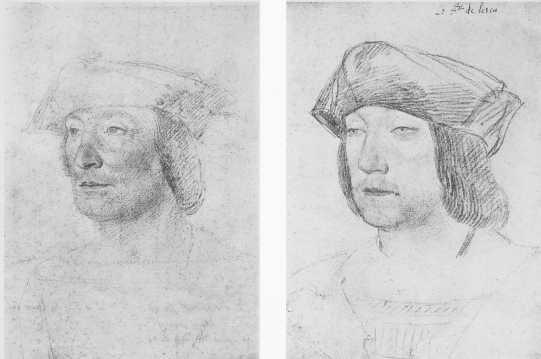
Photo. Giraudon.
LOUIS XII. (ABOUT 1514). ODET DE FOIX. Attributed to Jean Perréal. Attributed to Jean Perréal. Musée Condé.
To face page 2.
Furthermore, the so-called Tournois tapestry, which may be assigned to the beginning of the sixteenth century, seems to reveal Jean Perréal’s style. It is important to notice that documentary evidence proves that Perréal presided as Master of the Revels on the occasion of the State Entry into Lyons of Philip le Beau and his wife, Jeanne la Loca; on which occasion they were received with great pomp by Louis XII and Anne de Bretagne. We learn that he executed decorations for these festivities, and it is therefore not impossible that his designs may have been subsequently used for the tapestries in question, since they present to us Louis XII and Anne de Bretagne with their Royal guests and numerous suite.
Thus historical record also would seem to favour the theory which we have endeavoured to establish—namely, that Jean Perréal as stated worked with pencil and chalk some time before the appearance upon the scene of Jean Clouet. In spite of the regrettable fact that most of his work has either been swept away by time or is still attributed to other artists enough evidence remains, if one will only accept it, of an activity which it is not easy to discount.
Perréal is also mentioned in Royal Accounts as an architect and sculptor in the service of Anne de Bretagne, who entrusted to him the design for a tomb for her parents, François, Duc de Bretagne, and his wife Marguerite de Foix, at Nantes—a monument subsequently executed by Michel Colombe. The graceful angels who keep watch over the dead and the noble figures of Justice and Temperance are silent tokens of Perréal’s ability. He was also consulted by that noble patroness of the Arts, Margaret of Austria, in connection with the tomb at Brou of her husband, Philibert of Savoy, and for this monument also some of his designs were used.
Amongst the French medals (1476-1515) in the Metropolitan Museum (New York) there is a masterpiece which bears the portraits of Louis XII and Anne de Bretagne. This fine work of art (of which there is another example in the Wallace Collection) is known to have been designed by Jean Perréal (draughtsman), modelled by Nicolas Leclerc and Jehan de Saint-Priest (sculptors) and cast by Jehan Lepère (goldsmith). It is considered to be one of the finest examples of this species of work executed during the French Renaissance and was struck on the occasion of the marriage of Louis XII with the widow of Charles VIII. It was formerly supposed to be of Italian origin but is now authoritatively assigned to Jean Perréal. Reproductions of these medals, but smaller in size, are at the Victoria and Albert Museum. It would seem that the artist’s fame received a final recognition in the fact that immediately after his death in 1528 Francis I sent for Italian painters to decorate Fontainebleau on account of the dearth of native talent.
Plate LIII.
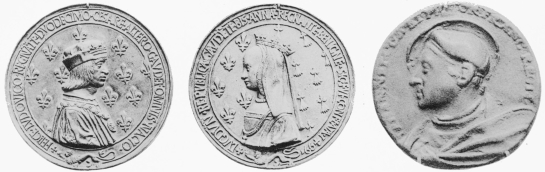
LOUIS XII. ANNE OF BRITTANY. JEAN CLOUET. Victoria and Albert Museum.
To face page 210.