Book 1 — CHAPTER VII. THE KINGDOM OF ALBAN.
Reading edition
A.D. 889-900. Donald, son of Constantin, king of Alban.
The Scots having now placed Donald, the son of Constantin, and the heir, according to the law of Tanistry, on the throne,[481] the succession became firmly established in the male line of the Scottish descendants of Kenneth mac Alpin, and assumed the not unusual form of an alternate succession between the houses descended from his two sons. The kingdom ceased to be called that of Scone and its territory Cruithentuath, or Pictavia its Latin equivalent, and now became known as the kingdom of Alban or Albania, and we find its kings no longer called kings of the Picts but kings of Alban.
About the time of Donald’s accession the islands of the Orkneys had become colonised by the Norwegians, who fled before the power of Harald Harfagr, the king of Norway; and that king having, after his power was established, sailed to the Orkneys with his fleet, and taken possession, he gave them on his return to Rognwald, Earl of Maeri, as a compensation for the loss of his son killed in one of his battles. By him they were made over to his brother Sigurd, to whom 336the king gave the title of Jarl, and thus the Norwegian earldom of Orkney was founded. Soon after Sigurd’s establishment as earl he invaded Scotland, and, in one account, ‘obtained possession of Caithness and Sutherland and all as far as Ekkialsbakki;’ in another, ‘Caithness, Sutherland, Ross, and Moray;’ and in a third, ‘all Caithness and much more of Scotland—Maerhæfui (Moray) and Ross—and that he built a borg on the southern border of Maerhæfui.’ These were the same districts which had been overrun by Thorstein the Red, and these Sagas confound the two invasions, and join Sigurd with Thorstein in their acquisition; but the inexorable logic of dates shows that the two invasions were different, and that the one was subsequent to the other.[482] The borg was no doubt built on the promontory called Torfnes by the Norse, and now Burghead, situated between the Findhorn and the Spey. We are then told that Melbrigda Tönn, or of the Tooth, a Scottish jarl, and Earl Sigurd made an arrangement to meet in a certain place with forty men each in order to come to an agreement regarding their differences. On the appointed day Sigurd, suspicious of treachery on the part of the Scots, caused eighty men to be mounted on forty horses. When Earl Melbrigda saw this, he said to his men, ‘Now we have been treacherously dealt 337with by Earl Sigurd, for I see two men’s legs on one side of each horse, and the men, I believe, are thus twice as many as the beasts. But let us be brave and kill each his man before we die.’ Then they made themselves ready. When Sigurd saw it, he also decided on his plan, and said to his men, ‘Now let one half of your number dismount and attack them from behind when the troops meet, while we shall ride at them with all our speed to break their battle-array.’ There was hard fighting immediately, and it was not long till Earl Melbrigda fell, and all his men with him. Earl Sigurd and his men fastened their heads to the saddle-straps in bravado, and so they rode home triumphing in their victory. As they were proceeding, Earl Sigurd, intending to kick at his horse with his foot, struck the calf of his leg against a tooth protruding from Earl Melbrigda’s head, which scratched him slightly; but it soon became swollen and painful, and he died of it. Sigurd the Powerful was buried in a mound at Ekkialsbakki.[483]
338The power of the Scottish king of Alban, however, could hardly at this time have extended to these northern districts, and their invasion would not materially affect Domnall’s position. A Danish invasion, however, followed some years after, which had for its scene the more southern districts, and proved fatal to the king himself. Towards the end of this century a fleet of Danes under the sons of Imhair came to Dublin, and the greater part of Ireland was plundered by them. After four years these Danes left Ireland, and invaded Alban under Sitriuc, son of Imhair. A battle was fought between these Danes and the Scots at a place which cannot now be recognised under the corrupted name of Visibsolian, or Visibcolian, in which the Scots claimed to be victorious; but that they had overrun the southern districts is evident, as Domnall the king was himself cut off and slain at Dun Fother, or Dunotter.[484]
339The Ulster Annals record his death after a reign of eleven years in the year 900, and he is the first of the kings of the line of Kenneth who is termed by them Ri or king of Alban.[485]
A.D. 900-942. Constantin, son of Aedh, king of Alban.
He was succeeded, according to the Tanistic usage, by Constantin, son of Aedh, his father’s brother, who reigned forty years, and was, soon after his accession, exposed to a similar invasion, for in his third year the Northmen plundered Dunkeld and the whole of Alban, but in the following year were cut off in Stratherne, and their leader, Imhair Ua Imhair, slain by the men of Fortrenn, who are said to have invoked the aid of Saint Columba, and to have attacked them with the crozier of Saint Columba at their head as their standard, which was henceforth called the Cathbuaidh, or Battle-victory.[486]
Constantin seems now to have turned his attention towards consolidating his kingdom, and obliterating the distinctions between its discordant elements by placing them on a footing of equality with each other. In his sixth year a solemn assembly was held on the Mote Hill, near the 340royal city of Scone, in which he as king, and Cellach, as bishop of Kilrymont, or St. Andrews, resolved ‘that the laws and discipline of the faith, and the rights of the churches and of the evangel, should be preserved entire and on a footing of equality with the Scots.’[487] By this declaration the Pictish and Scottish churches were now united into one, with the bishop of Kilrymont as its head, the supremacy of Dunkeld ceased, and the bishops of St. Andrews became known as bishops of Alban.
It is to this period also that we may probably attach one of the accounts given of the division of Alban, or Albania, into seven provinces. This account is given on the authority of Andrew, Bishop of Caithness, a Scotsman by birth, and a monk of Dunfermline. He is mentioned as bishop in the year 1150, and died on 3d December 1184. He seems to have considered that these provinces were separated from each other by large rivers or mountain chains, which do not always form what were evidently their actual boundaries. The first province, he tells us, extended from the water of Forth, which divides the kingdoms of the Scots and the Angles, and flows past Stirling, to the river Tay. This province consists, therefore, of the districts of Menteith and Stratherne, and was certainly that known by the name of Fortrenn. The second province extended to the Hilef, and contains the districts encircled by the sea as far as the hill on the north of the plain of Stirling called Athran. If by Hilef he means the river Isla, he must have supposed that 341instead of falling into the Tay it flowed in a direct line towards the sea, but he may also have meant the place now called Lyff, on the present boundary between the counties of Perth and Forfar at the sea. By Athran, Aithrie, near Stirling, is meant, and this province evidently contained the whole peninsula of Fife, including Kinross and Clackmannan, along with the district of Gowrie. The third province extends from Hilef to the Dee, and contains the old districts of Angus and Mearns, now the counties of Forfar and Kincardine. The fourth province extended from the river Dee to the river Spey, and included the old districts of Mar and Buchan, now the counties of Aberdeen and Banff. The fifth province extended from the Spey to the mountains of Brumalban, or Breadalbane, and by it the district of Atholl seems meant. The sixth province was Muref or Moray in its extended sense, and Ross; and the seventh was Arregaithel.[488]
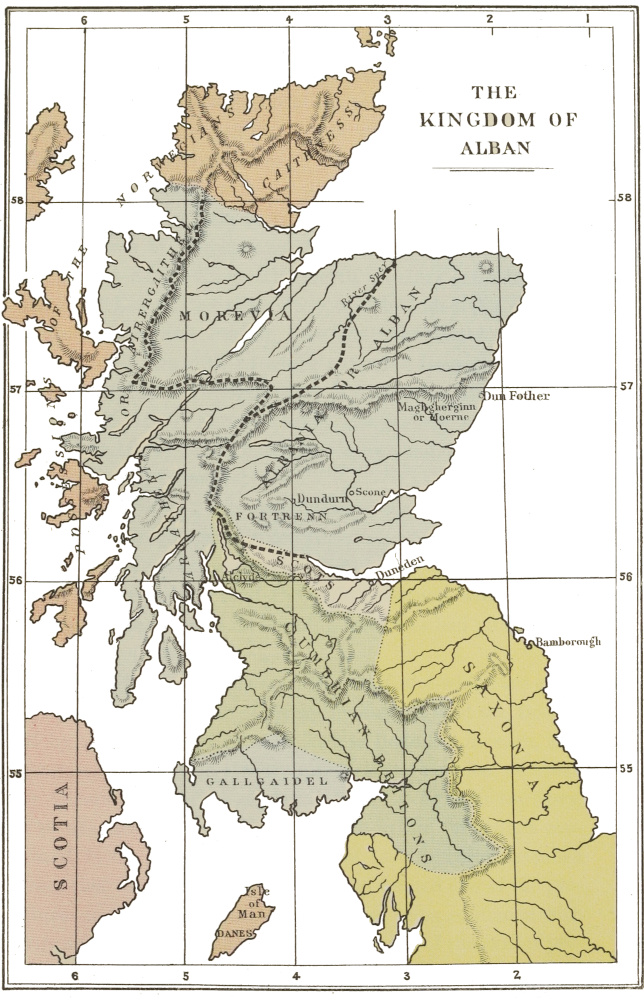
THE KINGDOM OF ALBAN W. & A.K. Johnston, Edinburgh & London
A comparison of this description of the sevenfold division of Alban with the other account contained in the same tract, and which we relegated to the reign of Nectan, king of the Picts, in the early part of the eighth century, will show the change which the two intervening centuries had produced in the aspect of the kingdom.
The first five provinces, the boundaries of which are given by the natural features of rivers, mountains, and sea, instead of by the old names of the districts included in each, now constituted what was, strictly speaking, the kingdom of Alban or Albania, at this time extending from the Forth to the Spey. The changes which had taken place within its bounds consisted, in the main, of the district of Gowrie being detached from that of Atholl, with which it had formed one of the provinces in the earlier state of them, and being combined with Fife and Fothrif, which had formed another of the earlier provinces, into one central region, the occupiers of which now 342appear as Scotti or Scots. It was, no doubt, the nucleus of the settlement of Scots which had taken place in the Pictish territory, and Gowrie became the heart of the kingdom of Alban in which its capital, Scone, was situated. West of it, in the province extending from the Forth to the Tay, were the old districts of Stratherne and Menteith, the people of which were still called the Men of Fortrenn. They were probably remains of the Pictish inhabitants, and had for their chief stronghold Dundurn, at the east end of Loch Earn. Forteviot, which had also belonged to them, and which is but a few miles from the west bank of the Tay, now belonged to the Scots, and was one of the seats of their kings. North of this central region was Atholl, and east of it a province extending from Hilef to the Dee, the northern part of which was occupied by a people called the Men of Moerne, also probably remains of the Pictish population, whose chief stronghold was Dun Fother or Dunotter; and north of them, extending from the Dee to the Spey, was the most northerly province included in the kingdom, which must still have been to a great extent Pictish.
The territory overrun by Thorstein the Red, and by Sigurd, earl of Orkney, consisted of the two earlier provinces beyond the Spey, which formed the northern boundary of the kingdom of Alban strictly so called. One of them, consisting of Muref and Ross, is included in the list of later provinces, as being still under its native rulers, but the other, Cathanesia, disappears, as being attached to the Norwegian earldom of Orkney. In place of it we have Arregaithel, now connected with the kingdom. The new province thus introduced must not, however, be absolutely identified, as is usual, with the kingdom of Dalriada, which was omitted from the list of the earlier provinces, as being then a separate kingdom of the Scots. It no doubt included it, but had a much more extensive signification, embracing the western districts extending from the Firth of Clyde to Loch Broom, and derives its name from being the 343border or coast region of the Gaedhel or Gael, a name now applied to all the inhabitants of Scotland who belonged to the Gaelic branch of the Celtic race.[489] The organisation of these seven provinces appears to have been quite analogous to that of Ireland. The unit was the Tuath or tribe; several Tuaths formed a Mortuath or great tribe; two or more Mortuaths a Coicidh or province; and at the head of each was the Ri or king; while each province contributed a portion of its territory, at their point of junction, to form a central district, in which the capital of the whole county was placed, and the Ri or king, who was elected to be its Ardri or sovereign, had his seat of government. In this account the provinces are termed ‘regna’ or kingdoms. Under each province was the ‘subregio’ or mortuath, with its ‘Regulus’ or Ri mortuath, and composed, no doubt, of a certain number of tuaths or tribes, with their chiefs or Ri tuaith; and where the four southern provinces met, was the central district in which the capital, Scone, the seat of the Ardri Albain, was placed. At the period to which the description of the provinces given us by Andrew, bishop of Caithness, belongs, this organisation had been so far modified, that the title of Ri, or king, is no longer borne by the heads of the tuath or tribe, and the mortuath or subregion, but at the head of the tuath is the Toisech, and of the mortuath, the Mormaor. The latter dignity, however, was still hereditary, and in the district of Angus, which was more immediately under Scottish influence and authority, we find it descending in the male line, while, in the most northern district of the kingdom of 344Alban proper, the Pictish law of succession through females was still observed.[490]
Beyond these seven provinces on the north were the islands of Orkney and Shetland, which were now colonised by the Norwegians. On the death of Sigurd, the first earl, he was succeeded by his son Guthorm, who reigned only one winter, and died childless. When Earl Rognwald, who had transferred the islands to his brother Sigurd, heard of his death and that of his son, he sent his son Hallad as earl, but he soon grew tired of it and resigned the earldom, which was then bestowed upon another son called Einar, who was earl at this time, and ruled over the Orkneys a long time.[491] On 345the west of these provinces lay the Western Islands, which were likewise colonised by the Norwegians, and were now called the Inchigall or islands of the Galls or strangers, and the Gaelic inhabitants of the islands and districts under their rule were now called the Gallgaidhel, a name originally borne by the Gallwegians, and still used in its territorial sense as synonymous with Galloway.[492] These islands, with the island of Man, were even more completely subdued and subjected to the Norwegian rule than any part of Ireland itself. They were eminently fitted to serve as a stronghold for the Northern Vikings, whose strength consisted almost entirely in their large and well-constructed ships, and may be regarded as the centre of the Norwegian settlements in the west, completely cutting Scotland off from Ireland, and severing the connection and arresting the intercourse between them.[493] The Western Isles were termed by them the Sudreys, to distinguish them from the Orkneys or Northern Islands;[494] and as Cathannia or Caithness and Sutherland had passed under the influence of the latter, and become more Norwegian than Scotch, so Galloway appears to have borne very much the same relation to the former. South of these provinces was on the east coast what had been the most northern district of Northumbria, but was now continually overrun by the king of Alban, to which the name of Saxonia was given; and on 346the west were the districts occupied by the Britons of Strathclyde. In the previous century and a half these had been narrowed to the Vale of the Clyde, with Alclyde or Dumbarton as its stronghold, and the rest of the British districts had, along with Galloway, been under the dominion of the Angles of Northumbria; but their rule had been relaxed during the period of disorganisation into which the Northumbrian kingdom had fallen, and had by degrees become little more than nominal, when the invasion of Bernicia by the Briton Giric, who for a time occupied the Pictish throne, led to the severance of these districts from Northumbria, and the whole of the British territory from the Clyde to the river Derwent in Cumberland became once more united under the rule of an independent king of the Britons.
The king at this time was Donald, but he appears to have been the last of the family claiming Roman descent which had hitherto given its kings to Alclyde; and on his death, which took place in the eighth year of the reign of King Constantin, the Britons appear to have found no one of their own race fitted to preserve their new-won independence; and as they owed it to a king of their own race who occupied the throne of Alban, so now they accepted a king from Alban by electing Donald, son of Aedh and brother of Constantin, to fill the throne of Alclyde.[495]
As in the earlier years of his reign Constantin had seen his kingdom overrun by a horde of Norwegians, who were finally cut off and their leader slain, so now but a few years elapsed ere he found himself engaged in a serious encounter with a powerful band of the Danish pirates, with a more doubtful result. Their leader was Regnwald, the son or 347grandson of Inguar or Imhair, son of Ragnar Lodbrog, and the brother of that Sitriuc who had invaded the kingdom in the latter years of his predecessor Donald. This Regnwald, in company with two other leaders, Ottir the Jarl and Oswl Gracaban, broke into the country and ravaged Dunblane. This took place in the year 912.[496] We next hear of Regnwald in the following year at the Isle of Man fighting a battle with Barid, son of Ottir, who is slain;[497] and he appears to have been making his way to effect a settlement in Ireland, as in 916 we hear of him arriving with innumerable hordes at Loch da Caech or Waterford, in Ireland, where they settle for the time and ravage the whole of Ireland. Here they remain for two years, when the Irish succeed in driving them out of Munster. They then proceed to Alban and invade the country. Their object appears to have been to make their way to Northumberland, and the irruption was so formidable that Constantin united with Eldred, the lord of Bamborough and ruler over Bernicia, to resist them. The encounter took place on a moor near the mouth of the river Tyne, which flows through East Lothian, called, by the Pictish Chronicle, Tynemoor. The Danes divided themselves into four bands—one under Gothbrith, a brother of Regnwald; the second under the two earls Ottir and Gracaban; the third under the young lords; and the fourth under Regnwald himself, which remained in ambuscade. The Scots invoked the aid of St. Columba, and advanced to meet them with his crozier, called the Cathbuaidh or Battle-victory, as their standard, and it did not belie its name, for the three battalions were routed by the men of Alban, and there was a great slaughter of the Danes, with the two earls Ottir and Gracaban. Regnwald then 348advanced from his ambuscade with the fourth battalion, and attacked the men of Alban from behind and slew many of them, but neither Constantin nor any of his maormors fell by him. Night put an end to the battle, but the Scots had evidently failed in their object, for Regnwald made his way to the south and took possession of the territories of the lord of Bamborough.[498]
This was the last invasion of Alban by the Northmen, who had harassed the kingdom during the whole period of the reigns of Kenneth mac Alpin and his successors down to Constantin. It was now to obtain a respite from their incessant invasions for upwards of a century; but if Constantin had no longer to defend his kingdom against the Northmen, he had to encounter a new enemy, and the kings of Alban were for the first time brought into contact with the growing power of the kings of Wessex. Their 349relations with the Anglic kings had hitherto been confined to those of Northumbria alone; but while the power of the latter state had been waning, that of Wessex had been increasing, and early in the ninth century these kings had in the person of Ecgbert obtained a supremacy over the other kingdoms south of the Humber. Their advance to the north, however, was arrested by their wars with the Danes, which lasted till the reign of the great Aelfred, who, after a fierce struggle, finally made a permanent peace with them in 878-883, which was only interrupted by a renewed struggle of four years from 893 to 897.
Aelfred is said by Simeon of Durham, on the death of Guthred, the Danish king of Deira, to have had the entire disposal of the whole kingdom of the Northumbrians, and to have appended to his own kingdom the provinces south of the East Angles and the Northumbrians;[499] but it was just at this moment that his renewed struggle with the Danes commenced, and the Saxon Chronicle, in recording his death, says, ‘he was king over all the Anglic race, except the part that was under the dominion of the Danes.’
His successor, Eadward the Elder, was supreme over all the states south of the Humber, but made no attempt to advance beyond it.
The Saxon Chronicle tells us in 924, ‘In this year king Eadward was chosen for father and for lord by the kings of the Scots, and by the Scots, and by king Regnall, and by all the Northumbrians, and also by the king of the Strathclyde Welsh, and by all the Strathclyde Welsh;’ but there is no record of any war beyond the Humber by which the submission of the northern kingdoms could 350have been obtained or enforced. What exactly took place, which could be interpreted by the Saxon Chronicle into the language of commendation, cannot now be discovered; but there was nothing in the relations of the northern kingdoms to the king of Wessex at that time that should naturally have led to a voluntary surrender of their independence, and the statement itself contains within it elements of suspicion which lead to doubt of its genuineness, while it is hard to believe that there was any reality in it. It was not till the reign of Aethelstan, the son and successor of the latter, that any serious attempt was made to extend the power of the Wessex kings beyond the Humber; and the great struggle to which it led on the part of the northern kingdoms to resist this advance and to maintain their independence, is sufficient to cast doubt upon mere nominal claims, unsupported by any events which would naturally have given rise to the supposed relation involved in them.[500]
With the accession of Aethelstan in 925, and the extension of the power of the kings of Wessex beyond the Humber, we obtain the valuable guidance of the Saxon Chronicle in the northern events. Aethelstan no sooner found himself firmly seated on the throne than he set himself seriously to work to add Northumbria to his kingdom. His first proceeding was to form a treaty of alliance with the existing rulers of Northumbria and with the northern 351powers who would support him. There was at this time a close connection between the Danes of Northumbria and those of Dublin and Waterford. Their chiefs belonged to the same family, and were equally descended from Inguar or Imhair, as he was termed by the Irish, the son of Ragnar Lodbrog, who first invaded Northumbria in 867, and the same person was frequently king of Dublin at one time, and king of Northumbria at another. The Danish king who ruled over Deira at this time was Sitriuc. He was the same Sitriuc called son of Imhair who had invaded Dublin in the last year of the reign of Donald, the predecessor of Constantin. He had been king of Dublin, but had been driven from thence in the year 920, and became king of the Danes of Deira. The Saxon Chronicle tells us that in the year 925 a meeting took place between him and Aethelstan at Tamworth, on the thirtieth of January, and that Aethelstan gave him his sister as a wife. In the following year an opportunity unexpectedly offered itself to Aethelstan by the sudden death of Sitriuc, and he immediately seized the kingdom of Deira and added it to his own, driving out, according to Simeon of Durham, Guthferth, the son of Sitriuc, who had succeeded his father. The northern part of Northumbria, to Bernicia, was at this time under the rule of a family calling themselves lords of Bamborough, and with Ealdred, son of Ealdulf of Bamborough, he made peace, maintaining him in his possessions, and also with Constantin, king of Alban; and, adds the Saxon Chronicle, they confirmed the peace by pledge and by oaths, at the place which is called Eamot, on the fourth of the Ides, or the 12th of July; but the Chronicle stamps its own statement with doubt when it adds ‘and they renounced all idolatry, and after that submitted to him in peace.’
Anlaf, the eldest son of Sitriuc, had, on his father’s death, gone to Dublin, and his father’s brother, Guthferth, having attempted, with a party of Danes from Dublin, to recover the 352kingdom of Deira, and been driven out in the following year by Aethelstan, he appears to have gone to Alban, and there cemented an alliance with Constantin by marrying his daughter, and they were probably making preparations for an attempt to recover Anlaf’s kingdom, when Aethelstan anticipated them, and, on the plea that Constantin had broken the peace, invaded Alban in the year 933 both by sea and land. The Saxon Chronicle merely says that he ravaged a great part of it; but Simeon of Durham, who places the invasion in the year 934, tells us that having put Owin, king of the Cumbrians, and Constantin, king of the Scots, to flight, he ravaged Scotland with his land force, which consisted of cavalry, as far as Dunfoeder, or Dunfother, and Wertermore, probably the Saxon form of Kerrimor or Kirriemuir in Forfarshire, and with his navy as far as Caithness, and in a great measure depopulated it.[501]
A.D. 937. Battle of Brunanburg.
Three years after this the whole of the northern population beyond the Humber united in a great effort to wrest Northumbria from Aethelstan, and the result of this effort was to decide whether the power of the kings of Wessex was to be arrested at the Humber and their kingdom limited to the southern part of Britain, or whether it was to extend to the Firth of Forth, if not to sweep the kingdom of Alban itself within its grasp. It was resolved to concentrate the northern forces upon Deira. Constantin and his son-in-law, 353Anlaf Cuaran as he was called, were to proceed with a fleet which was to enter the Humber, and a land army was to advance into Northumbria. The Strathclyde Britons were to cross the hills which divided them from the Anglic kingdom, and another Anlaf was to come from Dublin, with a body of the Danes of Dublin to support them. The chroniclers merely tell us of this battle in general terms, but we have two detailed accounts of it preserved to us: one from a Norse source in the Egills Saga, and the other in the poem commemorating the battle which is preserved to us in the Saxon Chronicle. Florence of Worcester tells us that Anlaf the Pagan, king of the Irish and of many islands besides, at the instigation of his father-in-law Constantin, king of the Scots, entered the mouth of the river Humber with a powerful fleet. King Aethelstan and his brother Eadmund the Etheling, met him at a place called Brunnanburg, and after a battle which lasted from daybreak until evening, slew five reguli and seven earls, whom the enemy had brought with them as auxiliaries, shedding more blood than had ever before in England been shed in battle, and returned home in great triumph, having driven the kings, Anlaf and Constantin, back to their ships. The latter were terribly cast down by the destruction of their army, and returned to their country with very few followers.[502]
The Egills Saga tells us that ‘when Adalsteinn had taken the kingdom there rose up to war those chiefs who had lost the dominion which their ancestors had possessed.’ They were ‘Britons, Scots, and Irish’ (Bretar oc Scotar oc Irar). Among them was ‘Olafr Skotakonungr,’ called the red; ‘he was Scotch by father’s kin, but Danish by mother’s kin; he came of the race of Ragnar Lodbrok.’[503] He drew together 354a mighty host, and went south from Scotland to England, when he harried all Northimbraland, gained a victory over two earls, who governed it under Adalsteinn, and subdued all Northimbraland. When Adalsteinn heard this he summoned all his troops and advanced to meet him. The two armies meet at Vinheidi (the Vin-heath) by Vinnskoda (the Vin-wood). King Olaf occupied a ‘Borg’ that stood north of the heath, with the greater part of his army, which encamped on the heath between the wood and the river. South of the heath was another ‘Borg,’ which was occupied by King Adalsteinn’s army, the leader of which amuses King Olaf with negotiations for peace till King Adalsteinn comes to the southern borg with additional troops. After a preliminary skirmish in which two of King Olaf’s earls had fallen with many of the Britons and Scots, the main battle takes place between the two armies, which are about equal in numbers. The details are given very minutely, but mainly to show the exploits of Egill and his brother from whom the saga is named. The result was that the army of King Olaf gave way, and great slaughter was made of them. ‘King Olaf fell there, and the most part of the troops that Olaf had led, because those that turned to flee were slain by their pursuers. King Adalsteinn there made a wonderful victory.’[504] This account, though inaccurate in its details, for King Olaf or Anlaf was not slain but fled in his ships from the Humber, 355is chiefly valuable from the description it gives of the scene of the battle. The Saxon Chronicle contains the following poem celebrating the victory, from which we may gather the following particulars:—
This year King Aethelstan,
Lord of Earls,
Ring-giver of warriors,
And his brother eke
Eadmund Aetheling,
Life-long glory
In battle won,
With edges of swords
At Brunanburh:
which gives us the oldest name of the field of battle. Then we have—
The foes lay low,
The Scots people
And the shipmen,
Death-doomed fell;
showing that they had arrived by sea. Again—
The West Saxons forth
The livelong day
In martial bands
Followed the footsteps
Of the hostile nations.
Again—
The Mercians refused not
The hard hand-play
To any of the warriors
Who with Olaf,
O’er the waves mingling
In the ship’s bosom,
The land had sought
Death-doomed in fight;
showing that Olaf too had arrived by sea. The slaughter too was great.
Five lay
On that battle stead,
Young kings,
By swords laid to sleep,
So seven eke
Of Olaf’s jarls,
Of the army countless,
Shipmen and Scots.
Then both Olaf and Constantin take refuge in their ships, and fly by sea.
There was put to flight,
The Northmen’s prince,
By need constrained,
To the vessel’s prow,
With a little band.
The bark drove afloat,
The king departed
On the fallow flood,
His life preserved.
So there eke the aged
Came by flight
To his country north,
Constantine,
Hoary warrior.
356His son and friends are slain.
He of his kinsmen was bereft,
Of his friends deprived,
On the trysting place,
In conflict slain,
And his son he left
On the slaughter place,
Mangled with wounds,
Young in warfare.
The Northmen who came from Dublin with another Olaf return.
Departed then the Northmen
In their nailed barks,
The darts gory leaving,
On the roaring sea,
O’er the deep water,
Dublin to seek,
Ireland once more,
In mind abashed.
And the poem concludes—
No slaughter has been greater
In this island,
Ever yet
Of folk laid low,
Before this,
By the sword’s edges,
From what books tell us,
Old chroniclers,
Since hither from the East,
Angles and Saxons
Came to land,
O’er the broad seas.
Britain sought
Proud war smiths,
The Welsh o’ercame,
Men for glory eager,
The country gained.[505]
357The site of this great battle is one of the problems in English history which has not yet been solved. It has been generally placed at Brumby or Brough on the Humber, from the statement that Anlaf entered the Humber with his ships; but if a large part of his force came from the north by land, it is unlikely that they would be allowed to penetrate as far as the Humber before they were met by Aethelstan. Others have looked for it in Lancashire, from the statement that Anlaf fled in his ships to Dublin; but the Anlaf who returned to Dublin was Anlaf, son of Godfrey, king of the Danes of Dublin, who had come to support his brethren in Northumbria, and he probably landed in Cumberland and made his way with the Cumbrians from thence to Northumbria and returned as he came. Anlaf, the son-in-law of Constantin, was Anlaf, son of Sitriuc, and he appears to have escaped with his father-in-law in the ships from the Humber, and returned to Scotland.
The poem in the Saxon Chronicle terms the field of battle the trysting-place, and the Egills Saga likewise implies that the battle had been fought at the place fixed by Anlaf for the assembling of his forces. We must therefore look for it at some point suitable for bringing these forces together. They may be said, in the main, to have come from three directions. First, a part under Constantin and possibly his son-in-law Anlaf came in ships up the Humber. Another part, consisting of the Scotch army, came by land from Scotland; and a third, consisting of the Cumbrians and the Danes from Dublin, came from the west, while Aethelstan in his march from the south met them and gave them battle at a place called Brunanburh in the Saxon Chronicle, and Vinheidi by the Egills Saga. Simeon of Durham says, in his history of the kings, that ‘Aethelstan fought at Wendune, and put King Onlaf with six hundred and fifteen ships, Constantin king of the Scots, and the king of the Cumbrians, with all their forces, to flight.’ And in his history of the 358Church of Durham, he says ‘Aethelstan fought at Weondune, which is also called Ætbrunnanmere or Brunnanbyrig, against Onlaf, the son of Guthred, the late king, who had arrived with a fleet of six hundred and fifteen ships, supported by the auxiliaries of the kings recently spoken of, that is to say, of the Scots and Cumbrians.’
The Wendune of Simeon is evidently the Vinheidi of the Egills Saga, and Brunnanbyrig, the Duinbrunde of the Pictish Chronicle, and the Borg on the river at the northern extremity of the heath occupied by Anlaf and his army. Now the Humber, with the Ouse which falls into it, is navigable for vessels as far as Boroughbridge, anciently called Ponte Burgi, about sixteen miles from York. A little lower down the river was the important Roman station of Isurium, the ramparts of which still remain, and here four Roman roads met, two from the south and two from the north. The Roman road from York passed along the left bank of the Ouse, until it crossed at a ferry near Aldwark, not far above the present bridge. Another road from the south passed through Knaresborough, and joined the former road at this point. From it two ‘Itinera’ went, one direct to the north, and the other to Cataracton or Catterick on the Swale, whence it proceeded by Stanmore into Cumberland. The Roman station of Isurium was called by the Angles the ‘Ealdburg,’ or Old Burgh. It appears in the time of Edward the Confessor as the manor of Burc, and it is now Aldborough. About a quarter of a mile to the west of Boroughbridge are three large monoliths, varying from eighteen to twenty-three feet high. They are now called the Devil’s Arrows; and east of Aldborough, at a place called Dunsforth, was a tumulus called the Devil’s Cross; it was broken into many years ago for road materials, and in it were found human remains.
Aldborough unites almost all the conditions required for the site of Brunanburgh. The ships which entered the 359Humber could make their way thus far. This burg, called by the Angles the old Burg, may have been the Borg on the river occupied by Anlaf. The Borg, south of the heath, occupied by Aethelstan, could hardly have been York, as it was too well known not to be mentioned by name, but may have been the strong position of Knaresborough, from whence an ancient way led to Aldborough. The Scots would advance by one of the northern routes, and the Danes of Dublin and the Cumbrians by the great highway which led from Cumberland by Catterick. The only authority which gives any indication of its situation are the Annals of Clonmacnoise, which say that the battle was fought on the plains of Othlyn. Othlyn is probably Gethlyn, now Getling, which gives its name to two Wapentakes in the vale of the Swale, which unites with the Ure close to Aldborough, and forms the river Ouse, which flows past York into the Humber, and the monuments called the Devil’s Cross and the Devil’s Arrows may be memorials of the battle.
Soon after Aethelstan had gained this great victory, he was to receive an unexpected auxiliary in curbing the Danes of Northumberland. In one of the Norse sagas we are told that Eric, called Bloody Axe, the son of the Norwegian king Harald Harfagr, sailed with a fleet to the west. He went first to Orkney, where he recruited his force, and then sailed south to England, plundering the coasts of Scotland and Northumberland as he went. On which King Aethelstan offered him a settlement in Northumberland, if he would defend it against the Danes and other Vikings and be baptized. Eric accepted their offers, received lands in Northumberland, where he settled his followers, was baptized, and had his residence at York.[506]
Aethelstan did not long survive the battle, but died in the year 940, and was succeeded by his brother Eadmund.
360Five years after this great defeat, Constantin, worn out with age and disappointment, resigned the throne for the pilgrim’s staff, and committed the kingdom to Malcolm, the son of his predecessor Donald, who was entitled under the Tanistic law to succeed him.[507] The later chronicles say that he became abbot of the Culdees of St. Andrews, and served God in that capacity for five years; but that is importing later language and ideas into his time, though he appears to have retired to the monastery of St. Andrews. St. Berchan says—
Afterwards God did call him
To the Recles (monastery) on the brink of the waves,
In the house of the apostle (Andrew) he came to death.
Undefiled was the pilgrim.
He lived ten years after his retirement, and his death is recorded by the Ulster Annals in the year 952, and by the Pictish Chronicle in the tenth year of his successor.[508]
A.D. 942-954. Malcolm, son of Donald, king of Alban.
Malcolm commenced his reign by making the first attempt to push the power of the kings of Alban beyond the Spey. So far as the northern boundary of the kingdom, their authority seems now to have been pretty well established; but he now invaded the province of Moreb or Moray beyond it with his army, and slew Cellach, probably its provincial king,[509] but with what permanent result we are not told. He was soon, however, to receive a much more important addition to his dominions in another direction. In the year 941, we are told by the Saxon Chronicle, the Northumbrians belied their fealty oaths, and chose Olaf of Ireland for their king. It is difficult to 361distinguish between the acts of the two Anlafs,—the son of Guthfrith and the son of Sitriuc,—in their appearances in Northumberland, and the chroniclers themselves seem to share in the difficulty; but following in the main the Saxon Chronicle, we may hold that this was Anlaf, son of Guthfrith or Godfrey, king of the Danes of Dublin; but a year after that, having laid waste and burnt the church of St. Balthere at Tyningham, he suddenly perished. Anlaf, the son of Sitriuc and son-in-law of Constantin, at length became king of Northumberland. In the year 943 he took Tamworth by storm, and great slaughter was made on either side; and the Danes had the victory, and led away great booty with them. King Eadmund then beset him in Leicester, and would have captured him had he not escaped out of the town by night. After that King Anlaf gained King Eadmund’s friendship, and was received by him at baptism, and he royally gifted him. And in the same year, after a good long interval, he received King Regnald at the bishop’s hand. This sudden friendship, however, only subsisted one year, for in 944 King Eadmund subdued all Northumberland into his power and expelled the two kings, Anlaf son of Sitriuc, and Regnald son of Guthfrith. During the whole of these attempts by the Danish kings of Dublin to maintain possession of Northumberland, and the repeated invasions from Dublin which followed every effort to expel them, they seem to have made their way through the territories of the Cumbrian Britons, and to have received the support of their kings, who, as descended from the brother of King Constantin, whose daughter Amlaiph, or Anlaf Cuaran, had married, were nearly connected with him. Eadmund seems therefore to have resolved to deprive them of this ready means of access to Northumberland and the support they obtained from it, by overrunning the British territories and making the king of Alban a guarantee for their fidelity.
A.D. 945. Cumbria ceded to the Scots.
362The Saxon Chronicle tells us that in the year 945 ‘King Eadmund harried over all Cumberland, and gave it all up to Malcolm, king of the Scots, on the condition that he should be his co-operator both on sea and on land.’ It has usually been assumed that this refers to the district in England afterwards called Cumberland alone, but the people termed by the same chronicle the Strathclyde Welsh had now come to be known under the Latin appellation of ‘Cumbri,’ and their territory as the land of the Cumbrians, of which ‘Cumbraland’ is simply the Saxon equivalent. Their king at this time was Donald, the son of that Eugenius or Owin, who was at the battle of Brunanburh. He is called king of the Northern Britons, and his kingdom extended from the Derwent in Cumberland to the Clyde. Accordingly we find in the British annals that at this time Strathclyde was ravaged by the Saxons.[510] There can be little question that the tenure by which the Cumbrian kingdom was held by Malcolm was one of fealty towards the king of England, and this seems to be the first occasion on which this relation was established with any reality between them, so far at least as this grant is concerned.
In the following year Eadmund died, and is succeeded by Eadred Aetheling, his brother, who, the Saxon Chronicle tells us, ‘reduced all Northumberland under his power; and the Scots gave him oaths that they would all that he would.’ The next year ‘Wulstan, the archbishop, and all 363the Northumbrian Witan swore fealty to the king; and within a little space belied it all, both pledges and also oaths;’ as did also the Scots, for in 948 ‘king Eadred harried over all Northumberland because they had taken Eric for their king. And when the king went homewards, the army within York overtook him, and there made great slaughter. Then was the king so indignant that he would again march in, and totally destroy the country. When the Northumbrian Witan understood that, they forsook Eric, and made compensation for the deed to King Eadred.’ Upon this the irrepressible Anlaf Cuaran again appeared on the scene, and came in the year 949 to Northumberland. This was the seventh year of the reign of Malcolm, the son of Donald; and we are told by the Pictish Chronicle that in that year he laid waste the Anglic territories as far as the river Tees, and carried off a multitude of men with their flocks, and that he did this at the instigation of Constantin, though some say that he made this plundering raid himself, having requested the king to surrender the kingdom to him for one week for the purpose; but he seems at all events to have retained in his penitential cell a sufficient interest in secular matters to incite Malcolm to support the attempt by his son-in-law Anlaf upon Northumberland by this expedition.[511] Anlaf only possessed Northumberland 364three years when the Northumbrians expelled him in 952,[512] and again received Eric Bloody Axe, and two years after expelled him, and submitted to Eadred, who in 954 ‘assumed the kingdom of the Northumbrians.’ This terminated the kingdom. Eadred committed the government to an earl, and Northumbria from a kingdom thus became an earldom, and remained so from henceforth. Anlaf Cuaran, on this his last expulsion, took refuge in Ireland, and spent the rest of a long life in incessant wars in that country as king of the Danes of Dublin, till at last, in the year 980, he was defeated in a great battle at Tara with the king of Ireland, in which his son Ragnall was slain, together with all the nobles of the Galls of Dublin, and Anlaf, son of Sitriuc, high king of the Galls, went on a pilgrimage to Hi-Choluimcille, where he died.
In the year 954 the Ulster Annals record that Maelcolam, son of Domnall, king of Alban, was slain. The Pictish Chronicle tells us that the men of Moerne slew him at Fodresach, now Fetteresso, in the parish of Fordun, Kincardineshire;[513] but the later chronicles remove the scene of his death farther north, and state that he was slain at Ulurn by the Moravienses, or people of Moray. St. Berchan, however, places it with the Pictish Chronicle in the parish of Fordun, when he says—
365Nine years to his reign,
Traversing the borders.
On the brink of Dun Fother at last
Will shout the Gael around his grave.
A.D. 954-962. Indulph, son of Constantin, king of Alban.
The succession to the throne now fell, according to the system of alternate succession which prevailed in the line of the Scottish kings, to Indulph, the son of his predecessor Constantin, and during his reign of eight years only two events are recorded, the first of which is, however, one of great significance. We are told by the Pictish Chronicle that in his time Duneden, or Edinburgh, was evacuated by the Angles and surrendered to the Scots, who still possessed it when the chronicle was compiled.[514] The surrender of Edinburgh implied that of the district between the Esk and the Avon, of which it was the principal stronghold, and the tenure of which by the Angles had always been very uncertain and precarious. From the Avon to the Forth the territory was still probably claimed by the Britons of Strathclyde. The other event recorded in the Pictish Chronicle is that a fleet of the Sumarlidi, or ‘Summer Wanderers’—a term applied to those Norwegian pirates who went out on plundering expeditions in summer, spending the winter at home or in a friendly port—had made a descent upon Buchan, and were there cut off.[515] This Norwegian fleet in question was probably that of the sons of Eric Bloody Axe, who had gone on his death from Northumberland to Orkney.[516] The later chronicles state that Indulph was 366slain by the Norwegians at Inverculen, but if this is the same event the Pictish Chronicle gives no countenance to the statement, and St. Berchan distinctly implies that he died at St. Andrews. In his metrical account of his reign he alludes to this unsuccessful attempt upon his territories, and to his acquisition of Duneden, when he says—
No severance will he sever
Of Alban of ships of long territories;
It is an addition to his kingdom he will take
From a foreign land by force;
Nine years and a half of bright fame
For him over Alban in the sovereignty.
In the house of the same pure apostle
He died, where died his father.
A.D. 962-967. Dubh, son of Maelcolam, king of Alban.
As his death is not recorded by the Pictish Chronicle or by the Ulster Annals, it is probable that he had followed his father’s example and retired to the monastery of Kilrymont, committing his kingdom to Dubh,[517] the son of Malcolm, who would have been entitled to succeed him on his death, but his family do not appear to have acquiesced in this, and there is some appearance that the principle of lineal succession was now coming into conflict with the form of Tanistic succession which had hitherto prevailed. The acquisition first of the Cumbrian kingdom and afterwards of part of Lothian would, no doubt, aid this. The latter was the acquisition of Indulph himself, and his son would naturally claim it as his inheritance accordingly. Dubh had not been three years on the throne when we find a battle fought at Drumcrub, in Stratherne, between him and 367Cuilean, the son of Indulph, who appears to have been supported by the lay abbot of Dunkeld and the governor of Atholl. In this battle Cuilean was defeated and his two supporters slain.[518]
A.D. 967-971. Cuilean, son of Indulph, king of Alban.
Two years after Cuilean succeeds in expelling Dubh, and in the same year the Ulster Annals record his death.[519] The later chronicles relate a strange story that Dubh was slain in Forres, that his body was hidden under the bridge of Kynlos, and that the sun did not shine till it was found. These chroniclers usually remove the scene of the battles in which these kings were slain from their southern localities to the northern districts of Scotland. It is, however, possible that in this case, when Dubh was expelled from the kingdom, he may have taken refuge in the country beyond the Spey, and had been slain at Kynlos, while the fact that an eclipse of the sun was visible there on the 10th of July 967 may have given rise to the tradition. Of Cuilean’s reign, which lasted four years and a half, we know nothing further than that he and his brother Eochodius or Eocha were slain by the Britons in the year 971.[520] The later chronicles are here in accord with the older, for they state that he was slain in Laodonia or Lothian, that is probably the part of Lothian which his father had acquired from the Angles, by Andarch, son of Donvald, on account of his daughter. St. Berchan names these two kings Dubh or black and Fionn or white, and considers that during Dubh’s life they reigned jointly.
368Two kings after that over Alban,
Both of them at mutual strife,
Fionn and Dubh together.
Woe! who took them in joint reign,
Nine years for them in their reign.
He terms the latter ‘Dubh of the three black divisions,’ which implies that he had the support of only three of the provinces. Of Fionn or Cuilean he says—
The grave of Fionn on the brink of the waves
A spear shall sever (life);
In a strange high valiant land,
It was by the Britons shall be his death.
A.D. 971-995. Kenneth, son of Malcolm, king of Alban.
The succession to the throne of Alban now fell to Kenneth, the son of Malcolm and brother of Dubh, and his first act seems to have been to retaliate upon the Britons for the death of his predecessor, but this he did not effect without loss. He is said by the Pictish Chronicle to have immediately laid waste the territory of the Britons to a great extent, while a party of his foot-soldiers were cut off with great slaughter in the moss of the Cornag, the water which gives its name to Abercorn.[521] His attention, however, was soon directed to the more important field of Northumbria. When the kingdom came to an end in 954, and the government of an earl substituted, the first earl appointed was Osulf, who ruled over both provinces, but he was succeeded in 966 by Oslac, and soon after Northumbria was divided into two earldoms, Oslac ruling at York and the southern parts, while Eadulf, called Yvelchild, was placed over the Northumbrians from the Tees to Myrcforth, 369or the Firth of Forth.[522] Immediately after the unsatisfactory expedition against the Strathclyde Britons, the Scots are recorded in the Pictish Chronicle to have laid waste Saxonia or the northern part of Northumbria as far as Stanmore, Cleveland, and the pools of Deira, that is, the part of Northumbria which had been placed as a separate earldom under Eadulf; and in order to protect himself against the Britons, Kenneth fortified the fords of the river Forth, which at this time separated his kingdom from that of Strathclyde.[523] In the following year Kenneth repeated his invasion of Northumbria, and is said to have carried off a son of the king of the Saxons, by whom Earl Eadulf is probably meant. We now lose the invaluable guidance of the Pictish Chronicle, which appears to have been compiled in Kenneth’s reign, at Brechin, as it breaks off with the intimation that this king gave the great city of Brechin to the Lord,[524] and leaves the years of his reign unfilled up, while it contains no record of his death; but, on the other hand, we recover the Irish annalist, Tighernac, the hiatus in whose annals terminates with the year 973. In 975 he tells us that Domnall, son of Eoain, king of the Britons, went on a pilgrimage. The Welsh Chronicle, the Brut y 370Tywysogion, which records the same event, calls him Dunwallaun, king of Strathclyde, and states that he went to Rome.[525] He is the same Domnaldus who was king of the Cumbrians when Eadmund ravaged the country in 945, and was the son of that Eugenius, king of the Cumbrians, who fought in the battle of Brunnanburg. Kenneth too appears to have had to contend against the claims of the sons of Indulph to succeed to their father in preference to that form of the law of Tanistry which had hitherto regulated the succession, by which it alternated between the two branches of the Scottish royal family; for Tighernac records that Amlaiph or Olaf, the son of Indulph, king of Alban, was slain in the year 977, by Kenneth, son of Malcolm.[526] The English chroniclers, however, add some events to the reign of Kenneth, of a much more questionable character, the chief of which is that the district of Lothian was ceded to Kenneth by King Eadgar, to be held by him as a fief of the English crown. This statement first appears in the Tract on the arrival of the Saxons, attributed to Simeon of Durham. It is there said that when Eadgar set the two earls, Oslac and Eadulf, over Northumbria, giving the latter the territory from the Tees to the Firth of Forth, these earls, with the bishop, brought Kenneth, king of the Scots, to King Eadgar, and when he had done homage to him, Eadgar gave him Lothian and sent him home with honour.[527] This Chronicle was made use of by John Wallingford, who wrote nearly a century later, and thus elaborates the story:—‘Kenneth, the king of Scotland, hearing from common 371report, and the praises of the two earls, Oslach and Eadulf, and Elfsi, bishop of Durham, of the greatness of King Eadgar, desiring greatly to see him, asked and obtained a safe-conduct to London, that he might converse with him. Thus conducted at the command of the king by the two earls and the bishop, Kenneth, the king of Scotland, came to London, and was honourably received by King Eadgar, and treated with high consideration. While they were conversing familiarly and pleasantly together, Kenneth suggested to Eadgar that “Louthion” was a hereditary possession of the kings of Scotland, and therefore ought to belong to him. King Eadgar being unwilling to do anything hurriedly, for fear of repenting of what he had done afterwards, referred the cause to his counsellors.
‘These men having been well instructed in the wisdom of their ancestors ... unless the king of Scotland should consent to do homage for it to the king of England ... and chiefly because the means of access to that district for the purposes of defence are very difficult, and its possession not very profitable.... Kenneth, however, assented to this decision, and sought and obtained it on the understanding that he was to do homage for it; and he did homage accordingly to King Eadgar, and further was obliged to promise under pledges, in solemn form, that he would not deprive the people of that region of their ancient customs, and that they should still be allowed to use the name and language of the Angles. These conditions have been faithfully observed to the present day, and thus was settled the old dispute about Louthion, though a new ground of difference still often arises.’[528]
The older English chroniclers know nothing whatever of this cession of Lothian by King Eadgar to Kenneth, and it is quite inconsistent with the account given by Simeon of 372Durham himself of how the Scottish kings acquired it. The Saxon Chronicle, though it mentions the cession of Cumbria to Malcolm, has no hint of this transaction, while the Pictish Chronicle presents us with a totally different picture of the relations between Kenneth and the two earls who shared the Northumbrian territories between them. There he appears only as endeavouring to wrest the country north of the Tees from one of them. We may therefore dismiss this tale as having no foundation in fact, and as one of those spurious narratives arising out of the controversy as to the dependence of Scotland. That the kings of Alban of the line of Kenneth mac Alpin asserted some claim to the territory south of the Firth of Forth seems however to have some foundation, otherwise it is difficult to account for the fact that they no sooner become possessed of the Pictish throne than, instead of consolidating their power over the Pictish kingdom, they at once attack Saxonia or the Northumbrian districts on the south side of the Firth of Forth. Kenneth, the founder of their house, is said to have invaded it six times. Giric is said to have conquered Bernicia. We find Constantin, son of Aedh, in alliance with the northern Saxons, and in conjunction with Anlaf Cuaran invading Northumbria. Malcolm, son of Donald, overruns the country as far as the Tees. Edinburgh and the district around it are given up by the Angles to Indulph, and Kenneth, of whom we are treating, twice repeats a similar invasion; but if these invasions of Northumbria were connected with any supposed claim to its possession, it was not Lothian alone but the whole of Bernicia that they claimed. Upon what right such a claim could have been based, whether upon the extent to which the previous kings of the Picts had obtained possession of part of that territory, or whether upon some ground peculiar to their dynasty, and involving, as Wallingford asserts, the assertion of a hereditary right, it is difficult to say. There is no doubt that not long before the accession 373of Kenneth mac Alpin to the Pictish throne the kingdom of Northumbria seems to have fallen into a state of complete disintegration, and we find a number of independent chiefs, or ‘duces’ as they are termed, appearing in different parts of the country and engaging in conflict with the kings and with each other, slaying and being slain, conspiring against the king and being conspired against in their turn, expelling him and each other, and being expelled. Out of this confusion, however, one family emerges who appear as lords of Bamborough and for a time govern Bernicia. Galloway, with which Kenneth’s family was connected, and out of which he emerged to claim the Pictish throne, was nominally a part of Bernicia, and under Anglic rule; and it is not impossible that among the chiefs who at this time appear to have asserted their position against the king of Northumbria, and to have practically ruled over different districts, one of Scottish descent, either from his connection with Galloway or from some connection in the female line with the Northumbrians, may have for the time obtained such a right to the rule over Bernicia as might give rise to a claim on the part of his descendants;[529] but be this as it may, we 374may hold it as certain that no cession of any part of this territory, in addition to what had been acquired by Indulph, had been made at this time to Kenneth son of Malcolm.
But if Kenneth did not add permanently to his kingdom on the south, we find that the districts beyond the Spey, on the north, had again fallen under the dominion of the Norwegian earl of Orkney. The earl who ruled at this time was Sigurd ‘the Stout.’ He was the son of Hlodver, the previous earl of Orkney, whose father Thorfinn, called the ‘Skull-cleaver,’ was the son of Earl Einar, and by his marriage with Grelauga, daughter of Dungadr or Duncan, the jarl of Caithness, had brought that district to the Norwegian earls of Orkney. But although they appear to have claimed Caithness as now forming an integral part of their dominions as Norwegian earls, and maintained possession of it as such, the kings of Alban seem also to have asserted a right to a sovereignty over it as one of the dependencies of their kingdom. By Grelauga Earl Thorfinn had five sons, three of whom were successively earls of Orkney. Havard, the eldest son, succeeded him, and was slain by his wife; and we find that when Liotr, the second brother, was earl of Orkney, another brother, Skuli, went to Scotland, and obtained a right to the earldom of Caithness from the king of the Scots. This led to a conflict between the brothers, in which Skuli was supported by the Scottish king and a Scottish earl called Magbiodr, and a battle ensued in which the Scots were defeated and Skuli slain. Earl Liotr then 375took possession of Caithness, and remained at war with the Scots, when Earl Magbiodr again came from Scotland with an army, and met him at Skidamyre in Caithness, where a hotly-contested battle took place, in which Liotr was victorious, but was mortally wounded. Hlodver, the only surviving brother, succeeded to the earldom, but died of sickness, and was buried at Hofn in Caithness. Sigurd, his son, succeeded him about the year 980, and was, we are told, a powerful man and a great warrior. He kept Caithness by main force from the Scots, and went every summer in war expeditions to the Sudreys or Western Isles, to Scotland, and to Ireland.[530]
Soon after Sigurd’s succession we find Finleikr, a Scotch jarl, entering Caithness with a large army, and challenging Earl Sigurd to meet him in battle at the same Skidamyre in Caithness where Magbiodr had met the former earl. He was no doubt the Finlaic, son of Ruaidhri, Mormaer of Moreb or Moray, whose death Tighernac records in the year 1020, and Magbiodr was probably the Maelbrigdi who is mentioned as his brother, and had been the previous Mormaer.[531] Sigurd drew an army together, but it was inferior in numbers until he obtained the aid of the ‘Bondir’ or allodial possessors of Orkney, by restoring to them the full right to their allodial lands, which had been taken from them by Earl Einar, and then went to battle with Earl Finleikr, whom he entirely defeated. Sigurd seems to have followed up his victory by overrunning the provinces north of the Spey, as we find him in 989 in possession of the four provinces of Moray, Ross, Sudrland or Sutherland, and Dali.[532] The district to which the name of Dali is here 376given was probably that part of Argathelia which had borne the name of Dalriada, a name which still lingered in connection with it, and appears in the Irish annalists for the last time at this period; and the acquisition of this district by Sigurd seems to have brought him in contact with the rulers of the Western Isles, who had hitherto possessed it. These were also Norwegians; and the kings of Norway appear to have claimed tribute from the islands, and to have attempted from time to time to maintain a direct dominion over them by means of jarls or earls, while at other times they appear under the rule of a Danish king of the Isles. In 973 we find a king Maccus or Magnus, whom Florence of Worcester calls king of many islands; and in the Irish Annals he is called son of Aralt, who was son of Sitriucc, lord of the Danes of Limerick.[533] He died about 977, and we then find his brother Godred or Goffraigh, son of Aralt, called king of Innis Gall or the Western Isles. These kings were descended from Inguar or Imhair, the ancestor of the Danish kings of Dublin, termed from him Hy Imhair; and thus, while the Danes gave kings to Dublin, Waterford, and Northumbria, the Norwegians gave earls to Orkney, which they colonised, and possessed the Innse Gall, Sudreys, or Western Isles,—the island of Man appearing to have been a bone of contention between the two.[534]
At the time that Sigurd came into contact with Godred or Godfrey mac Aralt he had entered into a short struggle with the Danes of Dublin for the possession of Man and the Isles. In 986 the Ulster Annals tell us that the Danes came with three ships to ‘Airer Dalriatai,’ or the coast lands of Dalriada, but that the attack was successfully resisted, 377the Danes were taken, 140 of them were hung, and the rest thrust through, and in the same year I Columcille was plundered by the Danes on Christmas Eve, and the abbot slain, with fifteen of the brethren. In the following year a battle is fought at the Isle of Man against Gofrath mac Aralt and the Danes, in which a thousand of them were slain, and in the same year a great slaughter was made of the Danes who had pillaged Iona.[535] Godred or Gofra had, however, now to encounter Sigurd, earl of Orkney. The events of this war are partly detailed to us in the Nial Saga in connection with the adventures of Grim and Helgi, the sons of Nial of Iceland. The narrative commences with the sons of Nial leaving Iceland in a ship with Olaf Ketilson of Elda, and Bardi the White. They are driven southward by a strong north wind, and so thick a mist came over them that they knew not where they were till the shoal water showed them they must be near land. They ask Bardi if he knows what land they would be nearest, who says that with the wind they had had it might be the Islands of Scotland or Ireland. Two nights after they enter a fiord, when they see land on both sides and breakers within. Here they anchor, and next morning are attacked by thirteen ships coming out of the fiord commanded by Griotgard and Snaekolf, sons of Moldan, from Duncansby in Caithness. The battle is then described, and they are hard bestead, when, looking to seaward, they see ten vessels coming from the southward round the promontory. They row hard towards them, and in the first of the ships they see a man by the mast clad in a silken kirtle, with a gilded helmet and gold-studded 378spear. This was Kari Solmundson, one of Earl Sigurd’s courtiers, who had been taking scat or tribute from the Sudreys from Earl Gilli. The battle is then renewed, and the sons of Earl Moldan are both slain. The sons of Nial then accompany Kari to Hrossey or the Mainland of Orkney, where he presents them to Sigurd, and tells him he found them fighting in the fiords of Scotland with the sons of Earl Moldan. These fiords of Scotland must be the numerous sea lochs which intersect the west coast; and as the fiord in question lay between Orkney and the Sudreys, had land on both sides, and a fleet coming from the south would be seen passing on looking to seaward, the description seems to answer to Loch Broom in the north-west of Ross-shire. The sons of Nial are passing the winter with Sigurd, when he receives news that two Scotch earls, Hundi and Melsnati, had entered the Norwegian territory on the mainland and slain Havard of Threswick, Sigurd’s brother-in-law, who was probably its Norwegian governor. This territory, we are told, consisted of the rikis or provinces in Scotland of Ros, Moray, Sudrland, and Dali, Caithness being considered as belonging to Orkney and not to Scotland. Earl Sigurd collects a large army and lands in Caithness, and a great battle takes place between him and the earls at Duncansness, when the Scots are defeated, Earl Melsnati slain, and Earl Hundi driven to flight, who is pursued till they learn that Earl Melkolf is collecting another army at Duncansby, when, finding themselves not in a position to meet a second army, the Norwegians return to Orkney. In the following summer Kari goes on an expedition with the sons of Nial, makes war in many places, and is everywhere victorious. They encounter Godred, king of Man, and vanquish him. Kari then goes to Norway with the scat or tribute to Earl Hakon of Norway. In the following summer they make a second expedition and harry all the Sudreys. Thence they go to Kintyre, land there, fight with the landsmen 379and carry off plunder. Then they go south to Wales, hold on for the Isle of Man, again meet Godred, fight with him, and slay Dungall, his son. Thence they go north to Koln or Colonsay, where they find Earl Gilli, and stay with him a while. Then Earl Gilli accompanies them to the Orkneys to meet Earl Sigurd, who gives him his sister Nereide in marriage, and he returns to the Sudreys and the sons of Nial to Iceland.[536] Such is a short outline of this curious narrative, from which we may gather that the tenure by which Earl Sigurd held his mainland possessions, extending to the river Spey, was a very precarious one, and appears to have been more an assertion of dominion over the native Mormaers, who took every opportunity to throw off the yoke. In the Western Islands we find an Earl Gilli having his principal seat in Colonsay, and paying scat or tribute to Sigurd, while Godred, who is obviously the Gofraigh mac Arailt, the Danish king of Innse Gall of the Ulster Annals, has his residence in Man. We also see that the Earl of Orkney paid scat or tribute to Earl Hakon of Norway. The name Gilli indicates that he was a native,[537] and not a Norwegian, and that the Sudreys did not so much differ from the mainland possessions in being merely subject and tributary to the Norwegians as in being actually colonised by them. The Ulster Annals record in 989 the death of Gofraigh mac Arailt, king of Innse Gall in Dalriatai, the Dali of Nials Saga, which gives us the date of the conclusion of this war, by which the temporary occupation of the Western Isles by the Danes of Dublin appears to have been brought to an end.[538]
If Kenneth was thus unable to extend his territories 380either south of the Firth of Forth or beyond the Spey on the north, we may well suppose that during a long reign of twenty-four years he could do much to consolidate the power of the Scots within these limits. Of the two great branches of the descendants of Kenneth mac Alpin who gave kings alternately to Alban, the senior house, of which he was the head, seems to have had its main interest in the provinces north of the Tay, while the junior house was more particularly connected with that of Fife and the other provinces south of it. We find the kings of the former house invariably confronted with the people called the Men of Moerne or the Mearns (viri na Moerne), as those of the latter were with the Men of Fortrenn (firu Fortrenn). Thus Donald, son of Constantin, is slain at Dun Fother, or Dunotter. His son Malcolm, too, is killed by the men of the Moerne at Fetteresso, and Kenneth, son of Malcolm, founds the church of Brechin in this part of the kingdom. On the other hand, the two conflicts which Constantin, son of Aedh, had with the Northmen—one against the Norwegians in his third year, and the other against the Danes in his eighteenth year—are fought by the men of Fortrenn. After the reign of Constantin we hear no more of the men of Fortrenn, who had now apparently become merged in the general population; but Kenneth, like his father and grandfather, is doomed to find his end in the same quarter. Tighernac, in recording his death in 995, merely tells us that he was slain by his own subjects, to which the Ulster Annals add the significant expression ‘by treachery.’[539] We have not now the assistance of the Pictish Chronicle, but the later chronicles tell us that he was slain in Fotherkern, now Fettercairn, in the Mearns, by the treachery of Finvela, daughter of Cunchar, earl of Angus, whose only son Kenneth had killed at Dunsinnan;[540] and this is confirmed by 381St. Berchan, who places his death on the moorland plain at the foot of the Mounth or great chain of the so-called Grampians.
He will bend his steps, no neighbourly act,
To Magsliabh at the great Monadh.
The Gael will shout around his head.
His death was the end of it.[541]
A.D. 995-997. Constantin, son of Cuilean, king of Alban.
He was succeeded by Constantin, the son of his predecessorpredecessor Cuilean, but his accession was not unopposed, as he had barely reigned two years when we are told by Tighernac that a battle took place between the men of Alban in the year 997, in which Constantin mac Cuilindain was slain with many others.[542] The later chronicles say that he was slain at Rathinveramon, or the fort at the mouth of the river Almond, by Kenneth, son of Malcolm.[543] Fordun places this battle on the banks of the Almond in West Lothian, and says that this Kenneth was an illegitimate brother of the deceased king.[544] This latter statement may be true, as we have no other clue to his identity, but St. Berchan clearly places the battle on the Tay.
A great battle shall be fought in Alban
With the shame of his head colours shall be changed.
The leader of the hosts was he
At Sruthlinn, or the Pool, which is called Toe.
The allusion in the second line is to the epithet given him of Constantin the Bald, and by the name Toe the Tay is meant.
Tighernac likewise records in the year 997 the death of Malcolm, son of Donald, king of the Northern Britons.[545] 382He was, no doubt, the son of that Donald who was king of the Cumbrians, when his kingdom was overrun by King Eadmund and bestowed upon Malcolm, king of Alban, and this shows that though the sovereignty was now vested in the Scottish kings, the line of provincial kings still remained in possession of their territory.
A.D. 997-1004. Kenneth son of Dubh, king of Alban.
Constantin’s successor was Kenneth, son of Dubh, who was the son of Malcolm, and the elder brother of Kenneth, son of Malcolm, the predecessor of Constantin. He is termed by St. Berchan
The Donn, or brown, from strong Duncath,
which is probably the fort on one of the Sidlaw hills in the parish of Fearn, Forfarshire, now called Duncathlaw, which connects him with the same part of the kingdom with which the branch of the descendants of Kenneth mac Alpin to which he belonged were peculiarly connected. In his fourth year Aethelred, king of England, appears to have attempted to wrest the Cumbrian kingdom from him, as the Saxon Chronicle tells us that in the year 1000, ‘the king went to Cumbraland and ravaged it very nigh all, and his ships went out about Chester, and should have come to meet him but could not,’ while St. Berchan implies that he had successfully resisted the attempt.
He will scatter hosts of the Saxons.
After the day of battle he will possess.
Five years after this, we are told by the Ulster Annals that a battle took place between the men of Alban among themselves, in which Kenneth, son of Dubh, the king of Alban, fell.[546] This expression, ‘a battle among the men of Alban themselves,’ usually implies a war of succession, and the later chronicles tell us that he was slain by Malcolm, 383the son of Kenneth, in Moeghavard[547] or Monzievaird in Stratherne, and St. Berchan confirms this when he says
Eight years and a half, bright the deeds,
To the Donn in their sovereignty
’Twas shut till they came against him.
Alas! the Gael again,
The Gael gathered around him,
The day on which he will be killed by us
At his stone of blood between two glens,
Not far from the banks of the Earn.
St. Berchan’s expression, ‘Alas! the Gael again,’ seems to imply that on this occasion Malcolm, son of Kenneth, brought against him the men of Moerne, who appear to have occupied an important position in the population of the kingdom of Alban throughout the entire history of her kings.
384