Book 1 — CHAPTER IX. THE KINGDOM OF SCOTIA PASSES INTO FEUDAL SCOTLAND. (continued 2)
Reading edition
A.D. 1250. Relics of Queen Margaret enshrined before the seven earls and the seven bishops.
It is probable that the seven earls, though not specifically mentioned by Fordun, took part in this ceremony, as he tells us that in the following year, ‘on the 19th of June,’ the king and the queen, his mother, with bishops and abbots, earls and barons, and other good men, both clerics and laymen, in great numbers, met at Dunfermline, and took up, in great state, the bones of the blessed Margaret, sometime queen of Scots, out of the stone monument where they had lain through a long course of years, and them they laid with the deepest devoutness in a shrine of deal set with gold and precious stones;[733] but when we turn to the Chartulary of Dunfermline, we find from an inquisition taken in the year 1316, that the enshrining took place ‘in the presence of King Alexander the Third, the seven bishops, and the seven earls of Scotland.’[734]
During the earlier years of Alexander’s reign, the Comyns seem to have held the principal sway in Scotland, at the head of whom was Walter, earl of Menteith; but when he had 492reached the age of fourteen, Henry, king of England, had an interview with him at Rokesburgh, the result of which was that the bishops of St. Andrews and Glasgow, and the earl of Menteith, who were at the head of the national party, were disgraced, and a regency appointed of the earl of Dunbar and others, who were more favourable to the king of England, for the seven years that would elapse till Alexander attained majority.[735]
A.D. 1263. War between kings of Norway and Scotland for the possession of the Sudreys.
During this time no attempt appears to have been made to renew the contest for the Western Isles, but when the king attained the age of twenty-one, he announced his intention of subduing the Hebrides if life were granted to him. The war was commenced by the earl of Ross, the son of that Macintagart who had proved so important an auxiliary to the crown, with others of the Ross-shire chiefs, with a kind of guerilla warfare against the isle of Skye and those other islands which lay opposite their territories. In the summer of 1262 letters reached the king of Norway from the kings of the Sudreys complaining of these hostilities, and warning the king of King Alexander’s avowed intention of wresting the islands from him by force, upon which King Hakon resolved to anticipate by an expedition to the Sudreys with a large force to repress these hostilities, and confirm the island chiefs in their allegiance to him. He accordingly, in the beginning of 1263, issued orders for collecting his forces, which were to assemble at Bergen towards the commencement of summer.
On the 15th of July Hakon sailed with a large fleet, consisting, according to the Saga, of upwards of 120 sail, and in a few days arrived in Orkney, and anchored in Elwick harbour in Shapinshay, opposite Kirkwall. King Alexander was not idle in preparing for the impending attack. He repaired the fortifications of Inverness, Wigtown, Stirling, and other castles, and increased their garrisons. He built vessels, and strongly garrisoned the castle of Ayr, where the 493chief attack was expected. On the 10th of August Hakon sailed from Orkney with his fleet, which had been reinforced, doubled Cape Wrath, swept past Lewis, and entered the Sound of Skye, where he anchored south of the island of Raasay. Here he was joined by Magnus, king of Man, and other Norwegian barons. He then proceeded through the Sound of Mull to Kerrera, where the forces gathered in the Isles were already assembled. From Kerrera, he sent 50 ships under the command of King Magnus and some Norwegian barons, and of King Dugald, of the family of Somerled, to Kintyre, and 15 ships to Bute, while he himself brought up at Gigha. The castles of Dunaverty in Kintyre and Rothesay in Bute having capitulated, he now sailed with the whole fleet and anchored in Lamlash harbour in Arran. King Alexander was stationed with the greater part of his forces at Ayr, on the opposite mainland, and negotiations now commenced for a peace, in which the Norwegian endeavoured to get his right to the whole islands acknowledged, while the Scots merely protracted them till the summer should pass and the bad weather of autumn set in. In this they were successful, and it was late in September when they were broken off. King Hakon then sent 60 of his ships under leaders of Somerled’s family to sail into Loch Long and ravage the adjacent districts, while he himself prepared to land with the main force at Largs, to which place the Scottish king had moved, and was encamped there with his army. A great storm, however, broke out on the night of the 30th of September, and lasted two days. Ten of the vessels sent to Loch Long were wrecked, and the main fleet off Largs suffered greatly.[736]
Of the battle of Largs which followed we have two accounts, one in the Norse Saga of Hakon IV., the other by Fordun; and it is possible that while the one makes too light of the Norwegian loss, the other may make their defeat 494more complete than it really was. Fordun’s account is that, ‘on the very day that both the kings had appointed for battle, there arose at sea a very violent storm which dashed the ships together; and a great part of the fleet dragged their anchors and were roughly cast on shore whether they would or not. Then the king’s army came against them and swept down many, both nobles and serfs, and a Norwegian king; Hakon’s nephew, a man of great might and vigour, was killed. On account of this the king of the Norwegians himself, sorrowing deeply, hurried back in no little dismay to Orkney, and while wintering there, awaiting a stronger force to fight it out with the Scots, he died.’[737] Although the Saga does not admit that the Norwegians were defeated, it states that five days after the battle King Hakon departed with his fleet, and sailed through the Western Isles till he arrived in the Orkneys, where he remained while the most part of the troops sailed to Norway; and while the Saga makes the most of the grants he is said on his return to have made to those Sudreyan kings of the family of Somerled who adhered to him, and even avers that, ‘in this expedition King Hakon regained all those provinces which Magnus Barefoot had acquired and conquered from the Scotch and the Sudreyans,’ it is obvious from the results that the expedition had in reality failed. King Hakon died in the Bishop’s Palace at Kirkwall on the 15th of December 1263, and was succeeded by his son Magnus as king of Norway. The results of the battle of Largs and the death of 495King Hakon substantially left the Western Isles at the mercy of King Alexander; and Fordun tells us that he no sooner heard of King Hakon’s death than he got a strong army together and made ready to set out with a fleet towards the Isle of Man. When he had reached Dumfries on his way, King Magnus of Man met him, and agreed to do homage for his petty kingdom which he was to hold of him for ever. The king then sent the earls of Buchan and Mar, and Alan the Hostiary, with a band of knights and natives, to the Western Isles, ‘where they slew those traitors who had the year before encouraged the king of Norway to go to war with Scotland. Some of them they put to flight, and, having hanged some of the chiefs, they brought with them thence exceeding great plunder.’[738]
A.D. 1266. Annexation of the Western Isles to the crown of Scotland.
King Magnus of Man died on the 24th of November 1265, and this paved the way for a treaty between the kings of Scotland and of Norway, by which, for payment of a sum of 4000 marks and an annual payment to the crown of Norway of 100 marks, the Isle of Man and all the Sudreys were finally ceded to King Alexander, the Orkneys and Shetland being excepted; and the ecclesiastical jurisdiction and metropolitan rights of the archbishop of Drontheim over Man and the Isles reserved. The treaty was concluded in July 1266, and thus were the Sudreys or Western Isles finally annexed to the kingdom of Scotland.[739]
496Alexander III. had two sons, Alexander and David, and one daughter, Margaret, who was married to Eric, king of Norway, but in the course of three years he was left childless. His son David died at Stirling at the end of June in the year 1281. On the 9th of April 1283 his daughter Margaret died, leaving an only daughter Margaret, commonly called the Maid of Norway, and on the 28th of January following died Alexander, prince of Scotland.
A.D. 1283. Assembly of baronage of the whole kingdom at Scone on 5th February to regulate succession.
The king immediately summoned the Estates of Scotland to meet at Scone on the 5th of February, and there they became bound to acknowledge Margaret, princess of Norway, as the legitimate heir of their sovereign, ‘failing any children whom Alexander might have, and failing the issue of the prince of Scotland deceased, in the whole kingdom and the island of Man, and the whole other islands belonging to the kingdom of Scotland.’ The nobles present will show that the Estates now represented the entire territory of Scotland. There were the earls of Buchan, Dunbar, Stratherne, Lennox, Carrick, Mar, Angus, Menteith, Ross, Sutherland, Fife, and Atholl, of whom four were Norman intruders into Celtic earldoms, and the earl of Orkney represented the earldom of Caithness; and there were twenty-four barons, of whom eighteen at least represented the Norman baronage of the kingdom; while the Celtic element is represented only by Alexander of Argyll, Angus son of Donald, and Alan son of Rotheric, the native rulers of Argyll and the Isles.[740]
A.D. 1285-6. Death of Alexander the Third.
King Alexander, thus left childless, married Yolande, daughter of the Count de Dreux, on the 14th of October 1285, in the hope of obtaining a male heir to the Crown, but was killed on the 19th of March following, having been thrown from his horse in the dusk of the evening while riding from Queensferry to Kinghorn to visit his queen.[741]
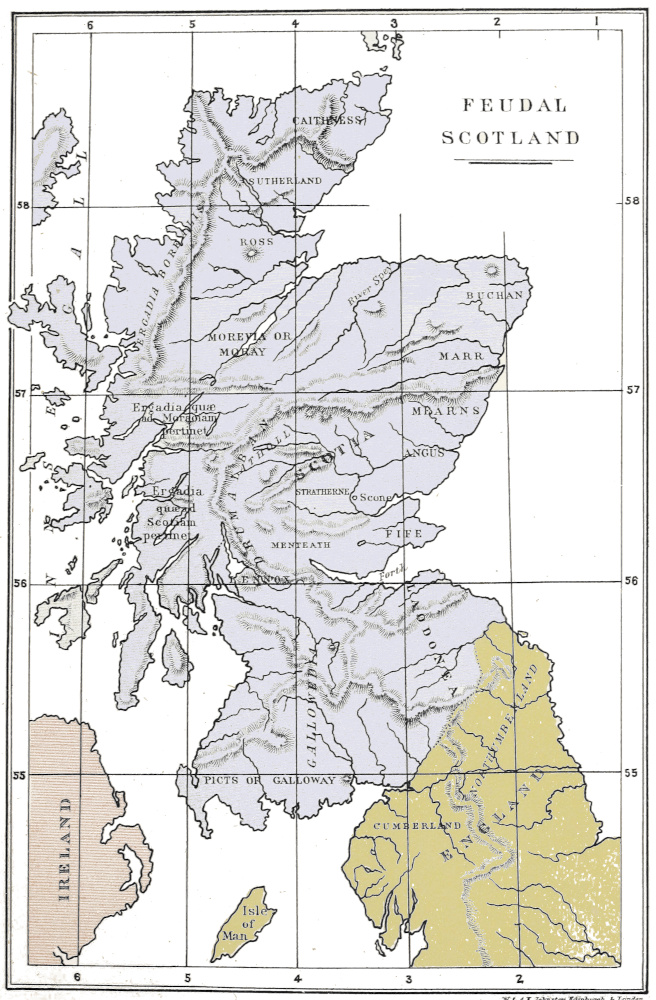
FEUDAL SCOTLAND W. & A. K. Johnston Edinburgh & London.
Conclusion.
497The young Maid of Norway died in Orkney, when on her passage from Norway to take possession of her kingdom, in the end of September 1290, and thus terminated the last native dynasty of Scottish monarchs of Celtic descent in the male line, and Scotland, with her united provinces, her feudal institutions, and her mixed population, now became a prize to be contested for between the English monarch, who asserted his right as her lord paramount, and the various Norman barons who claimed her as their inheritance through descent in the female line from her native monarchs. It is with the Celtic portion of her population alone that this work is now mainly concerned.
499