INTRODUCTION.
Reading edition
Name of Scotia, or Scotland.
The name of Scotia, or Scotland, whether in its Latin or its Saxon form, was not applied to any part of the territory forming the modern kingdom of Scotland till towards the end of the tenth century.
Prior to that period it was comprised in the general appellation of Britannia, or Britain, by which the whole island was designated in contradistinction to that of Hibernia, or Ireland. That part of the island of Britain which is situated to the north of the Firths of Forth and Clyde seems indeed to have been known to the Romans as early as the first century by the distinctive name of Caledonia,[1] and it also appears to have borne from an early period another appellation, the Celtic form of which was Albu, Alba, or Alban,[2] and its Latin form Albania.
2The name of Scotia, however, was exclusively appropriated to the island of Ireland, which was emphatically Scotia, the ‘patria,’ or mother country, of the Scots;[3] and although a colony of that people had established themselves as early as the beginning of the sixth century in the western districts of Scotland, it was not till the tenth century that any part of the present country of Scotland came to be known under that name, nor did it extend over the whole of those districts which formed the later kingdom of the Scots till after the twelfth century.
Ancient extent of the kingdom.
From the tenth to the twelfth or thirteenth centuries the name of Scotia, gradually superseding the older name of Alban, or Albania, was confined to a district nearly corresponding with that part of the Lowlands of Scotland which is situated on the north of the Firth of Forth. The Scotia of these centuries was bounded on the south by the Firth of Forth; on the north by the Moray Firth and river Spey; on the east by the German Ocean; and on the west by the range of mountains which divides the modern county of Perth from that of Argyll. It excluded Lothian, Strathclyde, and Galloway, on the south; the great province of Moravia, or Moray, and that of Cathanesia, or Caithness, on 3the north; and the region of Argathelia, or Argyll, on the west.
Subsequently the name of Scotia extended over these districts also, and the kingdom by degrees assumed that compact and united form which it ever afterwards exhibited.
The three propositions—1st, That Scotia, prior to the tenth century, was Ireland, and Ireland alone; 2d, That when applied to Scotland it was considered a new name superinduced upon the older designation of Alban or Albania; and 3d, That the Scotia of the three succeeding centuries was limited to the districts between the Forth, the Spey, and Drumalban,—lie at the very threshold of Scottish history.[4]
4The history of the name of a country is generally found to afford a very important clue to the leading features in the 5history of its population. This is remarkably the case with regard to the history of Scotland, and the facts just indicated 6in connection with the application of its name at different periods throw light upon the corresponding changes in the race and position of its inhabitants. They point to the fact that, prior to the tenth century, none of the small and independent tribes which originally occupied the country, and are ever the characteristic of an early period in their social history, or of the petty kingdoms which succeeded them, were sufficiently powerful and extended, or predominated sufficiently over the others, to give a general name to the country; and they point to a great change in the population of the country and the relative position of these kingdoms to each other in the tenth century, and to the elevation, by some important revolution, of the race of the Scots over the others, whose territory formed a centre round which the formerly independent petty kingdoms now assumed the form of dependent provinces, and from which an influence and authority proceeded that 7gradually extended the name of Scotia over the whole of the country, and incorporated its provinces into one compact and co-extensive monarchy.
Physical features of the country.
The great natural features of a country so mountainous and intersected by so many arms of the sea as that of Scotland, seem at all times to have influenced its political divisions and the distribution of the various races in its occupation. The original territories of the savage tribes of Caledonia appear to have differed little from those of the petty kingdoms which succeeded them, and the latter as little from the subsequent provinces of the monarchy. The same great leading boundaries, the same natural defences, are throughout found occupying a similar position and exercising a similar influence upon the internal history of the country, while, amidst the numerous fluctuations and changes which affected the position of the northern tribes towards the southern and more civilised kingdoms of Britain, the two ever showed a tendency to settle down upon the great natural bulwarks of the south of Scotland as their mutual boundary, to which, indeed, the independent position of the northern monarchy in no slight degree owed its existence.
Where the great arm of the western sea forming the Solway Firth contracts the island to a comparatively narrow breadth, not exceeding seventy miles, a natural boundary was thus partially formed, which had its influence at the very dawn of Scottish history; but, if during the occupation of the island by the Romans, who placed their trust more in the artificial protection of a rampart guarded by troops, the comparatively level ground in this contracted part of the country presented facilities for such a construction, the great physical bulwark of the Cheviot Hills had an irresistible attraction to fix the boundary eventually between the Solway and the Tweed, where that chain of hills extending between them proved so effectual a defence to the country along the whole of its 8range, that every hostile entrance into it was made either at the eastern or the western termination of that mountain chain.
Farther north is the still more remarkable natural boundary where the Eastern and the Western Seas penetrate into the country in the Firths of Forth and Clyde, and approach within a comparatively short distance of each other, separating the northern from the southern regions of Scotland by an isthmus not exceeding thirty-five miles in breadth. This was remarked as early as the first Roman invasion of Scotland, when the historian Tacitus observes that these estuaries almost intersect the country, leaving only a narrow neck of land, and that the northern part formed, as it were, another island.[5]
Proceeding farther north, the great series of the mountain ranges, stretching from the south-west to the north-east, present one continuous barrier, intersected indeed by rivers forming narrow and easily defended passes, but exhibiting the appearance of a mighty wall, which separates a wild and mountainous region from the well-watered and fertile plains and straths on the south and east; and, while the latter have been at all times exposed to the vicissitudes of external revolution, and the greatly more important and radical change from the silent progress of natural colonisation, the recesses of the Highlands have ever proved the shelter and protection of the descendants of the older tribes of the country, and the limit to the advance of a stranger population.
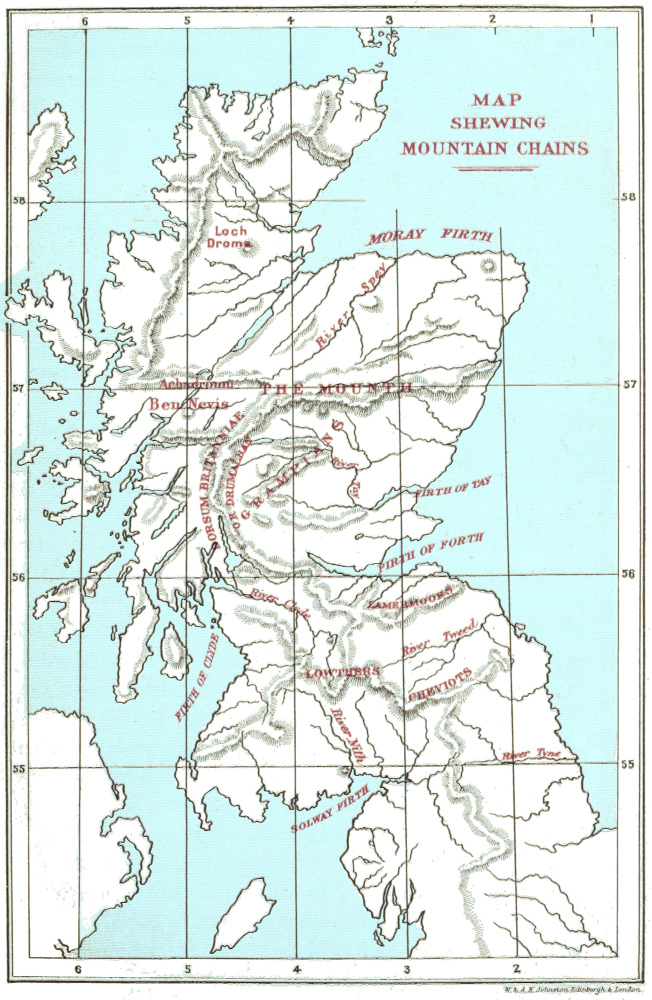
MAP SHEWING MOUNTAIN CHAINS W. & A.K. Johnston, Edinburgh & London.
The territory which forms the modern kingdom of Scotland is thus thrown by its leading physical features into three great compartments. First, the districts extending from the Solway, the Cheviots, and the Tweed, on the south, 9to the Firths of Forth and Clyde on the north; secondly, the low country extending along the east coast from the Forth as far as the Moray Firth, and lying between the sea and the great barrier of the Grampians; and thirdly, the Highland or mountainous region on the north-west.
Mountain chains.
In each of these great districts natural boundaries are again found exercising their influence on the subordinate political divisions. |The Cheviots.| In the first of these great compartments, the lofty range of the Cheviots, which forms the southern boundary and presents a steep face to the north, extends from the Cheviot Hill on the north-east by Carter Fell to Peel Fell on the south-west; and from thence a range of hills, sometimes included in the general name of the Cheviots, separates the district of Liddesdale from that of Teviotdale, and has its highest point in the centre of this part of the island, in a group of hills termed the Lowthers, where the four great rivers of the Tweed, the Clyde, the Annan, and the Nith, take their rise. From thence it extends westward to Loch Ryan, separating the waters which pour their streams into the Solway Firth from those which flow to the north. From the centre of this range a smaller and less remarkable chain of hills branches off, which, running eastward by Soutra and Lammermoor, end at St. Abb’s Head, at the entrance to the Firth of Forth, separating the tributaries of the Tweed from the streams which flow into the Firth of Forth. In the centre of the island, a barren and hilly region divides the districts watered by the rivers flowing into the east sea from those on the west coast.
The same natural boundary which separated the eastern from the western tribes afterwards divided the kingdom of the Strathclyde Britons from that of the Angles; at a subsequent period, the province of Galweia from that of Lodoneia in their most extended sense; and now separates the counties of Lanark, Ayr, and Dumfries from the Lothians and the Merse. Galloway in its limited sense was not more 10clearly separated by its mountain barrier on the north from Strathclyde, than were the Pictish from the British races by the same chain, and the earlier tribes of the Selgovæ and Novantæ from the Damnii.
In the other two great compartments situated on the north of the Firths of Forth and Clyde, two great mountain chains and two large rivers formed the principal landmarks in the early history of the social occupation of these districts. These two principal mountain chains were in fact the great central ridges from which the numerous minor chains proceed, and the rivers flow in opposite directions, forming that aggregate of well-watered glens and rocky defiles which characterise the mountain region of Scotland, till its streams, uniting their waters into larger channels, burst forth through the mountain passes, and flow through the more fertile plains of the Lowlands into the German Ocean.
The Mounth.
The first of these two great mountain chains was known by the name of the Mounth, and extends in nearly a straight line across the island from the Eastern Sea near Aberdeen to the Western Sea at Fort-William, having in its centre and at its western termination the two highest mountains in Great Britain—Ben-na-muich-dubh and Ben Nevis.
Drumalban.
The second great chain, less elevated and massive in its character, but presenting the more picturesque feature of sharp conical summits, crosses the other at right angles, running north and south, and forming the backbone of Scotland—the great wind and water shear, which separates the eastern from the western districts, and the rivers flowing into the German Ocean from those which pour their waters into the Western Sea. It is termed in the early records of Scottish history Dorsum Britanniæ, or Drumalban—the dorsal ridge or backbone of Scotland. It commences in Dumbartonshire, and forms the great separating ridge between the eastern and western waters from south to north, till it terminates in the Ord of Caithness.
11These two mountain chains—the Mounth and Drumalban, the one running east and west, the other south and north, and intersecting each other—thus divided the country north of the Firths of Forth and Clyde into four great districts, two extending along the east coast, and two along the west, while each of the two eastern and western divisions were separated from each other by the Mounth. The two eastern divisions are watered by the two great rivers of the Tay and the Spey and their tributaries, the one flowing south and the other north from these mountain chains. The two western divisions are intersected by those arms of the sea or lochs, which form so peculiar a feature in the West Highlands.
The Grampians.
The lesser mountain ridges which proceed on either side of the Mounth, and separate the various streams which flow into the two great rivers from each other, terminate as the waters enter the plains of the Lowlands, and present the appearance of a great barrier stretching obliquely across each of the two eastern districts and separating the mountain region from the plain; but, although this great barrier has an appearance as if it were a continuous mountain range, and is usually so considered, it is not so in reality, but is formed by the termination of these numerous lesser ridges, and is intersected by the great rivers and their tributaries. This great barrier forms what was subsequently termed the Highland line, and that part of it which extends across the south-eastern district from Loch Lomond to the eastern termination of the Mounth was known under the general but loosely applied name of the Grampians.[6]
12Within is a wild and mountainous region full of the most picturesque beauty which the ever-varied combination of mountain, rock, and stream can afford, but adapted only for pasture and hunting, and for the occupation of a people still in the early stage of pastoral and warlike life; while every stream which forces its way from its recesses through this terminating range forms a pass into the interior capable of being easily defended.
Throughout the early history of Scotland these great mountain chains and rivers have always formed important landmarks of the country. If the Mounth is now known as the range of hills which separate the more southern counties of Kincardine, Forfar, and Perth from those of Aberdeen and Inverness on the north, it was not less known to the 13Venerable Bede, in the eighth century, as the steep and rugged mountains which separate the provinces of the southern from those of the northern Picts.[7] If Drumalban now separates the county of Argyll from that of Perth, it formed equally in the eleventh century the mountain range which separated Arregaithel from Scotia,[8] and at an earlier period the boundary between the Picts and the Scots of Dalriada.[9]
The river Spey, which now separates the counties of Aberdeen and Banff from those of Moray and Nairn, was for three centuries the boundary between Scotia, or Scotland proper, and Moravia, or the great province of Moray. The Tay, which separates the districts of Stratherne and Gowry, formed for half a century the limit of the Anglic conquests 14in the territory of the Picts, and at the very dawn of our history interposed as formidable a barrier to the progress of the Roman arms. The Forth, which for three centuries was the southern boundary of Scotia, or Scotland proper, during the previous centuries separated the Pictish from the British population.
The debateable lands.
The tract of country in which the frontiers of several independent kingdoms, or the territories in the occupation of tribes of different race, meet, usually forms a species of debateable land, and the transactions which take place within its limits afford in general a key to much of their relative history. Such were the districts extending from the river Tay to the minor range of the Pentland hills and the river Esk, which flows into the Firth of Forth on the south. These districts fall naturally into three divisions. The region extending from the Tay to the river Forth, and containing part of Perthshire, was included in that part of the country to which the name of Alban, and afterwards that of Scotia, was given. The central district between the rivers Forth and Carron consisted of the whole of Stirlingshire and part of Dumbartonshire, and belonged more properly to Strathclyde. The region extending from the Carron to the Pentlands and the river Esk on the south comprised the counties of West and Mid Lothian, and was attached to Northumbria; but all three may be viewed as outlying districts, having a mixed population contributed by the neighbouring races.
Situated in the heart of Scotland, and having around it tribes of different races, and subsequently the four kingdoms of the Picts, the Scots, the Angles, and the Britons, surpassing the other districts in fertility, and possessing those rich carses which are still distinguished as the finest agricultural districts of Scotland, this region was coveted as the chief prize alike by the invaders and the native tribes. The scene of the principal Roman campaigns, it appears throughout the entire course of Scottish history as the main battlefield 15of contending races and struggling influences. Roman and Barbarian, Gael and Cymry, Scot and Angle, contended for its occupation, and within its limits is formed the ever-shifting boundary between the petty northern kingdoms, till in the memorable ninth century a monarchy was established, of which the founder was a Scot, the chief seat Scone, and that revolution was accomplished, which it is difficult to say whether it was more civil or ecclesiastical in its character, but which finally established the supremacy of the Scottish people over the different races in the country, and led to their gradual combination and more intimate union in the subsequent kingdom of Scotland. The kingdom of the Scots soon extended itself over these central plains. Its monarchs usually had their residence within its limits, and the capital, which had at first been Scone, on the left bank of the Tay, eventually became established at Edinburgh, within a few miles of its southern boundary.
During the few succeeding centuries of Scottish rule, after the establishment of the Scottish monarchy in the ninth century, it remained limited to the districts bounded by the Forth on the south, the mountain chain called Drumalban on the west, and the Spey on the north. The Scots had rapidly extended their power and influence over the native tribes within these limits; but beyond them (on the north and west) they held an uncertain authority over wild and semi-independent nations, nominally dependencies of the kingdom, but in reality neither owning its authority nor adopting its name.
It was by slow degrees that the peoples beyond these limits were first subjugated and then amalgamated with the original Scottish kingdom; and it was not till the middle of the thirteenth century, when the annexation of the Western Isles by Alexander the Third finally completed the territorial acquisitions of the monarchy, that its name and authority became co-extensive with the utmost limits of the country, 16and Scotland was consolidated in its utmost extent of territory into one kingdom.
Periods of its history.
The early history of Scotland thus presents itself to the historian in five distinct periods, each possessing a character peculiar to itself.
During the first period of three centuries and a half the native tribes of Scotland were under the influence of the Roman power, at one time struggling for independent existence, at another subject to their authority, and awaking to those impressions of civilisation and of social organisation, the fruits of which they subsequently displayed.
A period of rather longer duration succeeded to the Roman rule, in which the native and foreign races in the country first struggled for the succession to their dominant authority in the island, and then contended among themselves for the possession of its fairest portions.
The third period commences with the establishment of the Scottish monarchy in the ninth century, and lasted for two centuries and a half, till the Scottish dynasty became extinct in the person of Malcolm the Second.
There then succeeded, during the fourth period, which lasted for a century, a renewed struggle between the different races in the country, which, although the Scoto-Saxon dynasty, uniting through the female line the blood of the Scots and the Saxons, succeeded in seating themselves firmly on the throne, cannot be said to have terminated in the general recognition of their royal authority till the reign of David the First.
The fifth period, consisting of the reigns of David I., Malcolm IV., William the Lion, and Alexander the Second and Third, was characterised by the rapid amalgamation of the different provinces, and the spread of the Saxon race and of the feudal institutions over the whole country, with the exception of the Highlands and Islands, and left the kingdom 17of Scotland in the position in which we find it when the death of Alexander the Third, in 1286, terminated the last of the native dynasties of her monarchs.
Celtic Scotland.
During the first three periods of her early history, Scotland may be viewed as a purely Celtic kingdom, with a population composed of different branches of the race popularly called Celtic. But during the subsequent periods, though the connection between Scotland with her Celtic population and Lothian with her Anglic inhabitants was at first but slender, her monarchs identified themselves more and more with their Teutonic subjects, with whom the Celtic tribes maintained an ineffectual struggle, and gradually retreated before their increasing power and colonisation, till they became confined to the mountains and western islands. The name of Scot passed over to the English-speaking people, and their language became known as the Scotch; while the Celtic language, formerly known as Scotch, became stamped with the title of Irish.
What may be called the Celtic period of Scottish history has been peculiarly the field of a fabulous narrative of no ordinary perplexity; but while the origin of these fables can be very distinctly traced to the rivalry and ambition of ecclesiastical establishments and church parties, and to the great national controversy excited by the claim of England to a feudal supremacy over Scotland, still each period of its early history will be found not to be without sources of information, slender and meagre as no doubt they are, but possessing indications of substantial truth, from which some perception of its real character can be obtained.
Critical examination of authorities necessary.
Before the early history of any country can be correctly ascertained, there is a preliminary process which must be gone through, and which is quite essential to a sound treatment of the subject; and that is a critical examination of the authorities upon which that history is based. This is especially necessary with regard to the early history of Scotland. 18The whole of the existing materials for her early history must be collected together and subjected to a critical examination. Those which seem to contain fragments of genuine history must be disentangled from the less trustworthy chronicles which have been tampered with for ecclesiastical or national purposes, and great discrimination exercised in the use of the latter. The purely spurious matter must be entirely rejected. It is by such a process only that we can hope to dispel the fabulous atmosphere which surrounds this period of Scottish history, and attempt to base it upon anything like a genuine foundation.
The first to attempt this task was Thomas Innes, a priest of the Scots College in Paris, who published in 1729 his admirable Essay on the ancient inhabitants of Scotland. In this essay he assailed the fabulous history first put into shape by John of Fordun and elaborated by Hector Boece, and effectually demolished its authority; but he attempted little in the way of reconstruction, and merely printed a few of the short chronicles, upon which he founded, in an appendix.
Lord Hailes, who in 1776 published his Annals of Scotland, from the Accession of Malcolm III., surnamed Canmore, to the Accession of Robert I., abandons this period of Scottish history altogether, with the remark that his Annals ‘commence with the accession of Malcolm Canmore, because the history of Scotland previous to that period is involved in obscurity and fable.’
The first to attempt a reconstruction of this early history was John Pinkerton, who published in 1789 An Enquiry into the History of Scotland preceding the reign of Malcolm III., or the year 1056, including the authentic history of that period. It is unquestionably an essay of much originality and acuteness; and Pinkerton saw the necessity of founding the history of that period upon more trustworthy documents, but they were to a very limited extent accessible to him. The value of the work is greatly impaired 19by the adoption, to an excessive extent, of a theory of early Teutonic settlements in the country and of the Teutonic origin of the early population, and by an unreasoning prejudice against everything Celtic, which colours and biasses his argument throughout.
Pinkerton was followed in 1807 by George Chalmers, with his more elaborate and systematic work, the Caledonia, based, however, to a great extent upon the less trustworthy class of the early historical documents, which had been tampered with and manipulated for a purpose. He, too, was possessed by a theory which influences his views of the earlier portion of the history throughout; and where John Pinkerton could find nothing but Gothic and the Goths, George Chalmers was equally unable to see anything but Welsh and the Cymry.
In 1828 the first volume of a History of Scotland by Patrick Fraser Tytler appeared, which he continued to the accession of James VI. to the throne of England; but Tytler not only abandons this early part of the history as hopelessly obscure, but also a great part of the field occupied by Hailes in his Annals, and commences his history with the accession of Alexander the Third in 1249.
In 1862 a very valuable contribution to the early history of Scotland was made by the late lamented Mr. E. William Robertson in his Scotland under her Early Kings, in which the attempt is once more made to fill up the early period left untouched by Hailes and Tytler. It is a work of great merit, and exhibits much accurate research and sound judgment.[10]
Such is a short sketch of the attempts which have been made to place the early history of Scotland upon a sound basis, and to substitute a more trustworthy statement of it for the carefully manipulated fictions of Fordun, and the still 20more fabulous narrative of Hector Boece and his followers, prior to the appearance of Mr. Burton’s elaborate History of Scotland, from Agricola’s Invasion to the Extinction of the last Jacobite Insurrection, the first edition of which appeared in 1867, and the second, in which the early part is revised and much altered, in 1873.
These works, however, are all more or less tainted by the same defect, that they have not been founded upon that complete and comprehensive examination of all the existing materials for the history of this early period, and that critical discrimination of their relative value and analysis of their contents, without which any view of this period of the annals of the country must be partial and inexact. They labour, in short, under the twofold defect, first, of an uncritical use of the materials which are authentic; and second, of the combination with these materials of others which are undoubtedly spurious. The early chronicles are referred to as of equal authority, and without reference to the period or circumstances of their production. The text of Fordun’s Chronicle, upon which the history, at least prior to the fourteenth century, must always to a considerable extent be based, is quoted as an original authority, without adverting to the materials he made use of and the mode in which he has adapted them to a fictitious scheme of history; and the additions and alterations of his interpolator Bower are not only founded upon as the statements of Fordun himself, but quoted under his name in preference to his original version of the events.
The author has elsewhere endeavoured to complete the work commenced by Thomas Innes. He has collected together in one volume the whole of the existing chronicles and other memorials of the history of Scotland prior to the appearance of Fordun’s Chronicle, and has subjected them, as well as the work of Fordun, to a critical examination and analysis.[11]
21He now proposes to take a farther step in advance, and to attempt in the present work to place the early history of the country upon a sounder basis, and to exhibit Celtic Scotland, so far as these materials enable him to do so, in a clearer and more authentic light. By following their guidance, and giving effect to fair and just inferences from their statements unbiassed by theory or partiality, and subjected to the corrective tests of comparison with those physical records which the country itself presents, it is hoped that it may not be found impossible to make some approximation to the truth, even with regard to the annals of this early period of Scottish history.
It may be said that this task has been rendered unnecessary by the appearance of Mr. Burton’s History of Scotland, which commences the narrative with the invasion of Agricola, and claims ‘the two fundamental qualities of a serviceable history—completeness and accuracy;’[12] but, with much appreciation of the merits of Mr. Burton’s work as a whole, the author is afraid that he cannot recognise it as possessing either character, so far as the early part of the history is concerned, and he considers that the ground which the present work is intended to occupy remains still unappropriated.
Spurious authorities.
It remains for him to indicate here at the outset the materials founded upon by the previous writers which he considers of questionable authority, or must reject as entirely spurious.
22Among the first to be rejected as entirely spurious is the work attributed to Richard of Cirencester, De situ Britanniæ et Stationum quas Romani ipsi in ea insula ædificaverunt. It was published in 1757 from a MS. said to be discovered at Copenhagen by Charles Julius Bertram, and was at once adopted as genuine. The author at a very early period came to the conclusion that the whole work, including the itineraries, was an impudent forgery, and this has since been so amply demonstrated, and is now so generally admitted, that it is unnecessary to occupy space by proving it.[13] The whole of the Roman part of Pinkerton’s Enquiry and of the elaborate work of Chalmers is tainted by it; and, what is perhaps more to be regretted, the valuable work of General Roy[14] on The Military Antiquities of the Romans in Britain, published in 1793. He says in his introduction, ‘From small beginnings it is, however, no unusual thing to be led imperceptibly to engage in more extensive and laborious undertakings, as will easily appear from what follows, for since the discovery of Agricola’s camps, the work of Richard of Cirencester having likewise been found out in Denmark and published to the world, the curious have thereby been furnished with many new lights concerning the Roman history and 23geography of Britain in general, but more particularly the north part of it,’ and by this unfortunate adoption of the forged work by General Roy, there has been lost to the world, to a great extent, the advantage of the commentary of one so well able to judge of military affairs. Horsley’s valuable work, the Britannia Romana, was fortunately published in 1732 before this imposition was practised on the literary world; but Stuart has not been equally fortunate in his Caledonia Romana, published in 1845, the usefulness of which is greatly impaired by it.
Among the Welsh documents which are usually founded upon as affording materials for the early history of the country, there is one class of documents contained in the Myvyrian Archæology which cannot be accepted as genuine. The principal of these are the so-called Historical Triads, which have been usually quoted as possessing undoubted claims to antiquity under the name of the Welsh Triads; the tale called Hanes Taliessin, or the history of Taliessin; and a collection of papers printed by the Welsh ms. Society, under the title of the Iolo MSS. These all proceeded from Edward Williams, one of the editors of the Myvyrian Archæology published in 1801, and who is better known under the bardic title of Iolo Morganwg. The circumstances under which he produced these documents, or the motives which led him to introduce so much questionable matter into the literature of Wales, it is difficult now to determine; but certain it is that no trace of them is to be found in any authentic source, and that they have given a character to Welsh literature which is much to be deplored. In a former work, the author in reviewing these documents merely said, ‘It is not unreasonable therefore to say that they must be viewed with some suspicion, and that very careful discrimination is required in the use of them.’ He does not hesitate now to reject them as entirely spurious.[15]
24It will of course be impossible to write upon the Celtic period of Scottish history without making a large use of Irish materials; and it is difficult to over-estimate the importance of the Irish Annals for this purpose; but these too must be used with some discrimination. The ancient history of Ireland presents the unusual aspect of the minute and detailed annals of reigns and events from a period reaching back to many centuries before the Christian era, the whole of which has been adopted by her historians as genuine. The work of Keating, written in Irish in 1640, a translation of which by Dermod O’Connor was published in 1726, may be taken as a fair representation of it. The earlier part of this history is obviously artificial, and is viewed by recent Irish historians more in the light of legend; but there is nothing whatever in the mode in which the annals of the different reigns are narrated to show where legend terminates and history begins, and there is a tendency among even the soundest writers on Irish history to push the claims of these annals to a historical character beyond the period to which it can reasonably be attached. For the events in Irish history the Annals of the Four Masters are usually quoted. There is a certain convenience in this, as it is the most complete chronicle which Ireland possesses; but it was compiled as late as the seventeenth century, having been commenced in 1632 and finished in 1636. The compilers were four eminent Irish antiquaries, the principal of whom was Michael O’Clery, whence it was termed by Colgan the Annals of the Four Masters. These annals begin with the year of the Deluge, said to be the year of the world 2242, or 2952 years before Christ, and continue in an unbroken series to the year of our Lord 1616. The latter part of the annals 25are founded upon other documents which are referred to in the preface, and from which they are said to be taken, but the authority for each event is not stated, and some of those recorded are not to be found elsewhere, and are open to suspicion.[16] The earlier part of the annals consists simply of a reduction of the fabulous history of Ireland into the shape of a chronicle, and, except that it is thrown into that form instead of that of a narrative, it does not appear to the author to possess greater claims to be ranked as an authority than the work of Keating. He cannot therefore accept it as an independent authority, nor can he regard the record of events to the fifth century as bearing the character of chronological history in the true sense of the term, though no doubt many of these events may have some foundation in fact.[17]
The older annals stand in a different position. Those of Tighernac, Inisfallen, and the Annals of Ulster, are extremely valuable for the history of Scotland; and, while the latter commence with what may be termed the historic period in 26the fifth century, the earlier events recorded by Tighernac, who died in the year 1088, may contain some fragments of genuine history.
Plan of the work.
The subject of this work will be most conveniently treated under three separate heads or books.
The first book will deal with the Ethnology and Civil History of the different races which occupied Scotland. In this inquiry, it will be of advantage that we should start with a clear conception of the knowledge which the Romans had of the northern part of the island, and of the exact amount of information as to its state and population which their possession of the southern part of it as a province affords. This will involve a repetition of the oft-told tale of the Roman occupation of Scotland. But this part of the history has been so overloaded with the uncritical use of authorities, the too ready reception of questionable or forged documents, and the injurious but baseless speculations of antiquaries, that we have nearly lost sight of what the contemporary authorities really tell us. Their statements are, no doubt, meagre, and may appear to afford an insufficient foundation for the deductions drawn from them, but they are precise; and it will be found that though they may compress the account of a campaign or a transaction into a few words, yet they had an accurate knowledge of the transactions, the result of which they wished to indicate, and knew well what they were writing about. It will be necessary, therefore, carefully to weigh these short but precise statements, and to place before the reader the state of the early inhabitants of Scotland as the Romans at the time knew them and viewed them, not as what by argument from other premises they can be made to appear.[18]
27This will lay the groundwork for an inquiry into their race and language; and an attempt will then be made to trace the history of these different races, their mutual struggle for supremacy, the causes and true character of that revolution which laid the foundation of the Scottish monarchy, and the gradual combination of its various heterogeneous elements into one united kingdom; and thus by a more complete and critical use of its materials, to place the early history of the country, during the Celtic period, upon a sounder basis.
The second book will deal with the Early Celtic Church of Scotland and its influence on the language and culture of the people. The ecclesiastical history of Scotland has shared the same fate with its civil history, and is deeply tainted with the fictitious and artificial system which has perverted both; but the stamp of these fables upon it is less easily removed. It has also had the additional misfortune of having been made the battle-field of polemical controversy. Each historian of the Church has viewed it through the medium of his ecclesiastical prepossessions, and from the standpoint of the Church party to which he belonged. The Episcopal historian feels the necessity of discovering in it his Diocesan Episcopacy, and the partisan 28of Presbyterian parity considers the principles of his Church involved in maintaining the existence of his early Presbyterian Culdees. One great exception must be made, however, in Dr. Reeves’s admirable edition of Adamnan’s Life of St. Columba, which has laid the foundation for a more rational treatment of the history of the early Church in Scotland.
The subject of the third and last book will be the Land and People of Scotland. It will treat of the early land tenures and social condition of its Celtic inhabitants. The publication of the Brehon laws of Ireland now enables us to trace somewhat of the history and character of their early tribal institutions and laws, and of their development in Scotland into those communities represented in the eastern districts by the Thanages, and in the western by the Clan system of the Highlands and Islands of Scotland.
29