Part 2 — CHAPTER I. (continued 2)
N. D'Anvers translation
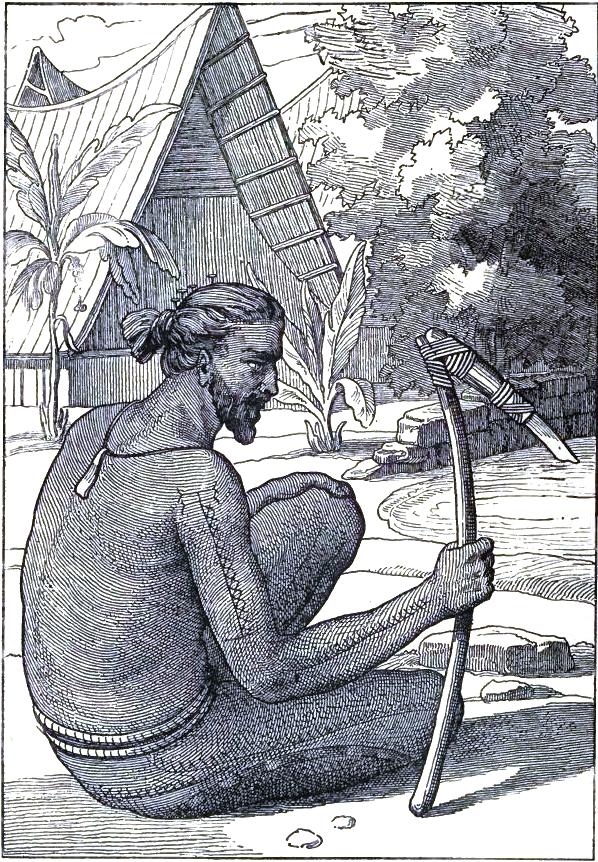
Native of Ualan. (Fac-simile of early engraving.)
After leaving Ualan, Lütke had a vain search for the Musgrave Islands, marked on Kruzenstern's map, and soon discovered a large island, surrounded by a coral reef, which had escaped the notice of Duperrey, and is known as Puinipet, or Pornabi. Some very large and fine canoes, each manned by fourteen men, and some smaller ones, worked by two natives only, soon surrounded the vessel. Their inmates, with fierce faces and blood-shot eyes, were noisy and blustering, and did a good deal of shouting, gesticulating, and dancing before they could make up their minds to trust themselves on board the Seniavine.
It would have been impossible to land, except by force, as the native canoes completely surrounded the vessel, and when an attempt at disembarkation was made, the savages surrounded the ship's boat, only retiring before the warlike attitude of the sailors and a volley from the guns of the Seniavine.
Lütke had not time to examine thoroughly his discovery, to which he gave the name of the Seniavine Archipelago. The information he collected on the people of the Puinipet Islands is, therefore, not very trustworthy. According to him they do not belong to the same race as those of Ualan, but resemble rather the Papuans, the nearest of whom are those of New Ireland, seven hundred miles away.
After another vain search, this time for Saint Augustine's Island, he sighted the Cora of Los Vaherites, also called Seven, or Raven Island, discovered in 1773 by the Spaniard Felipe Tompson.
The navigator next saw the Mortlock Archipelago, the old Lugunor group, known to Torrés as the Lugullos, the people of which resemble those of Ualan. He landed on the principal of these islands, which he found to be one huge garden of cocoa palms and breadfruit-trees.
The natives enjoy a centre degree of civilization. They weave and dye the fibres of the banana and cocoa-nut palms, as do those of Ualan and Puinipet. Their fishing-tackle does credit to their inventive faculties, especially a sort of case constructed of small sticks and split bamboo-canes, which the fish cannot get out of when once in. They also use nets of the shape of large wallets, lines, and harpoons.
Their canoes, in which they spend more than half their lives, are wonderfully adapted to their requirements. The large ones, which are a very great trouble to build, and which are kept in sheds constructed specially for them, are twenty-six feet long, two and a half wide, and four deep. They are furnished with gimbals, the cross-pieces being connected by a rafter. On the other side there is a small platform, four feet square, and furnished with a roof, under which they are accustomed to keep their provisions. These pirogues have a triangular sail, which is made of matting woven from bandanus leaves, and is attached to two yards. In tacking about they drop the sail, and turn the mast towards the other end of the canoe, to which, at the same time, they have passed the fastening of the sail, so that the pirogue moves forward by its other extremity.
Lütke next sighted the Namuluk group, the inhabitants of which do not differ at all from the people of Lugunor, and he proved the identity of Hogolu Island—already described by Duperrey—with Quirosa. He then visited the Namnuïto group, the first stratum of a number of islands, or of one large island which will some day exist in this part of the world.
Lütke, who was in want of biscuits and other articles, which he hoped to obtain at Guam, or from vessels at anchor in that port, now set sail for the Marianne Islands, where he counted upon being able to repeat some new experiments with the pendulum, in which Freycinet had found an important anomaly of gravitation.6
6 "From numerous experiments," says Freycinet, "with the pendulum, collected at our observatory at Agagna, in lat. 13° 27' 511" 5 N. ... at the level of the sea, and with the thermometer at +20° centig., we were shown that the pendulum which, in the same circumstances, would make at Paris 86,400 oscillations in 24 mean solar hours would here make 86,295 osc.013 in the same time."—Trans.
Great, however, was his surprise when he arrived to find not a sign of life at Guam. No flags waved above the two ports, the silence of death reigned everywhere, and but for the presence of a schooner at anchor in the inner harbour, it might have been a desert island. There was hardly anybody about on shore, and the few people there were were half savage, from whom it was all but impossible to obtain the slightest information. Fortunately, an English deserter came and offered his services to Lütke, who sent him to the governor with a letter, which elicited a satisfactory reply.
The governor was the same Medinella whose hospitality had been lauded by Kotzebue and Freycinet. There was, therefore, no difficulty in obtaining permission to set up an observatory, and to take to it the necessary provisions. The stay at Guam was, however, saddened by an accident to Lütke, who wounded himself severely in the thumb with his own gun when hunting.
The repairing and refitting of the Seniavine, with the taking in of wood and water, delayed the explorer at Guam until the 19th March. During this time Lütke was able to verify the information collected ten years ago by Freycinet in his stay of two months in the Governor's own house. Things had not changed at all since the French traveller's visit.
As it was not yet time to go north, Lütke made for the Caroline Islands, viâ the Swedes Islands. The inhabitants seemed to him to be better made than their neighbours on the west, from whom, however, they differ in no other particulars. The Faraulep, Ulie, Ifuluk, and Euripeg Islands were successively examined, and on the 27th April the explorer started for the Bonin Islands, where he learnt that his exploration of that group had been anticipated by Beechey. He, therefore, took no hydrographical surveys. Two of the crew of a whaling-vessel, which had been shipwrecked on the coast, were still living at Bonin Sima.
Since the rise of the great fisheries, this Archipelago has been frequented by numerous whalemen, who here find a safe port at all seasons, plenty of wood and water, turtles for six months of the year, fish, and immense quantities of anti-scorbutic plants, including the delicious savoy cabbage.
"The majestic height and the vigour of the trees," says Lütke, "the productions of the tropical and temperate zones, alternating with each other, bear witness at once to the fertility of the soil and the salubrity of the climate. Most of our vegetables and pot-herbs, perhaps, indeed, all of them would certainly flourish well, as would also wheat, rice, and maize, nor could a better climate be desired for the cultivation of the vine. Domestic animals of every kind and bees would multiply rapidly. In a word, a small and industrious colony would shortly convert this little group into a fertile and flourishing settlement."
On the 9th June, after a week's delay for want of wind, the Seniavine entered Petropaulovsky, where it was retained taking in provisions until the 26th. A whole series of surveys were taken during this interval, of the coasts of Kamtchatka, and of the Kodiak and Tchouktchi districts, interrupted, however, by visits to Karaghinsk Island, the bay of St. Lawrence, and the gulf of Santa Cruz.
During one of these visits, the captain met with a strange adventure. He had been for several days on a friendly footing with the Tchouktchis, whose knowledge of the people and customs of Russia he endeavoured to increase.
"These natives," he says, "were friendly and polite, and endeavoured to pay back our jokes and tricks in our own coin. I softly patted the cheek of a sturdy Tchouktchi as a sign of kindly feeling, and suddenly received in return a box on the ear which knocked me down. Recovered from my astonishment, there I saw my Tchouktchi with a laughing face, looking like a man who has just given proof of his politeness and tact. He too had meant to give me merely a gentle tap, but it was with a hand only accustomed to deal with reindeer."
The travellers were also witnesses of some proofs of the skill of a Tchouktchi conjurer, or chaman, who went behind a curtain, from which his audience soon heard a voice like the howl of a wild beast, accompanied by blows on a tambourine with a whale-bone. The curtain then rose, revealing the sorcerer balancing himself, and accompanying his own voice with blows on his drum, which he held close to his ear. Presently he flung off his jacket, leaving himself naked to the waist, took a polished stone, which he gave to Lütke to hold, took it away again, and as he passed one hand over the other the stone disappeared. Then showing a tumour on his shoulder, he pretended that the stone was in it; turned over the tumour, extracted the stone from it, and prophesied a favourable issue of the journey of the Russians.
The conjuror was congratulated on his skill, and a knife was given to him as a token of gratitude. Taking this knife in his hand, he put out his tongue, and began to cut it. His mouth became full of blood, and he finally cut a piece of his tongue off, and held the piece out in his hand. Here the curtain fell, probably because the skill of the professor of legerdemain could go no further.
The people inhabiting the north-east corner of Asia are known under the general name of Tchouktchis. This includes two races, one nomad, like the Samoyedes, called the Reindeer Tchouktchis; the other, living in fixed habitations, called the sedentary Tchouktchis. The mode of life, the physiognomy, and the very language of these two races differ. The idiom spoken by the sedentary Tchouktchis has great affinity with that of the Esquimaux, whom they also resemble in their mode of building their huts and leather boats, and in the instruments they use.
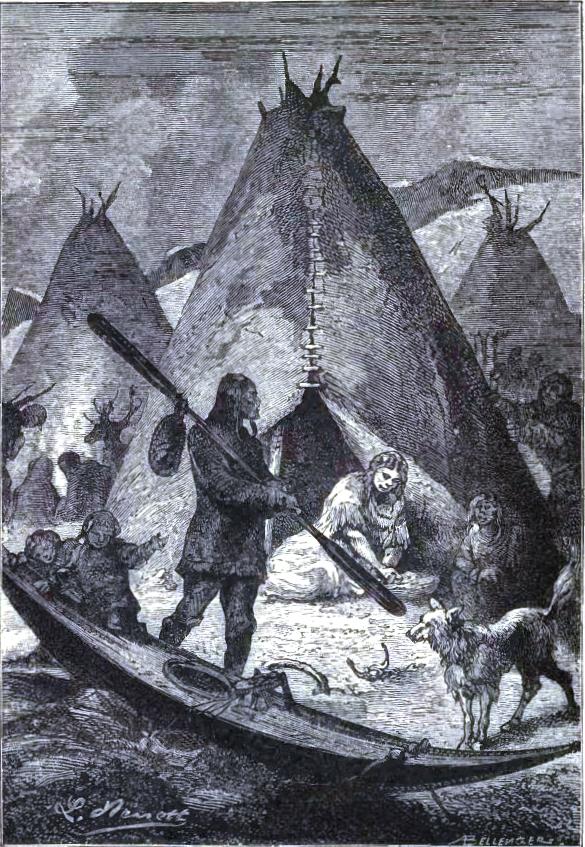
Sedentary Tchouktchis.
Lütke did not see many Reindeer Tchouktchis, so that he could add nothing to the information obtained by his predecessors. He was of opinion, however, that they had been painted in unfairly gloomy colours, and that their turbulence and wildness had been grossly exaggerated.
The sedentary Tchouktchis, generally called Namollos, spend the winter in sheds, and the summer in huts covered with skins. The latter usually each serve for several families.
"The sons and their wives, the daughters and their husbands," says the narrative, "live together with their parents, and vice versâ. Each family occupies one division of the back part of the hut, curtained off from the others. The curtains are made of reindeer-skins, sewn into the shape of a bell. They are fastened to the beams of the ceiling, and reach to the ground. With the aid of the grease they burn in cold weather, two, three, and sometimes more persons so warm the air with their breath in these hermetically sealed positions that all clothing is superfluous, even with the severest frost, but only Tchouktchi lungs are fitted to respire in such an atmosphere. In the outer part of the hut cooking-utensils, pottery, baskets, seal-skin trunks, &c., are kept. Here too is the hearth, if we can so call the spot where burn a few sticks of brushwood, painfully collected in the marsh, or when they are not to be obtained, whale-bones floating in grease. Round about the hut on wooden dryers, black and disgusting looking pieces of seal's flesh are exposed to view." These people lead a miserable life. They feed upon the half-raw flesh of seals and walruses hunted by themselves, or on that of whales flung up by the waves on the beach. The dog is the only domestic animal they possess, and they treat it badly enough, although the poor creatures are very affectionate and render them great services, now towing along their canoes, now dragging their sledges over the snow.
After a second stay of five weeks at Petropaulovski, the Seniavine left Kamtchatka, on the 10th of November, on its way back to Europe. Before reaching Manilla, Lütke made a cruise in the northern part of the Caroline Archipelago, which he had not had time to visit during the preceding winter. He saw in succession the islands of Marileu, Falulu, Faïu, Namuniuto, Magur, Faraulep, Eap, Mogmog, and found at Manilla the sloop, the Möller which was waiting his arrival.
The Caroline Archipelago embraces an immense space, and the Marianne Islands, as well as the Radak group, might fitly be included in it, as containing a population perfectly identical in race. For a long time the old geographers had had for their guidance only the charts of missionaries who, lacking alike the education and the appliances necessary to estimate accurately the size, position, and relative distance of all these archipelagoes, had attached notable importance to them, and often fixed at a considerable number of degrees the extent of a group which covered only a few miles.
Thus navigators accepted their guidance with wise caution. Freycinet was the first to infuse a little order into this chaos, and, thanks to his meeting with Kadu and Don Louis Torrès, he was able to identify later with earlier discoveries. Lütke did his part—and that not a small part—in the settling of an accurate and scientific chart of an archipelago which had long been the terror of navigators.
The learned Russian explorer is not of the same opinion as Lesson, one of his predecessors, who connected all the inhabitants of the Caroline group with the Mongolian race, under the name of the "Mongolo-Pelagian" branch. He rather sees in them, as did Chamisso and Balbi, a branch of the Malay family, which has peopled Eastern Polynesia. Whilst Lesson compares the people of the Carolines with the Chinese and Japanese, Lütke, on the other hand, finds in their great, projecting eyes, thick lips, and retroussé nose, a family likeness to the people of the Sandwich and Tonga Islands. The language does not suggest the slightest comparison with Japanese, whilst it shows a great resemblance to that of the Tonga Islands.
Lütke spent the time of his sojourn at Manilla in laying in stores, and repairing the sloop, and, on the 30th of January, he left that Spanish possession for Russia, which he reached on the 6th of September, 1829, casting anchor in the roads of Cronstadt.
It remains now to tell how it had fared with the sloop, the Möller, after the separation at Valparaiso. Arriving at Kamtchatka from Otaheite, she had left part of her cargo at Petropaulovski, and thereafter—in August, 1827—had set sail for Ounalashka, where she had remained for a month. After an examination of the west coast of America, which was cut short by unfavourable weather, and a stay at Honolulu, which extended to February, 1828, she had discovered the island Möller, noted the Necker, Gardner, and Lisiansky Islands, and marked, at a distance of six miles southwards, a very dangerous reef.
The sloop had then coasted the island of Curè, the French Frigate Shoal the reef Maro, Pearl Island, and the Isle of Hermes; and, after having made search for several islands marked upon Arrowsmith's charts, had at length reached Kamtchatka. At the end of April, she had set sail for Ounalashka and taken observations of the north coast of the Alaska peninsula. In September the Möller rejoined the Seniavine, and, from that period until their return to Russia, they were no more separated, save for brief intervals.
As one may judge from the sufficiently detailed account which has just been given, this expedition did not fail to bring about results of importance to geographical science. We must add that the different branches of natural history, physics, and astronomy, owe to it equally numerous and important additions.