Chapter I
N. D'Anvers translation
THE DAWN OF A CENTURY OF DISCOVERY.
Slackness of discovery during the struggles of the Republic and Empire—Seetzen's voyages in Syria and Palestine—Hauran and the circumnavigation of the Dead Sea—Decapolis—Journey in Arabia—Burckhardt in Syria—Expeditions in Nubia upon the two branches of the Nile—Pilgrimage to Mecca and Medina—The English in India—Webb at the Source of the Ganges—Narrative of a journey in the Punjab—Christie and Pottinger in Scinde—The same explorers cross Beluchistan into Persia—Elphinstone in Afghanistan—Persia according to Gardane, A. Dupré, Morier, Macdonald-Kinneir, Price, and Ouseley—Guldenstædt and Klaproth in the Caucasus—Lewis and Clarke in the Rocky Mountains—Raffles in Sumatra and Java.
A sensible diminution in geographical discovery marks the close of the eighteenth and the beginning of the nineteenth centuries.
We have already noticed the organization of the Expedition sent in search of La Pérouse by the French Republic, and also Captain Baudin's important cruise along the Australian coasts. These are the only instances in which the unrestrained passions and fratricidal struggles of the French nation allowed the government to exhibit interest in geography, a science which is especially favoured by the French.
At a later period, Bonaparte consulted several savants and distinguished artists, and the materials for that grand undertaking which first gave an idea (incomplete though it was) of the ancient civilization of the land of the Pharaohs, were collected together. But when Bonaparte had completely given place to Napoleon, the egotistical monarch, sacrificing all else to his ruling passion for war, would no longer listen to explorations, voyages, or possible discoveries. They represented money and men stolen from him; and his expenditure of those materials was far too great to allow of such futile waste. This was clearly shown, when he ceded the last remnants of French colonial rule in America to the United States for a few millions.
Happily other nations were not oppressed by the same iron hand. Absorbed although they might be in their struggle with France, they could still find volunteers to extend the range of geographical science, to establish archæology upon scientific bases, and to prosecute linguistic and ethnographical enterprise.
The learned geographer Malte-Brun, in an article published by him in the "Nouvelles Annales des Voyages" in 1817, gives a minute account of the condition of French geographical knowledge at the beginning of the nineteenth century, and of the many desiderata of that science. He reviews the progress already made in navigation, astronomy, and languages. The India Company, far from concealing its discoveries, as jealousy had induced the Hudson Bay Company to do, founded academies, published memoirs, and encouraged travellers.
War itself was utilized, for the French army gathered a store of precious material in Egypt. We shall shortly see how emulation spread among the various nations.
From the commencement of the century, one country has taken the lead in great discoveries. German explorers have worked so earnestly, and have proved themselves possessed of will so strong and instinct so sure, that they have left little for their successors to do beyond verifying and completing their discoveries.
The first in order of time was Ulric Jasper Seetzen, born in 1767 in East Friesland; he completed his education at Göttingen, and published some essays upon statistics and the natural sciences, for which he had a natural inclination. These publications attracted the attention of the government, and he was appointed Aulic Councillor in the province of Tever.
Seetzen's ambition, like that of Burckhardt subsequently, was an expedition to Central Africa, but he wished previously to make an exploration of Palestine and Syria, to which countries attention was shortly to be directed by the "Palestine Association," founded in London in 1805.
Seetzen did not wait for this period, but in 1802 set out for Constantinople, furnished with suitable introductions.
Although many pilgrims and travellers had successively visited the Holy Land and Syria, the vaguest notions about these countries prevailed. Their physical geography was not determined, details were wanting, and certain regions, as for example, the Lebanon and the Dead Sea had never been explored.
Comparative geography did not exist. It has taken the unwearied efforts of the English Association and the science of travellers in connexion with it to erect that study into a science. Seetzen, whose studies had been various, found himself admirably prepared to explore a country which, often visited, was still in reality new.
Having travelled through Anatolia, Seetzen reached Aleppo in May, 1802. He remained there a year, devoting himself to the practical study of the Arabic tongue, making extracts from Eastern historians and geographers, verifying the astronomical position of Aleppo, prosecuting his investigations into natural history, collecting manuscripts, and translating many of those popular songs and legends which are such valuable aids to the knowledge of a nation.
Seetzen left Aleppo in 1805 for Damascus. His first expedition led him across the provinces of Hauran and Jaulan, situated to the S.E. of that town. No traveller had as yet visited these two provinces, which in the days of Roman dominion had played an important part in the history of the Jews, under the names of Auranitis and Gaulonitis. Seetzen was the first to give an idea of their geography.
The enterprising traveller explored the Lebanon and Baalbek. He prosecuted his discoveries south of Damascus, and entered Judea, exploring the eastern portion of Hermon, the Jordan, and the Dead Sea. This was the dwelling-place of those races well known to us in Jewish history; the Ammonites, Moabites, and Gileadites. At the time of the Roman conquest, the western portion of this country was known as Perea, and was the centre of the celebrated Decapolis or confederacy of ten cities. No modern traveller had visited these regions, a fact sufficient to induce Seetzen to begin his exploration with them.
His friends at Damascus had tried to dissuade him from the journey, by picturing the difficulties and danger of a route frequented by Bedouins; but nothing could stay him. Before visiting the Decapolis region and investigating the condition of its ruins, Seetzen traversed a small district, named Ladscha, which bore a bad reputation at Damascus on account of the Bedouins who occupied it, but which was said to contain remarkable antiquities.
Leaving Damascus on the 12th of December, 1805, with an Armenian guide who misled him from the first, Seetzen, having prudently provided himself with a passport from the Pasha, proceeded from village to village escorted by an armed attendant.
In a narrative published in the earlier "Annales des Voyages," says the traveller,—
"That portion of Ladscha which I have seen is, like Hauran, entirely formed of basalt, often very porous, and in many districts forming vast stony deserts. The villages, which are mostly in ruins, are built on the sides of the rocks. The black colour of the basalt, the ruined houses, the churches and towers fallen into decay, with the total dearth of trees and verdure, combine to give a sombre aspect to this country, which strikes one almost with dread. In almost every village are either Grecian inscriptions, columns, or other remnants of antiquity; amongst others I copied an inscription of the Emperor Marcus Aurelius. Here, as in Hauran, the doors were of basalt."
Seetzen had scarcely arrived at the village of Gerasa and enjoyed a brief rest, before he was surrounded by half a score of mounted men, who said they had come by order of the vice-governor of Hauran to arrest him. Their master, Omar Aga, having learned that the traveller had been seen in the country the preceding year, and imagining his passports to be forgeries, had sent them to bring him before him.
Resistance was useless. Without allowing himself to be disconcerted by an incident which he regarded as a simple contretemps, Seetzen proceeded in the direction of Hauran, where after a day and a half's journey he met Omar Aga, travelling with the Mecca caravan. The travellers having received a hearty welcome, departed on the morrow, but meeting upon his way with many troops of Arabs, upon whom his demeanour imposed respect, he came to the conclusion that it had been Omar Aga's intention to have him robbed.
Returning to Damascus, Seetzen had great trouble in finding a guide who would accompany him in his expedition along the eastern shore of the Jordan, and around the Dead Sea. At last, a certain Yusuf-al-Milky, a member of the Greek church, who, for some thirty years, had carried on traffic with the Arab tribes, and travelled in the provinces which Seetzen desired to visit, agreed to bear him company.
The two travellers left Damascus on the 19th of January, 1806. Seetzen's entire baggage consisted of a few clothes, some indispensable books, paper for drying plants, and an assortment of drugs, necessary to sustain his assumed character as a physician. He wore the dress of a sheik of secondary rank.
The districts of Rasheiya and Hasbeiya, at the foot of Mount Hermon—whose summit at the time was hidden by snow—were the first explored by Seetzen, for the reason that they were the least known in Syria.
He then visited Achha, a village inhabited by the Druses, upon the opposite side of the mountain; Rasheiya, the residence of the Emir; and Hasbeiya, where he paid a visit to the Greek Bishop of Szur or Szeida, to whom he carried letters of recommendation. The object which chiefly attracted his attention in this mountainous district, was an asphalt-mine, whose produce is there used to protect the vines from insects.
Leaving Hasbeiya, Seetzen proceeded to Bâniâs, the ancient Casaræa Philippi, which is now a mere collection of huts. Even if traces of its fortifications were discoverable, not the smallest remains could be found of the splendid temple erected by Herod in honour of Augustus.
Ancient authorities hold that the river of Bâniâs is the source of the Jordan, but in reality that title belongs to the river Hasbany, which forms the larger branch of the Jordan. Seetzen recognized it, as he also did the Lake of Merom, or the ancient Samachonitis.
Here he was deserted by his muleteers, whom nothing could induce to accompany him so far as the bridge of Jisr-Benat-Yakûb, and also by his guide Yusuf, whom he was forced to send by the open road to await his arrival at Tiberias, while he himself proceeded on foot towards the celebrated bridge, accompanied by a single Arab attendant.
He, however, found no one at Jisr-Benat-Yakûb who was willing to accompany him along the eastern shore of the Jordan, until a native, believing him to be a doctor, begged him to go and see his sheik, who was suffering from ophthalmia, and who lived upon the eastern bank of the Lake of Tiberias.
Seetzen gladly availed himself of this opportunity; and it was well he did so, for he was thus enabled to study the Lake of Tiberias and also the Wady Zemmâk at his leisure, not, however, without risk of being robbed and murdered by his guide. Finally he reached Tiberias, called by the Arabs Tabaria, where he found Yusuf, who had been waiting for him for several days.
"The town of Tiberias," says Seetzen, "is situated upon the lake of the same name. Upon the land side it is surrounded by a good wall of cut basalt rock, but nevertheless, it scarcely deserves to be called a town. No trace of its earlier splendour remains, but the ruins of the more ancient city, which extended to the Thermæ, a league to the eastward, are recognizable.
"The famous Djezar-Pasha caused a bath to be erected above the principal spring. If these baths were in Europe, they would rival all those now existing. The valley in which the lake is situated, is so sheltered, and so warm, that dates, lemon-trees, oranges, and indigo, flourish there, whilst on the high ground surrounding it, the products of more temperate climates might be grown."
South-west of the lake are the remains of the ancient city of Tarichæa. There, between two mountain chains, lies the beautiful plain of El Ghor, poorly cultivated, and overrun by Arab hordes. No incident of moment marked Seetzen's journey to Decapolis, during which he was obliged to dress as a mendicant, to escape the rapacity of the native tribes.
"Over my shirt" he relates, "I wore an old kambas, or dressing-gown, and above that a woman's ragged chemise; my head was covered with rags, and my feet with old sandals. I was protected from cold and wet by an old ragged 'abbaje,' which I wore across my shoulders, and a stick cut from a tree served me as a staff; my guide, who was a Greek Christian, was dressed much in the same style; and together we scoured the country for some ten days, often hindered in our journey by chilling rains, which wetted us to the skin. For my part, I travelled an entire day in the mud with bare feet, because I could not wear my sandals upon sodden ground."
Draa which he reached a little farther on, presented but a mass of desert ruins; and no trace of the monuments which rendered it famous in earlier days, were visible. El-Botthin, the next district, contains hundreds of caverns, hewn in the rocks, which were occupied by the ancient inhabitants. It was much the same at Seetzen's visit. That Mkês was formerly a rich and important city, is proved by its many ruined tombs and monuments. Seetzen identified it with Gadara, one of the minor towns of the Decapolis. Some leagues beyond are the ruins of Abil or Abila. Seetzen's guide, Aoser, refused to go there, being afraid of the Arabs. The traveller was, therefore, obliged to go alone.
"This town," he says, "is entirely in ruins and abandoned. Not a single building remains; but its ancient splendour is sufficiently proved by ruins. Traces of the old fortifications remain, and also many pillars and arches of marble, basalt, and granite. Beyond the walls, I found a great number of pillars; two of them were of an extraordinary size. Hence I concluded that a large temple had formerly existed there."
On leaving El-Botthin, Seetzen entered the district of Edschlun, and speedily discovered the important ruins of Dscherrasch, which may be compared with those of Palmyra and Baalbek.
"It is difficult to conjecture," says Seetzen, "how this town, which was formerly so celebrated, has hitherto escaped the attention of antiquarians. It is situated in an open plain, which is fertile, and watered by a river. Several tombs, with fine bas-reliefs arrested my attention before I entered it; upon one of them, I remarked a Greek inscription. The walls, which were of cut marble, are entirely crumbled away, but their length over three quarters of a league, is still discernible. No private house has been preserved, but I remarked several public buildings of fine architectural design. I found two magnificent amphitheatres constructed of solid marble, the columns, niches, &c., in good condition, a few palaces, and three temples; one of the latter having a peristyle of twelve large Corinthian pillars, of which eleven were still erect. In one of these temples I found a fallen column of the finest polished Egyptian granite. Beside these, I found one of the city gates, formed of three arches, and ornamented with pilasters, in good preservation. The finest of the remains is a street adorned throughout its length with Corinthian columns on either side, and terminating in a semicircle, which was surrounded by sixty Ionic columns, all of the choicest marble. This street was crossed by another, and at the junction of the two, large pedestals of wrought stone occupied each angle, probably in former times these bore statues. Much of the pavement was constructed of hewn stone. Altogether I counted nearly two hundred columns, still in a fair state of preservation; but the number of these is far exceeded by those which have fallen into decay, for I saw only half the extent of the town, and in all probability the other half beyond this was also rich in remarkable relics."
From Seetzen's description, Dscherrasch would appear to be identical with the ancient Gerasa, a town which up to that time had been erroneously placed on the maps.
The traveller crossed Gerka—the Jabok of Jewish history—which forms the northern boundary of the country of the Ammonites, and penetrated into the district of El-Belka, formerly a flourishing country, but which he found uncultivated and barren, with but one small town, Szalt, formerly known as Amathus. Afterwards Seetzen visited Amman, a town which, under the name of Philadelphia, is renowned among the decapolitan cities, and where many antiquities are to be found, Eleal, an ancient city of the Amorites, Madaba, called Madba in the time of Moses, Mount Nebo, Diban, Karrak, the country of the Moabites, and the ruins of Robba, (Rabbath) anciently the royal residence. After much fatigue, he reached the region situated at the southern extremity of the Dead Sea, named Gor-es-Sophia.
The heat was extreme, and great salt-plains, where no watercourses exist, had to be crossed. Upon the 6th of April, Seetzen arrived in Bethlehem, and soon afterwards at Jerusalem, having suffered greatly from thirst, but having passed through most interesting countries, hitherto unvisited by any modern traveller.
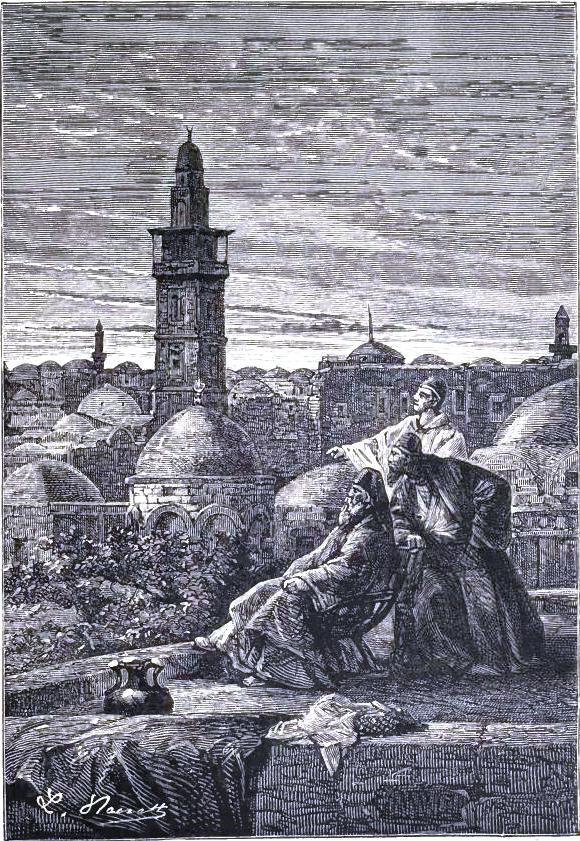
Jerusalem.
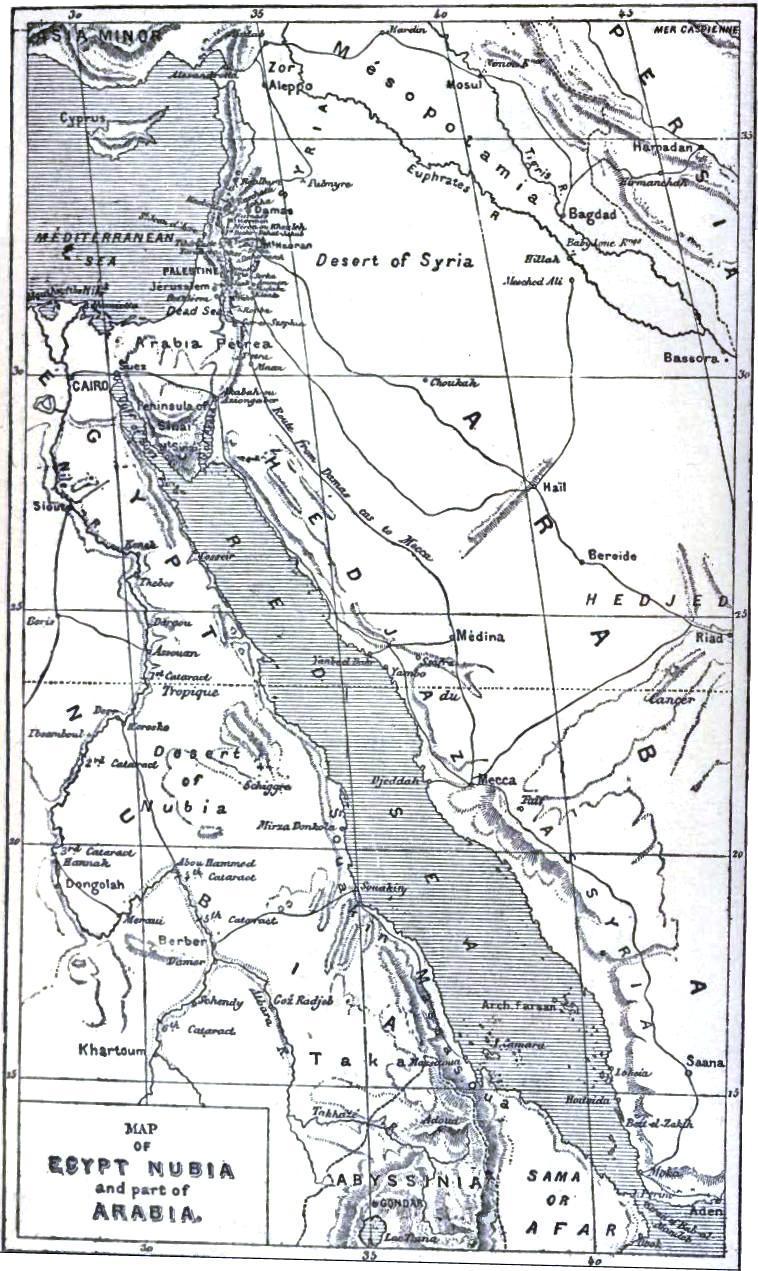
He had also collected much valuable information respecting the nature of the waters of the Dead Sea, refuted many false notions, corrected mistakes upon the most carefully constructed maps, identified several sites of the ancient Peræa, and established the existence of numberless ruins, which bore witness to the prosperity of all this region under the sway of the Roman Empire. Upon the 25th of June, 1806, Seetzen left Jerusalem, and returned to St. Jean d'Acre by sea.
In an article in the Revùe Germanique for 1858, M. Vinen speaks of his expedition as a veritable journey of discovery. Seetzen, however, was unwilling to leave his discoveries incomplete. Ten months later, he again visited the Dead Sea, and added largely to his observations. From thence he proceeded to Cairo, where he remained for two years, and bought a large portion of the oriental manuscripts which now enrich the library of Gotha. He collected many facts about the interior of the country, choosing instinctively those only which could be amply substantiated.
Seetzen, with his insatiable thirst for discovery, could not remain long in repose, far removed from idleness though it was. In April, 1809, he finally left the capital of Egypt, and directed his course towards Suez and the peninsula of Sinai, which he resolved to explore before proceeding to Arabia. At this time Arabia was a little-known country, frequented only by merchants trading in Mocha coffee-beans. Before Niebuhr's time no scientific expedition for the study of the geography of the country or the manners and customs of the inhabitants had been organized.
This expedition owed its formation to Professor Michälis, who was anxious to obtain information which would throw light on certain passages in the Bible, and its expenses were defrayed by the generosity of King Frederick V. of Denmark. It comprised Von Hannen, the mathematician, Forskaal, the naturalist, a physician named Cramer, Braurenfeind, the painter, and Niebuhr, the engineer, a company of learned and scientific men, who thoroughly fulfilled all expectations founded upon their reputations.
In the course of two years, from 1762 to 1764, they visited Egypt, Mount Sinai, Jeddah, landed at Loheia, and advancing into Arabia Felix, explored the country in accordance with the speciality of each man. But the enterprising travellers succumbed to illness and fatigue, and Niebuhr alone survived to utilize the observations made by himself and his companions. His work on the subject is an inexhaustible treasury, which may be drawn upon in our own day with advantage.
Seetzen, therefore, had much to achieve to eclipse the fame of his predecessor. He omitted no means of doing so. After publicly professing the faith of Islam, he embarked at Suez for Mecca, and hoped to enter that city disguised as a pilgrim. Tor and Jeddah were the places visited by him before he travelled to the holy city of Mecca. He was much impressed by the wealth of the faithful and the peculiar characteristics of that city, which lives for and by the Mahometan cultus. "I was seized," says the traveller, "with an emotion which I have never experienced elsewhere."
It is alike unnecessary to dwell upon this portion of the voyage and upon that relating to the excursion to Medina. Burckhardt's narrative gives a precise and trustworthy account of those holy places, and besides, there remain of Seetzen's works only the extracts published in "Les Annales des Voyages," and in the Correspondence of the Baron de Zach. The Journal of Seetzen's travels was published in German, and in a very incomplete manner, only in 1858.
The traveller returned from Medina to Mecca, and devoted himself to a secret study of the town, with its religious ceremonies, and to taking astronomical observations, which determined the position of the capital of Islam.
Seetzen returned to Jeddah on the 23rd March, 1810. He then re-embarked, with the Arab who had been his guide to Mecca, for Hodeidah, which is one of the principal ports of Yemen. Passing the mountainous district of Beith-el-Fakih, where coffee is cultivated, after a month's delay at Doran on account of illness, Seetzen entered Sana, the capital of Yemen, which he calls the most beautiful city of the East, on the 2nd of June. Upon the 22nd of July he reached Aden, and in November he was at Mecca, whence the last letters received from him are dated. Upon re-entering Yemen, he, like Niebuhr, was robbed of his collections and baggage, upon the pretext that he collected animals, in order to compose a philtre, with the intention of poisoning the springs.
Seetzen, however, would not quietly submit to be robbed. He started at once for Sana, intending to lay a complaint before the Iman. This was in December, 1811. A few days later news of his sudden death arrived at Taes, and the tidings soon reached the ears of the Europeans who frequented the Arabian ports.
It is little to the purpose now to inquire upon whom the responsibility of this death rests—whether upon the Iman or upon those who had plundered the traveller—but we may well regret that so thorough an explorer, already familiar with the habits and customs of the Arabs, was unable to continue his explorations, and that the greater portion of his diaries and observations have been entirely lost.
"Seetzen," says M. Vivien de Saint Martin, "was the first traveller since Ludovico Barthema (1503) who visited Mecca, and before his time no European had even seen the holy city of Medina, consecrated by the tomb of the Prophet."
From these remarks we gather how invaluable the trustworthy narrative of this disinterested and well-informed traveller would have been.
Just as an untimely death ended Seetzen's self-imposed mission, Burckhardt set out upon a similar enterprise, and like him commenced his long and minute exploration of Arabia by preliminary travel through Syria.
"It is seldom in the history of science," says M. Vivien de Saint Martin, "that we see two men of such merit succeed each other in the same career or rather continue it; for in reality Burckhardt followed up the traces Seetzen had opened out, and, seconded for a considerable time by favourable circumstances which enabled him to prosecute his explorations, he was enabled to add very considerably to the known discoveries of his predecessor."
Although John Lewis Burckhardt was not English, for he was a native of Lausanne, he must none the less be classed among the travellers of Great Britain. It was owing to his relations with Sir Joseph Banks, the naturalist who had accompanied Cook, and Hamilton, the secretary of the African Association, who gave him ready and valuable support, that Burckhardt was enabled to accomplish what he did.
Burckhardt was a deeply learned man. He had passed through the universities of Leipzic, and Göttingen, where he attended Blumenbach's lectures, and afterwards through Cambridge, where he studied Arabic. He started for the East in 1809. To inure himself to the hardships of a traveller's life, he imposed long fasts upon himself, accustomed himself to endure thirst, and chose the pavements of London or dusty roads for a resting-place. But how trifling were these experiences in comparison with those involved in an apostolate of science!
Leaving London for Syria, where he hoped to perfect his knowledge of Arabic, Burckhardt intended to proceed to Cairo and to reach Fezzan by the route formerly opened up by Hornemann. Once arrived in that country, circumstances must determine his future course.
Burckhardt, having taken the name of Ibrahim-Ibn-Abdallah, intended to pass as an Indian Mussulman. In order to carry out this disguise, he had recourse to many expedients. In an obituary notice of him in the "Annales des Voyages," it is related that when unexpectedly called upon to speak the Indian language, he immediately had recourse to German. An Italian dragoman, suspecting him of being a giaour, pulled him by his beard, thereby offering him the greatest insult possible in his character of Mussulman. But Burckhardt had so thoroughly entered into the spirit of his rôle, that he responded by a vigorous blow, which sending the unfortunate dragoman spinning to a distance, turned the laugh against him, and thoroughly convinced the bystanders of the sincerity of the traveller.
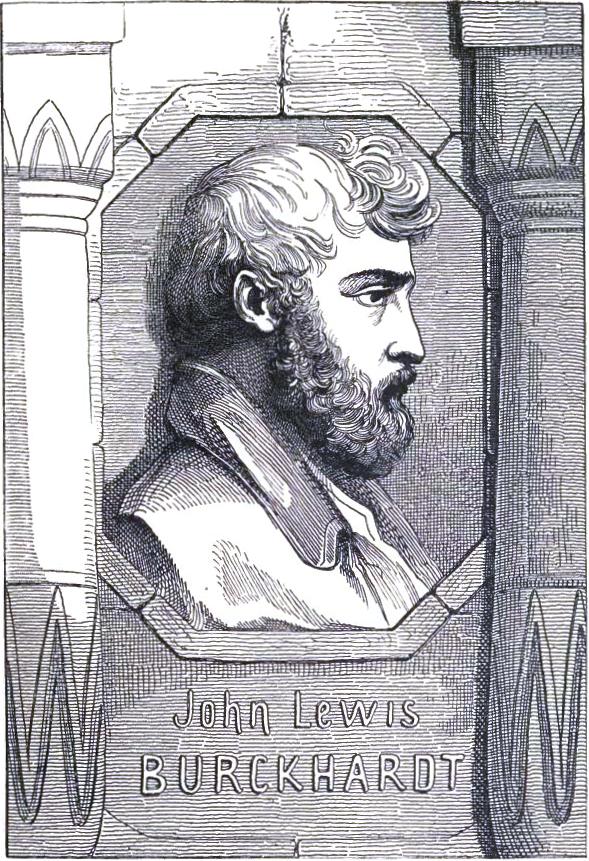
Portrait of Burckhardt. (Fac-simile of early engraving.)
Burckhardt remained at Aleppo from September, 1809, to February, 1812, pursuing his studies of Syrian manners and customs, and of the language of the country, with but one interruption, a six months' excursion to Damascus, Palmyra, and the Hauran, a country which had hitherto been visited by Seetzen only.
It is related that, during an excursion into Gor, a district north of Aleppo, upon the shores of the Euphrates, the traveller was robbed of his baggage and stripped of his clothes by a band of robbers. When nothing remained to him but his trousers, the wife of a chief, who had not received her share of the spoil, wished to relieve him even of those indispensable garments!
The Revue Germanique says:—"We owe a great deal of information to these excursions, respecting a country of which we had only crude notions, gained from Seetzen's incomplete communications. Burckhardt's power of close observation detected a number of interesting facts, even in well-known districts, which had escaped the notice of other travellers. These materials were published by Colonel Martin William Leake, himself a geographer, a man of learning, and a distinguished traveller."
Burckhardt had seen Palmyra and Baalbek, the slopes of Lebanon and the valley of the Orontes, Lake Huleh, and the sources of the Jordan; he had discovered many ancient sites; and his observations had led especially to the discovery of the site of the far-famed Apamoea, although both he and his publisher were mistaken in their application of the data obtained. His excursions in the Auranitis were equally rich, even though coming after Seetzen's, in those geographical and archæological details which represent the actual condition of a country, and throw a light upon the comparative geography of every age.
Leaving Damascus in 1813, Burckhardt visited the Dead Sea, the valley of Akâba, and the ancient port of Azcongater, districts which in our own day are traversed by parties of English, with their Murray, Cook, or Bædeker in their hands; but which then were only to be visited at the risk of life. In a lateral valley, the traveller came upon the ruins of Petra, the ancient capital of Arabia Petræa.
At the end of the year Burckhardt was at Cairo. Judging it best not to join the caravan which was just starting for Fezzan, he felt a great inclination to visit Nubia, a country rich in attractions for the historian, geographer, and archæologist. Nubia, the cradle of Egyptian civilization, had only been visited, since the days of the Portuguese Alvares, by Poncet and Lenoir Duroule, both Frenchmen, at the close of the seventeenth century, at the opening of the eighteenth by Bruce, whose narrative had so often been doubted, and by Norden, who had not penetrated beyond Derr.
In 1813 Burckhardt explored Nubia proper, including Mahass and Kemijour. This expedition cost him only forty-two francs, a very paltry sum in comparison with the price involved in the smallest attempt at an African journey in our own day; but we must not forget that Burckhardt was content to live upon millet-seed, and that his entire cortége consisted of two dromedaries.
Two Englishmen, Mr. Legh and Mr. Smelt, were travelling in the country at the same time, scattering gold and presents as they passed, and thus rendering the visits of their successors costly.
Burckhardt crossed the cataracts of the Nile. "A little farther on," says the narrative, "near a place called Djebel-Lamoule, the Arab guides practise a curious extortion." This is their plan of proceeding. They halt, descend from their camels, and arrange a little heap of sand and pebbles, in imitation of a Nubian tomb. This they, call "preparing the grave for the traveller" and follow up the demonstration by an imperious demand for money. Burckhardt having watched his guide commence this operation, began quietly to imitate him, and then said, "Here is thy grave; as we are brothers, it is but fair that we should be buried together." The Arab could not help laughing, both graves were simultaneously destroyed, and remounting the camels, the cavalcade proceeded, better friends than before. The Arab quoted a saying from the Koran: "No human being knows in what spot of the earth he will find his grave."
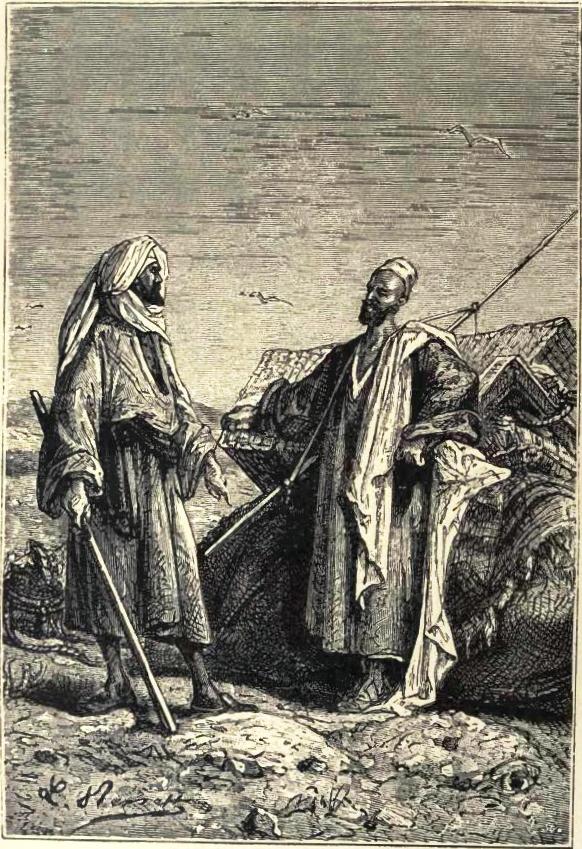
"Here is thy grave."
Burckhardt had hoped to get as far as Dingola, but was obliged to rest satisfied with collecting information about the country and the Mamelukes, who had taken refuge there after the massacre of their army by order of the viceroy of Egypt.
The attention of the traveller was frequently directed to the ruins of temples and ancient cities, than which none are more curious than those of Isambul.
"The temple on the banks of the Nile is approached by an avenue flanked by six colossal figures, which measure six feet and a half from the ground to the knees. They are representations of Isis and Osiris, in various attitudes. The sides and capitals of the pillars are covered with paintings or hieroglyphic carvings, in which Burckhardt thought a very ancient style was to be traced. All these are hewn out of the rock, and the faces appear to have been painted yellow, with black hair. Two hundred yards from this temple are the ruins of a still larger monument, consisting of four enormous figures, so deeply buried in the sand that it is impossible to say whether they are in a standing or sitting posture."
These descriptions of antiquities, which in our own day are accurately known by drawings and photographs, have, however, little value for us; and are merely interesting as indicating the state of the ruins when Burckhardt visited them, and enabling us to judge how far the depredations of the Arabs have since changed them.
Burckhardt's first excursion was limited to the borders of the Nile, a narrow space made up of little valleys, which debouched into the river. The traveller estimated the population of the country at 100,000, distributed over a surface of fertile land 450 miles in length, by a quarter of a mile in width.
"The men," says the narrative, "are, as a rule, muscular, rather shorter than the Egyptians, having little beard or moustache, usually merely a pointed beard under the chin. They have a pleasant expression, are superior to the Egyptians in courage and intelligence, and naturally inquisitive. They are not thieves. They occasionally pick up a fortune by dint of hard work, but they have little enterprise. Women share the same physical advantages, are pretty as a rule, and well made; their appearance is gentle and pleasing, and they are modest in behaviour. M. Denon has underrated the Nubians, but it must not be forgotten that their physique varies in different districts. Where there is much land to cultivate, they are well developed; but in districts where arable land is a mere strip, the people diminish in vigour, and are sometimes walking skeletons."
The whole country groaned under the yoke of the Kashefs, who were descendants of the commander of the Bosniacs, and paid only a small annual tribute to Egypt, which, however, was sufficient to serve as a pretext for oppressing the unfortunate fellaheen. Burckhardt cites a curious example of the insolence with which the Kashefs behaved.
"Hassan Kashef," he says, was in need of barley for his horses. Accompanied by his slaves, he walked into the fields, and there met the owner of a fine plot of barley. "How badly you cultivate your land," said he. "Here you plant barley in a field where you might have reaped an excellent crop of water-melons of double the value. See, here are some melon-seeds (offering a handful to the peasant proprietor); sow your field with these; and you, slaves, tear up this bad barley and bring it to me."
In March, 1814, after a short rest, Burckhardt undertook a fresh exploration, not this time of the banks of the Nile, but of the Nubian desert. Justly conceiving poverty to be his surest safe guard, he dismissed his servant, sold his camel, and contenting himself with one ass, joined a caravan of poor traders. The caravan started from Daraou, a village inhabited partly by fellahs and partly by Ababdéh Arabs. The traveller had good reason to complain of the former, not because they recognized him as a European, but because they imagined him to be a Syrian Turk, come to share the commerce in slaves of which they had the monopoly.
It would be useless to enumerate the names of the bridges, hills, and valleys in this desert. We will rather summarize the traveller's report of the physical aspect of the country.
Bruce, who had explored it, paints it in too gloomy colours, and exaggerates the difficulties of the route. If Burckhardt is to be credited, the country is less barren than that between Aleppo and Bagdad, or Damascus and Medina. The Nubian desert is not merely a plain of sand, where nothing interrupts the dreary monotony. It is interspersed with rocks, some not less than 300 feet in height, and shaded by thickets of acacias or date-trees. The shelter of these trees is, however, unavailing against the vertical rays of the sun, which explains an Arabic proverb, "Rely upon the favour of the great and the shade of an acacia."
At Ankheyre, or Wady-Berber, the caravan reached the Nile, after passing Shigre, one of the best mountain springs. One danger only is to be feared in crossing the desert; that of finding the wells at Nedjeym dry; and, unless the traveller should lose his way, which, however, with trustworthy guides, is little likely to happen, no serious obstacle arises.
It would appear, therefore, that the sufferings experienced by Bruce must have been greatly exaggerated, although the narrative of the Scotch traveller is generally trustworthy. The natives of the province of Berber appear to be identical with the Barbarins of Bruce, the Barabas mentioned by D'Anville, and the Barauras spoken of by Poncet. They are a well-made race, and different in feature from the negroes. They maintain their purity of descent by marrying only with the women of their own or of kindred tribes. Curious as is the picture Burckhardt draws of the character and manners of this tribe, it is not at all edifying. It would be difficult to convey an idea of the corruption and degradation of the Berbers. The little town of Wady-Berber, a commercial centre, the rendezvous for caravans, and a depôt for slaves, is a regular resort of banditti.
Burckhardt, who had trusted to the protection of the merchants of Daraou, found that he had made a great mistake in so doing. They sought every means of plundering him, chased him out of their company, and forced him to seek refuge with the guides and donkey-drivers, who cordially welcomed him.
Upon the 10th of April a fine was levied upon the caravan by the Mek of Damer, which lies a little south of the tributary Mogren (called Mareb by Bruce). This is a well-kept and cleanly Fakir village, which contrasts agreeably with the ruins and filth of Berber. The Fakirs give themselves up to the practices of sorcery, magic, and charlatanism. One of them, it is said, could even make a lamb bleat in the stomach of the man who had stolen and eaten it! These ignorant people have entire faith in such fables, and it must be reluctantly admitted that the fact contributes not a little to the peace of the town and the prosperity of the country.
From Damer, Burckhardt proceeded to Shendy, where he passed a month, during which time no one suspected him to be an infidel. Shendy had grown in importance since Bruce's visit, and now consisted of about a thousand houses. Considerable trade was carried on—grass, slaves, and cattle taking the place of specie. The principal marketable commodities were gum, ivory, gold, and ostrich feathers.
According to Burckhardt, the number of slaves sold yearly at Shendy amounts to 5000; 2500 of these are for Arabia, 400 for Egypt, 1000 for Dongola and the districts of the Red Sea.
The traveller employed his time during his stay at Sennaar in collecting information about that kingdom. Amongst other curious things, he was told that the king having one day invited the ambassador of Mehemet Ali to a cavalry review, which he considered rather formidable, the envoy in his turn begged the king to witness part of the Turkish artillery exercises. But at the outset of the performance—at the discharge of two small mounted guns—cavalry, infantry, spectators, courtiers, and the king himself, fled in terror.
Burckhardt sold his wares, and then, worn out by the persecutions of the Egyptian merchants who were his companions, he joined the caravan at Suakin, intending to traverse the unknown district between that town and Shendy. From Suakin he meant to set out for Mecca, hoping to find the Hadji useful to him in the realization of his projects.
"The Hadji," he says, "form one powerful body, and every member is protected, because if one is attacked the whole number take up arms." The caravan which Burckhardt now joined consisted of 150 merchants and 300 slaves. Two hundred camels were employed to convey heavy bales of "danmour," a stuff manufactured in Sennaar, and cargoes of tobacco.
The first object of interest to the travellers was the Atbara, a tributary of the Nile, whose banks, with their verdant trees, were grateful to the eye after the sandy desert. The course of the river was followed as far as the fertile district of Taka. During the journey the white skin of the pretended sheik Ibrahim (it will be remembered that this was the name assumed by Burckhardt) attracted much attention from the female population, who were little accustomed to the sight of Arabs.
"One day," relates the traveller, "a girl of the country, of whom I had been buying onions, offered to give me an extra quantity if I would remove my turban, and show her my head. I demanded eight more onions, which she immediately produced. As I removed my turban, and exposed my white and close-shaven head to view, she sprang back in horror and dismay. I asked her jokingly if she would not like a husband with a similar head, to which she replied with much energy, and many expressions of disgust, that she would prefer the ugliest slave ever brought from Darfur."
Just before Goz Radjeh was reached, Burckhardt's attention was attracted to a building, which he was told was either a church or temple, the same word having the two meanings. He at once proceeded in that direction, hoping to examine it, but his companions stopped him, saying, "It is surrounded by bands of robbers; you cannot go a hundred steps without danger of attack."
Burckhardt was unable to decide whether it was an Egyptian temple, or a monument of the empire of Axum.
At last the caravan entered the fertile district of Tak or El Gasch, a wide watered plain, whose soil is wonderfully fertile, but which for two months in the year is uninhabited. Grain is plentiful and is sold in Jeddah for twenty per cent. more than the best Egyptian millet.
The inhabitants, who are called Hadendoa, are treacherous, dishonest, and bloodthirsty; and their women are almost as degraded as those of Shendy and Berber.
Upon leaving Taka, the road to Suakin and the shores of the Red Sea lay over a chain of chalk hills. At Schenterab granite is found. The hills presented few difficulties, and the caravan reached Suakin in safety upon the 26th May. But Burckhardt's troubles were not yet at an end. The Emir and Aga combined to plunder him, and treated him as the lowest of slaves, until he produced the firman which he had received from Mehemet Ali and Ibrahim Pasha. This changed the face of affairs. Instead of being thrown into prison the traveller was invited to the Aga's, who offered him a present of a young slave. M. Vivien de Saint Martin writes of this expedition, "This journey of from twenty to twenty-five days, between the Nile and the Red Sea, was the first ever undertaken by a European. The observations collected, as to the settled or nomad tribes of these districts are invaluable for Europe. Burckhardt's narrative is of increasing interest, and few can compare with it for instruction and interest."
Upon the 7th of July Burckhardt succeeded in embarking in a boat, and eleven days later he reached Jeddah, which serves as a harbour to Mecca. Jeddah is built upon the sea-shore, and is surrounded by a wall, which, insufficient as it would be against artillery, protects it perfectly from the attacks of the Wahabees, who have been nicknamed the "Puritans of Islamism." These people are a distinct sect, who claim to restore Mahomedanism to its primitive simplicity.
"The entrance to the town, upon the side nearest the sea," says Burckhardt, "is protected by a battery which overlooks the entire fort, and is surmounted by one enormous piece of artillery capable of discharging a five-hundred pound shot, which is so renowned throughout the Arabian Gulf, that its reputation alone is enough to protect Jeddah."
The greatest drawback to this city is its want of fresh water, which is brought from small wells two miles distant. Without gardens, vegetables, or date-trees, Jeddah, in spite of its population of twelve or fifteen thousand (a number which is doubled in the pilgrimage season) presents a strange appearance. The population is the reverse of autochthonous; it is composed of natives of Hadramaut and Yemen, Indians from Surat and Bombay, and Malays who come as pilgrims and settle in the town. Burckhardt introduces many anecdotes of interest into his account of the manners, mode of living, price of commodities, and number of traders in the place.
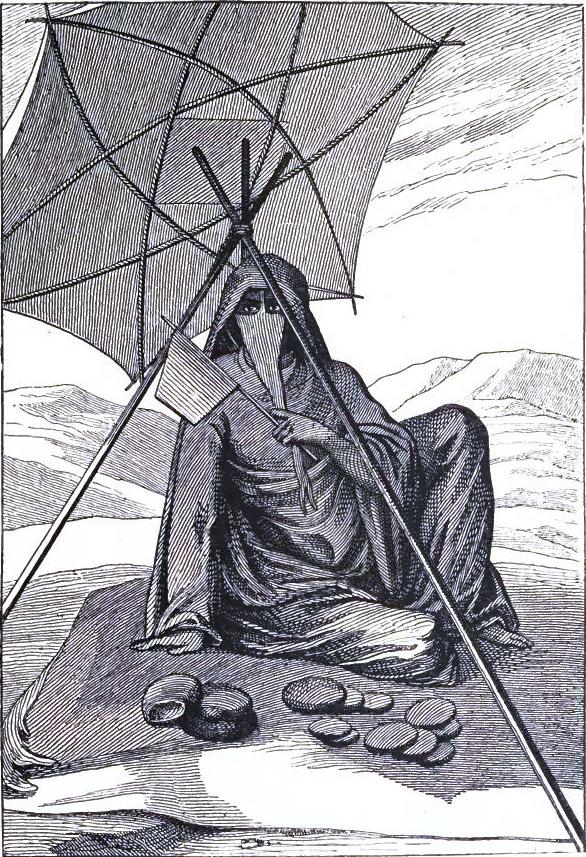
Merchant of Jeddah. (Fac-simile of early engraving.)
Speaking of the singular customs of the natives of Jeddah, he says:—"It is the almost universal custom for everybody to swallow a cup full of ghee or melted butter in the morning. After this they take coffee, which they regard as a strong tonic; and they are so accustomed to this habit from their earliest years, that they feel greatly inconvenienced if they discontinue it. The higher classes are satisfied with drinking the cup of butter, but the lower classes add another half cup, which they draw up through the nostrils, imagining that they thus prevent bad air entering the body by those apertures."
The traveller left Jeddah for Tayf on the 24th of August. The road winds over mountains and across valleys of romantic beauty and luxuriant verdure. Burckhardt was taken for an English spy at Tayf, and, although he was well received by the Pasha, he had no liberty, and could not carry on his observations.
Tayf, it appears, is famous for the beauty of its gardens; roses and grapes are sent from it into all the districts of Hedjaz. This town had a considerable trade, and was very prosperous before it was plundered by the Wahabees.
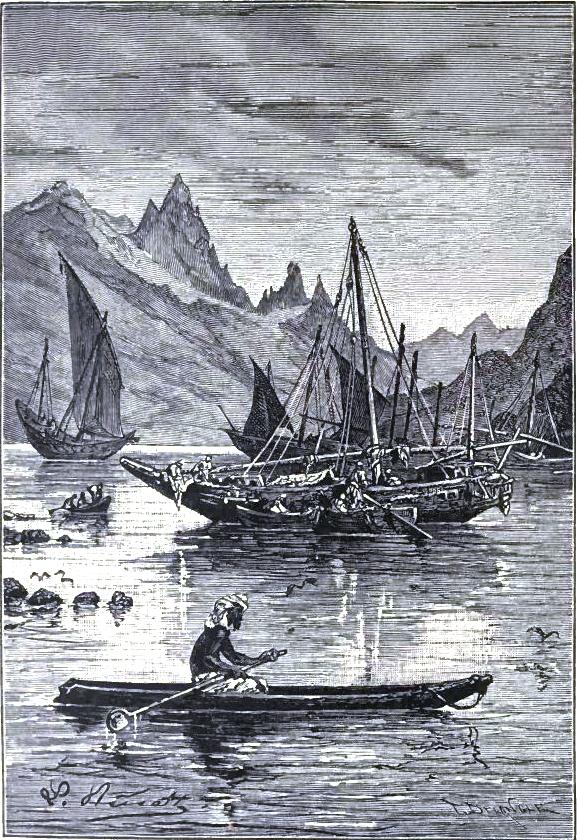
Shores and boats of the Red Sea.
The surveillance to which he was subjected hastened Burckhardt's departure, and upon the 7th of September he started for Mecca. Well versed in the study of the Koran, and acquainted with all the practices of Islamism, he was prepared to act the part of a pilgrim. His first care was to dress himself in accordance with the law prescribed for the faithful who enter Mecca—in the "ihram," or pieces of cloth without seam, one covering the loins, the other thrown over the neck and shoulders. The pilgrim's first duty is to proceed to the temple, without waiting even to procure a lodging. This Burckhardt did not fail to do, observing at the same time the rites and ceremonies prescribed in such cases, of which he gives many interesting particulars; we cannot, however, dwell upon them here.
"Mecca," says Burckhardt, "may be called a pretty town. As a rule, the streets are wider than in most Eastern cities. The houses are lofty and built of stone; and its numerous windows, opening upon the street, give it a more cheerful and European aspect than the cities of Egypt or Syria, whose dwellings generally have few windows on the outside. Every house has a terrace built of stone, and sloping in such a way as to allow water to run down the gutters into the street. Low walls with parapets conceal these terraces; for, as everywhere else in the East, it is not thought right for a man to appear there; he would be accused of spying upon the women, who spend much of their time upon the terrace of the house, engaged in domestic work, drying corn, hanging out linen, &c."
The only public place in the city is the large court of the Grand Mosque. Trees are rare; not a garden enlivens the view, and the scene depends for animation upon the well-stocked shops which abound during the pilgrimage. With the exception of four or five large houses belonging to the administration, two colleges, which have since been converted into warehouses for corn, and the mosque with the few buildings and colleges connected with it, Mecca can boast of no public buildings, and cannot compete in this respect with other cities in the East of the same size.
The streets are unpaved; and as drains are unknown, water collects in puddles, and the accumulation of mud is inconceivable. For a water supply the natives trust to heaven, catching the rain in cisterns, for that obtained from the wells is so foul that it is impossible to drink it.
In the centre of the town, where the valley widens a little, the mosque known as Beithóu'llah, or El Haram, is situated. This edifice owes its fame to the Kaaba which is enclosed in it, for other Eastern towns can boast of mosques equally large and more beautiful. El Haram is situated in an oblong space, surrounded on the eastern side by a quadruple colonnade, and by a triple one on the other. The columns are connected by pointed arches, upon each four stand little domes constructed of mortar and whitened outside. Some of these columns are of white marble, granite, or porphyry, but the greater part are of the common stone found among the mountains of Mecca.
The Kaaba has been so often ruined and restored that no trace of a remote antiquity remains. It was in existence before this mosque was built.
The traveller says, "The Kaaba is placed upon an inclined base some two feet high, and its roof being flat, it presents the appearance at a little distance of a perfect cube. The only door by which it can be entered, and which is opened two or three times a year, is on the north side, about seven feet above the ground, for which reason one cannot enter except by means of a wooden staircase. The famous 'black stone' is enshrined at the north-eastern corner of the Kaaba, near the door, and forms one of the angles of the building four or five feet above the floor of the court. It is difficult to ascertain the exact nature of this stone, as its surface has been completely worn and reduced to its present condition by the kisses and worshipping touches bestowed upon it by countless millions of pilgrims. The Kaaba is entirely covered with black silk, which envelopes its sides, leaving the roof exposed. This veil or curtain is called 'the Kesoua,' and is renewed yearly during the pilgrimage. It is brought from Cairo, where it is manufactured at the expense of the Viceroy."
Up to the time of Burckhardt no such detailed account of Mecca and her sanctuary had been given to the world. For this reason we shall insert extracts from the original narrative; extracts which might indeed be multiplied, for they include circumstantial accounts of the sacred well, called Zemzem, water from which is considered as an infallible remedy for every complaint. The traveller speaks also of the "Gate of Salvation," of the Makam Ibrahim, a monument containing the stone upon which Abraham sat when he was engaged in building the Kaaba, and where the marks of his knees may still be seen, and of all the buildings enclosed within the temple precincts.
Judging from Burckhardt's minute and complete description, these spots still retain their former physiognomy. The same number of pilgrims chant the same songs; the men only are no longer the same. His accounts of the feast of the pilgrimage and the holy enthusiasm of the faithful, are followed by a picture which brings before us, in the most sombre colours, the effects of this great gathering of men, attracted from every part of the world.
"The termination of the pilgrimage," he says, "lends a very different aspect to the mosque. Illness and death, consequent upon the great fatigues undergone during the voyage, are accelerated by the scanty covering afforded by the Ihram, the unhealthy dwellings of Mecca, the bad food, and frequent absolute dearth of provisions. The temple is filled with corpses brought thither to receive the prayers of the Iman, or with sick persons who insist upon being carried, as their last hours approach, to the colonnade, hoping to be saved by the sight of the Kaaba, or in any case to have the consolation of expiring within the sacred precincts. One sees poor pilgrims, sinking under illness and hunger, dragging their weary bodies along the colonnade; and when they no longer have the strength to stretch out a hand to the passer-by, they place a little jar beside the mat upon which they are laid, to receive what charity may bestow upon them. As they feel the last moment approach, they cover themselves with their ragged clothes, and very often a day passes before it is ascertained that they are dead."
We will conclude our extracts from Burckhardt's account of Mecca with his opinion of the inhabitants.
"Although the natives of Mecca possess grand qualities, although they are pleasant, hospitable, cheerful and proud, they openly transgress the Koran by drinking, gambling, and smoking. Deceit and perjury are no longer looked upon as crimes by them; they do not ignore the scandal such vices bring upon them; but while each individually exclaims against the corruption of manners, none reform themselves."
Upon the 15th of January, 1815, Burckhardt left Mecca with a caravan of pilgrims on their way to visit the tomb of the prophet. The journey to Medina, like that between Mecca and Jeddah, was accomplished at night, and afforded little opportunity for observation. In the winter night-travelling is less comfortable than travelling by day. A valley called Wady-Fatme, but generally known as El-Wadi, was crossed; it abounded in shrubs and date-trees, and was well cultivated in the eastern portion. A little beyond it lies the valley of Es-Ssafra, the market of the neighbouring tribes and celebrated for its plantations of dates.
The traveller relates that "The groves of date-trees extend for nearly four miles, and belong to the natives of Ssafra as well as to the Bedouins of the neighbourhood, who employ labourers to water the ground, and come themselves to reap the harvest. The date-trees pass from one person to another in the course of trade; they are sold separately. A father often receives three date-trees as the price of the daughter he gives in marriage. They are all planted in deep sand brought from the middle of the valley, and piled up over their roots; they ought to be renewed every year, and they are generally swept away by the torrents. Each little plot is surrounded by a wall of mud or stone, and the cultivators live in hamlets or isolated cabins among the trees. The principal stream flows through a grove near the market; beside it rises a little mosque, shaded by large chestnuts. I had seen none before in the Hedjaz."
Burckhardt was thirteen days in reaching Medina. But this rather long journey was not lost time to him; he collected much information about the Arabs and the Wahabees. At Medina, as at Mecca, the pilgrim's first duty is to visit the tomb and mosque of Mahomet; but the ceremonies attending the visit are much easier and shorter, and the traveller performed them in a quarter of an hour.
Burckhardt's stay at Mecca had already been prejudicial to him. At Medina he was attacked by intermittent fever, which increased in violence, and was accompanied by violent sickness. This soon so reduced him, that he could no longer rise from his carpet without the assistance of his slave, "a poor fellow who by nature and habit was more fit to tend camels than to take care of his worn-out and enfeebled master."
Burckhardt being detained at Medina for more than three months by a fever, due to bad climate, the detestable quality of the water, and the prevalence of infectious illnesses, was forced to relinquish his project of crossing the desert to Akabah, in order to reach Yanibo as quickly as possible, and from thence embark for Egypt.
"Next to Aleppo," he says, "Medina is the best-built town I have seen in the East. It is entirely of stone, the houses being generally three stories high, with flat tops. As they are not whitewashed, and the stone is brown in colour, the streets, which are very narrow, have usually a sombre appearance. They are often only two or three paces wide. At the present time Medina looks desolate enough; the houses are falling into ruins. Their owners, who formerly derived a considerable profit from the inroad of pilgrims, find their revenues diminishing, as the Wahabees forbid visitors to the tomb of the prophet, alleging that he was but a mere mortal. The possession which places Medina on a par with Mecca is the Grand Mosque, containing the tomb of Mahomet. This is smaller than that at Mecca, but is built upon the same plan, in a large square courtyard, surrounded on all sides by covered galleries, and having a small building in the centre. The famous tomb, surrounded by an iron railing painted green, is near the eastern corner. It is of good workmanship, in imitation of filagree, and interlaced with inscriptions in copper. Four doors, of which three lead into this enclosure, are kept constantly shut. Permission to enter is freely accorded to persons of rank, and others can purchase permission of the principal eunuchs for about fifteen piasters. In the interior are hangings which surround the tomb, and are only a few feet from it." According to the historian of Medina, these hangings cover a square edifice, built of black stones, and supported upon two columns, in the interior of which are the sepulchres of Mahomet and his two eldest disciples, Abou-Bekr and Omar. He also states that these sepulchres are deep holes, and that the coffin which contains the ashes of Mahomet is covered with silver, and surmounted by a marble slab with the inscription, "In the name of God, give him thy pity." The fables which were spread throughout Europe as to the tomb of the prophet being suspended in mid air, are unknown in the Hedjaz. The mosque was robbed of a great part of its treasures by the Wahabees, but there is some ground for believing that they had been forestalled by the successive guardians of the tomb.
Many other interesting details of Medina, and its inhabitants, surroundings, and the haunts of pilgrims, are to be found in Burckhardt's narrative. But we have given sufficient extracts to induce the reader who desires further information respecting the manners and customs of the Arabs, which have not changed, to refer to the book itself.
Upon the 21st of April, 1815, Burckhardt joined a caravan which conducted him to Yembo, where the plague was raging. The traveller at once fell ill and became so weak that it was impossible for him to resort to a country place. To embark was equally impossible; all the vessels which were ready to start were crowded with soldiers. He was compelled to remain eighteen days in the unhealthy little town, before he could obtain a passage in a small vessel which took him to Cosseir, and thence to Egypt.
Upon his return to Cairo Burckhardt heard of his father's death. The traveller's constitution had been sorely tried by illness, and he was unable to attempt the ascent of Mount Sinai until 1816. The study of natural history, the publication of his diary, and his correspondence, occupied him until 1817, at which time he expected to go with a caravan to Fezzan. Unfortunately he succumbed to a sudden attack of fever, his last words being, "Write and tell my mother that my last thought was of her."
Burckhardt was an accomplished traveller; well-informed, exact to minuteness, patient, courageous, and endowed with an upright and energetic character. His writings are of great value; the narrative of his voyage in Arabia—of which he unfortunately could not explore the interior—is so complete and precise, that owing to it that country was then better known than many in Europe.
In writing to his father from Cairo on the 13th of March, 1817, he says, "I have never said a word about what I have seen and met with that my conscience did not entirely justify; I did not expose myself to so much danger in order to write a romance!"
The explorers who have succeeded him in the same countries unanimously testify to his exactness, and agree in praising his fidelity, knowledge, and sagacity.
"Few travellers," says the Revue Germanique, "have enjoyed in a like degree the faculty of observation. That is a rare gift of nature, like all eminent qualities. He possessed a sort of intuition which discerned the truth, apart from his own observations, and thus information given by him from hearsay has a value that seldom attaches to statements of that nature. His mind, early ripened by reflection and study (he was but in his thirty-third year at the time of his death), invariably went straight to the point. His narrative, always sober, is filled—one may say—rather with things than words; yet his narratives possess infinite charm; one admires the man in them as much as the savant and observer."
While the Biblical countries occupied the attention of Seetzen and Burckhardt, India, the birthplace of most of the European languages, was about to command the attention of students of language, literature, and religion, as well as of geography. For the present our concern is with those problems of physical geography, which the conquests and studies of the India Company were about to solve by degrees.
In a preceding volume we have related how the Portuguese rule was established in India. The union of Portugal with Spain, in 1599, led to the fall of the Portuguese colonies, which came into the possession of the English and Dutch. England soon afterwards granted a monopoly of the commerce of India to a Company which was destined to play an important part in history.
At this time Akbar, the great Mogul emperor, the seventh descendant of Timour Leng, had established a vast empire in Hindustan and Bengal, upon the ruins of the Rajpoot kingdoms. Owing to the personal qualities of Akbar, which had gained for him the surname of the Benefactor of Man, that empire was at the height of its glory. The same brilliant course was pursued by Shah Jehan; but Akbar's grandson, Aurung Zeb, inspired by an insatiable ambition, assassinated his brothers, imprisoned his father, and seized the reins of government. While the Mogul Empire was in the enjoyment of profound peace, a clever adventurer laid the foundations of the Mahratta Empire. The religious intolerance of Aurung Zeb, and his crafty policy, led to the insurrection of the Rajpoots, and a struggle, which by draining the resources of the empire, shook his power. The death of the great usurper was followed by the decadence of the empire.
Up to this period the India Company had been unable to add to the narrow strip of territory which they possessed at the ports, but it was now to benefit by the conflict between the nabobs and rajahs of Hindustan. It was not, however, until after the taking of Madras, in 1746, by La Bourdonnais, and the struggle against Dupleix, that the influence and dominion of the English Company was materially increased.
The crafty policy of Clive and Hastings, the English Governors, who successively employed force, stratagem, and bribery, to attain their ends, laid the foundation of British greatness in India, and, at the close of the last century, the Company were possessors of an immense extent of country, with no less than sixty millions of inhabitants. Their territory included Bengal, Behar, the provinces of Benares, Madras, and the Sircars. Tippoo Saib alone, the Sultan of Mysore, struggled against the English encroachments, but he was unable to hold out against the coalition formed against him by the skill of Colonel Wellesley. When rid of their formidable enemies, the Company overcame such opposition as remained by pensions; and, under the pretext of protection, imposed upon the rajahs an English garrison which was maintained at their expense.
One would imagine from all this that the English rule was detested; but that is not the case. The Company, recognizing the rights of individuals, did not attempt to change the religion, laws, or customs of their subjects. Neither is it surprising that travellers, even when they ventured into districts which, properly speaking, did not belong to Great Britain, incurred but little danger. In fact, so soon as the East India Company was free from political embarrassments, it encouraged explorers throughout its vast domains. At the same time travellers were despatched to the neighbouring territories to collect observations, and we propose rapidly to review those expeditions.
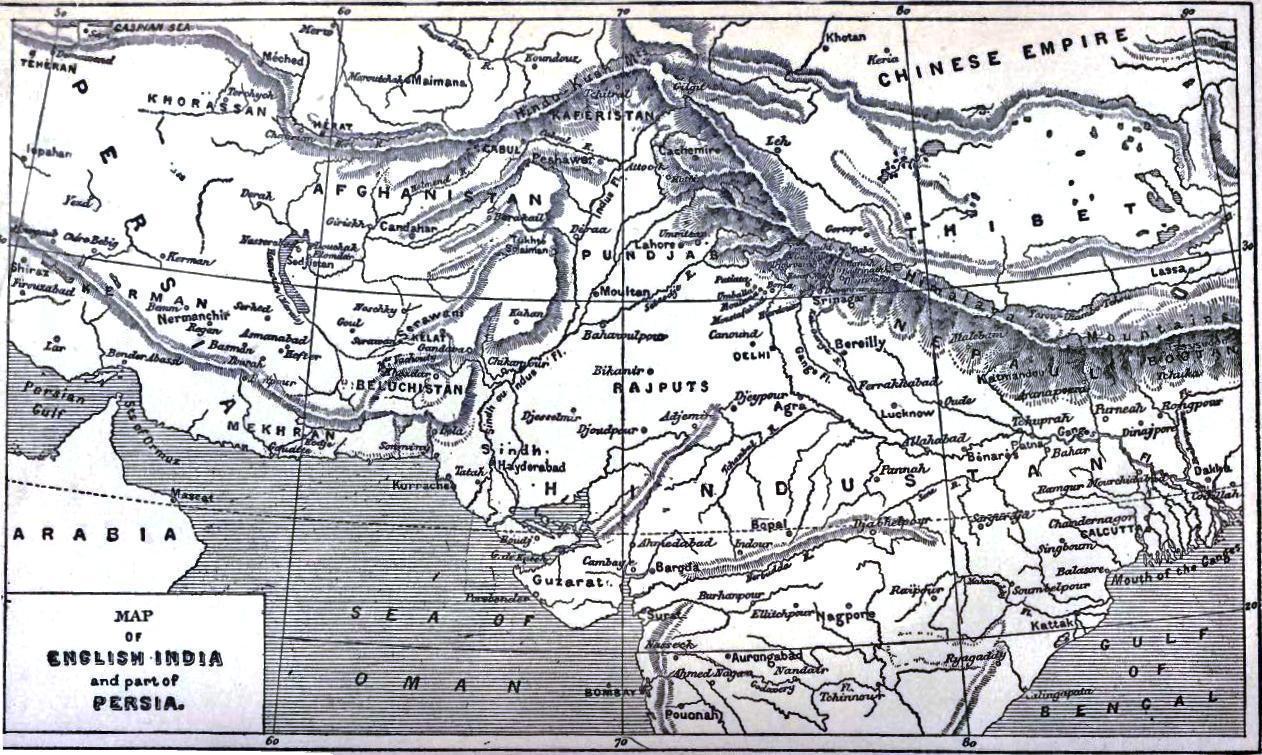
Gravé par E. Morieu.
One of the first and most curious was that of Webb to the sources of the Ganges, a river concerning which uncertain and contradictory opinions prevailed. The Government of Bengal, recognizing the great importance of the Ganges in the interests of commerce, organized an expedition, of which Messrs. Webb, Roper, and Hearsay, formed part. They were to be accompanied by Sepoys, native servants, and interpreters.
The expedition reached Herdouar, a small village on the left of the river, upon the 1st of April, 1808. The situation of this village, at the entrance of the fertile plains of Hindustan, had caused it to be much frequented by pilgrims, and it was at this spot that purifications in the waters of the holy river took place during the hot season.
As every pilgrimage implies the sale of relics, Herdouar was the centre of an important market, where horses, camels, antimony, asafoetida, dried fruits, shawls, arrows, muslins, cotton and woollen goods from the Punjab, Cabulistan, and Cashmere, were to be had. Slaves, too, were to be bought there from three to thirty years of age, at prices varying from 10 to 150 rupees. This fair, where such different races, languages, and costumes were to be met with, presented a curious spectacle.
Upon the 12th of April the English expedition set out for Gangautri, following a road planted with white mulberries and figs, as far as Gourondar. A little farther on water-mills of simple construction were at work, upon the banks of streams shaded with willows and raspberry-trees. The soil was fertile, but the tyranny of the Government prevented the natives from making the best of it.
The route soon became mountainous, but peach, apricot, nut, and other European trees abounded, and at length the expedition found themselves in the midst of a chain of mountains, which appeared to belong to the Himalaya range.
The Baghirati, which is known further on as the Ganges, was met with at the end of a pass. To the left, the river is bounded by high, almost barren mountains; to the right stretches a fertile valley. At the village of Tchiavli, the poppy is largely cultivated for the preparation of opium; here, owing probably, to the bad quality of the water, all the peasants suffer from wens.
At Djosvara the travellers had to cross a bridge of rope, called a "djorila." This was a strange and perilous structure.
"On either side of the river," says Webb, "two strong poles are driven in, at a distance of two feet from each other, and across them is placed another piece of wood. To this is attached a dozen or more thick ropes, which are held down upon the ground by large heaps of wood. They are divided into two packets, about a foot apart; Blow hangs a ladder of rope knotted to one of these, which answers instead of a parapet. The flooring of the bridge is composed of small branches of trees, placed at intervals of two and a half, or three feet from each other. As these are generally slender, they seem as if they were on the point of breaking every moment, which naturally induces the traveller to depend upon the support of the ropes which form the parapet, and to keep them constantly under their arms. The first step taken upon so shaky a structure is sufficient to cause giddiness, for the action of walking makes it swing to either side, and the noise of the torrent over which it is suspended is not reassuring. Moreover the bridge is so narrow, that if two persons meet upon it, one must draw completely to the side to make room for the other."
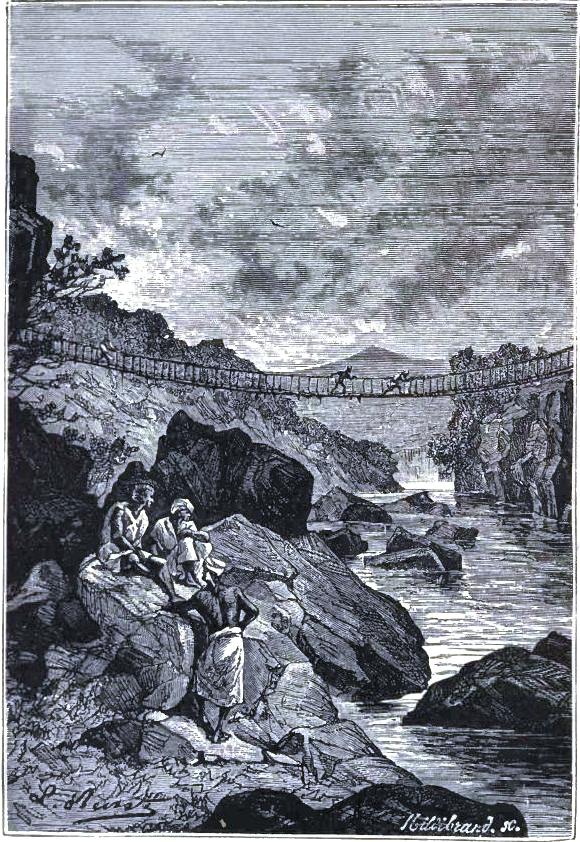
Bridge of rope.
The expedition afterwards passed through the town of Baharat, where but few of the houses have been rebuilt since the earthquake of 1803. This locality has always enjoyed a certain importance from the fact that a market is held there, and also on account of the difficulty of obtaining provisions in the towns higher up, as well as from its central position. The routes to Jemauhi, Kedar, Nath, and Sirinagur all meet there.
Beyond Batheri the road became so bad that the travellers were obliged to abandon their baggage. There was a mere path-track by the edge of precipices, amid débris of stones and rocks; and the attempt to proceed was soon relinquished.
Devaprayaga is situated at the junction of the Baghirati, and the Aluknanda. The first, coming from the north, hurries along with noise and impetuosity; the second, broader, deeper, and more tranquil, rises no less than forty-six feet above its ordinary level in the rainy season. The junction of these two rivers forms the Ganges, and is a sacred spot from which the Brahmins draw considerable profit, as they have arranged pools there, where for a certain price pilgrims can perform their ablutions without danger of being carried away by the current.
The Aluknanda was crossed by means of a running bridge, or "Dindla," which is thus described:—
"This bridge consists of three or four large ropes fixed upon either bank, and upon these a small seat some eighteen inches square is slung by means of hoops at either end. Upon this seat the traveller takes his place, and is drawn from one side of the river to the other by a rope pulled by the man upon the opposite bank."
The expedition reached Sirinagur upon the 13th of May. The curiosity of the inhabitants had been so much excited that the magistrates sent a message to the English begging them to march through the town.
Sirinagur, which had been visited by Colonel Hardwick in 1796, had been almost completely destroyed by the earthquake of 1803, and had in the same year been conquered by the Gorkhalis. Here Webb was joined by the emissaries whom he had sent to Gangautri by the route which he himself had been unable to follow, and who had visited the source of the Ganges.
"A large rock," he says, "on either side of which water flows, and which is very shallow, roughly resembles the body and mouth of a cow. A cavity at one end of its surface gave rise to its name of Gaoumokhi, the mouth of the cow, who, by its fancied resemblance, is popularly supposed to vomit the water of the sacred river. A little farther on, advance is impossible, a mountain as steep as a wall rises in front; the Ganges appeared to issue from the snow, which lay at its feet; the valley terminated here. No one has ever gone any farther."
The expedition returned by a different route. It met with the tributaries of the Ganges, and of the Keli Ganga, or Mandacni, rivers rising in the Mountains of Kerdar. Immense flocks of goats and sheep laden with grain were met with, numbers of defiles crossed, and after passing the towns of Badrinath and Manah the expedition finally reached the cascade of Barson, in the midst of heavy snow and intense cold.
"This," says Webb's narrative, "is the goal of the devotions of the pilgrims. Some of them come here to be sprinkled by the sacred spray of the cascade. At this spot the course of the Aluknanda may be traced as far as the south-western extremity of the valley, but its source is hidden under heaps of snow, which have probably been accumulating for centuries."
Webb furnishes some details respecting the women of Manah. They wore necklaces, earrings, and gold and silver ornaments, which were scarcely in keeping with their coarse attire. Some of the children wore necklaces and bracelets of silver to the value of six hundred rupees.
In winter, this town, which does a great trade with Thibet, is completely buried in snow, and the natives take refuge in neighbouring towns.
The expedition visited the temple at Badrinath, which is far-famed for its sanctity. Neither its internal nor external structure or appearance give any idea of the immense sums which are expended upon it. It is one of the oldest and most venerated sanctuaries of India. Ablutions are performed there in reservoirs fed with very warm sulphureous water.
"There are," says the narrative, "a great number of hot springs, each having their special name and virtue, and from all of them doubtless the Brahmins derive profit. For this reason, the poor pilgrim, as he gets through the requisite ablutions, finds his purse diminish with the number of his sins, and the many tolls exacted from him upon the road to paradise might induce him to consider the narrow way by no means the least expensive one. This temple possesses seven hundred villages, which have either been ceded to it by government, given as security for loans, or bought by private individuals and given as offerings."
The expedition reached Djosimah on the 1st of June. There the Brahmin who acted as guide received orders from the government of Nepaul, to conduct the travellers back immediately to the territories of the Company. The government had discovered, a little late it must be admitted, that the English explorations had a political as well as a geographical significance. A month afterwards, Webb and his companions entered Delhi, having definitely settled the course of the Ganges, and ascertained the sources of the Baghirati and Aluknanda; in fact, having attained the object which the Company had had in view.
In 1808, the English government decided upon sending a new mission to the Punjab, then under the dominion of Runjeet Sing. The anonymous narrative of this expedition published in the "Annales des Voyages" offers some particulars of interest, from which we will extract a few.
Upon the 6th of April, 1808, an English officer, in charge of the expedition, reached Herdonai, which he represents as the rendezvous of a million individuals at the time of the yearly fair. At Boria, which is situated between the Jumna and the Sutlej, the traveller was an object of much curiosity to the women, who begged permission to come and see him.
"Their looks and gestures," says the narrative, "sufficiently expressed their surprise. They approached me laughing heartily, the colour of my face amused them extremely. They addressed many questions to me, asking me whether I never wore a hat, whether I exposed my face to the sun, whether I remained continually shut up, or only walked out under shelter, and whether I slept upon the table placed in my tent, although my bed occupied one side of it; the curtains were, however, closed. They then examined it in detail, together with the lining of my tent and everything belonging to it. These women were all good-looking, with mild and regular features, their complexion was olive, and contrasted agreeably with their white and even teeth, which are a distinguishing feature of all the inhabitants of the Punjab."
Mustafabad, Mulana, and Umballa were visited in succession by the British officer. The country through which he passed was inhabited by Sikhs, a race remarkable for benevolence, hospitality, and truthfulness. The author of the narrative is of opinion that they are the finest race of men in India. Puttiala, Makeonara, Fegonara, Oudamitta, which Lord Lake entered in 1805 in his pursuit of a Mahratta chief, and finally Amritsur were stages easily passed.
Amritsur is better built than the generality of towns in Hindustan. It is the largest depôt of shawls and saffron as well as other articles of Deccan merchandise. The traveller says:—
"Upon the 14th, having put white shoes on my feet, I paid a visit to the Amritsur or reservoir of the elixir of immortality from whence the city derives its name. It is a reservoir of about 135 feet square, built of brick, and in the centre is a pretty temple dedicated to Gourogovind Sing. A footpath leads to it; it is decorated both within and without, and the rajah often adds to its stores by gifts of ornaments. In this sacred receptacle, the book of the laws, written by Gouron in the 'gourou moukhtis' character, is placed. This temple is called Hermendel, or the Dwelling of God. Some 600 priests are attached to its service, and comfortable dwellings are provided for them out of the voluntary contributions of the devotees who visit the temple. Although the priests are regarded with infinite respect, they are not absolutely free from vice. When they have money, they spend it as freely as they have gained it. The number of pretty women who daily repair to the temple is very great. They far excel the women of the inferior classes in Hindustan in the elegance of their manners, their fine proportions, and handsome features."
Lahore was next visited by the officer. It is interesting to know what remained of that fine city at the commencement of the present century. The narrative says:—
"Its very high walls are ornamented externally with all the profusion of Eastern taste, but they are falling into ruins, as are also the mosques and houses inside the town. Time has laid its destructive hand upon this city, as upon Delhi and Agra. The ruins of Lahore are already as extensive as those of that ancient capital."
Three days after his arrival the traveller was received with great politeness by Runjeet Sing, who conversed with him, principally upon military topics. The rajah was then twenty-seven years of age. His countenance would have been pleasant, had not the small-pox deprived him of one eye; his manners were simple, affable, and yet kingly. After paying visits to the tomb of Shah Jehan, to the Schalamar, and other monuments at Lahore, the officer returned to Delhi and the possessions of the Company. To his visit was due that better knowledge of the country which could not fail to tempt the ambition of the English Government.
The following year (1809), an embassy, consisting of Messrs. Nicholas Hankey Smith, Henry Ellis, Robert Taylor, and Henry Pottinger, was sent to the Emirs of Scinde. The escort was commanded by Captain Charles Christie.
The mission was transported to Keratchy by boat. The governor of that fort refused to allow the embassy to disembark, without instructions from the emirs. An interchange of correspondence ensued, as a result of which the envoy, Smith, drew attention to certain improprieties relating to the title and respective rank of the Governor-General and the emirs. The governor excused himself upon the ground of his ignorance of the Persian language, and said, that not wishing a cause of misunderstanding to exist, he was quite ready to kill or put out the eyes (as the envoy pleased) of the person who had written the letter. This declaration appeared sufficient to the English, who deprecated the execution of the guilty person.
In their letters the emirs affected a tone of contemptuous superiority; at the same time they brought a body of 8000 men within reach, and put every possible difficulty in the way of the English efforts to procure information. After tedious negotiations, in the course of which British pride was humbled more than once, the embassy received permission to start for Hyderabad.
Above Keratchy, which is the principal export harbour of Scinde, a vast plain without trees or vegetation extends along the coast. Five days are necessary to cross this, and reach Tatah, the ancient capital of Scinde, then ruined and deserted. Formerly it was brought into communication by means of canals, with the Sind, an immense river, which is, at its mouth, in reality an arm of the sea. Pottinger collected the most precise, complete, and useful details respecting the Sind, which were then known.
It had been arranged beforehand that the embassy should find a plausible excuse for separating and reaching Hyderabad by two different routes, in order to obtain geographical information on the country. The city was soon reached, and the same difficult negotiations about the reception of the embassy, who refused to submit to the humiliating exactions of the emirs, had to be gone through. Pottinger thus describes the arrival at Hyderabad. "The precipice upon which the eastern façade of the fortress of Hyderabad is situated, the roofs of the houses, and even the fortifications, were thronged by a multitude of both sexes, who testified friendly feeling towards us by acclamation and applause. Upon reaching the palace, where they were to dismount, the English were met by Ouli Mahommed Khan and other eminent officers, who walked before us towards a covered platform, at the extremity of which the emirs were seated. This platform being covered with the richest Persian carpet, we took off our shoes. From the moment the envoy took the first step towards the princes, they all three rose, and remained standing until he reached the place pointed out to him—an embroidered cloth, which distinguished him from the rest of the embassy. The princes addressed to each of us polite questions respecting our health. As it was a purely ceremonial reception, everything went off well, with compliments and polite expressions.
"The emirs wore a great number of precious stones, in addition to those which ornamented the hilts and scabbards of their swords and daggers, and emeralds and rubies of extraordinary size shone at their girdles. They were seated according to age, the eldest in the centre, the second to his right, the youngest on the left. A carpet of light felt covered the entire circle, and over this was a mattress of silk about an inch thick, exactly large enough to accommodate the three princes."
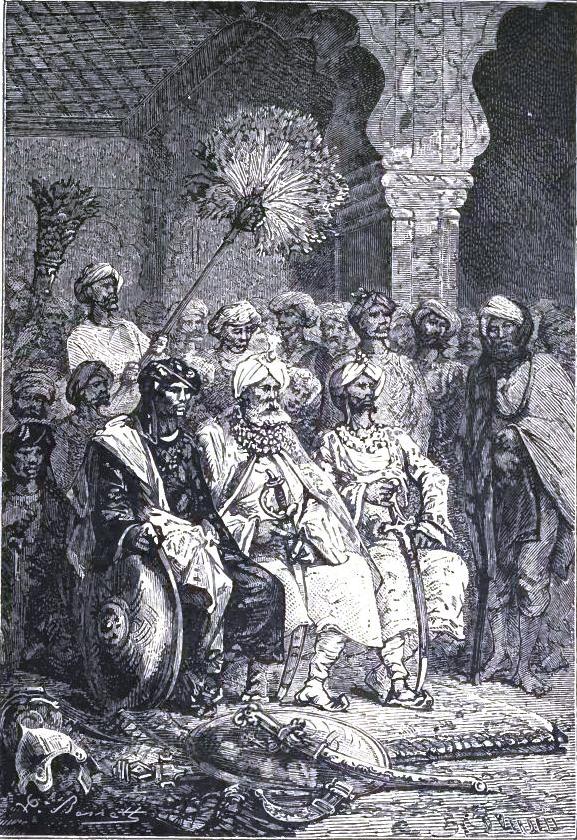
"They were seated according to age."
The narrative concludes with a description of Hyderabad, a fortress which would have scarcely been able to offer any resistance to a European enemy, and with various reflections upon the nature of the embassy, which had amongst other aims the closing of the entrance of Scinde against the French. The treaty concluded, the English returned to Bombay.
By this expedition the East India Company gained a better knowledge of one of the neighbouring kingdoms, and collected precious documents relating to the resources and productions of a country traversed by an immense river, the Indus of the ancients, which rises in the Himalayas, and might readily serve to transport the products of an immense territory. The end gained was perhaps rather political than geographical; but science profited, once more, by political needs.
Hitherto the little knowledge that had been gained of the regions lying between Cabulistan, India, and Persia, had been as incomplete as it was defective.
The Company, thoroughly satisfied with the manner in which Captain Christie and Lieutenant Pottinger had accomplished their embassy, resolved to confide to them a delicate and difficult mission. They were to rejoin General Malcolm, ambassador to Persia, by crossing Beluchistan, and in so doing to collect more accurate and precise details of that vast extent of country than had hitherto been acquired.
It was useless to think of crossing Beluchistan, with its fanatic population, in European dress. Christie and Pottinger, therefore, had recourse to a Hindu merchant, who provided horses on behalf of the Governments of Madras and Bombay, and accredited them as his agents to Kelat, the capital of Beluchistan.
Upon the 2nd of January, 1810, the two officers embarked at Bombay for Someany, the sole sea-port of the province of Lhossa, which they reached after a stay at Poorbunder, on the coast of Guzerat.
The entire country traversed by the travellers before they arrived at Bela was a morass, interspersed with jungle. The "Djam," or governor of that town, was an intelligent man. He put numerous questions to the English, by which he showed a desire to learn, and then confided the task of conducting the travellers to Kelat, to the chief of the tribe of Bezendjos, who are Belutchis.
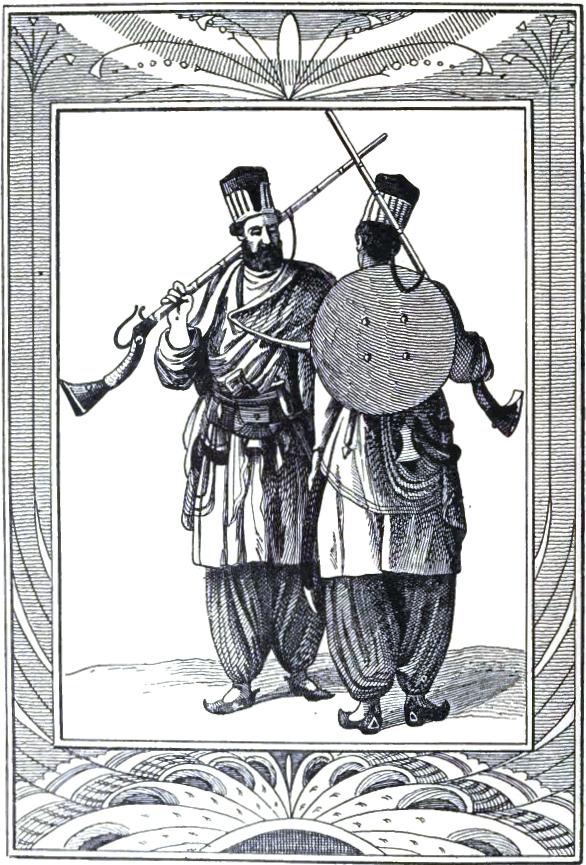
Beluchistan warriors. (Fac-simile of early engraving.)
The climate had changed since they left Bombay, and in the mountains, Pottinger and Christie experienced cold sufficiently keen to freeze the water in the leather bottles.
"Kelat," says Pottinger, "the capital of the whole of Beluchistan, whence it derives its name, Kelat, or the city, is situated upon a height to the west of a well-cultivated plain or valley, eight miles long and three wide. The greater portion of this is laid out in gardens. The town forms a square. It is surrounded on three sides by a mud wall about twenty feet high, flanked, at distances of 250 feet, by bastions, which, like the walls, are pierced with a large number of barbicans for musketry. I had no opportunity of visiting the interior of the palace, but it consists merely of a confused mass of mud buildings with flat roofs like terraces; the whole is defended by low walls, furnished with parapets and pierced with barbicans. There are about 2500 houses in the town, and nearly half as many in the suburbs. They are built of half-baked bricks and wood, the whole smeared over with mud. The streets, as a rule, are larger than those in towns inhabited by Asiatics. They usually have a raised footway on either side for pedestrians, in the centre an open stream, which is rendered very unpleasant by the filth and rubbish thrown into it, and by the stagnant rainwater which collects, for there is no regulation insisting upon it being cleaned. Another obstacle to the cleanliness and comfort of the town exists in the projection of the upper stories of the houses, which makes the under buildings damp and dark. The bazaar of Kelat is very large, and well stocked with every kind of merchandize. Every day it is supplied with provisions, vegetables, and all kinds of food, which are cheap."
According to Pottinger's account, the population is divided into two distinct classes—the Belutchis and the Brahouis, and each of these is subdivided into a number of tribes. The first is related to the modern Persian, both in appearance and speech; the Brahoui, on the contrary, retains a great number of Hindu words. Intermarriage between the two has given rise to a third.
The Belutchis, coming from the mountains of Mekram, are "Tunnites," that is to say, they consider the first four Imans as the legitimate successors of Mahomet.
They are a pastoral people, and have the faults and virtues of their class. If they are hospitable, they are also indolent, and pass their time in gambling and smoking. As a rule, they content themselves with one or two wives, and are less jealous of their being seen by strangers than are other Mussulmen. They have a large number of slaves of both sexes, whom they treat humanely. They are excellent marksmen, and passionately fond of hunting. Brave under all circumstances, they take pleasure in "razzias," which they call "tchépaos." As a rule, these expeditions are undertaken by the Nherouis, the wildest and most thievish of the Belutchis.
The Brahouis carry their wandering habits still farther. Few men are more active and strong; they endure the glacial cold of the mountains equally with the burning heat of the plains. They are of small stature, but as brave, as skilful in shooting, as faithful to their promises, as the Belutchis, and have not so pronounced a taste for plunder.
Pottinger says, "I have seen no Asiatic people whom they resemble, for a large number have brown hair and beards."
After a short stay at Kelat, the two travellers, who still passed as horse-dealers, resolved to continue their journey, but instead of following the high road to Kandahar, they crossed a dreary and barren country, ill-populated, watered by the Caisser, a river which dries up during the summer; and they reached a little town, called Noschky or Nouchky, on the frontier of Afghanistan.
At this place, the Belutchis, who appeared friendly, represented to them the great difficulty of reaching Khorassan and its capital, Herat, by way of Sedjistan. They advised the travellers to try to reach Kerman by way of Kedje and Benpor, or by Serhed, a village on the western frontier of Beluchistan, and from thence to enter Nermanchir. At the same moment the idea of following two distinct routes presented itself to both Christie and Pottinger. This course was contrary to their instructions; "but," said Pottinger, "we found a ready excuse in the unquestionable advantage which would result from our procuring more extensive geographical and statistical knowledge of the country we were sent to explore than we could hope to do by travelling together."
Christie set out first, by way of Douchak. We shall follow his fortunes hereafter.
A few days later, while still at Noutch, Pottinger received letters from his correspondent at Kelat, telling him that the emirs of Scinde were searching for them, as they had been recognized, and that his best plan for safety was to set out immediately.
Upon the 25th of March Pottinger started for Serawan, a very small town near the Afghan frontier. Upon his way thither Pottinger met with some singular altars, or tombs, the construction of which was attributed to the Ghebers, or fire-worshippers, who are known in our day as Parsees.
Serawan is six miles from the Serawani mountains, in a sterile and bare district. This town owes its existence to the constant supply of water it derives from the Beli, an inestimable advantage in a country constantly exposed to drought, scarcity, and famine.
Pottinger afterwards visited the Kharan, celebrated for the strength and activity of its camels, and crossed the desert which forms the southern extremity of Afghanistan. The sand of this desert is so fine that its particles are almost impalpable, and the action of the wind causes it to accumulate into heaps ten or twenty feet high, divided by deep valleys. Even in calm weather a great number of particles float in the air, giving rise to a mirage of a peculiar kind, and getting into the traveller's eyes, mouth, and nostrils, cause an excessive irritation, with an insatiable thirst.
In all this territory, Pottinger personated a "pyrzadeh," or holy man, for the natives are of a very thievish disposition, and in the character of a merchant he might have been involved in unpleasant adventures. After leaving the village of Goul, in the district of Daizouk, the traveller passed through the ruined towns of Asmanabad, Hefter, and Pourah, where Pottinger was forced to admit that he was a "Feringhi," to the great scandal of the guide, who during the two months they had been together had never doubted him, and to whom he had given many proofs of sanctity.
At last, worn out by fatigue, and at the end of his resources, Pottinger reached Benpor, a locality which had been visited in 1808 by Mr. Grant, a captain in the Bengal Sepoy Infantry. Encouraged by the excellent account given by that officer, Pottinger presented himself to the Serdar. But instead of affording him the necessary help for the prosecution of his journey, that functionary, discontented with the small present Pottinger offered him, found means to extort from him a pair of pistols, which would have been of great use to him.
Basman is the last inhabited town of Beluchistan. At this spot there is a hot sulphureous spring, which the Belutchis consider a certain cure for cutaneous diseases.
The frontiers of Persia are far from "scientific," hence a large tract of country remains not neutral, but a subject of dispute, and is the scene of sanguinary contests.
The little town of Regan, in Nermanchir, is very pretty. It is a fort, or rather a fortified village, surrounded by high walls, in good repair, and furnished with bastions.
Further on, in Persia proper, lies Benn, a town which was formerly of importance, as the ruins which surround it sufficiently prove. Here Pottinger was cordially received by the governor.
"On approaching," says Pottinger, "he turned to one of his suite and asked where the 'Feringhi' was. I was pointed out to him. Making me a sign to follow him, his fixed look at me, which took me in from head to foot, proclaimed his astonishment at my costume, which in truth was strange enough to serve as an excuse for the impoliteness of his staring. I was wearing the long shirt of a Belutchi, and a pair of trousers which had once been white, but which in the six weeks I had worn them had become brown, and were all but in rags; in addition to this I had on a blue turban, a piece of rope served me as a girdle, and I carried in my hand a thick stick, which had assisted me greatly in my walking, and protected me from dogs."
In spite of the dilapidated appearance of the tatterdemalion who thus presented himself before him, the governor received Pottinger with as much cordiality as was to be expected from a Mussulman, and provided him with a guide to Kerman. The traveller reached that town upon the 3rd of May, feeling that he had accomplished the most difficult portion of his journey, and was almost in safety.
Kerman is the capital of ancient Karamania. Under the Afghan rule it was a flourishing town, and manufactured shawls which rivalled those of Cashmere.
Here Pottinger witnessed one of those spectacles which, common enough to countries where human life is of little value, always fill Europeans with horror and disgust. The governor of this town was both son-in-law and nephew of the shah, and also the son of the Shah's wife. "Upon the 15th of May," says Pottinger, "the prince himself judged certain persons who were accused of killing one of their servants. It is difficult to estimate the state of restlessness and alarm which prevailed in the village during the entire day. The gates of the town were shut, that no one might pass out. The government officials did not transact any business. People were cited as witnesses, without previous notice. I saw two or three taken to the palace in a state of agitation which could scarcely have been greater had they been going to the scaffold. About three in the afternoon the prince passed sentence upon those who had been convicted. Some had their eyes put out, some the tongue split. Some had the ears, nose, and lips cut off; others were deprived of their hands, fingers, or toes. I learned that whilst these horrible punishments were inflicted, the prince remained seated at the window where I had seen him, and gave his orders without the least sign of compassion or of horror at the scene which took place before him."
Leaving Kerman, Pottinger reached Cheré Bebig, which is equally distant from Yezd, Shiraz, and Kerman, and thence proceeded to Ispahan, where he had the pleasure of finding his companion Christie. At Meragha he met General Malcolm. It was now seven months since they had left Bombay. Christie had traversed 2250 miles, and Pottinger 2412. Meanwhile Christie had accomplished his perilous journey much better than he had anticipated.
Leaving Noutch upon the 22nd of March, he crossed the Vachouty mountains and some uncultivated country, to the banks of the Helmend, a river which flows into Lake Hamoun.
Christie in his report to the Company says:—
"The Helmend, after passing near Kandahar, flows south-west and west, and enters Sedjestan some four days march from Douchak; making a détour around the mountains, it finally forms a lake. At Peldalek, which we visited, it is about 1200 feet in width, and very deep; the water is very good. The country is cultivated by irrigation for half a mile on either side; then the desert begins, and rises in perpendicular cliffs. The banks of the river abound in tamarind-trees and provide pasturage for cattle."
Sedjestan, which is watered by this river, comprises only 500 square miles. The portions of this district which are inhabited are those upon the river Helmend, whose bed deepens every year.
At Elemdar Christie sent for a Hindu, to whom he had an introduction. This man advised him to dismiss his Belutchi attendants and to personate a pilgrim. A few days later he penetrated to Douchak, now known as Jellalabad. He says:—
"The ruins of the ancient city cover quite as large a space of ground as Ispahan. It was built, like all the towns of Sedjistan, of half-burned bricks, the houses being two stories high, with vaulted roofs. The modern town of Jellalabad is clean, pretty, and growing; it contains nearly 2000 houses and a fair bazaar." The road from Douchak to Herat was easy. Christie's sole difficulty was in carrying out his personation of a pilgrim. Herat lies in a valley, surrounded by high mountains and watered by a river, to which it is due that gardens and orchards abound. The town covers an area of about four square miles; it is surrounded by a wall flanked with towers, and a moat full of water. Large bazaars, containing numerous shops, and the Mechedé Djouna, or Mosque of Friday, are its chief ornaments.