Chapter II · (continued 3)
N. D'Anvers translation
For all this, however, Boy brought John Lander safely to the brig. Captain Lake received the traveller pretty cordially, but declared his intention of making the king go back without so much as an obolus. Poor Boy was full of the most gloomy forebodings. His haughty manner was exchanged for an air of deprecating humility. An abundant meal was placed before him, but he scarcely touched it. Richard Lander, disgusted with the stinginess and bad faith of Lake, and unable to keep his promises, ransacked all his possessions; and finding, at last, five silver bracelets and a sabre of native manufacture, which he had brought from Yarriba, he offered these to Boy, who accepted them. Finally, the king screwed up courage enough to make his demand to the captain, who, in a voice of thunder which it was difficult to believe could have come from such a feeble body, declined to accede to it, enforcing his refusal with a shower of oaths and threats, such as made Boy, who saw, moreover, that the vessel was ready to sail, beat a hasty retreat, and hurry off to his canoe.
Thus ended the vicissitudes of the Brothers Lander's journey. They were in some danger in crossing the bar, but that was their last. They reached Fernando Po, and then the Calabar River where they embarked on the Carnarvon for Rio Janeiro, at which port Admiral Baker, then commanding the station, got them a passage on board a transport-ship.
On the 9th June they disembarked at Portsmouth. Their first care, after sending an account of their journey to Lord Goderich, then Colonial Secretary, was to inform that official of the conduct of Captain Lake, conduct which was of a nature to compromise the credit of the English Government. Orders were at once given by the minister for the payment of the sums agreed upon, which were perfectly just and reasonable.
Thus was completely and finally solved the geographical problem which had for so many centuries occupied the attention of the civilized world, and been the subject of so many different conjectures. The Niger, or as the natives call it, the Joliba, or Quorra, is not connected with the Nile, and does not lose itself in the desert sands or in the waters of Lake Tchad; it flows in a number of different branches into the ocean on the coast of the Gulf of Guinea, at the point known as Cape Formosa. The entire glory of this discovery, foreseen though it was by scientific men, belongs to the Brothers Lander. The vast extent of country traversed by the Niger between Yaoorie and the sea was completely unknown before their journey.
So soon as the discoveries made by Lander became known in England, several merchants formed themselves into a company for developing the resources of the new districts. In July, 1832, they equipped two steamers, the Quorra and Alburka, which, under the command of Messrs. Laird, Oldfield, and Richard Lander, appended the Niger as far as Bocqua. The results of this commercial expedition were deplorable. Not only was there absolutely no trade to be carried on with the natives, but the crews of the vessels were decimated by fever. Finally, Richard Lander, who had so often gone up and down the river, was mortally wounded by the natives, on the 27th January, 1834, and died on the morning of 5th February, at Fernando Po.
To complete our account of the exploration of Africa during the period under review, we have still to speak of the various surveys of the valley of the Nile, the most important of which were those by Cailliaud, Russegger, and Rüppell.
Frederic Cailliaud was born at Nantes in 1787, and arrived in Egypt in 1815, having previously visited Holland, Italy, Sicily, part of Greece, and European or Asiatic Turkey, where he traded in precious stones. His knowledge of geology and mineralogy won for him a cordial reception from Mehemet Ali, who immediately on his arrival commissioned him to explore the course of the Nile and the desert.
This first trip resulted in the discovery of emerald mines at Labarah, mentioned by Arab authors, which had been abandoned for centuries. In the excavations in the mountain Cailliaud found the lamps, crowbars, ropes, and tools used in working these mines by men in the employ of Ptolemy. Near the quarries the traveller discovered the ruins of a little town, which was probably inhabited by the ancient miners. To prove the reality of his valuable discovery he took back ten pounds' weight of emeralds to Mehemet Ali.
Another result of this journey was the discovery by the French explorer of the old road from Coptos to Berenice for the trade of India.
From September, 1819, to the end of 1832, Cailliaud, accompanied by a former midshipman named Letorzec, was occupied in exploring all the known oases east of Egypt, and in tracing the Nile to 10° N. lat. On his first journey he reached Wady Halfa, and for his second trip he made that place his starting-point. A fortunate accident did much to aid his researches. This was the appointment of Ismail Pacha, son of Mehemet Ali, to the command of an expedition to Nubia. To this expedition Cailliaud attached himself.
Leaving Daraou in November, 1820, Cailliaud arrived, on the 5th January in the ensuing year, at Dongola, and reached Mount Barka in the Chaguy country, where are a vast number of ruins of temples, pyramids, and other monuments. The fact of this district bearing the name of Merawe had given rise to an opinion that in it was situated the ancient capital of Ethiopia. Cailliaud was enabled to show this to be erroneous.
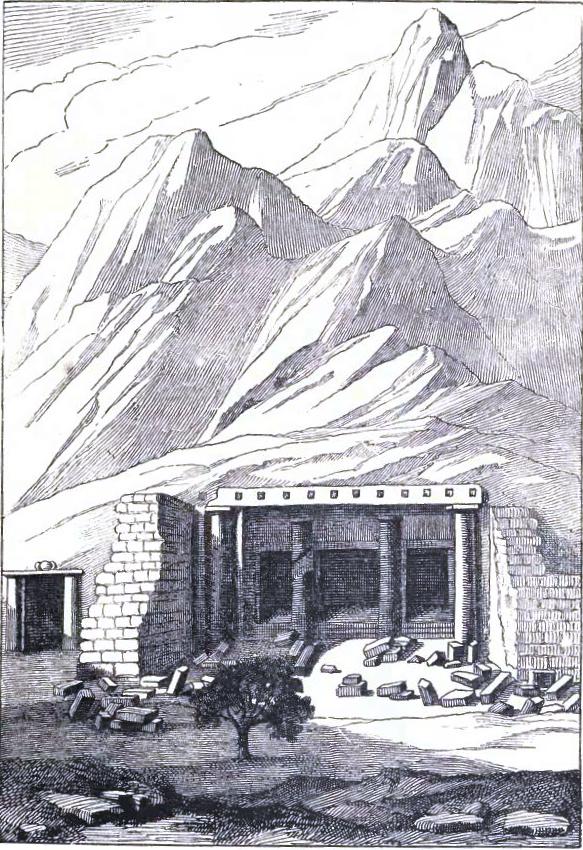
View of a Merawe temple. (Fac-simile of early engraving.)
The French explorer, accompanying Ismail Pacha in the character of a mineralogist beyond Berber, on a quest for gold-mines, arrived at Shendy. He then went with Letorzec to determine the position of the junction of the Atbara with the Nile; and at Assour, not far from 17° N. lat., he discovered the ruins of an extensive ancient town. It was Meroë. Pressing on in a southerly direction between the 15th and 16th degrees of N. lat., Cailliaud next identified the mouth of the Bahr-el-Abiad, or White Nile, visited the ruins of Saba, the mouth of the Rahad, the ancient Astosaba, Sennaar, the river Gologo, the Fazoele country, and the Toumat, a tributary of the Nile, finally reaching the Singue country between the two branches of the river. Cailliaud was the first explorer to penetrate from the north so near to the equator; Browne had turned back at 16° 10', Bruce at 11°. To Cailliaud and Letorzec we owe many observations on latitude and longitude, some valuable remarks on the variation of the magnetic needle, and details of the climate, temperature, and nature of the soil, together with a most interesting collection of animals and botanical specimens. Lastly, the travellers made plans of all the monuments beyond the second cataract.
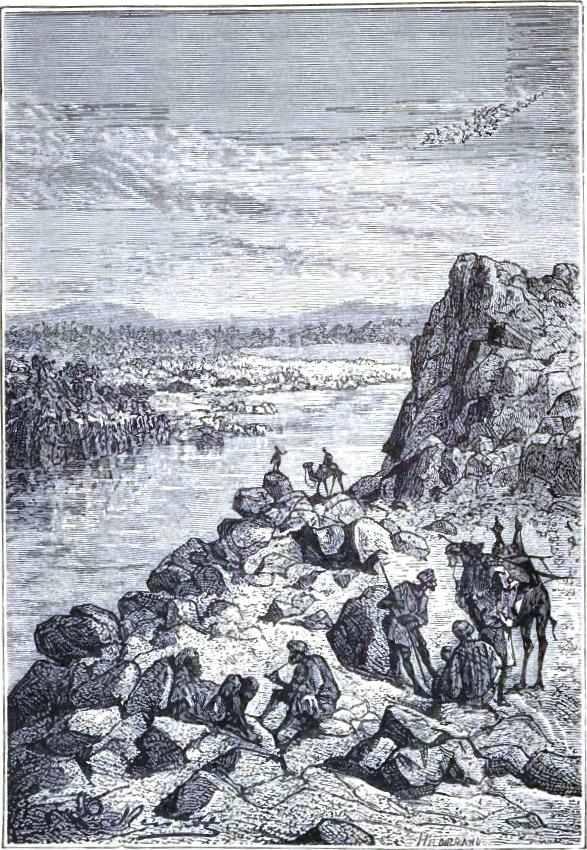
The Second Cataract of the Nile.
The two Frenchmen had preluded their discoveries by an excursion to the oasis of Siwâh. At the end of 1819 they left Fayum with a few companions, and entered the Libyan desert. In fifteen days, and after a brush with the Arabs, they reached Siwâh, having on their way taken measurements of every part of the temple of Jupiter Ammon, and determined, as Browne had done, its exact geographical position. A little later a military expedition was sent to this same oasis, in which Drovetti collected new and very valuable documents supplementing those obtained by Cailliaud and Letorzec. They afterwards visited successively the oasis of Falafre, never before explored by a European, that of Dakel, and Khargh, the chief place of the Theban oasis. The documents collected on this journey were sent to France, to the care of M. Jomard, who founded on them his work called "Voyage à l'Oasis de Siouah."
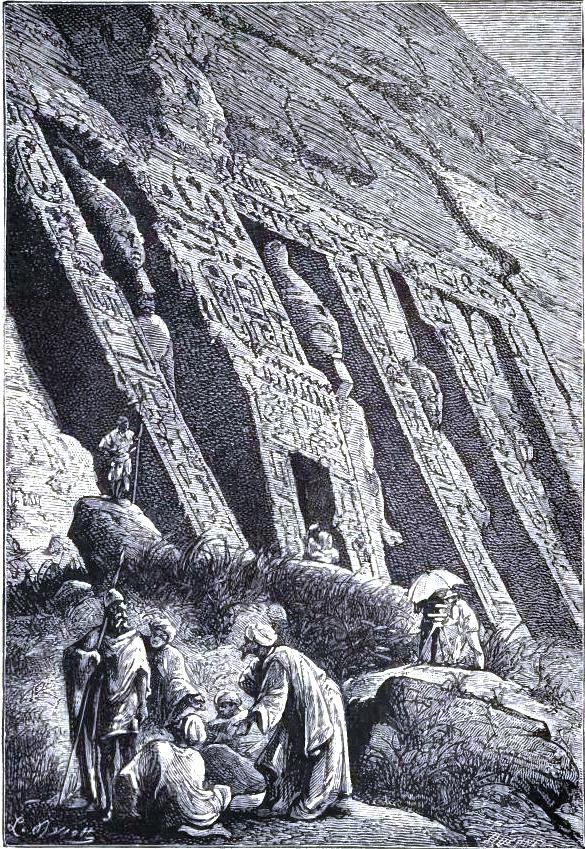
Temple of Jupiter Ammon.
A few years later Edward Rüppell devoted seven or eight years to the exploration of Nubia, Sennaar, Kordofan, and Abyssinia in 1824, he ascended the White Nile for more than sixty leagues above its mouth.
Lastly, in 1836 to 1838, Joseph Russegger, superintendent of the Austrian mines, visited the lower portion of the course of the Bahr-el-Abiad. This official journey was followed by the important and successful surveys afterwards made by order of Mehemet Ali in the same regions.