Chapter II · (continued 2)
N. D'Anvers translation
At last, one night, Partarieu, to disarm the suspicion of the natives, gave out that he could not carry all his baggage at once, and having first filled his coffers and bags with stones, he decamped with all his followers for the Senegal, leaving his tents pitched and his fires alight. His path was strewn with bales, arms, and animals. Thanks to this subterfuge, and the rapidity of their march, the English reached Bakel in safety, where the French welcomed the remnant of the expedition with enthusiasm.
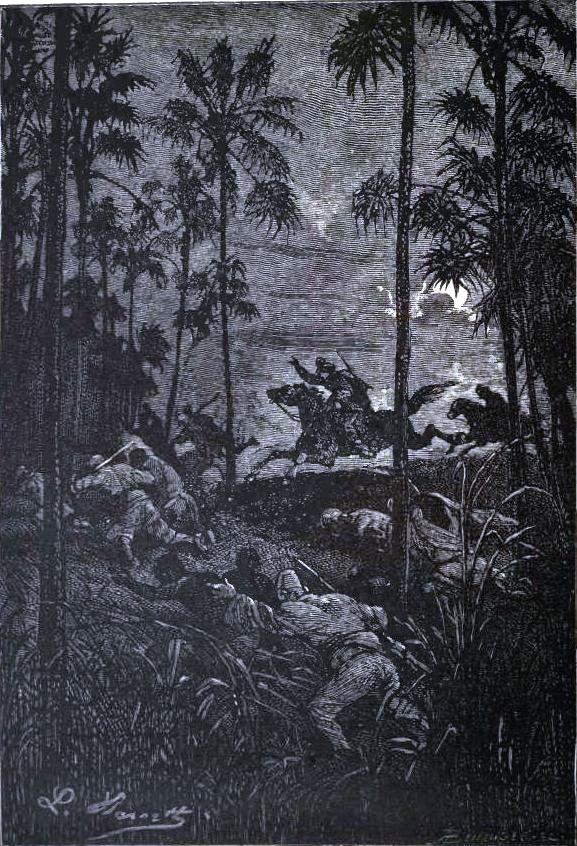
"He decamped with all his followers."
Caillié, attacked by a fever which nearly proved fatal, returned to St. Louis; but not recovering his health there, he was obliged to go back to France. Not until 1824 was he able to return to Senegal, which was then governed by Baron Roger, a friend to progress, who was anxious pari passu, to extend our geographical knowledge with our commercial relations. Roger supplied Caillié with means to go and live amongst the Bracknas, there to study Arabic and the Mussulman religion.
Life amongst the suspicious and fanatic Moorish shepherds was by no means easy. The traveller, who had great difficulty in keeping his daily journal, was obliged to resort to all manner of subterfuges to obtain permission to explore the neighbourhood of his house. He gives us some curious details of the life of the Bracknas—of their diet, which consists almost entirely of milk; of their habitations, which are nothing more than tents unfitted for the vicissitudes of the climate; of their "guéhués" or itinerant minstrels; their mode of producing the excessive embonpoint which they consider the height of female beauty; the aspect of the country; the fertility and productions of the soil, &c.
The most remarkable of all the facts collected by Caillié are those relating to the five distinct classes into which the Moorish Bracknas are divided. These are the Hassanes, or warriors, whose idleness, slovenliness, and pride exceed belief; the Marabouts, or priests; the Zénagues, tributary to the Hassanes; the Laratines; and the slaves.
The Zénagues are a miserable class, despised by all the others, but especially by the Hassanes, to whom they pay a tribute, which is of variable amount, and is never considered enough. They do all the work, both industrial and agricultural, and rear all the cattle.
"In spite of my efforts," says Caillié, "I could find out nothing about the origin of this people, or ascertain how they came to be reduced to pay tribute to other Moors. When I asked them any questions about this, they said it was God's will. Can they be a remnant of a conquered tribe? and if so, how is it that no tradition on the subject is retained amongst them. I do not think they can be, for the Moors, proud as they are of their origin, never forget the names of those who have brought credit to their families; and were such the case, the Zénagues, who form the majority of the population, and are skilful warriors, would rise under the leadership of one of their chiefs, and fling off the yoke of servitude."
Laratine is the name given to the offspring of a Moor and a negro slave. Although they are slaves, the Laratines are never sold, but while living in separate camps, are treated very much like the Zénagues. Those who are the sons of Hassanes are warriors, whilst the children of Marabouts are brought up to the profession of their father.
The actual slaves are all negroes. Ill-treated, badly fed, and flogged on the slightest pretext, there is no suffering which they are not called upon to endure.
In May, 1825, Caillié returned to St. Louis. Baron Roger was absent, and his representative was by no means friendly. The explorer had to content himself with the pay of a common soldier until the return of his protector, to whom he sent the notes he had made when amongst the Bracknas, but all his offers of service were rejected. He was promised a certain sum on his return from Timbuctoo; but how was he even to start without private resources?
The intrepid Caillié was not, however, to be discouraged. As he obtained neither encouragement nor help from the colonial government, he went to Sierra Leone, where the governor, who did not wish to deprive Major Laing of the credit of being the first to arrive at Timbuctoo, rejected his proposals.
In the management of an indigo factory, Caillié soon saved money to the extent of two thousand francs, a sum which appeared to him sufficient to carry him to the end of the world. He lost no time in purchasing the necessary merchandise, and joined some Mandingoes and "seracolets," or wandering African merchants. He told them, under the seal of secrecy, that he had been born in Egypt of Arab parents, taken to France at an early age, and sent to Senegal to look after the business of his master, who, satisfied with his services, had given him his freedom. He added, that his chief desire was to get back to Egypt, and resume the Mohammedan religion.
On the 22nd March, 1827, Caillié left Freetown for Kakondy, a village on the Rio Nuñez, where he employed his leisure in collecting information respecting the Landamas and the Nalous, both subject to the Foulahs of Fouta Djallon, but not Mohammedans, and, as a necessary result, both much given to spirituous liquors. They dwell in the districts watered by the Rio Nuñez, side by side with the Bagos, an idolatrous race who dwell at its mouth. The Bagos are light-hearted, industrious, and skilful tillers of the soil; they make large profits out of the sale of their rice and salt. They have no king, no religion but a barbarous idolatry, and are governed by the oldest man in their village, an arrangement which answers very well.
On the 19th April, 1827, Caillié with but one bearer and a guide, at last started for Timbuctoo. He speaks favourably of the Foulahs and the people of Fouta Djallon, whose rich and fertile country he crossed. The Ba-Fing, the chief affluent of the Senegal, was not more than a hundred paces across, and a foot and a half deep where he passed it; but the force of the current, and the huge granite rocks encumbering its bed, render it very difficult and dangerous to cross the river. After a halt of nineteen days in the village of Cambaya, the home of the guide who had accompanied him thus far, Caillié entered Kankan, crossing a district intersected by rivers and large streams, which were then beginning to inundate the whole land.
On the 30th May the explorer crossed the Tankisso, a large river with a rocky bed belonging to the system of the Niger, and reached the latter on the 11th June, at Couronassa.
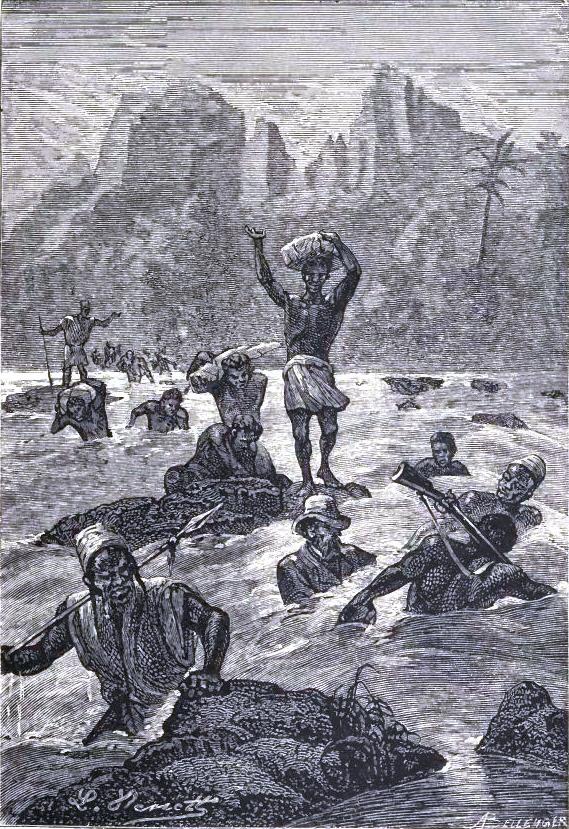
Caillié crossing the Tankisso.
"Even here," says Caillié, "so near to its source, the Niger is 900 feet wide, with a current of two miles and a half."
Before we enter Kankan with the French explorer, it will be well to sum up what he says of the Foulahs of Fouta. They are mostly tall, well-made men, with chestnut-brown complexions, curly hair, lofty foreheads, aquiline noses, features in fact very like those of Europeans. They are bigoted Mohammedans, and hate Christians. Unlike the Mandingoes, they do not travel, but love their home; they are good agriculturists and clever traders, warlike and patriotic, and they leave none but their old men and women in their villages when they go to war.
The town of Kankan stands in a plain surrounded by lofty mountains. The bombax, baobab, and butter-tree, also called "cé" the "shea" of Mungo Park, are plentiful. Caillié was delayed in Kankan for twenty-eight days before he could get on to Sambatikala; and during that time he was shamefully robbed by his host, and could not obtain from the chief of the village restitution of the goods which had been stolen.
"Kankan," says the traveller, "is a small town near the left bank of the Milo, a pretty river, which comes from the south, and waters the Kissi district, where it takes its rise, flowing thence in a north-westerly direction to empty itself into the Niger, two or three days' journey from Kankan. Surrounded by a thick quick-set hedge, this town, which does not contain more than 6000 inhabitants, is situated in an extensive and very fertile plain of grey sand. On every side are pretty little villages, called Worondes, where the slaves live. These habitations give interest to the scene, and are surrounded by very fine plantations; yams, rice, onions, pistachio nuts, &c., are exported in large quantities."
Between Kankan and Wassolo the road led through well cultivated, and, at this time of year, nearly submerged districts. The inhabitants struck Caillié as being of a mild, cheerful, and inquiring disposition. They gave him a cordial welcome.
Several tributaries of the Niger, including the Sarano, were passed before a halt was made at Sigala, the residence of Baranusa, the chief of Wassolo. He was of slovenly habits, like his subjects, and used tobacco both as snuff and for smoking. He was said to be very rich in gold and slaves. His subjects paid him a tribute in cattle; he had a great many wives, each of whom owned a hut of her own, their houses forming a little village, with well cultivated environs. Here Caillié for the first time saw the Rhamnus Lotus mentioned by Park.
On leaving Wossolo, Caillié entered Foulou, whose inhabitants, like those of the former district, are idolaters, of slovenly habits. They speak the Mandingo tongue. At Sambatikala the traveller paid a visit to the almamy.
"We entered," he says, "a place which served him as a bedroom for himself and a stable for his horse. The prince's bed was at the further end. It consisted of a little platform raised six inches from the ground, on which was stretched an ox hide, with a dirty mosquito curtain, to keep off the insects. There was no other furniture in this royal abode. Two saddles hung from stakes driven into the wall; a large straw hat, a drum only used in war-time, a few lances, a bow, a quiver, and some arrows, were the only ornaments. A lamp made of a piece of flat iron set on a stand of the same metal, stood on the ground. This lamp was fed by a kind of vegetable matter, not thick enough to be made into candles."
The almamy soon informed Caillié of an opportunity for him to go to Timeh, whence a caravan was about to start for Jenneh. The traveller then entered the province of Bambarra, and quickly arrived at the pretty little village of Timeh, inhabited by Mohammedan Mandingoes, and bounded on the east by a chain of mountains about 350 fathoms high.
When he entered this village, at the end of July, Caillié little dreamt of the long stay he would be compelled to make in it. He had hurt his foot, and the wound became very much inflamed by walking in wet grass. He therefore decided to let the caravan for Jenneh go on without him, and remain at Timeh until his foot should be completely healed. It would have been too great a risk for him in his state to travel through Bambarra, where the idolatrous inhabitants of the country would be pretty sure to rob him.
"The Bambarras," he says, "have few slaves, go almost naked, and are always armed with bows and arrows. They are governed by a number of petty independent chiefs, who are often at war with one another. They are in fact rude and wild creatures as compared with the tribes who have embraced Mohammedanism."
Caillié was detained at Timeh by the still unhealed wound in his foot, until the 10th November. At that date he proposed starting for Jenneh, but, to quote his own words, "I was now seized with violent pains in the jaws, warning me that I was attacked with scurvy, a terrible malady, all the horrors of which I was to realize. My palate was completely skinned, part of the bone came away, my teeth seemed ready to fall out of the gums, my sufferings were terrible. I feared that my brain might be affected by the agony of pain in my head. I was more than a fortnight without an instant's sleep."
To make matters worse, the wound broke out afresh; and he would have been cured neither of it nor of the scurvy had it not been for the energetic treatment of an old negress, who was accustomed to doctor the scorbutic affections, so common in that country.
On the 9th January, 1828, Caillié left Timeh, and reached Kimba, a little village where the caravan for Jenneh was assembled. Near to this village rises the chain erroneously called Kong, which is the general name for mountain amongst the Mandingoes.
The names of the villages entered by the travellers, and the incidents of the journey through Bambarra, are of no special interest. The inhabitants are accounted great thieves by the Mandingoes, but are probably not more dishonest than their critics.
The Bambarra women all wear a thin slip of wood imbedded in the lower lip, a strange fashion exactly similar to that noticed by Cook amongst the natives of the north-western coast of America. The Bambarras speak Mandingo, though they have a dialect of their own called Kissour, about which the traveller could obtain no trustworthy written information.
Jenneh was formerly called "the golden land." The precious metal is not, however, found there, but a good deal is imported by the Boureh merchants and the Mandingoes of Kong.
Jenneh, two miles and a half in circumference, is surrounded by a mud wall ten feet high. The houses, built of bricks baked in the sun, are as large as those of European peasants. They have all terraces, but no outer windows. Numbers of foreigners frequent Jenneh. The inhabitants, as many as eight or ten thousand, are very industrious and intelligent. They hire out their slaves, and also employ them in various handicrafts.
The Moors, however, monopolize the more important commerce. Not a day passes that they do not despatch huge boats laden with rice, millet, cotton, honey, vegetable butter, and other native products.
In spite of this great commercial movement, the prosperity of Jenneh was threatened. Sego Ahmadou, chief of the country, impelled by bigoted zeal, made fierce war upon the Bambarras of Sego, whom he wished to rally round the standard of the Prophet. This struggle did a great deal of harm to the trade of Jenneh, for it interrupted intercourse with Yamina, Sansanding, Bamakou, and Boureh, which were the chief marts for its produce.
The women of Jenneh would not be true to their sex if they did not show some marks of coquetry. Those who aim at fashion pass a ring or a glass ornament through the nostrils, whilst their poorer sisters content themselves with a bit of pink silk.
During Caillié's long stay at Jenneh, he was loaded with kindness and attentions by the Moors, to whom he had told the fabulous tale about his birth in Egypt, and abduction by the army of occupation.
On the 23rd March, the traveller embarked on the Niger for Timbuctoo, on which the sheriff, won over by the gift of an umbrella, had obtained a passage for him. He carried with him letters of introduction to the chief persons in Timbuctoo.
Caillié now passed in succession the pretty villages of Kera, Taguetia, Sankha-Guibila, Diebeh, and Isaca, near to which the river is joined by an important branch, which makes a great bend beyond Sego, catching sight also of Wandacora, Wanga, Corocoïla, and Cona, finally reaching, on the 2nd of April, the mouth of the important Lake Debo.
"Land," says Caillié, "is visible on every side of this lake except on the west, where it widens out like a vast inland sea. Following its northern coast in a west-north-west direction for a distance of fifteen miles, you leave on the left a tongue of level ground, which runs several miles to the south, seeming to bar the passage of the lake, and form a kind of strait. Beyond this barrier the lake stretches away out of sight in the west. The barrier I have just described cuts Lake Debo into two parts, the upper and lower. That navigable to boats contains three islands, and is very wide; it stretches away a short distance on the east, and is supplemented by an immense number of huge marshes."
One after the other, Caillié now passed the fishing village of Gabibi; Tongoon in the Diriman country, a district stretching far away on the east; Codosa, an important commercial town; Barconga, Leleb, Garfolo, Baracondieh, Tircy, Talbocoïla, Salacoïla, Cora, Coratou, where the Tuaricks exact a toll from passing boats, and finally reached Cabra, built on a height out of reach of the overflowing of the Niger, and serving as the port of Timbuctoo.
On the 20th, Caillié disembarked, and started for that city, which he entered at sundown.
"I, at last," cries our hero, "saw the capital of the Soudan, which had so long been the goal of my desires. As I entered that mysterious town, an object of curiosity to the civilized nations of Europe, I was filled with indescribable exultation. I never experienced anything like it, and my delight knew no bounds. But I had to moderate my transports, and it was to God alone I confided them. With what earnestness I thanked Him for the success which had crowned my enterprise and the signal protection He had accorded me in so many apparently insurmountable difficulties and perils. My first emotions having subsided, I found that the scene before me by no means came up to my expectations. I had conceived a very different idea of the grandeur and wealth of this town. At first sight it appeared nothing more than a mass of badly-built houses, whilst on every side stretched vast plains of arid, yellowish, shifting sands. The sky was of a dull red colour on the horizon; all nature seemed melancholy; profound silence prevailed, not so much as the song of a bird was heard. And yet there was something indescribably imposing in the sight of a large town rising up in the midst of the sandy desert, and the beholder cannot but admire the indomitable energy of its founders. I fancy the river formerly passed nearer the town of Timbuctoo; it is now eight miles north of it and five of Cabra."
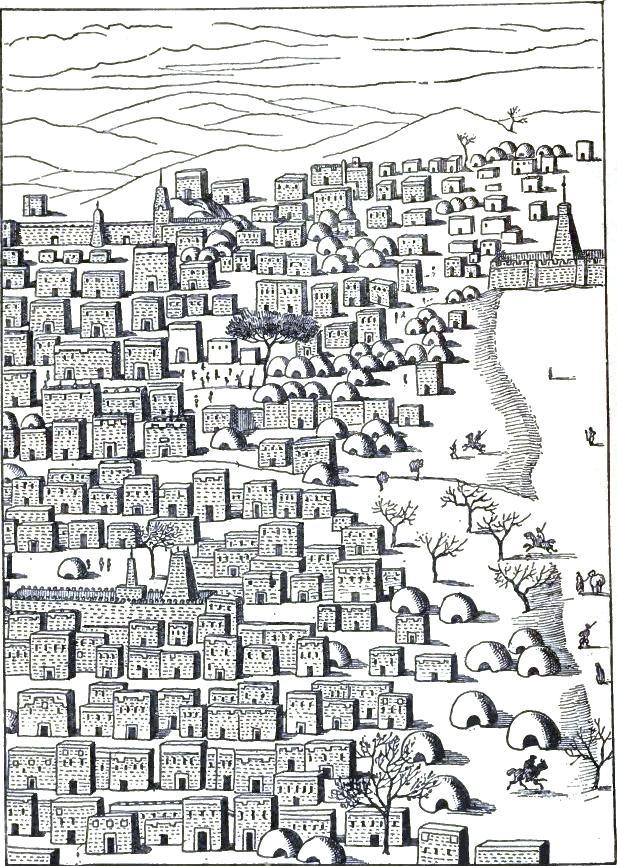
View of part of Timbuctoo. (Fac-simile of early engraving.)
Timbuctoo, which is neither so large nor so well populated as Caillié expected, is altogether wanting in animation. There are no large caravans constantly arriving in it, as at Jenneh; nor are there so many strangers there as in the latter town; whilst the market, held at three o'clock in the morning on account of the heat, appears deserted.
Timbuctoo is inhabited by Kissour negroes, who seem of mild dispositions, and are employed in trade. There is no government, and strictly speaking no central authority; each town and village has its own chief. The mode of life is patriarchal. A great many Moorish merchants are settled in the town, and rapidly make fortunes there. They receive consignments of merchandise from Adrar, Tafilet, Ghât, Ghâdames, Algiers, Tunis, and Tripoli.
To Timbuctoo is brought all the salt of the mines of Toudeyni, packed on camels. It is imported in slabs, bound together by ropes, made from grass in the neighbourhood of Tandayeh.
Timbuctoo is built in the form of a triangle, and measures about three miles in circumference. The houses are large but not lofty, and are built of round bricks. The streets are wide and clean. There are seven mosques, each surmounted by a square tower, from which the muezzin calls the faithful to prayer. Counting the floating population, the capital of the Soudan does not contain more than from ten to twelve thousand inhabitants.
Timbuctoo, situated in the midst of a vast plain of shifting white sand, trades in salt only, the soil being quite unsuitable to any sort of cultivation. The town is always full of people, who come to exact what they call presents, but what might with more justice be styled forced contributions. It is a public calamity when a Tuarick chief arrives. He remains in the town a couple of months, living with his numerous followers at the expense of the inhabitants, until he has wrung costly presents from them. Terror has extended the domination of these wandering tribes over all the neighbouring peoples, whom they rob and pillage without mercy.
The Tuarick costume is the same as that of the Arabs, with the exception of the head-dress. Day and night they wear a cotton band which covers the eyes and comes down over the nose, so that they are obliged to raise the head in order to see. The same band goes once or twice round the head and hides the mouth, coming down below the chin, so that the tip of the nose is all that is visible.
The Tuaricks are perfect riders, and mounted on first-rate horses or on fleet camels; each man is armed with a spear, a shield, and a dagger. They are the pirates of the desert, and innumerable are the caravans they have robbed, or blackmailed.
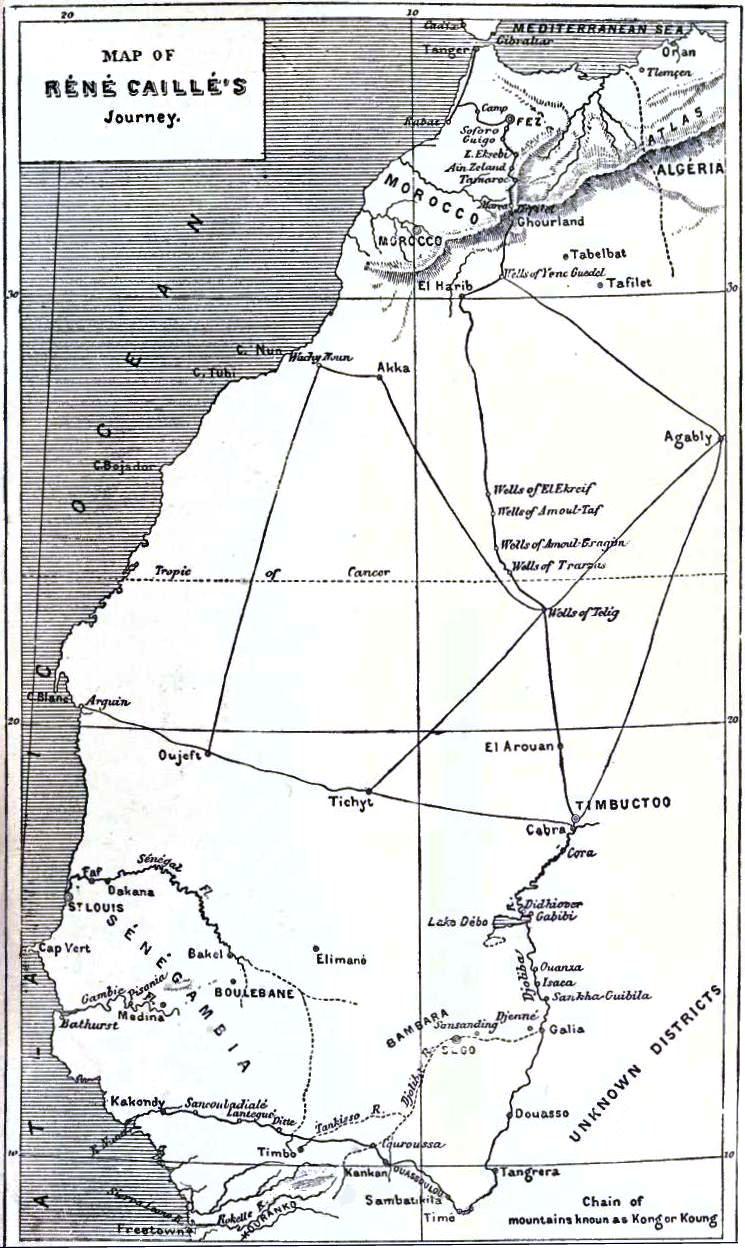
Four days after Caillié's arrival at Timbuctoo, he heard that a caravan was about to start for Talifet; and as he knew that another would not go for three months, fearing detection, he resolved to join this one. It consisted of a large number of merchants, and 600 camels. Starting on the 4th of May, 1828, he arrived, after terrible sufferings from the heat, and a sand-storm in which he was caught, at El Arawan, a town of no private resources, but important as the emporium for the Toudeyni salt, exported at Sansanding, on the banks of the Niger, and also as the halting-place of caravans from Tafilet, Mogadore, Ghât, Drat, and Tripoli, the merchants here exchanging European wares for ivory, gold, slaves, wax, honey, and Soudan stuffs. On the 19th May, the caravan left El Arawan for Morocco, by way of the Sahara. To the traveller's usual sufferings from heat, thirst, and privations of all kinds, was now added the pain of a wound incurred in a fall from his camel. He was also taunted by the Moors, and even by their slaves, who ridiculed his habits and his awkwardness, and even sometimes threw stones at him when his back was turned towards them.
"Often," says Caillié, "one of the Moors would say to me in a contemptuous tone: 'You see that slave? Well I prefer him to you, so you may guess in what esteem I hold you.' This insult would be accompanied with roars of laughter."
Under these miserable circumstances Caillié passed the wells of Trarzas, in whose vicinity salt is found, also those of Amul Gamil, Amul Taf, El Ekreif, surrounded by date-trees, wood, willows, and rushes, and reached Marabouty and El Harib, districts whose inhabitants are disgustingly dirty in their habits.
El Harib lies between two chains of low hills, dividing it from Morocco, to which it is tributary. Its inhabitants, divided into several nomad tribes, employ themselves chiefly in the breeding of camels. They would be rich and contented, but for the ceaseless exactions of the Berber Arabs.
On the 12th July the caravan left El Harib, and eleven days later entered the province of Talifet, famous for its majestic date-trees. At Ghourland, Caillié was welcomed with some kindness by the Moors, though he was not admitted to their houses, lest the women, who are visible only to the men of their own families, should be seen by the irreverent eyes of a stranger.
Caillié visited the market, which is held three times a week near a little village called Boheim, three miles from Ghourland, and was surprised at the variety of articles exposed for sale in it: vegetables, native fruits, fodder for cattle, poultry, sheep, &c. &c., all in large quantities. Water in leather bottles was carried about for sale to all who cared to drink in the exhausting heat, by men who announced their approach by ringing a small hand-bell. Moorish and Spanish coins alone passed current. The province of Tafilet contains several large villages and small towns. Ghourland, El Ekseba, Sosso, Boheim, and Ressant, which our traveller visited, contained some twelve hundred inhabitants each, all merchants and owners of property.
The soil is very productive: corn, vegetables, dates, European fruits, and tobacco, are cultivated in large quantities. Among the sources of wealth in Tafilet we may name very fine sheep, whose beautifully white wool makes very pretty coverlets, oxen, first-rate horses, donkeys, and mules.
As at El-Drah, a good many Jews live in the villages together with Mohammedans. They lead a miserable life, go about half naked, and are constantly struck and insulted. Whether brokers, shoemakers, blacksmiths, porters, or whatever their ostensible occupation, they all lend money to the Moors.
On the 2nd August the caravan resumed its march, and after passing A-Fileh, Tanneyara, Marca, Dayara, Rahaba, El Eyarac, Tamaroc, Ain-Zeland, El Guim, Guigo, and Soporo, Caillié arrived at Fez, where he made a short stay, and then pressed on to Rabat, the ancient Saléh. Exhausted by his long march, with nothing to eat but a few dates, obliged to depend on the charity of the Mussulmans, who as often as not declined to give him anything, and finding at Fez no representative of France but an old Jew named Ismail, who acted as Consular Agent, and who, being afraid of compromising himself, would not let Caillié embark on a Portuguese brig bound for Gibraltar,—the traveller eagerly availed himself of a fortunate chance for going to Tangiers. There he was kindly received by the Vice-Consul, M. Delaporte, who wrote at once to the commandant of the French station at Cadiz, and sent him off bound for that port, disguised as a sailor, in a corvette.
The landing at Toulon of the young Frenchman fresh from Timbuctoo, was a very unexpected event in the scientific world. With nothing to aid him but his own invincible courage and patience, he had brought to a satisfactory conclusion an exploit for which the French and English Geographical Societies had offered large rewards. Alone, without any resources to speak of, without the aid of government or of any scientific society, by sheer force of will, he had succeeded in throwing a flood of new light on an immense tract of Africa.
Caillié was not indeed the first European who had visited Timbuctoo. In the preceding year, Major Laing had penetrated into that mysterious city, but he had paid for his expedition with his life, and we shall presently relate the touching details of his fatal trip.
Caillié had returned to Europe, and brought back with him the curious journal from which our narrative is taken. It is true his profession of the Mohammedan faith had prevented him from taking astronomical observations, and from making sketches and notes freely, but only at the price of his seeming apostasy could he have passed through the region where the very name of a Christian is held in abhorrence.
How many strange observations, how many fresh and exact details, did Caillié add to our knowledge of North-West Africa! It had cost Clapperton two journeys to traverse Africa from Tripoli to Benin; Caillié had crossed from Senegal to Morocco in one—but at what a price! How much fatigue, how much suffering, how many privations, had the Frenchman endured! Timbuctoo was known at last, as well as the new caravan route across the Sahara by way of the oases of Tafilet and El Harib.
Was Caillié compensated for his physical and mental sufferings by the aid which the Geographical Society sent to him at once, by the prize of 10,000 francs adjudged to him, by the Cross of the Legion of Honour and the fame and glory attached to his name? We suppose he was. He says more than once in his narrative that nothing but his wish to add by his discoveries to the glory of France, his native country, could have sustained him under the trying circumstances and insults to which he was constantly subjected. All honour then to the patient traveller, the sincere patriot, the great discoverer.
We have still to speak of the expedition which cost Alexander Gordon Laing his life; but before giving our necessarily brief account, for his journals were all lost, we must say a few words about his early life and an interesting excursion made by him to Timmannee, Kouran and Soolimana, when he discovered the sources of the Niger.
Laing was born in Edinburgh in 1794, entered the English army at the age of sixteen, and soon distinguished himself. In 1820 he had gained the rank of Lieutenant, and was serving as aide-de-camp to Sir Charles Maccarthy, then Governor General of Western Africa. At this time war was raging between Amara, the Mandingo almamy, and Sannassi, one of his principal chiefs. Trade had never been very flourishing in Sierra Leone, and this state of things dealt it its death-blow. Maccarthy, anxious to put matters on a better footing, determined to interfere and bring about a reconciliation between the rival chiefs. He decided on sending an embassy to Kambia, on the borders of the Scarcies, and from thence to Malacoury and the Mandingo camp. The enterprising character, intelligence, and courage of Laing led to his being chosen by the governor as his envoy, and on the 7th January, 1822, he received instructions to report on the manufactures and topography of the provinces mentioned, and to ascertain the feeling of the inhabitants on the abolition of slavery.
A first interview with Yareddi, leader of the Soolimana troops accompanying the almamy, proved that the negroes of the districts under notice had only the vaguest ideas on European civilization, and that they had had but little intercourse with the whites.
"Every article of our dress," says Laing, "was a subject of admiration; observing me pull off my gloves, Yareddi stared, covered his widely-opened mouth with his hands, and at length exclaimed, 'Alla Akbar!' 'he has pulled the skin off his hands!' By degrees, and as he became more familiar, he alternately rubbed down Dr. Mackie's hair and mine, then indulging himself in a loud laugh, he would exclaim, 'They are not men, they are not men!' He repeatedly asked my interpreter if we had bones?"
These preliminary excursions, during which Laing ascertained that many Soolimanas owned a good deal of gold and ivory, led to his asking the governor's sanction to explore the districts to the east of the colony, with a view to increasing the trade of Sierra Leone by admitting their productions.
Maccarthy liked Laing's proposal and submitted it to the council. It was decided that Laing should be authorized to penetrate into Soolimana by the most convenient route for future communications.
Laing left Sierra Leone on the 16th April, 1824, and rowed up the Rokelle river to Rokon, the chief town of Timmannee. His interview with the King of Rokon was extremely amusing. To do him honour Laing had a salvo of ten charges fired as he came into the court in which the reception was to be held. At the noise the king stopped, drew back, darted a furious look at his visitor, and ran away. It was with great difficulty that the cowardly monarch was induced to return. At last he came back, and seating himself with great dignity in his chair of state he questioned the major:
"He wished to know," says Laing, "why he had been fired at, and was, with some difficulty, persuaded that it had been done out of honour to him. 'Why did you point your guns to the ground?' 'That you might see our intention was to show you respect.' 'But the pebbles flew in my face; why did you not point in the air?' 'Because we feared to burn the thatch on your houses.' 'Well, then, give me some rum.'"
Needless to add that the interview became more cordial after the major had complied with this request!
The portrait of the Timmannee monarch deserves a place in our volume for more than one reason. It is a case of ab uno disce omnes."
"Ba-Simera," to quote Laing again, "the principal chief or king of this part of the Timmannee country, is about ninety years of age, with a mottled, shrivelled-up skin, resembling in colour that of an alligator more than that of a human being, with dim, greenish eyes, far sunk in his head, and a bleached, twisted beard, hanging down about two feet from his chin; like the king of the opposite district he wore a necklace of coral and leopard's teeth, but his mantle was brown and dirty as his skin. His swollen legs, like those of an elephant, were to be observed from under his trousers of baft, which might have been originally white, but, from the wear of several years, had assumed a greenish appearance."
Like his predecessors in Africa, Laing had to go through many discussions about the right of passage through the country and bearers' wages, but thanks to his firmness he managed to escape the extortions of the negro kings. The chief halting-places on the route taken by the major were: Toma, where a white man had never before been seen; Balandeko, Roketchnick, which he ascertained to be situated in N. lat. 8° 30', and W. long. 12° 11'; Mabimg, beyond a very broad stream flowing north of the Rokelle; and Ma-Yosso, the chief frontier town of Timmannee. In Timmannee Laing made acquaintance with a singular institution, a kind of free-masonry, known as "Purrah," the existence of which on the borders of the Rio Nuñez had been already ascertained by Caillié.
"Their power" [that of the "Purrah"], says Laing, "supersedes even that of the headmen of the districts, and their deeds of secrecy and darkness are as little called in question, or inquired into, as those of the Inquisition were in Europe, in former years. I have endeavoured in vain to trace the origin, or cause of formation of this extraordinary association, and have reason to suppose, that it is now unknown to the generality of the Timmannees, and may possibly be even so to the Purrah themselves, in a country where no traditionary records are extant, either in writing or in song."
So far as Laing could ascertain Timmannee is divided into three districts. The chief of each arrogates to himself the title of king. The soil is fairly productive, and rice, yams, guavas, earth-nuts, and bananas might be grown in plenty, but for the lazy, vicious, and avaricious character of the inhabitants who vie with each other in roguery.
"I think," says Laing, "that a few hoes, flails, rakes, shovels, &c., would be very acceptable to them, when their respective uses were practically explained; and that they would prove more beneficial both to their interest and ours, than the guns, cocked hats, and mountebank coats, with which they are at present supplied." In spite of our traveller's philanthropic wish, things have not changed since his time. The negroes are just as fond of intoxicating drinks, and their petty kings still go about wearing on grand occasions hats the shape of an accordion, and blue coats with copper buttons, with no shirts underneath. The maternal sentiment did not seem to Laing to be very fully developed amongst the people of Timmannee, for he was twice roundly abused by women for refusing to buy their children of them. A few days later there was a great tumult raised against Laing, the white man who had inflicted a fatal blow on the prosperity of the country by checking its trade. The first town entered in Kouranko was Maboum, and it is interesting to note en passant what Laing says of the activity of the inhabitants.
"I entered the town about sunset, and received a first impression highly favourable to its inhabitants, who were returning from their respective labours of the day, every individual bearing about him proofs of his industrious occupation. Some had been engaged in preparing the fields for the crops, which the approaching rains were to mature; others were penning up cattle, whose sleek sides and good condition denoted the richness of their pasturages; the last clink of the blacksmith's hammer was sounding, the weaver was measuring the quantity of cloth he had woven during the day, and the gaurange, or worker in leather, was tying up his neatly-stained pouches, shoes, knife-scabbards, &c. (the work of his handicraft) in a large kotakoo or bag; while the crier at the mosque, with the melancholy call of 'Alla Akbar,' uttered at measured intervals, summoned the dévôts Moslems to their evening devotions."
Had a Marilhat or a Henri Regnault transferred to canvas a scene like this, when the dazzling light of the sun is beginning to die away in green and rose tints, might he not aptly name his painting the Retour des Champs, a title so often given to landscapes in our misty climate.
"This scene," adds Laing, "both by its nature and the sentiment which it inspired, formed an agreeable contrast with the noise, confusion, and the dissipation which pervaded a Timmannee town at the same hour; but one must not trust too much to appearances, and I regret to add, that the subsequent conduct of the Kouranko natives did not confirm the good opinion which I had formed of them."
The traveller now passed through Koufoula, where he was very kindly received, crossed a pleasant undulating district shut in by the Kouranko hills and halted at Simera, where the chief ordered his "guiriot" to celebrate in song the arrival of his guest, a welcome neutralized by the fact that the house assigned to Laing let in the rain through its leaky roof and would not let out the smoke, so that, to use his own words, he was more "like a chimney-sweeper" than the white guest of the King of Simera.
Laing afterwards visited the source of the Tongolelle, a tributary of the Rokelle, and then left Kooranko to enter Soolimana. Kooranko, into which our traveller did not penetrate beyond the frontier, is of vast extent and divided into a great number of small states. The inhabitants resemble the Mandingoes in language and costume, but they are neither so well looking nor so intelligent. They do not profess Mohammedanism and have implicit confidence in their "grigris." They are fairly industrious, they know how to sew and weave. Their chief object of commerce is rosewood or "cam," which they send to the coast. The products of the country are much the same as those of Timmannee.
Komia, N. lat. 9° 22', is the first town in Soolimana. Laing then visited Semba, a wealthy and populous city, where he was received by a band of musicians, who welcomed him with a deafening if not harmonious flourish of trumpets, and he finally reached Falaba, the capital of the country.
The king received Laing with special marks of esteem. He had assembled a large body of troops whom he passed in review, making them execute various manoeuvres accompanied by the blowing of trumpets, beating of tambourines, and the playing of violins and other native instruments. This "fantasia" almost deafened the visitor. Then came a number of guiriots, who sang of the greatness of the king, the happy arrival of the major, with the fortunate results which were to ensue from his visit for the prosperity of the country and the development of commerce.
Laing profited by the king's friendliness to ask his permission to visit the sources of the Niger, but was answered by all manner of objections on the score of the danger of the expedition. At last, however, his majesty yielded to the persuasions of his visitor, telling him that "as his heart panted after the water, he might go to it."
The major had not, however, left Falaba two hours before the permission was rescinded, and he had to give up an enterprise which had justly appeared to him of great importance.
A few days later he obtained leave to visit the source of the Rokelle or Sale Kongo, a river of which nothing was known before his time beyond Rokon. From the summit of a lofty rock, Laing saw Mount Loma, the highest of the chain of which it forms part. "The point," says the traveller, "from which the Niger issues, was now shown to me, and appeared to be at the same level on which I stood, viz., 1600 feet above the level of the Atlantic; the source of the Rokelle, which I had already measured, being 1470 feet. The view from this hill amply compensated for my lacerated feet.... Having ascertained correctly the situation of Konkodoogore, and that of the hill upon which I was at this time, the first by observation, and the second by account, and having taken the bearings of Loma from both, I cannot err much in laying down its position in 9° 25' N. and 9° 45' W."
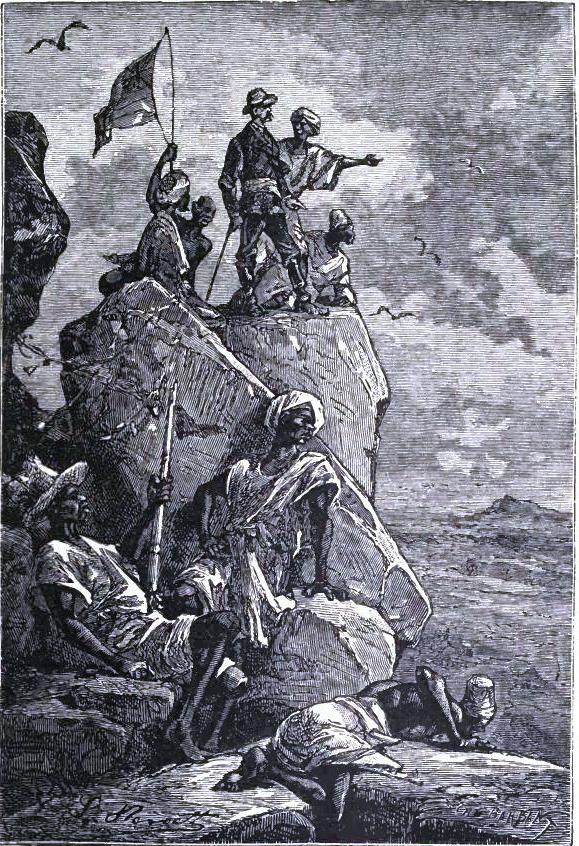
"Laing saw Mount Loma."
Laing had now spent three months in Soolimana, and had made many excursions. It is a very picturesque country, in which alternate hills, valleys, and fertile plains, bordered by woods and adorned with thickets of luxuriant trees.
The soil is fertile and requires very little cultivation; the harvests are abundant and rice grows well. Oxen, sheep, goats, and a small species of poultry, with a few horses, are the chief domestic animals of the people of Soolimana. The wild beasts, of which there are a good many, are elephants, buffaloes, a kind of antelope, monkeys, and leopards.
Falaba, which takes its name from the Fala-ba river, on which it is situated, is about a mile and a half long by one broad. The houses are closer together than in most African towns, and it contains some six thousand inhabitants. Its position as a fortified town is well-chosen. Built on an eminence in the centre of a plain which is under water in the rainy season, it is surrounded by a very strong wooden palisade, proof against every engine of war except artillery.
Strange to say in Soolimana the occupations of men and women seem to be reversed; the latter work in the fields except at seed time and harvest, build the houses, act as masons, barbers, and surgeons, whilst the men attend to the dairy, milk the cows, sew, and wash the linen.
On the 17th September, Laing started on his return journey to Sierra Leone bearing presents from the king, and escorted for several miles by a vast crowd. He finally reached the English colony in safety.
Laing's trip through Timmannee, Kooranko, and Soolimana was not without importance. It opened up districts hitherto unknown to Europeans, and introduced us to the manners, occupations, and trade of the people, as well as to the products of the country. At the same time the course was traced and the source discovered of the Rokelle, whilst for the first time definite information was obtained as to the sources of the Niger, for although our traveller had not actually visited them, he had gone near enough to determine their position approximately.
The results obtained by Laing on this journey, only fired his ambition for further discoveries. He, therefore, determined to make his way to Timbuctoo.
On the 17th June, 1825, he embarked at Malta for Tripoli, where he joined a caravan with which Hateeta, the Tuarick chief, who had made such friends with Lyon, was also travelling as far as Ghât. After two months' halt at Ghadames, Laing again started in October and reached Insalah, which he places a good deal further west than his predecessors had done. Here he remained from November, 1825, to January 1826, and then made his way to the Wâdy Ghât, intending to go from thence at once to Timbuctoo, making a tour of Lake Jenneh or Debbie, visiting the Melli country, and tracing the Niger to its mouth. He would then have retraced his steps as far as Sackatoo, visited Lake Tchad and attempted to reach the hill.
Outside Ghât the caravan with which Laing was travelling was attacked, some say by Tuaricks, others by Berber Arabs, a tribe living near the Niger.
"Laing," says Caillié, who got his information at Timbuctoo, "was recognized as a Christian and horribly ill-treated. He was beaten with a stick until he was left for dead. I suppose that the other Christian whom they told me was beaten to death, was one of the major's servants. The Moors of Laing's caravan picked him up, and succeeded by dint of great care in recalling him to life. So soon as he regained consciousness he was placed on his camel, to which he had to be tied, he was too weak to be able to sit up. The robbers had left him nothing, the greater part of his baggage had been rifled."
Laing arrived at Timbuctoo on the 18th August, 1826, and recovered from his wounds. His convalescence was slow, but he was fortunately spared the extortions of the natives, owing to the letters of introduction he had brought with him from Tripoli and to the sedulous care of his host, a native of that city.
According to Caillié, who quotes this remarkable fact from an old native, Laing retained his European costume, and gave out that he had been sent by his master, the king of England, to visit Timbuctoo and describe the wonders it contained.
"It appears," adds the French traveller, "that Laing drew the plan of the city in public, for the same Moor told me in his naive and expressive language, that he had 'written the town and everything in it.'"
After a careful examination of Timbuctoo, Laing, who had good reason to fear the Tuaricks, paid a visit by night to Cabra, and looked down on the waters of the Niger. Instead of returning to Europe by way of the Great Desert, he was very anxious to go past Jenneh and Sego to the French settlements in Senegal, but at the first hint of his purpose to the Foulahs who crowded to stare at him, he was told that a Nazarene could not possibly be allowed to set foot in their country, and that if he dared attempt it they would make him repent it.
Laing was, therefore, driven to go by way of El Arawan, where he hoped to join a caravan of Moorish merchants taking salt to Sansanding. But five days after he left Timbuctoo, his caravan was joined by a fanatic sheikh, named Hamed-ould-Habib, chief of the Zawat tribe, and Laing was at once arrested under pretence of his having entered their country without authorization. The major being urged to profess Mohammedanism refused, preferring death to apostasy. A discussion then took place between the sheikh and his hired assassins as to how the victim should be put to death, and finally Laing was strangled by two slaves. His body was left unburied in the desert.
This was all Caillié was able to find out when he visited Timbuctoo but one year after Major Laing's death. We have supplemented his accounts by a few details gathered from the reports of the Royal Geographical Society, for the traveller's journal and the notes he took are alike lost to us.
We have already told how Laing managed to fix pretty accurately the position of the sources of the Niger. We have also described the efforts made by Mungo Park and Clapperton to trace the middle portion of the course of that river. We have now to narrate the journeys made in order to examine its mouth and the lower part of its course. The earliest and most successful was that of Richard Lander, formerly Clapperton's servant.
Richard Lander and his brother John proposed to the English Government, that they should be sent to explore the Niger to its mouth. Their offer was accepted, and they embarked on a government vessel for Badagry, where they arrived on the 19th March, 1830.
The king of the country, Adooley, of whom Richard Lander retained a friendly remembrance, was in low spirits. His town had just been burnt, his generals and his best soldiers had perished in a battle with the people of Lagos, and he himself had had a narrow escape when his house and all his treasures were destroyed by fire.
He determined to retrieve his losses, and to do so at the expense of the travellers, who could not get permission to penetrate into the interior of the country until they had been robbed of their most valuable merchandise, and compelled to sign drafts in payment for a gun-boat with a hundred men, for two puncheons of rum, twenty barrels of powder, and a large quantity of merchandise, which they knew perfectly well would never be delivered by this monarch, who was as greedy of gain as he was drunken. As a matter of course the natives followed the example of their chief, vied with him in selfishness, greed, and meanness, regarded the English as fair spoil, and fleeced them on every opportunity.
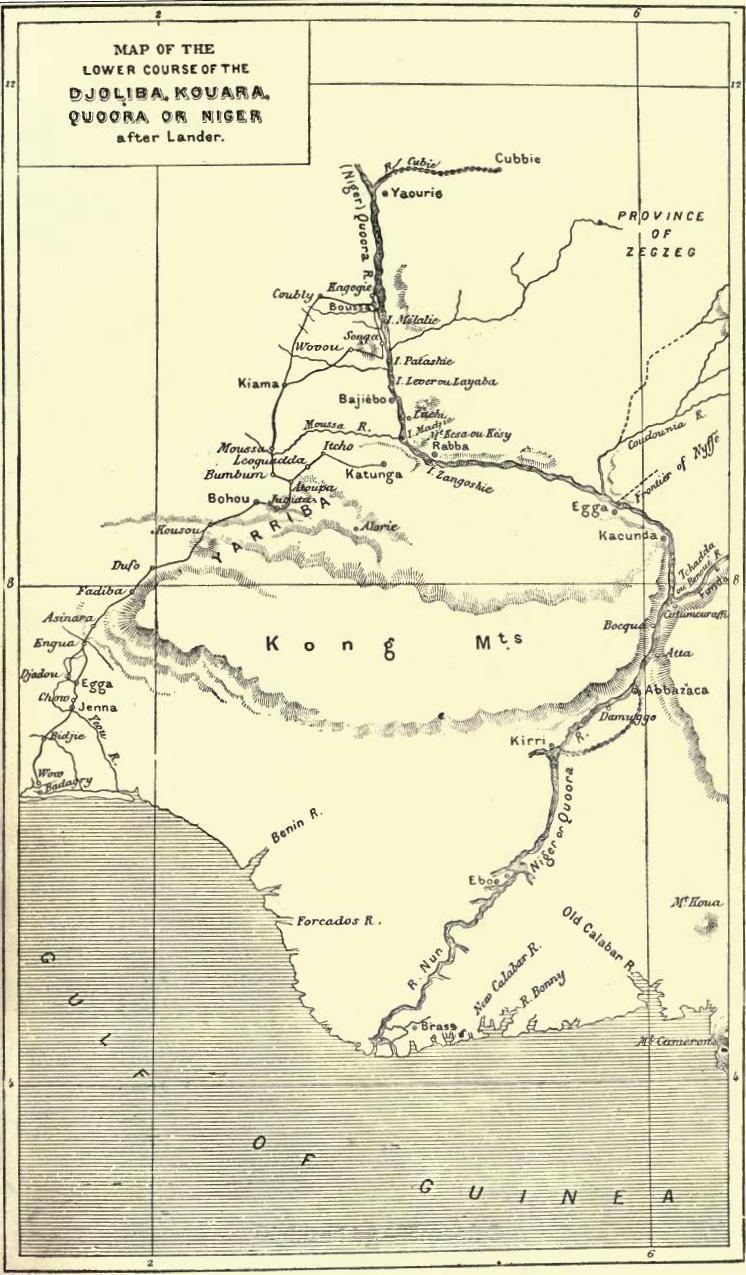
At last, on the 31st March, Richard and John Lander succeeded in getting away from Badagry; and preceded by an escort sent in advance by the king, arrived at Katunga on the 13th May, having halted by the way at Wow-wow, a good-sized town, Bidjie, where Pearce and Morrison had been taken ill, Jenneh, Chow, Egga, all towns visited by Clapperton, Engua, where Pearce died, Asinara, the first walled city they saw, Bohou, formerly capital of Yariba, Jaguta, Leoguadda, and Itcho, where there is a famous market.
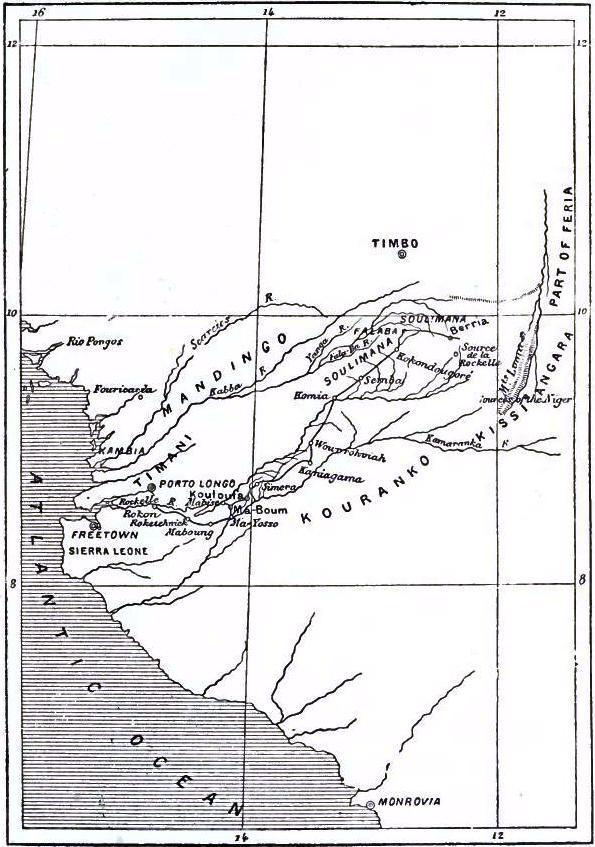
Lower Course of the Niger (after Lander).
At Katunga, according to custom, the travellers halted under a tree before they were received by the king. But being tired of waiting, they presently went to the residence of Ebo, the chief eunuch, and the most influential man about the person of the sovereign. A diabolical noise of cymbals, trumpets, and drums, all played together, announced the approach of the white men, and Mansolah, the king, gave them a most hearty welcome, ordering Ebo to behead every one who should molest them.
The Landers, fearful of being detained by Mansolah until the rainy season, acted on Ebo's advice, and said nothing about the Niger, but merely spoke of the death of their fellow-countryman at Boussa twenty years before, adding that the King of England had sent them to the sultan of Yaourie to recover his papers.
Although Mansolah did not treat the brothers Lander quite as graciously as he had treated Clapperton, he allowed them to go eight days after their arrival.
Of the many details given in the original account of the Landers' journey, of Katunga and the province of Yariba, we will only quote the following:—
"Katunga has by no means answered the expectations we had been led to form of it, either as regards its prosperity, or the number of its inhabitants. The vast plain on which it stands, although exceedingly fine, yields in verdure and fertility, and simple beauty of appearance, to the delightful country surrounding the less celebrated city of Bohoo. Its market is tolerably well supplied with provisions, which are, however, exceedingly dear; insomuch that, with the exception of disgusting insects, reptiles, and vermin, the lower classes of the people are almost unacquainted with the taste of animal food."
Mansolah's carelessness and the imbecile cowardice of his subjects had enabled the Fellatahs to establish themselves in Yarriba, to entrench themselves in its fortified towns, and to obtain the recognition of their independence, until they became sufficiently strong to assume an absolute sovereignty over the whole country.
From Katunga the Landers travelled to Borghoo, by way of Atoupa, Bumbum—a town much frequented by the merchants of Houssa, Borghoo, and other provinces trading with Gonja—Kishi, on the frontiers of Yarriba, and Moussa, on the river of the same name, beyond which they were met by an escort sent to join them by the Sultan of Borghoo. Sultan Yarro received them with many expressions of pleasure and kindness, showing special delight at seeing Richard Lander again. Although he was a convert to Mohammedanism, Yarro evidently put more faith in the superstitions of his forefathers than in his new creed. Fetiches and gri-gris were hung over his door, and in one of his huts there was a square stool, supported on two sides by four little wooden effigies of men. The character, manners, and costumes of the people of Borghoo differ essentially from those of the natives of Yarriba.
"Perhaps no two people in the universe residing so near each other," says the narrative, "differ more widely ... than the natives of Yarriba and Borghoo. The former are perpetually engaged in trading with each other from town to town, the latter never quit their towns except in case of war, or when engaged in predatory excursions; the former are pusillanimous and cowardly, the latter are bold and courageous, full of spirit and energy, and never seem happier than when engaged in martial exercises; the former are generally mild, unassuming, humble and honest, but cold and passionless. The latter are proud and haughty, too vain to be civil, and too shrewd to be honest; yet they appear to understand somewhat of the nature of love and the social affections, are warm in their attachments, and keen in their resentments."
On the 17th June our travellers at last came in sight of the city of Boussa. Great was their surprise at finding that town on the mainland, and not, as Clapperton had said, on an island in the Niger. They entered Boussa by the western gate, and were almost immediately introduced to the presence of the king and of the midiki or queen, who told them that they had both that very morning shed tears over the fate of Clapperton.
The Niger or Quorra, which flows below the city, was the first object of interest visited by the brothers.
"This morning," writes the traveller, "we visited the far-famed Niger or Quorra, which flows by the city about a mile from our residence, and were greatly disappointed at the appearance of this celebrated river. Bleak, rugged rocks rose abruptly from the centre of the stream, causing strong ripples and eddies on its surface. It is said that, a few miles above Boussa, the river is divided into three branches by two small, fertile islands, and that it flows from hence in one continued stream to Funda. The Niger here, in its widest part, is not more than a stone's-throw across at present. The rock on which we sat overlooks the spot where Mr. Park and his associates met their unhappy fate."
Richard Lander made his preliminary inquiries respecting the books and papers belonging to Mungo Park's expedition with great caution. But presently, reassured by the sultan's kindness, he determined to question him as to the fate of the explorer. Yarro was, however, too young at the time of the catastrophe to be able to remember what had occurred. It had taken place two reigns back; but he promised to have a search instituted for relics of the illustrious traveller.
"In the afternoon," says Richard Lander, "the king came to see us, followed by a man with a book under his arm, which was said to have been picked up in the Niger after the loss of our countryman. It was enveloped in a large cotton cloth, and our hearts beat high with expectation as the man was slowly unfolding it, for, by its size, we guessed it to be Mr. Park's Journal; but our disappointment and chagrin were great when, on opening the book, we discovered it to be an old nautical publication of the last century."
There was then no further hope of recovering Park's journal.
On the 23rd June the Landers left Boussa, filled with gratitude to the king, who had given them valuable presents, and warned them to accept no food, lest it should be poisoned, from any but the governors of the places they should pass through. They travelled alongside of the Niger as far as Kagogie, where they embarked in a wretched native canoe, whilst their horses were sent on by land to Yaoorie.
"We had proceeded only a few hundred yards," says Richard Lander, "when the river gradually widened to two miles, and continued as far as the eye could reach. It looked very much like an artificial canal, the steep banks confining the water like low walls, with vegetation beyond. In most places the water was extremely shallow, but in others it was deep enough to float a frigate. During the first two hours of the day the scenery was as interesting and picturesque as can be imagined. The banks were literally covered with hamlets and villages; fine trees, bending under the weight of their dark and impenetrable foliage, everywhere relieved the eye from the glare of the sun's rays, and, contrasted with the lively verdure of the little hills and plains, produced the most pleasing effect. All of a sudden came a total change of scene. To the banks of dark earth, clay, or sand, succeeded black, rugged rocks; and that wide mirror which reflected the skies, was divided into a thousand little channels by great sand-banks."
A little further on the stream was barred by a wall of black rocks, with a single narrow opening, through which its waters rushed furiously down. At this place there is a portage, above which the Niger flows on, restored to its former breadth, repose, and grandeur.
After three days' navigation, the Landers reached a village, where they found horses and men waiting for them, and whence they quickly made their way, through a continuously hilly country, to the town of Yaoorie, where they were welcomed by the sultan, a stout, dirty, slovenly man, who received them in a kind of farm-yard cleanly kept. The sultan, who was disappointed that Clapperton had not visited him, and that Richard Lander had omitted to pay his respects on his return journey, was very exacting to his present guests. He would give them none of the provisions they wanted, and did all he could to detain them as long as possible.
We may add that food was very dear at Yaoorie, and that Richard Lander had no merchandise for barter except a quantity of "Whitechapel sharps, warranted not to cut in the eye," for the very good reason, he tells us, that most of them had no eyes at all, so that they were all but worthless.
They were able, however, to turn to account some empty tins which had contained soups; the labels, although dirty and tarnished, were much admired by the natives, one of whom strutted proudly about for some days wearing an empty tin on his head, bearing four labels of "concentrated essence of meat."
The Sultan would not permit the Englishmen to enter Nyffé or Bornou, and told them there was nothing for them but to go back to Boussa. Richard Lander at once wrote to the king of that town, asking permission to buy a canoe in which to go to Funda, as the road by land was infested by plundering Fellatahs.
At last, on the 26th July, a messenger arrived from the King of Boussa to inquire into the strange conduct of the Sultan of Yaoorie, and the cause of his detention of the white men. After an imprisonment of five weeks the Landers were at last allowed to leave Yaoorie, which was now almost entirely inundated.
The explorers now ascended the Niger to the confluence of the Cubbie, and then went down it again to Boussa, where the king, who was glad to see them again, received them with the utmost cordiality. They were, however, detained longer than they liked by the necessity of paying a visit to the King of Wow-wow, as well as by the difficulty of getting a boat. Moreover, there was some delay in the return of the messengers who had been sent by the King of Boussa to the different chiefs on the banks of the river, and lastly, Beken Rouah (the Dark Water) had to be consulted in order to ensure the safety of the travellers in their journey to the sea.
On taking leave of the king, the brothers were at a loss to express their gratitude for his kindness and hospitality, his zeal in their cause, and the protection he was ever ready to extend during their stay of nearly two months in his capital. The natives showed great regret at losing their visitors, and knelt in the path of the brothers, praying with uplifted hands to their gods on their behalf.
Now began the descent of the Niger. A halt had to be made at the island of Melalie, whose chief begged the white men to accept a very fine kid. We may be sure they were too polite to refuse it. The Landers next passed the large town of Congi, the Songa of Clapperton, and then Inguazilligie, the rendezvous of merchants travelling between Nouffe and the districts north-east of Borghoo. Below Inguazilligie they halted at Patashie, a large fertile island of great beauty, planted with palm groves and magnificent trees.
As this place was not far from Wow-wow, Richard Lander sent a message to the king of that town, who, however, declined to deliver the canoe which had been purchased of him. The messenger failing in his purpose, the brothers were compelled themselves to visit the king, but as they expected, they got only evasive answers. They had now no choice, if they wished to continue their journey, but to make off with the canoes which had been lent them at Patashie. On the 4th October, after further delays, they resumed their course, and being carried down by the current, were soon out of sight of Lever, or Layaba, and its wretched inhabitants.
The first town the brothers came to was Bajiebo, a large and spacious city, which for dirt, noise, and confusion, could not be surpassed. Next came Leechee, inhabited by Nouffe people, and the island of Madje, where the Niger divides into three parts. Just beyond, the travellers suddenly found themselves opposite a remarkable rock, two hundred and eighty feet high, called Mount Kesa, which rises perpendicularly from the centre of the stream. This rock is greatly venerated by the natives, who believe it to be the favourite home of a beneficent genius.
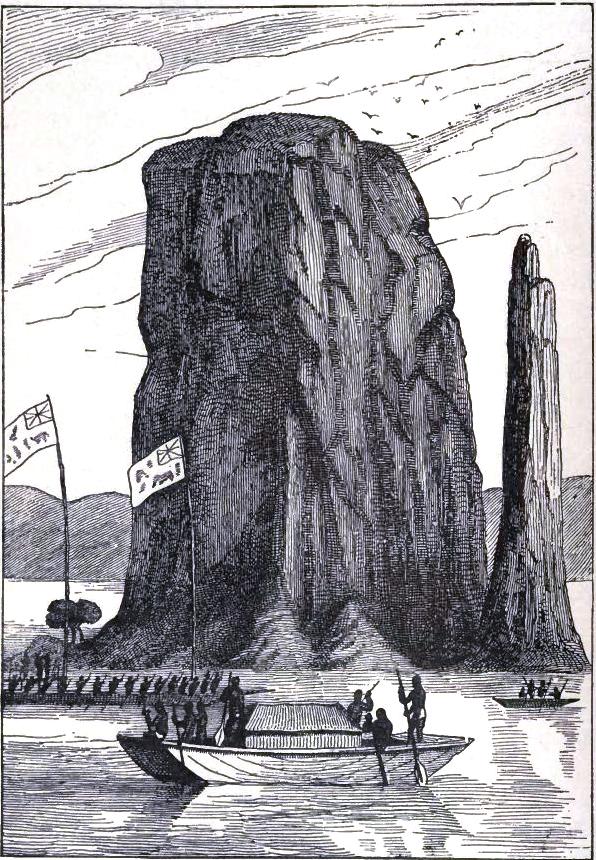
Mount Kesa. (Fac-simile of early engraving.)
At Belee, a little above Rabba, the brothers received a visit from the "King of the Dark Waters," chief of the island of Zagoshi, who appeared in a canoe of great length and unusual cleanliness, decked with scarlet cloth and gold lace. On the same day they reached the town of Zagoshi, opposite Rabba, and the second Fellatah town beyond Sackatoo.
Mallam Dendo, chief of Zagoshi, was a cousin of Bello. He was a blind and very feeble old man in very bad health, who knew he had but a few years longer to reign, and his one thought was how best to secure the throne to his son.
Although he had received very costly presents, Mallam Dendo was anything but satisfied, and declared that if the travellers did not make him other and more valuable gifts, he would require their guns, pistols, and powder, before he allowed them to leave Zagoshi.
Richard Lander did not know what to do, when the gift of the tobé (or robe) of Mungo Park, which had been restored by the King of Boussa, threw Mallam Dendo into such ecstasies of joy that he declared himself the protector of the Europeans, promised to do all he could to help them to reach the sea, made them a present of several richly-coloured plaited mats, two bags of rice, and a bunch of bananas. These stores came just in time, for the whole stock of cloth, looking-glasses, razors, and pipes was exhausted, and the English had nothing left but a few needles and some silver bracelets as presents for the chiefs on the banks of the Niger.
"Rabba," says Lander, "... seen from Zagoshi, appears to be a large, compact, clean, and well-built town, though it is unwalled, and is not otherwise fenced. It is irregularly built on the slope of a gently-rising hill, at the foot of which runs the Niger; and in point of rank, population, and wealth, it is the second city in the Fellatah dominions, Sackatoo alone being considered as its superior. It is inhabited by a mixed population of Fellatahs, Nyffeans, and emigrants and slaves from various countries, and is governed by a ruler who exercises sovereign authority over Rabba and its dependencies, and is styled sultan or king.... Rabba is famous for milk, oil, and honey. The market, when our messengers were there, appeared to be well supplied with bullocks, horses, mules, asses, sheep, goats, and abundance of poultry. Rice, and various sorts of corn, cotton cloth, indigo, saddles and bridles made of red and yellow leather, besides shoes, boots, and sandals, were offered for sale in great plenty. Although we observed about two hundred slaves for sale, none had been disposed of when we left the market in the evening.... Rabba is not very famous for the number or variety of its artificers, and yet in the manufacture of mats and sandals it is unrivalled. However, in all other handicrafts, Rabba yields to Zagoshi."
The industry and love of labour displayed by the people of the latter town were an agreeable surprise in this lazy country. Its inhabitants, who are hospitable and obliging, are protected by the situation of their island against the Fellatahs. They are independent too, and recognize no authority but that of the "King of the Dark Waters," whom they obey because it is to their interest to do so.
On the 16th October, the Landers at last started in a wretched canoe, for which the king had made them pay a high price, with paddles they had stolen, because no one would sell them any. This was the first time they had been able to embark on the Niger without help from the natives. They went down the river, whose width varies greatly, avoiding large towns as much as possible, for they had no means of satisfying the extortions of the chiefs. No incident of note occurred before Egga was reached, if we except a terrible storm which overtook the travellers when, unable to land in the marshes bordering the river, they had allowed their boat to drift with the current, and during which they were all but upset by the hippopotami playing about on the surface of the water. All this time the Niger flowed in an E.S.E. direction, now eight, now only two miles in width. The current was so rapid that the boat went at the rate of four or five miles an hour.
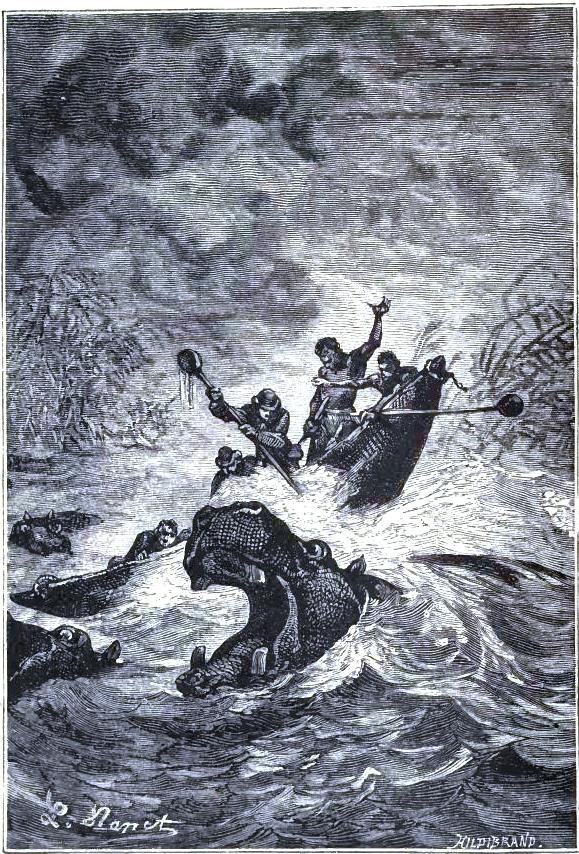
"They were all but upset."
On the 19th October the Landers passed the mouth of the Coudonia, which Richard had crossed near Cuttup on his first expedition, and a little later they came in sight of Egga. The landing-place was soon reached by way of a bay encumbered with an immense number of large and heavy canoes full of merchandise, with the prows daubed with blood, and covered with feathers, as charms against thieves.
The chief, to whom the travellers were at once conducted, was an old man with a long white beard, whose appearance would have been venerable and patriarchal had he not laughed and played in quite a childish manner. The natives assembled in hundreds to see the strange-looking visitors, and the latter had to place three men as sentinels outside their door to keep the curious at a distance.
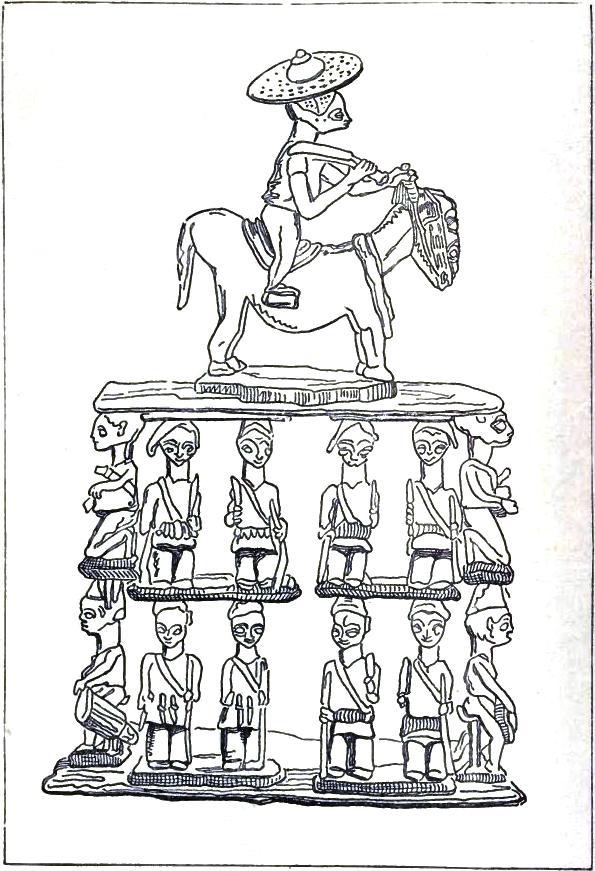
Square stool belonging to the King of Bornou. (Fac-simile of early engraving.)
Lander says that Benin and Portuguese cloths are sold at Egga by many of its inhabitants, so that it would appear that some kind of communication is kept up between the sea-coast and this place. The people are very speculative and enterprising, and numbers of them employ all their time solely in trading up and down the Niger. They live entirely in their canoes, over which they have a shed, that answers completely every purpose for which it is intended, so that, in their constant peregrinations, they have no need of any other dwelling or shelter than that which their canoes afford them....
"Their belief," says Lander, "that we possessed the power of doing anything we wished, was at first amusing enough, but their importunities went so far that they became annoying. They applied to us for charms to avert wars and other national calamities, to make them rich, to prevent the crocodiles from carrying off the people, and for the chief of the fishermen to catch a canoe-load of fish every day, each request being accompanied with some sort of present, such as country beer, goora-nuts, cocoa-nuts, lemons, yams, rice, &c., in quantity proportionate to the value of their request.
"The curiosity of the people to see us is so intense, that we dare not stir out of doors, and therefore we are compelled to keep our door open all day long for the benefit of the air, and the only exercise which we can take is by walking round and round our hut like wild beasts in a cage. The people stand gazing at us with visible emotions of amazement and terror; we are regarded, in fact, in just the same light as the fiercest tigers in Europe. If we venture to approach too near the doorway, they rush backwards in a state of the greatest alarm and trepidation; but when we are at the opposite side of the hut they draw as near as their fears will permit them, in silence and caution.
"Egga is a town of vast extent, and its population must be immense. Like all the towns on the banks of the Niger, it is inundated every year. We can but conclude that the natives have their own reasons for building their houses in situations which, in our eyes, are alike so inconvenient and unhealthy. Perhaps it may be because the soil of the surrounding districts consists of a black greasy mould of extraordinary fertility, supplying all the necessaries of life at the cost of very little trouble. Although the King of Egga looked more than a hundred years old, he was very gay and light-hearted. The chief people of the town met in his hut, and spent whole days in conversation. This company of greybeards, for they are all old, laugh so heartily at the sprightliness of their own wit, that it is an invariable practice, when any one passes by, to stop and listen outside, and they add to their noisy merriment so much good-will, that we hear nothing from the hut in which the aged group are revelling during the day but loud peals of laughter and shouts of applause."
One day the old chief wished to show off his accomplishments of singing and dancing, expecting to astonish his visitors.
"He frisked," says Lander, "beneath the burden of five-score, and shaking his hoary locks, capered over the ground to the manifest delight of the bystanders, whose plaudits, though confined, as they always are, to laughter, yet tickled the old man's fancy to that degree, that he was unable to keep up his dance any longer without the aid of a crutch. With its assistance he hobbled on a little while, but his strength failed him; he was constrained for the time to give over, and he set himself down at our side on the threshold of the hut. He would not acknowledge his weakness to us for the world, but endeavoured to pant silently, and suppress loud breathings, that we might not hear him. How ridiculous, yet how natural, is this vanity! He made other unavailing attempts to dance, and also made an attempt to sing, but nature would not second his efforts, and his weak piping voice was scarcely audible. The singers, dancers, and musicians, continued their noisy mirth, till we were weary of looking at and listening to them, and as bedtime was drawing near, we desired them to depart, to the infinite regret of the frivolous but merry old chief."
Mallam-Dendo, however, tried to dissuade the English from continuing the descent of the river. Egga, he said, was the last Nouffe town, the power of the Fellatahs extended no further, and between it and the sea dwelt none but savage and barbarous races, always at war with each other. These rumours and the stories told by the natives to the Landers' people of the danger they would run of being murdered or sold as slaves so terrified the latter, that they refused to embark, declaring their intention of going back to Cape Coast Castle by the way that they came. Thanks to the firmness of the brothers this mutiny was quelled, and on the 22nd October the explorers left Egga, firing a parting salute of three musket-shots. A few miles further down, a sea-gull flew over their heads, a sure sign that they were approaching the sea, and with it, it appeared all but certain, the end of their wearisome journey.
Several small and wretched villages, half under water, and a large town at the foot of a mountain, which looked ready to overwhelm it, the name of which the travellers could not learn, were passed in succession. They met a great number of canoes built like those on the Bonny and Calabar Rivers. The crews stared in astonishment at the white men whom they dared not address. The low marshy banks of the Niger were now gradually exchanged for loftier, richer, and more fertile districts.
Kacunda, where the people of Egga had recommended Lander to halt, is on the western bank of the river. From a distance its appearance is singularly picturesque. The natives were at first alarmed at the appearance of the travellers. An old Mallam acting as Mohammedan priest and schoolmaster took them under his protection, and, thanks to him, the brothers received a warm welcome in the capital of the independent kingdom of Nouffé. The information collected in this town, or rather in this group of four villages, coincided with that obtained at Egga. Richard Lander therefore resolved to make the rest of the voyage by night and to load his four remaining guns and two pistols with balls and shot. To the great astonishment of the natives, who could not understand such contempt of danger, the explorers left Kacunda with three loud cheers, committing their cause to the hands of God. They passed several important towns, which they avoided. The river now wound a great deal, flowing from the south to south-east, and then to the south-west between lofty hills.
On the 25th October, the English found themselves opposite the mouth of a large river. It was the Tchadda or Benuwe. At its junction with the Niger is an important town called Cutum Curaffi. After a narrow escape from being swallowed up in a whirlpool and crushed against the rocks, Lander having found a suitable spot showing signs of habitation, determined to land. That this place had been visited a little time previously, was proved by two burnt out fires with some broken calabashes, fragments of earthenware vessels, cocoa-nut shells, staves of powder-barrels, &c., which the travellers picked up with some emotion, for they proved that the natives had had dealings with Europeans. Some women ran away out of a village which three of Lander's men entered with a view to get the materials for a fire. The exhausted explorers were resting on mats when they were suddenly surrounded by a crowd of half-naked men armed with guns, bows and arrows, cutlasses, iron barbs, and spears. The coolness and presence of mind of the brothers alone averted a struggle, the issue of which could not be dubious. "As we approached," says Lander, "we made all the signs and motions we could with our arms, to deter the chief and his people from firing on us. His quiver was dangling at his side, his bow was bent, and an arrow which was pointed at our breasts already trembled on the string, when we were within a few yards of his person. This was a highly critical moment, the next might be our last. But the hand of Providence averted the blow; for just as the chief was about to pull the fatal cord, a man that was nearest him rushed forward, and stayed his arm. At that instant we stood before him, and immediately held forth our hands; all of them trembled like aspen leaves; the chief looked up full in our faces, kneeling on the ground; light seemed to flash from his dark, rolling eyes, his body was convulsed all over, as though he were enduring the utmost torture, and with a timorous yet undefinable expression of countenance, in which all the passions of our nature were strangely blended, he drooped his head, eagerly grasped our proffered hands, and burst into tears. This was a sign of friendship; harmony followed, and war and bloodshed were thought of no more. It was happy for us that our white faces and calm behaviour produced the effect it did on these people; in another minute our bodies would have been as full of arrows as a porcupine's is full of quills. 'I thought you were children of heaven fallen from the skies,' said the chief, in explanation of this sudden change."
This scene took place in the famous market-town of Bocqua, of which the travellers had so often heard, whither the people come up from the coast to exchange the merchandise of the whites for slaves brought in large numbers from Funda, on the opposite bank.
The information obtained at Bocqua was most satisfactory; the sea was only ten days' journey off. There was no danger in going down the river, the chief said, though the people on the banks were a bad lot.
Following the advice of this chief, the travellers passed the fine town of Atta without stopping, and halted at Abbagaca, where the river divides into several branches, and whose chief showed insatiable greed. Refusing to halt at several villages, whose inhabitants begged for a sight of the white strangers, they were finally obliged to land at the village of Damuggo, where a little man wearing a waistcoat which had once formed part of a uniform, hailed them in English, crying out: "Halloa, ho! you English, come here!" He was an emissary from the King of Bonny come to buy slaves for the master.
The chief of Damuggo, who had never before seen white men, received the explorers very kindly, held public rejoicings in their honour and detained them with constant fêtes until the 4th November. Although the fetich consulted by him presaged that they would meet with a thousand dangers before reaching the sea, this monarch supplied them with an extra canoe, some rowers, and a guide.
Gravé par E. Morieu.
The sinister predictions of the fetich were soon fulfilled. John and Richard Lander were embarked in different boats. As they passed a large town called Kirree they were stopped by war-canoes, each containing forty men wearing European clothes, minus the trousers.
Each canoe carried what at first sight appeared to be the Union Jack flying from a long bamboo cane fixed in the stern, a four or six pounder was lashed to each prow, and every black sailor was provided with a musket.
The two brothers were taken to Kirree, where a palaver was held upon their fate. Fortunately the Mallams or Mohammedan priests interfered in their favour, and some of their property was restored to them, but the best part had gone to the bottom of the river with John Lander's canoe.
"To my great satisfaction," says Lander, "I immediately recognized the box containing our books, and one of my brother's journals; the medicine-chest was by its side, but both were filled with water. A large carpet bag, containing all our wearing apparel, was lying cut open, and deprived of its contents, with the exception of a shirt, a pair of trousers, and a waistcoat. Many valuable articles which it had contained were gone. The whole of my journal, with the exception of a note-book with remarks from Rabba to this place, was lost. Four guns, one of which had been the property of the late Mr. Park, four cutlasses, and two pistols, were gone. Nine elephants' tusks, the finest I had seen in the country, which had been given us by the kings of Wow-wow and Boussa; a quantity of ostrich feathers, some handsome leopard skins, a great variety of seeds, all our buttons, cowries, and needles, which were necessary for us to purchase provisions with, all were missing, and said to have been sunk in the river."
This was like going down in port. After crossing Africa from Badagry to Boussa, escaping all the dangers of navigating the Niger, getting free from the hands of so many rapacious chiefs, to be shipwrecked six day's journey from the sea, to be made slaves of or condemned to death just on the eve of making known to Europe the results of so many sufferings endured, so many dangers escaped, so many obstacles happily surmounted! To have traced the course of the Niger from Boussa, to be on the point of determining the exact position of its mouth and then to find themselves stopped by wretched pirates was really too much, and bitter indeed were the reflections of the brothers during the interminable palaver upon their fate.
Although their stolen property was partially restored to them, and the negro who had begun the attack upon them was condemned to be beheaded, the brothers were none the less regarded as prisoners, and they were marched off to Obie, king of the country, who would decide what was to be done with them. It was evident that the robbers were not natives of the country, but had only entered it with a view to pillage. They probably counted on trading in two or three such market-towns as Kirree if they did not meet with any boats but such as were too strong to be plundered. For the rest, all the tribes of this part of the Niger seemed to be at daggers drawn with each other, and the trade in provisions was carried on under arms. After two days' row the canoes came in sight of Eboe, at a spot where the stream divides into three "rivers" of great width, with marshy level banks covered with palm-trees. An hour later one of the boatmen, a native of Eboe, cried, "There is my country." Here fresh difficulties awaited the travellers. Obie, king of Eboe, a young man with a refined and intelligent countenance, received the white men with cordiality. His dress, which reminded his visitors of that of the King of Yarriba, was adorned with such a quantity of coral that he might have been called the coral king.
Obie seemed to be affected by the account the English gave of the struggle in which they had lost all their merchandise, but the aid he gave them was by no means proportioned to the warmth of the sentiments which he expressed, indeed he let them all but die of hunger.
"The Eboe people," says the narrative, "like most Africans, are extremely indolent, and cultivate yams, Indian corn, and plantains only. They have abundance of goats and fowls, but few sheep are to be seen, and no bullocks. The city, which has no other name than the Eboe country, is situated on an open plain; it is immensely large, contains a vast population, and is the capital of a kingdom of the same name. It has, for a series of years, been the principal slave-mart for native traders from the coast, between the Bonny and Old Calabar rivers; and for the production of its palm-oil it has obtained equal celebrity. Hundreds of men from the rivers mentioned above come up for the purpose of trade, and numbers of them are at present residing in canoes in front of the town. Most of the oil purchased by Englishmen at the Bonny and adjacent rivers is brought from thence, as are nearly all the slaves which are annually exported from those places by the French, Spaniards, and Portuguese. It has been told us by many that the Eboe people are confirmed anthropophagi; and this opinion is more prevalent among the tribes bordering on that kingdom, than with the natives of more remote districts."
From what the travellers could learn, it was pretty certain that Obie would not let them go without exacting a considerable ransom. He may doubtless have been driven to this by the importunity of his favourites, but it was more likely the result of the greed of the people of Bonny and Brass, who quarrelled as to which tribe should carry off the English to their country.
A son of the Chief of Bonny, King Pepper, a native named Gun, brother of King Boy, and their father King Forday, who with King Jacket govern the whole of the Brass country, were the most eager in their demands, and produced as proofs of their honourable intentions the testimonials given to them by the European captains with whom they had business relations.
One of these documents, signed James Dow, captain of the brig "Susan" of Liverpool, and dated from the most important river of the Brass Country, September, 1830, ran thus:—
"Captain Dow states that he never met with a set of greater scoundrels than the natives generally, and the pilots in particular."
It goes on in a similar strain heaping curses upon the natives, and charging them with having endeavoured to wreck Dow's vessel at the mouth of the river with a view to dividing his property amongst them. King Jacket was designated as an arrant rogue and a desperate thief. Boy was the only one of common honesty or trustworthiness.
After an endless palaver, Obie declared that according to the laws and customs of the country he had a right to look upon the Landers and their people as his property, but that, not wishing to abuse his privileges, he would set them free in exchange for the value of twenty slaves in English merchandise. This decision, which Richard Lander tried in vain to shake, plunged the brothers into the depths of despair, a state of mind soon succeeded by an apathy and indifference so complete that they could not have made the faintest effort to recover their liberty. Add to these mental sufferings the physical weakness to which they were reduced by want of food, and we shall have some idea of their state of prostration. Without resources of any kind, robbed of their needles, cowries, and merchandise, they were reduced to the sad necessity of begging their bread. "But we might as well have addressed our petitions to the stones or trees," says Lander; "we might have spared ourselves the mortification of a refusal. We never experienced a more stinging sense of our own humbleness and imbecility than on such occasions, and never had we greater need of patience and lowliness of spirit. In most African towns and villages we have been regarded as demigods, and treated in consequence with universal kindness, civility, and veneration; but here, alas, what a contrast! we are classed with the most degraded and despicable of mankind, and are become slaves in a land of ignorance and barbarism, whose savage natives have treated us with brutality and contempt."
It was Boy who finally achieved the rescue of the Landers, for he consented to pay to Obie the ransom he demanded for them and their people. Boy himself was very moderate, asking for nothing in return for his trouble and the risk he ran in taking the white men to Brass, but fifteen bars or fifteen slaves, and a barrel of rum. Although this demand was exorbitant, Lander did not hesitate to write an order on Richard Lake, captain of an English vessel at anchor in Brass river, for thirty-six bars.
The king's canoe, on which the brothers embarked on the 12th November, carried sixty persons, forty of whom were rowers. It was hollowed out of a single tree-trunk, measured more than fifty feet long, carried a four-pounder in the prow, an arsenal of cutlasses and grape-shot, and was laden with merchandise of every kind. The vast tracts of cultivated land on either side of the river showed that the population was far more numerous than would have been supposed. The scenery was flat, open, and varied; and the soil, a rich black mould, produced luxuriant trees, and green shrubs of every shade. At seven p.m. on the 11th November the canoe left the chief branch of the Niger and entered the Brass river. An hour later, Richard Lander recognized with inexpressible delight tidal waves.
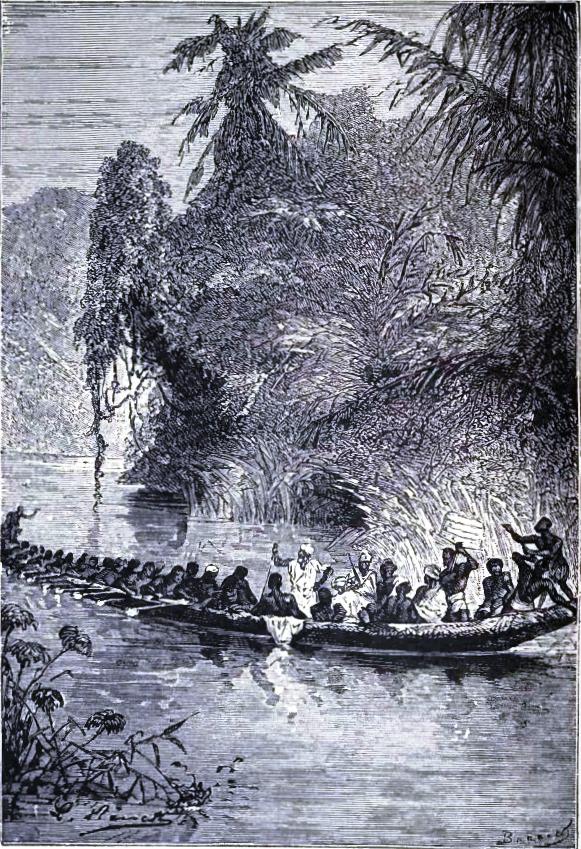
"It was hollowed out of a single tree-trunk."
A little farther on Boy's canoe came up with those of Gun and Forday. The latter was a venerable-looking old man, in spite of his wretched semi-European semi-native clothing and a very strong predilection for rum, of which he consumed a great quantity, although his manners and conversation betrayed no signs of excessive drinking.
That was a strange escort which accompanied the two Englishmen as far as the town of Brass.
"The canoes," says Lander, "were following each other up the river in tolerable order, each of them displaying three flags. In the first was King Boy, standing erect and conspicuous, his headdress of feathers waving with the movements of his body, which had been chalked in various fantastic figures, rendered more distinct by its natural colour; his hands were resting on the barbs of two immense spears, which at intervals he darted violently into the bottom of the canoe, as if he were in the act of killing some formidable wild animal under his feet. In the bows of all the other canoes fetish priests were dancing, and performing various extraordinary antics, their persons, as well as those of the people with them, being chalked over in the same manner as that of King Boy; and, to crown the whole, Mr. Gun, the little military gentleman, was most actively employed, his canoe now darting before and now dropping behind the rest, adding not a little to the imposing effect of the whole scene by the repeated discharges of his cannon."
Brass consists of two towns, one belonging to Forday, the other to King Jacket. The priests performed some curious ceremonies before disembarking, evidently having reference to the whites. Was the result of the consultation of the fetish of the town favourable or not to the visitors? The way the natives treated them would answer that question. Before he set foot on land Richard Lander, to his great delight, recognized a white man on the banks. He was the captain of a Spanish schooner at anchor in the river. The narrative goes on to say:—
"Of all the wretched, filthy, and contemptible places in this world of ours none can present to the eye of a stranger so miserable an appearance, or can offer such disgusting and loathsome sights, as this abominable Brass Town. Dogs, goats, and other animals run about the dirty streets half-starved, whose hungry looks can only be exceeded by the famishing appearance of the men, women, and children, which bespeaks the penury and wretchedness to which they are reduced; whilst the persons of many of them are covered with odious boils, and their huts are falling to the ground from neglect and decay."
Another place, called Pilot Town by the Europeans, on account of the number of pilots living in it, is situated at the mouth of the river Nun, seventy miles from Brass. King Forday demanded four bars before the Landers left the town, saying it was customary for every white man who came to Brass by the river to make that payment. It was impossible to evade compliance, and Lander drew another bill on Captain Lake. At this price Richard Lander obtained permission to go down in Boy's royal canoe to the English brig stationed at the mouth of the river. His brother and his servants were not to be set free until the return of the king. On his arrival on the brig, Lander's astonishment and shame was extreme when he found that Lake refused to give him any help whatever. The instructions given to the brothers from the ministry were read, to prove that he was not an impostor; but the captain answered,—
"If you think that you have a —— fool to deal with, you are mistaken; I'll not give a —— flint for your bill. I would not give a —— for it."
Overwhelmed with grief at such unexpected behaviour from a fellow-countryman, Richard Lander returned to Boy's canoe, not knowing to whom to apply, and asked his escort to take him to Bonny, where there were a number of English vessels. The king refused to do this, and the explorer was obliged to try once more to move the captain, begging him to give him at least ten muskets, which might possibly satisfy Forday.
"I have told you already," answered Lake, "that I will not let you have even a flint, so bother me no more."
"But I have a brother and eight people at Brass Town," rejoined Lander, "and if you do not intend to pay King Boy, at least persuade him to bring them here, or else he will poison or starve my brother before I can get any assistance from a man-of-war, and sell all my people."
"If you can get them on board," replied the captain, "I will take them away; but as I have told you before, you do not get a flint from me."
At last Lander persuaded Boy to go back and fetch his brother and his people. The king at first declined to do so without receiving some payment on account, and it was only with difficulty that he was induced to forego this demand. When Lake found out that Lander's servants were able-bodied men, who could replace the sailors he had lost by death or who were down with fever, he relented a little. This yielding mood did not, however, last long, for he declared that if John and his people did not come in three days he would start without them. In vain did Richard prove to him beyond a doubt that if he did so the white men would be sold as slaves. The captain would not listen to him, only answering, "I can't help it; I shall wait no longer." Such inhumanity as this is fortunately very rare; and a wretch who could thus insult those not merely his equals, but so much his superiors, ought to be pilloried. At last, on the 24th November, after weathering a strong breeze which made the passage of the bar very rough and all but impossible, John Lander arrived on board. He had had to bear a good many reproaches from Boy, for whom, it must be confessed, there was some excuse; for had he not at his own cost rescued the brothers and their people from slavery, brought them down in his own canoe, and fed them, although very badly, all on the strength of their promise to pay him with as much beef and rum as he could consume? whereas he was, after all, roughly received by Lake, told that his advances would never be refunded, and treated as a thief. Certainly he had cause to complain and any one else would have made his prisoners pay dearly for the disappointment of so many hopes, and the loss of so much money.