TOOTSY WOOTSY.
Reading edition
POEM, LESSON-TALK AND PANTOMIME, BY MRS. FREDERICK W. PENDER.
POSES BY BABY ELOCUTIONIST VIRGINIA BELL (2 YEARS OLD) AND KITTEN TOOTSY WOOTSY (4 MONTHS OLD).
Photographs by Jacques Joel, New York.
Copyright, 1906, by Edgar S. Werner.
Written expressly for this book.
SEE, Tootsy Wootsy be’s m’ tat, An’ her as tunnin’ as tan be; She am ner bigger den m’ han’, An’s dot der bites’ eyes oo’ see. All fluffy wuffy be’s her toat, An’ say, her face, it’s orsel wise; I spec’s some day ’at she’ll dit Der firstes’, bestes’ tind oo’ prize. She puts her ’ittle velvet paws Wite up ter me ser dem I’ll shake; An’ ef she be’s des fas’ ersleep, I nezzer ties fer her ter wake. I ’dopt her fer m’ owners’ tat, An’ dot fer her der nices’ house, W’ere she do stay w’en nite am tum Ser still an’ twiet as er mouse. She ain’t ner tommon tind o’ tat, She am Andora, yes, she be; An’ w’en I smooth her back an’ tail, Her winks, an’ purrs, an’ p’ays wiv me. An’ nen I buy (now doan yo’ laff), Er sing ner uzzer titten’s dot, Er nussin’ bottle, wiv er mouf F’um w’ich she dinks her milk w’en hot. Oh! she do be ser very nice, I hopes she nezzer wuns erway; Fer ef she do, I tannot tell W’at I ’oud do, or sink, or say. Maybe, I mite dess tazy dit, Ef f’um m’ titten I did part; So, Tootsy, darlin’! oo’ stay here, Fer ef yer don’ yo’ bwake m’ heart.
[Some people do not care to teach children dialect, so we print the poem “Tootsy Wootsy” in ordinary English. The same lesson-talk applies to both forms of the poem.]
TOOTSY WOOTSY.
SEE, Tootsy Wootsy is my cat, And she’s as cunning as can be; She is no bigger than my hand, And has the brightest eyes you see. All fluffy wuffy is her coat, And see, her face, it’s very wise; I expect some day that she’ll get The first and only kind of prize. She puts her little velvet paws Right up to me so them I’ll shake; And if she is just fast asleep, I never cry for her to wake. I take her for my very own And have for her the nicest house, Where she can stay when night is come As still and quiet as a mouse. She’s not a common kind of cat, She is Angora, yes, she is; And when I smooth her back and tail, She winks, and purrs, and plays with me. And then I buy (now don’t you laugh) A thing no other kitten’s got, A nursing-bottle, with a mouth From which she drinks her milk when hot. Oh! she is really very nice, I hope she’ll never run away; For if she does, I cannot tell What I would do, or think, or say. Maybe, I might just crazy get, If from my kitten I did part; So, Tootsy, darling! you stay here, For if you don’t, you’ll break my heart.
FOREWORD.
AS soon as a little tot in lisping accents can pronounce words sufficiently well to form sentences, it often becomes a proud mother’s ambition to teach her nursery rhymes; and baby is called on to surprise her fond papa, or maybe her doting grandparents, with a display of her wonderful elocutionary talent. But when the darling entertains a number of her mama’s dearest friends in the drawing-room, or, better still, when she makes her début at the Sunday-school social, and receives plaudits for her little recitation delivered in bird-like tones, it is then that the mother’s heart reaches its zenith of happiness. “Tootsy Wootsy” has been arranged and posed especially for children from three to six years of age.
Points.—Before the child recites, place a small stool or chair a little to right of center of platform. On left side there should be a small table or stand; a little way from this, lying on floor with cover off, should be kitten’s basket with a tiny nursing-bottle filled with milk. Care should be taken not to have these articles arranged in set manner, but rather with play-room or nursery effect. The younger the kitten, the easier handled by a child.
LESSON-TALK ON “TOOTSY WOOTSY.”
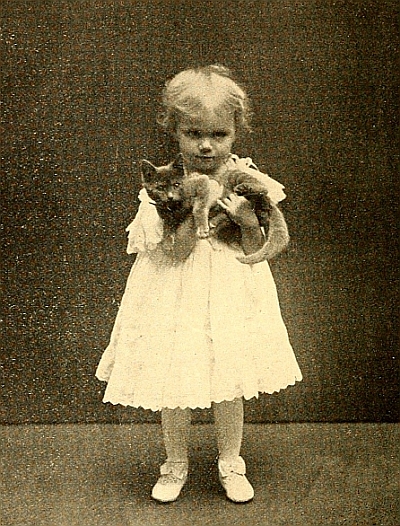
“See, Tootsy Wootsy he’s m’ tat, An’ her as tunnin’ as tan be.”
Picture I.
“See, Tootsy Wootsy be’s m’ tat.”
Picture I.—Advance on platform carrying pet kitten in arms in regular childish fashion; pause, throw weight of body evenly upon both feet; face expressing joy and pride; and in pleasing tones explain who “Tootsy Wootsy” is and how “tunnin’.”
“She am ner bigger den m’ han’, An’s dot der bites’ eyes oo’ see.”
Descriptive Pose.—Smile, hold kitten out in front of you for admiration of audience; seat yourself on floor, wind one arm and hand around kitten, while holding up other arm with fingers of hand extended, as though to illustrate what you think is correct size of her tail; facial expression brightens as head is slightly bowed, when gazing at beauty of kitten’s eyes.
“All fluffy wuffy be’s her toat, An’ say, her face, it’s orsel wise.”
Descriptive Pose.—Still seated, run one hand over and through kitten’s fur; hold kitten up a little and rub your cheek against its soft body; glancing alternately at kitten, then at her friends. Words requiring emphasis are “fluffy,” “wuffy,” “toat” and “it’s orsel wise.”
“I spec’s some day ’at she’ll dit Der firstes’, bestes’ tind oo’ prize.”
Picture II.
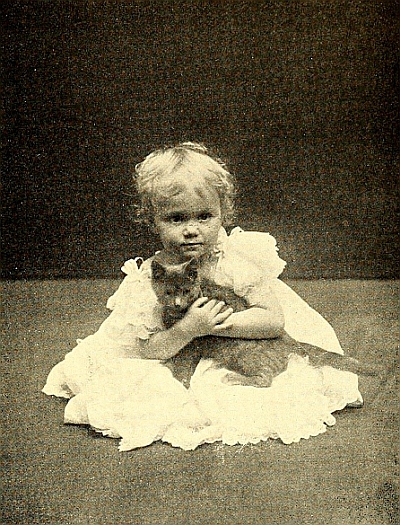
“I spec’s some day ’at she’ll dit Der firstes’, bestes’ tind oo’ prize.”
Picture II.—Still seated, hug kitten closely to breast, and show by look that you have no doubt of kitten’s receiving “firstes’, bestes’ tind oo’ prize.” Words that are emphatic are “some day,” “she,” and the entire second line.
“She puts her ’ittle velvet paws Wite up ter me ser dem I’ll shake.”
Picture III.
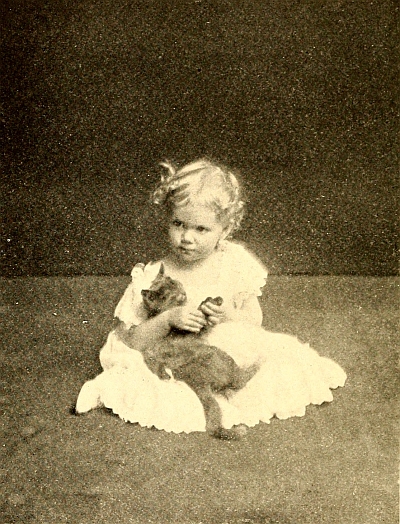
“She puts her ’ittle velvet paws Wite up ter me ser dem I’ll shake.”
Picture III.—Put right arm around kitten; both hands clasp kitten’s paws; while you glance up obliquely with earnest tone and recite the lines. Special emphasis on “wite up ter me” as though it were something unusual for a kitten to do such a thing.
“An’ ef she be’s fas’ ersleep, I nezzer ties fer her ter wake.”
Descriptive Pose.—Serious tone and expression of face and eyes; prolong “des fas’ ersleep;” accompany “I nezzer ties” with movement of head from right to left to make more emphatic.
“I ’dopt her fer m’ ownes’ tat, An’ dot fer her der nices’ house.”
Picture IV.
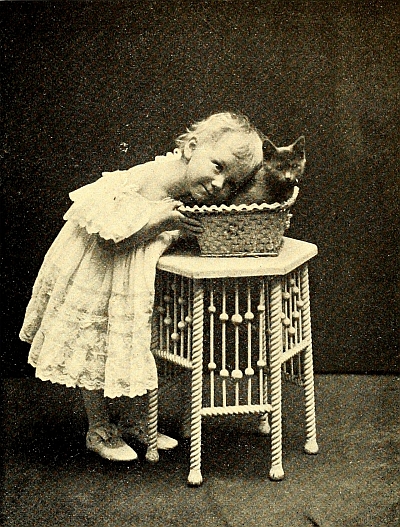
“I ’dopt her fer m’ ownes’ tat, An’ dot fer her der nices’ house.”
Picture IV.—Rise, advance to where basket is lying; place kitten in it; put basket with contents on stand; bow head, resting it lightly on kitten; hands clasp sides of basket; face expressing happiness.
“Where she do stay w’en nite am tum Ser still an’ twiet as er mouse.”
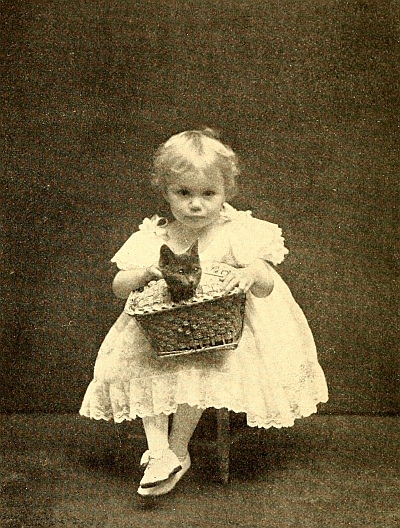
Picture V.
“Where she do stay w’en nite am tum Ser still an’ twiet as er mouse.”
Picture V.—Place cover of basket over kitten, leaving head exposed to view; then sit in chair, feet crossed, and hold kitten in basket, for audience to gaze at. Show dignified tone and manner when reciting; tone softens and voice grows lighter on “still an’ twiet as er mouse.”
“She ain’t ner tommon tind o’ tat, She am Andora, yes she be.”
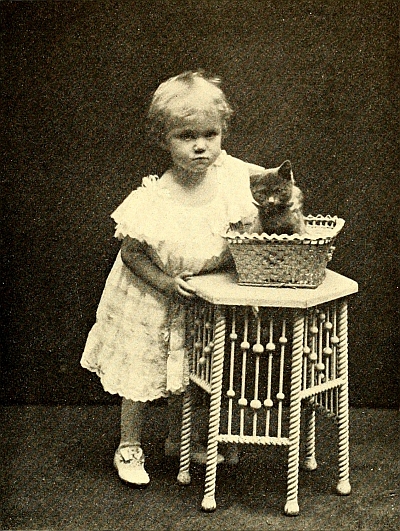
Picture VI.
“She ain’t ner tommon tind o’ tat, She am Andora, yes, she be.”
Picture VI.—Remove cover from basket, which still contains kitten; place cover to one side. Clasp with left hand kitten’s collar in the back. Cling with right hand to edge of stand, feet in natural childish position; body slightly inclined in sort of protecting manner over loved treasure, and with look and tone of disdain and strongest emphasis say that your kitten “ain’t ner tommon tind o’ tat;” give its breed, laying special stress on “Andora,” and “yes, she be;” decided nod of head in affirmative on last three words.
“An’ w’en I smooth her back an’ tail, Her winks, an’ purrs, an’ p’ays wiv me.”
Descriptive Pose.—Continue dignified tone through first line; expression softens on second line; suggestion of smile. Emphasize “winks,” “purrs,” “p’ays wiv me.”
“An’ nen I buy (now doan yo’ laff) Er sing ner uzzer titten’s dot.”
Descriptive Pose.—Take kitten from basket; resume your seat in chair; face should glow with pride and pleasure when thinking what you have for your kitten; for a moment the thought comes that when your friends learn what it is, they will make sport of you. With pathetic face beg them not to “laff.” Again assuming bright facial expression and giving marked stress to the words, assure them that it is—“Er sing ner uzzer titten’s dot,” and describe it as
“Er nussin’-bottle, wiv er mouf F’um w’ich she dinks her milk w’en hot.”
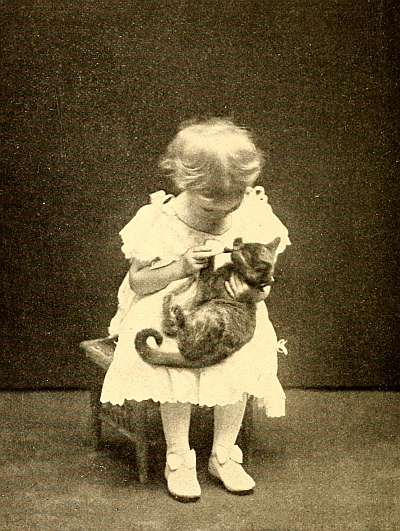
Picture VII.
“Er nussin’ bottle wiv er mouf, F’um wich she dinks her milk w’en hot.”
Picture VII.—Bend forward, clasp kitten with left hand, and proceed to give kitten milk from bottle that you take from basket.
“Oh! she do be ser very nice, I hopes she nezzer wuns erway.”
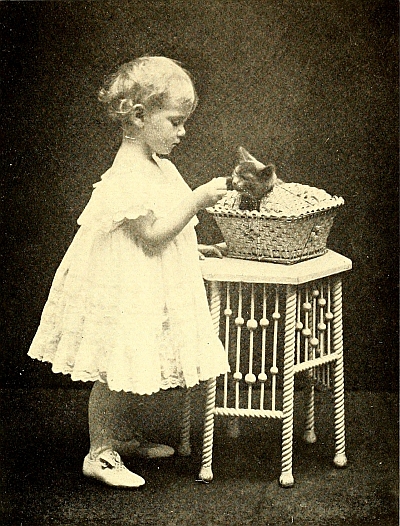
Picture VIII.
“Oh, she do be ser very nice.”
Picture VIII.—Rise, place cat in basket on stand, keep side of your body toward audience; continue to offer kitten milk as you recite the lines. Emphasize “very nice,” “nezzer,” and “wuns erway.”
“Fer ef she do, I tannot tell W’at I ’oud do, or sink, or say.”
Descriptive Pose.—Your fear of losing kitten should be expressed very vividly. Place nursing-bottle in basket. Lovingly take kitten out of basket. Put right hand to your eye as if to check a tear; left arm and hand encircle kitten; general appearance of childish sorrow.
“May be, I mite dess tazy dit, Ef f’um m’ titten I did part;”
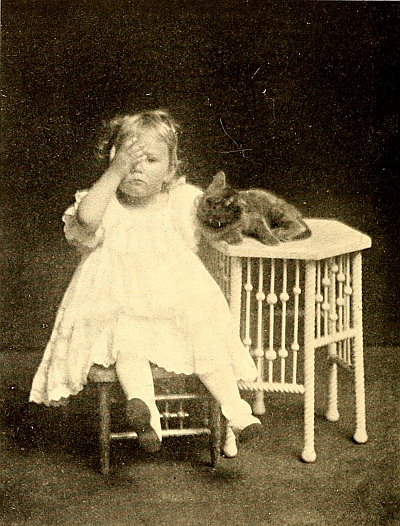
Picture IX.
“Maybe I mite dess tazy dit, Ef f’um titten I did part.”
Picture IX.—In your great fondness for the kitten, you fear that you may lose it after all. Sit in chair, place cat on stand, holding its collar tightly with left hand. To illustrate still more clearly how you would mourn, should such a catastrophe befall you, when reciting how she “mite tazy dit,” place right hand on your face and give deep sigh and expression of intense suffering.
“So, Tootsy, darlin’! Oo’ stay here, Fer ef yer don’, yo’ bwake m’ heart.”
Descriptive Pose.—Take kitten, hug it closely, and in above lines beg it not to leave you. Strong emphasis on “yo’ bwake mi’ heart.” Then, carrying kitten under right arm, and basket containing nursing-bottle in left hand, smile sadly to audience and leave platform.