AN OBJECT OF LOVE.
Reading edition
Mary E. Wilkins.
A TINY white-painted house, with a door and one window in front, and a little piazza, over which the roof jutted, and on which the kitchen door opened, on the rear corner. Squashes were piled up on this piazza in a great yellow and green heap.
Ann Millet, her shawl pinned closely over her hair and ears, the small oval of her solemn, delicate old face showing almost uncanny beneath it, stood in the door, surveying the sky outside.
“There’s goin’ to be a heavy frost, sure enough,” she said. “I’ll hev to git the squashes in. Thar’s Mis’ Stone comin’. Hope to goodness she won’t stop an’ hinder me! Lor’ sakes! I’d orter hev more patience.”
A tall, stooping figure came up the street, and paused at the gate hesitatingly.
“Good-evenin’, Ann.”
“Good-evenin’, Mis’ Stone.”
“Gettin’ in your squashes, ain’t you?” Mrs. Stone spoke in a very high pitched tone. Ann was somewhat deaf.
“Yes. I didn’t dare resk ’em out to-night, it’s so cold.”
“Well, it’s a good deal colder than I hed any idea of when I come out. Yes, I’d take ’em in. We got ourn in last week. We ain’t got more’n half as many as you hev. I shouldn’t think you could use ’em all, Ann.”
“Well, I do. I allers liked squashes, an’ Willy likes ’em, too. You’d orter see him brush round me, a-roundin’ up his back an’ purrin’ when I’m a scrapin’ of ’em out of the shell. He likes ’em better’n fresh meat.”
“Seems queer for a cat to like sech things. Ourn won’t touch ’em. How nice an’ big your cat looks a-settin’ thar in the window!”
“He’s a-watchin’ of me. He jumped up thar jest the minute I come out!”
“He’s a good deal of company for you, ain’t he?”
“Yes, he is. What on airth I should do this long winter that’s comin’, without him, I don’t know. Everybody wants somethin’ that’s alive in the house.”
“That’s so. It must be pretty lonesome for you anyway.”
“Well, I don’t mean to complain. I’d orter be thankful. I’ve got my Bible an’ Willy, an’ a roof over my head, an’ enough to eat an’ wear; an’ p’rhaps some other woman ain’t lonesome because I am, an’ maybe she’d be one of the kind that didn’t like cats, an’ wouldn’t hev got along half as well as me. No, I never orter complain.”
“Well, if all of us looked at our mercies more’n our trials, we’d be a good deal happier. But, sakes! I must be goin’. Good-night, Ann.”
“Good-night, Mis’ Stone.”
Mrs. Stone hitched rapidly down the street to her own home, and Ann went on tugging in her squashes. She was a little woman and had to carry them in one at a time. After they were all in she took off her shawl and hung it on a nail behind the kitchen door. Then she gave her cat his saucer of warm milk in a snug corner by the stove and sat down contentedly to her own supper. The cat was a beautiful little animal, with a handsome dark striped coat on his back, and white paws and face.
When he had finished lapping his milk, he came and stood beside his mistress’s chair while she ate, and purred, and she gave him bits of bread from her plate now and then. She talked to him.
“Nice Willy! nice cat. Got up on the window to see me bring in the squashes, didn’t he? There’s a beautiful lot of ’em, an’ he shall hev some stewed for his dinner to-morrow, so he shall.”
And the cat would purr, and rub his soft coat against her, and look as if he knew just what she meant.
There was a prayer-meeting that evening, and Ann Millet went. She never missed one. The minister, when he entered, always found her sitting in the same place. She had a pretty voice when she was young, people said, and she sang now in a sweet thin quaver the hymns which the minister gave out. She listened in solemn enjoyment to the stereotyped prayers and the speaker’s remarks.
After meeting Ann always went up and told him how much she had enjoyed his remarks, and inquired after his wife and children. To her a minister was an unpublished apostle, and his wife and family were set apart on the earth.
When she had reached home and lighted her lamp, she called her cat. She had expected to find him waiting to be let in, but he was not. She stood out on her little piazza, and called, “Willy! Willy! Willy!”
She thought every minute she would see him bounding around the corner, but she did not. She called over and over, “Willy! Willy! Kitty! Kitty! Kitty!”
Finally she went into the house and waited awhile, crouching, shivering with cold and nervousness, over the kitchen stove. Then she went outside and called again, “Willy!” over and over, waiting between the calls trembling, her dull old ears alert, her dim old eyes strained. She ran out to the road, and looked and called. Once her heart leaped; she thought she saw Willy coming; but it was only a black cat which belonged to one of the neighbors. Over and over all night long she called the poor little creature which was everything earthly she had to keep her company in the great universe in which she herself was so small.
In the morning she went over to Mrs. Stone’s, her small old face wild and wan.
“Hev you seen anything of Willy?” she asked. “He’s been out all night, an’ I’m afraid somethin’s happened to him. I never knowed him to stay out so before.”
When they told her they had not seen him, she went on to the next neighbors to inquire. But no one had seen anything of the cat. All that day and night, at intervals, people heard her plaintive, inquiring call, “Willy! Willy! Willy!”
The next Sunday, Ann was not out at church. Mrs. Stone went over to see what was the matter.
“Why, Ann Millet, are you sick?” she asked.
“No, I ain’t sick.”
“You wa’n’t out to meetin’, an’ I didn’t know——”
“I ain’t never goin’ to meetin’ agin.”
“Why, what do you mean?”
“I mean jest what I say. I ain’t never goin’ to meetin’ agin. Folks go to meetin’ to thank the Lord for blessin’s, I s’pose. I’ve lost mine, an’ I ain’t goin’.”
“What hev you lost, Ann?”
“Ain’t I lost Willy?”
“You don’t mean to say you’re makin’ such a fuss as this over a cat?”
“Yes, I do.”
“Well, I aint nothin’ agin cats, but I must say I’m beat. Why, Ann Millet, it’s downright sinful for you to feel so. Of course, you set a good deal by Willy; but it ain’t as ef he was a human creature. Cats is cats. For my part, I never thought it was right to set by animals as ef they was babies.”
“I can’t hear what you say.”
“I never thought it was right to set by animals as ef they was babies.”
“I don’t keer. It’s comfortin’ to have live creatures about you, an’ I ain’t never hed anything like other women. I ain’t hed no folks of my own sense I kin remember. I’ve worked hard all my life, an’ hed nothin’ at all to love, an’ I’ve thought I’d orter be thankful all the same. But I did want as much as a cat.”
“Well, as I said before, I’ve nothin’ agin cats. But I don’t understand any human bein’ with an immortal soul a-settin’ so much by one.”
“I can’t hear what you say.”
“I don’t understand any human bein’ with an immortal soul a-settin’ so much by a cat.”
“You’ve got folks, Mis’ Stone.”
“I know I hev; but folks is trials sometimes. But, Ann Millet, I didn’t think you was one to sink down so under any trial. I thought the Lord would be a comfort to you.”
“I know all that, Mis’ Stone. But when it comes to it, I’m here an’ I ain’t thar; an’ I’ve got hands, an’ I want somethin’ I kin touch.”
Then the poor soul broke down, and sobbed out loud like a baby.
“I ain’t—never felt as ef I orter begrutch other—women their homes an’ their folks. I thought—p’raps—I could git along better without ’em than—some; an’ the Lord knowed it, an’ seein’ thar wa’n’t enough to go round, he gave ’em to them that needed ’em most. I ain’t—never—felt—as ef I’d orter complain. But—thar—was—cats—enough. I might a hed—that—much.”
“You kin git another cat, Ann. Mis’ Maxwell’s got some real smart kittens.”
“I don’t want any of Mis’ Maxwell’s kittens; I don’t never want any other cat.”
“P’rhaps yourn will come back.”
“No, he won’t. I’ll never see him agin. I’ve felt jest that way about it from the first.”
“Hark! I declar’ I thought I heard a cat mew somewhar! But I guess I didn’t. Well, I’m sorry, Ann. Why, Ann Millet, whar’s your squashes?”
“I throwed ’em away out in the field. Willy can’t hev none of ’em now, an’ I don’t keer about ’em myself.”
Mrs. Stone looked at her in horror. When she got home she told her daughter that Ann Millet was in a dreadful state of mind, and she thought the minister ought to see her.
The next day the minister called on her. He did not find her so outspoken; her awe of him restrained her. Still, Ann Millet was for the time a wicked, rebellious old woman.
In the course of the call a rap came at the kitchen door.
“Nothin’ but a little gal with a Malty cat,” said she. “The children hev got wind of my losin’ Willy, an’ they mean it all right, but it seem as ef I should fly! They keep comin’ and bringin’ cats. They’ll find a cat that they think mebbe is Willy, an’ so they bring him to show me. They’ve brought Malty and white cats, an’ cats all Malty. They’ve brought yaller cats, an’ black, an’ there wa’n’t one of ’em looked like Willy. Then they’ve brought kittens that they knowed wa’n’t Willy, but they thought mebbe I’d like ’em instead of him. They mean all right, I know; they’re real tender-hearted; but it ’most kills me. Why, they brought me two little kittens that hain’t got their eyes open jest before you came. They was striped and white, an’ they said they thought they’d grow up to look like Willy.”
He went away without saying much of anything; he was so afraid that what he said might be out of proportion to the demands of the case.
Going out the door, he stopped and listened a minute; he thought he heard a cat mew. Then he concluded he was mistaken, and went on. He watched eagerly for Ann the next meeting night, but she did not come.
The day after the meeting, she had occasion to go down cellar for something. The cellar stairs led up to the front part of the house. Ann went through her chilly sitting-room, and opened the cellar door, which was in the front entry. There was a quick rush from the gloom below, and Willy flew up the cellar stairs.
“Lor’ sakes!” said Ann, with a white shocked face. “He has been down there all the while. Now I remember. He followed me when I came through here to git my cloak that meetin’ night, an’ he wanted to go down cellar, an’ I let him. Lor’ sakes!”
She went back into the kitchen, her knees trembling. She poured out a saucer of milk, and watched Willy hungrily lapping. He did not look as if he had suffered, though he had been in the cellar a week.
Ann watched him, the white, awed look still on her face.
“I s’pose he mewed an’ I didn’t hear him. Thar he was all the time, jest whar I put him; an’ me a-blamin’ of the Lord an’ puttin’ of it on him. I’ve been an awful wicked woman. I ain’t been to meetin’, an’ I’ve talked, an’—them squashes I threw away. It’s been so warm they ain’t froze, an’ I don’t deserve it. I hadn’t orter hev one of ’em; I hadn’t orter hev anything. I’d orter offer up Willy. Lor’ sakes, think of me a-sayin’ what I did, an’ him down cellar!”
That afternoon Mrs. Stone saw Ann slowly and painfully bringing in squashes one at a time. The next meeting night Ann was in her place. After meeting, the minister hurried out of his desk to speak to her. When she looked up at him, her old cheeks were flushing.
“The cat has come back,” said Ann.
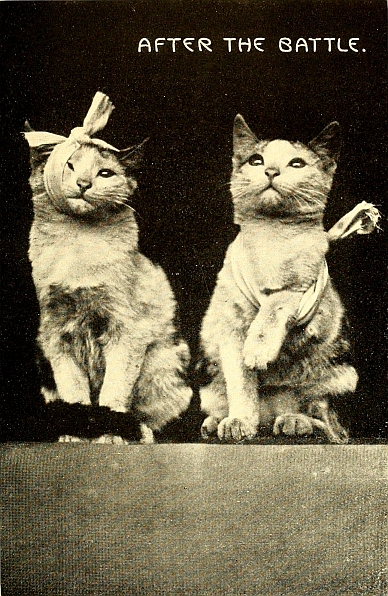
AFTER THE BATTLE.
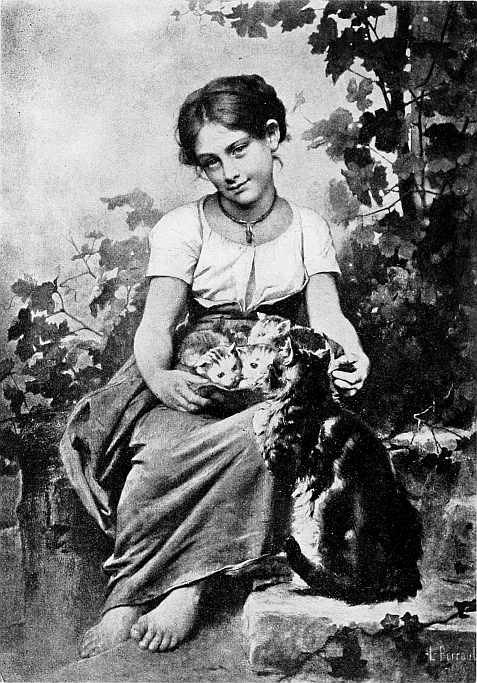
From Painting by L. Perrault.
A Happy Mother.