CATS.
Reading edition
Essay or Address.
Stanley Schell.
IN all the varied world of animals, three only are universally the inmates of our homes, the companions of our firesides—the cat, the bird, and the dog. The cat, especially, is the friend of our early childhood; the purr of the cat blends with the voices of the children and the ticking of the clock; it is the music of repose, the veritable “Home, Sweet Home” that haunts the wanderer on far-off shores.
A tenderness toward the animal creation is always characteristic of noble, generous and intellectual souls; and it is well known that our most intellectual people are most tender-hearted toward beings helpless and inferior to themselves, and they love with a child-like love the cat, whose image is associated with the sweetness and tenderness of the child’s world of happiness—the home.
The most noted persons in every profession have been domestic cat lovers, particularly authors and poets. Such men as Pope Gregory, Mahomet, Petrarch, Tasso, Cardinal Woolsey, Admiral Doria, Gladstone, Montaigne, Swinburne, Watson, Matthew Arnold, Dickens, Southey, Cooper, Hugo, Mérimée, Sainte Beuve, Baudelaire, Gauthier, Pierre Loti, Hoffmann, Scheffel, Lord Chesterfield, Jeremy Bentham, Doctor Johnson, Fielding, Lincoln, etc., were all cat lovers and worshippers, and many of them immortalized the cat in rhyme or in prose.
The Cat Family is a large one, and to it belong:
Tiger,
Lion,
Leopard,
Ounce,
Puma,
Jaguar,
Clouded Tiger,
Thibet Tiger Cat,
Fontaneir’s Cat,
Golden Cat,
Fishing Cat,
Bengalese Cat,
Wagate,
Marbled Tiger Cat,
Serval,
Golden-haired Cat,
Gray African Cat,
Servaline Cat,
Ocelot,
Margay,
Geoffroy’s Cat,
Ocelot-like Cat,
Yaguarundi (Brazil),
Eyra,
Colocolo,
Rusty Spotted Cat,
Chinese Cat,
Small Cat,
Jerdon’s Cat,
Java Cat,
Small-eared Cat,
Large-eared Cat,
Flat-headed Cat,
Bornean Bay Cat,
Egyptian Cat,
Wild Cat,
Indian Wild Cat,
Common Jungle Cat,
Ornate Jungle Cat,
Steppe Cat,
Shaw’s Cat,
Manul,
Straw or Pampas Cat,
Northern Lynx,
Pardine Lynx,
Carcal,
Cheetah,
Domestic Cat.
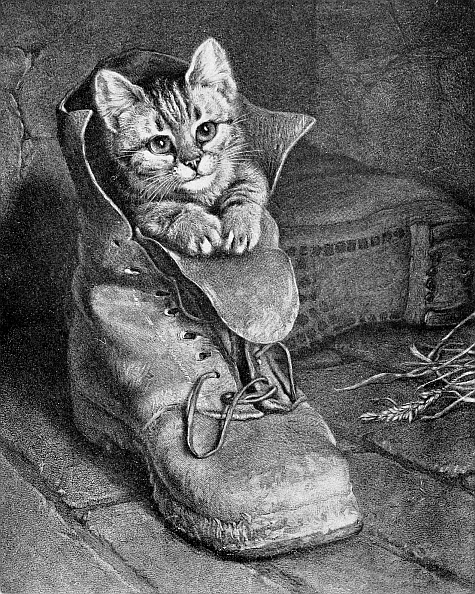
From Painting by Frank Paton.
Puss in Boots.
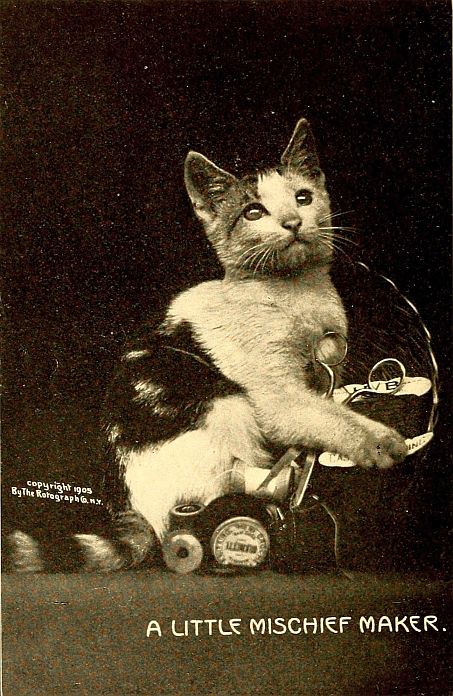
A LITTLE MISCHIEF MAKER.
Considering the Cat Family as a whole, there is probably no other animal so well equipped for the battle of life.
Cats are carnivorous, preferring to discover and kill their own prey. Cats are ferocious and sanguinary, loving retirement; moving with concealment and stealth; always fighting desperately when injured, or when escape is no longer possible. All cats climb with ease, except the tiger and the lion. So persistent are the characters both of body and mind in the Cat Family, that, in spite of thirty-five centuries or more of domestication, the household cat to-day preserves far more of its ancestral traits than any other of the four-footed associates of man.
Cats are found all over the world except in the Australian region, in Madagascar, and the West Indies. They are mainly tropical and heat-loving, although a few species range far to the north, as the tiger in Asia and the puma in America. The short-tailed lynxes also predominate in the northern regions.
The first real evidence of cats in connection with man is to be found in the ancient monuments of Egypt, Babylon, and Nineveh. Cats are mentioned in inscriptions as early as 1684 B.C., and they were certainly domesticated in Egypt 1300 years before Christ.
The earliest known representation of the cat as a domestic animal and pet is at Leyden, in a tablet of the 18th or 19th Dynasty.
In ancient Egypt, the cat was an object of religious worship and a venerated inmate of certain temples. The Goddess of Pasht or Bubastis, the goddess of cats, was, under the Roman Empire, represented with a cat’s head. A temple at Beni-Hassan, dedicated to her, belongs to the 18th Dynasty (1500 B.C.). Behind this temple are pits containing a multitude of cat mummies.
The cat was also worshipped in the Temple of the Sun at Heliopolis, as the Egyptians deemed the cat an emblem of the sun, because its eyes were supposed to vary in appearance with the course of the sun, and for a similar reason the cat was deemed sacred to the moon, because it would undergo a change each lunar month, and because of the waxing and waning of its pupils.
Among the Greeks the cats became common pets at the period when Athens represented the civilization of the world; and, later, in the Græco-Italian civilization of Herculaneum and Pompeii in the south of Italy, and in the period of Roman supremacy, it was a well-known pet of courts and ladies’ boudoirs.
During the Middle Ages, cats were very scarce and valuable, and persons owning cats were heavily taxed.
The cat has also had its detractors, and shortly after the Middle Ages cats were looked upon as symbols of witchcraft and deviltry of all kinds, and were even burned at the stake as sorcerers and savants.
In Paris, every St. John’s Day, a number of cats were heaped up in baskets and bags in the Place de Greve, and the sovereign himself always set fire to the pile. This practice continued down to Louis XIV., who was the last King of France to do so cruel an act.
Gipsies have always feared the black cat and have greatly loved the white cat.
Shakespeare rarely alludes to cats, except in an uncomplimentary way.
The domestication of cats was gradual and continuous.
The origin of our domestic cat is undoubtedly the wild cat of Egypt and the American wild cat. And such origin is of very ancient date.
To-day the classification of our domestic cat is into two great classes: (1) The Long-haired or Angora Cat (Asiatic or Eastern in origin), consisting of the Persian, Russian, Chinese, and Indian Cats; (2) the Short-haired Cat (European and Western), consisting of the Tortoise Shell, Tortoise Shell and White, Tabbies—banded and spotted, brown, spotted, blue and silver, red, white, blue (Maltese in America), black and white, Royal cat of Siam, Manx.