CAT AND PAINTER.
Reading edition
Eleanor H. Porter.
“Me-ow-w!”
It was a plaintive wail that came from behind the ash barrel in the alley-way.
It had been so delightful to scurry out the hall-door when Miss Dorothy was not looking—out into the bright sunshine, where the red and yellow leaves were chasing each other down the smooth walk in front of the house.
Then there came a time when the sunshine fled and the leaves lay quiet, refusing to play, even when she poked them with her little insistent paw. She had run far down the street, and everything was new and strange to her. A big dog bounced around the corner, and she was obliged to scramble up a tree.
She had but just accomplished her fearsome descent when a group of boys hailed her appearance with yells of delight. Then to her tail—her beautiful fluffy tail—they tied a cruel cord with a jangling tin can at the end. Down the street she wildly fled, around corners, through back alleys, followed always by that deafening rattle dangling at the tip of her tail.
The shouts of the boys grew fainter and fainter, and finally ceased altogether. It was then that she stopped, and tugged and bit at the knotted cord until at last she could switch her tail from side to side—free from its hated burden.
“Me-ow-w!”
“Whew! little cat, is it so bad as all that?”
He was tall, wore a soft black hat, and carried a cane, which he playfully twirled over the kitten’s head as he spoke.
The kitten’s tail came upright instantly, waving an appreciative welcome to the kindly tones.
Two blocks down the street, the man ran up the steps of a house. His latch-key was in his hand before he spied the kitten. She had sprung lightly to the topmost step and was now facing him.
“Why—pussy!”
“Meow!”
Mechanically the man obeyed the obvious command, unlocked the door, and pushed it open. The kitten was inside the hall with a bound.
“Oh, what a beauty, Mr. Heywood! Where did you get it?” asked the landlady.
“That’s just the trouble, Mrs. Merriam; I didn’t get it at all—it came!”
“Came to you? How perfectly lovely! The very best sign of good luck that you could possibly have! There’s not a bit of doubt now, Mr. Heywood—your picture will be a certain success.”
“But what am I going to do with it?” asked Heywood.
“Do with it? Why, you’re going to keep it.”
The kitten had arrived with a bedraggled ribbon of what had once been lustrous white satin around her neck. This forlorn bit of finery Heywood at once consigned to the wastebasket, substituting a band of blue cut from a roll of ribbon, after scrutiny of his guest’s eyes to obtain just the proper shade; but the roll of ribbon soon began to show signs of a rapid disappearance, so frequently was the necklet renewed. This was owing to the fact that the kitten’s usual companions, during her waking hours, were Heywood’s tubes of paints.
The first time she had jumped upon his low stand and poked her inquisitive nose into his paint-box, he had looked on in dumb dismay. A skirmish, a sweep of a yellow paw—and a tube of Rose Madder leaped from the box and scurried across the floor with the kitten in full pursuit.
It was then that Heywood had caught up his crayon and drawn hurried lines on the canvas before him; and it was that rough sketch that became the first study for his famous picture “The Kittens’ Playground.”
After that he used every device in his power to interest the kitten in that paint-box.
From the very first the little stranger had not lacked for a name. She was always referred to as “Her Majesty,” and right royally she ruled the household. It was two weeks before Her Majesty’s new surroundings palled upon her and she longed for other worlds to conquer. Coincident with this longing came the open back-yard gate. A wild scamper, and she was free—out in the wide, wide world! Through the alley and across the lot another open gate tempted her. Up the steps, through the kitchen door and on into the dining-room pattered the little yellow feet.
“Why, Queenie!—you darling!” and she was in Miss Dorothy’s arms.
“Where have you been? You little dear—you’re as plump as a partridge, anyway! Some one has appreciated you. But they’ve taken off your pretty white ribbon and put on a horrid blue one. We’ll go and change it, sweetheart. I never did like blue!”
Meanwhile on the other side of the square consternation reigned.
“Where’s Her Majesty?”
“I don’t know, but I’ll hunt her up,” responded Mrs. Merriam.
Perhaps the kitten missed her box of pigment playthings, or perhaps she longed for the masculine homage she did not find at home; at any rate, three days later, when she heard a familiar call from across the open lot, she slipped through the back-yard gate, and hurried in the direction of Mrs. Merriam’s voice.
“I’ve got her,” she announced breathlessly, “but I guess she’s found her home, Mr. Heywood. I don’t know’s we ought to keep her—you see her ribbon’s changed.”
“Yes, I see it is. But that’s easily remedied. I shan’t paint her in a white one.”
“But—shall we keep her?” asked Mrs. Merriam timidly.
“We’ll try to—until the picture is done, anyway.”
When the kitten had first come to the house, Heywood had been engaged upon an elaborate landscape, which he had intended to finish and present to the judges of a forthcoming Art Exhibition. But since the first study of “Her Majesty,” his interest in the landscape had waned. Abandoning his original plan, he was now hard at work on “The Kittens’ Playground,” determined to exhibit that or nothing. For a week Her Majesty was closely guarded and the picture grew apace; then one day she disappeared. High and low they searched, but all in vain.
Across the square Miss Dorothy was tenderly caressing an animated ball of yellow fur.
“Queenie, Queenie, what does this mean? What am I to think when you run away from me so? Who are your new friends that insist on tying on these odious blue ribbons around your neck? Here, just let me take off the horrid thing and—why, what is this!” she exclaimed, interrupting herself in amazement as a tiny crumpled paper dropped into her hand.
“Kindly leave the blue ribbon on. I like it better—it’s more artistic,” she read.
“Well, really—impertinent creature!” Then she laughed, caught up a pencil, and wrote on the back of the paper:
“So sorry, but I prefer white!”
When the small yellow cat and the big white bow appeared before Heywood that night, he laughed outright. With careful fingers he undid the knot, and then he laughed again.
“As I expected—graceful, in spite of disadvantages.”
When the blue again adorned the kitten’s neck, it bore with it this message:
“I regret to be obliged a second time to call your attention to the fact that blue is the only possible ribbon for this cat. Look at her eyes!”
The picture was nearly done now. Her Majesty came and went much at her own sweet will, and it was not two days before another huge white bow appeared on her neck to mock Heywood’s gaze. His fingers shook a little as he untied the knot and freed the tiny crumpled paper.
“I regret to be obliged a second time to call your attention to the fact that I prefer white. Look at her—whiskers!” he read.
The time of the Exhibition arrived and Heywood had thoughts for but one thing. At last his picture was hung, and so attractive did it prove to be that it bid fair to realize his dearest hopes.
It represented the interior of an artist’s studio. The whole was but the setting for four yellow kittens—the cleverest, most fascinating yellow kittens in the world, peeping from behind curtains, tumbling among rugs, rolling over tubes of paint—life-like, bewitching, and altogether perfection.
It was on the third day of the Exhibition that a tall girl in drooping feathers and rich furs stopped before the picture with an exclamation of delight.
“It’s Queenie!—why, it’s Queenie to the very life!” “C.R. Heywood. Not for sale,” she read disappointingly from her catalogue; then she sought the manager.
“‘The Kittens’ Playground’—it is not for sale,” she asked.
“No, madam.”
“But the artist, Heywood—does he live in the city? Can you give me his address?”
“Thirty-four Union Avenue, madam,” replied the man, consulting his book.
Dorothy Marsh was not a young woman who dallied. Once determined on a course, action quickly followed. Her mother, always gentle and pleasantly acquiescent, was hurried into the carriage and the order, “Thirty-four Union Avenue,” given to the coachman.
Upon their arrival at the house, the two ladies were shown into the studio, and in a moment Heywood appeared.
The girl was in the middle of the floor, turning round and round in amazement.
“Why, they’re all Queenies, every one of them!” she exclaimed.
The man bowed, and a peculiar smile flickered across his face.
“They are, indeed, all—‘Her Majesty’s.’”
He had not time to say more, for at the first tones of the girl’s voice, there was the crash of a falling vase and the scampering of little feet from an inner room. Then with a spring and a bound a small yellow kitten landed in Miss Dorothy’s outstretched arms.
There was a moment’s awkward silence. Mrs. Marsh unconsciously came to the rescue.
“Why, it is our kitten, isn’t it? This must be where she goes so often, daughter.”
The color deepened in the girl’s cheeks and she threw a quick glance at Heywood.
“It evidently is, mother,” she laughed.
Mrs. Marsh turned to the artist.
“My daughter has taken a great fancy to your kitten picture at the Exhibition, Mr. Heywood. We—er—I see that the catalogue states that it is not for sale.”
“Indeed, madam, it was my intention to keep the picture,” he began, speaking to the mother, though looking at the daughter, “but—”—the kitten jumped from the girl’s arms to the floor and began playing with a tube of paint—“Well, there are circumstances,” he continued, then paused again.
“Yes, there are circumstances,” repeated the girl softly, her eyes on the kitten.
“Yes, circumstances which—which alter determinations,” he suddenly concluded, following her gaze with his eyes.
Dorothy was strangely silent through the rest of the interview.
It was when the ladies were leaving that the artist placed Her Majesty into Dorothy’s arms. His hand rested in a momentary caress on the round yellow head, then his fingers just touched the white bow at the neck.
“The ribbon in the picture, Miss Marsh,” he began, closely studying the girl’s face, “shall I change it to—er—white?”
“Thank you, no. I—I prefer the blue,” she answered, with a sudden flash from her eyes and a dazzling smile.
Her Majesty is older now. She is plump, sleek, and of stately dignity, and her eyes—once turquoise—gleam with shifting amber lights. Her present realm is a certain mansion. Incidentally, it is also the home of the artist, Heywood, and of his wife, Dorothy.
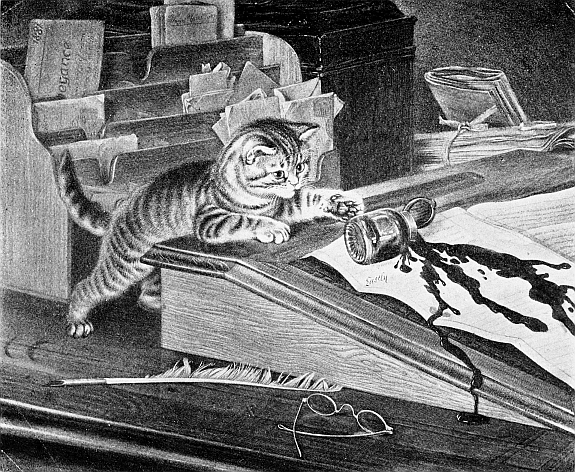
From Painting by Frank Paton.
“Witness my act and deed.”
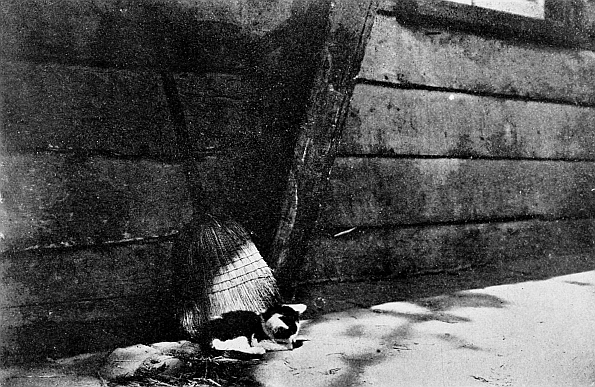
From “Life,” by courtesy of David Smith, Artist. (See page 135.)
Homeless Kitten
.
Ques.—When is a tea-pot like a kitten?
Ans.—When you’re teasin’ it (tea’s in it).