Volume 5 — N
Reading edition
Nādān.—Nādān, meaning ruler of a country or village, or one who lives in the country, is a title of the Shānāns, who, further, call themselves Nādāns in preference to Shānāns.
Nāga (cobra: Naia tripudians).—Nāg, Nāga, Nāgasa, or Nāgēswara, occurs in the name of a sept or gōtra of various classes in Ganjam and Vizagapatam, e.g., Aiyarakulu, Bhondāri, Bhumia, Bottada, Dōmb, Gadaba, Konda Dora, Mēdara, Mūka Dora, Nagarālu, Omanaito, Poroja, Rōna, and Sāmantiya. Members of the Nāgabonso sept of Odiya claim to be descendants of Nāgamuni, the serpent rishi. Nāga is further a gōtra or sept of Kurnis and Toreyas, of whom the latter, at their weddings, worship at ‘ant’ (Termites) hills, which are often the home of cobras. It is also a sub-division of Gāzula Kāpus and Koppala Velamas. Nāgavadam (cobra’s hood) is the name of a sub-division of the Pallis, who wear an ornament, called nāgavadam, shaped like a cobra’s head, in the dilated lobes of the ears. Among the Vīramushtis there is a sept named Nāga Mallika (Rhinacanthus communis), the roots of which shrub are believed to be an antidote to the bite of poisonous snakes. The flowers of Couroupita guianensis, which has been introduced as a garden tree in Southern India, are known as nāga linga pu, from the staminal portion of the flower which curves over the ovary being likened to a cobra’s hood, and the ovary to a lingam.
Nāgali (plough).—An exogamous sept of Kāpu.
Nāgalika (of the plough).—A name for Lingayats engaged in cultivation.
For the following note, I am indebted to Mr. C. Hayavadana Rao. Viziarām Raz, the friend of Bussy, conferred mokhāsas (grants of land) on some of the most important members of the caste, whose descendants are to be found in various places. The caste is divided into three sections or gōtras, viz., Nāgēsvara (cobra) Kūrmēsa (tortoise), and Vignēsvara or Mūshika (rat). The rat is the vehicle of the elephant god Ganēsa or Vignēsvara. It is further divided into exogamous septs or intipērulu, such as sampathi (riches), chakravarthi (king or ruler), majji, etc.
The mēnarikam system, according to which a man should marry his maternal uncle’s daughter, is in force. Girls are usually married before puberty, and a Brāhman officiates at marriages. The marriage of widows and divorce are not permitted.
The dead are burnt, and the chinna (little) and pedda rōzu (big day) death ceremonies, whereat a Brāhman officiates, are celebrated.
Some members of the caste have acquired a great reputation as medicine-men and druggists.
The usual caste title is Pāthrulu, indicating those who are fit to receive a gift
Nagartha.—Nagarata, Nagarattar, or Nagarakulam is returned, in the Madras Census Report, 1901, as a sub-caste of Chetti. In the Census Report, 1891, it is recorded that the Nagarattu “hail from Kānchipuram (Conjeeveram), where, it is said, a thousand families of this caste formerly lived. Their name (nagaram, a city) refers to their original home. They wear the sacred thread, and worship both Vishnu and Siva. They take neither flesh nor alcohol. As they maintain that they are true Vaisyas, they closely imitate the Brāhmanical ceremonies of marriage and death. This sub-division has a dancing-girl and a servant attached to it, whose duties are to dance, and to do miscellaneous work during marriages. The caste servant is called Jātipillai (child of the caste).
Nāga-srēni.—A fanciful name, meaning those who live in the Nāga street, used as a caste name by the Patramēla dancing-girl caste.
Nāgavāsulu.—The Nāgavāsulu are described, in the Vizagapatam Manual, as “cultivators in the Vizagapatam district. Women who have not entered into matrimony earn money by prostitution, and acting as dancers at feasts. Some of the caste lead a bad life, and are excluded from the body of the caste.” In the Madras Census Report, 1891, it is stated that “Nāgavāsamu means a company of dancing-girls, and the sons of women of this profession frequently call themselves Nāgavāsulu. The bulk of the caste in Vizagapatam, however, are said to be respectable farmers.” It is noted, in the Census Report, 1901, that “most of the Nāgavāsulu are cultivators, but some of the women, are prostitutes by profession, and outsiders are consequently admitted to the caste. Their title is Naidu.”
Nāgellu (plough).—An exogamous sept of Bōya.
Nagna (naked).—A name for Sanyāsis, who go about naked.
Naidu.—Naidu or Nāyudu is a title, returned at times of census by many Telugu classes, e.g., Balija, Bestha, Bōya, Ēkari, Gavara, Golla, Kālingi, Kāpu, Mutrācha, and Velama. A Tamilian, when speaking of a Telugu person bearing this title, would call him Naicker or Naickan instead of Naidu.
(a) Native captain or headman. “Il s’appelle Naique, qui signifie Capitaine.” Barretto, Rel du Prov de Malabar.
(b) A title of honour among Hindus in the Deccan. “The kings of Deccan also have a custome when they will honour a man or recompence their service done, and rayse him to dignitie and honour. They give him the title of Naygue”.—Linschoten.
(c) The general name of the kings of Vijayanagara, and of the Lords of Madura and other places. “Il y a plusieurs Naiques au Sud de Saint Thomé, qui sont Souverains: Le Naigue de Madure on est un”.—Thevenot.
Naik, Naickan, Naicker, Nāyak or Nāyakkan has been returned, at recent times of census, by the Tamil Pallis, Irulas, and Vēdans, and also by various Telugu and Canarese classes, e.g.:—
Telugu—Balīja, Bōya, Ēkari, Golla, Kavarai, Muttiriyan, Oddē, Tottiyan, and Uppiliyan.
Canarese—Bēdar, Cheptēgāra, Chārodi, Kannadiyan, Servēgāra, Sīvīyar, and Toreya. Some Jēn Kurumbas (a jungle folk) in the Wynād are also locally known as Naikers.
Tulu—The Mogērs, in some parts of South Canara, prefer the title Naiker to the ordinary caste title Marakālēru, and some Bants have the same title.
The headman among the Lambādis or Brinjāris is called Naik. Naicker further occurs as a hereditary title in some Brāhman families. I have, for example, heard of a Dēsastha Brāhman bearing the name Nyna Naicker.
Naik, Naiko, or Nāyako appears as the title of various Oriya classes, e.g., Alia, Aruva, Bagata, Gaudo, Jātapu, Odia, Pentiya, Rōna, and Tēli. It is noted by Mr. S. P. Rice that “the Uriya Korono, or head of the village, appropriates to himself as his caste distinction the title Potonaiko signifying the Naik or head of the town.”
In the South Canara district, the name Naikini (Naik females) is taken by temple dancing-girls.
Nainar.—See Nāyinar.
Nakāsh.—A name, denoting exquisite workmanship, by which Rāchevars or Chitrakāras are known in some places.
Nakkala.—Nakkala or Nakka, meaning jackal, has been recorded as an exogamous sept of Bōya, Gudala, Golla, and Mutrācha. The jackal is the vehicle of the goddess Ankamma, who is the tutelary deity of the Mutrāchas. The name occurs further as a name for the Kuruvikkārans, who manufacture spurious jackal horns as charms.
Nāli (bamboo tube).—An exogamous sept of Kuruba.
Nālillakkar (people of the four illams).—A section of Mukkuvans, which is divided into four illams.
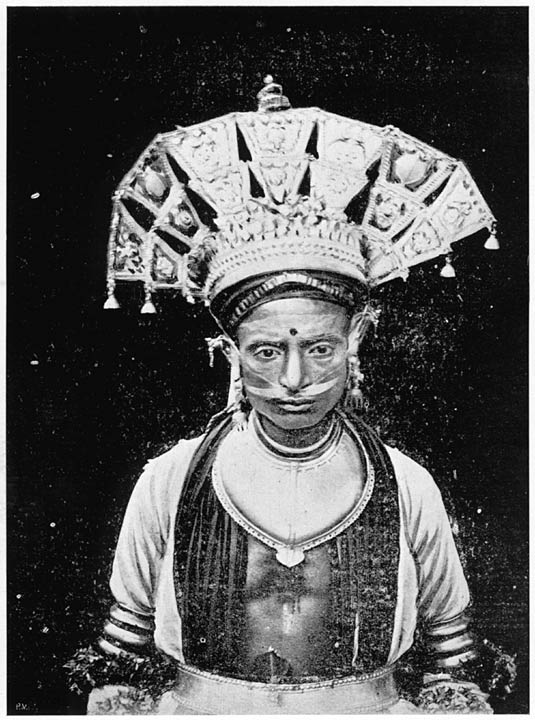
Nalke devil-dancer.
“The names of the Bhūtas are legion. One of the most dreaded is named Kalkuti. Two others commonly worshipped by the Bants and the Billavas are Kōti Baidya and Chennaya Baidya, who always have Billava pūjāris. These two Bhūtas are the departed spirits of two Billava heroes. The spirit of Kujumba Kānje, a Bant of renown, belongs to this class of Bhūtas. Amongst the most well known of the others, may be mentioned Kodamanitāya and Mundaltāya, and the jungle demons Hakkerlu and Brahmērlu. The Holeyas worship a Bhūta of their own, who is not recognised by any other class of the people. He goes by the name of Kumberlu, and the place where he is said to reside is called Kumberlu-kotya. Very often a stone of any shape, or a small plank is placed on the ground, or fixed in a wall, and the name of a Bhūta given to it. Other representations of Bhūtas are in the shape of an ox (Mahīsandāya), a horse (Jārāndāya), a pig (Panjurli), or a giant (Baiderlu).
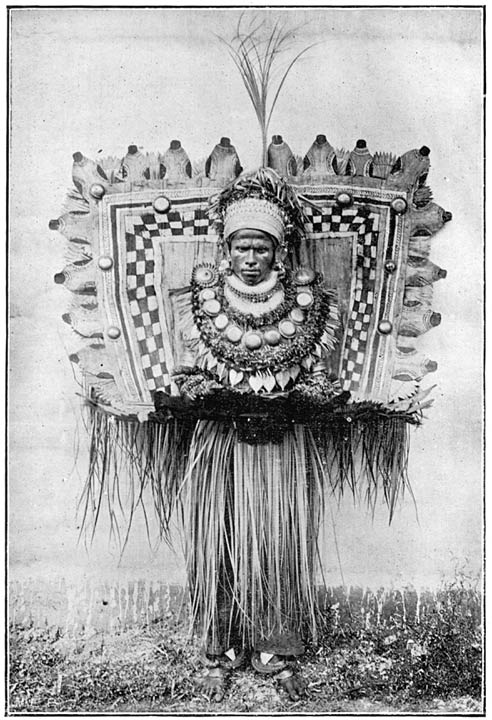
Nalke devil-dancer.
“The Bhūta worship of South Canara is of four kinds, viz., kōla, bandi, nēma, and agelu-tambila. Kōla, or devil dancing, is offered to the Bhūtas in the sthāna of the village in which they are supposed to reside. The Sudras of the village, and of those adjacent to it, assemble near the sthāna, and witness the kōla ceremony in public, sharing the cost of it by subscriptions raised among all the Sudra families in the village in which the ceremony is held. Bandi is the same as kōla, with the addition of dragging about a clumsy kind of car, on which the Pompada priest representing the Bhūta is seated. Nēma is a private ceremony in honour of the Bhūtas, held in the house of anyone who is so inclined. It is performed once in ten, fifteen, or twenty years by well-to-do Billavas or Bants. The expenses of the nēma amount to about Rs. 600 or Rs. 700, and are borne by the master of the house in which the nēma takes place. During the nēma, the Bhūtas, i.e., the things representing them, are brought from the sthāna to the house of the man giving the feast, and remain there till it is over. Agelu-tambila is a kind of worship offered only to the Baiderlu, and that annually by the Billavas only. It will be seen that kōla, bandi, and nēma are applicable to all the Bhūtas, including the Baiderlu, but that the agelu-tambila is applicable only to the Baiderlu.”
The following account of Canara devil-dancers and exorcists is given in Mr. Lavie’s Manuscript History of Canara. “It is their duty to carry a beautiful sword with a handsomely curved handle, and polished blade of the finest steel. These they shake and flourish about in all directions, jumping, dancing, and trembling in a most frightful manner. Their hair is loose and flowing, and, by their inflamed eyes and general appearance, I should suppose that they are prepared for the occasion by intoxicating liquids or drugs.... Their power as exorcists is exercised on any person supposed to be possessed with the devil. I have passed by a house in which an exorcist has been exercising his powers. He began with groans, sighs, and mutterings, and broke forth into low mournings. Afterwards he raised his voice, and uttered with rapidity and in a peculiar tone of voice certain mantrams or charms, all the while trembling violently, and moving his body backwards and forwards.” The performance (of devil dances) always takes place at night, commencing about nine o’clock. At first the pūjāri, with the Bhūta sword and bell in his hands, whirls round and round, imitating the supposed mien and gestures of the demon. But he does not aspire to full possession; that is reserved for a Pombada or a Nalke, a man of the lowest class, who comes forward when the Billava pūjāri has exhibited himself for about half an hour. He is naked save for a waist-band, his face is painted with ochre, and he wears a sort of arch made of cocoanut leaves, and a metal mask. After pacing up and down slowly for some time, he gradually works himself up to a pitch of hysterical frenzy, while the tom-toms are beaten furiously, and the spectators join in raising a long, monotonous howling cry, with a peculiar vibration. At length he stops, and every one is addressed according to his rank; if the Pombada offends a rich Bānt by omitting any of his numerous titles, he is made to suffer for it. Matters regarding which there is any dispute are then submitted for the decision of the Bhūta, and his award is generally accepted. Either at this stage or earlier, the demon is fed, rice and food being offered to the Pombada, while, if the Bhūta is of low degree, flesh and arrack (liquor) are also presented. These festivals last for several nights, and Dr. Burnell states that the devil-dancer receives a fee of eight rupees for his frantic labours.”
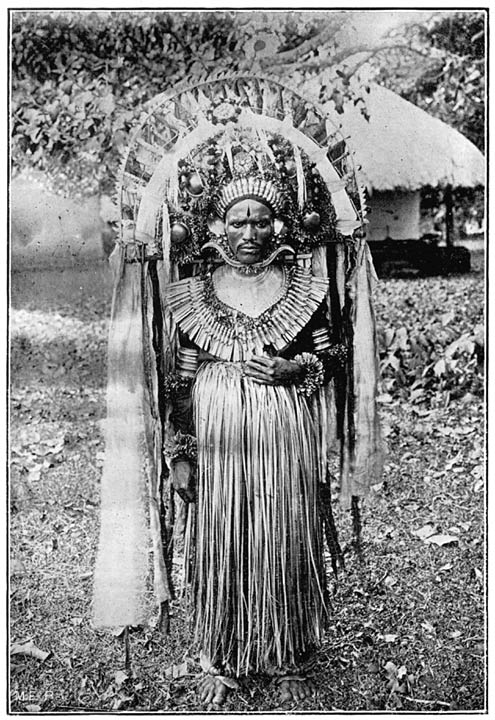
Nalke devil-dancer.
Of the three devil-dancing castes found in South Canara (Nalke, Parava, and Pompada), the Nalkes are apparently the lowest. Even a Koraga considers a Nalke or a Parava inferior to him. It is said that, when a Parava meets a Koraga, he is expected to raise his hand to his forehead. This practice does not, however, seem to be observed at the present day. The Nalkes, though living amidst castes which follow the aliyasantāna law of inheritance (in the female line), follow the makkalakattu law of Inheritance from father to son. The caste has numerous balis (septs), which are evidently borrowed from the Bants and Billavas. As examples of these, Salannaya, Bangerannaya, Kundarannaya, and Uppenannayya may be cited. The Nalkes have a headman called Gurikāra, who settles disputes and other matters affecting the community, and acts as the priest at marriages, death ceremonies, and other ceremonials.
Girls are married after puberty, and a woman may marry any number of times. The marriage ceremony is concluded in a single day. The contracting couple are seated on planks, and the Gurikāra throws coloured rice over their heads, and ties a turmeric-dyed string with beads strung on it round their necks. Those assembled then throw rice over them, their hands are joined by the Gurikāra or their fathers, and the dhare water is poured thereon.
The dead are either buried or cremated. After burial or cremation, a mound (dhupe) is, as among other castes in Canara, made over the spot. Round it, four posts are stuck in the ground, and decorated so as to resemble a small car (cf. Billava). The final death ceremonies (uttarakriya) are generally performed on the fifth or seventh day. On this day, cooked food is offered to the deceased by placing it near the dhupe, or on the spot where he breathed his last. This is followed by a feast. If the ceremony is not performed on one of the recognised days, the permission of some Bants or Billavas must be obtained before it can be carried out.
All castes in South Canara have great faith in Bhūtas, and, when any calamity or misfortune overtakes a family, the Bhūtas must be propitiated. The worship of Bhūtas is a mixture of ancestor and devil propitiation. In the Bhūta cult, the most important personage is Brahmeru, to whom the other Bhūtas are subordinate. Owing to the influence of Brāhman Tantris, Brahmeru is regarded as another name for Brahma, and the various Bhūtas are regarded as ganas or attendants on Siva. Brāhmanical influence is clearly to be traced in the various Bhūta songs, and all Bhūtas are in some manner connected with Siva and Parvati.
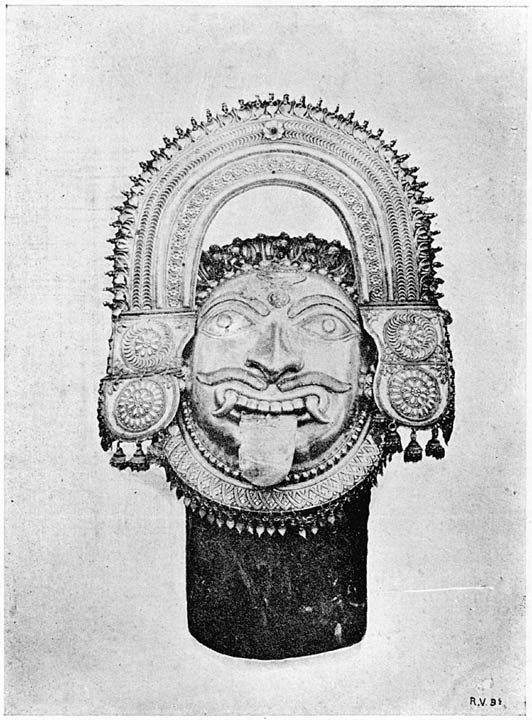
Jumadi Bhūta.
Whenever people want to propitiate the Bhūtas, a Nalke or Parava is engaged. In some places, the Nalke disguises himself as any Bhūta, but, where Paravas are also to be found, the Nalke may not dress up as the Baiderkulu, Kodamanitaya, or Rakteswari. The propitiation of the Bhūta takes the form of a ceremony called Kōla, Nēma, or Agelu Tambila. Of these, Kōla is a periodical ceremony, in which various castes take part, and is always performed near a Bhūtasthana. Nēma is usually undertaken by a single family, and is performed at the house. Agelu Tambila is celebrated by Billavas at their homes. The Kōla ceremony is usually performed for the propitiation of Bhūtas other than the Baiderkulu. The Muktesar or chief man, with the assistance of a Brāhman, fixes an auspicious day for its celebration. The jewels, and votive offerings made to the Bhūtas, are kept in the custody of the Muktesar. On the Kōla day, the people go in procession from the sthana to the Muktesar’s house, and return to the sthana with the jewels and other articles. These are arranged on cots, and a Billava pūjāri places seven plantain leaves in a row on a cot, and heaps rice thereon. On each heap, a cocoanut is placed for the propitiation of the most important Bhūta. To the minor Bhūtas, these things are offered on three or five leaves placed on cots, or on the floor of the sthana, according to the importance of the Bhūta. A seven-branched torch must be kept burning near the cot of the principal Bhūta. The pūjāri goes to the courtyard of the sthana, and piles up a conical mass of cooked rice on a stool. Over this pieces of plantain fruits are scattered. Round the mass several sheaths of plantain leaves are arranged, and on them tender cocoanut leaves, cut in various ways, are stuck. The pūjāri, who wears a metal belt and other jewelry, does pūja to the Bhūtas, and retires. The Nalkes or Paravas then advance dressed up as Bhūtas, and request permission to put on their canopy (ani) and brass anklet (guggirē). They then dance, and sing songs connected with the Bhūtas which are being propitiated. When they are exhausted and retire, the pūjāri steps forwards, and addresses the assembly in the following terms:— “Oh! great men who are assembled, with your permission I salute you all. Oh! Brāhmans who are assembled, I salute you. Oh! priest, I salute you.” In this manner, he is expected to run through the names of all important personages who are present. When he has finished, the devil-dancers do the same, and the ceremony is at an end.
Of the Bhūtas, the best known are Brahmeru, Kodamanitaya, Kukkintaya, Jumadi, Sarlu Jumadi, Pancha Jumadi, Rakteswari, Panjurli, Kuppe Panjurli, Rakta Panjurli, Urundarayya, Hosadēvata (or Hosa Bhūta), Dēvanajiri, Kalkutta, Ukkatiri, Gulige, Bobbariya, Nicha, Duggalaya, Mahisandaya, Varte, Chāmundi, Baiderukulu, Okkuballala, and Oditaya. According to some, Jumadi is the small-pox goddess Māri. There are only two female Bhūtas—Ukkatiri and Kallurti. The Bhūtas are supposed to belong to different castes. For example, Okkuballala and Dēvanajiri are Jains, Kodamanitaya and Kukkinataya are Bants, Kalkutta is a smith, Bobbariya is a Māppilla, and Nicha a Koraga.
In some temples dedicated to Siva, the Tantris offer food, etc., to the various Bhūtas on special occasions, such as Dīpavali and Sankarānthi. At Udipi, the Sanyāsis of the various mutts (religious institutions) seem to believe in some of the Bhūtas, as they give money for the performance of Kōla to Panjurli, Sarla Jumadi, and Chāmundi.
At Hiriadkāp in South Canara, where the Nalkes performed before me, the dancers wore spathes of the areca palm, forming spats to prevent the skin from being injured by the metal bells round their ankles as they danced.
A collection of stories (pādanollu) belonging to the demon-worshippers of the Tulu country, and recited at their annual festivals, was published at the Mangalore Basel Mission Press in 1886.
Nalla (black).—An exogamous sept of Koppala Velama.
Nallūr.—Nallūr and Nāluvītan are recorded, in the Travancore Census Report, 1901, as sub-divisions of Nāyar.
Nāmadari.—A name, indicating one who wears the Vaishnava sectarian mark (nāmam). The equivalent Nāmala occurs as an exogamous sept of Bōya.
Nambidi.—A class, included among the Ambalavāsis. It is recorded, in the Travancore Census Report, 1901, that “Nampitis are of two classes, the thread-wearing and the threadless. The former have their own priests, while the Ilayatus perform the required sacerdotal functions for the latter. Their ceremonies are very much like those of the Kshatriyas. Tradition connects them with royalty acquired under rather unenviable circumstances. They are, therefore, called Tampurāns (lords) by the Sūdras, and also Mūppīnnu (elder) or Kāranavappāt (uncle) head of a matriarchal family. They observe twelve days’ pollution, and inherit in the female line. Their women are called Māntalu. The chief man among the Nampitis is the Kāranavappat of Kakkāt in British Malabar.” In the Cochin Census Report, 1901, it is noted that of the Nampidis “the Aiynikoor Nampidis, or the five families of Nampidis, are historically and socially the most important; the eldest male member possesses the honorific title of Karanavarpad, enjoying special privileges at the hands of the rulers of Cochin, as the members of the family once held responsible posts in the militia of the State. According to tradition, they were Nambūdris. One of the Perumāls or Viceroys of Kērala having proved troublesome, the Brāhmans resolved upon his removal. In the struggle that followed, the Perumāl was killed by the Brāhmans. When those who had slain him returned to the place where the Brāhmans had met in solemn conclave, they were gladly welcomed, and asked to sit in their midst; but, feeling that they had committed a heinous crime and thus disqualified themselves from sitting along with the Brāhmans, they volunteered to sit apart on the threshold of the council room by saying nam padimel (we on the threshold), which fact is supposed to account for the origin of their name Nampadi. They and their companions have since been regarded as having almost lost their social status as Brāhmans, and they are now classed along with the intermediate castes, having but a few privileges other than those enjoyed by the group. They wear the sacred thread, and have Gayatri. Nambūdri Brāhmans officiate as priests at marriage ceremonies, srādhas, and purification at the end of birth or death pollution, which lasts only for ten days. They follow the marumakkatāyam law of inheritance (in the female line). The tāli (marriage badge) is tied by their own caste men. Nambūdris, or their own caste men, unite themselves in sambandham with Nampidi females. Nampidis are allowed to consort with Nāyar women. At public feasts they are not privileged to sit and eat with Nambūdris. Their women are called Manolpads.”
Nambiyassan.—A division of the Ambalavāsis. It is noted, in the Travancore Census Report, 1901, that “the Nampiassans, otherwise called Nampiyars or Nampis, have at present no temple service of any kind. They keep gymnasia or schools of training suited to the Indian system of warfare. They were the gurus (preceptors) of the fighting Nāyars. They seem, however, at one time to have followed the profession of garland-making in temples. It is still the occupation of many Nampiassans in Cochin and British Malabar.” In the Cochin Census Report, 1901, it is stated that Nambiyar is rather a misleading title, as it is applied to more than one class of people. Some Nāyars are known by that title. In some places, Muthads and Elayads are also called Nambiyars. Chakkiyar Nambiyars beat a drum of a peculiar shape at intervals during the discourses or acting of the Chakkiyars, while their females, called Nangiyars, keep time. The Nangiyars also assume the figure of mythical characters, and perform a sort of pantomime on the Chakkiyar’s stage. (See Unni.)
Nambiyatiri (a person worthy of worship).—A synonym of Elayad.
A Nambūtiri, when questioned about the past, refers to the Kēralolpatti. The Nambūtiris and their organization according to grāmams owe their origin in legend, so far as Malabar is concerned, to Parasu Rāma. Parasu Rāma (Rāma of the axe), an incarnation of Vishnu, had, according to the purānic story, slain his mother in a fit of wrath, and was advised by the sages to expiate his sin by extirpating the Kshatriyas twenty-one times. He did so, and handed over the land to the sages. But this annoyed the Brāhmans exceedingly, for they got no share in the arrangement; so they banished Parasu Rāma from the land. By the performance of austerities he gained from the gods the boon to reclaim some land from Varuna, the sea god. Malabar was then non-existent. He was allowed to throw his axe from Cape Comorin, and possess all the land within the distance of his throw. So he threw his axe as far as Gokarnam in the South Canara district, and immediately there was land between these two places, within the direct line and the western ghāts, now consisting of Travancore and Cochin, Malabar, and part of South Canara. To this land he gave the name Karma Bhūmi, or the country in which salvation or the reverse depends altogether on man’s individual actions, and blessed it that there be plenty of rain and no famine in it. But he was alone. To relieve his loneliness, he brought some Brāhmans from the banks of the Krishna river, but they did not remain long, for they were frightened by the snakes. Then he brought some Brāhmans from the north, and, lest they too should flee, gave them peculiar customs, and located them in sixty-four grāmams. He told them also to follow the marumakkattāyam law of succession (in the female line), but only a few, the Nambūtiris of Payyanūr, obeyed him. The Brāhmans ruled the land with severity, so that the people (who had somehow come into existence) resolved to have a king under whom they could live in peace. And, as it was impossible to choose one among themselves, they chose Kēya Perumal, who was the first king of Malabar, and Malabar was called Kēralam after him. The truths underlying this legend are that the littoral strip between the western ghāts and the sea is certainly of recent formation geologically. It is not very long, geologically, since it was under the sea, and it is certain that the Nambūtiris came from the north. The capital of the Chēra kingdom was very probably on the west coast not far from Cranganore in the Travancore State, the site of it being now called Tiruvānjikkulam. There is still a Siva temple there, and about a quarter of a mile to the south-west of it are the foundations of the old palace. The rainfall of Malabar is very high, ranging from 300 inches in the hills to about 120 inches on the coast.
The Kēralolpatti relates the story of the exclusion of the Panniyūr Brāhmans from the Vēdas. There were in the beginning two religious factions among the Nambūtiris, the Vaishnavas or worshippers of Vishnu in his incarnation as a boar, and the Saivas; the former residing in Panniyūr (boar village), and the latter in Chovūr (Siva’s village). The Saivas gained the upper hand, and, completely dominating the others, excluded them altogether from the Vēdas. So now the Nambūtiris of Panniyūr are said to be prohibited from studying the Vēdas. It is said, however, that this prohibition is not observed, and that, as a matter of fact, the Panniyūr Nambūtiris perform all the Vēdic ceremonies.
“Tradition,” Mr. N. Subramani Aiyar writes, “as recorded in the Kēralamahatmiya, traces the Nambūtiris to Ahikshētra, whence Parasu Rāma invited Brāhmans to settle in his newly reclaimed territory. In view to preventing the invited settlers from relinquishing it, he is said to have introduced, on the advice of the sage Nārada, certain deep and distinctive changes in their personal, domestic, and communal institutions. The banks of the Nerbudda, the Krishna, and the Kāveri are believed to have given Brāhmans to Malabar. I have come across Nambūtiris who have referred to traditions in their families regarding villages on the east coast whence their ancestors originally came, and the sub-divisions of the Smarta caste, Vadama, Brihatcharanam, Ashtasahasram, Sankēti, etc., to which they belonged. Even to this day, an east coast Brāhman of the Vadadesattu Vadama caste has to pour water into the hands of a Nambūtiri Sanyāsi as part of the latter’s breakfast ritual. Broach in Kathiwar, one of the greatest emporiums of trade in the middle ages, is also mentioned as one of the ancient recruiting districts of the Nambūtiri Brāhmans. Broach was the ancient Bhrigucachchha, where Parasu Rāma made his avabhritasnāna (final bathing) after his great triumph over the Kshatriyas, and where to this day a set of people called Bhargava Brāhmans live. Their comparatively low social status is ascribed to the original sin of their Brāhman progenitor or founder having taken to the profession of arms. The date of the first settlement of the Nambūtiris is not known. Orthodox tradition would place it in the Trētāyuga, or the second great Hindu cycle. The reference to the grāmams of Chovvur and Panniyūr contained in the Manigrāmam Syrian Christian grant of the eighth century, and its absence in the Jewish, have suggested to antiquarians some time between the seventh and eighth centuries as the probable period. The writings of Ptolemy and the Periplus furnish evidence of Brāhman settlements on the Malabar coast as early as the first century, and it is probable that immigrant Brāhman families began to pour in with the ascendancy of the Western Chalukya kings in the fourth and fifth centuries, and became gradually welded with the pre-existing Nambūtiris. All these Nambūtiris were grouped under two great sections:—(a) the Vaishnavites or Panniyūr Grāmakkar, who came with the patronage of the Vaishnavites of the Chalukya dynasty with the boar as their royal emblem; (b) the Saivites or Chovvūr Grāmakkar, who readily accepted the Saivite teachings from the Chēra, Chōla, and Pāndya kings who followed the Chalukyans. They included in all sixty-four grāmams, which, in many cases, were only families. Of these, not more than ten belong to modern Travancore. These grāmams constituted a regular autocracy, with four talis or administrative bodies having their head-quarters at Cranganore. It appears that a Rāja or Perumāl, as he was called, from the adjoining Chēra kingdom, including the present districts of Salem and Coimbatore, was, as an improved arrangement, invited to rule for a duodecennial period, and was afterwards confirmed, whether by the lapse of time or by a formal act of the Brāhman owners it is not known. The Chēra Viceroys, by virtue of their isolation from their own fatherland, had then to arrange for marital alliances being made, as best they could, with the highest indigenous caste, the Nambūtiris, the males consorting with Sūdra women. The matriarchal form of inheritance was thus a necessary consequence. Certain tracts of Kērala, however, continued under direct Brāhman sovereignty, of which the Ettappalli chief is almost the only surviving representative.”
Concerning the occupations of the Nambūtiris, Mr. Subramani Aiyar writes that “service in temples, unless very remunerative, does not attract them. Teaching as a means of living is rank heterodoxy. And, if anywhere Manu’s dictum to the Brāhman ‘Never serve’ is strictly observed, it is in Malabar. Judging from the records left by travellers, the Nambūtiris used to be selected by kings as messengers during times of war. Writing concerning them, Barbosa states that “these are the messengers who go on the road from one kingdom to another with letters and money and merchandise, because they pass in safety without any one molesting them, even though the king may be at war. These Brāhmans are well read ... and possess many books, and are learned and masters of many arts; and so the kings honour them as such.” As the pre-historic heirs to the entire land of Kērala, the Nambūtiris live on agriculture. But inefficiency in adaptation to changing environments operates as a severe handicap in the race for progressive affluence, for which the initial equipment was exceptionally favourable. The difficulties incidental to an effete landlordism have contributed to making the Nambūtiris a litigious population, and the ruinous scale of expenditure necessary for the disposal of a girl, be it of the most plebeian kind, has brought their general prosperity to a very low level. The feeling of responsible co-operation on the part of the unmarried males of a Nambūtiri household in the interests of the family is fast decreasing; old maids are increasing; and the lot of the average Nambūtiri man, and more especially woman, is very hard indeed. As matters now stand, the traditional hospitality of the Hindu kings of Malabar, which, fortunately for them, has not yet relaxed, is the only sustenance and support of the ordinary Nambūtiri. The characteristic features of the Nambūtiri are his faith in God and resignation to his will, hospitality to strangers, scrupulous veracity, punctiliousness as regards the ordinances prescribed, and extreme gentility in manners. The sustaining power of his belief in divine providence is so great, that calamities of whatsoever kind do not exasperate him unduly. The story is told with great admiration of a Nambūtiri who, with his large ancestral house on fire, his only son just tumbled into a deep disused well, while his wife was expiring undelivered, quietly called out to his servant for his betel-box. Evening baths, and daily prayers at sunrise, noon and sunset, are strictly observed. A tradition, illustrative of the miracles which spiritual power can work, is often told of the islet in the Vempanat lake known as Patiramanal (midnight sand) having been conjured into existence by the Tarananallūr Nambūtiripād, when, during a journey to Trivandrum, it was past evening, and the prayers to Sandhya had to be made after the usual ablutions. To the lower animals, the attitude of the Nambūtiri is one of child-like innocence. In his relation to man, his guilelessness is a remarkable feature. Harshness of language is unknown to the Nambūtiris, and it is commonly said that the severest expression of his resentment at an insult offered is generally that he (the Nambūtiri) expects the adversary to take back the insult a hundred times over. Of course, the modern Nambūtiri is not the unadulterated specimen of goodness, purity, and piety that he once was. But, on the whole, the Nambūtiris form an interesting community, whose existence is indeed a treasure untold to all lovers of antiquity. Their present economic condition is, however, far from re-assuring. They are no doubt the traditional owners of Kērala, and hold in their hands the janmom or proprietary interest in a large portion of Malabar. But their woeful want of accommodativeness to the altered conditions of present day life threatens to be their ruin. Their simplicity and absence of business-like habits have made them a prey to intrigue, fraudulence, and grievous neglect, and an unencumbered and well ordered estate is a rarity among Malabar Brāhmans, at least in Travancore.”
The orthodox view of the Nambūtiri is thus stated in an official document of Travancore. “His person is holy; his directions are commands; his movements are a procession; his meal is nectar; he is the holiest of human beings; he is the representative of god on earth.” It may be noted that the priest at the temple of Badrināth in Gurhwal, which is said to have been established by Sankarāchārya, and at the temple at Tiruvettiyūr, eight miles north of Madras, must be a Nambūtiri. The birth-place of Sankara has been located in a small village named Kāladi in Travancore. It is stated by Mr. Subramani Aiyar that “at some part of his eventful life, Sankara is believed to have returned to his native village, to do the last offices to his mother. Every assistance was withdrawn, and he became so helpless that he had to throw aside the orthodox ceremonials of cremation, which he could not get his relations to help him in, made a sacrificial pit in his garden, and there consigned his mother’s mortal remains. The compound (garden) can still be seen on the banks of the Periyār river on the Travancore side, with a masonry wall enclosing the crematorium, and embowered by a thick grove of trees.”
Every Nambūtiri is, theoretically, a life-long student of the Vēdas. Some admit that religious study or exercise occupies a bare half hour in the day; others devote to these a couple of hours or more. It is certain that every Nambūtiri is under close study between the ages of seven and fifteen, or for about eight years of his life, and nothing whatsoever is allowed to interfere with this. Should circumstances compel interruption of Vēdic study, the whole course is, I believe, re-commenced and gone through da capo. A few years ago, a Nambūtiri boy was wanted, to be informally examined in the matter of a dacoity in his father’s illam; but he had to be left alone, as, among other unpleasant consequences of being treated as a witness, he would have had to begin again his whole course of Vēdic study. The Nambūtiris are probably more familiar with Sanskrit than any other Brāhmans, even though their scholarship may not be of a high order, and certainly none other is to the same extent governed by the letter of the law handed down in Sanskrit.
As already said, the Nambūtiris are for the most part landholders, or of that class. They are also temple priests. The rich have their own temples, on which they spend much money. All over Malabar there are to be seen Pattar Brāhmans, wandering here and there, fed free at the illams of rich Nambūtiris, or at the various kōvilakams and temples. And they are always to be found at important ceremonial functions, marriage or the like, which they attend uninvited, and receive a small money present (dakshina). But the Nambūtiri never goes anywhere, unless invited. From what I have seen, the presents to Brāhmans on these occasions are usually given on the following scale:—eight annas to each Nambūtiri, six annas to each Embrāntiri, four annas to each Pattar Brāhman. The Nambūtiri is sometimes a money-lender.
Of the two divisions, Nambūtiri and Nambūtiripād, the latter are supposed to be stricter, and to rank higher than the former. Pād, meaning power or authority, is often used to all Nambūtiris when addressing them. Thus, some who are called Nambūtiripāds may really be Nambūtiris. It may not be strictly correct to divide the Nambūtiris thus, for neither so-called division is separated from the other by interdiction of marriage. The class distinctions are more properly denoted the Ādhyan and Asyan, of which the former is the higher. An Ādhyan is never a priest; he is a being above even such functions as are sacerdotal in the temple. But there are also divisions according to the number of yāgams or sacrifices performed by individuals, thus:—Sōmatiri or Sōmayāji, Akkitiri or Agnihōtri, and Adittiri. A man may reach the first stage of these three, and become an Addittiripād by going through a certain ceremony. At this, three Nambūtiri Vaidikars, or men well versed in the Vēdas, must officiate. A square pit is made. Fire raised by friction between two pieces of pīpal (Ficus religiosa) wood with a little cotton is placed in it. This fire is called aupāsana. The ceremony cannot be performed until after marriage. It is only those belonging to certain gōtras who may perform yāgams, and, by so doing, acquire the three personal distinctions already named. Again, there are other divisions according to professions. Thus it is noted, in the Cochin Census Report, 1901, that “the Ādhyans are to study the Vēdas and Sāstras; they are prohibited from taking parānnam (literally meals belonging to another), from taking part in the funeral ceremonies of others, and from receiving presents. Those who perform the sacrifice of adhana are known as Aditiris, those who perform some yāga are called Somayagis or Chomatiris, while those who perform agni are called Agnihotris or Akkitiris. Only married men are qualified to perform the sacrifices. The Nāyar is an indispensable factor in the performance of these sacrifices. The Bhattatiris are to study and teach the Sāstras; the Orthikans are to teach the Vēdas, and to officiate as family priests. The Vādhyans are to teach the Vēdas, and to supervise the moral conduct of their pupils. The Vydikans are the highest authority to decide what does or does not constitute violation of caste rules, and to prescribe expiatory ceremonies. The Smarthas are to study the Smritis and other Sāstras relating to customs, with the special object of qualifying themselves to preside over caste panchāyats, or courts, and to investigate, under the orders of the sovereign, cases of conjugal infidelity arising among the Nambūtiris. The rulers of Cochin and Travancore issue the writs convening the committee in the case of offences committed within their territory. The Zamorin of Calicut, and other Chiefs or Rājas, also continue to exercise the privilege of issuing such orders in regard to cases occurring in Malabar. The Tantris officiate as high priests in temples. They also practice exorcism. There are Ādhyans among this class also. Having received weapons from Parasu Rāma and practiced the art of war, the Sastrangakars are treated as somewhat degraded Brāhmans. They are prohibited from studying the Vēdas, but are entitled to muthalmura, that is, reading the Vēdas, or hearing them recited once. Having had to devote their time and energy to the practice of the art of war, they could not possibly spend their time in the study of the Vēdas. The Vaidyans or physicians, known as Mūssads, are to study the medical science, and to practice the same. As the profession of a doctor necessitates the performance of surgical operations entailing the shedding of blood, the Mūssads are also considered as slightly degraded. They too are entitled only to muthalmura. Of these, there are eight families, known as Ashta Vaidyans. The Grāmanis are alleged to have suffered degradation by reason of their having, at the command of Parasu Rāma, undertaken the onerous duties of protecting the Brāhman villages, and having had, as Rakshapurushas or protectors, to discharge the functions assigned to Kshatriyas. Ooril Parisha Mūssads are supposed to have undergone degradation on account of their having accepted from Parasu Rāma the accumulated sin of having killed the warrior Kshatriyas thrice seven times, along with immense gifts in the shape of landed estates. They are not allowed to read the Vēdas even once.”
“There are,” Mr. Subramani Aiyar writes, “five sub-divisions among the Nambūtiris, which may be referred to:—
(1) Tampurakkal.—This is a corruption of the Sanskrit name Samrāt, and has probable reference to temporal as much as to secular sovereignty. Of the two Tampurakkal families in South Malabar, Kalpancheri and Azhvancheri, the latter alone now remains. As spiritual Samrāts (sovereigns) they are entitled to (1) bhadrāsanam, or the highest position in an assembly, (2) brahmavarchasa, or authority in Vēdic lore, and consequent sanctity, (3) brahmasamrāgyam, or lordship over Brāhmans, (4) sarvamanyam, or universal acknowledgment of reverence. Once in six years, the Azhvancheri Tampurakkal is invited by the Mahārāja of Travancore, who accords him the highest honours, and pays him the homage of a sāshtānganamaskāram, or prostration obeisance. Even now, the Samrāts form a saintly class in all Malabar. Though considered higher than all other sub-divisions of Nambūtiris, they form, with the Ādhyas, an endogamous community.
(2) Ādhyas.—They form eight families, called Ashtādhyas, and are said by tradition to be descended from the eight sons of a great Brāhman sage, who lived on the banks of the river Krishna. The fund of accumulated spirituality inherited from remote ancestors is considered to be so large that sacrifices (yāgas), as well as vanaprastha and sanyāsa (the two last stages of the Brāhman’s life), are reckoned as being supererogatory for even the last in descent. They are, however, very strict in the observance of religious ordinances, and constantly engage themselves in the reverent study of Hindu scriptures. The Tantris are Ādhyas with temple administration as their specialised function. They are the constituted gurus of the temple priests, and are the final authorities in all matters of temple ritual.
(3) Visishta.—These are of two classes, Agnihōtris and Bhattatiris. The former are the ritualists, and are of three kinds:—(1) Akkittiris, who have performed the agnichayanayāga, (2) Adittiris, who have done the ceremony of agniadhana, (3) Chomatiris, who have performed the soma sacrifice. The Bhattatiris are the philosophers, and are, in a spirit of judicious economy, which is the characteristic feature of all early caste proscriptions, actually prohibited from trenching on the province of the Agnihōtris. They study tarkka (logic), vēdānta (religious philosophy or theology), vyākarana (grammar), mīmāmsa (ritualism), bhatta, from which they receive their name, and prabhākara, which are the six sciences of the early Nambūtiris. They were the great religious teachers of Malabar, and always had a large number of disciples about them. Under this head come the Vādyars or heads of Vēdic schools, of which there are two, one at Trichūr in Cochin, and the other at Tirunavai in British Malabar; the six Vaidikas or expounders of the caste canons, and the Smartas, who preside at the smartavichārams or socio-moral tribunals of Brāhmanical Malabar.
(4) Sāmānyas.—They form the Nambūtiri proletariat, from whom the study of the Vēdas is all that is expected. They take up the study of mantravāda (mystic enchantment), pūja (temple ritual), and reciting the sacred accounts of the Avatāra and astrology.
(5) Jātimatras.—The eight leading physician families of Malabar, or Ashta Vaidyas, are, by an inexcusable misuse of language, called Gatimatras or nominal Nambūtiris. The class of Nambūtiris called Yatrakalikkar (a corruption of Sastrakalikkar) also comes under this head. They are believed to be the Brāhmans, who accepted the profession of arms from their great founder. Those that actually received the territory from the hands of Parasu Rāma, called Grāmani Nambūtiris or Grāmani Ādhyas, are also Gatimatras. They were the virtual sovereigns of their respective lands. The physicians, the soldiers, and the landed kings, having other duties to perform, were not able to devote all their time to Vēdic recitations. The mutalmūrā or first study was, of course, gone through. In course of time, this fact was unfortunately taken by the religious conscience of the people to lower the Brāhmans who were deputed under the scheme of Parasu Rāma for special functions in the service of the nation in the scale of Nambūtiri society, and to mean a formal prohibition as of men unworthy to be engaged in Vēdic study.
Papagrastas are Nambūtiris, who are supposed to have questioned the divine nature of Parasu Rāma, The Urilparisha Mussus, who too are Brāhmans who received gifts of land from Parasu Rāma, the Nambitis, the Panniyūr Grāmakkar, and the Payyanūr Grāmakkar or the Ammuvans (uncles), so called from their matriarchal system of inheritance, form other sections of Nambūtiris.”
It is recorded, in the Cochin Census Report, 1901, that “certain special privileges in regard to the performance of religious rites and other matters of a purely social nature serve as the best basis for a sub-division of the Nambūtiris in the order of social precedence as recognised amongst themselves. For this purpose, the privileges may be grouped under two main classes, as given in the following mnemonic formula:—
A
1. Edu (the leaf of a cadjan grandha or book): the right of studying and teaching the Vēdas and Sastras.
2. Piccha (mendicancy symbolic of family priests): the right of officiating as family priests.
3. Othu (Vēdas): the right of studying the Vēdas.
4. Adukala (kitchen): the right of cooking for all classes of Brāhmans.
5. Katavu (bathing place or ghāt): the right of bathing in the same bathing place with other Brāhmans, or the right of touching after bathing, without thereby disqualifying the person touched for performing religious services.
B
1. Adu (sheep): the right of performing holy sacrifices.
2. Bhiksha (receiving alms): the right of becoming a Sānyasi.
3. Santhi (officiating as temple priests): the right of performing priestly functions in temples.
4. Arangu (stage): the right of taking part in the performance of Sastrangam Nambūdris.
5. Panthi (row of eaters): the right of messing in the same row with other Brāhmans.
Those who enjoy the privilege of No. 1 in A are entitled to all the privileges in A and B; those enjoying No. 2 in A have all the privileges from No. 2 downwards in A and B; those having No. 3 in A have similarly all the privileges from No. 3 downwards in A and B, and so on. Those entitled to No.1 in B have all the privileges except No. 1 in A; similarly those entitled to No. 2 in B have all the privileges from No. 2 downwards in B, but only from No. 3 downwards in A, and so on.”
Among the people of good caste in Malabar, to speak of one as a hairy man is to speak of him reproachfully. Yet, putting aside Muhammadans, the highest of all, the Nambūtiris are certainly the most hairy. In the young Nambūtiri, the hair on the head is plentiful, glossy, and wavy. The hair is allowed to grow over an oval patch from the vertex or a little behind it to a little back from the forehead. This is the regular Malabar fashion. The hair thus grown is done into a knot hanging over the forehead or at one side according to fancy, never hanging behind. The rest of the head, and also the face is shaved. The whole body, excepting this knot and the back, is shaved periodically. Karkkadakam, Kanni, Kumbham and Dhānu are months in which shaving should be avoided as far as possible. An auspicious day is always selected by the Nambūtiri for being shaved. Gingelly oil (enna) is commonly used for the hair. When a Nambūtiri’s wife is pregnant, he refrains from the barber, letting his hair grow as it will. And, as he may have as many as four wives, and he does not shave when any of them is in an interesting condition, he sometimes has a long beard. A marked difference observed between the Nambūtiri and those allied to him, and the lower races, is this. The former have whiskers in the shape of a full growth of hair on the cheeks, while in the latter this is scanty or entirely absent. Also, while the Nambūtiris have very commonly a hairy chest, the others have little or no hair on the chest. So, too, in the case of hair on the arms and legs. One Nambūtiri examined had hair all over the body, except over the ribs.
It is noted by Mr. Subramani Aiyar that “the Nambūtiris are passionate growers of finger-nails, which are sometimes more than a foot long, and serve several useful purposes. As in everything else, the Nambūtiri is orthodox even in the matter of dress. Locally-manufactured cloths are alone purchased, and Indian publicists who deplore the crushing of indigenous industries by the importation of foreign goods may congratulate the Kērala Brāhmans on their protectionist habits. Silk and coloured cloths are not worn by either sex. The style of dress is peculiar. That of the males is known as tattutukkuka. Unlike the Nāyar dress, which the Nambūtiris wear during other than religious hours, the cloth worn has a portion passing between the thighs and tucked in at the front and behind, with the front portion arranged in a number of characteristic reduplications. The Nambūtiri wears wooden shoes, but never shoes made of leather. Nambūtiri women have two styles of dress, viz., okkum koluttum vachchutukkuka for the Ādhyans, and ngoringutukkuka for ordinary Nambūtiris. Undyed cloths constitute the daily wearing apparel of Nambūtiri women. It is interesting to notice that all Brāhman women, during a yāgnam (sacrifice), when, as at other ceremonials, all recent introductions are given up in favour of the old, wear undyed cloths. Beyond plain finger-rings and a golden amulet (elassu) attached to the waist-string, the Nambūtiri wears no ornaments. His ears are bored, but no ear-rings are worn unless he is an Agnihōtri, when ear-pendants of an elongated pattern (kundalam) are used. The ornaments of the Nambūtiri women have several peculiarities. Gold bracelets are, as it were, proscribed even for the most wealthy. Hollow bangles of brass or bell-metal for ordinary Nambūtiris, and of solid silver for the Ādhyas, are the ones in use. The chuttu is their ear ornament. A peculiar necklace called cheru-tāli is also worn, and beneath this Ādhya women wear three garlands of manis or gold pieces, along with other jewels called kasumala, puttali, and kazhuttila. The Nambūtiris do not bore their noses or wear nose-rings, and, in this respect, present a striking contrast to the Nāyar women. No restriction, except the removal of the tāli, is placed on the use of ornaments by Nambūtiri women. Tattooing is taboo to Nambūtiri women. They put on three horizontal lines of sandal paste after bathing. These marks have, in the case of Ādhya women, a crescentic shape (ampilikkuri). Kunkuma, or red powder, is never applied by Nambūtiri women to the forehead. Turmeric powder as a cosmetic wash for the face is also not in vogue. Mr. Fawcett states that, on festive occasions, turmeric is used by the Brāhmans of Malabar. But this is not borne out by the usage in Travancore. Eye-salves are applied, and may be seen extending as dark lines up to the ears on either side.”
The ornaments and marks worn by individual Nambūtiri males are thus recorded by Mr. Fawcett:—
(1) Left hand: gold ring with large green stone on first finger; four plain gold rings on third finger; a ring, in which an ānavarāhan coin is set, on little finger. This is a very lucky ring. Spurious imitations are often set in rings, but it is the genuine coin which brings good luck. Right hand: two plain gold rings, and a pavitram on the third finger. The pavitram is of about the thickness of an ordinary English wedding ring, shaped like a figure of eight, with a dotted pattern at each side, and the rest plain. It is made of gold, but, as every Nambūtiri must wear a pavitram while performing or undergoing certain ceremonies, those who do not possess one of gold wear one made of darbha grass. They do not say so, but I think the ring of darbha grass is orthodox.
(2) Golden amulet-case fastened to a string round the waist, and containing a figure (yantram) written or marked on a silver plate. He had worn it three years, having put it on because he used to feel hot during the cool season, and attributed the circumstance to the influence of an evil spirit.
(3) Youth, aged 12. Wears a yak skin sash, an inch wide, over the left shoulder, fastened at the ends by a thong of the same skin. He put it on when he was seven, and will wear it till he is fifteen, when he will have completed his course of Vēdic study. A ring, hanging to a string in front of his throat, called mōdiram, was put on in the sixth month when he was named, and will be worn until he is fifteen. The ears are pierced. He wears two amulets at the back, one of gold, the other of silver. In each are some chakrams (Travancore silver coins), and a gold leaf, on which a charm is inscribed. One of the charms was prepared by a Māppilla, the other by a Nambūtiri.
(4) Black spot edged with yellow in the centre of the forehead. Three horizontal white stripes on the forehead. A dab on each arm, and a stripe across the chest.
(5) Black spot near glabella, and two yellow horizontal stripes near it. The same on the chest, with the spot between the lines.
(6) Red spot and white stripe on the forehead. A red dab over the sternum, and on each arm in front of the deltoid.
(7) An oval, cream-coloured spot with red centre, an inch in greatest length, over the glabella.
The stripes on the forehead and chest are generally made with sandal paste. Rudrāksha (nuts of Elœocarpus Ganitrus) necklaces, mounted in gold, are sometimes worn.
The thread worn by men over the left shoulder is made of a triple string of country-grown cotton, and, unlike other Brāhmans of Southern India, no change is made after marriage. It may be changed on any auspicious day. Brāhmans of Southern India outside Malabar change their thread once a year.
Concerning the habitations of the Nambūtiris, Mr. Subramani Aiyar writes as follows. “A Nambūtiri’s house stands within a compound (grounds) of its own. Each house has its own name, by which the members are known, and is called by the generic title of illam, the term used by Brāhmans, or mana, which is the reverential expression of Sudras and others. Sometimes the two words are found combined, e.g., Itamana illam. In the compound surrounding the house, trees such as the tamarind, mango, and jāk, grow in shady luxuriance. The area of the compound is very extensive; in fact, no house in Malabar is surrounded by a more picturesque or more spacious garden than that of the Nambūtiri. Plantains of all varieties are cultivated, and yams of various kinds and peas in their respective seasons. A tank (pond) is an inseparable accompaniment, and, in most Nambūtiri houses, there are three or four of them, the largest being used for bathing, and the others for general and kitchen purposes. Whenever there is a temple of any importance near at hand, the Nambūtiri may prefer to bathe in the tank attached to it, but his favourite ghāt is always the tank near his home, and owned by him. Wells are never used for bathing, and a hot-water bath is avoided as far as possible, as plunging in a natural reservoir would alone confer the requisite ablutional purity. Towards the north-west corner of the house is located the sarpakkavu or snake abode, one of the indispensables of a Malabar house. The kavu is either an artificial jungle grown on purpose in the compound, or a relic of the unreclaimed primeval jungle, which every part of Malabar once was. Right in the centre of the kavu is the carved granite image of the cobra, and several flesh-and-blood representatives of the figure haunt the house, as if in recognition of the memorial raised. In the centre of the compound is situated the illam or mana, which is in most cases a costly habitat. All the houses used until recently to be thatched as a protection against the scorching heat of the tropical sun, which a tiled house would only aggravate. In form the house is essentially a square building, consisting of several courtyards in the centre, with rooms on all sides. On the east or west of the courtyard, a room having the space of two ordinary rooms serves as a drawing room and the dormitory of the unmarried members of the house. The rest of the house is zenāna to the stranger. Right on the opposite side of the visitor’s room, beyond the central courtyard, is the arappura, of massive wood-work, where the valuables are preserved. On either side of this are two rooms, one of which serves as a storehouse, and the other as a bed-room. The kitchen adjoins the visitor’s room, and is tolerably spacious. In the front, which is generally the east of the house, is a spacious yard, square and flat, and leading to it is a flight of steps, generally made of granite. These steps lead to a gate-house, where the servants of the house keep watch at night. The whole house is built of wood, and substantially constructed. Though the houses look antiquated, they have a classical appearance all their own. To the north-east is the gōsāla, where large numbers of oxen and cows are housed. The furniture of a Nambūtiri is extremely scanty. There are several cots, some made of coir (cocoanut fibre), and others of wooden planks. The kūrmasana is the Nambūtiri’s devotional seat, and consists of a jak (Artocarpus integrifolia) plank carved in the form of a tortoise. Other seats, of a round or oblong shape, are also used, and no Brāhman addresses himself to his meal without being seated on one of them. Every Brāhman visitor is offered one, and is even pressed to sit on it. When the writer went to a Brāhman house at Kalati, the native village of Sankarāchārya, and wished the hosts not to trouble themselves about a seat for him, he was told that the contact of a Brāhman’s nates with the floor was harmful to the house. Hanging cots, attached to the ceiling by chains of iron, are common things in a Nambūtiri’s house, especially in the bed-rooms. Skins of spotted deer, used to sit on during prayers, also form part of the Nambūtiri’s furniture.”
The Nambūtiris follow the makkatāyam law of inheritance from father to son; not, however, precisely as do the other people who do so. Nor is their system of inheritance the same as that of Brāhmans to the eastward (i.e., of Southern India generally), with whom the family property may be divided up amongst the male members at the instance of any one of them. The Nambūtiri household is described by Mr. Subramani Aiyar as representing a condition intermediate between the impartible matriarchal form of the Nāyars and the divided patriarchal form of the other coast. Among the Nambūtiris, the eldest male member of the family is the Kāranavan or manager of it, and has complete control over all the property. The younger members of the family are entitled to nothing but maintenance. The head of the family may be a female, provided there is none of the other sex. The eldest son alone marries. The accepted practice, as well as the recognised principle among the Nambūtiris, seems to be in consonance with the directions expounded by Manu, viz.—
Immediately on the birth of his first-born, a man is the father of a son, and is free from the debt to the manes. That son is, therefore, worthy to receive the whole estate.
That son alone, on whom he throws his debt, is begotten for (the fulfilment of) the law. All the rest they consider the offspring of desire.
As a father supports his sons, so let the eldest support his younger brothers, and so let them, in accordance with the law, behave towards their eldest brother as sons behave towards their father.
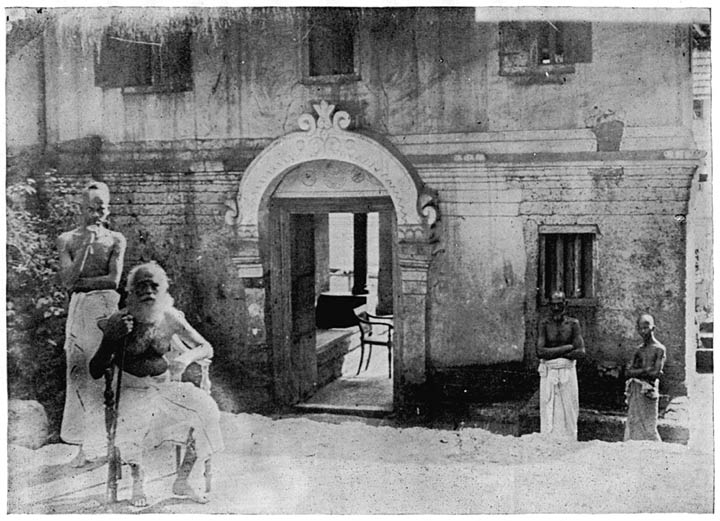
Nambutiri Brāhman house.
Adoption among the Nambūtiris is stated by Mr. Subramani Aiyar to be of three kinds, called Pattu kaiyyal dattu, Chanchamata dattu, and Kutivazhichcha dattu. “The first is the orthodox form. Pattukai means ten hands, and indicates that five persons take part in the ceremony, the two natural parents, the two adopted parents, and the son to be adopted. The gōtra and sūtra of the natural family have to be the same as those of the adoptive family. The son adopted may have had his upanayanam already performed by his natural parents. An adoption of this kind cannot be made without the permission of all the male members of the family, of the Sapindas or Samānōdakas who are distinct blood relations, though some degrees removed. In the second form, the adoption relieves the adopted son of all ceremonial duties towards the natural parents. Involving, as it does, a position contrary to the established ordinances of Sankarāchārya, this kind of adoption is not in favour. The third form is still less orthodox. The adoption is made by a surviving widow, and mainly serves to keep up the lineage.”
Liquor and flesh are strictly forbidden to the Nambūtiris. Their staple food is rice and curry. Uppēri is a curry of chopped vegetables fried in ghī (clarified butter), cocoanut or gingelly oil, seasoned with gingelly (Sesamum indicum), salt, and jaggery (crude sugar). Aviyal is another, composed of jāk fruit mixed with some vegetables. Sweets are sometimes eaten. Candied cakes of wheat or rice, and rice boiled in milk with sugar and spices, are delicacies. Papadams (wafer-like cakes) are eaten at almost every meal. The Nambūtiri must bathe, and pray to the deity before partaking of any meal. An offering of rice is then made to the household fire, some rice is thrown to the crows, and he sits down to eat. The food is served on a plantain leaf or a bell-metal plate. It should be served by the wife; but, if a man has other Nambūtiris dining with him, it is served by men or children. The sexes feed separately. Before a man rises from his meal, his wife must touch the leaf or plate on which the food has been served. The reason may lie in this. The remains of the food are called ēchchil, and cannot be eaten by any one. Just before finishing his meal and rising, the Nambūtiri touches the plate or leaf with his left hand, and at the same time his wife touches it with her right hand. The food is then no longer ēchchil, and she may eat it. The Nambūtiri householder is said to be allowed by the Sāstras, which rule his life in every detail, to eat but one meal of rice a day—at midday. He should not, strictly speaking, eat rice in the evening, but he may do so without sinning heinously, and usually does. Fruit only should be eaten in the evening. Women and children eat two or three times in a day. A widow, however, is supposed to lead the life of a Sanyāsi, and eats only once a day. A Nambūtiri may eat food prepared by an east country Brāhman (Pattar), or by an Embrāntiri. In fact, in the large illams, where many people are fed every day, the cooks are generally Pattars in South Malabar. The Nambūtiri woman is more scrupulous, and will not touch food prepared by any one of a caste inferior to her own, as the Pattar is considered to be. Tea and coffee are objected to. The Sāstras do not permit their use. At the same time, they do not prohibit them, and some Nambūtiris drink both, but not openly. Persons observing vows are not allowed an oil bath, to eat off bell-metal plates, or to eat certain articles of food. The gourd called churakhai, palmyra fruit, and palmyra jaggery are taboo to the Nambūtiri at all times. Water-melons are eaten regularly during the month Karkkātaka, to promote health and prolong life.
To crown their meal no meanest life expires.
Pulse, fruit, and herb alone their food requires.
“Ghī is not in a great requisition. Gingelly oil never enters the kitchen. Milk is not taken except as porridge, which goes by the name of prathaman (first). A bolus-like preparation of boiled rice-flour with cocoanut scrapings, called kozhakkatta, is in great favour, and is known as Parasu Rāma’s palahāram, or the light refreshment originally prescribed by Parasu Rāma. Conji, or rice gruel, served up with the usual accessories, is the Nambūtiri’s favourite luncheon. Cold drinks are rarely taken. The drinking water is boiled, and flavoured with coriander, cummin seeds, etc., to form a pleasant beverage.”
The horse is a sacred animal, and cannot be kept. The cow, buffalo, dog, and cat are the animals ordinarily kept in domestication; and it is said that a parrot is sometimes taught to repeat Sanskrit slōkas.
It is extremely difficult to obtain reliable information regarding magic or anything allied to it among any people, and most difficult of all among the Nambūtiris. They possess magic books, but they will neither produce nor expound them. Hara Mēkhala is the name of one of these, which is most used. It is said that the sorcerer aims at the following:—
(1) Destruction (marana).
(2) Subjection of the will of another (vasikarana).
(3) Exorcism (uchchātana).
(4) Stupefaction (stambhana).
(5) Separation of friends (vidvēshana).
(6) Enticement as for love (mōhana).
Of these, the first may be carried out in the following manner. A figure representing the enemy to be destroyed is drawn on a small sheet of metal (gold by preference), and to it some mystic diagrams are added. It is then addressed with a statement that bodily injury or the death of the person shall take place at a certain time. This little sheet is wrapped up in another metal sheet or leaf (of gold if possible), and buried in some place which the person to be injured or destroyed is in the habit of passing. Should he pass over the place, it is supposed that the charm will take effect at the time named. Instead of the sheet of metal, a live frog or lizard is sometimes buried within a cocoanut shell, after nails have been stuck into its eyes and stomach. The deaths of the animal and the person are supposed to take place simultaneously. For carrying out vasīkarana, vidvēshana, and mōhana, betel leaves, such as are ordinarily used for chewing, or vegetables are somehow or other given to the victim, who unknowingly takes them into his mouth. Exorcism may be treated as follows. If a young woman is suffering from hysteria, and is supposed to be possessed by an evil spirit, or by the discontented spirit of some deceased ancestor, nervousness is excited by beating drums, blowing conch-shells, and otherwise making a horrible noise close to her. When the supreme moment is believed to have arrived, water is sprinkled over the wretched woman, who is required to throw rice repeatedly on certain diagrams on the ground, woven into which is a representation of the goddess Durga, the ruler of evil spirits. An effigy of the evil spirit is then buried in a copper vessel. By means of certain mantrams, Hanumān or Kāli is propitiated, and, with their aid, in some occult manner, the position of buried treasure may be found. It is said that the bones of a woman who has died immediately after childbirth, and the fur of a black cat, are useful to the magician.
There are said to be two Nambūtiris of good family, well known in South Malabar, who are expert mantravādis or dealers in magic, and who have complete control over Kuttichchāttan, an evil mischievous spirit, whose name is a household word in Malabar. He it is who sets fire to houses, damages cattle, and teases interminably. Concerning Kuttichchāttan, Mr. Subramani Aiyar writes as follows. “The most mischievous imp of Malabar demonology is an annoying, quip-loving little spirit, as black as night, and about the size and nature of a well-nourished twelve-year old boy. Some people say that they have seen him, vis-à-vis, having a forelock. The nature and extent of its capacity for evil almost beggar description. There are Nambūtiris, to whom these are so many missiles, which they throw at anybody they choose. They are, like Ariel, little active things, and most willing slaves of the master under whom they happen to be placed. Their victim suffers from unbearable agony. His clothes take fire, his food turns into ordure, his beverages become urine, stones fall in showers on all sides of him, but curiously not on him, and his bed becomes a literal bed of thorns. He feels like a lost man. In this way, with grim delight, the spirit continues to torment his victim by day as well as by night. But, with all this annoying mischief, Kuttichchāttan, or Boy Satan, does no serious harm. He oppresses and harasses, but never injures. A celebrated Brāhman of Changanacheri is said to own more than a hundred of these Chāttans. Household articles and jewelry of value can be left on the premises of the homes guarded by Chāttan, and no thief dares to lay his hands on them. The invisible sentry keeps diligent watch over his master’s property, and has unchecked powers of movement in any medium. As remuneration for all these services, the Chāttan demands nothing but food, but that on a large scale. If starved, the Chāttans would not hesitate to remind the master of their power; but, if ordinarily cared for, they would be his most willing drudges. By nature Chāttan is more than a malevolent spirit. As a safeguard against the infinite power secured for the master by the Kuttichchāttan, it is laid down that malign acts committed through his instrumentality recoil on the prompter, who either dies childless, or after frightful physical and mental agony. Another method of oppressing humanity, believed to be in the power of sorcerers, is to make men and women possessed by spirits; women being more subject to their evil influence than men. Delayed puberty, sterility, and still-births are not uncommon ills of a woman possessed by a devil. Sometimes the spirits sought to be exorcised refuse to leave the body of the victim, unless the sorcerer promises them a habitation in the compound of his own house, and arranges for daily offerings being given. This is agreed to as a matter of unavoidable necessity, and money and lands are conferred upon the Nambūtiri mantravādi, to enable him to fulfil his promise.”
A Nambūtiri is not permitted to swear, or take oath in any way. He may, however, declare so and so, holding the while his sacred thread between the thumb and forefinger of the right hand, by way of invoking the Gāyatri in token of his sincerity. And he may call on the earth mother to bear witness to his words, for she may, should he speak falsely, relieve herself of him. The name of the Supreme Being is not used in oath. Nambūtiris have been known to take oath before a shrine, in order to settle a point in a Civil Court, but it is not orthodox to do so.
Something has been said already concerning vows. Those who desire offspring perform the vow called payasahavanam. Sacrifice is made through fire (hōmam) to the Supreme Being. Hōmam is also vowed to be done on a child’s birthday, to ensure its longevity. Here we may observe a contrast between the Nambūtiri and a man of one of the inferior castes. For, while the vow of the Nambūtiri has assumed to some extent the nature of propitiatory prayer, of which those low down really know nothing, the other gives nothing until he has had the full satisfaction of his vow. Mrityunjayam, or that which conquers death, is another kind of hōmam in performance of a vow. A further one is concerned with cleansing from any specific sin. Liberal presents are made to Brāhmans, when the vow is completed. In the vow called rudrābhishēka the god Siva is bathed in consecrated water. It is performed by way of averting misfortune. Monday is the day for it, as it is supposed that on that day Siva amuses himself with Parvati by dancing on Kailāsa.
The custom observed by Nambūtiris of letting the hair grow on the head, face, and body, untouched by the razor, when a wife is enceinte has been noticed already. A Nambūtiri who has no male issue also lets his hair grow in the same way for a year after the death of his wife. Should there, however, be male issue, on the eldest son devolves the duty of performing the ceremonies connected with the funeral of his mother (or father), and it is he who remains unshaven for a year. In such a case, the husband of a woman remains unshaven for twelve days (and this seems to be usual), or until after the ceremony on the forty-first day after death. The period during which the hair is allowed to grow, whether for a death, a pregnant wife, or by reason of a vow, is called dīksha. During dīksha, as well as during the Brahmachāri period, certain articles of food, such as the drumstick vegetable, milk, chillies, gram, dhāl, papadams, etc., are prohibited.
“Bathing,” Mr.Subramani Aiyar writes, “is one of the most important religious duties of all Hindus, and of Brāhmans in particular. A Nambūtiri only wants an excuse for bathing. Every Nambūtiri bathes twice a day at least, and sometimes oftener. It is prohibited to do so before sunrise, after which a bath ceases to be a religious rite on the other coast. The use of a waist-cloth, the languti excepted, during a bath in private or in public, is also prohibited. This injunction runs counter to that of the Sutrakāras, who say ‘Na vivasanah snayat,’ i.e., bathe not without clothing. The fastidious sense of bath purity occasionally takes the form of a regular mania, and receives the not inapt description of galappisāchu or possession by a water-devil. Never, except under extreme physical incapacity, does a Nambūtiri fail to bathe at least once a day.” Before concluding the bath, the cloth worn when it was begun, and for which another has been substituted, is wrung out in the water. From this practice, a patch of indurated skin between the thumb and first finger of the right hand, where the cloth is held while wringing it, is commonly to be seen. Almost every Nambūtiri examined in North Malabar was marked in this way.
The Nambūtiris observe sixty-four anācharams, or irregular customs, which are said to have been promulgated by the great reformer Sankarāchārya. These are as follows:—
(1) You must not clean your teeth with sticks.
(2) You must not bathe with cloths worn on your person.
(3) You must not rub your body with the cloths worn on your person.
(4) You must not bathe before sunrise.
(5) You must not cook your food before you bathe.
(6) Avoid the water kept aside during the night.
(7) You must not have one particular object in view while you bathe.
(8) The remainder of the water taken for one purpose must not be used for another ceremony.
(9) You must bathe if you touch another, i.e., a Sūdra.
(10) You must bathe if you happen to be near another, i.e., a Chandāla.
(11) You must bathe if you touch polluted wells or tanks.
(12) You must not tread over a place that has been cleaned with a broom, unless it is sprinkled with water.
(13) A particular mode of marking the forehead with ashes (otherwise described as putting three horizontal lines on the forehead with pure burnt cow-dung).
(14) You must repeat charms yourself. (You must not allow someone else to do it.)
(15) You must avoid cold rice, etc. (food cooked on the previous day).
(16) You must avoid leavings of meals by children.
(17) You must not eat anything that has been offered to Siva.
(18) You must not serve out food with your hands.
(19) You must not use the ghī of buffalo cows for burnt offerings.
(20) You must not use buffalo milk or ghī for funeral offerings.
(21) A particular mode of taking food (not to put too much in the mouth, because none must be taken back).
(22) You must not chew betel while you are polluted.
(23) You must observe the conclusion of the Brahmachāri period (the samāvarttanam ceremony). This should be done before consorting with Nāyar women.
(24) You must give presents to your guru or preceptor. (The Brahmachāri must do so.)
(25) You must not read the Vēdas on the road.
(26) You must not sell women (receive money for girls given in marriage).
(27) You must not fast in order to obtain fulfilment of your desires.
(28) Bathing is all that a woman should observe if she touches another in her menses. (A woman touching another who is in this state should, it is said, purify herself by bathing. A man should change his thread, and undergo sacred ablution. Women, during their periods, are not required to keep aloof, as is the custom among non-Malabar Brāhmans.)
(29) Brāhmans should not spin cotton.
(30) Brāhmans should not wash cloths for themselves.
(31) Kshatriyas should avoid worshipping the lingam.
(32) Brāhmans should not accept funeral gifts from Sudras.
(33) Perform the anniversary ceremony of your father (father’s father, mother’s father and both grandmothers).
(34) Anniversary ceremonies should be performed on the day of the new moon (for the gratification of the spirits of the deceased).
(35) The death ceremony should be performed at the end of the year, counting from the day of death.
(36) The ceremony to be performed till the end of the year after death (Dīksha is apparently referred to).
(37) Srāddhas should be performed with regard to the stars (according to the astronomical, not the lunar year).
(38) The death ceremony should not be performed until after the pollution caused by childbirth has been removed.
(39) A particular mode of performing srāddha by an adopted son (who should do the ceremony for his adopted parents as well as for his natural parents. Among non-Malabar Brāhmans, an adopted son has nothing to do with the ceremonies for his natural father, from whose family he has become entirely disconnected).
(40) The corpse of a man should be burnt in his own compound.
(41) Sanyāsis should not look at (see) women.
(42) Sanyāsis should renounce all worldly pleasures.
(43) Srāddha should not be performed for deceased Sanyāsis.
(44) Brāhman women must not look at any other persons besides their own husbands.
(45) Brāhman women must not go out, unless accompanied by women servants.
(46) They should wear only white clothing.
(47) Noses should not be pierced.
(48) Brāhmans should be put out of their caste if they drink any liquor.
(49) Brāhmans should forfeit their caste, if they have intercourse with other Brāhman women besides their wives.
(50) The consecration of evil spirits should be avoided. (Otherwise said to be that worship of ancestors should not be done in temples.)
(51) Sūdras and others are not to touch an idol.
(52) Anything offered to one god should not be offered to another.
(53) Marriage etc., should not be done without a burnt offering (hōmam).
(54) Brāhmans should not give blessings to each other.
(55) They should not bow down to one another. (Among non-Malabar Brāhmans, juniors receive benediction from seniors. The Nambūtiris do not allow this.)
(56) Cows should not be killed in sacrifice.
(57) Do not cause distraction, some by observing the religious rites of Siva, and others those of Vishnu.
(58) Brāhmans should wear only one sacred thread.
(59) The eldest son only is entitled to marriage.
(60) The ceremony in honour of a deceased ancestor should be performed with boiled rice.
(61) Kshatriyas, and those of other castes, should perform funeral ceremonies to their uncles.
(62) The right of inheritance among Kshatriyas, etc., goes towards nephews.
(63) Sati should be avoided. (This also includes directions to widows not to shave the head, as is the custom among non-Malabar Brāhmans.)
In connection with the foregoing, Mr. Subramani Aiyar writes that the manners and customs of the Nambūtiris differ from those of the other communities in several marked particulars. They go by the specific name of Kēralāchāras, which, to the casual observer, are so many anāchāras or mal-observances, but to the sympathetic student are not more perhaps than unique āchāras. A verse runs to the effect that they are anāchāras, because they are not āchāras (observances) elsewhere. (Anyatracharanabhavat anacharaitismritah.) Of these sixty-four āchāras, about sixty will be found to be peculiar to Malabar. These may be grouped into the following six main classes:—
(1) Personal hygiene.—Bathing.
(2) Eating.—The rules about food, either regarding the cooking or eating of it are very religiously observed. Absolute fasting is unknown in Malabar.
(3) Worship of the Gods and manes.—The anniversary of a person’s death is regulated not by the age of the moon at the time, but by the star, unlike on the other coast. Again, a birth pollution has priority over other observances, even death ceremonies. A son who has to perform the funeral ceremonies of his father is rendered unfit for that solemn function by an intervening birth pollution. An adopted son is not, as in other parts of India, relieved of the srāddha obligations to his natural parents. Sectarian controversies in regard to Siva and Vishnu are strictly tabooed. The establishment of Hinduism on a non-sectarian basis was the sacred mission of Sankarāchārya’s life. A single triple string (sacred thread) is worn irrespective of civil condition. This is contrary to the usage of the other coast, where married Brāhmans wear two or three triplets. Sprinkling water is an essential purificatory act after the use of the broom. An isolated rule requires dead bodies to be burnt in private compounds, and not in consecrated communal sites, as among the east coast people.
(4) Conduct in society.—Chastity is jealously guarded by the imposition of severe ostracism on adulterers. Formal salutation, and even namaskāras and anugrāhas, or prostration before and blessing by seniors, are prescribed. This is a striking point of difference between Malabar and the rest of India, and is probably based on the esoteric teaching of universal oneness.
(5) Āsramas or stages of life.—It is distinctly prescribed that a Brāhman should formally conclude the Brahmachāri āsrama, and that presents or dakshina to the gurus should be the crowning act. The asura or bride-sale form of marriage is prohibited—a prohibition which, in the case of the Nambūtiris, is absolutely unnecessary as matters now stand. An injunction in the reverse direction against the ruinous tyranny of a bride-penalty would be an anxiously sought relief to the strugglings of many an indigent bride’s father. The special law of Malabar, under which the eldest son is alone entitled to be married, has already been referred to. The anchorite stage comes in for regulation by the Manu of Kērala. The eyes of a Sanyāsin should never rest on a woman even for a second. This rule, which, if it errs at all, only does so on the side of safety, is not observed elsewhere, as the stage of a Sanyāsin is expected to be entered only after the complete subjugation of the passions. No āradhana (worship) srāddhas are performed for them, as is done in other parts. The soul of the Sanyāsin is freed from the bondage of Karma and the chance of recurring birth, and has only to be remembered and worshipped, unlike the ordinary Jīvan or still enslaved soul, whose salvation interests have to be furthered by propitiatory Karmas on the part of its earthly beneficiaries.
(6) Regulation of women’s conduct.—Women are not to gaze on any face but that of their wedded lord, and never go out unattended. They are to wear only white clothes, and are never to pierce their noses for the wearing of jewelry. Death on the husband’s funeral pyre is not to be the sacred duty of the Nambūtiri widow, who is advised to seek in the life of a self-sacrificing Sanyāsi a sure means of salvation.
In affairs of the world, time is reckoned by the ordinary Malabar kollam or solar year, the era beginning from the date of the departure of the last Perumāl, a sovereign of the western coast, to Arabia in 825. The months of the kollam year are Mēsha (Mētam), Vrishabha (Itavam), Mithuna, Karkkātaka, Sihma (Chingga), Kanya (Kanni), Tula, Vrischika, Dhanu, Makara, Kumbha, Mīna. In affairs of religion, time is reckoned by the sālivāhana saka, or lunar year, the months of which are Chaitra, Vaisākha, Jēshta, Āshādha, Srāvana, Bhādrapata, Āsvavuja, Margasirsha, Paushya, Māgha, Phālguna. Every three years or thereabouts, there is added another month, called Adhika.
Some of the festivals kept by the Nambūtiris are as follows: —
(1) Sivarātri.—Worship of Siva on the last day of Māgha. Fast and vigil at night, and pūja.
(2) Upākarma.—The regular day for putting on a new sacred thread, after having cleansed away the sins of the year through the prāyaschittam, in which ceremony the five sacred products of the cow (milk, curds, ghī, urine, and dung) are partaken of. It is done on the 15th of Srāvana.
(3) Nāgara panchimi.—The serpent god is worshipped, and bathed in milk. On the 5th of Srāvana. This festival is common in Southern India.
(4) Gōkulāshtami.—Fast and vigil at night, to celebrate the birth of Krishna. Pūja at night, on the eighth day of the latter half of Srāvana.
(5) Navarātri.—The first nine days of Asvayuja are devoted to this festival in honour of Dūrga.
(6) Dipāvali.—Observed more particularly in North Malabar on the anniversary of the day on which Krishna slew the rākshasa Naraka. Everyone takes an oil bath. On the last day of Asvayuja.
(7) Ashtkalam.—The pitris (ancestors) of the family are propitiated by offerings of pinda (balls of rice) and tarpana (libations of water). On the new moon day of Dhanu.
(8) Vināyaka Chaturthi.—The elephant-headed god of learning is worshipped. At the end of the ceremony, the idol is dropped into a well. On the 4th of Bhādrapada.
(9) Pūram.—The god of love, represented by a clay image, is propitiated by unmarried girls with offerings of flowers seven days successively. The image is finally given, together with some money, to a Brāhman, who drops it into a well. The flowers which have been used to decorate the image are placed by the girls at the foot of a jāk tree. Contrary to the custom of other Brāhmans, Nambūtiri girls are under no disgrace, should they attain puberty while unmarried. In the month of Mīna.
(10) Ōnam.—The great festival of Malabar, kept by everyone, high and low, with rejoicing. It is the time of general good-will, of games peculiar to the festival, and of distribution of new yellow cloths to relations and dependants. It is supposed to commemorate the descent of Maha Bali, or Mābali, to see his people happy.
(11) Tiruvadira.—Fast and vigil in honour of Siva, observed by women only. In the month of Dhanu.
(12) Vishu.—The solar new year’s day. A very important festival in Malabar. It is the occasion for gifts, chiefly to superiors. The first thing seen by a Nambūtiri on this day should be something auspicious. His fate during the year depends on whether the first object seen is auspicious, or the reverse.
The following festivals are referred to by Mr. Subramani Aiyar:—
(1) Trikkatta or Jyēshta star.—In the month of Chingam. Food is cooked, and eaten before sunrise by all the married male members, as well as by every female member of a family. Though not of the previous day, the food goes by the name of Trikkatta pazhayatu, or the old food of the Trikkatta day. The import of this festival, when the specific ordinance of Sankara against food cooked before sunrise is contravened, is not known.
(2) Makam or Magha star.—In the month of Kanni. On this day, the cows of the house are decorated with sandal paste and flowers, and given various kinds of sweetmeats. The ladies of the house take ten or twelve grains of paddy (rice), anoint them with oil, and, after bathing in turmeric-water, consecrate the grains by the recitation of certain hymns, and deposit them in the ara or safe room of the house. If there are in the house any female members born under the Makam star, the duty of performing the ceremony devolves on them in particular. This is really a harvest festival, and has the securing of food-grains in abundance (dhanyasamriddhi) for its temporal object.
(3) All the days in the month of Thulam.—In this month, young unmarried girls bathe every day before 4 A.M., and worship Ganapathi (Vignēsvara), the elephant god.
(4) Gauri pūja.—In the month of Vrischigam. This is done on any selected Monday in the month. The ceremony is known as ammiyum vilakkaum toduka, or touching the grinding-stone and lamp. The married women of the house clean the grinder and the grinding-stone, and place a bronze mirror by its side. They then proceed to worship Gauri, whose relation to Siva represents to the Hindu the ideal sweetness of wedded life.
(5) Tiruvatira or Ardra star.—In the month of Dhanu. This is a day of universal festivity and rejoicing. For seven days previous to it, all the members of the house bathe in the early morning, and worship Siva. This bathing is generally called tutichchukuli or shivering bath, as the mornings are usually cold and intensely dewy. On the day previous to Tiruvatira, ettangnati, or eight articles of food purchased in the bazār, are partaken of. Such a repast is never indulged in on any other day. The Tiruvatira day is spent in the adoration of Siva, and the votaries take only a single meal (orikkal). Night vigils are kept both by the wife and husband seated before a lighted fire, which represents the sakshi (witness) of Karmas and contracts. (Hence the common term agnisakshi.) They then chew a bundle of betel leaves, not less than a hundred in number. This is called kettuvettila tinnuka. As the chewing of betel is taboo except in the married state, this function is believed to attest and seal their irrefragable mutual fidelity.
(6) The new moon day in the month of Karkātakam.—On the evening of this day, various kinds of sweetmeats are cooked, and, before the family partakes of them, a portion of each is placed in the upper storey as an offering to rats, by which their divine master, Ganapathi, is believed to be propitiated.
The Nambūtiri’s business, which he has in hand, will be concluded to his satisfaction, should he on starting hear or see vocal or instrumental music, a harlot, a dancing-girl, a virgin, a litter, an elephant, a horse, a bull or cow tethered, curds, raw rice of a reddish colour, sugar-cane, a water-pot, flowers, fruits, honey, or two Brāhmans. Bad omens, which, if seen by a householder the first thing in the morning, mean trouble of some kind for the rest of the day, are a crow seen on the left hand, a kite on the right, a snake, a cat, a jackal, a hare, an empty vessel, a smoky fire, a bundle of sticks, a widow, a man with one eye, or a man with a big nose. A Nambūtiri, seeing any of these things, when setting out on a journey, will turn back. Should he, however, at once see a lizard on the eastern wall of a house, he may proceed. To sneeze once is a good omen for the day; to sneeze twice is a bad one. An evil spirit may enter the mouth while one is yawning, so, to avert such a catastrophe, the fingers are snapped, and kept snapping until the yawn is over, or the hand is held in front of the mouth. But this idea, and the custom of snapping the fingers, are by no means peculiar to the Nambūtiris.
The Nambūtiris look on a voyage across the sea with horror, and no Nambūtiri has ever yet visited England.
A Nāyar should not come nearer than six paces to a Nambūtiri, a man of the barber caste nearer than twelve paces, a Tiyan than thirty-six, a Malayan than sixty-four, and a Pulaiyan than ninety-six. Malabar is, indeed, the most conservative part of Southern India. The man of high caste shouts occasionally as he goes along, so that the low caste man may go off the road, and allow him to pass unpolluted. And those of the lowest castes shout as they go, to give notice of their pollution-bearing presence, and, learning the command of the man of high caste, move away from the road. It is common to see people of the inferior castes travelling parallel to the road, but not daring to go along it. They do not want to. It is not because they are forced off the road. Custom clings to them as to the Nāyar or to the Nambūtiri. But even this is undergoing modification.
(1) keeping a lamp lighted at the fire burning perpetually;
(2) heating in the fire a piece of wood (plāsa or palāsa) or dharba grass. The wood or grass is put away, and, when the aupāsana agni is to be revived, is lighted in a fire of jāk and pīpal wood, while certain mantrams (consecrated formulæ) are repeated.
It will have been seen already that the Nambūtiris are not strict monogamists. Some stated that a man may have four wives, and that the same ceremony as that described must be performed for wedding all four wives. Moreover, there is no restriction to the number of Nāyar women, with whom a man may be associated.
Hamilton, writing concerning Malabar at the end of the seventeenth and beginning of the eighteenth century, says that “when the Zamorin marries, he must not cohabit with his bride till the Nambūtiri or chief priest has enjoyed her, and, if he pleases, may have three nights of her company, because the first fruit of her nuptials must be an holy oblation to the god he worships: and some of the nobles are so complaisant as to allow the clergy the same tribute; but the common people cannot have that compliment paid to them, but are forced to supply the priest’s place themselves.”
Of ceremonies after marriage, and those performed during pregnancy and subsequent to the birth of a child, the following may be noted:—