Volume 5 — M (Continued)
Reading edition
In the Madras Census Report, 1901, the Jōnagans are separated from the Marakkāyars, and are described as Musalman traders of partly Hindu parentage. And, in the Gazetteer of South Arcot, Mr. Francis says that “the term Jōnagan or Sōnagan, meaning a native of Sōnagan or Arabia, is applied by Hindus to both Labbais and Marakkāyars, but it is usually held to have a contemptuous flavour about it.” There is some little confusion concerning the exact application of the name Jōnagan, but I gather that it is applied to sea-fishermen and boatmen, while the more prosperous traders are called Marakkāyars. A point, in which the Labbais are said to differ from the Marakkāyars, is that the former are Hanafis, and the latter Shāfis.
The Marakkāyars are said to admit converts from various Hindu classes, who are called Pulukkais, and may not intermarry with the Marakkāyars for several generations, or until they have become prosperous.
In one form of the marriage rites, the ceremonial extends over four days. The most important items on the first day are fixing the mehr (bride-price) in the presence of the vakils (representatives), and the performance of the nikka rite by the Kāzi. The nikka kudbha is read, and the hands of the contracting couple are united by male elders, the bride standing within a screen. During the reading of the kudbha, a sister of the bridegroom ties a string of black beads round the bride’s neck. All the women present set up a roar, called kulavi-idal. On the following day, the couple sit among women, and the bridegroom ties a golden tāli on the bride’s neck. On the third or fourth day a ceremony called pāpārakkolam, or Brāhman disguise, is performed. The bride is dressed like a Brāhman woman, and holds a brass vessel in one hand, and a stick in the other. Approaching the bridegroom, she strikes him gently, and says “Did not I give you buttermilk and curds? Pay me for them.” The bridegroom then places a few tamarind seeds in the brass vessel, but the bride objects to this, and demands money, accompanying the demand with strokes of the stick. The man then places copper, silver, and gold coins in the vessel, and the bride retires in triumph to her chamber.
Like the Labbais, the Marakkāyars write Tamil in Arabic characters, and speak a language called Arab-Tamil, in which the Kurān and other books have been published. (See Labbai.)
Maralu (sand).—A gōtra of Kurni.
Mārān or Mārāyan.—The Mārāyans are summed up, in the Madras Census Report, 1901, as being “temple servants and drummers in Malabar. Like many of the Malabar castes, they must have come from the east coast, as their name frequently occurs in the Tanjore inscriptions of 1013 A.D. They followed then the same occupation as that by which they live to-day, and appear to have held a tolerably high social position. In parts of North Malabar they are called Oc’chan.”
1. Pāni, or drum, beaten with the hand.
2. Kōni, or bier, i.e., the making of the bier.
3. Natumittam, or shaving.
4. Tirumittam, or sweeping the temple courts.
“In North Malabar a Mārāyan performs all the above duties even now. In the south there appears to have been a division of labour, and there a Mārāyan is in these days only a drummer and temple servant. Funeral rites are conducted by an Attikurissi Mārāyan, otherwise known as simply Attikurissi, and shaving is the duty of the Velakattalavan. This appears to have been the case for many generations, but I have not attempted to distinguish between the two sections, and have classed all as barbers. Moreover, it is only in parts of South Malabar that the caste has entirely given up the profession of barber; and, curiously enough, these are the localities where Nambūdiri influence is supreme. The Mārāyans there appear to have confined themselves to officiating as drummers in temples, and to have obtained the title of Ambalavāsi; and, in course of time, they were even honoured with sambandham of Nambūdiris. In some places an attempt is made to draw a distinction between Mārāyan and Mārāyar, the former denoting the barber, and the latter, which is merely the honorific plural, the temple servant. There can, however, be little doubt that this is merely an ex post facto argument in support of the alleged superiority of those Mārāyans who have abandoned the barber’s brush. It may be here noted that it is common to find barbers acting as musicians throughout the Madras Presidency, and that there are several other castes in Malabar, such as the Tiyyans, Mukkuvans, etc., who employ barbers as purōhits at their funeral ceremonies.”
In the Cochin Census Report, 1901, Mr. M. Sankara Menon writes that the Mārārs are “Sūdras, and, properly speaking, they ought to be classed along with Nāyars. Owing, however, to their close connection with services in temples, and the absence of free interdining or intermarriage with Nāyars, they are classed along with Ambalavāsis. They are drummers, musicians, and storekeepers in temples. Like Tiyattu Nambiyars, some sections among them also draw figures of the goddess in Bhagavati temples, and chant songs. In some places they are also known as Kuruppus. Some sub-castes among them do not dine, or intermarry. As they have generally to serve in temples, they bathe if they touch Nāyars. In the matter of marriage (tāli-kettu and sambandham), inheritance, period of pollution, etc., they follow customs exactly like those of Nāyars. In the southern tāluks Elayads officiate as purōhits, but, in the northern tāluks, their own castemen take the part of the Elayads in their srādha ceremonies. The tāli-kettu is likewise performed by Tirumalpāds in the southern tāluks, but by their own castemen, called Enangan, in the northern tāluks. Their castemen or Brāhmans unite themselves with their women in sambandham. As among Nāyars, purificatory ceremonies after funerals, etc., are performed by Cheethiyans or Nāyar priests.”
For the following detailed note on the Mārāns of Travancore I am indebted to Mr. N. Subramani Iyer, The name Mārān has nothing to do with maranam or death, as has been supposed, but is derived from the Tamil root mar, to beat. In the Tanjore inscriptions of the eleventh century, the caste on the Coromandel coast appears to have been known by this name. The Mārāns correspond to the Ōcchans of the Tamil country, and a class of Mārāns in North Malabar are sometimes called by this designation. In the old revenue records of the Travancore State, Mangalyam appears to be the term made use of. The two well-known titles of the caste are Kuruppu and Panikkar, both conveying the idea of a person who has some allotted work to perform. In modern days, English-educated men appear to have given these up for Pillai, the titular affix added to the name of the Sūdra population generally.
Mārāns may be divided into two main divisions, viz., Mārāns who called themselves Mārārs in North Travancore, and who now hesitate to assist other castes in the performance of their funeral rites; and Mārāns who do not convert their caste designation into an honorific plural, and act as priests for other castes. This distinction is most clearly marked in North Travancore, while to the south of Alleppey the boundary line may be said to remain only dim. In this part of the country, therefore, a fourfold division of the caste is the one best known to the people, namely Orunul, Irunul, Cheppat, and Kulanji. The Orunuls look upon themselves as higher than the Irunuls, basing their superiority on the custom obtaining among them of marrying only once in their lifetime, and contracting no second alliance after the first husband’s death. Living, however, with a Brāhman, or one of a distinctly higher caste, is tolerated among them in the event of that calamity. The word Orunul means one string, and signifies the absence of widow marriage, Among the Irunuls (two strings) the tāli-tier is not necessarily the husband, nor is a second husband forbidden after the death of the first. Cheppat and Kulanji were once mere local varieties, but have now become separate sub-divisions. The males of the four sections, but not the females, interdine. With what rapidity castes sub-divide and ramify in Travancore may be seen from the fact of the existence of a local variety of Mārāns called Muttal, meaning substitute or emergency employée, in the Kalkulam tāluk, who are believed to represent an elevation from a lower to a higher class of Mārāns, rendered necessary by a temple exigency. The Mārāns are also known as Asupānis, as they alone are entitled to sound the two characteristic musical instruments, of Malabar temples, called asu and pāni. In the south they are called Chitikans, a corruption of the Sanskrit chaitika, meaning one whose occupation relates to the funeral pile, and in the north Asthikkurichis (asthi, a bone), as they help the relations of the dead in the collection of the bones after cremation. The Mārāns are, further, in some places known as Potuvans, as their services are engaged at the funerals of many castes.
Before the days of Sankarāchārya, the sole occupation of the Mārāns is said to have been beating the drum in Brāhmanical temples. When Sankarāchārya was refused assistance in the cremation of his dead mother by the Nambūtiri Brāhmans, he is believed to have sought in despair the help of one of these temple servants, with whose aid the corpse was divided into eight parts, and deposited in the pit. For undertaking this duty, which the Nambūtiris repudiated from a sense of offended religious feeling, the particular Mārān was thrown out of his caste by the general community, and a compromise had to be effected by the sage with the rest of the caste, who returned in a body on the day of purification along with the excommunicated man, and helped Sankarāchārya to bring to a close his mother’s death ceremonies. In recognition of this timely help, Sankara is believed to have declared the Mārān to be an indispensable functionary at the death ceremonies of Nambūtiris and Ambalavāsis. It has even been suggested that the original form of Mārān was Mūrān, derived from mur (to chop off), in reference to the manner in which the remains of Sankara’s mother were disposed of.
The traditional occupation of the Mārāns is sounding or playing on the panchavadya or five musical instruments used in temples. These are the sankh or conch-shell, timila, chendu, kaimani, and maddalam. The conch, which is necessary in every Hindu temple, is loudly sounded in the early morning, primarily to wake the deity, and secondarily to rouse the villagers. Again, when the temple service commences, and when the nivedya or offering is carried, the music of the conch is heard from the northern side of the temple. On this account, many Mārāns call themselves Vadakkupurattu, or belonging to the northern side. The asu and pāni are sounded by the highest dignitaries among them. The beating of the pāni is the accompaniment of expiatory offerings to the Saptamata, or seven mothers of Hindu religious writings, viz., Brāhmi, Mahēsvarī, Kaumari, Vaishnavi, Varahi, Indrāni, and Chāmunda. Offerings are made to these divine mothers during the daily sribali procession, and in important temples also during the sribhutabali hours, and on the occasion of the utsavabali at the annual utsava of the temple. There are certain well-established rules prescribing the hymns to be recited, and the music to be played. So religiously have these rules to be observed during the utsavabali, that the priest who makes the offering, the Variyar who carries the light before him and the Mārāns who perform the music all have to fast, and to dress themselves in orthodox Brāhmanical fashion, with the uttariya or upper garment worn in the manner of the sacred thread. It is sincerely believed that the smallest violation of the rules would be visited with dire consequences to the delinquents before the next utsava ceremony.
In connection with the musical instrument called the timila, the following legend is current. There was a timila in the Sri Padmanābha temple made of kuruntotti, and there was a Mārān attached to the temple, who was such an expert musician that the priest was unable to adjust his hymn recitation to the music of the Mārān’s drum, and was in consequence the recipient of the divine wrath. It was contrived to get a Brāhman youth to officiate as priest, and, as he could not recite the hymns in consonance with the sounds produced by the drum, a hungry spirit lifted him up from the ground to a height of ten feet. The father of the youth, hearing what had occurred, hastened to the temple, and cut one of his fingers, the blood of which he offered to the spirit. The boy was then set free, and the old man, who was more than a match for the Mārān, began to recite the hymns. The spirits, raising the Mārān on high, sucked away his blood, and vanished. The particular timila has since this event never been used by any Mārān.
The higher classes of Mārāns claim six privileges, called pāno, kōni, tirumuttam, natumuttam, velichchor, and puchchor. Kōni means literally a ladder, and refers to the stretcher, made of bamboo and kūsa grass or straw, on which the corpses of high caste Hindus are laid. Tirumuttam is sweeping the temple courtyard, and natumuttam the erection of a small pandal (booth) in the courtyard of a Nambūtiri’s house, where oblations are offered to the departed spirit on the tenth day after death. Velichchor, or sacrificial rice, is the right to retain the remains of the food offered to the manes, and puchchor the offering made to the deity, on whom the priest throws a few flowers as part of the consecration ceremony.
A large portion of the time of a Mārān is spent within the temple, and all through the night some watch over it. Many functions are attended to by them in the houses of Nambūtiris. Not only at the tonsure ceremony, and samavartana or closing of the Brāhmacharya stage, but also on the occasion of sacrificial rites, the Mārān acts as the barber. At the funeral ceremony, the preparation of the last bed, and handing the til (Sesamum) seeds, have to be done by him. The Chitikkans perform only the functions of shaving and attendance at funerals, and, though they may beat drums in temples, they are not privileged to touch the asu and pāni. At Vechūr there is a class of potters called Kūsa Mārān, who should be distinguished from the Mārāns proper, with whom they have absolutely nothing in common.
Many families of the higher division of the Mārāns regard themselves as Ambalavāsis, though of the lowest type, and abstain from flesh and liquor. Some Mārāns are engaged in the practice of sorcery, while others are agriculturists. Drinking is a common vice, sanctioned by popular opinion owing to the notion that it is good for persons with overworked lungs.
In their ceremonies the Mārāns resemble the Nāyars, as they do also in their caste government and religious worship. The annaprasana, or first food-giving ceremony, is the only important one before marriage, and the child is taken to the temple, where it partakes of the consecrated food. The Nāyars, on the contrary, generally perform the ceremony at home. Purification by a Brāhman is necessary to release the Mārān from death pollution, which is not the case with the Nāyars. In Travancore, at any rate, the Nāyars are considered to be higher in the social scale than the Mārāns.
In connection with asu and pāni, which have been referred to in this note, I gather that, in Malabar, the instruments called maram (wood), timila, shanku, chengulam, and chenda, if played together, constitute pāni kottugu, or playing pāni. Asu and maram are the names of an instrument, which is included in pāni kottugu. Among the occasions when this is indispensable, are the dedication of the idol at a newly built temple, the udsavam pūram and Sriveli festivals, and the carrying of the tadambu, or shield-like structure, on which a miniature idol (vigraham) is borne outside the temple,
Marāsāri.—Marāsāri or Marapanikkan, meaning carpenter or worker in wood, is an occupational sub-division of Malayālam Kammālas.
Marātha.—Marāthas are found in every district of the Madras Presidency, but are, according to the latest census returns, most numerous in the following districts:—
South Canara 31,351
Salem 7,314
Tanjore 7,156
Bellary 6,311
It is recorded, in the Madras Census Report, 1891, that “the term Marāthi denotes the various Marāthi non-Brāhman castes, who came to the south either as soldiers or camp followers in the armies of the Marāthi invaders; but in South Canara, in which district the caste is most numerous, it appears to be the same as Ārē, a class of Marāthi cultivators. Of the total number of 65,961, as many as 40,871 have returned Marāthi as both caste and sub-division. The number of sub-divisions returned by the rest is no less than 305, of which the majority are the names of other castes. Some of these castes are purely Dravidian, and the names have evidently been used in their occupational sense. For example, we have Bōgam, Gāndla, Mangala, etc.” Mr. H. A, Stuart writes further, in the South Canara Manual, that “Marāthi, as a caste name, is somewhat open to confusion, and it is probable that many people of various castes, who speak Marāthi, are shown as being of that caste. The true Marāthi caste is said to have come from Goa, and that place is the head-quarters. The caste is divided into twelve wargs or balis, which are exogamous sub-divisions. Caste disputes are settled by headmen called Hontagaru, and allegiance is paid to the head of the Sringēri math. The favourite deity is the goddess Mahādēvi. Brāhmans, usually Karādis, officiate at their ceremonies. Marriage is both infant and adult. The dhāre form of marriage is used (see Bant). Widows may remarry, but they cannot marry again into the family of the deceased husband—a rule which is just the reverse of the Levirate. In some parts, however, the remarriage of widows is prohibited. A husband or a wife can divorce each other at will, and both parties may marry again. Marāthis are either farmers, labourers, or hunters. They eat fish and flesh (except that of cattle and animals generally regarded as unclean) and they use alcoholic liquors. They speak either the ordinary Marāthi or the Konkami dialect of it.” The Marāthis of South Canara call themselves Ārē and Ārē Kshatri.
Of the history of Marāthas in those districts in which they are most prevalent, an account will be found in the Manuals and Gazetteers.
A classified index to the Sanskrit Manuscripts in the Tanjore palace was published by Mr. A. C. Burnell in 1880. In the introduction thereto, he states that “the library was first brought to the notice of European scholars by H.S.H. Count Noer, Prince Frederic of Schleswig-Holstein, who brought an account of it to the late Professor Goldstücker. But its full importance was not known till I was deputed, in 1871, to examine it by the then Governor of Madras, Lord Napier and Ettrick. The manuscripts are the result of perhaps 300 years’ collections; firstly, by the Nāyaks of Tanjore; secondly, after about 1675, by the Mahratha princes. Some of the palm-leaf manuscripts belong to the earlier period, but the greater part were collected in the last and present centuries. All the Nāgari Manuscripts belong to the Mahratha times, and a large number of these were collected at Benares by the Rāja Serfojee (Carabhoji) about fifty years ago.”
The cranial type of the Marāthas is, as shown by the following table, like that of the Canarese, mesaticephalic or sub-brachycephalic:—
—— —— Cephalic Index
Av. Max.
Canarese 50 Holeyas 79.1 87.4
Marāthi 30 Rangāris 79.8 92.2
Canarese 50 Vakkaligas 81.7 93.8
Marāthi 30 Suka Sālēs 81.8 88.2
Marāthi 30 Sukun Sālēs 82.2 84.4
It is noted, in the Madras Police Report, 1903, that “a large section of the population in Tinnevelly—the Maravans—are criminal by predilection and training. Mr. Longden’s efforts have been directed to the suppression of a bad old custom, by which the police were in the habit of engaging the help of the Maravans themselves in the detection of crime. The natural result was a mass of false evidence and false charges, and, worst of all, a police indebted to the Maravan, who was certain to have his quid pro quo. This method being discountenanced, and the station-house officer being deprived of the aid of his tuppans (men who provide a clue), the former has found himself very much at sea, and, until sounder methods can be inculcated, will fail to show successful results. Still, even a failure to detect is better than a police in the hands of the Maravans.” Further information concerning tuppukuli, or clue hire, will be found in the note on Kallans.
Marikka. Piccha. Tondamān. Sītrama. Thanicha. Karuputhra. Katrā.
Tree. Kothu. Khilai.
Milaku Pepper vine Viramudithanginan.

Sedhar.
Semanda.
Vettile Betel vine Agastyar.
Maruvidu.
Alakhiya Pandiyan.
Thennang Cocoanut Vaniyan.
Vettuvan.
Nataivendar.
Komukham Areca nut Kelnambhi.
Anbutran.
Gautaman.
Ichang Dates Sadachi.
Sangaran.
Pichipillai.
Panang Palmyra Akhili.
Lokhamurti
Jambhuvar.
“Unfortunately I am unable to trace out the meanings of all these khilais. Agastya and Gautamar are, of course, sages of old. Viramudithanginan seems to mean a king’s crown-bearer. Alakhiya Pandiyan seems to be one of the old Pandiyan kings of Madura (alakhiya means beautiful). Akhili is perhaps intended to mean the wife of Gautama, Lokamurti, the one being of the world, and Jambhuvar, a monkey king with a bear’s face, who lived long, long ago. The common rule regulating marriages among Brāhmans, and indeed people of almost every caste in Southern India, is that the proper husband for the girl is her mother’s brother or his son. But this is not so among the Kondayamkottai Maravars. A girl can never marry her mother’s brother, because they are of the same khilai. On the other hand, the children of a brother and sister may marry, and should do so, if this can be arranged, as, though the brother and sister are of the same khilai, their children are not, because the children of the brother belong perforce to that of their mother, who is of a different khilai. It very often happens that a man marries into his father’s khilai; indeed there seems to be some idea that he should do so if possible. The children of brothers may not marry with each other, although they are of different khilais, for two brothers may not marry into the same khilai. One of the first things to be done in connection with a marriage is that the female relations of the bridegroom must go and examine the intended bride, to test her physical suitability. She should not, as it was explained to me, have a flat foot; the calf of her leg should be slender, not so thick as the thigh; the skin on the throat should not form more than two wrinkles; the hair over the temple should grow crossways. The last is very important.” A curl on the forehead resembling the head of a snake is of evil omen.
In another form of the marriage ceremony, the father of the bridegroom goes to the bride’s house, accompanied by his relations, with the following articles in a box made of plaited palmyra leaves:—
5 bundles of betel. 21 measures of rice. 7 cocoanuts. 70 plantains. 7 lumps of jaggery (crude sugar). 21 pieces of turmeric. Flowers, sandal paste, etc.
At the bride’s house, these presents are touched by those assembled there, and the box is handed over to the bride’s father. On the wedding day (which is four days afterwards), pongal (cooked rice) is offered to the house god early in the morning. Later in the day, the bridegroom is taken in a palanquin to the house of the bride. Betel is presented to him by her father or brother. The bride generally remains within the house till the time for tying the tāli has arrived. The maternal uncle then blindfolds her with his hand, lifts her up, and carries her to the bridegroom, Four women stand round the contracting couple, and pass round a dish containing a broken cocoanut and a cake three times. The bride and bridegroom then spit into the dish, and the females set up their shrill keening. The maternal uncles join their hands together, and, on receiving the assent of those present, the bridegroom’s sister ties the tāli on the bride’s neck. The tāli consists of a ring attached to a black silk thread. After marriage, the “silk tāli” is, for every day purposes, replaced by golden beads strung on a string, and the tāli used at the wedding is often borrowed for the occasion. The tāli having been tied, the pair are blessed, and, in some places, their knees, shoulders, heads, and backs are touched with a betel leaf dipped in milk, and blessed with the words “May the pair be prosperous, giving rise to leaves like a banyan tree, roots like the thurvi (Cynodon Dactylon) grass, and like the bamboo.” Of the thurvi grass it is said in the Atharwana Vēda “May this grass, which rose from the water of life, which has a hundred roots and a hundred stems, efface a hundred of my sins, and prolong my existence on earth for a hundred years.”
Still further variants of the marriage ceremonial are described by Mr. Fawcett, in one of which “the Brāhman priest (purōhit) hands the tāli to the bridegroom’s sister, who in turn hands it to the bridegroom, who ties a knot in it. The sister then ties two more knots in it, and puts it round the bride’s neck. After this has been done, and while the pair are still seated, the Brāhman ties together the little fingers of the right hands of the pair, which are interlocked, with a silken thread. The pair then rise, walk thrice round the marriage seat (manavanai), and enter the house, where they sit, and the bridegroom receives present from the bride’s father. The fingers are then untied. While undergoing the ceremony, the bridegroom wears a thread smeared with turmeric tied round the right wrist. It is called kappu.”
It is recorded, in the Madras Census Report, 1891, that “a special custom obtaining among the Marava zemindars of Tinnevelly is mentioned by the Registrar of that district. It is the celebration of marriage by means of a proxy for the bridegroom in the shape of a stick, which is sent by the bridegroom, and is set up in the marriage booth in his place. The tāli is tied by some one representative of the bridegroom, and the marriage ceremony then becomes complete.... Widow re-marriage is freely allowed and practiced, except in the Sembunāttu sub-division.” “A widow,” Mr. Fawcett writes, “may marry her deceased husband’s elder brother, but not a younger brother. If she does not like him, she may marry some one else.”
When a girl reaches puberty, news of the event is conveyed by a washerman. On the sixteenth day she comes out of seclusion, bathes, and returns home. At the threshold, her future husband’s sister is standing, and averts the evil eye by waving betel leaves, plantains, cocoanuts, cooked flour paste (puttu), a vessel filled with water, and an iron measure containing rice with a style (ambu) stuck in it. The style is removed by the girl’s prospective sister-in-law, who beats her with it as she enters the house. A feast is held at the expense of the girl’s maternal uncle, who brings a goat, and ties it to a pole at her house.
Both burial and cremation are practiced by the Maravans. The Sembunāttu Maravans of Rāmnād regard the Agamudaiyans as their servants, and the water, with which the corpse is washed, is brought by them. Further, it is an Agamudaiyan, and not the son of the deceased, who carries the fire-pot to the burial-ground. The corpse is carried thither on a bier or palanquin. The grave is dug by an Āndi, never by a Pallan or Paraiyan. Salt, powdered brick, and sacred ashes are placed on the floor thereof and the corpse is placed in it in a sitting posture. The Kondaiyamkottai Maravans of Rāmnād, who are stone and brick masons, burn their dead, and, on their way to the burning-ground, the bearers of the corpse walk over cloths spread on the ground. On the second or third day, lingams are made out of the ashes, or of mud from the grave if the corpse has been buried. To these, as well as to the soul of the deceased, and to the crows, offerings are made. On the sixteenth day, nine kinds of seed-grain are placed over the grave, or the spot where the corpse was burnt. A Pandāram sets up five kalasams (brass vessels), and does pūja (worship). The son of the deceased, who officiated as chief mourner, goes to a Pillayar (Ganēsa) shrine, carrying on his head a pot containing a lighted lamp made of flour. As he draws near the god, a screen is stretched in front thereof. He then takes a few steps backwards, the screen is removed, and he worships the god. He then retires, walking backwards. The flour is distributed among those present. Presents of new cloths are made to the sons and daughters of the deceased. In his account of the Kondaiyamkottai Maravans, Mr. Fawcett gives the following account of the funeral rites. “Sandals having been fastened on the feet, the corpse is carried in a recumbent position, legs first, to the place of cremation. A little rice is placed in the mouth, and the relatives put a little money into a small vessel which is kept beside the chest. The karma karta (chief mourner) walks thrice round the corpse, carrying an earthen vessel filled with water, in which two or three holes are pierced. He allows some water to fall on the corpse, and breaks the pot near the head, which lies to the south. No Brāhman attends this part of the ceremony. When he has broken the pot, the karma karta must not see the corpse again; he goes away at once, and is completely shaved. The barber takes the cash which has been collected, and lights the pyre. When he returns to the house, the karma karta prostrates himself before a lighted lamp; he partakes of no food, except a little grain and boiled pulse and water, boiled with coarse palm sugar and ginger. Next day he goes to the place of cremation, picks up such calcined bones as he finds, and places them in a basket, so that he may some day throw them in water which is considered to be sacred. On the eleventh or twelfth day, some grain is sown in two new earthen vessels which have been broken, and there is continued weeping around these. On the sixteenth day, the young plants, which have sprouted, are removed, and put into water, weeping going on all the while; and, after this has been done, the relatives bathe and enjoy a festive meal, after which the karma karta is seated on a white cloth, and is presented with a new cloth and some money by his father-in-law and other relatives who are present. On the seventeenth day takes place the punyagavachanam or purification, at which the Brāhman priest presides, and the karma karta takes an oil bath. The wood of the pīpal tree (Ficus religiosa) is never used for purposes of cremation.”
Concerning the death ceremonies in the Trichinopoly district, Mr. F. R. Hemingway writes as follows. “Before the corpse is removed, the chief mourner and his wife take two balls of cow-dung, in which the barber has mixed various kinds of grain, and stick them on to the wall of the house. These are thrown into water on the eighth day. The ceremonial is called pattam kattugiradu, or investing with the title, and indicates the succession to the dead man’s estate. A rocket is fired when the corpse is taken out of the house. On the sixth day, a pandal (booth) of nāval (Eugenia, Jambolana) leaves is prepared, and offerings are made in it to the manes of the ancestors of the family. It is removed on the eighth day, and the chief mourner puts a turban on, and merry-making and dances are indulged in. There are ordinarily no karumāntaram ceremonies, but they are sometimes performed on the sixteenth day, a Brāhman being called in. On the return home from these ceremonies, each member of the party has to dip his toe into a mortar full of cow-dung water, and the last man has to knock it down.”
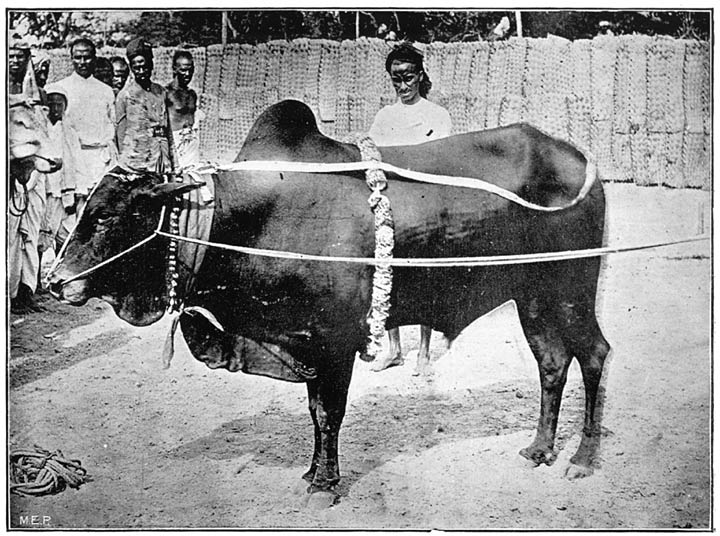
Jallikattu bull.
Among some Kondaiyamkottai Maravans, a ceremony called palaya karmāndhiram, or old death ceremony, is performed. Some months after the death of one who has died an unnatural death, the skull is exhumed, and placed beneath a pandal (booth) in an open space near the village. Libations of toddy are indulged in, and the villagers dance wildly round the head. The ceremony lasts over three days, and the final death ceremonies are then performed.
A further account of the jallikat or jellicut is given in the Gazetteer of the Madura district. “The word jallikattu literally means tying of ornaments. On a day fixed and advertised by beat of drums at the adjacent weekly markets, a number of cattle, to the horns of which cloths and handkerchiefs have been tied, are loosed one after the other, in quick succession, from a large pen or other enclosure, amid a furious tom-tomming and loud shouts from the crowd of assembled spectators. The animals have first to run the gauntlet down a long lane formed of country carts, and then gallop off wildly in every direction. The game consists in endeavouring to capture the cloths tied to their horns. To do this requires fleetness of foot and considerable pluck, and those who are successful are the heroes of the hour. Cuts and bruises are the reward of those who are less skilful, and now and again some of the excited cattle charge into the on-lookers, and send a few of them flying. The sport has been prohibited on more than one occasion. But, seeing that no one need run any risks unless he chooses, existing official opinion inclines to the view that it is a pity to discourage a manly amusement which is not really more dangerous than football, steeple-chasing, or fox-hunting. The keenness of the more virile sections of the community, especially the Kallans (q.v.), in this game is extraordinary, and, in many villages, cattle are bred and reared specially for it. The best jallikats are to be seen in the Kallan country in Tirumangalam, and next come those in Mēlur and Madura taluks.”
The Maravans bear Saivite sectarian marks, but also worship various minor deities, among whom are included Kāli, Karuppan, Muthu Karuppan, Periya Karuppan, Mathurai Vīran, Aiyanar, and Mūnuswāmi.
The lobes of the ears of Marava females are very elongated as the result of boring and gradual dilatation during childhood. Mr. (now Sir) F. A. Nicholson, who was some years ago stationed at Ramnād, tells me that the young Maravan princesses used to come and play in his garden, and, as they ran races, hung on to their ears, lest the heavy ornaments should rend asunder the filamentous ear lobes.
It was recorded, in 1902, that a young Maravan, who was a member of the family of the Zemindar of Chokampatti, was the first non-Christian Maravan to pass the B.A. degree examination at the Madras University.
The general title of the Maravans is Tēvan (god), but some style themselves Talaivan (chief), Sērvaikkāran (captain), Karaiyālan (ruler of the coast), or Rāyarvamsam (Rāja’s clan).
Mārayan.—A synonym of Mārān.
Māri.—Māri or Mārimanisaru is a sub-division of Holeya.
Māriyan.—Said to be a sub-division of Kōlayān.
Markandēya.—A gōtra of Padma Sālē and Sēniyan (Dēvānga), named after the rishi or sage Markandēya, who was remarkable for his austerities and great age, and is also known as Dīrghāyus (the long-lived). Some Dēvāngas and the Sālāpus claim him as their ancestor.
Marri. (Ficus bengalensis).—An exogamous sept of Māla and Mutrācha. Marri-gunta (pond near a fig tree) occurs as an exogamous sept of Yānādi.
Marumakkathāyam.—The Malayālam name for the law of inheritance through the female line.
Marvāri.—A territorial name, meaning a native of Marwar. At times of census, Marvāri has been returned as a caste of Jains, i.e., Marvāris, who are Jains by religion. The Marvāris are enterprising traders, who have settled in various parts of Southern India, and are, in the city of Madras, money-lenders.
Māsādika.—A synonym for Nādava Bant.
Māsila (māsi, dirt).—An exogamous sept of Dēvānga.
Masthān.—A Muhammadan title, meaning a saint, returned at times of census.
Matam (monastery, or religious institution).—An exogamous sept of Dēvānga.
Mātanga.—Mātanga or Mātangi is a synonym of Mādiga. The Mādigas sometimes call themselves Mātangi Makkalu, or children of Mātangi, who is their favourite goddess. Mātangi is further the name of certain dedicated prostitutes, who are respected by the Mādiga community.
Matavan.—Recorded, in the Travancore Census Report, 1901, as a name for the Pulikkapanikkan sub-division of Nāyar.
Matsya (fish).—A sept of Dōmb.
Mattiya.—The Mattiyas are summed up as follows in the Madras Census Report, 1901. “In Vizagapatam these are hill cultivators from the Central Provinces, who are stated in one account to be a sub-division of the Gonds. Some of them wear the sacred thread, because the privilege was conferred upon their families by former Rājas of Malkanagiri, where they reside. They are said to eat with Rōnas, drink with Porojas, but smoke only with their own people. The name is said to denote workers in mud (matti), and in Ganjam they are apparently earth-workers and labourers. In the Census Report, 1871, it is noted that the Matiyās are ‘altogether superior to the Kois and to the Parjās (Porojas). They say they sprang from the soil, and go so far as to point out a hole, out of which their ancestor came. They talk Uriyā, and farm their lands well’”
For the following note, I am indebted to Mr. C. Hayavadana Rao. The caste is divided into at least four septs, named Bhāg (tiger), Nāg (cobra), Chēli (goat), and Kochchimo (tortoise). A man may claim his paternal aunt’s daughter in marriage. Girls are, as a rule, married after puberty. When a match is contemplated, the would-be husband presents a pot of liquor to the girl’s parents. If this is accepted, a further present of liquor, rice, and a pair of cloths, is made later on. The liquor is distributed among the villagers, who, by accepting it, indicate their consent to the transfer of the girl to the man. A procession, with Dōmbs acting as musicians, is formed, and the girl is taken to the bridegroom’s village. A pandal (booth) has been erected in front of the bridegroom’s house, which the contracting couple enter on the following morning. Their hands are joined together by the presiding Dēsāri, they bathe in turmeric water, and new cloths are given to them. Wearing these, they enter the house, the bridegroom leading the bride. Their relations then exhort them to be constant to each other, and behave well towards them. A feast follows, and the night is spent in dancing and drinking. Next day, the bride’s parents are sent away with a present of a pair of cows or bulls as jholla tonka. The remarriage of widows is allowed, and a younger brother usually marries the widow of his elder brother. Divorce is permitted, and, when a husband separates from his wife, he gives her a new cloth and a bullock as compensation. A divorced woman may remarry.
By the Mattiyas, and other Oriya castes, the ghorojavai (house son-in-law) custom is practiced. According to this custom, the poorer folk, in search of a wife, work, according to a contract, for their future father-in-law for a specified time, at the expiration of which they set up a separate establishment with his daughter. To begin married life with, presents are made to the couple by the father-in-law.
The dead are burnt, and the spot where cremation takes place is marked by setting up in the ground a bamboo pole, to which one of the dead man’s rags is attached. The domestic pots, which were used during his last illness, are broken there. Death pollution is observed for eight days. On the ninth day, the ashes, mixed with water, are cleared up, and milk is poured over the spot. The ashes are sometimes buried in a square hole, which is dug to a depth of about three feet, and filled in. Over it a small hut-like structure is raised. A few of these sepulchral monuments may be seen on the south side of the Pangām stream on the Jeypore-Malkangiri road. The personal names of the Mattiyas are often taken from the day of the week on which they are born.
It is recorded, in the Gazetteer of Malabar, that the Māvilōns are “divided into Tulu Mavilōns and Eda Mavilōns, and sub-divided into thirty illams. They are employed as mahouts (drivers of elephants), and collect honey and other forest produce. Their headmen are called Chingam (simham, lion), and their huts Māpura.”
Mayalōtilu (rascal).—Mayalōtilu or Manjulōtilu is said by the Rev. J. Cain to be a name given by the hill Kōyis to the Kōyis who live near the Godāvari river.
Mayan.—Recorded, in the Madras Census Report, as a synonym of Kammālan. The Kamsali goldsmiths claim descent from Maya.
Mēda, Mēdara, Mēdarlu, or Mēdarakāran.—The Mēdaras are workers in bamboo in the Telugu, Canarese, Oriya and Tamil countries, making sieves, baskets, cradles, mats, fans, boxes, umbrellas, and tatties (screens). Occasionally they receive orders for waste-paper baskets, coffins for Native Christian children, or cages for pigeons and parrots. In former days they made basket-caps for sepoys. They are said to cut the bamboos in the forest on dark nights, in the belief that they would be damaged if cut at any other time. They do not, like the Korachas, make articles from the leaf of the date-palm (Phœnix).
As among many other castes, opprobrious names are given to children. For example, a boy, whose elder brother has died, may be called Pentayya (dung-heap). As a symbol of his being a dung-heap child, the infant, as soon as it is born, is placed on a leaf-platter. Other names are Thavvayya, or boy bought for bran, and Pakiru, mendicant. In a case where a male child had been ill for some months, a woman, under the influence of the deity, announced that he was possessed by the goddess Ankamma. The boy accordingly had the name of the goddess conferred on him.
The following are some of the gōtras and exogamous septs of the Mēdaras:—
(a) Gōtras.
Hanumanta (monkey-god). Bombadai (a fish).
Puli (tiger). Vināyaka (Ganēsa).
Thāgenīlu (drinking water). Kāsi (Benares).
Avisa (Sesbania grandiflora). Moduga (Butea frondosa).
Rēla (Ficus). Kovila (koel or cuckoo).
Sēshai (snake?).
(b) Exogamous septs.
Pilli (cat). Nuvvulu (gingelly).
Parvatham (mountain). Senagapapu (Bengal gram).
Putta (ant-hill). Tsanda (subscription).
Konda (mountain). Nīla (blue).
Javādi (civet-cat). Sirigiri (a hill).
Nandikattu (bull’s mouth). Kanigiri (a hill).
Kandikattu (dhāl soup). Pōthu (male).
Kottakunda (new pot). Nāginīdu (snake).
Pooreti (a bird). Kola (ear of corn).
Kallūri (stone village).
A man most frequently marries his maternal uncle’s daughter, less frequently the daughter of his paternal aunt. Marriage with a deceased wife’s sister is regarded with special favour. Marriage with two living sisters, if one of them is suffering from disease, is common.
In a note on the Mēdaras of the Vizagapatam district, Mr. C. Hayavadana Rao writes that girls are married before or after puberty. A Brāhman officiates at the marriage ceremonies. Widows are allowed to remarry once, and the sathamānam (marriage badge) is tied by the new husband on the neck of the bride, who has, as in the Gūdala caste, to sit near a mortar.
Formerly all the Mēdaras were Saivites, but many are at the present day Vaishnavites, and even the Vaishnavites worship Siva. Every family has some special person or persons whom they worship, for example, Vīrullu, or boys who have died unmarried. A silver image is made, and kept in a basket. It is taken out on festive occasions, as before a marriage in a family, and offerings of milk and rice gruel are made to it. Bāla Pērantālu, or girls who have died before marriage, and Pērantālu, or women who have died before their husbands, are worshipped with fruits, turmeric, rice, cocoanuts, etc.
Some of the Saivites bury their dead in a sitting posture, while others resort to cremation. All the Vaishnavites burn the dead, and, like the Saivites, throw the ashes into a river. The place of burning or burial is not as a rule marked by any stone or mound. But, if the family can afford it, a tulsi fort is built, and the tulsi (Ocimum sanctum) planted therein. In the Vizagapatam district, death pollution is said to last for three days, during which the caste occupation is not carried out. On the third day, a fowl is killed, and food cooked. It is taken to the spot where the corpse was burnt, on which a portion is thrown, and the remainder eaten.
The potency of charms in warding off evil spirits is believed in. For example, a figure of Hanumān the monkey-god, on a thin plate of gold, with cabalistic letters inscribed on it, is worn on the neck. And, on eclipse days, the root of the madar or arka plant (Calotropis gigantea), enclosed in a gold casket, is worn on the neck of females, and on the waist or arms of males. Some members of this, as of other castes, may be seen with cicatrices on the forehead, chest, back, or neck. These are the scars resulting from branding during infancy with lighted turmeric or cheroot, to cure infantile convulsions, resulting, it is believed, from inhaling tobacco smoke in small, ill-ventilated rooms.
Various legends are current in connection with tribal heroes. One Mēdara Chennayya is said to have fed some thousands of people with a potful of rice. His grandson, Mēdara Thodayya, used to do basket-making, and bathed three times daily. A Brāhman, afflicted with leprosy, lost a calf. In searching for it, he fell into a ditch filled with water, in which the Mēdara had bathed, and was cured. One Mēdara Kēthayya and his wife were very poor, but charitable. In order to test him, the god Iswara made grains of gold appear in large quantities in the hollow of a bamboo, which he cut. He avoided the bamboos as being full of vermin, and useless. At some distance, he found an ant-hill with a bamboo growing in it, and, knowing that bamboos growing on such a hill will not be attacked by vermin, cut it. In so doing, he cut off the head of a Rishi, who was doing penance. Detecting the crime of which he had been guilty, he cried “Siva, Siva.” His wife, who was miles away, heard him, and, knowing that he must be in some trouble, went to the spot. He asked her how he was to expiate his sin, and she replied. “You have taken a life, and must give one in return.” He thereon prepared to commit suicide, but his wife, taking the knife from him, was about to sacrifice herself when Iswara appeared, restored the Rishi to life, and took Mēdara Kēthayya and his wife to heaven.
As among many other castes, the sthambamuhurtham (putting up the post) ceremony is performed when the building of a new house is commenced, and the deeparathana (lamp-worship) before it is occupied. In every settlement there is a Kulapedda, or hereditary caste headman, who has, among other things, the power of inflicting fines, sentencing to excommunication, and inflicting punishments for adultery, eating with members of lower castes, etc. Excommunication is a real punishment, as the culprit is not allowed to take bamboo, or mess with his former castemen. In the Kistna and Godāvari districts, serious disputes, which the local panchāyat (council) cannot decide, are referred to the headman at Masulipatam, who at present is a native doctor. There are no trials by ordeal. The usual form of oath is “Where ten are, there God is. In his presence I say.”
When a girl reaches puberty, she has to sit in a room on five fresh palmyra palm leaves, bathes in turmeric water, and may not eat salt. If there is “leg’s presentation” at childbirth, the infant’s maternal uncle should not hear the infant cry until the shanti ceremony has been performed. A Brāhman recites some mantrams, and the reflection of the infant’s face is first seen by the uncle from the surface of oil in a plate. Widow remarriage is permitted. A widow can be recognised by her not wearing the tāli, gāzulu (glass bangles), and mettu (silver ring on the second toe).
The lowest castes with which the Mēdaras will eat are, they say, Kōmatis and Velamas. Some say that they will eat with Sātānis,
Mēda (raised mound).—An exogamous sept of Padma Sālē.
Medam (fight).—An exogamous sept of Dēvānga.
Meikāval (body-guard of the god).—A name for Pandārams.
Mēkala (goats).—Recorded as an exogamous sept of Bōya, Chenchu, Golla, Kamma, Kāpu, Togata, and Yānādi. Nerigi Mēkala (a kind of goat) is a further sept of Yānādi.
Mēkhri.—A sub-division of Navāyat Muhammadans.
Mēlāchchēri.—A class of Muhammadans in the Laccadive islands (see Māppilla).
Mēladava.—Dancing-girls in South Canara.
Mellikallu.—Under the name Mellikallu or Mallekalu, seventy-six individuals are returned, in the Madras Census Report, 1901, as “hill cultivators in Pedakōta village of Vīravalli tāluk of the Vizagapatam Agency, who are reported to constitute a caste by themselves. They pollute by touch, have their own priests, and eat pork but not beef.”
Mēlnādu.—Mēlnādu, or Mēlnātar, meaning western country, is the name of a territorial sub-division of Kallan and Shānān.
Mēlu Sakkare.—A name, meaning western Sakkare, by which Upparas in Mysore style themselves. They claim descent from a mythical individual, named Sagara, who dug the Bay of Bengal. Some Upparas explain that they work in salt, which is more essential than sugar, and that Mēl Sakkara means superior sugar.
Mēman.—More than three hundred members of this Muhammadan class of Bombay traders were returned at the Madras Census, 1901. It is recorded, in the Bombay Gazetteer, that many Cutch, Mēmans are prospering as traders in Kurrachee, Bombay, the Malabar coast, Hyderabad, Madras, Calcutta, and Zanzibar.
Menasu (pepper or chillies).—An exogamous sept of Kuruba, and gōtra of Kurni.
Mēnōkki (overseer).—Mēnōkki and Mēnōki have been returned, in the Travancore and Cochin Census Reports, as a sub-division of Nāyars, who are employed as accountants in temples. The name is derived from mēl, above, nōkki, from nōkkunnu to look after.
Mēra.—A sub-division of Holeya.
Meria.—At the Madras Census, 1901, twenty-five individuals returned themselves as Meria or Merakāya. They were descendants of persons who were reserved for human (Meriah) sacrifice, but rescued by Government officials in the middle of the last century.
Mēsta.—A name taken by some Chaptēgāras (carpenters) in South Canara.
Mettu Kamsali.—A synonym of Ojali blacksmith, Mettu means shoes or sandals.
Mhāllo.—A name for Konkani barbers.
Midathala (locust).—An exogamous sept of Bōya and Mādiga.
Middala or Meddala (storeyed house).—An exogamous sept of Padma Sālē.
Midichi (locust).—A gōtra of Kurni.
Mīla.—The Mīlas are a fishing caste in Ganjam and Vizagapatam, for the following note on whom I am indebted to Mr. C. Hayavadana Rao. The name Mīlavāndlu, by which they are commonly known, means fishermen. They also call themselves Ōdavāndlu, because they go out to sea, fishing from boats (ōda). When they become wealthy, they style themselves Ōda Balijas. The caste is divided into numerous exogamous septs, among which are dhōni (boat), and tōta (garden). The custom of mēnarikam, according to which a man should marry his maternal uncle’s daughter, is in force, and a man may also marry his sister’s daughter. Girls are generally married after puberty. Gold jewellery is presented in lieu of money as the bride-price (vōli). On the occasion of a marriage, half a dozen males and females go to the house of the bride, where they are entertained at a feast. She is conducted to the home of the bridegroom. A plank is placed at the entrance to the house, on which the bride and bridegroom take their seats. After they have bathed, new cloths are presented to them, and the old ones given to the barber. They then sit once more on the plank, and the caste headman, called the Ejaman, takes up the sathamānam (marriage badge), which is passed round among those assembled. It is finally tied by the bridegroom on the bride’s neck. The remarriage of widows is recognised. Each village has an Ejaman, who, in addition to officiating at weddings, presides over council meetings, collects fines, etc. The caste goddess is Pōlamma, to whom animal sacrifices are offered, and in whose honour an annual festival is held. The expenses thereof are met by public subscription and private donations. The dead are burnt, and a Sātāni officiates at funerals. Death pollution is not observed. On the twelfth day after death, the pedda rōzu (big day) ceremony is performed. The caste titles are Anna and Ayya.
Milaku (pepper: Piper nigrum).—A tree or kothu of Kondaiyamkotti Maravans.
Milikhān.—A class of Muhammadan pilots and sailors in the Laccadive Islands (see Māppilla).
Mīnalavāru (fish people).—An exogamous sept of Bēdar or Bōya. Mīn (fish) Palli occurs as a name for Pallis who have settled in the Telugu country, and adopted fishing as their profession.
Minchu (metal toe-ring).—An exogamous sept of Kuruba.
Mini (leather rope).—A gōtra of Kurni.
Mīnpidi (fish-catching).—A sub-division of Pānan.
Mirapakāya (Capsicum frutescens).—An exogamous sept of Bōya.
Mirigani.—A sub-division of Dōmb.
Miriyāla (pepper).—An exogamous sept of Balija.
Mir Shikari.—A synonym of Kurivikkāran.
Mīsāla (whiskers).—An exogamous sept of Bōya.
Mīse (moustache).—An exogamous sept of Kuruba.
Mochi.—See Mucchi.
Modikāran.—The name sometimes applied to Nōkkan mendicants, who dabble in jugglery. Modi is a trial of magical powers between two persons, in which the hiding of money is the essential thing.
Mōduga (Butea frondosa).—A gōtra of Mēdara.
Mogēr.—The Mogērs are the Tulu-speaking fishermen of the South Canara district, who, for the most part, follow the aliya santāna law of inheritance (in the female line), though some who are settled in the northern part of the district speak Canarese, and follow the makkala santāna law (inheritance from father to son).
The Mogērs manufacture the caps made from the spathe of the areca palm, which are worn by Koragas and Holeyas.
The settlements of the Mogēr fishing community are called pattana, e.g., Odorottu pattana, Manampādē pattana. For this reason, Pattanadava is sometimes given as a synonym for the caste name. The Tamil fishermen of the City of Madras are, in like manner, called Pattanavan, because they live in pattanams or maritime villages.
Like other Tulu castes, the Mogērs worship bhūthas (devils). The principal bhūtha of the fishing community is Bobbariya, in whose honour the kōla festival is held periodically. Every settlement, or group of settlements, has a Bobbariya bhūthasthana (devil shrine). The Matti Brāhmans, who, according to local tradition, are Mogērs raised to the rank of Brāhmans by one Vathirāja Swāmi, a Sanyāsi, also have a Bobbariya bhūthasthana in the village of Matti. The Mogērs who have ceased to be fishermen, and dwell in land, worship the bhūthas Panjurli and Baikadthi. There is a caste priest, called Mangala pūjāri, whose head-quarters are at Bannekuduru near Barkūr. Every family has to pay eight annas annually to the priest, to enable him to maintain the temple dedicated to Ammanoru or Mastiamma at Bannekuduru. According to some, Mastiamma is Māri, the goddess of small-pox, while others say that she is the same as Mohini, a female devil, who possesses men, and kills them.
For every settlement, there must be at least two Gurikāras (headmen), and, in some settlements, there are as many as four. All the Gurikāras wear, as an emblem of their office, a gold bracelet on the left wrist. Some wear, in addition, a bracelet presented by the members of the caste for some signal service. The office of headman is hereditary, and follows the aliya santāna law of succession (in the female line).
The ordinary Tulu barber (Kelasi) does not shave the Mogērs, who have their own caste barber, called Mēlantavam, who is entitled to receive a definite share of a catch of fish. The Konkani barbers (Mholla) do not object to shave Mogērs, and, in some places where Mhollas are not available, the Billava barber is called in.
Like other Tulu castes, the Mogērs have exogamous septs, or balis, of which the following are examples:—
Āne, elephant. Bali, a fish. Dēva, god. Dyava, tortoise. Honne, Pterocarpus Marsupium. Shetti, a fish. Tolana, wolf.
The marriage ceremonial of the Mogērs conforms to the customary Tulu type. A betrothal ceremony is gone through, and the sirdochi, or bride-price, varying from six to eight rupees, paid. The marriage rites last over two days. On the first day, the bride is seated on a plank or cot, and five women throw rice over her head, and retire. The bridegroom and his party come to the home of the bride, and are accommodated at her house, or elsewhere. On the following day, the contracting couple are seated together, and the bride’s father, or the Gurikāra, pours the dhāre water over their united hands. It is customary to place a cocoanut on a heap of rice, with some betel leaves and areca nuts at the side thereof. The dhāre water (milk and water) is poured thrice over the cocoanut. Then all those assembled throw rice over the heads of the bride and bridegroom, and make presents of money. Divorce can be easily effected, after information of the intention has been given to the Gurikāra. In the Udipi tāluk, a man who wishes to divorce his wife goes to a certain tree with two or three men, and makes three cuts in the trunk with a bill-hook. This is called barahakodu, and is apparently observed by other castes. The Mogērs largely adopt girls in preference to boys, and they need not be of the same sept as the adopter.
On the seventh day after the birth of a child a Madivali (washerwoman) ties a waist-thread on it, and gives it a name. This name is usually dropped after a time, and another name substituted for it.
The dead are either buried or cremated. If the corpse is burnt, the ashes are thrown into a tank (pond) or river on the third or fifth day. The final death ceremonies (bojja or sāvu) are performed on the seventh, ninth, eleventh, or thirteenth day, with details similar to those of the Billavas. Like other Tulu castes, some Mogērs perform a propitiatory ceremony on the fortieth day.
The ordinary caste title of the Mogērs is Marakālēru, and Gurikāra that of members of the families to which the headmen belong. In the Kundapūr tāluk, the title Naicker is preferred to Marakālēru.
The cephalic index of the Mogērs is, as shown by the following table, slightly less than that of the Tulu Bants and Billavas:—
— Av. Max. Min. No. of times index 80 or over.
50 Billavas 80.1 91.5 71. 28
40 Bants 78. 91.2 70.8 13
40 Mogērs 77.1 84.9 71.8 9
Mogili (Pandanus fascicularis).—An exogamous sept of Kāpu and Yerukala.
Mogotho.—A sub-division of Gaudo, the members of which are considered inferior because they eat fowls.
Mohiro (peacock).—An exogamous sept or gōtra of Bhondāri and Gaudo,
Mōksham (heaven).—An exogamous sept of Dēvānga.
Moktessor or Mukhtesar.—See Stānika.
Mola (hare).—An exogamous sept of Gangadikāra Holeya and Gangadikāra Vakkaliga.
Molaya Dēvan.—A title of Kallan and Nōkkan.
Mōliko.—A title of Doluva and Kondra.
Monathinni.—The name, meaning those who eat the vermin of the earth, of a sub-division of Valaiyan.
There are several proverbs relating to this class of mendicants, one of which is to the effect that the rough and rugged ground traversed by the Kalladi-siddhan is powdered to dust. Another gives the advice that, whichever way the Kalladi-mangam goes, you should dole out a measure of grain for him. Otherwise he will defile the road owing to his disgusting habits. A song, which the Mondi may often be heard warbling, runs as follows:—
Mother, mother, Oh! grandmother,
Grandmother, who gave birth.
Dole out my measure.
Their original ancestor is said to have been a shepherd, who had both his legs cut off by robbers in a jungle. The king of the country in compassion directed that every one should pay him and his descendants, called mondi or lame, a small amount of money or grain.
The caste is divided into a series of bands, each of which has the right to collect alms within a particular area. The merchants and ryots are expected to pay them once a year, the former in money, and the latter in grain at harvest time. Each band recognises a headman, who, with the aid of the caste elders, settles marital and other disputes.
Marriage is usually celebrated after puberty. In the North Arcot district, it is customary for a man to marry his maternal uncle’s daughter, and in the Madura district a man can claim his paternal aunt’s daughter in marriage. The caste is considered so low in the social scale that Brāhmans will not officiate at marriages. Divorce is easy, and adultery with a man of higher caste is condoned more readily than a similar offence within the caste.
Mondolo.—Recorded, in the Madras Census Report, 1901, as an Oriya title given by Zamindars to the headmen of villages. It is also a title of various Oriya castes.
Mora Būvva.—A sub-division of Mādigas, who offer food (būvva) to the god in a winnowing basket (mora) at marriage.
Morasa Kāpulu women never touch the new grain of the year without worshipping the sun (Sūrya), and may not eat food prepared from this grain before this act of worship has been performed. They wrap themselves in a kambli (blanket) after a purificatory bath, prostrate themselves on the ground, raise their hands to the forehead in salutation, and make the usual offering of cocoanuts, etc. They are said, in times gone by, to have been lax in their morals and to have prayed to the sun to forgive them.
Morasu has further been returned as a sub-division of Holeya, Māla and Oddē. The name Morasu Paraiyan probably indicates Holeyas who have migrated from the Canarese to the Tamil country, and whose women, like the Kallans, wear a horse-shoe thread round the neck.
Motāti.—A sub-division of Kāpu.
The Moyilis are also called Dēvādigas, and should not be mixed with the Malerus (or Maleyavaru). Both do temple service, but the Maleru females are mostly prostitutes, whereas Moyili women are not. Malerus are dancing-girls attached to the temples in South Canara, and their ranks are swelled by Konkani, Shivalli, and other Brāhman women of bad character.
The Moyilis have adopted the manners and customs of the Bants, and have the same balis (septs) as the Bants and Billavas.
To make black, red, and blue writing ink, also ink of other colours as may seem requisite.
To mend quills, rule lines, make envelopes, mount or paste maps or plans on cloth with ribbon edges, pack parcels in wax-cloth, waterproof or common paper, seal letters and open boxes or trunk parcels.
To take charge of boxes, issue stationery for current use, and supply petty articles.
To file printed forms, etc., and bind books.”
In the Fort St. George Gazette, 1906, applications were invited from persons who have passed the Matriculation examination of the Madras University for the post of Mucchi on Rs. 8 per mensem in the office of a Deputy Superintendent of Police.
In the District Manuals, the various occupations of the Mucchis are summed up as book-binding, working in leather, making saddles and trunks, painting, making toys, and pen-making. At the present day, Mucchis (designers) are employed by piece-goods merchants in Madras in devising and painting new patterns for despatch to Europe, where they are engraved on copper cylinders. When, as at the present day, the bazars of Southern India are flooded with imported piece-goods of British manufacture, it is curious to look back and reflect that the term piece-goods was originally applied in trade to the Indian cotton fabrics exported to England.
The term Mucchi is applied to two entirely different sets of people. In Mysore and parts of the Ceded Districts, it refers to Marāthi-speaking workers in leather. But it is further applied to Telugu-speaking people, called Rāju, Jīnigāra, or Chitrakāra, who are mainly engaged in painting, making toys, etc., and not in leather-work. (See Rāchevar.)
In a note on the Mudavāndis, Mr. F. R. Hemingway writes that it is stated to be the custom that children born blind or lame in the Konga Vellāla caste are handed over by their parents to become Mudavāndis. If the parents hesitate to comply with the custom, the Mudavāndis tie a red cloth round the head of the child, and the parents can then no longer withhold their consent. They have to give the boy a bullock to ride on if he is lame, or a stick if he is blind.
A Revenue Officer writes (1902) that, at the village of Āndipalayam in the Salem district, there is a class of people called Modavāndi, whose profession is the adoption of the infirm members of the Konga Vellālas. Āndis are professional beggars. They go about among the Konga Vellālas, and all the blind and maimed children are pounced upon by them, and carried to their village. While parting with their children, the parents, always at the request of the children, give a few, sometimes rising to a hundred, rupees. The infirm never loses his status. He becomes the adopted child of the Āndi, and inherits half of his property invariably. They are married among the Āndis, and are well looked after. In return for their services, the Āndis receive four annas a head from the Konga Vellāla community annually, and the income from this source alone amounts to Rs. 6,400. A forty-first part share is given to the temple of Arthanariswara at Trichengōdu. None of the Vellālas can refuse the annual subscription, on pain of being placed under the ban of social excommunication, and the Āndi will not leave the Vellāla’s house until the infirm child is handed over to him. One Tahsildar (revenue officer) asked himself why the Āndi’s income should not be liable to income-tax, and the Āndis were collectively assessed. Of course, it was cancelled on appeal.
Mudi (knot).—An exogamous sept of Māla.
Mudiya.—The name, derived from mudi, a preparation of fried rice, of a sub-division of Chuditiya.
Muduvar.—The Muduvars or Mudugars are a tribe of hill cultivators in Coimbatore, Madura, Malabar, and Travancore. For the following note on those who inhabit the Cardamom hills, I am indebted to Mr. Aylmer Ff. Martin.
The name of the tribe is usually spelt Muduvar in English, and in Tamil pronounced Muthuvar, or Muthuvānāl. Outsiders sometimes call the tribe Thagappanmargal (a title sometimes used by low-caste people in addressing their masters). The Muduvars have a dialect of their own, closely allied to Tamil, with a few Malayālam words. Their names for males are mostly those of Hindu gods and heroes, but Kanjan (dry or stingy), Karupu Kunji (black chick), Kunjita (chicken) and Kar Mēgam (black cloud) are distinctive and common. For females, the names of goddesses and heroines, Karapayi (black), Koopi (sweepings), and Paychi (she-devil) are common. Boy twins are invariably Lutchuman and Rāman, girl twins Lutchmi and Rāmayi. Boy and girl twins are named Lutchman and Rāmayi, or Lutchmi and Rāman.
The tribe is settled on the northern and western portion of the Cardamom Hills, and the High Range of Travancore, known as the Kanan Dēvan hills, and there is, I believe, one village on the Ānaimalai hills. They wander to some extent, less so now than formerly, owing to the establishment of the planting community in their midst. The head-quarters at present may be said to be on the western slopes of the High Range. The present Mēl Vāken or headman lives in a village on the western slope of the High Range at about 2,000 feet elevation, but villages occur up to 6,000 feet above sea level, the majority of villages being about 4,000 feet above the sea. The wandering takes place between the reaping of the final crop on one piece of land, and the sowing of the next. About November sees the breaking up of the old village, and February the establishment of the new. On the plateau of the High Range their dwellings are small rectangular, rather flat-roofed huts, made of jungle sticks or grass (both walls and root), and are very neat in appearance. On the western slopes, although the materials lend themselves to even neater building, their houses are usually of a rougher type. The materials used are the stems and leaves of the large-leaved īta (bamboo: Ochlandra travancorica) owing to the absence of grass-land country. The back of the house has no wall, the roof sloping on to the hillside behind, and the other walls are generally made of a rough sort of matting made by plaiting split īta stems.
Outsiders are theoretically not received into the caste, but a weaver caste boy and girl who were starving (in the famine of 1877, as far as I can make out), and deserted on the hills, were adopted, and, when they grew up, were allowed the full privileges of the caste. Since then, a ‘Thotiya Naicker’ child was similarly adopted, and is now a full-blown Muduvar with a Muduvar wife. On similar occasions, adoptions from similar or higher castes might take place, but the adoption of Pariahs or low-caste people would be quite impossible. In a lecture delivered some years ago by Mr. O. H. Bensley, it was stated that the Muduvars permit the entry of members of the Vellāla caste into their community, but insist upon a considerable period of probation before finally admitting the would-be Muduvar into their ranks.
If any dispute arises in the community, it is referred to the men of the village, who form an informal panchāyat (council), with the eldest or most influential man at its head. References are sometimes, but only seldom, made to the Mūppen, a sort of sub-headman of the tribe, except, perhaps, in the particular village in which he resides. The office of both Mūppen and Mēl Vāken is hereditary, and follows the marumakkatāyam custom, i.e., descent to the eldest son of the eldest sister. The orders of the panchāyat, or of the headman, are not enforceable by any specified means. A sort of sending a delinquent to Coventry exists, but falls through when the matter has blown over. Adjudications only occur at the request of the parties concerned, or in the case of cohabitation between the prohibited degrees of consanguinity, when, on it becoming known, the guilty pair are banished to the jungle, but seem nevertheless to be able to visit the village at will. When disputes between parties are settled against any one, he may be fined, generally in kind—a calf, a cow, a bull, or grain. There is no trial by ordeal. Oaths by the accuser, the accused, and partisans of both, are freely taken. The form of oath is to call upon God that the person swearing, or his child, may die within so many days if the oath is untrue, at the same time stepping over the Rāma kodu, which consists of lines drawn on the ground, one line for each day. It may consist of any number of lines, but three, five, or seven are usual. Increasing the number of lines indefinitely would be considered to be trifling with the subject.
There do not seem to be any good omens, but evil omens are numerous. The barking of ‘jungle sheep’ (barking deer) or sāmbar, the hill robin crossing the path when shifting the village, are examples. Oracles, magic, sorcery, witchcraft, and especially the evil eye, are believed in very firmly, but are not practiced by Muduvars. I was myself supposed to have exercised the evil eye at one time. It once became my duty to apportion to Muduvars land for their next year’s cultivation, and I went round with some of them for this purpose, visiting the jungle they wished to clear. A particular friend of mine, called Kanjan, asked for a bit of secondary growth very close to a cinchona estate; it was, in fact, situated between Lower Nettigudy and Upper Nettigudy, and the main road passed quite close. I told him that there was no objection, except that it was most unusual, and that probably the estate coolies would rob the place; and I warned him very distinctly that, if evil came of his choice, he was not to put the blame on me. Shortly afterwards I left India, and was absent about three months, and, when I returned, I found that small-pox had practically wiped out that village, thirty-seven out of forty inhabitants having died, including Kanjan. I was, of course, very sorry; but, as I found a small bit of the land in question had been felled, and there being no claimants, I planted it up with cinchona. As the smallpox had visited all the Muduvar villages, and had spread great havoc among them, I was not surprised at their being scarce, but I noticed, on the few occasions when I did see them, that they were always running away. When I got the opportunity, I cornered a man by practically riding him down, and asked for an explanation. He then told me that, of course, the tribe had been sorely troubled, because I told Kanjan in so many words that evil would come. I had then disappeared (to work my magic, no doubt), and returned just in time to take that very bit of land for myself. That was nearly five years ago, and confidence in me is only now being gradually restored.
The Muduvans have lucky days for starting on a journey—
Monday, start before sunrise.
Tuesday, start in the forenoon.
Wednesday start before 7 A.M.
Thursday, start after eating the morning meal.
Friday, never make a start; it is a bad day.
Saturday and Sunday, start as soon as the sun has risen.
When boys reach puberty, the parents give a feast to the village. In the case of a girl, a feast is likewise given, and she occupies, for the duration of the menstrual period, a hut set apart for all the women in the village to occupy during their uncleanness. When it is over, she washes her clothes, and takes a bath, washing her head. This is just what every woman of the village always does. There is no mutilation, and the girl just changes her child’s dress for that of a woman. The married women of the village assist at confinements. Twins bring good luck. Monsters are said to be sometimes born, bearing the form of little tigers, cows, monkeys, etc. On these occasions, the mother is said generally to die, but, when she does not die, she is said to eat the monster. Monstrosities must anyway be killed. Childless couples are dieted to make them fruitful, the principal diet for a man being plenty of black monkey, and for a woman a compound of various herbs and spices.
A man may not marry the daughter of his brother or sister; he ought to marry his uncle’s daughter, and he may have two or three wives, who may or may not be sisters. Among the plateau Muduvars, both polygamy and polyandry are permitted, the former being common, and the latter occasional. In the case of the latter, brothers are prohibited from having a common wife, as also are cousins on the father’s side. In the case of polygamy, the first married is the head wife, and the others take orders from her, but she has no other privileges. If the wives are amicably disposed, they live together, but, when inclined to disagree, they are given separate houses for the sake of peace and harmony. With quarrelsome women, one wife may be in one village, and the others in another. A man may be polygamous in one village, and be one of a polyandrous lot of men a few miles off. On the Cardamom Hills, and on the western slopes, where the majority of the tribe live, they are monogamous, and express abhorrence of both the polygamous and polyandrous condition, though they admit, with an affectation of amused disgust, that both are practiced by their brethren on the high lands.
Marriages are arranged by the friends, and more often by the cousins on the mother’s side of the bridegroom, who request the hand of a girl or woman from her parents. If they agree, the consent of the most remote relatives has also to be obtained, and, if everyone is amicable, a day is fixed, and the happy couple leave the village to live a few days in a cave by themselves. On their return, they announce whether they would like to go on with it, or not. In the former case, the man publicly gives ear-rings, a metal (generally brass) bangle, a cloth, and a comb to the woman, and takes her to his hut. The comb is a poor affair made of split īta or perhaps of bamboo, but it is the essential part of the ceremony. If the probationary period in the cave has not proved quite satisfactory to both parties, the marriage is put off, and the man and the woman are both at liberty to try again with some one else. Betrothal does not exist as a ceremony, though families often agree together to marry their children together, but this is not binding in any way. The tying of the tāli (marriage badge) is said to have been tried in former days as part of the marriage ceremony, but, as the bride always died, the practice was discontinued. Remarriage of widows is permitted, and the widow by right belongs to, or should be taken over by her deceased husband’s maternal aunt’s son, and not, under any circumstances, by any of his brothers. In practice she marries almost any one but one of the brothers. No man should visit the house of his younger brother’s wife, or even look at that lady. This prohibition does not extend to the wives of his elder brothers, but sexual intercourse even here would be incest. The same ceremonies are gone through at the remarriage of a widow as in an ordinary marriage, the ear-rings and bangles, which she discarded on the death of the previous husband, being replaced. Widows do not wear a special dress, but are known by the absence of jewelry. Elopements occur. When a man and woman do not obtain the consent of the proper parties, they run away into the jungle or a cave, visiting the village frequently, and getting grain, etc., from sympathisers. The anger aroused by their disgraceful conduct having subsided, they quietly return to the village, and live as man and wife. [It is noted, in the Travancore Census Report, 1901, that, after a marriage is settled, the bridegroom forcibly takes away the maiden from her mother’s house when she goes out for water or firewood, and lives with her separately for a few days or weeks in some secluded part of the forest. They then return, unless in the meantime they are searched for, and brought back by their relations.] In theory, a man may divorce his wife at will, but it is scarcely etiquette to do so, except for infidelity, or in the case of incompatibility of temper. If he wants to get rid of her for less horrible crimes, he can palm her off on a friend. A woman cannot divorce her husband at all in theory, but she can make his life so unbearable that he gladly allows her to palm herself off on somebody else. Wives who have been divorced marry again freely.
The tribe follow the west coast or marumakkatāyam law of inheritance with a slight difference, the property descending to an elder or younger sister’s son. Property, which seldom consists of more than a bill-hook, a blanket, and a few cattle, always goes to a nephew, and is not divided in any way.
The tribe professes to be Hindu, and the chief gods are Panaliāndavar (a corruption of Palaniāndi) and Kadavallu, who are supposed to live in the Madura temple with Mīnākshiammal and her husband Sokuru. They are also said to worship Chāntiāttu Bhagavati and Nēriyamangalam Sāsta. Sūryan (the sun) is a beneficent deity. The deities which are considered maleficent are numerous, and all require propitiation. This is not very taxing, as a respectful attitude when passing their reputed haunts seems to suffice. They are alluded to as Karapu (black ones). One in particular is Nyamaru, who lives on Nyamamallai, the jungles round which were said to be badly haunted. At present they are flourishing tea estates, so Nyamaru has retired to the scrub at the top of the mountain. Certain caves are regarded as shrines, where spear-heads, a trident or two, and copper coins are placed, partly to mark them as holy places, and partly as offerings to bring good luck, good health, or good fortune. They occur in the most remote spots. The only important festival is Thai Pongal, when all who visit the village, be they who they may, must be fed. It occurs about the middle of January, and is a time of feasting and rejoicing.
The tribe does not employ priests of other castes to perform religious ceremonies. Muduvars who are half-witted, or it may be eccentric, are recognised as Swāmyars or priests. If one desires to get rid of a headache or illness, the Swāmyar is told that he will get four annas or so if the complaint is soon removed, but he is not expected to perform miracles, or to make any active demonstration over the matter. Swāmyars who spend their time in talking to the sun and moon as their brethren, and in supplications to mysterious and unknown beings, are the usual sort, and, if they live a celibate life, they are greatly esteemed. For those who live principally on milk, in addition to practicing the other virtue, the greatest reverence is felt. Such an one occurs only once or twice in a century.
The dead are buried lying down, face upwards, and placed north and south. The grave has a little thatched roof, about six feet by two, put over it. A stone, weighing twenty or thirty pounds, is put at the head, and a similar stone at the feet. These serve to mark the spot when the roof perishes, or is burnt during the next grass fire. The depth of the grave is, for a man, judged sufficient if the gravedigger, standing on the bottom, finds the level of the ground up to his waist, but, for a woman, it must be up to his armpits. The reason is that the surviving women do not like to think that they will be very near the surface, but the men are brave, and know that, if they lie north and south, nothing can harm them, and no evil approach. The ghosts of those killed by accident or dying a violent death, haunt the spot till the memory of the occurrence fades from the minds of the survivors and of succeeding generations. These ghosts are not propitiated, but the haunted spots are avoided as much as possible. The Muduvars share with many other jungle-folk the idea that, if any animal killed by a tiger or leopard falls so as to lie north and south, it will not be eaten by the beast of prey. Nor will it be re-visited, so that sitting over a “kill” which has fallen north and south, in the hopes of getting a shot at the returning tiger or leopard, is a useless proceeding.
Totemism does not exist, but, in common with other jungle tribes, the tiger is often alluded to as jackal.
Fire is still often made by means of the flint and steel, though match-boxes are common enough. Some dry cotton (generally in a dirty condition) is placed along the flint, the edge of which is struck with the steel. The spark generated ignites the cotton, and is carefully nursed into flame in dead and dry grass. The Muduvars also know how to make fire by friction, but nowadays this is very seldom resorted to. A rotten log of a particular kind of tree has first to be found, the inside of which is in an extremely dry and powdery condition, while the outside is still fairly hard. Some of the top of the topmost side of the recumbent log having been cut away at a suitable place, and most of the inside removed, a very hard and pointed bit of wood is rapidly rotated against the inner shell of the log where the powdery stuff is likely to ignite, and this soon begins to smoke, the fire being then nursed much in the same way as with the fire generated by the flint and steel.
By the men, the langūti and leg cloth of the Tamils are worn. A turban is also worn, and a cumbly or blanket is invariably carried, and put on when it rains. [It is noted, in the Travancore Census Report, 1901, that males dress themselves like the Maravans of the low country. A huge turban is almost an invariable portion of the toilette. The chief of the Mudavars is known as Vākka, without whose consent the head-dress is not to be worn.] I have seen a Muduvar with an umbrella. Nowadays, the discarded coats of planters, and even trousers and tattered riding-breeches are common, and a Muduvar has been seen wearing a blazer. The men wear ear-rings, supposed to be, and sometimes in reality, of gold, with bits of glass of different colours in them, and also silver or brass finger and toe rings, and sometimes a bangle on each arm or on one leg. The women go in very largely for beads, strings of them adorning their necks, white and blue being favourite colours. Rings for the ears, fingers and toes, and sometimes many glass bangles on the arms, and an anklet on each leg, are the usual things, the pattern of the metal jewelry being often the same as seen on the women of the plains. The cloth, after being brought round the waist, and tucked in there, is carried over the body, and two corners are knotted on the right shoulder. Unmarried girls wear less jewelry than the married women, and widows wear no jewelry till they are remarried, when they can in no way be distinguished from their sisters. Tattooing is not practiced. Sometimes a stout thread is worn on the arm, with a metal cylinder containing some charm against illness or the evil eye, but only the wise men or elders of the caste lay much store on, or have knowledge of these things.
The Muduvars believe that they were originally cultivators of the soil, and their surroundings and tastes have made them become hunters and trappers, since coming to the hills. At the present day, they cut down a bit of secondary jungle or cheppukad, and, after burning it off, sow rāgi (millet), or, where the rainfall is sufficient, hill-rice, which is weeded and tended by the women, the men contenting themselves by trying to keep out the enemies to their crops. After harvest there is not much to be done, except building a new village perhaps, making traps, and shooting. All they catch is game to them, though we should describe some of the animals as vermin. They catch rats, squirrels, quail, jungle fowl, porcupines, mouse-deer, and fish. They kill, with a blowpipe and dart, many small birds. The traps in use are varied, but there are three principal ones, one of which looks like a big bow. It is fixed upright in the ground as a spring to close with a snap a small upright triangle of sharp-edged bamboo, to which it is connected, and into which any luckless small game may have intruded its head, induced to do so by finding all other roads closed with a cunningly made fence. Another is a bent sapling, from which a loop of twine or fibre hangs on what appears to be the ground, but is really a little platform on which the jungle fowl treads, and immediately finds itself caught by both legs, and hanging in mid-air. The third is very much the same, but of stouter build. The loop is upright, and set in a hedge constructed for the purpose of keeping the fretful porcupine in the path, passing along which the beast unconsciously releases a pin, back flies the sapling, and the porcupine is hung. If fouled in any way, he generally uses his teeth to advantage, and escapes. The Muduvars are also adepts at catching ‘ibex’ (wild goat), which are driven towards a fence with nooses set in it at proper points, which cause the beasts to break their necks. Fish are caught in very beautifully constructed cruives, and also on the hook, while, on the larger rivers below the plateau, the use of the night-line is understood. With the gun, sambar, ‘ibex,’ barking deer, mungooses, monkeys, squirrels, and martens are killed. Besides being a good shot, the Muduvar, when using his own powder, takes no risks. The stalk is continued until game is approached, sometimes to within a few yards, when a charge of slugs from the antiquated match-lock has the same effect as the most up-to-date bullet from the most modern weapon. Mr. Bensley records how, on one occasion, two English planters went out with two Muduvars after ‘bison.’ One of the Muduvars, carrying a rifle, tripped, and the weapon exploded, killing one of the planters on the spot. The two Muduvars immediately took to their heels. The other planter covered them with his rifle, and threatened to shoot them if they did not return, which they at last did. Mr. Bensley held the magisterial enquiry, and the Muduvars were amazed at escaping capital punishment.
In their agricultural operations, the Muduvars are very happy-go-lucky. They have no scare-crows to avert injury to crops or frighten away demons, but they employ many devices for keeping off pigs, sāmbar, and barking deer from their crops, none of which appear to be efficacious for long. The implement par excellence of the Muduvar is the bill-hook, from which he never parts company, and with which he can do almost anything, from building a house to skinning a rat, or from hammering sheet-lead into bullets to planting maize.
The bulk of the tribe live on rāgi or hill-rice, and whatever vegetables they can grow, and whatever meat they trap or shoot. They esteem the flesh of the black monkey (Semnopithecus johni) above everything, and lust after it. I have seen a Muduvar much pulled down by illness seize an expiring monkey, and suck the blood from its jugular vein. Muduvars will not eat beef, dog, jackals, or snakes, but will eat several sorts of lizards, and rats, ‘ibex,’ and all the deer tribe, fish, fowl, and other birds, except kites and vultures, are put into the pot. The plateau Muduvars, and those on the eastern slopes, will not eat pig in any shape or form. Those on the western slopes are very keen on wild pig, and this fact causes them to be somewhat looked down upon by the others. I think this pork-eating habit is due to the absence of sāmbar or other deer in the heart of the forests. Muduvars are fond of alcohol in any shape or form. They take a liquor from a wild palm which grows on the western slopes, and, after allowing it to become fermented, drink it freely. Some members of the tribe, living in the vicinity of these palms, are more or less in a state of intoxication during the whole time it is in season. Their name for the drink is tippily-kal, and the palm resembles the kittūl (Caryota urens). The western slope Muduvars are acquainted with opium from the west coast, and some of them are slaves to the habit. The Muduvars do not admit that any other caste is good enough to eat, drink, or smoke with them. They say that, once upon a time, they permitted these privileges to Vellālans, but this fact induced so many visitors to arrive that they really could not afford it any more, so they eat, drink, and smoke with no one now, but will give uncooked food to passing strangers.
I have never heard any proverb, song, or folk-tale of the Muduvars, and believe the story of their arrival on the hills to be their stock tale. They have a story, which is more a statement of belief than anything else, that, when a certain bamboo below Pallivasal flowers, a son of the Mahārāja of Travancore turns into a tiger or puli-manisan, and devours people. Men often turn into puli-manisan owing chiefly to witchcraft on the part of others, and stories of such happenings are often told. The nearest approach to a proverb I have heard is Tingakilamei nalla tingalam, which sounds rather tame and meaningless in English, “On Monday you can eat well”—the play on the words being quite lost.
The Muduvars make a miniature tom-tom by stretching monkey skin over a firm frame of split bamboo or īta, on which the maker thereof will strum by the hour much to his own enjoyment.
In former days, the whole tribe were very shy of strangers, and it is only within the last thirty years that they have become used to having dealings with outsiders. Old men still tell of the days when robbers from the Coimbatore side used to come up, burn the Muduvar villages, and carry off what cattle or fowls they could find. Even now, there are some of the men in whom this fear of strangers seems to be innate, and who have never spoken to Europeans. In the women this feeling is accentuated, for, when suddenly met with, they make themselves scarce in the most surprising way, and find cover as instinctively as a quail chick. There are now and again men in the tribe who aspire to read, but I do not know how far any of them succeed.
The Muduvars are becoming accustomed to quite wonderful things—the harnessing of water which generates electricity to work machinery, the mono-rail tram which now runs through their country, and, most wonderful of all, the telephone. An old man described how he would raise envy and wonder in the hearts of his tribe by relating his experience. “I am the first of my caste to speak and hear over five miles,” said he, with evident delight.
I have alluded to the two different types of countenance; perhaps there is a third resulting from a mixture of the other two. The first is distinctly aquiline-nosed and thin-lipped, and to this type the men generally belong. The second is flat-nosed, wide-nostrilled, and thick-lipped, and this fairly represents the women, who compare most unfavourably with the men in face. I have never seen men of the second type, but of an intermediate type they are not uncommon. On the Cardamom Hills there may still exist a tribe of dwarfs, of which very little is known. The late Mr. J. D. Munro had collected a little information about them. Mr. A. W. Turner had the luck to come across one, who was caught eating part of a barking deer raw. Mr. Turner managed to do a little conversation with the man by signs, and afterwards he related the incident to Srīrangam, a good old Muduvar shikāri (sportsman), who listened thoughtfully, and then asked “Did you not shoot him?” The question put a new complexion on to the character of the usually peaceful and timid Muduvar.