Volume 5 — N (continued 4)
Reading edition
On the subject of religion, Mr. Fawcett writes as follows. “No Nāyar, unless one utterly degraded by the exigencies of a Government office, would eat his food without having bathed and changed his cloth. It is a rule seldom broken that every Nāyar goes to the temple to pray at least once a day after having bathed: generally twice a day. The mere approach anywhere near his vicinity of a Cheruman, a Pulayan, or any inferior being, even a Tiyan, as he walks to his house from the temple, cleansed in body and mind, his marks newly set on his forehead with sandal-wood paste, is pollution, and he must turn and bathe again ere he can enter his house and eat. Buchanan tells us that in his time, about a century ago, the man of inferior caste thus approaching a Nāyar would be cut down instantly with a sword; there would be no words. Now that the people of India are inconvenienced with an Arms Act which inhibits sword play of this kind, and with a law system under which high and low are rated alike, the Nāyar has to content himself with an imperious grunt-like shout for the way to be cleared for him as he stalks on imperturbed. His arrogance is not diminished, but he cannot now show it in quite the same way.
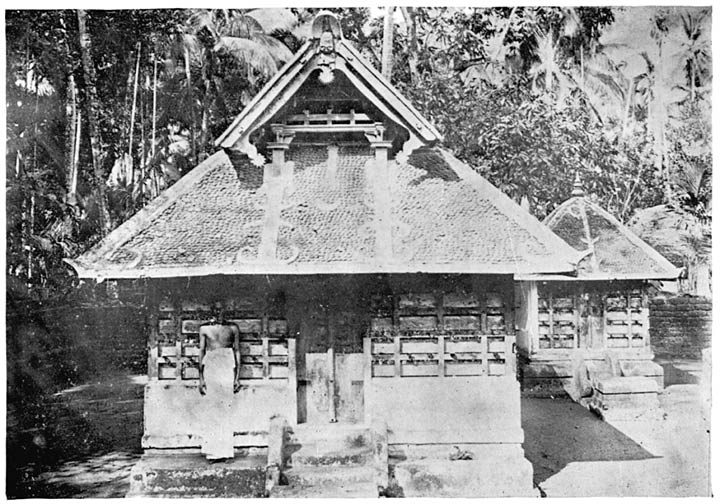
Aiyappan temple.
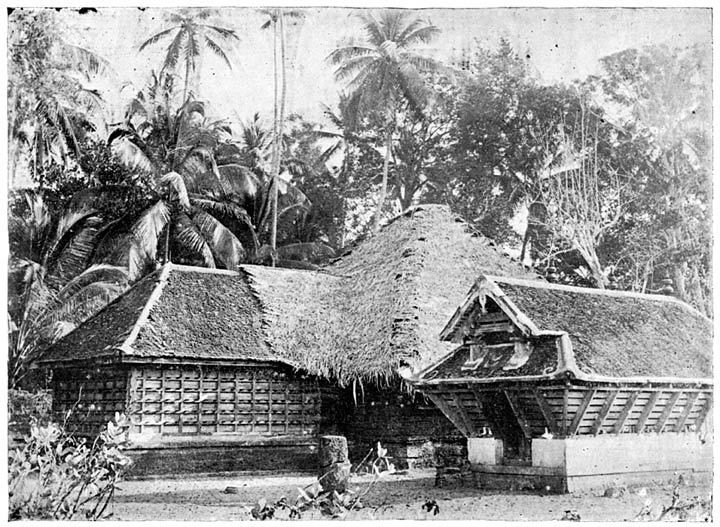
Aiyappan temple, near Calicut.
“An important local festival is that held near Palghat, in November, in the little suburb Kalpāti inhabited entirely by Pattar Brāhmans from the east. But it is not a true Malayāli festival, and it suffices to mention its existence, for it in no way represents the religion of the Nāyar. The dragging of cars, on which are placed the images of deities, common everywhere from the temple of Jagganath at Pūri in Orissa to Cape Comorin, is quite unknown in Malabar, excepting only at Kalpāti, which is close to the eastern frontier of Malabar.
“Near Chowghāt (Chavagāt), about 30 miles to the southward of Calicut, on the backwater, at a place called Guruvayūr, is a very important temple, the property of the Zamorin, yielding a very handsome revenue. I visited the festival on one occasion, and purchase was made of a few offerings such as are made to the temple in satisfaction of vows—a very rude representation of an infant in silver, a hand, a leg, an ulcer, a pair of eyes, and, most curious of all, a silver string which represents a man, the giver. Symbolization of the offering of self is made by a silver string as long as the giver is tall. Goldsmiths working in silver and gold are to be seen just outside the gate of the temple, ready to provide at a moment’s notice the object any person intends to offer, in case he is not already in possession of his votive offering. The subject of vows can be touched on but incidentally here. A vow is made by one desiring offspring, to have his hand or leg cured, to have an ulcer cured, to fulfil any desire whatsoever, and he decides in solemn affirmation to himself to give a silver image of a child, a silver leg, and so on, in the event of his having fulfilment of his desire.
“A true Malayāli festival is that held at Kottiyūr in North Malabar, in the forest at the foot of the Wynād hills rising 3,000 to 5,000 feet from the sides of the little glade where it is situated. It is held in July during the height of the monsoon rain. Though it is a festival for high and low, these do not mix at Kottiyūr. The Nāyars go first, and after a few days, the Nāyars having done, the Tiyans, and so on. A curious feature of it is that the people going to attend it are distinctly rowdy, feeling that they have a right to abuse in the vilest and filthiest terms everyone they see on the way—perhaps a few days’ march. And not only do they abuse to their hearts’ content in their exuberant excitement, but they use personal violence to person and property all along the road. They return like lambs. At Kottiyūr one sees a temple of Īsvara, there called Perumāl (or Perumāl Īsvara) by the people, a low thatched building forming a hollow square, in the centre of which is the shrine, which I was not permitted to see. There were some Nambūtiri priests, who came out, and entered into conversation. The festival is not held at the temple, but in the forest about a quarter of a mile distant. This spot is deemed extremely sacred and dreadful. There was, however, no objection to myself and my companions visiting it; we were simply begged not to go. There were with us a Nāyar and a Kurichchan, and the faces of these men, when we proceeded to wade through the little river, knee-deep and about thirty yards wide, in order to reach the sacred spot, expressed anxious wonder. They dared not accompany us across. No one (excepting, of course, a Muhammadan) would go near the place, unless during the few days of the festival, when it was safe; at all other times any man going to the place is destroyed instantly. Nothing on earth would have persuaded the Nāyar or the Kurichchiyan to cross that river. Orpheus proceeding to find his Eurydice, Danté about to enter the Inferno, had not embarked on so fearful a journey. About a hundred yards beyond the stream, we came upon the sacred spot, a little glade in the forest. In the centre of the glade is a circle of piled up stones, 12 feet in diameter. In the middle of the pile of stones is a rude lingam. Running east from the circle of the lingam is a long shed, in the middle of which is a long raised platform of brick, used apparently as a place for cooking. Around the lingam there were also thatched sheds, in which the people had lodged during the festival. Pilgrims going to this festival carry with them offerings of some kind. Tiyans take young cocoanuts. Every one who returns brings with him a swish made of split young leaves of the cocoanut palm.”
Of the Kottiyūr festival, the following account is given in the Gazetteer of Malabar. “The Nambūdiri priests live in a little wayside temple at Kottiyūr, but the true shrine is a quarter of a mile away in the forest across one of the feeder streams of the Valarpattanam river. For eleven months in the year, the scene is inconceivably desolate and dreary; but during the month Edavam (May-June) upwards of 50,000 Nāyars and Tiyans from all parts of Malabar throng the shrine for the twenty-eight days of the annual festival. During the rest of the year, the temple is given up to the revels of Siva and Parvati, and the impious Hindu who dares to intrude is consumed instantly to ashes. The two great ceremonies are the Neyyāttam and the Elanīrāttam, the pouring of ghee (clarified butter) and the pouring of the milk of the green cocoanut. The former is performed by the Nāyars, who attend the festival first, and the latter by Tiyans. In May, all roads lead to Kottiyūr, and towards the middle of the month the ghee pourers, as the Nāyar pilgrims are called, who have spent the previous four weeks in fasting and purificatory rites, assemble in small shrines subordinate to the Kottiyūr temple. Thence, clad in white, and bearing each upon his head a pot of ghee, they set forth in large bodies headed by a leader. At Manattana the pilgrims from all parts of Malabar meet, and thence to Kottiyūr the procession is unbroken. However long their journey, the pilgrims must eat only once, and the more filthy their language, the more orthodox is their conduct. As many as five thousand pots of ghee are poured over the lingam every year. After the Neyyāttam ceremony, the Nāyars depart, and it is the turn of the Tiyans. Their preparations are similar to those of the Nāyars, and their language en route is even more startling. Eruvatti near Kadirūr is the place where most of them assemble for their pilgrimage, and their green cocoanuts are presented gratis by the country people as an offering to the temple. The Elanīrāttam ceremony begins at midnight, and the pilgrims heap up their cocoanuts in front of the shrine continuously till the evening of the same day. Each Tiyan then marches thrice round the heap, and falls prostrate before the lingam; and a certain Nāyar sub-caste removes the husks preparatory to the spilling of the milk. The festival finally closes with a mysterious ceremony, in which ghee and mantrams play a great part, performed for two days consecutively by the presiding Nambūdiri, and Kottiyūr is then deserted for another year.”
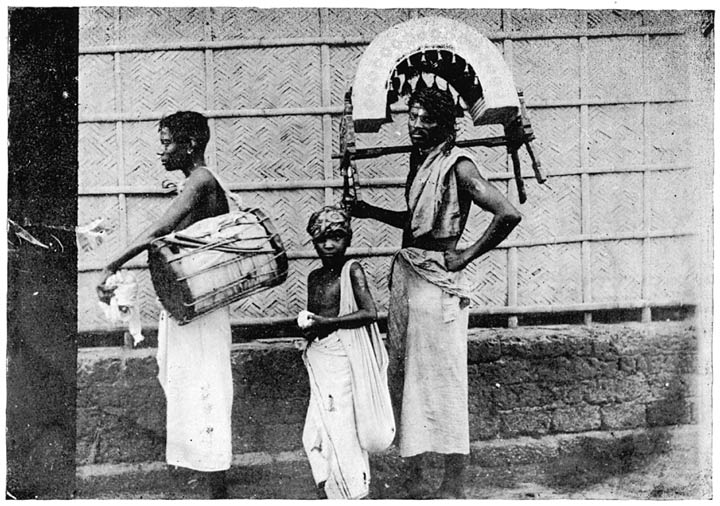
Palni pilgrim and Kavadi.
“A shrine,” Mr. Fawcett continues, “to which the Malayālis, Nāyars included, resort is that of Subramania at Palni in the north-west corner of the Madura district about a week’s march from the confines of Malabar near Palghat. Not only are vows paid to this shrine, but men, letting their hair grow for a year after their father’s death, proceed to have it cut there. The plate shows an ordinary Palni pilgrim. The arrangement which he is carrying is called a kāvadi. There are two kinds of kāvadi, a milk kāvadi containing milk, and a fish kāvadi containing fish, in a pot. The vow may be made in respect of either, each being appropriate to certain circumstances. When the time comes near for the pilgrim to start for Palni, he dresses in reddish orange cloths, shoulders his kāvadi, and starts out. Together with a man ringing a bell, and perhaps one with a tom-tom, with ashes on his face, he assumes the rôle of a beggar. The well-to-do are inclined to reduce the beggar period to the minimum; but a beggar every votary must be, and as a beggar he goes to Palni in all humbleness and humiliation, and there he fulfils his vow, leaves his kāvadi and his hair, and a small sum of money. Though the individuals about to be noticed were not Nāyars, their cases illustrate very well the religious idea of the Nāyar as expressed under certain circumstances, for between the Nāyars and these there is in this respect little if any difference. It was at Guruvayūr in November, 1895. On a high raised platform under a peepul tree were a number of people under vows, bound for Palni. A boy of 14 had suffered as a child from epilepsy, and seven years ago his father vowed on his behalf that, if he were cured, he would make the pilgrimage to Palni. He wore a string of beads round his neck, and a like string on his right arm. These were in some way connected with the vow. His head was bent, and he sat motionless under his kāvadi, leaning on the bar, which, when he carried it, rested on his shoulder. He could not go to Palni until it was revealed to him in a dream when he was to start. He had waited for this dream seven years, subsisting on roots (yams, etc.), and milk—no rice. Now he had had the long-looked-for dream, and was about to start. Another pilgrim was a man wearing an oval band of silver over the lower portion of the forehead, almost covering his eyes; his tongue protruding beyond the teeth, and kept in position by a silver skewer through it. The skewer was put in the day before, and was to be left in for forty days. He had been fasting for two years. He was much under the influence of his god, and whacking incessantly at a drum in delirious excitement. Several of the pilgrims had a handkerchief tied over the mouth, they being under a vow of silence. One poor man wore the regular instrument of silence, the mouth-lock—a wide silver band over the mouth, and a skewer piercing both cheeks. He sat patiently in a nice tent-like affair, about three feet high. People fed him with milk, etc., and he made no effort to procure food, relying merely on what was given him. The use of the mouth-lock is common with the Nāyars when they assume the pilgrim’s robes and set out for Palni; and I have often seen many of them garbed and mouth-locked, going off on a pilgrimage to that place. Pilgrims generally go in crowds under charge of a priestly guide, one who, having made a certain number of journeys to the shrine, wears a peculiar sash and other gear. They call themselves pūjāris, and are quite au fait with all the ceremonial prior to the journey, as well as with the exigencies of the road. As I stood there, one of these pūjāris stood up amidst the recumbent crowd. He raised his hands towards the temple a little to the west, and then spread out his hands as if invoking a blessing on the people around him. Full of religious fervour, he was (apparently at any rate) unconscious of all but the spiritual need of his flock.
“Brief mention must be made of the festival held at Kodungallūr near Cranganore in the northernmost corner of the Cochin State, as it possesses some strange features peculiar to Malabar, and is much frequented by the Nāyars. I have been disappointed in obtaining particulars of the festival, so make the following excerpt from Logan’s Manual of Malabar. ‘It takes the people in great crowds from their homes. The whole country near the lines of march rings with the shouts “Nada-a Nada-a” of the pilgrims to the favourite shrine. Of what takes place when the pilgrims reach this spot perhaps the less said the better. In their passage up to the shrine, the cry of “Nada-a Nada-a” (march, march away) is varied by terms of unmeasured abuse levelled at the goddess (a Bhagavati) of the shrine. This abusive language is supposed to be acceptable to her. On arrival at the shrine, they desecrate it in every conceivable way, believing that this too is acceptable; they throw stones and filth, howling volleys of opprobrium at her house. The chief of the fisherman caste, styled Kūli Muttatta Arayan, has the privilege of being the first to begin the work of polluting the Bhoot or shrine. Into other particulars it is unnecessary to enter. Cocks are slaughtered and sacrificed. The worshipper gets flowers only, and no holy water after paying his vows. Instead of water, he proceeds outside and drinks arrack or toddy, which an attendant Nāyar serves out. All castes are free to go, including Tiyars and low caste people. The temple was originally only a Bhoot or holy tree with a platform. The image in the temple is said to have been introduced only of recent years.’ It is a pity Mr. Logan is so reticent. My information is that the headman of the Mukkuvans opens the festival by solemnly making a fæcal deposit on the image. Here again there is the same strange union of everything that is filthy, abusive, foul and irreverent, with every mode of expressing the deepest religious feeling.”
“The month Karkkatakam,” Mr. Fawcett writes, “when the Malayālis say the body is cool, is the time when, according to custom, the Nāyar youths practice physical exercises. At Payōli in North Malabar, when I was there in 1895, the local instructor of athletics was a Paravan, a mason by caste. As he had the adjunct Kurup to his name, it took some time to discover the fact. Teachers of his ilk are invariably of the Paravan caste, and, when they are believed to be properly accomplished, they are given the honorific Kurup. So carefully are things regulated that no other person was permitted to teach athletics within the amsham (a local area, a small county), and his womenfolk had privileges, they only being the midwives who could attend on the Nāyar women of the amsham. His fee for a course of exercises for the month was ten rupees. He, and some of his pupils, gave an exhibition of their quality. Besides bodily contortions and somersaults, practiced in a long low-roofed shed having a sandy floor, there is play with the following instruments:—watta; cheruvadi, a short stick; and a stick like a quarter-staff called a sariravadi, or stick the length of one’s body. The watta is held in the right hand as a dagger; it is used to stab or strike and, in some ingenious way, turn over an opponent. The total length of the watta is two feet, and of the cheruvadi about three feet. The latter is squared at the ends, and is but a short staff. It is held in the right hand a few inches from the end, and is used for striking and guarding only. The sariravadi is held at or near one end by one or by both hands. The distance between the hands is altered constantly, and so is the end of the stick, which is grasped now by one, now by another end by either hand, as occasion may require; sometimes it is grasped in the middle. The performance with these simple things was astonishing. I should say the watta and the cheruvadi represented swords, or rather that they were used for initiation or practice in swordsmanship, when the Nāyars were the military element in Malabar. The opponents, who faced each other with the sariravadi or quarter-staff, stood thirty feet apart, and, as if under the same stimulus, each kicked one leg high in the air, gave several lively bounds in the air, held their staff horizontally in front with out-stretched arms, came down slowly on the haunches, placed the staff on the ground, bent over, and touched it with the forehead. With a sudden bound they were again on their feet, and, after some preliminary pirouetting, went for each other tooth and nail. The sword play, which one sees during festive ceremonies, such as a marriage or the like, is done by the hereditary retainers, who fight imaginary foes, and destroy and vanquish opponents with much contortion of body, and always indulge in much of this preliminary overture to their performance. There is always, by way of preliminary, a high kick in the air, followed by squatting on the haunches, bounding high, turning, twisting, pirouetting, and all the time swinging the sword unceasingly above, below, behind the back, under the arm or legs, in ever so many impossible ways. Nāyar shields are made of wood, covered with leather, usually coloured bright red. Within the boss are some hard seeds, or metal balls loose in a small space, so that there is a jingling sound like that of the small bells on the ankles of the dancer, when the shield is oscillated or shaken in the hand. The swords are those which were used ordinarily for fighting. There are also swords of many patterns for processional and other purposes, more or less ornamented about the handle, and half way up the blade.”
“The Nāyars,” Mr. N. Subramani Aiyar writes, “have a distinct feudal organisation, and the division of their territories had an unmistakeable reference to it. The territorial unit was the dēsam, presided over by a Dāsavazhi. A number of dēsams adjoining one another constituted a nādu, which was under the jurisdiction of a chieftain called the Nāduvazhi. Above the Nāduvazhis was the Rājah, the highest suzerain in the country. In course of time, each nādu split itself up into a certain number of taras, over the affairs of which a Karanavan, or elder, presided. An assembly of these Karanavans constituted the six hundred—an old socio-military organisation of the Nāyars in mediæval times. These six hundred are referred to in two places in the second Syrian Christian document, which bears the date 925 A.D. In a South Travancore inscription, dated 371 M.E., the same organisation is referred to as Venattarunuru, or the six hundred of Venad, and one of their duties evidently related to the supervision of the working of temples and charitable institutions connected therewith. As Venad was divided into eighteen districts in ancient days, there might have been altogether eighteen six hundred in the country. The Nāduvazhis possessed considerable authority in all social matters and possessed enough lands to be cultivated by their Kudiyans. A feudal basis was laid for the whole organisation. Large numbers served as soldiers in times of war, and cultivated their lands when the country was quiet. In modern times, none of them take to military service in Travancore, except those employed as sepoys in the Nāyar Brigade.”
The occupation of the Nāyars is described by Mr. N. Subramani Aiyar as “comprising all kinds of worldly pursuits. So late as the end of the eighteenth century, there were with the then Mahārāja of Travancore a hundred thousand soldiers, consisting of Nāyars and Chovas, armed with arrows, spears, swords and battle-axes. The chief occupation of the Nāyars is agriculture. Cultivation of a slipshod, time-honoured type is the forte of the Nāyar, for which he has always found time from times of old, though engaged in other occupations as well. In the Velakali, a kind of mock fight, which is one of the items of the utasom programme in every important temple in Malabar, the dress worn by the Nāyars is supposed to be their ancient military costume. Even now, among the Nāyars who form the Mahārāja’s own Brigade, agriculture, to which they are enabled to attend during all their off-duty days, goes largely to supplement their monthly pay. Various other occupations, all equally necessary for society, have been, according to the Kēralavakasakrama, assigned to the Nāyars, and would seem to have determined their original sub-divisions. They are domestic servants in Brāhman and Kshatriya houses and temples, and deal in dairy produce, as well as being engaged in copper-sheet roofing, tile-making, pottery, palanquin-bearing, and so on. But these traditional occupations are fast ceasing under the ferment of a new civilisation. In the matter of education, the Nāyars occupy a prominent position. Almost every Nāyar girl is sent to the village school to learn the three R’s, quite as much as a matter of course as the schooling of boys. This constitutes a feature of Malabar life that makes it the most literate country in all India, especially in respect of the female sex. After Rāmanujam Ezhuttachchan developed and enriched the Malayālam language, numerous Asans or village teachers came into existence in different parts of Malabar. After a preliminary study of Malayālam, such as desired higher, i.e., Sanskrit education, got discipled to an Ambalavāsi or a Sastri. Even to-day the estimable desire to study Sanskrit is seen in some Nāyar youths, who have readily availed themselves of the benefit of the local Sanskrit college. In respect of English education, the Nāyars occupy a prominent position. The facility afforded by the Government of Travancore for the study of English is being largely availed of by Nāyars, and it is a matter deserving to be prominently recorded that, in recent years, several Nāyar girls have passed the Matriculation examination of the University of Madras.”
It is noted, in the Gazetteer of Malabar, that “the Nāyars as a class are the best educated and the most advanced of the communities in Malabar (excepting perhaps the Pattar Brāhmans, who are not strictly a Malayālam class), and are intellectually the equals of the Brāhmans of the East Coast. Many of them have risen to the highest posts in Government, and the caste has supplied many of the leading members of the learned professions.”
Nāyi (dog).—An exogamous sept of Kuruba.
Nāyinar.—Nāyinar, Nāyanar, or Nainar, has been recorded as a section of Vellālas, who are thought to be descended from Jains who were converted to Hinduism, and as a title of Jains, Kaikōlans, Pallis, and Udaiyāns. Nāyanikulam occurs as a synonym of Bōya. The word Nāyinar is the same as Nāyaka, meaning lord or master, and the Saivite saints, being religious teachers, are so called, e.g., Sundara Mūrti Nāyanar.
Nāyinda.—Recorded, in the Mysore Census Report, 1901, as the name of a caste, which follows the hereditary occupation of barber, and also of agriculture. “They are,” it is there said, “members of the village hierarchy. They are paid, like the Agasa (washerman), in kind for their services. They are also fiddlers, and have the exclusive right of wind instruments. They are known as Kēlasiga or Hajām. They are both Saivites and Vaishnavites. A section of them wear the lingam, and follow Lingayetism. They are known as Silavanta. These people are largely in requisition at feasts, marriages, etc., when they form the music band.” Kelasi is the name of a Canarese barber caste, and Hajām is a Hindustani word for barber.
Nedungādi.—This name, denoting a settlement in Nedunganād in the Walluvanād taluk of Malabar, has been returned as a sub-caste of Nāyars and Sāmantas.
Nekkāra.—A small class of washermen in South Canara. The women only are said to do the washing, while the men are employed as devil-dancers.
Nellika (Phyllanthus Emblica).—An illam of Tiyan.
Nellu (paddy, unhusked rice).—A gōtra of Kurni.
Nemilli (peacock).—An exogamous sept of Bōya and Balija.
Nērali (Eugenia Jambolana).—An exogamous sept of Gangadikāra Holeya.
Nerati.—Nerati or Neravati is a sub-division of Kāpu.
Nēse.—An occupational term, meaning weaver applied to several of the weaving castes, but more especially to the Kurnis. It is noted, in the Madras Census Report, 1901, that “in the inscriptions of Rāja Rāja the Chōla king, about the beginning of the eleventh century, the Paraiyan caste is called by its present name. It had then two sub-divisions, Nesavu (the weavers) and Ulavu (the ploughman).”
Nettikōtala.—In a note on the Nettikōtalas or Neththikōtalasi, Mr. C. Hayavadana Rao writes that they correspond to the Kalladi Siddhans of the Tamil country. The name means those who cut their foreheads. They are mendicants who beg from Gavara Kōmatis, whom they are said to have assisted in days of old by delaying the progress of Rāja Vishnu Vardhana. (See Kōmati.) When their dues are not promptly paid, they make cuts in their foreheads and other parts of the body, and make blood flow.
Nēyigē.—The silk and cotton hand-loom weavers of the Mysore Province are, in the Census Report, 1891, dealt with collectively under the occupational name Nēyigē (weaving), which includes Bilimagga, Dēvānga, Khatri, Patvēgar, Sāle, Saurāshtra (Patnūlkāran), Sēniga and Togata.
Neytikkar.—Weavers of coir (cocoanut fibre) mats in Malabar.
Nēyyala.—The Nēyyala are a Telugu fishing caste found chiefly in Vizagapatam and Ganjam, for the following note on whom I am indebted to Mr. C. Hayavadana Rao. The name is derived from the Telugu nēyyalu, meaning fried rice or cholam (Sorghum vulgare), which is made by female members of the caste, especially during the harvest season, into balls with jaggery (crude sugar). These are carried about the country by the men for sale to those engaged in reaping the crop and others. As payment, they receive from, the reapers a portion of the grain which they are cutting. A further occupation of the caste is fishing with konti vala, or koyyala vala i.e., nets supported on a row of bamboo sticks, which are placed in shallow water, and dragged by two men.
The Nāga (cobra) is reverenced by the caste. A Brāhman officiates at marriages, during which the sacred thread is worn. The remarriage of widows is permitted, provided that the woman has no children by her first husband. Divorce is not allowed. The dead are burnt, and the chinna (little) and pedda rōzu (big day) death ceremonies are observed.
As a caste, the Nēyyalas do not drink intoxicating liquor, and eat only in Brāhman houses. Their usual title is Ayya.
Nēyye (clarified butter).—An occupational sub-division of Kōmati.
Nīla (blue).—An exogamous sept of Mēdara.
Nīlagāra (indigo people).—The name of a class of dyers, who are, in the Mysore Census Report, 1901, included in the Kumbāra or potter caste.
Nīli (indigo).—An exogamous sept of Padma Salē and Togata.
Nirganti.—Recorded, in the Mysore and Coorg Gazetteer, as a regulator and distributor of water to irrigated lands. He is usually a Holeya by caste.
Nirpūsi (wearers of sacred ashes).—Recorded, at times of census, as a sub-division of Pāndya Vellālas. Nīrpūsi Vellāla is described, in the Gazetteer of the South Arcot district, as a name current in the South Arcot district meaning Vellālas who put on holy ash, in reference to certain Jains, who formerly became Saivites taking off their sacred threads, and putting holy ashes on their foreheads.
Nityadāsu.—Nityadāsu, or Nityulu, meaning immortal slaves, is a name by which some Māla Dāsaris style themselves.
Nodha.—Recorded, in the Madras Census Report, 1901, as a very small caste of hill cultivators and earth-workers in the Oriya country.
Nōkkan.—The Nōkkans, who often go by the name of Jādipillais (children of the caste), are a class of mendicants, who beg from members of the Palli caste. The word Nōkkan is said to mean ‘he who looks’. The Nōkkans make periodical visits to villages where Pallis live, and receive from them a small fee in money. They attend at Palli marriages, and, during processions, carry flags (palempores) bearing devices of Hanumān, tigers, Agni, etc., which are made at Kālahasti.
The Nōkkans claim fees from the Pallis, because one of their ancestors helped them. The legend runs as follows. During the reign of a Palli king at Conjeeveram, a car, bearing the idol of the god, stood still, and could not be moved. A human sacrifice was considered necessary, but no one would offer himself as a victim. A Nōkkan came forward, and allowed his only daughter, who was pregnant, to be sacrificed. Pleased at his behaviour, the king ordered that the Pallis should in future treat the Nōkkans as their Jādipillais. Some Nōkkans say that they were presented with copper-grants, one of which is reputed to be in the possession of one Nōkka Ramaswāmi of Mulavāyal village in the Ponnēri tāluk of the Chingleput district.
In the course of their rounds, the Nōkkans repeat the story of the origin of the Pallis, one version of which runs as follows. Two Asuras, Vāthāpi and Enādhapi, who were ruling at Ratnagiripatnam, obtained at the hands of Siva, by means of severe tapas (penance), the following boon. No child should die within their dominions, and the Asuras should be invincible, and not meet their death at the hands of uterine-born beings. The Dēvatas and others, unable to bear the tyranny of the Asuras, prayed to Brahma for rescue. He directed them to the Rishi Jambuvamuni, who was doing penance on the banks of the river Jumna. This Rishi is said to have married a woman named Āsendi, who was born from the cheeks of Parvati. Hearing the request of the Dēvatas, the Rishi lighted the sacred fire, and therefrom arose a being called Rūdra Vanniyan, and forty other warriors, including Nīlakanta, Gangabala, and Vajrabāhu. The Pallis are descended from these fire-born heroes. (See Palli)
Nōkkans wear the sacred thread, and carry with them a big drum and a gourd pipe like that used by snake-charmers.
Noliya.—A synonym used by Oriya castes for the Telugu Jalāris.
Nonaba.—A territorial sub-division of Vakkaliga. The name is derived from Nonambavādi, one of the former great divisions of the Tanjore country.
Nōttakāran.—The office of village Nōttakāran, or tester, has been abolished in modern times. It was generally held by a goldsmith, whose duty was to test the rupees when the land revenue was being gathered in, and see that they were not counterfeit.
Nuchchu (broken rice).—A gōtra of Kurni.
Nūkala (coarse grain powder).—An exogamous sept of Padma Sālē.
Nulayan.—In the Madras Census Report, 1901, ninety-six individuals are recorded as belonging to a small caste of Malayālam fishermen and boatmen. The Nulayans are found in Travancore, and were returned in the census of Malabar, as the two small British settlements of Anjengo and Tangacheri in Travancore are under the jurisdiction of the Collector of Malabar.
Nūnē (oil).—An occupational sub-division of Kōmati.
Nunia (nuno, salt).—A sub-division of Odiya.
Nūrankurup.—An occupational name for Paravans settled in Malabar, whose employment is that of lime-burners (nūru, lime).
Nūrbāsh.—Recorded, at the census, 1901, as a synonym of Dūdēkula. A corruption of nūrbaf (weaving).
Nūvvala (gingelly: Sesamum indicum).—An exogamous sept of Kamma and Mēdara. Gingelly seeds, from which an oil is extracted, “form an essential article of certain religious ceremonies of the Hindus, and have therefore received the names of hōma-dhānya or the sacrificial grain, and pitri-tarpana or the grain that is offered as an oblation to deceased ancestors.” (U. C. Dutt.) During the death ceremonies of some Brāhmans, libations of water mixed with gingelly seeds, called tīlothakam, and a ball of rice, are offered daily to two stones representing the spirit of the deceased.
Nyāyam (justice).—An exogamous sept of Padma Sālē.