Volume 5 — N (continued 3)
Reading edition
A photograph by Mr. F. Fawcett shows a young man with a ring hanging round his neck, as a sign that he was still unattached. But he was soon about to part with it, for a present of a rupee enabled him to find a girl, and fix up a marriage, within two days.
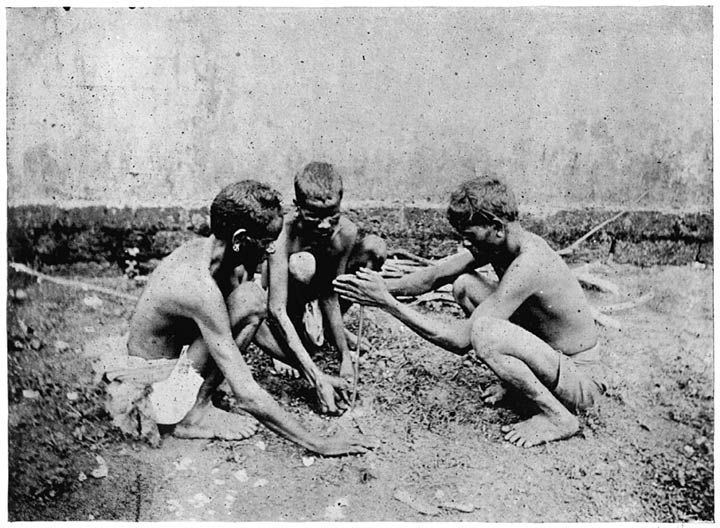
Nāyādis making fire.
Adultery is regarded with abhorrence, and there is a belief that those who are guilty of it are liable to be attacked by wild beasts or demons. On the occasion of the marriage of a divorced woman’s son or daughter, the mother attends the festivities, if she receives a cordial invitation from her children. But she does not look her former husband straight in the face, and returns to her home the same evening.
The chief gods of the Nāyādis are Mallan, Malavazhi, and Parakutti, to whom offerings of toddy, rice, and the flesh of monkeys are made. Parakutti it is who aids them in their hunting expeditions, bringing the game to them, and protecting them from wild beasts. If they do not succeed in bagging the expected game, they abuse him.
The Nāyādis are also ancestor worshippers, and keep representations of the departed, to which offerings of rice and toddy are made during the Ōnam, Vishu, and other festivals. Beneath a mango tree in a paramba (garden) were forty-four stones set up in a circle round the tree. One of the stones was a beli-kal (beli stone), such as is placed round the inner shrines of temples. The remainder resembled survey stones, but were smaller in size. The stones represented forty-four Nāyādis, who had left the world. On the ceremonial occasions referred to above, a sheep or fowl is killed, and the blood allowed to fall on them, pūja (worship) is performed, and solemn prayers are offered that the souls of the departed may protect them against wild beasts and snakes. A Nāyādi asserted that, if he came across a tiger, he would invoke the aid of his ancestors, and the animal would be rendered harmless.
Whenever the Nāyādis labour under any calamity or disease, they consult the Parayan astrologer. And, when a woman is possessed by devils, the Parayan is summoned. He is furnished with a thread and some toddy. Muttering certain prayers to Parakutti and other deities, he ties the thread round the woman’s neck, drinks the toddy, and the devil leaves her. When a person is believed to be under the influence of a devil or the evil eye, salt, chillies, tamarind, oil, mustard, cocoanut, and a few pice (copper coins) in a vessel are waved thrice round the head of the affected individual, and given to a Nāyādi, whose curse is asked for. There is this peculiarity about a Nāyādi’s curse, that it always has the opposite effect. So, when he is asked to curse one who has given him alms, he does so by invoking misery and evil upon him. By the Nāyādi money is called chembu kāsu (copper coin), food elamāttam (exchange of leaves), and having no food nakkān illa (nothing to lick on). As a protection against snake-bite, the Nāyādis wear a brass toe-ring. And, when engaged in catching rats in their holes, they wear round the wrist a snake-shaped metal ring, to render them safe against snakes which may be concealed in the hole.
The Nāyādis who live within the jurisdiction of the Kavalapāra Nāyar near Shoranūr wear the kudumi (front lock of hair), as there are no Māppillas (Muhammadans) to molest them. The Kavalapāra Nāyar was at one time an important chief, and directed all Nambūtiri jenmis (landlords) who held land within his jurisdiction to bind themselves not to let the land to Māppillas. Nāyādis of other parts are not allowed by the Māppillas to wear the kudumi, and, if they do so, they are taken for Parayans and professional sorcerers, and beaten.
Some Nāyādis have become converts to Christianity, others to Muhammadanism, and maintain themselves by begging for alms from Muhammadans. They are called Thoppyitta (cap-wearing) Nāyādis.
Average height, 155 cm.; nasal index, 86.
’Poliar the labouring lower clans are named:
By the proud Nayrs the noble rank is claimed;
The toils of culture and of art they scorn:
The shining faulchion brandish’d in the right—
Their left arm wields the target in the fight’—
went on to observe: ‘These lines, and especially the two last, contain a good description of a Nayr, who walks along, holding up his naked sword with the same kind of unconcern as travellers in other countries carry in their hands a cane or walking staff. I have observed others of them have it fastened to their back, the hilt being stuck in their waist band, and the blade rising up and glittering between their shoulders’ (Asiatic Researches, V. 10, 18). M. Mahé de la Bourdonnais, who had some experience of their fighting qualities in the field, thus described them: ‘Les Nairs sont de grands hommes basanés, légers, et vigoureux: Ils n’ont pas d’autre profession que celle des armes, et seraient de fort bons soldats, s’ils étiaent disciplinés: mais ils combattent sans ordre, ils prennent la fuite dès qu’on les serre de près avec quelque supèrioritê; pourtant, s’ils se voient pressés avec vigueur et qu’ils se croient en danger, ils reviennent à la charge, et ne se rendent jamais’ (M. Esquer, Essai sur les Castes dans l’Inde, page 181). Finally, the only British General of any note—Sir Hector Munro—who had ever to face the Nāyars in the field, thus wrote of their modes of fighting:—
“Some,” Mr. N. Subramani Aiyar writes in a note on the Nāyars of Travancore, “believe that Nāyar is derived from Nāga (serpents), as the Aryans so termed the earlier settlers of Malabar on account of the special adoration which they paid to snakes. The Travancore Nāyars are popularly known as Malayāla Sūdras—a term which contrasts them sharply with the Pāndi or foreign Sūdras, of whom a large number immigrated into Travancore in later times. Another name by which Nāyars are sometimes known is Malayāli, but other castes, which have long inhabited the Malayālam country, can lay claim to this designation with equal propriety. The most general title of the Nāyars is Pillai (child), which was once added to the names of the Brāhman dwellers in the south. It must, in all probability, have been after the Brāhmans changed their title to Aiyar (father), by which name the non-Brāhman people invariably referred to them, that Sūdras began to be termed Pillai. We find that the Vellālas of the Tamil country and the Nāyars of Travancore called themselves Pillai from very early times. The formal ceremony of paying down a sum of money, and obtaining a distinction direct from the Sovereign was known as tirumukham pitikkuka, or catching the face of the king, and enabled the recipients to add, besides the honorary suffix Pillai, the distinctive prefix Kanakku, or accountant, to their name. So important were the privileges conferred by it that even Sanku Annavi, a Brāhman Dalava, obtained it at the hand of the reigning Mahārāja, and his posterity at Vempannūr have enjoyed the distinction until the present day. The titles Pillai and Kanakku are never used together. The name of an individual would be, for example, either Krishna Pillai or Kanakku Rāman Krishnan, Rāman being the name of the Karanavan or the maternal uncle. A higher title, Chempakaraman, corresponds to the knighthood of mediæval times, and was first instituted by Mahārāja Marthanda Varma in memory, it is said, of his great Prime Minister Rāma Aiyyan Dalawa. The individual, whom it was the king’s pleasure to honour, was taken in procession on the back of an elephant through the four main streets of the fort, and received by the Prime Minister, seated by his side, and presented with pānsupāri (betel). Rare as this investiture is in modern times, there are many ancient houses, to which this title of distinction is attached in perpetuity. The title Kanakku is often enjoyed with it, the maternal uncle’s name being dropped, e.g., Kanakku Chempakaraman Krishnan. Tambi (younger brother) is another title prevalent in Travancore. It is a distinctive suffix to the names of Nāyar sons of Travancore Sovereigns. But, in ancient times, this title was conferred on others also, in recognition of merit. Tambis alone proceed in palanquins, and appear before the Mahārāja without a head-dress. The consorts of Mahārājas are selected from these families. If a lady from outside is to be accepted as consort, she is generally adopted into one of these families. The title Karta, or doer, appears also to have been used as a titular name by some of the rulers of Madura. [At the Madras census, 1901, Kartākkal was returned by Balijas claiming to be descendants of the Nāyak kings of Madura and Tanjore.] The Tekkumkur and Vadakkumkur Rājas in Malabar are said to have first conferred the title Karta on certain influential Nāyar families. In social matters the authority of the Karta was supreme, and it was only on important points that higher authorities were called on to intercede. All the Kartas belong to the Illam sub-division of the Nāyar caste. The title Kuruppu, though assumed by other castes than Nāyars, really denotes an ancient section of the Nāyars, charged with various functions. Some were, for instance, instructors in the use of arms, while others were superintendents of maid-servants in the royal household. Writing concerning the Zamorin of Calicut about 1500 A.D., Barbosa states that “the king has a thousand waiting women, to whom he gives regular pay, and they are always at the court to sweep the palaces and houses of the king, and he does this for the State, because fifty would be enough to sweep.” When a Mahārāja of Travancore enters into a matrimonial alliance, it is a Kuruppu who has to call out the full title of the royal consort, Panappillai Amma, after the presentation of silk and cloth has been performed. The title Panikkar is derived from pani, work. It was the Panikkars who kept kalaris, or gymnastic and military schools, but in modern times many Panikkars have taken to the teaching of letters. Some are entirely devoted to temple service, and are consequently regarded as belonging to a division of Mārans, rather than of Nāyars. The title Kaimal is derived from kai, hand, signifying power. In former times, some Kaimals were recognised chieftains, e.g., the Kaimal of Vaikkattillam in North Travancore. Others were in charge of the royal treasury, which, according to custom, could not be seen even by the kings except in their presence. “Neither could they,” Barbosa writes, “take anything out of the treasury without a great necessity, and by the counsel of this person and certain others.” The titles Unnithan and Valiyathan were owned by certain families in Central Travancore, which were wealthy and powerful. They were to some extent self-constituted justices of the peace, and settled all ordinary disputes arising in the kara where they dwelt. The title Menavan, or Menon, means a superior person, and is derived from mel, above, and avan he. The recipient of the title held it for his lifetime, or it was bestowed in perpetuity on his family, according to the amount of money paid down as atiyara. As soon as an individual was made a Menon, he was presented with an ola (palmyra leaf for writing on) and an iron style as symbols of the office of accountant, which he was expected to fill. In British Malabar even now every amsam or revenue village has an accountant or writer called Menon. The title Menokki, meaning one who looks over or superintends, is found only in British Malabar, as it was exclusively a creation of the Zamorin. [They are, I gather, accountants in temples.]
“There are numerous sub-divisions comprised under the general head Nāyar, of which the most important, mentioned in vernacular books, are Kiriyam, Illam, Svarupam, Itacheri or Idacheri, Pallichan, Ashtikkurichchi, Vattakātan, Otatu, Pulikkal, Vyapari, Vilakkitalavan, and Veluthetan. Of these Ashtikkurichchi and Pulikkal are divisions of Mārān, Vyapari is a division of Chettis, and Vilakkitalavan and Veluthetan are barbers and washermen respectively.
“The chief divisions of Nāyars, as now recognised, are as follows:—
1. Kiriyam, a name said to be a corruption of the Sanskrit griha, meaning house. This represents the highest class, the members of which were, in former times, not obliged to serve Brāhmans and Kshatriyas.
2. Illakkar.—The word illam indicates a Nambūtiri Brāhman’s house, and tradition has it that every illam family once served an illam. But, in mediæval times, any Nāyar could get himself recognised as belonging to the Illam division, provided that a certain sum of money, called adiyara, was paid to the Government. The Illakkar are prohibited from the use of fish, flesh, and liquor, but the prohibition is not at the present day universally respected. In some parts of Malabar, they have moulded many of their habits in the truly Brāhmanical style.
3. Svarupakkar.—Adherents of the Kshatriya families of Travancore. The members of the highest group, Parūr Svarupam, have their purificatory rites performed by Mārāns. It is stated that they were once the Illakkar servants of one Karuttetathu Nambutiri, who was the feudal lord of Parūr, and afterwards became attached to the royal household which succeeded to that estate, thus becoming Parūr Svarupakkar.
4. Padamangalam and Tamil Padam were not originally Nāyars, but immigrants from the Tamil country. They are confined to a few localities in Travancore, and until recently there was a distinctive difference in regard to dress and ornaments between the Tamil Padam and the ordinary Nāyars. The occupation of the Padamangalakkar is temple service, such as sweeping, carrying lamps during processions, etc. The Tamil Padakkar are believed to have taken to various kinds of occupation, and, for this reason, to have become merged with other sections.
5. Vāthi or Vātti.—This name is not found in the Jatinirnaya, probably because it had not been differentiated from Mārān. The word is a corruption of vāzhti, meaning praying for happiness, and refers to their traditional occupation. They use a peculiar drum, called nantuni. Some call themselves Daivampatis, or wards of God, and follow the makkathāyam system of inheritance (in the male line).
6. Itacheri or Idacheri, also called Pantaris in South Travancore. They are herdsmen, and vendors of milk, butter and curds. The name suggests a relation of some kind to the Idaiyan caste of the Tamil country.
7. Karuvelam, known also by other names, such as Kappiyara and Tiruvattar. Their occupation is service in the palace of the Mahārāja, and they are the custodians of his treasury and valuables. Fifty-two families are believed to have been originally brought from Kolathanād, when a member thereof was adopted into the Travancore royal family.
8. Arikuravan.—A name, meaning those who reduced the quantity of rice out of the paddy given to them to husk at the temple of Kazhayakkuttam near Trivandrum, by which they were accosted by the local chieftain.
9. Pallichchan.—Bearers of palanquins for Brāhmans and Malabar chieftains. They are also employed as their attendants, to carry their sword and shield before them.
10. Vandikkāran.—A name, meaning cartmen, for those who supply fuel to temples, and cleanse the vessels belonging thereto.
11. Kuttina.—The only heiress of a Svarupam tarwad is said to have been a maid-servant in the Vadakketam Brāhman’s house, and her daughter’s tāli-kettu ceremony to have been celebrated in her master’s newly-built cowshed. The bride was called kuttilachchi, or bride in a cowshed, and her descendants were named Kuttina Nāyars. They intermarry among themselves, and, having no priests of their own, obtain purified water from Brāhmans to remove the effects of pollution.
12. Matavar.—Also known as Puliyattu, Veliyattu, and Kāllur Nāyars. They are believed to have been good archers in former times.
13. Otatu, also called Kusa. Their occupation is to tile or thatch temples and Brāhman houses.
14. Mantalayi.—A tract of land in the Kalkulam taluk, called Mantalachchi Konam, was granted to them by the State. They are paid mourners, and attend at the Trivandrum palace when a death occurs in the royal family.
15. Manigrāmam.—Believed to represent Hindu recoveries from early conversion to Christianity. Manigrāmam was a portion of Cranganore, where early Christian immigrants settled.
16. Vattaykkatan, better known in Travancore as Chakala Nāyars, form in many respects the lowest sub-division. They are obliged to stand outside the sacrificial stones (balikallu) of a sanctuary, and are not allowed to take the title Pillai. Pulva is a title of distinction among them. One section of them is engaged in the hereditary occupation of oil-pressing, and occupies a lower position in the social scale than the other.”
Kiriyattil. Sudra. Kurup. Nambiyar. Urāli. Nalliōden. Viyyūr. Akattu Charna. Purattu Charna. Vattakkād. Vangilōth. Kitāvu. Pallichan. Muppathināyiran. Vīyāpāri or Rāvāri. Attikurissi. Manavalan. Adungādi. Adiōdi. Amayengolam.
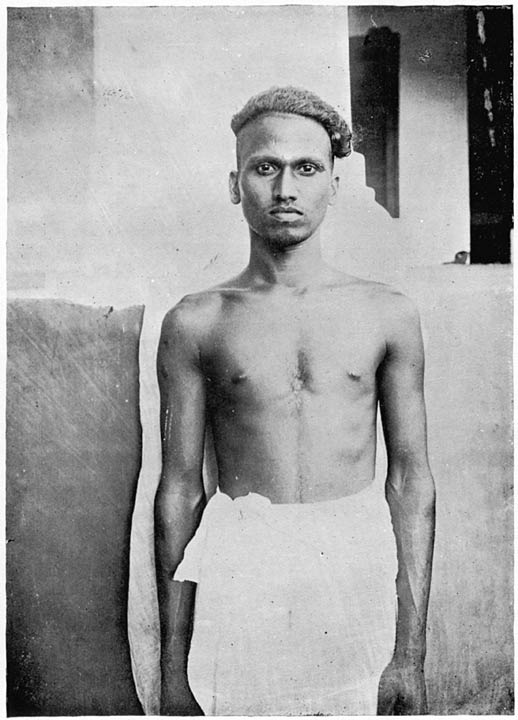
Akattucharna Nāyar.
The complexity of the sub-divisions among the Nāyars in North Malabar is made manifest by the following account thereof in the Gazetteer of Malabar. “There are exogamous sub-divisions (perhaps corresponding to original tarwāds) called kulams, and these are grouped to form the sub-castes which are usually endogamous. It is quite impossible to attempt a complete account of the scheme, but to give some idea of its nature one example may be taken, and dealt with in some detail; and for this purpose the portion of Kurumbranād known as Payyanād will serve. This is the country between the Kōttapuzha and Pōrapuzha rivers, and is said to have been given by a Rāja of Kurumbranād to a certain Ambādi Kōvilagam Tamburātti (the stānam or title of the senior lady of the Zāmorin Rāja’s family). In this tract or nād there were originally six stānis or chieftains, who ruled, under the Rāja, with the assistance, or subject to the constitutional control, of four assemblies of Nāyars called Kūttams. Each kūttam had its hereditary president. In this tract there are seven groups of kulams. The highest includes twelve kulams, Vengalat, Pattillat, Vīyyūr, Nelliōt, Atunkudi, Amayangalat, Nellōli, Nilanchēri, Rendillat, Pulliyāni, Orakātteri, and Venmēri. Of these, the Pattillat and Rendillat (members of the ten and members of the two illams or houses) affix the title Adiyōdi to their names, the last three affix the title Nambiyar, and the rest affix Nāyar. Of the six stānis already mentioned, three, with the title of Adiyōdi, belong to the Vengalat kulam, while two of the presidents of kūttams belonged to the Pattillat kulam. The younger members of the stāni houses are called kidavu. It is the duty of women of Viyyūr and Nelliōt kulams to join in the bridal procession of members of the Vengalat kulam, the former carrying lamps, and the latter salvers containing flowers, while the Rendillat Adiyōdis furnish cooks to the same class. Pattillat Adiyōdis and Orakātteri Nambiyars observe twelve days’ pollution, while all the other kulams observe fifteen. The second group consists of six kulams, Eravattūr, Ara-Eravattūr (or half Eravattūr), and Attikōdan Nāyars, Tonderi Kidāvus, Punnan Nambiyars, and Mēnōkkis. All these observe fifteen days’ pollution. The third group consists of three kulams, Tacchōli to which the remaining three stānis belong, Kōthōli, and Kuruvattānchēri. All affix Nāyar to their names, and observe fifteen days’ pollution. The fourth group consists of three kulams, Peruvānian Nambiyars, Chellādan Nāyars, and Vennapālan Nāyars. All three observe fifteen days’ pollution. The name Peruvānian means great or principal oil-man; and it is the duty of this caste to present the Kurumbranād Rāja with oil on the occasion of his formal installation. The fifth group consists of the three kulams, Mannangazhi, Paramchela, and Pallikara Nāyars, all observing fifteen days’ pollution. A member of the first-named class has to place an āmanapalaga (the traditional seat of Nambūdiris and other high castes) for the Kurumbranād Rāja to sit on at the time of his installation, while a member of the second has to present him with a cloth on the same occasion. The sixth group consists of four kiriyams named Patam, Tulu, Manan, and Ottu respectively, and has the collective name of Rāvāri. The seventh group consists of six kulams, Kandōn, Kannankōdan, Kotta, Karumba, Kundakollavan, and Panakādan Nāyars. All observe fifteen days’ pollution, and the women of these six kulams have certain duties to perform in connection with the purification of women of the Vengalat, Pattillat, and Orakatteri kulams. Besides these seven groups, there are a few other classes without internal sub-divisions. One such class is known as Pāppini Nāyar. A woman of this class takes the part of the Brāhmini woman (Nambissan) at the tāli-kettu kalyanam of girls belonging to the kulams included in the third group. Another class called Pālattavan takes the place of the Attikurissi Nāyar at the funeral ceremonies of the same three kulams.”
In illustration of the custom of polyandry among the Nāyars of Malabar in by-gone days, the following extracts may be quoted. “On the continent of India,” it is recorded in Ellis’ edition of the Kural, “polyandry is still said to be practiced in Orissa, and among particular tribes in other parts. In Malayālam, as is well known, the vision of Plato in his ideal republic is more completely realised, the women among the Nāyars not being restricted to family or number, but, after she has been consecrated by the usual rites before the nuptial fire, in which ceremony any indifferent person may officiate as the representative of her husband, being in her intercourse with the other sex only restrained by her inclinations; provided that the male with whom she associates be of an equal or superior tribe. But it must be stated, for the glory of the female character, that, notwithstanding the latitude thus given to the Nāyattis, and that they are thus left to the guidance of their own free will and the play of their own fancy (which in other countries has not always been found the most efficient check on the conduct of either sex), it rarely happens that they cohabit with more than one person at the same time. Whenever the existing connexion is broken, whether from incompatibility of temper, disgust, caprice, or any of the thousand vexations by which from the frailty of nature domestic happiness is liable to be disturbed, the woman seeks another lover, the man another mistress. But it mostly happens that the bond of paternity is here, as elsewhere, too strong to be shaken off, and that the uninfluenced and uninterested union of love, when formed in youth, continues even in the decline of age.”
In his “New Account of the East Indies, (1727)” Hamilton wrote: “The husbands,” of whom, he said, there might be twelve, but no more at one time, “agree very well, for they cohabit with her in their turns, according to their priority of marriage, ten days more or less according as they can fix a term among themselves, and he that cohabits with her maintains her in all things necessary for his time, so that she is plentifully provided for by a constant circulation. When the man that cohabits with her goes into her house he leaves his arms at the door, and none dare remove them or enter the house on pain of death. When she proves with child, she nominates its father, who takes care of his education after she has suckled it, and brought it to walk or speak, but the children are never heirs to their father’s estate, but the father’s sister’s children are.”
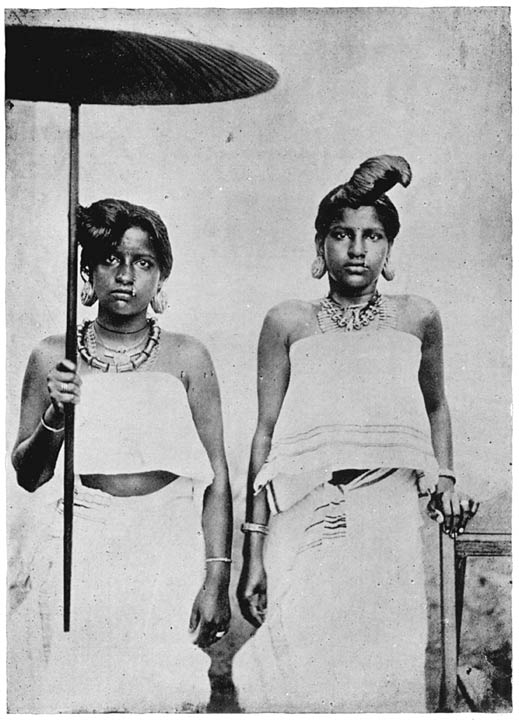
Nāyar females.
Of the tāli-kattu kalyānam in Malabar, the following detailed account, mainly furnished by an Urāli Nāyar of Calicut, is given in the Gazetteer of Malabar. “An auspicious time has to be selected for the purpose, and the preliminary consultation of the astrologer is in itself the occasion of a family gathering. The Manavālan or quasi-bridegroom is chosen at the same time. For the actual kalyānam, two pandals (booths), a small one inside a large one, are erected in front of the padinhātta macchu or central room of the western wing. They are decorated with cloth, garlands, lamps and palm leaves, and the pillars should be of areca palm cut by an Asāri on Sunday, Monday, or Wednesday. The first day’s ceremonies open with a morning visit to the temple, where the officiating Brāhman pours water sanctified by mantrams (religious formulæ), and the addition of leaves of mango, peepul and darbha, over the girl’s head. This rite is called kalasam maduga. The girl then goes home, and is taken to the macchu, where a hanging lamp with five wicks is lighted. This should be kept alight during all the days of the kalyānam. The girl sits on a piece of pala (Alstonia scholaris) wood, which is called a mana. She is elaborately adorned, and some castes consider a coral necklace an essential. In her right hand she holds a vāalkannādi (brass hand mirror), and in her left a charakkal (a highly ornate arrow). In front of the girl are placed, in addition to the five-wicked lamp and nirachaveppu, a metal dish or talam of parched rice, and the eight lucky things known as ashtamangalyam. A woman, termed Brahmini or Pushpini, usually of the Nambissan caste, sits facing her on a three-legged stool (pidam), and renders appropriate and lengthy songs, at the close of which she scatters rice over her. About midday there is a feast, and in the evening songs in the macchu are repeated. Next morning, the ceremonial in the macchu is repeated for the third time, after which the paraphernalia are removed to the nearest tank or to the east of the household well, where the Pushpini sings once more, goes through the form of making the girl’s toilet, and ties a cocoanut frond round each of her wrists (kappōla). The girl has then to rise and jump over a kindi (vessel) of water with an unhusked cocoanut placed on the top, overturning it the third time. The party then proceed to the pandal, two men holding a scarlet cloth over the girl as a canopy, and a Chāliyan (weaver) brings two cloths (kōdi vastiram), which the girl puts on. In the evening, the previous day’s ceremonial is repeated in the macchu. The third day is the most important, and it is then that the central act of the ceremony is performed. For this the girl sits in the inner pandal richly adorned. In some cases she is carried from the house to the pandal by her karnavan or brother, who makes a number of pradakshinams round the pandal (usually 3 or 7) before he places her in her seat. Before the girl are the various objects already specified, and the hymeneal ditties of the Pushpini open the proceedings. At the auspicious moment the Manavālan arrives in rich attire. He is often preceded by a sort of body guard with sword and shield who utter a curious kind of cry, and is met at the gate of the girl’s house by a bevy of matrons with lamps and salvers decorated with flowers and lights, called talams. A man of the girl’s family washes his feet, and he takes his seat in the pandal on the girl’s right. Sometimes the girl’s father at this stage presents new cloths (mantravādi or mantrokōdi) to the pair, who at once don them. The girl’s father takes the tāli, a small round plate of gold about the size of a two-anna bit, with a hole at the top, from the goldsmith who is in waiting, pays him for it,’ and gives it to the Manavālan. The karnavan or father of the girl asks the astrologer thrice if the moment has arrived, and, as he signifies his assent the third time, the Manavālan ties the tāli round the girl’s neck amidst the shouts of those present. The Manavālan carries the girl indoors to the macchu, and feasting brings the day to a close. Tom-toming and other music are of course incessant accompaniments throughout as on other festal occasions, and the women in attendance keep up a curious kind of whistling, called kurava, beating their lips with their fingers. On the fourth day, girl and Manavālan go in procession to the temple richly dressed. The boy, carrying some sort of sword and shield, heads the party. If the family be one of position, he and the girl must be mounted on an elephant. Offerings are made, to the deity, and presents to the Brāhmans. They return home, and, as they enter the house, the Manavālan who brings up the rear is pelted by the boys of the party with plantains, which he wards off with his shield. In other cases, he is expected to make a pretence of forcing the door open. These two usages are no doubt to be classed with those marriage ceremonies which take the form of a contest between the bridegroom and the bride’s relatives, and which are symbolic survivals of marriage by capture. The Manavālan and the girl next partake of food together in the inner pandal—a proceeding which obviously corresponds to the ceremonious first meal of a newly-married couple. The assembled guests are lavishly entertained. The chief Kovilagans and big Nāyar houses will feed 1,000 Brāhmans as well as their own relations, and spend anything up to ten or fifteen thousand rupees on the ceremony.”
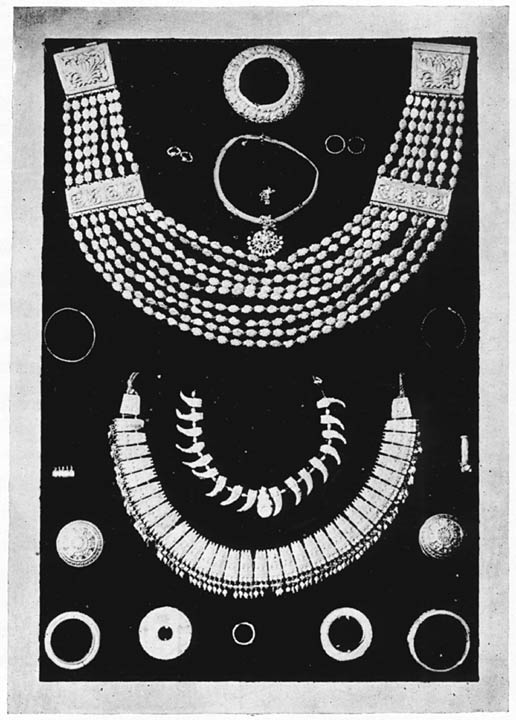
Nāyar jewelry.
In an account of the tāli-kettu ceremony, in the Cochin Census Report, 1901, it is stated that “the celebration of the ceremony is costly, and advantage is therefore taken of a single occasion in the course of ten or twelve years, at which all girls in a family, irrespective of their ages, and, when parties agree, all girls belonging to families that observe death pollution between one another go through the ceremony. The ceremony opens with the fixing of a post for the construction of a pandal or shed, which is beautifully decorated with cloth, pictures and festoons. The male members of the village are invited, and treated to a feast followed by the distribution of pān-supāri. Every time that a marriage ceremony is celebrated, a member of the family visits His Highness the Rāja with presents, and solicits his permission for the celebration. Such presents are often made to the Nambūdri Jenmis (landlords), by their tenants, and by castes attached to illams. It may be noted that certain privileges, such as sitting on a grass mat, having an elephant procession, drumming, firing of pop-guns, etc., have often to be obtained from the Ruler of the State. The marriage itself begins with the procession to the marriage pandal with the eight auspicious things (ashtamangalyam) and pattiniruththal (seating for song), at the latter of which a Brāhmini or Pushpini sings certain songs based upon suitable Purānic texts. The girls and other female members of the family, dressed in gay attire and decked with costly ornaments, come out in procession to the pandal, where the Pushpini sings, with tom-toms and the firing of pop-guns at intervals. After three, five, or seven rounds of this, a cutting of the jasmine placed in a brass pot is carried on an elephant by the Elayad or family priest to the nearest Bhagavati temple, where it is planted on the night previous to the ceremonial day with tom-toms, fireworks, and joyous shouts of men and women. A few hours before the auspicious moment for the ceremony, this cutting is brought back. Before the tāli is tied, the girls are brought out of the room, and, either from the ground itself or from a raised platform, beautifully decorated with festoons, etc., are made to worship the sun. The bridegroom, a Tirumulpād or an enangan, is then brought into the house with sword in hand, with tom-toms, firing of pop-guns, and shouts of joy. At the gate he is received by a few female members with ashtamangalyam in their hands, and seated on a bench or stool in the pandal. A male member of the family, generally a brother or maternal uncle of the girl, washes the feet of the bridegroom. The girls are covered with new cloths of cotton or silk, and brought into the pandal, and seated screened off from one another. After the distribution of money presents to the Brāhmans and the Elayad, the latter hands over the tāli, or thin plate of gold shaped like the leaf of aswatha (Ficus religiosa), and tacked on to a string, to the Tirumulpād, who ties it round the neck of the girl. A single Tirumulpād often ties the tāli round the neck of two, three, or four girls. He is given one to eight rupees per girl for so doing. Sometimes the tāli is tied by the mother of the girl. The retention of the tāli is not at all obligatory, nay it is seldom worn or taken care of after the ceremony. These circumstances clearly show the purely ceremonial character of this form of marriage. The Karamel Asan, or headman of the village, is an important factor on this occasion. In a conspicuous part of the marriage pandal, he is provided with a seat on a cot, on which a grass mat, a black blanket, and white cloth are spread one over the other. Before the tāli is tied, his permission is solicited for the performance of the ceremony. He is paid 4, 8, 16, 32 or 64 puthans (a puthan = 10 pies) per girl, according to the means of the family. He is also given rice, curry stuff, and pān-supāri. Rose-water is sprinkled at intervals on the males and females assembled on the occasion. With the distribution of pān-supāri, scented sandal paste and jasmine flowers to the females of the village and wives of relatives and friends, who are invited for the occasion, these guests return to their homes. The male members, one or two from each family in the village, are then treated to a sumptuous feast. In some places, where the Enangu system prevails, all members of such families, both male and female, are also provided with meals. On the third day, the villagers are again entertained to a luncheon of rice and milk pudding, and on the fourth day the girls are taken out in procession for worship at the nearest temple amidst tom-toms and shouting. After this a feast is held, at which friends, relatives, and villagers are given a rich meal. With the usual distribution of pān-supāri, sandal and flowers, the invited guests depart. Presents, chiefly in money, are made to the eldest male member of the family by friends and relatives and villagers, and with this the ceremony closes. From the time of fixing the first pole for the pandal to the tying of the tāli, the village astrologer is in attendance on all ceremonial occasions, as he has to pronounce the auspicious moment for the performance of each item. During the four days of the marriage, entertainments, such as Kathakali drama or Ottan Tullal, are very common. When a family can ill-afford to celebrate the ceremony on any grand scale, the girls are taken to the nearest temple, or to the illam of a Nambūdri, if they happen to belong to sub-divisions attached to illams, and the tāli is tied with little or no feasting and merriment. In the northern taluks, the very poor people sometimes tie the tāli before the Trikkakkarappan on the Tiruvonam day.”
The tāli-kettu ceremony is referred to by Kerr, who, in his translation of Castaneda, states that “these sisters of the Zamorin, and other kings of Malabar, have handsome allowances to live upon; and, when any of them reaches the age of ten, their kindred send for a young man of the Nāyar caste out of the kingdom, and give him presents to induce him to initiate the young virgin; after which he hangs a jewel round her neck, which she wears all the rest of her life, as a token that she is now at liberty to dispose of herself to anyone she pleases as long as she lives.”
The opinion was expressed by Mr. (now Sir Henry) Winterbotham, one of the Malabar Marriage Commissioners, that the Brāhman tāli-tier was a relic of the time when the Nambūtiris were entitled to the first fruits, and it was considered the high privilege of every Nāyar maid to be introduced by them to womanhood. In this connection, reference may be made to Hamilton’s ‘New Account of the East Indies’, where it is stated that “when the Zamorin marries, he must not cohabit with his bride till the Nambūdri, or chief priest, has enjoyed her, and he, if he pleases, may have three nights of her company, because the first fruits of her nuptials must be an holy oblation to the god she worships. And some of the nobles are so complaisant as to allow the clergy the same tribute, but the common people cannot have that compliment paid to them, but are forced to supply the priests’ places themselves.”
Of those who gave evidence before the Malabar Commission, some thought the tāli-kettu was a marriage, some not. Others called it a mock marriage, a formal marriage, a sham marriage, a fictitious marriage, a marriage sacrament, the preliminary part of marriage, a meaningless ceremony, an empty form, a ridiculous farce, an incongruous custom, a waste of money, and a device for becoming involved in debt. “While,” the report states, “a small minority of strict conservatives still maintain that the tāli-kettu is a real marriage intended to confer on the bridegroom a right to cohabit with the bride, an immense majority describe it as a fictitious marriage, the origin of which they are at a loss to explain. And another large section tender the explanation accepted by our President (Sir T. Muttusami Aiyar) that, in some way or other, it is an essential caste observance preliminary to the forming of sexual relations.”
“Almost every Nāyar officer in Government employ, when applying for leave on account of the kettukalliānam of his daughter or niece, states in his application that he has to attend to the ‘marriage’ of the girl. The ceremony is generally mentioned as marriage even in the letters of invitation sent by Nāyar gentlemen in these days....
This ceremony is not intended even for the betrothal of the girl to a particular man, but is one instituted under Brāhman influence as an important kriya (sacrament) antecedent to marriage, and intended, as the popular saying indicates, for dubbing the girl with the status of Amma, a woman fit to be married. The saying is Tāli-kettiu Amma āyi, which means a woman has become an Amma when her tali-tying ceremony is over.”
Of sambandham the following account was given by Mr. Chandu Menon to the Malabar Marriage Commission. “The variations of the sambandham are the pudamuri, vastradānam, uzhamporukkuka, vitāram kayaruka, etc., which are local expressions hardly understood beyond the localities in which they are used, but there would be hardly a Malaiyāli who would not readily understand what is meant by sambandham tudanguga (to begin sambandham). The meaning of this phrase, which means to ‘marry,’ is understood throughout Kēralam in the same way, and there can be no ambiguity or mistake about it. It is thus found that sambandham is the principal word denoting marriage among marumakkatāyam Nāyars. [Sambandhakāran is now the common term for husband.] It will also be found, on a close and careful examination of facts, that the principal features of this sambandham ceremony all over Kēralam are in the main the same. As there are different local names denoting marriage, so there may be found local variations in the performance of the ceremony. But the general features are more or less the same. For instance, the examination, prior to the betrothal, of the horoscopes of the bride and bridegroom to ascertain whether their stars agree astrologically; the appointment of an auspicious day for the celebration of the ceremony; the usual hour at which the ceremony takes place; the presentation of dānam (gifts) to Brāhmans; sumptuous banquet; the meeting of the bride and bridegroom, are features which are invariably found in all well-conducted sambandhams in all parts of Kēralam alike. But here I would state that I should not be understood as saying that each and every one of the formalities above referred to are gone through at all sambandhams among respectable Nāyars; and I would further state that they ought to be gone through at every sambandham, if the parties wish to marry according to the custom of the country. I would now briefly refer to the local variations to be found in the ceremony of the sambandham, and also the particular incidents attached to certain forms of sambandham in South Malabar. I shall describe the pudamuri or vastradānam as celebrated in North Malabar, and then show how the other forms of sambandham differ from it. Of all the forms of sambandham, I consider the pudamuri the most solemn and the most fashionable in North Malabar. The preliminary ceremony in every pudamuri is the examination of the horoscopes of the bride and bridegroom by an astrologer. This takes place in the house of the bride, in the presence of the relations of the bride and bridegroom. The astrologer, after examination, writes down the results of his calculations on a piece of palmyra leaf, with his opinion as to the fitness or otherwise of the match, and hands it over to the bridegroom’s relations. If the horoscopes agree, a day is then and there fixed for the celebration of the marriage. This date is also written down on two pieces of cadjan (palm leaf), one of which is handed over to the bride’s Karanavan, and the other to the bridegroom’s relations. The astrologer and the bridegroom’s party are then feasted in the bride’s house, and the former also receives presents in the shape of money or cloth. This preliminary ceremony, which is invariably performed at all pudamuris in North Malabar, is called pudamuri kurikkal, but is unknown in South Malabar. Some three or four days prior to the date fixed for the celebration of the pudamuri, the bridegroom visits his Karanavans and elders in caste, to obtain formal leave to marry. The bridegroom on such occasion presents his elders with betel and nuts, and obtains their formal sanction to the wedding. On the day appointed, the bridegroom proceeds after sunset to the house of the bride, accompanied by a number of his friends. He goes in procession, and is received at the gate of the house by the bride’s party, and conducted with his friends to seats provided in the tekkini or southern hall of the house. There the bridegroom distributes presents (dānam) or money gifts to the Brāhmans assembled. After this, the whole party is treated to a sumptuous banquet. It is now time for the astrologer to appear, and announce the auspicious hour fixed. He does it accordingly, and receives his dues. The bridegroom is then taken by one of his friends to the padinhatta or principal room of the house. The bridegroom’s party has, of course, brought with them a quantity of new cloths, and betel leaves and nuts. The cloths are placed in the western room of the house (padinhatta), in which all religious and other important household ceremonies are usually performed. This room will be decorated, and turned into a bed-room for the occasion. There will be placed in the room a number of lighted lamps, and ashtamangalyam, which consists of eight articles symbolical of mangalyam or marriage. These are rice, paddy (unhusked rice), the tender leaves of cocoanut trees, an arrow, a looking-glass, a well-washed cloth, burning fire, and a small round box called cheppu. These will be found placed on the floor of the room as the bridegroom enters it. The bridegroom with his groomsman enters the room through the eastern door. The bride, dressed in rich cloths and bedecked with jewels, enters the room through the western door, accompanied by her aunt or some other elderly lady of her family. The bride stands facing east, with the ashtamangalyam and lit-up lamps in front of her. The groomsman then hands over to the bridegroom a few pieces of new cloth, and the bridegroom puts them into the hands of the bride. This being done, the elderly lady who accompanied the bride sprinkles rice over the lamps and the head and shoulders of the bride and bridegroom, who immediately leaves the room, as he has to perform another duty. At the tekkini or southern hall, he now presents his elders and friends with cakes, and betel leaf and nuts. Betel and nuts are also given to all the persons assembled at the place. After the departure of the guests, the bridegroom retires to the bed-room with the bride. Next morning, the vettilakettu or salkāram ceremony follows, and the bridegroom’s female relations take the bride to the husband’s house, where there is feasting in honour of the occasion. Uzhamporukkuka or vīdāram kayaral is a peculiar form of marriage in North Malabar. It will be seen from description given above that the pudamuri is necessarily a costly ceremony, and many people resort to the less costly ceremony of uzhamporukkuka or vīdāram kayaral. The features of this ceremony are to a certain extent the same as pudamuri, but it is celebrated on a smaller scale. There is no cloth-giving ceremony. The feasting is confined to the relations of the couple. The particular incident of this form of marriage is that the husband should visit the wife in her house, and is not permitted to take her to his house, unless and until he celebrates the regular pudamuri ceremony. This rule is strictly adhered to in North Malabar, and instances in which the husband and wife joined by the uzhamporukkuka ceremony, and with grown-up children as the issue of such marriage, undergo the pudamuri ceremony some fifteen or twenty years after uzhamporukkuka, in order to enable the husband to take the wife to his house, are known to me personally. The sambandham of South Malabar, and the kidakkora kalyānam of Palghat have all or most of the incidents of pudamuri, except the presenting of cloths. Here money is substituted for cloths, and the other ceremonies are more or less the same. There is also salkāram ceremony wanting in South Malabar, as the wives are not at once taken to the husband’s house after marriage.”
In connection with the following note by Mr. C. P. Rāman Menon on sambandham among the Akattu Charna or Akathithaparisha (inside clan), Mr. Fawcett states that “my informant says in the first place that the man should not enter into sambandham with a woman until he is thirty. Now-a-days, when change is running wild, the man is often much less. In North Malabar, which is much more conservative than the south, it was, however, my experience that sambandham was rare on the side of the man before twenty-seven.” “The Karanavan,” Mr. Rāman Menon writes, “and the women of his household choose the bride, and communicate their choice to the intending bridegroom through a third party; they may not, dare not speak personally to him in the matter. He approves. The bride’s people are informally consulted, and, if they agree, the astrologer is sent for, and examines the horoscopes of both parties to the intended union. As a matter of course these are found to agree, and the astrologer fixes a day for the sambandham ceremony. A few days before this takes place, two or three women of the bridegroom’s house visit the bride, intimating beforehand that they are coming. There they are well treated with food and sweetmeats, and, when on the point of leaving, they inform the senior female that the bridegroom (naming him) wishes to have sambandham with ... (naming her), and such and such a day is auspicious for the ceremony. The proposal is accepted with pleasure, and the party from the bridegroom’s house returns home. Preparations for feasting are made in the house of the bride, as well as in that of the bridegroom on the appointed day. To the former all relations are invited for the evening, and to the latter a few friends who are much of the same age as the bridegroom are invited to partake of food at 7 or 8 P.M., and accompany him to the bride’s house. After eating they escort him, servants carrying betel leaves (one or two hundred according to the means of the taravad), areca nuts and tobacco, to be given to the bride’s household, and which are distributed to the guests. When the bride’s house is far away, the bridegroom makes his procession thither from a neighbouring house. Arrived at the bride’s house, they sit awhile, and are again served with food, after which they are conducted to a room, where betel and other chewing stuff is placed on brass or silver plates called thālam. The chewing over, sweetmeats are served, and then all go to the bridal chamber, where the women of the house and others are assembled with the bride, who, overcome with shyness, hides herself behind the others. Here again the bridegroom and his party go through more chewing, while they chat with the women. After a while the men withdraw, wishing the couple all happiness, and then the women, departing one by one, leave the couple alone, one of them shutting the door from the outside. The Pattar Brāhmans always collect on these occasions, and receive small presents (dakshina) of two to four annas each, with betel leaves and areca nuts from the bridegroom, and sometimes from the bride. A few who are invited receive their dakshina in the bridal chamber, the others outside. Those of the bridegroom’s party who live far away are given sleeping accommodation at the bride’s house [in a Nāyar house the sleeping rooms of the men and women are at different ends of the house]. About daybreak next morning the bridegroom leaves the house with his party, leaving under his pillow 8, 16, 32, or 64 rupees, according to his means, which are intended to cover the expenses of the wife’s household in connection with the ceremony. The sambandham is now complete. The girl remains in her own taravad house, and her husband visits her there, coming in the evening and leaving next morning. A few days after the completion of the ceremony, the senior woman of the bridegroom’s house sends some cloths, including pavu mundu (superior cloths) and thorthu mundu (towels) and some oil to the bride for her use for six months. Every six months she does the same, and, at the Ōnam, Vishu, and Thiruvathīra festivals, she sends besides a little money, areca nuts, betel and tobacco. The money sent should be 4, 8, 16, 32, or 64 rupees. Higher sums are very rarely sent. Before long, the women of the husband’s house express a longing for the girl-wife to be brought to their house, for they have not seen her yet. Again the astrologer is requisitioned, and, on the day he fixes, two or three of the women go to the house of the girl, or, as they call her, Ammāyi (uncle’s wife). They are well treated, and presently bring away the girl with them. As she is about to enter the gate-house of her husband’s taravad, the stile of which she crosses right leg first, two or three of the women meet her, bearing a burning lamp and a brass plate (thālam), and precede her to the nalukattu of the house. There she is seated on a mat, and a burning lamp, a nazhi (measure) of rice, and some plantains are placed before her. One of the younger women takes up a plantain, and puts a piece of it in the Ammāyi’s mouth; a little ceremony called madhuram tītal, or giving the sweets for eating. She lives in her husband’s house for a few days, and is then sent back to her own with presents, bracelets, rings or cloths, which are gifts of the senior woman of the house. After this she is at liberty to visit her husband’s house on any day, auspicious or inauspicious. In a big taravad, where there are many women, the Ammāyi does not, as a rule, get much sympathy and good-will in the household, and, if she happens to live temporarily in her husband’s house, as is sometimes, though very rarely the case in South Malabar, and to be the wife of the Karanavan, it is observed that she gets more than her share of whatever good things may be going. Hence the proverb, ‘Place Ammāyi Amma on a stone, and grind her with another stone.’ A sambandham ceremony at Calicut is recorded by Mr. Fawcett, at which there were cake and wine for the guests, and a ring for the bride.
In connection with sambandham, Mr. N. Subramani Aiyar writes from Travancore that “it is known in different localities as gunadosham (union through good or evil), vastradānam or putavakota (giving of cloth), and uzhamporukkal (waiting one’s turn). It may be performed without any formal ceremony whatever, and is actually a private transaction confidentially gone through in some families. The bridegroom and his friends assemble at the house of the bride on the appointed night, and, before the assembled guests, the bridegroom presents the bride with a few unbleached cloths. Custom enjoins that four pieces of cloth should be presented, and the occasion is availed of to present cloths to the relatives and servants of the bride also. The girl asks permission of her mother and maternal uncle, before she receives the cloths. After supper, and the distribution of pān-supāri, the party disperses. Another day is fixed for the consummation ceremony. On that day the bridegroom, accompanied by a few friends, goes to the bride’s house with betel leaves and nuts. After a feast, the friends retire.”
It is noted in the Cochin Census Report, 1901, that one name for the sambandham rite is kitakkora, meaning bed-chamber ceremony. In the same report, the following account of a puberty ceremony is given. “The tirandukuli ceremony is practically a public declaration that a girl has reached the age of maturity. When a girl attains puberty, she is seated in a separate room, where a lamp is lit, and a brass pot with a bunch of cocoanut flowers is kept. She has to keep with her a circular plate of brass called vālkannādi, literally a looking-glass with a handle. The event is proclaimed by korava (shouts of joy by females). The females of the neighbouring houses, and of the families of friends and relatives, visit her. New cloths are presented to the girl by her near relatives. On the third day the villagers, friends and relatives are treated to a luncheon of rice and milk pudding. Early in the morning on the fourth day, the Mannans or Vēlans appear. The girl is anointed with oil, and tender leaves of the cocoanut palm are tied round the head and waist. In the company of maidens she is brought out of the room, and the Vēlans sing certain songs. Thence the party move on to the tank, where the girl wears a cloth washed by a Vēlan, and takes a bath. After the bath the Vēlans again sing songs. In the afternoon, the girl is taken out by the females invited for the occasion to an ornamental pandal, and the Vēlans, standing at a distance, once more sing. With the usual distribution of pān-supāri, sandal and jasmine flowers, the ceremony closes. In the midst of the song, the female guests of the village, the wives of friends and relatives, and most of the members of the family itself, present each a small cloth to the Vēlans. They are also given a small amount of money, rice, betel leaf, etc. The guests are then entertained at a feast. In some places, the girl is taken to a separate house for the bath on the fourth day, whence she returns to her house in procession, accompanied by tom-toms and shouting. In the northern tāluks, the Vēlan’s song is in the night, and the performance of the ceremony on the fourth day is compulsory. In the southern tāluks, it is often put off to some convenient day. Before the completion of this song ceremony, the girl is prohibited from going out of the house or entering temples.”
—— Nāyars. Tiyans. Others. Total.
1897 28 6 2 36
1898 8 2 4 14
1899 8 2 4 14
1900 8 ... 9 17
1901 3 ... 1 4
1902 ... ... ... ...
1903 2 ... ... 2
Total 57 10 20 87
In a recent account of a Nāyar wedding in high life in Travancore, the host is said to have distributed flowers, attar, etc., to all his Hindu guests, while the European, Eurasian, and other Christian guests, partook of cake and wine, and other refreshments, in a separate tent. The Chief Secretary to Government proposed the toast of the bride and bridegroom.
The following note on Nāyar pregnancy ceremonies was supplied to Mr. Fawcett by Mr. U. Balakrishnan Nāyar. “A woman has to observe certain ceremonies during pregnancy. First, during and after the seventh month, she (at least among the well-to-do classes) bathes, and worships in the temple every morning, and eats before her morning meal a small quantity of butter, over which mantrams (consecrated formulæ) have been said by the temple priest, or by Nambūtiris. This is generally done till delivery. Another, and even more important ceremony, is the puli-kuti (drinking tamarind juice). This is an indispensable ceremony, performed by rich and poor alike, on a particular day in the ninth month. The day and hour are fixed by the local astrologer. The ceremony begins with the planting of a twig of the ampasham tree on the morning of the day of the ceremony in the principal courtyard (natu-muttam) of the taravād. At the appointed hour or muhūrtam, the pregnant woman, after having bathed, and properly attired, is conducted to a particular portion of the house (vatakini or northern wing), where she is seated, facing eastward. The ammayi, or uncle’s wife, whose presence on the occasion is necessary, goes to the courtyard, and, plucking a few leaves of the planted twig, squeezes a few drops of its juice into a cup. This she hands over to the brother, if any, of the pregnant woman. It is necessary that the brother should wear a gold ring on his right ring finger. Holding a country knife (pissan kathi) in his left hand, which he directs towards the mouth, he pours the tamarind juice over the knife with his right hand three times, and it dribbles down the knife into the woman’s mouth, and she drinks it. In the absence of a brother, some other near relation officiates. After she has swallowed the tamarind juice, the woman is asked to pick out one of several packets of different grains placed before her. The grain in the packet she happens to select is supposed to declare the sex of the child in her womb. The ceremony winds up with a sumptuous feast to all the relatives and friends of the family.” In connection with pregnancy ceremonies, Mr. N. Subramani Aiyar writes that “the puli-kuti ceremony is performed at the seventh, or sometimes the ninth month. The husband has to contribute the rice, cocoanut, and plantains, and present seven vessels containing sweetmeats. In the absence of a brother, a Mārān pours the juice into the mouth of the woman.” It is noted in the Cochin Census Report, 1901, that “the puli-kudi ceremony consists in administering to the woman with child a few pills of tamarind and other acid substances. The pills are placed at the end of a knife-blade, and pushed into the mouth of the woman by means of a gold ring. The ceremony, which in a way corresponds to the pumsavana of the Brāhmans, is performed either by a brother or uncle of the woman, and, in the absence of both, by the husband himself. Unlike Brāhmans, the ceremony is performed only at the time of the first pregnancy.” In the eighth month, a ceremony, called garbha veli uzhiyal, is performed by the Kaniyan (astrologer) to remove the effects of the evil eye.
“At delivery,” Mr. Balakrishnan Nāyar writes, “women of the barber caste officiate as midwives. In some localities, this is performed by Vēlan caste women. Pollution is observed for fifteen days, and every day the mother wears cloths washed and presented by a woman of the Vannān [or Tīyan] caste. On the fifteenth day is the purificatory ceremony. As in the case of death pollution, a man of the Attikurissi clan sprinkles on the woman a liquid mixture of oil and the five products of the cow (pānchagavya), with gingelly (Sesamum) seeds. Then the woman takes a plunge-bath, and sits on the ground near the tank or river. Some woman of the family, with a copper vessel in her hands, takes water from the tank or river, and pours it on the mother’s head as many as twenty-one times. This done, she again plunges in the water, from which she emerges thoroughly purified. It may be noted that, before the mother proceeds to purify herself, the new-born babe has also to undergo a rite of purification. It is placed on the bare floor, and its father or uncle sprinkles a few drops of cold water on it, and takes it in his hands. The superstitious believe that the temperament of the child is determined by that of the person who thus sprinkles the water. All the members of the taravād observe pollution for fifteen days following the delivery, during which they are prohibited from entering temples and holy places.” It is noted by Mr. N. Subramani Aiyar that the first act done, when a male child is born, is to beat the earth with a cocoanut leaf, and, if the issue is a female, to grind some turmeric in a mortar, with the object, it is said, of removing the child’s fear.
In connection with post-natal ceremonies, Mr. Balakrishnan Nāyar writes further that “the twenty-seventh day after the child’s birth, or the first recurring day of the star under which it was born, marks the next important event. On this day, the Karanavan of the family gives to the child a spoonful or two of milk mixed with sugar and slices of plantain. Then he names the child, and calls it in the ear by the name three times. This is followed by a feast to all friends and relatives, the expenses of which are met by the father of the child. With the Nāyar, every event is introduced by a ceremonial. The first meal of rice (chorūn) partaken of by the child forms no exception to the rule. It must be remembered that the child is not fed on rice for some time after birth, the practice being to give it flour of dried plantain boiled with jaggery (crude sugar). There is a particular variety of plantain, called kunnan, used for this purpose. Rice is given to the child for the first time generally during the sixth month. The astrologer fixes the day, and, at the auspicious hour, the child, bathed and adorned with ornaments (which it is the duty of the father to provide) is brought, and laid on a plank. A plantain leaf is spread in front of it, and a lighted brass lamp placed near. On the leaf are served a small quantity of cooked rice—generally a portion of the rice offered to some temple divinity—some tamarind, salt, chillies, and sugar. [In some places all the curries, etc., prepared for the attendant feast, are also served.] Then the Karanavan, or the father, ceremoniously approaches, and sits down facing the child. First he puts in the mouth of the child a mixture of the tamarind, chillies and salt, then some rice, and lastly a little sugar. Thenceforward the ordinary food of the child is rice. It is usual on this occasion for relatives (and especially the bandhus, such as the ammayi, or ‘uncle’s wife’) to adorn the child with gold bangles, rings and other ornaments. The rice-giving ceremony is, in some cases, preferably performed at some famous temple, that at Guruvayūr being a favourite one for this purpose.” It is noted by Mr. N. Subramani Aiyar that the rice-giving ceremony is usually performed by taking the child to a neighbouring temple, and feeding it with the meal offered to the deity as nivadiyam. In some places, the child is named on the chorūn day.
Of ceremonies which take place in infancy and childhood, the following account is given in the Gazetteer of Malabar. “On the fifth day after birth, a woman of the Attikurissi or Mārayan caste among Nāyars, or of the barber caste in the lower classes, is called in, and purifies the mother, the other women of the household, and the room in which the child was born, by lustration with milk and gingelly oil, using karuga (Cynodon Dactylon) as a sprinkler. Her perquisites are the usual nīracchaveppu (1 edangazhi of paddy and 1 nazhi of uncooked rice) placed together with a lamp of five wicks in the room to be cleansed, and a small sum in cash. A similar purification ceremony on the 15th day concludes the pollution period. In some cases, milk and cow’s urine are sprinkled over the woman, and, after she has bathed, the Mārayan, or Attikurissi waves over her and the child two vessels, one containing water, stained red with turmeric and lime, and one water blackened with powdered charcoal. During this and other periods, a characteristic service called māttu (change) has to be rendered by people of the Mannān caste to Nāyars, and to other castes by their proper washermen, who may or may not be Mannāns. On the day of birth, the Mannātti brings a clean tūni (cloth) of her own, and a mundu (cloth), which she places in the yard, in which she finds the accustomed perquisites of grain set out, and a lamp. An Attikurissi Nāyar woman takes the clean clothes, and the Mannātti removes those previously worn by the mother. Every subsequent day during the pollution period, the Mannātti brings a change of raiment, but it is only on the 7th and 15th days that any ceremonial is observed, and that the Attikurissi woman is required. On those days, a Mannān man attends with the Mannātti, He makes three pradakshinams round the clean clothes, the lamp, and the niracchaveppu, and scatters a little of the grain forming the latter on the ground near it, with an obeisance, before the Attikurissi woman takes the clothes indoors. This rite of māttu has far reaching importance. It affords a weapon, by means of which the local tyrant can readily coerce his neighbours, whom he can subject to the disabilities of excommunication by forbidding the washerman to render them this service; while it contributes in no small degree to the reluctance of Malayāli women to leave Kērala, since it is essential that the māttu should be furnished by the appropriate caste and no other.
“On the twenty-eighth day (including the day of birth) comes the Pālu-kudi (milk-drinking) ceremony, at which some women of the father’s family must attend. Amongst castes in which the wife lives with the husband, the ceremony takes place in the husband’s house, to which the wife and child return for the first time on this day. The usual lamp, niracchaveppu and kindi of water, are set forth with a plate, if possible of silver, containing milk, honey, and bits of a sort of plantain called kunnan, together with three jack leaves folded to serve as spoons. The mother brings the child newly bathed, and places it in his Karnavan’s lap. The goldsmith is in attendance with a string of five beads (mani or kuzhal) made of the panchaloham or five metals, gold, silver, iron, copper and lead, which the father ties round the baby’s waist. The Karnavan, or the mother, then administers a spoonful of the contents of the plate to the child with each of the jack leaves in turn. The father’s sister, or other female relative, also administers some, and the Karnavan then whispers the child’s name thrice in its right ear.
“The name is not publicly announced till the Chōrunnu or Annaprāsanam (rice giving), which takes place generally in the sixth month, and must be performed at an auspicious moment prescribed by an astrologer. The paraphernalia required are, besides the five-wicked lamp, some plantain leaves on which are served rice and four kinds of curry called kalan, olan, avil, and ericchakari, some pappadams (wafers of flour and other ingredients), plantains and sweetmeats called uppēri (plantains fried in cocoanut oil). The mother brings the child newly bathed, and wearing a cloth for the first time, and places it in the Karnavan’s lap. The father then ties round the child’s neck a gold ring, known as muhurta mothiram (auspicious moment ring), and the relatives present give the child other ornaments of gold or silver according to their means, usually a nūl or neck-thread adorned with one or more pendants, an arannal or girdle, a pair of bangles, and a pair of anklets. The Karnavan then, after an oblation to Ganapathi, gives the child some of the curry, and whispers its name in its right ear three times. He then carries the child to a cocoanut tree near the house, round which he makes three pradakshinams, pouring water from a kindi round the foot of the tree as he does so. The procession then returns to the house, and on the way an old woman of the family proclaims the baby’s name aloud for the first time in the form of a question, asking it ‘Krishnan’ (for instance), ‘dost thou see the sky?’ In some cases, the father simply calls out the name twice.
“The Vidyarambham ceremony to celebrate the beginning of the child’s education takes place in the fifth or seventh year. In some places, the child is first taken to the temple, where some water sanctified by mantrams is poured over his head by the Shāntikāran (officiating priest). The ceremony at the house is opened by Ganapathi pūja performed by an Ezhuttacchan, or by a Nambūdri, or another Nāyar. The Ezhuttacchan writes on the child’s tongue with a gold fanam (coin) the invocation to Ganapathi (Hari Sri Ganapathayi nama), or sometimes the fifty-one letters of the Malayalam alphabet, and then grasps the middle finger of the child’s right hand, and with it traces the same letters in parched rice. He also gives the child an ola (strip of palm leaf) inscribed with them, and receives in return a small fee in cash. Next the child thrice touches first the Ezhuttacchan’s feet, and then his own forehead with his right hand, in token of that reverent submission to the teacher, which seems to have been the key-note of the old Hindu system of education.
“The Kāthukuttu or ear-boring is performed either at the same time as the Pāla-kudi or the Choulam, or at any time in the fifth or seventh year. The operator, who may be any one possessing the necessary skill, pierces first the right and then the left ear with two gold or silver wires brought by the goldsmith, or with karamullu thorns. The wires or thorns are left in the ears. In the case of girls, the hole is subsequently gradually distended by the insertion of nine different kinds of thorns or plugs in succession, the last of which is a bamboo plug, till it is large enough to admit the characteristic Malayāli ear ornament, the boss-shaped toda.”
“There are,” Mr. Fawcett writes, “many interesting features in the death ceremonies as performed by the Kiriattil class. Those who carry the corpse to the pyre are dressed as women, their cloths being wet, and each carries a knife on his person. Two junior male members of the taravād thrust pieces of mango wood into the southern end of the burning pyre, and, when they are lighted, throw them over their shoulders to the southwards without looking round. Close to the northern end of the pyre, two small sticks are fixed in the ground, and tied together with a cloth, over which water is poured thrice. All members of the taravād prostrate to the ground before the pyre. They follow the enangu carrying the pot of water round the pyre, and go home without looking round. They pass to the northern side of the house under an arch made by two men standing east and west, holding at arms length, and touching at the points, the spade that was used to dig the pit under the pyre, and the axe with which the wood for the pyre was cut or felled. After this is done the kodali ceremony, using the spade, axe, and big knife. These are placed on the leaves where the corpse had lain. Then follows circumambulation and prostration by all, and the leaves are committed to the burning pyre.”
In connection with the death ceremonies, it is noted in the Cochin Census Report, 1901, that “the last moments of a dying person are really very trying. All members (male and female), junior to the dying person, pour into his or her mouth drops of Ganges or other holy water or conjee (rice) water in token of their last tribute of regard. Before the person breathes his last, he or she is removed to the bare floor, as it is considered sacrilegious to allow the last breath to escape while lying on the bed, and in a room with a ceiling, which last is supposed to obstruct the free passage of the breath. The names of gods, or sacred texts are loudly dinned into his or her ears, so that the person may quit this world with the recollections of God serving as a passport to heaven. The forehead, breast, and the joints especially are besmeared with holy ashes, so as to prevent the messengers of death from tightly tying those parts when they carry away the person. Soon after the last breath, the dead body is removed to some open place in the house, covered from top to toe with a washed cloth, and deposited on the bare floor with the head towards the south, the region of the God of death. A lighted lamp is placed near the head, and other lights are placed all round the corpse. A mango tree is cut, or other firewood is collected, and a funeral pyre is constructed in the south-eastern corner of a compound or garden known as the corner of Agni, which is always reserved as a cemetery for the burning or burial of the dead. All male members, generally junior, bathe, and, without wiping their head or body, they remove the corpse to the yard in front of the house, and place it on a plantain leaf. It is nominally anointed with oil, and bathed in water. Ashes and sandal are again smeared on the forehead and joints. The old cloth is removed, and the body is covered with a new unwashed cloth or a piece of silk. A little gold or silver, or small coins are put into the mouth. With the breaking of a cocoanut, and the offering of some powdered rice, betel leaf, areca nut, etc., the body is taken to the pyre. The members junior to the deceased go round the pyre three, five, or seven times, throw paddy and rice over the dead body, put scantlings of sandal wood, prostrate at the feet of the corpse, and then set fire to the pyre. When the body is almost wholly consumed, one of the male members carries a pot of water, and, after making three rounds, the pot is broken and thrown into the pyre. The death of an elderly male member of a family is marked by udakakriya and sanchayanam, and the daily bali performed at the bali kutti (altar) planted in front of the house, or in the courtyard in the centre of the house, where there is one. The Ashtikurissi Nāyar officiates as priest at all such obsequies. On the morning of the fifteenth day, the members of the family wear cloths washed by a Vēlan, and assemble together for purification by the Nāyar priest, both before and after bathing, who throws on them paddy and rice, and sprinkles the holy mixture. The Elayad or family purōhit then performs another punnayaham or purification, and on the sixteenth day he takes the place of the priest. On the evening of the fifteenth day, and the morning of the sixteenth day, the purōhits and villagers are sumptuously feasted, and presents of cloths and money are made to the Elayads. In the Chittūr tāluk, the Tamil Brāhman sometimes performs priestly functions in place of the Elayad. Dīksha is performed for forty-one days, or for a whole year, for the benefit of the departed soul. This last ceremony is invariably performed on the death of the mother, maternal uncle, and elder brother.”
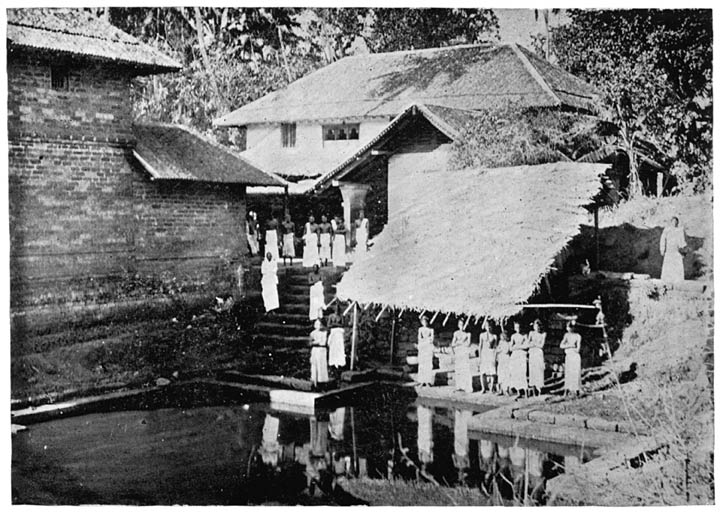
Nāyar house.
In connection with the habitations of the Nāyars, Mr. Fawcett writes as follows. “A house may face east or west, never north or south; as a rule, it faces the east. Every garden is enclosed by a bank, a hedge, or a fencing of some kind, and entrance is to be made at one point only, the east, where there is a gate-house, or, in the case of the poorest houses, a small portico or open doorway roofed over. One never walks straight through this; there is always a kind of stile to surmount. It is the same everywhere in Malabar, and not only amongst the Nāyars. The following is a plan of a nālapura or four-sided house, which may be taken as representative of the houses of the rich:—
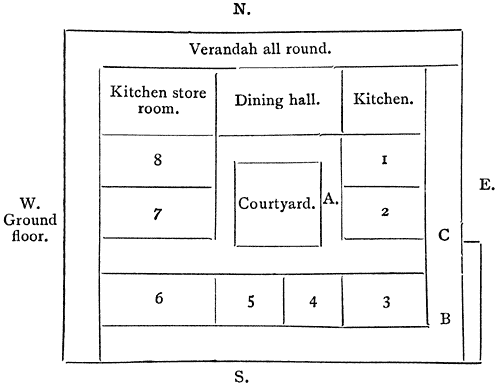
Numbers 6 and 7 are rooms, which are generally used for storing grain. At A is a staircase leading to the room of the upper storey occupied by the female members of the family. At B is another staircase leading to the rooms of the upper storey occupied by the male members. There is no connection between the portions allotted to the men and women. No. 8 is for the family gods. The Karanavans and old women of the family are perpetuated in images of gold or silver, or, more commonly, brass. Poor people, who cannot afford to have these images made, substitute a stone. Offerings are made to these images, or to the stones at every full moon. The throat of a fowl will be cut outside, and the bird is then taken inside and offered. The entrance is at C.
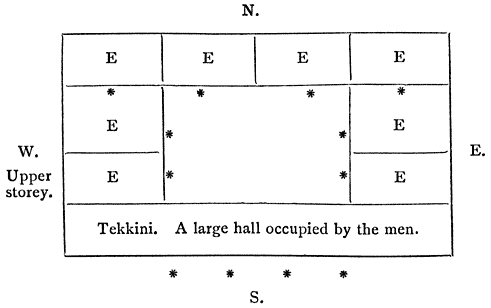
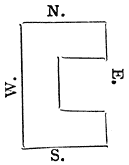
There are windows at * * *. E are rooms occupied by women and children. It may be noticed that the apartment where the men sleep has no windows on the side of the house which is occupied by women. The latter are relatively free from control by the men as to who may visit them. We saw, when speaking of funeral ceremonies, that a house is supposed to have a courtyard, and, of course, it has this only when there are four sides to the house. The nālapura is the proper form of house, for in this alone can all ceremonial be observed in orthodox fashion. But it is not the ordinary Nāyar’s house that one sees all over Malabar. The ordinary house is roughly of the shape here indicated. Invariably there is an upper storey. There are no doors, and only a few tiny windows opening to the west. Men sleep at one end, women at the other, each having their own staircase. Around the house there is always shade from the many trees and palms. Every house is in its own seclusion.”
Concerning Nāyar dwellings, Mr. N. Subramani Aiyar writes that “the houses of the Nāyar, standing in a separate compound, have been by many writers supposed to have been designed with special reference to the requirements of offence and defence, and Major Welsh states that the saying that every man’s house is his castle is well verified here. The higher ambition of the Nāyar is, as has frequently been said, to possess a garden, wherein he can grow, without trouble or expense, the few necessaries of his existence. The garden surrounding the house is surrounded by a hedge or strong fence. At the entrance is an out-house, or patipura, which must have served as a kind of guardroom in mediæval times. In poorer houses its place is taken by a roofed door, generally provided with a stile to keep out cattle. The courtyard is washed with cow-dung, and diverse figures are drawn with white chalk on the fence. Usually there are three out-houses, a vadakkettu on the north side serving as a kitchen, a cattle-shed, and a tekketu on the southern side, where some family spirit is located. These are generally those of Maruta, i.e., some member of the family who has died of small-pox. A sword or other weapon, and a seat or other emblem is located within this out-house, which is also known by the names of gurusala (the house of a saint), kalari (military training-ground), and daivappura (house of a deity). The tekketu is lighted up every evening, and periodical offerings are made to propitiate the deities enshrined within. In the south-west corner is the serpent kavu (grove), and by its side a tank for bathing purposes. Various useful trees are grown in the garden, such as the jack, areca palm, cocoanut, plantain, tamarind, and mango. The whole house is known as vitu. The houses are built on various models, such as pattayappura, nālukettu, ettukettu, and kuttikettu.”
It is noted by Mr. Fawcett that “the Venetian sequin, which probably first found its way to Malabar in the days of Vasco da Gama and Albuquerque, is one of those coins which, having found favour with a people, is used persistently in ornamentation long after it has passed out of currency. So fond are the Malayālis of the sequin that to this day there is quite a large trade in imitations of the coin for purposes of ornament. Such is the persistence of its use that the trade extends to brass and even copper imitation of the sequins. The former are often seen to bear the legend ‘Made in Austria.’ The Nāyars wear none but the gold sequins. The brass imitations are worn by the women of the inferior races. If one asks the ordinary Malayāli, say a Nāyar, what persons are represented on the sequin, one gets for answer that they are Rāma and Sīta; between them a cocoanut tree.”
In connection with the wearing of charms by Nāyars Mr. Fawcett writes as follows. “One individual (a Kiriattil Nāyar) wore two rings made of an amalgamation of gold and copper, called tambāk, on the ring finger of the right hand for good luck. Tambāk rings are lucky rings. It is a good thing to wash the face with the hand, on which is a tambāk ring. Another wore two rings of the pattern called trilōham (lit. metals) on the ring finger of each hand. Each of these was made during an eclipse. Yet another wore a silver ring as a vow, which was to be given up at the next festival at Kottiūr, a famous festival in North Malabar. The right nostril of a Sūdra Nāyar was slit vertically as if for the insertion of a jewel. His mother miscarried in her first pregnancy, so, according to custom, he, the child of her second pregnancy, had his nose slit. Another wore a silver bangle. He had a wound in his arm which was long in healing, so he made a vow to the god at Tirupati (in the North Arcot district), that, if his arm was healed, he would give up the bangle at the Tirupati temple. He intended to send the bangle there by a messenger. An Akattu Charna Nāyar wore an amulet to keep off the spirit of a Brāhman who died by drowning. Another had a silver ring, on which a piece of a bristle from an elephant’s tail was arranged.”
Tattooing is said by Mr. Subramani Aiyar not to be favoured by North Travancore Nāyars, and to be only practiced by Nāyar women living to the south of Quilon. Certain accounts trace it to the invasion of Travancore by a Moghul Sirdar in 1680 A.D. In modern times it has become rare. The operation is performed by women of the Odda or Kurava caste before a girl reaches the twelfth year.
Concerning the religious worship of the Nāyars, Mr. Subramani Aiyar writes that “Buchanan notes that the proper deity of the Nāyars is Vishnu, though they wear the mark of Siva on their foreheads. By this is merely meant that they pay equal reverence to both Siva and Vishnu, being Smartas converted to the tenets of Sankaracharya. Besides worshipping the higher Hindu deities, the Nāyars also manifest their adoration for several minor ones, such as Mātan, Utayam, Yakshi, Chattan, Chantakarnan, Murti, Maruta, and Arukula. Most of these have granite representations, or at least such emblems as a sword or a cane, and are provided with a local habitation. Besides these, persons who have met with accidental death, and girls who have died before their tāli-tying ceremony, are specially worshipped under the designations of Kazhichchavu and Kannichchavu. Magicians are held in some fear, and talismanic amulets are attached to the waist by members of both sexes. Kuttichattan, the mischievous imp of Malabar, is supposed to cause much misery. Various spirits are worshipped on the Tiruvonam day in the month of Avani (August-September), on the Uchcharam or 28th day of Makarom (January-February), and on some Tuesdays and Fridays. Kolam-tullal, Velan-pravarti, Ayiramaniyam-tullel, Chavuttu, Tila-homam, and a host of other ceremonies are performed with a view to propitiate spirits, and the assistance of the Kaniyans and Vēlans is largely sought. Serpents, too, whose images are located on the north-western side of most gardens in Central and North Travancore, receive a large share of adoration. The sun is an object of universal worship. Though the Gayatri cannot be studied, or the Sandhyavandanam of the Brahmans performed, an offering of water to the sun after a bath, to the accompaniment of some hymn, is made by almost every pious Nāyar. The Panchakshara is learnt from an Ilayatu, and repeated daily. A large portion of the time of an old Nāyar is spent in reading the Rāmayana, Bhagavata and Mahābharata, rendered into Malayālam by Tunchattu Ezhuttachhan, the greatest poet of the Malabar coast. Many places in Travancore are pointed out as the scene of memorable incidents in the Rāmayana and Mahābharata. There are many temples, tanks, and mountains connected with Rāma’s march to the capital of Rāvana. Equally important are the singular feats said to have been performed by the five Pāndavas during the time of their wanderings in the jungles before the battle of Kurukshetra. Bhima especially has built temples, raised up huge mountains, and performed many other gigantic tasks in the country. There are some village temples owned exclusively by the Nāyars, where all the karakkars (villagers) assemble on special occasions. A very peculiar socio-religious ceremony performed here is the kūttam. This is a village council, held at the beginning of every month for the administration of the communal affairs of the caste, though, at the present day, a sumptuous feast at the cost of each villager in rotation, and partaken of by all assembled, and a small offering to the temple, are all that remains to commemorate it. Astrology is believed in, and some of its votaries are spoken of as Trikalagnas, or those who know the past, present, and future. It is due to a curse of Siva on the science of his son, who made bold by its means to predict even the future of his father, that occasional mistakes are said to occur in astrological calculations. Sorcery and witchcraft are believed to be potent powers for evil. To make a person imbecile, to paralyse his limbs, to cause him to lavish all his wealth upon another, to make him deaf and dumb, and, if need be, even to make an end of him, are not supposed to be beyond the powers of the ordinary wizard. Next to wizardry and astrology, palmistry, omens, and the lizard science are generally believed in. In the category of good omens are placed the elephant, a pot full of water, sweetmeats, fruit, fish and flesh, images of gods, kings, a cow with its calf, married women, tied bullocks, gold lamps, ghee, milk, and so on. Under the head of bad omens come the donkey, a broom, buffalo, untied bullock, barber, widow, patient, cat, washerman, etc. The worst of all omens is beyond question to allow a cat to cross one’s path. An odd number of Nāyars, and an even number of Brāhmans, are good omens, the reverse being particularly bad. On the Vinayaka-chaturthi day in the month of Avani, no man is permitted to look at the rising moon under penalty of incurring unmerited obloquy.
“Various field sports, of which foot-ball is the chief, are indulged in during the Ōnam festival. To quote Paulinus once more, the men, particularly those who are young, form themselves into parties, and shoot at each other with arrows. These arrows are blunted, but exceedingly strong, and are discharged with such force that a considerable number are generally wounded on both sides. These games have a great likeness to the Ceralia and Juvenalia of the ancient Greeks and Romans.”
In connection with bows and arrows, Mr. Fawcett writes that “I once witnessed a very interesting game called ēitū (ēiththu), played by the Nāyars in the southern portion of Kurumbranād during the ten days preceding Ōnam. There is a semi-circular stop-butt, about two feet in the highest part, the centre, and sloping to the ground at each side. The players stand 25 to 30 yards before the concave side of it, one side of the players to the right, the other to the left. There is no restriction of numbers as to sides. Each player is armed with a little bow made of bamboo, about 18 inches in length, and arrows, or what answer for arrows, these being no more than pieces of the midrib of the cocoanut palm leaf, roughly broken off, leaving a little bit of the end to take the place of the feather. In the centre of the stop-butt, on the ground, is placed the target, a piece of the heart of the plantain tree, about 3 inches in diameter, pointed at the top, in which is stuck a small stick convenient for lifting the cheppu, as the mark which is the immediate objective of the players is called. They shoot indiscriminately at the mark, and he who hits it (the little arrows shoot straight, and stick in readily) carries off all the arrows lying on the ground. Each side strives to secure all the arrows, and to deprive the other side of theirs—a sort of ‘beggar my neighbour.’ He who hits the mark last takes all the arrows; that is, he who hits it, and runs and touches the mark before any one else hits it. As I stood watching, it happened several times that as many as four arrows hit the mark, while the youth who had hit first was running the 25 yards to touch the cheppu. Before he could touch it, as many as four other arrows had struck it, and, of course, he who hit it last and touched the mark secured all the arrows for his side. The game is accompanied by much shouting, gesticulation and laughter. Those returning, after securing a large number of arrows, turned somersaults, and expressed their joy in saltatory motions.” In a note on this game with bows and arrows in Kurumbranad, Mr. E. F. Thomas writes that “the players themselves into two sides, which shoot alternately at the mark. Beside the mark stand representatives of the two sides. When the mark is hit by a member of either side, on his representative shouting ‘Run, man,’ he runs up the lists. His object is to seize the mark before it is hit by any one belonging to the other side. If he can do this, his side takes all the arrows which have been shot, and are sticking in the stop-butt. If, on the other hand, the mark is hit by the other side before he reaches it, he may not seize the mark. A member of the other side runs up in his turn to seize the mark if possible before it is hit again by the first side. If he can do this, he takes out, not all the arrows, but only the two which are sticking in the mark. If, while number two is running, the mark is hit a third time, a member of the first side runs up, to seize the mark if possible. The rule is that one or three hits take all the arrows in the stop-butt, two or four only the arrows sticking in the mark. Great excitement is shown by all who take part in the game, which attracts a number of spectators. The game is played every fortnight by Nāyars, Tiyans, Māppillas, and others. I am told that it is a very old one, and is dying out. I saw it at Naduvanūr.”
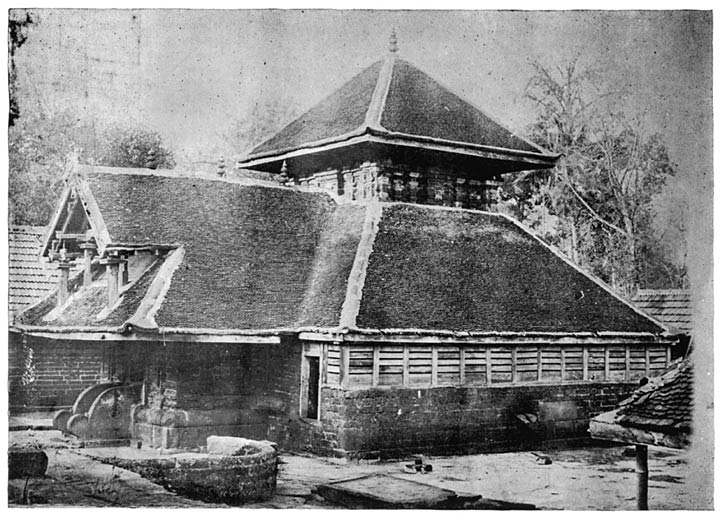
Bhagavati temple, Pandalūr.
Yet another important festival, Vishu, is thus described by Mr. Gopal Panikkar. “Vishu, like the Ōnam and Thiruvathira festivals, is a remarkable event among us. Its duration is limited to one day. The 1st of Mētam (some day in April) is the unchangeable day, on which it falls. It is practically the astronomical new year’s day. This was one of the periods when, in olden days, the subjects of ruling princes or authorities in Malabar, under whom their lots were cast, were expected to bring their new year’s offerings to such princes. Failure to comply with the customary and time-consecrated demands was visited with royal displeasure, resulting in manifold varieties of oppression. The British Government, finding this was a great burden, pressing rather heavily upon the people, obtained as far back as 1790 a binding promise from those Native Princes that such exactions of presents from the people should be discontinued thereafter. Consequently the festival is now shorn of much of its ancient sanctity and splendour. But suggestive survivals of the same are still to be found in the presents, which tenants and dependents bring to leading families on the day previous to the Vishu. Being the commencement of a new year, native superstition surrounds it with a peculiar solemn importance. It is believed that a man’s whole prosperity in life, depends upon the nature, auspicious or otherwise, of the first things that he happens to fix his eyes upon on this particular morning. According to Nair, and even general Hindu mythology, there are certain objects which possess an inherent inauspicious character. For instance, ashes, firewood, oil, and a lot of similar objects are inauspicious ones, which will render him who chances to notice them first fare badly in life for the whole year, and their obnoxious effects will be removed only on his seeing holy things, such as reigning princes, oxen, cows, gold, and such like, on the morning of the next new year. The effects of the sight of these various materials are said to apply even to the attainment of objects by a man starting on a special errand, who happens for the first time to look at them after starting. However, with this view, almost every family religiously takes care to prepare the most sightworthy objects on the new year morning. Therefore, on the previous night they prepare what is known as a kani. A small circular bell-metal vessel is taken, and some holy objects are systematically arranged inside it. A grandha or old book made of palmyra leaves, a gold ornament, a new-washed cloth, some ‘unprofitably gay’ flowers of the konna tree (Cassia Fistula), a measure of rice, a so-called looking-glass made of bell-metal, and a few other things, are all tastefully arranged in the vessel, and placed in a prominent room inside the house. On either side of this vessel two brass or bell-metal lamps, filled with cocoanut oil clear as diamond sparks, are kept burning, and a small plank of wood, or some other seat, is placed in front of it. At about 5 o’clock in the morning of the day, some one who has got up first wakes up the inmates, both male and female, of the house, and takes them blindfolded, so that they may not gaze at anything else, to the seat near the kani. The members are seated, one after another, in the seat, and are then, and not till then, asked to open their eyes, and carefully look at the kani. Then each is made to look at some venerable member of the house, or sometimes a stranger even. This over, the little playful urchins of the house begin to fire small crackers, which they have bought and stored for the occasion. The kani is then taken round the place from house to house for the benefit of the poor families, which cannot afford to prepare such a costly adornment. With the close of the noise of the crackers, the morning breaks, and preparations are begun for the morning meal. This meal is in some parts confined to rice kanji (gruel) with a grand appendage of other eatable substances, and in others to ordinary rice and its accompaniments, but in either case on a grand scale. Immediately the day dawns, the heads of the families give to almost all the junior members and servants of the household, and to wives and children, money presents to serve as their pocket-money. In the more numerically large families, similar presents are also made by the heads of particular branches of the same family to their juniors, children, wives and servants. One other item connected with the festival deserves mention. On the evening of the previous day, about four or five o’clock, most well-to-do families distribute paddy or rice, as the case may be, in varying quantities, and some other accessories to the family workmen, whether they live on the family estates or not. In return for this, these labourers bring with them for presentation the fruits of their own labours, such as vegetables of divers sorts, cocoanut oil, jaggery, plantains, pumpkins, cucumbers, brinjals (fruit of Solanum Melongena), etc., according as their respective circumstances permit. With the close of the midday meal the festival practically concludes. In some families, after the meal is over, dancing and games of various kinds are carried on, which contribute to the enhancement of the pleasantries incidental to the festival. As on other prominent occasions, card-playing and other games are also resorted to.”