B (continued 5)
Reading edition
(1) Sānto (sāmānta, a chief).
(2) Dānua (gift-taking).
(3) Pādhiya (one who learns the Vēdas).
(4) Sārua (sāru, tubers of the arum Colocasia antiqitorum).
(5) Holua (holo, yoke of a plough).
(6) Bhodri (Bhadriya, an agrahāram on the Ganges).
(7) Bārua (a small sea-port town).
(8) Deuliya (one who serves in temples).
(9) Kotokiya (kotaka, palace. Those who live in palaces as servants to zamindars).
(10) Sāhu (creditor).
(11) Jhādua (jungle).
(12) Sodeibālya (those who follow an ungodly life).
It is recorded, in the Madras Census Report, 1901, that “the Sāntos regard themselves as superior to the others, and will not do purōhit’s work for them, though they will for zamindars. They are also very scrupulous about the behaviour of their womenkind. The Dānuas live much by begging, especially at the funerals of wealthy persons, but both they and the Pādhiyas know the Vēdas, and are priests to the zamindars and the higher classes of Sūdras. The Sāruas cultivate the ‘yam’ (Colocasia), and the Holuas go a step further, and engage in ordinary cultivation—actual participation in which is forbidden to Brāhmans by Manu, as it involves taking the lives of worms and insects. A few of the Sāruas are qualified to act as purōhits, but the Holuas hardly ever are, and they were shown in the 1891 census to be the most illiterate of all the Brāhmans of the Presidency. Few of them even perform the Sandhya and Tarpana, which every Brāhman should scrupulously observe. Yet they are regarded as ceremonially pure, and are often cooks to the zamindars. Regarding the sixth class, the Bhodris, a curious legend is related. Bhodri means a barber, and the ancestor of the sub-division is said to have been the son of a barber who was brought up at Puri with some Sānto boys, and so learned much of the Vēdas and Shāstras. He left Puri and went into Jeypore, wearing the thread and passing himself off as a Brāhman, and eventually married a Brāhman girl, by whom he got children who also married Brāhmans. At last, however, he was found out, and taken back to Puri, where he committed suicide. The Brāhmans said they would treat his children as Brāhmans if a plant of the sacred tulsi grew on his grave, but, instead of tulsi, a plant of tobacco appeared there, and so his descendants are Bhodris or barber Brāhmans, and even Karnams, Gaudos, and Mahantis decline to accept water at their hands. They cultivate tobacco and ‘yams,’ but nevertheless officiate in temples, and are purōhits to the lower non-polluting castes. Of the remaining six divisions, the Bāruas are the only ones who do purōhit’s work for other castes, and they only officiate for the lower classes of Sūdras. Except the Sodeibālyas, the others all perform the Sandhya and Tarpana. Their occupations, however, differ considerably. The Bāruas are pūjāris in the temples, and physicians. The Deuliyas are pūjāris and menials in zamindars’ houses, growers of ‘yams,’ and even day labourers. The Kotokiyas are household servants to zamindars. The Sāhus trade in silk cloths, grain, etc., and are money-lenders. The Jhāduas are hill cultivators, and traders with pack-bullocks. The last of the divisions, the Sodeibālyas, are menial servants to the zamindars, and work for daily hire.”
VII. Sārasvat and Konkani.—Both these classes belong to the Gauda branch, and speak the Konkani language. The original habitation of the Konkanis is said to have been the bank of the Sarasvati, a river well known in early Sanskrit works, but said to have subsequently lost itself in the sands of the desert, north of Rajputana. As they do not abstain from fish, the other Brāhmans among whom they have settled regard them as low. The full name as given by the Konkanis is Gauda Sārasvata Konkanastha. All the Konkani Brāhmans found in South Canara are Rig Vēdis. Like the Shivalli Brāhmans, they have numerous exogamous septs, which are used as titles after their names. For example, Prabhu is a sept, and Krishna Prabhu the name of an individual. A large majority of the Konkani Brāhmans are Mādhvas, and their god is Venkatarāmana of Tirupati, to whom their temples in South Canara are dedicated. Other Brāhmans do not go to the Konkani temples, though non-Brāhmans do so. A very striking feature of the Konkani temples is that the god Venkatarāmana is not represented by an idol, but by a silver plate with the image of the god embossed on it. There are three important temples, at Manjēshwar, Mulki, and Karkal. To these are attached Konkani Brāhmans called Darsanas, or men who get inspired. The Darsana attached to the Mulki temple comes there daily about 11 A.M. After worship, he is given thīrtham (holy water), which he drinks. Taking in his hands the prasādam (offering made to the god), he comes out, and commences to shiver all over his body for about ten minutes. The shivering then abates, and a cane and long strip of deer skin are placed in his hands, with which he lashes himself on the back, sides, and head. Holy water is given to him, and the shivering ceases. Those who have come to the temple put questions to the Darsana, which are answered in Konkani, and translated. He understands his business thoroughly, and usually recommends the people to make presents of money or jewels to Venkatarāmana, according to their means. In 1907, a rich Guzerati merchant, who was doing business at Mangalore, visited the temple, and consulted the Darsana concerning the condition of his wife, who was pregnant. The Darsana assured him that she would be safely delivered of a male child, and made him promise to present to the temple silver equal in weight to that of his wife, should the prophecy be realised. The prediction proving true, the merchant gave silver, sugar-candy, and date fruits, to the required weight at a cost, it is said, of five thousand rupees. At the Manjēshwar temple, the Darsana is called the dumb Darsana, as he gives signs instead of speaking. At a marriage among the Konkanis, for the Nāgavali ceremony eight snakes are made out of rice or wheat flour by women and the bridal couple. By the side of the pot representing Siva and Parvati, a mirror is placed. Close to the Nāgavali square, it is customary to draw on the ground the figures of eight elephants and eight Bairavas in flour.
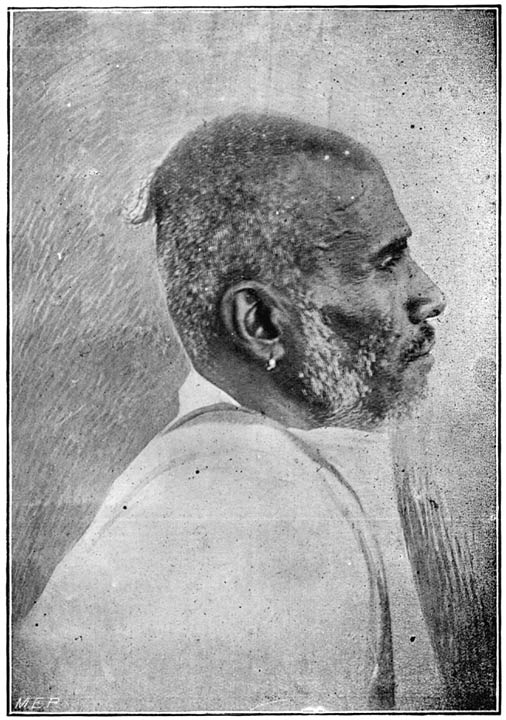
Konkani Brāhman.
The following account of the Konkanis is given in the Cochin Census Report, 1901:—“The Konkanis are a branch of the Sarasvat sub-division of the Pancha Gaudas. Judged from their well-built physique, handsome features and fair complexion, they appear to belong ethnically to the Aryan stock. The community take their name from their Guru Sarasvata. Trihotrapura, the modern Tirhut in Behar, is claimed as the original home of the community. According to their tradition, Parasu Rāma brought ten families, and settled them in villages in and around Gomantaka, the modern Goa, Panchrakosi, and Kusasthali. When Goa was conquered by Vijayanagar, they placed themselves under the protection of the kings of that country. For nearly a quarter of a century after the conquest of Goa by the Portuguese, they continued unmolested under the Portuguese Governors. During this period, they took to a lucrative trade in European goods. With the establishment of the Inquisition at Goa, and the religious persecution set on foot by the Portuguese, the community left Goa in voluntary exile. While some submitted to conversion, others fled to the north and south. Those that fled to the south settled themselves in Canara and at Calicut. Receiving a cold reception at the hands of the Zamorin, they proceeded further south, and placed themselves under the protection of the Rulers of Cochin and Travancore, where they flourish at the present day. The Christian converts, who followed in the wake of the first batch of exiles, have now settled themselves at the important centres of trade in the State as copper-smiths, and they are driving a very profitable trade in copper-wares. The Brāhman emigrants are called Konkanis from the fact of their having emigrated from Konkan. In the earliest times, they are supposed to have been Saivites, but at present they are staunch Vaishnavites, being followers of Mādhavāchārya. They are never regarded as on a par with the other Brāhmans of Southern India. There is no intermarriage or interdining between them and other Brāhmans. In Cochin they are mostly traders. Their occupation seems to have been at the bottom of their being regarded as degraded. They have their own temples, called Tirumala Dēvaswāms. They are not allowed access to the inner structure surrounding the chief shrine of the Malayāli Hindu temples; nor do they in turn allow the Hindus of this coast to enter corresponding portions of their religious edifices. The Nambūdris are, however, allowed access even to the interior of the sacred shrine. All caste disputes are referred to their high priest, the Swāmiyar of Kāsi Mutt, who resides at Mancheswaram or Basroor. He is held in great veneration by the community, and his decisions in matters religious and social are final. Some of their temples possess extensive landed estates. Their temple at Cochin is one of the richest in the whole State. The affairs of the temple are managed by Konkani Yogakkars, or an elected committee. Nāyars and castes above them do not touch them. Though their women use coloured cloths for their dress like the women of the East Coast, their mode of dress and ornaments at once distinguish them from other Brāhman women. Amongst them there are rich merchants and landholders. Prabhu, Pai, Shenai, Kini, Mallan, and Vadhyar, are some of the more common titles borne by them.”
In conclusion, brief mention may be made of several other immigrant classes. Of these, the Dēsasthas are Marāthi-speaking Brāhmans, who have adopted some of the customs of the Smartha and Mādhva Carnatakas, with whom intermarriage is permitted. A special feature of the marriage ceremonies of the Dēsasthas is the worship of Ambābhavāni or Tuljabhavāni, with the assistance of Gondala musicians, who sing songs in praise of the deity. The Chitpāvan Brāhmans speak Marāthi and Konkani. In South Canara they are, like the Havīks, owners of areca palm plantations. Karādi Brāhmans, who are also found in South Canara, are said to have come southward from Karhād in the Bombay Presidency. There is a tradition that Parasu Rāma created them from camel bones.
Brāhmani.—A class of Ambalavāsis. (See Unni.)
Brihaspati Vārada.—The name, indicating those who worship their god on Thursday, of a sub-division of Kurubas.
Brinjāri.—A synonym of Lambādi.
Budubudikē.—The Budubudikē or Budubudukala are described in the Mysore Census Report as being “gipsy beggars and fortune-tellers from the Marāta country, who pretend to consult birds and reptiles to predict future events. They are found in every district of Mysore, but only in small numbers. They use a small kind of double-headed drum, which is sounded by means of the knotted ends of strings attached to each side of it. The operator turns it deftly and quickly from side to side, when a sharp and weird sound is emitted, having a rude resemblance to the warbling of birds. This is done in the mornings, when the charlatan soothsayer pretends to have divined the future fate of the householder by means of the chirping of birds, etc., in the early dawn. They are generally worshippers of Hanumantha.” The name Budubudikē is derived from the hour-glass shaped drum, or budbudki.
Bujjinigiyōru (jewel-box).—A sub-division of Gangadikāra Vakkaliga.
Bukka.—Described, in the Madras Census Report, 1901, as a “sub-caste of Balija. They are sellers of saffron (turmeric), red powder, combs, etc., and are supposed to have been originally Kōmatis.” They are described by the Rev. J. Cain as travelling about selling turmeric, opium, and other goods. According to the legend, when Kanyakamma threw herself into the fire-pit (see Komāti), they, instead of following her example, presented to her bukka powder, turmeric, and kunkuma. She directed that they should live apart from the faithful Kōmatis, and live by the sale of the articles which they offered to her.
Būragām.—A sub-division of Kālingi.
Burgher.—A name commonly applied to the Badagas of the Nīlgiri hills. In Ceylon, Burgher is used in the same sense as Eurasian in India.
Burmese.—A few Burmese are trained as medical students at Madras for subsequent employment in the Burmese Medical service. At the Mysore census, 1901, a single Burman was recorded as being engaged at the Kolar gold fields. Since Burma became part of the British dominions in 1886, there has been emigration to that developing country from the Madras Presidency on a large scale. The following figures show the numbers of passengers conveyed thence to Burma during the five years, 1901–05:—
1901 84,329
1902 80,916
1903 100,645
1904 127,622
1905 124,365
Busam (grain).—An exogamous sept of Dēvanga.
Busi (dirt).—An exogamous sept of Mutrācha.
Byagara.—Byagara and Bēgara are synonyms of Holeya.
Printed by The Superintendent, Government Press, Madras.