B (continued 2)
Reading edition
“In 1901, certain envious Bagatas looted one of the villages of the Konda Mālas or hill Paraiyans, a pushing set of traders, who are rapidly acquiring wealth and exalted notions, on the ground that they were becoming unduly arrogant. The immediate cause of the trouble was the fact that at a cockfight the Mālas’ birds had defeated the Bagatas’.”
In a note on the Bagatas, Mr. C. Hayavadana Rao writes that the caste is divided into exogamous septs or intipērulu, some of which occur also among the Kāpus, Telagas, and Vantaris. Girls are married either before or after puberty, and the custom, called mēnarikam, which renders it a man’s duty to marry his maternal uncle’s daughter, is the general rule. An Oriya or Telugu Brāhman officiates at marriages, and the bride is presented with jewelry as a substitute for the bride-price (vōli) in money. It is noted, in the Census Report, 1901, that, at a wedding, the bridegroom is struck by his brother-in-law, who is then presented with a pair of new cloths. The Bagatas are both Vaishnavites and Saivites, and the former get themselves branded on the arm by a Vaishnava guru, who lives in the Godāvari district. The Vaishnavites burn their dead, and the Saivites bury them in the customary sitting attitude. Sātānis officiate for the former, and Jangams for the latter. Both sections perform the chinna and pedda rōzu (big and little day) death ceremonies. The hill Bagatas observe the Itiga Ponduga festival, which is celebrated by the hill classes in Vizagapatam.
Bahusāgara (many seas).—Recorded, in the Madras Census Report, 1901, as a synonym of Rangāri. The Rangāris are tailors and dyers, and the signification of the name is not clear.
Baidya.—See Vaidyan.
Bainēdu.—The Bainēdu, or Bainēdi, as they are called in the Census Report, 1901, are the musicians and barbers of the Mālas and Mādigas. At the peddadinamu death ceremony of the Gamallas, a Māla Bainēdu takes part in the recitation of the story of Ankamma, and in making the designs (muggu) on the ground.
The name Bairāgi is derived from the Sanskrit vairāgya (vi + rāg), denoting without desire or passion, and indicates an ascetic, who has subdued his passions, and liberated himself from worldly desires. The Bairāgis are sometimes called Bāvāji or Sādhu.
The Bairāgis are Vaishnavites, and bear the Tengalai Vaishnava mark (nāmam), made with sandal-paste or gōpi, on the forehead. Bairāgis with a Vadagalai mark are very rare. The Bairāgis wear necklaces of tulsi (Ocimum sanctum) beads or lotus (Nelumbium speciosum) seeds. Every Bairāgi cooks his food within a space cleansed with cow-dung water by himself or his disciple, and will not leave the space until he has finished his meal. The Bairāgis are not particular about screening the space from the public gaze. They partake of one meal daily, in the afternoon, and are abstainers from flesh dietary. They live mainly on alms obtained in the bazars, or in choultries (rest-houses for travellers). They generally carry with them one or two brass vessels for cooking purposes, a sālagrāma stone and a conch-shell for worship, and a chillum (pipe) for smoking ganja (Indian hemp) or opium. They are, as a rule, naked except for a small piece of cloth tied round the waist and passed between the thighs. Some wear more elaborate body-clothing, and a turban. They generally allow the beard to grow, and the hair of the head is long and matted, with sometimes a long tail of yak or human hair tied in a knot on the top of the head. Those who go about nearly naked smear ashes all over their bodies. When engaged in begging, some go through the streets, uttering aloud the name of some God. Others go from house to house, or remain at a particular spot, where people are expected to give them alms.
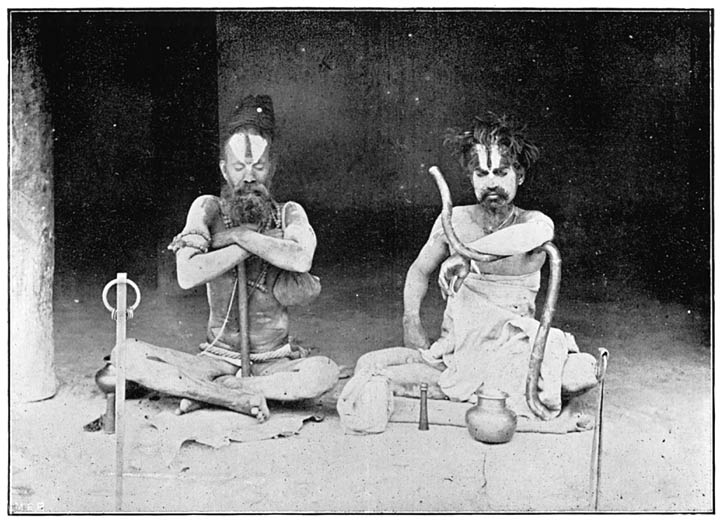
Bairāgis.
The Bairāgis have a guru or priest, whom they call Mahant. Some visit the celebrated temple near Tirupati and pay their respects to the Mahant thereof.
Baisya.—A sub-division of Koronos of Ganjam.
Bājantri.—A synonym of Mangala, indicating their occupation as professional musicians.
Bakta.—See Bagata.
Bākuda.—A sub-division of Holeya.
Balanollu.—Balanollu and Badranollu are names of gōtras of Gānigas, the members of which may not cut Erythroxylon monogynum.
Bālasantōsha.—The Bālasantōsha or Bālasanta vāndlu (those who please children) are described in the Kurnool Manual as “ballad reciters, whose chief stories are the Bobbili katha, or the story of the siege of the fort of Bobbili in Vizagapatam by Bussy; the Kurnool Nabob’s katha or the story of the resumption of Kurnool by the English; and the tale of the quarrels between Ganga and Parvati, the two wives of Siva.”
Balēgara (bangle man).—An occupational sub-division of Banajiga.
In a letter submitted, from Coimbatore, to Mr. Francis in connection with the census, 1901, it was stated that “the Balija people are Kshatriyas of the Lunar Race, as can be proved by a reference to the Bahgavatham, Vishnupurānam, and Brahmmandapurānam, etc.... In this connection, it will be interesting to note that one Sevappa Naidu married Murthiammal, sister-in-law to Achuta Dēva Rayulu of Narapathi Samasthanam of Vijayanagar, and as a marriage portion or dowry received the territory of Tanjore, over which he ruled as king for a long period. It was at this time that the celebrated Tirumalay Naidu of Madura took as wife one of the daughters of Sevappa Naidu’s family. Tirumalay’s grandson, one Chockalinga Naidu, married Mangammal, daughter of Vijiaragavulu Naidu, a grandson of the said Tanjore Sevappa Naidu. It will thus be seen that the Naidu rulers of Tanjore, Trichinopoly, and Madura, were all relations of Narapathi Samasthanam of Vijianagar. That these Narapathies of Vijianagaram were Kshatriyas of the Lunar Race can be clearly seen by a reference to Manucharithra, Pārijāthāpaharanam, Prouda Prabanda Kavi Charitra, etc., and that they were direct descendants of the great Andra Kings can be proved with equal satisfaction by referring to Colonel Mackenzie’s MSS., in the introduction of A. D. Campbell’s Telugu Grammar, and James Prinsep’s Useful Tables of Andra Kings will show that the Andras were immediate descendants of the well-known Yayathi Rāja of the Lunar Race.”
The name Balija is said to be derived from the Sanskrit bali (a sacrifice) and ja (born), signifying that the Balijas owe their origin to the performance of a yāgam. The legend is current that on one occasion Siva wanted his consort Parvati to appear before him in all her glory. But, when she stood before him, fully decorated, he laughed, and said that she was not as charming as she might be. On this, she prayed that Siva would help her to become so. From his braid of hair Siva created a being who descended on the earth, bearing a number of bangles and turmeric paste, with which Parvati adorned herself. Siva, being greatly pleased with her appearance, told her to look at herself in a looking-glass. The being, who brought the bangles, is believed to have been the ancestor of the Gāzula Balijas. According to another version of the legend, Parvati was not satisfied with her appearance when she saw herself in the looking-glass, and asked her father to tell her how she was to make herself more attractive. He accordingly prayed to Brahma, who ordered him to perform a severe penance (thapas). From the sacrificial fire, kindled in connection therewith, arose a being leading a donkey laden with heaps of bangles, turmeric, palm leaf rolls for the ears, black beads, sandal powder, a comb, perfumes, etc. From this Maha Purusha who thus sprang from a sacrifice (bali), the Balijas derived their origin and name. To him, in token of respect, were given flags, torches, and certain musical instruments.
The Dēsāyis, or leaders of the right-hand faction, are said to be Balijas by caste. In former days they had very great influences, and all castes belonging to the right-hand faction would obey the Dēsāyi Chetti. Even at the present day, the Oddēs and others refer their disputes to the Dēsāyi, and not to their own caste headman. In former times there were three principal Dēsāyis, who had their head-quarters at Conjeeveram, Cuddalore, and Walajapet. The head Dēsāyi possesses a biruthu (insigne of office) in the form of a large brass ladle with a bell attached to it. On the occasion of Balija marriages and funerals, this is sent through the Chalavathi (a pariah), who is the servant of the Dēsāyi, and has the right of allu eduththal (taking a handful) when he goes to the bazaar, where he receives meat from the butcher, vegetables, etc., as his perquisite. The Dēsāyi’s ladle is kept in the custody of the Chalavathi (See Dēsāyi).
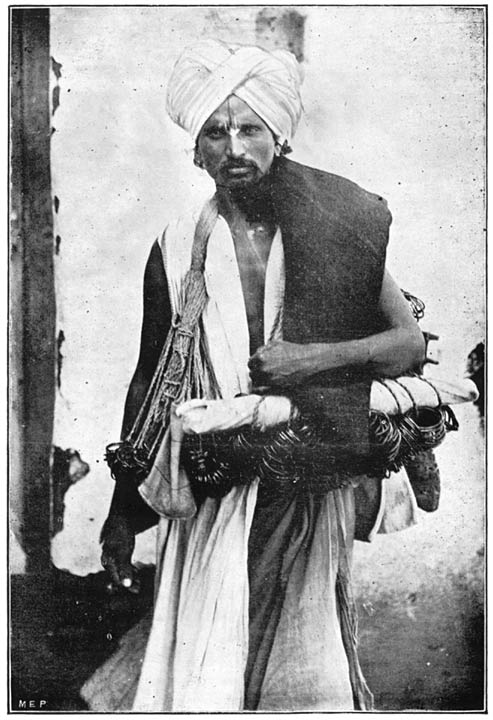
Gazula Balija with Bangles.
Of the numerous sub-divisions of the Balijas, the following may be noticed:—
Gāzula, glass bangles. Valaiyal or vala (bangle) Chetti is the Tamil equivalent. By some the sight of a Gāzula Balija with his pile of bangles on his back is considered a good omen. In recent years, a scare has arisen in connection with an insect, which is said to take up its abode in imported German glass bangles, which compete with the indigenous industry of the Gāzulas. The insect is believed to lie low in the bangle till it is purchased, when it comes out and nips the wearer, after warning her to get her affairs in order before succumbing. A specimen of a broken bangle, from which the insect is stated to have burst forth and stung a girl in the wrist, was sent to me. But the insect was not forthcoming.
Gandavallu, or Gundapodi vāndlu. Go about the villages, hawking turmeric, kunkumam (colour powder), kamela (Mallotus philippinensis) dye powder, beads, combs, cosmetics and other articles. Supposed to have been originally Kōmatis.
Kavarai, Tamil synonym for Balija.
Linga.
Panchama.
Telugu or Telaga. A synonym for Balija in the Northern Circars.
Rājamāhendram or Mūsu Kamma. The former denotes the town of Rajahmundry, and the latter a special ear-ornament worn by women.
Tōta, garden.
Ralla, precious stones.
Pagadala, coral.
Pūsa, beads.
Rācha, royal.
Vyāsa. A sage (rishi) or hunter, whom the hunting classes claim as their ancestor.
Other sub-divisions, classified as Balijas at the census, 1901, were:—
Jakkulas, among whom it was, at Tenali in the Kistna district, formerly customary for each family to give up one girl for prostitution. Under the influence of social reform, a written agreement was a few years ago entered into to give up the practice.
Ādapāpa. Female attendants on the ladies of the families of Zamindars, who, as they are not allowed to marry, lead a life of prostitution. Their sons call themselves Balijas. In some places, e.g., the Kistna and Godāvari districts, this class is known as Khasa or Khasavandlu.
Santa Kavarai. Returned as Balijas in the Chingleput district.
Ravut. Returned in the Salem district. Said to have been formerly soldiers under the Poligars.
Like other Telugu castes, the Balijas have exogamous septs (intipēru) and gōtras. Of the former, the following are examples:—
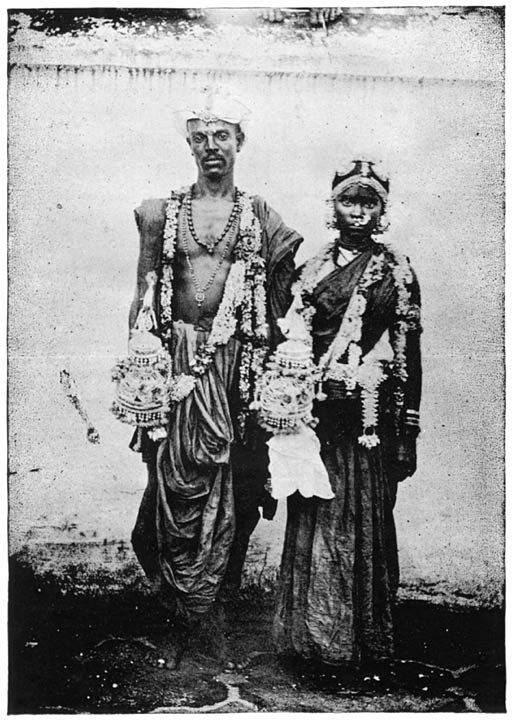
Balija Bride and Bridegroom.
Tupākala, musket. Samudram, ocean. Pappu, split pulse. Gantla, bell. Puli, tiger. Balli, lizard. Āvula, cow. Gandham, sandal paste or powder. Jilakara, cummin seeds. Miriyāla, pepper. Mutyāla, pearls. Nārikēlla, cocoanut. Nemili, peacock. Pagadāla, coral. Pattindla, silk house. Ratnāla, precious stones. Ungarāla, rings. Yenumala, buffalo.
There is a saying that a Balija who has no gōtra must take the name of the Pasuleti, or Pasupuleti gōtra. In like manner, a Brāhman orphan, whose gōtra cannot be traced, is made to adopt the Vathsa gōtra.
Among the Mūsu Kammas, the consent of both the maternal uncle and elder sister’s husband must be obtained before a girl is given in marriage. At the betrothal ceremony, the future bridegroom’s relations proceed to the house of the girl, carrying the following articles on an odd number of trays beneath a cloth canopy (ulladam): mustard, fenugreek (Trigonella Fœnumgræcum), cummin seeds, curds, jaggery, dhāl (Cajanus indicus), balls of condiments, tamarinds, pepper, twenty-one cakes, eleven cocoanuts, salt, plantains, flowers, a new cloth, black beads, a palm-leaf roll for the ear lobe, turmeric, a comb, and kunkumam (colour powder). A few rupees, called kongu mudi, to be given to the future mother-in-law, are also placed on the tray. The contracting parties exchange betel and a cocoanut, of which the latter is taken away by a member of the bridegroom’s party, tied up in his body-cloth. The girl is seated on a plank, goes through the ceremony (nalagu) of being anointed with oil and paste, and is presented with a new cloth. Wearing this, she sits on the plank, and betel, flowers, jewels, etc., are placed in her lap. A near female relation then ties a string of black beads round her neck. Among the Mūsu Kammas, the milk-post, consisting of a green bamboo, with sometimes a branch of Odina Wodier, must be set up two days before the commencement of the marriage ceremonies. It is worshipped, and to it are tied an iron ring, and a string of cotton and wool twisted together (kankanam). A small framework, called dhornam, made of two sticks, across which cotton threads or pieces of cloth are stretched, is brought by a washerwoman, and given to the maternal uncle of the bridegroom, who ties it to the marriage booth. The marriage pots are brought from a potter’s house beneath a cloth canopy (ulladam), and given to married couples, closely related to the bridegroom, who fetch water, and place the pots on the dais. Some married women pour rice on a clean white cloth spread on the floor, and rub off the bran with their hands, while they sing songs. The cloth to be worn by the bridegroom is dipped in turmeric water by these women and dried. The Balijas are very particular about the worship of their female ancestors (pērantālu) and no auspicious ceremony can be commenced until pērantālu pūja has been performed. Among the Mūsu Kammas, five women, who are closely related to the bridal couple, take only one meal a day, and try to keep free from pollution of all sorts. They go through the nalagu ceremony, and are presented with new cloths. Among other sections, the wall is simply painted with turmeric dots to represent the ancestors. The ancestor worship concluded, the finger and toe-nails of the bridegroom are cut, and a Mūsu Kamma bridegroom is conducted to a temple of Vignēswara (Ganēsa), if there is one near at hand. By other sections it is considered sufficient, if Vignēswara worship is performed at the marriage booth. The Mūsu Kamma bridegroom is dressed up at the temple, and a bashingam (chaplet) tied on his forehead. An old-fashioned turban (pāghai) is placed on his head, and a dagger (jimthadu) stuck into his waist-cloth. It is said that, in olden times, the Balijas used to worship the dagger, and sacrifice sheep or goats at marriages. The bridegroom is next brought to the house where the wedding is being celebrated, and his brother-in-law washes his feet, and, after throwing flowers and rice over them, puts toe-rings and shoes thereon. The Brāhman purōhit lights the sacred fire (hōmam), and pours ghī (clarified butter) therein, while he utters some verses, Vēdic or other. He then ties the kankanam (thread) on the bridegroom’s wrist. The parents of the bride next proceed with the dhārādhattam (gift of the girl) by pouring water and grains of rice into the hands of the bridegroom. Vignēswara is then worshipped, and the bottu (marriage badge) is blessed by those assembled, and handed to the bridegroom. He, placing his right foot on that of the bride, who is separated from him by a screen, ties it round her neck. The couple then exchange seats, and rice is thrown in front of them. They next go thrice round the dais and milk-post, and, at the end of the first and second rounds, the foot of the bride is placed on a grinding stone. After the third round they gaze at the pole-star (Arundati). Into one of the marriage pots are put a pap-bowl, ring, and bracelet, which are picked out by the couple. If the pap-bowl is first got hold of by the bridegroom, the first-born child will be a boy; if the ring, it will be a girl. This rite concluded, the bridegroom makes a mark on the bride’s forehead with collyrium. On the second day, the bridegroom makes a pretence of being angry, and stays in a garden or house near that in which the marriage ceremonies are conducted. The bride, and some of her relations, go to him in procession, and, treating him with great respect, bring him back. The sacred fire is lighted, and the bride enters the room in which the marriage pots (aravēni) are kept. The bridegroom is stopped at the entrance thereto by a number of married women, and has to call his wife by her name, and pay a small sum of money for the ārathi (coloured water), which is waved by the women, to ward off the evil eye. In some places, the sister of the bridegroom extracts a promise that his coral (daughter) shall be given in marriage to her pearl (son). He is then permitted to enter the room. On the third day, after hōmam has been performed by the Brāhman priest, the newly married couple go through a burlesque imitation of domestic life, after they have worshipped the posts of the booth, and perform a mimic ploughing ceremony, the bridegroom stirring up some earth in a basket with a stick or miniature plough. This, in some places, his sister tries to prevent him from doing by covering the basket with a cloth, and he has to say “I will give my coral to your pearl.” His brother-in-law tries to squeeze his fingers between a pair of sticks called kitti, which was, in former times, a very popular form of torture as a means of extracting confession. The bride gives her husband some conji (rice-gruel) to refresh him after his pretended labour.
At a marriage among the Perikes (q.v.), a gunny-bag is said to be worshipped before the bottu is tied. A quantity of rice is measured on the first day of the ceremonies and tied up in a cloth. On the third day, the cloth is opened, and it is considered an auspicious sign if the quantity of rice exceeds that which was originally put into it. Among the Rājamāhendram Balijas, just before the nalagu ceremony, the knees, shoulders, and cheeks of the bride and bridegroom are touched with a pestle, while the names of their septs are called out. On the third day, the same process is repeated, but in the reverse order. A Gāzula Balija bride must, when the bottu is tied, be dressed in a white cloth with red stripes, called sanna pappuli. With other sections, a white cloth dyed with turmeric is de rigeur.
Balija, it may be noted, is, in the North Arcot Manual, returned as a division of Dāsaris and Īdigas. The better classes of Mēdaras (cane-splitters and mat-makers) are also taking to calling themselves Balijas, and assume the title Chetti. Oddēs and Upparas sometimes style themselves Oddē Balija and Uppara Balija. They belong to the right-hand section, which is headed by the Dēsayi, who is a Balija, and so describe themselves as belonging to the Setti or Chetti samayam (section). Some members of the Mila and Vāda fishing castes have adopted Ōda or Vāda (boat) Balija as their caste name.
Ballem (spear).—An exogamous sept of Māla.
Balli (lizard).—An exogamous sept of Balija.
Bālolika.—A synonym of Rājāpuri.
Bālu (bear).—A sept of Dōmb.
Bāna (big pot).—An exogamous sept of Togatas, and a name for Telugu washermen, who are sometimes called Bāna Tsākala. Bāna is the Telugu name for the pot which they use for boiling the clothes in.
Banajiga (vanik, tradesman).—Canarese traders, many of whom are Lingāyats. See Linga Balija.
Banda.—Banda, as applied to the Mondi mendicant class, seems to be used in the sense of an obstinate fellow. Some, however, maintain that it refers to a beggar who carries about a stone, and threatens to beat his brains out, if alms are not forthcoming. Banda, meaning a rock, also occurs as an exogamous sept of Oddē.
Bandāri.—Bandāri, denoting apparently the shrub Dodondæa viscosa, is an exogamous sept of Oddē. It further occurs, in the sense of a temple treasurer, as an exogamous sept of Dēvāngas and Padma Sālēs, for whom the Bandāri acts as caste messenger. It is also the name of the assistant to the headman, or Pattakar, of the Okkiliyans, a title of Konkani Brāhmans, and a synonym of Kelasis.
Bāndēkāra.—A synonym for Konkani Vānis (traders), who are said, in the Madras Census Report, 1901, to ape the Brāhmanical customs, and call themselves by the curious hybrid name of Vasiya (or Vaisya) Brāhman.
Bandi (cart).—An exogamous sept of Kāpu, Kavarai, Korava, Kumbāra, Kurni, Kuruba, Māla, Oddē, Stānika, and Yānādi. It further occurs as a name for Koravas, who drag the temple car at times of religious festival. Vandikkāran (cartmen) is an occupational name for Nāyars, who work as cartmen for carrying fuel.
Bangāru Mukkara (gold nose ornament).—A sub-division of Kamma.
Baniya.—The Baniyas or Bunyas are immigrant traders and money-lenders (sowcars) from Northern India, who have settled down in the southern bazars, where they carry on a lucrative business, and wax sleek and wealthy. Bania also occurs as a synonym for the South Indian trading caste, the Kōmatis.
Bānjāri.—A synonym of Lambādi.
Banka (gum).—An exogamous sept of Motāti Kāpu.
Bannagara (a painter).—A synonym of Chitrakāra.
Bannān.—A synonym of Vannān or Mannān, recorded at times of census. In like manner Bannata occurs as a Canarese form of the Malayālam Veluttēdan or Vannattān.
Banni or Vanni (Prosopis spicigera).—An exogamous sept of Kuruba and Kurni. The tree is worshipped because on it “the five Pāndava princes hung up their arms when they entered Virāt Nagra in disguise. On the tree the arms turned to snakes, and remained untouched till the owners returned.” (Lisboa.)
Few traces of any such organisation as has been indicated now prevail, great changes having been made when the Vijayanagar Government introduced, more than five hundred years ago, a system of administration under which the local Jain chiefs, though owing allegiance to an overlord, became more independent in their relations with the people of the country. Under the Bednūr kings, and still more under the Mysore rule, the power of the chiefs was also swept away, but the old organisation was not reverted to.
The Bants are now the chief land-owning and cultivating class in South Canara, and are, with the exception of the Billavas or toddy-drawers, the most numerous caste in the district. “At the present day, the Bants of Canara are largely the independent and influential landed gentry, some would say, perhaps, the substantial yeomanry. They still retain their manly independence of character, their strong and well developed physique, and they still carry their heads with the same haughty toss as their forefathers did in the stirring fighting days when, as an old proverb had it, ‘The slain rested in the yard of the slayer,’ and when every warrior constantly carried his sword and shield. Both men and women of the Bant community are among the comeliest of Asiatic races, the men having high foreheads and well-turned aquiline noses.”
Most of the Bants are Hindus by religion, and rank as Sūdras, but about ten thousand of them are Jains. Probably they originally assumed Jainism as a fashionable addition to the ancestral demon worship, to which they all still adhere, whether they profess to be Vaishnavites, Saivites, or Jains. It is probable that, during the political supremacy of the Jains, a much larger proportion of the Bants professed adherence to that religion than now-a-days.
There are four principal sub-divisions of the caste, viz., Māsādika, who are the ordinary Bants of Tuluva; Nādava or Nād, who speak Canarese, and are found in the northern part of South Canara; the Parivāra, who do not follow the aliya santāna system of inheritance; and the Jains. Members of these sub-divisions may not intermarry, but instances have occurred of marriage between members of the Māsādika and Nād sub-divisions.
As a custom similar to aliya santāna prevails in Malabar, it no doubt originated before Tuluva and Kērala were separated. The small body of Parivāra Bants, and the few Jain Bants that do not follow the aliya santāna system, are probably the descendants of a few families who allowed their religious conversion to Hinduism or Jainism to have more effect on their social relations than was commonly the case. Now that the ideas regarding marriage among the Bants are in practice assimilated to a great extent to those of most other people, the national rule of inheritance is a cause of much heart-burning and quarrelling, fathers always endeavouring to benefit their own offspring at the cost of the estate. A change would be gladly welcomed by many, but vested interests in property constitute an almost insuperable obstacle.
The Bants do not usually object to the use of animal food, except, of course, the flesh of the cow, and they do not as a rule wear the sacred thread. But there are some families of position called Ballāls, amongst whom heads of families abstain from animal food, and wear the sacred thread. These neither eat nor intermarry with the ordinary Bants. The origin of the Ballāls is explained by a proverb, which says that when a Bant becomes powerful, he becomes a Ballāl. Those who have the dignity called Pattam, and the heads of certain families, known as Shettivalas or Heggades, also wear the sacred thread, and are usually managers or mukhtesars of the temples and bhūtasthāns or demon shrines within the area over which, in former days, they are said to have exercised a more extended jurisdiction, dealing not only with caste disputes, but settling numerous civil and criminal matters. The Jain Bants are strict vegetarians, and they abstain from the use of alcoholic liquors, the consumption of which is permitted among other Bants, though the practice is not common. The Jain Bants avoid taking food after sunset.
The more well-to-do Bants usually occupy substantial houses on their estates, in many of which there is much fine wood-work, and, in some cases, the pillars of the porches and verandahs, and the doorways are artistically and elaborately carved. These houses have been described as being well built, thatched with palm, and generally prettily situated with beautiful scenic prospects stretching away on all sides.
The Bants have not as a rule largely availed themselves of European education, and consequently there are but few of them in the Government service, but among these few some have attained to high office, and been much respected. As is often the case among high spirited people of primitive modes of thought, party and faction feeling run high, and jealousy and disputes about landed property often lead to hasty acts of violence. Now-a-days, however, the last class of disputes more frequently lead to protracted litigation in the Courts.
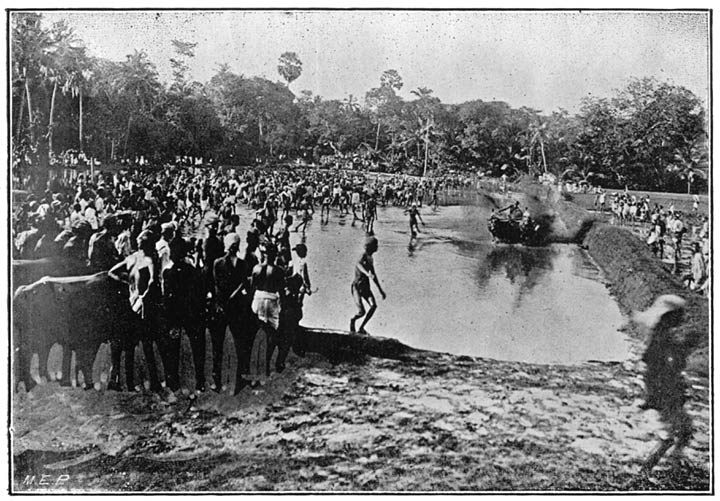
Kambla Buffalo Race.
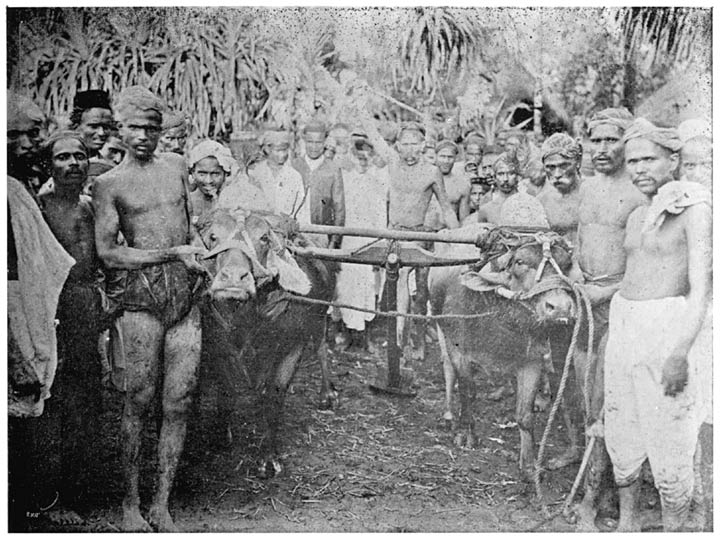
Kambla Racing Buffaloes.
For the following note on buffalo races, I am indebted to Mr. H. O. D. Harding. “This is a sport that has grown up among a race of cultivators of wet land. It is, I believe, peculiar to South Canara, where all the cultivation worth mentioning is wet. The Bants and Jains, and other landowners of position, own and run buffaloes, and the Billava, or toddy drawer, has also entered the racing world. Every rich Bant keeps his kambla field consecrated to buffalo-racing, and his pair of racing buffaloes, costing from Rs. 150 to Rs. 500, are splendid animals; and, except for an occasional plough-drawing at the beginning of the cultivation season, are used for no purpose all the year, except racing. The racing is for no prize or stakes, and there is no betting, starter, judge, or winning post. Each pair of buffaloes runs the course alone, and is judged by the assembled crowd for pace and style, and, most important of all, the height and breadth of the splash which they make. Most people know the common levelling plank used by the ryots (cultivators) all over India to level the wet field after ploughing. It is a plank some 4 or 5 feet long by 1 or 1½ feet broad, and on it the driver stands to give it weight, and the buffaloes pull it over the mud of a flooded rice-field. This is the prototype of the buffalo-racing car, and any day during the cultivating season in the Tulu country one may see two boys racing for the love of the sport, as they drive their levelling boards. From this the racing car has been specialised, and, if a work of art for its own purpose, is not a car on which any one could or would wish to travel far. The leveller of utility is cut down to a plank about 1½ by 1 foot, sometimes handsomely carved, on which is fixed a gaily decorated wooden stool about 6 inches high and 10 inches across each way, hollowed out on the top, and just big enough to afford good standing for one foot. In the plank, on each side, are holes to let the mud and water through. The plank is fixed to a pole, which is tied to the buffalo’s yoke. The buffaloes are decorated with coloured jhūls and marvellous head-pieces of brass and silver (sometimes bearing the emblems of the sun and moon), and ropes which make a sort of bridle. The driver, stripping himself to the necessary minimum of garments, mounts, while some of his friends cling, like ants struggling round a dead beetle, to the buffaloes. When he is fairly up, they let go, and the animals start. The course is a wet rice-field, about 150 yards long, full of mud and water. All round are hundreds, or perhaps thousands of people, including Pariahs who dance in groups in the mud, play stick-game, and beat drums. In front of the galloping buffaloes the water is clear and still, throwing a powerful reflection of them as they gallop down the course, raising a perfect tornado of mud and water. The driver stands with one foot on the stool, and one on the pole of the car. He holds a whip aloft in one hand, and one of the buffaloes’ tails in the other. He drives without reins, with nothing but a waggling tail to hold on to and steer by. Opening his mouth wide, he shouts for all he is worth, while, to all appearances, a deluge of mud and water goes down his throat. So he comes down the course, the plank on which he stands throwing up a sort of Prince of Wales’ feathers of mud and water round him. The stance on the plank is no easy matter, and not a few men come to grief, but it is soft falling in the slush. Marks are given for pace, style, sticking to the plank, and throwing up the biggest and widest splash. Sometimes a kind of gallows, perhaps twenty feet high, is erected on the course, and there is a round of applause if the splash reaches up to or above it. Sometimes the buffaloes bolt, scatter the crowd, and get away into the young rice. At the end of the course, the driver jumps off with a parting smack at his buffaloes, which run up the slope of the field, and stop of themselves in what may be called the paddock. At a big meeting perhaps a hundred pairs, brought from all over the Tulu country, will compete, and the big men always send their buffaloes to the races headed by the local band. The roads are alive with horns and tom-toms for several days. The proceedings commence with a procession, which is not infrequently headed by a couple of painted dolls in an attitude suggestive of that reproductiveness, which the races really give thanks for. They are a sort of harvest festival, before the second or sugge crop is sown, and are usually held in October and November. Devils must be propitiated, and the meeting opens with a devil dance. A painted, grass-crowned devil dancer, riding a hobby-horse, proceeds with music round the kambla field. Then comes the buffalo procession, and the races commence. At a big meeting near Mangalore, the two leading devil dancers were dressed up in masks, and coat and trousers of blue mission cloth, and one had the genitalia represented by a long piece of blue cloth tipped with red, and enormous testes. Buffaloes, young and old, trained and untrained, compete, some without the plank attached to them, and others with planks but without drivers. Accidents sometimes happen, owing to the animals breaking away among the crowd. On one occasion, a man who was in front of a pair of buffaloes which were just about to start failed to jump clear of them. Catching hold of the yoke, he hung on to it by his hands, and was carried right down the course, and was landed safely at the other end. If he had dropped, he would have fallen among four pairs of hoofs, not to mention the planks, and would probably have been brained. It is often a case of owners up, and the sons and nephews of big Bants, worth perhaps Rs. 10,000 a year, drive the teams.”
To the above account, I may add a few notes made at a buffalo race-meeting near Udipi, at which I was present. Each group of buffaloes, as they went up the track to the starting-point, was preceded by the Koraga band playing on drum, fife and cymbals, Holeyas armed with staves and dancing, and a man holding a flag (nishāni). Sometimes, in addition to the flag, there is a pakkē or spear on the end of a bamboo covered with strips of cloth, or a makara torana, i.e., festooned cloths between two bamboos. The two last are permitted only if the buffaloes belong to a Bant or Brāhman, not if they are the property of a Billava. At the end of the races, the Ballāla chief, in whose field they had taken place, retired in procession, headed by a man carrying his banner, which, during the races, had been floating on the top of a long bamboo pole at the far end of the track. He was followed by the Koraga band, and the Holeyas attached to him, armed with clubs, and dancing a step dance amid discordant noises. Two Nalkes (devil-dancers), dressed up in their professional garb, and a torch-bearer also joined in the procession, in the rear of which came the Ballāla beneath a decorated umbrella. In every village there are rākshasas (demons), called Kambla-asura, who preside over the fields. The races are held to propitiate them, and, if they are omitted, it is believed that there will be a failure of the crop. According to some, Kambla-asura is the brother of Mahēshasura, the buffalo-headed giant, from whom Mysore receives its name. The Koragas sit up through the night before the Kambla day, performing a ceremony called panikkuluni, or sitting under the dew. They sing songs to the accompaniment of the band, about their devil Nīcha, and offer toddy and a rice-pudding boiled in a large earthen pot, which is broken so that the pudding remains as a solid mass. This pudding is called kandēl addē, or pot pudding. On the morning of the races, the Holeyas scatter manure over the field, and plough it. On the following day, the seedlings are planted, without, as in ordinary cases, any ploughing. To propitiate various devils, the days following the races are devoted to cock-fighting. The Kamblas, in different places, have various names derived from the village deity, the chief village devil, or the village itself, e.g., Janardhana Dēvara, Daivala, or Udiyavar. The young men, who have the management of the buffaloes, are called Bannangayi Gurikara (half-ripe cocoanut masters) as they have the right of taking tender cocoanuts, as well as beaten rice to give them physical strength, without the special permission of their landlord. At the village of Vandar, the races take place in a dry field, which has been ploughed, and beaten to break up the clods of earth. For this reason they are called podi (powder) Kambla.
A pair of buffaloes, belonging to the field in which the races take place, should enter the field first, and a breach of this observance leads to discussion and quarrels. On one occasion, a dispute arose between two Bants in connection with the question of precedence. One of them brought his own pair of buffaloes, and the other a borrowed pair. If the latter had brought his own animals, he would have had precedence over the former. But, as his animals were borrowed, precedence was given to the man who brought his own buffaloes. This led to a dispute, and the races were not commenced until the delicate point at issue was decided. In some places, a long pole, called pūkāre, decorated with flags, flowers, and festoons of leaves, is set up in the Kambla field, sometimes on a platform. Billavas are in charge of this pole, which is worshipped, throughout the races, and others may not touch it.
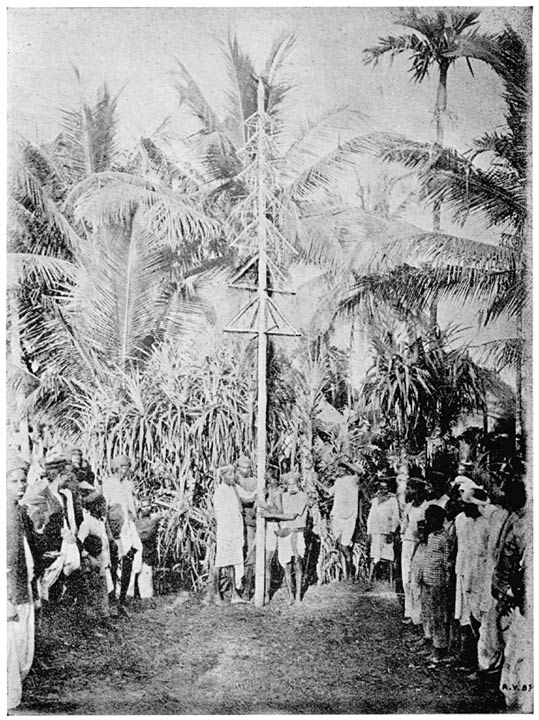
Pūkāre Post at Kambla Buffalo Races.
Fines inflicted by the Bant caste council are, I am informed, spent in the celebration of a temple festival. In former days, those found guilty by the council were beaten with tamarind switches, made to stand exposed to the sun, or big red ants were thrown over their bodies. Sometimes, to establish the innocence of an accused person, he had to take a piece of red-hot iron (axe, etc.) in his hand, and give it to his accuser.
At a puberty ceremony among some Bants the girl sits in the courtyard of her house on five unhusked cocoanuts covered with the bamboo cylinder which is used for storing paddy. Women place four pots filled with water, and containing betel leaves and nuts, round the girl, and empty the contents over her head. She is then secluded in an outhouse. The women are entertained with a feast, which must include fowl and fish curry. The cocoanuts are given to a washerwoman. On the fourth day, the girl is bathed, and received back at the house. Beaten rice, and rice flour mixed with jaggery (crude sugar) are served out to those assembled. The girl is kept gōsha (secluded) for a time, and fed up with generous diet.
Under the aliya santāna system of inheritance, the High Court has ruled that there is no marriage within the meaning of the Penal Code. But, though divorce and remarriage are permitted to women, there are formal rules and ceremonies observed in connection with them, and amongst the well-to-do classes divorce is not looked upon as respectable, and is not frequent. The fictitious marriage prevailing amongst the Nāyars is unknown among the Bants, and a wife also usually leaves the family house, and resides at her husband’s, unless she occupies so senior a position in her own family as to make it desirable that she should live on the family estate.
Bellathannaya, jaggery.
Bhūthiannaya, ashes.
Chāliannaya, weaver.
Edinnaya, hornet’s nest.
Karkadabennai, scorpion.
Kayerthannaya (Strychnos Nux-vomica).
Kochattabannayya, or Kajjarannayya, jack tree (Artocarpus integrifolia).
Koriannaya, fowl.
Pathanchithannaya, green peas.
Perugadannaya, bandicoot rat.
Poyilethannaya, one who removes the evil eye.
Puliattannaya, tiger.
Rāgithannaya, rāgi (Eleusine Coracana).
Infant marriage is not prohibited, but is not common, and both men and girls are usually married after they have reached maturity. There are two forms of marriage, one called kai dhāre for marriages between virgins and bachelors, the other called budu dhāre for the marriage of widows. After a match has been arranged, the formal betrothal, called ponnapāthera or nischaya tambula, takes place. The bridegroom’s relatives and friends proceed in a body on the appointed day to the bride’s house, and are there entertained at a grand dinner, to which the bride’s relatives and friends are also bidden. Subsequently the karnavans (heads) of the two families formally engage to perform the marriage, and plates of betel leaves and areca nuts are exchanged, and the betel and nuts partaken of by the two parties. The actual marriage ceremony is performed at the house of the bride or bridegroom, as may be most convenient. The proceedings commence with the bridegroom seating himself in the marriage pandal, a booth or canopy specially erected for the occasion. He is there shaved by the village barber, and then retires and bathes. This done, both he and the bride are conducted to the pandal by their relations, or sometimes by the village headman. They walk thrice round the seat, and then sit down side by side. The essential and binding part of the ceremony, called dhāre, then takes place. The right hand of the bride being placed over the right hand of the bridegroom, a silver vessel (dhāre gindi) filled with water, with a cocoanut over the mouth and the flower of the areca palm on the cocoanut, is placed on the joined hands. The parents, the managers of the two families, and the village headmen all touch the vessel, which, with the hands of the bridal pair, is moved up and down three times. In certain families the water is poured from the vessel into the united hands of the couple, and this betokens the gift of the bride. This form of gift by pouring water was formerly common, and was not confined to the gift of a bride. It still survives in the marriage ceremonies of various castes, and the name of the Bant ceremony shows that it must once have been universal among them. The bride and bridegroom then receive the congratulations of the guests, who express a hope that the happy couple may become the parents of twelve sons and twelve daughters. An empty plate, and another containing rice, are next placed before the pair, and their friends sprinkle them with rice from the one, and place a small gift, generally four annas, in the other. The bridegroom then makes a gift to the bride. This is called sirdachi, and varies in amount according to the position of the parties. This must be returned to the husband, if his wife leaves him, or if she is divorced for misconduct. The bride is then taken back in procession to her home. A few days later she is again taken to the bridegroom’s house, and must serve her husband with food. He makes another money present to her, and after that the marriage is consummated.
According to another account of the marriage ceremony among some Bants, the barber shaves the bridegroom’s face, using cow’s milk instead of water, and touches the bride’s forehead with razor. The bride and bridegroom bathe, and dress up in new clothes. A plank covered with a newly-washed cloth supplied by a washerman, a tray containing raw rice, a lighted lamp, betel leaves and areca nuts, etc., are placed in the pandal. A girl carries a tray on which are placed a lighted lamp, a measure full of raw rice, and betel. She is followed by the bridegroom conducted by her brother, and the bride, led by the bridegroom’s sister. They enter the pandal and, after going round the articles contained therein five times, sit down on the plank. An elderly woman, belonging to the family of the caste headman, brings a tray containing rice, and places it in front of the couple, over whom she sprinkles a little of the rice. The assembled men and women then place presents of money on the tray, and sprinkle rice over the couple. The right hand of the bride is held by the headman, and her uncle, and laid in that of the bridegroom. A cocoanut is placed over the mouth of a vessel, which is decorated with mango leaves and flowers of the areca palm. The headman and male relations of the bride place this vessel thrice in the hands of the bridal couple. The vessel is subsequently emptied at the foot of a cocoanut tree.
The foregoing account shows that the Bant marriage is a good deal more than concubinage. It is indeed as formal a marriage as is to be found among any people in the world, and the freedom of divorce which is allowed cannot deprive it of its essential character. Widows are married with much less formality. The ceremony consists simply of joining the hands of the couple, but, strange to say, a screen is placed between them. All widows are allowed to marry again, but it is, as a rule, only the young women who actually do so. If a widow becomes pregnant, she must marry or suffer loss of caste.
The Bants all burn their dead, except in the case of children under seven, and those who have died of leprosy or of epidemic disease such as cholera or small-pox. The funeral pile must consist at least partly of mango wood. On the ninth, eleventh or thirteenth day, people are fed in large numbers, but the Jains now substitute for this a distribution of cocoanuts on the third, fifth, seventh, or ninth day. Once a year—generally in October—a ceremony called agelū is performed for the propitiation of ancestors.
From a detailed account of the Bant death ceremonies, I gather that the news of a death is conveyed to the caste people by a Holeya. A carpenter, accompanied by musicians, proceeds to cut down a mango tree for the funeral pyre. The body is bathed, and laid out on a plank. Clad in new clothes, it is conveyed with music to the burning-ground. A barber carries thither a pot containing fire. The corpse is set down near the pyre and divested of the new clothes, which are distributed between a barber, washerman, carpenter, a Billava and Holeya. The pyre is kindled by a Billava, and the mat on which the corpse has been lying is thrown thereon by a son or nephew of the deceased. On the third day the relations go to the burning-ground, and a barber and washerman sprinkle water over the ashes. Some days later, the caste people are invited to attend, and a barber, washerman, and carpenter build up on the spot where the corpse was burnt a lofty structure, made of bamboo and areca palm, in an odd number of tiers, and supported on an odd number of posts. It is decorated with cloths, fruits, tender cocoanuts, sugarcane, flowers, mango leaves, areca palm flowers, etc., and a fence is set up round it. The sons and other relations of the deceased carry to the burning-ground three balls of cooked rice (pinda) dyed with turmeric and tied up in a cloth, some raw rice dyed with turmeric, pieces of green plantain fruit, and pumpkin and a cocoanut. They go thrice round the structure, carrying the various articles in trays on their heads, and deposit them therein. The relations then throw a little of the coloured rice into the structure, and one of the caste men sprinkles water contained in a mango leaf over their hands. After bathing, they return home. The clothes, jewels, etc., of the deceased are laid on a cloth spread inside the house. A piece of turmeric is suspended from the ceiling by a string, and a tray containing water coloured yellow placed beneath it. Round this the females seat themselves. A cocoanut is broken, and a barber sprinkles the water thereof contained in a mango leaf over those assembled. On the following day, various kinds of food are prepared, and placed on leaves, with a piece of new cloth, within a room of the house. The cloth remains there for a year, when it is renewed. The renewal continues until another death occurs in the family.
In the following table, the cephalic index of the Bants is compared with that of the Billavas and Shivalli Brāhmans:—
Average. Maximum. Minimum.
Brahman 80.4 96.4 72
Billava 80.1 91.5 71
Bant 78 91.2 70.8
The headman among the Bants is generally called Guttinayya, meaning person of the guttu or site. Every village, or group of villages, possesses a guttu, and the Bant who occupies, or holds in possession the house or site set apart as the guttu is the Guttinayya. When this passes to another by sale or inheritance, the office of headman passes with it. It is said that, in some instances, the headmanship has in this way passed to classes other than Bants, e.g., Brāhmans and Jains. In some villages, the headman is, as among some other castes, called Gurikāra, whose appointment is hereditary.
A few supplementary notes may be added on the Parivara, Nād, and Māsādika Bants. The Parivaras are confined to the southern taluks of the South Canara district. They may interdine, but may not intermarry with the other section. The rule of inheritance is makkalakattu (in the male line). Brāhman priests are engaged for the various ceremonials, so the Parivaras are more Brāhmanised than the Nād or Māsādika Bants. The Parivaras may resort to the wells used by Brāhmans, and they consequently claim superiority over the other sections. Among the Nād Bants, no marriage badge is tied on the neck of the bride. At a Parivara marriage, after the dhāre ceremony, the bridegroom ties a gold bead, called dhāre mani, on the neck of the bride. The remarriage of widows is not in vogue. In connection with the death ceremonies, a car is not, as among the Nād and Māsādika sections, set up over the mound (dhūpe). On the eleventh day, the spreading of a cloth on the mound for offerings of food must be done by Nekkāras, who wash clothes for Billavas.
The Nād or Nādava and Māsādika Bants follow the aliya santāna law of succession, and intermarriage is permitted between the two sections. The names of the balis, which have already been given, are common among the Māsādikas, and do not apply to the Nāds, among whom different sept names occur, e.g., Honne, Shetti, Koudichi, etc. Elaborate death ceremonies are only performed if the deceased was old, or a respected member of the community. The corpse is generally cremated in one of the rice-fields belonging to the family. After the funeral, the male members of the family return home, and place a vessel containing water and light in a room. One or two women must remain in this room, and the light must be kept burning until the bojja, or final death ceremonies, are over. The water in the vessel must be renewed twice daily. At the final ceremonies, a feast is given to the castemen, and in some places, the headman insists on the people of the house of mourning giving him a jewel as a pledge that the bojja will be performed on the ninth, eleventh, or thirteenth day. The headman visits the house on the previous day, and, after examination of the provisions, helps in cutting up vegetables, etc. On the bojja day, copper and silver coins, and small pieces of gold, are buried or sown in the field in which the ceremony is performed. This is called hanabiththodu. The lofty structure, called gurigi or upparige, is set up over the dhūpe or ashes heaped up into a mound, or in the field in which the body was cremated, only in the event of the deceased being a person of importance. In some places, two kinds of structure are used, one called gurigi, composed of several tiers, for males, and the other called dēlagūdu, consisting of a single tier, for females. Devil-dancers are engaged, and the commonest kōla performed by them is the eru kōla, or man and hobby-horse. In the room containing the vessel of water, four sticks are planted in the ground, and tied together. Over the sticks a cloth is placed, and the vessel of water placed beneath it. A bit of string is tied to the ceiling, and a piece of turmeric or a gold ring is attached to the end of it, and suspended so as to touch the water in the vessel. This is called nīr neralu (shadow in water), and seems to be a custom among various Tulu castes. After the bojja ceremony, all those who are under death pollution stand in two rows. A Madavali (washerman) touches them with a cloth, and a Kēlasi (barber) sprinkles water over them. In this manner, they are freed from pollution.
The most common title among the Bants is Chetti or Setti, but many others occur, e.g., Heggade, Nāyaka, Bangēra, Rai, Ballālaru, etc.
Bārang Jhodia.—A sub-division of Poroja.
Bardēshkar (people of twelve countries).—Some families among Konkani Brāhmans go by this name.
It is recorded, in the Gazetteer of the Bellary district, that “in the middle of the threshold of nearly all the gateways of the ruined fortifications round the Bellary villages will be noticed a roughly cylindrical or conical stone, something like a lingam. This is the boddu-rāyi, literally the navel stone, and so the middle stone. It was planted there when the fort was built, and is affectionately regarded as being the boundary of the village site. Once a year, in May, just before the sowing season begins, a ceremony takes place in connection with it. Reverence is first made to the bullocks of the village, and in the evening they are driven through the gateway past the boddu-rāyi with tom-toms, flutes, and all kinds of music. The Bārike next does pūja (worship) to the stone, and then a string of mango leaves is tied across the gateway above it. The villagers now form sides, one party trying to drive the bullocks through the gate, and the other trying to keep them out. The greatest uproar and confusion naturally follow, and, in the midst of the turmoil, some bullock or other eventually breaks through the guardians of the gate, and gains the village. If that first bullock is a red one, the red grains on the red soils will flourish in the coming season. If he is white, white crops like cotton and white cholam will prosper. If he is red-and-white, both kinds will do well. When the rains fail, and, in any case, on the first full moon in September, rude human figures drawn on the ground with powdered charcoal may be seen at cross-roads and along big thoroughfares. They represent Jōkumāra the rain-god, and are made by the Bārikes—a class of village servants, who are usually of the Gaurimakkalu sub-division of the Kabbēras. The villagers give the artists some small remuneration, and believe that luck comes to those who pass over the figures.”
Bārike.—A title of Gaudos and other Oriya castes.
Barrellu (buffaloes).—An exogamous sept of Kāpu.
Bāsala.—Recorded, in the Madras Census Report, 1901, as Telugu beggars and soothsayers in Vizagapatam. The word is apparently a corruption of Bāsa-vālu, a sage. The Bāsa-vālu pretend to be messengers of Indra, the chief of the Dēvatas, and prognosticate coming events.
Basari (fig tree).—A gōtra of Kurni.
Basavi.—See Dēva-dāsi.
Basiya Korono.—A sub-division of Korono.
Basruvōgaru (basru, belly).—An exogamous sept of Gauda.
Baththāla (rice).—An exogamous sept of Kamma.
Batlu (cup).—An exogamous sept of Kuruba.
Bāvāji.—The Bāvājis are Bairāgi or Gosāyi beggars, who travel about the country. They are known by various names, e.g., Bairāgi, Sādu, etc.
The Bāvuris gave the name of two gōtras, saptha bhavunia and nāga, which are said to be exogamous. The former offer food to the gods on seven leaves of the white gourd melon, Benincasa cerifera (kokkara), and the latter on jak (Artocarpus integrifolia: panasa) leaves. All over the Oriya country there is a general belief that house-names or bamsams are foreign to the Oriya castes, and only possessed by the Telugus. But some genuine Oriya castes, e.g., Haddis, Dandāsis and Bhondāris, have exogamous bamsams.
For every group of villages (muttah), the Bāvuris apparently have a headman called Bēhara, who is assisted by Naikos or Dolo Bēharas, or, in some places, Dondias or Porichas, who hold sway over a smaller number of villages. Each village has its own headman, called Bhollobhaya (good brother), to whose notice all irregularities are brought. These are either settled by himself, or referred to the Bēhara and Naiko. In some villages, in addition to the Bhollobhaya, there is a caste servant called Dangua or Dogara. For serious offences, a council-meeting is convened by the Bēhara, and attended by the Bhollobhayas, Naikos, and a few leading members of the community. The meeting is held in an open plain outside the village. Once in two or three years, a council-meeting, called mondolo, is held, at which various matters are discussed, and decided. The expenses of meetings are defrayed by the inhabitants of the villages in which they take place. Among the most important matters to be decided by tribunals are adultery, eating with lower castes, the re-admission of convicts into the caste, etc. Punishment takes the form of a fine, and trial by ordeal is apparently not resorted to. A man, who is convicted of committing adultery, or eating with a member of a lower caste, is received back into the caste on payment of the fine. A woman, who has been proved guilty of such offences, is not so taken back. It is said that, when a member of a higher caste commits adultery with a Bāvuri woman, he is sometimes received into the Bāvuri caste. The Bēhara receives a small fee annually from each village or family, and also a small present of money for each marriage.
Girls are married either before or after puberty. A man may marry his maternal uncle’s, but not his paternal aunt’s daughter. At an adult marriage, the festivities last for four days, whereas, at an infant marriage, they are extended over seven days. When a young man’s parents have selected a girl for him, they consult a Brāhman, and, if he decides that the marriage will be auspicious, they proceed to the girl’s home, and ask that a day be fixed for the betrothal. On the appointed day the amount of money, which is to be paid by the bridegroom-elect for jewels, etc., is fixed. One or two new cloths must be given to the girl’s grandmother, and the man’s party must announce the number of feasts they intend to give to the castemen. If the family is poor, the feasts are mentioned, but do not actually take place. The marriage ceremony is always celebrated at night. On the evening of the day prior thereto, the bride and bridegroom’s people proceed to the temple of the village goddess (Tākurāni), and, on their way home, go to seven houses of members of their own or some higher caste, and ask them to give them water, which is poured into a small vessel. This vessel is taken home, and hung over the bedi (marriage dais). The water is used by the bride and bridegroom on the following morning for bathing. On the marriage day, the bridegroom proceeds to the bride’s village, and is met on the way by her party, and escorted by his brother-in-law to the dais. The Bhollobhaya enquires whether the bride’s party have received everything as arranged, and, when he has been assured on this point, the bride is brought to the dais by her maternal uncle. She carries with her in her hands a little salt and rice; and, after throwing these over the bridegroom, she sits by his side. The grandfathers of the contracting couple, or a priest called Dhiyāni, officiate. Their palms are placed together, and the hands united by a string dyed with turmeric. The union of the hands is called hasthagonti, and is the binding portion of the ceremony. Turmeric water is poured over the hands seven times from a chank or sankha shell. Seven married women then throw over the heads of the couple a mixture of Zizyphus Jujuba (borkolipathro) leaves, rice smeared with turmeric, and Cynodon Dactylon (dhūba) culms. This rite is called bhondaivaro, and is performed at all auspicious ceremonies. The fingers of the bride and bridegroom are then linked together, and they are led by the wife of the bride’s brother seven times round the bedi. The priest then proclaims that the soot can soon be wiped off the cooking-pot, but the connection brought about by the marriage is enduring, and relationship is secured for seven generations. The pair are taken indoors, and fed. The remaining days of the marriage ceremonies are given up to feasting. The remarriage of widows is permitted. A widow is expected to marry the younger brother of her deceased husband, or, with his permission, may marry whom she likes.
When a girl attains maturity, she is seated on a new mat, and Zizyphus Jujuba leaves are thrown over her. This ceremony is sometimes repeated daily for six days, during which sweets, etc., are given to the girl, and women who bring presents are fed. On the seventh day, the girl is taken to a tank (pond), and bathed.
The dead are either buried or burnt. The corpse is, at the funeral, borne in the hands, or on a bier, by four men. Soon after the village boundary has been crossed, the widow of the deceased throws rice over the eyes of the corpse, and also a little fire, after taking it three times round. She usually carries with her a pot and ladle, which she throws away. If an elderly woman dies, these rites are performed by her daughter-in-law. At the burial-ground, the corpse is taken seven times round the grave, and, as it is lowered into it, those present say “Oh! trees, Oh! sky, Oh! earth, we are laying him in. It is not our fault.” When the grave has been filled in, the figures of a man and woman are drawn on it, and all throw earth over it, saying “You were living with us; now you have left us. Do not trouble the people.” On their return home, the mourners sprinkle cowdung water about the house and over their feet, and toddy is partaken of. On the following day, all the old pots are thrown away, and the agnates eat rice cooked with margosa (Melia Azadirachta) leaves. Food is offered to the dead person, either at the burial-ground or in the backyard of the house. On the tenth day, the Dhiyani, as the priest is called, is sent for, and arrives with his drum (dhiyani). A small hut is erected on a tank bund (embankment), and food cooked seven times, and offered seven times on seven fragments of pots. A new cloth is spread, and on it food, fruits, a chank shell, etc., are placed, and offered to the deceased. The various articles are put into a new pot, and the son, going into the water up to his neck, throws the pot into the air, and breaks it. The celebrants of the rite then return to the house, and stand in a row in front thereof. They are there purified by means of milk smeared over their hands by the Dhiyani. On the twelfth day, food is offered on twelve leaves.
The Bāvuris do not worship Jagannāthāswāmi, or other of the higher deities, but reverence their ancestors and the village goddesses or Tākurānis. Like other Oriya classes, the Bāvuris name their children on the twenty-first day. Opprobrious names are common among them, e.g., Ogādu (dirty fellow), Kangāli (wretched fellow), Haddia (Haddi, or sweeper caste).
“In the Kurnool district, they have a bad name, and many are on the police records as habitual thieves and housebreakers. They seldom stoop to lesser offences. Some are carpenters, others blacksmiths who manufacture all sorts of agricultural implements. Some, again, are engaged as watchmen, and others make excellent snares for fish out of bamboo. But the majority of them are agriculturists, and most of them work on their own putta lands. They are now a hard-working, industrious people, who have become thrifty by dint of their industry, and whose former predatory habits are being forgotten. Each village, or group of villages, submits to the authority of a headman, who is generally termed the Naidu, less commonly Dora as chieftain. In some parts of Kurnool, the headmen are called Simhasana Bōyas. The headman presides at all functions, and settles, with the assistance of the elders, any disputes that may arise in the community regarding division of property, adultery, and other matters. The headman has the power to inflict fines, the amount of which is regulated by the status and wealth of the defaulter. But it is always arranged that the penalty shall be sufficient to cover the expense of feeding the panchayatdars (members of council), and leave a little over to be divided between the injured party and the headman. In this way, the headman gets paid for his services, and practically fixes his own remuneration.”
It is stated in the Manual of the Bellary district that “of the various Hindu castes in Bellary, the Bōyas (called in Canarese Bēdars, Byēdas, or Byādās) are far the strongest numerically. Many of the Poligars whom Sir Thomas Munro found in virtual possession of the country when it was added to the Company belonged to this caste, and their irregular levies, and also a large proportion of Haidar’s formidable force, were of the same breed. Harpanahalli was the seat of one of the most powerful Poligars in the district in the eighteenth century. The founder of the family was a Bōya taliāri, who, on the subversion of the Vijayanagar dynasty, seized on two small districts near Harpanahalli. The Bōyas are perhaps the only people in the district who still retain any aptitude for manly sports. They are now for the most part cultivators and herdsmen or are engaged under Government as constables, peons, village watchmen (taliāris), and so forth. Their community provides an instructive example of the growth of caste sub-divisions. Both the Telugu-speaking Bōyas and the Canarese-speaking Bēdars are split into the two main divisions of Ūru or village men, and Myāsa or grass-land men, and each of these divisions is again sub-divided into a number of exogamous Bedagas. Four of the best known of these sub-divisions are Yemmalavaru or buffalo-men; Mandalavaru or men of the herd; Pūlavaru or flower-men, and Mīnalavaru or fish-men. They are in no way totemistic. Curiously enough, each Bedagu has its own particular god, to which its members pay special reverence. But these Bedagas bear the same names among both the Bōyas and the Bēdars, and also among both the Ūru and Myāsa divisions of both Bōyas and Bēdars. It thus seems clear that, at some distant period, all the Bōyas and all the Bēdars must have belonged to one homogeneous caste. At present, though Ūru Bōyas will marry with Ūru Bēdars and Myāsa Bōyas with Myāsa Bēdars, there is no intermarriage between Ūrus and Myāsas, whether they be Bōyas or Bēdars. Even if Ūrus and Myāsas dine together, they sit in different rows, each division by themselves. Again, the Ūrus (whether Bōyas or Bēdars) will eat chicken and drink alcohol, but the Myāsas will not touch a fowl or any form of strong drink, and are so strict in this last matter that they will not even sit on mats made of the leaf of the date-palm, the tree which in Bellary provides all the toddy. The Ūrus, moreover, celebrate their marriages with the ordinary ceremonial of the hālu-kamba or milk-post, and the surge, or bathing of the happy pair; the bride sits on a flour-grinding stone, and the bridegroom stands on a basket full of cholam (millet), and they call in Brāhmans to officiate. But the Myāsas have a simpler ritual, which omits most of these points, and dispenses with the Brāhman. Other differences are that the Ūru women wear ravikkais or tight-fitting bodices, while the Myāsas tuck them under their waist-string. Both divisions eat beef, and both have a hereditary headman called the ejamān, and hereditary Dāsaris who act as their priests.”
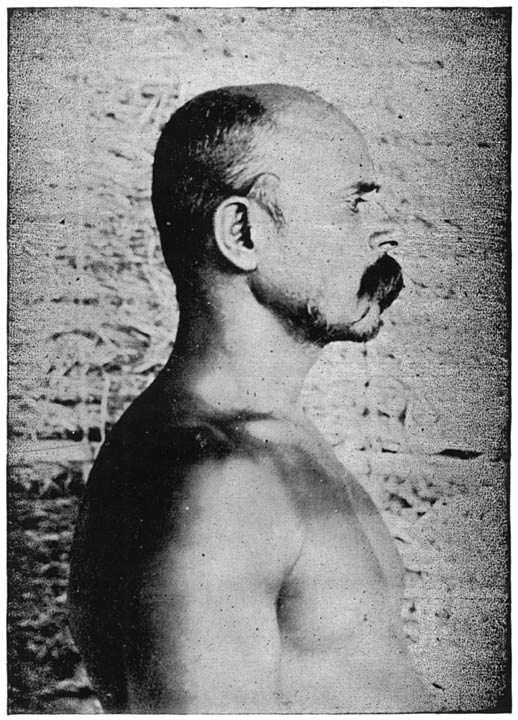
Bedar.
The titles of the Bōyas are said to be Naidu or Nayudu, Naik, Dora, Dorabidda (children of chieftains), and Valmiki. They claim direct lineal descent from Valmiki, the author of the Rāmayana. At times of census in Mysore, some Bēdars have set themselves up as Valmiki Brāhmans. The origin of the Myāsa Bēdas is accounted for in the following story. A certain Bēdar woman had two sons, of whom the elder, after taking his food, went to work in the fields. The younger son, coming home, asked his mother to give him food, and she gave him only cholam (millet) and vegetables. While he was partaking thereof, he recognised the smell of meat, and was angry because his mother had given him none, and beat her to death. He then searched the house, and, on opening a pot from which the smell of meat emanated, found that it only contained the rotting fibre-yielding bark of some plant. Then, cursing his luck, he fled to the forest, where he remained, and became the forefather of the Myāsa Bēdars.
For the following note on the legendary origin of the Bēdars, I am indebted to Mr. Mainwaring. “Many stories are told of how they came into existence, each story bringing out the name which the particular group may be known by. Some call themselves Nishadulu, and claim to be the legitimate descendants of Nishadu. When the great Venudu, who was directly descended from Brahma, ruled over the universe, he was unable to procure a son and heir to the throne. When he died, his death was regarded as an irreparable misfortune. In grief and doubt as to what was to be done, his body was preserved. The seven ruling planets, then sat in solemn conclave, and consulted together as to what they should do. Finally they agreed to create a being from the right thigh of the deceased Venudu, and they accordingly fashioned and gave life to Nishudu. But their work was not successful, for Nishudu turned out to be not only deformed in body, but repulsively ugly. It was accordingly agreed, at another meeting of the planets, that he was not a fit person to be placed on the throne. So they set to work again, and created a being from the right shoulder of Venudu. Their second effort was crowned with success. They called their second creation Chakravati, and, as he gave general satisfaction, he was placed on the throne. This supersession naturally caused Nishudu, the first born, to be discontented, and he sought a lonely place. There he communed with the gods, begging of them the reason why they had created him, if he was not to rule. The gods explained to him that he could not now be put on the throne, since Chakravati had already been installed, but that he should be a ruler over the forests. In this capacity, Nishudu begot the Koravas, Chenchus, Yānādis, and Bōyas. The Bōyas were his legitimate children, while the others were all illegitimate. According to the legend narrated in the Valmiki Rāmayana, when king Vishwamitra quarrelled with the Rishi Vashista, the cow Kamadenu belonging to the latter, grew angry, and shook herself. From her body an army, which included Nishadulu, Turka (Muhammadans), and Yevannudu (Yerukalas) at once appeared.
“A myth related by the Bōyas in explanation of their name Valmikudu runs as follows. In former days, a Brāhman, who lived as a highwayman, murdering and robbing all the travellers he came across, kept a Bōya female, and begot children by her. One day, when he went out to carry on his usual avocation, he met the seven Rishis, who were the incarnations of the seven planets. He ordered them to deliver their property, or risk their lives. The Rishis consented to give him all their property, which was little enough, but warned him that one day he would be called to account for his sinful deeds. The Brāhman, however, haughtily replied that he had a large family to maintain, and, as they lived on his plunder, they would have to share the punishment that was inflicted upon himself. The Rishis doubted this, and advised him to go and find out from his family if they were willing to suffer an equal punishment with him for his sins. The Brāhman went to his house, and confessed his misdeeds to his wife, explaining that it was through them that he had been able to keep the family in luxury. He then told her of his meeting with the Rishis, and asked her if she would share his responsibility. His wife and children emphatically refused to be in any way responsible for his sins, which they declared were entirely his business. Being at his wit’s end, he returned to the Rishis, told them how unfortunate he was in his family affairs, and begged advice of them as to what he should do to be absolved from his sins. They told him that he should call upon the god Rāma for forgiveness. But, owing to his bad bringing up and his misspent youth, he was unable to utter the god’s name. So the Rishis taught him to say it backwards by syllables, thus:—ma ra, ma ra, ma ra, which, by rapid repetition a number of times, gradually grew into Rāma. When he was able to call on his god without difficulty, the Brāhman sat at the scene of his graver sins, and did penance. White-ants came out of the ground, and gradually enveloped him in a heap. After he had been thus buried alive, he became himself a Rishi, and was known as Valmiki Rishi, valmiki meaning an ant-hill. As he had left children by the Bōya woman who lived with him during his prodigal days, the Bōyas claim to be descended from these children and call themselves Valmikudu.”
The Bēdars, whom I examined at Hospet in the Bellary district, used to go out on hunting expeditions, equipped with guns, deer or hog spears, nets like lawn-tennis nets used in drives for young deer or hares. Several men had cicatrices, as the result of encounters with wild boars during hunting expeditions, or when working in the sugar plantations. It is noted in the Bellary Gazetteer that “the only caste which goes in for manly sports seems to be the Bōyas, or Bēdars, as they are called in Canarese. They organise drives for pig, hunt bears in some parts in a fearless manner, and are regular attendants at the village gymnasium (garidi mane), a building without any ventilation often constructed partly underground, in which the ideal exercise consists in using dumbbells and clubs until a profuse perspiration follows. They get up wrestling matches, tie a band of straw round one leg, and challenge all and sundry to remove it, or back themselves to perform feats of strength, such as running up the steep Joladarāsi hill near Hospet with a bag of grain on their back.” At Hospet wrestling matches are held at a quiet spot outside the town, to witness which a crowd of many hundreds collect. The wrestlers, who performed before me, had the hair shaved clean behind so that the adversary could not seize them by the back hair, and the moustache was trimmed short for the same reason. Two young wrestlers, whose measurements I place on record, were splendid specimens of youthful muscularity.
cm. cm.
Height 163.2 163
Shoulders 41.8 42.8
Chest 84 82
Upper arm, flexed 28 29
Thigh 47 51
Mr. Mainwaring writes that “the Bōyas are adepts at shikar (hunting). They use a bullock to stalk antelope, which they shoot with matchlocks. Some keep a tame buck, which they let loose in the vicinity of a herd of antelope, having previously fastened a net over his horns. As soon as the tame animal approaches the herd, the leading buck will come forward to investigate the intruder. The tame buck does not run away, as he probably would if he had been brought up from infancy to respect the authority of the buck of the herd. A fight naturally ensues, and the exchange of a few butts finds them fastened together by the net. It is then only necessary for the shikāris to rush up, and finish the strife with a knife.”
Among other occupations, the Bōyas and Bēdars collect honey-combs, which, in some places, have to be gathered from crevices in overhanging rocks, which have to be skilfully manipulated from above or below.
The Bēdar men, whom I saw during the rainy season, wore a black woollen kambli (blanket) as a body-cloth, and it was also held over the head as a protection against the driving showers of the south-west monsoon. The same cloth further does duty as a basket for bringing back to the town heavy loads of grass. Some of the men wore a garment with the waist high up in the chest, something like an English rustic’s smock frock. Those who worked in the fields carried steel tweezers on a string round the loins, with which to remove bābūl (Acacia arabica) thorns, twigs of which tree are used as a protective hedge for fields under cultivation. As examples of charms worn by men the following may be cited:—
String tied round right upper arm with metal talisman box attached to it, to drive away devils. String round ankle for the same purpose.
Quarter-anna rolled up in cotton cloth, and worn on upper arm in performance of a vow.
A man, who had dislocated his shoulder when a lad, had been tattooed with a figure of Hanumān (the monkey god) over the deltoid muscle to remove the pain.
Necklet of coral and ivory beads worn as a vow to the Goddess Huligamma, whose shrine is in Hyderabad.
Necklets of ivory beads and a gold disc with the Vishnupād (feet of Vishnu) engraved on it. Purchased from a religious mendicant to bring good luck.
According to the Mysore Census Report, 1901, the chief deity of the Bēdars is “Tirupati Venkatarāmanaswāmi worshipped locally under the name of Tirumaladēvaru, but offerings and sacrifices are also made to Māriamma. Their guru is known as Tirumalatatachārya, who is also a head of the Srīvaishnava Brāhmans. The Ūru Bōyas employ Brāhmans and Jangams as priests.” In addition to the deities mentioned, the Bēdars worship a variety of minor gods, such as Kanimiraya, Kanakarayan, Uligamma, Palaya, Poleramma, and others, to whom offerings of fruits and vegetables, and sacrifices of sheep and goats are made. The Dewān of Sandūr informs me that, in recent times, some Myāsa Bēdars have changed their faith, and are now Saivas, showing special reverence to Mahadēva. They were apparently converted by Jangams, but not to the fullest extent. The guru is the head of the Ujjani Lingayat matt (religious institution) in the Kudligi tāluk of Bellary. They do not wear the lingam. In the Madras Census Report, 1901, the patron deity of the Bōyas is said to be Kanyā Dēvudu.
Concerning the religion of the Bōyas, Mr. Mainwaring writes as follows. “They worship both Siva and Vishnu, and also different gods in different localities. In the North Arcot district, they worship Tirupatiswāmi. In Kurnool, it is Kanyā Dēvudu. In Cuddapah and Anantapūr, it is Chendrugadu, and many, in Anantapūr, worship Akkamma, who is believed to be the spirit of the seven virgins. At Uravakonda, in the Anantapūr district, on the summit of an enormous rock, is a temple dedicated to Akkamma, in which the seven virgins are represented by seven small golden pots or vessels. Cocoanuts, rice, and dal (Cajanus indicus) form the offerings of the Bōyas. The women, on the occasion of the Nāgalasauthi or snake festival, worship the Nāgala swāmi by fasting, and pouring milk into the holes of ‘white-ant’ hills. By this, a double object is fulfilled. The ‘ant’ heap is a favourite dwelling of the nāga or cobra, and it was the burial-place of Vālmīki, so homage is paid to the two at the same time. Once a year, a festival is celebrated in honour of the deceased ancestors. This generally takes place about the end of November. The Bōyas make no use of Brāhmans for religious purposes. They are only consulted as regards the auspicious hour at which to tie the tāli at a wedding. Though the Bōya finds little use for the Brāhman, there are times when the latter needs the services of the Bōya. The Bōya cannot be dispensed with, if a Brāhman wishes to perform Vontigadu, a ceremony by which he hopes to induce favourable auspices under which to celebrate a marriage. The story has it that Vontigadu was a destitute Bōya, who died from starvation. It is possible that Brāhmans and Sūdras hope in some way to ameliorate the sufferings of the race to which Vontigadu belonged, by feeding sumptuously his modern representative on the occasion of performing the Vontigadu ceremony. On the morning of the day on which the ceremony, for which favourable auspices are required, is performed, a Bōya is invited to the house. He is given a present of gingelly (Sesamum) oil, wherewith to anoint himself. This done, he returns, carrying in his hand a dagger, on the point of which a lime has been stuck. He is directed to the cowshed, and there given a good meal. After finishing the meal, he steals from the shed, and dashes out of the house, uttering a piercing yell, and waving his dagger. He on no account looks behind him. The inmates of the house follow for some distance, throwing water wherever he has trodden. By this means, all possible evil omens for the coming ceremony are done away with.”
At Hospet the Bēdars have two buildings called chāvadis, built by subscription among members of their community, which they use as a meeting place, and whereat caste councils are held. At Sandūr the Ūru Bēdars submit their disputes to their guru, a Srīvaishnava Brāhman, for settlement. If a case ends in a verdict of guilty against an accused person, he is fined, and purified by the guru with thīrtham (holy water). In the absence of the guru, a caste headman, called Kattaintivadu, sends a Dāsari, who may or may not be a Bēdar, who holds office under the guru, to invite the castemen and the Samaya, who represents the guru in his absence, to attend a caste meeting. The Samayas are the pūjāris at Hanumān and other shrines, and perform the branding ceremony, called chakrānkitam. The Myāsa Bēdars have no guru, but, instead of him, pūjāris belonging to their own caste, who are in charge of the affairs of certain groups of families. Their caste messenger is called Dalavai.
The following are examples of exogamous septs among the Bōyas, recorded by Mr. Mainwaring:—
Mukkara, nose or ear ornament. Majjiga, butter-milk. Kukkala, dog. Pūla, flowers. Pandhi, pig. Chilakala, paroquet. Hastham, hand. Yelkamēti, good rat. Mīsāla, whiskers. Nemili, peacock. Pēgula, intestines. Mījam, seed. Uttarēni, Achyranthes aspera. Puchakayala, Citrullus Colocynthis. Gandhapodi, sandal powder. Pasula, cattle. Chinthakāyala, Tamarindus indica. Āvula, cow. Udumala, lizard (Varanus). Pulagam, cooked rice and dhal. Boggula, charcoal. Midathala, locust. Potta, abdomen. Ūtla, swing for holding pots. Rottala, bread. Chimpiri, rags. Panchalingāla, five lingams. Gudisa, hut. Tōta, garden. Lanka, island. Bilpathri, Ægle Marmelos. Kōdi-kandla, fowl’s eyes. Gādidhe-kandla, donkey’s eyes. Jōti, light. Nāmāla, the Vaishnavite nāmam. Nāgellu, plough. Ulligadda, onions. Jinkala, gazelle. Dandu, army. Kattelu, sticks or faggots. Mēkala, goat. Nakka, jackal. Chevvula, ear. Kōtala, fort. Chāpa, mat. Guntala, pond. Thappata, drum. Bellapu, jaggery. Chīmala, ants. Gennēru, Nerium odorum. Pichiga, sparrows. Uluvala, Dolichos biflorus. Geddam, beard. Eddula, bulls. Cheruku, sugar-cane. Pasupu, turmeric. Aggi, fire. Mirapakāya, Capsicum frutescens. Janjapu, sacred thread. Sankati, rāgi or millet pudding. Jerripōthu, centipede. Guvvala, pigeon.
Many of these septs are common to the Bōyas and other classes, as shown by the following list:—
Āvula, cow—Korava. Boggula, charcoal—Dēvānga. Cheruku, sugar-cane—Jōgi, Oddē. Chevvula, ear—Golla. Chilakala, paroquet—Kāpu, Yānādi. Chīmala, ants—Tsākala. Chinthakāyala, tamarind fruit—Dēvānga. Dandu, army—Kāpu. Eddula, bulls—Kāpu. Gandhapodi, sandal powder—a sub-division of Balija. Geddam, beard—Padma Sālē. Gudisa, hut—Kāpu. Guvvala, pigeon—Mutrācha. Jinkala, gazelle—Padma Sālē. Kukkala, dog—Orugunta Kāpu. Lanka, island—Kamma. Mēkala, goat—Chenchu, Golla, Kamma, Kāpu, Togata, Yānādi. Midathala, locust—Mādiga. Nakkala, jackal—Dudala, Golla, Mutrācha. Nemili, peacock—Balija. Pichiga, sparrow—Dēvānga. Pandhi, pig—Asili, Gamalla. Pasula, cattle—Mādiga, Māla. Puchakāya, colocynth—Kōmati, Vīramushti. Pūla, flowers—Padma Sālē, Yerukala. Tōta, garden—Chenchu, Mīla, Mutrācha, Bonthuk Savara. Udumala, lizard—Kāpu, Tōttiyan, Yānādi. Ulligadda, onions—Korava. Uluvala, horse-gram—Jōgi. Utla, swing for holding pots—Padma Sālē.
At Hospet, the preliminaries of a marriage among the Myāsa Bēdars are arranged by the parents of the parties concerned and the chief men of the kēri (street). On the wedding day, the bride and bridegroom sit on a raised platform, and five married men place rice stained with turmeric on the feet, knees, shoulders, and head of the bridegroom. This is done three times, and five married women then perform a similar ceremony on the bride. The bridegroom takes up the tāli, and, with the sanction of the assembled Bēdars, ties it on the bride’s neck. In some places it is handed to a Brāhman priest, who ties it instead of the bridegroom. The unanimous consent of those present is necessary before the tāli-tying is proceeded with. The marriage ceremony among the Ūru Bēdars is generally performed at the bride’s house, whither the bridegroom and his party proceed on the eve of the wedding. A feast, called thuppathūta or ghī (clarified butter) feast, is held, towards which the bridegroom’s parents contribute rice, cocoanuts, betel leaves and nuts, and make a present of five bodices (rāvike). At the conclusion of the feast, all assemble beneath the marriage pandal (booth), and betel is distributed in a recognised order of precedence, commencing with the guru and the god. On the following morning four big pots, smeared with turmeric and chunam (lime) are placed in four corners, so as to have a square space (irāni square) between them. Nine turns of cotton thread are wound round the pots. Within the square the bridegroom and two young girls seat themselves. Rice is thrown over them, and they are anointed. They and the bride are then washed by five women called bhūmathōru. The bridegroom and one of the girls are carried in procession to the temple, followed by the five women, one of whom carries a brass vessel with five betel leaves and a ball of sacred ashes (vibūthi) over its mouth, and another a woman’s cloth on a metal dish, while the remaining three women and the bridegroom’s parents throw rice. Cocoanuts and betel are offered to Hanumān, and lines are drawn on the face of the bridegroom with the sacred ashes. The party then return to the house. The lower half of a grinding mill is placed beneath the pandal, and a Brāhman priest invites the contracting couple to stand thereon. He then takes the tāli, and ties it on the bride’s neck, after it has been touched by the bridegroom. Towards evening the newly married couple sit inside the house, and close to them is placed a big brass vessel containing a mixture of cooked rice, jaggery (crude sugar) and curds, which is brought by the women already referred to. They give a small quantity thereof to the couple, and go away. Five Bēdar men come near the vessel after removing their head-dress, surround the vessel, and place their left hands thereon. With their right hands they shovel the food into their mouths, and bolt it with all possible despatch. This ceremony is called bhūma idothu, or special eating, and is in some places performed by both men and women. All those present watch them eating, and, if any one chokes while devouring the food, or falls ill within a few months, it is believed to indicate that the bride has been guilty of irregular behaviour. On the following day the contracting couple go through the streets, accompanied by Bēdars, the brass vessel and female cloth, and red powder is scattered broadcast. On the morning of the third and two following days, the newly married couple sit on a pestle, and are anointed after rice has been showered over them. The bride’s father presents his son-in-law with a turban, a silver ring, and a cloth. It is said that a man may marry two sisters, provided that he marries the elder before the younger.
The following variant of the marriage ceremonies among the Bōyas is given by Mr. Mainwaring. “When a Bōya has a son who should be settled in life, he nominally goes in search of a bride for him, though it has probably been known for a long time who the boy is to marry. However, the formality is gone through. The father of the boy, on arrival at the home of the future bride, explains to her father the object of his visit. They discuss each other’s families, and, if satisfied that a union would be beneficial to both families, the father of the girl asks his visitor to call again, on a day that is agreed to, with some of the village elders. On the appointed day, the father of the lad collects the elders of his village, and proceeds with them to the house of the bride-elect. He carries with him four moottus (sixteen seers) of rice, one seer of dhal (Cajanus indicus), two seers of ghī (clarified butter), some betel leaves and areca nuts, a seer of fried gram, two lumps of jaggery (molasses), five garlic bulbs, five dried dates, five pieces of turmeric, and a female jacket. In the evening, the elders of both sides discuss the marriage, and, when it is agreed to, the purchase money has to be at once paid. The cost of a bride is always 101 madas, or Rs. 202. Towards this sum, sixteen rupees are counted out, and the total is arrived at by counting areca nuts. The remaining nuts, and articles which were brought by the party of the bridegroom, are then placed on a brass tray, and presented to the bride-elect, who is requested to take three handfuls of nuts and the same quantity of betel leaves. On some occasions, the betel leaves are omitted. Betel is then distributed to the assembled persons. The provisions which were brought are next handed over to the parents of the girl, in addition to two rupees. These are to enable her father to provide himself with a sheet, as well as to give a feast to all those who are present at the betrothal. This is done on the following morning, when both parties breakfast together, and separate. The wedding is usually fixed for a day a fortnight or a month after the betrothal ceremony. The ceremony differs but slightly from that performed by various other castes. A purōhit is consulted as to the auspicious hour at which the tāli or bottu should be tied. This having been settled, the bridegroom goes, on the day fixed, to the bride’s village, or sometimes the bride goes to the village of the bridegroom. Supposing the bridegroom to be the visitor, the bride’s party carries in procession the provisions which are to form the meal for the bridegroom’s party, and this will be served on the first night. As the auspicious hour approaches, the bride’s party leave her in the house, and go and fetch the bridegroom, who is brought in procession to the house of the bride. On arrival, he is made to stand under the pandal which has been erected. A curtain is tied therein from north to south. The bridegroom then stands on the east of the curtain, and faces west. The bride is brought from the house, and placed on the west of the curtain, facing her future husband. The bridegroom then takes up the bottu, which is generally a black thread with a small gold bead upon it. He shows it to the assembled people, and asks permission to fasten it on the bride’s neck. The permission is accorded with acclamations. He then fastens the bottu on the bride’s neck, and she, in return, ties a thread from a black cumbly (blanket), on which a piece of turmeric has been threaded, round the right wrist of the bridegroom. After this, the bridegroom takes some seed, and places it in the bride’s hand. He then puts some pepper-corns with the seed, and forms his hands into a cup over those of the bride. Her father then pours milk into his hand, and the bridegroom, holding it, swears to be faithful to his wife until death. After he has taken the oath, he allows the milk to trickle through into the hands of the bride. She receives it, and lets it drop into a vessel placed on the ground between them. This is done three times, and the oath is repeated with each performance. Then the bride goes through the same ceremony, swearing on each occasion to be true to her husband until death. This done, both wipe their hands on some rice, which is placed close at hand on brass trays. In each of these trays there must be five seers of rice, five pieces of turmeric, five bulbs of garlic, a lump of jaggery, five areca nuts, and five dried dates. When their hands are dry, the bridegroom takes as much of the rice as he can in his hands, and pours it over the bride’s head. He does this three times, before submitting to a similar operation at the hands of the bride. Then each takes a tray, and upsets the contents over the other. At this stage, the curtain is removed, and, the pair standing side by side, their cloths are knotted together. The knot is called the knot of Brahma, and signifies that it is Brahma who has tied them together. They now walk out of the pandal, and make obeisance to the sun by bowing, and placing their hands together before their breasts in the reverential position of prayer. Returning to the pandal, they go to one corner of it, where five new and gaudily painted earthenware pots filled with water have been previously arranged. Into one of these pots, one of the females present drops a gold nose ornament, or a man drops a ring. The bride and bridegroom put their right hands into the pot, and search for the article. Whichever first finds it takes it out, and, showing it, declares that he or she has found it. This farce is repeated three times, and the couple then take their seats on a cumbly in the centre of the pandal, and await the preparation of the great feast which closes the ceremony. For this, two sheep are killed, and the friends and relations who have attended are given as much curry and rice as they can eat. Next morning, the couple go to the bridegroom’s village, or, if the wedding took place at his village, to that of the bride, and stay there three days before returning to the marriage pandal. Near the five water-pots already mentioned, some white-ant earth has been spread at the time of the wedding, and on this some paddy (unhusked rice) and dhal seeds have been scattered on the evening of the day on which the wedding commenced. By the time the couple return, these seeds have sprouted. A procession is formed, and the seedlings, being gathered up by the newly married couple, are carried to the village well, into which they are thrown. This ends the marriage ceremony. At their weddings, the Bōyas indulge in much music. Their dresses are gaudy, and suitable to the occasion. The bridegroom, if he belongs to either of the superior gōtras, carries a dagger or sword placed in his cummerbund (loin-band). A song which is frequently sung at weddings is known as the song of the seven virgins. The presence of a Basavi at a wedding is looked on as a good omen for the bride, since a Basavi can never become a widow.”