B (continued 4)
Reading edition
To the Hindu mind, Yama (the god of death) is a hideous god, whose servants are represented as being capable of tormenting the soul of the dead. “No sooner,” writes Monier Williams, “has death occurred, and cremation of the terrestrial body taken place, than Yama’s two messengers (Yama Dūtan), who are waiting near at hand, make themselves visible to the released spirit, which retains its subtle body composed of the subtle elements, and is said to be of the size of a thumb (angustha-mātra). Their aspect is terrific, for they have glaring eyes, hair standing erect, gnashing teeth, crow-black skin, and claw-like nails, and they hold in their hands the awful rod and noose of Yama. Then, as if their appearance in this form were not sufficiently alarming, they proceed to terrify their victim by terrible visions of the torments (yātana) in store for him. They then convey the bound spirit along the road to Yama’s abode. Being led before Yama’s judgment seat, it is confronted with his Registrar or Recorder named Chitra Gupta. This officer stands by Yama’s side, with an open book before him. It is his business to note down all the good and evil deeds of every human being born into the world, with the resulting merit (punya) and demerit (pāpa), and to produce a debtor and creditor account properly made up and balanced on the day when that being is brought before Yama. According to the balance on the side of merit or demerit is judgment pronounced. The road by which Yama’s two officers force a wicked man to descend to the regions of torment is described in the first two chapters of the Garuda Purāna. The length of the way is said to be 86,000 leagues (yojanas). The condemned soul, invested with its sensitive body, and made to travel at the rate of 200 leagues a day, finds no shady trees, no resting place, no food, no water. At one time it is scorched by a burning heat equal to that of twelve meridian suns, at another it is pierced by icy cold winds; now its tender frame is rent by thorns; now it is attacked by lions, tigers, savage dogs, venomous serpents, and scorpions. In one place it has to traverse a dense forest, whose leaves are swords; in another it falls into deep pits; in another it is precipitated from precipices; in another it has to walk on the edge of razors; in another on iron spikes. Here it stumbles about helplessly in profound darkness; there it struggles through loathsome mud swarming with leeches; here it toils through burning sand; there its progress is arrested by heaps of red-hot charcoal and stifling smoke. Compelled to pass through every obstacle, however formidable, it next encounters a succession of terrific showers, not of rain, but of live coals, stones, blood, boiling water and filth. Then it has to descend into appalling fissures, or ascend to sickening heights, or lose itself in vast caves, or wade through lakes seething with fœtid ordures. Then midway it has to pass the awful river Vaitarani, one hundred leagues in breadth, of unfathomable depth; flowing with irresistible impetuosity; filled with blood, matter, hair, and bones; infested with huge sharks, crocodiles, and sea monsters; darkened by clouds of hideous vultures and obscene birds of prey. Thousands of condemned spirits stand trembling on the banks, horrified by the prospect before them. Consumed by a raging thirst, they drink the blood which flows at their feet; then, tumbling headlong into the torrent, they are overwhelmed by the rushing waves. Finally, they are hurried down to the lowest depths of hell, and yet not destroyed. Pursued by Yama’s officers, they are dragged away, and made to undergo inconceivable tortures, the detail of which is given with the utmost minuteness in the succeeding chapters of the Garuda Purāna.”
The Ahannikams, or daily observances, of a religious Brāhman are very many. Nowadays, Brāhmans who lead a purely religious life are comparatively few, and are mostly found in villages. The daily observances of such are the bath, the performance of the Sandhya service, Brahma yagna, Dēva pūja or Dēvatarchana, Tarpana (oblations of water), Vaisvadēva ceremony, and the reading of Purānas or Ithihāsas. Every orthodox Brāhman is expected to rise at the time called Brahma Muhūrtam in the hour and a half before sunrise. He should then clean his teeth, using as a brush mango leaf, or twigs of Acacia arabica or nīm (Melia Azadirachta). He next bathes in a river or tank (pond), standing knee-deep in the water, and repeating the following:—“I am about to perform the morning ablution in this sacred stream (Ganges, Sarasvati, Yamuna, Godāvari, etc.), in the presence of the gods and Brāhmans, with a view to the removal of guilt resulting from act, speech, and thought, from what has been touched and untouched, known and unknown, eaten and not eaten, drunk and not drunk.” After the bath, he wipes his body with a damp cloth, and puts on his cotton madi cloth, which has been washed and dried. The cloth, washed, wrung, and hung up to dry, should not be touched by anybody. If this should happen prior to the bath, the cloth is polluted, and ceases to be madi. A silk cloth, which cannot be polluted, is substituted for it. The madi or silk cloth should be worn until the close of the morning ceremonies and meal. The man next puts the marks which are characteristic of his sect on the forehead and body, and performs the Sandhya service. This is very important, and is binding on all Brāhmans after the Upanayanam ceremony, though a large number are not particular in observing it. According to the shāstras, the Sandhya should be done in the morning and evening; but in practice there is an additional service at midday. Sandhyāvandhanam means the thanksgiving to God when day and night meet in the morning and evening. The rite commences with the sipping of water (āchamanam) from the hollow of the right palm. This is done three times, while the words Achyuthāyanamaha, Anantāyanamaha, and Govindāyana are repeated. Immediately after sipping, twelve parts of the body are touched with the fingers of the right hand in the following order:—
The two cheeks with the thumb, repeating the names Kēsava and Narāyana;
The two eyes with the ring-finger, repeating Mādhava and Govinda;
The two sides of the nose with the forefinger, repeating Vishnu and Madhusūdhana;
The two ears with the little finger, repeating Trivkrama and Vāmana;
The shoulders with the middle finger, repeating Sridhara and Rishikēsa;
The navel and head with all the fingers, repeating Padmanabha and Damōdar.
This Āchamana is the usual preliminary to all Brāhman religious rites. The water sipped is believed to cleanse the internal parts of the body, as bathing cleanses the external parts.
After Āchamana comes Prānāyāma, or holding in of vital breath, which consists in repeating the Gāyatri (hymn) and holding the breath by three distinct operations, viz:—
Pūraka, or pressing the right nostril with the fingers, and drawing in the breath through the left nostril, and vice versâ.
Kumbhaka, or pressing both nostrils with finger and thumb or with all the fingers, and holding the breath as long as possible.
Rēchaka, or pressing the right nostril with the thumb, and expelling the breath through the left nostril, and vice versâ.
The suppression of the breath is said to be a preliminary yōga practice, enabling a person to fix his mind on the Supreme Being who is meditated on.
The celebrant next repeats the Sankalpa (determination), with the hands brought together, the right palm over the left, and placed on the right thigh. Every kind of ceremony commences with the Sankalpa, which, for the Sandhya service, is as follows:—“I am worshipping for the removal of all my sins that have adhered to me, and for the purpose of acquiring the favour of Narāyana or the Supreme Being.” The performer of the rite then sprinkles himself with water, repeating:—“Oh! ye waters, the sources of all comforts, grant us food, so that our senses may grow strong and give us joy. Make us the recipients of your essence, which is the most blissful, just as affectionate mothers (feed their children with milk from their breasts). May we obtain enough of that essence of yours, the existence of which within you makes you feel glad. Oh! waters, grant us offspring.” He then takes up the water in his palm, and drinks it, repeating the following:—“May the sun and anger, may the lords of anger, preserve me from my sins of pride and passion. Whate’er the nightly sins of thought, word, deed, wrought by my mind, my speech, my hands, my feet; wrought through my appetite and sensual organs; may the departing night remove them all. In thy immortal light, Oh! radiant sun, I offer up myself and this my guilt.” At the evening service, the same is repeated, with the word Agni instead of Sūrya (sun). At the midday service the following is recited:—“May the waters purify the earth by pouring down rain. May the earth thus purified make us pure. May the waters purify my spiritual preceptor, and may the Vēda (as taught by the purified preceptor) purify me. Whatever leavings of another’s food, and whatever impure things I may have eaten, whatever I may have received as gift from the unworthy, may the waters destroy all that sin and purify me. For this purpose, I pour this sanctified water as a libation down my mouth.” Once more the celebrant sprinkles himself with water, and says:—“I sing the praise of the god Dadikrāvan, who is victorious, all-pervading, and who moves with great speed. May he make our mouths (and the senses) fragrant, and may he prolong our lives. Oh! ye waters, the sources of all comforts, grant us food,” etc.
The ceremonies performed so far are intended for both external and internal purification. By their means, the individual is supposed to have made himself worthy to salute the Lord who resides in the orb of the rising luminary, and render him homage in true Brāhman style by what is called Arghya. This is an offering of water to any respected guest. Repeating the Gāyatri, the worshipper throws water in the air from the palms of the hands joined together with the sacred thread round the thumbs. The Gāyatri is the hymn par excellence, and is said to contain the sum and substance of all Vēdic teaching.
After these items, the worshipper sits down, and does Japam (recitation of prayers in an undertone). The Gāyatri, as repeated, consists of the Gāyatri proper Vyāhritis, and Gāyatri Siromantra. It runs as follows:—
Ōm, Bhuh; Ōm, Bhuvah;
Ōm, Suvah; Ōm, Mahaha;
Ōm, Janaha; Ōm, Thapaha;
Ōm, Sathyam.
Ōm, Thatsaviturvārēnyam;
Bhargodēvasya dhimahi dhiyo-yonah prachodāyat;
Ōm, Jyotiraso amrutam
Brahma, Bhur, Bhuvasvarūm.
The Vyāhritis are generally taken to refer to the seven worlds, and the prefixing of the Pranava (Ōm) means that all these worlds have sprung from the Supreme Being. The Pranava given above means “All the seven worlds are (the visible manifestations of) Ōm, the all-pervading Brāhman. We think of the adorable light of the Lord, who shines in our hearts, and guides us. May he guide our intellects aright. Water, light, all things that have savour (such as trees, herbs, and plants), the nectar of the gods, the three worlds, in fact everything that is Brāhman, the universal soul.”
The mystic syllable Ōm is the most sacred of all Hindu utterances. Concerning it, Monier Williams writes that it is “made up of the three letters A, U, M, and symbolical of the threefold manifestation of the one Supreme Being in the gods Brahma, Vishnu, and Siva, and is constantly repeated during the Sandhya service. This prayer is, as we have seen, the most sacred of all Vēdic utterances, and, like the Lord’s Prayer among Christians, or like the Fatihah or opening chapter of the Kuran among Muhammadans, must always, among Hindus, take precedence of all other forms of supplication.”
The celebrant next proceeds to invoke the Gāyatri Dēvata thus:—“May the goddess Gāyatri Dēvata, who grants all our desires, come to us to make known to us the eternal Lord, who is revealed to us only through the scriptures. May the Gāyatri, the mother of all the Vēdas, reveal to us the eternal truth. Oh! Gāyatri, thou art the source of all spiritual strength. Thou art the power that drivest away the evil inclinations which are mine enemies. Thou, by conducing to a sound mind, conducest to a sound body. Thou art the light of the gods, that dispellest my intellectual darkness, and illuminest my heart with divine wisdom. Thou art all. In the whole universe there is naught but thee that is. Thou art the eternal truth that destroys all sins. Thou art the Pranava that reveals to me the unknown. Come to my succour, Oh! thou Gāyatri, and make me wise.” This invocation is followed by the repetition of the Gāyatri 108 or only 28 times. The celebrant then says:—“The goddess Gāyatri resides on a lofty peak on the summit of mount Mēru (whose base is deeply fixed) in the earth. Oh! thou goddess, take leave from the Brāhmans (who have worshipped thee, and been blessed with thy grace), and go back to thy abode as comfortably as possible.” The Sandhya service is closed with the following prayer to the rising sun:—“We sing the adorable glory of the sun god, who sustains all men (by causing rain); which glory is eternal, and most worthy of being adored with wonder. The sun, well knowing the inclinations of men, directs them to their several pursuits. The sun upholds both heaven and earth; the sun observes all creatures (and their actions) without ever winking. To this eternal being we offer the oblation mixed with ghī. Oh! sun, may that man who through such sacrifice offers oblations to thee become endowed with wealth and plenty. He who is under thy protection is not cut off by untimely death; he is not vanquished by anybody, and sin has no hold on this man either from near or from afar.” In the evening, the following prayer to Varuna is substituted:—“Hear, Oh! Varuna, this prayer of mine. Be gracious unto me this day. Longing for thy protection, I cry to thee. Adoring thee with prayer, I beg long life of thee. The sacrificer does the same with the oblations he offers thee. Therefore, Oh! Varuna, without indifference in this matter, take my prayer into your kind consideration, and do not cut off our life. Oh! Lord Varuna, whatever law of thine we, as men, violate day after day, forgive us these trespasses. Oh! Lord Varuna, whatever offence we, as men, have committed against divine beings, whatever work of thine we have neglected through ignorance, do not destroy us, Oh! Lord, for such sin. Whatever sin is attributed to us by our enemies, as by gamblers at dice, whatever sins we may have really committed, and what we may have done without knowing, do thou scatter and destroy all these sins. Then, Oh! Lord, we shall become beloved of thee.” The Sandhya prayer closes with the Abhivādhana or salutation, which has been given in the account of marriage. After the Sandhya service in the morning, the Brahma yagna, or worship of the Supreme Being as represented in the sacred books is gone through. The first hymn of the Rig Vēda is recited in detail, and then follow the first words of the Yajur Vēda, Sāma Vēda, Atharvana Vēda, the Nirukta, etc.
The next item is the Tarpana ceremony, or offering of water to the Dēvatas, Rishis, and Pitris. The sacred thread is placed over the left shoulder and under the right arm (upavīta), and water is taken in the right hand, and poured as an offering to the Dēvatas. Then, with the sacred thread round the neck like a necklace (niviti), the worshipper pours water for the Rishis. Lastly, the sacred thread is placed over the right shoulder (prāchinā vīthi) and water is poured for the Pitris (ancestors).
The various ceremonies described so far should be performed by all the male members of a family, whereas the daily Dēvatarchana or Dēvata pūja is generally done by any one member of a family. The gods worshipped by pious Brāhmans are Siva and Vishnu, and their consorts Parvati and Lakshmi. Homage is paid thereto through images, sālagrāma stones, or stone lingams. In the house of a Brāhman, a corner or special room is set apart for the worship of the god. Some families keep their gods in a small almirah (chest).
Smarthas use in their domestic worship five stones, viz.:—
1. Sālagrāma, representing Vishnu.
2. Bāna linga, a white stone representing the essence of Siva.
3. A red stone (jasper), representing Ganēsha.
4. A bit of metallic ore, representing Parvathi, or a lingam representing Siva and Parvathi.
5. A piece of pebble or crystal, to represent the sun.
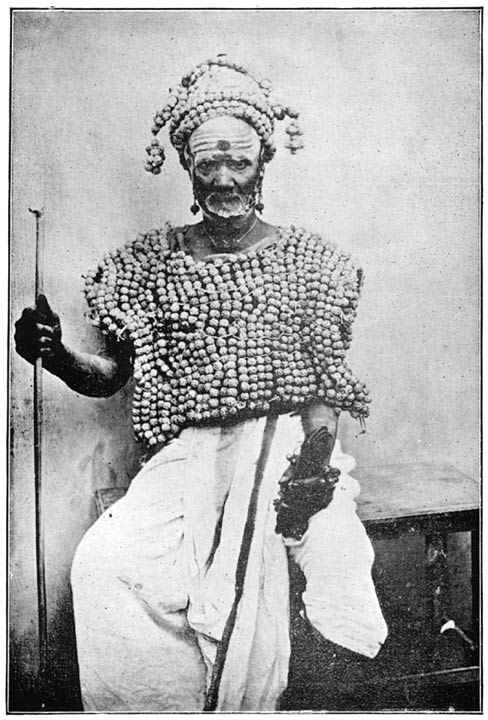
Telugu Brāhman with Rudraksha Coat.
The Shōdasopachāra, or sixteen acts of homage, are next performed in due order, viz.—
1. Āvahana, or invocation of the gods.
2. Āsanam, or seat.
3. Pādhya, or water for washing the feet.
4. Arghya, or oblation of rice or water.
5. Āchamanam, or water for sipping.
6. Snānam, or the bath.
7. Vastra, or clothing of tulsi leaves.
8. Upavastra, or upper clothing of tulsi leaves.
9. Gandha, or sandal paste.
10. Pushpa, or flowers.
11. 12. Dhūpa and Dhipa, or incense and light.
13. Naivēdya, or offering of food.
14. Pradakshina, or circumambulation.
15. Mantrapushpa, or throwing flowers.
16. Namaskāra, or salutation by prostration.
While the five stones already referred to are bathed by pouring water from a conch shell, the Purusha Sūktha, or hymn of the Rig Vēda, is repeated. This runs as follows:—“Purusha has thousands of heads, thousands of arms, thousands of eyes, and thousands of feet. On every side enveloping the earth, he transcended this mere space of ten fingers. Purusha himself is this whole (universe); whatever has been, and whatever shall be. He is also the lord of immortality, since through food he expands. Such is his greatness, and Purusha is superior to this. All existing things are a quarter of him, and that which is immortal in the sky is three quarters of him. With three quarters Purusha mounted upwards. A quarter of him was again produced below. He then became diffused everywhere among things, animate and inanimate. From him Viraj was born, and from Viraj Purusha. As soon as born, he extended beyond the earth, both behind and before. When the gods offered up Purusha as a sacrifice, the spring was its clarified butter (ghī), summer its fuel, and the autumn the oblation. This victim, Purusha born in the beginning, they consecrated on the sacrificial grass. With him as their offering, the Gods, Sadhyas, and Rishis sacrificed. From that universal oblations were produced curds and clarified butter. He, Purusha, formed the animals which are subject to the power of the air (Vāyavya), both wild and tame. From that universal sacrifice sprang the hymns called Rik and Saman, the Metres, and the Yajus. From it were produced horses, and all animals with two rows of teeth, cows, goats, and sheep. When they divided Purusha, into how many parts did they distribute him? What was his mouth? What were his arms? What were called his thighs and feet? The Brāhman was his mouth; the Rājanya became his arms; the Vaisya was his thighs; the Sūdra sprang from his feet. The moon was produced from his soul; the sun from his eye; Indra and Agni from his mouth; Vāyu from his breath. From his navel came the atmosphere; from his head arose the sky; from his feet came the earth; from his ears the four quarters; so they formed the worlds. When the gods, in performing their sacrifice, bound Purusha as a victim, there were seven pieces of wood laid for him round the fire, and thrice seven pieces of fuel employed. With sacrifice the gods worshipped the sacrifice. These were the primæval rites. These great beings attained to the heaven, where the Gods, the ancient Sādhyas, reside.”
Some Smarthas, e.g., the Brahacharnams, are more Saivite than other sections of Tamil-speaking Brāhmans. During worship, they wear round the neck rudrāksha (Elæocarpus Ganitrus) beads, and place on their head a lingam made thereof. In connection with the rudrāksha, the legend runs that Siva or Kālāgni Rudra, while engaged in Tripura Samhāra, opened his third eye, which led to the destruction of the three cities, of which Rākshasas or Asuras had taken the form. From this eye liquid is said to have trickled on the ground, and from this arose the rudrāksha tree. The mere mention of the word rudrāksha is believed to secure religious merit, which may be said to be equivalent to the merit obtained by the gift of ten cows to Brāhmans. Rudrāksha beads are valued according to the number of lobes (or faces, as they are called), which are ordinarily five in number. A bead with six lobes is said to be very good, and one with two lobes, called Gauri Sankara rudrāksha, is specially valued. Dīkshitar Brāhmans, and Pandāram priests of the higher order, wear a two-lobed bead mounted in gold. In a manuscript entitled Rudrākshopanishad, it is stated that a good rudrāksha bead, when rubbed with water, should colour the water yellow. The Mādhvas worship in the same way as Smarthas, but the objects of worship are the sālagrāma stone, and images of Hanumān and Ādi Sēsha. Food offered to Ādi Sēsha, Lakshmi, and Hanumān, is not eaten, but thrown away. The Mādhvas attach great importance to their spiritual guru, who is first worshipped by a worshipper. Some keep a brindāvanam, representing the grave of their guru, along with a sālagrāma stone, which is worshipped at the close of the Dēvata pūja. Sri Vaishnavas keep for domestic worship only sālagrāma stones. Like the Mādhvas, they are scrupulous as to the worship of their gurus (ācharyas), without whose intervention they believe that they cannot obtain beatitude. Hence Sri Vaishnavites insist upon the Samāsrayanam ceremony. After the Sandhya service and Brahma yagna, the guru is worshipped. All orthodox Vaishnavas keep with them a silk cloth bearing the impressions of the feet of their Ācharya, an abhayastha or impression of the hand of Vishnu in sandal paste, a few necklaces of silk thread (pavitram), and a bit of the bark of the tamarind tree growing at the temple at Ālvartirunagiri in the Tinnevelly district. The worshipper puts on his head the silk cloth, and round his neck the silk necklaces, and, if available, a necklace of Nelumbium (sacred lotus) seeds. After saluting the abhayastha by pressing it to his eyes, he repeats the prayer of his Ācharya, and proceeds to the Dēvatarchana, which consists in the performance of the sixteen upachāras already described. The sālagrāma stone is bathed, and the Purusha Sūktha repeated.
The daily observances are brought to a close by the performance of the Vaisvadēva ceremony, or offering to Vaisvadēvas (all the gods). This consists in offering cooked rice, etc., to all the gods. Some regard this as a sort of expiatory ceremony, to wipe out the sin which may have accidentally been committed by killing small animals in the process of cooking food.
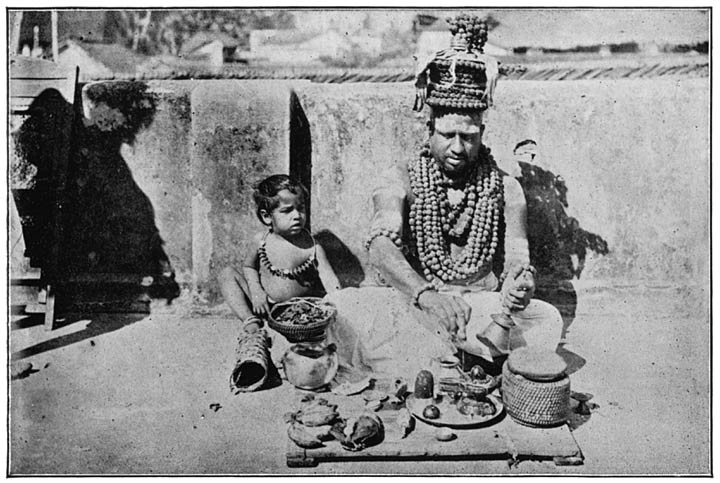
Smartha Brāhman (Brahacharnam) Doing Siva Worship.
The male members of a family take their meals apart from the females. The food is served on platters made of the leaves of the banyan (Ficus bengalensis), Butea frondosa, Bauhinia, or plantain. Amongst Smarthas and Mādhvas, various vegetable preparations are served first, and rice last, whereas, amongst the Sri Vaishnavas, especially Vadagalais, rice is served first. Before commencing to eat, a little water (tīrtham), in which a sālagrāma stone has been bathed, is poured into the palms of those who are about to partake of the meal. They drink the water simultaneously, saying “Amartopastaranamasi.” They then put a few handfuls of rice into their mouths, repeating some mantras—“Pranāyasvāha, Udanayasvāha, Somanayasvāha,” etc. At the end of the meal, all are served with a little water, which they sip, saying “Amartapithānamasi.” They then rise together.
In some temples, the Mūla Vigraha, or idol fixed in the inner sanctuary, is decorated with a necklace of sālagrāma stones. For example, at Tirupati the god is thus decorated.
Temple worship is entirely based on Āgamas. As Brāhmans take part only in the worship of Siva and Vishnu, temples dedicated to these gods are largely frequented by them. The duties connected with the actual worship of the idol are carried out by Gurukkals in Siva temples, and by Pāncharatra or Vaikhānasa Archakas in Vishnu temples. The cooking of the food for the daily offering is done by Brāhmans called Parchārakas. At the time of worship, some Brāhmans, called Adhyāpakas, recite the Vēdas. Some stanzas from Thiruvāimozhi or Thēvāram are also repeated, the former by Brāhmans at Vishnu temples, and the latter by Pandārams (Ōduvar) at Siva temples. In a typical temple there are usually two idols, one of stone (mūla vigraha) and the other of metal (utsava vigraha). The mūla vigraha is permanently fixed within the inner shrine or garbagraha, and the utsava vigraha is intended to be carried in procession. The mūla vigrahas of Vishnu temples are generally in human form, either in a standing posture, or, as in the case of Ranganātha, Padmanābha, and Govindarājaswāmi, in a reclining posture, on Ādisēsha. Ordinarily, three idols constitute the mūla vigraha. These are Vishnu, Sridēvi (Lakshmi), and Bhudēvi (earth goddess). In temples dedicated to Sri Rāma, Lakshmana is found instead of Bhudēvi. Sridēvi and Bhudēvi are also associated with Vishnu in the utsava vigraha. In all the larger temples, there is a separate building in the temple precincts dedicated to Lakshmi, and within the garbagraha thereof, called thāyar or nāchiyar sannadhi, is a mūla vigraha of Lakshmi. There may also be one or more shrines dedicated to the Ālvars (Vaishnava saints) and the Āchāryas—Dēsikar and Manavāla Mahāmunigal. The sect mark is put on the faces of the mūla and utsava vigrahas. The mūla vigraha in Siva temples is a lingam (phallic emblem). In Siva temples, there is within the garbagraha only one lamp burning, which emits a very feeble light. Hence arise the common sayings “As dim as the light burning in Siva’s temple,” or “Like the lamp in Siva’s temple.” The utsava vigraha is in the human forms of Siva and Parvathi. In all important Saivite temples, Parvathi is housed in a separate building, as Lakshmi is in Vishnu temples. Vignēswara, Subramanya, and the important Nāyanmars also have separate shrines in the temple precincts.
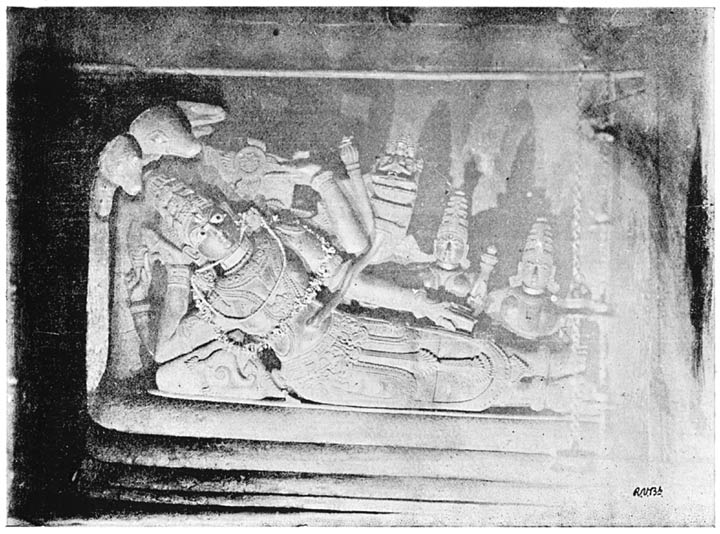
Padmanābha Swāmi.
So far as ordinary daily worship is concerned, there is not much difference in the mode of worship between temple and domestic worship. Every item is done on a large scale, and certain special Āgamic or Tantric rites are added to the sixteen Upachāras already mentioned. At the present time, there are, especially in the case of Vishnu temples, two forms of temple worship, called Pāncharatra and Vaikhānasa. In the former, which is like domestic worship in all essential points, any Brāhman may officiate as temple priest. In the latter, only Vaikhānasa Archakas may officiate.
All big temples are generally well endowed, and some temples receive from Government annual grants of money, called tasdik. The management of the temple affairs rests with the Dharmakarthas (trustees), who practically have absolute control over the temple funds. All the temple servants, such as Archakas, Parchārakas, and Adhyāpakas, and the non-Brāhman servants (sweepers, flower-gatherers, musicians and dancing-girls) are subject to the authority of the Dharmakartha. For their services in the temple, these people are paid partly in money, and partly in kind. The cooked food, which is offered daily to the god, is distributed among the temple servants. On ordinary days, the offerings of cooked food made by the Archakas, and the fruits brought by those who come to worship, are offered only to the mūla vigraha, whereas, on festival days, they are offered to the utsava vigrahas.
For worship in Vishnu temples, flowers and tulsi (Ocimum sanctum) are used. In Siva temples, bilva (bael: Ægle Marmelos) leaves are substituted for tulsi. At the close of the worship, the Archaka gives to those present thīrtham (holy water), tulsi or bilva leaves, and vibhūthi (sacred ashes) according to the nature of the temple. At Vishnu temples, immediately after the giving of thīrtham, an inverted bowl, bearing on it the feet of Vishnu (satāri or sadagōpam), is placed by the Archaka first on the head, and then on the right shoulder, and again on the head, in the case of grown up and married males, and only on the head in the case of females and young people. The bowl is always kept near the mūla vigraha, and, on festival days, when the god is taken in procession through the streets, it is carried along with the utsava vigraha. On festival days, such as Dhipāvali, Vaikunta Ekādasi, Dwādasi, etc., the god of the temple is taken in procession through the main streets of the town or village. The idol, thus borne in procession, is not the stone figure, but the portable one made of metal (utsava vigraha), which is usually kept in the temple in front of the Mūla idol. At almost every important temple, an annual festival called Brahmōtsavam, which usually lasts ten days, is celebrated. Every night during this festival, the god is seated on the clay, wooden or metal figure of some animal as a vehicle, e.g., Garuda, horse, elephant, bull, Hanumān, peacock, yāli, etc., and taken in procession, accompanied by a crowd of Brāhmans chanting the Vēdas and Tamil Nālayara Prapandhams, if the temple is an important one. Of the vehicles or vahānams, Hanumān and Garuda are special to Vishnu, and the bull (Nandi) and tiger to Siva. The others are common to both deities. During the month of May, the festival of the god Varadarāja takes place annually. On one of the ten days of this festival, the idol, which has gone through a regular marriage ceremony, is placed on an elaborately decorated car (ratha), and dragged through the main streets. The car frequently bears a number of carved images of a very obscene nature, the object of which, it is said, is to avert the evil eye. Various castes, besides Brāhmans, take part in temple worship, at which the saints of both Siva and Vishnu—Nāyanmar and Ālvars—are worshipped. The Brāhmans do not entirely ignore the worship of the lower deities, such as Māriamma, Munēswara, Kodamanitaya, etc. At Udipi in South Canara, the centre of the Mādhva cult, where Mādhva preached his Dvaitic philosophy, and where there are several mutts presided over by celibate priests, the Brāhmans often make a vow to the Bhūthas (devils) of the Paravas and Nalkes. Quite recently, we saw an orthodox Shivalli Brāhman, employed under the priest of one of the Udipi mutts, celebrating the nēma (festival) of a bhūtha named Panjurli, in fulfilment of a vow made when his son was ill. The Nalke devil-dancers were sent for, and the dance took place in the courtyard of the Brāhman’s house. During the leaf festival at Periyapalayam near Madras, Brāhman males and females may be seen wearing leafy twigs of margosa (Melia Azadirachta), and going round the Māriamma shrine.
I pass on to a detailed consideration of the various classes of Brāhmans met with in Southern India. Of these, the Tamil Brāhmans, or Drāvidas proper, are most numerous in the southern districts. They are divided into the following sections:—
I. Smartha. (a) Vadama. (b) Kēsigal. (c) Brahacharnam. (d) Vathima or Madhema. (e) Ashtasahasram. (f) Dīkshitar. (g) Shōliar. (h) Mukkāni. (i) Kāniyalar. (j) Sankēthi. (k) Prathamasāki. (l) Gurukkal.
II. Vaishnava. A. Vadagalai (northerners). (a) Sri Vaishnava. (b) Vaikhānasa. (c) Pāncharatra. (d) Hebbar. B. Thengalai (southerners). (a) Sri Vaishnava. (b) Vaikhānasa. (c) Pāncharatra. (d) Hebbar. (e) Mandya.
I. Smartha—(a) Vadama.—The Vadamas claim to be superior to the other classes, but will dine with all the sections, except Gurukkals and Prathamasākis, and, in some places, will even eat with Prathamasākis. The sub-divisions among the Vadamas are:—
1. Chōladēsa (Chōla country).
2. Vadadēsa (north country).
3. Savayar or Sabhayar.
4. Īnji.
5. Thummagunta Drāvida.
All these are Smarthas, who use as their sect mark either the ūrdhvapundram (straight mark made with sandal paste) or the circular mark, and rarely the cross lines. They worship both Siva and Vishnu, and generally read Purānas about Vishnu. Some Vadamas use the Vaishnava nāmam as their sect mark, and are called Kiththunāmakkārar. They follow the Smartha customs in every way. There is a common saying “Vadamam muththi Vaishnavam,” i.e., a Vadama ripens into a Vaishnava. This is literally true. Some Vadama families, who put on the ūrdhvapundram mark, and follow the Smartha customs, observe pollution whenever a death occurs in certain Sri Vaishnava families. This is because the Sri Vaishnavas are Vadamas recently converted into Vaishnava families.
(b) Kēsigal.—The Kēsigals, or Hiranyakēsikal (men of the silvery hair), as they are sometimes called, closely resemble the Vadamas, but are an exclusive endogamous unit, and highly conservative and orthodox. They are called Hiranyakēsikal or Hiranyakēsis because they follow the Grihya Sūtras of Hiranyakēsi. It is noted, in the Gazetteer of the Tanjore district, that they “are peculiar in all having one common Sūtram called the Sathyāshāda after a common ancestor.”
(c) Brahacharnam (the great sect).—The Brahacharnams are more Saivite, and more orthodox than the Vadamas. They put on vibhūti (sacred ashes) and sandal paste horizontal lines as their sect mark. The sub division Sathyamangalam Brahacharnam seems, however, to be an exception, as some members thereof put on the Vaishnavite sect mark at all times, or at least during the month of Purattāsi, which is considered sacred to the god Venkataramana of Tirupati. The more orthodox Brahacharnams wear a single rudrāksha bead, or a necklace of beads, and some make lingams out of these beads, which they put on the head during worship. They generally worship five gods, viz., Siva in the form of a lingam, spatika (crystal) lingam, Vishnu, Ganēsa, and Iswara. It is said that Brahacharnam women can be distinguished by the mode of tying the cloth, which is not worn so as to reach to the feet, but reaches only to just below the knees. The Brahacharnams are sub-divided into the following sections:—
1. Kandramanicka.
2. Milaganur.
3. Māngudī.
4. Palavanēri or Pazhamanēri.
5. Musanādu.
6. Kolaththur.
7. Maruthanchēri.
8. Sathyamangalam.
9. Puthur Drāvida.
It is recorded, in the Gazetteer of the Tanjore district, that “one ceremony peculiar to the Milaganur Brahacharnams is that, before the principal marriage ceremonies of the first day, a feast is given to four married women, a widow, and a bachelor. This is called the adrisya pendugal (invisible women) ceremony. It is intended to propitiate four wives belonging to this sub-division, who are said to have been cruelly treated by their mother-in-law, and cursed the class. They are represented to have feasted a widow, and to have then disappeared.”
(d) Vathima.—The Vathimas, or Madhimas, are most numerous in the Tanjore district, and are thus described in the Gazetteer:—“The Vattimas are grouped into three smaller sub-sections, of which one is called ‘the eighteen village Vattimas,’ from the fact that they profess (apparently with truth) to have lived till recently in only eighteen villages, all of them in this district. They have a marked character of their own, which may be briefly described. They are generally money-lenders, and consequently are unpopular with their neighbours, who are often blind to their virtues and unkind to their failings. [There is a proverb that the Vadamas are always economical, and the Vathimas always unite together.] It is a common reproach against them that they are severe to those who are in their debt, and parsimonious in their household expenditure. To this latter characteristic is attributed their general abstinence from dholl (the usual accompaniment of a Brāhman meal), and their preference for a cold supper instead of a hot meal. The women work as hard as the men, making mats, selling buttermilk, and lending money on their own account, and are declared to be as keen in money-making and usury as their brothers. They, however, possess many amiable traits. They are well known for a generous hospitality on all great occasions, and no poor guest or Brāhman mendicant has ever had reason to complain in their houses that he is being served worse than his richer or more influential fellows. Indeed, if anything, he fares the better for his poverty. Again, they are unusually lavish in their entertainments at marriages; but their marriage feasts have the peculiarity that, whatever the total amount expended, a fixed proportion is always paid for the various items—so much per cent. for the pandal, so much per cent. for food, and so on. Indeed it is asserted that a beggar who sees the size of the marriage pandal will be able to guess to a nicety the size of the present he will get. Nor, again, at their marriages, do they haggle about the marriage settlement, since they have a scale, more or less fixed and generally recognised, which determines these matters. There is less keen competition for husbands among them, since their young men marry at an earlier age more invariably than among the other sub-divisions. The Vattimas are clannish. If a man fails to pay his dues to one of them, the word is passed round, and no other man of the sub-division will ever lend his money. They sometimes unite to light their villages by private subscription, and to see to its sanitation, and, in a number of ways, they exhibit a corporate unity. Till quite recently they were little touched by English education; but a notable exception to this general statement existed in the late Sir A. Seshayya Sāstri, who was of Vattima extraction.”
The sub-divisions of the Vattimas are:—
1. Pathinettu Grāmaththu (eighteen villages).
2. Udayalur.
3. Nannilam.
4. Rāthāmangalam. According to some, this is not a separate section, but comes under the eighteen village section.
(e) Ashtasahasram (eight thousand).—This class is considered to be inferior to the Brahacharnams and Vadamas. The members thereof are, like the Brahacharnams, more Saivite than the Vadamas. The females are said to wear their cloth very elegantly, and with the lower border reaching so low as to cover the ankles. The sub-divisions of the Ashtasahasrams are:—
1. Aththiyur.
2. Arivarpade.
3. Nandivādi.
4. Shatkulam (six families).
As their numbers are few, though the sub-divisions are endogamous, intermarriage is not entirely prohibited.
(g) Shōliar.—The Shōliars are divided into the following sections:—
(1) Thirukattiur.
(2) Mādalur.
(3) Visalur.
(4) Puthalur.
(5) Senganur.
(6) Avadayar Kōvil.
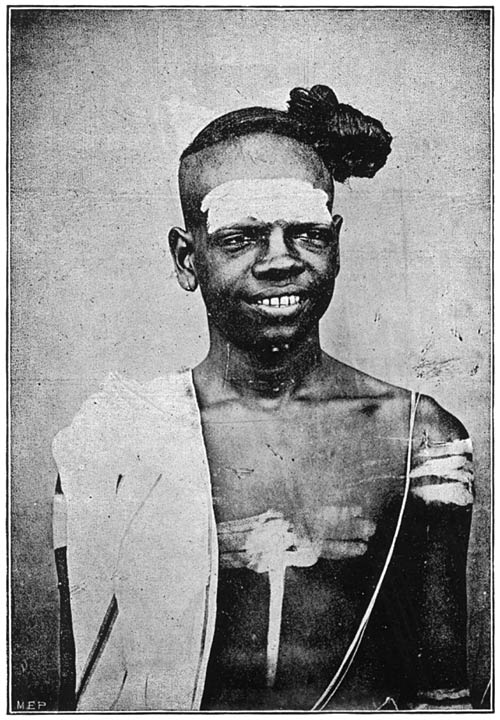
Dikshitar Brāhman.
(h) Mukkāni.—The Mukkānis are Smarthas confined to the Cochin and Travancore States.
(i) Kāniyālar.—Concerning the Kāniyālars, Mr. Ramachendrier writes as follows:—“Kaniālars form a separate class of Smartha Brahmins, and they live in the district of Tinnevelly and some parts of Trichinopoly. They do not intermarry with any other class of Smartha Brahmins, but eat with them. A large number of them, though Smarthas by birth, wear a mark on their forehead like Vyshnava Brahmins, and serve as cooks and menial servants in the big temple at Srirangam. Their women adopt the Vyshnava women’s style of wearing cloths, and to all appearance they would pass for Vyshnava women. The Vyshnava Brahmins would not allow them to mess in their houses, though they treat rice and cakes prepared by them in temples and offered to god as pure and holy, and partake of them.”
(j) Sankēthi.—The Sankēthis are confined to the Mysore Province. They speak a very corrupt form of Tamil, mixed with Canarese. The following account of them is given in the Mysore Census Report, 1891. “They are found chiefly in the Mysore and Hassan districts. Their colonies are also found in Kadur and Shimoga. Their number seems to have been somewhat understated; many of them have probably returned themselves as Dravidas. So far as language is an indication of race, the Sanketis are Tamilians, although their dialect is more diluted with Kanarese than that of any other Kannada ridden Tamil body. Theirs seems to have been among the earliest immigrations into Mysore from the neighbouring Tamil country. It is said that some 700 years ago, about 1,000 families of Smartha Brahmans emigrated from the vicinity of Kanchi (Conjeeveram), induced doubtless by contemporary politics. They set out in two batches towards Mysore. They were attacked by robbers on the road, but the larger party of about 700 families persevered in the march notwithstanding, and settled near the village of Kausika near Hassan, whence they are distinguished as Kausika Sanketis. Some twelve years afterwards, the other party of 300 families found a resting place at Bettadapura in the Hunsur taluk. This branch has been called Bettadapura Sanketi. Their religious and social customs are the same. The Kausika Sanketis occasionally take wives from the Bettadapura section, but, when the married girl joins her husband, her connection with her parents and relatives ceases altogether even in regard to meals. During the Coorg disturbances about the end of the last (eighteenth) century, many young women of the Sanketis were captured by the Kodagas (Coorgs), and some of the captives were subsequently recovered. Their descendants are to this day known as Sanketis of the West, or Hiriangalas. But they, and another sub-class called Patnagere Sanketis, do not in all exceed twenty families. The Sanketis are proverbially a hardy, intensely conservative and industrious Brahman community. They are referred to as models for simultaneously securing the twofold object of preserving the study of the Vēdas, while securing a worldly competence by cultivating their gardens; and, short of actually ploughing the land, they are pre-eminently the only fraction of the Brahman brotherhood who turn their hands to the best advantage.”
(k) Prathamasāki.—These follow the white Yajur Vēda, and are hence called Sukla Yejur Vēdis. The white Yajus forms the first fifteen sākas of the Yejur Vēda, and this is in consequence sometimes called Prathamasāka. The Prathamasākis are sometimes called Kātyayana (followers of Kātyayana Sūtram), Vājusaneya, and Madyandanas. The two last names occur among their Pravara and Gōtra Rishis. The Prathamasākis are found among all the linguistic sections. Among Smarthas, Āndhras, and Vaishnavas, they are regarded as inferior. Carnataka Prathamasākis are, on the other hand, not considered inferior by the other sections of Carnatakas. In the Tanjore district, the Prathamasākis are said to be known as Madyāna Paraiyans. The following quaint legend is recorded in the Gazetteer of that district:—“The god of the Tiruvalur temple was entreated by a pūjāri of this place (Koiltirumūlam) to be present in the village at a sacrifice in his (the god’s) honour. The deity consented at length, but gave warning that he would come in a very unwelcome shape. He appeared as a Paraiyan (Pariah) with beef on his back, and followed by the four Vēdas in the form of dogs, and took his part in the sacrifice thus accoutred and attended. All the Brahmans who were present ran away, and the god was so incensed that he condemned them to be Paraiyans for one hour in the day, from noon till 1 P.M., ever afterwards. There is a class of Brahmans called mid-day Paraiyans, who are found in several districts, and a colony of whom reside at Sedanipuram five miles from Nannilam. It is believed throughout the Tanjore district that the mid-day Paraiyans are the descendants of the Brahmans thus cursed by the god. They are supposed to expiate their defilement by staying outside their houses for an hour and a half every day at mid-day, and to bathe afterwards; and, if they do this, they are much respected. Few of them, however, observe this rule, and orthodox persons will not eat with them, because of their omission to remove the defilement. They call themselves the Prathamasaka.” Several versions of stories accounting for their pollution are extant, and the following is a version given by Mr. Ramachendrier. “Yagnavalkiar, who was the chief disciple of Vysampayanar, having returned with his students from pilgrimage, represented to his priest that Yajur Vēda was unrivalled, and that he and his students alone were qualified for its propagation. Vysampayanar, feeling provoked by this assertion, which, he remarked, implied insult to Brahmans, proposed certain penance for the offence. Yagnavalkiar replied that he and his students had done many good deeds and performed many religious rites, and that they were still to do such, and that the insult imputed to them was worthy of little notice. Vysampayanar required Yagnavalkiar to give back the Vedās which he had taught him, which he threw out at once. The matter thrown out having been like cinders, Vysampayanar’s disciples then present, assuming the shape of thithiri birds (fire-eating birds), swallowed them, and hence the Vēda is called Thithiriya Sāka and Ktishna Yajus. Soon after, Yagnavalkiar, without his priest’s knowledge, went to the Sun, and, offering prayers, entreated him to teach him Vēdas. The Sun, thereupon taking the shape of a horse, taught him the Yajur Vēda, which now forms the first fifteen sākas, and he in turn taught it to his disciples Kanvar, Madhyandanar, Katyayanar, and Vajasaneyar. It is to be gathered from Varāha Purānam that Vysampayanar pronounced a curse that the Rig Vēda taught by the Sun should be considered degraded, and that the Brahmans reading it should become Chandālas (outcastes).” Another version of the legend runs as follows. Vaisampayanar used to visit the king almost every day, and bless him by giving akshatha or sacred rice. One day, as Vaisampayanar could not go, he gave the rice grains to his disciple Yagnavalkiar, and told him to take them to the king. Accordingly, Yagnavalkiar went to the king’s palace, and found the throne empty. Being impatient by nature, he left the rice grains on the throne, and returned to his priest. The king, when he returned home, found his throne changed into gold, and certain plants were growing round his seat. On enquiry, he discovered that this marvellous effect was due to the sacred akshatha. He sent word to Vaisampayanar to send the rice grains by his disciple who had brought them. Yagnavalkiar refused, and was told to vomit the Vēdas. Readily he vomited, and, going to the Sun, learnt the Vēda from him. As the Sun is always in motion sitting in his car, the Vēdas could not be learnt without mistakes and peculiar sounds. When he came to his Guru Vaisampayanar, Yagnavalkiar was cursed to become a Chandāla. The curse was subsequently modified, as the Sun interceded on behalf of Yagnavalkiar.
(l) Gurukkal.—The Gurukkals are all followers of the Bodhayana Sūtras. They are temple priests, and other Brāhmans regard them as inferior, and will not eat with them. Even in temples, the Gurukkals sprinkle water over the food when it is offered to the god, but do not touch the food. They may not live in the same quarters with other Brāhmans. No agrahāram (Brāhman quarter) will ever contain a Gurukkal’s house. There should, strictly speaking, be at least a lane separating the houses of the Gurukkals from those of other Brāhmans. This is, however, not rigidly observed at the present day. For example, at Shiyali, Gurukkals and other Brāhmans live in the same street. There are among the Gurukkals the following sub-divisions:—
1. Tiruvālangad.
2. Conjeeveram.
3. Tirukkazhukunram.
The Tiruvālangad Gurukkals mark their bodies with vibhūti (sacred ashes) in sixteen places, viz., head, face, neck, chest, navel, knees, two sides of the abdomen, back and hands (three places on each hand). The other two sub-divisions mark themselves in eight places, viz., head, face, neck, chest, knees and hands. Gurukkals who wish to become priests have to go through several stages of initiation called Dīkshai (see Pandāram). Gurukkals are Saivites to a greater extent than the Smarthas, and do not regard themselves as disciples of Sankaracharya. Those who are orthodox, and are temple priests, should not see the corpses of Pandārams and other non-Brāhman castes. The sight of such a corpse is supposed to heap sin on them, and pollute them, so that they are unfit for temple worship.
II. Vaishnava.—The Vaishnavas, or Sri Vaishnavas, as they are sometimes called to distinguish them from the Mādhvas, who are also called Vaishnavas, are all converts from Smarthas, though they profess to constitute a distinct section. Some are converts from Telugu Smarthas, and are called Āndhra Vaishnavas. These do not mix with other Tamil-speaking Vaishnavas, and retain some of the Telugu customs. There are two distinct groups of Sri Vaishnavas—the Vadagalais (northerners) and Thengalais (southerners), who are easily distinguished by the marks on their foreheads. The Vadagalais put on a U-shaped mark, and the Thengalais a Y-shaped mark. The white mark is made with a kind of kaolin called tiruman, and turmeric rendered red by means of alkali is used for the central streak. The turmeric, as applied by the more orthodox, is of a yellow instead of red colour. Orthodox Sri Vaishnavas are very exclusive, and hold that they co-existed as a separate caste of Brāhmans with the Smarthas. But it was only after Rāmānuja’s teaching that the Vaishnavas seceded from the Smarthas, and the ranks were swollen by frequent additions from amongst the Vadamas. There are some families of Vaishnavas which observe pollution when there is a death in certain Smartha families, which belong to the same gōtra. Vaishnavas of some places, e.g., Valavanur, Savalai, and Perangiyur, in the South Arcot district, are considered low by the orthodox sections of Vaishnavas, because they are recent converts to Vaishnavism. A good example of Smarthas becoming Vaishnavas is afforded by the Thummagunta Drāvidas, some of whom have become Vaishnavas, but still take girls in marriage from Smartha families, but do not give their daughters in marriage to Smarthas. All Vaishnavas are expected to undergo a ceremony of initiation into Vaishnavism after the Upanayanam ceremony. At the time of initiation, they are branded with the marks of the chakram and sankha (chank) on the right and left shoulders respectively. The Vaikhānasas and Pāncharatras regard the branding as unnecessary. The ceremony of initiation (samāsrayanam) is usually performed by the head of a mutt. Sometimes, however, it is carried out by an elderly member of the family of the candidate. Such families go by the name of Swayam Ācharya Purushas (those who have their own men as Ācharyas).
For Vadagalais there are two mutts. Of these, the Ahobila mutt was formerly at Tiruvallur, but its head-quarters has been transferred to Narasimhapūram near Kumbakonam. The Parakālaswāmi mutt is in the Mysore Province. For Thengalais there are three mutts, at Vanamamalai and Sriperumbudur in Chingleput, and Tirukoilur in South Arcot. These are called respectively the Tothādri, Ethirājajhir, and Emberumānar mutts. There are various points of difference between Vadagalais and Thengalais, which sometimes lead to bitter quarrels in connection with temple worship. During the procession of the god at temple festivals, both Vadagalais and Thengalais go before and after the god, repeating Sanskrit Vēdas and Tamil Prapandhams respectively. Before commencing these, certain slōkas are recited, in one of which the Vadagalais use the expression Rāmānuja dayā pātram, and the Thengalais the expression Srisailēsa dayā pātram, and a quarrel ensues in consequence. The main differences between the two sections are summarised as follows in the Mysore Census Report, 1891:—“The tenets which form the bone of contention between the Tengalēs and Vadagalēs are stated to number 18, and seem to cluster round a few cardinal items of controversy:—
1. Whether Lakshmi, the consort of Vishnu, is (Vibhu) co-omnipresent and co-illimitable with Vishnu;
2. Whether Lakshmi is only the mediatrix for, or the co-bestower of mōksham or final beatitude;
3. Whether there is any graduated mōksham attainable by the good and blessed, according to their multifarious merits;
4. Whether prapatti, or unconditional surrender of the soul to god, should be performed once for all, or after every act of spiritual rebellion;
5. Whether it (prapatti) is open to all, or is prescribed only for those specially prepared and apprenticed;
6. Whether the indivisibly atomic human soul is entered into, and permeated or not by the omnipresent creator;
7. Whether god’s mercy is exerted with or without cause;
8. Whether the same (the divine mercy) means the overlooking (dhōsha darsanam) or enjoyment (dhōsha bogyatvam) of the soul’s delinquencies;
9. Whether works (karma) and knowledge (jnāna) are in themselves salvation giving, or only lead to faith (bhakthi) by which final emancipation is attained;
10. Whether the good of other (unregenerate) castes should be tolerated according to their graduated social statuses, or should be venerated without reference to caste inequalities;
11. Whether karma (works, rituals, etc.) should or not be bodily and wholly abandoned by those who have adopted prapatti.”
Widows should avoid, even when in affliction and danger, shaving, eating of sweets, betel nut, flowers, sexual intercourse, conversation with men, and jewels (Sāndilyah).
A woman, whether unmarried or widowed, who shaves her hair, will go to the hell called Rauravam. When the husband dies, the widow should perform his due obsequies without shaving. She should never shave on any occasion, or for any purpose whatever (Sambhuh).
If any woman, whether unmarried or widowed, shave (her head), she will dwell in the hell called Rauravam for one thousand karors of kalpās. If a widow shave (her head) by ignorance, she will cause hair to grow in the mouths of her ancestors’ ghosts on both sides. If she perform any ceremonies inculcated by the Srutis and Smritis with her head shaved, she will be born a Chandālī (Manuh).
There is no sin in a devout widow, whose object is eternal salvation, wearing her hair. If she should shave, she will assuredly go to hell. A Vaishnava widow should never shave her head. If she do so through ignorance, her face should not be looked at (Vridd’ha Manuh in Khagēsvara Samhitā).
If any one observe a Brahmachāri beggar with his kachchē (cloth passed between the legs, and tucked in behind), a householder without it, and a widow without hair on her head, he should at once plunge into water with his clothes (Ananta Samhitā).
It is considered highly meritorious for Vaishnava widows to wear their hair, as long as they remain in this world (Hayagrīva Samhitā).”
“The monkey and its cub. As the cub clings to its mother, so man seeks divine aid, and clings to his God. The doctrine of the Vadakalais.
“Like the cat and her kitten. The stronger carrying and protecting the weaker; used to illustrate the free grace of God. The doctrine of the Tenkalais.
“Leaving the speculative differences between these two sects, I have now to mention the practical one which divides them, and which has been, and continues to be, the principal cause of the fierce contentions and long-drawn law suits between them. And this relates to the exact mode of making the sectarian mark on the forehead. While both sects wear a representation of Vishnu’s trident, composed of red or yellow for the middle line or prong of the trident, and of white earth for those on each side, the followers of the Vadakalai draw the middle line only down to the bridge of the nose, but those of the Tenkalai draw it over the bridge a little way down the nose itself. Each party maintain that their mode of making the mark is the right one, and the only means of effecting a settlement of the dispute is to ascertain how the idol itself is marked, whether as favouring the Vadakalai or Tenkalai. But this has been found hitherto impossible, I am told, for instance at Conjeveram itself, the head-quarters of these disputes, owing to the unreliable and contradictory character of the evidence produced in the Courts.”
The Hebbar and Mandya sections belong to the Mysore Province, in which the former are very numerous. The latter are few in number, and confined to Mandya and Melkōte. Some families have settled in the city of Madras, where they are employed as merchants, bank clerks, attorneys, etc.
The Mandyas say that they migrated to Mysore from some place near Tirupati. Though both the Hebbar and Mandya Brāhmans speak Tamil, some details peculiar to Carnatakas are included in the marriage ceremonial.
The Vaishnava Shōliars are considered somewhat low in the social scale. Intermarriage takes place between Smartha and Vaishnavite Shōliars. The Vaikhānasas and Pāncharatras are temple priests (archakas). Both use as their title Dīkshitar. Sometimes they are called Nambi, but this term is more used to denote Sātāni temple servants.
Reference may here be made to the Pattar Brāhmans, who are Tamil Brāhmans, who have settled in Malabar. The name is said to be derived from the Sanskrit bhatta. It is noted, in the Gazetteer of Malabar, that “the Pattars present no peculiarities distinguishing them from the ordinary East Coast Brahmans. Like the latter, they engage in trade and business, and form a large proportion of the official, legal, and scholastic classes. With the exception of one class known as Chōzhiya or Ārya Pattars, they wear their kudumi (top-knot) on the back of the head in the east coast fashion, and not on the top and hanging over the forehead, as is done by the genuine Malayāli castes. They also live as a general rule in regular streets or grāmams on the east coast plan. Few Pattars, except in the Palghat taluk, are large land-owners. As a class, they have embraced modern educational facilities eagerly, so far as they subserve their material prospects. Both Pattars and Embrāndiris, but especially the latter, have adopted the custom of contracting sambandham (alliance) with Nāyar women, but sambandham with the foreign Brahmans is not considered to be so respectable as with Nambūdiris, and, except in the Palghat taluk (where the Nambūdiri is rare), they are not allowed to consort with the women of aristocratic families.”
In connection with the Ārya Pattars, it is recorded, in the Travancore Census Report, 1901, that “the term Aryapattar means superior Brahmins. But the actual position in society is not quite that. At Rāmēsvaram, which may be considered the seat of Aryapattars, their present status seems to be actually inferior, due probably, it is believed, to their unhesitating acceptance of gifts from Sudras, and to their open assumption of their priestly charge. Though at present a small body in Malabar, they seem to have once flourished in considerable numbers. In the case of large exogamous but high-caste communities like the Kshatriyas of Malabar, Brahmin husbands were naturally in great requisition, and when, owing to their high spiritual ideals, the Brahmins of Malabar were either Grihasthas or Snātakas (bachelor Sanyāsins dedicating their life to study, and to the performance of orthodox rites), the supply was probably unequal to the demand. The scarcity was presumably added to when the differences between the Kōlattunāt Royal Family and the Brahmins of the Perinchellūr grāmam became so pronounced as to necessitate the importing of Canarese and Tulu Brahmins for priestly services at their homes and temples. The first immigration of Brahmins from the east coast, called Aryapattars, into Malabar appears to have been under the circumstances above detailed, and at the instance of the Rajas of Cranganore. With the gradual lowering of the Brahminical ideal throughout the Indian Peninsula, and with the increasing struggle for physical existence, the Nambūtiris entered or re-entered the field, and ousted the Aryapattars first from consortship, and latterly even from the ceremony of tāli-tying in families that could pay a Nambūtiri. The Aryapattar has, in his turn, trespassed into the ranks of the Nāyars, and has begun to undertake the religious rite of marriage, i.e., tāli-tying, in aristocratic families among them. There are only two families now in all Travancore, and they live in the Karunagapalli taluk. Malayālam is their household tongue; in dress and personal habits, they are indistinguishable from Malayāla Brahmins. The males marry into as high a class of Brahmins as they could get in Malabar, which is not generally higher than that of the Pōtti. The Pōtti woman thus married gets rather low in rank on account of this alliance. The daughter of an Aryapattar cannot be disposed of to a Brahminical caste in Malabar. She is taken to the Tinnevelly or Madura district, and married into the regular Aryapattar family according to the rites of the latter. The girl’s dress is changed into the Tamil form on the eve of her marriage.”
III. Āndhra.—The Telugu-speaking Brāhmans are all Āndhras, who differ from Tamil Brāhmans in some of their marriage and death ceremonies, female attire, and sectarian marks. Telugu Brāhman women wear their cloth without passing it between the legs, and the free end of the skirt is brought over the left shoulder. The sect mark consists of three horizontal streaks of sacred ashes on the forehead, or a single streak of sandal paste (gandham). In the middle of the streak is a circular black spot (akshintalu or akshintalu bottu). The marriage badge is a circular plate of gold, called bottu, attached to a thread, on which black glass beads are frequently strung. A second bottu, called nāgavali bottu, is tied on the bride’s neck on the nāgavali day. During the time when the bridegroom is performing the vrata ceremony, the bride is engaged in the worship of Gauri. She sits in a new basket filled with paddy (unhusked rice) or cholam (Andropogon Sorghum). On the return from the mock pilgrimage (kāsiyātra), the bride and bridegroom sit facing each other on the dais, with a screen interposed between them. Just before the bottu is tied on the bride’s neck by the bridegroom, the screen is lowered. During the marriage ceremony, both the bride and bridegroom wear clothes dyed with turmeric, until the nāgavali day. Among Tamil Brāhmans, the bridegroom wears a turmeric-dyed cloth, and the bride may wear a silk cloth. Immediately after the tying of the bottu, the contracting couple throw rice over each other, and those assembled pour rice over their heads. This is called Talambralu.
Taken as a class, the Telugu Brāhmans are very superstitious, and the females perform a very large number of vratams. Of the vratams performed by Telugu and Canarese females, both Brāhman and non-Brāhman, the following account is given in the Manual of the Nellore district. A very favourite deity is Gauri, in honour of whom many of the rites hereafter noticed are performed. These ceremonies give a vivid idea of the hopes and fears, the aspirations, and the forebodings of Hindu womanhood. The following ceremonies are practised by girls after betrothal, and before union with their husbands:—
Atlataddi.—On the third day after the full moon, an early meal before sunrise, the worship of Gauri in the afternoon, and the presentation of ten cakes to ten matrons upon the dismissal of the deity invoked. The object is to secure a young agreeable husband.
Uppu (salt).—This consists in making a present to any matron of a pot of salt, full to the brim, at the end of the year, with the view to secure a long enjoyment of the married state.
Akshayabandar.—This consists in making a present of a pot full of turmeric to any matron at the end of the year, with a view to avert the calamity of widowhood.
Udayakunkuma.—Putting the red kunkuma mark on the foreheads of five matrons before sunrise, with the object of being always able to wear the same mark on her own forehead, i.e., never to become a widow.
Padiharukudumulu.—The presentation of sixteen cakes once a year for sixteen years to a matron. This is for the attaining of wealth.
Kartika Gauri Dēvi.—Exhibiting to a matron the antimony box, with a preparation of which the eyes are trimmed to give the brilliancy, and wearing on the head turmeric rice (akshatalu). The object of this is said to be to give sight to blind relatives.
Kandanomi.—Abstaining for a year from the use of arum (Amorphophallus Campanulatus), of which the corms are an article of food), and presenting a matron with a silver and gold representation of a kanda to be worn on the neck. The object to be attained is that she who performs the rite may never have to shed tears.
Gummadi Gauri Dēvi.—The presentation at the end of the year to a matron of a pumpkin in the morning, and another in the afternoon, with a silver one at food time, and a gold one to be worn round the neck. This is for the prolongation of married life.
Gandala Gauri Dēvi.—The distribution of twenty-five different sorts of things, twenty-five to be distributed to matrons at the rate of five of each sort to each. The object of this is to avert evil accidents of all kinds, which may threaten the husband.
Chittibottu.—Making the kunkuma marks on the foreheads of five matrons in the morning, for the attainment of wealth.
Isalla Chukka.—Rubbing butter-milk, turmeric, kunkuma, and sandalwood paste on the threshold of the door. The object is the same as in the last.
Tavita Navomi.—To avoid touching bran for any purpose, for the prolongation of married life.
Nitya Srungaram.—Offering betel nut, and putting the kunkuma mark on the face of a matron, for the purpose of securing perpetual beauty.
Nallapusala Gauri Dēvi.—The presentation to a matron of a hundred black beads with one gold one, the object being again to avert widowhood.
Mocheti Padmam.—The worship of some deity, and the making of the forehead mark (bottlu) for four matrons in the first year, eight in the second, and so on, increasing the number by four each year for twenty-seven years, being the number of certain stars. This presentation has to be made in silence. The object is the attainment of enduring wealth.
Mogamudo sellu.—The performer washes her face thirteen times daily in a brass vessel, and offers to some matron some rice, a pearl, and a coral.
Undrallatadde.—On the thirteenth day after the full moon, taking food before sunrise, the girl worships the goddess Gauri in the afternoon, and, at the time of dismissing the deity invoked (udyapana), she presents five round cakes to as many matrons. The object of this is to secure her future husband’s affections.
Vara Lakshmi.—The worship of the goddess Lakshmi for the attainment of wealth and salvation, or to make the best of both worlds.
Vavila Gauri Dēvi.—In order to avert the risk of all accidents for her future lord, the devotee, on each of the four Tuesdays of the month Sravana, worships the goddess Gauri Dēvi, and distributes Bengal gram to married women.
Savitri Gauri Dēvi.—The offering of nine different articles on nine different days after the sun has entered the solstice, the sign of Capricorn. This is also practised to secure a husband’s affection.
Tsaddikutimangalavaram.—This is a piece of self-mortification, and consists in eating on every Tuesday for one year nothing but cold rice boiled the previous day, and feeding a matron with the same.
The following are some of the ceremonies practised by young women after attaining a marriageable age:—
Prabatcha Adivaram.—Offering worship to a married couple, and limiting the taking of food to a single meal on Sunday. This is done with the object of having children.
Apadalēni Adivaram.—Taking but one meal every Sunday, and making a presentation to five matrons of five cakes with a flat basket of rice, body jackets, and other things. This is for the procuring of wealth.
Adivaram (Sunday).—Total abstinence from some one article of food for one year, another article the next year, and so on for five years; also limitation to a single meal every Sunday, and the presentation of cloths to Brāhmans upon the dismissal of the deity invoked for worship. The object of this seems to be to secure re-union with the husband after death.
Chappitti Adivaram.—Abstinence from salt on every Sunday for a year, with a view to secure the longevity of children.
Udayapadmam.—To take for one year a daily bath, and to draw the representation of a lotus with rice-flour every morning near the sacred tulasi plant (Ocimum sanctum), which is kept in many Hindu households, growing on an altar of masonry. The object of this is to restore a dead husband to life again, i.e., to secure re-union in another life.
Krishna Tulasi.—To avert widowhood, those who perform this rite present thirteen pairs of cakes in a gold cup to a Brāhman.
Kartika Chalimidi.—The distribution of chalimidi, which is flour mixed with sugar water, for three years; in the first year one and a half seer of rice, in the second year two and a half seers, and in the third year twenty-six seers, the object sought being to restore life to children that may die, i.e., restoration in another world.
Kailāsa Gauri Dēvi.—To grind one and a half viss (a measure) of turmeric without assistance in perfect silence, and then distribute it among 101 matrons, the object being to avert widowhood.
Dhairya Lakshmi.—As a charm against tears, matrons light a magic light, which must have a cotton wick of the weight of one pagoda (a gold coin), and, instead of a quarter of a viss of ghee, clarified butter.
Dhanapalalu.—Giving four different sorts of grain for five years to a Brāhman, to atone for the sin of the catamenial discharge.
Nadikēsudu.—The distribution of five seers each of nine different sorts of grain, which must be dressed and eaten in the house. This is done for the procuring of wealth.
Nityadhanyamu.—Daily giving a handful of grain to any Brahmin with the object of averting widowhood.
Phalala Gauri Dēvi.—This is performed by the presentation of sixteen fruits of sixteen different species to any married woman, with the view of securing healthy offspring.
Pamidipuvulu.—With the view to avert widowhood and secure influence with their husbands, young wives practise the daily worship of thirteen flowers for a time, and afterwards present to a Brahmin the representations of thirteen flowers in gold, together with a lingam and panavattam (the seat of the lingam).
Muppadimudupurnamulu.—To avert widowhood, cakes are offered on the occasion of thirty-three full-moons; on the first one cake is eaten, on the second two, and so on up to thirty-three.
Mudukartelu.—For the attainment of wealth, women light seven hundred cotton wicks steeped in oil at the three festivals of full moon, Sankurātri (the time when the sun enters the zodiacal sign of Capricorn), and Sivarātri.
Magha Gauri Dēvi.—The worship of the goddess Gauri in the month of Magham, with a view to avert widowhood.
Vishnukanta.—For the same purpose, thirteen pairs of cakes are offered in a new pot to some married woman.
Vishnuvidia.—To atone for the sin of the catamenial discharge, food is eaten without salt on the second day after every new moon.
Sokamulēni Somavaram.—The taking of food without salt every Monday, for the restoration of children removed by death.
Chitraguptulu.—Burning twelve wicks daily in oil, for the attainment of happiness in a future state.
Sukravaram.—For the acquisition of wealth, women sometimes limit themselves to one meal on Fridays, and feed five married women on each occasion of dismissing the deity invoked for worship.
Saubhagyatadde.—To avert widowhood, another practice is on the third day after every new moon to distribute, unassisted and in silence, one and a quarter viss of turmeric among thirteen matrons.
Kshirabdhi Dvādasi.—Keeping a fast day specially devoted to the worship of Vishnu, with a view to secure happiness in a future state.
Chinuku.—A woman takes a stalk of Indian corn fresh pulled up, and with it pounds rice-flour mixed with milk in a mortar. This is to avert widowhood in this world, and to secure happiness in the next.
Women who have lost children frequently perform the following two ceremonies for restoration to life or restoration in a future state:—
Kundella Amavasya (hare’s new moon).—To give thirteen different things to some married woman every new moon for thirteen months.
Kadupukadalani Gauri Dēvi.—The presentation of thirteen pairs of cakes to thirteen matrons.
The following ceremonies are often performed after the cessation of the catamenial discharge, to atone for the sin contracted by their occurrence:—
Annamumuttani Adivaram.—The eating of yams and other roots every Sunday for three years, or, under certain conditions, a longer period.
Rushipanchami.—On the fifth day of Bhadrapada month to eat five balusu (Canthium parviflorum) leaves, and to drink a handful of ghee.
Gomayani.—To eat three balls of cow-dung every morning for a year.
Lakshvattulu.—To burn one lac (100,000) of wick lights.
Lakshmivarapu Ekādasi.—From the time when the eleventh day after new moon falls on a Thursday, to observe a fast, and to worship the tulasi plant for eleven days.
Margasira Lakshmivaram.—The mistress of a family will often devote herself to the worship of Lakshmi on every Thursday of the month of Margasira, in order to propitiate the goddess of wealth.
Somisomavaram.—A special worship performed on every new moon that falls on Monday, with the giving away of 360 articles, two or three on each occasion. This is performed with the view of attaining atonement for sins, and happiness in a future state.
There are many ceremonies performed by women to whom nature has denied the much-coveted joys of maternity. Among these may be noted:—
Asvadhapradakshinam.—In villages is often to be seen a margosa (Melia Azadirachta)tree, round which a pīpul tree (Ficus religiosa) has twined itself. The ceremony consists in a woman walking round and round this tree several times daily for a long period.
The sub-divisions of the Telugu Brāhmans are as follows:—
A.—Vaidiki. 1. Murikinādu. 2. Telaganyam. 3. Velnādu. 4. Kasalnādu. 5. Karnakammalu. 6. Veginādu. 7. Konesime. 8. Ārama Drāvida. 9. Ārādhya. 10. Prathamasāki.
B.—Niyogi. 1. Āruvela. 2. Nandavarikulu. 3. Kammalu. 4. Pesalavayalu. 5. Prānganādu.
C.—Tambala.
D.—Immigrants. 1. Pudur Drāvida. 2. Thummagunta Drāvida.
All these sections are endogamous, and will eat together, except the Tambalas, who correspond to the Gurukkals among the Tamil Brāhmans. Vaidikis are supposed to be superior to Niyōgis. The former do not generally grow moustaches, while the latter do. For srādh ceremonies, Niyōgis do not generally sit as Brāhmans representing the ancestors, Vaidikis being engaged for this purpose. In some places, e.g., the Nandigama tāluk of the Kistna district, the Niyōgis are not referred to by the name Brāhman, Vaidikis being so called. Even Niyōgis themselves point to Vaidikis when asked about Brāhmans.
Velnādu, Murikinādu, and Vēginādu seem to be territorial names, and they occur also among some of the non-Brāhman castes. The Ārādhyas are dealt with in a special article (see Ārādhya). Among the Karnakammas are certain sub-sections, such as Ōgōti and Koljēdu. They all belong to Rig Sāka. Of the Telaganyams, some follow the Rig Vēda, and others the Yejur Vēda (both black and white Yajus). The Nandavarikulu are all Rig Vēdis, and regard Chaudēswari, the goddess of the Dēvāngas, as their tutelary deity. When a Nandavariki Brāhman goes to a Dēvānga temple, he is treated with much respect, and the Dēvānga priest gives up his place to the Nandavariki for the time being. The Nandavariki Brāhmans are, in fact, gurus or priests to the Dēvēngas.
A special feature of the Telugu Brāhmans is that, like the Telugu non-Brāhman classes, they have house names or intipērulu, of which the following are examples:—Kōta (fort), Lanka (island), Puchcha (Citrullus Colocynthis), Chintha (tamarind), Kākī (crow). Niyōgi house-names sometimes terminate with the word rāzu.
IV. Carnātaka.—The sub-divisions of the Carnātakas or Canarese-speaking Brāhmans are as follows:—
A.—Smartha. 1. Aruvaththuvokkālu. 2. Badaganādū. 3. Hosalnādu. 4. Hoisanige or Vaishanige. 5. Kamme (Bobburu, Karna, and Ulcha). 6. Sīrnādu. 7. Māraka.
B.—Mādhva. 1. Aruvēla. 2. Aruvaththuvokkalu. 3. Badaganādu. 4. Pennaththūrar. 5. Prathamasāki. 6. Hyderabadi.
The Carnātakas very closely resemble the Āndhras in their ceremonial observances, and, like them, attach much importance to vratams. The Mādhva Carnātakas are recent converts from Carnātaka or Āndhra Smarthas. The Pennaththūrars are supposed to be Tamil Brāhmans converted into Mādhvas. They retain some of the customs peculiar to the Tamil Brāhmans. The marriage badge, for example, is the Tamil tāli and not the bottu. Intermarriages between Smarthas and Mādhvas of the same section are common. Mādhvas, excepting the very orthodox, will take food with both Carnātaka and Āndhra Smarthas.
The Mādhva Brāhmans commence the marriage ceremony by asking the ancestors of the bridal couple to bless them, and be present throughout the performance of the rites. To represent the ancestors, a ravike (bodice) and dhotra (man’s cloth) are tied to a stick, which is placed near the box containing the sālagrāma stone and household gods. In consequence of these ancestors being represented, orthodox Vaidiki Brāhmans refuse to take food in the marriage house. When the bridegroom is conducted to the marriage booth by his future father-in-law, all those who have taken part in the Kāsiyātra ceremony, throw rice over him. A quaint ceremony, called rangavriksha (drawing), is performed on the morning of the second day. After the usual playing with balls of flowers (nalagu or nalangu), the bridegroom takes hold of the right hand of the bride, and, after dipping her right forefinger in turmeric and chunam (lime) paste, traces on a white wall the outline of a plantain tree, of which a sketch has previously been made by a married woman. The tracing goes on for three days. First the base of the plant is drawn, and, on the evening of the third day, it is completed by putting in the flower spikes. On the third night the bridegroom is served with sweets and other refreshments by his mother-in-law, from whose hands he snatches the vessels containing them. He picks out what he likes best, and scatters the remainder about the room. The pollution caused thereby is removed by sprinkling water and cow-dung, which is done by the cook engaged for the marriage by the bridegroom’s family. After washing his hands, the bridegroom goes home, taking with him a silver vessel, which he surreptitiously removes from near the gods. Along with this vessel he is supposed to steal a rope for drawing water, and a rice-pounding stone. But in practice he only steals the vessel, and the other articles are claimed by his people on their return home.
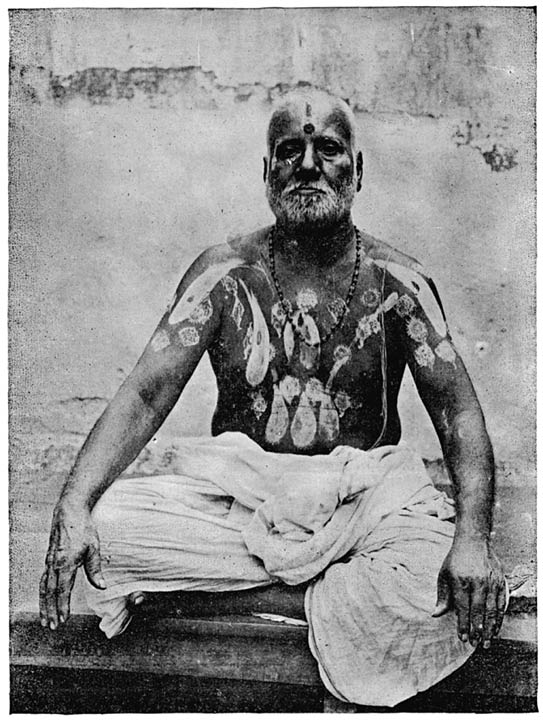
Mādhva Brāhman.
The god Hanumān (the monkey god) is specially reverenced by Mādhvas, who call him Mukyaprānadēvaru (the chief god).
V. Tulu.—The Tulu-speaking Brāhmans are, in their manners and customs, closely allied to the Carnatakas. Their sub-divisions are—
1. Shivalli.
2. Kōta.
3. Kandāvara.
4. Havīk or Haiga.
5. Pānchagrāmi.
6. Kōteswar.
“All Tulu Brahmin chronicles agree in ascribing the creation of Malabar and Canara, or Kērala, Tuluva, and Haiga, to Parasu Rāma, who reclaimed from the sea as much land as he could cover by hurling his battle-axe from the top of the Western Ghauts. According to Tulu traditions, after a quarrel with Brahmins who used to come to him periodically from Ahi-Kshētra, Parasu Rāma procured new Brahmins for the reclaimed tract by taking the nets of some fishermen, and making a number of Brahminical threads, with which he invested the fishermen, and thus turned them into Brahmins, and retired to the mountains to meditate, after informing them that, if they were in distress and called on him, he would come to their aid. After the lapse of some time, during which they suffered no distress, they were curious to know if Parasu Rāma would remember them, and called upon him in order to find out. He promptly appeared, but punished their thus mocking him by cursing them, and causing them to revert to their old status of Sudras. After this, there were no Brahmins in the land till Tulu Brahmins were brought from Ahi-Kshētra by Mayūr Varma of the Kadamba dynasty. A modified form of the tradition states that Parasu Rāma gave the newly reclaimed land to Nāga and Machi Brahmins, who were not true Brahmins, and were turned out or destroyed by fishermen and Holeyas (Pariahs), who held the country till the Tulu Brahmins were introduced by Mayūr Varma. All traditions unite in attributing the introduction of the Tulu Brahmins of the present day to Mayūr Varma, but they vary in details connected with the manner in which they obtained a firm footing in the land. One account says that Habāshika, chief of the Koragas (Pariahs), drove out Mayūr Varma, but was in turn expelled by Mayūr Varma’s son, or son-in-law, Lōkāditya of Gōkarnam, who brought Brahmins from Ahi-Kshētra and settled them in thirty-two villages. Another makes Mayūr Varma himself the invader of the country, which till then had remained in the possession of the Holeyas (Pariahs) and fishermen who had turned out Parasu Rāma’s Brahmins. Mayūr Varma and the Brahmins whom he had brought from Ahi-Kshētra were again driven out by Nanda, a Holeya chief, whose son Chandra Sayana had, however, learned respect for Brahmins from his mother, who had been a dancing-girl in a temple. His admiration for them became so great that he not only brought back the Brahmins, but actually made over all his authority to them, and reduced his people to the position of slaves. A third account makes Chandra Sayana, not a son of a Holeya king, but a descendant of Mayūr Varma and a conqueror of the Holeya king. Nothing is known from other sources of Lōkāditya, Habāshika, or Chandra Sayana, but inscriptions speak to Mayūr Varma being the founder of the dynasty of the Kadambas of Banavāsi in North Canara. His date is usually put down at about 750 A.D. The correctness of the traditions, which prevail in Malabar as well as in Canara, assigning the introduction of Brahmins to the West Coast to Mayūr Varma who was in power about 750 A.D., is to some extent corroborated by the fact that Brahmins attested the Malabar Perumal’s grant to the Christians in 774 A.D., but not that to the Jews about 700 A.D. The Brahmins are said to have been brought from Ahi-Kshētra, on the banks of the Gōdāvari, but it is not clear what connection a Kadamba of Banavāsi could have with the banks of the Gōdāvari, and there may be something in the suggestion made in the North Kanara Gazetteer that Ahi-Kshētra is merely a sanskritised form of Haiga or the land of snakes. The tradition speaks of the Brahmins having been brought by Lōkāditya from Gōkarnam, which is in the extreme north of Haiga, and in the local history of the Honalli Matha in Sunda in North Canara, Gōkarnam is spoken of as being Ahi-Kshētra. Gōkarnam is believed to have been a Brahmin settlement in very early times, and there was probably a further influx of Brahmins there as Muhammadan conquest advanced in the north.
“The class usually styled Tulu Brahmins at the present day are the Shivalli Brahmins, whose head-quarters are at Udipi, and who are most numerous in the southern part of the district, but the Kōta, Kōtēshwar, and Haiga or Havīka Brahmins are all branches of the same, the differences between them having arisen since their settlement in Canara; and, though they now talk Canarese in common with the people of other parts to the north of the Sītanadi river, their religious works are still written in the old Tulu-Malayālam character. Tulu Brahmins, who have settled in Malabar in comparatively late years, are known as Embrāntris, and treated as closely allied to the Nambūtiris, whose traditions go back to Mayūr Varma. Some families of Shivalli and Havīka Brahmins in the southern or Malayālam portion of the district talk Malayālam, and follow many of the customs of the Malabar or Nambūtiri Brahmins. Many of the thirty-two villages in which the Brahmins are said to have been settled by Mayūr Varma are still the most important centres of Brahminism. Notably may be mentioned Shivalli or Udipi, Kōta and Kōtēshwar, which have given names to the divisions of Tulu Brahmins of which these villages are respectively the head-quarters. When the Brahmins were introduced by Mayūr Varma they are said to have been followers of Bhattāchārya, but they soon adopted the tenets of the great Malayālam Vēdāntic teacher Sankarāchārya, who is ordinarily believed to have been born at Cranganore in Malabar in the last quarter of the eighth century, that is, soon after the arrival of the Brahmins on the west coast. Sankarāchārya is known as the preacher of the Advaita (non-dual) philosophy, which, stated briefly, is that all living beings are one with the supreme spirit, and absorption may finally be obtained by the constant renunciation of material in favour of spiritual pleasure. This philosophy, however, was not sufficient for the common multitude, and his system included, for weaker minds, the contemplation of the first cause through a multitude of inferior deities, and, as various manifestations of Siva and his consort Parvati, he found a place for all the most important of the demons worshipped by the early Dravidians whom the Brahmins found on the West Coast, thus facilitating the spread of Hinduism throughout all classes. That the conversion of the Bants and Billavas, and other classes, took place at a very early date may be inferred from the fact that, though the great bulk of the Tulu Brahmins of South Canara adopted the teaching of the Vaishnavite reformer Mādhavāchārya, who lived in the thirteenth century, most of the non-Brahmin Hindus in the district class themselves as Shaivites to this day. Sankarāchārya founded the Sringēri Matha in Mysore near the borders of the Udipi taluk, the guru of which is the spiritual head of such of the Tulu Brahmins of South Canara as have remained Smarthas or adherents of the teaching of Sankarāchārya. Mādhavāchārya is believed to have been born about 1199 A.D. at Kaliānpur, a few miles from Udipi. He propounded the Dvaita or dual philosophy, repudiating the doctrine of oneness and final absorption held by ordinary Vaishnavites as well as by the followers of Sankarāchārya. The attainment of a place in the highest heaven is to be secured, according to Mādhavāchārya’s teaching, not only by the renunciation of material pleasure, but by the practice of virtue in thought, word and deed. The moral code of Mādhavāchārya is a high one, and his teaching is held by some—not ordinary Hindus of course—to have been affected by the existence of the community of Christians at Kaliānpur mentioned by Cosmos Indico Pleustes in the seventh century. Mādhavāchārya placed the worship of Vishnu above that of Siva, but there is little bitterness between Vaishnavites and Shaivites in South Canara, and there are temples in which both are worshipped under the name of Shankara Nārāyana. He denied that the spirits worshipped by the early Dravidians were manifestations of Siva’s consort, but he accorded sanction to their worship as supernatural beings of a lower order.
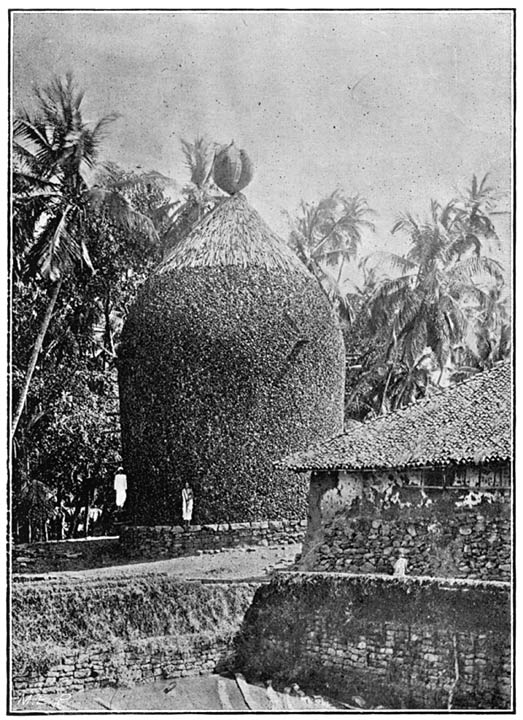
Fuel Stack at Udipi Matt.
“Many of the Shivalli Brahmins are fair complexioned with well-cut intelligent features. A number of them own land which they cultivate by tenants or by hired labourers, and there are several wealthy families with large landed properties, but the great bulk of them are either astronomers, astrologers, tantris, purohitas, worshippers in temples, or professional beggars. They have been backward in availing themselves of English education, and consequently not many of them are to be found holding important posts under Government or in the professions, but a few have come to the front in late years. A good many of them are village accountants and teachers in village schools. The women, as is usually the case among all classes, are fairer than the men. Their education is even more limited, but they are said to be well trained for the discharge of household and religious duties. They wear the cloth falling as low as the feet in front, but not usually so low behind, especially on festive occasions, the end being passed between the legs and tucked into the fold of the cloth round the waist. Like all Brahmin women in Canara, they are fond of wearing sweet-scented flowers in their hair. The language of the Shivalli Brahmins is Tulu, except to the north of the Sītanadi river, where close intercourse with the ruling Canarese classes above the ghauts for several centuries has led to the adoption of that language by all classes. Their religious books are in Sanskrit, and, even north of the Sītanadi river, they are written in the old Tulu-Malayālam character. Their houses are all neat, clean, and provided with verandahs, and a yard in front, in which stands, in a raised pot, a plant of the tulasi or sacred basil. Some of the houses of the old families are really large and substantial buildings, with an open courtyard in the centre. Men and widows bathe the whole body every day before breakfast, but married women bathe only up to the neck, it being considered inauspicious for them to bathe the head also. In temples and religious houses, males bathe in the evening also. An oil bath is taken once a week. They are, of course, abstainers from animal food and spirituous liquors, and a prohibition extends to some other articles, such as onions, garlic, mushrooms, etc. At times of marriages, deaths or initiations, it is usual to give feasts, which may be attended by all Drāvida Brahmins. The Shivallis have 252 gōtras, and the names of the following seem to be of totemistic origin:—
Kudrettāya, from kudre, a horse, taya, belonging to.
Tālitāya, palmyra palm.
Manōlitāya, name of a vegetable.
Shunnatāya, chunam, lime.
Kalambitāya, a kind of box.
Nellitāya, the Indian gooseberry.
Gōli, banyan tree.
Āne, elephant.
“These names were obtained from one of the eight swāmis or gurus of the Udipi math, and according to him they have no totemistic force at the present day. Girls must be married before maturity, and the ordinary age now-a-days is between five and eleven. The age of the bridegroom is usually between fifteen and five and twenty. A maternal uncle’s daughter can be married without consulting any horoscope, and during the marriage ceremonies it is customary for a bridegroom’s sister to obtain from him a formal promise that, if he has a daughter, he will give her in marriage to her son. Widows take off all their ornaments, and wear a red or white cloth. They ought not to attend any auspicious ceremonies or festivals, but of late years there has been a tendency to relax the severity of the restrictions on a widow’s freedom, and a young widow is allowed to keep her head unshaven, and to wear a few ornaments. A few Shivallis in the Malayālam-speaking portion of the Kāsaragōd taluk follow the customs and manners of the Malayālam Brahmins, and amongst these a girl does not lose caste by remaining unmarried until she comes of age.
“Kōtēshwar Brahmins are a small body, who take their name from Kōtēshwar in the Coondapoor taluk. They are practically the same as the Shivalli Brahmins, except that, like all classes in that taluk, they talk Canarese.
“Havīka, Havīga, or Haiga Brahmins are the descendants of the section of the Brahmins brought in by Mayūr Varma, who settled within the tract known as Haiga, which comprised the southern part of North Canara and the extreme northern part of South Canara. They did not, like the Shivallis, adopt the teaching of Mādhavāchārya, but remained followers of Sankarāchārya, and they now speak Canarese, though their religious and family records are written in old Tulu-Malayālam character. Though originally of the same stock, a distinction has arisen between them and the Shivalli Brahmins, and they do not intermarry, though they may eat together. A number of Havīka Brahmins are to be found scattered throughout South Canara, engaged for the most part in the cultivation of areca palm gardens, in which they are very expert. A very well-to-do colony of them is to be found in the neighbourhood of Vittal in the Kāsaragōd taluk, where they grow areca nuts which are valued only second to those grown in the māgane of the Coondapoor taluk above the ghauts. The Havīka Brahmins, perhaps owing to their residing for many generations in the comparatively cool shade of the areca nut gardens, are specially fair even for west coast Brahmins. This fairness of complexion is particularly noticeable in the women, who do not differ much in their manners and customs from the Shivalli Brahmin women, except that they take a prominent part in the work of the gardens, and never on any occasion wear the end of their cloth passed through the legs and tucked up behind. The Havīk widows are allowed more freedom than in most other classes. Some Havīk Brahmins in the Malayālam portion of the Kāsaragōd taluk have, like the Shivallis in the same locality, adopted the language and customs of the Malayāli Brahmins.
“Kōta Brahmins, so called from a village in the northern part of the Udipi taluk, are, like the Havīks, Smarthas or followers of Sankarāchārya, and now speak Canarese, but the breach between them and the Shivallis is not so wide, as intermarriages occasionally take place. In the Coondapoor taluk and the northern part of the Udipi taluk, the Kōtas occupy a place in the community corresponding to that taken by the Shivallis throughout the rest of the district.
“Saklāpuris, of whom there are a few in the district, are what may be called a dissenting sect of Havīkas who, a few years ago, renounced their allegiance to the Rāmchandrapura matha in favour of one at Saklāpuri near the boundary between North and South Canara. Like the Havīkas, they speak Canarese.
“Kandāvaras obtain their name from the village of Kandāvar in the Coondapoor taluk. They are commonly known as Udapas, and they all belong to one gōtram, that of Visvamitra. They are, therefore, precluded from marrying within the caste, and take their wives and husbands from the ranks of the Shivalli Brahmins. They are, indeed, said to be the descendants of a Shivalli Brahmin who settled in Kandāvar about seven or eight centuries ago. The head of the Annu Udapa family, which is called after this ancestor, is the hereditary head of the caste, and presides over all panchāyats or caste councils. They speak Canarese. Their title is Udapa or Udpa.”
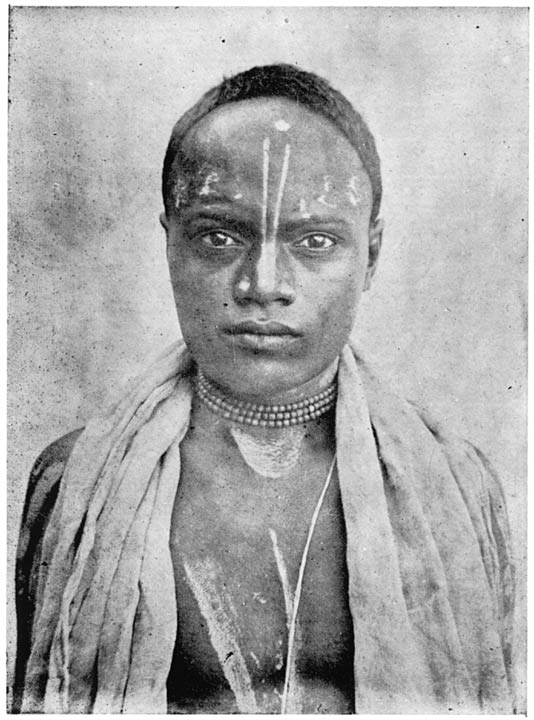
Oriya Brāhman.
VI. Oriya.—The Oriya Brāhmans of the Ganjam district belong to the Utkala section of the Pancha Gaudas. Between them and the Pancha Drāvidas there is very considerable difference. None of the sections of the Pancha Drāvidas adopt the gōsha system as regards their females, whereas Oriya Brāhman women are kept gōsha (in seclusion). Occasionally they go out to bring water, and, if on their way they come across any males, they go to the side of the road, and turn their backs to the passers-by. It is noted, in the Manual of the Vizagapatam district, that Oriya Brāhmans “eat many kinds of meat, as pea fowl, sāmbur (deer), barking deer, pigeons, wild pig, and fish.” Fish must be one of the dishes prepared on festive occasions. As a rule, Oriya Brāhmans will accept water from a Gaudo (especially a Sullokondia Gaudo), and sometimes from Gudiyas and Odiyas. Water touched by Drāvida Brāhmans is considered by them to be polluted. They call the Drāvidas Komma (a corruption of Karma) Brāhmans. The Oriya Brāhmans are more particular than the Drāvidas as regards the madi cloth, which has already been referred to. A cloth intended for use as a madi cloth is never given to a washerman to be washed, and it is not worn by the Oriya Brāhmans when they answer the calls of nature, but removed, and replaced after bathing. Marriage with a maternal uncle’s daughter, which is common among the Drāvida Brāhmans, would be considered an act of sacrilege by Oriyas. When an Oriya Brāhman is charged with being a meat eater, he retorts that it is not nearly so bad as marrying a mathulakanya (maternal uncle’s daughter). The marriage tāli or bottu is dispensed with by Oriya Brāhmans, who, at marriages, attach great importance to the pānigrahanam (grasping the bride’s hand) and saptapadi (seven steps). The Oriya Brāhmans are both Smarthas and Vaishnavas who are generally Paramarthos or followers of Chaitanya. The god Jagannātha of Puri is reverenced by them, and they usually carry about with them some of the prasādham (food offered to the god) from Puri. They are divided into the following twelve sections:—