B (continued 3)
Reading edition
In some places, a branch of Ficus religiosa or Ficus bengalensis is planted in front of the house as the marriage milk-post. If it withers, it is thrown away, but, if it takes root, it is reared. By some Bēdars a vessel is filled with milk, and into it a headman throws the nose ornament of a married woman, which is searched for by the bride and bridegroom three times. The milk is then poured into a pit, which is closed up. In the North Arcot Manual it is stated that the Bōya bride, “besides having a golden tāli tied to her neck, has an iron ring fastened to her wrist with black string, and the bridegroom has the same. Widows may not remarry or wear black bangles, but they wear silver ones.”
“Divorce,” Mr. Mainwaring writes, “is permitted. Grounds for divorce would be adultery and ill-treatment. The case would be decided by a panchāyat (council). A divorced woman is treated as a widow. The remarriage of widows is not permitted, but there is nothing to prevent a widow keeping house for a man, and begetting children by him. The couple would announce their intention of living together by giving a feast to the caste. If this formality was omitted, they would be regarded as outcastes till it was complied with. The offspring of such unions are considered illegitimate, and they are not taken or given in marriage to legitimate children. Here we come to further social distinctions. Owing to promiscuous unions, the following classes spring into existence:—
1. Swajathee Sumpradayam. Pure Bōyas, the offspring of parents who have been properly married in the proper divisions and sub-divisions.
2. Koodakonna Sumpradayam. The offspring of a Bōya female, who is separated or divorced from her husband who is still alive, and who cohabits with another Bōya.
3. Vithunthu Sumpradayam. The offspring of a Bōya widow by a Bōya.
4. Arsumpradayam. The offspring of a Bōya man or woman, resulting from cohabitation with a member of some other caste.
The Swajathee Sumpradayam should only marry among themselves. Koodakonna Sumpradayam and Vithunthu Sumpradayam may marry among themselves, or with each other. Both being considered illegitimate, they cannot marry Swajathee Sumpradayam, and would not marry Arsumpradayam, as these are not true Bōyas, and are nominally outcastes, who must marry among themselves.”
On the occasion of a death among the Ūru Bēdars of Hospet, the corpse is carried on a bier by Ūru Bēdars to the burial-ground, with a new cloth thrown over, and flowers strewn thereon. The sons of the deceased each place a quarter-anna in the mouth of the corpse, and pour water near the grave. After it has been laid therein, all the agnates throw earth into it, and it is filled in and covered over with a mound, on to the head end of which five quarter-anna pieces are thrown. The eldest son, or a near relation, takes up a pot filled with water, and stands at the head of the grave, facing west. A hole is made in the pot, and, after going thrice round the grave, he throws away the pot behind him, and goes home without looking back. This ceremony is called thelagolu, and, if a person dies without any heir, the individual who performs it succeeds to such property as there may be. On the third day the mound is smoothed down, and three stones are placed over the head, abdomen, and legs of the corpse, and whitewashed. A woman brings some luxuries in the way of food, which are mixed up in a winnowing tray divided into three portions, and placed in the front of the stones for crows to partake of. Kites and other animals are driven away, if they attempt to steal the food. On the ninth day, the divasa (the day) ceremony is performed. At the spot where the deceased died is placed a decorated brass vessel representing the soul of the departed, with five betel leaves and a ball of sacred ashes over its mouth. Close to it a lamp is placed, and a sheep is killed. Two or three days afterwards, rice and vegetables are cooked. Those who have been branded carry their gods, represented by the cylindrical bamboo basket and stick already referred to, to a stream, wash them therein, and do worship. On their return home, the food is offered to their gods, and served first to the Dāsari, and then to the others, who must not eat till they have received permission from the Dāsari. When a Myāsa Bēdar, who has been branded, dies his basket and stick are thrown into the grave with the corpse.
In the Mysore Census Report, 1891, the Mysore Bēdars are said to cremate the dead, and on the following day to scatter the ashes on five tangēdu (Cassia auriculata) trees.
Bēdar.—See Vēdan.
Bēgara.—Bēgara or Byāgara is said to be a synonym applied by Canarese Lingāyats to Holeyas.
Bēhara.—Recorded, at times of census, as a title of various Oriya castes, e.g., Alia, Aruva, Dhōbi, Gaudo, Jaggali, Kevuto, Kurumo, Ronguni, and Sondi. In some cases, e.g., among the Rongunis, the title is practically an exogamous sept. The headman of many Oriya castes is called Bēhara.
Bejjo.—A sub-division of Bhondāri, and title of Kevuto.
Bēlata (Feronia elephantum: wood-apple).—An exogamous sept of Kuruba.
Bellapu (jaggery: palm-sugar).—An exogamous sept of Boya.
Bellathannaya (jaggery: crude sugar).—An exogamous sept of Bant.
Bellē (white).—An exogamous sept of Kuruba. The equivalent bilē occurs as a gōtra of Kurni.
Belli.—Belli or Velli, meaning silver, has been recorded as an exogamous sept of Badaga, Korava, Kuruba, Mādiga, Okkiliyan, Toreya, and Vakkaliga. The Belli Toreyas may not wear silver toe-rings.
Vellikkai, or silver-handed, has been returned as a sub-division of the Konga Vellalas.
Bēlu (Feronia elephantum).—An exogamous sept of Kuruba.
Benayito.—A sub-division of Odiya.
Bendē (Hibiscus esculentus).—An exogamous sept of Kuruba. The mucilaginous fruit (bendēkai or bandicoy) of this plant is a favourite vegetable of both Natives and Europeans. The nickname Bendēkai is sometimes given, in reference to the sticky nature of the fruit, to those who try to smooth matters over between contending parties.
Bengri (frog).—A sept of Dōmb.
Benise (flint stone).—An exogamous sept of Kuruba.
Benne (butter).—A gōtra of Kurni.
Beralakoduva (finger-giving).—A section of the Vakkaligas, among whom the custom of sacrificing some of the fingers used to prevail. (See Morasu.)
The legend of the Bēri Chettis, as given by Mr. H. A. Stuart,55 states that “Kāvēripuram near Kumbakōnam was formerly the town in which the caste principally resided. The king of the country attempted to obtain a Bēri Chetti maiden in marriage, but was refused, and he therefore persecuted them, and drove them out of his dominions, forbidding interchange of meals between them and any other caste whatever—a prohibition which is still in force.”
The Bēri Chettis have a number of endogamous divisions, named after geographical areas, towns, etc., such as Tirutaniyar, Acharapākaththar, Telungu, Pākkam, Musalpākam. Among these there is an order of social precedence, some of the divisions interdining, others not.
The Bēri Chettis are, like the Kammālans (artisan class), a leading caste of the left-hand section, and the following story is narrated. While the Bēris were living at Kāvēripuram in a thousand houses, each house bearing a distinct gōtra (house name,) a king, who took wives from among all castes, wanted the Bēris to give him one of their maidens. Though unwilling, they promised to do so, but made up their minds to get over the difficulty by a ruse. On the day fixed for the marriage, all the Bēri families left the place, after a male black dog had been tied to the milk-post of the marriage pandal (booth). When he learnt what had occurred, the king was very angry, and forbade all castes to take water from the Bēris. And this led to their joining the left-hand section.
The Bēri Chettis resort to the panchāyat system of administration of affairs affecting the caste, and the headman, called Peridanakkāran, is assisted by a barber of the left-hand section. They are in favour of infant marriages, though adult marriage is not prohibited. They are not allowed to tie plantain trees to the posts of the wedding pandal, with the trees touching the ground. If this is done, the Paraiyans, who belong to the right-hand section, cut them down. This custom is still observed in some out-of-the way villages. Upanāyanam, or investiture with the sacred thread, is either performed long before marriage, or by some along with the marriage rite. A man or boy, after investiture, always wears the thread.
Most of the Bēri Chettis are meat-eaters, but some profess to be vegetarians.
The Acharapākam Chettis are known as Malighē Chettis, and are connected with the Chettis of this legend. Even now, in the city of Madras, when the Bēri Chettis assemble for the transaction of caste business, the notice summoning the meeting excludes the Malighē Chettis, who cannot, like other Bēri Chettis, vote at elections, meetings, etc., of the Kandasāmi temple.
Some Bēri Chettis, Mr. Stuart writes, “worship Siva, and some Vishnu, and a few are Lingāyats, who do not marry into families with a different worship. They bury, while the others burn their dead. All the divisions wear the sacred thread, and do not tolerate widow remarriage. Unlike Kōmatis, their daughters are sometimes married after puberty.”
Bestha.—The Besthas are summed up, in the Madras Census Report, 1891, as “a Telugu caste, the hereditary occupation of which is hunting and fishing, but they have largely taken to agriculture, and the professions of bearers and cooks.” In the Census Report, 1901, it is stated that “the fisherman caste in the Deccan districts are called Besthas and Kabbēras, while those in some parts of the Coimbatore and Salem districts style themselves Toreyar, Siviyar, and Parivārattar. These three last speak Canarese like the Kabbēras, and seem to be the same as Besthas or Kabbēras. Kabbēra and Toreya have, however, been treated as distinct castes. There are two endogamous sub-divisions in the Bestha caste, namely the Telaga and the Parigirti. Some say that the Kabbili or Kabbēravāndlu are a third. The Parigirti section trace their descent from Sūtudu, the famous expounder of the Māhābhārata. Besthas employ Brāhmans and Sātānis (or Jangams, if Saivites) for their domestic ceremonies, and imitate the Brāhman customs, prohibiting widow remarriage, and worshipping Siva and Vishnu as well as the village deities. The Maddi sub-caste is said to be called so, because they dye cotton with the bark of the maddi tree (Morinda citrifolia).” It is suggested, in the Gazetteer of the Bellary district, that the Besthas are really a sub-division of the Gangimakkalu Kabbēras, who were originally palanquin-bearers, but, now that these vehicles have gone out of fashion, are employed in divers other ways. It may be noted that the Siviyars of Coimbatore say that they are Besthas who emigrated from Mysore in the troublous times of the Muhammadan usurpation. The name Siviyar, they say, was given to them by the Tamils, as, being strong and poor, they were palanquin-bearers to officers on circuit and others in the pre-railway days. Their main occupations at the present day are tank and river fishing.
In the Manual of the North Arcot district, it is noted that many Besthas “trade, and are in a flourishing condition, being most numerous above the ghāts. The name Bestha appears to have no meaning, but they call themselves Sūtakulam, and say they are descendants of the rishi Sūta Mahāmuni. The term Sūta also applies to the offspring of a Kshatriya by a Brāhman, but it seems more probable that the Besthas gained the name from their superiority in the culinary art, sūta also meaning cook. They are divided into Telugu Besthas and Parigirti Besthas, the difference between them being chiefly one of religious observance, the former being in the habit of getting themselves branded on the shoulders with the Vaishnavite emblems—chank and chakram—and the latter never undergoing this ceremony. It is a rule with them to employ Dāsaris as the messengers of a death, and Tsākalas, as those of a birth, or of the fact that a girl has reached womanhood. Their chief object of worship is Hanumān, the monkey god, a picture or figure of whom they always have in their houses for domestic worship.”
In connection with the names Parigirti or Pakirithi which have been recorded as divisions of the Besthas, it may be observed that, in some parts of the Telugu country, the term Pakirithi is used as a substitute for Vaishnava. This word has become converted into Parigirti or Parikithi, denoting that the Besthas are Vaishnavites, as opposed to Saivites. Some Besthas, when questioned as to the origin of their caste, said that they had no purandam to help them. The word used by them is a corruption of purānam.
The Besthas are summed up, in the Mysore Census Report, 1901, as “fishermen, boatmen, and palanquin-bearers, who are known by different names according to the localities they live in. In the eastern districts they are called Bestha, in the southern Toraya, Ambiga and Parivara (boatmen), while in the western parts their names are Kabyara and Gangemakkalu. The Telugu-speaking population call themselves Boyis. Their chief occupations are fishing, palanquin-bearing, and lime-burning. Some of them are employed by Government as peons (orderlies), etc., while a large number are engaged in agricultural pursuits. The Boyis obey a headman called the Pedda (big) Boyi. The Toraya does not intermarry either with the Kabyara or the Boyi, whom he resembles in every way. The Kabyara or Karnatic Besthas proper never carry the palanquin, but live by either farming or lime-burning. They have a headman known as the Yajaman.”
I have often seen Besthas in Mysore fishing on tanks from rafts, with floats made of cane or cork-wood supporting their fish-baskets. The Besthas use small cast-nets, and it is thought by them that the employment of drag-nets worked by several men would bring bad luck to them. When a new net is used for the first time, the first fish which is caught is cut, and the net smeared with its blood. One of the meshes of the net is burnt, after incense has been thrown into the fire. If a snake becomes entangled in a net when it is first used, it is rejected, and burnt or otherwise disposed of.
The tribal deity of the Telugu Besthas is Kāmamma, and, when this goddess is worshipped, Māla Pambalas are engaged to recite the legendary story relating to her. They never offer the flesh of animals or liquor to the goddess.
Bēsyā (a prostitute).—Recorded, in the Madras Census Report, 1901, as a sub-caste of Oriya Gūnis. It is a form of the word Vēsya.
Betta (hill).—A sub-division of Kurumba.
Bēvina.—Bēvina or Bēvā (nīm or margosa: Melia Azadirachta) has been recorded as an exogamous sept of Kuruba, and a sub-division of Kādu Kurumba. The nīm tree is held sacred by Hindus, and takes an important part in many of the ceremonials connected with the small-pox goddess and other village deities.
Bhāg (tiger).—A sept of numerous classes in Vizagapatam, e.g., Bhumia, Bottada, Domb, Gadaba, Mattiya, Omanaito, Pentiya, and Rōna. The equivalent Bhāgo occurs among some classes in Ganjam.
Bhāgavatulu.—Recorded as play-actors in the Telugu country. Their name is derived from the fact that they perform stories and episodes from the Bhāgavatam, one of the Purānas.
Bhakta.—See Bagata.
Bhandāri.—See Kelasi.
Bhānde.—Recorded, in the Madras Census Report, 1901, as “a class of potters in the Ganjam Māliahs, a sub-division of Kumbhāro. The name is derived from the Sanskrit bhānda, a pot.”
Bharadwāja.—A Brāhmanical gōtra of Bhatrāzus. Bharadwāja was a rishi, the son of Brihaspati, and preceptor of the Pāndavas.
Bhātia.—Nearly four hundred members of this caste were returned at the Madras Census, 1901. It is recorded in the Bombay Gazetteer, that “the Bhātias claim to be Bhāti Rājputs of the Yādav stock. As a class they are keen, vigorous, enterprising, thrifty, subtle and unscrupulous. Some of the richest men in Bombay started life without a penny. A large number of Bhātias are merchant traders and brokers, and within the last fifty years they have become a very wealthy and important class.” Like the Nāttukōttai Chettis of Southern India, the Bhātias undertake sea voyages to distant countries, and they are to be found eastward as far as China.
Bhatta.—A sub-division of Gaudo.
Bhatkali.—A class of Muhammadans on the west coast, who are said to have originally settled at Bhatkal in North Canara.
Bhatrāzu.—The Bhāts, Bhatrāzus, or Bhatrājus are described, in the Mysore Census Reports, 1891 and 1901, as musicians and ballad-reciters, who “speak Telugu, and are supposed to have come from the Northern Circars. They were originally attached to the courts of the Hindu princes as bards or professional troubadours, reciting ballads in poetry in glorification of the wondrous deeds of local princes and heroes. Hyder Ali, although not a Hindu, delighted to be constantly preceded by them, and they are still an appendage to the state of Hindu and Mussalman Chiefs. They have a wonderful faculty in speaking improvisatore, on any subject proposed to them, a declamation in measures, which may be considered as a sort of medium between blank verse and modulated verse. But their profession is that of chanting the exploits of former days in front of the troops while marshalling them for battle, and inciting them to emulate the glory of their ancestors. Now many of them are mendicants.”
In the Madras Census Report, 1871, the Bhat Rājahs are said to “wear the pavitra or sacred thread. They are the bards and minstrels, who sing the praises of the Kshatriya race, or indeed of great men in general, and especially of those who liberally reward the singers. They are a wandering class, gaining a living by attaching themselves to the establishments of great men, or in chanting the folklore of the people. They are mostly Vishnu worshippers, and in only one district is it reported that they worship village deities.” In the Madras Census Report, 1891, the Bhatrāzus are summed up as being “a class of professional bards, spread all over the Telugu districts. They are the representatives of the Bhāt caste of other parts of India. They are called Rāzus, because they are supposed to be the offspring of a Kshatriya female by a Vaisya male. They are well versed in folklore, and in the family histories and legends of the ancient Rājahs. Under the old Hindu Rājahs the Bhatrāzus were employed as bards, eulogists, and reciters of family genealogy and tradition. Most of them are now cultivators, and only a few are ballad-reciters. They will eat with the Kāpus and Velamas. Their ceremonies of birth, death and marriage are more or less the same as those of the Kāpus. Rāzu is the general name of the caste.”
In connection with the special attachment of the Bhatrāzus to the Velama, Kamma, and Kāpu castes, the following story is narrated. Once upon a time there was a man named Pillala Marri Bethāla Reddi, who had three sons, of whom two took to cultivation. The third son adopted a military life, and had seventy-four sons, all of whom became commanders. On one occasion, during the reign of Pratāpa Rūdra, when they were staying at the fort of Wārangal, they quarrelled among themselves, and became very rebellious. On learning this, the king summoned them to his court. He issued orders that a sword should be tied across the gate. The commanders were reluctant to go under a sword, as it would be a sign of humiliation. Some of them ran against the sword, and killed themselves. A Bhatrāzu, who witnessed this, promised to help the remaining commanders to gain entrance without passing under the sword. He went to the king, and said that a Brāhman wished to pay him a visit. An order was accordingly issued that the sword should be removed. The services of the Bhatrāzu greatly pleased the commanders, and they came to regard the Bhatrāzus as their dependants, and treated them with consideration. Even at the present day, at a marriage among the Kāpus, Kammas, and Velamas, a Bhatrāzu is engaged. His duties are to assist the bridegroom in his wedding toilette, to paint sectarian marks on his forehead, and to remain as his personal attendant throughout the marriage ceremonies. He further sings stanzas from the Rāmayana or Mahābhārata, and songs in praise of Brāhmans and the caste to which the bridal couple belong. The following was sung at a Kāpu wedding. “Anna Vema Reddi piled up money like a mountain, and, with his brother Pinna Brahma Reddi, constructed agrahārams. Gone Buddha Reddi spent large sums of money for the reading of the Rāmayana, and heard it with much interest. Panta Malla Reddi caused several tanks to be dug. You, their descendants, are all prosperous, and very charitable.” In the houses of Kammas, the following is recited. “Of the seventy-seven sons, Bobbali Narasanna was a very brave man, and was told to go in search of the kamma (an ornament) without using abusive language. Those who ran away are Velamas, and those who secured it Kammas.”
In the Madras Census Report, 1901, Bhāto, Kani Rāzu, Kannāji Bhāt and Padiga Rāju appear as synonyms, and Annāji Bhat as a sub-caste of Bhatrāzus.
Bhāyipuo.—Bhāyipuo is returned, in the Census Report, 1901, as an Oriya caste, the members of which claim to be Kshatriyas. The word means brother’s son, in which sense it is applied to the issue of the brothers of Rājahs by concubines. The illegitimate children of Rājahs are also classed as Bhāyipuo.
Bhima.—A section of Savaras, named after Bhima, one of the Pāndava brothers.
Bholia (wild dog).—An exogamous sept of Kondra.
There are apparently three endogamous sub-divisions, named Godomalia, Odisi, and Bejjo. The word Godomalia means a group of forts, and it is said to be the duty of members of this section to serve Rājahs who live in forts. The Godomalias are most numerous in Ganjam, where they claim to be superior to the Odisi and Bejjo sections. Among exogamous septs, Mohiro (peacock), Dhippo (light), Oppomarango (Achyranthes aspera), and Nāgasira (cobra) may be noted. Members of the Oppomarango sept do not touch, or use the root of the plant as a tooth brush. Lights may not be blown out with the breath, or otherwise extinguished by members of the Dhippo sept; and they do not light their lamps unless they are madi, i.e., wearing silk cloths, or cloths washed and dried after bathing. Nāgasira is a sept common to many Oriya castes, and is said to owe its origin to the influence of Oriya Brāhmans.
The hereditary headman of the caste is called Bēhara, and he is assisted by a Bhollobaya. Most of the Bhondāris follow the form of Vaishnavism inculcated by Chaithyana, and known as Paramartho matham. They wear as a necklace a string of tulsi (Ocimum sanctum) beads, without which they will not worship or take their food. Many Hindu deities, especially Jagannātha, and various local Tākurānis are also worshipped by them.
A man should not marry his maternal uncle’s or paternal aunt’s daughter. Infant marriage is the rule, and, if a girl has not secured a husband before she attains maturity, she has to go through a mock marriage ceremony called dharma bibha. She is taken to a Streblus asper (sahāda or shādi) tree, and married to it. She may not, during the rest of her life, touch the Streblus tree, or use its twigs as a tooth brush. Sometimes she goes through the ceremony of marriage with some elderly man, preferably her grandfather, or, failing him, her elder sister’s husband as bridegroom. A divorce agreement (tsado patro) is drawn up, and the pseudo-marriage thereby dissolved. Sometimes the bridegroom is represented by a bow and arrow, and the ceremony is called khando bibha.
The real marriage ceremonies last over seven days. On the day before the bibha (wedding), a number of earthen pots are placed on a spot which has been cleaned for their reception, and some married women throw Zizyphus Jujuba leaves and rice, apparently as an evil-eye removing and purificatory ceremony. While doing so, they cry “Ūlu, ulu” in a manner which recalls to mind the kulavi idal of the Maravans and Kallans. A ceremony, called sokko bhondo, or wheel worship, is performed to a potter’s wheel. The bridegroom, who has to fast until the night, is shaved, after which he stands on a grindstone and bathes. While he is so doing, some women bring a grinding-mill stone, and grind to powder Vigna Catiang, Cajanus indicus and Cicer arietinum seeds, crying “Ūlu, ulu,” as they do so. The bridegroom then dresses himself, and sits on the marriage dais, while a number of married women crowd round him, each of whom touches an areca nut placed on his head seven times with a grinding stone. They also perform the ceremony called bhondaivaro, which consists in throwing Zizyphus Jujuba leaves, and rice dyed with turmeric, over the bridegroom, again calling out “Ūlu, ulu.” Towards evening, the bridegroom’s party proceed in procession to a temple, taking with them the various articles required on the morrow, such as the sacred thread, jewels, cloths, and mokkuto (forehead ornament). After worshipping the god, they return home, and on the way thither collect water in a vessel from seven houses, to be used by the bridegroom when he bathes next day. A ceremonial very similar to that performed by the bridegroom on the eve of the wedding is also performed by the bride and her party. On the wedding day, the bridegroom, after worshipping Vignēswara (Ganēsa) at the marriage dais with the assistance of a Brāhman purōhit, proceeds, dressed up in his marriage finery, mokkuto, sacred thread and wrist thread, to a temple in a palanquin, and worships there. Later on, he goes to the bride’s house in a palanquin. Just as he is about to start, his brother’s wife catches hold of the palanquin, and will not let him go till she has received a present of a new cloth. He is met en route by the bride’s father, and his feet are washed by her brother. His future father-in-law, after waving seven balls of coloured rice before him, escorts him to his house. At the entrance thereto, a number of women, including the bride’s mother, await his arrival, and, on his approach, throw Zizyphus Jujuba leaves, and cry “Ūlu, ulu.” His future mother-in-law, taking him by the hand, leads him into the house. As soon as he has reached the marriage dais, the bride is conducted thither by her maternal uncle, and throws some salt over a screen on to the bridegroom. Later on, she takes her seat by his side, and the Brāhman purōhit, after doing hōmam (making sacred fire), ties the hands of the contracting couple together with dharbha grass. This is called hastagonthi, and is the binding portion of the marriage ceremony. The bride and bridegroom then exchange ten areca nuts and ten myrabolams (Terminalia fruits). Two new cloths are thrown over them, and the ends thereof are tied together in a knot containing twenty-one cowry (Cypræa Arabica) shells, a coin, and a few Zizyphus leaves. This ceremonial is called gontiyalo. The bride’s brother strikes the bridegroom with his fist, and receives a present of a cloth. At this stage, the couple receive presents from relations and friends. They then play seven times with cowry shells, and the ceremonial closes with the throwing of Zizyphus leaves, and the eating by the bride and bridegroom of rice mixed with jaggery (crude sugar) and curds. On the two following days, they sit on the dais, play with cowries, and have leaves and rice thrown over them. They wear the cloths given to them on the wedding day, and may not bathe in a tank (pond) or river. On the fourth day (chauti), the bride is received into the gōtra of the bridegroom. In token thereof, she cooks some food given to her by the bridegroom, and the pair make a show of partaking thereof. Towards the evening the bride is conducted by her maternal uncle to near the dais, and she stands on a grinding stone. Seven turns of thread dyed with turmeric are wound round the posts of the dais. Leading his wife thither, the bridegroom cuts the thread, and the couple stand on the dais, while four persons support a cloth canopy over their heads, and rice is scattered over them. On the fifth day, the newly-married couple and their relations indulge in throwing turmeric water over each other. Early on the morning of the sixth day, the bridegroom breaks a pot placed on the dais, and goes away in feigned anger to the house of a relation. Towards evening, he is brought back by his brother-in-law, and plays at cowries with the bride. The Bhondaivaro ceremony is once more repeated. On the seventh day, the sacred thread, wrist-threads and mokkuto are removed. Widows and divorcées are permitted to remarry. As among various other castes, a widow should marry her deceased husband’s younger brother.
The dead are cremated. When a person is on the point of death, a little Jagannātha prasādam, i.e., rice from the temple at Puri, is placed in his mouth. Members of many Oriya castes keep by them partially cooked rice, called nirmālyam, brought from this temple, and a little of this is eaten by the orthodox before meals and after bathing. The corpse is washed, anointed, and wrapped in a new cloth. After it has been secured on the bier, a new red cloth is thrown over it. At the head, a sheaf of straw, from the roof of the house, if it is thatched, is placed. The funeral pyre is generally prepared by an Oriya washerman. At the burning-ground, the corpse is placed close to the pyre, and the son puts into the mouth some parched rice, and throws rice over the eyes. Then, lighting the straw, he waves it thrice round the corpse, and throws it on the face. The corpse is then carried thrice round the pyre, and laid thereon. In the course of cremation, each mourner throws a log on the pyre. The son goes home, wet and dripping, after bathing. On the following day, the fire is extinguished, and two fragments of bone are placed in a small pot, and carefully preserved. The ashes are heaped up, and an image is drawn on the ground with a stick, to which food is offered. A meal, called pithapona (bitter food), consisting of rice and margosa (Melia Azadirachta) leaves, is partaken of by agnates only. On the tenth day, the relatives and intimate friends of the deceased are shaved, the son last of all. The son and the agnates go to a tank bund (pond embankment), and cook food in a new pot within a shed which has been specially constructed for the occasion. The pot is then broken into ten fragments, on which food is placed, and offered to the dead person. The son takes the fragments, one by one, to the tank, bathing each time. The pot containing the two pieces of bone is generally buried beneath a pīpal (Ficus religiosa) tree growing near a tank. On the tenth day, after the offering of food, the son proceeds to this spot, and, after pouring water ten times over the ground beneath which the pot is buried, takes the pot home, and buries it near the house. As he approaches his home, he goes ahead of those who accompany him, and, carrying a vessel filled with water, pours some of this three times on the ground, waving his hand in a circular manner. He then makes three marks with a piece of iron on the ground. A piece of hollow bamboo open at both ends, or other grain measure, is given to him, with which he measures rice or other grain seven times. He then throws the measure behind him between his legs, and, entering the house, puts a sect mark on his forehead with the aid of a broken looking-glass, which must be thrown away. Ghī (clarified butter) and meat may not be eaten by those under death pollution till the eleventh day, when a feast is held.
If an important elder of the community dies, a ceremony called jola-jola handi (pot drilled with holes) is performed on the night of the tenth day. Fine sand is spread over the floor of a room having two doors, and the surface is smoothed with a tray or plank. On the sand a lighted lamp is placed, with an areca nut by its side. The lamp is covered with an earthen cooking-pot. Two men carry on their shoulders a pot riddled with holes, suspended from a pole made of Diospyros Embryopteris wood, from inside the room into the street, as soon as the lamp is covered by the cooking-pot. Both doors of the room are then closed, and not opened till the return of the men. The pot which they carry is believed to increase in weight as they bear it to a tank, into which it is thrown. On their return to the house, they tap three times at the door, which then opens. All present then crowd into the room, and examine the sand for the marks of the foot-prints of a bull, cat or man, the trail of a centipede, cart-track, ladder, etc., which are believed to be left by the dead person when he goes to the other world.
Opprobrious names are very common among the Bhondāris, especially if a child is born after a succession of deaths among the offspring of a family. Very common among such names are those of low castes, e.g., Haddi, Bavuria, Dandāsi, etc.
Bhonjo.—The title of the Rāja of Gumsūr in Ganjam.
Bhūmanchi (good earth).—A sub-division of Kāpu.
Bhū (earth) Rāzu.—A name for Rāzus who live in the plains, in contradistinction to the Konda Rāzus who live in the hills.
Bhū Vaisya (earth Vaisya).—A name returned by some Nāttukōttai Chettis and Vellālas.
Bhūmi Dhompthi.—The name, meaning earth marriage offering, of a sub-division of Mādigas, at whose marriages the offering of food is placed on the ground.
Bhūmi Rāzulu (kings of the earth).—A name assumed by some Koyis.
Bhuri.—A sub-division of Gond.
Bījam (seed).—An exogamous sept of Bōya.
Bilpathri (bael: Ægle Marmelos).—An exogamous sept of Bōya.
Bindhani (workman).—A title of Oriya Badhōyis, and sometimes used as the name of the caste.
Bhūtiannaya (ashes).—An exogamous sept of Bant.
Bidāru (wanderers).—A sub-division of Odde.
Bilimagga.—The Bilimagga weavers of South Canara, who speak a very corrupt form of Tamil, must not be confused with the Bilimaggas of Mysore, whose mother-tongue is Canarese. In some places the Bilimaggas of South Canara call themselves Padma Sālēs, but they have no connection with the Padma Sālē caste. There is a tradition that they emigrated from Pāndiya Maduradēsa in the Tamil country. The caste name Bilimagga (white loom) is derived from the fact that they weave only white cloths. In some places, for the same reason, Dēvāngas call themselves Bilimaggas, but the Dēvāngas also make coloured cloths. White cloths are required for certain gods and bhūthas (devils) on occasions of festivals, and these are usually obtained from Bilimaggas.
The Bilimaggas follow the makkala santāna law of inheritance (from father to son). They are said to have seven gōtras, and those of the Mangalore, Kundapūr, and Udipi tāluks, are stated to belong respectively to the 800, 700, and 500 nagaras. The caste deities are Vīrabhadra, Brahmalinga, and Ammanoru.
For the whole community, there is a chief headman called Paththukku Solra Settigar, or the Setti who advises the ten, and for every village there is an ordinary headman styled Gurikāra. The chief headman is usually the manager of some temple of the caste, and the Gurikāra has to collect the dues from the members of the community. Every married couple has to pay an annual tax of twelve annas, and every unmarried male over twelve years of age of six annas towards the temple fund.
Marriage of girls before puberty is the rule, and any girl who attains maturity without being married runs the risk of losing her caste. The remarriage of widows is permitted. The betrothal ceremony is important as being binding as a contract. It consists in the father of the girl giving betel leaves and areca nuts in a tray to the father of her future husband, before a number of people. If the contract is dissolved before the marriage is celebrated, betel and nuts must be presented to the father of the girl, in the presence of an assembly, as a sign that the engagement is broken off. On the day previous to the marriage ceremonial, the fathers of the contracting couple exchange betel leaves and areca nuts three times. On the following morning, they proceed to the house of the bridegroom, the bride’s father carrying a brass vessel containing water. From this vessel, water is poured into smaller vessels by an odd number of women (five or more). These women are usually selected by the wife of the headman. The pouring of the water must be carried out according to a recognised code of precedence, which varies with the locality. At Udipi, for example, the order is Mangalore, Barkūr, Udipi. The women all pour water over the head of the bridegroom.
The rite is called mariyāthe nīru (water for respect). The bridegroom is then decorated, and a bāshingam (chaplet) is placed on his forehead. He sits in front of a brass vessel, called Ganapathi (the elephant god), which is placed on a small quantity of rice spread on the floor, and worships it. He is then conducted to the marriage pandal (booth) by his sister’s husband, followed by his sister carrying the brass vessel and a gindi (vessel with a spout), to which the bride’s bāshingam and the tāli (marriage badge) are tied. A red cloth, intended for the bride, must also be carried by her. Within the pandal, the bridegroom stands in front of a cot. The bride’s party, and the men in attendance on the bridegroom, stand opposite each other with the bridegroom between them, and throw rice over each other. All are then seated, except the bridegroom, his sister, and the bride’s brother. The bridegroom’s father waves incense in front of the cot and brass vessel, and hands over the gindi, and other articles, to the bridegroom’s sister, to be taken to the bride. Lights and ārathi water are waved before the bridegroom, and, while the bride’s father holds his hands, her brother washes his feet. He then goes seven times round the cot, after he has worshipped it, and broken cocoanuts, varying in number according to the nagara to which he belongs—seven if he is a member of the seven hundred nagara, and so on. He next takes his seat on the cot, and is joined by the bride, who has had the bāshingam put on her forehead, and the tāli tied on her neck, by the bridegroom’s sister. Those assembled then call the maternal uncles of the bridal couple, and they approach the cot. The bridegroom’s uncle gives the red cloth already referred to to the uncle of the bride. The bride retires within the house, followed by her maternal uncle, and sits cross-legged, holding her big toes with her hands. Her uncle throws the red cloth over her head, and she covers her face with it. This is called dēvagiri udugarē. The uncle then carries her to the pandal, and she sits on the left of the bridegroom. The Gurikāra asks the maternal uncle of the bridegroom to hand over the bride’s money, amounting to twelve rupees or more. He then requests permission of the three nagara people, seven gōtra people, and the relatives of the bride and bridegroom to proceed with the dhāre ceremony. This being accorded, the maternal uncles unite the hands of the pair, and, after the cloth has been removed from the bride’s face, the dhāre water is poured over their hands, first by the bride’s father, and then by the Gurikāra, who, while doing so, declares the union of the couple according to the observances of the three nagaras. Those assembled throw rice on, and give presents to the bride and bridegroom. The presents are called moi, and the act of giving them moi baikradhu (Tamil). Some women wave ārathi, and the pair go inside the house, and sit on a mat. Some milk is given to the bridegroom by the bride’s sister, and, after sipping a little of it, he gives it to the bride. They then return to the pandal, and sit on the cot. Rice is thrown over their heads, and ārathi waved in front of them. The bridegroom drops a ring into a tray, and turmeric-water is poured over it. The couple search for the ring. The wedding ceremonies are brought to a close by bathing in turmeric-water (vokli bath), after which the couple sit on the cot, and those assembled permit the handing over of the bride to the bridegroom’s family (pennu oppuchchu kodukradhu).
Any number of marriages, except three or seven, may be carried on simultaneously beneath a single pandal. If there are more than a single bridal couple, the bāshingam is worn only by the pair who are the elder, or held in most respect. Sometimes, one couple is allowed to wear the bāshingam, and another to have the dhāre water first poured over them.
The dead are cremated. The corpse is carried to the burning-ground on a bier, with a tender plantain leaf placed beneath it. Fire is carried not by the son, but by some other near relative. The ashes are collected on the third day, and a mound (dhūpe) is made therewith. Daily until the final death ceremony, a tender cocoanut, and water in a vessel, are placed near it. In the final death ceremony (bojja), the Bilimaggas closely follow the Bants, except as regards the funeral car. To get rid of death pollution, a Tulu Madivāli (washerman caste) gives cloths to, and sprinkles water over those under pollution.
The caste title is Setti or Chetti.
Billai-kavu (cat-eaters).—Said to be Māla Paidis, who eat cats.
It is worthy of note that the Billavas differ from the Tīyans in one very important physical character—the cranial type. For, as shown by the following table, whereas the Tīyans are dolichocephalic the Billavas are, like other Tulu classes, sub-brachycephalic:—
Cephalic Index.
Average. Maximum. Minimum. Number of times exceeding 80.
40 Tiyans 73 78.7 68.5 1
50 Billavas 80 91.5 71 28
Some Billavas about Udipi call themselves either Billavaru or Halēpaikaru. But the Halēpaiks proper are toddy-drawers, who are found in the Kundapūr tāluk, and speak Kanarese. There are said to be certain differences between the two classes in the method of carrying out the process of drawing toddy. For example, the Halēpaiks generally grasp the knife with the fingers directed upwards and the thumb to the right, while the Billavas hold the knife with the fingers directed downwards and the thumb to the left. A Billava at Udipi had a broad iron knife with a round hole at the base, by which it was attached to an iron hook fixed on to a rope worn round the loins. For crushing the flower-buds within the spathe of the palm, Billavas generally use a stone, and the Halēpaiks a bone. There is a belief that, if the spathe is beaten with the bone of a buffalo which has been killed by a tiger, the yield of toddy will, if the bone has not touched the ground, be greater than if an ordinary bone is used. The Billavas generally carry a long gourd, and the Halēpaiks a pot, for collecting the toddy in.
Baidya and Pūjāri occur as caste names of the Billavas, and also as a suffix to the name, e.g., Saiyina Baidya, Bomma Pūjāri. Baidya is said to be a form of Vaidya, meaning a physician. Some Billavas officiate as priests (pūjāris) at bhūtasthānas (devil shrines) and garidis. Many of these pūjāris are credited with the power of invoking the aid of bhūtas, and curing disease. The following legend is narrated, to account for the use of the name Baidya. A poor woman once lived at Ullal with two sons. A Sanyāsi (religious ascetic), pitying their condition, took the sons as his sishyas, with a view to training them as magicians and doctors. After some time, the Sanyāsi went away from Ullal for a short time, leaving the lads there with instructions that they should not be married until his return. In spite of his instructions, however, they married, and, on his return, he was very angry, and went away again, followed by his two disciples. On his journey, the Sanyāsi crossed the ferry near Ullal on foot. This the disciples attempted to do, and were on the point of drowning when the Sanyāsi threw three handfuls of books on medicine and magic. Taking these, the two disciples returned, and became learned in medicine and magic. They are supposed to be the ancestors of the Billavas.
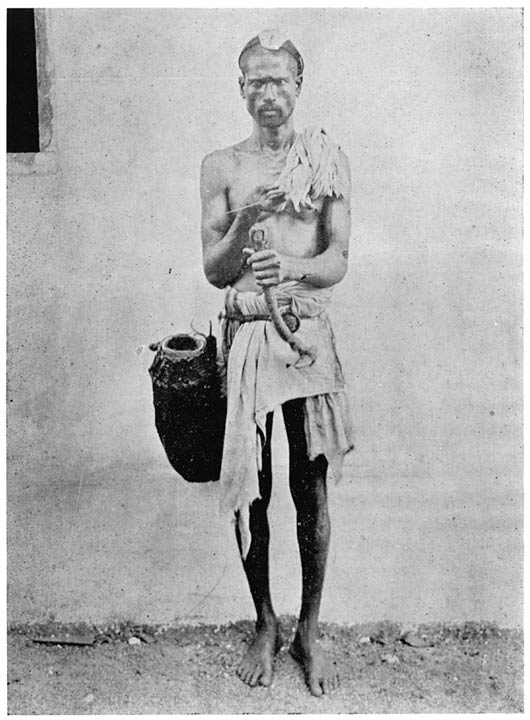
Billava Toddy-Tapper.
The Billavas, like the Bants, have a number of exogamous septs (balis) running in the female line. There is a popular belief that these are sub-divisions of the twenty balis which ought to exist according to the Aliya Santāna system (inheritance in the female line).
The caste has a headman called Gurikāra, whose office is hereditary, and passes to the aliya (sister’s son). Affairs which affect the community as a whole are discussed at a meeting held at the bhūtasthāna or garidi.
At the betrothal ceremony, the bride-price (sirdachi), varying from ten to twenty rupees, is fixed. A few days before the wedding, the maternal uncle of the bride, or the Gurikāra, ties a jewel on her neck, and a pandal (booth) is erected, and decorated by the caste barber (parēl maddiyali) with cloths of different colours. If the bridegroom is an adult, the bride has to undergo a purificatory ceremony a day or two before the marriage (dhāre) day. A few women, usually near relations of the girl, go to a tank (pond) or well near a Bhūtasthāna or garidi, and bring water thence in earthenware pots. The water is poured over the head of the girl, and she bathes. On the wedding day, the bride and bridegroom are seated on two planks placed on the dais. The barber arranges the various articles, such as lights, rice, flowers, betel leaves and areca nuts, and a vessel filled with water, which are required for the ceremonial. He joins the hands of the contracting couple, and their parents, or the headman, place the nose-screw of the bridesmaid on their hands, and pour the dhāre water over them. This is the binding part of the ceremony, which is called kai (hand) dhāre. Widow remarriage is called bidu dhāre, and the pouring of water is omitted. The bride and bridegroom stand facing each other, and a cloth is stretched between them. The headman unites their hands beneath the screen.
If a man has intercourse with a woman, and she becomes pregnant, he has to marry her according to the bidu dhāre rite. Before the marriage ceremony is performed, he has to grasp a plantain tree with his right hand, and the tree is then cut down.
At the first menstrual period, a girl is under pollution for ten or twelve days. On the first day, she is seated within a square (muggu), and five or seven cocoanuts are tied together so as to form a seat. A new earthenware pot is placed at each corner of the square. Four girls from the Gurikāra’s house sit at the corners close to the pots. Betel leaves, areca nuts, and turmeric paste are distributed among the assembled females, and the girls pour water from the pots over the head of the girl. Again, on the eleventh or the thirteenth day, the girl sits within the square, and water is poured over her as before. She then bathes.
The dead are usually cremated, though, in some cases, burial is resorted to. The corpse is washed and laid on a plantain leaf, and a new cloth is thrown over it. Some paddy (unhusked rice) is heaped up near the head and feet, and cocoanut cups containing lighted wicks are placed thereon. All the relations and friends assembled at the house dip leafy twigs of the tulsi (Ocimum sanctum) in water, and allow it to drop into the mouth of the corpse. The body is carried on a plank to the burning-ground. The collection of wood for the pyre, or the digging of the grave, is the duty of Holeyas. The wood of Strychnos Nux-vomica should never be used for the pyre. This is lighted by placing fire at the two ends thereof. When the flames meet in the middle, the plantain leaf, paddy, etc., which have been brought from the house, are thrown into them. On the fifth day, the ashes are collected, and buried on the spot. If the body has been buried, a straw figure is made, and burnt over the grave, and the ashes are buried there. A small conical mound, called dhūpe, is made there, and a tulsi plant stuck in it. By the side of the plant a tender cocoanut with its eyes opened, tobacco leaf, betel leaves and areca nuts are placed. On the thirteenth day, the final death ceremonies, or bojja, are performed. On the evening of the previous day, four poles, for the construction of the upparige or gudikattu (car), are planted round the dhūpe. At the house, on or near the spot where the deceased breathed his last, a small bamboo car, in three tiers, is constructed, and decorated with coloured cloths. This car is called Nīrneralu. A lamp is suspended from the car, and a cot placed on the ground beneath it, and the jewels and clothes of the dead person are laid thereon. On the following morning, the upparige is constructed, with the assistance of the caste barber. A small vessel, filled with water, is placed within the Nīrneralu. The sons-in-law of the deceased receive a present of new cloths, and, after bathing, they approach the Nīrneralu. The chief mourner takes the vessel from within it, and pours the water at the foot of a cocoanut tree. The chief Gurikāra pours some water into the empty vessel, and the chief mourner places it within the Nīrneralu. Then seven women measure out some rice three times, and pour the rice into a tray held by three women. The rice is taken to a well, and washed, and then brought back to the car. Jaggery (crude sugar) and cocoanut scrapings are mixed with the rice, which is placed in a cup by seven women. The cup is deposited within the car on the cot. The wife or husband of the deceased throws a small quantity of rice into the cup. She turns the cup, and a ladle placed by its side, upside down, and covers them with a plantain leaf. The various articles are collected, and tied up in a bundle, which is placed in a palanquin, and carried in procession, by two men to the upparige, which has been constructed over the dhūpe. Nalkes and Paravas (devil-dancers), dressed up as bhūtas, may follow the procession. Those present go thrice round the upparige, and the chief mourner unties the bundle, and place its contents on the car. The near relations put rice, and sometimes vegetables, pumpkins, and plantains, on the plantain leaf. All present then leave the spot, and the barber removes the cloths from the car, and pulls it down. Sometimes, if the dead person has been an important member of the community, a small car is constructed, and taken in procession round the upparige. On the fourteenth day, food is offered to crows, and the death ceremonies are at an end.
If a death occurs on an inauspicious day, a ceremony called Kāle deppuni (driving away the ghost) is performed. Ashes are spread on the floor of the house, and the door is closed. After some time, or on the following day, the roof of the house is sprinkled with turmeric water, and beaten with twigs of Zizyphus Œnoplia. The door is then opened, and the ashes are examined, to see if the marks of the cloven feet of the ghost are left thereon. If the marks are clear, it is a sign that the ghost has departed; otherwise a magician is called in to drive it out. A correspondent naively remarks that, when he has examined the marks, they were those of the family cat.
In some cases, girls who have died unmarried are supposed to haunt the house, and bring trouble thereto, and they must be propitiated by marriage. The girl’s relations go in search of a dead boy, and take from the house where he is a quarter of an anna, which is tied up between two spoons. The spoons are tied to the roof of the girl’s house. This represents the betrothal ceremony. A day is fixed for the marriage, and, on the appointed day, two figures, representing the bride and bridegroom, are drawn on the floor, with the hands lying one on the other. A quarter-anna, black beads, bangles, and a nose-screw, are placed on the hands, and water is poured on them. This is symbolical of the dhāre ceremony, and completes the marriage.
Bilva (jackal).—An exogamous sept of Kondra.
Bindhollu (brass water-pot).—An exogamous sept of Jōgi.
Binu (roll of woollen thread).—An exogamous sept of Kuruba.
At times of census, Bissoyi has been returned as a title of Doluva, Kālingi, Kurumo, and Sondi.
Biswālo.—A title of various Oriya castes.
Bochchu (hairs).—An exogamous sept of Odde.
Bōda.—Recorded, in the Madras Census Report, 1901, as a small cultivating class in Ganjam. Bōda is the name of a sub-division of the Gadabas, who use the fibre of boda luvāda (Ficus glomerata) in the manufacture of their female garments.
Bōda Dāsari (bald-headed mendicant).—An exogamous sept of Jōgi.
Boddu (navel).—An exogamous sept, or sub-division of Idigas and Asilis. It is recorded in the Gazetteer of the Bellary district, that “in the middle of the threshold of nearly all the gateways of the ruined fortifications round the Bellary villages will be noticed a roughly cylindrical or conical stone, something like a lingam. This is the Boddu-rāyi, literally the navel stone, and so the middle stone. Once a year, in May, just before the sowing season begins, a ceremony takes place in connection with it.” (See Bāriki.)
Bodo (big).—A sub-division of Bottada, Māli, Omanaito, Pentia, and other castes. Bodo Nāyak is a title among the Gadabas, and Bodo Odiya occurs as a sub-division of Sondi.
Bōgam.—See Dēva-dasi and Sāni.
Bōgarlu.—Occurs as the name of a class of agricultural labourers in the Vizagapatam Agency, who are probably workers in metal who have taken to agriculture.
Boggula (charcoal).—An exogamous sept of Bōya and Dēvānga.
Boidyo.—Recorded under the name Boyidyo, in the Madras Census Report, 1901, as “literally a physician: a sub-caste of Pandito.” There is said to be no difference between Panditos and Boidyos. In Ganjam they are known by the former, elsewhere by the latter name.
Boipāri.—A synonym of Lambādi. (See Bēpāri.)
Boishnobo.—The Boishnobos have been defined as a class of Oriya religious mendicants and priests to Sūdras. The name means worshippers of Bishnu or Vishnu. Most of them are followers of Chaitanya, the great Bengāli reformer.
Boksha.—Boksha or Boksham (treasury) is the name of a sub-division of Gollas, indicating their employment as treasury servants in guarding and carrying treasure. In some places, those who are employed in packing and lifting bags of money in district treasuries are still called Gollas, though they may belong to some other caste. In the Census Report, 1901, Bokkisha Vadugar (treasury northerner) was returned as a Tamil synonym for Golla.
Bolāsi.—The Bolāsis are a caste of Oriya cultivators, who are largely found in the Gumsūr tāluk of Ganjam. Many of them serve as paiks or peons. The original name of the caste is said to have been Thadia, which has been changed in favour of Bolāsi (Bayalisi, forty-two) in reference to the caste being one of the recognized forty-two Oriya Sūdra castes. It is also suggested that the name is derived from bola (anklets), as the women wear heavy brass anklets.
Their ceremonial rites connected with marriage, death, etc., are similar to those of the Doluvas, Gaudos, Badhōyis, and other castes. Marriage is infant, and, if a girl does not secure a husband before she reaches maturity, she goes through a form of marriage with an arrow or a grinding stone. The Bolāsis are Vaishnavites, and observe the Paramartho or Chaitanya form thereof. The caste titles are Podhāno, Nāyako, Daso, Mahanti, Pātro, Sāhu, Jenna, and Konhoro.
Gudiyas who are engaged in agriculture are sometimes known as Bolāsi Gudiyas.
Bolodia.—The name of a section of Tellis, who use pack-bullocks (bolodo, an ox) for carrying grain about the country. Some Gaudos, at times of census, have also returned Bolodia as their sub-division.
Bombadai (a fish).—A gōtra of Mēdara. The equivalent Bomidi occurs as an exogamous sept of Māla. Members of the Vamma gōtra of the Janappans abstain from eating this fish, because, when some of their ancestors went to fetch water in a marriage pot, they found a number of this fish in the water collected in the pot.
Bommali.—A sub-division of the Koronos of Ganjam.
Bonda.—A sub-division of Poroja.
Bondia.—A small class, inhabiting Ganjam. The name is said to be derived from bondono, meaning praise, as the Bondias are those who praise and flatter Rājas.
I am informed that one section of the Bondilis is named Tōli, in reference to their being workers in leather. There is, at Venkatagiri, a street called Tōli mitta, or Tōli quarters, and, in former days, the inhabitants thereof were not allowed to enter the temples.
In the Census Report, 1901, Guvālo, or traders from Sambalpūr, is returned as a sub-caste of Bondili.
Bonka.—Recorded, in the Vizagapatam Manual, as cultivators in the Jeypore hills, and, in the Madras Census Report, 1901, as a small Oriya caste of hill cultivators, which has three sub-divisions, Bonka, Pata Bonka, and Goru Bonka.
Bonthuk.—The Bonthuks or Bonthuk Savaras are scattered about the Kistna and Guntūr districts, and lead a nomad life, carrying their small dwelling-huts with them as they shift from place to place. They are called Bonthuk Savaras to distinguish them from the Pothra (stone) Savaras, who dwell further north. By Telugu people they are called Chenchu or Bontha Chenchu, though they have no connection with the Chenchus who inhabit the hills in Kurnool, and other parts of the Telugu country. The Bonthuks, however, like the Chenchus, claim Ahobila Narasimha as their tribal deity. The Bonthuks speak the Oriya language, and they have a Mongoloid type of features, such as are possessed by the Savaras of Ganjam and Vizagapatam. Their house-names, or intipēralu, however are Telugu. These constitute exogamous septs, and seem to be as follows:—Pasupuretti, Simhādri (the god at Simhachalam near Vizagapatam), Konēti, Dāsapatri, Gēdala (buffaloes), Kudumala (cakes), Ākula (leaves), Sunkara, and Tōta (garden). At marriages, individuals of the Pasupuretti sept officiate as priests, and members of the Konēti sept as drummers and musicians. Men belonging to the Gēdalu sept are considered as equivalent to shepherds.
The Bonthuks have a very interesting way of naming their children. If a child is born when an official or person of some distinction happens to be near their encampment, it is named after him. Thus such names as Collector, Tahsildar, Kolnol (Colonel), Governor, Innes, Superintendent, and Acharlu (after one Sukracharlu) are met with. Sometimes children are named after a town or village, either because they were born there, or in the performance of a vow to some place of pilgrimage. In this way, such names as Hyderabad, Channapatam (Madras), Bandar (Masulipatam), Nellore, and Tirupati arise. A boy was named Tuyya (parrot), because a parrot was brought into the settlement at the time of his birth. Another child was called Beni because, at its birth, a bamboo flute (beni) was played.
Every settlement is said to have a headman, called Bichādi, who, in consultation with several elders of the tribe, settles disputes and various affairs affecting the community. If an individual has been fined, and does not accept the punishment, he may appeal to another Bichādi, who may enhance the fine. Sometimes those who do not agree to abide by the decision of the Bichādi have to undergo a trial by ordeal, by taking out an areca nut from a pot of boiling cowdung water. The dimensions of the pot, in height and breadth, should not exceed the span of the hand, and the height of the cowdung water in the pot should be that of the middle finger from the base to the tip. If, in removing the nut from the pot, the hand is injured, the guilt of the individual is proved. Before the trial by ordeal, a sum of ten rupees is deposited by both complainant and accused with the Bichādi, and the person under trial may not live in his dwelling-hut. He lives in a grove or in the forest, watched by two members of the Pasupuretti sept.
The Bonthuks are engaged in collecting bamboos, and selling them after straightening them by heating them in the fire. Before the bamboos are placed in carts, for conveyance to the settlement, a goat and fowls are sacrificed to Satyamma, Dodlamma, Muthyalamma, and Pothurāju, who are represented by stones.
Girls are married before puberty, and, if a girl happens to be mated only after she has reached maturity, there is no marriage ceremonial. The marriage rites last over five days, on the first of which a brass vessel, with a thread tied round its neck, and containing turmeric water and the oyila tokka or tonko (bride’s money), is carried in procession to the bride’s hut on the head of a married girl belonging to a sept other than those of the contracting couple. She has on her head a hood decorated with little bells, and the vessel is supported on a cloth pad. When the hut is reached, the bride’s money is handed over to the Bichādi, and the turmeric water is poured on the ground. The bride’s money is divided between her parents and maternal uncle, the Bichādi, and the caste men. A pig is purchased, and carried by two men on a pole to the scene of the marriage. The caste people, and the married girl carrying a brass vessel, go round the animal, to the accompaniment of music. The girl, as she goes round, pours water from the vessel on the ground. A thread is tied round the neck of the pig, which is taken to the bridegroom’s hut, and cut up into two portions, for the parties of the bridegroom and bride, of which the former is cooked and eaten on the same day. At the homes of the bride and bridegroom, a pandal (booth) and dais are erected. The materials for the former are brought by seven women, and for the latter by nine men. The pandal is usually decorated with mango and Eugenia Arnoltiana leaves. After supper, some relations of the contracting couple go to an open space, where the Bichādi, who has by him two pots and two bashingams (chaplets) of arka (Calotropis gigantea) flowers, is seated with a few men. The fathers of the bride and bridegroom ask the Bichādi to give them the bashingams, and this he does after receiving an assurance that the wedding will not be attended by quarrelling. The bride and bridegroom take their seats on the dais at the home of the latter, and the officiating priest ties the bashingams on their foreheads. Nine men and seven women stand near the dais, and a thread is passed round them seven times. This thread is cut up by the priest, and used for the kankanams (wrist threads) of the bride and bridegroom. These are removed, at the close of the marriage festivities, on the fifth day.
When a girl attains maturity, she is under pollution for nine days, at the conclusion of which the Bichādi receives a small present of money from her parents. Her husband, and his agnates (people of his sept) also have to observe pollution, and, on the ninth day, the cooking pots which they have used are thrown away, and they proceed to the Bichādi, to whom they make a present of money, as they have probably broken the tribal rule that smoking is forbidden when under pollution. On the ninth day, the girl and her husband throw water over each other, and the marriage is consummated.
The dead are usually buried, lying on the left side. On the second day, food is offered to crows and Brāhmani kites. On the eleventh day, a mat is spread on the floor of the hut, and covered with a clean sheet, on which balls of food are placed. The dead person is invoked by name, as the various people deposit the food offering. The food is finally put into a winnowing basket, and taken to the bank of a tank (pond). A small hut is made there, and the food is placed therein on two leaves, one of which represents the Yama Dutas (servants of the god of death), the other the deceased.
Boori (cake).—An exogamous sept of Māla.
Bosantiya.—The Bosantiyas are summed up, in the Madras Census Report, 1901, as “Oriya cultivators found in the northern tāluks of Ganjam. They are said by some to have been originally dyers.” I am informed that the caste name has reference to the fact that the occupation thereof was the collection of the fruits of Mallotus philippinensis, and trade in the dye (bosonto gundi) obtained therefrom. The dye, commonly known as kamēla, or kamala, is the powdery substance obtained as a glandular pubescence from the exterior of the fruits. The following note on the dye was published in the Indian Forester, 1892. “Among the many rich natural products of Ganjam, probably the most esteemed in commerce is the red kamēla dye, the valuable product of the Mallotus philippinensis. This tree, with its lovely scarlet berries and vivid emerald green foliage, is a marked feature of forest scenery in Ganjam. The berries are coated with a beautiful red powder, which constitutes the dye. This powder is collected by being brushed off into baskets made for the purpose, but the method of collection is reckless and wasteful in the extreme, the trees being often felled in order to reach the berries more easily. The industry is a monopoly of the Hill Khonds, who, however, turn it to little advantage. They are ignorant of the great commercial value of the dye, and part with the powder to the low-country dealers settled among them for a few measures of rice or a yard or two of cloth. The industry is capable of great development, and a large fortune awaits the firm or individual with sufficient enterprise to enter into rivalry with the low-country native dealers settled among the Khonds, who at present enjoy a monopoly of the trade. It is notorious that these men are accumulating vast profits in respect of this dye. The tree is cultivated largely by the Khonds in their forest villages.”
The Bosantiyas seem to have no sub-divisions, but exogamous gōtras, e.g., nāgasira (cobra) and kochimo (tortoise) exist among them. Socially they are on a par with the Bhondāris, and above Pachchilia Gaudos and Sāmantiyas. They have a headman called Bissoyi, who is assisted by a Bhollobaya, and they have further a caste messenger called Jāti Naiko. The caste titles are Bissoyi and Nāhako.
Most of the Bosantiyas are Saivites, but a few follow the Paramartho form of Vaishnavism. They also worship various Tākurānis (village deities), such as Kotāru and Chondi.
In the Vizagapatam Manual (1869), Bosuntea is described as a caste of Paiks or fighting men in the Vizagapatam district (Jeypore).
For the following note, I am indebted to Mr. C. Hayavadana Rao. There is a current tradition that the caste originally dwelt at Barthagada, and emigrated to Vizagapatam long ago. It is vaguely mentioned that Barthagada was situated towards and beyond Bastar, near which place there are still to be found people of this caste, with whom those living in the Vizagapatam Agency intermarry. The caste is divided into three endogamous divisions, viz.:—
(1) Bodo, or genuine Bottadas;
(2) Madhya, descendants of Bottada men and non-Bottada women;
(3) Sanno, descendants of Madhya men and non-Madhya women. The Bodos will not interdine with the other two sections, but males of these will eat with Bodos.
The following notes refer to the Bodo section, in which various exogamous septs, or bamsa, exist, of which the following are examples:—
Kochchimo, tortoise.
Bhāg, tiger.
Gōyi, lizard (Varanus).
Nāg, cobra.
Kukkuro, dog.
Mākado, monkey.
Cheli, goat.
Girls are married either before or after puberty. A man can claim his paternal aunt’s daughter in marriage. When a marriage is under contemplation, the prospective bridegroom’s parents take maddho (liquor) and chada (beaten rice) to the girl’s house, where they are accepted or refused, according as her parents agree to, or disapprove of the match. After a stated period, further presents of liquor, rice, black gram, dhāl, salt, chillies, and jaggery (crude sugar) are brought, and betel leaves and areca nuts given in exchange. Two days later the girl’s parents pay a return visit to those of the young man. After another interval, the marriage takes place. Nine days before its celebration, paddy (unhusked rice) and Rs. 2 are taken to the bride’s house as jholla tonka, and a feast is held. At the bridegroom’s house, a pandal, made of nine sorghi or sāl (Shorca robusta) posts, is erected, with a pot of turmeric water tied to the central post. The bride is conducted thither. At the marriage rites the Dēsāri officiates. The ends of the cloths of the contracting couple are tied together, and their little fingers are linked together, while they go, with pieces of turmeric and rice in their hands, seven times round the pandal. The sacred fire, or hōmam, is raised, and into it seven or nine different kinds of wood, ghī (clarified butter), milk, rice and jaggery are thrown. Turmeric-rice dots are put on the foreheads of the bride and bridegroom by the Dēsāri, parents, and relations. They are anointed with castor-oil, and bathed with the water contained in the pot tied to the post. New cloths are presented to them, and a caste feast is held.
Widow remarriage is permitted, and a younger brother often marries the widow of his elder brother. If, however, she marries any one else, her new husband has to pay rānd tonka, consisting of liquor, a sheep or goat, and rice, as a fine to the caste, or he may compound for payment of five rupees. Divorce is permitted, and, if a man divorces his wife, he usually gives her some paddy, a new cloth, and a rupee. If the woman divorces herself from her husband, and contracts an alliance with another man, the latter has to pay a fine of twenty rupees to the first husband, a portion of which is spent on a feast, at which the two husbands and the woman are present.
The dead are burned, and death pollution is observed for ten days, during which no agricultural work is done, and no food is cooked in the bamsa of the deceased, which is fed by some related bamsa. On the day following cremation, a new pot with water, and some sand are carried to the spot where the corpse was burnt. A bed of sand is made, in which a banyan (Ficus bengalensis) or pīpal (Ficus religiosa) is planted. A hole is made in the pot, and the plant watered. On the tenth day, on which a bath is taken, some fried rice and a new pot are carried to the burning-ground, and left there.
The Bottadas have the reputation of being the best cultivators in the Jeypore Agency, and they take a high position in social rank. Many of them wear the sacred thread, at the time of marriage and subsequently, and it is said that the right to wear it was acquired by purchase from former Rājas of Jeypore.
Bottu Kattōru (those who tie the bottu).—A sub-division of Kāppiliyans, who are Canarese cultivators settled in the Tamil district of Madura. The bottu (marriage badge) is the equivalent of the Tamil tāli.
Bōvi.—The name of the palanquin-bearing section of the Mogērs of South Canara. Some Besthas from Mysore, who have settled in this district, are also called Bōvi, which is a form of Bōyi (bearer).
Bōyan.—A title of Oddē.
Bōyi (see Bestha).—It is also the title of one of the chief men among the Savaras.
Brāhman.—The Brāhmans of Southern India are divided into a number of sections, differing in language, manners and customs. As regards their origin, the current belief is that they sprang from the mouth of Brahma. In support thereof, the following verse from the Purusha Sūktha (hymn of the primæval male) of the Rig Vēda is quoted:—From the face of Prajāpathi (Viratpurusha) came the Brāhmans; from the arms arose the Kshatriyas; from the thighs sprang the Vaisyas; and from the feet the Sūdras. Mention of the fourfold division of the Hindu castes is also made in other Vēdas, and in Ithihāsas and Purānas.
The Brāhmans fall into three groups, following the three Vēdas or Sākas, Rig, Yajus, and Samam. This threefold division is, however, recognised only for ceremonial purposes. For marriage and social purposes, the divisions based on language and locality are practically more operative. In the matter of the more important religious rites, the Brāhmans of Southern India, as elsewhere, closely follow their own Vēdas. Every Brāhman belongs to one or other of the numerous gōtras mentioned in Pravara and Gōtra Kandams. All the religious rites are performed according to the Grihya Sūtras (ritual books) pertaining to their Sāka or Vēda. Of these, there are eight kinds now in vogue, viz.:—
1. Asvalayana Sūtra of the Rig Vēda.
2. Āpasthamba Sūtras of the black Yajus.

3. Bhāradwaja
4. Bhodayana
5. Sathyāshāda
6. Vaikkānasa
7. Kāthyayana Sūtra of the white Yajus.
8. Drahyayana Sūtra of Sāma Vēda.
All Brāhmans claim descent from one or more of the following seven Rishis:—Atri, Bhrigu, Kutsa, Vashista, Gautama, Kasyapa, Angiras. According to some, the Rishis are Agasthya, Angiras, Atri, Bhrigu, Kasyapa, Vashista, and Gautama. Under these Rishis are included eighteen ganams, and under each ganam there are a number of gōtras, amounting in all to about 230. Every Brāhman is expected to salute his superiors by repeating the Abhivādhanam (salutation) which contains his lineage. As an example, the following may be given:—“I, Krishna by name, of Srivathsa gōtra, with the pravara (lineage) of the five Rishis, Bhargava, Chyāvana, Āpnuvana, Aruva, and Jamadagni, following the Āpasthamba sūtra of the Yajus Sāka, am now saluting you.” Daily, at the close of the Sandhya prayers, this Abhivādhanam formula should be repeated by every Brāhman.
Taking the Brāhmans as a whole, it is customary to group them in two main divisions, the Pancha Drāvidas and Pancha Gaudas. The Pancha Drāvidas are pure vegetarians, whereas the Pancha Gaudas need not abstain from meat and fish, though some, who live amidst the Pancha Drāvidas, do so. Other differences will be noted in connection with Oriya Brāhmans, who belong to the Pancha Gauda section. In South India, all Brāhmans, except those who speak the Oriya and Konkani languages, are Pancha Drāvidas, who are divided into five sections, viz.:—
1. Tamil, or Drāvida proper.
2. Telugu or Āndhra.
3. Canarese, or Carnātaka.
4. Marathi or Dēsastha.
5. Guzarāti.
The Tulu-speaking Shivalli Brāhmans are included among the Carnātakas; the Pattar and Nambūtiri Brāhmans (see Nambūtiri) among the Drāvidas proper.
From a religious point of view, the Brāhmans are either Saivites or Vaishnavites. The Saivites are either Saivites proper, or Smarthas. The Smarthas believe that the soul of man is only a portion of the infinite spirit (ātman), and that it is capable of becoming absorbed into the ātman. They recognise the Trimurtis, Brahma, Vishnu, and Siva as separate gods, but only as equal manifestations of the supreme spirit, and that, in the end, these are to be absorbed into the infinite spirit, and so disappear. Saivas, on the other hand, do not recognise the Trimurtis, and believe only in one god, Siva, who is self-existent, and not liable to lose his personality. Of Vaishnavites there are three kinds, viz., those who are the followers of Chaitanya, Rāmānuja, and Mādhvāchārya. Like the Smarthas, the Vaishnavites recognise Brahma, Vishnu, and Siva, but Vishnu is supposed to be the chief god, to whom the others are subordinate.
The Oriya Brāhmans, who follow the creed of Chaitanya, are called Paramarthos, and are confined to the Ganjam district. There is no objection to intermarriage between Smartha and Paramartho Oriya Brāhmans.
Sri Vaishnavas (who put on the nāmam as a sectarian mark) and Mādhvas are exclusive as regards intermarriage, but the Mādhvas have no objection to taking meals with, and at the houses of Smarthas, whereas Sri Vaishnavas object to doing so.
According to the Sūtras, a Brāhman has to go through the following samskāras (rites):—
1. Garbhādāna.
2. Pumsavanam.
3. Sīmantam.
4. Jātakarmam.
5. Nāmakaranam.
6. Annaprāsanam
7. Chaulam.
8. Upanayanam
9. Vivāham.
These rites are supposed to purify the body and spirit from the taint transmitted through the womb of the mother, but all of them are not at the present day performed at the proper time, and in regular order.
The Garbhādhāna, or impregnation ceremony, should, according to the Grihya Sūtras, be performed on the fourth day of the marriage ceremonies. But, as the bride is a young girl, it is omitted, or Vēdic texts are repeated. The Garbhādhāna ceremony is performed, after the girl has attained puberty. At the time of consummation or Ritu Sānthi, the following verse is repeated:—“Let all pervading Vishnu prepare her womb; let the Creator shape its forms; let Prajāpathi be the impregnator; let the Creator give the embryo.”
Pumsavanam and Sīmantam are two ceremonies, which are performed together during the seventh or ninth month of the first pregnancy, though, according to the Grihya Sūtras, the former should be performed in the third month. At the Pumsavanam, or male producing ceremony, the pregnant woman fasts, and her husband squeezes into her right nostril a little juice from the fruit and twig of the ālam tree (Ficus bengalensis), saying “Thou art a male child.” The twig selected should be one pointing, east or north; with two fruits looking like testicles. The twig is placed on a grinding-stone, and a girl, who has not attained puberty, is asked to pound it. The pulp is wrapped in a new silk cloth, and squeezed to express the juice. On the conclusion of the Pumsavanam, the Sīmantam, or parting the pregnant woman’s hair, is gone through. After oblations in the sacred fire (hōmam), the woman’s husband takes a porcupine quill, to which three blades of dharbha grass, and a twig with fruits of the aththi tree (Ficus glomerata) are attached, and passes it over the woman’s head from before backwards, parting the hair.
The Jātakarmam, Nāmakaranam, Annaprāsanam, and Chaulam rites are ordinarily celebrated, one after the other, on the Upanayanam day. Jātakarmam consists in smearing some ghī (clarified butter) and honey on the tongue of the baby, and repeating the following verses from the Rig Vēda:—“Oh! long lived one, mayst thou live a hundred years in this world, protected by the gods. Become firm as a rock, firm as an axe, pure as gold. Thou art the Vēda called a son; live thou a hundred years. May Indra bestow on thee his best treasures. May Sāvitri, may Sarasvati, may the Asvins grant thee wisdom.”
At the Nāmakaranam, or naming ceremony, the parents of the child pronounce its name close to its ear, and repeat the Vēdic prayer to Indra and Agni “May Indra give you lustre, and Indra semen, wisdom, and children.”
The Annaprāsanam, or food-giving ceremony, should be performed during the sixth month after birth. A little solid food is put into the child’s mouth, and the following Vēdic verses are repeated:—“Agni who lives on plants, Sōma who lives on sōma juice, Brāhmans who live on the Vēdas, and Dēvatas who live on amartam (ambrosia), may they bless you. As the earth gives food to plants and water, so I give you this food. May these waters and plants give you prosperity and health.”
At the Chaulam, or tonsure ceremony, the child is seated in his mother’s lap. The father, taking a few blades of dharbha grass in his hand, sprinkles water over the child’s head. Seven times he inserts blades of dharbha in the hair of the head (three blades each time), saying “Oh! divine grass, protect him.” He then cuts off the tips of the blades, and throws them away. The father is expected, according to the Grihya Sūtras, to shave or cut the child’s hair. At the present day, however, the barber is called in, and shaves the head, leaving one lock or more according to local custom.
The Upanayana, or leading a boy to his guru or spiritual teacher, is essentially a ceremony of initiation. From an orthodox point of view, this ceremony should be performed before the age of eight years, but in practice it is deferred even up to the age of seventeen. It usually commences with the arrangement of seed-pans containing nine kinds of grain, and tying a thread or pratisaram on the boy’s wrist. After this, the Abyudayam, or invocation of ancestors, is gone through. The boy sits in front of the sacred fire, and his father, or some other person, sits by his side, to help him in the ceremonial and act the part of guru. He places over the boy’s head blades of dharbha grass so that the tips are towards the east, south, west, and north. The tips are cut off, and the following Vēdic verses are repeated:—“Please permit me to shave the head of this boy with the knife used by the sun for shaving Sōma. He is to be shaved, because it will bring him long life and old age. May the boy become great, and not die a premature death. May he outshine all in glory.” The boy is then shaved by a barber, and more Vēdic verses are repeated, which run as follows:—“You are shaving with a sharp razor, so that this shaving may enable him to live long. Brihaspathi, Sūrya, and Agni shaved the hair of the head of Varuna, and placed the hairs in the middle regions of the sky, earth, and in swarga. I shall place the hairs removed by me at the foot of the audambara tree (Ficus glomerata), or in the clumps of dharbha grass.” The boy then bathes, and comes near the sacred fire. After ghī has been poured thereon, a bundle of palāsa (Butea frondosa) sticks is given to him, and he puts it on the fire after repeating certain Vēdic riks. A grinding-stone is placed on one side of the fire, and the boy treads on it, while the following verse is repeated:—“Tread on this stone, and may you be as firm as it is. May you subdue thy enemies.” A new cloth is given to him, which he puts on. The following verses are then repeated:—“Oh! cloth, Revathi and others have spun, woven, spread out, and put skirts on both sides of you. May these goddesses clothe the boy with long life. Blessed with life, put on this cloth. Dress the boy with this cloth. By wearing it, let him attain a hundred years of age. May his life be extended. Such a garment as this was given to Sōma by Brihaspathi to wear. Mayst thou reach old age. Put on this cloth. Be a protector to all people. May you live a hundred years with full vigour. May you have plenty of wealth.” After the boy has put on the cloth, the following is repeated:—“You have put on this cloth for the sake of blessing. You have become the protector of your friends. Live a hundred years. A noble man, blessed with life, mayst thou obtain wealth.” A girdle (minji) spun from grass is wound thrice round the boy’s body, and tied with a knot opposite the navel, or to the left of it. The following verses are repeated:—“This blessed girdle, the friend of the gods, has come to us to remove our sins, to purify and protect us, bring strength to us by the power of exhalation and inhalation. Protect, Oh! girdle, our wealth and meditation. Destroy our enemies, and guard us on all the four sides.” A small piece of deer-skin is next tied on to the sacred thread, which has been put on the boy soon after the shaving rite. The following verses are repeated:—“Oh! skin which is full of lustre because Mitra sees you, full of glory and one that is not fit for wicked people, I am now putting you on. May Aditi tuck up thy garment. Thou mayst read Vēdas, and grow wise. Thou mayst not forget what you have read. Mayst thou become holy and glorious.” The boy seats himself next to the guru, and close to the sacred fire, and repeats the following:—“I have come near the spiritual teacher, my Āchārya. May the teacher and myself become prosperous. May I also complete my Vēdic studies properly, and let me be blessed with a married life after the study.” The guru sprinkles water over the boy three times, and, taking hold of his hand, says:—“Agni, Sōman, Savitha, Sarasvati, Pūsha, Aryaman, Amsuhu, Bagadēvata, and Mitra have seized thy hand. They have taken you over to them, and you have become friends.” Then he hands over the boy to the gods by repeating:—“We give you to Agni, Sōman, Savitha, Sarasvati, Mrityu, Yaman, Gadhan, Andhakan, Abhaya, Ōshadhi, Prithvi, and Vaisvānara. With the permission of Sūrya, I am allowing you to approach me. Oh! boy, may you have children full of lustre, and capable of becoming heroes.” The boy then repeats the following:—“I am come to be a student. You that have obtained permission from the Sūrya, please take me.” The teacher asks, “Who are you? What is your name?” The boy gives out his name, and the teacher enquires of him what kind of Brahmachari he is. The boy replies that he is a Brahmachari for Ātman, and repeats the following:—“Oh! sun, the lord of all ways, through your grace I am about to begin my studies, which will do good to me.” The teacher and the boy take their seats on dharbha grass, and say:—“Oh! dharbha, a giver of royal power, a teacher’s seat, may I not withdraw from thee.” The boy then pours some ghī on to the sacred fire. A cloth is thrown over both the teacher and the boy, and the latter asks the former to recite the Sāvitri. The following Gāyatri is repeated into his ear:—“Let us meditate on that excellent glory of the divine vivifier. May he illumine our understandings.” The boy touches his own upper lip with his right hand, and says:—“Oh! Prāna, I have become illumined, having heard the Sāvitri. Protect and guard this wealth that has entered me, the Gāyatri or Sāvitri.” He then takes the palāsa staff, and the teacher says:—“Up with life. Oh! sun, this is thy son. I give him in charge to thee.” The boy then worships the sun thus:—“That bright eye created by the gods, which rises in the east, may we see it a hundred autumns; may we live a hundred autumns; may we rejoice a hundred autumns; may we live a hundred autumns; may we rejoice a hundred autumns; may we be glad a hundred autumns; may we prosper a hundred autumns; may we speak a hundred autumns; may we live undecaying a hundred autumns; and may we long see the sun.” The ceremonial is brought to a close on the first day by the boy begging rice from his mother and other female relations. A basket, filled with rice, is placed in a pandal (booth), and the boy stands near it, repeating “Please give me alms.” Each woman pours some rice into a tray which he carries, and presents him with some money and betel leaves. The rice is placed in the basket. On the second and third days, the boy puts palāsa sticks into the sacred fire, and pours ghī thereon. On the fourth day, the new cloth is given to the teacher.
The grass girdle and deer-skin worn by a youth at the Upanayanam ceremony are removed on the fifth day, or, among the orthodox, kept on until the first Upākarmam day. They, and the palāsa stick, should be retained by the Brahmachāri till the close of his studentship. Nambūtiri Brāhman lads of eight or nine years old, who have gone through the Upanayanam ceremony, always carry with them the palāsa stick, and wear the grass girdle, and, in addition to the sacred thread, a thin strip of deer-skin in length equal to the thread. Round the waist he wears a narrow strip of cloth (kaupīnam) passed between the legs. He may cover his breast and abdomen with a cloth thrown over his body. He is thus clad until his marriage, or at least until he has concluded the study of the Vēdas.
The marriage rites in vogue at the present day resemble those of Vēdic times in all essential particulars. All sections of Brāhmans closely follow the Grihya Sūtras relating to their sākha. The marriage ceremonies commence with the Nischyathartham or betrothal ceremony. The bridegroom being seated on a plank amidst a number of Brāhmans, Vēdic verses are repeated, and, after the bestowal of blessings, the bride’s father proclaims that he intends giving his daughter in marriage to the bridegroom, and that he may come for the purpose after the completion of the Vratam ceremony. For this ceremony, the bridegroom, after being shaved, dresses up. Meanwhile, the Brāhmans who have been invited assemble. The bridegroom sits on the marriage dais, and, after repeating certain Vēdic verses, says:—“With the permission of all assembled, let me begin the Vratams Prājāpathyam, Soumyam, Āgnēyam, and Vaiswadēvam, and let me also close them.” All the Vratams should be performed long before the marriage. In practice, however, this is not done, so the bridegroom performs an expiatory ceremony, to make up for the omission. This consists in offering oblations of ghī, and giving presents of money to a few Brāhmans. The bridegroom is helped throughout the Vratam ceremonies by a spiritual teacher or guru, who is usually his father or a near relation. The guru sprinkles water over the bridegroom’s body, and tells him to go on with kāndarishi tharpanam (offerings of water, gingelly, and rice, as an oblation to Rishis). A small copper or silver vessel is placed on a leaf to the north-east of the sacred fire, and is made to represent Varuna. A new cloth is placed round the vessel. The various Vratams mentioned are gone through rapidly, and consist of offerings of ghī through fire to the various Dēvatas and Pitris. The Nāndhi Srādh, or memorial service to ancestors, is then performed. The bridegroom next dresses up as a married man, and proceeds on a mock pilgrimage to a distant place. This is called Paradēsa Pravesam (going to a foreign place), or Kāsiyatra (pilgrimage to Benares). It is a remnant of the Snāthakarma rite, whereat a Brahmachāri, or student, leaves his spiritual teacher’s house at the close of his studies, performs a ceremony of ablution, and becomes an initiated householder or Snāthaka. The bridegroom carries with him an umbrella, a fan, and a bundle containing some rice, cocoanut, and areca-nut. He usually goes eastward. His future father-in-law meets him, and brings him to the house at which the marriage is to be celebrated. As soon as he has arrived there, the bride is brought, dressed up and decorated in finery. The bridal pair are taken up on the shoulders of their maternal uncles, who dance about for a short time. Whenever they meet, the bride and bridegroom exchange garlands (mālaimāththal). The couple then sit on a swing within the pandal (booth), and songs are sung. A few married women go round them three times, carrying water, a light, fruits, and betel, in a tray. The pair are conducted into the house, and are seated on the marriage dais. The marriage, or Vivāham, is then commenced. A purōhit (priest) repeats certain Vēdic texts as a blessing, and says:—“Bless this couple of ... gōtras, the son and daughter of ..., grandchildren of ..., now about to be married.” At this stage, the gōtras of the contracting couple must be pronounced distinctly, so as to ensure that they are not among the prohibited degrees. The bridal couple must belong to different gōtras. The bridegroom next says that he is about to commence the worship of Visvaksēna if he is a Vaishnavite, or Ganapathi if he is a Saivite, for the successful termination of the marriage ceremonies. The Ankurarpana (seed-pan) ceremony is then proceeded with. Five earthenware pans are procured, and, after being purified by the sprinkling of punyāham water over them, are arranged in the form of a square. Four of the pans are placed at the four cardinal points, east, west, north, and south, and the remaining pot is set down in the centre of the square. The pan to the east represents Indra, the one to the west Varuna, the one to the south Yama, and the one to the north Sōman. While water is being sprinkled over the pans, the following synonyms for each of these gods are repeated:—
Indra—Sathakruthu, Vajranam, Sachipathi.
Yama—Vaivaswata, Pithrupathi, Dharmarāja.
Varuna—Prachethas, Apāmpathi, Swarūpinam.
Sōman—Indum, Nisākaram, Ōshadīsam.
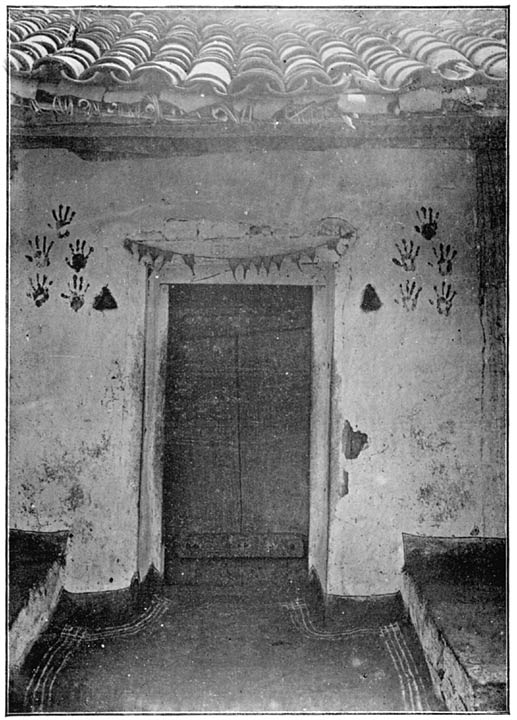
Brāhman House with Marks of Hand to Ward Off the Evil Eye.
Nine kinds of grains soaked in water are placed in the seed-pans. These grains are Dolichos Lablab (two varieties), Phaseolus Mungo (two varieties), Oryza sativa, Cicer Arietinum, Cajanus indicus, Eleusine Coracana, and Vigna Catiang. The tying of the wrist-thread (pratisaram) is next proceeded with. Two cotton threads are laid on a vessel representing Varuna. After the recitation of Vēdic verses, the bridegroom takes one of the threads, and, dipping it in turmeric paste, holds it with his left thumb, smears some of the paste on it with his right thumb and forefinger, and ties it on the left wrist of the bride. The purōhit ties the other thread on the right wrist of the bridegroom, who, facing the assembly, says “I am going to take the bride.” He then recites the following Vēdic verse:—“Go to my future father-in-law with due precautions, and mingle with the members of his family. This marriage is sure to be pleasing to Indra, because he gets oblations of food, etc., after the marriage. May your path be smooth and free from thorns. May Sūrya and Bhaga promote our dhāmpathyam (companionship).”
It will be noticed that prayers for male issue are of frequent occurrence during the marriage ceremonial. In Sanskrit works, Putra (son) is defined as one who delivers a parent from a hell called put. It is generally believed that the welfare of a parent’s soul depends on the performance of srādh (memorial services) by his son. It was laid down by Manu that a man is perfect, when he consists of three—himself, his wife, and his son. In the Rig Vēda it is stated that “when a father sees the face of a living son, he pays a debt in him, and gains immortality. The pleasure which a father has in his son exceeds all other enjoyments. His wife is a friend, his daughter an object of companion, his son shines as his light in the highest world.” The following story of a certain pious man of ascetical temperament, who determined to shirk the religious duty of taking a wife, is narrated by Monier Williams:—“Quietly skipping over the second prescribed period of life, during which he ought to have been a householder (grihastha), he entered at once upon the third period—that is to say, he became an ascetic, abjured all female society, and retired to the woods. Wandering about one day, absorbed in meditation, he was startled by an extraordinary spectacle. He saw before him a deep and apparently bottomless pit. Around its edge some unhappy men were hanging suspended by ropes of grass, at which here and there a rat was nibbling. On asking their history, he discovered to his horror that they were his own ancestors compelled to hang in this unpleasant manner, and doomed eventually to fall into the abyss, unless he went back into the world, did his duty like a man, married a suitable wife, and had a son, who would be able to release them from their critical predicament.” This legend is recorded in detail in the Mahābhārata.