Chapter XXXVI
Reading edition
HENRY VI.
Arrangements during the Minority—Condition of France—Death of Charles VI.—Bedford's Marriage—Battle of Crévant—Release of the Scottish King—Battle of Verneuil—Gloucester's Marriage and its Consequences—Rivalry of Gloucester and Beaufort—Siege of Orleans—Battle of the Herrings—Joan of Arc—The March to Orleans—Relief of the Town—March to Rheims—Coronation of Charles—The Repulse from Paris—Capture of the Maid—Her Trial and Death—Coronation of Henry—Bedford Marries again—Congress of Arras—Death of Bedford—The Tudors—Contests between Beaufort and Gloucester—Henry's Marriage—Deaths of Gloucester and Beaufort—Disasters in France—Fall and Death of Suffolk.
Henry VI., on the death of his father, was scarcely nine months old. However prosperous his father had been, and however well fortified he seemed to have left him in the care of his mother and the ability and unity of his uncles, as well as the reverence of the people for their late brilliant king, no one who had studied history, even in the smallest degree, but must have foreseen in the course of so long a minority many troubles, and probably much disaster. It would, indeed, have been a miracle if the clashing ambitions of the blood-relations, and of other great men around the infant king's throne, had not produced much trouble and civil conflict. But the prospect of his power in France was still more critical. There he was the nominal heir to a throne of which his father had not lived to obtain possession—of a kingdom not yet entirely subdued by the British arms; a kingdom naturally hostile to an English ruler; a kingdom of proud, sensitive people, who, though they had consented to the ascendency of Henry V., in order to procure some degree of repose, yet had by no means forgotten the haughty and the cruel deeds of the English in their country; above all, a kingdom in which the rightful heir to the throne was still alive—in fact, had still most devoted adherents; and who presented to their feelings the image of a young prince unjustly and unnaturally excluded from his own great patrimony by an imbecile father and a haughty conqueror.
The effect of these circumstances became first manifest in England. After the interment of Henry V., Queen Catherine retired to Windsor with her infant charge, and the Parliament proceeded to take measures for the security of the throne during the minority. The nobles during the reign of Henry V. had been held in perfect and respectful subordination by the ability and the high prestige of the king. Parliament had asserted its own, but sought not to encroach on the royal prerogative in the hands of a sovereign who showed no disposition to encroach on the popular rights. But now Parliament, and especially the House of Peers, showed unmistakable evidence of a consciousness of their augmented authority.
Henry on his death-bed had named the Duke of Bedford as regent of France, the Duke of Gloucester as regent of England, and the Earl of Warwick as guardian of his son. On the arrival of the official information of the king's death, a number of peers and prelates, chiefly members of the royal council, assembled at Westminster, and issued commissions to the judges, sheriffs, and other officers, ordering them to continue in the discharge of their respective functions; and also summoning a Parliament to meet on the 5th of November. On the day previous to the meeting of Parliament, a committee of peers offered to the Duke of Gloucester a commission empowering him, in the king's name and with the consent of the council, to open, conduct, and dissolve the Parliament. Gloucester objected to the words, "with the consent of the council." He contended that it was an infringement of his own right, the late king before his death having named him regent. But the peers insisted that what they did was made necessary by the extreme youth of the king, and Gloucester was obliged to give way.
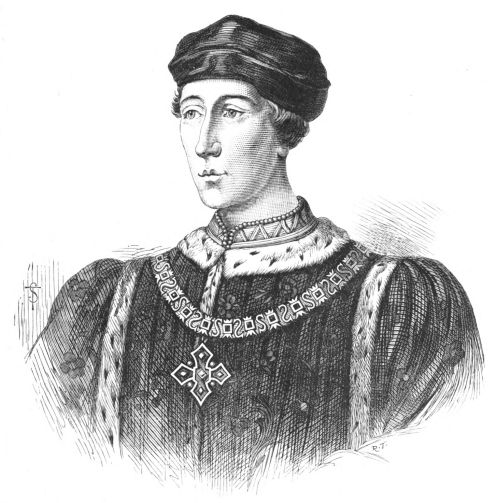
HENRY VI.
The Parliament immediately on assembling ratified all the acts by which it had been convoked, and entered upon the duty of arranging the form of government for the minority. Gloucester contended that his authority as regent did not depend on the consent of the council, but was the act of the late king himself; and that in no commissions of the late king had any such words as "acting by the consent of the council" been introduced. But Parliament declared the appointment of the late king to be of no force, inasmuch as to make it valid, it required the consent of the three estates. It was also shown that the last two centuries presented three minorities, those of Henry III., Edward III., and Richard II., and in none of them, except in the first two years of Henry III., had the powers of the executive government been committed to a guardian or a regent.
They refused altogether the title of regent, as far as England was concerned, but, leaving the Duke of Bedford regent of France, they did not even grant to Gloucester the same power under another name in this country. They gave the chief authority to the Duke of Bedford as the elder brother, and nominated him, not regent—which might sanction the idea of his authority being derived from the Crown only—but protector, or guardian, of the kingdom. They then appointed Gloucester protector during the Duke of Bedford's absence only, making him, as it were, merely deputy-protector—his brother's lieutenant.
They thus completely set aside the arrangement of the late king, and reduced the power of Gloucester to a subordinate degree. They limited it still more by appointing the chancellor treasurer and keeper of the privy seal, and sixteen members of council, with the Duke of Bedford as president. In the absence of the duke, Gloucester was to officiate as president. The care of the young king was committed to the Earl of Warwick, and his education to Henry Beaufort, Bishop of Winchester, afterwards the famous Cardinal. Beaufort was one of the three natural sons of John of Gaunt by Catherine Swynford, who were legitimatised by royal patent, and had taken the name of Beaufort from the castle of Beaufort in France, where they were born. The bishop was thus half-brother to Henry IV., and, consequently, great uncle to the infant king. Both as a churchman, and as belonging to a family which, though of royal blood, could have no pretensions to the crown, Parliament deemed him a fitting person to enjoy that important office.
These arrangements must have been very mortifying to the Duke of Gloucester; but being proposed by the Peers, and fully consented to by the Commons, he acquiesced in them with the best grace he could.
Having also enacted regulations for the proceedings of the council, and continued the tonnage and poundage and the duties on wool for two years, the Parliament was dissolved.
In France the Duke of Bedford appeared all-powerful. He had a reputation for ability, both in the council and the field, second only to that of his late brother the king. He had had varied experience under the consummate command of Henry V., and was everywhere regarded as a man of the highest prudence, probity, bravery, and liberality. The authority which the English Parliament had conferred on him, adding even to that designed by the late king, raised him still more in public opinion. He had now the whole power of England in his hands. His troops had long been inured to victory, and he was surrounded by a number of the most distinguished generals that the nation had ever produced. These were the Earls of Somerset, Warwick, Suffolk, Salisbury, and Arundel, the brave Talbot, and Sir John Fastolf. He was master of three-fourths of France, was in possession of its capital, and was in close alliance with its most powerful prince, the Duke of Burgundy. Following out the dying advice of the late king, he offered to Burgundy the regency of France, but that prince declined it, and, by the advice of his council, Charles VI. conferred it on Bedford.
While everything thus appeared to favour the English interest, the Dauphin's affairs were eminently discouraging. He possessed but a fragment of France in the south, and his officers were more celebrated for their ferocity than their military skill. He was only about twenty years of age, and had the character of an indolent and dissipated prince. His wife, Mary of Anjou, was a woman of much beauty and virtue, but she was neglected by him for his mistress, Agnes Sorel, to whom he was blindly devoted. The Duke of Burgundy, the most influential prince of the blood, was his mortal enemy, on account of the assassination of his father. The other great princes of his family, who should now have given strength to his party, the Dukes of Orleans and Bourbon, the Counts of Eu, Angoulême, and Vendôme, had been prisoners in England ever since the fatal day of Agincourt. The Duke of Brittany, one of the greatest vassals of his crown, had now deserted him and gone over to Burgundy and England. No other prince or noble had joined his standard, nor any foreign nation except the Scots.
But in the very depth of these depressing circumstances a sudden light sprang up. His father, Charles VI., died on the 21st of October, 1422, at his palace of St. Pol in Paris. This event was not likely to afflict the Dauphin greatly. In a political point of view the death of the king was of the very highest advantage to him. It cut at once a powerful bond of obedience to the English. Many of the French nobility, while ostensibly supporting the English, did it only out of deference to their own monarch. But that monarch once gone, they could not think of conferring their allegiance on a child and a foreigner when the true heir was at hand. In all French hearts, these sentiments began to stir; and the death of Charles VI., instead of seating Henry of Windsor on the throne of France, gave a shock to the English power there from which it never recovered.
The Duke of Bedford exerted himself to strengthen the English alliance to the utmost. To bind to him more securely the powerful Duke of Burgundy, he concluded the marriage with the Princess Anne, the youngest sister of the duke, which had been contracted at the treaty of Arras. On the 17th of April, 1423, he met at Amiens, Burgundy, the Duke of Brittany, and his brother Arthur, the Count of Richemont. Bedford knew that, next to Burgundy, the Duke of Brittany was the most desirable ally of the English. The provinces of France now in possession of England lay between the territories of these two princes, and must always be exposed to their attacks, when not in friendship with them. The Duke of Brittany had already acceded to the treaty of Troyes in resentment towards the Government of Charles VI., and had done homage to Henry V., as the acknowledged heir to the throne. But Bedford sought to bind him by fresh ties. His brother, the Count of Richemont, was a bold and ambitious man, and Bedford planned to gratify his ambition. The Count of Richemont had been one of the prisoners taken at Agincourt. While in England, Henry V. had shown him much kindness, and had permitted him to visit Brittany on his parole, where affairs of state made his presence highly desirable. He was in Brittany when Henry's death took place, and declared that as his parole was given only to Henry, it was now void, and, therefore, he declined to return to England. The plea was wholly untenable according to the laws of honour, but Bedford, so far from seeking to enforce the obligation, sought to lay him under one of a more pleasing kind. He proposed a marriage between Richemont and another of the sisters of the Duke of Burgundy, the widow of the dauphin Lewis, the elder brother of Charles. By this marriage Richemont would become not only allied to Burgundy, but to Bedford, and the Duke of Brittany would be more deeply interested in the career of these princes. At this meeting they swore to love each other as brothers, to support each other against the attacks of their enemies; but, above all, to protect the oppressed people of France, and to banish as soon as possible the scourge of war from its so long afflicted soil.
The new King of France, meanwhile, was not idle. He sought to strengthen himself in the only quarter from which he had hitherto received essential aid—namely, amongst the Scots. The Duke of Albany, the Regent of Scotland, was now dead, and his son and successor Murdoch, a man of an easy disposition, not finding any employment for the more restless and martial spirits amongst his subjects, those Scots eagerly offered their services to Charles VII., who gave them every encouragement, and heaped all the distinctions in his power upon them. The Earl of Buchan, the brother of the Scottish regent, was himself not only their leader, but the Constable of France. Continued arrivals of these Scottish adventurers swelled the ranks of Charles. Amongst others the Earl of Douglas brought over 5,000 men. These strengthened Charles in the south, but as he possessed some fortresses in the north, Bedford determined first to clear those of the enemy, in order that he might afterwards advance with more confidence southwards. The castles of Dorsoy and Noyelle, the town of Rue in Picardy, and Pont-sur-Seine, Vertus, and Montaigne, successively fell before the English arms. But a still more decisive action took place in June at Crévant in Burgundy. There James Stuart, Lord Darnley, at the head of a body of Scottish auxiliaries, and the Marshal of Severac with a number of French troops, sat down before the town. The Duke of Burgundy, feeling himself too weak in that quarter to cope with them, sent a pressing message to Bedford for aid. The duke at once despatched the Earls of Salisbury and Suffolk to raise the siege of Crévant. But the French, relying on their numbers, and still more on the well-known valour of their Scottish allies, stood their ground, and awaited the attack. On their march the English fell in with the Burgundians at Auxerre, under the Count of Toulongeon, hastening to the same goal. Still their united numbers were inferior to the enemy, and they had to force the passage of the Yonne in the face of the main body of the enemy. They found the French and Scots drawn up in strength on the right bank of the river. To draw them away from the place where they meant to cross, they appeared to direct the whole force of their attack upon the bridge. For three hours the battle raged there; but then, seeing that their stratagem had taken effect, the English at once plunged into the river, and were followed by the Burgundians. They forced their way over, gained the opposite bank, and the battle became fierce and general. The Scots fought valiantly; but the French, galled by a rear attack from the arrows of the garrison, soon gave way, and left their brave allies to bear the whole brunt of the battle. Attacked both in front and flank, the heroic Scots were mowed down mercilessly. The combined army cleared the field and entered the place in triumph, carrying with them as prisoners two of the commanders—the Count of Ventadour and Lord Darnley—each of whom had lost an eye in the battle. Of the Scots, 3,000 were said to be slain, and 2,000 taken with their general.
This was a most disastrous blow to Charles, and the ruin of his affairs seemed imminent; but just at this crisis came reinforcements from both Italy and Scotland, and retrieved his fortunes. The Earl of Douglas, who now arrived to help the new French monarch, had formerly fought for Henry V.; and it is probable this going over was the main cause of his being rewarded with the dukedom of Tourraine. Besides this, John de la Pole, brother to the Duke of Suffolk, was met, on his return from Anjou into Normandy, laden with plunder, at La Gravelle by a strong force under Harcourt, Count of Aumale, one of the chiefs of the royal party. The English were taken by surprise, encumbered by their booty, and especially by 10,000 head of cattle. Taken at this disadvantage, the archers, however, planted their sharp stakes, and for some time maintained the unequal contest; but they were eventually compelled to give way, and leave their cattle behind them, as well as 500 of their comrades slain, and their commander, De la Pole, prisoner.
De la Pole was soon afterwards exchanged; but these successes greatly encouraged all those who were inclined to go over to the French king. Several towns in the north and north-west of France had declared for their native prince. There was a spirit abroad there alarming to the English, and therefore, instead of being able to cross the Loire and bear down effectually on Charles, they were compelled to defend their hold on their own northern territories. To add to this disquietude, the Count of Richemont, whose friendship had been so anxiously sought by Bedford, soon proved that his character was of a kind not to be depended upon. Haughty and ambitious, he would not consent to serve unless he were placed at the head of an army. This Bedford had not sufficient confidence in his abilities or his integrity to concede. Nothing short of this would satisfy him. Bedford had secured him an alliance with himself and the Duke of Burgundy, by the marriage of Margaret, the sister of Burgundy; he had granted him ample lands, and he now offered him a liberal pension; but all would not soothe his offended dignity. He withdrew to his brother of Brittany, and used his influence to detach him from the English interest.
Chagrined at this, Bedford strove all the more to rivet the goodwill of Burgundy; but at the very time when Bedford entered into the alliance with Burgundy and Brittany at Amiens, which was to be so brotherly, and to last for ever, these two princes had made a separate and secret treaty, which boded no good to England at some future day. Seeing how precarious the friendship of these princes was, Bedford turned his attention to another source of strength. It was of the utmost consequence to deprive Charles of the assistance of Scotland, and to obtain, if possible, the co-operation of the brave Scots for England. He wrote, therefore, to the council at home, earnestly recommending that the Scottish king should be liberated, allowed to return to his kingdom with honour, and on such terms as should make him a fast friend to the country.
It will be recollected that James, the son of Robert III. of Scotland, was kidnapped at sea by Henry IV. of England, as his father was sending him to France for security, this being his only remaining son and successor—the elder son, the Duke of Rothesay, having been murdered by Ramorgny. James was well treated and well educated by Henry; but the Duke of Albany, the young prince's uncle, having usurped the government of Scotland under the name of regent, it was equally the interest of Henry and Albany to retain the young king in England. He had, accordingly, remained a royal captive at the English court now eighteen years. On the death of Henry IV., Henry V. had still retained James, who could not have been restored without incurring a war with Albany, for which his continual wars in France left him no leisure. On the Scots engaging in France against him, he endeavoured to prevail on James to issue an order forbidding his subjects to serve in the army of the Dauphin. James is said to have replied that so long as he was a captive, and his government in the hands of another, it neither became him to issue any such orders, nor the Scots to obey them. He therefore steadfastly refused; but added that it would be a pleasure and an advantage to himself to make the campaign in France under so renowned a captain as Henry. We have, therefore, seen James of Scotland commanding a detachment of Henry's army, on condition that within three months after its close he should be allowed to return to Scotland.
It would seem that the Government of the infant Henry VI. did not feel themselves bound by the engagement between James and Henry V., for he was still in captivity when Bedford suggested the policy of his release. The grandfather and father of James, Robert II., and Robert III., had been monarchs rather amiable than of great capacity; James was a very different man.
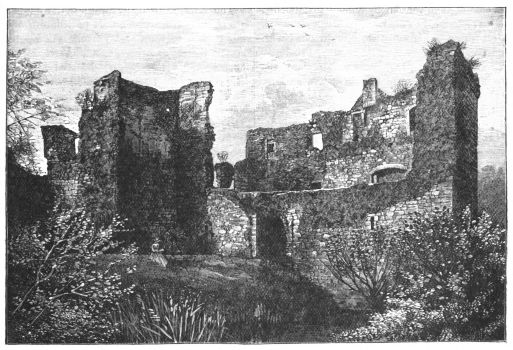
ROTHESAY CASTLE.
(From a photograph by G. W. Wilson, & Co., Aberdeen.)
[See larger version]
James I. was in person handsome, in constitution vigorous, in mind frank, affable, generous, and just. His accomplishments were of a high order. He had cultivated a knowledge of books and music in his many long years of solitary life in the Tower and at Windsor. At Windsor love had made a poet of him. He beheld from his window one of the queen's ladies in the court below, who wonderfully attracted his attention. This lady was Joan Beaufort, daughter of the Earl of Somerset, granddaughter of John of Gaunt, and niece of Bishop Beaufort, afterwards the cardinal, the educator of the boy-king. Joan Beaufort was a fitting consort for the youthful King of Scotland. When he came, under Henry V., to have more liberty and freer intercourse with the court, her beauty and excellence entirely won his heart, and in honour of her he wrote the "King's Quhair," that is, the King's book, a poem which to this day continues to be admired by all lovers of our old, genuine poetry.
On the arrival of Catherine of Valois, the young bride of Henry V., at Windsor, she was naturally interested in this handsome and accomplished captive king. She heard of his attachment to the Lady Beaufort, and promoted his suit with the king and with her family. They were affianced; yet James was still detained in England. The time was now come when circumstances combined for his release. The old Duke of Albany had been long dead, and his son Murdoch, who had succeeded him, was not able to keep in order the rude barons of Scotland, or his still ruder sons. Two of them were so haughty and licentious that they were said to respect the authority of neither God nor man. Their behaviour to their father was destitute of all reverence, so much so, that one of them importuning the father for a favourite falcon, and he refusing it, the brutal son snatched it from the regent's wrist, and wrung its neck. The loss of his falcon did what numberless greater insults had not effected. "Since thou wilt give me neither reverence nor obedience," said the enraged Murdoch, "I will fetch home one whom we all must obey."
Murdoch Stuart was as good as his word. He began to make overtures to the English Government for the return of James. As the young king was greatly attached to the English court, and likely to be more closely connected with it by marriage, the restoration to his throne was obviously much to the advantage of England under existing circumstances. At this juncture came the recommendation of Bedford, and the matter was accomplished. The Scots agreed to pay a considerable ransom by annual instalments. James was married to his admired Joan Beaufort, and, returning to his kingdom, was crowned with his queen at Scone, on the 21st of May, 1424.
While this great event was taking place, the Duke of Bedford was engaged in active warfare. The Count of Richemont and several Burgundian nobles had gone over to Charles; and, thus encouraged, his partisans had surprised Compiègne and Crotoy, and then the garrison of Ivry, which consisted of Bretons, opened the gates to the French. The duke procured fresh troops from England, re-took Compiègne and Crotoy, and sat down before Ivry with 2,000 men-at-arms and 7,000 archers. Charles collected, by great exertion, an army of 14,000 men, half of whom were Scots. They were under the command of the Earl of Buchan, Constable of France, attended by the Earl of Douglas, the Duke of Alençon, the Marshal La Fayette, the Count of Aumale, and the Viscount of Narbonne. On reaching Ivry, he found it surrounded, and the English position too strong for attack; he therefore marched to Verneuil, which opened its gates to him.
Bedford did not allow them much time to enjoy their good fortune. Leaving a garrison in Ivry, he marched on to Verneuil. At his approach Buchan called a council of war, to determine what course of action they should adopt. The more prudent portion of the council advised a retreat, representing that all the past misfortunes of France had resulted from their rashness in giving battle when there was no necessity for it; and that this was the last army of the king, the only force remaining to enable him to defend the few provinces which were left him. But there was a great number of young French noblemen, who, precisely as at Agincourt, insisted upon fighting, and this counsel prevailed.
The French army possessed many advantages in the fight. They were greatly superior to Bedford in numbers, but they were an ill-assorted crowd of French, Italians, and Scots, the last the only staunch portion of the host. They had, however, the town defending one of their flanks, and for them, if necessary, to fall back upon. They took the precaution to leave their horses and baggage in the city, and to fight on foot, with the exception of about 2,000 men-at-arms, chiefly Italians, on horseback.
The English had, as usual, adopted the tactics of Creçy and Agincourt. The duke had ordered them to post the horses and baggage in the rear, to plant their pointed stakes in front, and wait.
The Earl of Douglas, aware of the mischief of attacking these archers thus posted, also advised the French to wait, and provoke the English to attack them. But here, again, the characteristic impatience of the French defeated his caution. The Count of Narbonne rushed on with his division, shouting, "Mountjoye! St. Denis!" and the rest were obliged to follow and support him. The whole body of the French army came down upon the English front, which stood firm under the shock, shouting, "St. George for Bedford!" The weight and impetuosity of the enemy broke in some degree the ranks of the archers, and forced them back towards their baggage, which they found attacked by La Hire and Saintrailles, with their cavalry. The archers let fly at these, and, after repeated charges, put the whole to flight, the Italians being the first to flinch under the fatal shower of arrows, and gallop off the field. The archers then turned again, accompanied by their rear division, and fell furiously on the van of the enemy. Here they came upon the Scots, who were fighting like lions, and for three hours they maintained a deadly struggle against the archers in front, and the Duke of Bedford thundering on their flank with his men-at-arms. The French supported their Scottish allies, but at length the whole were compelled to give way, and were pursued with great slaughter. The carnage was terrible. There were about 4,000 French, Scots, and Italians left on the field, and 1,600 of the English. The Earl of Buchan, the Earl of Douglas and his son Lord James Douglas, Sir Alexander Meldrum, and many other Scots of rank and distinction, were slain. Of the French, four counts, two viscounts, eight barons, and nearly 300 knights fell; amongst them, the Viscount Narbonne, chief author of the mischief, the Counts Tonnerre and Ventadour, with Sieurs Rochebaron and Gamaches. The Duke of Alençon, Marshal la Fayette, and 200 gentlemen were made prisoners. Bedford, as his brother Henry had done at Agincourt, called his officers around him, and returned thanks to God on the field. In everything the duke had kept in view the military maxims of his illustrious brother, and the battle of Verneuil was long compared to that of Agincourt. It was fought on the 16th of August, 1424. But it was the last great victory of this able commander, whose prudence and skill were destined henceforth to be crippled and eventually crushed by the reckless ambition and fatal quarrels of his relatives, above all by the conduct of his brother Gloucester.
This overthrow appeared to annihilate the power of Charles VII. His last army was dispersed and demoralised. The Scots were so decimated that they never again could form a distinct corps in the French army, for they could no longer draw fresh troops from their own country, where now James I. reigned in strict alliance with England. Charles was so straitened that he had not even money for his personal needs, much less for subsisting his troops. It was all that he could do to get his table supplied with the plainest fare for himself and his few followers. Day after day brought him the news of some fresh loss or disaster. Towns most important to him were compelled to surrender for want of supplies. All the country north of the Loire was lost to him, and his enemies were preparing to drive him out of the last remains of his hereditary kingdom.
But it was the singular fortune of this prince, when reduced by his demerits to the lowest condition, always to find himself raised again by circumstances which no merit or talent of the ablest or most prudent man could originate. He was—spite of his weaknesses, his follies, and his repeated overthrows—saved by something little short of a miracle, and reserved to triumph over all his enemies, and to secure to the French crown provinces which it had lost for ages.
This time the dissensions of the English council turned the scale in his favour. Instead of the Duke of Gloucester exerting himself to maintain concord at home, and sending over fresh forces and supplies to his brother the regent in France, he had plunged himself into violent altercations with Henry Beaufort, which produced anger, quarrels, and partisanship in the Government, and threatened the worst consequences. But still more startling and pregnant with calamity was the rash marriage of Gloucester with Jacqueline of Bavaria. Nothing so mischievous to the ascendency of England in France could have been devised by the subtlest enemy; and Gloucester appears to have been of so headstrong and impetuous a temper, that he set at naught all considerations of policy and sound advice.
Jacqueline of Bavaria was the heiress of Hainault, Holland, Zealand, and Friesland. This heiress of whole kingdoms was, moreover, handsome, high-spirited, and of a bold and masculine understanding. The court of France had early cast its eyes upon her desirable domains, and secured her for the dauphin John. After the death of the Dauphin, her uncle, called John the Merciless, who had formerly waged fierce war to deprive her of her heritage, now sought to marry her to the Duke of Brabant, whose stepfather he was. Henry V. had sought her hand for his brother Bedford; but the immense advantage which the possession of Hainault and Holland would give to the English, already on the eve, as it appeared, of becoming masters of France, no doubt excited the strongest, if not the most open opposition on the part of her near relative, the Duke of Burgundy, and others who dreaded such a contingency. Jacqueline was worried into the marriage with the Duke of Brabant. It was an ill-starred union. The duke was a mere boy of sixteen, and a sickly and wilful boy. Jacqueline was of womanly age, and had, too, a will of her own. She began with despising her husband, and ended by hating him. Their life was diversified chiefly by quarrels. The favourite of her husband, William le Bégue, had insulted Jacqueline, and, at her instigation, her half-brother, called the Bastard of Hainault, proceeded to punish him, and, in truth, killed him. Her husband, in his revenge, drove away the ladies and the servants who had accompanied her from Holland; and soon after the people rose and massacred the favourites of the duke. Jacqueline got away to her mother at Valenciennes, and from Valenciennes she made her way over to England, where she was received with a warm welcome, and had a pension of £100 per month conferred on her by the king.
While in England she is said to have fallen in love with the Duke of Gloucester, and the Duke returned the sentiment with the promptitude which his own ardent character and the extent of the lady's lands made very natural. Henry V., however, saw instantly how destructive would be any such alliance to all his hopes in France. The Duke of Brabant was the near relative of the Duke of Burgundy, and Burgundy was his heir. It was inevitable that the duke would view with profound alarm a marriage which would not only deprive him of the reversion of Holland and Hainault, but place the English on almost every side of his paternal lands, with an extension of power and influence perfectly overwhelming. Henry, therefore, did everything in his power to discourage this connection, and it no doubt lay very much at the bottom of his earnest injunctions on his death-bed to his brothers to cultivate with all their energy the friendship of Burgundy.
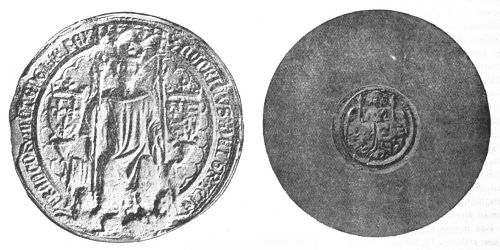
GREAT SEAL OF HENRY VI.
But sentiments of policy or prudence were lost on Gloucester. His ambition, if not his love, fired at the idea of possessing such a splendid territory in right of his wife, made him disregard every other consideration. He resolved to marry Jacqueline, contending that the Duke of Brabant was within the prescribed degrees of consanguinity, though a dispensation had been obtained for that very purpose. A second dispensation was requisite before Gloucester could marry the duchess, and this the Pope, Martin V., refused, in consequence of the representations of the Duke of Burgundy. Gloucester then applied to Benedict XIII., who, though he had been deposed from the papal chair by the Council of Constance, refused to submit to its dictum. He was only too happy to oblige where Martin had disobliged, and Gloucester married the heiress of Holland.
So long as Gloucester and his bride remained quiescent in England, the Duke of Burgundy, probably under the persuasions of Bedford, remained passive also. But presently Gloucester and Jacqueline landed at Calais with an English army of 5,000 or 6,000 men. This was a few weeks after the battle of Verneuil, and Burgundy was greatly pleased, believing that Gloucester was come with reinforcements for the combined army destined to complete the subjugation of France. But his astonishment and indignation knew no bounds, when he learned that Gloucester and his lady had marched directly into Hainault, and taken possession of it in virtue of the marriage. He was at the moment celebrating his own nuptials with the Dowager Duchess of Nevers. He instantly recalled his troops from the combined army, and sent them to assist the Duke of Brabant to drive Gloucester from Hainault. He wrote the most passionate letters to all his vassals, commanding them to hasten to the assistance of Brabant. On his part Gloucester wrote to the Duke of Burgundy, deprecating his hostility, declaring that he had broken no treaty or peace with Burgundy, and was merely taking possession of his own. He even added that Burgundy had formerly favoured this very alliance. Burgundy replied that this was false, and the two angry dukes proceeded to still higher words, and the engagement to fight a duel, which, however, never came off.
In the meantime, the effect of this quarrel was disastrous to Bedford's campaign. Not only had the Duke of Burgundy withdrawn his troops to oppose Gloucester, but Gloucester, on his part, also intercepted the troops and supplies intended for Bedford, and diverted them to his own contest in Hainault. In a great council at Paris it was at length decided that the legitimacy of the two marriages should be submitted to the Pope, and that the contest should pause till his decision was received. The Duke of Brabant consented, but Gloucester refused. The Duke of Burgundy thereupon prosecuted the war against Gloucester with redoubled determination; and to add to Bedford's embarrassment, the Count of Richemont, flattered by Charles with the appointment of Constable of France, vacant by the death of the Earl of Buchan at Verneuil, prevailed on his brother, the Duke of Brittany, also to go over to Charles. Nay, the Burgundians, brought into contact with the enemies of England, began to listen to their representations of the English ambition, and suggestions were even made to the duke from various quarters for a reconciliation with the rightful King of France. Luckily, the murder of his father was still strong in his remembrance, and he remained for eight years longer the ally of his brother-in-law, Bedford, but not the same cordial and efficient one.
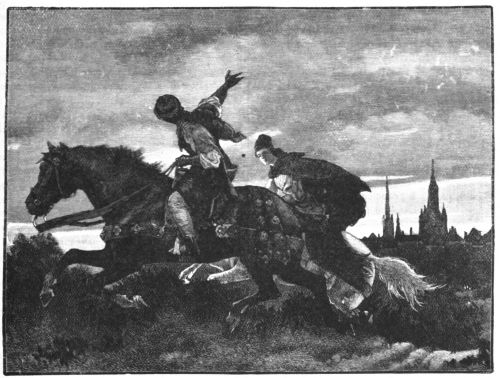
ESCAPE OF JACQUELINE FROM GHENT. (See p. 585.)
[See larger version]
Gloucester maintained the contest against his combined foes for about a year and a half, when the exhaustion of his resources, and his jealousy of the growing influence of his uncle Beaufort in the government at home, drew him to England. His departure was fatal to all his views on Hainault. No sooner was he gone than Valenciennes, Condé, and Bouchain opened their gates to Burgundy. Jacqueline, at Gloucester's departure, had entreated him not to leave her behind. But the people of Mons insisted on her remaining there to head the resistance to Brabant and Burgundy. It was only in tears that she consented to remain, predicting the fatal consequences of their separation. Her fears were speedily confirmed. Mons was invested by Burgundy, and the perfidious citizens delivered up Jacqueline to him. She was conducted by the Prince of Orange to Ghent, where she was to be detained till the Pope had decided on the validity of the marriage.
The adventurous Jacqueline did not feel herself bound to wait for the decree of the Pontiff. She planned, with a woman's ingenuity, escape from her prison. She seized her opportunity, dressed herself and maid in male attire, stole unobserved, in the dusk of the evening, out of her place of detention, mounted on horseback, and, passing the city gates, continued her flight till she reached the borders of Holland, where her subjects received her with enthusiasm. But the Duke of Burgundy was not inclined thus to let her escape. He pursued her to Holland; her subjects refused to betray her, and a war was prosecuted in that country for two years. Gloucester sent her a reinforcement of 500 men, and would have sent her more, but was prevented by Bedford and the council.
In 1426, the Pope pronounced the validity of the marriage with the Duke of Brabant; but that feeble personage died soon after, and Jacqueline, who now certainly, according to all the laws of God and man, was free, became the wife of Gloucester. But right was of little importance in that age, and especially in the case of a woman. The Duke of Burgundy was determined to reduce her by force of arms, and compel her to acknowledge him as her heir. Had England not been engaged in the conquest of France, the Duke of Gloucester would have been victoriously supported in his claim; as it was, these claims were destructive of the greater object of ambition. Little, however, as the Duke of Gloucester was able to contribute to the support of his wife, who now assumed the title of the Duchess of Gloucester, it enabled her to maintain the contest till 1428, when the power of Burgundy bore her down; and he compelled her to sign a treaty nominating him her heir, admitting him to garrison her towns and fortresses in security of that claim, and pledging her word never to marry without his consent.
The war in Hainault and Holland, created by the marriage of Gloucester and Jacqueline of Hainault, whose life more resembles a romance than a piece of real history, perfectly crippled the proceedings of Bedford. He lost the grand opportunity of following up the impression of the battle of Verneuil, and thus putting an end to the war. For three years the war was almost at a standstill. Neither the regent nor Charles was in a condition to make further demonstrations than slight skirmishes and sieges, which, without advancing one party or the other, tended to sink the people still more deeply in misery.
The court of London was torn by the dissensions of Gloucester and Henry Beaufort, Bishop of Winchester. This prelate was not more ambitious than he was politic. He carefully hoarded the large revenues of his see and of his private estate, and gave an air of patriotism to his wealth, by lending it to the Crown in its need. He had furnished to the late king £28,000, and to the present £11,000. He had thrice held the high office of chancellor; he had been the ecclesiastical representative at the Council of Constance, and had acquired a good character for sanctity by having made a pilgrimage to Jerusalem.
Every act of his ambition wore an air of patriotism. He had, in his character of guardian of the young king and of chancellor, opposed with all his energy the attempt of Gloucester on Hainault. When the duke persisted in proceeding on that expedition, he took advantage of his absence to garrison the Tower, and committed it to the keeping of Richard Woodville, with the significant injunction "to admit no one more powerful than himself." On the return of Gloucester he was accordingly refused a lodging in the Tower; and rightly attributing the insult to the secret orders of his uncle Beaufort, he instantly took counter-measures by ordering the lord mayor to close the city gates, and to furnish him with 500 horsemen, as a guard, with which he might in safety pay his respects to his nephew, the king, at Eltham. The followers of Beaufort, on the other hand, posted themselves at the foot of London Bridge, of which they sought to take forcible possession. They barricaded the street, placed archers at all the windows on both sides, and declared that, as the duke had excluded the chancellor from going into the city, they would prevent the duke from going out. The country was on the very edge of civil war. In vain the Archbishop of Canterbury and the Duke of Coimbra, the second son of the King of Portugal, by Philippa, sister of the late monarch, rode to and fro between the hostile relatives, endeavouring to effect a pacification. The bishop wrote off post haste to Bedford, entreating him to come instantly to prevent the effusion of blood.
Bedford left his now greatly weakened post in France with a groan over the folly and the obstinacy of his brother; and landing in England a little before Christmas, summoned a Parliament to meet at Leicester in February. In the meantime he strove hard to reconcile the antagonists. He sent the Archbishop of Canterbury and a deputation of the lords to request Gloucester to meet the council at Northampton towards the end of January, representing that there could be no reasonable objection on his part to meet his uncle, who, as the accused party, had just right to be heard; and assuring him that efficient measures should be taken to prevent any collision between their followers.
Gloucester, in his fierce resentment, was not to be persuaded; he was, therefore, summoned to attend in his place in Parliament. There Gloucester presented a bill of impeachment against Beaufort, in which, after stating his own grievances, he preferred two serious charges, which he swore had been communicated to him by the late king, his brother. These were nothing less than that Beaufort had exhorted Henry V. to usurp the crown during the life of his father; and, secondly, that he, Beaufort, had hired assassins to murder Henry while he was Prince of Wales.
Beaufort replied to these charges that, so far as they related to the late king, they were false, and he instanced, in proof of his innocence, the confidence Henry V. had reposed in him on coming to the throne, and his constant employment of him. He denied having given just cause of offence to Gloucester, and complained of Gloucester's behaviour towards him. The Duke of Bedford and the other lords took an oath to judge impartially between the opponents, and then they on their part agreed to leave the decision to the Archbishop of Canterbury and eight other arbitrators. After Beaufort had solemnly declared that he had no ill-will to Gloucester, and besought his reconciliation, Gloucester appeared to consent. They shook hands, the bishop resigned his seals of office, and requested permission to travel.
It was thought, however, that Gloucester was by no means in a mood for submitting even to the council. He was reported to say, "Let my brother govern as him listeth while he is in this land; after his going over into France I woll governe as me seemeth." Out of doors the followers of the two antagonists being forbidden to bring arms to the neighbourhood of the Parliament, they came with bludgeons upon their shoulders, whence it was called the Parliament of Bats. These being also prohibited, they put stones and lumps of lead in their pockets, so ready were they for an affray.
The council, apprehensive of mischief, and especially from Gloucester after the departure of Bedford, required both dukes to swear that, during the minority of the king, and for the peace and security of his throne, they would "be advised, demeaned, and ruled by the lords of the council; and obey unto the king and to them as lowly as the least and poorest of his subjects."
Bedford, after a sojourn of eight months, returned to France. The Duke of Brittany was severely punished for his defection. The English poured their troops into his province, and overran it with fire and sword to the very walls of Rennes. The duke solicited an armistice; it was denied him; again the war went on, and again he was everywhere discomfited. At length he was compelled to accept the terms dictated by Bedford, and swore once more, with all his barons, prelates, and commonalty, to observe the treaty of Troyes, and do homage to Henry for his territories, and to no other prince whatever.
Flushed with this success, the leaders of the army in the following year, 1428, were urgent to make a grand descent on the country south of the Loire, and to drive Charles from the provinces yet adhering to him. Bedford, aware of the suspicious character of some of his allies, was strongly opposed to the measure. Several councils were held in Paris to discuss the propriety of this undertaking, and Bedford in vain opposed it; he was overwhelmed by a majority of voices. Of this circumstance he afterwards complained in one of his letters to the king. "Alle things prospered for you," he wrote, "till the time of the seage of Orleans, taken in hand God knoweth by what advice." It was now Orleans that the commanders were eager to attack. Montague, Earl of Salisbury, had just brought over from England a reinforcement of 6,000 men. He was regarded as inferior in the field only to the Earl of Warwick, and was unanimously elected general on the occasion.
Orleans was one of the most important places in the kingdom, and the French did everything which could enable it to hold out a siege. Stores and ammunition were collected into the city; batteries were erected on all sides upon the walls; and the beautiful suburbs were razed to the ground. The inhabitants of the neighbouring country, and of the towns of Bourges, Poitiers, La Rochelle, and other places, sent money, troops, and stores. The Parliament at Chinon voted 400,000 francs in aid of the city. Charles VII. himself appeared to be roused from his torpor by the imminent danger of this quiet town, and sent thither all the troops that he could spare, under some of his most famous commanders, Saintrailles, De Guitry, and Villars. He appointed the Count de Gaucourt governor, and many brave Scots—encouraged by a treaty which Charles had made with their sovereign, James I., binding himself to marry the Dauphin to a daughter of his, and give him the county of Evreux or the Duchy of Berri—threw themselves into it.
Salisbury, reducing Mun, Jeuville, and other places on the way, advanced towards Orleans, and sat down before it on the 12th of October. He pitched his tent amid the ruins of a monastery on the left bank of the river, and directed his first attack against the Tournelles, a tower built at the extremity of the bridge leading into the city. This he took by assault; but the garrison retreating, broke down an arch of the bridge behind them and there was another defence erected at the city end of the bridge. From the windows of the evacuated Tournelles, Salisbury directed the attack on the city. His post was discovered, and a huge stone ball was discharged from a cannon at the window. He observed the flash, and started aside; but the window was dashed in, the officer who had been standing behind him was killed, and the iron-work of the window driven in different directions with such force, that Salisbury was so wounded in the face by it that he died in a week.
The command devolved on the Earl of Suffolk, who endeavoured to convert the siege into a blockade. He erected huts at intervals all round the city, covered from the enemy's fire by banks of earth, throwing up lines of entrenchments from one of these posts, or bastilles, as they were called, to the other. But the circuit which they had thus to occupy was so vast that the intervals between the bastilles were too great for his amount of forces to secure. The Bastard of Orleans, a natural son of the Duke of Orleans who was killed by Burgundy, made his way into the city with numerous bodies of French, Scots, Spaniards, and Italians. De Culant, whom Charles had named Admiral of France, did the like by means of the river, and thus Orleans continued during the winter to set the besiegers at defiance.
Early in February, the Duke of Bedford sent aid from Paris—Sir John Fastolf, with 1,500 men, and 400 waggons and carts laden with stores and provisions for the army before Orleans. Sir John had reached Bouvray when he received the alarming intelligence that the Count Charles of Bourbon, the Count of Clermont, and Sir John Stewart, Constable of Scotland, had thrown themselves with 4,000 or 5,000 cavalry betwixt him and Orleans. They were, moreover, in full march upon him. This intelligence reached him at midnight, and he lost no time in preparing for the attack. He drew up all his waggons and carts in a circle, enclosing his troops, leaving an opening at each end, where he posted his archers in great force. Every moment he expected the attack, but the enemy was disputing as to the best mode of making the assault. The French were for charging on horseback, the Scots were for dismounting and fighting on foot. It was not till three o'clock in the morning that the disputants resolved each to fight in their own way. The attack was made simultaneously at both openings, but the archers sent such well-directed volleys of arrows amongst the assailants, that the French speedily galloped off the field, leaving nearly all the Scots dead upon it. Six hundred of the united, or rather disunited, force were slain; and Sir John marched in triumph into the camp before Orleans with the stores which the French had confidently counted upon possessing. The Constable of Scotland, the Sieurs D'Albret and Rochechouart were amongst the slain, and the Count of Dunois was severely wounded. This battle, from the salted fish and provisions which Sir John was conveying for the use of the army during Lent, was called the Battle of the Herrings.
This was a severe blow to Charles VII. There appeared only one way of preventing the almost immediate loss of his crown. The English commander was actively pressing the siege. He had cast up a still more complete line round the city, fresh reinforcements enabled him to make the bastilles more numerous, and famine began to menace the place with all its horrors. To avoid the fall of Orleans, Charles engaged the Duke of Orleans, who had been so long a prisoner in England, to exert himself with the Protector and council in England to guarantee the neutrality of his demesnes, and for greater security to consign them during the war to their ally, the Duke of Burgundy. To this the council consented, as placing the duchy in a manner in the hands of England. The Duke of Burgundy readily accepted this trust, and waited on Bedford in Paris to apprise him of it. But Bedford, by no means flattered by the expected prey being thus adroitly taken out of his hands, said that he was not of a humour to beat the bushes while others ran away with the game. Burgundy affected to smile at the apt simile, and retired; but it was with a resolve in his breast, to be made apparent in due time.
Foiled in this attempt, Charles now gave way to despair. The city of Orleans could not possibly long hold out, and he determined to retire with the miserable remainder of his forces into Languedoc and Dauphiné, and there await the last attacks of the conquering foe. This cowardly resolve was, however, vehemently resisted by the queen, who declared that it would be the total ruin of his affairs; and his mistress, Agnes Sorel, who was living on the best of terms with the queen, supported her in this protest vigorously, threatening, if he made so pusillanimous a retreat, to go over to England and seek a better fortune in the British court. This decided the king, and while affairs were in this critical situation, help, and eventually triumph, came from a quarter which no human sagacity could have foreseen.
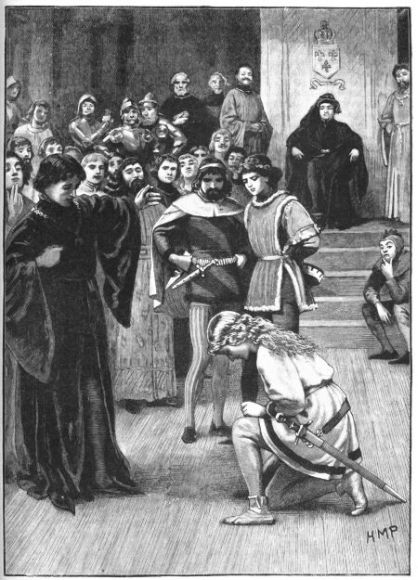
JOAN OF ARC BEFORE CHARLES. (See p. 591.)
[See larger version]
On the borders of Lorraine, but just within the province of Champagne, lies the hamlet of Domrémy, situate between Neufchâteau and Vaucouleurs. In this hamlet lived a small farmer of the name of James d'Arc; and his daughter Joan, whilst a little girl, was accustomed to tend his small flock of sheep in the fields and heaths around. When about five years of age, whilst walking in her father's garden on a Sunday, she declared she saw a bright light in the air near her, and turning towards it saw a figure, who said that he was the archangel Michael, and commanded her to be good and dutiful, and that God would protect her.
At this period the fortunes of unhappy France were at their lowest ebb. The inhabitants of Domrémy were royalists, but those of Marcy, the next village, were Burgundians. Thence arose constant feuds. When they met they fought and pelted each other with stones. Joan saw all this, and heard the insults of the Burgundians when the king was defeated and disgraced. At this moment came the terrible news of the great battle of Verneuil, and she saw the distress and despair of her friends and neighbours. The visions now came oftener, and comforted her, till the siege, the famine, and the expected fall of Orleans renewed the general trouble. With the archangel Michael she now regularly saw the saints Catherine and Margaret, who were the patronesses of her parish church. They exhorted her to devote herself to the salvation of her country. She represented that she was a poor peasant maiden, and did not know anything of such great matters; but the archangel Michael assured her that strength and wisdom would be given her, and that the saints Catherine and Margaret would go with her, and that all would be well. The two female saints then appeared to her, surrounded by a great light, their heads crowned with jewels, and their voices gentle and sweet as music. Joan knew that there was a prophecy abroad that, as France had been ruined by a wicked woman—Isabella of Bavaria—so it should be restored by a virgin, spotless, and devoted to the rescue of her country. Nay, this saviour of France was to come out of the neighbouring forest of oaks.
The heavenly voices became more and more frequent, more and more urgent, as the affairs of France approached a crisis, announcing that she was the maid who was appointed to save France. Joan became greatly distressed, and was often found weeping when the visions left her, and longing that the angels of paradise would carry her away with them. Her parents had no faith in her visions, and, to prevent her from going off to the army, they tried to force her into a marriage; but Joan had voluntarily taken a vow of perpetual chastity, and she revolted with horror from the proposal. Just then a party of Burgundians fell on the village of Domrémy, plundered it, and burnt down the church. Joan, with her parents, was compelled to flee and seek refuge in Neufchâteau. When they returned to Domrémy, and beheld the scene of desolation, the indignation of Joan was roused to the highest pitch. The voices now commanded her, on pain of the forfeiture of her salvation, to go at once to Baudricourt, the Governor of Vaucouleurs, and demand an escort to the court of the king. There she was to announce to him that she was sent to raise the siege of Orleans, and to crown him, the rightful King of France, in the city of Rheims. Joan now gave way; there was nothing to be hoped from her parents but opposition; she therefore hastened secretly to Vaucouleurs, to an uncle—a simple, pious man—there. The old man, a wheelwright by trade, at once went with her to the governor. Baudricourt at first refused to see her; when she was, at length, through her importunity, admitted, he looked upon her as crazed, and told her uncle that he should send her back to her parents, and that she ought to be well whipped. Joan said, "It was her Lord's work, and she must do it." "Who is your lord?" asked Baudricourt. "The King of Heaven!" replied Joan. This satisfied the governor of her insanity, and he rudely dismissed her. But Joan still remained at Vaucouleurs, daily praying before the high altar in the church, and asserting that the voices urged her day and night to proceed and execute her mission. The rumour of this strange maiden flew rapidly through the town and country; the sight of her modesty and piety, and the fame of her past pure and devout life, brought numbers of people to see her, and amongst others men of high note.
Baudricourt was compelled by the public voice to take charge of her; but not before he had tested her by a priest and the sprinkling of holy water, that she was no sorceress, nor possessed of the devil. The Seigneurs de Metz and Bertrand de Poulengi, who had conceived full faith in her, offered to accompany her, with her brother Peter, two servants, a king's messenger, and Richard, an archer of the royal guard. The journey thus undertaken in the middle of February, 1429, was, according to ordinary ideas, little short of an act of madness. The distance from Vaucouleurs to Chinon in Tourraine, where Charles's court lay, was 150 leagues, through a country abounding with hostile garrisons, and, where these were absent, with savage marauders. But Joan declared that they should go in perfect safety, and they did so. Joan rode boldly, in man's attire, and with a sword by her side, but they saw not even a single enemy. In ten days they arrived at Fierbois, a few miles from Chinon, and she sent to inform the king of her desire to wait upon him.
When the advent of so singular a champion was announced to the frivolous Charles, he burst into a loud fit of laughter. Some of his counsellors, however, advised him to see her, others treated the proposition as the height of absurdity. For three days the court continued divided, and Charles unable to decide. At length it was agreed that she should be admitted; and to test her pretensions to superhuman direction, Charles was to pass for a private person, and one of the princes was to represent him. But Joan discovered the king at a glance; and walking up to him with serious and unembarrassed air, through the crowd of staring courtiers, bent her knee, and said, "God give you good life, gentle king!" Charles was surprised, but replied, pointing to another part of the hall, "I am not the king: he is there." "In the name of God," rejoined Joan, "it is not they, but you who are the king. I am, most noble king, Joan the maid, sent of God to aid you and the kingdom, and by His name I announce to you that you will be crowned in the city of Rheims."
But the timid Charles hesitated, and conveyed her to Poitiers to be examined before the Parliament by the most learned doctors and subtle theologians. For three weeks she was interrogated and cross-questioned in all ways. Every kind of erudite trap was laid for her, but in vain. She had but one story—that she was sent to raise the siege of Orleans, and to crown the king at Rheims, now in the hands of his enemies. When asked for a miracle, she replied, "Send me to Orleans, with an escort of men-at-arms, and you shall soon see the sign of the truth of my mission—the raising of the siege." When not before the council, she passed her time in retirement and prayer. Having passed the most searching ordeal of the prelates and doctors, and the repeated application of holy water, she was once more brought out, armed cap-à-pie, with her banner borne before her, and equipped at all points like a knight. Mounted on a white charger, she ran a tilt with a lance, keeping such a firm seat, and displaying so steady an eye, that the soldiers and watching multitudes were enraptured.
The people of Orleans sent express for instant aid, and implored that the maid should lead the reinforcement. She demanded an ancient sword which, she said, lay in a tomb in the church of St. Catherine, at Fierbois, which was sought for, found, and brought to her, having five crosses upon its blade. Thus armed, receiving the staff and rank of general, a brave knight, of the name of John Daulon, being appointed her esquire, with two pages and two heralds, the maid of Domrémy set out with a body of troops conveying provisions to Orleans. No sooner did she come into their camp, than she instituted the most rigorous discipline. She expelled all the low women who followed it, and insisted on every soldier confessing his sins and taking the sacrament.
The famishing people of Orleans received Joan of Arc with enthusiastic acclamations and blazing torches. They believed that deliverance was come to them from Heaven, and they were right. A splendid banquet was offered to Joan, but she declined it, retiring to the house of Bouchier, the treasurer to the Duke of Orleans, where she supped simply on bread dipped in wine; and there she remained during her stay in Orleans, keeping the wife and daughter of Bouchier constantly about her, to prevent any aspersions on her fair fame.
The strangest terror fell over the English soldiers. They had heard of nothing for two months but the coming of this maid, who had written to their commanders, telling them she was ordained by God to drive them out of France. The French had proclaimed her as sent by Heaven; the English officers, with curses, had sworn that she came from the devil. This, which they thought would completely destroy her with the soldiers, was the very thing which fixed her power over them. They would probably have cared nothing for her professed divine mission; but they at once gave credit to her alliance with Satan, and declared that flesh and blood they did not fear, but they were no match for the arch-fiend. In vain the commanders, who saw their error, endeavoured to remove this impression by representing Joan as a low-born, ignorant wench, and no better than she should be, who was got up by the French to frighten them: the mischief was done; in their eyes Joan was a witch of the first order, and wherever she appeared the soldiers fled. The subjects of Burgundy, who was himself no longer cordial in the cause, stole away from the camp on all sides; and the numbers necessary for the blockade of the town became deficient. The French now went in and out with impunity. A large store of provisions had arrived at Blois, which Charles constituted a depôt for the supply of Orleans. Joan marched out at the head of a very strong body, attended by the Bastard of Orleans, Saintrailles, La Hire, and other generals. Her banner of white silk, bordered with fleur-de-lis of silver, and on one side bearing an image of the Almighty, on the other the words "Jhesus Maria," was borne before her. After came a body of priests bearing another banner, and chanting their anthems; and in this manner, glittering in her bright armour, and mounted on her milk-white steed, the maid rode forth in the very face of the English, who lay still, as if stricken into stone. Thus she went to Blois, and returned with fresh troops and means of defence.
Joan now mounted a tower opposite to the Tournelles, and called to the English, bidding them begone from France, or worse would befall them. Sir William Glansdale replied from the Tournelles, abusing her for a witch and an abandoned woman, bidding her go back to her cows. "Base knight!" said Joan, "thou thyself shalt never pass hence, but shalt surely be slain." She now commanded an assault on the bastilles; but the generals, who were becoming jealous of Joan's fame, resolved to try their fortune without her. They told her they would commence the attack the next day, and Joan retired to lie down and take some repose. Soon she started up, and called for her arms, saying the voices summoned her to fight, and rushing forth she met the soldiers returning from a sortie, which had been made without her knowledge, and in which the French were repulsed with slaughter.
Joan was greatly enraged, and now led on the forces herself. Successively the bastilles of St. Loup, St. Jean le Blanc, and the Augustinians fell before her. The attack was then led against the main fortress, the Tournelles. Joan led the way, severely reprimanding Gaucourt, the governor of the city, for his disobedience to her orders, and threatening to put him or any one to death who opposed her. The people and soldiers, who worshipped her, stood to a man in her support, and she led the way to the Tournelles, sword in hand. Three times the French attacked the tower with all their force and engines, but the English this time defended themselves manfully, and with their artillery and arrows mowed down the French, clearing the bridge and river bank of them. Nothing daunted, Joan seized a scaling-ladder, and, amid a hail of shot and flying shafts, advanced to the foot of the tower, planted her ladder, and began to ascend. An arrow struck her, piercing her armour between the chest and shoulder, and she fell into the ditch. The English gave a great shout at the sight, and Joan, supposed to be dead, was borne away into the rear. Finding that the maid was alive, the arrow was extracted, and, feeling all the weakness of the woman during the operation, Joan cried in agony; but once over, she fell on her knees in prayer, and rose up as if wholly refreshed, declaring it was not blood but glory that flowed from her wound, and that the voices called her to finish her victory. The combat recommenced with augmented fury; the English, confounded at the reappearance of the maid, gave way, and Glansdale and his knights were put to the sword, as Joan had predicted.
That night Suffolk held a council of war, and such appeared the discouragement of his troops, that it was resolved to abandon the siege and man all the fortresses along the river. Accordingly, the next day he drew out his forces, and placed them in battle array. Determined to make a show of resistance, while in the very act of drawing off, he sent a challenge into the city, bidding the French, now so superior in numbers as they were, to come with their Joan, and, were she harlot, witch, or prophetess, they would fight her in a fair field. It was Sunday; Joan forbade the French to quit the city, but to spend the day in worshipping God, who had given them the victory. Suffolk waited for some hours in vain, when he gave the concerted signal, and all the long line of forts burst into flames, and the soldiers, dejected and crestfallen, marched away. Joan prohibited any pursuit that day.
Thus the first of the two great things which Joan had promised was accomplished—the siege of Orleans was raised; and the maid, now honoured with the title of the Maid of Orleans, rode forth to meet the king at Blois. As she advanced through the country, the peasantry flocked on all sides to behold her, and crowded forward to touch her feet, her very garments, and, if unable to do that, were happy to touch her horse. By the court she was received with great honour, and the king proposed to entertain her with a magnificent banquet. But Joan told him that it was no time for feasting and dancing; she had much yet to do for France, and but little time to do it in, for her voices told her that she should die within two years. She called on Charles now to advance with her to Rheims, where she must crown him, and leave the English and Burgundians, who were safe in the hand of God.
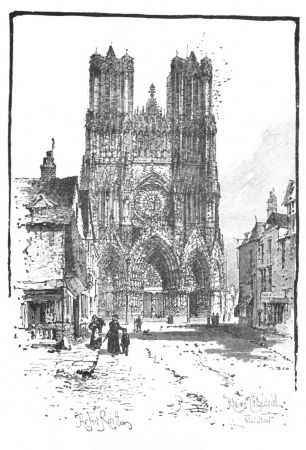
THE CATHEDRAL, RHEIMS.
[See larger version]
Charles put himself at the head of his forces, and collected all his power on the banks of the Loire. He proposed, however, first to clear the enemy from their strongholds, and afterwards to march to Rheims. His army, led on by the Maid, invested the town of Jargeau, where Suffolk, the commander-in-chief, lay, and within ten days the place was carried by storm, and Suffolk himself taken prisoner. In this triumphant action Joan, as usual, led the way. She was the first to scale the wall of the city; but on her head appearing above it she received a blow which precipitated her into the ditch. She was severely bruised, but not killed; and as she lay on the ground, unable to raise herself, she cried, "Forward, countrymen! fear nothing; the Lord has delivered them into our hands." The soldiers, fired to enthusiasm by her heroism and her confident words, rushed on and took the place. Three hundred of the garrison lay dead. Six thousand of the English had fallen at Orleans, and a panic seized them everywhere. The Lord Talbot, who was now left in command, evacuated the different ports and towns, and retreated towards Paris.
At Patay he was met by a reinforcement of 4,000 men, and made a stand. Sir John Fastolf, who had brought these troops, advised further retreat, but Talbot refused. While the commanders debated the point, the French were upon them; and Talbot, who saw himself on a flat, open country, endeavoured, but too late, to secure his rear by a village and fenced enclosures. On the other side, the French commanders, dreading an attack of the English in the open field, remembering Agincourt and Verneuil, advised waiting for additional cavalry, but Joan indignantly exclaimed, "Have you not good spears? Ride on in the name of the Lord; the English are delivered into my hands,—you have only to smite them!" So saying, she led the way in charge, and the men clamoured to follow. La Hire and Saintrailles dashed on with the Maid, and broke into the very midst of the English before they had time to form. Fastolf without striking a blow, led off his men; and the brave Talbot, fighting amid heaps of his slain soldiers, was taken, with the Lord Scales and Hungerford, and the bulk of the officers. Twelve hundred of the English lay dead on the field.
In this moment of victory Joan again urged on Charles to march to Rheims, and be crowned. At this the contemptible king, who on all occasions of danger kept aloof, shrank back. The distance was great, the whole way was full of strong towns in the hands of the English and Burgundians. His officers supported him in this view, but the undaunted Maid upbraided them with their want of faith, after so many wondrous proofs of the truth of her promises.
She strove wisely to reconcile Charles to the Constable, the Count of Richemont, whom La Tremouille, the king's favourite, hated and feared; but in vain. Not only Richemont with his troops, but many other knights, were refused attendance in the court, and with these diminished forces Charles set forward on the road to Rheims. But everywhere the fortified towns fell before them. Auxerre made a treaty of submission, but Troyes for a time held out. As the soldiers suffered greatly in the siege for want of provisions, they began to lose faith in Joan, and openly to insult her as a foul witch. The murmurs of the base soldiery were quickly seized upon by the Archbishop of Rheims, who had always expressed his disbelief in Joan's inspiration, and the poor maid was summoned before the council, and interrogated like a criminal. But with a simple and fearless eloquence she made the leaders feel ashamed of their doubts. She challenged them to follow her to the walls, and see them surmounted, and she prevailed. With bags of earth and fagots the soldiers filled up the ditch, and were preparing with scaling-ladders to pour over the walls in a frenzy of enthusiasm, when a parley was demanded by the besieged, and the notorious Friar Richard, who figured so much in the camp from this time, made terms of surrender. As Joan was in the act of passing the city gate at the head of the troops, the friar, still believing that he had to do with an imp of Satan, crossed himself in great agitation with many crosses, and sprinkled holy water on the threshold of the gate. Instead of seeing the Maid resolve herself into a hideous demon and vanish away, or find herself unable to cross the threshold, he beheld her march on calm and unmoved; and at once he pronounced her an angel, and the people flocked round with admiring wonder. From that hour Friar Richard became a zealous ally of the king, though often relapsing into doubt of the Maid and into bigoted opposition to her. He now, however, went on preaching to the people of the neighbouring towns to rise in defence of the king, and drive out the Burgundians. Châlons sent Charles the keys of the town, and on arriving at Rheims, he found that the people had risen at the approach of the Maid, had driven out the adherents of Bedford and Burgundy, and received him with open arms. A grand procession of priests waited to accompany the king and the Maid into the city, and on the 15th of July, 1429, Charles and Joan, attended by all the chief officers, marched into the city preceded by the banners of the Church, and amid the sound of its hymns. Two days after this, Charles VII. was crowned in the cathedral, as the Maid had promised him.
But in entering on so stupendous a mission as the salvation of the nation, a humble village girl like Joan had entered on the field of martyrdom. From such a career there could be no retreat but through death. The same voices which she invariably avowed had called her to the enterprise, had pronounced her early doom. The enthusiasm of the multitude is short-lived; the envy and the hatred of the military chiefs, scarcely suppressed during the hour of triumph, were eternal in their nature. She had snatched the prestige of invincibility from the English, and raised the spirit of France. This had to be avenged. In the meantime, however, she was too indispensable to the completion of the conquest of France. Charles resolutely refused to listen to her tears and prayers to be permitted to withdraw. But from that hour the Maid was no longer the same. The spirit had departed from her. She was dejected, and full of distress. When importuned to direct what should next be done, she was uncertain and confused, which she never had been before. Bedford was exerting himself to check this unexampled progress of the French. Cardinal Beaufort came over with 2,000 archers and 250 men-at-arms. Every means was used to fix the alliance of the wavering Burgundy, who, however, gave no essential assistance. He had withdrawn his garrisons from Normandy, and the constable had seized them. Bedford was compelled to march himself from Paris to recover them; and the Maid, who had hung up her arms in the Church of St. Denis, at Rheims, as the sign that her mission was over, was induced by the king to assume them again. Once in her old panoply, her courage, if not her confidence, seemed to revive. She advised the monarch to march on Paris while Bedford was absent. She led the way and Soissons, Senlis, Beauvais, and St. Denis, opened their gates. At the assault on the Faubourg St. Honoré, Joan was again wounded, and left in the ditch for hours. Charles, mortified at the repulse, retired in dudgeon to Bourges; and Joan, again hanging up her armour, implored her dismissal. Charles refused, and endeavoured to fix her in his interest by granting her a patent of nobility, with an income equal to that of an earl, and freed her native parish of Domrémy from all taxation for ever. The unhappy Maid went on; but her voices were gone, and she was no longer a safe oracle. During the winter, indeed, Friar Richard had brought forward his rival prophetess—one Catherine of La Rochelle—who undertook, not to fight, but to raise money, by preaching to the populace and revealing hidden treasures. Joan refused any connection with her, declaring that success lay at the point of the lance.
In May, 1430, Joan was sent to raise the siege of Compiègne, which was invested by the Duke of Burgundy. She fought her way into the city with her accustomed valour, but, in making a sortie, was deserted by her followers, and bravely fighting her way back to the city, just as she approached the gates, she was dragged from her horse by an archer, and, as she lay on the ground, she surrendered to the Bastard of Vendôme.
The news of the capture of the terrible Maid flew like lightning through the Burgundian camp. All the officers of the army ran to gaze at her, the duke himself amongst them. Monstrelet, the historian, who recounts these transactions, was present on the occasion.
And now came the dark termination to this brilliant and wonderful episode in the history of these wars of France—even that which Joan herself had foretold. The base King of France abandoned her to the tender mercies of her enemies. When the news reached the English quarters, they sang Te Deum in their exultation.
Pope Martin V. demanded her that he might consign her to the benign offices of the Holy Inquisition. But the Bastard of Vendôme had sold his captive to John of Luxembourg, and he sold her to the English for 10,000 francs. During the winter she lay in prison, her friends seemed to have forgotten her, and her enemies were ravenous for her destruction. There was one general cry for her being burnt as a witch; and so fierce was the popular feeling in Paris that a poor woman was actually burnt for merely saying that she believed Joan had been sent by Heaven. She was carried from one dungeon to another, to Beaurevoir, to Arras, to Crotoy, and, finally, to Rouen. There the Bishop of Beauvais, a man devoted to the English interests, claimed to conduct her trial. He was a servile tool of Bedford, hoping for preferment through him; and Bedford had long declared that Joan was "a disciple and limb of the fiend:" therefore, the result was quite certain. Her trial was opened on the 13th of February, 1431.
On sixteen different days Joan was brought before the court, and interrogated with all the subtlety of the most celebrated priests, doctors, and lawyers that could be found. There were upwards of a hundred of these grave, learned men arrayed against this simple girl. They tried every means of entrapping her into admissions of the evil agency of her spiritual prompters; but the noble damsel remained calm, clear, and undaunted in her demeanour. When they interrogated her as to her attachment to the Church, she reminded them of her constant resort to its altars and services; but she made the fatal confession that when her voices gave different advice she followed them, as of higher authority than the Church. The court condemned her as an impious heretic and impostor; and the Parliament of Paris and the University, besides various eminent prelates who were consulted, confirmed the justice of the sentence.
The treatment of poor Joan in prison was still more infamous than in open court. When condemned as a heretic to be burned, her cell was haunted by monks and confessors, who described her death to her in the most terrible language, and wearied her with entreaties to confess and escape so frightful a death. A woman's fears at length got the better of her: she consented, and was brought out publicly in the cemetery of St. Ouen, where a friar addressed her before the assembled English and Burgundians, and the citizens of Rouen, describing the enormity of her crimes, and the infamy of her conduct as a woman. Joan bore all this in patience; but when he proceeded to defame the king, her loyalty broke out, and she warmly defended him. Her punishment was commuted to perpetual imprisonment.
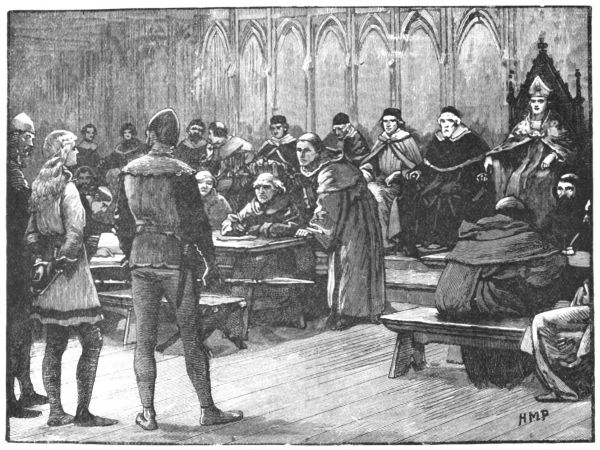
TRIAL OF JOAN OF ARC. (See p. 595.)
[See larger version]
But this did not satisfy the vengeful longings of her enemies. To her mitigated sentence was attached an oath which she swore, never, on penalty of death, again to assume male attire. This was made a snare for her. During sleep her own garments were taken away, and those of a man put in their place. On awaking, she put on a portion of the only attire left her, and no sooner was this the case, than her guards, who were on the watch, rushed in, and conducted her, thus arrayed, to the officers. On this forced breach of her oath, judgment of death by fire, as a relapsed heretic, was at once pronounced; and on the 30th of May she was brought to the stake in the little market-place, since called the Place de la Pucelle, in memory of her.
When she had been conducted back to her cell, after her second condemnation, she confessed her guilt to God in that she had been weak enough to deny the power by which He had led her to do His will for France. Her "voices" came back to her; she was filled with new courage, and with beautiful visions. When she was brought out, and saw the horrible apparatus of death, her fortitude failed her, and she was led, sobbing to the stake. When she saw the fire kindled, she grasped a crucifix convulsively, and called loudly on the Almighty for support, and she was thus seen when the dense smoke enveloped her, praying to Christ for mercy.
Thus perished the most pure, noble, and remarkable heroine in history, for the crime of saving her country. Numbers of her companions, of all ranks, were living when her history was written, who all united in testimony to the purity of her life and the wonder of her deeds. Her ashes were scattered on the Seine; but twenty-five years later, the infamous judgment which had been passed upon her was reversed by the Archbishop of Rheims and the Bishop of Paris.
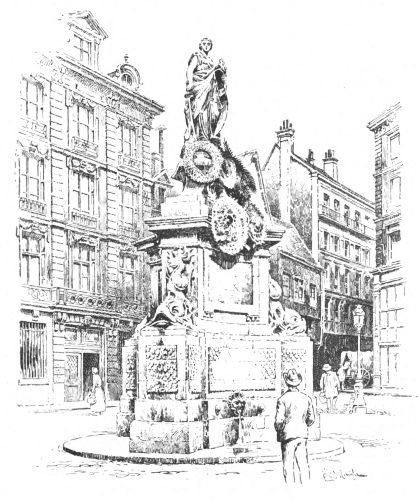
PLACE DE LA PUCELLE, ROUEN.
(Photo: Neurdein Frères, Paris.)
[See larger version]
The ceremony of the coronation of Charles VII. at Rheims appearing to give him a more confirmed title to the crown of France in the eyes of the people, Bedford resolved to crown Henry of England also there. Henry was now in his tenth year, a boy amiable but weakly, both in body and mind. He had received the royal unction in Westminster; and from that moment the title of protector was dropped, and that of prime counsellor only given to Gloucester. Both France and England had at this period so completely exhausted themselves by their wars, that it was six months before money could be raised sufficient to defray the expenses of Henry's coronation journey. It was then procured by loan. Gloucester was appointed the king's lieutenant during his absence; and Beaufort, now Cardinal of Winchester, accompanied the latter. Henry proceeded to Rouen, but the boast of Bedford that he would crown him in Rheims appeared every day farther from any prospect of accomplishment; and, after eighteen months' abode of the king at Rouen, it was resolved to crown him in Paris. From Pontoise to Paris the youthful king, accompanied by the principal English nobles and 3,000 horse, advanced in state; and great processions of the clergy, the members of the Estates General, the magistrates, and citizens came out to meet him. Triumphal arches were erected, various devices were exhibited, mysteries enacted, and a show of festivity was presented; but the whole was hollow. There was no real joy on such a ceremony, which, to the Parisians, was but a mark of subjugation to a foreign yoke. The entire aspect of the affair was English, not French. Cardinal Beaufort performed the ceremony; the great officers of state surrounding the throne were English. Not a single prince or peer of France condescended to attend on the occasion—not even Burgundy, the ally of the young monarch. When crowned, there was no loyal desire to retain the monarch amongst them. Henry was not at home there, and, in a few days, went back to Rouen, where he resided a year, and, after a visit to Calais, returned to London.
In the meantime, the disposition of the French to return to the allegiance of their own prince became still more conspicuous in the provinces than in the capital. The atrocious cruelty of the English to their heroine, though it had been passively permitted by the Government, revolted and incensed the people. Everywhere the new spirit which she had evoked showed itself in the greater daring and success of the French generals. Dunois surprised and took Chartres. Lord Willoughby was defeated at St. Celerin-sur-Sarthe. The fair of Caen, the capital of Normandy was pillaged by De Lore, a French officer; and Dunois, emboldened by his success, even compelled the Duke of Bedford to raise the siege of Lagny.
But, far beyond these petty advantages, every day demonstrated that the unnatural alliance of the Duke of Burgundy with England against his own sovereign was hastening to an end. Nothing but the duke's resentment against Charles for the murder of his father could have led him to this alliance; and nothing but the decided ascendency of the English could have retained him in it. That ascendency was evidently shaken; the English influence was on the wane, the spirit of the French people was rising in bolder form against it; and Charles, who seemed at length to acquire a politic character, made earnest overtures to the duke for reconciliation. The humiliations and distresses to which Charles had long been subjected had gratified the revenge of Burgundy, and he was now sufficiently cool to perceive as clearly as any one that nothing in reality could be more fatal to his interests than the union of France and England under one crown. The English had already given him more than one cause of offence; he did not forget that Bedford had refused to surrender the government of the Duchy of Orleans to him when it had been given him by the English council. And now, while Charles was assiduously courting him, and he was in this tone of mind, Bedford unluckily added fresh and deep cause of resentment.
Ann of Burgundy, Duchess of Bedford, sister of Philip, died at Paris, in November, 1432. Here was snapped a bond of union which, by the judicious endeavours of the duchess, had proved a strong one. In two months after her death, Bedford, who could not plead the impetuosity or thoughtlessness of youth, married Jacquetta of Luxembourg, a vassal of Burgundy, and that without giving the slightest announcement of his intention to the duke. Burgundy felt the proceeding a direct insult to the memory of his sister, and probably Bedford was quite as conscious of the fact, and, therefore, had omitted to communicate his intention to Philip. Philip expressed his resentment in no measured terms, and Bedford retorted with equal indignation. There were numerous individuals at the Burgundian court ready to fan the flame of dissension. The Count of Richemont and the Duke of Brittany had long been striving to carry over Philip to the French side. The Duke of Bourbon, who had also married a sister of Philip, threw his weight most joyfully into the scale.
The Cardinal of Winchester, who, whatever his feuds with Gloucester, had long been giving the most prudent counsel, in the exhausted state of the finances of both countries, to attempt a peace, now saw with consternation this quarrel, which threatened to throw Burgundy into the arms of Charles, and thus augment immensely the difficulties of England. He hastened to interpose his good offices, and prevailed upon the two incensed princes to consent to a meeting at St. Omer. But here the old proverb of bringing a horse to water was seen in its full force. Each duke expected that the other should make the first visit. Bedford stood upon his being the son, brother, and uncle to a king, and Philip upon the greatness of his own independent dominions. Neither would condescend to make the first move, and they parted with only increased bitterness. Bedford, in this case, permitted his pride to sway him from his usual prudence, and, though he did not live long, it was long enough to cause him deeply to repent his folly.
The Duke of Burgundy was now quite prepared to reconcile himself to Charles. A point of honour only stood in the way, and diplomacy is never at a loss to get rid of such little obstacles. By the treaty of Troyes he was solemnly sworn never to make peace with Charles without consent of the English. To surmount this difficulty, either by establishing an actual peace between the three parties, or by so far putting the English in the wrong as to justify in the eyes of the world a peace without it, it was suggested by his brothers-in-law, Richemont and Bourbon, to endeavour to get up a congress under the mediation of the Pope, as the common friend and father of all Christian princes. Eugenius IV. set himself with alacrity to effect this desirable but difficult work, and prevailed so far as to have a grand congress summoned to meet at Arras, in August, 1435.
To give effect to this assembly, care was taken to render it the most illustrious convocation of princes and diplomatists which Europe had yet seen. The Pontiff sent as his representative the Cardinal of Santa Croce; the Council of Basle then sitting also delegated the Cardinal of Cyprus. The Duke of Burgundy, one of the most powerful, and by far the most magnificent prince of the age, came attended by all the nobility of his states. Beaufort, Cardinal of Winchester, represented his relative, the King of England, attended by twenty-six nobles, half English and half French. Charles VII. appointed as his plenipotentiaries the Duke of Bourbon and the Constable Richemont, who were attended by twenty-nine peers and ministers. Besides these there came envoys from Norway, Denmark, Poland, and Sicily, from many of the German and Italian states, and from the cities of Flanders, and of the Hanseatic League.
If the object was to exhibit the hauteur and unreasonableness of England rather than that of showing the enormous difficulties in the way, the stratagem fully succeeded. The French plenipotentiaries offered to cede Guienne and Normandy to the English, but subject to the conditions of homage and vassalage. The English, who were not disposed to abate a jot their demands of independent possession of all the lands they now held in France, were so indignant at what they considered the arrogance of this proposal, that they abruptly refused to submit any counter-proposition of their own, but rose and left the assembly. On this there was a general outcry against the intolerable pride and unreasonableness of the English. The fact was, that the two cardinals, who came openly as mediators, were in reality the decided partisans of France and Burgundy. Every means was now used to represent the conduct of the English in the most odious light, and a draft of a treaty ready prepared between Burgundy and France was openly produced, considered, and signed on the 21st of September. The English had already left Arras on the 6th. No sooner was the ratification of this treaty made known, than universal rejoicings took place throughout France and Burgundy. On the other hand, the English loaded the Duke of Burgundy with the bitterest reproaches, as a perjured violator of the treaty of Troyes.
Charles, on his part, had been compelled not only to implore Philip's forgiveness of the murder of his father, but to surrender to Burgundy all the towns of Picardy lying between the Somme and the Low Countries, with other territories, to be held for life without fealty or homage. The sacrifices of honour and domain had been enough between the parties to lay the foundation for future heartburnings, had the English but acted with tolerable policy; but their violent conduct tended to draw off a too scrutinising glance from the new allies, and to cement their union. To add to the mischief, Bedford died at Rouen immediately after receiving the news of this disastrous treaty. He had been an able and prudent manager of the English affairs in France, but he had not been a successful one. Circumstances had fought against him. The distractions of the council at home, and the consequent diminution of his resources, had crippled him. The strange apparition of the Maid of Orleans had set at defiance all human counsels. His horrible execution of that innocent and most meritorious damsel had sullied his reputation for humanity, and his haughty conduct to the Duke of Burgundy had equally injured the estimation of his political wisdom. The sudden rending of that old tie, and the power with which it invested France, hastened, as it undoubtedly darkened, his end. He was buried on the right hand of the high altar of the Cathedral of Rouen, where his grave yet meets the eye of the English traveller.